Sea-Air-Space: How Accelerated Digitalization Improves Navy Ship Design
A digitalized ship cross-section from NAPA group. Image credit: NAPA Group
Other than the ability to navigate the seas, Navy ship design and cruise ship design don’t appear to have much in common. But a Finnish company’s software innovations for cruise ships are increasingly being used in Navy ships.
The maritime software from NAPA Group focuses on the holistic design of any floating structure, including ships and submarines. It encompasses everything from productions to operations and includes 3D models, engineering calculations, structure and stability.
“It locks in all of the design elements so there are no surprises during manufacturing that could be extremely costly,” said NAPA Group CEO Mikko Kuosa.
Kuosa, whose company is exhibiting in the Finland booth (PL 101), said NAPA contracts with most of the major shipyards and its software is used for over 90% of global shipbuilding. NAPA software has been used to design all of the big cruise ships, including Icon of the Seas, the largest cruise ship in the world.
Some of the trends in cruise ship design are being adopted by NAPA’s defense customers, Kuosa said. In particular, NAPA’s flooding simulation tool, which predicts within minutes how ship flooding will progress over time and how to maintain mission capability, has been used by cruise ships for 15 years and is now starting to be used in Navy ships. Electronic logbooks are also a cruise ship staple that are making their way to Navy ships.
In addition, NAPA is working on modernizing U.S. shipyards as part of the SHIPS for America Act. Asian and European shipyards already use NAPA software to accelerate digitalization, streamline design workflows, reduce costs and support innovation.
This includes using operational simulation and data at the design stage to inform decisions on new fuels and technologies. Kuosa said a trend in cruise ship construction is voyage optimization design that calculates how best to use wind propulsion for fuel efficiency.
Sea-Air-Space: New Pit-Stop Approach Can Cut Engine Overhaul from Months to Days, FMD Says
Fairbanks Morse Defense workers overhaul an engine using the “pit stop” method. Photo credit: Fairbanks Morse Defense
Imagine if a Navy ship could pull into a pit stop like a race car, get its engine overhauled and be back on the seas in less than a month. That’s what the team at Beloit, Wisconsin-based Fairbanks Morse Defense (Booth 1537) envisioned years ago, and now it’s a reality.
“Maintenance has traditionally taken way too long and cost too much money,” said Keith Haasl, FMD’s president of service and technology.
Haasl notes that a traditional Navy ship engine overhaul, including disassembly, inspection, repair, and reassembly, can take up to nine months. But FMD’s pit-stop approach can take as little as 26 days for ship service generators and 38 days for main propulsion engines.
Haasl said FMD did its first pit stop in early 2024 on a ship service generator. Since then, FMD has overhauled eight generators and three main propulsion engines on landing ship, dock-class vessels using the new approach.
“It’s been really successful. The fleet likes it. Our partners at NAVSEA [Naval Sea Systems Command] like it, and we sure like it,” Haasl said. “It’s revolutionized the way the Navy is doing maintenance and how NAVSEA is structuring their Class Maintenance Plans.”
Historically, ship engines have been overhauled using an “open and inspect” method. “It was really like incremental discovery. You open up the engine on the ship, take the measurements, inspect it, write the report, go to the customer for approval, get the replacement parts, install them, and then reassemble the engine,” Haasl said. “All of this is going on while there’s sanding and painting and welding on the ship, which increases the risk of engine contamination.”
The pit-stop approach begins with technicians bringing a standardized kit of original equipment manufacturer parts, which are replaced onsite no matter what the engine’s condition. These parts are included in the kit because they’re essential to engine performance.
The parts that are removed from the ship’s engine are taken to the FMD facility, where they’re refurbished, inspected, and certified in a controlled environment. These parts are then used in the next standardized kit for an engine overhaul on another ship. This helps save time and costs by avoiding supply-chain issues and ensuring replacement parts are always available as needed.
The pit-stop approach also reduces engine overhaul time and costs in other ways.
“We’re doing work pier side, so there are no docking costs. The costs of parts are significantly lower because we’re remanufacturing parts that might have been replaced with new parts under the old method,” Haasl said. “All of those efficiencies we can gain are tremendous.”
Combatting Climate Change
Captured by SD 1078 in the Atlantic Ocean during Hurricane Fiona, Sept. 22, 2022. (Video: NOAA and Saildrone)
Excerpted from the upcoming article in the May 2023 issue of Seapower Magazine
As climate change increasingly affects weather patterns over the Atlantic Ocean and Gulf of Mexico, tracking hurricanes and monitoring their intensity has become more critical than ever.
The National Oceanic and Atmospheric Administration (NOAA) reports that between 1980 and 2021, hurricanes caused 6,697 deaths and over $1.1 trillion in damages. Hurricanes’ massive waves and roaring winds can also have catastrophic effects on ships at sea, making accurate forecasting a must for naval operations.
While new technology has steadily improved hurricane-tracking forecasts since the 1990s, predicting how rapidly a tropical storm or hurricane may intensify has been more problematic. To understand storm intensity, scientists measure heat and momentum, collecting data on the exchange of energy between the ocean and atmosphere. But in order to do this in the most accurate way, scientists need data from inside the storm itself.
That’s where uncrewed systems come in. “With uncrewed systems, we can either do what we’re already doing, but do it more productively and efficiently, or we can go get data we just couldn’t get before,” said NOAA Corps Captain William Mowitt, director of NOAA’s Uncrewed Systems Operations Center.
You can read the full article about how the U.S. Navy, NOAA, and private partners are using uncrewed systems and new technologies to forecast hurricanes in the May issue of Seapower Magazine.
Vicky Uhland is a Colorado-based writer and editor who also covers the Navy League’s annual Sea-Air-Space conference.
CMS Panelists Envision Future American Sea Power
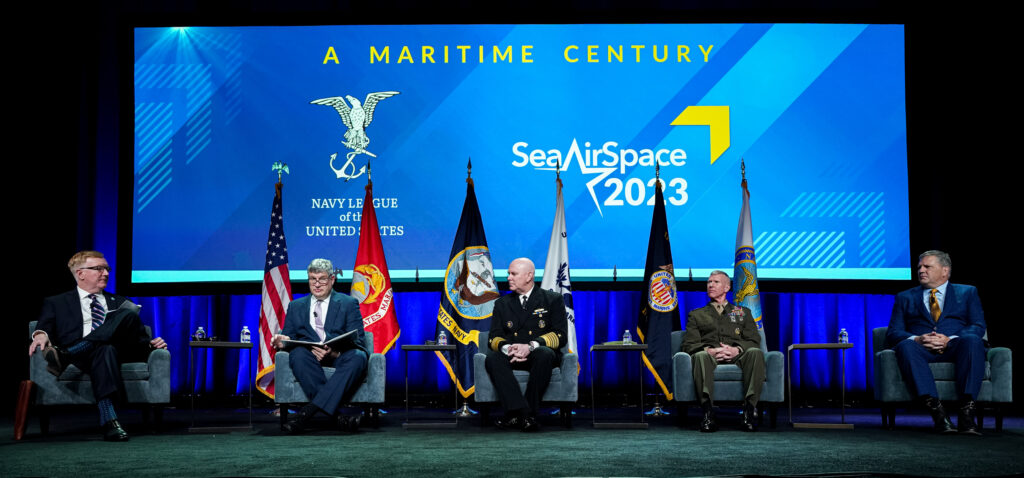
L to R – Admiral James Foggo (Ret.) Dr. William LaPlante, Admiral Christopher Grady, USN, General Eric Smith, USMC and James Geurts discuss issues relating to Reestablishing American Seapower at the CMS breakfast.
During the Center for Maritime Strategy (CMS) Breakfast on Tuesday morning, eggs and pastries provided food for the body, while four leaders from the maritime security community provided food for thought.
The breakfast panel, “Reestablishing American Seapower,” offered a front-row view of how the U.S. military is addressing new threats from adversaries and foreign regimes.
“We face far more challenges today than I have ever seen in my 40 of years of active service,” said moderator Admiral James Foggo, USN (Ret.), dean, Center for Maritime Strategy, Navy League of the United States. He asked each panelist to explain how their teams are addressing those challenges.
William LaPlante, PhD, under secretary of defense for acquisition and sustainment, said what really matters is, “production, production, production. Everything depends on it.”
LaPlante said Navy production is defined as ship construction and other weapons development. He said since the start of fiscal year 2022, the Navy has delivered 14 battle ships, and there are plans to build seven more ships this year and as many as 17 in the following 12 months.
“But we have to do more procurement, more production, and the Navy is going to lead the way,” he said.
Capital Acquisition is Key
The magic bullet is figuring out how to acquire capital, and LaPlante said the Office of Strategic Capital (OSC) is instrumental in that. “But if we’re trying to attract capital, investors want to see a return on investment,” he said. “We need to do a better job explaining that there are production and sustainability possibilities, not just prototypes.”
Admiral Christopher Grady, USN, vice chairman, Joint Chiefs of Staff, discussed his role as head of the Joint Requirements Oversight Council (JROC). He said four transformations are taking place in the JROC:
Building on the work of predecessors who established more of a top-down culture.
Breaking out of system-oriented stovepipes and getting into consolidation management.
Transitioning to Intelligence Advanced Research Projects Activity (IARPA) process acquisition review. “It helps us go faster,” Grady said.
Keeping a scorecard for what the JROC does.
General Eric Smith, assistant commandant of the U.S. Marine Corps, detailed how the force is pivoting from several decades of land fighting in the Middle East and transforming for the future of combat.
Training and Retaining the Force
“The threat is getting more assertive, more challenging,” he said. “If you want to be ready for the next fight and not the last fight, you have to move.”
Smith said when people talk about force design, they focus on how it affects quantifiable things. “But there’s more than that. It’s about a force that’s mature, experienced and that you can retain,” he said.
“We’re doing better at training,” Smith said, noting that basic infantry training has gone from eight weeks to 14 weeks, with more of an emphasis on teams rather than individuals. In terms of retention, “we hit our recruiting numbers last year and will hit them this year,” he said.
Currently, the Marine Corps is working on organic mobility, which Smith said “provides opportunity to get where you need to go and cuts down on risk.”
Industry Partnerships
James Geurts, former assistant secretary of the Navy for research, development and acquisition; distinguished fellow for Business Executives for National Security, closed the panel session with a discussion of how the Navy is working with private industry.
The key is to transition to network thinking on the industrial base — “what I call the future industrial network,” he said. “The industrial base is not going to carry us for the next 30, 40 years.” The future industrial network is more dynamic and diverse, including international partners, venture-backed startups, traditional contractors and the tech base, he said.
Geurts also touched on capability, which he defined as a combination of equipment and training tactics supported by logistics. “Too much in the industrial base focuses only on equipment,” he said. On the industry side, Geurts said it’s key to think about networking, to reverse the urge to vertically integrate everything, and to concentrate on how to apply new technologies and innovation to more than just equipment.
U.S. Navy Embraces Diversity Initiatives
The seal of the United States contains just three words: E Pluribus Unum, or Out of Many, One. But achieving that unity has been an ongoing challenge in the military.
During the Tuesday morning session, “Towards a Culture of Unity,” a diverse panel of soldiers engaged in what moderator Admiral John Richardson, USN (Ret.) called a “very practical, authentic discussion” on how to foster more diversity, equity, inclusion and accessibility (DEIA) in the Navy.
Richardson launched the discussion with a question he’s been asked numerous times — is the Navy weaker because it’s spending too much time on “woke” topics like diversity and environmentalism?
“It’s sometimes posed as a choice between diversity and strength, or taking care of the planet and strength,” he said. “But rather than approach this as a choice, a much better way to approach it as “yes, and …” We can do both. Just like operations and safety — the teams best at operations are best at safety. Unity through diversity enhances your strength as a force.”
But this doesn’t happen on its own, Richardson said. It takes positive encouragement and a daily commitment.
RADM Sinclair Harris, USN (Ret.), president emeritus, National Naval Officers Association (NNOA), agreed.
“Our Constitution says “a more perfect union. That takes work,” he said. “But Constitutionally, this whole discussion of DEI and A is what you signed up for when you took that oath.”
Transforming Roles
Harris said the most important transformation during his time in the Navy was the elevation of the role of women in the service.
“My first four ships were all boy,” he said. “We got a whole of a lot smarter when we started to elevate women on our platforms. They’ve raised the bar.”
Harris, who is Black, said four things have been important in his career: role models, mentors, coaches and advocates. “Make sure they don’t all just look like you,” he advised.
LCDR Rolando Machado Jr., vice president, Association of Naval Services Officers (ANSO), said it took him a while to understand that a person can serve in all four of these roles at the same time.
“When you meet someone, figure out what role they can play in your life and what role you can play in their life,” he said. “It’s going from a place of ‘what can I get?’ to ‘what I give also brings something back to me.’”
Machado said it’s important to look within the Navy’s ranks and acknowledge the stories of diversity in the past. He told the story of Dorie Miller, a Navy cook third class who was killed in action during the attack on Pearl Harbor. Miller, who helped several sailors who were wounded and shot down four to six Japanese planes using an anti-aircraft machine gun for which he had no training, was the first African American to be awarded the Navy Cross.
As a Black man, mess attendant was one of the only options Miller had in the Navy at that time. “Can you imagine if the Navy had trained him how to be a gunner, medic, or commanding officer, what type of impact he could have had?” Machado asked. “It’s powerful to think about our past, but also important to recognize the present.”
Deckplate Unity
Lieutenant Andrea Howard, navigator PCU New Jersey (SSN 796), provided context of what it takes to transfer the ideal of a more perfect union to the reality on the deckplate. As one of the first women deployed on a submarine, she’s been part of the evolution over the last decade.
Howard compared DEIA to a patchwork quilt. Like pieces of a quilt, soldiers should be encouraged to keep their own identity while unifying as a whole.
Howard said there are three steps to creating that patchwork quilt:
Cultural forging, which is most effective when sailors are leading the charge.
Representation, which shows there’s a future for others like you in this community.
Allyship, in which people from the majority — especially those in the chain of command — provide a safe and welcoming space for those in the minority.
Captain Emily Bassett, president, Sea Services Leadership Association (SSLA) and founder and moderator of the webinar Lean on Navy, said she was in a Boston University ROTC class when the Navy first welcomed women into the nuclear propulsion program.
Bassett, who commanded the USS Manchester (LCS 14), said she’s always been in the first class of women throughout her Navy career. “In a lot of ways I felt different and not part of the team,” she said. But after a commander told her to focus on her strengths rather than her differences, she started to feel like she belonged.
Bassett encouraged all soldiers to join an organization like SSLA, ANSO or NNOA, where they can talk about challenges they face and learn how to be part of the conversation around solutions.
A Maritime Century
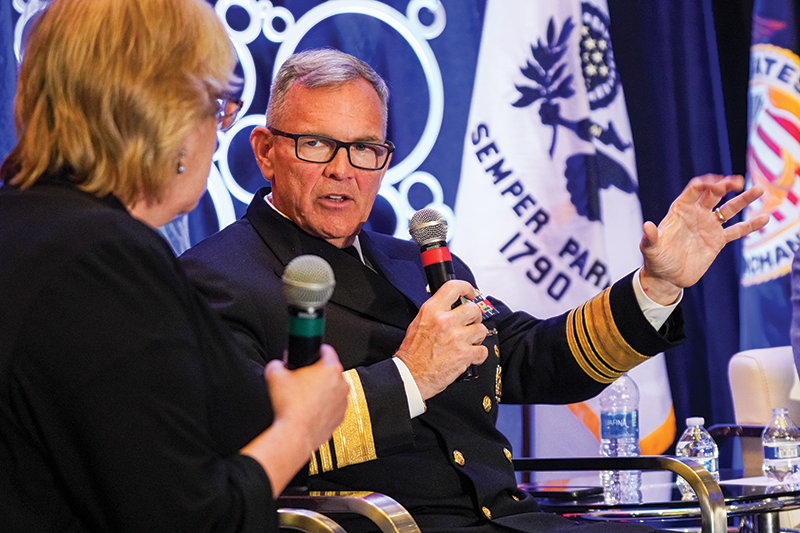
Admiral Mike Gilday, USN, Chief of Naval Operations, General David Berger USMC, Admiral Linda Fagan, USGC, Ann Phillips, Maritime Administrator, Speak during the Sea Security 2030 and Beyond: Building the Nation’s Future Force Now.
Sea-Air-Space 2023 kicked off its largest conference in history in fitting fashion — with leaders from the Navy, Marine Corps, Coast Guard, and Maritime Administration discussing the future of their forces over the next decade
To comply with the new National Defense Strategy and National Security Strategy, the sea forces are reevaluating how they recruit and retain personnel, and acquire hardware and software. During the Monday morning Sea Service Chiefs Leadership Panel discussion, “Sea Security 2030 and Beyond,” Moderator Francis Rose, founder and host of “The Federal Government Today,” concentrated on two key questions in those areas.
People First
All of you have talked about the importance of investments in people. What investments are you currently making or would like to make?
Ann C. Phillips, RDML USN (Ret.), administrator of the Maritime Administration, said safety for mariners at sea is the “north star of the department.” In late 2021, the Merchant Marine Academy launched its Every Mariner Builds A Respectful Culture (EMBARC) program that improved safety at sea, especially for women and minorities.
Only 7 percent of Merchant Marine mariners are women, and Phillips hopes EMBARC will help boost those numbers. “We don’t want them to be afraid of what will happen to them while at sea,” she said. “We are committed to investing in everyone’s safety at sea.”
Phillips said the Maritime Administration is also building state-of-the-art vessels to train future generations of mariners and encourage them to serve. The first ship, Empire State, is scheduled to be delivered this summer.
The Maritime Administration is also committed to listening to and delivering what’s important to young mariners, Phillips said, including internet access, gym equipment, good food, and vessels that are well maintained and cared for.
“Our goal is to get them at sea and get them to see there’s a place at sea for them to advance and move up,” she said.
Admiral Linda Fagan, commandant of the Coast Guard, said one of the biggest problems in attracting people to the Coast Guard is that many Americans don’t even know we have a Coast Guard, let alone the “true opportunity for service it represents. We always hear: ‘Had I known about the Coast Guard, I would have joined sooner.’”
The Coast Guard is committed to doing a better job of marketing and recruiting, Fagan said, including opening nine new recruiting offices and new junior ROTC programs. It’s also committed to quality-of life initiatives like childcare, healthcare and medical access for families.
“Our highest priority is our people,” Fagan said.
Gen. David Berger, commandant of the Marine Corps, said the Corps’ force-modernization program is focused more on people than operations. Noting ruefully that the 18-30 age group, “is not bashful about telling us what their priorities are,” Berger said not all Marine facilities or services are at the standard that service members expect.
“What’s important is where they live, the fitness centers, child development centers, where they work, where they eat. We must invest in that now,” he said.
Berger said Marine quality-of-life priorities include healthcare. “We have to make sure military members get the very best care in the world, including mental and reproductive healthcare and training.”
“The thing most people intuitively think about in terms of quality of life is the best and most realistic training, because that’s our best chance at winning,” he said. “We need to train for today, not 30 years ago.” This includes acknowledging that people learn at different paces, and weaving live, virtual and constructive training alongside our allies and partners, he said.
Adm. Mike Gilday, chief of naval operations, U.S. Navy, said the Navy is also making significant investments in live, virtual constructive training, including leveraging technology from the gaming community.
“That is the future, and we’ve found it to be highly effective,” he said, noting that the Navy is also investing in ready relevant learning, including training that’s “not cookie cutter — more creative.”
Talent management is another key Navy recruitment and retention initiative. “We want to be more transparent about what’s available to sailors and how they can manage their own career,” Gilday said. “They’re thirsty for that, and we’re very committed to delivering that.”
Shipbuilding Support
What platforms are you asking for now, and what is the status of those in progress?
“We’re in very good shape in support for shipbuilding. All of our production lines are humming,” Gilday said. “We’re optimistic about stable, predictable funding for ships, and we hope to sustain that.”
Berger said the equipment each Marine wears now is “extraordinary.” And “aircraft modernization is so far down the road, the capability is pretty eye-watering.”
The goal now is to focus on logistics. “The time to set the theater, which we grew up thinking was 30-60 days, is shorter now,” Berger said. “I can’t say it any more strongly: The power of information in a conflict is key to the ability to make adjustments.”
Fagan said the Coast Guard needs more ships with polar capacity, and the Polar Security Cutter Program is dedicated to doing that.
“We’re working on great state-of-the-art vessels and are in a great place in regard to acquisition, but we still have significant infrastructure backlog,” she said. Some shore facilities are in poor shape, and the Coast Guard would like 3 to 5 percent growth in infrastructure funding. Any current increases in funding are going to operations, including information-technology investments, she said.
Phillips said the average Maritime Administration Ready Reserve vessel is 45 years old. Consequently, the Administration, which is funded jointly by the U.S. Department of Defense and the Department of Transportation, is working to service existing vessels and buy two new, used vessels a year.
The Maritime Administration has also launched a port infrastructure-development grant program as part of its mission to foster, promote and develop the U.S. maritime industry. Last year the program funded $700 million in grants, and it has an equivalent amount available this year, Phillips said.
Coast Guard Uses New Tech for Oil Spill Response
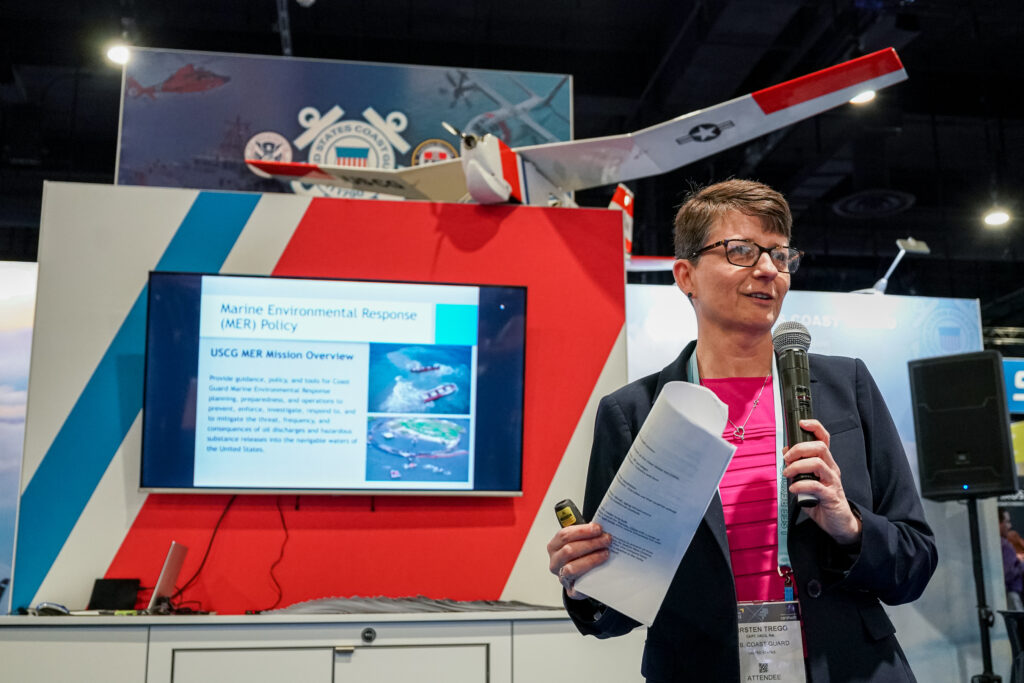
Kirsten Trego talks about the USCG – Oil Spill Response: Tech Effort on the Horizon in the exhibit hall.
When most people think of the U.S. Coast Guard, they envision daring rescues at sea. But the USCG has a variety of lesser-known but equally important duties, said USCG Capt. (Ret.) Kirsten Trego.
During the Monday morning presentation, “USCG Oil Spill Response: Tech Efforts on the Horizon,” Trego discussed how the Coast Guard is the federal on-scene coordinator for oil-discharge cleanup in the coastal zone. That zone not only includes the nation’s shores, but also rivers, waterways, the Great Lakes and more.
“If something happens, we’re the best prepared,” she said.
The USGS has a 30-person team dedicated to oil-spill responses. One of the team’s focuses is working with the oil and gas industry, state and local governments, federal agencies and academia to research how oil spills are evolving and how best to deal with them.
Trego said these research initiatives include the Great Lakes Oil Center of Expertise, which is dedicated to research, training and testing focused on freshwater and cold-weather conditions during an oil-spill response.
The Coast Guard is also increasingly relying on uncrewed systems to more quickly and safely respond to spills, Trego said. New technology like sub-surface remote sensing uses long-range autonomous underwater vehicles to detect oil under ice in the Great Lakes. There is also an air focus, including remote-sensing unmanned aircraft systems (UAS).
“And where the fun is, is the NOAA MESDIS Marine Pollution Surveillance Program from space,” Trego said. Remote-sensing UAS can see oil spills from space, characterize them and report the data.
Trego anticipates more UAS involvement in oil-spill responses in the future. “In the changing landscape of more oil exploration and more risk, traditional methods are no longer viable,” she said. “When spills happen, we need to be ready and available to handle them.”
Panelists Discuss Challenges in Navigating Space as a Warfighting Domain
Space may have been the final frontier for the Starship Enterprise, but it’s the current frontier for the worlds’ fighting forces. As nations race to conquer this military high ground, the U.S. Department of Defense and private industry are increasingly working together to ensure American warfighters’ place in space now and in the future.
During the Monday afternoon panel, “Space: The 5th Warfighting Domain,” four representatives from the military and industry discussed the following questions from moderator Theresa Hitchens, a reporter with Breaking Defense, and audience members.
We’ve heard a lot about how the threat environment is changing. What keeps you up at night in that regard?
VADM Jeffrey Trussler, USN, deputy chief of naval operations for information warfare, N2/N6, Office of the Chief of Naval Operations/Director of Naval Intelligence, said he’s concerned about both the expanded use of the RF spectrum and China’s efforts in space.
Because the Navy is reliant on RF, it needs to look at the best ways to use the RF spectrum as the space layer proliferates, he said.
Meanwhile, China has made its intentions for space supremacy public knowledge, and that’s earned the attention of the Department of Defense.
“I’ve never seen a department more focused on an adversary and what we need to do,” Trussler said. “The work we’re doing in space, we’re going to move out and move out fast.”
Derek Tournear, PhD, executive director, Space Development Agency, discussed resiliency. His company launched 10 satellites on Sunday as part of its effort to put hundreds of small satellites in the sky rather than a few large ones that are easier to shoot down. Tournear said Space Development Agency is also concerned about common mode failures, especially cyberthreats, RF spectrum threats, and supply-chain threats.
Steven Butow, director, space portfolio, Defense Innovation Unit, said from a commercial standpoint, economic security and national security are intertwined. That makes it important to work across all levels of government for financial stability.
How do you deal with overclassification?
Butow said an argument can be made that moving fast is more effective than locking down information for long periods of time.
“Industry knows how to lock down information, but also how to release it and commoditize it,” he said.
Ed Zoiss, president, space & airborne systems, L3Harris Technologies, said a private company can be a matchmaker when its customers are working on similar classified technologies.
Trussler believes the problem isn’t just overclassification. “Even our simple acquisition processes give information to China,” he said. “It’s about how we share information and doing it right. It’s not as simple as overclassification.”
Tournear made the case for selectively releasing information. “We can’t deter if can’t talk about it. Thirty years ago, we couldn’t say ‘national reconnaissance office,’ but the Soviets already knew we had it,” he said. “We need to make sure we know what we need to protect, but also talk about what we’re doing so there’s a deterrence factor.”
LEO (low earth orbit) has thousands of satellites. How concerned are you about debris, signal interference and collision?
“Two thoughts: Space is congested, and space is big — it depends on the orbital regime,” Tournear said. There can be unintended consequences to mitigating congestion, but he believes that policies that promote being a good steward in your orbital slot can be effective.
Butow pointed out that there are more planes in the U.S. airspace than satellites in LEO, but the planes are regulated. That’s why he thinks it’s important that a space traffic commission be formalized and adopted on a global scale.
Navy Prioritizes Mental Health with New Playbook
The U.S. Navy has always been dedicated to ensuring that the bodies and minds of its Sailors are ready and prepared to win in combat. But there have been challenges over the years in helping Sailors with mental-health resources during active service, and as they transition out of the Navy into civilian life.
The Navy Culture and Resilience Office, N17, Office of the Chief of Naval Operations is addressing those challenges through its new Mental Health Playbook. This 28-page playbook, which was released in February, is designed to put mental health tools and resources into the hands of every Navy leader, no matter what their rank.
“Our goal is that everyone in our great Navy develops a shared understanding about how to conduct mental-health and preventative maintenance for our people, and then where to go for additional resources,” said Rear Admiral Brett Mietus, director of N17. “It’s an incredibly important topic to me and all of the Navy’s senior leadership.”
The Navy already offers a variety of mental-health resources. Navy N9 quality-of-life programs include Morale, Welfare and Recreation (MWR); Wounded Warrior; Mind Body Mental Fitness (MBMF); and Sailor Assistance and Intercept for Life (SAIL). There are also family advocacy programs, childcare and relocation programs, assistance programs, non-medical counseling at fleet and family-support centers, and more.
The Navy League of the United States has mental-health resources as well. For example, Sea-Air-Space’s Transition Connection Job Fair, which will be held from 10 a.m. to 2 p.m. on Monday in the Cherry Blossom Ballroom, is one of the ways the Navy League helps with transitioning Sailors’ overall well-being.
The Mental Health Playbook complements all these efforts through its mission to create a “climate of trust and respect with open, two-way communication; challenging inappropriate conduct or poor leadership; and eliminating stigma for seeking help.” The Playbook is organized into five sections:
Roles and Responsibilities, which is geared toward helping commanders create, “a community of support, where sailors feel connected to the mission, the command and each other.”
Conversations That Matter, which provides strategies for conducting mental-health discussions.
Identifying and Responding to a Mental Health Related Concern, which discusses what to do when sailors are in mental or emotional distress.
Navigating Support Systems, which helps sailors find the right support at the right time.
Navy’s Mental Health Capabilities and Resources, which describes the clinical and non-clinical tools available both inside and outside the military and provides contact information for a variety of programs.
“Most of the resources that are in the playbook have been out there, but they just haven’t been put together in a way that’s easily digestible and then usable by a fleet leader,” Mietus said.
Mietus said the playbook is a response to requests and concerns from fleet members about the Navy’s approach to mental health. He noted that while older Sailors aren’t necessarily used to acknowledging or discussing mental-health issues, younger generations are much more attuned to their mental and emotional needs.
“Our goal is to eliminate stigma when it comes to mental-health care. I think the important thing for us all is to normalize conversations around it,” he said.
DoD Addresses Supply Chain Woes Both Pre- and Post-Pandemic
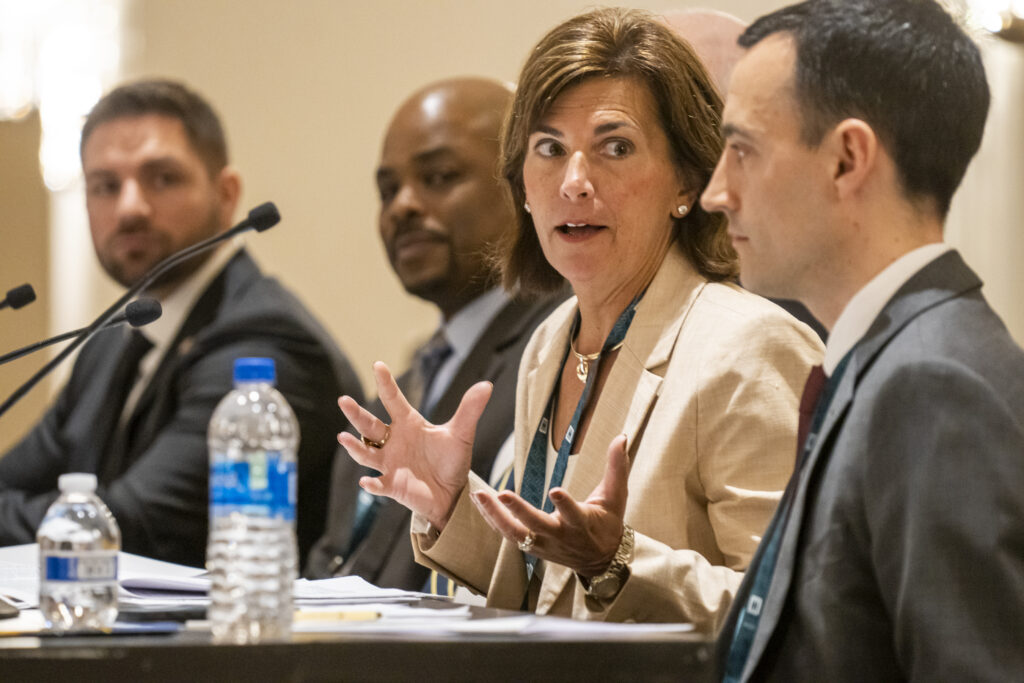
Karen Fenstermacher, with Naval Supply Systems Command, talks during the Supply Chain Risk Roundtable. SOLARES PHOTOGRAPHY
NATIONAL HARBOR, Md. — The COVID pandemic has spiked consumer interest in supply chain issues. But for the Department of Defense, supply chain problems have existed for decades, said panelists during the Supply Chain Risk Roundtable held April 5 at Sea-Air-Space.
Chris Espenshade, director of small business for Naval Supply Systems Command, kicked off the roundtable discussion with an examination of the issues affecting global supply-chain resiliency. Everything from big data analytics to port closures and border delays impact the supply chain, he said. Specifically, lack of depth and competition among suppliers is hampering cost and quality.
“For example, today, 90% of our missiles come from only three sources,” Espenshade said.
Shortages in energy, labor and raw materials are key drivers of supply-chain disruption. In particular, Espenshade said, environmental issues, climate change and natural disasters, global health and pandemic response, social unrest, trade and tariff policies, and political unrest and terrorism have resulted in increased cost and price inflation.
As a result of President Biden’s February Executive Order 14017 on America’s Supply Chains, the Department of Defense is actively building a deeper understanding of its supply chains and industrial base capabilities, with a holistic approach to resilience, Espenshade said.
But there are two key issues, said Kurt Wendelken, vice commander for NAVSUP.
“There are a limited number of suppliers, and we’re fighting obsolescence on a daily basis,” he said. “Both of these need to inform how we think about procurement and if cost is the right solution.”
Both Wendelken and Karen Fenstermacher, executive for strategic initiatives for NAVSUP, emphasized the “one Navy” concept when communicating with suppliers.
“The Navy is really 19 navies. We have very well-carved stovepipes in the Navy. But we want to have a single Navy voice to industry on the key challenges we’re facing and our strategies to work together,” Fenstermacher said.
This includes creating a conversation during the acquisition process about how the Department of Defense is going to sustain the systems it’s purchasing. “The acquisition policy is tremendously complex and voluminous,” Fenstermacher said. “One thing that’s exciting is the low-cost framework we’ve established.”
From an industry standpoint, supply chain has traditionally been thought of as a back-office function, but now has come to the forefront. “I see that both as a challenge and a great opportunity,” said Clark Dumont, senior director of global procurement for BAE Systems.
Panelists also emphasized the importance of including small businesses in the supply chain.
“We’re open for business; the money is there,” said Jimmy Smith, director of the Department of the Navy Office of Small Business Programs. He noted that last year, the Department of Defense spent $17.1 billion on small-business programs.
In particular, Smith mentioned the DoD’s Mentor-Protégé Program, a partnership between large and small manufacturing businesses.
“The government will give a large partner up to $3 million to help a small business partner, but in many cases I can’t find partners from industry to do this,” Smith said. “I encourage you to step forward and take this opportunity.”