Diversity Helps Foster Warfighting Readiness, Panelists Say

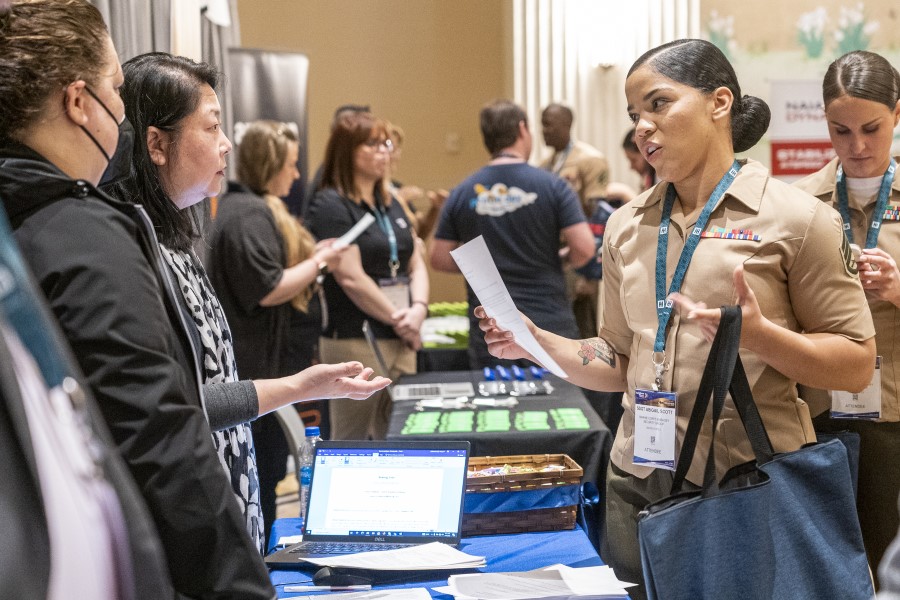
Marine Corps Brig. Gen. A.T. Williamson, right, says the service is modernizing how it manages and recruits talent. NAVY LEAGUE / Lisa Nipp

Less than 30% of youth today are available for military service, said Michelle Godfrey, senior advisor for diversity and inclusion, U.S. Coast Guard. As the nation becomes more diverse, one of the keys to attracting and retaining that scarce talent is to foster equity and inclusion efforts, said Godfrey and other panelists during the Aug. 3 session on Inclusion and Diversity as a Force Multiplier.

“The data backs it up — the more diverse team you have, the higher your performance,” Godfrey said.

In the Navy, diversity, equity and inclusion (DEI) efforts help foster warfighting readiness, said Vice Adm. John Nowell Jr., deputy chief of naval operations for manpower, personnel, training and education and chief of naval personnel.

“If you want to outfight the enemy, you have to outthink them, and the way you do that is by leveraging diverse and inclusive leadership,”  he said.

Nowell said the Navy is currently implementing 56 recommendations from a DEI task force. For instance, recruiters now look at applicants’ whole personality rather than just quantifiable measures like SATs. Navy leader trainer development is taking DEI into account and is looking at bias in terms of decision science. Navy classrooms are also using a bias mitigation tool. The key, Nowell said, is to use data analytics while still being able to rely on intuition as well.

The Marine Corps is modernizing its manpower system, including talent management, said

Brig. Gen. A.T. Williamson, director, Manpower Plans & Policy Division, U.S. Marine Corps. Along with ethnic inclusivity, diversity of thought, experience and background also helps build a cohort of inclusive teams, he said.

The Marine Corps is currently working on and vetting a DEI framework, Williamson said. It’s also conducting a survey to see if there’s bias within the personnel evaluation system, and asking questions about inclusion during exit surveys.

The Coast Guard has a DEI action plan with 36 distinct actions, Godfrey said. The organization has completed a women’s retention study and expects a study to be published this month on recruitment and retention of underrepresented minorities. In April, the Coast Guard deployed a virtual mentoring program that helps foster DEI efforts. Close to 1,000 people have signed up for the program’s mentoring app, she said.

The Coast Guard also offers tools on how to have DEI conversations, Godfrey said. It’s trained more than 100 diversity and inclusion change agents, who offer coaching for various DEI situations. Performance appraisals also include diversity and inclusion competency.

The Department of the Navy has exceeded its social and economic DEI goals for the past six years, said Jimmy Smith, director, Office of Small Business Programs, Department of the Navy. During the last fiscal year, it spent $17.3 billion on small businesses that were in diverse socioeconomic categories, he said. It’s also working with historically black colleges and universities on recruitment efforts.

“We’re fighting to attract talent,” Smith said. “We’re spending money in places we haven’t before.”

In terms of equity, only some companies can perform jobs like shipbuilding, Smith pointed out. But the Department of the Navy is committed to doing a better job of enforcing how those companies are distributing funding to their subcontractors.

“We need to change our bias from always going to certain places to get certain things done,” he said. “We need to create more competition. At the end of the day, it’s all about fairness.”

All of the speakers emphasized that DEI efforts encompass more than just race, religion, age and sexuality. They also include factors like inclusivity of education and viewpoints, and diversity of thought and problem-solving.

Smith believes DEI initiatives should be deeply personal as well. “Being a father of three girls, there are things women in our workforce go through today that I never want to see my girls ever have to go through,” he said.


NSS-Supply: Transforming the Navy’s Supply Chains

NSS-Supply is a hugely ambitious project for the Navy, due both to its broad scope and the speed at which it moves. NAVSUP

The Navy requires a single, strategic-scale, sustainable design for supply-chain management, with the right mix of commercial and organic activities to project and sustain the force required for war fighting.

With that in mind, Naval Supply Systems Command (NAVSUP) kicked off the newest vice chief of naval operations-led naval sustainment system in October 2020. Naval Sustainment System-Supply (NSS-Supply) aims to unify numerous independent supply-chain functions under the leadership of NAVSUP Commander Rear Adm. Pete Stamatopolous, with the goal of improving end-to-end supply chain readiness and affordability.

As NSS-Supply nears its first anniversary in operation momentum continues to build as NAVSUP and mission partners have progressed through several waves of deliberate transformation.

“The Navy’s supply chains lacked end-to-end coordination and alignment for decades, which has created numerous issues: insufficient and inefficient organic repair capacity, high rates of part cannibalization, an excess of unrepaired parts, a cash shortfall and, ultimately, degraded readiness,” Stamatopoulos said.

“Over the past several years, uncoordinated decisions made upstream were constricting our supply chains and causing significant downstream inefficiencies. NSS-Supply is working to better orchestrate, integrate and synchronize the many functions of our supply chains to correct these issues and deliver higher readiness at lower costs throughout the lifecycle of the weapons systems.”

Grounded in commercial best practices pioneered by industrial companies such as Caterpillar, Delta Tech Ops and John Deere, NSS-Supply elevates supply chain management into the Navy “C-Suite.” Designated as the Navy’s single end-to-end supply chain integrator, Stamatopolous is responsible for elevating the visibility of supply-chain performance by holding supporting functions accountable.

Stamatopoulos leads an organization of supply chain professionals responsible for providing responsive logistical support worldwide, through a global network with a presence in more than 17 countries and 21 states, districts and territories.

NSS-Supply is also moving supply-chain decisions upstream to better shape and design life-cycle logistics strategies for which the costs are lower. To hold the Navy accountable, NSS-Supply has created a cash-based metric to evaluate the efficiency and effectiveness of its supply chain in the long term. This north-star metric, the Supply Chain Effectiveness Figure of Merit (SeFOM), is the Navy’s first enterprise-level metric that balances readiness and costs. For every dollar put into sustaining a platform, the SeFOM measures the value of readiness generated.

In addition, NSS-Supply is driving unity of effort across six pillars that dissect and transform different functions of the supply chain.

• The Achieve End-to-End Integration pillar.
• The Demand Management pillar aims to reduce demand fleet-wide and increase predictability through improving reliability and maintenance.
• The End-to-End Velocity pillar focuses on accelerating the movement of material and parts in the Navy supply chain by lowering repair turnaround times and repair, overhaul or reconditioning queue times.
• The Optimize Working Capital Fund pillar reorients financial management to a commercial cash flow-centric approach designed to improve transparency of cash allocation, collections, expenditures and pricing for long-term stability.
• The Optimize Organic Repair pillar rebalances organic depot repair volume to fully utilize capability and capacity.
• The Shape Industrial Base pillar, the most aspirational pillar, aims to expand competition and deepen partnerships with strategic suppliers to make acquisition and sustainment more efficient, cost-effective and affordable.

NSS-Supply is a hugely ambitious project for the Navy, due both to its broad scope and the speed at which it moves. While NSS-Supply is a multiyear undertaking, it’s divided into three-month “waves” during which three to five initiatives run simultaneously across the six pillars.

The timelines for the waves’ initiatives are based on an agile framework (another commercial best practice). Each initiative has multiple two- to four-week sprints, with clear outcomes at the end of each sprint that define and shape the work of the subsequent sprints.

Although this is a new approach for the Navy, it’s already yielding positive change and realizable gains since launching last fall. With each wave and sprint, NAVSUP and Navy are gaining new supply-chain competencies and confidence in the effectiveness of this way of doing business.

“These first several months of NSS-Supply have given me great confidence and optimism that we are finally within reach of a decades-long goal of achieving a fully integrated and sustainable Navy-wide supply chain,” Stamatopoulos said. “I look forward to its continued success.”