Baltic Convergence: Region Emerges from Backwater to Potential Battleground
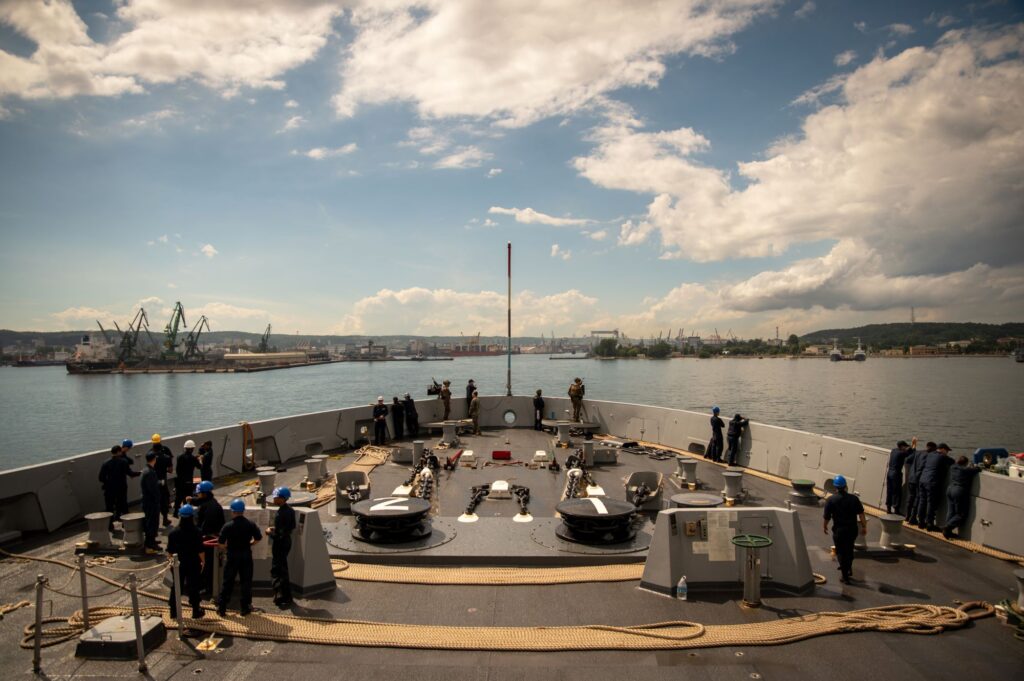
Operators, strategists and policy experts met in Gdynia, Poland, for the 2024 Littoral Op-Tech workshop earlier this year. The symposium, conducted at the Polish Naval Academy on the shore of the Baltic Sea, examined threats, challenges and opportunities in the Baltic Sea, which have been amplified since Russia’s invasion of Ukraine.
While presentations addressed emerging technologies and warfighting capabilities to fight and win in the extreme littoral maritime environment of the Baltic Sea, much of the discussion explored the dynamic geopolitical situation, which is even more relevant due to the juxtaposition of Russia’s aggression in Ukraine and the 75th anniversary of the NATO Alliance. The event was sponsored by Saab AB, MBDA, BAE Systems and EmbeddedArt.
The workshop focused on the convergence of strategy, policy, technology, operations and tactics. First and foremost was the geopolitical significance of Poland and the Baltic Sea.
Like other Baltic countries, Poland has memories of Russian incursions and occupation. Poland shares a land border with Belarus, Ukraine, Slovakia, Czechia, Germany, and the Russian enclave of Kaliningrad (only 90 minutes from Gdynia by road). It also shares a maritime boundary with Denmark and Sweden. The distance between Poland’s naval base at Gdynia and Sweden’s base at Karlskrona is about 200 nautical miles.
“The Littoral OpTech series of workshops are about learning from each other,” said retired Swedish navy Captain Bo Wallander. “While littoral environments and maritime traffic varies, all navies that defend or operate in coastal waters share some similar challenges.”
The war in Ukraine has had a profound impact on Poland and its neighbors. As host, Rear Admiral Tomasz Szubrychat, the academy’s director commandant, commented on the important timing of the event.
“All of the Baltic Sea is part of the EU and NATO, except for Russia,” Szubrychat said. “Each country has its own perspective regarding the complex threats in the Baltic. If we put each nation’s knowledge together, and exchange ideas, we can have a more complete picture of the Baltic maritime security.”
Rear Admiral Wlodzimierz Kulagin, chief of Armaments Branch of the Polish Navy Inspectorate, said having the workshop in Poland while there is a war going on at its eastern border is a statement of solidarity.
The region is a very complex operating environment, Kulagin said. “We have an enormous challenge of detecting threats in all dimensions; many non-state actors; a growing maritime infrastructure; and increased maritime commerce and traffic, and its importance for the Baltic Sea nations, but also the Russian economy.”
Kulagin spoke of the requirement for employing new technologies. The operational calculus has been adjusted with the entrance of Finland and Sweden into the NATO alliance, and the added value for defense, deterrence and mutual security cooperation in the region, he said. “Enhanced cooperation and exchange of information to build maritime situational awareness is a starting point for each country. The crucial factor remains the same: our military reaction time.”
Kulagin noted Ukraine is not presently a member of any alliance and is fighting alone on the battlefield against a great military power. “But Ukraine as a country is not alone, because we — the countries represented here at this conference — are here.”
Kulagin pointed out that Poland is a logistics portal at the frontline. He also said Poland is participating in NATO task groups, operations and exercises, as well as the Combined Maritime Force (CMF) in the Persian Gulf, “to show our colors,” and demonstrate Poland’s commitment to this vital multi-national effort.
“The NATO strategy concept is about the prosperity and freedom of navigation,” Kulagin said. “And this is this is exactly the reason that we decided to join the combined maritime forces in the Gulf.”
Crucial for Security
After many years of being somewhat of a backwater, the Baltic Sea is now crucial for European and world security.
Professor James Bergeron, the political-military advisor for NATO’s Allied Maritime Command in Northwood, United Kingdom, talked about how NATO is celebrating its 75th anniversary, but is still evolving, and continues to be both stable and “new, fresh and vulnerable.
“We started with 12 nations, when nuclear war was a distinct possibility, almost too distinct,” Bergeron said. “Later, with the fall of the Berlin Wall and the collapse of the Soviet Union, Cold War ended, we shifted to crisis management operations, we focused on everything but Russia. The magic of the institution is that it always feels like two steps away from collapse. We redesign it every five years, but in its essence, it does not change.”
For many years, Bergeron said the NATO maritime battlespace was the Atlantic and Mediterranean; the Black Sea and Baltic Sea were peripheral. “With the accessions of the former Soviet states, and most recently the accession of Finland and Sweden — which has changed the strategic importance of the Baltic — NATO now has to seriously consider the deterrence and defense of its allies and the water space of the Black Sea and Baltic Sea.”
Captain Jon Wessenberg, Finland’s defense attaché to Poland, said his navy has a simple purpose. “We are here to fight and save our country. We have that in our mind all the time. Now that we are a member of the NATO alliance, we are here to fight for our collective countries.”
Wessenberg said the sea lines of communications in the Baltic are critical for Finland. “Ninety percent of our traffic, by volume and value, goes by sea. It is the sea that allows Finland to live and survive. It’s the reason why we have a navy.”
Now, Wessenberg said, the balance of power in the Baltic has changed. In the Cold War, Russia and its Warsaw Pact nations were the dominant factor in the Baltic Sea. It was not the highest priority for NATO. The situation today has changed. Russia stands alone, and is isolated at St. Petersburg and Kaliningrad, with its sea lines of communications threatened by NATO.
“The overall political strategic situation here in Baltic is unfavorable for Russia. They are backed into a corner. And it’s because of Finland and Sweden joining NATO,” Wessenberg said. “For many years we have prepared for a long war alone. Now it’s quite nice to be part of the alliance.”
Brigadier General Patrik Gardensten, deputy commander of the Royal Swedish Navy, voiced a similar sentiment.
“As a nonaligned state for hundreds of years, we have had to rely on building a strong independent defense force to manage threats on our own in our area of operation. Even though our close defense cooperation with Finland always had made us stronger together.”
Although Sweden had participated in NATO’s “Partnership for Peace” since 1994, the Russian invasion of Ukraine demonstrated to the country that a real threat to its security was imminent, and the nation applied for full membership in the alliance.
“The threat in this environment, both conventional and hybrid, projected by Russia today and tomorrow must be handled,” Gardensten said.
Technology Challenges
Addressing the technology front, Eric Olsson, a retired Royal Swedish Navy officer representing Embeddedart AB, said unmanned and autonomous systems face challenges in all domains, but he emphasized the increased difficulties of operating unmanned systems underwater.
“We need autonomous vehicles on the surface to be the communication link between subsurface vehicles and the above water networks and be the link to the kinetic effectors to bring effective power into the battle space,” he said.
Olsson foresees the use of artificial intelligence-based decision making to improve the navigation of unmanned underwater vehicles, and to better manage the amount of data and information to transfer between the sensor and operators.
Dr. Roger Berg, the director of technology management at Saab Kockums, is responsible for research and development, university collaboration, technology strategies and product management. He talked about “disruption” and the innovation or business models that have drastically changed the market or market behavior.
“We have seen in Ukraine a lot of these different kinds of disruptions in technology, systems, tactics, and how things behave,” Berg said. “It has changed warfare forever.”
Berg said the vulnerabilities of GPS positioning have been countered by new kinds of precision navigation and timing; inexpensive drones have replaced exquisite sensors and weapons delivery systems; and hand-held devices can now call for fire support in a fraction of the time it used to take to get permission to shoot.
In addition to its status as a frontline warfighting environment, the United States also looks at the Baltic Sea as a realistic laboratory for trying out new technologies and warfighting concepts.
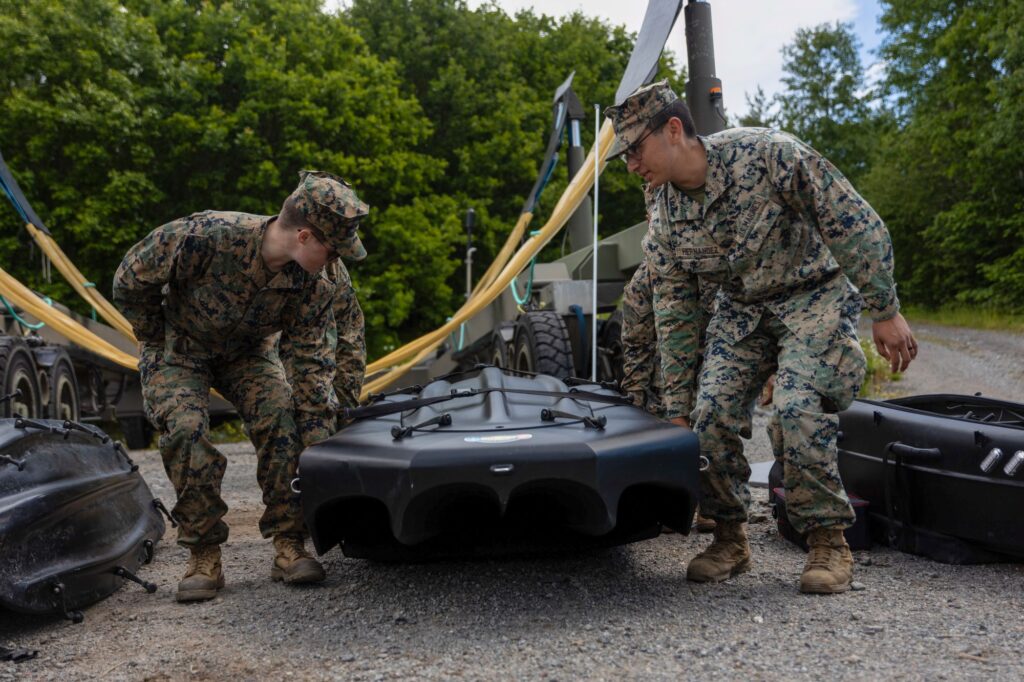
The Department of the Navy has used Small Business Innovation Research funding to have Marines test and evaluate small, low-cost unmanned surface vessels from Green River, Arizona-based Hydronalix, for sensing, mobile gateway buoys to connect underwater sensors with above water networks, and logistics support in austere operating conditions.
Hydronalix CEO Anthony Mulligan discussed how disruptive technologies innovative capabilities don’t have to be exquisite or expensive, and can be integrated into exercises to allow warfighters to try them. Mulligan’s company exemplifies the value of the SBIR program, which invests in small companies to quickly develop and test new technologies and concepts in exercises like BALTOPS, Archipelago Endeavor in Sweden and Freezing Winds in Finland.
Edward Lundquist is a retired U.S. Navy captain who writes about defense, maritime, naval, security, transportation and energy issues. He is a frequent contributor to Seapower. This article originally appeared in the December issue of Seapower.