Blue Ops Building V7 Combat USVs for Undisclosed Customers
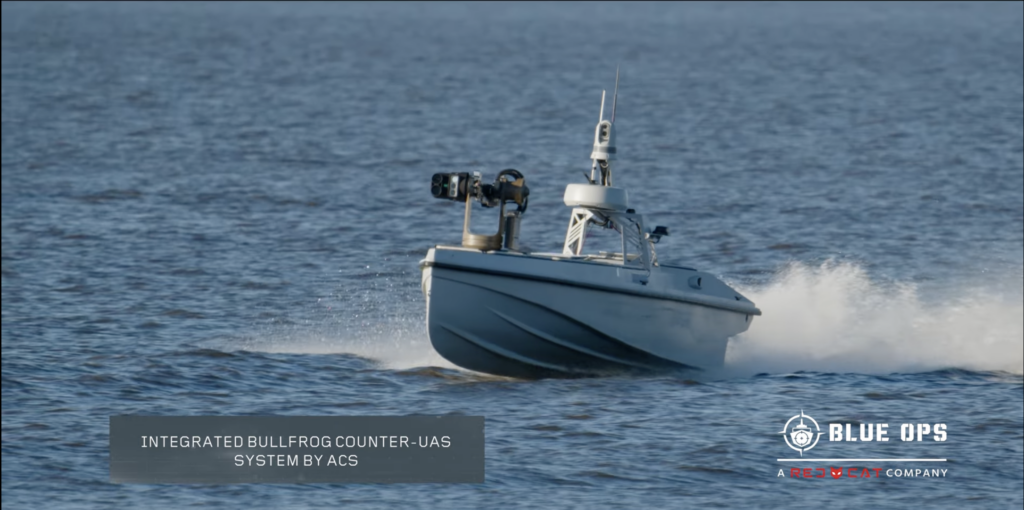
ARLINGTON, Va. — Blue Ops Inc. Marine, a division of Red Cat Holdings, is building its newest combat semi-autonomous uncrewed surface vessel (USV) in the United States for a set of undisclosed customers.
The Blue Ops Variant 7 (V7) is capable of a variety of missions, including kamikaze strike, anti-USV, counter-UAS, anti-helicopter, launching precision munitions, said Barry Hinckley, president of Blue Ops Marine, in an interview with Seapower.
The V7 can carry an 1,800-pound shaped-charge warhead for a kamikaze mission. For the counter-UAS mission, the V7 is armed with the Bullfrog, a .50-caliber machine gun that has demonstrated that “with 5 shots it can take down a 9-inch UAV going 100 miles per hour at 500 meters,” Hinckley said.
The company is testing launching Red Cat’s ISR UAVs from the V7.
“You can project our boat 800 miles at 40 knots and then launch a UAV to go out 30 kilometers,” Hinckley said.
Introducing the Variant 7, an advanced unmanned surface vessel designed for extended range, endurance, and increased payload capacity. Built on operational insights and powered by Blue Ops’ open MOSA architecture with proprietary semi-autonomous command and control, the Variant 7 supports mission-adaptable operations, including integrated UAV launch and recovery. The Variant 7 enhances flexibility for U.S. and allied forces across complex maritime environments.
Blue Ops’ earlier USVs have logged 10,000 combat hours of operating time in live combat missions, he said, with USVs built in Europe.
“We initially did a deal with a European company that had Ukrainian roots and we were building boats in Western Europe that were called Version 2,” he said. “We had a difference of opinion on how we would address the technology architecture. We wanted an open, modular solution, which is what our American end-users have been asking for, which is: you guys focus on building a great boat and we’ll let the technology innovation — whether its payload, sensor, communications, autonomy — [be applied as needed]. Our former European/Ukrainian partners wanted really wanted to control the tech pack from the top to bottom and have us re-sell it here. It was an amicable separation. We separated in December.”
The V7 is the only boat Blue Ops is currently building, he said.
Red Cat Holdings announced in a release last September that Blue Ops was partnering with Hogdon Shipbuilding to build the first five prototype USVs of the V7 design. Hogdon’s facilities in the Boothbay region of Maine and in Damariscotta, Maine, also provided a site for research and development for Blue Ops.
Hinckley praised the high quality and small batch production in Maine but for expansion chose the warmer clime of Valdosta, Georgia, where the V7 is now in mass production in a leased 155,000-square-foot facility.
“This boat [the V7] was an idea in August [2025],” Hinckley said. “We went into production in October; we went into the water in late December/early January. Unveiling to military officials on February 26. And to Wall Street guests on Feb. 27. With UAV payloads.”
Hinckley said Blue Ops has customers for the V7, but he declined to name them.
“We’re working with several groups right now,” he said.
Hinckley said that a single V7 costs $695,000, but with quantities more than 100 the price comes down to the mid-$500,000s; for more than 200 the price is close to $525,000.