WASHINGTON – The Coast Guard announced Friday it exceeded its fiscal year 2025 (FY25) recruiting goals, achieving the highest accession numbers since 1991.
The Coast Guard accessed 5,204 active-duty enlisted service members in FY25, which was 121% of its FY25 target of 4,300. This success was the second year in a row that the Coast Guard met its active-duty enlisted recruiting goals after the Service brought in 4,422 new service members last year.
In addition to the success of the active-duty enlisted recruiting efforts, the Service commissioned 371 new officers, to achieve 101% of the overall goal. This represents the largest officer target achieved in recorded history.
In the reserve component, the Coast Guard accessed 777 reservists, which was 104% of the official target of 750. This was the third year in a row that the Coast Guard met its recruiting goals for the Coast Guard reserve.
To support these recruiting efforts, the Coast Guard opened 7 new recruiting offices in FY25. These offices are located in:
Miami, Florida
Los Angeles, California
Long Island, New York
Austin, Texas
Grand Rapids, Michigan
Cincinnati, Ohio
Davenport, Iowa
All enlisted members begin their Coast Guard careers at Training Center Cape May in Cape May, New Jersey, where they complete basic training to prepare for service. Officer accessions occur on board the Coast Guard Academy in New London, Connecticut, where candidates are trained and commissioned for service as Coast Guard officers.
“The Coast Guard far exceeded our recruiting goals in Fiscal Year 2025, showing that more Americans want to serve in the Coast Guard than ever before,” said Adm. Kevin Lunday, acting commandant of the Coast Guard. “Thanks to our recruiters for their great success. We aren’t just growing – we are bringing in the best talent from across the United States and building the workforce of the future.”
These results align with the goals of Force Design 2028, a strategic initiative to modernize the Coast Guard’s workforce, enhance readiness and grow its military force by 15,000 members by FY28 to support fleet expansion and meet emerging mission demands.
Coast Guard Sets Record with Amount of Cocaine Seized in FY25
From Headquarters, U.S. Coast Guard, Nov. 6, 2025
WASHINGTON — The U.S. Coast Guard announced Thursday it seized nearly 510,000 pounds of cocaine in the Eastern Pacific Ocean and Caribbean during fiscal year 2025 (FY25), the largest amount in the Service’s history.
On average, the Coast Guard seizes 167,000 pounds of cocaine annually. The amount seized in FY25 is over three times that amount, and equivalent to 193 million potentially lethal doses (1.2 grams), enough to endanger over half of the U.S. population.
“The Coast Guard’s top priority is to achieve complete operational control of the U.S. border and maritime approaches,” said Adm. Kevin Lunday, acting commandant of the Coast Guard. “We own the sea, and this historic amount of cocaine seized shows we are defeating narco-terrorist and cartel operations to protect our communities and keep dangerous drugs off our streets.”
Detecting and interdicting narco-terrorism on the high seas involves significant interagency and international coordination. U.S. Southern Command’s Joint Interagency Task Force-South, based in Key West, Florida, detects and monitors both aerial and maritime transit of illegal drugs. Once interdiction becomes imminent, the law enforcement phase of the operation begins, and control of the operation shifts to the U.S. Coast Guard throughout the interdiction and apprehension.
The Coast Guard is the United States’ lead federal agency for maritime drug interdiction. We are part of the Department of Homeland Security team protecting our nation and are at all times a military service and part of the joint force defending it.
Coast Guard Cutter Campbell Returns Home After 54-Day Maritime Border Security Patrol
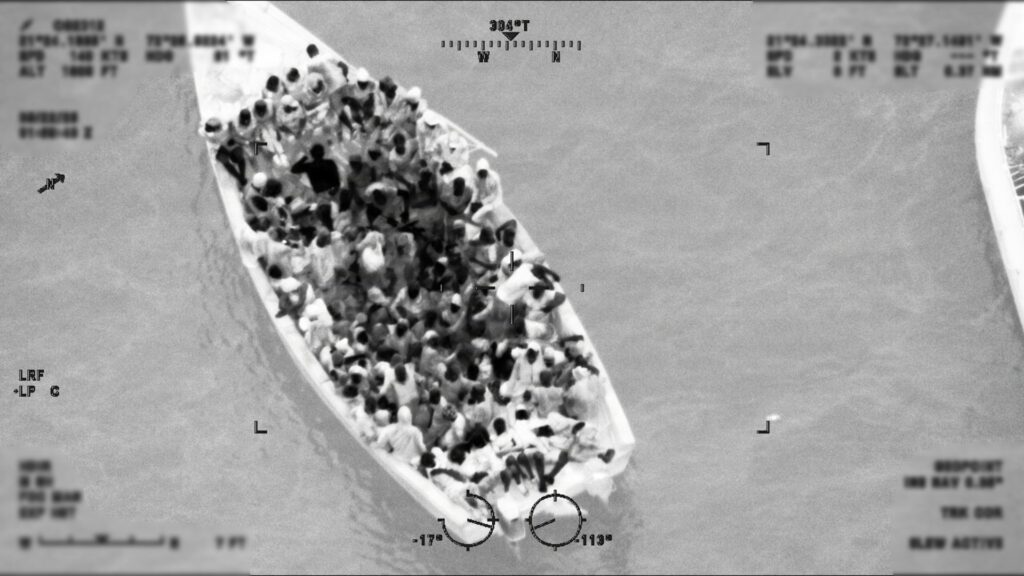
A overloaded Haitian sailing vessel underway approximately 40 miles east of Great Inagua, The Bahamas, September 21, 2025. A forward deployed U.S. Coast Guard Aviation Training Center HC-144 Ocean Sentry aircrew spotted the vessel during a routine surveillance flight along the Florida Straits. (U.S. Coast Guard photo)
NEWPORT, R.I. — The crew of Coast Guard Cutter Campbell (WMEC 909) returned to their homeport at U.S. Naval Station Newport, Monday, following a 54-day maritime border security patrol in the Windward Passage.
Campbell’s crew deployed to the Coast Guard District Southeast area of responsibility in support of Operation Vigilant Sentry, where crews advanced the primary missions of protecting the safety of life at sea while preventing unlawful maritime entry into the United States and its territories.
On Sept. 21, Campbell’s crew coordinated with an HC-144 Ocean Sentry aircrew from Aviation Training Center Mobile to interdict an unsafe, overloaded Haitian sailing vessel with 103 aliens aboard approximately 15 miles from Turks and Caicos. After interdicting the vessel, Campbell’s crew provided life jackets for the aliens and ensured their safety while coordinating with the Royal Turks and Caicos Police Force, who towed the vessel back to the island of Providenciales for further processing.
“This interdiction demonstrates the power of teamwork and international cooperation,” said Cmdr. Krystyn Pecora, commanding officer of Campbell. “Our combined efforts helped to support the Coast Guard’s ongoing mission of deterring illegal maritime migration and ensuring the safety of life at sea. I could not be prouder of this crew’s hard work and dedication throughout this deployment in ensuring Campbell remained mission ready.”
While underway, Campbell’s crew served as the lead task unit in the Windward Passage, coordinating the tactical employment of additional Coast Guard assets to detect, deter and intercept unsafe and illegal alien migration activity.
OVS is a Department of Homeland Security-led operation comprised of federal, state and local partners, responsible for preventing and responding to maritime migration. OVS, previously known as Homeland Security Task Force – Southeast, was established in 2003 and is comprised of more than 50 federal, state and local agencies.
CGD-SE is responsible for Coast Guard activities throughout a 1.7 million square mile area including Puerto Rico, the U.S. Virgin Islands, Florida, Georgia, South Carolina, as well as 34 foreign nations and territories.
Campbell is a 270-foot, Famous-class medium endurance cutter commissioned in 1988. The cutter’s primary missions are counter-drug, alien interdiction and search and rescue in support of U.S. Coast Guard operations throughout the Western Hemisphere. The cutter falls under the command of U.S. Coast Guard Atlantic Area based in Portsmouth, Virginia.
U.S. Coast Guard Cutter Healy Returns to Seattle After 129-Day Arctic Deployment
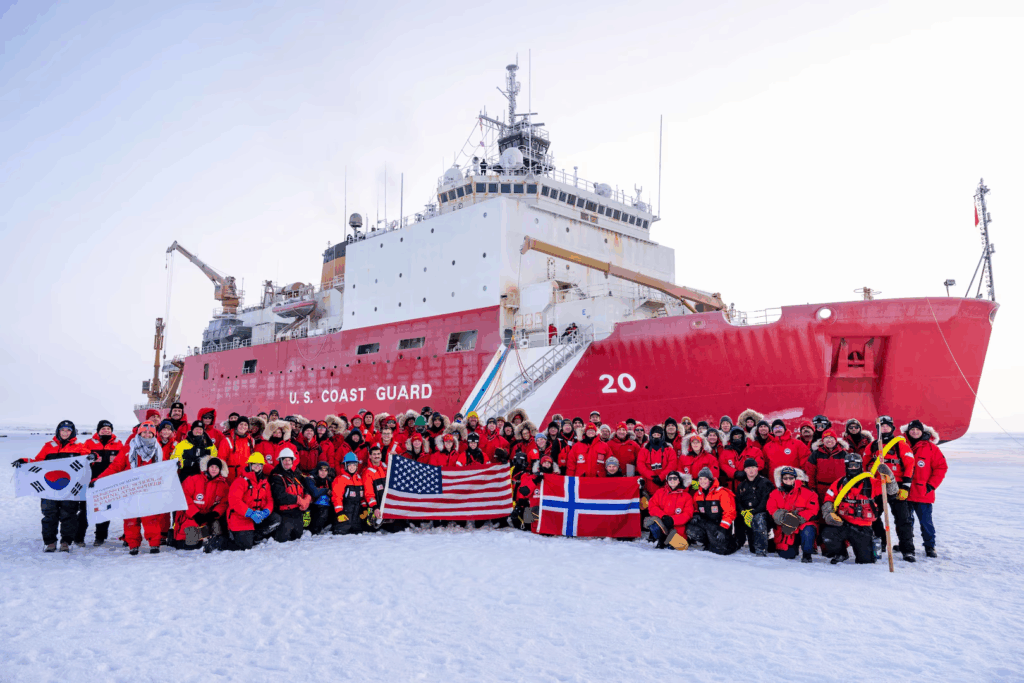
Crewmembers, researchers, and partner nation representatives sailing aboard U.S. Coast Guard Cutter Healy (WAGB 20) pose for a photo on the ice in the Arctic Ocean, Oct. 1, 2025. (U.S. Coast Guard photo by Petty Officer 3rd Class Chris Sappey)
From U.S. Coast Guard Northwest District, Oct. 31, 2025
SEATTLE — The U.S. Coast Guard Cutter Healy (WAGB 20) returned to its Seattle home port Sunday, following a 129-day patrol that concluded its annual Arctic deployment.
Healy, one of three Coast Guard polar icebreakers, steamed over 20,000 miles this deployment, supporting Operation Arctic West Summer and Operation Frontier Sentinel, protecting U.S. sovereign rights and territory, and promoting national security in the Arctic.
“Healy’s unique and specialized capabilities allow us to operate in the most remote regions conducting the highest priority missions of the Coast Guard,” said Capt. Kristen Serumgard, commanding officer of Healy. “Healy’s dynamic crew of active duty and civilian personnel showcased tremendous adaptability, dedication and resilience, steaming over 20,000 miles through ice-covered waters to complete the mission.”
As a part of Operation Frontier Sentinel, Healy queried and monitored three foreign research vessels operating in ice-covered waters over the U.S. Extended Continental Shelf and U.S. Exclusive Economic Zone, protecting the territorial integrity of the United States’ northernmost border.
Five China-affiliated research vessels operated in the Arctic region over the summer, and Healy was one of several Coast Guard assets deployed to control, secure, and defend U.S. sovereign interests. The Coast Guard works in conjunction with U.S. Northern Command and Alaskan Command to constantly monitor foreign vessels operating in and near U.S. waters.
Healy’s crew also supported two missions involving the deployment and recovery of subsurface oceanographic equipment throughout the U.S. Arctic, East Siberian Sea, and Laptev Sea. This work was performed in conjunction with the Office of Naval Research, the National Science Foundation, and other partner agencies. The data collected will help build a more cohesive picture of the physical, biological, and chemical properties of the Arctic Ocean, improving maritime domain awareness north of the Arctic Circle.
As part of the Arctic District’s multi-faceted response to a series of devastating storms that struck Western Alaska communities, Healy diverted to the affected region to respond to Search and Rescue and disaster relief needs.
Homeported in Seattle, Healy is the largest cutter in the U.S. Coast Guard at 420-foot long and 16,000 tons. Healy is designed to break 4.5 feet of ice continuously at three knots and can operate in temperatures as low as -50 degrees Fahrenheit, enabling year-round access to the Arctic Ocean.
Coast Guard Cutter Arrives at New Homeport in Honolulu After Restorative Maintenance
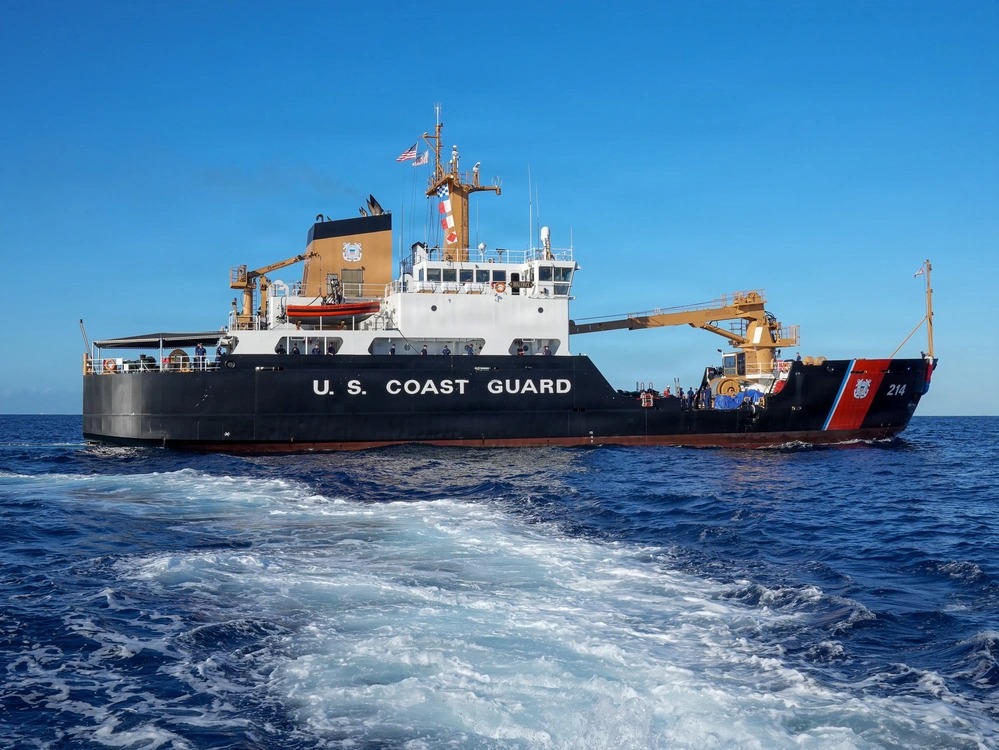
The seagoing buoy tender USCGC Hollyhock (WLB 214) transits toward Honolulu Oct. 14, 2025. After a 806-day restorative maintenance period, the Hollyhock crew arrived at their new homeport prepared to assist in maintaining and deploying aids to navigation. (U.S. Coast Guard photo by Petty Officer 3rd Class Jennifer Nilson)
Release From U.S. Coast Guard Oceania District
HONOLULU — The crew of Coast Guard Cutter Hollyhock (WLB 214) arrived at their new homeport in Honolulu Oct. 14 after 806 days of restorative maintenance.
The primary mission of the Hollyhock, a 225-foot Juniper-class seagoing buoy tender, is to maintain and deploy aids to navigation within the navigable waters of the main Hawaiian Islands, American Samoa, and Midway Atoll, servicing buoys that mark shipping channels, ports and hazardous areas.
Additionally, the Hollyhock’s presence in the region will support Operation Blue Pacific, the Coast Guard’s initiative to promote security, safety, sovereignty, and economic prosperity in Oceania. While deployed, the cutter’s crew will conduct law enforcement, fisheries boardings, and support maritime safety through the servicing of navigational aids throughout the region in cooperation with allies and partners.
Commissioned in 2003, the Hollyhock was originally homeported in Port Huron, Michigan, before entering maintenance at the Coast Guard Yard in Baltimore on July 31, 2023.
The Hollyhock crew departed for Honolulu on Aug. 31, 2025.
“The crew is excited to arrive in Honolulu and support critical operations throughout Oceania,” said Cmdr. Jessica McCollum, commanding officer of the Hollyhock. “Our arrival enhances the Coast Guard’s capacity to maintain vital navigational aids that facilitate the safe flow of maritime commerce. This is especially crucial in Hawaii, where more than 90% of goods arrive by sea.”
The Hollyhock is the last of the Coast Guard’s 16 seagoing buoy tenders to complete the major maintenance availability (MMA) program, ensuring the cutter achieves its full 30-years of designated service.
Maintenance work included completion of hull and structural repairs and replacement of obsolete, unsupportable or intensive maintenance equipment, including updates to the machinery control system, propellers, and heating, ventilation and air conditioning systems.
The MMA is part of the Coast Guard’s In-Service Vessel Sustainment (ISVS) program, a strategic class-by-class evaluation offering the most cost-effective solution for delivering essential maintenance and upgrades, ensuring Coast Guard surface vessels meet or exceed their expected service life.
Coast Guard Conducts Post-Storm Assessments, Cleanup Operations in Western Alaska
From U.S. Coast Guard Arctic District, Oct. 24, 2025
ANCHORAGE, Alaska – The Coast Guard is conducting post-storm assessments and cleanup operations in Western Alaska where communities have been impacted by severe flooding from Ex-Typhoon Halong.
“The Coast Guard continues to support local, state and federal disaster recovery efforts by conducting pollution response operations in impacted communities,” said Capt. Christopher Culpepper, commander, U.S. Coast Guard Sector Western Alaska and U.S. Arctic. “We understand how essential the local ecology is for communities that depend on critical subsistence hunting and fishing activity. We are working to mitigate environmental impacts to preserve the communities’ food source and future viability.”
Personnel from U.S. Coast Guard Sector Western Alaska and U.S. Arctic deployed to affected areas to identify pollution concerns and work with state, federal, and industry partners to conduct clean-up operations. Response teams have conducted pollution and damage assessments in Kipnuk, Bethel, Quinhagak, Hooper Bay, Nome, St. Michael, Tuntutuliak and Nightmute. Crews are also scheduled to conduct damage and pollution assessments in Kwigillingok, Napakiak, Napaskiak, Oscarville and Kongiginak.
Coast Guard Cutter Aspen (WLB 208) deployed to the Yukon-Kuskokwim River Delta on Oct. 14 to determine potential hazards posed by storm damage and lingering debris and conduct repairs to impacted maritime navigation aids.
The Coast Guard activated the Oil Spill Liability Trust Fund on Oct. 12 and contracted Resolve Marine Group to conduct cleanup operations in Nightmute. To date, Resolve crews have recovered a total of 724 gallons of petroleum product from various sources in Nightmute.
On Oct. 23rd, the Coast Guard contracted Alaska Chadux Network to conduct cleanup operations in Kipnuk. They plan to begin operations on Oct. 25th, focusing on securing potential pollutions sources and mitigating any spilled products they find.
Bollinger Shipyards Delivers FRC 1161 Olivia Hooker to U.S. Coast Guard
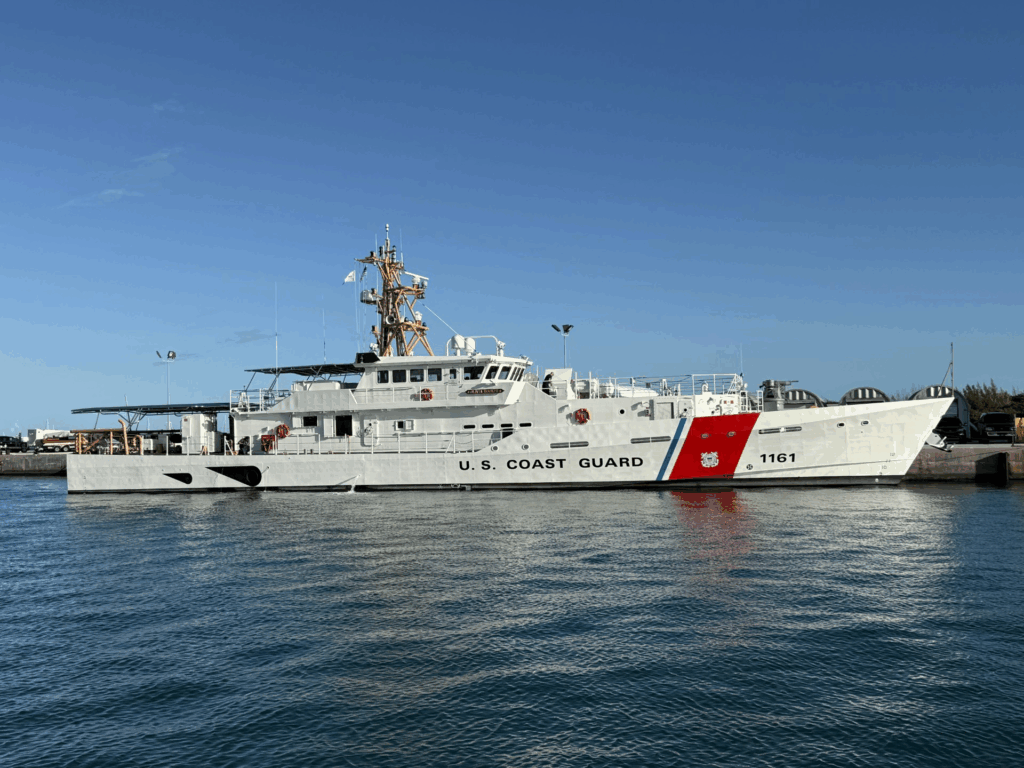
USCGC Olivia Hooker is the second of three FRCs to be homeported in St. Petersburg, FL
From Bollinger Shipyards, Oct. 23, 2025
LOCKPORT, La., — (October 23, 2025) – Bollinger Shipyards (“Bollinger”) today announced the recent delivery of the USCGC Olivia Hooker at Coast Guard Sector Key West. This is the 61st Fast Response Cutter (FRC) delivered under the U.S. Coast Guard’s current program and the 187th vessel built by Bollinger for the U.S. Coast Guard over a 40-year partnership. The Olivia Hooker will be homeported in St. Petersburg, Florida.
“We are honored to deliver the Olivia Hooker to the U.S. Coast Guard, continuing our proud tradition of providing high-quality, mission-ready vessels,” said Bollinger President & CEO Ben Bordelon. “The FRC platform has proven itself time and again as a cornerstone of the Coast Guard’s fleet, excelling in a wide range of operational conditions. We’re confident this vessel will serve its crew well in their mission of defending our nation’s national security interests over a vast and challenging area of responsibility.”
The USCGC Olivia Hooker is the second of three FRCs to be home-ported in St. Petersburg. Sector St. Petersburg has become one of the Coast Guard’s largest commands, with an area of responsibility encompassing over 400 nautical miles of coastline along Florida’s west coast and the third largest U.S. port for domestic trade. The Sector has responsibility for five primary operational missions: Search and Rescue; Marine Safety; Maritime Law Enforcement; Ports, Waterways, and Coastal Security; and Living Marine Resources.
Last month, Bollinger announced that the U.S. Coast Guard awarded the company 10 additional FRCs. The award was supported by the historic $25 billion funding included in President Trump’s recently enacted One Big Beautiful Bill Act, which provided $1 billion for additional FRCs and strengthened the Coast Guard in support of its Force Design 2028 initiative.
“With this award, the Coast Guard is doubling down on a proven platform and a proven team,” said Bordelon at the time of the award. “Our workforce has delivered nearly 200 cutters, including 60 FRCs, in our more than 40-year partnership with the Coast Guard. That performance is no accident. It reflects the dedication, precision and pride of the men and women of Bollinger, and our shared commitment to the Coast Guard’s mission.”
“This decision reflects our unwavering confidence in your capabilities, expertise, and longstanding commitment to excellence within the maritime industry,” said the U.S. Coast Guard in its award notification to Bollinger. “We continue to be particularly impressed by your track record in shipbuilding, your innovative approaches to maintaining a sustainable design, and your commitment to adhering to the highest standards of safety and compliance…This contract option award is a testament to the trust we place in your abilities and to the shared vision we hold for the future of our fleet. We look forward to a productive and successful partnership and to the delivery of ten world-class ships that will advance our mission and further strengthen our operational capabilities.”
To date, Bollinger has delivered 61 FRCs and had been under contract to build 67 vessels, with the final FRC previously scheduled for delivery in 2028. With the most recent award, the total program has increased to 77 vessels, extending the production line by approximately three years and ensuring uninterrupted deliveries to meet operational demand.
Earlier this year, to protect the taxpayer and preserve hard-won efficiencies, Bollinger went “at-risk” to sustain production momentum. The company procured long-lead materials and maintained full payroll to avoid costly restarts and schedule gaps. That proactive decision reduced risk, preserved skilled jobs, and enabled the government to stretch its investment further.
The FRC program continues to be a powerful economic engine. Since its inception, it has generated over $2 billion in material spending, directly supports more than 650 jobs in Southeast Louisiana, and has indirectly created 1,690 jobs from operations and capital investment, with an annual GDP impact of $202 million, according to the U.S. Maritime Administration’s data on the economic importance of the U.S. shipbuilding and repair industry. Each FRC comprises over 271,000 distinct items and approximately 282 million components and parts, sourced from 965 suppliers across 37 states, demonstrating the program’s broad national industrial footprint.
Each FRC is named for an enlisted Coast Guard hero who distinguished themselves in the line of duty. This vessel is named after Dr. Olivia Juliette Hooker (1915–2018), who made history as the first African-American woman to serve in the U.S. Coast Guard, enlisting in 1945 as a member of the SPARs during World War II. Dr. Hooker answered the call to serve, completing boot camp and yeoman training before processing discharges for returning Coast Guardsmen. After the war, Dr. Hooker earned advanced degrees in psychology, becoming a respected professor at Fordham University and a lifelong advocate for education, mental health, and civil rights. Her trailblazing service exemplified the Coast Guard’s core values of honor, respect, and devotion to duty, and her legacy endures as the namesake of USCGC Olivia Hooker.
ABOUT THE FAST RESPONSE CUTTER PLATFORM
The FRC is an operational “game changer,” according to senior Coast Guard officials. FRCs are consistently being deployed in support of the full range of missions within the United States Coast Guard and other branches of our armed services. This is due to its exceptional performance, expanded operational reach and capabilities, and ability to transform and adapt to the mission. FRCs have conducted operations as far as the Marshall Islands—a 4,400 nautical mile trip from their homeport. Measuring in at 154-feet, FRCs have a flank speed of 28 knots, state-of-the-art C4ISR suite (Command, Control, Communications, Computers, Intelligence, Surveillance, and Reconnaissance), and stern launch and recovery ramp for a 26-foot, over-the-horizon interceptor cutter boat.
USCGC Waesche Returns Following Multi-Mission Arctic Patrol
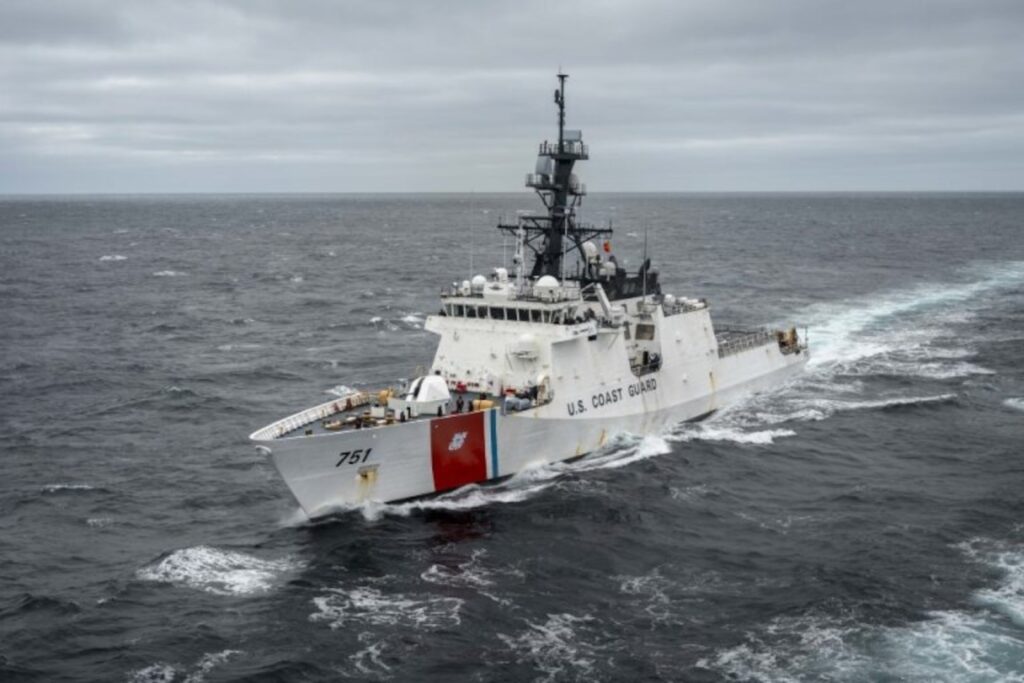
Coast Guard Cutter Waesche (WMSL 751) transit the Bering Sea during Arctic Edge 2025, Aug. 10, 2025. AE25 is a North American Aerospace Defense Command (NORAD) and U.S. Northern Command-led homeland defense exercise designed to improve readiness, demonstrate capabilities, and enhance Joint and Allied Force interoperability in the Arctic. (U.S. Coast Guard courtesy photo)
ALAMEDA, Calif. – The U.S. Coast Guard Cutter Waesche (WMSL 751) returned to its Base Alameda home port Oct. 10, concluding a 105-day Arctic deployment spanning over 21,000 nautical miles.
Waesche’s deployment underscored the Coast Guard’s commitment to safeguarding U.S. sovereignty, enforcing border control, and ensuring national security in the strategically vital Bering Sea, Arctic Ocean, and along the U.S. – Russia Maritime Boundary Line.
Throughout the three-and-a-half-month deployment, the crew integrated operations with U.S. Northern Command (NORTHCOM) and U.S. Alaska Command (ALCOM), conducting national defense operations and enforcing maritime laws to safeguard national sovereignty in an increasingly geostrategic Arctic.
The Arctic is a national priority. The U.S. Coast Guard remains steadfast in its commitment to protecting U.S. interests in the Arctic and ensuring the safety and security of Alaska’s maritime borders and approaches.
Five China-affiliated research vessels operated in the Arctic region over the summer, and Waesche was one of several Coast Guard assets deployed to the Arctic to control, secure, and defend U.S. territory and sovereign interests.
In August, Waesche’s crew responded to the People’s Republic of China Research Vessel Zhong Shan Da Xue Ji Di as it was transiting north in the Chukchi Sea above the Arctic Circle, after passing through the Bering Strait. Waesche and the Coast Guard Cutter Healy (WAGB 20) patrolled the Arctic Ocean in September supporting Operation Frontier Sentinel, an operation that responds to adversaries operating in and around Alaskan and U.S. Arctic waters, before responding to China’s research vessels in the region. The U.S. Coast Guard’s responses are intended to counter malign activities, defend sovereign interests, and promote maritime conduct consistent with international law and norms.
The Coast Guard is the only U.S. surface presence in the Arctic and works in conjunction with U.S. Northern Command and Alaskan Command to constantly monitor foreign vessels operating in and near U.S. waters in support of U.S. homeland defense and security operations.
While deployed to the region, Waesche served as a Forward Afloat Staging Base during NORTHCOM’s Exercise Arctic Edge 2025, executing a complex, multi-agency assault of a mock target of interest. The operation showcased seamless integration between Waesche, Coast Guard Maritime Security Response Team West, U.S. Navy SEALs, and the Alaska Air National Guard to rapidly respond to domestic threats.
Waesche conducted joint operations with ALCOM and the Royal Canadian Navy frigate HMCS Regina (FFH 334), demonstrating interagency coordination and a shared commitment to regional security during a joint patrol. The exercise included a passenger exchange, a mock boarding, cross-deck hoist operations with Regina’s CH-148 Cyclone helicopter, air support from a U.S. Coast Guard C-130J Hercules fixed wing aircraft from Air Station Kodiak and a Royal Canadian Air Force CP-140 Aurora.
“This deployment was a resounding success, proving the concept of expeditionary logistics in the Northern Frontier and solidifying our partnerships with the Joint Force and key allies,” said U.S. Coast Guard Capt. Tyson Scofield, commanding officer of Waesche. “The underway replenishment with Asterix and the successful barge fueling in Kotzebue represent a significant leap forward in our ability to sustain operations in the Arctic. Our integration with the Royal Canadian Navy, ALCOM, and NORTHCOM highlights the importance of peace through strength to maintain an Arctic free of adversarial coercion.”
Waesche successfully conducted the Coast Guard’s first-ever fueling at sea in the Alaskan theater with the Royal Canadian Navy replenishment oiler MV Asterix – accomplished in 6-8 foot seas with sustained 30-knot winds. Additionally, Waesche fueled north of the Arctic Circle, extending Coast Guard operations into the remote Arctic environment.
Waesche’s crew conducted professional exchanges with Canadian counterparts, including HMCS Max Bernays in Dutch Harbor, and hosted personnel from the National Oceanic and Atmospheric Administration (NOAA) law enforcement division, and Russian and Mandarin interpreters, further enhancing the cutter’s operational capabilities and regional understanding. Coast Guard Cutter Healy joined Waesche for a joint MBL patrol as well.
Commissioned in 2010, Waesche is one of four Legend-class national security cutters homeported in Alameda. National security cutters are 418-feet long, 54-feet wide, have a top speed of over 28 knots, a range of 12,000 nautical miles, endurance of up to 90 days, and can hold a crew of up to 170. The advanced technologies of the national security cutter class ships are designed to support the operations and missions throughout the Pacific.
U.S. Coast Guard Suspends Coastal Buoy Modernization in the Northeast
BOSTON — Coast Guard District Northeast is closing the period for providing comments to the Coastal Buoy Modernization Proposal (CBMP) advertised in the Local Notice to Mariners (LNM) and directly solicited from stakeholders.
After receiving over 3,200 public comments, the Coast Guard will be conducting further analysis of the aids to navigation (ATON) system. There will be no changes to ATON in relation to the proposal until further analysis is complete.
“We are extremely appreciative of the public’s input on this important project, and our team’s hard work, analysis, and conclusions were reinforced by the outstanding feedback we received from our maritime stakeholders,” said Rear Adm. Michael Platt, the Northeast Coast Guard District Commander. “The Northeast Coast Guard District will continue to ensure a safe, secure, and efficient Maritime Transportation System. We remain focused on shaping the future of our waterways, ensuring a modern aids to navigation system, and facilitating commerce vital to economic prosperity and strategic mobility.”
The Coast Guard maintains nearly 45,000 navigational aids nationwide. With America’s Marine Transportation System supporting $5.4 trillion of economic activity, America’s ATON system enables the safe and efficient flow of commerce, economic prosperity, and strategic mobility. The Coast Guard will continue assessing waterways and provide the most effective changes to support a resilient marine transportation system.
Coast Guard Launches Operation River Wall to Control Border Along Rio Grande
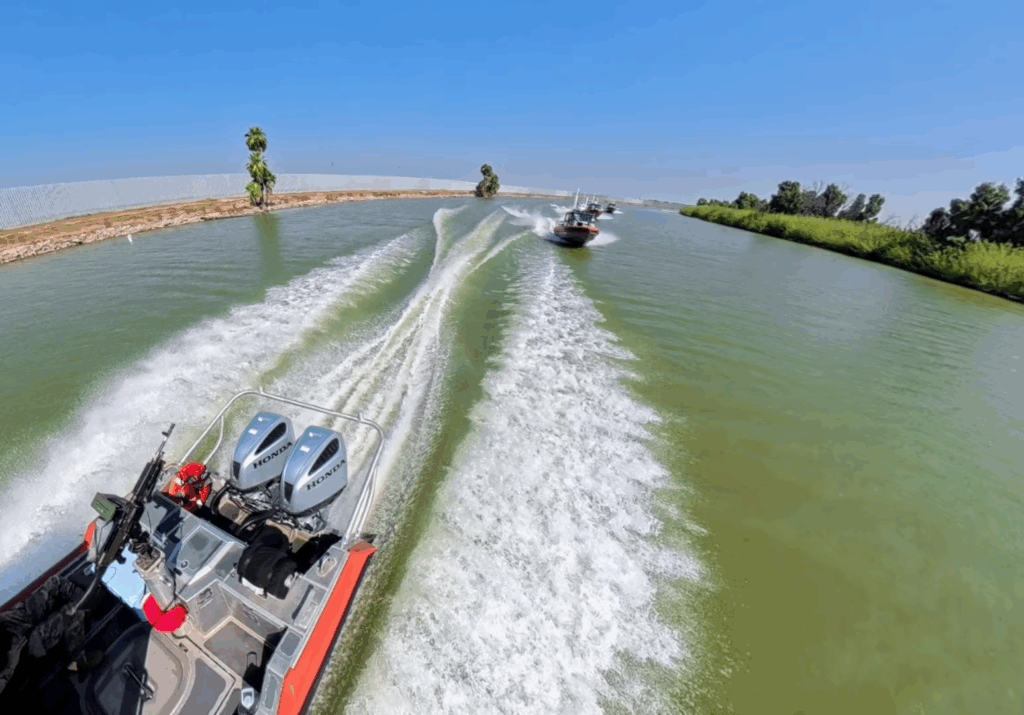
Coast Guard crews patrol the Rio Grande near Mission, Texas Oct. 18, 2025. The Coast Guard is taking immediate and decisive action to control, secure, and defend U.S. borders and maritime approaches, as well as facilitate commerce vital to economic prosperity and strategic mobility and successfully respond to crises or contingencies that may come with little or no warning. (U.S. Coast Guard video)
From Headquarters, U.S. Coast Guard, Oct. 20, 2025
WASHINGTON – The Coast Guard announced today the deployment of additional forces to the Rio Grande River in eastern Texas, starting on Oct. 9, 2025, to ensure operational control of the border where the President has declared a national emergency. This surge operation – known as Operation River Wall – will bolster ongoing Coast Guard efforts to control, secure and defend approximately 260 miles of the Rio Grande River that makes up the U.S. border there. Leveraging its unmatched expertise, authorities and capabilities, the Coast Guard will deter, interdict, and defeat illegal immigration, drug smuggling, and other threats to our communities.
“U.S. Coast Guard is the best in the world at tactical boat operations and maritime interdiction at sea, along our coasts, and in riverine environments,” said Adm. Kevin E. Lunday, Acting Commandant of the Coast Guard. “Through Operation River Wall, the Coast Guard is controlling the U.S. southern border along the Rio Grande River in eastern Texas.”
As part of this mobilization, the Coast Guard is deploying additional response boats, shallow watercraft, command and control assets, and tactical teams in support of national security objectives. This represents an unprecedented commitment of Coast Guard personnel and resources to the Rio Grande region.
The Coast Guard is leading operations, working with U.S. Border Patrol and the Department of War under U.S. Northern Command, to control, secure, and defend the U.S. border along the Rio Grande River in Cameron and Hidalgo counties in eastern Texas, extending to the sea.