Coast Guard Cutter Escanaba Returns Home after $60 Million Drug Bust
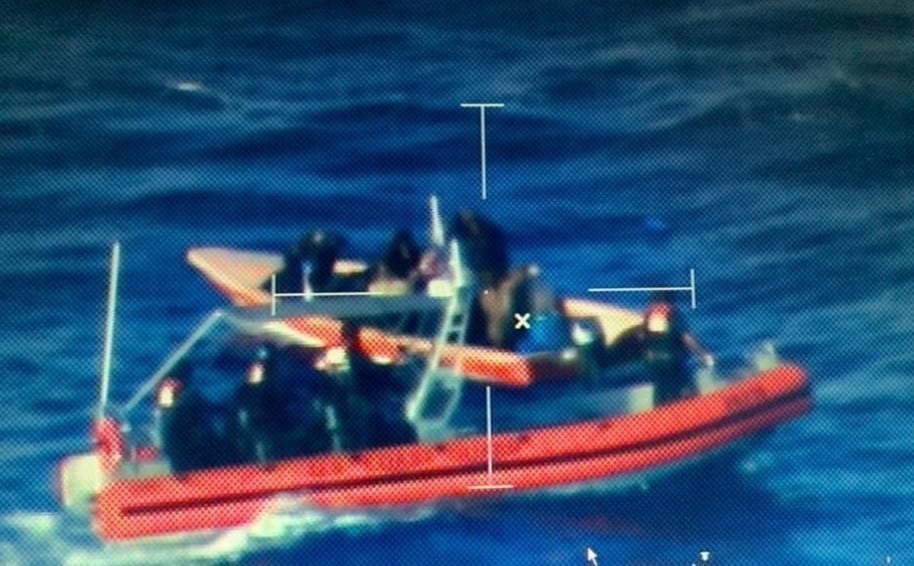
A helicopter interdiction tactical squadron with the Coast Guard Cutter Escanaba pursues a drug-smuggling vessel in the Caribbean Sea in April. U.S. Coast Guard/Petty Officer 2nd Class Michael Trees
BOSTON — The crew of Coast Guard Cutter Escanaba returned home to Boston on May 23 following a 62-day patrol in support of Operation Martillo in the western Caribbean, the Coast Guard 1st District said in a release.
Escanaba’s crew seized nearly 2,000 kilograms of cocaine, valued at $60 million, while working with an armed helicopter interdiction tactical squadron onboard and local Panamanian law enforcement.
Escanaba’s crew also located a disabled boat 100 miles north of Colombia in 14-foot seas and 35 mph winds. The crew launched its small boat team and rescued the four crew members stranded aboard the boat. Escanaba’s crew transferred the survivors to the Colombian navy.
“I am extremely proud of the crew for their extraordinary dedication and professionalism throughout this patrol during an unprecedented time,” said Cmdr. Mike Nalli, commanding officer of the Escanaba. “We overcame numerous challenges to focus on mission execution and achieve excellent results in support of [U.S. Southern Command’s] national objectives.”
Operation Martillo is a multinational detection, monitoring and interdiction operation that consists of 20 participating nations working together to counter transnational organized crime networks and illicit trafficking in the waters along Central America.
Escanaba is a 270-foot medium-endurance cutter with a crew complement of 100. They conduct maritime enforcement and homeland security missions in support of Coast Guard operations throughout the Western Hemisphere.
USS Pinckney Takes Down Drug Vessel, Seizes Over $28 Million of Cocaine
The Arleigh Burke-class guided-missile destroyer USS Pinckney (DDG 91) with embarked U.S. Coast Guard (USCG) Law Enforcement Detachment (LEDET) team conducts enhanced counter narcotics operations May 14. U.S. COAST GUARD
EASTERN PACIFIC OCEAN (NNS) — The Arleigh Burke-Class Destroyer USS Pinckney (DDG 91) with embarked U.S. Coast Guard (USCG) Law Enforcement Detachment (LEDET) team seized more than 3,000 pounds of cocaine May 14, the U.S. 4h Fleet/U.S. Naval Forces Southern Command said in a May 21 release.
A U.S. Navy maritime patrol aircraft assigned to the “Tridents” of Patrol Squadron 26 first spotted the low-profile vessel (LPV). Pinckney, with its embarked helicopters assigned to the “Wolf Pack” of Helicopter Maritime Strike Squadron 75 and the embarked LEDET, moved into position to intercept the LPV.
Pinckney and the embarked LEDET recovered a total of 70 bales of cocaine totaling an estimated 1,400 kilograms, worth over $28 million wholesale value.
“This was truly a team effort,” said Cmdr. Andrew Roy, USS Pinckney commanding officer. “The air support we received was first class. We were able to safely and successfully conduct this operation due to the outstanding professionalism of the Navy – Coast Guard team.”
USS Pinckney is deployed to the U.S. 4th Fleet area of operations conducting U.S Southern Command and Joint Interagency Task Force South’s enhanced counter drug operations missions in the Caribbean and Eastern Pacific.
On April 1, U.S. Southern Command began enhanced counter-narcotics operations in the Western Hemisphere to disrupt the flow of drugs in support of Presidential National Security Objectives.
Numerous U.S. agencies from the Departments of Defense, Justice and Homeland Security cooperated in the effort to combat transnational organized crime. The Coast Guard, U.S. Navy, Customs and Border Protection, FBI, Drug Enforcement Administration, and Immigration and Customs Enforcement, along with allied and international partner agencies, play a role in counter-drug operations.
Cutter Active Offloads $37 Million Worth of Cocaine
Members of the Coast Guard Cutter Active crew offload more than 2,000 pounds of cocaine, worth about $37 million, seized in international waters of the eastern Pacific Ocean in May. U.S. Coast Guard/Petty Officer 3rd Class Alex Gray
SAN DIEGO — The crew of the U.S. Coast Guard Cutter Active offloaded more than 2,000 pounds of cocaine worth about $37 million on May 20 that was seized in early May from known drug-transit zones of the eastern Pacific Ocean, the Coast Guard’s 11th Disrict said in a release.
On April 1, U.S. Southern Command began enhanced counter-narcotics operations in the Western Hemisphere to disrupt the flow of drugs in support of Presidential National Security Objectives.
Numerous U.S. agencies from the Departments of Defense, Justice and Homeland Security cooperated in the effort to combat transnational organized crime. The Coast Guard, U.S. Navy, Customs and Border Protection, FBI, Drug Enforcement Administration and Immigration and Customs Enforcement, along with allied and international partner agencies, play a role in counter-drug operations.
The fight against drug cartels in the eastern Pacific requires unity of effort in all phases from detection, monitoring and interdictions, to criminal prosecutions by international partners and U.S. attorneys in districts across the nation. The law enforcement phase of counter-smuggling operations in the eastern Pacific is conducted under the authority of the 11th Coast Guard District, headquartered in Alameda. The interdictions, including the actual boardings, are led and conducted by members of the U.S. Coast Guard.
“This patrol, and this interdiction in particular, highlights the resilience and professionalism of Active’s crew,” said Cmdr. James O’Mara, commanding officer of Active. “We cancelled a port visit, stretched logistics and diverted 500 miles to get on target and do our job. No captain could ask or expect more from a crew, especially given all the adversity overcome during this patrol. Though I know if more were required, this crew would rally and answer the call, the way they always do.”
Active is a 210-foot medium-endurance cutter commissioned in 1966 and homeported in Port Angeles, Washington.
Coast Guard Academy Holds Virtual Graduation Ceremony for Class of 2020
Coast Guard Commandant Adm. Karl Schultz delivers remarks during the Coast Guard Academy virtual graduation ceremony.
NEW LONDON, Conn. — The U.S. Coast Guard Academy’s Class of 2020 is the largest and most inclusive graduating class and includes the largest number of female graduates in the institution’s history, the academy said in a May 21 release. They also became the first class to hold a virtual commencement ceremony due to the COVID-19 pandemic.
Commencement day activities began at 1 p.m. with recorded congratulatory messages from a host of flag officers, elected officials and celebrities, including TV weatherman and producer of the Coast Guard TV series Al Roker, as well as actors Gary Sinise and Kevin Costner, who referenced his portrayal of a Coast Guard swimmer in the film “The Guardian.”
The five international students from the class were also sent congratulatory messages from officials representing their respective home countries of Haiti, Mexico, the Philippines and the Federated States of Micronesia.
The official ceremony consisted of a combination of live streamed footage from the official party on Cadet Memorial Field at the Academy, along with a mix of pre-recorded videos that closely followed the traditional run of past events. The event ended with recorded messages from the graduates to the rest of their classmates.
As the distinguished honor graduate of the Class of 2020, Ensign Alaric Stone gave an address that touched on the successes of his classmates despite the unprecedented circumstances they found themselves in and the bonds that hold them together.
“It is a testament to our resilience in the face of adversity and our ability to take failure in our stride,” Stone said. “With 2020 vision we’ve been able to look beyond hardship and see what is truly important. Each other. Through trials and tribulations both big and small we have always remained a team. A family.”
In his remarks, Rear Adm. Bill Kelly, the Coast Guard Academy’s superintendent, reminded the audience of the inclusive nature of the class.
“With 2020 vision we’ve been able to look beyond hardship and see what is truly important. Each other. Through trials and tribulations both big and small we have always remained a team. A family.”
Rear Adm. Bill Kelly, Coast Guard Academy superintendent
“This year, we graduate the largest number of African-Americans, Native-Americans and Alaska natives and we continue to graduate more Hispanic officers than ever before,” Kelly said.
“The hard work to be more representative of the nation we serve is paying dividends, and while the demographic profile of this class is the most diverse ever, it’s the perspective, the skills and abilities each and every graduate brings to the service that makes them uniquely qualified to serve and lead during these unprecedented times.”
Standing on the stage alongside the official party at Cadet Memorial Field, Coast Guard Commandant Adm. Karl Schultz made brief remarks before introducing a prerecorded message from U.S. Army Gen. Mark Milley, chairman of the Joint Chiefs of Staff.
Milley told the graduates that, as leaders, they would be counted on during difficult circumstances.
“Honor, respect and devotion to duty,” Milley said. “These words can’t be abstract to you. In our profession, you must develop a bond of trust like no other occupation in the world. You have to trust each other. You have to trust the chain of command. You have to trust the petty officers and the seamen, and they must trust you.”
In his recorded remarks, Homeland Security Secretary Chad Wolfe welcomed the graduates into the U.S. Department of Homeland Security team and reminded them what it takes to serve in the current environment.
“As frustrating as it may be, the unorthodox situation in which we find ourselves today is emblematic of what you will all find when you are on the front lines defending this country, and that is the need to be prepared for the unexpected,” Wolfe said.
“Put simply, life is going to look a lot different out there than it did inside your classrooms at the academy, and that is why I expect you to always keep learning. It is the best way to prepare yourself for the challenges that lie ahead.”
Coast Guard Cutter Diligence Will Change Homeport to Pensacola
The Coast Guard Cutter Diligence, moored in downtown Wilmington, North Carolina. U.S. Coast Guard
ARLINGTON, Va. — The U.S. Coast Guard Cutter Diligence will shift homeport from Wilmington, North Carolina, to Pensacola, Florida, on May 25, the Coast Guard 5th District said in a release.
“Diligence is scheduled to depart the city of Wilmington on [May 25] to conduct a patrol in support of the 7th Coast Guard District, and will return to the cutter’s new homeport, Pensacola, Florida,” the release said. “Diligence has been assigned to Wilmington since its recommissioning in 1994, but the namesake has a long history with the state of North Carolina and the city of Wilmington dating back to 1792.”
“The past and present crew of Diligence have truly appreciated the support of the Wilmington community over the years,” said Cdr. Luke Slivinski, commanding officer of the Diligence. “Our close and welcoming relationship has been special, and we’ll miss calling the Coast Guard City of Wilmington our home, but we’re eager to embark on the adventure of establishing a new home port following this patrol.”
Eastern Shipbuilding Group Performs Keel-Laying for Offshore Patrol Cutter
An artist’s rendering of the offshore patrol cutter. Eastern Shipbuilding Group
PANAMA CITY, Fla. — Eastern Shipbuilding Group held a keel-laying ceremony for the U.S. Coast Guard’s first-of-class offshore patrol cutter (OPC), the Argus, the company said in a release.
The April 28 ceremony, at Eastern Shipbuilding’s Nelson Street facility in Panama City, was performed and recorded without an audience to comply with U.S. Centers for Disease Control guidelines for combatting the spread of the COVID-19 virus.
The keel-laying represents the ceremonial start of a ship’s life by commemorating the assembly of the initial modular construction units. Historically, to attest that the keel was properly laid and of excellent quality, the shipbuilder would carve their initials into it. This practice is commemorated by welding the initials of the ship’s sponsor into the keel authentication plate.
The ship’s sponsor is retired Coast Guard Capt. Beverly Kelley, who was the first woman to command a U.S. military vessel. She commanded the 95-foot patrol boat, the cutter Cape Newagen, in 1979. Throughout her distinguished career, she became the first woman to command both a medium-endurance cutter and a high-endurance cutter in cutters Northland and Boutwell, respectively.
“Eastern Shipbuilding Group is humbled and proud to have been chosen to build this next-generation ship for the world’s best Coast Guard, and we think today represents a milestone that all those involved in the program can be proud of,” said Eastern’s president, Joey D’Isernia.
“The steel joined here today is unlike any you or I have seen before. This steel has been ravaged by 162 mph winds, generated by the third most powerful hurricane to make landfall in this country’s history. This steel has borne witness to a pandemic that has caused fear and shaken our core. But through all this, it remains sturdy, it remains resilient, and today it will join with other steel to become stronger, more defined and more resolute. Today is representative of how we build, and of unwavering resolve in the face of adversity for a Coast Guard and a nation that deserves nothing less.”
Adm. Charles W. Ray, vice commandant of the Coast Guard, tours the construction of the first offshore patrol cutter, the Argus, in 2019 at the Eastern Shipbuilding Group shipyard in Panama City, Florida. U.S. Coast Guard/Petty Officer 2nd Class Loumania Stewart
D’Isernia was accompanied on the podium by Capt. Andrew Meverden, representing the Coast Guard, and Bradley Remick, the welder charged with fashioning the sponsor’s initials onto the ceremonial keel authentication plate.
The OPC will provide a capability bridge between the national security cutter, which patrols the demanding open ocean, and the fast-response cutter, which serves closer to shore. The OPC design includes the capability of carrying an MH-60 or MH-65 helicopter and three operational over-the-horizon small boats. The vessel also is equipped with a highly sophisticated combat system and C4ISR suite.
U.S. Coast Guard, Australia to Begin Officer Exchange Program
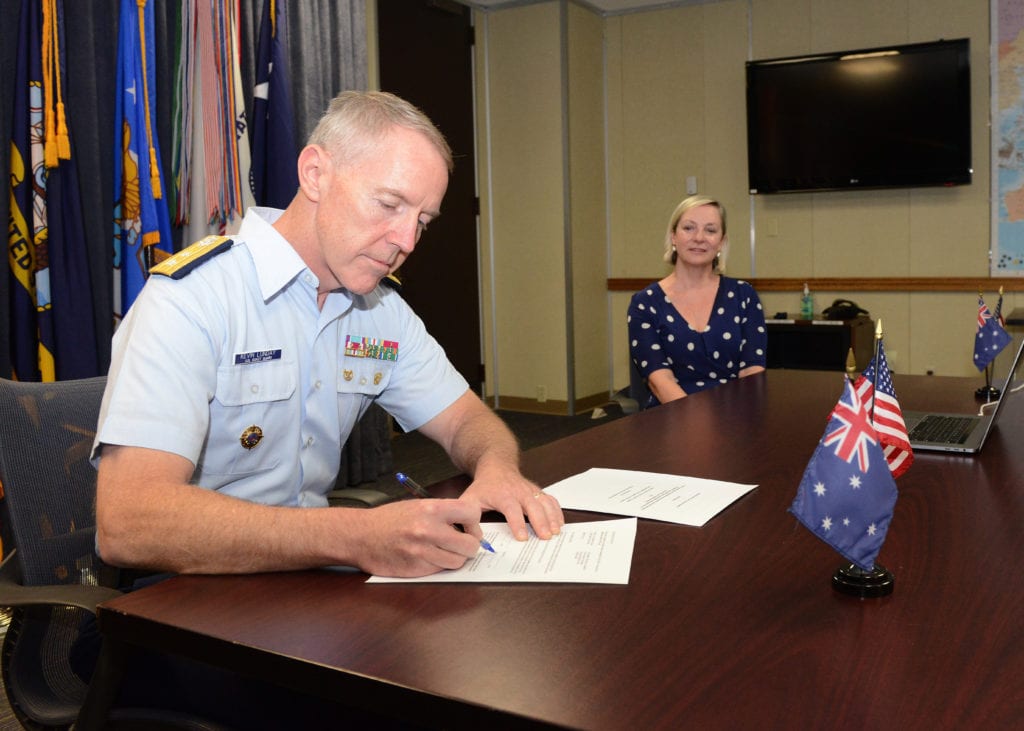
Rear Adm. Kevin Lunday, commander, Coast Guard 14th District, and Kingsley Woodford-Smith, the assistant commissioner, Australian Boarder Force, virtually sign a memorandum of agreement creating a system of mutual officer exchange. U.S. Coast Guard/Petty Officer 3rd Class Matthew West
HONOLULU — The U.S. Coast Guard and the Australian Department of Home Affairs on April 27 signed an agreement for a system of mutual officer exchange from their offices in Hawaii and Canberra, the Coast Guard 14th District said in a release.
Rear Adm. Kevin Lunday, commander of the 14th District, and Kingsley Woodford-Smith, assistant commissioner of Australian Border Force, signed the memorandum of agreement.
“The memorandum of agreement solidifies an already incredible relationship with our Australian partners in the Blue Pacific region,” said Cmdr. Jason Brand, chief of enforcement with the 14th District.
“The agreement enhances the interoperability between the U.S. Coast Guard and Australian Department of Home Affairs by creating a personnel exchange system designed to share experience, professional knowledge and doctrine between the partners. This exchange is another tool for our work to promote and further a free and open Indo-Pacific.”
The memorandum establishes a seagoing officer exchange program allowing one Australian Border Force marine unit officer to serve a four- to six-week assignment among the units in Honolulu. A U.S. Coast Guard officer will deploy with the Australian Border Force fleet.
Upon signing the agreement, Rear Adm. Lunday commented, “The U.S. and Australian alliance is built on over a century of mateship. This agreement reflects the importance of our combined operations to maritime governance and security across Oceania, especially as the U.S. Coast Guard is expanding its permanent presence and operations in the Pacific.”
In attendance was Ambassador Jane Hardy, the Australian consul-general in Honolulu, who said of the agreement “this significant bilateral initiative will develop further our mutual efforts to maintain and enhance regional security. The skill and bravery of our U.S. Coast Guard ‘mates’ and Australian Border Force exemplify the heart of the Australia-US Alliance.”
Australian and Coast Guard personnel often find themselves working alongside one another during joint missions throughout the Pacific from search and rescue cases to the prevention of illegal, unreported, and unregulated fishing (IUU).
Examples of such efforts include the work of Royal Australian navy HMAS Toowoomba and a Coast Guard Station Honolulu 45-foot response boat-medium crews to respond to a de-masted sailboat off Hawaii in 2018 and joint exercises between the HMAS Choules and the Coast Guard Cutter Walnut in the South Pacific during Operation Aiga 2019.
Both countries annually contribute resources to operations of the Pacific Island Forum Fisheries Agency (FFA), Western and Central Pacific Fisheries Commission (WCPFC), and Pacific Quadrilateral Defence Coordination Group (P-QUAD) such as the recent FFA Operation Rai Balang.
Under Op Rai Balang, crews from Coast Guard Cutter Sequoia, an Air Station Barbers Point HC-130 Hercules aircrew, and the crew of the Australian navy’s HMAS Maryborough all contributed to the surveillance operation to disrupt IUU fishing in March. The joint efforts protect the organization’s member states’ exclusive economic zones and ensure Pacific fish stocks remain sustainable.
Scheduled later this year, the partners will reach a new milestone when the Coast Guard sends a surface asset for the first time to serve alongside Australia’s during P-QUAD’s Operation Nasse.
“We plan to send crews aboard Coast Guard Cutter Kimball (WMSL 256) and an Air Station Barbers Point HC-130 Hercules airplane to support the P-QUAD operation for the first time,” Brand said.
“The U.S. and Australia have been standing side-by-side for more than 100 years. This is more than a partnership, it is mateship. As we increase operations with our Australian counterparts, this new personnel exchange allows us to take the next step to integrate further for more fruitful outcomes maximizing the value of the experience and resources of our nations.”
Coast Guard Cutter Harriet Lane Returns Home After Caribbean Patrol
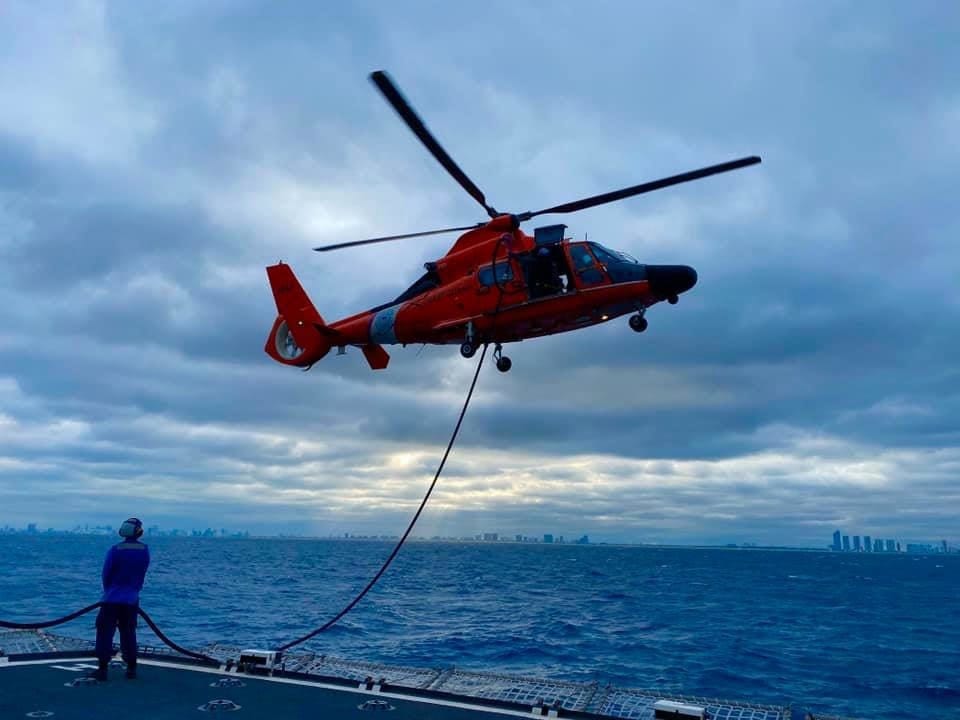
The crew of the cutter Harriet Lane conducts a vertical replenishment evolution with an MH-65 Dolphin helicopter aircrew during their patrol in the Caribbean. U.S. Coast Guard/Ensign Camisha Moore
PORTSMOUTH, Va. — The U.S. Coast Guard Cutter Harriet Lane returned to its homeport of Portsmouth, Virginia, on April 26 following a 71-day patrol of the central Caribbean, the Coast Guard 5th District said in a release.
The cutter’s multimission patrol resulted in the interdiction of 1,306 pounds of marijuana, with a street value of over $2.3 million. Harriet Lane conducted its patrol in support of the Coast Guard’s 7th District and the United States Southern Command’s Joint Interagency Task Force South.
The Harriet Lane crew started their patrol with flight operations off the coast of Miami for a biannual aviation assessment. Working with a helicopter from Air Station Miami, the Harriet Lane completed a series of day and night flight operations, including vertical replenishment, in-flight refueling and landing evolutions.
Soon after, Harriet Lane joined forces with the Honduran Navy Special Forces to conduct a joint law enforcement patrol off the coast of Honduras. This engagement provided the opportunity for law enforcement subject matter expert exchanges and improved interoperability between the two nations for future counter-narcotic operations.
The Harriet Lane continued into to the central Caribbean to combat the smuggling of illegal narcotics across the region. During their time there, the cutter’s crew worked with a maritime patrol aircraft to interdict a go-fast style vessel off the coast of Jamaica. The Harriet Lane arrived on scene, with the crew seizing 1,306 pounds of marijuana from the vessel and its jettison field and detaining four suspected drug traffickers.
Coast Guard, Panamanian Authorities Stop Drug-Smuggling Operation Near Panama
A Coast Guard Cutter Escanaba small boat crew recovered 40 bales of cocaine April 13, 2020. U.S. COAST GUARD / Coast Guard Cutter Escanaba
MIAMI — The Coast Guard stopped a drug smuggling operation April 13 in international waters northeast of Panama, the Coast Guard 7th District said in an April 23 release.
A Coast Guard Helicopter Interdiction Tactical Squadron MH-65 Dolphin helicopter crew, forward deployed with the Coast Guard Cutter Escanaba (WMEC-907), spotted a suspect fishing vessel with five people aboard. The cutter Escanaba crew sent a small boat crew to the scene.
The cutter Escanaba small boat crew recovered 40 bales of cocaine, and a nearby Panamanian law enforcement boat crew recovered 43 bales, taking a total approximately $60 million wholesale that would have otherwise funded transnational criminal organizations. The 40 bales recovered by the Escanaba crew were transferred to the Coast Guard Cutter Raymond Evans (WPC-1110) crew.
“During this uncertain time, our U.S. military forces continue to aggressively interdict narcotics being smuggled in our hemisphere,” said Vice Adm. Scott Buschman, Coast Guard Atlantic Area commander. “Like the crew of the Escanaba, we will continue to protect our nation’s maritime borders, ensure our security and carry out all Coast Guard’s missions.”
On April 1, U.S. Southern Command began enhanced counternarcotics operations in the Western Hemisphere to disrupt the flow of drugs in support of presidential national security objectives. The interdictions, including the actual boardings, are led and conducted by the members of the U.S. Coast Guard.
Coast Guard, Dominican Navy Interdict Migrants, Arrest Smugglers
Coast Guard Cutter Joseph Doyle’s cutter boat on scene with a 25-foot illegal migrant vessel interdicted on April 20 south of Isla Saona, Dominican Republic. U.S. Coast Guard
SAN JUAN, Puerto Rico — The crew of the U.S. Coast Guard Cutter Joseph Doyle and a Dominican Republic navy vessel combined efforts on April 20 during the interdiction of an illegal migrant voyage transporting 15 migrants in waters south of Isla Saona, according to a Coast Guard 7th District release.
The interdiction, which was part of a joint effort between the Coast Guard, the Dominican navy and U.S. Immigrations and Customs Enforcement-Homeland Security Investigations, led to Dominican authorities arresting Edgar Batista Matos and Manauris Andujar Manon, who reportedly are associated with human smuggling activities and the organization of illegal migrant voyages.
During a patrol in the Caribbean on April 20, the crew of a Coast Guard HC-144 Ocean Sentry aircraft detected a suspect migrant vessel south of Isla Saona. While patrolling nearby waters, the cutter Joseph Doyle responded to the sighting and interdicted the 25-foot make-shift vessel that was carrying 15 migrants, 13 men and two women of Dominican nationality. Shortly thereafter, a responding Dominican Republic Navy vessel arrived on scene and the crew took custody of the migrants and towed the interdicted vessel back to the Dominican Republic.
Following the interdiction, Dominican naval authorities informed the Coast Guard that the known smugglers were found to be among the interdicted migrants.
“This successful interdiction and arrest of two smugglers was the result of the strong partnership and collaboration that exists between the Coast Guard and Dominican Republic navy,” said Capt. Eric King, commander of Coast Guard Sector San Juan.
“The results achieved today, despite the challenging operational environment presented by the global COVID-19 pandemic, reflect the commitment and daily efforts carried out by both countries to protect our borders from existing maritime threats and safeguard the lives of migrants who face the danger of an uncertain and potentially perilous voyage.”
The Joseph Doyle is a 154-foot fast-response cutter homeported in San Juan.