Coast Guard Continues Response to Chinese Research Vessel Activity in U.S. Arctic

A C-130J Hercules airplane crew from Coast Guard Air Station Kodiak responds to a Chinese research vessel operating in the U.S. Arctic as part of Operation Frontier Sentinel Aug. 13, 2025. (U.S. Coast Guard courtesy photo) 

Release From U.S. Coast Guard Arctic District

JUNEAU, Alaska — The Coast Guard is continuing its response to five Chinese research vessels operating in the U.S. Arctic. 

The Coast Guard Arctic District has been monitoring activity and deployed a C-130J Hercules fixed wing aircraft from Air Station Kodiak Wednesday to query the vessels. The U.S. Coast Guard, in conjunction with U.S.  Northern Command and Alaskan Command, constantly monitor the activity of foreign vessels operating in and near U.S. waters in support of U.S. homeland defense and security efforts. 

The Arctic is a growing zone of strategic global competition. The Coast Guard is the only U.S. surface presence in the Arctic and recently, in Alaska, commissioned U.S. Coast Guard Cutter  Storis (WAGB 21), the service’s newest polar icebreaker, and U.S. Coast Guard Cutter Earl Cunningham (WPC 1159), the newest Sentinel-class fast response cutter. 

“Commissioning the Storis and Earl Cunningham increases our ability to control, secure, and defend Alaska’s U.S. border and maritime approaches,” said Rear Adm. Bob Little, commander, U.S. Coast Guard Arctic District. “As we continue to grow our surface fleet, we utilize our aviation resources which play a vital role in countering foreign malign influence.” 

The five Chinese Research Vessels are: Xue Long 2, China flagged; Shen Hai Yi Hao, China flagged; Zhong Shan Da Xue Ji Di, Liberia flagged; Ji Di, China flagged; andTan Suo San Hao, China flagged. 


U.S. Coast Guard Cutter Bertholf Returns Home from Deployment in Support of Southern Border Operations 

U.S. Coast Guard Cutter Bertholf (WSML 750) rendezvoused with U.S. Coast Guard Cutter Eagle (WIX 327) for a passenger exchange and formation steaming in the Pacific Ocean, August 6, 2025. Eagle is underway for her West Coast summer cadet tour, and Bertholf was nearing the completion of her Deployment in support of Operation Border Trident. (U.S. Coast Guard photo by Ensign Holli Welcker)

From U.S. Coast Guard Southwest District, Aug. 13. 2025 

ALAMEDA, Calif. — The U.S. Coast Guard Cutter Bertholf (WMSL 750) crew returned to their home port on Coast Guard Base Alameda, California, Sunday, following a 70-day patrol operating along the Southwest maritime boundary line (MBL) near San Diego. 

Bertholf deployed in support of Operation Border Trident, Coast Guard District Southwest’s (CGD-SW) standing operation to counter-illicit maritime activity along the Southwest MBL.  

Operation Border Trident is a Coast Guard-led interagency approach to detection, monitoring, interdiction, and apprehension operations to combat transnational criminal organizations and illegal alien activity in the California Coastal Region. Bertholf increased Coast Guard operational presence in the area, maintaining border control and territorial integrity of the United States.  

While at sea executing Operation Border Trident, Bertholf conducted 86 security boardings and queries in the vicinity of San Diego, checking more than 250 IDs and inspecting closed cabin vessels to thwart illegal activity. This included more than 250-crew hours deployed in Bertholf’s cutter response boats, providing law enforcement presence and deterrence on the Southwest MBL.  

Departing Alameda on June 2, Bertholf conducted a change of command followed by an annual readiness assessment and training in San Diego prior to deploying to their assigned operating area. On June 9, 2025, Capt. Andrew Pate relieved Capt. Billy Mees as Bertholf’s 10th commanding officer.  

Beginning on June 10, under the guidance of Afloat Training Organization San Diego, Bertholf conducted the first full Basic Cutter Operations assessment for the Legend-Class national security cutter fleet which included two weeks of drills, evaluations, and training reviews. The crew was tested against simulated shipboard fires and flooding in both the in port and underway environments, as well as shipboard emergencies in various tactical scenarios. Bertholf displayed high proficiency in several complex ship evolutions, including mooring, unmooring, and anchoring. Scoring a 95% average across all training areas, Bertholf earned certifications in naval warfare, damage control, seamanship, navigation, medical, and engineering proficiency.  

Bertholf was twice diverted to respond to search and rescue tasking, a core responsibility that remains a sacred trust between the U.S. Coast Guard and the maritime public. The first case involved the search for a downed aircraft about 460 miles off San Diego. Bertholf conducted search patterns, including flying its embarked small, unmanned aircraft system (sUAS) and used one of its cutter response boats as part of a multi-service search effort.   

Later in the deployment, Bertholf received tasking from Coast Guard Sector San Diego to respond to a person in the water 36 miles west of San Diego reported to be experiencing medical distress. Once on scene, Bertholf response boat crewmembers safely recovered the person in distress and brought them aboard Bertholf for initial medical care. Onboard health services technicians provided medical evaluations and care to stabilize the survivor until they were transferred to Emergency Medical Personnel for further care in San Diego.  

“Bertholf’s crew displayed exceptional proficiency and professionalism recovering the survivor, stabilizing their condition, and conducting a smooth transfer via cutter boat to waiting EMS at Sector San Diego for further transfer to higher level care,” said Capt. Andrew Pate, commanding officer of Bertholf.  

To maintain the cutter’s shipboard helicopter operation proficiency, Bertholf conducted 180 helicopter deck landings with U.S. Coast Guard Air Stations (AIRSTA) San Diego and Ventura aircrews. Bertholf also completed 24 fast rope exercises with AIRSTA Ventura and U.S. Coast Guard Maritime Security Response Team West. Coordination of flight operations provided critical training and proficiency opportunities for helicopter crews and Bertholf’s crew, supporting their ability to respond to emergencies requiring shipboard helicopter operations both during the day and at night.   

Routinely operating independently, far from other U.S. Coast Guard cutters, Bertholf capitalized on several unexpected opportunities to rendezvous at sea with multiple cutters deployed from other districts.   

Teaming with the U.S. Coast Guard Cutter Active (WMEC 618) early in the deployment, the cutters ran several small boat exercises to certify Bertholf’s boarding teams for law enforcement operations.   

Later, while transiting south to evade a hurricane in Puerto Vallarta, Mexico, Bertholf rendezvoused with the U.S. Coast Guard Cutter Storis (WAGB 21), the first polar icebreaker acquired by the U.S. Coast Guard in over 25 years. Storis was partway through its maiden voyage and briefly conducted formation steaming with Bertholf.   

Finally, Bertholf capitalized on the U.S. Coast Guard Cutter Eagle’s (WIX 327) visit to the west coast, coordinating a passenger exchange for 36 crew members and formation steaming. Eagle is a 295-foot, three-masted barque used exclusively as a training vessel for future officers of the United States Coast Guard. Bertholf and Eagle were briefly joined by the U.S. Coast Guard Cutter Florence Finch (WPC 1157), one of the Coast Guard’s newest 154-foot Fast Response Cutters.  

During this deployment, Bertholf had several opportunities to interact with Department of Defense and international partners. While on a port visit in San Diego, Bertholf’s crew hosted the 89th Military Police Brigade and the 716th Military Police Battalion, strengthening relationships between the land and maritime services and enhanced their understanding of domain awareness capabilities in support of Operation Border Trident.  

“I couldn’t be prouder of the Bertholf crew,” said Pate. “Their proficiency, professionalism, and pride throughout this deployment reflect a selfless commitment to defeating adversaries and providing security for the American people we serve.”  

Bertholf is named for Commodore Ellsworth Price Bertholf, the Coast Guard’s first Commandant. Commodore Bertholf’s most notable service was his role in the famous Alaska Overland Expedition in 1897. When over 265 American whalers became trapped in ice at Point Barrow, Bertholf led the relief party 1,600 miles via dogsled. Along with Lt. David Jarvis and Dr. Samuel Call, Bertholf herded almost 400 reindeer through a frozen Alaska winter to feed the starving whalers, an act that would later earn him the Congressional Gold Medal.   

Homeported in Alameda, Bertholf was commissioned on August 4, 2008, as the Coast Guard’s first Legend-class national-security cutter. National security cutters are 418-feet long, 54-feet wide, and have a 4,600 long-ton displacement. They have a top speed of 28 knots, a range of 12,000 nautical miles, and can hold a crew of up to 170. Bertholf routinely conducts operations throughout the Pacific, where the cutter’s combination of range, speed, and ability to operate in extreme-weather conditions provides the mission flexibility necessary to conduct vital strategic missions. The ship’s motto is “Legends Begin Here.”   


Coast Guard Awards $32M for Runway Reconstruction at Base Elizabeth City, NC

From U.S. Coast Guard East District, Aug. 12, 2025 

NORFOLK, Va. – The U.S. Coast Guard’s Facilities Design and Construction Center in Norfolk, Virginia, has awarded RQ Construction a $32 million design-build contract for the reconstruction of crosswind Runway 1-19 and the restoration of taxiways Kilo and Golf at Base Elizabeth City, North Carolina. 

The project involves a complete reconstruction of Runway 1-19, which measures 4,518 feet in length and 150 feet in width. The scope of work also includes upgrading the runway lighting system, encompassing runway end identifier lights, edge lights, guidance signs, associated electrical infrastructure and taxiway lighting. A new end-of-runway turnaround apron will be constructed at the Runway 1-19 approach end. 

“This significant infrastructure investment will greatly improve air traffic operations and enhance air traffic safety at Base Elizabeth City,” said Capt. Neal Armstrong, commanding officer of the Coast Guard Facilities Design and Construction Center. “Importantly, the project will be constructed without requiring the closure of the primary Runway 10-28, minimizing disruption to ongoing operations.” 

Construction is scheduled to begin in 2026 and is expected to be completed by fall 2027. 

Base Elizabeth City is a key Coast Guard installation that coordinates and provides regional mission support, including critical search and rescue missions, within the U.S. Coast Guard East District. Air Station Elizabeth City operates HC-130J Hercules aircraft and MH-60T Jayhawk helicopters. Base Elizabeth City is also home to the Coast Guard Aviation Logistics Center, which provides depot-level maintenance for all fixed- and rotary-wing aircraft (HC-27J, HC-144, HC-130J/H, MH-60T and MH-65D), and the Elizabeth City Regional Airport, which hosts a variety of general aviation and light commercial aircraft. 


Coast Guard Commissions USCGC Earl Cunningham in Kodiak, Alaska 

The Coast Guard commissioned its newest cutter, Coast Guard Cutter Earl Cunningham (WPC 1159), for official entry into its service fleet during a ceremony held in Kodiak, Alaska, Aug. 11, 2025. The ceremony was presided over by Adm. Kevin Lunday, acting commandant of the Coast Guard, and members of the Cunningham family were also in attendance, including the cutter’s sponsor, Penney Helmer, who is also the granddaughter of Earl Cunningham. (U.S. Coast Guard photo by PA3 Carmen Caver)

From Coast Guard Arctic District Public Affairs, Aug. 11, 2025 

KODIAK, Alaska — The U.S. Coast Guard commissioned its newest cutter, Coast Guard Cutter Earl Cunningham (WPC 1159), for official entry into its service fleet during a ceremony held in Kodiak, Monday. 

The ceremony was presided over by Adm. Kevin Lunday, acting commandant of the Coast Guard. Members of the Cunningham family were also in attendance, including the cutter’s sponsor, Penney Helmer, granddaughter of Earl Cunningham.  

“Commissioning the USCGC Earl Cunningham strengthens our ability to control, secure, and defend Alaska’s U.S. border and maritime approaches, protect resources vital to our economic prosperity, and respond to crises throughout the Aleutian Islands,” said Adm. Lunday. “This crew will honor the heroic legacy and selfless devotion to duty exemplified by Petty Officer Cunningham in the years ahead.” 

The Earl Cunningham is the 59th Fast Response Cutter (FRC) in the service and the second of three FRCs scheduled to be homeported at Coast Guard Base Kodiak. The crew of the Cunningham primarily serves in and around the Aleutian Islands, Bering Sea, Gulf of Alaska, and North Pacific Ocean. The cutter is designed for missions such as search and rescue; fishery patrols; drug and migrant interdiction; national defense; and ports, waterways, and coastal security. 

The namesake for the cutter, Petty Officer 2nd Class Earl Cunningham, enlisted in the Coast Guard in 1928 and was appointed as a surfman. On February 8, 1936, Cunningham volunteered to rescue two ice fishermen that were trapped in the water on Lake Michigan. Cunningham was able to reach them on his skiff and pulled them out of the water. However, adverse weather conditions prevented them from returning to shore. 

Three days later, one of the fishermen walked 9 miles across the ice onto shore to safety. The other died trying to make it across the ice with him. Cunningham had died and was found on February 12, frozen in place, still manning the oars of the rescue skiff. 

For his ultimate sacrifice, Cunningham was awarded the Gold Life Saving Metal posthumously. He was survived by his wife Helen and three sons. 

Cunningham had also previously served in the Army and fought in the trenches of France during World War I, leaving the service as a corporal to eventually join the Coast Guard.    

The Coast Guard has ordered a series of new FRCs to replace the 1980s-era Island-class 110-foot patrol boats. Supported by historic investments made possible through President Trump’s One Big Beautiful Bill Act, the legislation provides nearly $25 billion – the largest single funding commitment in Coast Guard history – including $1 billion dollars for additional FRCs. 

The FRCs feature advanced command, control, communications, computers, intelligence, surveillance and reconnaissance equipment, and over-the-horizon cutter boat deployment, enhancing the Coast Guard’s operations to control, secure, and defend the U.S. border and maritime approaches. These new assets and capabilities continue the Coast Guard’s modernization through Force Design 2028, an initiative introduced by Secretary of Homeland Security Kristi Noem to transform the Coast Guard into a more agile, capable and responsive fighting force. 

The commissioning ceremony is a traditional milestone in the life of a cutter that marks its entry into active service and represents the cutter’s readiness to conduct Coast Guard operations.  


Fairbanks Morse Defense to Supply Valves, Actuators for U.S. Coast Guard WCC Program 

BELOIT, Wis. – August 12, 2025 – Fairbanks Morse Defense (FMD) has secured a contract from Birdon America to supply key fluid control components for the U.S. Coast Guard’s Waterways Commerce Cutter (WCC) program. The company will deliver motor-operated valves for the first two vessels.  

“Safeguarding maritime commerce extends beyond the open ocean. We must also ensure the security and reliability of our inland waterways,” said Michael Johnston, President of Components at Fairbanks Morse Defense. “This contract underscores Fairbanks Morse Defense’s enduring commitment to maritime readiness across all critical corridors that drive the nation’s economy.”  

 The WCC program is a major modernization effort to replace the Coast Guard’s decades-old fleet of inland buoy and construction tenders, which is approaching obsolescence. These vessels are responsible for maintaining more than 28,000 aids to navigation across 12,000 miles of inland waterways, which are critical routes for the transport of over 630 million tons of cargo annually. Beyond navigation, the cutters also support search and rescue, environmental protection, marine safety, and port security.  

The new fleet will have up to 30 vessels consisting of three designs: River Buoy Tenders, Inland Construction Tenders, and Inland Buoy Tenders. The first of these new vessels, which will be constructed at Birdon’s recently acquired Bayou La Batre shipyard in Alabama, includes sixteen River Buoy Tenders and eleven Inland Construction Tenders.   

Initial deliveries are expected to be operational in 2027.  

 Acquired by Fairbanks Morse Defense in 2021, Hunt Valve, together with its divisions, Hunt Valve Actuator, Montreal Bronze, and Pima Valve, LLC, is a trusted provider of advanced fluid power engineering solutions for U.S. and Canadian maritime defense forces. The company brings decades of expertise in delivering high-performance, severe-duty valves and engineered system solutions that meet the rigorous standards of the Navy and Coast Guard and are built to endure the world’s most demanding naval environments.  


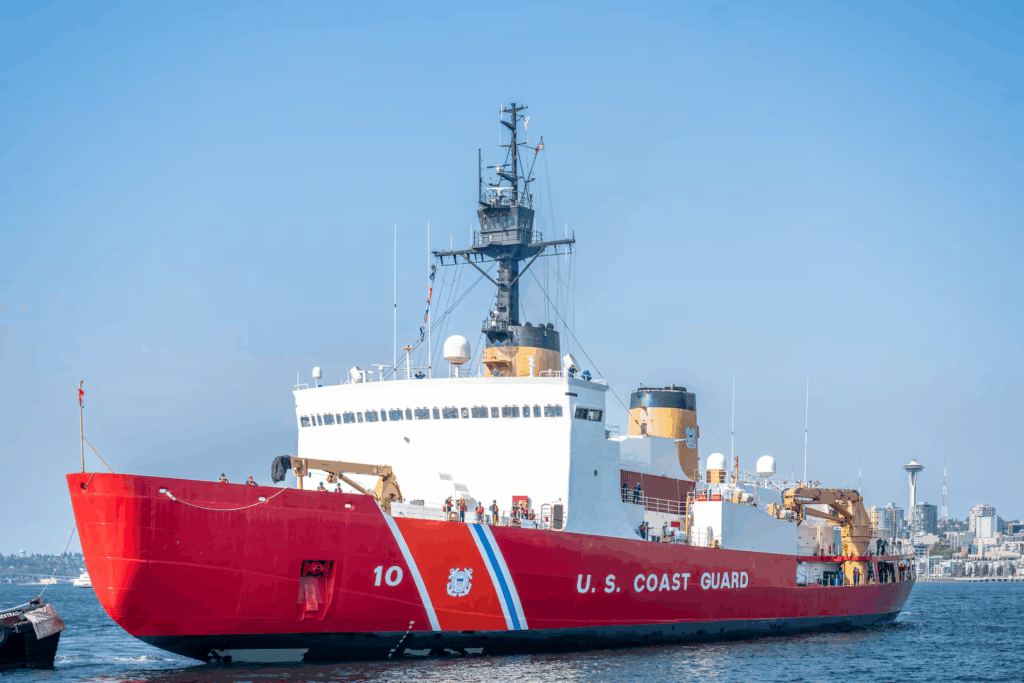
Coast Guard Commissions Icebreaker Storis in Juneau

The Coast Guard Cutter Storis in Juneau for its commissioning as the nation’s newest Arctic icebreaker. Photo credit: Craig S. Neus

JUNEAU, ALASKA— On Saturday, Aug. 10, U.S. Senator Dan Sullivan (R-Alaska) and Admiral Kevin Lunday, acting commandant of the U.S. Coast Guard, participated in the commissioning ceremony of the United States Coast Guard Cutter Storis (WAGB 21) in Juneau.

Storis, the renamed and reconditioned former commercial icebreaker Aiviq, is the country’s first new icebreaker in a quarter century. Sullivan has championed the effort to build new American icebreakers and to procure commercially available icebreakers, and to homeport them in Alaska in order to close the icebreaker gap in the Arctic.

News reporters on the bow-mounted helicopter pad aboard USCGC Storis. Photo credit: Craig S. Neus

“Storis adds vital capability to the U.S. polar icebreaker fleet at a critical time, when our adversaries are expanding their activities in and near U.S. waters, and the challenges and threats we face as a nation are growing more complex every day,” Lunday said at the ceremony.  

“With the arrival of the Storis to its new homeport in Juneau, we mark not just the commissioning of a vessel, but a strategic milestone in America’s Arctic future,”Sullivan said.“This ship is an investment in real capability, real people, and a real presence in the region that defines the next chapter of global security, commerce, and energy. The homeporting of the Storis right here in Juneau sends a clear and deliberate message: The United States is an Arctic nation, Alaska is an Arctic state, and the United States Coast Guard is a capable and growing Arctic force.”

Members of the public and press visit Storis the weekend of its commissioning. Photo credit: Craig S. Neus.

The recent One Big Beautiful Bill, signed into law July 4, included $300 million to support the shoreside infrastructure needed for Storis’ homeporting. Until that is complete, Storis will be temporarily berthed in Seattle, Washington, with the Coast Guard’s two other polar icebreakers.

“The United States is an Arctic nation, and it is so because of the great state of Alaska,” Lunday said.

The United States’ only operational heavy icebreaker, the 1970s-era Polar Star, is undergoing repairs in California and the Coast Guard’s medium icebreaker Healey is returning to homeport for repairs after an engine fire. Meanwhile, Sullivan said, Russia has 55 icebreakers and is building more and by 2025, China, which has no sovereignty over any Arctic waters, is set to surpass the United States’ icebreaker fleet.

A view of the Storis’ bridge. The ship is crewed with a hybrid crew consisting of military cuttermen and civilian mariners. Photo credit: Craig S. Neus

“If we’re not ready to lead in the Arctic, others will, and they’ll be happy to do it for us,” Sullivan said. “That’s why the Storis is so important.”

Lunday said the recent funding bill also funds the beginning of a new generation of icebreakers for the service.

“This is a remarkable moment because it doesn’t happen very often, but it’s going to be happening a lot more,” Lunday said of the commissioning.


U.S. Coast Guard Responds to Increased Chinese Research Vessel Activity in U.S. Arctic

The Zhong Shan Da Xue Ji Di, a Liberian Flagged Research Vessel, owned and operated by the Chinese University Sun Yat-Sen, as detected by a Coast Guard C-130 Hercules aircraft from Air Station Kodiak. (U.S. Coast Guard courtesy photo) 

Release From U.S. Coast Guard Arctic District

JUNEAU, Alaska — The U.S. Coast Guard detected and responded to two Chinese research vessels operating in the U.S. Arctic and is currently monitoring a total of five similar vessels in or near the U.S Arctic.  

On August 5, a C-130J Hercules fixed wing aircraft from Air Station Kodiak responded to the Chinese research vessels Ji Di and the Zhong Shan Da Xue Ji Di.  Both vessels were transiting northeast in the Bering Sea.  

On August 6, the crew of U.S. Coast Guard Cutter Waesche (WMSL 751) again responded to the Zhong Shan Da Xue Ji Di as it was transiting north in the Chukchi Sea above the Arctic Circle, after passing through the Bering Strait. 

The C-130 and USCGC Waesche were patrolling under Operation Frontier Sentinel, an operation that responds to adversaries operating in and around Alaskan and U.S. Arctic waters. The U.S. Coast Guard’s responses are intended to counter malign activities, defend sovereign interests, and promote maritime conduct consistent with international law and norms.  

In July, Coast Guard Arctic District deployed a C-130J Hercules fixed wing aircraft from Air Station Kodiak to query the Xue Long 2, another Chinese research vessel, approximately 290 NM north of Utqiagvik, Alaska. 

The presence of these vessels is consistent with a three-year trend of increased activity from Chinese research vessels operating in the U.S. Arctic. Last year, three Chinese research vessels conducted research operations north of the Bering Strait. 

The Coast Guard Arctic District works in conjunction with international partners, U.S. Northern Command, and Alaskan Command to constantly monitor the activity of foreign vessels operating near U.S. sovereign waters and the extended outer continental shelf to ensure homeland security, homeland defense, and compliance with U.S. and international law. 

The Coast Guard is America’s only surface presence in the Arctic — a growing zone of strategic global competition. A robust national fleet of icebreakers, made possible by historic investment in the Coast Guard, will secure U.S. access, security, and leadership in the Arctic.  

On Sunday, the Coast Guard will commission the Coast Guard Cutter Storis, the newest icebreaker in the fleet, at a ceremony in Juneau. 


Coast Guard District is Economic Nerve Center with Complex Northern Border Challenge

The crew of Coast Guard Cutter Bristol Bay, homeported in Detroit, assists the vessel James R. Barker at Rock Cut in the St. Marys River April 2, 2018. Bristol Bay worked the river to keep the waterway open. Photo credit: U.S. Coast Guard | Chief Petty Officer Nick Gould

Editor’s Note: Since this article first appeared in the July/August issue of Seapower, the 9th District has been renamed the Great Lakes District.

The 9th Coast Guard District, or D9 as it is known to the 5,000 people stationed at more than 78 units across five sectors, encompasses eight U.S. states and the five Great Lakes, including three of the world’s largest by surface area — Lake Superior, Lake Michigan and Lake Huron.

With 6,700 miles of shoreline and a 1,600-nautical-mile international border with Canada, the 9th District ensures safe passage each year for 80 million tons of bulk cargo — iron ore, taconite pellets, grain, salt, concrete and fertilizer — along a handful of vital shipping corridors. In D9, these waterways are essentially narrow passages; in the event of a marine casualty situation, bypasses are scarce. What’s more, 90% of the nation’s iron ore (taconite) comes from open-pit mines in Minnesota and Wisconsin on Lake Superior, where its shipping relies entirely on the Soo Locks, a complex of locks on the St. Marys River without which Lake Superior would be isolated from the rest of the Great Lakes.

Inside the 9th District is the 2,340-mile St. Lawrence Sea­way. The primary access route to North America’s heart­land, the seaway connects the Atlantic Ocean to the head of the Great Lakes. The route is the only navigable link for oceangoing vessels, including cruise ships, to reach the major inland ports of the Great Lakes, among them Ontar­io’s Port of Thunder Bay and the Port of Duluth-Superior.

D9 also has oversight of 5.5 million registered boaters with some of the busiest recreational boating activity in the world. Driving home the economic value of D9’s area of responsibility is the fact that America’s five great lakes contain 20% of the Earth’s fresh surface water, and 40 million Americans rely on the lakes for safe drinking water.

But there’s more: a “Hall-of-Fame” stat one might not expect, according to Rear Admiral Jon P. Hickey, the 9th District commander and senior Coast Guard commander for the Great Lakes and St. Lawrence Seaway.
“If you took the Great Lakes region, the eight states, the two Canadian provinces, the five lakes, and called that a nation, it would be the third-largest GDP in the world [after] the United States and China,” Hickey told Seapower. “The impact that this sector has, it’s real, it’s tangible. In the 9th District, we’re all about safety and security of these maritime regions, these lakes. It is a lifeblood of the U.S. economy.”

D9 is a thriving ecosystem in which all the moving parts — the multitude of lakes and waterways, the valuable cargo, the skilled workforce and the robust, if overworked, fleet — function seamlessly, usually without disruption and therefore, out of the public eye. None of the work is effortless, much less easy. Hickey described the “challenging” narrow passage along the St. Marys River, considered critical infrastructure by the Department of Homeland Security.

“That’s why we have the vessel traffic system. It is absolutely critical what these folks do to manage vessel traffic safely and securely in those waterways,” Hickey said. “You’ve got these … thousand footers [ships] going through there … carrying a product that’s essential to our economy, our security, and if anything were to go wrong, it’s likely [to] block the waterway. These are the things that keep me up at night. The idea of a marine casualty in the St. Marys River, the Detroit River, the St. Clair River because those are the single points of failure in the MTS,” or maritime transportation system.

The regulatory and security landscape surrounding maritime operations on the Great Lakes is nothing if not complex. With 1,600 nautical miles of maritime international border, Hickey said the long-standing cooperation with Canadian maritime authorities is crucial.

“We have an incredible partnership with [our Canadian partners],” Hickey said. “We call it ‘Shiprider,’ where they come on board our vessels, and we go on their vessels. So, it’s a seamless enforcement of Canadian and U.S. laws across that border. We’re ensuring the safety and security of our maritime transportation system, which on the Great Lakes is tantamount to our border. If you were to navigate from the Sioux Locks to Duluth, you would cross the Canadian and U.S. border, staying inside the channel, over 20 times.”

Unique to the 9th District is the Canadian and U.S. Laker fleet, which operates solely within the bounds of the Great Lakes and the St. Lawrence Seaway up to around Montreal, Hickey said. Made of Canadian and U.S. commercial cargo vessels designed for the transport of bulk commodities within the Great Lakes system, the Laker fleet is “not really considered international” and not subject to the same international regulations, such as SOLAS (International Convention for the Safety of Life at Sea), given they only operate within the internal waters of Canada and the U.S.

Meanwhile, the seasonal foreign trade routes through the St. Lawrence Seaway bring foreign flag vessels into the Great Lakes from mid-March to January every year. These vessels are subject to international regulations and must abide by SOLAS requirements because they are in U.S. and Canadian internal waters.

“We have to be very vigilant about … what’s coming in,” Hickey said. “Are they threats to our critical infrastructure, our safety, security? If they meet the threshold for a high-interest vessel, we are going to board them as soon as — or before — they get into the lakes. In the U.S. waters and in the seaway, we’re going to make sure we keep our American public safe and secure.”

Since January, D9 has allocated available operational capacity toward securing and defending the northern border, Hickey said. He said D9 is “leaning into” northern border concerns and intelligence, using resources on hand in anticipation of how border events elsewhere in the country play out.

“We’re also asking the questions of: ‘What would we need if we wanted to do more in the event that … illicit activity increases on the northern border as we continue to lock down the southern border?,’ that balloon effect,” he said. “We have really doubled down on our interagency coordination. [We are] making sure that illegal cross-border activity like drug trafficking and people trafficking is not happening, and we are as committed to that as we are to our search and rescue mission.”

U.S. Coast Guard units coordinated with local partners in a response to a capsized vessel with five persons and a dog in the water off Mackinac Island, Michigan. (U.S. , in August 2024. Photo credit: U.S. Coast Guard Station St. Ignace

The 9th District does the second-most search and rescue cases after the 7th Coast Guard District in the Southeastern U.S. and Caribbean. In the past year, the people of D9 executed more than 2,000 SAR cases across the Great Lakes, Hickey said.

“We saved 873 lives,” he said. “I tell my people, if you save one life, you’ve impacted and changed the lives of everybody in their circle of trust, circle of love, friends, family and loved ones, for the rest of their lives. Search and rescue goes beyond just a mission. It is our special trust with the American public.”

Whether on behalf of recreational boating safety, icebreaking or the uneventful movement of critical bulk cargo, the D9’s Vessel Traffic Service teams rely on a healthy fleet of multimission cutters, response and patrol boats, and, by extension, U.S. Laker cargo vessels. This is not as easy as it sounds, according to Hickey, who said overdue maintenance and slow to no vessel recapitalization are ongoing challenges for VTS operations and overall readiness.

“Those VTS folks are like air traffic controllers. They maintain situational awareness,” Hickey said. “Our U.S. Laker fleet and the Canadian Laker fleet is old, and what we’re witnessing is an increase in our maritime casualties. I am concerned about the health of the fleet. We are in a downward readiness spiral … and it’s due to the perennial underinvestment in our Coast Guard. We have backlogs and maintenance across the board, whether it’s our cutter fleet, our boats, our aircraft or our shore infrastructure.”

In April 2025, DHS issued the Force Design 2028 report, which outlines plans for implementing transformational changes within the Coast Guard, including an overhaul of the agency’s acquisition and contracting system to expedite much-needed new ships. Shortly after the report’s release, Admiral Kevin Lunday, the acting commandant of the Coast Guard, told members of the House Armed Services Committee that efforts were underway and that production milestones outlined in Force Design 2028 are being met.

Hickey said the plans in Force Design 2028 can’t come soon enough. Citing last winter’s above-average ice season in the Great Lakes, he said it was the first time in a while the 9th District had been “stress-tested” with respect to the icebreaking mission. But, thanks to some excellent advanced planning by D9 district staff for maintenance and to complete aids to navigation, or ATONs, in the summer months, they were well prepared.

“We were able to cover down very, very well on the ice season. But, from my perspective, this plan to renew our fleet, our Coast Guard writ large, can’t come soon enough,” Hickey said. “When we talk about Force Design 2028 and recapitalizing the Coast Guard, the VTS system is part of that. We need to recapitalize that system. I am very grateful for the leadership of the administration to get after recapitalization and renewal of the Coast Guard, because it’s not sustainable.”

Daisy Khalifa is a journalist and publicist. With more than 25 years of professional, public affairs and writing experience in Washington, D.C., she recently relocated to the Minneapolis area. Khalifa has consulted and worked full-time in the federal government, for associations and for Fortune 500 companies, among them the Smithsonian Institution, MCI and Nextel Corp.


Coast Guard Announces ‘Chief Petty Officer Class’ for New Waterways Commerce Cutters

Release From U.S. Coast Guard Headquarters

WASHINGTON — The U.S. Coast Guard announced today that its new fleet of Waterways Commerce Cutters (WCC) will be designated as the “Chief Petty Officer Class.” Each cutter will be named in honor of a Coast Guard Chief Petty Officer, recognizing the profound impact and legacy of these leaders within the Service. 

These cutters will replace the Coast Guard’s aging river tender fleet, facilitating the safe, secure and reliable flow of commerce throughout the nation’s Marine Transportation System (MTS). With America’s MTS supporting $5.4 trillion of economic activity, the WCCs will maintain aids to navigation that enable safe movement of food, energy, consumer goods, and raw materials between producers and consumers. Through their stewardship of the MTS, including our vital system of aids to navigation, the WCC fleet will play a critical role in advancing America’s economic security and protecting vital ports and waterways.  

The Coast Guard has received initial approval to produce the first eight WCCs, supported by historic investments made possible through President Trump’s One Big Beautiful Bill Act. The legislation provides nearly $25 billion – the largest single funding commitment in Coast Guard history – including $162 million to accelerate production rates and deliver three cutters ahead of schedule. These modernization efforts are aligned with Force Design 2028, a blueprint introduced by Secretary of Homeland Security Kristi Noem to transform the Coast Guard into a more agile, capable and responsive force.    

The announcement comes on National Lighthouse Day, underscoring the Service’s long-standing role in safeguarding maritime commerce and navigation. Since 1789, Coast Guard missions have been linked to protecting safe passage across America’s waterways, a legacy that continues today with the WCC fleet. 

“Since 1920, Chief Petty Officers and the Chiefs Mess have driven Coast Guard readiness and operational excellence,” said Master Chief Petty Officer of the Coast Guard Phillip Waldron. “These new cutters and their crews will build on that legacy, ensuring maritime commerce flows safely and we continue to control, secure and defend our inland ports and waterways and Marine Transportation System.”  

The Coast Guard maintains nearly 45,000 navigational aids nationwide. This new class of cutters – supported by historic recapitalization efforts and guided by Force Design 2028 – will be instrumental in continuing these vital operations, ensuring safe and efficient waterways and a stronger, more ready and capable Coast Guard for generations to come.  


Austal USA Starts Construction on Second OPC for Coast Guard

MOBILE, Ala. –  Austal USA started construction on its second Heritage-class Offshore Patrol Cutter (OPC), Icarus (WMSM 920).  Like Pickering (WMSM 919), Icarus is being built at the company’s Mobile, Ala. ship manufacturing facility as part of a contract that includes options for up to 11 cutters with a potential value of $3.3 billion.  

“Construction on the first OPC is well underway and we are excited to begin building our second OPC, Icarus,” commented, Harley Combs, vice president surface programs. “Our steel production line is running smoothly with all of the steel modules under construction for Pickering.” 

To accommodate Austal USA’s unique build strategy, the engineering and production teams collaborated to optimize the stage 1 OPC hull structure design to reduce weight, resulting in a more efficient build process and increasing the life expectancy of the vessel.  The Austal USA team also developed a 3-D model for the cutter early in the design process. This allowed each module to be outfitted to a significantly higher percentage than industry benchmarks.   

Icarus is the second USCG cutter to bear the name. The first Icarus, WPC 110, was commissioned in 1932 and was the first Coast Guard ship to sink an enemy submarine during World War II and the first to bring foreign POWs to America since the War of 1812.   

The 360-foot OPC will provide the majority of the Coast Guard’s offshore presence conducting a variety of missions including law enforcement, drug and migrant interdiction, and search and rescue.  With a range of 10,200 nautical miles at 14 knots and a 60-day endurance period, each OPC will be capable of deploying independently or as part of task groups, serving as a mobile command and control platform for surge operations such as hurricane response, mass migration incidents and other events. The cutters will also support Arctic objectives by helping regulate and protect emerging commerce and energy exploration in Alaska. 

Including Icarus, Austal USA has seven ships under construction.  A new assembly building will be used to support the final assembly of the Offshore Patrol Cutters is under completion.  When complete the building  will provide 192,000 square feet of new covered manufacturing space.  The building will consist of three bays, two of which are specifically designed to erect the OPC.