Coast Guard Commissions Icebreaker Storis in Juneau
The Coast Guard Cutter Storis in Juneau for its commissioning as the nation’s newest Arctic icebreaker. Photo credit: Craig S. Neus
JUNEAU, ALASKA— On Saturday, Aug. 10, U.S. Senator Dan Sullivan (R-Alaska) and Admiral Kevin Lunday, acting commandant of the U.S. Coast Guard, participated in the commissioning ceremony of the United States Coast Guard Cutter Storis (WAGB 21) in Juneau.
Storis, the renamed and reconditioned former commercial icebreaker Aiviq, is the country’s first new icebreaker in a quarter century. Sullivan has championed the effort to build new American icebreakers and to procure commercially available icebreakers, and to homeport them in Alaska in order to close the icebreaker gap in the Arctic.
News reporters on the bow-mounted helicopter pad aboard USCGC Storis. Photo credit: Craig S. Neus
“Storis adds vital capability to the U.S. polar icebreaker fleet at a critical time, when our adversaries are expanding their activities in and near U.S. waters, and the challenges and threats we face as a nation are growing more complex every day,” Lunday said at the ceremony.
“With the arrival of the Storis to its new homeport in Juneau, we mark not just the commissioning of a vessel, but a strategic milestone in America’s Arctic future,”Sullivan said.“This ship is an investment in real capability, real people, and a real presence in the region that defines the next chapter of global security, commerce, and energy. The homeporting of the Storis right here in Juneau sends a clear and deliberate message: The United States is an Arctic nation, Alaska is an Arctic state, and the United States Coast Guard is a capable and growing Arctic force.”
Members of the public and press visit Storis the weekend of its commissioning. Photo credit: Craig S. Neus.
The recent One Big Beautiful Bill, signed into law July 4, included $300 million to support the shoreside infrastructure needed for Storis’ homeporting. Until that is complete, Storis will be temporarily berthed in Seattle, Washington, with the Coast Guard’s two other polar icebreakers.
“The United States is an Arctic nation, and it is so because of the great state of Alaska,” Lunday said.
The United States’ only operational heavy icebreaker, the 1970s-era Polar Star, is undergoing repairs in California and the Coast Guard’s medium icebreaker Healey is returning to homeport for repairs after an engine fire. Meanwhile, Sullivan said, Russia has 55 icebreakers and is building more and by 2025, China, which has no sovereignty over any Arctic waters, is set to surpass the United States’ icebreaker fleet.
A view of the Storis’ bridge. The ship is crewed with a hybrid crew consisting of military cuttermen and civilian mariners. Photo credit: Craig S. Neus
“If we’re not ready to lead in the Arctic, others will, and they’ll be happy to do it for us,” Sullivan said. “That’s why the Storis is so important.”
Lunday said the recent funding bill also funds the beginning of a new generation of icebreakers for the service.
“This is a remarkable moment because it doesn’t happen very often, but it’s going to be happening a lot more,” Lunday said of the commissioning.
U.S. Coast Guard Responds to Increased Chinese Research Vessel Activity in U.S. Arctic
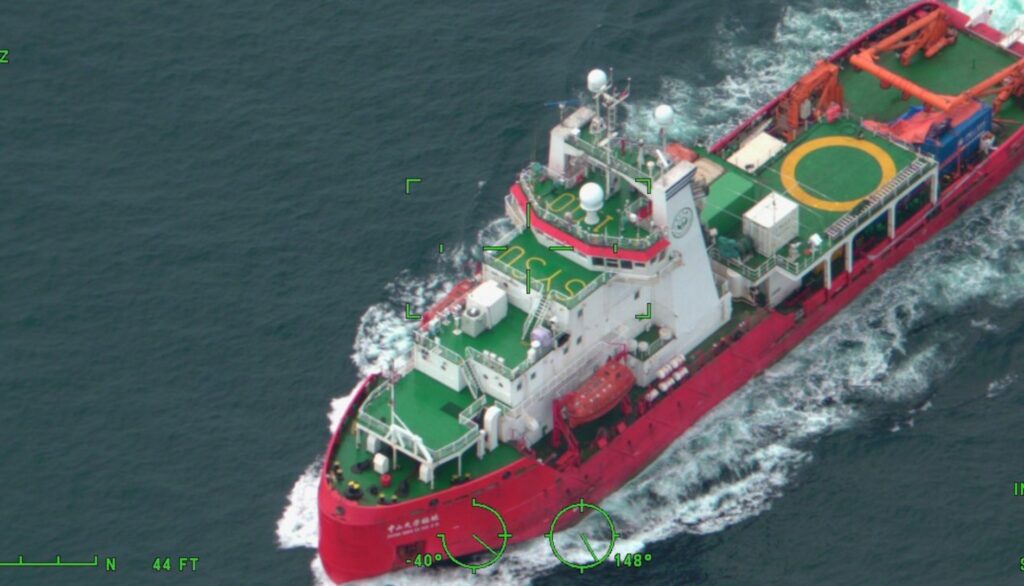
The Zhong Shan Da Xue Ji Di, a Liberian Flagged Research Vessel, owned and operated by the Chinese University Sun Yat-Sen, as detected by a Coast Guard C-130 Hercules aircraft from Air Station Kodiak. (U.S. Coast Guard courtesy photo)
JUNEAU, Alaska — The U.S. Coast Guard detected and responded to two Chinese research vessels operating in the U.S. Arctic and is currently monitoring a total of five similar vessels in or near the U.S Arctic.
On August 5, a C-130J Hercules fixed wing aircraft from Air Station Kodiak responded to the Chinese research vessels Ji Di and the Zhong Shan Da Xue Ji Di. Both vessels were transiting northeast in the Bering Sea.
On August 6, the crew of U.S. Coast Guard Cutter Waesche (WMSL 751) again responded to the Zhong Shan Da Xue Ji Di as it was transiting north in the Chukchi Sea above the Arctic Circle, after passing through the Bering Strait.
The C-130 and USCGC Waesche were patrolling under Operation Frontier Sentinel, an operation that responds to adversaries operating in and around Alaskan and U.S. Arctic waters. The U.S. Coast Guard’s responses are intended to counter malign activities, defend sovereign interests, and promote maritime conduct consistent with international law and norms.
The presence of these vessels is consistent with a three-year trend of increased activity from Chinese research vessels operating in the U.S. Arctic. Last year, three Chinese research vessels conducted research operations north of the Bering Strait.
The Coast Guard Arctic District works in conjunction with international partners, U.S. Northern Command, and Alaskan Command to constantly monitor the activity of foreign vessels operating near U.S. sovereign waters and the extended outer continental shelf to ensure homeland security, homeland defense, and compliance with U.S. and international law.
The Coast Guard is America’s only surface presence in the Arctic — a growing zone of strategic global competition. A robust national fleet of icebreakers, made possible by historic investment in the Coast Guard, will secure U.S. access, security, and leadership in the Arctic.
On Sunday, the Coast Guard will commission the Coast Guard Cutter Storis, the newest icebreaker in the fleet, at a ceremony in Juneau.
Coast Guard District is Economic Nerve Center with Complex Northern Border Challenge
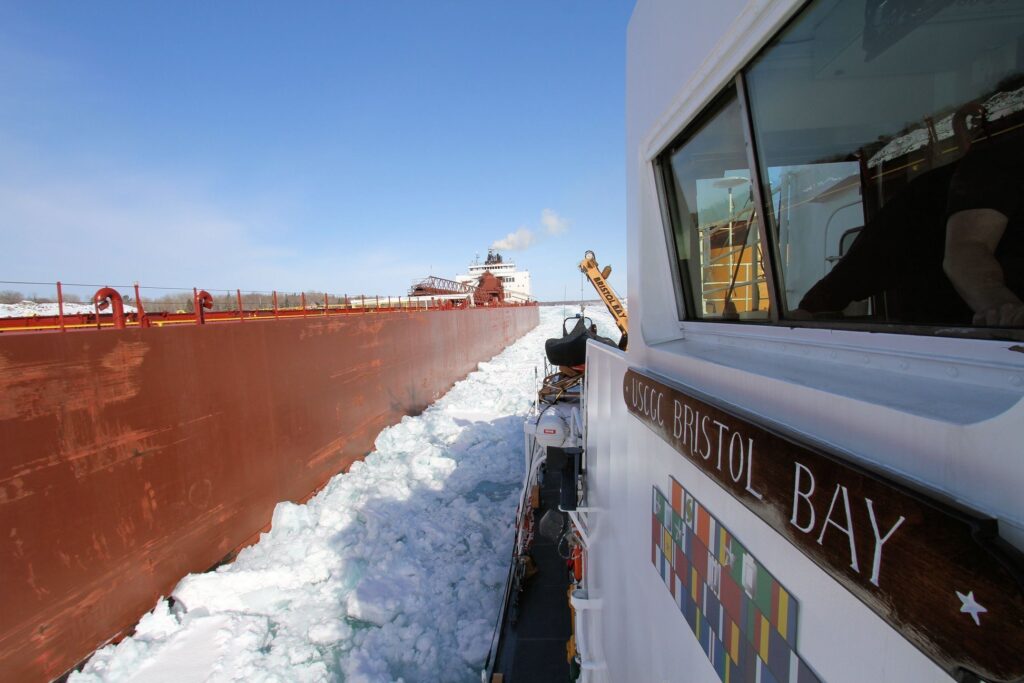
The crew of Coast Guard Cutter Bristol Bay, homeported in Detroit, assists the vessel James R. Barker at Rock Cut in the St. Marys River April 2, 2018. Bristol Bay worked the river to keep the waterway open. Photo credit: U.S. Coast Guard | Chief Petty Officer Nick Gould
Editor’s Note: Since this article first appeared in the July/August issue of Seapower, the 9th District has been renamed the Great Lakes District.
The 9th Coast Guard District, or D9 as it is known to the 5,000 people stationed at more than 78 units across five sectors, encompasses eight U.S. states and the five Great Lakes, including three of the world’s largest by surface area — Lake Superior, Lake Michigan and Lake Huron.
With 6,700 miles of shoreline and a 1,600-nautical-mile international border with Canada, the 9th District ensures safe passage each year for 80 million tons of bulk cargo — iron ore, taconite pellets, grain, salt, concrete and fertilizer — along a handful of vital shipping corridors. In D9, these waterways are essentially narrow passages; in the event of a marine casualty situation, bypasses are scarce. What’s more, 90% of the nation’s iron ore (taconite) comes from open-pit mines in Minnesota and Wisconsin on Lake Superior, where its shipping relies entirely on the Soo Locks, a complex of locks on the St. Marys River without which Lake Superior would be isolated from the rest of the Great Lakes.
Inside the 9th District is the 2,340-mile St. Lawrence Seaway. The primary access route to North America’s heartland, the seaway connects the Atlantic Ocean to the head of the Great Lakes. The route is the only navigable link for oceangoing vessels, including cruise ships, to reach the major inland ports of the Great Lakes, among them Ontario’s Port of Thunder Bay and the Port of Duluth-Superior.
D9 also has oversight of 5.5 million registered boaters with some of the busiest recreational boating activity in the world. Driving home the economic value of D9’s area of responsibility is the fact that America’s five great lakes contain 20% of the Earth’s fresh surface water, and 40 million Americans rely on the lakes for safe drinking water.
But there’s more: a “Hall-of-Fame” stat one might not expect, according to Rear Admiral Jon P. Hickey, the 9th District commander and senior Coast Guard commander for the Great Lakes and St. Lawrence Seaway. “If you took the Great Lakes region, the eight states, the two Canadian provinces, the five lakes, and called that a nation, it would be the third-largest GDP in the world [after] the United States and China,” Hickey told Seapower. “The impact that this sector has, it’s real, it’s tangible. In the 9th District, we’re all about safety and security of these maritime regions, these lakes. It is a lifeblood of the U.S. economy.”
D9 is a thriving ecosystem in which all the moving parts — the multitude of lakes and waterways, the valuable cargo, the skilled workforce and the robust, if overworked, fleet — function seamlessly, usually without disruption and therefore, out of the public eye. None of the work is effortless, much less easy. Hickey described the “challenging” narrow passage along the St. Marys River, considered critical infrastructure by the Department of Homeland Security.
“That’s why we have the vessel traffic system. It is absolutely critical what these folks do to manage vessel traffic safely and securely in those waterways,” Hickey said. “You’ve got these … thousand footers [ships] going through there … carrying a product that’s essential to our economy, our security, and if anything were to go wrong, it’s likely [to] block the waterway. These are the things that keep me up at night. The idea of a marine casualty in the St. Marys River, the Detroit River, the St. Clair River because those are the single points of failure in the MTS,” or maritime transportation system.
The regulatory and security landscape surrounding maritime operations on the Great Lakes is nothing if not complex. With 1,600 nautical miles of maritime international border, Hickey said the long-standing cooperation with Canadian maritime authorities is crucial.
“We have an incredible partnership with [our Canadian partners],” Hickey said. “We call it ‘Shiprider,’ where they come on board our vessels, and we go on their vessels. So, it’s a seamless enforcement of Canadian and U.S. laws across that border. We’re ensuring the safety and security of our maritime transportation system, which on the Great Lakes is tantamount to our border. If you were to navigate from the Sioux Locks to Duluth, you would cross the Canadian and U.S. border, staying inside the channel, over 20 times.”
Unique to the 9th District is the Canadian and U.S. Laker fleet, which operates solely within the bounds of the Great Lakes and the St. Lawrence Seaway up to around Montreal, Hickey said. Made of Canadian and U.S. commercial cargo vessels designed for the transport of bulk commodities within the Great Lakes system, the Laker fleet is “not really considered international” and not subject to the same international regulations, such as SOLAS (International Convention for the Safety of Life at Sea), given they only operate within the internal waters of Canada and the U.S.
Meanwhile, the seasonal foreign trade routes through the St. Lawrence Seaway bring foreign flag vessels into the Great Lakes from mid-March to January every year. These vessels are subject to international regulations and must abide by SOLAS requirements because they are in U.S. and Canadian internal waters.
“We have to be very vigilant about … what’s coming in,” Hickey said. “Are they threats to our critical infrastructure, our safety, security? If they meet the threshold for a high-interest vessel, we are going to board them as soon as — or before — they get into the lakes. In the U.S. waters and in the seaway, we’re going to make sure we keep our American public safe and secure.”
Since January, D9 has allocated available operational capacity toward securing and defending the northern border, Hickey said. He said D9 is “leaning into” northern border concerns and intelligence, using resources on hand in anticipation of how border events elsewhere in the country play out.
“We’re also asking the questions of: ‘What would we need if we wanted to do more in the event that … illicit activity increases on the northern border as we continue to lock down the southern border?,’ that balloon effect,” he said. “We have really doubled down on our interagency coordination. [We are] making sure that illegal cross-border activity like drug trafficking and people trafficking is not happening, and we are as committed to that as we are to our search and rescue mission.”
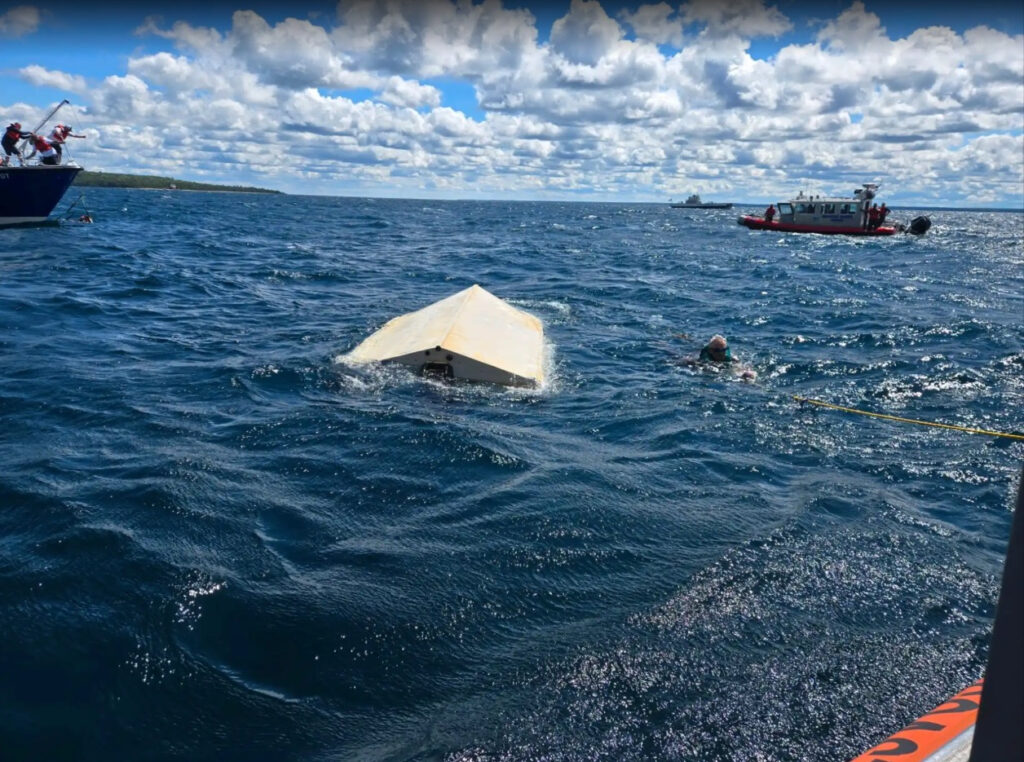
U.S. Coast Guard units coordinated with local partners in a response to a capsized vessel with five persons and a dog in the water off Mackinac Island, Michigan. (U.S. , in August 2024. Photo credit: U.S. Coast Guard Station St. Ignace
The 9th District does the second-most search and rescue cases after the 7th Coast Guard District in the Southeastern U.S. and Caribbean. In the past year, the people of D9 executed more than 2,000 SAR cases across the Great Lakes, Hickey said.
“We saved 873 lives,” he said. “I tell my people, if you save one life, you’ve impacted and changed the lives of everybody in their circle of trust, circle of love, friends, family and loved ones, for the rest of their lives. Search and rescue goes beyond just a mission. It is our special trust with the American public.”
Whether on behalf of recreational boating safety, icebreaking or the uneventful movement of critical bulk cargo, the D9’s Vessel Traffic Service teams rely on a healthy fleet of multimission cutters, response and patrol boats, and, by extension, U.S. Laker cargo vessels. This is not as easy as it sounds, according to Hickey, who said overdue maintenance and slow to no vessel recapitalization are ongoing challenges for VTS operations and overall readiness.
“Those VTS folks are like air traffic controllers. They maintain situational awareness,” Hickey said. “Our U.S. Laker fleet and the Canadian Laker fleet is old, and what we’re witnessing is an increase in our maritime casualties. I am concerned about the health of the fleet. We are in a downward readiness spiral … and it’s due to the perennial underinvestment in our Coast Guard. We have backlogs and maintenance across the board, whether it’s our cutter fleet, our boats, our aircraft or our shore infrastructure.”
In April 2025, DHS issued the Force Design 2028 report, which outlines plans for implementing transformational changes within the Coast Guard, including an overhaul of the agency’s acquisition and contracting system to expedite much-needed new ships. Shortly after the report’s release, Admiral Kevin Lunday, the acting commandant of the Coast Guard, told members of the House Armed Services Committee that efforts were underway and that production milestones outlined in Force Design 2028 are being met.
Hickey said the plans in Force Design 2028 can’t come soon enough. Citing last winter’s above-average ice season in the Great Lakes, he said it was the first time in a while the 9th District had been “stress-tested” with respect to the icebreaking mission. But, thanks to some excellent advanced planning by D9 district staff for maintenance and to complete aids to navigation, or ATONs, in the summer months, they were well prepared.
“We were able to cover down very, very well on the ice season. But, from my perspective, this plan to renew our fleet, our Coast Guard writ large, can’t come soon enough,” Hickey said. “When we talk about Force Design 2028 and recapitalizing the Coast Guard, the VTS system is part of that. We need to recapitalize that system. I am very grateful for the leadership of the administration to get after recapitalization and renewal of the Coast Guard, because it’s not sustainable.”
Daisy Khalifa is a journalist and publicist. With more than 25 years of professional, public affairs and writing experience in Washington, D.C., she recently relocated to the Minneapolis area. Khalifa has consulted and worked full-time in the federal government, for associations and for Fortune 500 companies, among them the Smithsonian Institution, MCI and Nextel Corp.
Coast Guard Announces ‘Chief Petty Officer Class’ for New Waterways Commerce Cutters
WASHINGTON — The U.S. Coast Guard announced today that its new fleet of Waterways Commerce Cutters (WCC) will be designated as the “Chief Petty Officer Class.” Each cutter will be named in honor of a Coast Guard Chief Petty Officer, recognizing the profound impact and legacy of these leaders within the Service.
These cutters will replace the Coast Guard’s aging river tender fleet, facilitating the safe, secure and reliable flow of commerce throughout the nation’s Marine Transportation System (MTS). With America’s MTS supporting $5.4 trillion of economic activity, the WCCs will maintain aids to navigation that enable safe movement of food, energy, consumer goods, and raw materials between producers and consumers. Through their stewardship of the MTS, including our vital system of aids to navigation, the WCC fleet will play a critical role in advancing America’s economic security and protecting vital ports and waterways.
The Coast Guard has received initial approval to produce the first eight WCCs, supported by historic investments made possible through President Trump’s One Big Beautiful Bill Act. The legislation provides nearly $25 billion – the largest single funding commitment in Coast Guard history – including $162 million to accelerate production rates and deliver three cutters ahead of schedule. These modernization efforts are aligned with Force Design 2028, a blueprint introduced by Secretary of Homeland Security Kristi Noem to transform the Coast Guard into a more agile, capable and responsive force.
The announcement comes on National Lighthouse Day, underscoring the Service’s long-standing role in safeguarding maritime commerce and navigation. Since 1789, Coast Guard missions have been linked to protecting safe passage across America’s waterways, a legacy that continues today with the WCC fleet.
“Since 1920, Chief Petty Officers and the Chiefs Mess have driven Coast Guard readiness and operational excellence,” said Master Chief Petty Officer of the Coast Guard Phillip Waldron. “These new cutters and their crews will build on that legacy, ensuring maritime commerce flows safely and we continue to control, secure and defend our inland ports and waterways and Marine Transportation System.”
The Coast Guard maintains nearly 45,000 navigational aids nationwide. This new class of cutters – supported by historic recapitalization efforts and guided by Force Design 2028 – will be instrumental in continuing these vital operations, ensuring safe and efficient waterways and a stronger, more ready and capable Coast Guard for generations to come.
Austal USA Starts Construction on Second OPC for Coast Guard
MOBILE, Ala. – Austal USA started construction on its second Heritage-class Offshore Patrol Cutter (OPC), Icarus (WMSM 920). Like Pickering (WMSM 919), Icarus is being built at the company’s Mobile, Ala. ship manufacturing facility as part of a contract that includes options for up to 11 cutters with a potential value of $3.3 billion.
“Construction on the first OPC is well underway and we are excited to begin building our second OPC, Icarus,” commented, Harley Combs, vice president surface programs. “Our steel production line is running smoothly with all of the steel modules under construction for Pickering.”
To accommodate Austal USA’s unique build strategy, the engineering and production teams collaborated to optimize the stage 1 OPC hull structure design to reduce weight, resulting in a more efficient build process and increasing the life expectancy of the vessel. The Austal USA team also developed a 3-D model for the cutter early in the design process. This allowed each module to be outfitted to a significantly higher percentage than industry benchmarks.
Icarus is the second USCG cutter to bear the name. The first Icarus, WPC 110, was commissioned in 1932 and was the first Coast Guard ship to sink an enemy submarine during World War II and the first to bring foreign POWs to America since the War of 1812.
The 360-foot OPC will provide the majority of the Coast Guard’s offshore presence conducting a variety of missions including law enforcement, drug and migrant interdiction, and search and rescue. With a range of 10,200 nautical miles at 14 knots and a 60-day endurance period, each OPC will be capable of deploying independently or as part of task groups, serving as a mobile command and control platform for surge operations such as hurricane response, mass migration incidents and other events. The cutters will also support Arctic objectives by helping regulate and protect emerging commerce and energy exploration in Alaska.
Including Icarus, Austal USA has seven ships under construction. A new assembly building will be used to support the final assembly of the Offshore Patrol Cutters is under completion. When complete the building will provide 192,000 square feet of new covered manufacturing space. The building will consist of three bays, two of which are specifically designed to erect the OPC.
Coast Guard Offloads $88M in Illicit Drugs Interdicted in the Eastern Pacific
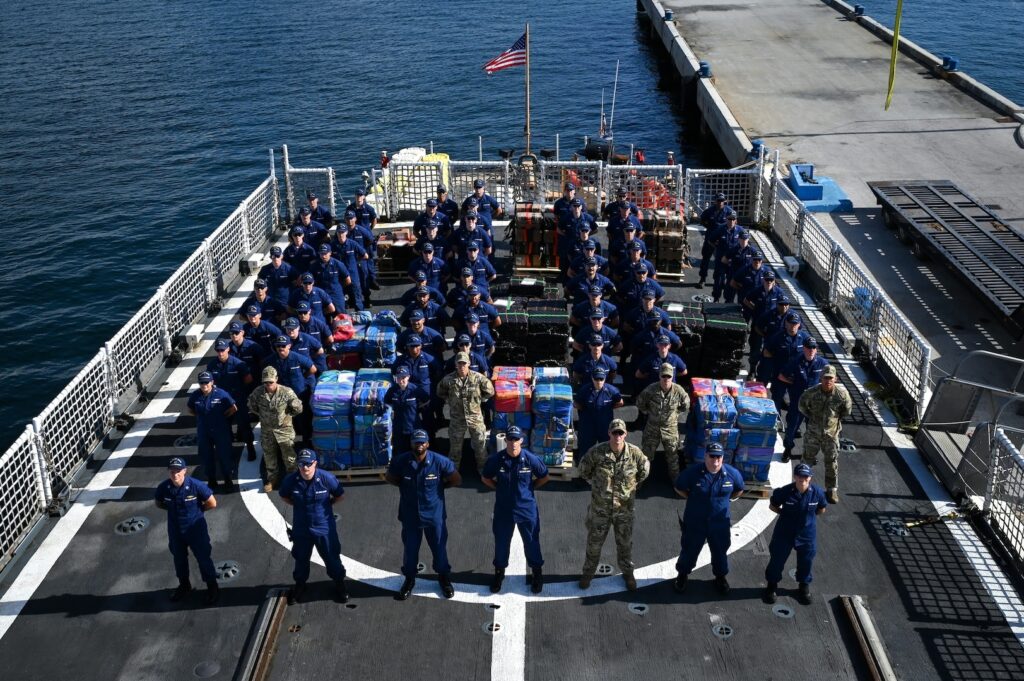
The crew of the U.S. Coast Guard Cutter Escanaba standing at parade rest on the flight deck at Port Everglades, Florida, August 5, 2025. The seized contraband was transferred to partner agencies for accountability and destruction. (U.S. Coast Guard photo by Petty Officer 3rd Class Jessica Walker)
MIAMI – U.S. Coast Guard Cutter Escanaba’s crew offloaded approximately 11,922 pounds of cocaine worth an estimated $88.2 million, Tuesday, at Port Everglades.
The seized contraband was the result of three separate interdictions in the eastern Pacific by the crew of the Escanaba, Pacific Area Tactical Law Enforcement Team, and embarked Coast Guard Helicopter Interdiction Tactical Squadron aircrew.
“The professionalism and cohesiveness of our team on board were the biggest contributors to our operational successes,” said Petty Officer Third Class Nadia Sands, an Operations Specialist in the cutter’s Combat Information Center. “This crew and command routinely embody the spirit of ‘One Team, One Dream’ and that spirit will continue to drive us to achieving our goals of protecting our borders and countering transnational criminal actors in the region.”
The following assets and crews were involved in the interdiction operations:
U.S. Coast Guard Cutter Escanaba (WMEC 907)
U.S. Coast Guard Helicopter Interdiction Tactical Squadron
U.S. Coast Guard Pacific Area Tactical Law Enforcement Team
Detecting and interdicting illicit drug traffickers on the high seas involves significant coordination. Joint Interagency Task Force-South conducts the detection and monitoring of aerial and maritime transit of illegal drugs. Once an interdiction becomes imminent, the law enforcement phase of the operation begins, and control of the operation shifts to the U.S. Coast Guard for the interdiction and apprehension phases. Interdictions in the Eastern Pacific Ocean are performed by members of the U.S. Coast Guard under the authority and control of the Southwest Coast Guard District, headquartered in Alameda, California.
Make a difference on land, at sea or in the air with the Coast Guard. Visit GoCoastGuard.com to learn more about active duty and reserve, officer and enlisted opportunities. Information on how to apply to the U.S. Coast Guard Academy can be found here.
Bollinger Shipyards Applauds Full Funding of Polar Security Cutter Program
Release From Bollinger Shipyards
PASCAGOULA, Miss. — August 5, 2025 — With the recent enactment of the “One Big Beautiful Bill Act,” the U.S. Coast Guard’s Polar Security Cutter (PSC) program is now funded through completion of all three vessels – a historic milestone for American shipbuilding and a strong affirmation of the federal government’s full confidence in Bollinger’s ability to deliver this critical national asset.
“This is more than a funding milestone—it’s a vote of confidence in American industrial capability and in Bollinger’s proven ability to deliver,” said Ben Bordelon, President and CEO of Bollinger Shipyards. “We took on a troubled program knowing the stakes were high. Since day one, our team has been laser-focused on restoring momentum, rebuilding trust, and delivering results. Today’s announcement is a testament to that effort.”
The recently enacted “One Big Beautiful Bill Act” included $4.3 billion for the advanced procurement and construction of vessels two and three of the PSC program, fully funding the program through completion.
Bollinger acquired the PSC program from Singapore-based ST Engineering in 2022 through its acquisition of VT Halter Marine. At the time, the program faced significant challenges, including schedule delays, cost overruns, and an incomplete concept design. Since then, Bollinger has worked in close partnership with the U.S. Coast Guard and Navy to stabilize and restructure the program, bringing it back on track through disciplined project management, strategic investment, and a revitalized workforce.
Earlier this year, Bollinger received a $951.6 million contract modification to advance the construction of the first PSC. With the new funding secured for vessels two and three, the program is now fully resourced to deliver a modern fleet of heavy icebreakers capable of operating in the most extreme polar environments.
The PSC program is the cornerstone of the Coast Guard’s Arctic and Antarctic strategy, enabling year-round access to polar regions for national defense, scientific research, and maritime sovereignty. The new cutters will be the first American-built heavy icebreakers in nearly 50 years.
“Bollinger is proud to be building the most advanced icebreaking vessels in U.S. history,” Bordelon added. “We’re not just building ships—we’re building capability, security, and opportunity for generations to come.”
As Bollinger continues to enhance its operations in Mississippi into world-class shipyards, the company remains committed to making strategic investments to modernize and expand its capabilities. Since acquiring VT Halter, Bollinger has made a significant economic impact in the state through targeted investments and workforce expansion. To date, Bollinger has invested $76 million across its Mississippi facilities, including Bollinger Mississippi Shipbuilding (BMS), Bollinger Mississippi Repair (BMR), Bollinger Gulfport Shipyard (BGS), and CHAND Gulf Coast.
“Mississippi shipbuilders are the best in the nation and this is further proof of that,” said Mississippi Governor Tate Reeves. “Our state has what it takes to deliver results and keep our country safe. Congratulations to the entire Bollinger team on this incredible win for Mississippi.”
Since the acquisition in 2022, Bollinger has increased its Mississippi workforce by over 61%, with production roles at BMS alone increasing by more than 178%. These numbers are expected to rise as the program reaches full production over the coming years. A key driver of this growth has been Bollinger’s innovative Bootcamp workforce development programs, which continue to strengthen the skilled labor pipeline.
“Our investment in developing the next generation of skilled American workers not only strengthens our competitive edge in the shipbuilding industry but also underscores our commitment to fostering economic growth and American innovation,” added Bordelon. “We are committed to providing high-quality careers that positively impact the families and communities we support along Mississippi’s Gulf coast.”
This contract modification primarily supports operations at Bollinger Mississippi Shipbuilding, with additional project contributions from facilities located in Massachusetts, Illinois, Virginia, Georgia, Louisiana, and other regions. Completion of the first Polar Security Cutter is anticipated by May 2030.
The Polar Security Cutter will provide the United States with enhanced operational capability in polar regions, playing a critical role in safeguarding national security, economic stability, and supporting vital maritime and commercial interests.
Austal USA Receives Contract for Second Offshore Patrol Cutter
Release From Austal USA
Mobile, Ala. – Austal USA has received a contract option award from the U.S. Coast Guard for the construction of the second Stage 2 Heritage-class Offshore Patrol Cutter (OPC) and acquisition of long lead-time material to support construction of a third Stage 2 OPC. The $273 million option is part of a contract that includes options for up to 11 OPCs with a potential value of $3.3 billion.
“The exercise of this option is a strong sign of the successful partnership between the Coast Guard and our shipbuilding team on the OPC program,” commented Austal USA President Michelle Kruger. “This award is an important step in moving into serial production and delivering this critical capability. It is a testament to the capabilities of our talented shipbuilders at Austal USA.”
Austal USA began building the company’s first OPC, Pickering, last summer. All of Pickering’s steel modules are under construction in Austal USA’s steel assembly line. Construction on the second cutter will begin this week. Progress on the OPC program is occurring concurrently with a major facility with $750M in construction underway to increase capacity for both surface vessel and submarine manufacturing. The OPC joins the U.S. Navy’s Towing Salvage and Rescue (T-ATS) and Landing Craft Utility (LCU) programs in serial production in the company’s Mobile ship manufacturing facility.
The 360-foot OPC will provide the majority of the Coast Guard’s offshore presence conducting a variety of missions including law enforcement, drug and migrant interdiction, and search and rescue. With a range of 10,200 nautical miles at 14 knots and a 60-day endurance period, each OPC will be capable of deploying independently or as part of task groups, serving as a mobile command and control platform for surge operations such as hurricane response, mass migration incidents and other events. The cutters will also support Arctic objectives by helping regulate and protect emerging commerce and energy exploration in Alaska.
Shield AI’s New V-BAT Passes Operational Evaluation with U.S. Coast Guard
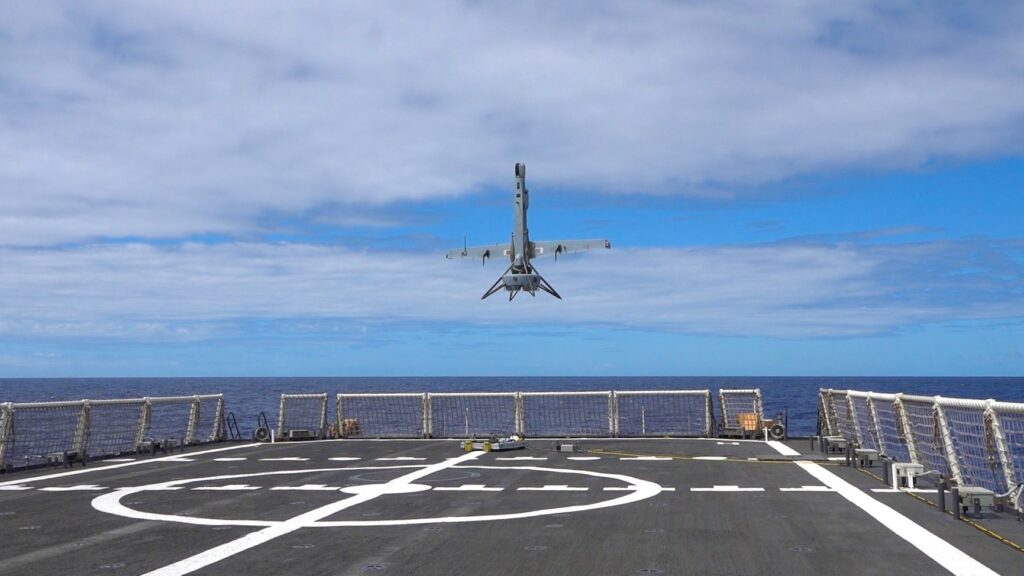
SAN DIEGO (July 31, 2025) – Shield AI, the deep-tech company developing cutting-edge autonomy software and next-generation defense aircraft, announced that its new V-BAT 5.3 unmanned aircraft system (UAS) has successfully completed Operational Test & Evaluation (OT&E) with the U.S. Coast Guard.
The V-BAT passed the operational test by scoring 100% on all Key Performance Parameters and Key System Attributes aboard Coast Guard Cutter Midgett over the course of four days of flight tests. This milestone clears the way for full deployment under a $198 million indefinite-delivery, indefinite-quantity firm fixed-price contract awarded in June 2024 to deliver Intelligence, Surveillance, and Reconnaissance (ISR) services using the V-BAT platform.
“V-BAT’s role in the Coast Guard’s transformation under Force Design 2028 underscores how rapidly unmanned systems are reshaping maritime operations,” said Brandon Tseng, Shield AI’s President, Co-founder, and former Navy SEAL. “Passing this OT&E on time and on target is an important milestone, but it’s just the beginning. Our focus now turns to expanding the V-BAT capability within the Coast Guard to deliver outcomes every day at unprecedented scale.”
V-BAT is Shield AI’s operationally deployed single-engine, ducted-fan vertical take-off and landing (VTOL) UAS, capable of launching and recovering without personnel. Trusted by U.S. and international forces, it supports a broad range of missions across Group 1 to Group 5 categories and beyond.
U.S. Coast Guard Cutter Stratton Returns Home Following 134-day Western Pacific Patrol
U.S. Coast Guard Cutter Stratton (WMSL 752) transits the San Francisco Bay after crossing under the Bay Bridge during the ship’s return to its Alameda, California, July 30, 2025. National security cutters are 418-feet long, 54-feet wide, and can hold a crew of up to 170. (U.S. Coast Guard photo by Petty Officer 3rd Class Austin Wiley)
From U.S. Coast Guard Oceania District, July 31, 2025
ALAMEDA, Calif. — The U.S. Coast Guard Cutter Stratton (WMSL 752) and crew returned to their Base Alameda home port, Wednesday, following a 134-day patrol in the Indo-Pacific.
Stratton’s crew engaged in professional exchanges, cultural events, and joint exercises with Japan, Republic of Korea and the Philippines, including at-sea search-and-rescue and interdiction exercises.
Expanded U.S. Coast Guard presence in the Indo-Pacific facilitates professional exchanges that strengthen our mutual capacity and interoperability with allies and partners, creating opportunities to expand maritime domain awareness in support of a secure and prosperous Indo-Pacific through unrestricted access to the maritime commons.
In Puerta Princesa, Philippines, Stratton conducted joint operations with the U.S. Coast Guard Maritime Security Response Team West and Philippine Coast Guard (PCG) Special Operations Forces and hosted the U.S. Ambassador to the Philippines, MaryKay Carlson, and PCG Commandant Adm. Ronnie Gil Gavan.
In Busan, Republic of Korea, Stratton participated in a search and rescue (SAR) tabletop exercise with ten countries for international mission collaboration. Stratton also conducted a trilateral partner nation engagement with the PCG and Japan Coast Guard in Kagoshima, Japan, during which the crew led ship’s tours, tabletop discussions and an at-sea SAR exercise, marking the first time the PCG operated with the U.S. Coast Guard outside their Exclusive Economic Zone.
While anchored in Koror, Palau, Stratton hosted the President of Palau and U.S. Ambassador to Palau, Joel Ehrendreich. The event highlighted the importance of the U.S partnership as Stratton was the first in its class to visit Palau.
Supporting a White House initiative for the Quadrilateral Security Dialogue, Stratton hosted six observers from India Coast Guard, Japan Coast Guard, and Australian Border Force, for the first-ever Quad at-sea ship observer mission to improve interoperability in the Indo-Pacific.
The U.S. Coast Guard navigates with our Quad partners to leverage and network respective maritime security capabilities toward cooperation on key maritime issues of mutual concern and significant value to Indo-Pacific stability.
Additionally, Stratton’s crew embarked three law enforcement officers from the Republic of the Marshall Islands (RMI) Sea Patrol, who provided a combined presence and conducted two successful maritime law enforcement boardings of commercial fishing vessels operating in the RMI EEZ. While no violations were initially reported from the boarding, potential issues with the catch emerged later and constituted further inspection from RMI.
Stratton’s deployment contributed to regional cooperation and enhanced global maritime governance through integrated deterrence and strengthened partnerships.
“The crew is excited to return home after a long but incredibly important deployment,” says Capt. Dorothy Hernaez, Stratton’s commanding officer. “Stratton and her crew showcased that the U.S. Coast Guard is a global Coast Guard. Through presence and partner engagement in the Indo-Pacific, Stratton advanced regional stability that in turn provides for homeland security, peace, and prosperity.”
Hernaez assumed command of the Stratton during a change of command ceremony held in Honolulu on July 22, as the cutter transited toward its home port.
Commissioned in 2012, Stratton is one of ten Legend-class national security cutters and one of four homeported in Alameda. National security cutters are 418-feet long, 54-feet wide, and have a 4,600 long-ton displacement. They have a top speed of 28 knots, a range of 12,000 nautical miles, and can hold a crew of up to 170. National security cutters routinely conduct operations throughout the Pacific, where their unmatched combination of range, speed, and ability to operate in extreme weather provides the mission flexibility necessary to conduct vital strategic missions.
The namesake of U.S. Coast Guard Cutter Stratton is Capt. Dorothy Stratton, who led the service’s all-female reserve force during World War II. Dorothy Stratton was the first female commissioned officer in the Coast Guard and commanded more than 10,000 personnel. The ship’s motto is “We Can’t Afford Not To.”