Coast Guard Cutter Reliance Returns Home to Florida After 60-day Patrol
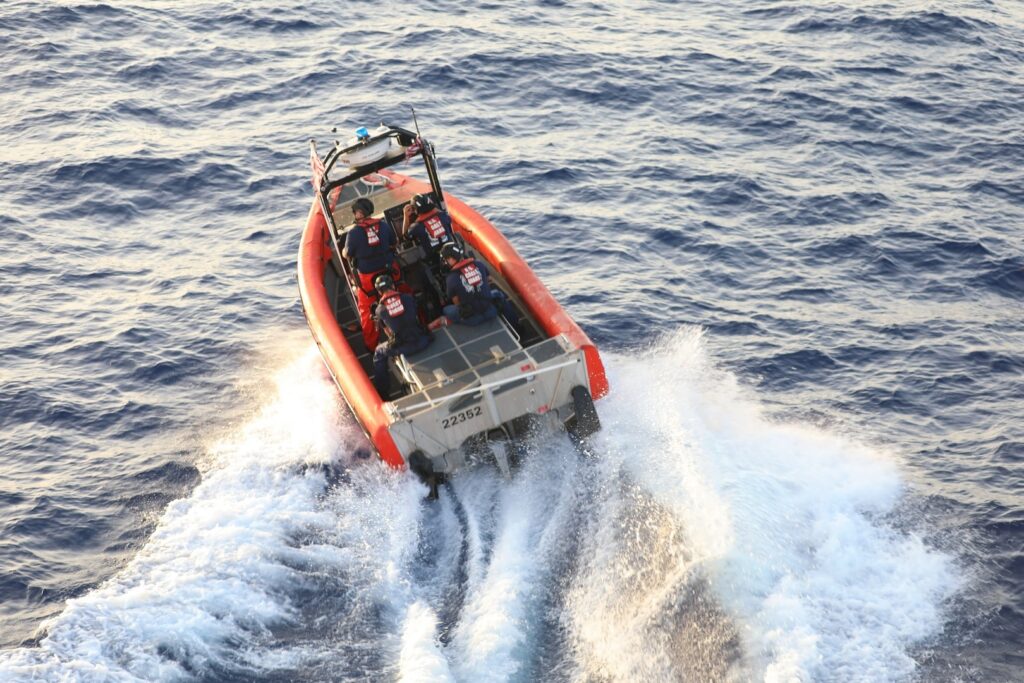
 Coast Guard Cutter Reliance (WMEC 615) small boat crew conducts operations in the Gulf of America, July 15, 2025. Reliance’s crew completed a 60-day maritime border security patrol to deter illegal migration, fishing, and smuggling in the region. (U.S. Coast Guard photo by Ensign Jack Steel)

From U.S. Coast Guard Atlantic Area

PENSACOLA, Fla. — The crew of the Coast Guard Cutter Reliance (WMEC 615) returned to their home port in Pensacola, Friday, following a 60-day maritime border security patrol in the Gulf of America. 

Reliance’s crew deployed to the Coast Guard Heartland District’s area of responsibility in support of maritime safety, security and environmental protection, where crew members conducted extensive operations along the U.S. – Mexico maritime border to protect American sovereignty and territorial integrity. While at sea, the crew worked to deter illegal migration, fishing and smuggling while increasing awareness of all maritime activity in the region. 

During the patrol, Reliance’s crew visited Galveston, Texas, near where the cutter was constructed in 1964. While in Galveston, the crew hosted free public tours over Independence Day weekend, welcoming over 800 members of the public on board for an up-close look at life aboard a Coast Guard cutter while providing informational materials to prospective recruits. 

Additionally, Reliance’s crew was honored to receive a visit from Master Chief Petty Officer Michael Koch, command master chief, Coast Guard Heartland District, who recognized Reliance’s very own Petty Officer 1st Class Cody Scott, a storekeeper on board, as the Heartland District 2024 Enlisted Person of the Year. 

“I am incredibly proud and impressed by the Reliance crew’s professionalism, resilience and skill, which they demonstrated throughout this patrol,” said Cmdr. Kevin Robinson, commanding officer of Reliance. “Their unwavering dedication to protecting our nation’s marine resources and deterring illegal activity at our maritime border reflects the very best of the Coast Guard. Their efforts not only safeguarded American lives and livelihoods but reinforced the Coast Guard’s commitment to mission excellence in maritime safety and security.” 

Reliance is a 210-foot, Reliance-class medium-endurance cutter with a crew of 77. The cutter’s primary missions include counter-narcotics and alien interdiction, enforcement of living marine resource laws, and search and rescue throughout the Western Hemisphere. 

For information on how to join the U.S. Coast Guard, visit GoCoastGuard.com to learn about active duty, reserve, officer and enlisted opportunities. Information on how to apply to the U.S. Coast Guard Academy can be found here.   
For more, follow us on Facebook, Instagram and X.   


U.S. Coast Guard, USS Sampson Conduct Drug Interdiction in Eastern Pacific 

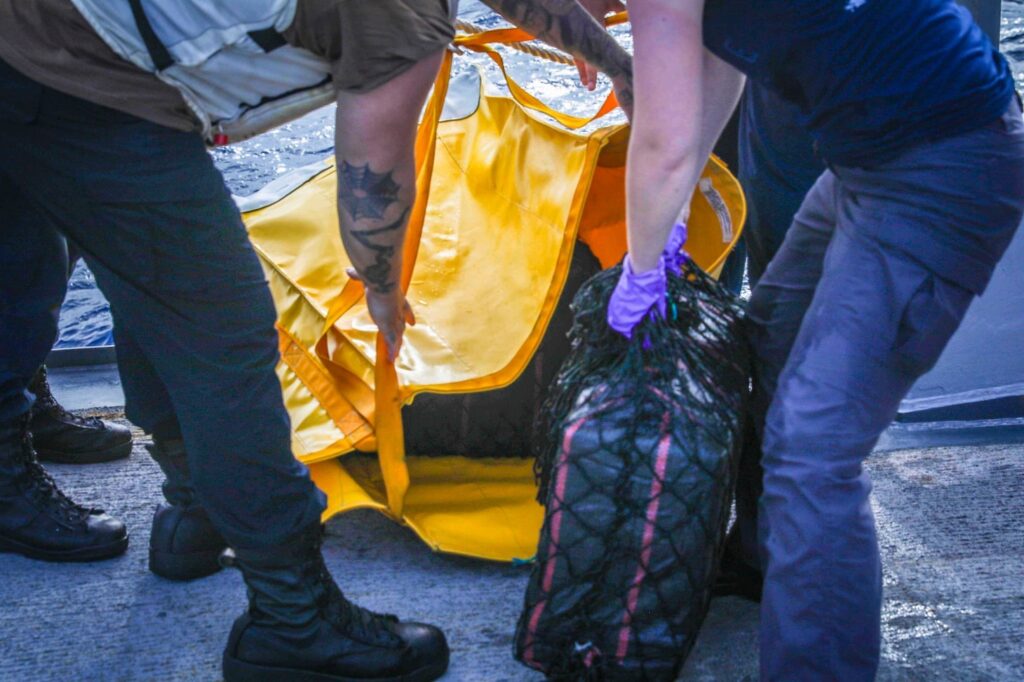
PACIFIC OCEAN (July 10, 2025) Service members aboard the Arleigh Burke-class guided-missile destroyer USS Sampson (DDG 102) haul seized contraband to a secured space in the Pacific Watch mission, July 10, 2025. (U.S. Navy photo by MCSN Maliq Martin) 

Release From U.S. Pacific Fleet

PACIFIC OCEAN  –  The U.S. Coast Guard, in coordination with the U.S. Navy destroyer USS Sampson (DDG 102), interdicted two suspected drug smugglers, and seized approximately 3,439 pounds of cocaine in international waters of the Eastern Pacific Ocean July 10. 
 
While on routine patrol, the Sampson detected a go-fast vessel approximately 380 miles southwest of Acapulco, Mexico. The vessel displayed no indication of nationality and was operating in a known drug trafficking corridor. Its appearance and behavior aligned with known maritime smuggling trends, raising further suspicion. 
 
Tactical control of the Sampson was transferred from U.S. Third Fleet to Coast Guard Southwest District for interdiction and apprehension authority. When the U.S. Navy MH-60R Sea Hawk helicopter, assigned to the “Scorpions” of Helicopter Maritime Strike Squadron (HSM) 49, launched from the Sampson and signaled its presence, the suspects aboard began jettisoning packages into the ocean. After warning shots were ineffective, the helicopter crew employed disabling fire, successfully stopping the vessel. 
 
The Sampson launched two boarding teams, which recovered several of the jettisoned packages and took positive control of the suspect vessel. Coast Guard law enforcement personnel conducted a boarding and determined the vessel to be without nationality, granting authority for a full law enforcement boarding. 
 
The two suspected drug smugglers were taken into custody, and field tests confirmed the presence of cocaine aboard the go-fast. 
 
Due to the vessel’s lack of tow points, absence of navigation lights, and poor seaworthiness, the Coast Guard deemed it a hazard to navigation and authorized the sinking of the vessel. 
 
Tactical control of the USS Sampson has since been returned to U.S. Third Fleet for continued operations. 
 
The Coast Guard routinely partners with U.S. Navy and interagency assets to counter transnational criminal organizations operating in the maritime domain. 
 
Sampson is employed under U.S. Northern Command’s maritime homeland defense authorities with a Coast Guard Law Enforcement Detachment embarked to enable maritime interdiction missions to prevent the flow of illegal drugs and other illegal activity. U.S. Northern Command is working together with the Department of Homeland Security to provide additional military forces and capabilities at the southern border. 


HASC Marks National Defense Authorization Bill

Edited by Richard R. Burgess, Senior Editor 

Arlington, Va. — The House Armed Services Committee (HASC) filed the bill for the 2026 National Defense Authorization Act, the bill’s leaders, Committee Chairman Sen. Roger Wicker (R-Miss.)  and Sen. Jack Reed (D- R.I.) announced in a July 16 release. 

Some announced naval-related provisions are listed below:  

  • Authorizes procurement for not more than five Columbia-class submarines.  

  • Authorizes a block buy of up to 15 Medium Landing Ships (LSM) to support testing and experimentation of the Marine Littoral Regiment formation.  

  • Limits funding for TAGOS Ship unless the Secretary of the Navy provides information on the Navy’s management of the program and an assessment of alternative solutions for the mission.  

  • Requires the Navy, in implementing the Medium Landing Ship and Light Replenishment Oiler programs, to utilize a Vessel Construction Manager (VCM) acquisition strategy, employing commercial design standards, construction practices, and an external entity to contract for construction.  

  • Exempts unmanned surface vessels and unmanned underwater vehicles from the Senior Technical Authority requirement and limits certain technical requirements from the Chief Engineer of the Naval Sea Systems Command without prior approval of the program manager.  

  • Modifies certification requirements of operational demonstrations for propulsion and electrical systems of large and medium unmanned surface vessels to increase industrial base participation.  

  • Limits funding to certain Navy-developed software for autonomy and command and control of unmanned surface vessels.  

  • Directs a briefing to the congressional defense committees to prioritize innovative, commercially driven solutions to deliver a scalable medium unmanned surface vessel (MUSV) capability that meets the urgent needs of the fleet while fostering a competitive industrial base.  

  • Requires the Navy to move leadership for conventional surface ship maintenance to the Type Commanders, delegates decision-making authority to project managers, port engineers, and ship commanding officers, and directs a new contracting strategy that emphasizes workload stability and collaborative planning.  

  • Requires the Navy to investigate, and where feasible qualify and fully integrate, 23 advanced technologies and processes into Navy surface ship readiness.  

  • Supports amphibious warship production and readiness by limiting funding of the Secretary of the Navy and the Secretary of Defense if the 30-year shipbuilding plan does not comply with the statutory requirement for 31 amphibious ships, 15 defines “temporarily unavailable” within the 31 amphibious ship requirements, and requires a plan to maintain and extend the service lives of amphibious ships 

  • Requires DOD to develop a comprehensive plan to establish a government-controlled open mission systems computing environment for all variants and blocks of the F–35 aircraft operated by the DOD.  

  • Directs the Navy and Air Force to conduct a comparative study, independent of the air vehicle manufacturer, on the two propeller systems on the C-130J platform.  

  • Accelerates development of the nuclear-armed sea-launched cruise missile and creates a supplementary parallel pathway for rapid fielding.  

  • Strongly encourages the Secretary of Defense to invite the naval forces of Taiwan to the Rim of the Pacific (RIMPAC) exercise, as appropriate, and requires a notification and justification if the Secretary chooses not to do so. 

  • Requires the Navy to develop options for two sources of domestic solid rocket motors in the Navy Modular Missile program. 

  • Directs a briefing on opportunities for the Irregular Warfare Technical Support Directorate to complement innovation efforts by Naval Special Warfare Command for research, experimentation, and prototyping of unmanned maritime vessels.  

  • Authorizes personnel end strength for the active component at 344,600 for the Navy; 172,300 for the Marine Corps; 57,500 for the Navy Reserve; 33,600 for the Marine Corps Reserve; and 7,000 for the Coast Guard Reserve. 

Read the FY26 NDAA Bill Language.  

Read the FY26 NDAA Executive Summary. 


Secretary Noem Terminates Contract for Two Coast Guard Offshore Patrol Cutters 

From the U.S. Department of Transportation, July 11, 2025 

“This Administration is unwavering in its commitment to the American taxpayer” 

WASHINGTON – Today, United States Department of Homeland Security Secretary Kristi Noem announced the partial termination of a wasteful shipbuilding contract to protect American taxpayer dollars while revolutionizing the United States Coast Guard for the 21st century. 

“This Administration is unwavering in its commitment to the American taxpayer and to a strong, ready Coast Guard,” said a senior Homeland Security official. “We cannot allow critical shipbuilding projects to languish over budget and behind schedule. Our Coast Guard needs modern, capable vessels to safeguard our national and economic security, and we will ensure every dollar is spent wisely to achieve that mission. This action redirects resources to where they are most needed, ensuring the Coast Guard remains the finest, most-capable maritime service in the world.” 

As part of that commitment, the Coast Guard is reviewing contracts which are failing to meet delivery agreements. An existing Offshore Patrol Cutter (OPC) contract with Eastern Shipbuilding Group (ESG) has been slow to deliver four OPCs, harming the U.S.’s defense capabilities and wasting American’s hard-earned money. In light of that, Secretary Noem partially canceled ESG’s contract for two out of the four OPCs expected from ESG in Panama City, Florida because it was not an effective use of taxpayer money. 

ESG’s delivery of OPC 1 was initially due in June 2023 but will now be completed by the end of 2026 at the earliest. ESG missed its April 2024 delivery for OPC 2. The Coast Guard stopped work on OPCs 3 and 4 after ESG notified the service earlier this year they could not fulfill their contractual duty to deliver all four OPCs without unabsorbable loss. The money saved will redirected to ensure it’s actually benefiting the Coast Guard. 

Due to decades of neglect by previous Administrations and Congress, the Coast Guard has been underfunded, underequipped, and ignored for too long. President Donald Trump is ending that era of neglect with the passage of the One Big Beautiful Bill and Force Design 2028 – Homeland’s plan to transform the Coast Guard into a more agile, capable fighting force. Now, a massive injection of nearly $25 billion is coming to the Coast Guard. 

The Coast Guard’s goal is to procure 25 OPCs — and that has not changed. The Coast Guard remains intent on acquiring and delivering the full OPC class as fast as possible to address the Nation’s security and safety needs. 

The OPC fleet will complement the capabilities of the Service’s National Security Cutters, Fast Response Cutters and Polar Security Cutters as an essential element of the Nation’s layered maritime security strategy. They will be especially critical to the counter-drug and migrant interdiction missions along the southeast border. 


U.S. Coast Guard, Mexican Navy Team to Disrupt Suspected Maritime Smuggling Venture

From U.S. Coast Guard Pacific Southwest Public Affairs, July 15, 2025 

SAN DIEGO — The crew of the Coast Guard Cutter Robert Ward (WPC 1130) and the Mexican Navy vessel ARM Revolución successfully collaborated to deter a suspected maritime smuggling attempt approximately 11 miles southwest of Point Loma, Sunday. 

At approximately 4 p.m., the crew of Robert Ward detected a vessel transiting north from Mexican waters into U.S. territorial waters. As the cutter prepared to deploy its small boat to conduct a boarding, the suspected smuggling vessel suddenly reversed course and fled south at a high rate of speed. 

The Robert Ward pursued the vessel to the U.S.–Mexico Maritime Boundary Line. ARM Revolución was observed operating nearby, and Robert Ward relayed a description of the suspect vessel via VHF radio. Mexican Navy personnel aboard Revolución located, stopped and conducted a boarding of the approximately 24-foot center-console vessel with four people aboard within Mexican territorial waters. 

The outcome of the boarding is unknown at this time; however, the coordinated effort between the U.S. Coast Guard and Mexican Navy successfully deterred a potential smuggling venture and underscored the value of international maritime cooperation in combating transnational criminal activity. 


Coast Guard Cutter Blacktip Arrives at New Homeport in Valdez, Alaska 

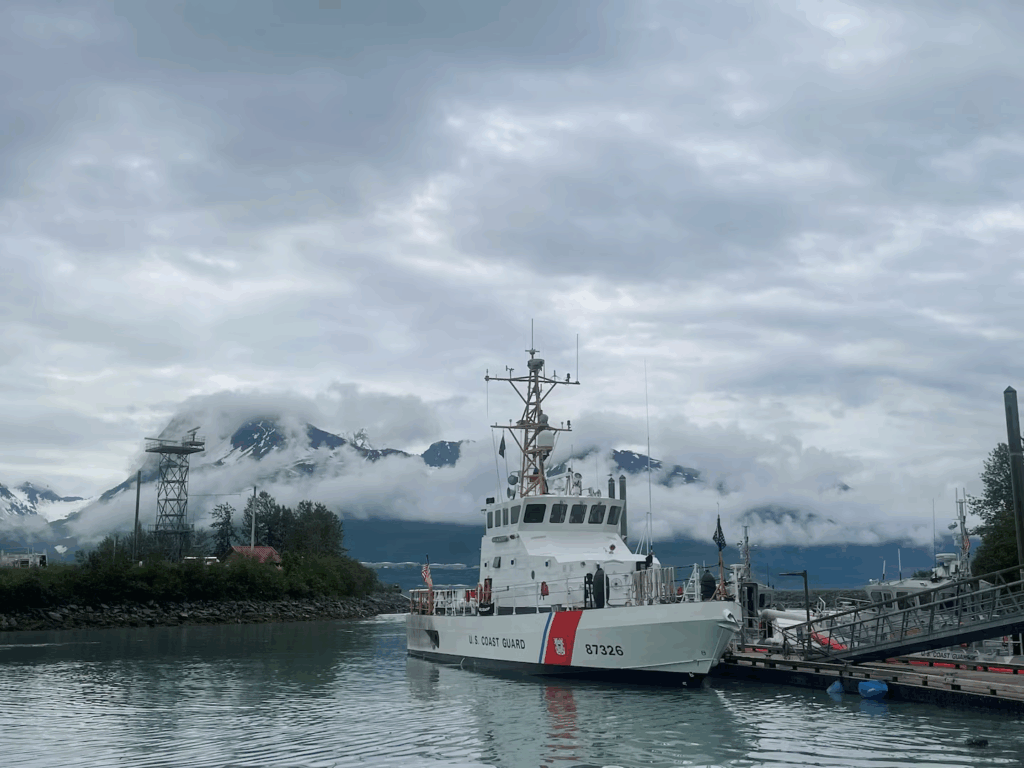
Coast Guard Cutter Blacktip (WPB 87326) arrives at new homeport in Valdez, Alaska.

VALDEZ, Alaska — Coast Guard Cutter Blacktip (WPB 87326) arrived at its new homeport in Valdez Monday after transiting approximately 2,800 miles. 

Blacktip, an 87-foot Marine Protector-class patrol boat, is replacing the recently decommissioned 110-foot Island-class cutter Liberty and will conduct various missions throughout the Arctic District, including maritime law enforcement and security, living marine resources, and search and rescue.  

“We are extremely happy to be in Alaska and to continue serving the community of Valdez,” said Senior Chief Petty Officer Andre Pinault, officer in charge.  

Blacktip was commissioned in 2000 and previously homeported in Oxnard, California.  

Marine Protector-class patrol boats are 87-feet long and 19.5-feet wide with a 100 long-ton displacement. They have a top speed of 25 knots and a range of 1,000 miles. They can hold a crew of up to 12. The Blacktip is equipped with advanced electronics and navigation systems for multi-mission operations, including search and rescue, law enforcement, and homeland security. 


NCIS Deploys Special Agents Aboard DDGs Patrolling Southern Border

Release From U.S. Fleet Forces Command

SAN DIEGO –The Navy deployed two Arleigh Burke-class guided missile destroyers in mid-March to conduct border security objectives in support of the U.S. Northern Command southern border mission: the USS Gravely (DDG 107) to the Gulf of America and the Caribbean, and the USS Stockdale (DDG 106) to the Pacific Ocean. Earlier this summer, the USS Cole (DDG 67) relieved the USS Gravely after 83 days of service to the mission. 

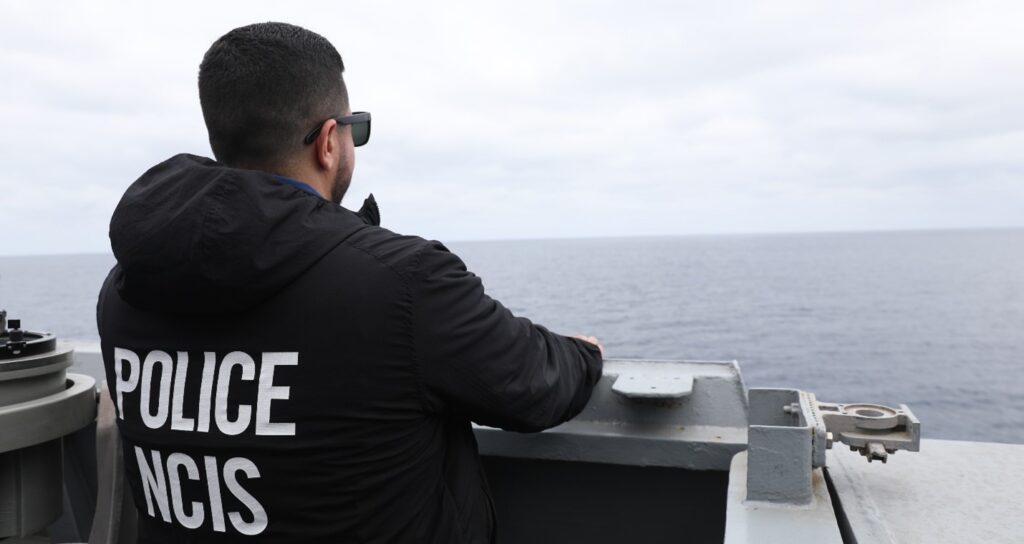
Among the crew onboard these ships have been NCIS Special Agents who provide law enforcement and counterintelligence capabilities related to counternarcotics and combating transnational organized crime. 
 
These Special Agents collaborate with law enforcement and intelligence community partners to synthesize data that enhances Navy leadership’s understanding of the operational environment and increases the probability of successful counternarcotics interdictions. 
 
Such counternarcotics interdictions have included, among others, the seizure of over 6,000 pounds of cocaine by the USS Gravely in May. A subsequent seizure netted over 11,000 pounds of cocaine and 7,200 pounds of marijuana. The USS Cole, partnering with the Royal Canadian Navy, was involved in the seizure of over 540 pounds of cocaine in June. 
 
The ships operate with an embarked U.S. Coast Guard Law Enforcement Detachment (LDET) that, combined with NCIS Special Agents enhance maritime security and support interagency collaboration in the region through presence operations. 
 
These deployments are unique in scope and duration compared to the traditional Special Agent Afloat deployments that NCIS has been conducting aboard U.S. Navy ships since the early 1970s. The Special Agent Afloat program deploys agents for year-long deployments aboard aircraft carriers, hospital ships, and amphibious assault ships. NCIS law enforcement and counterintelligence support to these ships enables the Navy to operate with optimal readiness and lethality to protect the United States and advance its interests globally. 


Coast Guard Cutter Harriet Lane Returns Home Following Patrol in Oceania

U.S. Coast Guardsmen assigned to medium endurance cutter USCGC Harriet Lane (WMEC 903) moor the cutter at a pier in Taiohae, French Polynesia, May 18, 2025. The crew visited Nuka Hiva, the largest of the Marquesas Islands of French Polynesia, as part of their 73-day patrol supporting Operation Blue Pacific. (U.S. Coast Guard photo by Petty Officer 1st Class Kenneth Shellenberger) 

U.S. Coast Guard Oceania District External Affairs, July 10, 2025 

HONOLULU – The crew of U.S. Coast Guard Cutter Harriet Lane (WMEC 903) returned to Honolulu Wednesday following a 73-day patrol in support of Coast Guard Oceania District’s Operation Blue Pacific.  

The Harriet Lane crew departed Joint Base Pearl Harbor-Hickam in April to conduct joint operations and territorial integrity missions across Oceania. Patrolling more than 15,000 nautical miles around the Hawaiian Islands, French Polynesia, Cook Islands, and American Samoa, the cutter’s crew worked alongside interagency and Pacific Island partners to reinforce the rules-based international maritime order in the region.   

“The crew demonstrated their professionalism, grit, and dedication to strengthening maritime governance in Oceania,” said Petty Officer 1st Class Brennan Augustine, senior maritime enforcement specialist aboard the Harriet Lane. “The crew’s commitment and teamwork with our law enforcement partners protects America’s maritime borders and drives stability in the region.”  

The Harriet Lane crew exercised partnerships with Cook Islands, French Polynesia, New Zealand, and the National Oceanic and Atmospheric Administration (NOAA) Office of Law Enforcement through bilateral maritime law enforcement agreements, professional exchanges, and domestic federal maritime law enforcement operations.  

In the Cook Islands’ exclusive economic zone (EEZ), the Harriet Lane crew and two Ministry of Marine Resources officers conducted six boardings of fishing vessels, resulting in one suspected violation.   

In French Polynesia, the crew conducted joint operations and exercises with French Armed Forces in the Asia-Pacific (ALPACI) to enhance collective maritime domain awareness while sustaining rules-based international norms regarding high seas fishing. Coordinating with an ALPACI aviation asset, the Harriet Lane crew conducted two Western and Central Pacific Fisheries Commission (WCPFC) high seas boardings and inspections on commercial fishing vessels, resulting in one potential violation.  

The crew conducted 14 additional high seas boarding and inspections on commercial fishing vessels, resulting in two potential violations of conservation and management measures under the WCPFC.   

While in American Samoa, the Harriet Lane crew hosted a reception attended by U.S. Congresswoman Aumua Amata Coleman Radewagen’s staff delegation, American Samoa Attorney General Gwen Tauiliili-Langkilde, the Assistant Director of NOAA’s Office of Law Enforcement Pacific Islands Division, and representatives from the U.S. Department of Commerce, National Marine Sanctuary of American Samoa, American Samoa Department of Port Administration, American Samoa Department of Marine and Wildlife Resources, as well as command and crew from the French Overseas Patrol Vessel Teriieroo a Teriierooiterai. Event attendees discussed the deterrence of threats to regional security and illicit maritime activities that affect U.S. border security, regional security and economic prosperity.   

Commissioned in 1984, Cutter Harriet Lane is a 270-foot medium-endurance cutter homeported in Honolulu to support Coast Guard missions in the Pacific region. The service’s medium endurance cutter fleet supports a variety of Coast Guard missions including search and rescue, law enforcement, maritime defense, and protection of the marine environment.   


Coast Guard Responds with Unified Command to Flooding Near Kerrville, Texas

Release From U.S. Coast Guard Heartland District

AUSTIN, Texas – The Coast Guard, along with a unified command, is responding to an area affected by flash flooding near Kerrville, Texas.  

Sector New Orleans watchstanders received a report July 4th at approximately 5:57 am from Texas A&M Task Force 1 personnel requesting assistance for rescue operations in response to flooding near Kerrville, Texas. 

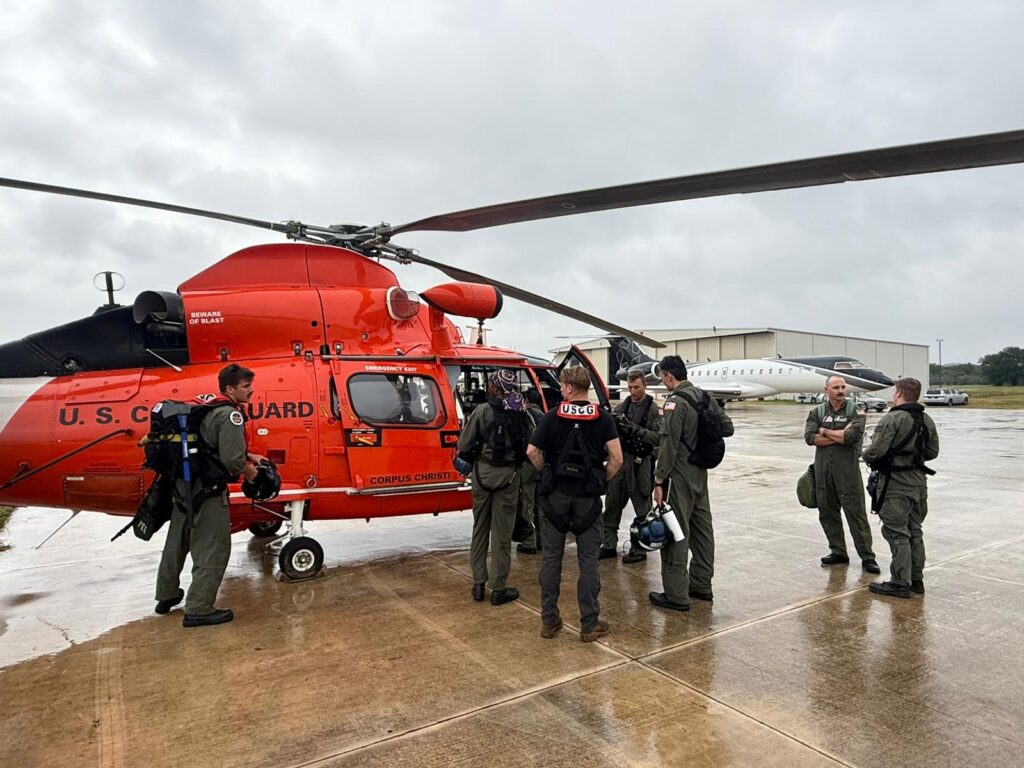
An MH-65 Dolphin helicopter aircrew and an HC-144 Ocean Sentry Aircraft aircrew was launched from Air Station Corpus Christi along with an Air Station Houston MH-65 Dolphin helicopter aircrew to provide assistance with rescue operations. 

The Coast Guard has conducted 12 flights to the affected area, and rescued 15 campers from Camp Mystic in Hunt, Texas, yesterday. A Coast Guard rescue swimmer remained with victims of the flooding, providing medical assistance to and aiding with the evacuation efforts of 230 victims into assisting agencies air assets.    

Additionally, today, three people were rescued, and four were assisted from a mobile home community in Leander, Texas.   

Agencies also responding to the flooded area are: 

  • Texas Task Force 1  

  • Texas Dept of Public Safety  

  • Texas National Guard 

  • Texas Parks and Wildlife 

  • Country STAR Flight  

  • Local Police Department 

“The preservation of life during this incident is our top priority,” said Capt. Ulysses S. Mullins, The Coast Guard Heartland District Chief of Staff, “which is why the Coast Guard is working with the State of Texas alongside other responding agencies to ensure that every asset on scene is able to coordinate, communicate and respond as safety and quickly as possible” 

Any media networks seeking information about the Coast Guard’s rescue and response operations are encouraged to contact the Texas Public Affairs Detachment Duty line at 832-293-1293. 


U.S. Coast Guard Receives Historic Investment to Rebuild Under President Trump’s One Big Beautiful Bill

Release From U.S. Coast Guard Headquarters, July 4, 2025 

WASHINGTON – The U.S. Coast Guard welcomed the nearly $25 billion investment included in the One Big Beautiful Bill Act Friday — marking the largest single commitment of funding in Service history.   

This investment strengthens every facet of Coast Guard operations and supports the Service’s role as the Nation’s leading drug interdiction and maritime border security force.   

This funding will allow the Coast Guard to procure an estimated 17 new icebreakers, 21 new cutters, over 40 helicopters and six C-130J aircraft while modernizing shore infrastructure and maritime surveillance systems. The package also strengthens the Coast Guard’s ability to counter drug and human trafficking, conduct search and rescue, enhance navigational safety and enable maritime trade.  

“This historic investment marks a new era for the Coast Guard,” said Coast Guard Acting Commandant Adm. Kevin Lunday. “It reflects the strong support of the American people and empowers us to restore our Service and prepare for the challenges of today and tomorrow. With this level of support, and the dedication of our Coast Guard men and women, there’s nothing we can’t accomplish. We are deeply grateful for this opportunity to build a stronger Coast Guard for the Nation.”  

Investment highlights include:  

  • $4.4 billion for shore infrastructure, training facilities and homeports  

  • $4.3 billion for Polar Security Cutters, extending U.S. reach in the Arctic  

  • $4.3 billion for nine new Offshore Patrol Cutters  

  • $3.5 billion for three Arctic Security Cutters  

  • $2.3 billion for more than 40 MH-60 helicopters  

  • $2.2 billion for depot level maintenance to sustain readiness  

  • $1.1 billion for six new HC-130J aircraft and simulators  

  • $1 billion for Fast Response Cutters  

  • $816 million for light and medium Icebreaking Cutters  

  • $266 million for long-range unmanned aircraft systems  

  • $170 million for maritime domain awareness, including next-generation sensors   

  • $162 million for three Waterways Commerce Cutters  

These investments support Force Design 2028 — the Secretary’s comprehensive effort to modernize operations and capabilities to ensure the Coast Guard remains the finest maritime fighting force ready to protect and defend the nation for decades to come.   

The Coast Guard extends its appreciation for the leadership of the Administration, including President Trump and Secretary Noem, and leaders in Congress for recognizing the strategic importance of a ready, modern and resilient Coast Guard.