Vice Adm. Buzzella Assumes Command of U.S. Coast Guard Pacific Area and Defense Force West
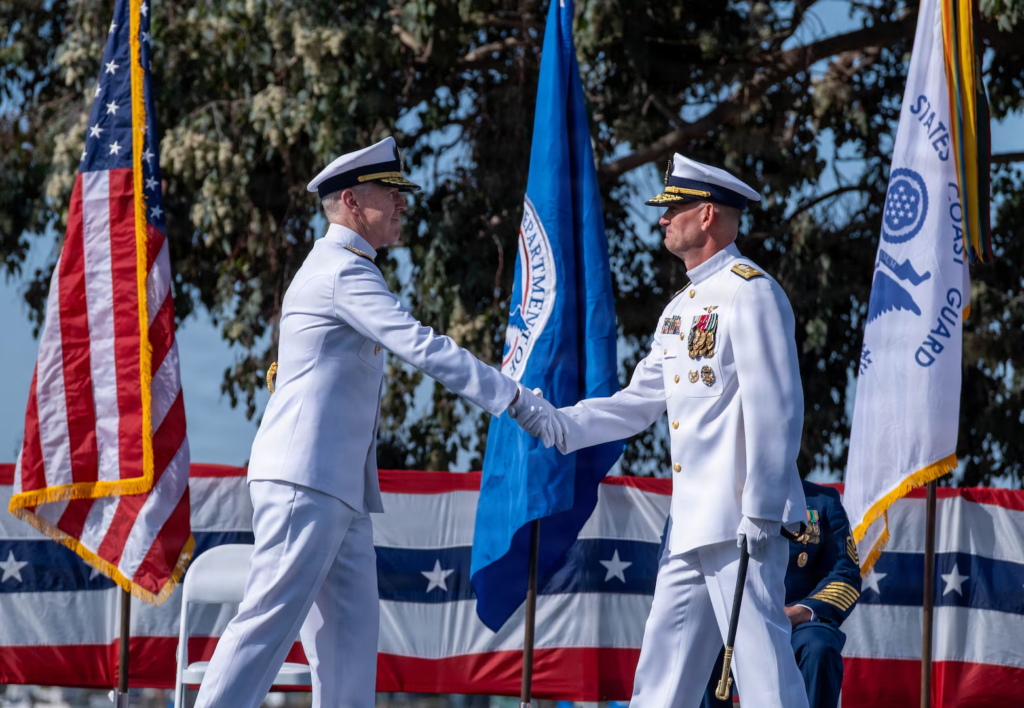
Adm. Kevin Lunday (left), commandant of the U.S. Coast Guard, shakes hands with Vice Adm. Joe Buzzella during an assumption of command ceremony, March 26, 2026, at Coast Guard Island, Alameda, California. The ceremony formally marked Vice Adm. Joe Buzzella as the commander of Coast Guard Pacific Area and Defense Force West. (U.S. Coast Guard photo by Petty Officer 3rd Class Charlie Valor)
From U.S. Coast Guard Pacific Area, March 31, 2026
ALAMEDA, Calif. – The U.S. Coast Guard held a formal assumption of command ceremony for Vice Adm. Joe Buzzella as he assumed the duties and responsibilities of U.S. Coast Guard Pacific Area and Defense Force West Commander during an event Thursday, at Coast Guard Island in Alameda.
Adm. Kevin Lunday, commandant of the U.S. Coast Guard presided over the ceremony. Senior Coast Guard leadership and distinguished guests joined in recognizing Vice Adm. Buzzella’s commitment to leading the Service.
Vice Adm. Buzzella formally assumed the responsibilities of commander, Coast Guard Pacific Area, overseeing all Coast Guard operations across the Pacific theater—an area encompassing more than 74 million square miles. He reaffirmed the Service’s enduring role as a vital instrument of national power responsible for ensuring maritime safety, security, and stewardship; strengthening partnerships with allies and advancing U.S. interests throughout the Indo-Pacific region.
“It is an honor to assume command of Coast Guard Pacific Area and Defense Force West,” said Vice Adm. Buzzella. “Across this vast and vital region, Coast Guardsmen stand the watch. Every day, our crews are saving lives, protecting and ensuring we control, secure and defend our nation’s borders. I am humbled by the opportunity to lead this team and remain committed to supporting the readiness, resilience, and mission excellence of the Pacific Area workforce and their families.”
As Pacific Area commander, Vice Adm. Buzzella will lead Coast Guard operations throughout the Indo-Pacific, the Polar Regions and Western Hemisphere, focusing on enhancing operational readiness, strengthening international partnerships, and advancing strategic priorities in support of national security objectives.
Coast Guard Repatriates 60 Aliens to Dominican Republic Following Voyage Interdiction
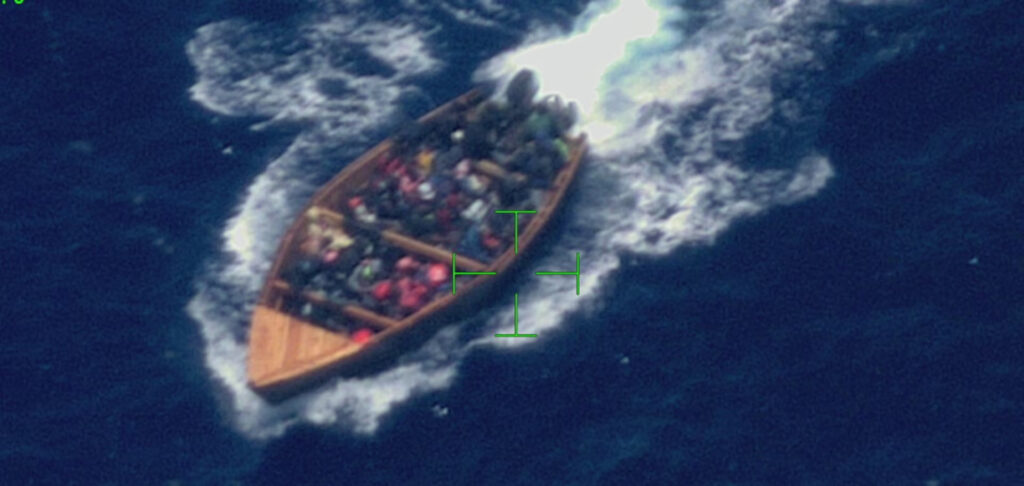
Coast Guard Cutter Thetis and a Customs and Border Protection multi-role enforcement aircraft crew interdict an unlawful migration voyage vessel in Mona Passage waters off Puerto Rico, March 27, 2026. Thetis crewmembers repatriated 60 migrants and transferred them to Dominican Republic Navy authorities in Santo Domingo, Dominican Republic, March 30, 2026. (U.S. Coast Guard photo)
From U.S. Coast Guard Southeast District, March 30, 2026
SAN JUAN, Puerto Rico — The crew of Coast Guard Cutter Thetis repatriated 60 aliens to Santo Domingo, Dominican Republic, Monday, following the interdiction of an unlawful migration vessel voyage in Mona Passage waters northwest of Aguadilla, Puerto Rico.
The repatriated aliens were transferred to Dominican Republic Navy authorities including 43 men and 11 women who claimed Haitian nationality and five other men and one woman who claimed Dominican Republic nationality. No minors were identified in this case.
The interdiction occurred Friday afternoon after a Customs and Border Protection Caribbean Air and Marine Branch Multi-Role Enforcement aircraft crew on a routine patrol detected a makeshift vessel, approximately 50 nautical miles from Aguadilla, Puerto Rico. Sector San Juan watchstanders diverted the Coast Guard Cutter Thetis and launched an Air Station Borinquen MH-60T Jayhawk helicopter to respond. Once on-scene, Thetis deployed the cutter’s Over the Horizon small boat whose crew took positive control of the suspect vessel. Following the interdiction, the Thetis crew safely embarked all the migrants.
“The swift response, effective communications and seamless coordination between Coast Guard Thetis, Sector San Juan personnel and our CBP partners led to a successful interdiction and resulted in sixty lives saved,” said Cmdr. Matthew Romano, Sector San Juan chief of response. “The resolve of the Coast Guard, our Homeland Security Task Force – San Juan and of our Dominican Republic Navy partners to detect and stop these potentially deadly voyages is unwavering. To those thinking of taking part in an unlawful migration voyage, don’t take to the sea! These voyages most often involve unseaworthy and grossly overloaded makeshift vessels with no lifesaving equipment. They are highly unstable and could capsize without warning killing everyone onboard. Individuals taking part in these voyages should also realize they may be subject to criminal prosecution and or repatriated to their country of origin or departure.”
Once aboard a Coast Guard cutter, aliens are processed to determine their identity and are provided with food, water, shelter and basic medical attention.
The United States Coast Guard, along with its Operation Vigilant Sentry partners, maintains a continued presence with air, land, and sea assets in the Florida Straits, the Windward Passage, the Mona Passage, and the Caribbean Sea. Operation Vigilant Sentry’s multi-layered approach is designed to protect the safety of life at sea while preventing unlawful maritime entry to the United States and its territories.
Coast Guard Cutter Stratton returns to California following 3-month deployment
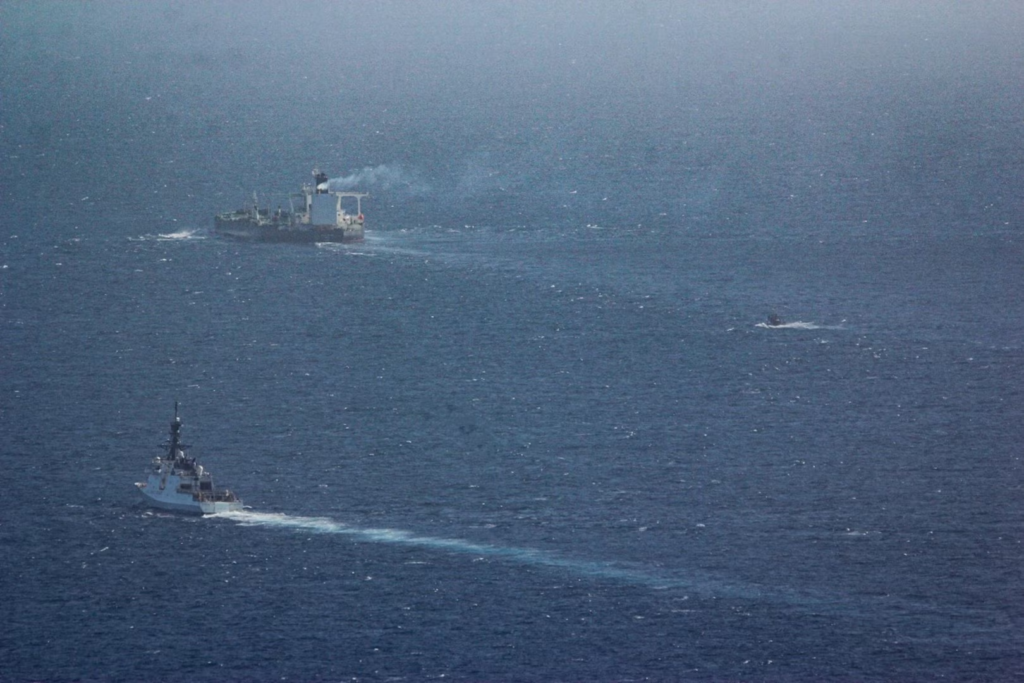
The Legend-class USCGC Stratton (WMSL 752) assumed escort duties of motor tanker Sophia and escorted the vessel from an anchorage south of Puerto Rico to an at-sea transfer with Venezuela for further disposition, Jan. 27, 2026. (U.S. Coast Guard courtesy photo.)
From U.S. Coast Guard Pacific Area, March 29, 2026
ALAMEDA, Calif. – The U.S. Coast Guard Cutter Stratton (WMSL 752) returned to their home port in Alameda, Monday after sailing more than 16,000 nautical miles and completing a 79-day patrol in the Caribbean.
Stratton departed Alameda Jan. 4 and transited through the Panama Canal to support ongoing operations in the Caribbean, preventing the illicit trade of crude oil in violation of international sanctions. On Jan. 25, Stratton assumed escort duties of motor tanker Sophia and escorted the vessel from anchorage south of Puerto Rico to an at-sea transfer with Venezuela for further disposition.
Additionally, while transiting in the Eastern Pacific, Stratton’s crew operated in support of Joint Interagency Task Force-South to detect, monitor, and intercept illicit narcotics. Stratton’s crew interdicted one fishing vessel at sea, exercising the North American Maritime Security Initiative (NAMSI) standard operating procedures. Enacting NAMSI and boarding the vessel at sea allowed for the transfer of the vessel to the Mexican Navy for further disposition.
During the patrol, Stratton conducted a fueling-at-sea evolution with USNS Supply (T-AOE 6) and helicopter vertical replenishments with Coast Guard Air Station Borinquen crews to resupply the cutter while deployed in the Caribbean. Additionally, the crew exercised helicopter deck landing operations with an MH-60 aircrew from the USS Lake Erie (CG 70) and Coast Guard Air Station Ventura, displaying Stratton’s interoperability across different agencies and platforms.
“The Strattoncrew looks forward to returning to Alameda to reunite with our friends and family,” said Capt. Dorothy Hernaez, Stratton’s commanding officer. “This was a demanding and dynamic patrol that tested our resilience and capabilities across a wide spectrum of operations. This patrol demonstrated Stratton’s essential role as a multi-mission platform capable of adapting to an evolving operational environment.”
Commissioned in 2012, Stratton is one of ten Legend-class national security cutters, and one of four homeported in Alameda. National security cutters are 418-feet long, 54-feet wide, and have a 4,600 long-ton displacement. They have a top speed of 28 knots, a range of 12,000 nautical miles, and can hold a crew of up to 170. National security cutters routinely conduct operations throughout the world, where their unmatched combination of range, speed, and ability to operate in extreme weather provides the mission flexibility necessary to conduct vital strategic missions.
The namesake of the U.S. Coast Guard Cutter Stratton is Capt. Dorothy Stratton, who led the service’s all-female reserve force during World War II. Dorothy Stratton was the first female commissioned officer in the Coast Guard and commanded more than 10,000 personnel. The ship’s motto is “We Can’t Afford Not To.”
U.S. Coast Guard, CNMI partners strengthen maritime security presence in Saipan’s waters
Members of the U.S. Coast Guard Sector Boarding Team conduct a joint patrol with the CNMI Department of Public Safety – Marine Unit personnel on March 20, 2026, in Saipan. From March 18-22, conducted joint underway and shoreside operations alongside the CNMI Department of Public Safety, Saipan Marine Unit, and Saipan Customs and Biosecurity, reinforcing direct lines of communication and cooperation that strengthen maritime domain awareness across the CNMI’s waters and surrounding exclusive economic zone. (U.S. Coast Guard photo by Petty Officer 1st Class Chris Farrell)
From U.S. Coast Guard Forces Micronesia, March 26, 2026
SAIPAN, CNMI — Federal and local maritime law enforcement agencies patrolled Saipan’s waters and port together in mid-March, boarding six small vessels and launching new coordination channels that expand the CNMI’s ability to monitor and respond to threats in its surrounding waters.
From March 18-22, the U.S. Coast Guard Sector Boarding Team conducted joint underway and shoreside operations alongside the CNMI Department of Public Safety Saipan Marine Unit and CNMI Customs and Biosecurity. Teams engaged 12 vessel contacts and completed six small vessel security boardings, while a joint patrol of the Port of Saipan marked the first combined shoreside operation between the U.S. Coast Guard and Customs and Biosecurity.
The operation also brought together key agency leaders for the first time. SBT members met with an ICE Homeland Security Investigations representative, the assistant director of the CNMI Department of Fish and Wildlife, and the newly appointed chief of the DPS’s Saipan Marine Unit — reinforcing direct lines of communication and cooperation that strengthen maritime domain awareness across the CNMI’s waters and surrounding exclusive economic zone.
“The Marianas sit at the center of Western Pacific maritime activity: commercial traffic, fishing, small vessels moving between islands,” said Lt. j.g. Thomas Forames-Su, supervisor of the SBT. “These operations are about more than boardings. We’re strengthening the relationships and shared awareness that let us and our partners act faster and more cohesively.”
Maritime domain awareness is a shared responsibility across federal, local, and community stakeholders. The CNMI’s economy depends heavily on the free flow of maritime commerce, fishing, and tourism, all of which require safe and well-monitored waters. Joint operations, like this one, strengthen the network of agencies and protect those interests every day.
Building on the momentum from this week’s operations, the U.S. Coast Guard and CNMI partners are planning additional joint patrols, dockside security boardings, and coordinated cutter operations, like the USCGC Frederick Hatch’s recent patrol, in the waters around Saipan and to the north. Agencies are also working to deepen communication protocols and formalize interagency coordination agreements to expand joint response capabilities across the region.
Seabed 2030, Greenroom Robotics Announce Partnership to Support Global Ocean Mapping
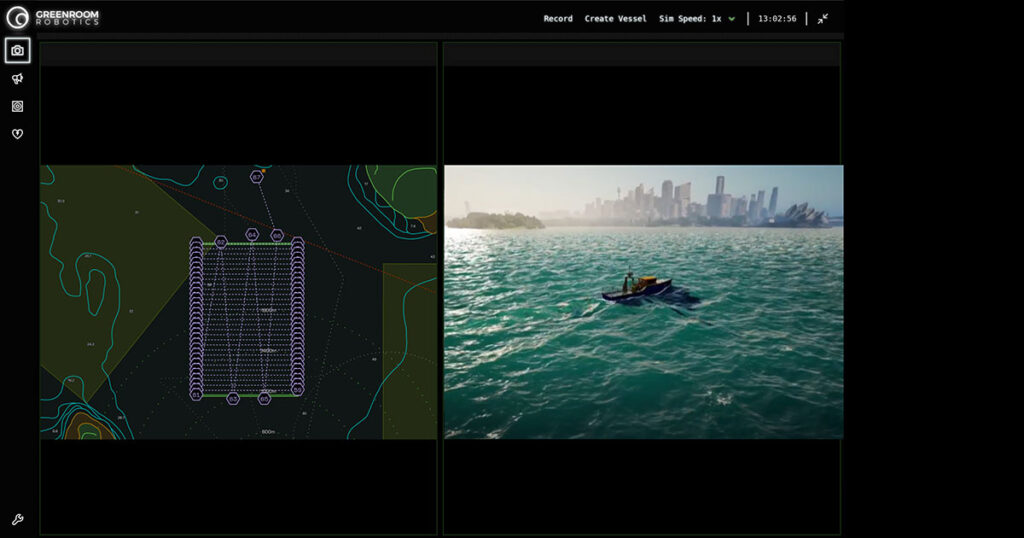
Autonomous survey mission planning in Greenroom Robotics’ MIS-SIM simulation environment, enabling efficient, scalable ocean data collection.
LONDON, 24 March 2026 –The Nippon Foundation-GEBCO Seabed 2030 Project is pleased to announce a new partnership with Australian maritime AI and autonomy innovator, Greenroom Robotics. Greenroom Robotics specialises in artificial intelligence-enabled perception and autonomy software that support safer, more efficient and environmentally responsible maritime operations.
Through this collaboration, Seabed 2030 and Greenroom Robotics will explore opportunities to support the efficient collection, processing and sharing of bathymetric data, contributing to the mission of delivering a complete map of the world’s ocean floor.
Greenroom Robotics software modernises maritime operations through enhanced autonomy, situational awareness and digital workflows. Its hardware-agnostic solutions support uncrewed and optimally crewed vessel operations, helping to enable more persistent and scalable ocean data collection.
Seabed 2030 is a collaborative project between The Nippon Foundation and the General Bathymetric Chart of the Oceans (GEBCO), which seeks to inspire the complete mapping of the world’s ocean, and to compile all the data into the freely available GEBCO Ocean Map.
The Project is formally endorsed as a Decade Action of the UN Ocean Decade. GEBCO is a joint programme of the International Hydrographic Organization (IHO) and the Intergovernmental Oceanographic Commission (IOC), and is the only organisation with a mandate to map the entire ocean floor.
Advances in autonomous and digitally integrated maritime systems are increasingly supporting hydrographic surveying and ocean mapping activities. By enabling vessels to operate more efficiently and collect high-quality data at scale, such technologies can help expand and expedite mapping coverage in both coastal and remote ocean regions.
For example, advanced autonomy systems can enable survey operations using smaller vessels and reduced crew while maintaining data quality. In real world operations this approach has delivered a 94% reduction in diesel consumption compared to the same crewed survey task, demonstrating the potential for more environmentally efficient ocean mapping operations.
Commenting on the new partnership, Seabed 2030 Director Jamie McMichael-Phillips said: “Achieving the ambitious goal of mapping the entire ocean floor requires continued innovation in the technologies used to collect and process bathymetric data. Partnerships with organisations such as Greenroom Robotics help advance the capabilities needed to make ocean mapping more efficient, scalable and accessible.”
James Keane, Chief Executive Officer of Greenroom Robotics, commented: “We are proud to partner with Seabed 2030 in support of the global effort to map the ocean floor. By modernising maritime operations with autonomous and digitally integrated technologies, we can help make ocean mapping safer, cleaner and more efficient. We’re looking forward to supporting the collection of high-quality data that contributes to this important global initiative and helps safeguard our oceans for the future.”
All data collected and shared with the Seabed 2030 project is included in the free and publicly available GEBCO global grid.
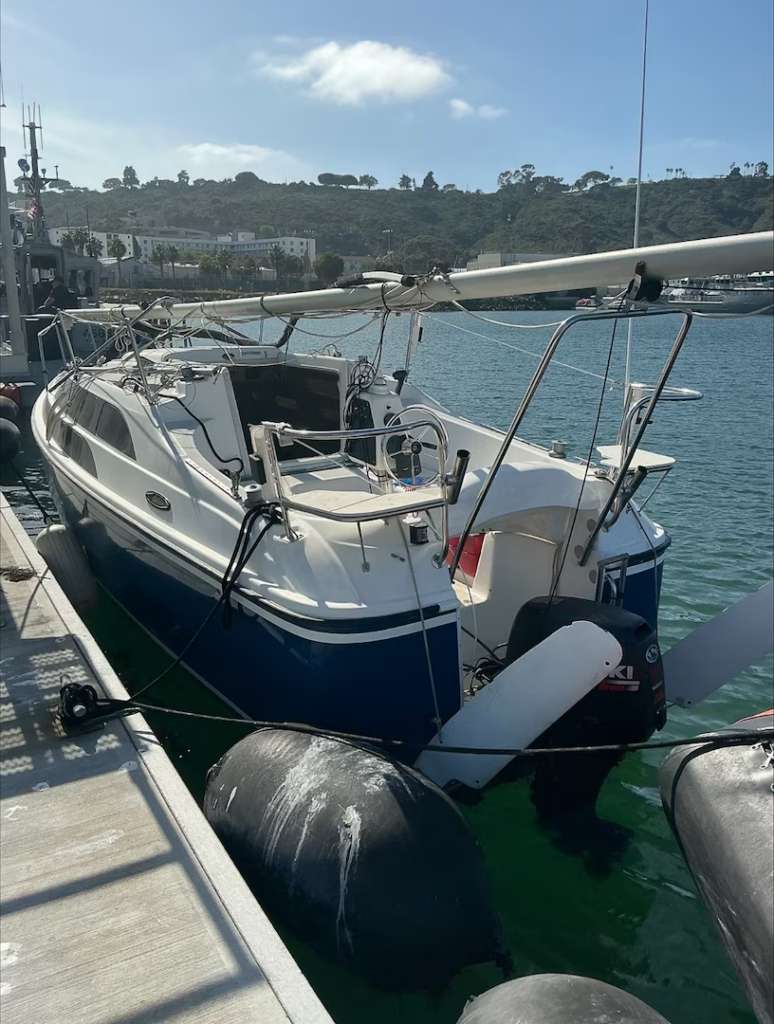
SAN DIEGO — A Coast Guard boarding team interdicted 12 suspected aliens Monday offshore San Diego.
At 6:09 a.m., watchstanders detected a panga-style vessel transiting north into U.S. waters. A boarding team from a Coast Guard Maritime Safety and Security Team deployed to intercept.
The boarding team issued commands for the vessel to stop, but the operator failed to comply and attempted to flee. The crew employed graduated use of force, which resulted in disabling fire.
Boarding team members identified 12 suspected aliens aboard, all claiming Mexican nationality.
All 12 aliens were transferred to U.S. Border Patrol personnel at Ballast Point in Imperial Beach.
Coast Guard Offloads Over $49.3 Million in Illicit Drugs Interdicted in Eastern Pacific Ocean
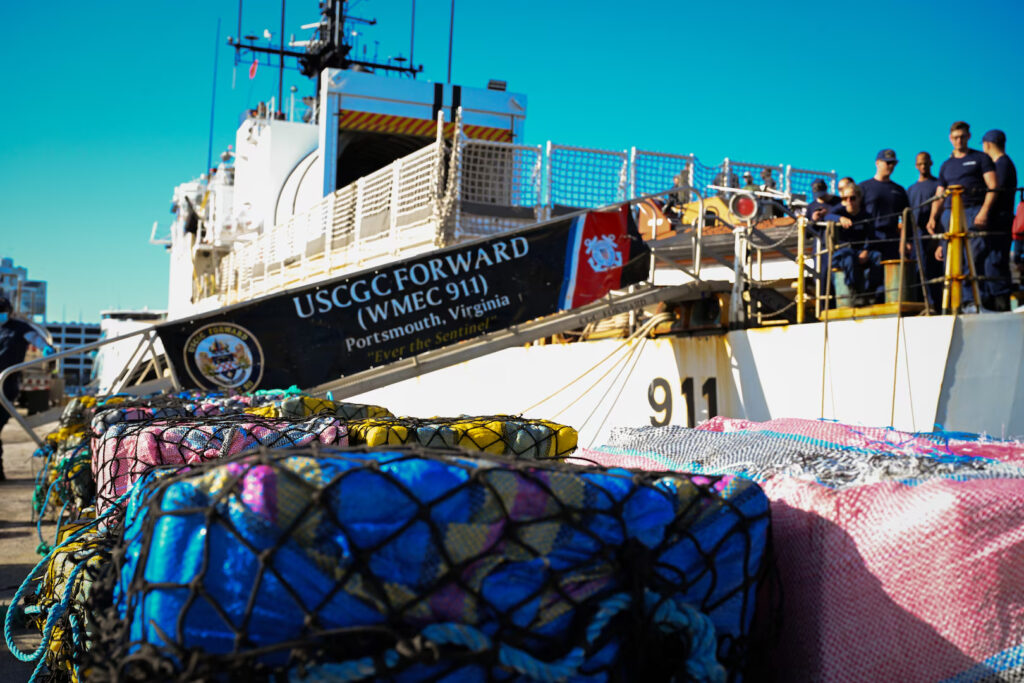
USCGC Foward’s (WMEC-911) crew offload illicit drugs valued at more than $49.3 million at Port Everglades, Florida March 19, 2026. This offload was a result of two interdictions in the international waters of the Eastern Pacific Ocean by the crews of USCGC Spencer (WMEC-905) and Forward interdicting approximately 6,750 pounds of cocaine. (U.S. Coast Guard photo by Seaman Christopher Moret)
From U.S. Coast Guard Southeast District, March 19, 2026
MIAMI – U.S. Coast Guard Cutter Forward’s crew offloaded approximately 6,570 pounds of cocaine worth more than $49.3 million at Port Everglades, Thursday.
The seized contraband was the result of two interdictions in the international waters of the Eastern Pacific Ocean.
On Feb. 7, a maritime patrol aircraft located a suspicious vessel, and Coast Guard Cutter Spencer’s embarked Helicopter Interdiction Tactical Squadron aircrew employed airborne use-of-force tactics to disable the vessel. Spencer’s boarding team interdicted the vessel and seized approximately 6,435 pounds of cocaine.
On March 8, a maritime patrol aircraft located a suspicious vessel, and Forward’s embarked HITRON aircrew employed airborne use-of-force tactics to disable the vessel. Forward’s crew interdicted the go-fast vessel, recovering approximately 130 pounds of cocaine.
“I’m incredibly proud of the crew for adding to the success of Operation Pacific Viper,” said Cmdr. Andrew Grantham, Forward’s commanding officer. “The Coast Guard and our partners are working tirelessly to stop narco-terrorists and criminal organizations before their dangerous and illegal cargos reach American shores.”
The following assets and crews were involved in the interdiction operations:
80% of interdictions of U.S.-bound drugs occur at sea. This underscores the importance of maritime interdiction in combatting the flow of illegal narcotics and protecting American communities from this deadly threat. U.S. Southern Command’s Joint Interagency Task Force-South based in Key West conducts the detection and monitoring of aerial and maritime transit of illegal drugs. Once interdiction becomes imminent, the law enforcement phase of the operation begins, and control of the operation shifts to the U.S. Coast Guard throughout the interdiction and apprehension. Interdictions in the Eastern Pacific Ocean are performed by members of the U.S. Coast Guard under the authority and control of the Coast Guard’s Southwest District, headquartered in Alameda, California.
To protect the Homeland from ongoing trafficking of illicit narcotics from South America to the United States, the Coast Guard is accelerating our counter-drug operations in the Eastern Pacific Ocean in support of Operation Pacific Viper. Since launching this operation in early August, the Coast Guard has seized over 200,000 pounds of cocaine, and apprehended 150 suspected drug smugglers.
The Coast Guard continues increased operations to interdict, seize and disrupt transshipments of cocaine and other bulk illicit drugs by sea. These drugs fuel and enable cartels and transnational criminal organizations to produce and traffic illegal fentanyl, threatening the United States.
These interdictions deny criminal organizations illicit revenue. They provide critical testimonial and drug evidence as well as key intelligence for their total elimination. These interdictions relate to Homeland Security Task Force Tampa, investigations in support of Operation Take Back America, which identifies, disrupts, and dismantles the highest-level criminal organizations that threaten the United States using a prosecutor-led, intelligence-driven, multi-agency approach.
Coast Guard interdicts 11 aliens near Imperial Beach
The Coast Guard interdicted 11 suspected aliens approximately 7 miles west of Imperial Beach, Sunday. At approximately 12:57 p.m., crew members aboard the Coast Guard Cutter Sea Otter (WPB-87362) observed a vessel transiting into U.S. waters and dispatched a boarding team to intercept.
U.S. Coast Guard Southwest District, March 16, 2026
SAN DIEGO — The Coast Guard interdicted 11 suspected aliens approximately 7 miles west of Imperial Beach, Sunday.
At approximately 12:57 p.m., crew members aboard the Coast Guard Cutter Sea Otter (WPB-87362) observed a vessel transiting into U.S. waters and dispatched a boarding team to intercept.
The Sea Otter’s boarding team interdicted the vessel and identified 11 suspected aliens aboard, all claiming Mexican nationality.
A Coast Guard Station San Diego boat crew assisted by transporting the vessel and all 11 suspected aliens to Border Patrol at Ballast Point.
USCGC William Hart Returns Home After 48-Day Operation Blue Pacific Patrol in Oceania
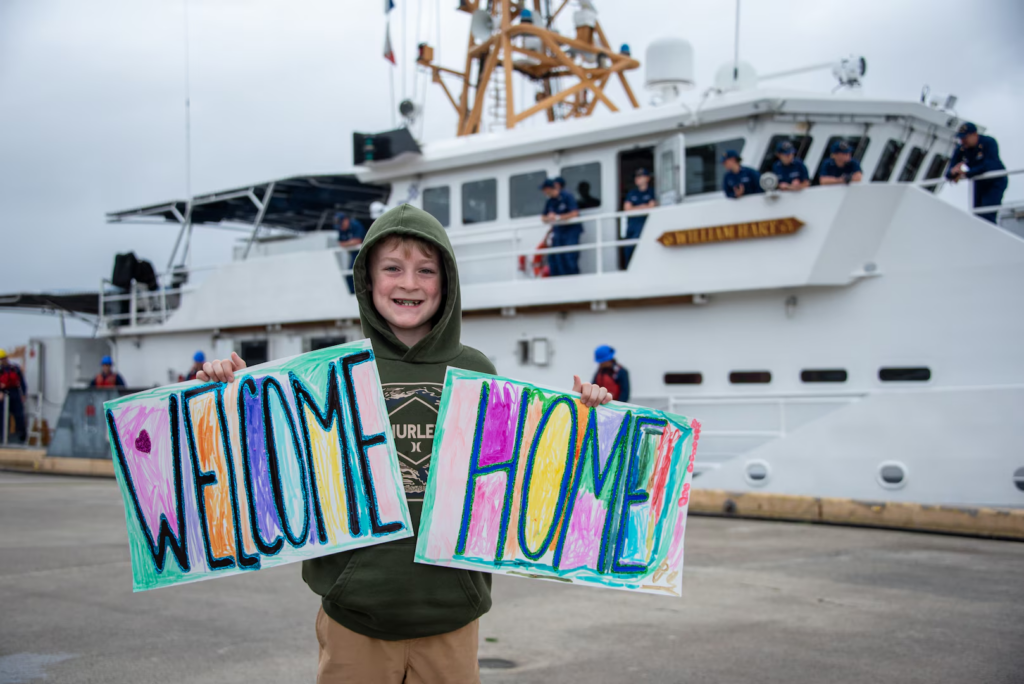
Henry Helsabeck, son of U.S. Coast Guard Lt. Cmdr. Jason Helsabeck, awaits the return of fast response cutter USCGC William Hart (WPC 1134) on Coast Guard Base Honolulu March 15, 2026. Helsabeck, the cutter’s commanding officer, led his crew on a 48-day patrol throughout Oceania, visiting Samoa, Cook Islands, American Samoa, Tonga and Kiribati. (U.S. Coast Guard photo by Chief Petty Officer Corinne Zilnicki)
Coast Guard Oceania District External Affairs, March 15, 2026
Editor’s Note: Click here to download high-resolution video.
HONOLULU – The crew of Coast Guard Cutter William Hart (WPC 1134) returned to Honolulu Sunday following a 48-day patrol in support of Coast Guard Oceania District’s Operation Blue Pacific in Oceania.
The William Hart crew departed Coast Guard Base Honolulu in January and traveled more than 7,000 nautical miles, making port calls in Apia, Samoa, Rarotonga, Cook Islands, Pago Pago, American Samoa, Nuku’alofa, Tonga, and Kiritimati, Kiribati.
Patrolling in support of Operation Blue Pacific, the cutter’s crew worked alongside Pacific Island partners to bolster maritime security and sovereignty, counter illicit maritime activities and transnational criminal organizations, and protect vital marine resources.
The William Hart crew exercised partnerships with Samoa and Cook Islands through bilateral maritime law enforcement agreements, professional exchanges and community engagements. In total, the William Hart crew and Pacific Island enforcement officers conducted eight boardings of fishing vessels.
The crew conducted one additional boarding of a foreign fishing vessel on the high seas supporting the Western and Central Pacific Fisheries Commission as part of a multinational effort to deter illegal fishing practices throughout Oceania.While on patrol to control, secure and defend the U.S. maritime border and its approaches in American Samoa, the crew worked alongside Coast Guard Sector Honolulu boarding team personnel and conducted a total of six boardings, including a cargo vessel, recreational boats and three passenger vessels in the vicinity of Pago Pago.
In Tonga, the crew hosted U.S. Deputy Secretary of State Christopher Landau and Prime Minister Fatafehi Fakafānua to facilitate the signing of the new annex to the 2009 bilateral maritime law enforcement agreement between the U.S. and Kingdom of Tonga. This addition significantly strengthened the security partnership between both nations by enhancing the ability to combat illegal fishing, illicit maritime activities, and transnational crime in Tonga’s exclusive economic zone through expanded enforcement authority and technical cooperation.
“This historic patrol advanced critical partnerships with Pacific Island nations, protecting valuable marine resources and strengthening U.S. Coast Guard presence throughout Oceania,” said Lt. Cmdr. Jason Helsabeck, commanding officer of the William Hart. “Our crew’s dedication to these partnerships ensures a more secure and prosperous future for the region. I am deeply proud of the crew’s unsurpassed professionalism, relentless commitment to securing our maritime borders, and the positive impact we’ve made alongside our trusted partners. We look forward to future deployments in Oceania.”
Operation Blue Pacific is an overarching multi-mission Coast Guard endeavor to promote security, safety, sovereignty and economic prosperity in Oceania. Coast Guard cutters, aircrew and personnel deploy throughout Oceania to maintain unrestricted, lawful access to the maritime domain for all nations, improve regional stability, and solidify the Coast Guard as a reliable partner for maritime safety, security and stewardship in the Pacific.
The William Hart is the third 154-foot Sentinel-class fast response cutter homeported in Honolulu. The cutter’s primary missions are maritime law enforcement, search and rescue, and national defense.
CGC Forward interdicts suspected drug smugglers in Eastern Pacific Ocean
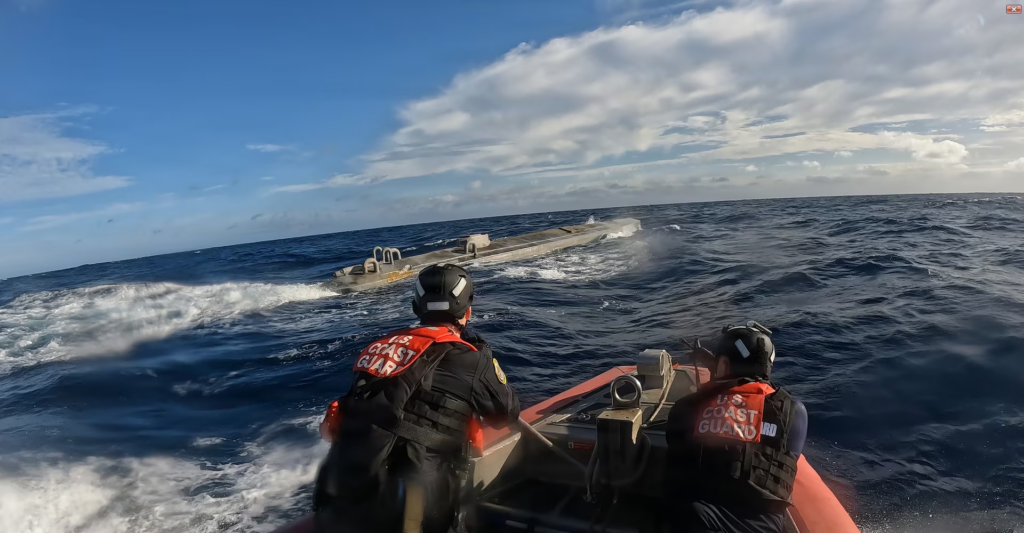
The U.S. Coast Guard Cutter Forward’s Over-the-Horizon cutter boat approaches a Self-Propelled Semi-Submersible in the Eastern Pacific Ocean, February 24, 2026. (U.S. Coast Guard courtesy photo)
From U.S. Coast Guard Southwest District, March 11, 2026
PORTSMOUTH, Va. – Coast Guard Cutter Forward (WMEC 911) delivered a decisive blow to maritime criminal networks by intercepting a self-propelled semi-submersible (SPSS) vessel during a routine patrol on February 24 in the Eastern Pacific Ocean.
A maritime patrol aircraft detected the vessel and reported the location to Forward watchstanders. Forward’s crew rapidly deployed its over-the-horizon cutter pursuit boat and an embarked MH-65 aircraft from the Helicopter Interdiction Tactical Squadron (HITRON) to intercept the suspicious vessel.
Despite repeated verbal commands issued by the boarding team, the SPSS failed to comply or stop their vessel. The boarding team successfully gained access to the vessel, secured positive control, and apprehended four suspected narco-terrorists. All personnel were safely evacuated to the cutter as the SPSS experienced flooding and subsequently sank.
SPSS vessels are commonly used by maritime criminal networks to transport large quantities of drugs in the Eastern Pacific. The Coast Guard routinely interdicts these vessels as part of ongoing counterdrug operations in the region.
“SPSS vessels are purpose-built to move large quantities of illicit, dangerous cargo,” said Cmdr. Andrew Grantham, commanding officer of the Forward. “This interdiction of an SPSS of over 70 feet, prevented a potential 17,600 lbs of cocaine—more than 6 million lethal doses—from reaching U.S. shores. Stopping this vessel demonstrates the exceptional skill and dedication of the Forward crew, the HITRON, Joint Interagency Task Force South, and Coast Guard District Southwest at imposing significant costs on transnational crime organizations.”
The Coast Guard is committed to deterring criminal activity and enhancing maritime security through disrupting illicit smuggling activity at sea before it can reach U.S. shores.
Coast Guard Cutter Forward is a 270-foot Famous-class medium-endurance cutter that conducts counterdrug, migrant interdictions and search and rescue missions throughout the Western Hemisphere. Link to provide more information on the Forward: History