USCGC Decisive Returns Home from Final Patrol 

The Reliance-class medium endurance cutter USCGC Decisive (WMEC 629) conduct at sea engagements with the navy of Guatemala in the territorial seas of Guatemala on Oct. 25 – 26, 2021. The U.S. Coast Guard conducts routine deployments in the Southern Command area of responsibility, works alongside partners, builds maritime domain awareness, and shares best practices with partner nation navies and coast guards. (U.S. Coast Guard photo)

Release from U.S. Coast Guard 

*******

PENSACOLA, Fla. — The crew of the USCGC Decisive (WMEC 629) returned to their homeport in Pensacola, Jan. 13, following a 33-day patrol in the Eastern Pacific Ocean, concluding 55 years of service to the Nation, the Coast Guard Atlantic Area said in a Jan. 18 release. 

Decisive patrolled the Eastern Pacific Ocean in the Coast Guard Eleventh District’s area of operations. While underway, the Decisive’s crew supported the Coast Guard’s drug interdiction and search and rescue missions to promote safety of life at sea and deter the flow of illegal narcotics into the United States.   

While deployed, Decisive’s crew collaborated with Coast Guard assets and foreign military aircraft to detect, deter, and interdict illegal narcotics voyages. At one point, Decisive disrupted two vessels suspected of drug trafficking in the same night. Decisive also collaborated with the USCGC Alert (WMEC 630) to safely transfer three suspected smugglers. While aboard Decisive, the detainees received food, water, shelter and medical attention. 

“The crew’s remarkable professionalism, competence and determination were on full display as we met the diverse challenges of operations at sea,” said Cmdr. Aaron Delano-Johnson, commanding officer of Decisive. “Whether it was conducting simultaneous boardings or our skilled engineers conducting voyage repairs in Panama, the crew exceeded expectations at every turn. After a successful, final patrol for Decisive, we are looking forward to returning home to our family and friends on shore.” 

During the patrol, Decisive traveled more than 6,000 miles and traversed through the Panama Canal. By transiting the historic waterway, Decisive’s crew earned their Order of the Ditch certificates, a time-honored nautical tradition recognizing mariners who have crossed the Panama Canal between the Atlantic and Pacific Oceans. 

Decisive is a 210-foot, Reliance-class medium-endurance cutter with a crew of 72. The cutter’s primary missions are counter drug operations, migrant interdiction, and search and rescue in support of U.S. Coast Guard operations throughout the Western Hemisphere. 


USCGC Tahoma Returns Home after 50-day Caribbean Sea Patrol 

Coast Guard, and Customs and Border Protection Air and Marine Operations crews stop a grossly overloaded and unsafe Haitian sail freighter about 50 miles south of Cudjoe Key, Florida, Dec. 12, 2022. The people were repatriated to Haiti on Dec. 20, 2022. U.S. COAST GUARD / Cutter Tahoma’s crew

Release by U.S. Coast Guard 

******* 

NEWPORT, R.I. — The crew of the USCGC Tahoma (WMEC 908) returned to their home port in Newport, Rhode Island, Jan. 16, following a 50-day patrol in the Caribbean Sea, the Coast Guard Atlantic Area said in a release. 

Tahoma patrolled the south Florida Straits in support of Homeland Security Task Force – Southeast and Operation Vigilant Sentry in the Coast Guard Seventh District’s area of operations. While underway, Tahoma’s crew conducted maritime safety and security missions while working with a variety of Coast Guard and U.S. Customs and Border Protection assets, as well as good Samaritan vessels, to detect, deter and intercept unsafe and illegal migrant ventures bound for the United States. 

Throughout the patrol, Tahoma intercepted, cared for and safely transferred more than 650 Cuban and Haitian nationals. Notably, Tahoma worked with partners to stop a highly unstable, overloaded sailboat with 93 Haitian nationals on board, many of whom were held below decks in unsafe and unsanitary conditions. 

Tahoma’s rescues highlight the Coast Guard’s critical maritime law enforcement and lifesaving missions of maintaining safety at sea and preventing the potential for loss of life by deterring migrants from taking to the sea in dangerously overcrowded, unseaworthy vessels in an attempt to enter the United States illegally. 

“I am very proud of Tahoma’s crew for their hard work and dedication, carrying out this demanding mission while being away from family during the holiday season,” said Cmdr. Piero Pecora, Tahoma’s commanding officer. “Their focus and professionalism at all hours of the day and night saved hundreds of lives and reflects the Coast Guard’s unwavering dedication to the safety of life at sea.” 

Tahoma is a 270-foot Famous-class medium-endurance cutter with a crew of 100. The cutter’s primary missions are counter drug operations, migrant interdiction, enforcement of federal fishery laws, and search and rescue in support of U.S. Coast Guard operations throughout the Western Hemisphere. 


Cutter Alex Haley Returns to Kodiak following 7-Month-Long Maintenance Period 

The Coast Guard Alex Haley sits dry docked for repairs and maintenance in Seattle, Washington, Dec. 13, 2022. While in dry dock, the crew and contractors successfully completed more than $6 million worth of repairs. U.S. COAST GUARD

Release from U.S. Coast Guard 

******* 

KODIAK, Alaska — The crew of the Coast Guard Cutter Alex Haley returned to homeport at Coast Guard Base Kodiak, Alaska, on Jan. 12, following an extended seven-month dry dock maintenance period in Seattle, Washington, the Coast Guard 17th District said in a release.  

While in dry dock, the crew and contractors successfully completed more than $6 million worth of repairs.  

The engineering department oversaw 76 work items including major overhauls on the cutter’s controllable pitch propeller system, speed reducers, rudders, and boilers, along with inspections of fuel, sewage, and water tanks. The operations department supervised a renewal of the Alex Haley’s flight deck, navigation systems, and electronics while maintaining critical law enforcement currencies. The deck department expertly completed vast amounts of painting and topside preservation, while ensuring small boat operational readiness.  

When crewmembers were not directly involved in repairs, they took advantage of temporary duty training opportunities to gain technical proficiencies.  

Crew Helps with Other Coast Guard Missions 

Crewmembers were sent to southern California to aid in migrant operations, supported scientific missions in the Arctic, and played a key role in the Rim of the Pacific 2022 Naval Exercise, strengthening our relationships with 33 partner nations.  

The entire crew also attended advanced damage control schools hosted by Naval Base Kitsap in Bremerton, Washington. Crewmembers were taught plugging, patching and dewatering techniques in the classroom then went hands-on, applying their knowledge to simulated flooding in a wet trainer.  

Firefighting tactics were also honed while combating real fires during two scenarios that mimicked plausible casualties on a cutter like the Alex Haley.  

“I am incredibly proud of the crew’s accomplishments during this extended maintenance period,” said Cmdr. Brian Whisler, commanding officer of the Alex Haley. “The crew worked tirelessly to make significant material and aesthetic improvements to the cutter which will have long-term benefits as we continue to prepare for future patrols in the Bering Sea. Seven months is a long time to be away from home and we are thrilled to be reunited with our family, friends, and our Kodiak Community.” 

Following its dry dock period, the Alex Haley will be able to continue operating as the Coast Guard’s primary asset in the Bering Sea with renewed and improved capabilities.  

The Alex Haley is a 52-year-old 282-foot Medium Endurance Cutter that has been homeported in Kodiak since 1999. The crew routinely operates throughout the Bering Sea, the Gulf of Alaska, and the Pacific Ocean. The Alex Haley’s ability to operate in extreme weather conditions provides the mission flexibility necessary to perform search and rescue, fisheries law enforcement, and vessel safety inspections across Alaska. 


Coast Guard, Navy Competition for Ship Availabilities to Increase: USCG Official

The Coast Guard Yard at Curtiss Bay, Maryland, is the service’s main cutter maintenance facility. U.S. COAST GUARD

ARLINGTON, Va. — The U.S. Coast Guard will be in “closer competition than we ever have before” with the U.S. Navy for dry dock and dockside availabilities for their ships, a Coast Guard official said during a panel on maintenance at the Surface Navy Association Annual Symposium on Jan. 12. 

Bob Thomas, U.S. Coast Guard deputy assistant commandant for engineering and logistics (CG-4D), said that the Coast Guard is competing for resources with both the industry and the Navy as retention and recruiting struggles. persist throughout the military. Along with maintenance areas that the Coast Guard hasn’t historically dealt with, such as cyber, that creates an intensely competitive environment, he said. 

The Coast Guard has seen many of the same recruiting and retention challenges as the other services, Thomas noted. 

“The workforce has almost become a migrant workforce,” he said. “They’ll shift to where the work is, [or] who’s paying the most. […] That drives the cost way up when people are competing for limited resources. You get to pay more for the same thing, or sometimes it’s not available.”

Collaborating to Retain Workforce Numbers

However, he added that the Coast Guard is working closely with the Navy to help mitigate some of these issues, mentioning a number of collaborative efforts that he thinks are “going to pay off huge for the Coast Guard.” 
 
Navy Rear Adm. Scott Brown, deputy commander for logistics, maintenance, and industrial operations, also said that 2022 was “not a great year” in terms of staffing at the public shipyards, stating that they were short by 1,200 personnel, with 37,000 total working in those shipyards. 
 
“A big focus of our efforts is to improve the recruiting and incentives for folks that come into the shipyards,” he said. 
 
Brown said he believes that, in addition to the economy, the state of the shipyards and changing demographics are the primary reasons why the Navy continues to struggle with recruiting and retention. 
 
To offset some of those challenges, the Navy is looking not only to boost pay, but to also offer career development opportunities to sailors. For example, the Navy has introduced a program to help mechanical expert tradespeople, a promotion that keeps them “turning wrenches” while still providing advancement opportunities.


USCGC Hamilton Returns Home after Historic Sixth Feet Deployment

The U.S. Coast Guard Cutter Hamilton (WMSL 753) moors to the pier in North Charleston, South Carolina, Dec. 21. U.S. COAST GUARD / Petty Officer 2nd Class Brandon Hillard

NORTH CHARLESTON, S.C. — The crew of U.S. Coast Guard Cutter Hamilton (WMSL 753) returned to their homeport Dec. 21 in North Charleston following a 94-day deployment in the U.S. Naval Forces Europe – Africa area of operations, the Coast Guard Atlantic Area said in a release.   

Hamilton’s crew operated in support of the U.S. Sixth Fleet and was tasked to defend U.S., allied and partner interests.  

Hamilton began its deployment with a transatlantic voyage to Rota, Spain and met with operational commanders from U.S. Sixth Fleet. After Spain, the cutter transited through the English Channel and Danish Straits, two vitally significant waterways that provide safe passage for 15% of the world’s shipping.  

Immediately upon entering the Baltic Sea region, Hamilton conducted at-sea exchanges with naval, coast guard and border guard forces of multiple Baltic Sea allies and partners, including Sweden, Finland, Estonia, Latvia and Lithuania. Each engagement was oriented to support either traditional Coast Guard missions or in combination with defense readiness exercises used to enhance interoperability between the U.S. and NATO partners.  

As the first U.S. military vessel to visit Turku, Finland in over a decade, Hamilton hosted public tours of the cutter and held a reception for U.S. and Finnish government and military leaders. Guests included the U.S. Ambassador to the Republic of Finland, the deputy chief of the Finnish Border Guard, the state secretary of the Ministry of Interior and the mayor of Turku. The visit also served to reinforce the long-standing partnership between the Finnish Border Guard and the U.S. Coast Guard.   

Additionally, Hamilton is the first U.S. Coast Guard cutter to visit Riga, Latvia in more than 20 years. The crew met with the U.S. ambassador to Latvia and hosted a reception on board Hamilton for members of Latvia’s navy and coast guard to include the Latvian navy’s chief of staff and the commander of the Latvian coast guard. Hamilton also served as a backdrop to Latvia’s 104th Freedom Day celebration alongside NATO forces.   

“It was an honor to grow the relationship between the United States and our Baltic Sea allies and partners during engagements both at sea and in port,” said Capt. Matthew Brown, commanding officer of Hamilton. “By working side by side with our current and future NATO allies, we learned just how much we have in common, and we were left with a stronger appreciation for our shared values. I could not be more proud of this crew’s hard work and sacrifice while serving as the United States’ representatives in the Baltic.”  

Hamilton’s deployment demonstrated the strategic value of conducting meaningful at-sea engagements, subject matter exchanges and port visits with allies and partners in the high northern latitudes and Baltic Sea region. The U.S. maritime services regularly operate with partner nations to cultivate a cohesive force to maintain freedom of the seas, ensure free economic exchange and maintain maritime security.  

“The U.S. Coast Guard is a proud and capable partner of the U.S. Joint Forces serving in the Europe and Africa areas of operations,” said Vice Adm. Kevin E. Lunday, commander of Coast Guard Atlantic Area. “We will continue to build maritime domain awareness and share best practices with our partner nations’ navies and coast guards.”    

Hamilton is a 418-foot, Legend-class national security cutter with a crew of 160. With its robust command, control, communication, computers, intelligence, surveillance and reconnaissance equipment, the NSC is the most technologically advanced ship in the Coast Guard’s fleet. NSCs are a worldwide deployable asset that supports the Department of Homeland Security, Department of Defense and national objectives to include drug interdiction, migrant interdiction, national defense, search and rescue, fisheries enforcement and national intelligence collection.


USCGC Vigorous Returns Home after a 48-day Multi-Mission Patrol

U.S. Coast Guard Cutter Vigorous moored at home port in Virginia Beach, Virginia Dec. 21, 2022. Vigorous is a 210-foot, Reliance-class medium endurance cutter with a crew of 74. U.S. COAST GUARD / Petty Officer 3rd Class Kate Kilroy

VIRGINIA BEACH, Va. — The crew of the U.S. Coast Guard Cutter Vigorous (WMEC 627) returned to their homeport in Virginia Beach Dec. 21, following a 48-day patrol in the Northern Caribbean Sea, the Coast Guard Atlantic Area said in a release. 

In support of the Coast Guard’s Seventh District, Vigorous’ crew conducted maritime safety and security missions as they responded to the historically high migration activity and remained prepared to interdict and disrupt the flow of illegal narcotics in the South Florida Straits and Windward Pass.  

During the patrol, Vigorous traveled more than 8,000 miles and contributed to the safe transfer of more than 500 Cuban nationals. Vigorous worked with numerous Coast Guard assets, U.S. Customs and Border Protection boats and good Samaritan vessels to detect, deter and intercept unsafe and illegal ventures bound for the United States. 

“The Vigorous crew’s remarkable professionalism, competence and determination were on full display as we met the diverse challenges of operations at sea,” said Cmdr. Ryan Waters, commanding officer of Vigorous. “Whether executing days of small boat operations late into the night or rendering assistance to mariners on a disabled vessel, the Vigorous crew exceeded expectations at every turn. After a successful patrol, we look forward to returning home to our family and friends on shore.” 

Vigorous is a 210-foot, Reliance-class medium-endurance with a crew of 74. The cutter’s primary missions are counter-drug operations, migrant interdiction, enforcing federal fishery laws and search and rescue in support of U.S. Coast Guard operations throughout the Western Hemisphere.


USCGC Forward Offloads $176 Million Worth of Cocaine in Port Everglades

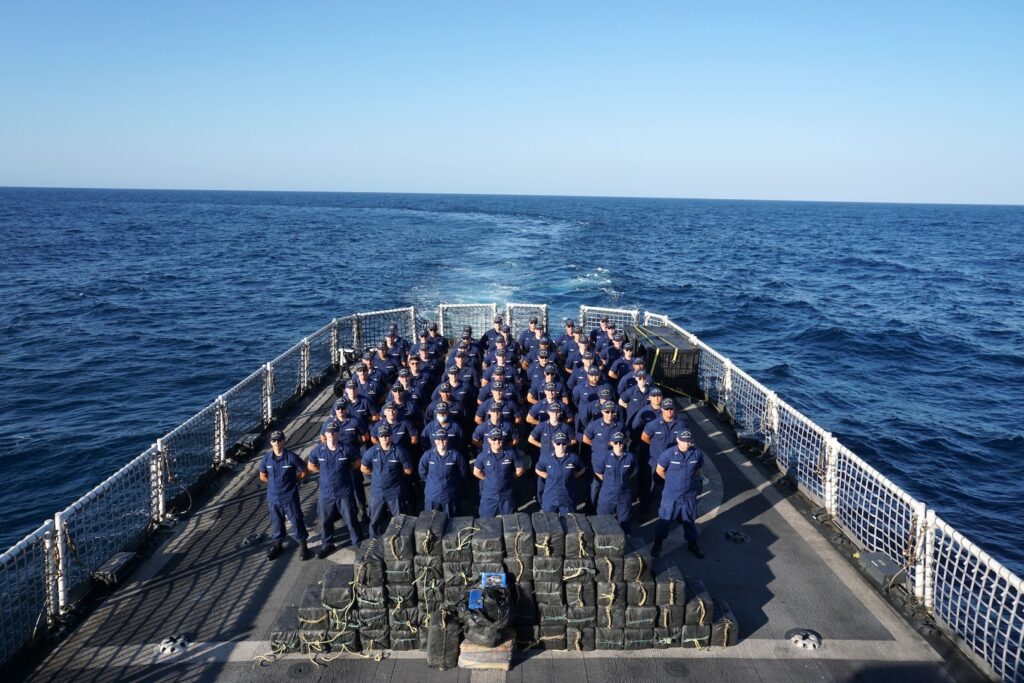
The crew of the Coast Guard Cutter Forward pose with approximately 13,375 pounds of cocaine in Port Everglades, Florida, Dec. 15, 2022. U.S. COAST GUARD / Petty Officer 3rd Class Eric Rodriguez

PORT EVERGLADES, Fla. ­— The crew of the U.S. Coast Guard Cutter (USCGC) Forward (WMEC 911) offloaded approximately 13,375 pounds of cocaine worth an estimated $176 million in Port Everglades, Florida, Dec. 15, the Coast Guard 7th District said in a Dec. 19 release. 

The drugs were interdicted in the international waters of the Caribbean Sea by crews from Forward, Coast Guard Helicopter Interdiction Tactical Squadron and Coast Guard Law Enforcement Detachment 408 on the HNLMS Holland (P840). 

Throughout the patrol, Forward held approximately 18,500 pounds of cocaine on deck worth an estimated $244 million. Earlier this month, Forward transferred approximately 4,365 pounds of cocaine to USCGC Campbell (WMEC 909) and 1,654 pounds of cocaine to the United States Drug Enforcement Administration. Forward also intercepted three suspected narcotics smugglers and held 12 others.  

“Working with the Dutch to support multi-national interests in the Caribbean is greatly rewarding,” said Cmdr. Staci K. Rutsch, Forward’s commanding officer. “Coupled with our ship’s organic law enforcement capabilities, this patrol led to a significant removal of illicit narcotics from the maritime domain. Opposing transnational criminal organizations is important in maintaining our partnerships and keeping our partners in the central Caribbean safe. I could not be more proud of the crew’s hard work in supporting this mission.” 

The fight against drug cartels in the Caribbean Sea and the transnational criminal organizations they are associated with requires a unity of effort in all phases; from detection and monitoring to interdiction and apprehension, and on to criminal prosecutions by international partners and U.S. Attorneys’ Offices in districts across the nation. 

Forward is a 270-foot Famous-class medium-endurance cutter homeported in Portsmouth, Virginia, with a crew of 97. The cutter’s primary missions include law enforcement, search and rescue, protection of living marine resources, homeland security and defense operations, international training and humanitarian operations throughout the Western hemisphere. 


Sea Machines and Coast Guard Partner to Bring Computer Vision Domain Awareness to Critical Missions

BOSTON — Sea Machines Robotics Inc. has installed its new AI-ris computer vision product onboard a U.S. Coast Guard (USCG) 270-foot Famous-class medium-endurance cutter ahead of the vessel’s upcoming deployment. AI-ris uses artificial intelligence to identify and track visual targets of interest.   

This installation was made possible under an ongoing Cooperative Research and Development Agreement between Sea Machines Robotics and the USCG Research and Development Center in an effort to evaluate how computer vision systems can be utilized for autonomous navigation, collision avoidance and target detection. The deployment of AI-ris provides the USCG a new tool for maritime domain awareness and allows Sea Machines to refine its computer vision technology with feedback from the USCG across diverse environmental conditions and operational scenarios.  

The collaboration between Sea Machines and the U.S. Coast Guard began in 2020 following the USCG Research and Development Center selecting the Sea Machines’ SM300 remote command and autonomy product for their 29-foot research vessel.  

Sea Machines CEO Michael G. Johnson stated, “The close collaboration between Sea Machines and the United States Coast Guard Research and Development Center extends deeply into their mission-oriented service. The USCG is a branch of the armed forces, a law enforcement agency, a regulator, a member of the U.S. Intelligence community, and a first responder. Sea Machines’ goal is to lead with new technologies that advance on-water operations and support the Coast Guard in the many missions they serve.”    


USCGC Campbell Returns to Homeport Following 60-day Eastern Pacific Patrol 

U.S. Coast Guard Cutter Campbell (WMEC 909) transits toward its homeport, on Nov. 30, 2022. Campbell completed a 60-day counterdrug patrol in the eastern Pacific Ocean to support Joint Interagency Task Force – South. U.S. COAST GUARD / Ensign Olivia Anthony

NEWPORT, R.I. — The crew of the U.S. Coast Guard Cutter Campbell (WMEC 909) returned to their homeport in Newport, Rhode Island, Dec. 9, after a 60-day counterdrug patrol in the Eastern Pacific Ocean to support Joint Interagency Task Force – South. 

With the assistance of an embarked Helicopter Interdiction Tactical Squadron detachment based out of Jacksonville, Florida, Campbell was tasked with the disruption and interdiction of illicit narcotics originating in Central and South America.  

Throughout October and November, Campbell’s crew boarded five different vessels, resulting in the successful detention of 12 suspected drug smugglers and the interdiction of over 9,700 pounds of marijuana worth approximately $9.7 million.  

Campbell’s actions directly contributed to the United States’ ongoing efforts to combat transnational criminal organizations. 

During the deployment, the crew took multiple opportunities to strengthen ties with partner nations across the region. Campbell embarked two members of the Panamanian National Aeronaval Service for the duration of the deployment to the Eastern Pacific. Campbell also conducted joint training with members of the Costa Rican and Ecuadorian maritime forces, strengthening regional partnerships in the Western Hemisphere.  

While transiting home in December, crew members from Campbell rescued nine migrants who were stranded on an uninhabited Bahamian island.  

In early December, Campbell completed a drug offload in Fort Lauderdale, Florida, transferring over 14,500 pounds of cocaine and marijuana worth an estimated $320 million. The contraband was the result of interagency and international collaboration, and included busts from Campbell, USCGC Forward (WMEC 911) and HNLMS Holland (P 840) of the Royal Netherlands Navy.  

Campbell is a 270-foot, Famous-class medium-endurance cutter with a crew of 100. Its primary missions include search and rescue, maritime law enforcement, marine environmental protection, homeland security and national defense operations.


Task Force 59 Launches Aerial Drone from Coast Guard Ship in Middle East 

An Aerovel Flexrotor unmanned aerial vehicle (UAV) takes off from U.S. Coast Guard fast response cutter USCGC Emlen Tunnell transiting the Arabian Gulf, Dec. 7. U.S. NAVY

MANAMA, Bahrain — A U.S. Navy unmanned task force in the Middle East launched an aerial drone from a U.S. Coast Guard vessel operating the Arabian Gulf, Dec. 7, U.S. Naval Forces Central Command / U.S. 5th Fleet Public Affairs said in a release. 
 
U.S. 5th Fleet’s Task Force 59 launched an unmanned aerial vehicle (UAV) from U.S. Coast Guard Cutter Emlen Tunnell (WPC 1145), marking a first for the task force with a U.S. Coast Guard vessel since the task force’s establishment in September 2021. 
 
The launch also demonstrated close collaboration between the U.S. Coast Guard and Task Force 59 as U.S. 5th Fleet rapidly integrates unmanned systems and artificial intelligence to enhance monitoring of regional waters. 
 
Task Force 59 is conducting Digital Horizon, a three-week event focused on integrating new unmanned and artificial intelligence platforms, including 10 that are in the region for the first time. 
 
“Each day during Digital Horizon we have pushed to discover new capabilities, fast,” said Capt. Michael Brasseur, commodore of Task Force 59. “I am so proud of the team for their steadfast commitment to not only imagine new possibilities, but to deliver them.” 
 
An Aerovel Flexrotor successfully took off and landed vertically aboard Emlen Tunnell, showcasing close collaboration between Navy, Coast Guard and industry partners to advance technology integration. 
 
“We are so excited to be part of Digital Horizon and play a critical role by helping integrate new technologies into the fleet,” said Lt. Patrick Kelly, Emlen Tunnell’s commanding officer. “I am so proud of the crew for their dedication, commitment and professionalism, which made today’s success possible.” 
 
The Flexrotor can support intelligence, surveillance and reconnaissance (ISR) missions day and night using a daylight or infrared camera to provide a real-time video feed. 
 
In addition to providing ISR capability, UAVs like the Flexrotor enable Task Force 59 to enhance a resilient communications network used by unmanned systems to relay video footage, pictures and other data to command centers ashore and at sea. 
 
U.S. 5th Fleet established Task Force 59 more than 14 months ago. Since its launch, the task force has deployed a suite of new unmanned systems while integrating artificial intelligence at operational hubs in Jordan and Bahrain. 
 
Emlen Tunnell is one of the Coast Guard’s newest Sentinel-class fast response cutters forward-deployed to Bahrain where U.S. 5th Fleet is headquartered. The ship helps ensure maritime security and stability across the Middle East.