USCGC Dependable Returns Home after Month-Long Patrol in Florida Straits
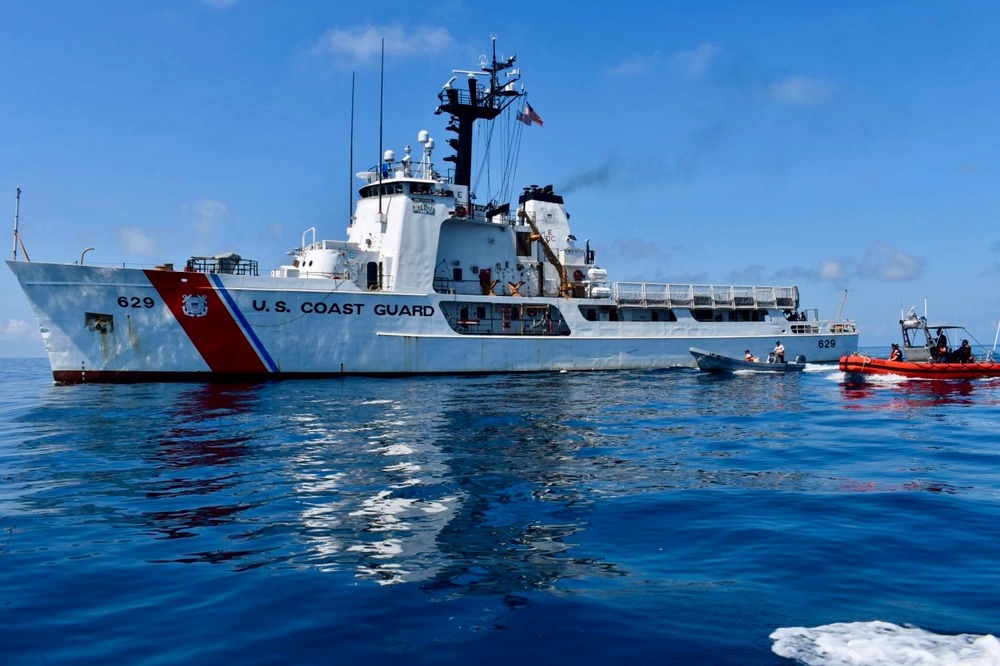
The Coast Guard Cutter Dependable transits toward the pier at Joint Expeditionary Base Little Creek, Fort Story in Virginia Beach, Virginia, Sept. 27, 2016. U.S. COAST GUARD / Petty Officer 1st Class Melissa Leake
VIRGINIA BEACH, Va. — The crew of the U.S. Coast Guard Cutter Dependable (WMEC 626) returned to their homeport in Virginia Beach, Nov. 5, following a 29-day patrol in the Florida Straits, the Coast Guard Atlantic Area said in a release.
In support of the Coast Guard’s 7th District, Dependable’s crew conducted migrant interdiction operations, collaborating with numerous Coast Guard assets and Department of Homeland Security boats and aircraft to detect, deter and intercept unsafe and illegal ventures bound for the United States.
During the patrol, Dependable’s crew assisted with the interdiction of 193 migrants and cared for a total of 297 migrants that were interdicted by various Coast Guard and other law enforcement entities working within the Florida Straits.
“The crew began preparing for this Florida Straits patrol back in July, including qualifying over 50 crewmembers to stand watch and care for migrants embarked on board the cutter,” said Lt. Cmdr. Dana Prefer, executive officer on board Dependable. “All of the training and preparation paid off as it was truly a team effort to interdict, process and care for almost 300 migrants throughout our patrol.”
Dependable is a 210-foot Reliance-class medium-endurance cutter with a crew of 67. The cutter’s primary missions include counterdrug operations, migrant interdiction, enforcement of federal fishery laws and search and rescue in support of Coast Guard operations throughout the Western Hemisphere.
Coast Guard Cutter Active Returns to Port Angeles after Eastern Pacific Patrol
Coast Guard Cutter Active (WMEC 618) crewmembers aboard the cutter’s 26-foot Small Boat pull alongside the Coast Guard Cutter Steadfast (WMEC 623) to transfer parts and provisions while the cutters patrol the Eastern Pacific Ocean, Sept. 20, 2022. U.S. COAST GUARD / Chief Petty Officer Shane Sexton
PORT ANGELES, Wash. — The Coast Guard Cutter Active (WMEC 618) and crew returned to their homeport Friday after a 65-day patrol in international waters of the Eastern Pacific Ocean near Central and South America, the Coast Guard Pacific Area said in a Nov. 5 release.
Coast Guard cutters operating in the Eastern Pacific Ocean often collaborate to prevent and deter Transnational Criminal Organizations (TCOs) from successfully transporting narcotics destined for the United States.
During this patrol, the Active’s crew rendezvoused with Coast Guard Cutters Steadfast (WMEC 623) and Bertholf (WMSL 750) to conduct joint operations. Active’s crew also partnered with maritime patrol aircrews from Joint Interagency Task Force-South (JIATF-S) who aid in the detection of ships suspected of drug smuggling.
Crewmembers aboard Active transited more than 10,000 nautical miles from the Strait of Juan de Fuca to the southern hemisphere during the patrol. The crew sighted an abundance of marine wildlife throughout the patrol, and rescued sea turtles trapped in fishing gear.
The Active’s crew departed Port Angeles Sept.1 and transited to San Diego for a logistics stop. While in San Diego, the crew completed unscheduled repairs, enabling the Active to continue its southbound journey along the coast of Mexico and Central America in pursuit of illegal drug smuggling vessels.
“The Active crew performed superbly in every assigned mission,” said Cmdr. Brian Tesson, commanding officer of the Active. “They were presented with various challenges from engineering casualties to abundant tropical weather systems. This crew consistently stepped up with a can-do attitude, ingenuity and fortitude in the face of adversity, defining what it means to work aboard the ‘Li’l Tough Guy.’ Our success as a team is due in no small part to the families and support network at home who enable us to focus on the mission; for them I am most grateful.”
The Active and other Coast Guard cutters frequently patrol this 42-million square mile region with the assistance of JIATF-S to interdict and disrupt drug shipments, thereby reducing the flow of drugs and disrupting the TCOs that traffic them. JIATF-S is a multiagency organization that coordinates with international partners in detecting and monitoring illicit narcotics trafficking and other organized crime flowing from Latin America to the United States.
The Active, a 57-year-old, 210-foot medium endurance cutter nicknamed “Li’l Tough Guy” is equipped with two deployable small boats and a flight deck capable of conducting underway flight operations with Coast Guard MH-65 Dolphin helicopter aircrews.
USCGC Reliance Returns Home Following 67-Day Migrant-Interdiction Patrol
Coast Guard Cutter Reliance patrols the Western Caribbean in support of the Joint Interagency Task Force – South October 2014. U.S. COAST GUARD / Petty Officer 3rd Class Clinton McDonald
PENSACOLA, Fla. — The crew of U.S. Coast Guard Cutter Reliance (WMEC 615) returned to their homeport in Pensacola, Nov. 4, following a 67-day Caribbean Sea patrol.
During the patrol, Reliance’s crew collaborated with numerous Coast Guard assets and other Department of Homeland Security boats and aircraft to detect, deter and intercept unsafe and illegal ventures to the United States.
In support of the Coast Guard’s Seventh District, Reliance primarily patrolled the South Florida Straits, south of the Florida Keys and the Windward-passage, off the northwest coast of Haiti, contributing to the interdiction and care of 613 migrants and 13 detainees. Additionally, Reliance’s crew repatriated 120 migrants to Santiago, Cuba, marking the first visit by a U.S. warship to the port in more than 50 years.
“I am extremely pleased by this crew and proud to be a part of this team. Reliance departed homeport shorthanded and was immediately put to the test, performing especially high-tempo migrant interdiction operations. At all hours of day and night, the Reliance crew responded superbly, facilitating the safe care and repatriation of a historic surge of Cuban migrants while also completing qualification requirements and robust training exercises necessary following the summer transfer season,” said Cmdr. Brian Chapman, commanding officer of Reliance.
Reliance is a 210-foot medium-endurance cutter homeported in Pensacola with a crew of 77. The cutter’s primary missions are counter-drug operations, migrant interdiction, enforcement of federal fishery laws and search and rescue in support of Coast Guard operations throughout the Western Hemisphere.
Coast Guard Cutter Oliver Berry Conducts Bilateral Shiprider Boardings with Samoa
Crew members from the U.S. Coast Guard Cutter Oliver Berry board a foreign flagged fishing vessel. U.S. COAST GUARD
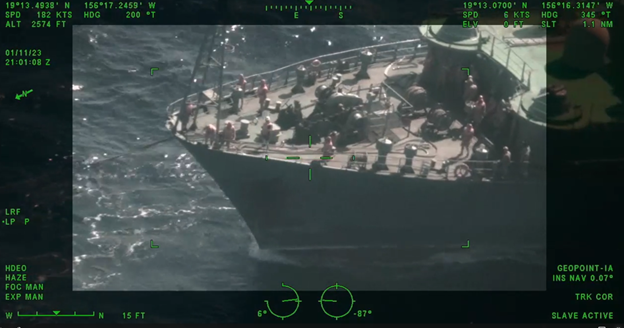
HONOLULU — The Coast Guard Cutter Oliver Berry (WPC 1124), a 154-foot Fast Response Cutter homeported in Honolulu, patrolled the Independent State of Samoa’s exclusive economic zone while partnering with Samoan Maritime Police and Fisheries Officers, where they executed four safety and living marine resources boardings on Samoan and foreign flagged fishing vessels in Samoan waters, identifying six violations, the Coast Guard 14th District said in a Nov. 4 release.
During their expeditionary patrol across Oceania, Oliver Berry’s crew is collaborating with partner governments like Samoa to conduct bilateral shiprider boardings to strengthen maritime domain awareness and resource security within their EEZs; an EEZ is the area of coastal water within a certain distance of a nation’s coastline to which the country claims exclusive rights for drilling, fishing and other economic ventures.
The U.S. Coast Guard employs 11 bilateral law enforcement agreements with Pacific Island Forum nations, including Samoa, to help ensure the nations’ maritime resource security and sovereignty. These programs highlight the shared commitment to ensuring security and freedom of navigation in the Pacific.
“Collaborating with our partners throughout Oceania is essential in ensuring a free and open Blue Pacific,” said Lt. Cmdr. Micah Howell, commanding officer of the Oliver Berry. “It is a privilege, and we are proud to support Samoa through dedicated partnership in the effort to maintain maritime governance and security.”
Oliver Berry’s crew also enjoyed a multitude of community engagements during their time in Samoa. These engagements included crew visits to the National University of Samoa Maritime School and Samoa’s Victim Support Camp, and a beach cleanup with staff from the U.S. Embassy, Peace Corps and Samoa Tourism Authority.
The crew also provided tours of Oliver Berry for the Maritime Division of the Ministry of Police, Prisons and Corrections Services, the Ministry of Works, Transport and Infrastructure, the Ministry of Agriculture and Fisheries, members of the media and students from the National University of Samoa Maritime School and St. Mary’s College.
Oliver Berry’s crew will continue patrolling the Blue Pacific across the high seas in support of Samoa, Tonga and Kiribati to combat illegal, unregulated fishing, demonstrating the United States Coast Guard’s enduring commitment to our partner nations throughout Oceania.
Coast Guard Cutter Midgett Returns Home from Western Pacific Deployment
Petty Officer 1st Class Kyle Buell stands with his wife after U.S. Coast Guard Cutter Midgett (WMSL 757) returned to homeport in Honolulu, Hawaii, Oct. 31, 2022. The crew was deployed for nearly three months in the Western Pacific theatre. U.S. COAST GUARD / Petty Officer Steve Strohmaier
HONOLULU — The U.S. Coast Guard Cutter Midgett (WMSL 757) and crew returned to its homeport, Monday, following an 83-day, 16,000 nautical-mile deployment to the Western Pacific, the Coast Guard Pacific Area said in a Nov. 1 release.
The Midgett and crew departed Honolulu in August to the Western Pacific to operate under the tactical control of U.S. Navy 7th Fleet to promote a free and open Indo-Pacific region.
“The Coast Guard strives to be a trusted partner, and we play a vital role in ensuring safety, security and prosperity across the Indo-Pacific,” said Vice Adm. Andrew J. Tiongson, commander Pacific Area. “As the region faces challenges like climate change and Illegal, Unregulated and Unreported Fishing, we will join with our Pacific partners to face these common threats and challenges together.”
“I am extremely proud of this crew and all they have accomplished over this deployment,” said Capt. Willie Carmichael, commanding officer of Midgett. “They engaged in meaningful and collaborative engagements with our partners that increased our interoperability to address shared maritime threats and challenges. This Western Pacific deployment highlights the critical role the Coast Guard plays in strengthening maritime governance around the world and how much our partners value our presence. Midgett’s ability and dedication to sail across two oceans and participate in purposeful engagements with our partners is a testament to the United States’ commitment to a free and open Indo-Pacific.”
The U.S. Coast Guard has a 150-year enduring role in the Indo-Pacific. The service’s ongoing deployment of resources to the region directly supports U.S. foreign policy. As both a federal law enforcement agency and a branch of the armed forces, the Coast Guard is uniquely positioned to conduct security cooperation in support of combatant commanders on all seven continents. The service routinely provides forces in joint military operations worldwide, including the deployment of cutters, boats, aircraft and deployable specialized forces.
Since 2019, Coast Guard Cutters Bertholf (WMSL 750), Stratton (WMSL 752), Waesche (WMSL 751) and Munro (WMSL 755) have deployed to the Western Pacific.
Commissioned in 2019, Midgett is one of two Coast Guard legend-class national security cutters homeported in Honolulu. National security cutters are 418 feet long, 54 feet wide and have a 4,600 long-ton displacement. They have a top speed in excess of 28 knots, a range of 12,000 nautical miles, endurance of up to 90 days and can hold a crew of up to 170.
Midgett is the second cutter named after the Midgett family, many of whom served in the U.S. Coast Guard, U.S. Life Saving Service and other predecessor life-saving services. Seven members of the Midgett family have been awarded the Gold Lifesaving Medal, including John Allen Midgett Jr. and Rasmus Midgett.
National security cutters feature advanced command and control capabilities, aviation support facilities, stern cutter boat launch and increased endurance for long-range patrols to disrupt threats to national security further offshore.
Coast Guard Cutter Returns Home after Encounter with Chinese, Russian Naval Ships
Petty Officer 2nd Class Matthew Nichols observes the sunset aboard the Coast Guard Cutter Kimball (WMSL 756), in the Bering Sea, during its patrol. The Kimball, homeported in Hawaii, completed a 19,000 mile deployment in the Chukchi and Bering Seas, operating as part of Operation Frontier Sentinel. U.S. COAST GUARD
HONOLULU — The Coast Guard Cutter Kimball (WMSL 756), which encountered a formation of Russian and Chinese naval ships near Alaska in September, returned to its Honolulu homeport, Oct. 28, the Coast Guard Pacific Area said in an Oct. 29 release.
The Kimball and its crew covered more than 22,000 miles in over 100 days, conducting search and rescue and fisheries enforcement patrols in the Bering and Chukchi Seas, earning the ship’s first Coast Guard Arctic Service Medal.
While on routine patrol, the vessel encountered a group of Russian and Chinese naval ships in the Bering Sea. The formation, which was transiting through the U.S. Exclusive Economic Zone, did not enter U.S. territorial waters. The Kimball came within about a mile of the naval ships, established and maintained radio contact and ultimately ensured their presence was in accordance with international rules and norms.
“As Arctic sea ice melts, Coast Guard presence in the region is vital to ensuring the safety of increased maritime traffic, protecting critical resources such as fish stocks, and upholding U.S. sovereign interests and international law,” said Capt. Thomas D’Arcy, Kimball’s commanding officer. “It was an honor to lead Kimball’s crew during this patrol, and we’re proud to contribute to a long legacy of essential Coast Guard presence in the Bering Sea and the Arctic.”
Kimball’s crew also monitored fishing vessel safety standards and preserved living marine resources within the U.S. Exclusive Economic Zone by enforcing applicable laws and regulations. Kimball’s crew patrolled both sides of the U.S. – Russia Maritime Boundary Line and conducted multiple boardings inspecting U.S. commercial fishing vessels, including one fishing vessel that has operated for 109 years.
Additionally, Kimball’s crew supported a long-range helicopter medical evacuation of an injured crewmember aboard a bulk carrier ship, and supported a proof-of-concept trial that involved operating larger helicopters on national security cutters. Air Station Kodiak aircrews coordinated efforts with Kimball’s crew, resulting in the first overnight deployment of a Coast Guard MH-60 Jayhawk helicopter on a national security cutter in the Arctic.
The Kimball’s ship and aircrews made multiple visits to remote island and coastal communities, where crew members performed community service and outreach events, reinforcing the Coast Guard’s commitment to the communities it serves.
“It was an extremely rewarding experience to serve aboard Kimball for this unique arctic patrol,” said Ens. Emma Simms, a Kimball junior officer. “I was able to participate in a variety of Coast Guard missions in a single patrol, ranging from conducting fisheries boardings to search and rescue to defending sovereign interests.”
Commissioned in 2019, Kimball is the Coast Guard’s seventh national security cutter. National security cutters are 418-feet-long, 54-feet-wide and have a displacement of 4,600 long-tons. With a range of 13,000 nautical miles, the advanced technologies of this class are designed to support the national objective to maintain the security of America’s maritime boundaries and provide long-range search and rescue capabilities.
HMS Medway, U.S. Coast Guard Law Enforcement Detachment Seize Cocaine in Caribbean
HMS MEDWAY and her embarked U.S. Coast Guard Law Enforcement Detachment team interdicted a vessel carrying over 400kg of cocaine in the Caribbean Sea, Sep. 29, 2022. U.K. ROYAL NAVY
LONDON — A Royal Navy ship and U.S. Coast Guard boarding team seized more than 400 kilograms of cocaine worth around £24m on Britain’s streets from a boat in the Caribbean, the U.K. Ministry Of Defence said in an Oct. 28 release.
Caribbean-based patrol ship HMS Medway and her embarked U.S. Coast Guard Law Enforcement Detachment spotted the vessel near the Dominican Republic with help from a patrol aircraft.
Following a tense chase, the vessel was boarded and the drugs discovered with three crew members detained.
“To secure an interdiction on our first day dedicated to this type of operation in this period has been tremendous,” said Comdr. Chris Hollingworth, commanding officer of Medway. “Everyone involved demonstrated their professionalism during a challenging pursuit. It might be the first, but we’re going to make sure that it won’t be the last, and I speak on behalf of everyone here in saying this has galvanised our determination to succeed.”
The boat contained several large packages which were quickly confirmed as being cocaine prior to being seized and brought aboard the warship.
It is believed the boat had come from South America, a common route taken by smugglers at this time of year.
After an overnight operation to secure the contraband — estimated by the National Crime Agency to be worth around £24m, had those drugs reached the streets of the United Kingdom — and detain the crew, the vessel was sunk by Medway’s gunnery team.
The destruction of the drugs smuggling vessel, which is normal for this type of operation, ensures it is no longer used for illegal activity while also providing valuable gunnery training.
“Although we talk of these boats being commonplace in the Caribbean, that doesn’t in any way diminish the achievement of landing a bust like this,” said a member of the boarding team, U.S. Coast Guard Law Enforcement Detachment 404, who wishes to remain anonymous.
“Together with our partners on board Medway and up in the skies above us, we’re able to smash a hole in the supply chain and disrupt the movement of these harmful drugs before they have the chance to harm people at home and abroad.”
Medway recently helped the people of the Cayman Islands and Turks and Caicos in their recovery efforts following Hurricanes Ian and Fiona.
“It’s a perfect example of Medway’s versatility and demonstrates my team’s ability to shift from Disaster Relief Operations to Counter Illicit Trafficking Operations without missing a beat,” Hollingworth said.
“I’m exceptionally proud of the collective effort of my ship’s company and our colleagues from the U.S. Coast Guard for their proactive attitude and total commitment to the task.”
Coast Guard Establishes New Base in Oregon
Cmdr. Todd Wimmer, the commanding officer of Base Astoria, shakes hands with Rear Adm. Jon Hickey, the Director of Operational Logistics, during an establishment ceremony in Warrenton, Oregon, to formally establish Coast Guard Base Astoria Oct. 26, 2022. U.S. COAST GUARD / Petty Officer 1st Class Travis Magee
ASTORIA, Ore. — The U.S. Coast Guard held an establishment ceremony Oct. 26 in Warrenton, Oregon, to formally establish Coast Guard Base Astoria.
During the ceremony, Cmdr. Todd Wimmer assumed command of the new unit.
Rear Adm. Jon Hickey, the director of Operational Logistics, presided over the ceremony.
Wimmer previously served as chief of facilities at Coast Guard Training Center Petaluma, California, from 2019-2022.
Base Astoria is located in Warrenton and will provide operational logistics support for Coast Guard units across the Thirteenth Coast Guard District’s Oregon and southern Washington regions.
Coast Guard Delivers Upgraded MH-65 Helicopters to Air Station Atlantic City
Coast Guard Air Station Atlantic City received its first upgraded MH-65E Dolphin helicopter Oct. 25. U.S. COAST GUARD
ATLANTIC CITY, N.J. — Coast Guard Air Station Atlantic City received its first upgraded MH-65E Dolphin helicopter Oct. 25 to replace the legacy MH-65D helicopters that serve out of the Coast Guard’s largest MH-65 helicopter unit.
The avionics upgrade to the Echo or “E” configuration will provide enhanced search and rescue capabilities including modern “glass cockpit” technology that increases pilot and aircrew situational awareness.
The Dolphin upgrades also include reliability and capability improvements for the automatic flight control system, enhanced digital weather and surface radar and multifunctional displays with more accurate fuel calculations.
The upgrades comply with the Federal Aviation Administration’s Next Generation Airspace Transportation System requirements, and extends the aircraft service life to the late 2030s.
The transition of Air Station Atlantic City’s 12 MH-65D helicopters to the upgraded “E” configuration is expected to take approximately 10 months.
During the upgrade period, the unit’s 62 pilots and 104 aircrew members will undergo a three-week transition course at the Aviation Training Center in Mobile, Alabama. Aircrew and mechanics will undergo formal training specific to their roles and duties during this course.
“The upgrades and advanced training will enhance the situational awareness of our aircrews and improve mission planning capabilities aboard the Coast Guard’s most prolific rotary-wing asset,” said Cmdr. Christian Polyak, engineering officer at Air Station Atlantic City. “The replacement and inspection of key aircraft components as a part of the upgrade are also expected to extend the aircraft’s service-life and enable us to continue safeguarding and securing our coasts for years to come.”
Air Station Atlantic City Dolphin helicopter crews perform search and rescue, provide aids to navigation support and maritime law enforcement and marine environmental protection to the mid-Atlantic region from Long Island, New York, to the Maryland and Virginia border.
Air Station Atlantic City helicopters and aircrews also provide continuous support for the North American Aerospace Defense Command’s airspace security mission in Washington, D.C., and throughout the country as necessary.
Additionally, the upgrades also include advanced navigation capabilities that will allow pilots to safely maneuver through highly congested, complex air traffic that can be encountered in situations such as disaster response.
The Coast Guard plans to convert all 98 of its Dolphin helicopters to the MH-65E configuration by the end of 2024.
DHS S&T and NOAA Transition Harmonized Waterway Database to Coast Guard
WASHINGTON — The Department of Homeland Security (DHS) Science and Technology Directorate (S&T) is delivering a harmonized geospatial dataset of national waterways to all federal agencies that comprise the U.S. Committee on the Marine Transportation System (CMTS), the directorate said in an Oct. 25 release.
The “Harmonized Waterway” project and the delivered dataset will enable enhanced delivery of critical Marine Safety Information (MSI) to mariners in U.S. waters, as well as improve inter-agency coordination to advance federal waterways management. The Coast Guard will host and maintain this geospatial dataset and make this information available online, at no cost to the public. In addition, waterways managers and planners, industry leaders and researchers will have a new tool to help study and monitor our national waterways.
“The Harmonized Waterway dataset will make it possible for anyone using U.S. waterways — from ships engaged in international trade and commercial fishermen, to recreational boaters — to go online to find the navigational information they need to sail in U.S. waters,” said Dr. Dimitri Kusnezov, DHS undersecretary for Science and Technology.
With the delivery of the database, the Coast Guard will now transition its delivery of MSI from referencing the National Oceanic and Atmospheric Administration (NOAA) paper chart identification name and number to the harmonized waterway name.
“The transition away from paper charts and manual application of MSI to electronic charts allows the Coast Guard to improve our delivery of critical safety information to the mariner and represents a major milestone in our efforts to implement the CMTS Strategic Implementation of e-Navigation,” said Mike Emerson, the Coast Guard’s director of Marine Transportation Systems.
“The Harmonized Waterway project will help immensely as we transition away from traditional paper charts and focus on electronic charts as the primary product for navigation,” said NOAA Adm. Benjamin Evans, director of NOAA Office of Coast Survey. “Working in concert with other agencies helps us do this in an efficient, unified manner.”
“The Harmonized Waterway program is a major leap forward for the U.S. Marine Transportation System and its ability to provide mariners with the best information for navigating our waterways. The success of this project also highlights the importance of our interagency collaboration and partnerships, and the CMTS has been a proud supporter of this project since its inception,” said Helen Brohl, executive director, CMTS.
Another benefit the Harmonized Waterway data affords the maritime community is to deconflict and synchronize names and abbreviations for rivers, bays and landmarks, which can differ between local, state and federal agencies.
“The database is much more agile and can be updated and made available to mariners electronically much more quickly than paper charts,” said David Paquette, S&T Maritime Safety and Security program manager.
The Coast Guard is coordinating the release of its revised Local Notice to Mariner reports with NOAA and anticipates the transition will begin in 2023.