Port of Guam Receives Port Security Grant, Working with U.S. Coast Guard Toward Increased Resiliency

The Port of Guam as seen from the air in June 2021. U.S. COAST GUARD

SANTA RITA, Guam — The Jose D. Leon Guerrero Commercial Port also known as the Port of Guam is among several Western Pacific entities receiving federal grant money through the 2022 Port Security Grant Program (PSGP) to ensure supply chain resiliency within Guam and the Mariana Islands, U.S. Coast Guard Forces Marianas said in a release. 

Guam will receive $564,218 from the PSGP. The PSGP is one of four grant programs under the Department of Homeland Security’s Federal Emergency Management Agency that focuses on strengthening the nation’s critical transportation security infrastructure.  
 
The purpose of the PSGP is to provide the necessary funds for not only state partners but local, territorial and private sector partners to enhance security measures and resilience to critical maritime infrastructure and build threat readiness. 
   
The U.S. Department of Transportation’s Maritime Administration also awarded Guam $5.7 million in grants under the America’s Marine Highway Program in early October. The Jose D. Leon Guerrero Commercial Port is Guam’s only deep-water port and receives about 90% of the island’s imports. It offers facilities and services to ships of all registries and is striving to develop into the world-class container terminal port of the Western Pacific Region. 

“We’re excited for our partners at the Port of Guam, and these awards are very timely. The region we operate in is referred to as the Blue Pacific Continent, highlighting that the ocean connects hundreds of diverse communities,” said Capt. Nick Simmons, commander of U.S. Coast Guard Forces Micronesia and the Captain of the Port. “The eyes of the world are focused on this region, and it has never been more obvious how vital our ports are to our way of life — our economic security and prosperity.” 

The PSGP is vital to maintaining a modernized and secure port supporting the uninterrupted flow of commerce. Regional health, safety, and prosperity inextricably link to the maritime-enabled flow of goods and services, especially realized within the Pacific Islands. This program is one of the ways the U.S. Coast Guard works with private and public sector partners to secure the regional maritime transportation system from disruption, cyber-enabled or otherwise. 

“October is cyber security awareness month which can sound vague but requires our attention. We must safeguard our critical infrastructure from all threats, including those in the digital domain. We are adding capacity here in the Sector, including a cyber security expert, capacity crucial to better supporting our regional partners,” said Simmons. 

At the end of September, members from U.S. Coast Guard Forces Micronesia/Sector Guam, the Government of Guam and industry partners conducted a successful annual full-scale maritime security training exercise at the port of Guam. This exercise prepares federal, territorial and industry Area Maritime Security Committee partners to respond to security threats affecting Guam’s marine transportation system and surrounding critical infrastructure. The scenarios included: 

• Simultaneous cyber incidents at several port facilities. 
• Coordination of response efforts during an island-wide loss of communications. 
• Simulated response to suspected terrorist activity. 
• Changes to the maritime security level. 
• Establishment of a Unified Command to manage the various response efforts. 

“Recently, the Port invited us over to help celebrate their 47th anniversary,” said Simmons. “The main event was a coed team tractor-trailer pull for time. There were seven teams, and the Port Police took the first prize. What heartened me the most was to see our Coast Guard members step in to make a difference when a few teams needed another person. It reflects what we know is true out here, this thing only works if we come together as a team to pull it across the finish line.”


Cutter Alert Returns to Astoria Following 68-DayDrug Interdiction Patrol

The Coast Guard Cutter Alert (WMEC 630) conducts an engagement coincidental to operations with members of the Guatemalan Navy August 23, 2022, five miles south of Puerto Quetzal, Guatemala. U.S. COAST GUARD

ASTORIA, Ore. — The U.S. Coast Guard Cutter Alert (WMEC 630) crew returned to their homeport Saturday Oct. 8, following a 68-day patrol in the Eastern Pacific Ocean, the Coast Guard Pacific Area said in an Oct. 19 release. 
 
The crew steamed over 13,700 nautical miles ranging from Oregon to Columbia and conducted counter-drug missions, search-and-rescue operations and international law enforcement training engagements. 
 
While in theater, Alert’s crew boarded three Costa Rican fishing vessels and successfully removed 1,440 pounds of marijuana valued at $1.4 million. Furthermore, during the boarding of the fishing vessel Mujer Gitana, Alert’s crew detected and articulated numerous factors of reasonable suspicion allowing Costa Rica to issue a return to port order. Costa Rican Law Enforcement officials searched the vessel and located a hidden compartment under a reversible steel hydraulic door system, a smuggling technique that reportedly has never been seen before on a Costa Rican vessel. The search resulted in the seizure of 729 kilograms of cocaine worth $21.1 million, and the apprehension of seven detainees by one of our top-priority partner nations. 
 
Additionally, the Alert crew led a multinational training engagement with the Guatemalan Navy, conducted three joint boardings with the Costa Rican Coast Guard, and responded to one search and rescue case involving an American fisherman off the coast of Baja California. 
 
The embarked helicopter aircrew flew more than 50 hours over 16 days and searched thousands of miles over the Eastern Pacific Ocean. 
 
The ship also freed two sea turtles that were found entangled in fishing nets left drifting upon the ocean. 
 
“I’m extremely proud of the crew’s dedication, hard work, and sustained high levels of performance over the last two months,” said Cmdr. Matthew R. Kolodica, Alert’s commanding officer. “The Alert and crew truly epitomize the Coast Guard’s motto ‘Semper Paratus’ – ‘Always Ready’ and had a direct positive impact on stemming the flow of illicit narcotics to America, and we helped counter its destabilizing effects in Central and South America.  As each day passes, the crew continues to inspire me; I’m truly honored to lead such an outstanding crew.” 
 
Commissioned in 1969, Alert is one of three 210-foot medium-endurance cutters stationed on the West Coast. With a crew of 75, they regularly perform counter-drug, migrant interdiction, search and rescue and fisheries law enforcement missions throughout the Northern and Eastern Pacific Ocean. 


Coast Guard Cutter Willow Completes Aids-to-Navigation Mission in Puerto Rico

Petty Officer 3rd Class Vincent Wassylenko, Coast Guard Cutter Willow buoy deck supervisor (wearing yellow safety hardhat in photo), prepares to set a relief hull in Mayaguez Bay, Puerto Rico Oct. 9, 2022. U.S. COAST GUARD

SAN JUAN, Puerto Rico — The Coast Guard Cutter Willow completed its scheduled aids to navigation service mission around Puerto Rico port and navigable waterways Oct. 17, the Coast Guard 7th District said in a release. 

During the eight-day mission, cutter Willow crewmembers serviced 23 aids to navigation and performed eight buoy hull reliefs around island ports and navigable waters in Arecibo, Culebra, Guanica, Guayanilla, Ponce, San Juan, Tallaboa and Vieques. 

After the Coast Guard reopened all the ports in Puerto Rico following Hurricane Fiona, the cutter Willow moved up its itinerary to provide scheduled maintenance around the island and further inspect the status of the aids to navigation in the most affected areas from the hurricane. 

“The crew and I were happy to be back in Puerto Rico, our second homeport, servicing aids to navigation to facilitate the movement of commerce into Puerto Rico and supporting safe navigation around the island,” said Cmdr. Erin H. Chlum, cutter Willow commanding officer. “We were especially grateful for the opportunity to work in areas affected by Hurricane Fiona to ensure necessary resources, fuel and supplies can reach the island and people in need.” 

Cutter Willow is responsible for the maintenance of 246 aids to navigation throughout the Coast Guard’s 7th District, ranging from South Carolina to the Caribbean, including Puerto Rico and the U.S. Virgin Islands as well as Guantanamo Bay and Haiti. 

Coast Guard Cutter Willow is a 225-foot sea-going buoy tender homeported in Charleston, South Carolina. 


U.S. Naval Forces in Middle East Interdict $29 Million in Illegal Drugs

Personnel from U.S. Coast Guard fast response cutter USCGC Charles Moulthrope (WPC 1141) interdict a fishing vessel smuggling illicit drugs in the Gulf of Oman, Oct. 12. U.S. COAST GUARD / Information Systems Technician 1st Class Vincent Aguirre

MANAMA, Bahrain — A U.S. Coast Guard fast response cutter seized an estimated $29 million worth of illicit narcotics from a fishing vessel while patrolling the Gulf of Oman, Oct. 12, two weeks after another sizable interdiction, U.S. Naval Forces Central Command Public Affairs said in an Oct. 13 release. 

USCGC Charles Moulthrope (WPC 1141) confiscated 2,980 kilograms of opium and 400 kilograms of methamphetamines as the fishing vessel transited international waters. The Coast Guard cutter was operating in support of Combined Task Force 150, which oversees maritime security operations for Combined Maritime Forces in the Arabian Sea, Gulf of Oman and Gulf of Aden. 

“A success like this is a team effort. I am proud of each and every member of our crew,” said Lt. Cmdr. Stephen Hills, Charles Moulthrope’s commanding officer. “We remain committed to countering the flow of illegal contraband and promoting security and stability across the region.” 

Hills’ crew previously interdicted another fishing vessel Sept. 27 while patrolling the Gulf of Oman, which led to the seizure of $85 million worth of illegal drugs. 

Charles Moulthrope arrived in the Middle East in May and operates from the U.S. Navy base in Bahrain where U.S. Naval Forces Central Command, U.S. 5th Fleet and Combined Maritime Forces are headquartered. 


USCGC Spencer Returns Home After 57-day Multi-Mission Patrol

PORTSMOUTH, Va. — The crew of the USCGC Spencer (WMEC 905) returned to their homeport in Portsmouth Sept. 25, following a 57-day patrol in the mid-Atlantic Ocean and Caribbean Sea, the Coast Guard Atlantic Area said in an Oct. 13 release. 

During the patrol, Spencer’s crew conducted fisheries enforcement, search and rescue, and migrant interdiction operations in support of the Coast Guard’s Fifth and Seventh Districts. 

In response to a rise in maritime migration from Cuba, Spencer was surged to the Caribbean to detect, deter and intercept unsafe and illegal ventures to the United States. Spencer’s crew intercepted and cared for 100 migrants across multiple cases.  

“Spencer’s crew expertly demonstrated the multi-mission capability of our Coast Guard by quickly adapting to the mission changing from fisheries enforcement to migrant interdiction. I am honored to serve with such a dedicated crew who maintained high morale throughout the patrol despite the changes, and difficult nature of migrant interdiction operations,” said Cmdr. Corey Kerns, commanding officer of Spencer. 

Spencer is a 270-foot medium-endurance cutter homeported in Portsmouth with 100 crewmembers. The cutter’s primary missions are counter drug operations, migrant interdiction, enforcing federal fishery laws and search and rescue in support of Coast Guard operations throughout the Western Hemisphere. 


U.S., Federated States of Micronesia Sign Expanded Shiprider Agreement

U.S. Coast Guard Forces Micronesia Sector Guam Commander Capt. Nicholas R. Simmons and the Honorable Joses R. Gallen, Secretary of Justice, Federated States of Micronesia, signed an expanded shiprider agreement allowing remote coordination of authorities, the first of its kind aboard the USCGC Myrtle Hazard (WPC 1139) in Guam, on Oct. 13, 2022. U.S. COAST GUARD / Chief Warrant Officer Sara Muir

SANTA RITA, Guam — To overcome complex challenges to maritime enforcement in the Federated States of Micronesia (FSM), a nation with over six hundred islands, representatives of the United States and the FSM signed a remote shiprider agreement on Oct. 13, 2022, during a Joint Committee Meeting hosted by Joint Region Marianas. 

Through remote coordination, this agreement, the first of its kind, will enable the U.S. to act on behalf of the country to combat illicit maritime activity when an FSM law enforcement officer is not present. More specifically, the agreement provides a coordinating mechanism and process for U.S. law enforcement personnel to work with the FSM National Police through command centers to receive approval from the FSM to act. 

Shiprider agreements allow maritime law enforcement officers to observe, board and search vessels suspected of violating laws or regulations within a designated exclusive economic zone (EEZ) or on the high seas. These law enforcement activities bolster maritime law enforcement operations and maritime domain awareness and provide a mechanism to conduct integrated operations within the Pacific. 

“We’re thrilled to cooperate with our Federated States of Micronesia partners on this initiative that will reap benefits for FSM’s economic, environmental and national security in the maritime domain,” said Alissa Bibb, chargé d’affaires at the U.S. Embassy in Kolonia. 

The dynamic nature of detecting, deterring and suppressing illegal activity in the Pacific, like fisheries offenses and illicit maritime drug trafficking, requires creative and collaborative solutions. This agreement builds on the enduring partnership and long-standing shiprider agreement between the two nations by providing a new framework to conduct maritime operations and relies on the professionalism and expertise of U.S. and FSM maritime law enforcement officers. 

The U.S. Coast Guard regularly exercises 13 bilateral fisheries law enforcement agreements with countries throughout the Pacific islands. These agreements enable U.S. Coast Guard personnel and U. S. Navy vessels with embarked U.S. Coast Guard law enforcement personnel to work with host nations to protect critical regional resources. Shiprider efforts greatly enhance host-nation sovereignty by enabling Pacific Island Nation partners to enforce their laws and regulations using U.S. assets. 

The U.S. Coast Guard maintains strong partnerships with the maritime forces in the region through extensive training and subject matter expert exchanges. FSM, also known as the Big Ocean State, has one of the world’s largest EEZs, with waters rich in sea life. FSM consists of four states — Pohnpei, Chuuk, Yap and Kosrae — each with a mix of unique peoples, languages and cultures. FSM is a signatory to a Compact of Free Association with the United States. They are also a Pacific Islands Forum Fisheries Association member and a party to the South Pacific Tuna Treaty. 

“This historic agreement significantly strengthens presence and enforcement options to counter illicit maritime activity in the region. It is only made possible by the deep and abiding relationships and respect between the Coast Guard and our FSM partners,” said Capt. Nick Simmons, commander of U.S. Coast Guard Forces Micronesia. “FSM has the 14th largest EEZ in the world and only two patrol boats. Our crews spend ample time within the region but getting a shiprider aboard our vessels can be a real logistical challenge. This agreement dramatically increases the capacity of available resources to act on FSM’s behalf to protect their living marine resources and sovereignty. We appreciate their continued trust and confidence as we work together.” 

The USCGC Oliver Henry (WPC 1140) hosted Chargé d’affaires Bibb and her team aboard in Pohnpei in September. They met with several key officials, and members of the cutter’s engineering team conducted a subject matter exchange with the crew of FSS Palikir, the last active Pacific-class patrol boat, on shipboard repairs and assisting with preventative maintenance. 

In May, USCGC Myrtle Hazard (WPC 1139) made a contactless crew rest and re-fueling stop in FSM during their expeditionary patrol across Oceania. In December 2021, USCGC Sequoia (WLB 215), working alongside the Navy’s Underwater Construction Team Two (UCT-2), conducted operations to widen the channel at Kapingamarangi Atoll. U.S. Coast Guard Forces Micronesia/Sector Guam also provides search and rescue support to FSM, with several successful cases in the last year, resulting in ten lives saved. 

The shiprider program supports regional coordination and aligns with the National Security Strategy, U.S. Indo-Pacific Command efforts, and the U.S. Coast Guard’s Operation Blue Pacific. The bilateral agreements enacted in the Pacific are the bedrock of regional maritime law enforcement partnership. They convey the United States’ ongoing investment in protecting shared resources and interest in maritime safety and security, including fair and reciprocal trade, while standing against a current of aggressive and coercive influence in the region. 

The U.S. is devoted to ensuring greater unity and a free and open Indo-Pacific for all nations who observe the rule of law. The U.S. Coast Guard continues to demonstrate our enduring presence in the Pacific and help facilitate increased regional stability, security and resilience for U.S. partners.


Construction of New Maritime Center at Coast Guard Academy Nearly Complete

U.S. Senator Richard Blumenthal, one of two senators for Connecticut, speaks at the commissioning ceremony of the Maritime Center of Excellence, Oct. 12. The 20,000 square-foot Maritime Center of Excellence (MCOE) will be the Academy’s first Leadership in Energy and Environmental Design (LEED) certified building and will highlight the unique waterfront programs there. U.S. COAST GUARD / Petty Officer 2nd Class Matthew Abban

NEW LONDON, Conn. — A $25 million construction project is nearing completion at the U.S. Coast Guard Academy that will transform the waterfront area of the 90-year-old campus, the Academy said in an Oct. 12 release.  

A ceremony and reception acknowledging the milestone was held at the center Oct. 12 with construction company representatives, cadets and alumni eager to tour the nearly completed project.  

The 20,000 square-foot Maritime Center of Excellence (MCOE) will be the Academy’s first Leadership in Energy and Environmental Design (LEED) certified building and will highlight the unique waterfront programs there. 

With a curvilinear vaulted roof, wooden decks and true north orientation, the building is designed to highlight the waterfront landscape. The new facility will feature interactive and high-tech classrooms designed to encourage collaboration.  

The modern design of the center also includes ambitious sustainability design goals in line with coordinated climate resiliency efforts across the service to address the dangers posed by climate change.  

The interior spaces of the future center have been designed with access to daylight and natural ventilation to minimize reliance on artificial lighting and air conditioning. Double-height spaces for vessel maintenance, office space and an atrium will provide natural ventilation. 

Other sustainability goals include the exploration of ground-source heating and cooling, solar panels and rainwater harvesting. The building exterior will also feature durable, resilient materials that are easily maintained. 

The completion of the center represents a significant step forward as the Academy works to recapitalize 1930’s infrastructure and build modern training and education spaces to develop the future Coast Guard workforce. 

“This LEED-certified, multi-purpose facility will be a space where young women and men can gather to learn and grow,” said Rear Adm. Bill Kelly, academy superintendent. “I am certain it will enhance an appreciation for the water and all its power and beauty, and ultimately play an important role in helping us instill a liking for the sea and its lore.” 


Coast Guard Cutter Northland Diverted to Patrol Near Port-au-Prince, Haiti

U.S. Coast Guard Cutter Northland (WMEC 904) patrols with the Haitian Coast Guard in vicinity of Port-au-Prince, Haiti, Oct. 12, 2022. The U.S. Coast Guard is one part of a whole-of-government approach to assist the Haitian government with security and stability throughout Haiti through the deterrence and prevention of dangerous, irregular maritime migration. U.S. COAST GUARD / Seaman Rachelle Amezcua-Gonzales

MIAMI — The Coast Guard diverted one of its major cutters to patrol near Port-au-Prince, Haiti, Wednesday, at the request of the government of Haiti and in close coordination with the U.S. okay Department of State, the Coast Guard 7th District said in an Oct. 12 release. 

USCGC Northland (WMEC 904) was diverted to Haiti as a clear sign of U.S. resolve in support of the Government of Haiti and its people, and to rendezvous with the Haitian Coast Guard for training in the area. 

Northland was previously patrolling within the Windward Pass under the direction of the Coast Guard’s Seventh District, headquartered in Miami, in support of Operation Vigilant Sentry, a standing maritime law enforcement operation. 

“The U.S. Government has a vested interest in regional security throughout the Caribbean Sea and is aware of the ongoing situation of civil unrest and gang violence within Haiti,” said Rear Adm. Brendan C. McPherson, commander of the Seventh Coast Guard District. “The Coast Guard is one part of a whole-of-government approach to assist the Haitian government with security and stability throughout Haiti, especially as it relates to the deterrence and prevention of dangerous, irregular maritime migration.” 

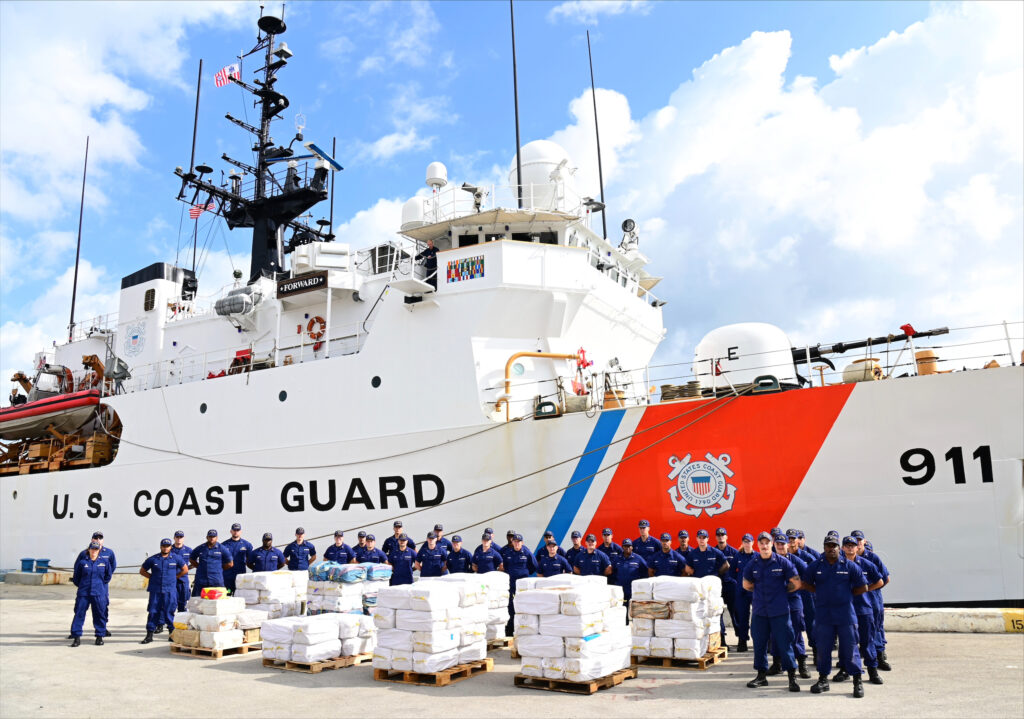
The Coast Guard has a longstanding relationship with the Haitian Coast Guard. In January 2010, USCGC Forward (WMEC 911), a 270-foot Famous-class medium-endurance cutter, was the first U.S. asset to respond and render humanitarian aid and assistance following a 7.0-magnitude earthquake in Haiti. In August 2021, the Coast Guard was among the first U.S. agencies to respond with humanitarian aid following a 7.2-magnitude earthquake in Haiti. 

In August 2022, USCGC Robert Yered (WPC 1104), a 154-foot Sentinel-class fast response cutter, delivered firefighting equipment sourced as a donation from Miami-Dade Fire Rescue to better equip the Haitian firefighting department at Port-au-Prince-Toussaint Louverture International Airport. In September 2022, the Coast Guard’s international training team visited Haiti to facilitate the second of two iterations of small boat operations training with the Haitian Coast Guard to ensure uniform and repeatable training standards for the maintenance and safe operation of the Haitian Coast Guard’s surface fleet. 

The Coast Guard continues to patrol the Caribbean Sea to deter undocumented migration by sea. In fiscal year 2022, the Coast Guard interdicted 7,173 Haitian migrants attempting to enter the United States illegally by sea. 

Northland is a 270-foot Famous-class medium endurance cutter homeported in Portsmouth, Virginia. Northland’s missions include law enforcement, search and rescue, drug interdiction, fisheries enforcement, migrant interdiction, homeland security and defense operations, international training, and humanitarian operations. Northland patrols the offshore waters from Maine to Florida, the Gulf of Mexico, the Eastern Pacific Ocean and the Caribbean Sea.


U.S. Coast Guard, U.K Ships Seize $93 Million in Drugs in Middle East

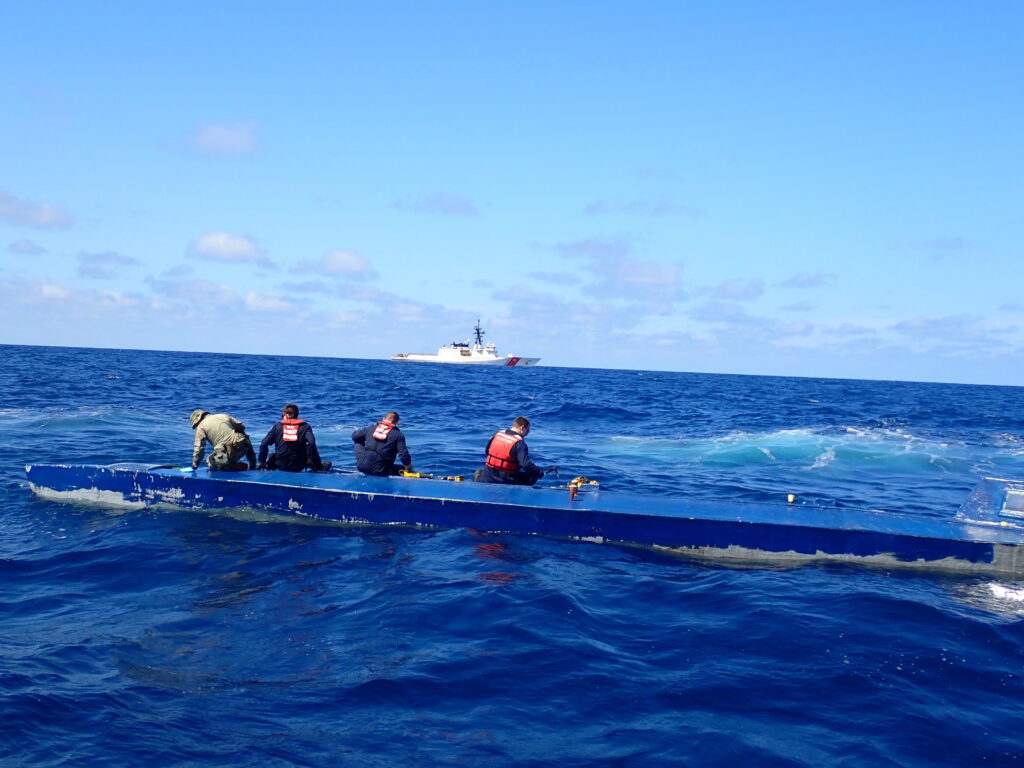
Personnel from U.S. Coast Guard fast response cutter USCGC Glen Harris (WPC 1144) inventory illicit drugs seized from a fishing vessel in international waters in the Gulf of Oman, Oct. 10. U.S. COAST GUARD

MANAMA, Bahrain — A U.S. Coast Guard fast response cutter seized an estimated $48 million worth of drugs from a fishing vessel while patrolling the Gulf of Oman, Oct. 10, while a week earlier a Royal Navy frigate seized $45 million worth of drugs in the Gulf of Oman, said U.S. Naval Forces Central Command Public Affairs said in Oct. 9 and 11 releases. 

While operating in support of Combined Task Force (CTF) 150, USCGC Glen Harris (WPC 1144) seized 5,000 kilograms of hashish and 800 kilograms of methamphetamine as the fishing vessel transited international waters.  

Glen Harris previously interdicted another fishing vessel Aug. 30 while patrolling the Gulf of Oman. The interdiction led to CTF 150 seizing 2,980 kilograms of hashish and 320 kilograms of amphetamine tablets worth $20 million. This followed two earlier Glen Harris seizures of heroin, methamphetamine and amphetamine pills worth $28 million in the same body of water in May. 
 
The fast response cutter arrived in the Middle East in January and operates from the U.S. Navy base in Bahrain where CMF is headquartered with U.S. Naval Forces Central Command and U.S. 5th Fleet. 

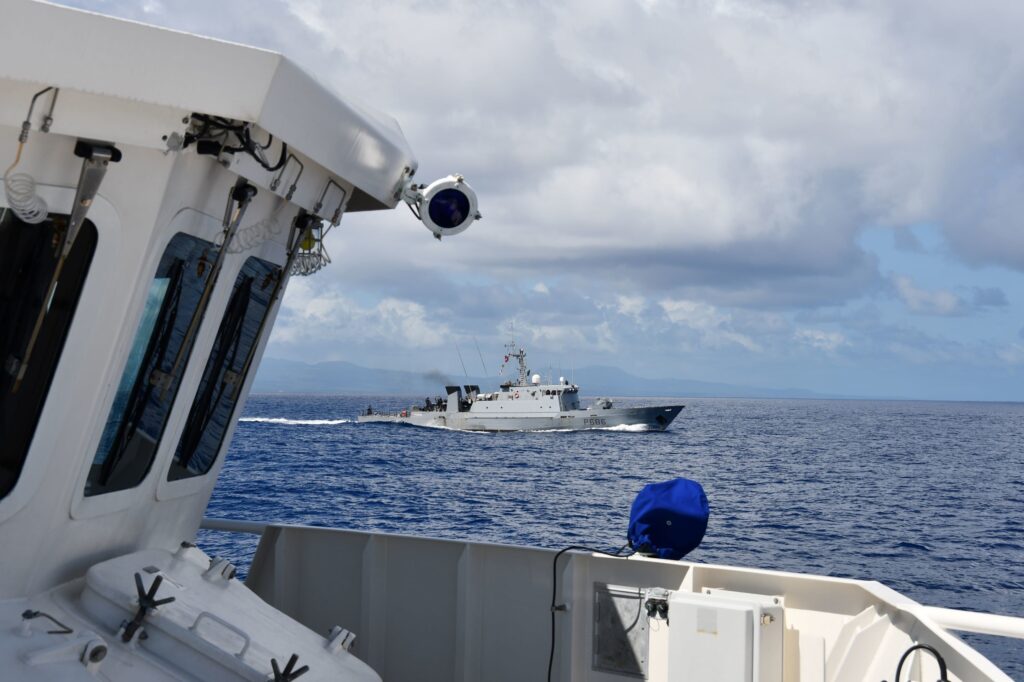
The Royal Navy frigate HMS Montrose (F 236) was operating in international waters in the Gulf of Oman as part of CTF 150 when it seized 870 kilograms of crystal methamphetamine. Montrose is a Duke-class frigate that has been operating in the Middle East since March 2019. 

“HMS Montrose again proves the value of having a forward-deployed presence in the region,” said Cmdr. Claire Thompson, the ship’s commanding officer. “This shows the professionalism of the boarding team and whole ship’s company.” 

Led by the Royal Saudi Navy, CTF 150 is one of four task forces under Combined Maritime Forces, the largest multinational naval partnership in the world. CTF 150 conducts maritime security operations in the Gulf of Oman and North Arabian Sea to help ensure the free flow of commerce.
 
Combined Maritime Forces is the largest multinational naval partnership in the world. The organization includes 34 nations and is headquartered in Bahrain with U.S. Naval Forces Central Command and U.S. 5th Fleet. 


Coast Guard Releases Draft Environmental Impact Statement for Seattle Base Expansion

SEATTLE – The Coast Guard is inviting the public to comment on the Draft Programmatic Environmental Impact Statement (PEIS) for the Coast Guard’s proposed expansion and modernization of Base Seattle, the Coast 13th District said in a release. In accordance with the National Environmental Policy Act of 1969, the PEIS analyzes the potential environmental impacts of the proposed action alternatives. 

The purpose of the expansion is to provide adequate facilities and infrastructure at Base Seattle to support current and future execution of the Coast Guard’s statutory missions. Base Seattle is the largest Coast Guard facility in the Pacific Northwest and is an essential facility to support Coast Guard missions in both the local area as well as the Polar Regions now and for the foreseeable future. 

The draft PEIS can be read in its entirety at the following online location: https://www.dcms.uscg.mil/NEPA 

With the Oct. 11 publication of the Coast Guard’s Notice of Availability, the public may provide comments through Dec. 2, 2022. Comments may be submitted online at www.regulations.gov with docket number USCG-2021-0183 or via U.S. Mail addressed to: U.S. Coast Guard, Shore Infrastructure Logistics Center, Environmental Management Division, ATTN: Mr. Dean Amundson, 1301 Clay Street, Suite 700N, Oakland, CA 94612-5203.  Comments must be received or postmarked no later than Dec. 2, 2022. 

A public meeting is scheduled to be held in mid-November in Seattle to provide an additional opportunity for public commentary. Additional details will be released at a later date.