USCGC Valiant Returns Home after 35-day Caribbean Sea Patrol
The Coast Guard Cutter Valiant crew recovers their cutter boat Sept. 2018, while underway in the Carribean Sea. U.S. COAST GUARD
JACKSONVILLE, Fla. — The crew of U.S. Coast Guard Cutter Valiant (WMEC 621) returned to their homeport at Naval Station Mayport Nov. 7, 2022, following a 35-day Caribbean Sea patrol, the Coast Guard Atlantic Area said in a Nov. 7 release.
While underway in the Coast Guard Seventh District’s area of operations and in support of Joint Interagency Task Force – South, Valiant conducted counterdrug and migrant interdiction operations.
Within the first week of patrol, Valiant’s crew boarded a vessel suspected of carrying illegal narcotics and seized just under 900 pounds of cocaine worth approximately $8 million.
Valiant’s crew also patrolled off the coast of Haiti as a deterrent to dangerous and irregular maritime migration events occurring because of continued instability in the country.
Prior to patrol, Valiant completed a 7-month dry-dock period in Tampa where the 55-year-old cutter completed extensive maintenance and preservation work.
“The past eight months have certainly been very busy for Valiant’s crew, and we are glad to finally be back in Jacksonville,” said Cmdr. Jacob McMillan, commanding officer of Valiant. “The crew’s remarkable ability to quickly transition from maintenance to operations has been impressive. I’m very proud of the crew and I’m honored to be serving at sea with them.”
Valiant is a multi-mission, 210-foot medium-endurance cutter. Its primary missions include search and rescue, maritime law enforcement, marine environmental protection, homeland security and national defense operations.
Coast Guard Polar Icebreaker Departs Seattle; Bound for Antarctica
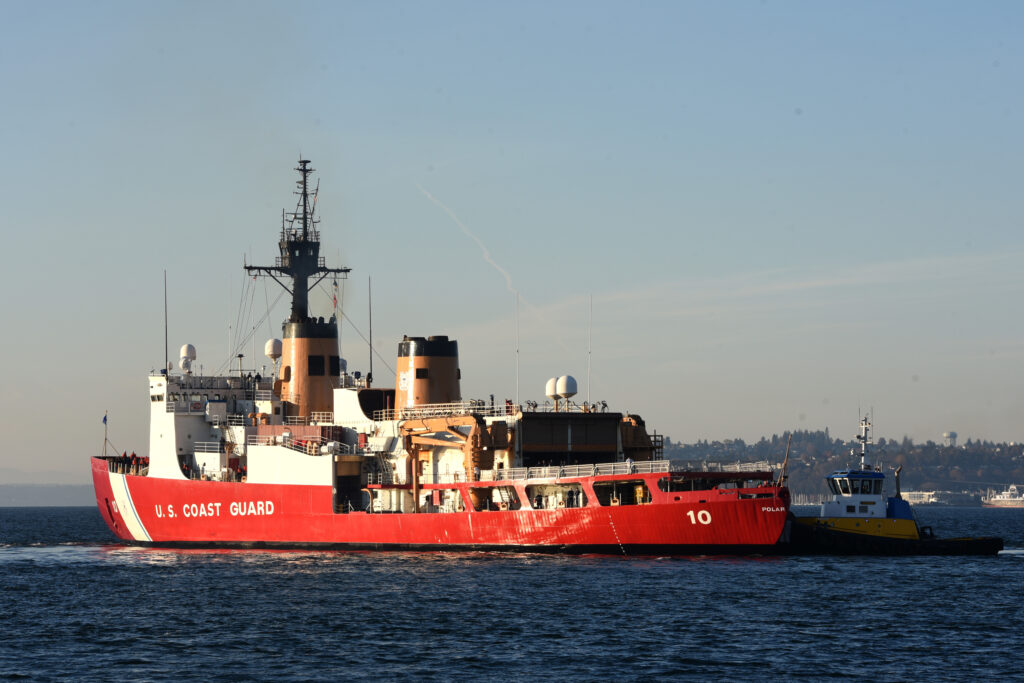
The Coast Guard Cutter Polar Star and crew departs Seattle to begin Operation Deep Freeze, Nov. 16, 2022. U.S. COAST GUARD / Petty Officer 3rd Class Michael Clark
SEATTLE — The Coast Guard Cutter Polar Star (WAGB 10) and crew departed Seattle Nov. 16 and is in transit to Antarctica in support of Operation Deep Freeze, the Coast Guard Pacific Area said in a Nov. 17 release.
Operation Deep Freeze is an annual joint military mission to resupply the United States Antarctic stations in support of the National Science Foundation, the lead agency for the United States Antarctic Program. This marks the 26th year for the Polar Star to render support.
Each year, the Polar Star crew breaks a navigable channel through ice, sometimes as much as 21-feet thick, to allow fuel and supply ships to reach McMurdo Station, which is the largest Antarctic station and the logistics hub of the U.S. Antarctic Program.
“This is a unique and important mission that the Coast Guard undertakes each year,” said Capt. Keith Ropella, commanding officer of the Polar Star. “It takes a special crew to make the 20,000 nautical mile round trip through some of the most remote locations and arduous conditions on the planet to get the job done, and perhaps more significantly, to prepare this 46-year-old cutter for the challenge. I am overwhelmed and immensely proud of the tireless work this crew and our shore side support partners have done since returning from the last Operation Deep Freeze back in April to get us ready to go, and I am incredibly excited to make this once in a lifetime journey with them.”
The U.S. Coast Guard is recapitalizing its polar icebreaker fleet to ensure continued access to the Polar regions, project U.S. sovereignty and protect the country’s economic, environmental and national security interests.
“As the Nation’s most active and visible maritime presence in the high latitudes, the Coast Guard maintains a vital leadership role in Antarctica and deeply values its relationship as a trusted partner to the National Science Foundation and U.S. Antarctic Program,” said Vice Adm. Andrew J. Tiongson, commander Coast Guard Pacific Area. “Polar Star’s continued support of Operation Deep Freeze exemplifies the Coast Guard’s unique blend of operational capability, regulatory authority and strategic leadership in the polar regions. It is an honor to ensure uninhibited access to the region, and join together with our international allies and Department of Defense sister services to support essential scientific research and the preservation of a safe, secure and cooperative environment on the Antarctic continent.”
Through Operation Deep Freeze, the U.S. Coast Guard provides direct logistical support to the National Science Foundation and maintains a regional presence that preserves Antarctica as a scientific refuge.
USCGC Northland Returns Home after 59-day Caribbean Sea Patrol
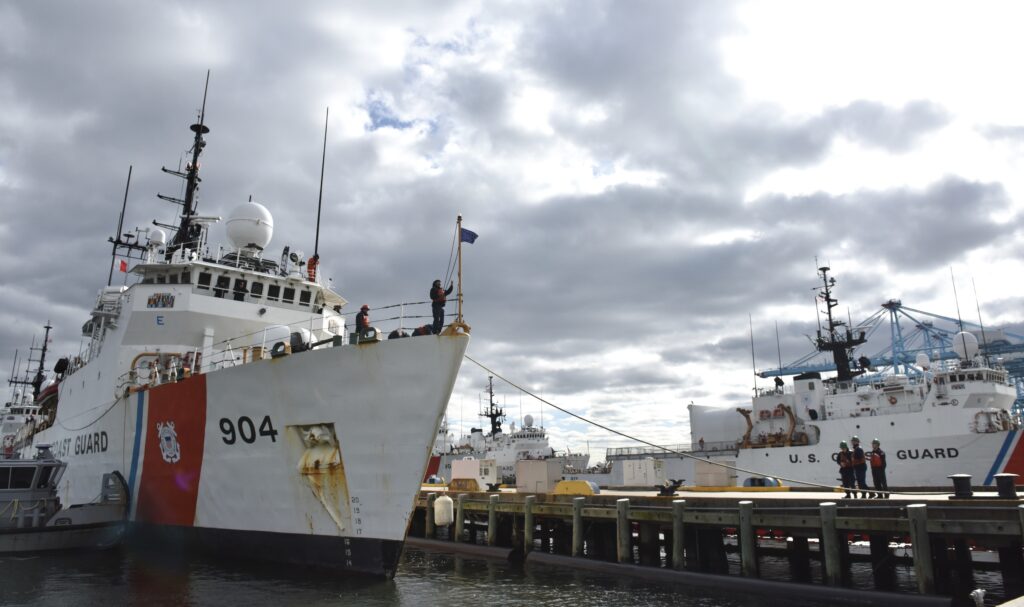
U.S. Coast Guard Cutter Northland prepares to moor at its homeport in Portsmouth, Va., Monday. Northland completed a 59-day patrol in the Caribbean Sea conducting migrant interdiction, law enforcement and humanitarian missions. U.S. COAST GUARD / Petty Officer 2nd Class Brandon Hillard
PORTSMOUTH, Va. — The crew of the U.S. Coast Guard Cutter Northland (WMEC 904) returned to their homeport in Portsmouth, Nov. 14 following a 59-day Caribbean Sea patrol, the Coast Guard Atlantic Area said in a release.
In support of the Coast Guard’s Seventh District and Operation Vigilant Sentry under Homeland Security Task Force – Southeast, Northland’s crew conducted migrant interdiction, law enforcement and humanitarian operations, collaborating with numerous Coast Guard assets and Department of Homeland Security boats and aircraft to detect, deter and intercept unsafe and illegal ventures bound for the United States.
During the deployment, Northland’s crew primarily patrolled the Windward Passage between Cuba and Haiti, maintaining a U.S. presence while serving as a deterrent to irregular maritime migration events occurring because of continued instability in Haiti.
In October, Northland was diverted to patrol near Port-au-Prince, Haiti, at the request of the government of Haiti and in close coordination with the U.S. Department of State, as a clear sign of U.S. resolve in support of Haiti and its people, and to rendezvous with the Haitian Coast Guard for training in the area.
Northland also supported counterdrug operations in the region by working with other Coast Guard units and the U.S. Navy, offloading approximately 5,363 pounds of cocaine worth more than $101 million and transferring 11 suspected smugglers Nov. 11 in Port Everglades, Florida. The drugs came from five different interdictions in the Caribbean Sea.
“I am extremely proud of the adaptability, ingenuity and determination demonstrated by this remarkable crew on a daily basis,” said Cmdr. Andrew B. Dennelly, commanding officer of Northland. “Our crew showed day in and day out that we are always ready to deliver exceptional service to the nation, whether it be responding to unsafe and illegal ventures by migrants or assisting in counterdrug operations. Like any deployment, this patrol came with its own challenges — responding to an international crisis, last minute changes in scheduling and harsh weather and sea-states. Through it all, our crew promoted safety and security at sea and demonstrated why the Coast Guard is the preferred maritime partner.”
Northland is a 270-foot Famous-class medium-endurance cutter. Its missions include law enforcement, search and rescue, drug interdiction, fisheries enforcement, migrant interdiction, homeland security and defense operations, international training and humanitarian operations. Northland patrols the offshore waters from Maine to Florida, the Gulf of Mexico, the Eastern Pacific Ocean and the Caribbean Sea.
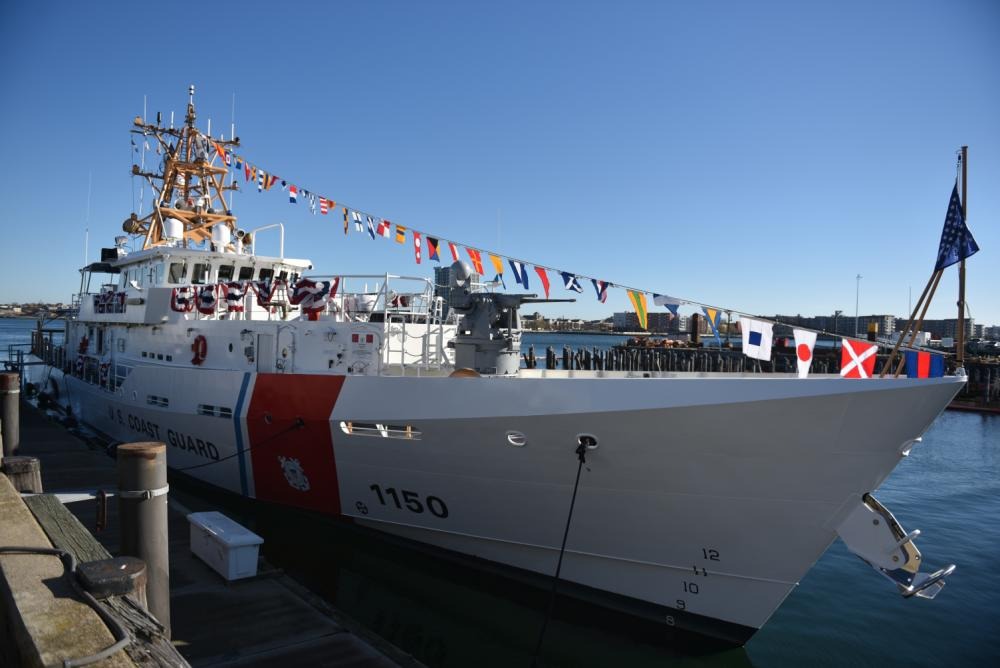
BOSTON — Coast Guard Cutter William Chadwick (WPC-1150) was commissioned Nov. 10 at Coast Guard Base Boston, as the first of six fast response cutters to be stationed in the city, the 1st Coast Guard District said in a release.
Adm. Steven Poulin, vice commandant of the Coast Guard, and Rear Adm. John Mauger, commander, 1st Coast Guard District, oversaw the ceremony, as Lt. Cmdr. Tyler Kelley assumed command of the 154-foot cutter and its crew. Under Kelly’s command, the 24-person crew will now conduct missions offshore of the Northeast United States.
These Sentinel-class fast response cutters (FRCs) are designed for multiple missions, including drug and migrant interdiction; ports, waterways and coastal security; fishery patrols; search and rescue; and national defense. The Coast Guard has ordered 65 FRCs to replace the 1980s-era Island-class 110-foot patrol boats. The FRCs feature advanced command, control, communications, computers, intelligence, surveillance and reconnaissance equipment; over the horizon cutter boat deployment to reach vessels of interest; and improved habitability and seakeeping.
Born in Dover, New Jersey, the cutter’s namesake was a keeper of the Green Island Lifeboat Station in New Jersey and recipient of the Congressional Gold Lifesaving Medal for his rescue of the crew of the schooner George Taulane on Feb. 3, 1880. Chadwick remained keeper of Green Island Station until his retirement in August 1886.
USCGC Dependable Returns Home after Month-Long Patrol in Florida Straits
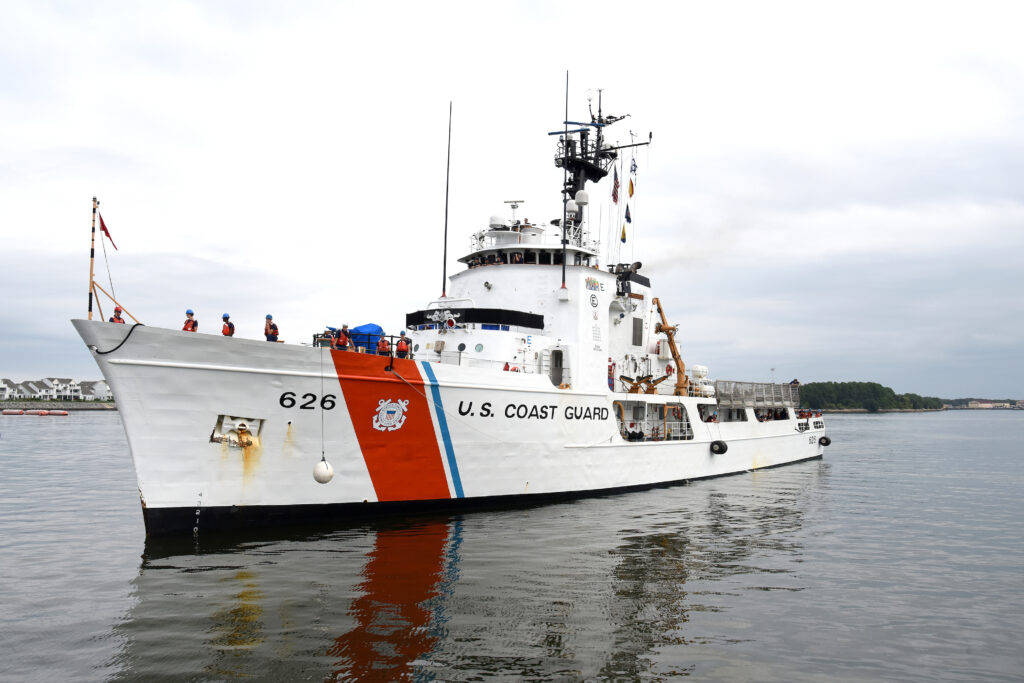
The Coast Guard Cutter Dependable transits toward the pier at Joint Expeditionary Base Little Creek, Fort Story in Virginia Beach, Virginia, Sept. 27, 2016. U.S. COAST GUARD / Petty Officer 1st Class Melissa Leake
VIRGINIA BEACH, Va. — The crew of the U.S. Coast Guard Cutter Dependable (WMEC 626) returned to their homeport in Virginia Beach, Nov. 5, following a 29-day patrol in the Florida Straits, the Coast Guard Atlantic Area said in a release.
In support of the Coast Guard’s 7th District, Dependable’s crew conducted migrant interdiction operations, collaborating with numerous Coast Guard assets and Department of Homeland Security boats and aircraft to detect, deter and intercept unsafe and illegal ventures bound for the United States.
During the patrol, Dependable’s crew assisted with the interdiction of 193 migrants and cared for a total of 297 migrants that were interdicted by various Coast Guard and other law enforcement entities working within the Florida Straits.
“The crew began preparing for this Florida Straits patrol back in July, including qualifying over 50 crewmembers to stand watch and care for migrants embarked on board the cutter,” said Lt. Cmdr. Dana Prefer, executive officer on board Dependable. “All of the training and preparation paid off as it was truly a team effort to interdict, process and care for almost 300 migrants throughout our patrol.”
Dependable is a 210-foot Reliance-class medium-endurance cutter with a crew of 67. The cutter’s primary missions include counterdrug operations, migrant interdiction, enforcement of federal fishery laws and search and rescue in support of Coast Guard operations throughout the Western Hemisphere.
Coast Guard Cutter Active Returns to Port Angeles after Eastern Pacific Patrol
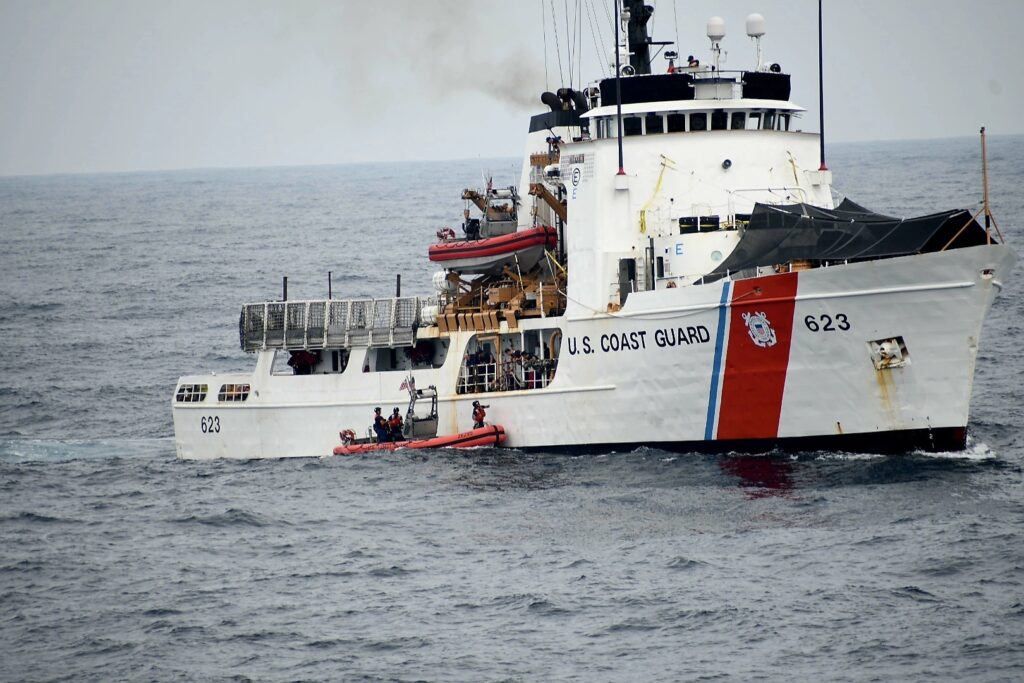
Coast Guard Cutter Active (WMEC 618) crewmembers aboard the cutter’s 26-foot Small Boat pull alongside the Coast Guard Cutter Steadfast (WMEC 623) to transfer parts and provisions while the cutters patrol the Eastern Pacific Ocean, Sept. 20, 2022. U.S. COAST GUARD / Chief Petty Officer Shane Sexton
PORT ANGELES, Wash. — The Coast Guard Cutter Active (WMEC 618) and crew returned to their homeport Friday after a 65-day patrol in international waters of the Eastern Pacific Ocean near Central and South America, the Coast Guard Pacific Area said in a Nov. 5 release.
Coast Guard cutters operating in the Eastern Pacific Ocean often collaborate to prevent and deter Transnational Criminal Organizations (TCOs) from successfully transporting narcotics destined for the United States.
During this patrol, the Active’s crew rendezvoused with Coast Guard Cutters Steadfast (WMEC 623) and Bertholf (WMSL 750) to conduct joint operations. Active’s crew also partnered with maritime patrol aircrews from Joint Interagency Task Force-South (JIATF-S) who aid in the detection of ships suspected of drug smuggling.
Crewmembers aboard Active transited more than 10,000 nautical miles from the Strait of Juan de Fuca to the southern hemisphere during the patrol. The crew sighted an abundance of marine wildlife throughout the patrol, and rescued sea turtles trapped in fishing gear.
The Active’s crew departed Port Angeles Sept.1 and transited to San Diego for a logistics stop. While in San Diego, the crew completed unscheduled repairs, enabling the Active to continue its southbound journey along the coast of Mexico and Central America in pursuit of illegal drug smuggling vessels.
“The Active crew performed superbly in every assigned mission,” said Cmdr. Brian Tesson, commanding officer of the Active. “They were presented with various challenges from engineering casualties to abundant tropical weather systems. This crew consistently stepped up with a can-do attitude, ingenuity and fortitude in the face of adversity, defining what it means to work aboard the ‘Li’l Tough Guy.’ Our success as a team is due in no small part to the families and support network at home who enable us to focus on the mission; for them I am most grateful.”
The Active and other Coast Guard cutters frequently patrol this 42-million square mile region with the assistance of JIATF-S to interdict and disrupt drug shipments, thereby reducing the flow of drugs and disrupting the TCOs that traffic them. JIATF-S is a multiagency organization that coordinates with international partners in detecting and monitoring illicit narcotics trafficking and other organized crime flowing from Latin America to the United States.
The Active, a 57-year-old, 210-foot medium endurance cutter nicknamed “Li’l Tough Guy” is equipped with two deployable small boats and a flight deck capable of conducting underway flight operations with Coast Guard MH-65 Dolphin helicopter aircrews.
USCGC Reliance Returns Home Following 67-Day Migrant-Interdiction Patrol
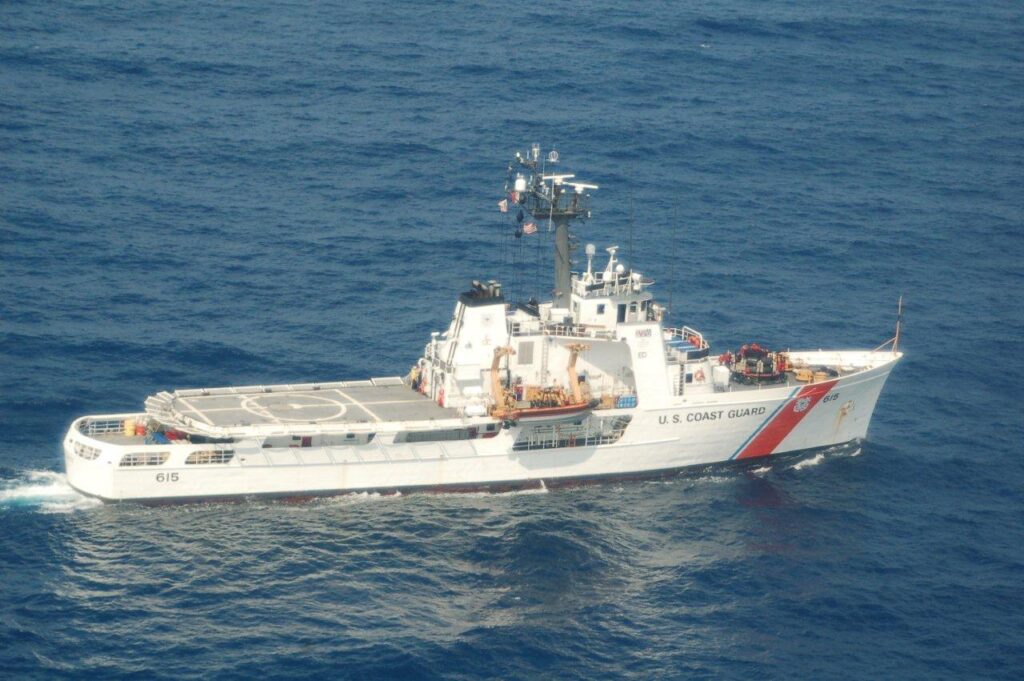
Coast Guard Cutter Reliance patrols the Western Caribbean in support of the Joint Interagency Task Force – South October 2014. U.S. COAST GUARD / Petty Officer 3rd Class Clinton McDonald
PENSACOLA, Fla. — The crew of U.S. Coast Guard Cutter Reliance (WMEC 615) returned to their homeport in Pensacola, Nov. 4, following a 67-day Caribbean Sea patrol.
During the patrol, Reliance’s crew collaborated with numerous Coast Guard assets and other Department of Homeland Security boats and aircraft to detect, deter and intercept unsafe and illegal ventures to the United States.
In support of the Coast Guard’s Seventh District, Reliance primarily patrolled the South Florida Straits, south of the Florida Keys and the Windward-passage, off the northwest coast of Haiti, contributing to the interdiction and care of 613 migrants and 13 detainees. Additionally, Reliance’s crew repatriated 120 migrants to Santiago, Cuba, marking the first visit by a U.S. warship to the port in more than 50 years.
“I am extremely pleased by this crew and proud to be a part of this team. Reliance departed homeport shorthanded and was immediately put to the test, performing especially high-tempo migrant interdiction operations. At all hours of day and night, the Reliance crew responded superbly, facilitating the safe care and repatriation of a historic surge of Cuban migrants while also completing qualification requirements and robust training exercises necessary following the summer transfer season,” said Cmdr. Brian Chapman, commanding officer of Reliance.
Reliance is a 210-foot medium-endurance cutter homeported in Pensacola with a crew of 77. The cutter’s primary missions are counter-drug operations, migrant interdiction, enforcement of federal fishery laws and search and rescue in support of Coast Guard operations throughout the Western Hemisphere.
Coast Guard Cutter Oliver Berry Conducts Bilateral Shiprider Boardings with Samoa
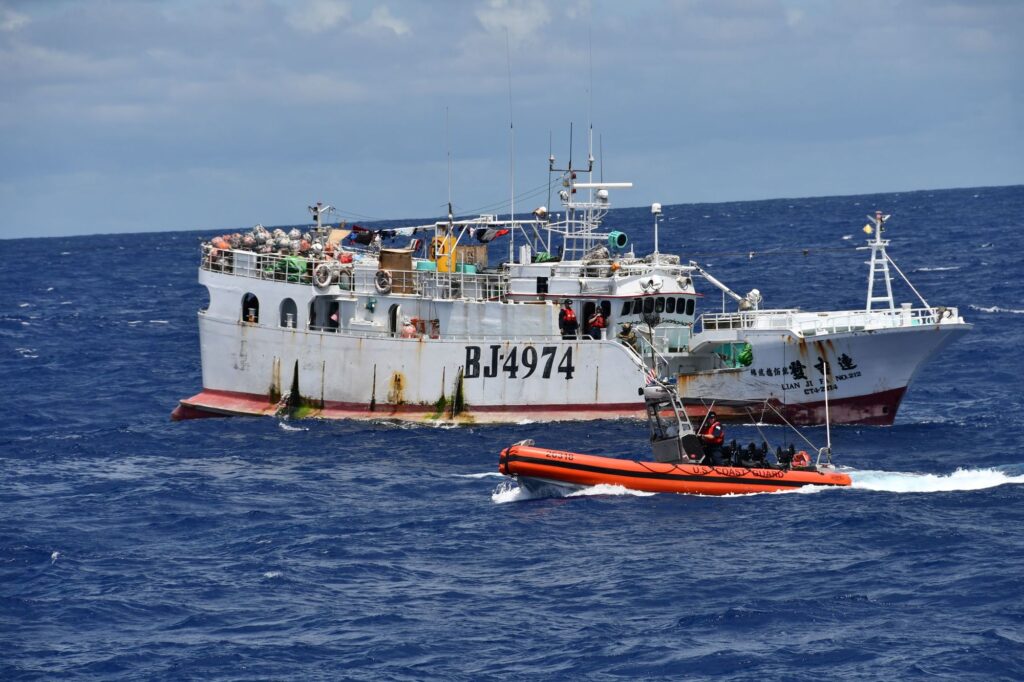
Crew members from the U.S. Coast Guard Cutter Oliver Berry board a foreign flagged fishing vessel. U.S. COAST GUARD
HONOLULU — The Coast Guard Cutter Oliver Berry (WPC 1124), a 154-foot Fast Response Cutter homeported in Honolulu, patrolled the Independent State of Samoa’s exclusive economic zone while partnering with Samoan Maritime Police and Fisheries Officers, where they executed four safety and living marine resources boardings on Samoan and foreign flagged fishing vessels in Samoan waters, identifying six violations, the Coast Guard 14th District said in a Nov. 4 release.
During their expeditionary patrol across Oceania, Oliver Berry’s crew is collaborating with partner governments like Samoa to conduct bilateral shiprider boardings to strengthen maritime domain awareness and resource security within their EEZs; an EEZ is the area of coastal water within a certain distance of a nation’s coastline to which the country claims exclusive rights for drilling, fishing and other economic ventures.
The U.S. Coast Guard employs 11 bilateral law enforcement agreements with Pacific Island Forum nations, including Samoa, to help ensure the nations’ maritime resource security and sovereignty. These programs highlight the shared commitment to ensuring security and freedom of navigation in the Pacific.
“Collaborating with our partners throughout Oceania is essential in ensuring a free and open Blue Pacific,” said Lt. Cmdr. Micah Howell, commanding officer of the Oliver Berry. “It is a privilege, and we are proud to support Samoa through dedicated partnership in the effort to maintain maritime governance and security.”
Oliver Berry’s crew also enjoyed a multitude of community engagements during their time in Samoa. These engagements included crew visits to the National University of Samoa Maritime School and Samoa’s Victim Support Camp, and a beach cleanup with staff from the U.S. Embassy, Peace Corps and Samoa Tourism Authority.
The crew also provided tours of Oliver Berry for the Maritime Division of the Ministry of Police, Prisons and Corrections Services, the Ministry of Works, Transport and Infrastructure, the Ministry of Agriculture and Fisheries, members of the media and students from the National University of Samoa Maritime School and St. Mary’s College.
Oliver Berry’s crew will continue patrolling the Blue Pacific across the high seas in support of Samoa, Tonga and Kiribati to combat illegal, unregulated fishing, demonstrating the United States Coast Guard’s enduring commitment to our partner nations throughout Oceania.
Coast Guard Cutter Midgett Returns Home from Western Pacific Deployment
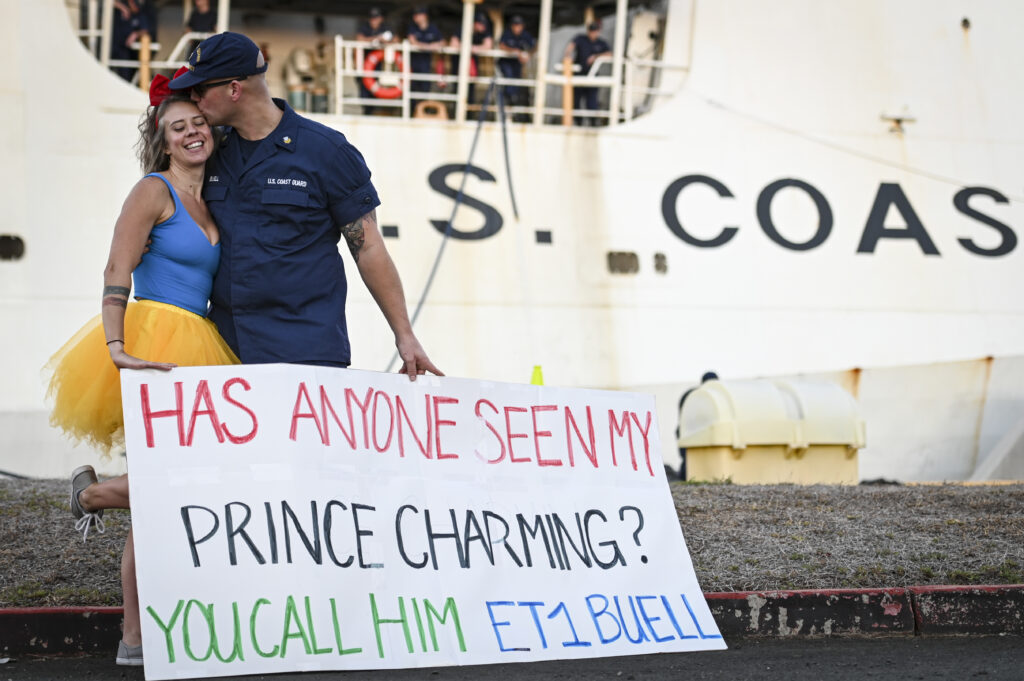
Petty Officer 1st Class Kyle Buell stands with his wife after U.S. Coast Guard Cutter Midgett (WMSL 757) returned to homeport in Honolulu, Hawaii, Oct. 31, 2022. The crew was deployed for nearly three months in the Western Pacific theatre. U.S. COAST GUARD / Petty Officer Steve Strohmaier
HONOLULU — The U.S. Coast Guard Cutter Midgett (WMSL 757) and crew returned to its homeport, Monday, following an 83-day, 16,000 nautical-mile deployment to the Western Pacific, the Coast Guard Pacific Area said in a Nov. 1 release.
The Midgett and crew departed Honolulu in August to the Western Pacific to operate under the tactical control of U.S. Navy 7th Fleet to promote a free and open Indo-Pacific region.
“The Coast Guard strives to be a trusted partner, and we play a vital role in ensuring safety, security and prosperity across the Indo-Pacific,” said Vice Adm. Andrew J. Tiongson, commander Pacific Area. “As the region faces challenges like climate change and Illegal, Unregulated and Unreported Fishing, we will join with our Pacific partners to face these common threats and challenges together.”
“I am extremely proud of this crew and all they have accomplished over this deployment,” said Capt. Willie Carmichael, commanding officer of Midgett. “They engaged in meaningful and collaborative engagements with our partners that increased our interoperability to address shared maritime threats and challenges. This Western Pacific deployment highlights the critical role the Coast Guard plays in strengthening maritime governance around the world and how much our partners value our presence. Midgett’s ability and dedication to sail across two oceans and participate in purposeful engagements with our partners is a testament to the United States’ commitment to a free and open Indo-Pacific.”
The U.S. Coast Guard has a 150-year enduring role in the Indo-Pacific. The service’s ongoing deployment of resources to the region directly supports U.S. foreign policy. As both a federal law enforcement agency and a branch of the armed forces, the Coast Guard is uniquely positioned to conduct security cooperation in support of combatant commanders on all seven continents. The service routinely provides forces in joint military operations worldwide, including the deployment of cutters, boats, aircraft and deployable specialized forces.
Since 2019, Coast Guard Cutters Bertholf (WMSL 750), Stratton (WMSL 752), Waesche (WMSL 751) and Munro (WMSL 755) have deployed to the Western Pacific.
Commissioned in 2019, Midgett is one of two Coast Guard legend-class national security cutters homeported in Honolulu. National security cutters are 418 feet long, 54 feet wide and have a 4,600 long-ton displacement. They have a top speed in excess of 28 knots, a range of 12,000 nautical miles, endurance of up to 90 days and can hold a crew of up to 170.
Midgett is the second cutter named after the Midgett family, many of whom served in the U.S. Coast Guard, U.S. Life Saving Service and other predecessor life-saving services. Seven members of the Midgett family have been awarded the Gold Lifesaving Medal, including John Allen Midgett Jr. and Rasmus Midgett.
National security cutters feature advanced command and control capabilities, aviation support facilities, stern cutter boat launch and increased endurance for long-range patrols to disrupt threats to national security further offshore.
Coast Guard Cutter Returns Home after Encounter with Chinese, Russian Naval Ships
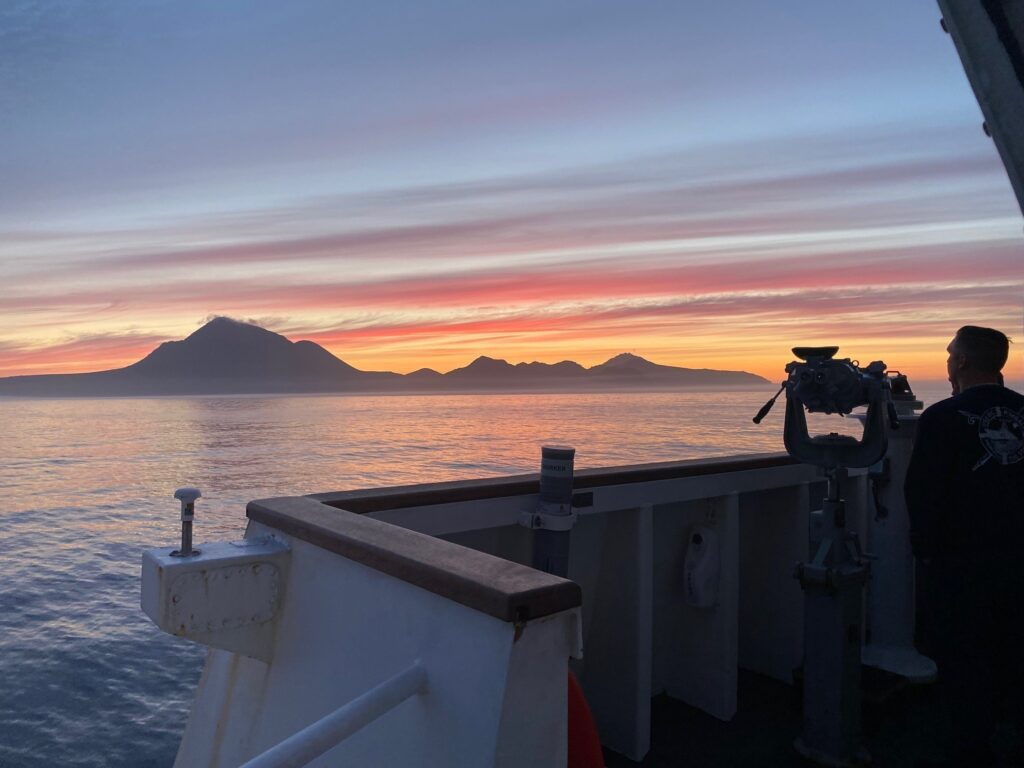
Petty Officer 2nd Class Matthew Nichols observes the sunset aboard the Coast Guard Cutter Kimball (WMSL 756), in the Bering Sea, during its patrol. The Kimball, homeported in Hawaii, completed a 19,000 mile deployment in the Chukchi and Bering Seas, operating as part of Operation Frontier Sentinel. U.S. COAST GUARD
HONOLULU — The Coast Guard Cutter Kimball (WMSL 756), which encountered a formation of Russian and Chinese naval ships near Alaska in September, returned to its Honolulu homeport, Oct. 28, the Coast Guard Pacific Area said in an Oct. 29 release.
The Kimball and its crew covered more than 22,000 miles in over 100 days, conducting search and rescue and fisheries enforcement patrols in the Bering and Chukchi Seas, earning the ship’s first Coast Guard Arctic Service Medal.
While on routine patrol, the vessel encountered a group of Russian and Chinese naval ships in the Bering Sea. The formation, which was transiting through the U.S. Exclusive Economic Zone, did not enter U.S. territorial waters. The Kimball came within about a mile of the naval ships, established and maintained radio contact and ultimately ensured their presence was in accordance with international rules and norms.
“As Arctic sea ice melts, Coast Guard presence in the region is vital to ensuring the safety of increased maritime traffic, protecting critical resources such as fish stocks, and upholding U.S. sovereign interests and international law,” said Capt. Thomas D’Arcy, Kimball’s commanding officer. “It was an honor to lead Kimball’s crew during this patrol, and we’re proud to contribute to a long legacy of essential Coast Guard presence in the Bering Sea and the Arctic.”
Kimball’s crew also monitored fishing vessel safety standards and preserved living marine resources within the U.S. Exclusive Economic Zone by enforcing applicable laws and regulations. Kimball’s crew patrolled both sides of the U.S. – Russia Maritime Boundary Line and conducted multiple boardings inspecting U.S. commercial fishing vessels, including one fishing vessel that has operated for 109 years.
Additionally, Kimball’s crew supported a long-range helicopter medical evacuation of an injured crewmember aboard a bulk carrier ship, and supported a proof-of-concept trial that involved operating larger helicopters on national security cutters. Air Station Kodiak aircrews coordinated efforts with Kimball’s crew, resulting in the first overnight deployment of a Coast Guard MH-60 Jayhawk helicopter on a national security cutter in the Arctic.
The Kimball’s ship and aircrews made multiple visits to remote island and coastal communities, where crew members performed community service and outreach events, reinforcing the Coast Guard’s commitment to the communities it serves.
“It was an extremely rewarding experience to serve aboard Kimball for this unique arctic patrol,” said Ens. Emma Simms, a Kimball junior officer. “I was able to participate in a variety of Coast Guard missions in a single patrol, ranging from conducting fisheries boardings to search and rescue to defending sovereign interests.”
Commissioned in 2019, Kimball is the Coast Guard’s seventh national security cutter. National security cutters are 418-feet-long, 54-feet-wide and have a displacement of 4,600 long-tons. With a range of 13,000 nautical miles, the advanced technologies of this class are designed to support the national objective to maintain the security of America’s maritime boundaries and provide long-range search and rescue capabilities.