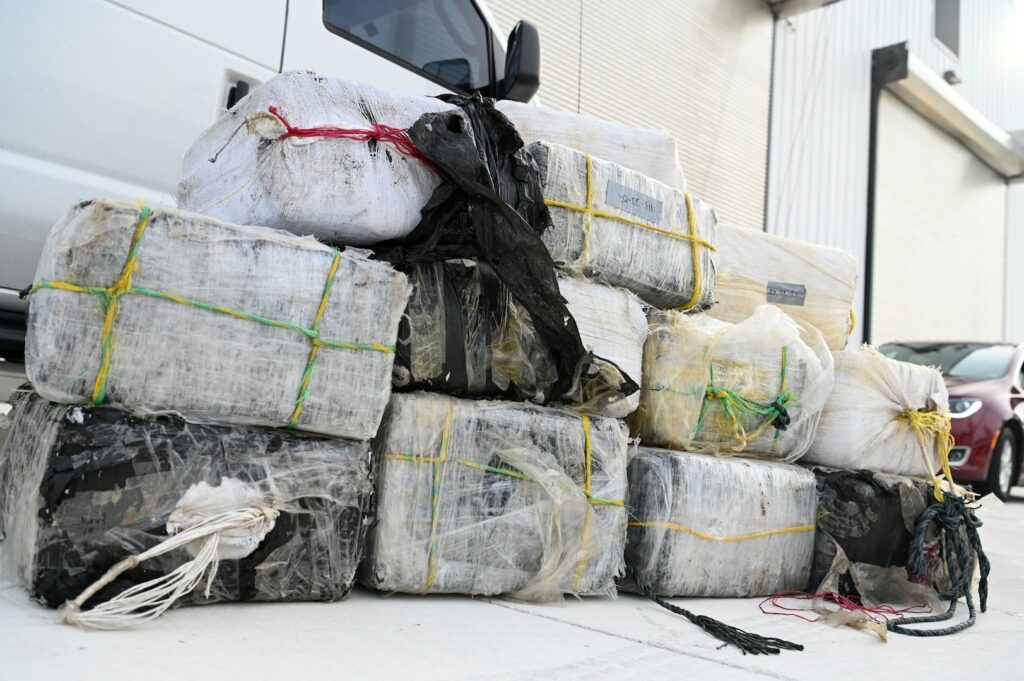
MIAMI – The crew of Coast Guard Cutter Margaret Norvell offloaded more than 2,450 pounds of cocaine with an assessed street value of approximately $32.2 million in Miami, Tuesday.
Coast Guard crews interdicted the illegal drugs in international waters of the Caribbean Sea during two separate cases.
“Thanks to the tremendous efforts of the Coast Guard crews and agency partners involved with this interdiction, Coast Guard Cutter Margaret Norvell brought these suspected smugglers and illicit contraband ashore for prosecution,” said Lt. Cmdr. Colin Weaver, Commanding Officer. “Coast Guard crews continue to deliver on our important missions of homeland and maritime security to save lives and thwart transnational criminal organizations operating in the Caribbean.”
The following assets were involved in the interdictions:
USCG Cutter Richard Dixon
USCG Cutter Dauntless
Joint Interagency Task Force South
Along with the illicit narcotics, six suspected smugglers were apprehended and will face prosecution in federal courts by the Department of Justice.
These interdictions relate to Organized Crime Drug Enforcement Task Forces designated investigations. OCDETF identifies, disrupts, and dismantles the highest-level criminal organizations that threaten the United States using a prosecutor-led, intelligence-driven, multi-agency approach. Additional information about the OCDETF program can be found here.
Detecting and interdicting illegal drug traffickers on the high seas involves significant interagency and international coordination. The Joint Interagency Task Force South in Key West, Florida conducts the detection and monitoring of aerial and maritime transit of illegal drugs. Once interdiction becomes imminent, the law enforcement phase of the operation begins, and control of the operation shifts to the U.S. Coast Guard throughout the interdiction and apprehension. Interdictions in the Caribbean Sea are performed by members of the U.S. Coast Guard under the authority and control of the Coast Guard’s Seventh District, headquartered in Miami.
MANAMA, Bahrain — U.S. Coast Guard cutters assigned to the Combined Maritime Forces seized illegal drugs with a total estimated street value of $24.5 million on Dec. 24 and Dec. 26 from vessels in the Gulf of Oman.
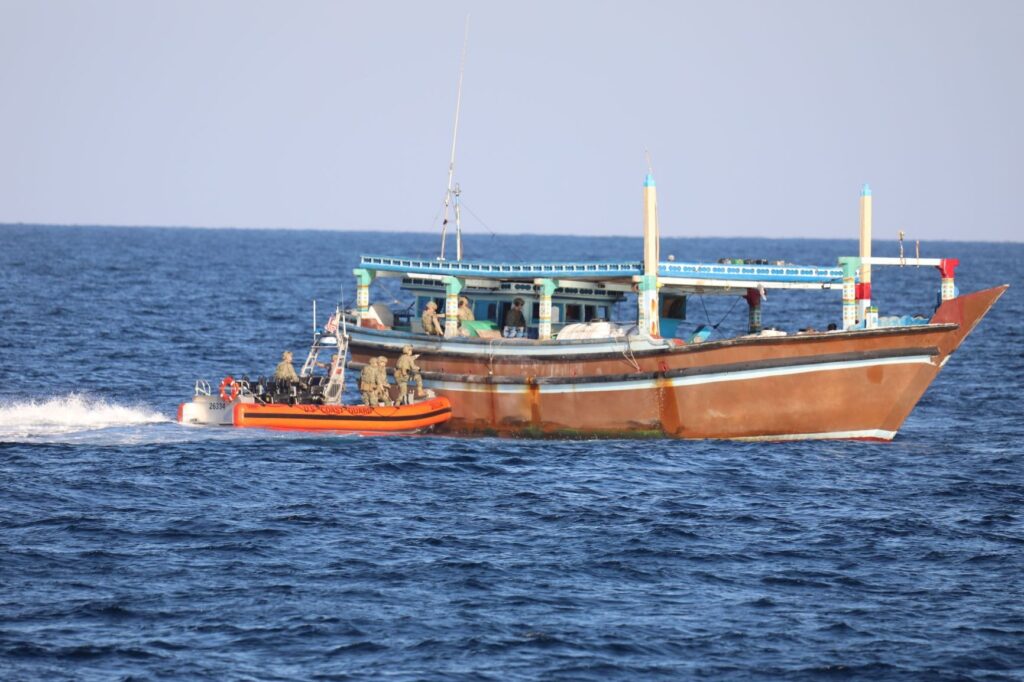
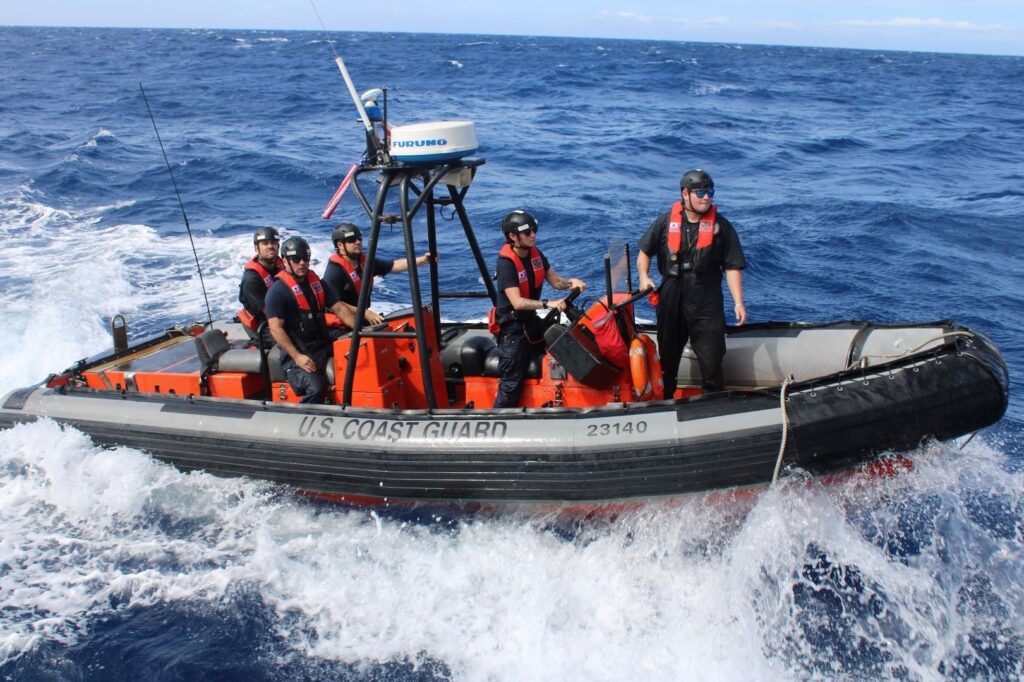
At approximately 2 p.m. local time (10 a.m. Greenwich Mean Time) on Dec. 24, a team from USCGC Clarence Sutphin Jr. (WPC 1147), a Sentinel-class cutter patrolling under the command of Combined Task Force 150 of the Combined Maritime Forces, boarded a dhow after it displayed several indicators consistent with illicit drug trafficking.
Aboard, the crew discovered 90 kilograms of heroin with an estimated street value of $3.2 million.
After testing and seizing the narcotics, the team disembarked the dhow, allowing it to continue on its journey.
At approximately 5 a.m. local time (9 a.m. Greenwich Mean Time) on Dec. 26, a team from USCGC John Scheuerman (WPC 1146), a Sentinel-class cutter patrolling under the command of Combined Task Force 150 of the Combined Maritime Forces, boarded a dhow after it also displayed several indicators consistent with illicit drug trafficking.
Aboard, the team discovered 261 kilograms of methamphetamines, 2,936 kilograms of hashish, 142 kilograms of heroin and 75,000 pills with the potential to be abused as opium substitutes, with a total estimated street value of more than $21.3 million.
The John Scheuerman team released the dhow’s crew and disposed of the illicit drugs.
The mission of Combined Task Force 150 is to disrupt the ability of non-state actors to move weapons or drugs, or engage in other illicit activities, in the Gulf of Oman, Arabian Sea and Indian Ocean.
These interdictions marked the tenth and eleventh times Combined Task Force 150 assets have seized illegal narcotics at sea since France took command in July 2023.
Combined Maritime Forces is a multinational maritime partnership committed to disrupting criminal and terrorist activities by restricting their freedom of maneuver across approximately 3.2 million square miles of international waters encompassing some of the world’s most important shipping lanes.
Since 2021, units assigned to the Combined Maritime Forces have seized more than $1 billion in illegal drugs while patrolling waters across the Middle East.
CMF-assigned Cutter Seizes Hashish and Methamphetamines in North Arabian Sea
*****
By Combined Maritime Forces Public Affairs | January 02, 2024
A U.S. Coast Guard cutter patrolling under the command of Combined Task Force 150 of the Combined Maritime Forces seized hashish and methamphetamines with a total estimated street value of $24.3 million Dec. 28 in the North Arabian Sea.
It was the third seizure by a CMF-assigned cutter in four days, following seizures by USCGC Clarence Sutphin Jr. (WPC 1147) and USCGC John Scheuerman (WPC 1146) of hashish, heroin, methamphetamines and pills with a total estimated street value of $24.5 million Dec. 24 and Dec. 26 in the Gulf of Oman.
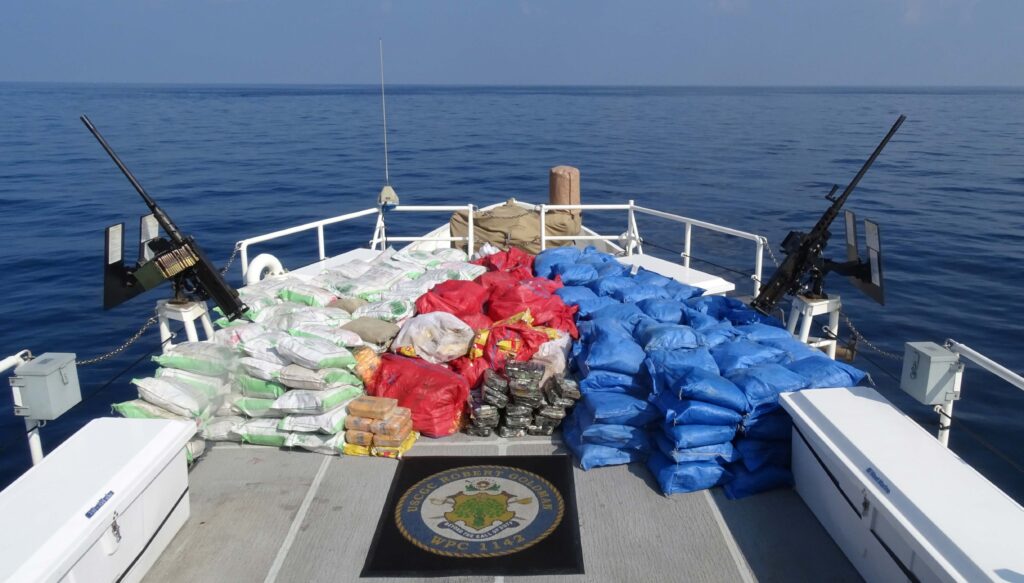
A team from USCGC Robert Goldman (WPC 1142), a Sentinel-class cutter, boarded a dhow at approximately 6:30 a.m. local time Dec. 28 after it displayed indicators consistent with illicit drug trafficking.
Aboard, the team discovered over 300 bags of drugs containing 3,514 kilograms of hashish and 417 kilograms of methamphetamines.
The Robert Goldman team released the dhow and disposed of the illicit drugs.
The mission of Combined Task Force 150 is to disrupt the ability of non-state actors to move weapons or drugs, or engage in other illicit activities, in the Gulf of Oman, Arabian Sea and Indian Ocean.
This interdiction marked the twelfth time Combined Task Force 150 assets have seized illegal narcotics at sea since France took command in July 2023.
Combined Maritime Forces is a multinational maritime partnership committed to disrupting criminal and terrorist activities by restricting their freedom of maneuver across approximately 3.2 million square miles of international waters encompassing some of the world’s most important shipping lanes.
Since 2021, units assigned to the Combined Maritime Forces have seized more than $1 billion in illegal drugs while patrolling waters across the Middle East.
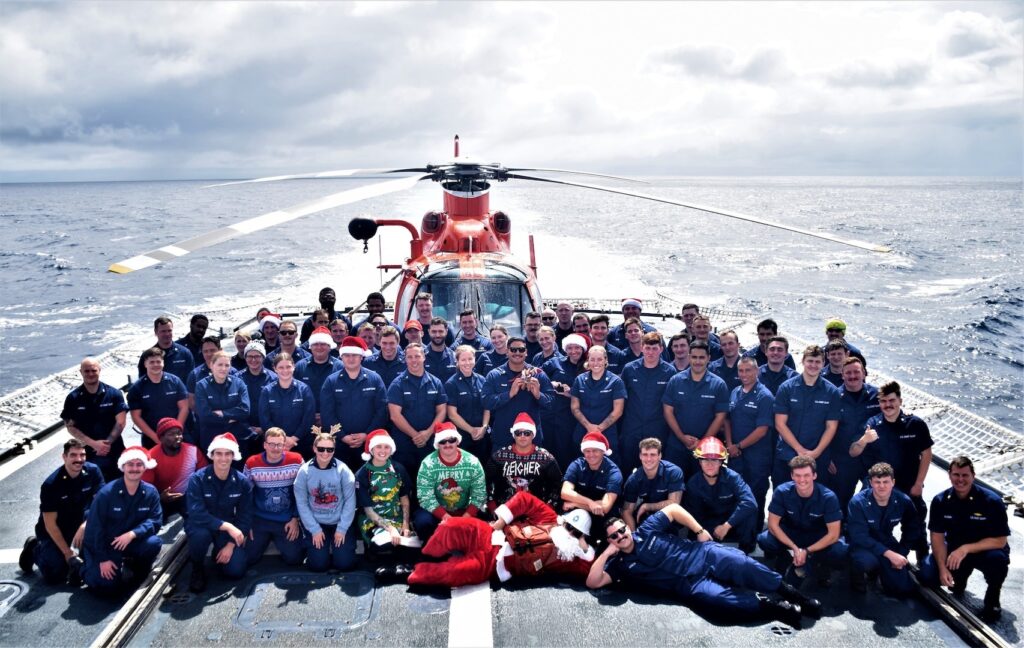
PORTSMOUTH, Va. — The crew of U.S. Coast Guard Cutter Seneca (WMEC 906) returned home to Portsmouth, Friday, following a 65-day patrol in the Western Caribbean and Eastern Pacific Ocean.
Patrolling in support of Joint Interagency Task Force-South, Seneca worked alongside other Coast Guard cutters, Department of Defense and Department of Homeland Security units, and international partners to conduct maritime safety and security missions.
During their patrol, Seneca responded to a sailboat in distress more than 100 miles west of Dry Tortugas National Park in heavy seas. Seneca provided a vital communications relay between the Coast Guard’s Seventh District, Coast Guard Sector Key West, and a Coast Guard Air Station Clearwater MH-60 helicopter crew, which airlifted the injured mariner to the Lower Keys Medical Center for immediate medical care.
“The resilience and tenacity of Seneca’s crew was on display during our 65-day deployment to the Western Caribbean Sea and Eastern Pacific Ocean,” said Capt. James McCormack, the commanding officer of Seneca. “Seneca provided persistent presence in deterring transnational criminal organizations from trafficking illicit narcotics across the Central American region bound for the United States. The crew is eager to return to our family and friends for the holiday season and looks forward to our next mission protecting the United States and those at sea.”
Seneca is a 270-foot, Famous-class medium endurance cutter. The cutter’s primary missions are counter-drug operations, migrant interdiction, enforcement of federal fishery laws, and search and rescue in support of U.S. Coast Guard operations throughout the Western Hemisphere.
For information on how to join the U.S. Coast Guard, visit GoCoastGuard.com to learn about active duty, reserve, officer, and enlisted opportunities. Information on how to apply to the U.S. Coast Guard Academy can be found here.
U.S. Coast Guard Cutter Polar Star Departs Australia, En Route to Antarctica
Editor’s Note: To follow the U.S. Coast Guard Cutter Polar Star’s Operation Deep Freeze journey, click here for more imagery.
HOBART, Australia — U.S. Coast Guard Cutter Polar Star (WAGB 10) and crew departed Hobart, Wednesday, after a four-day port call in Hobart and an earlier stop in Sydney, to begin the journey across the Southern Ocean en route to Antarctica in support of Operation Deep Freeze 2024.
While in Hobart and Sydney, the crew hosted tours aboard the Polar Star for guests from the U.S. Embassy including U.S. Ambassador for Australia Caroline Kennedy and members from the Australian government, Royal Australian Navy, Tasmanian government, local industry partners, and local schools and universities.
“A sincere thank you to our Australian hosts and all our international partners whose incredible collaboration has defined the success of Operation Deep Freeze,” said Capt. Keith Ropella, commanding officer of Polar Star. “The cohesion among Antarctic programs reinforces the significance of our joint efforts, fostering a legacy of success for future scientific endeavors in this challenging environment.”
Operation Deep Freeze is a joint military service mission to resupply the United States Antarctic stations of the National Science Foundation, who is the lead agency for the United States Antarctic program (USAP). This year marks Polar Star’s 27th voyage to Antarctica. Every year, a joint and total force team work together to complete a successful Operation Deep Freeze season. Military members from the U.S. Air Force, Army, Coast Guard, and Navy work together through Joint Task Force-Support Forces Antarctica to continue the tradition of providing U.S. military support. Operation Deep Freeze works closely with other Antarctic programs to include those of Australia and New Zealand, as well as those Nations’ respective defense forces.
Leading up to and during the transit, the crew received training and prepared themselves to support this vital mission despite the austere environment. Operation Deep Freeze is one of the more challenging U.S. military peacetime missions due to the harsh environment in which it is conducted. Antarctica is the coldest, windiest, most inhospitable continent on the planet, and each trip requires careful planning and coordination.
“Through rigorous training and specialized preparations, our Coast Guard team stands ready for the challenges of Operation Deep Freeze,” said Lt. Cmdr. Don Rudnickas, operations officer of Polar Star. “The Coast Guard’s unwavering commitment underscores our dedication to the success of U.S. missions in the Polar Regions, ensuring the safety and efficacy of our operations.”
The Polar Star provides heavy icebreaking capabilities to facilitate sealift, seaport access, bulk fuel supply, and port cargo handling for three U.S. research stations in Antarctica with McMurdo Station being the largest. The cutter’s icebreaking capabilities enable the safe delivery of critical supplies to sustain USAP’s year-round operations and support international partnership in the harsh Antarctic environment. It’s vitally important that the U.S. maintains a maritime domain presence in Antarctica to protect uninhibited international access to the region.
When the Polar Star deploys in support of Operation Deep Freeze, they routinely spend the holiday season away from home. During the cutter’s first stop in Honolulu, the crew celebrated Thanksgiving while underway and moored alongside the U.S. Navy fleet at Joint Base Pearl Harbor-Hickam in Honolulu.
During the transit across the Pacific, the crew sailed through the position 0 degrees latitude and 180 degrees longitude, also known as “The X” marking the intersection of the equator and international date line. Crossing this exact position is a unique and rare opportunity among Coast Guard crews.
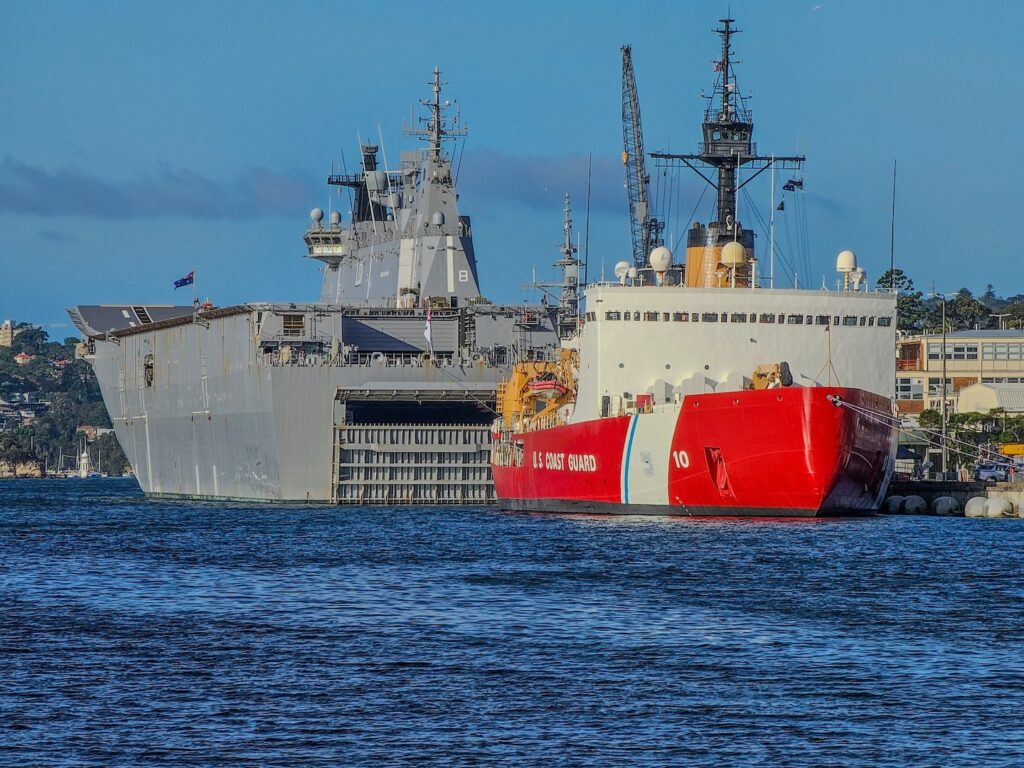
On December 10, the Polar Star moored at HMAS Kuttabul alongside several Royal Australian Navy ships close to the center of Sydney during a logistics stop for fuel and supplies.
The Polar Star departed its Seattle homeport November 15 and has traveled approximately 7,700 miles with stops in Honolulu, Sydney and Hobart.
The Polar Star is the United States’ only asset capable of providing access to both Polar Regions. It is a 399-foot heavy polar icebreaker commissioned in 1976, weighing 13,500 tons, 84-feet wide, with a 34-foot draft. The six diesel and three gas turbine engines produce up to 75,000 horsepower.
USCGC Active Returns Home After Counternarcotics Patrol in Eastern Pacific Ocean
PORT ANGELES, Wash. – U.S. Coast Guard Cutter Active and crew returned to its home port, Tuesday, after a 57-day patrol in support of Joint Interagency Task Force-South’s (JIATF-S) counternarcotics campaign in the Eastern Pacific Ocean.
Active and crew routinely deploys to this region in an effort to disrupt transnational criminal organizations specifically in pursuit of illegal trafficking of narcotics. Equipped with two boats and an MH-65E helicopter from Helicopter Interdiction Tactical Squadron (HITRON), Active and crew met a variety of mission demands.
Active’s crewmembers aided in the rescue of five Ecuadorian fishermen, November 19, who were adrift on their disabled vessel for an estimated 19 days. The survivors faced harsh elements and prolonged exposure which created life threatening conditions. Active’s crew provided medical care and rehydration to the fishermen as they began to recover from their critical condition before transferring them to authorities in El Salvador.
The crew successfully interdicted over 3,400 pounds of cocaine and detained three suspected narcotics traffickers. Less than 24 hours after the holiday interdiction, Active successfully apprehended three more suspected smugglers transporting more than 2,400 pounds of cocaine.
“I am extremely proud of the crew and their relentless pursuit of our mission objectives,” said Cmdr. Adam Disque, commanding officer of the Active. “Interdictions at sea are always challenging, and no two are the same. These back-to-back operations were exceptionally well coordinated, which included the tactical employment of an interdiction helicopter, multiple surface boat deployments, and our highly trained boarding teams. The whole crew is always grateful to contribute to the fight against the transnational crime that triggers violence and instability at home.”
The Active is a 210-foot medium endurance cutter homeported in Port Angeles, Washington. This multi-mission platform falls under the operational command of the Coast Guard Pacific Area. As a Coast Guard resource, Active deploys in support of the Coast Guard’s Eleventh and Thirteenth Districts as well as JIATF-S. Patrolling from northern most part of the contiguous United States, all the way to the equator, Active is a critical asset conducting search and rescue, counter-narcotics law enforcement, living marine resource protection, and homeland defense operations.
U.S. Coast Guard Cutter Seizes Illegal Narcotics in Gulf of Oman
By U.S. Naval Forces Central Command Public Affairs | December 15, 2023
MANAMA, Bahrain — A U.S. Coast Guard ship seized illegal drugs worth over $6 million from a fishing vessel in the Gulf of Oman, Dec. 12.
Crewmembers from the Sentinel-class fast response cutter USCGC Glen Harris (WPC 1144) observed individuals on a fishing vessel throw seven bales of material over the side. The material was discovered to be 174 kilograms of heroin.
Glen Harris arrived in the Middle East region last year and operates from Naval Support Activity Bahrain.
The fast response cutter is part of a contingent of U.S. Coast Guard ships forward-deployed to the region under Patrol Forces Southwest Asia (PATFORSWA). PATFORSWA deploys Coast Guard personnel and ships alongside U.S. and regional naval forces throughout the Middle East.
Coast Guard Cutter Diligence returns to Pensacola after interdicting $20.3 million in illicit drugs, six smugglers
PENSACOLA, Fla. — The crew of Coast Guard Cutter Diligence (WMEC 616) returned to homeport in Pensacola on Thursday after a 52-day counterdrug patrol in the Caribbean Sea.
During the patrol, Diligence’s crew worked in support of Joint Interagency Task Force South (JIATF-South) within the Coast Guard Seventh District’s area of responsibility to interdict and deter the smuggling of illicit narcotics. Diligence’s crew disrupted approximately 700 kilograms of cocaine with an estimated street value of over $20.3 million dollars and apprehended six suspected smugglers.
Diligence also conducted a joint training exercise with the Army’s 160th Special Operations Aviation Regiment (SOAR). During the exercise, the Diligence crew and pilots from SOAR completed daytime and nighttime helicopter landing evolutions. This exercise strengthened the interoperability of the Coast Guard and the U.S. Army.
“Stopping the flow of drugs to the United States is a challenging mission that requires a significant amount of teamwork,” said Cmdr. Nolan Cain, Diligence’s commanding officer. “The Diligence crew had the opportunity to work alongside our Department of Defense and international partners in this unified effort. The dedication and hard work of the Diligence crew and our partners is incredibly inspiring.”
Detecting and interdicting illegal drug traffickers on the high seas involves significant interagency and international coordination. JIATF-South in Key West, Florida, conducts detection and monitoring of aerial and maritime transit of illegal drugs. Once interdiction becomes imminent, the law enforcement phase of the operation begins, and control of the operation shifts to the U.S. Coast Guard throughout the interdiction and apprehension process. Interdictions in the Caribbean Sea are performed by members of the U.S. Coast Guard under the authority and control of the Coast Guard’s Seventh District, headquartered in Miami.
Diligence is a 210-foot medium endurance cutter with 78 crewmembers. The cutter’s primary missions are counterdrug operations, migrant interdiction, enforcing federal fishery laws, and search and rescue in support of Coast Guard operations throughout the Western Hemisphere.
For information on how to join the U.S. Coast Guard, visit GoCoastGuard.com to learn about active duty, reserve, officer and enlisted opportunities. Information on how to apply to the U.S. Coast Guard Academy can be found here.
U.S. Coast Guard Cutter Harriet Lane arrives at new homeport in Pearl Harbor
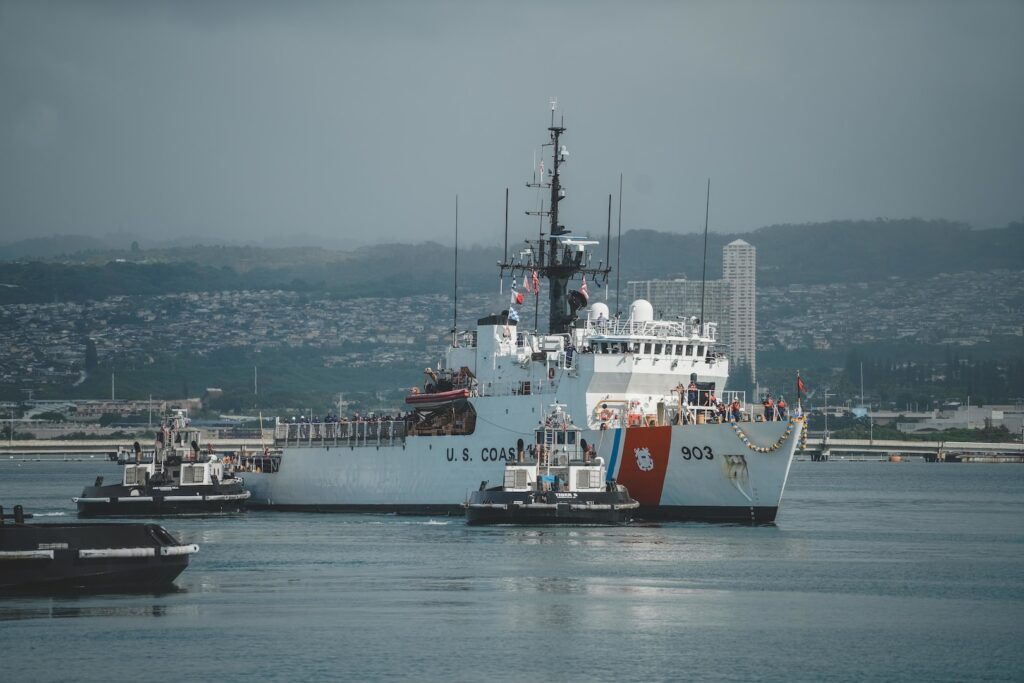
HONOLULU – U.S. Coast Guard Cutter Harriet Lane (WMEC 903) and crew arrived at its new homeport at Joint Base Pearl Harbor-Hickam, Wednesday, after transiting more than 8,000 nautical miles over 36-days from Portsmouth, Virginia.
The Harriet Lane is U.S. Coast Guard Pacific Area’s newest Indo-Pacific support cutter and spent more than 15 months in a Service Life Extension Program (SLEP) in Baltimore, Maryland, to prepare for the transition in missions and operations. Following reconstitution of the crew in July and returning to Portsmouth in August, the crew went through an extensive dockside period, ensuring the cutter was ready for the transit from the Atlantic Ocean to the Pacific Ocean.
“Re-homeporting U.S. Coast Guard Cutter Harriet Lane is indicative of the Coast Guard’s commitment to the Indo-Pacific – the most dynamic region in the world,” said Rear Admiral Brendan McPherson, deputy commander, U.S. Coast Guard Pacific Area. “Harriet Lane will work by, with, and through allies and partners within the Indo-Pacific region to promote capacity building and model good maritime governance.”
“The crew and I look forward to building partnerships in Oceania to enhance our capabilities, strengthen maritime governance and security while promoting individual sovereignty,” said Cmdr. Nicole Tesoniero, commanding officer of the Harriet Lane. “We plan to build upon many decades of enduring support, operating in concert with the needs of our partners.”
Harriet Lane and crew departed Coast Guard Base Portsmouth, November 2023, and during the transit, the crew conducted trainings for upcoming operations along with professional development for crewmembers. Harriet Lane transited through the Panama Canal, and had port calls in Golfito, Costa Rica and San Diego.
Harriet Lane, commissioned in 1984, is a 270-foot medium endurance cutter now homeported in Honolulu to support Coast Guard missions in the Pacific region. The service’s medium endurance cutter fleet supports a variety of Coast Guard missions including search and rescue, law enforcement, maritime defense, and protection of the marine environment.
Coast Guard Cutter Dauntless returns home to Florida after interdicting 19.4 million in illegal narcotics, 3 suspected drug smugglers
PENSACOLA, Fla. – The crew of the U.S. Coast Guard Cutter Dauntless (WMEC 624) returned to their homeport in Pensacola Tuesday following a 25-day counterdrug deployment in the Caribbean Sea.
While underway in the Coast Guard Seventh District’s area of operations and in support of Joint Interagency Task Force–South, Dauntless’s crew spent 25 days patrolling the Caribbean, where their primary mission was detecting and interdicting go-fast and other vessels suspected of smuggling illegal narcotics into the U.S.
During the patrol, Dauntless’s crew interdicted one go-fast vessel smuggling illegal narcotics, seizing over 670 kilograms of cocaine worth an estimated 19.4 million, and apprehended three suspected drug smugglers.
“This interdiction truly showcased the impressive skill and relentless perseverance of the Dauntless crew,” said Cmdr. Aaron Kowalczk, commanding officer of Dauntless. “Their ability to complete the seizure despite challenging conditions highlights the Coast Guard’s important role in countering transnational criminal organizations. The crew’s commitment to combating narcotics trafficking is emblematic of their dedication to service.”
In addition to interdicting illegal narcotics, Dauntless’s crew conducted joint operations with the USS Farragut and its embarked Law Enforcement Detachment to transfer 433 kilograms of illegal narcotics and six suspected traffickers, strengthening interoperability with Department of Defense partners and promoting maritime security and safety.
Dauntless is a 210-foot Reliance-class medium endurance cutter. The cutter’s primary missions are counter-narcotics operations, migrant interdiction, living marine resources protection, and search and rescue in support of U.S. Coast Guard operations throughout the Western Hemisphere.
For information on how to join the U.S. Coast Guard, visit www.GoCoastGuard.com to learn more about active duty and reserve officer and enlisted opportunities. Information on how to apply to the U.S. Coast Guard Academy can be found at www.uscga.edu.