U.S. Coast Guard Participating in Operations Island Chief, Blue Pacific 2022 

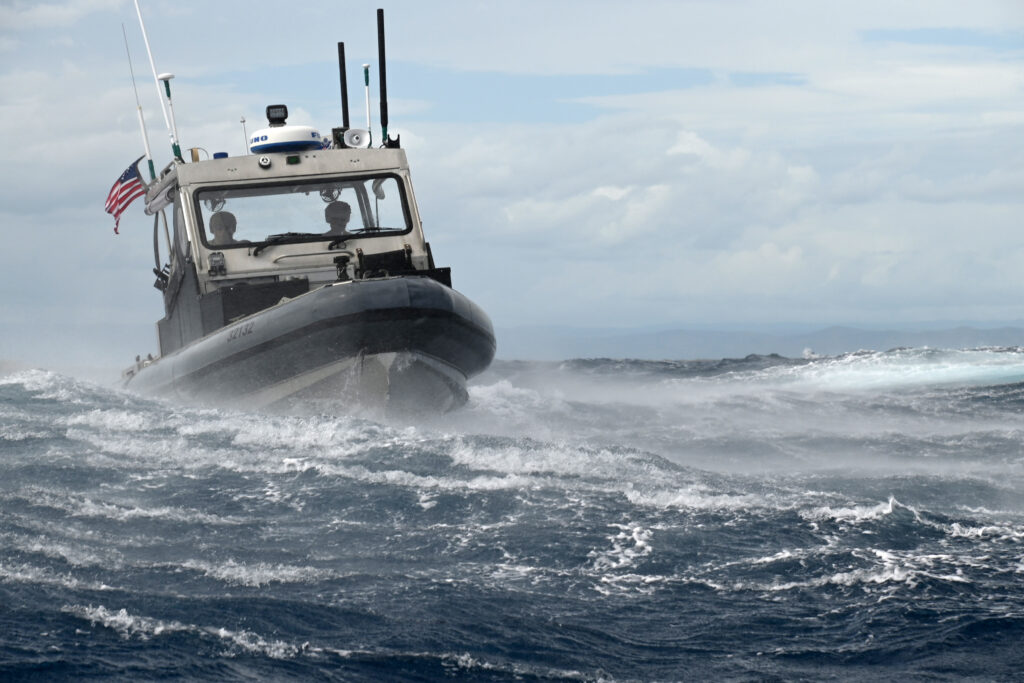
The USCGC Oliver Henry (WPC 1140) crew arrives in Manus, Papua New Guinea, on Aug. 14, 2022, from Guam as part of a patrol headed south to assist partner nations in upholding and asserting their sovereignty while protecting U.S. national interests. U.S. Coast Guard / SW3 Victor Villanueva, NMCB-FOUR

MANUS, Papua New Guinea — The U.S. Coast Guard is participating with partners to support the Pacific Islands Forum Fisheries Agency-led Operation Island Chief and the larger Operation Blue Pacific through patrols in the Western Pacific in August and September 2022, the Coast Guard’s Micronesia Sector said in an Aug. 14 release. 

“Employing our unique authorities, capabilities, and access within Oceania is a privilege. We are eager to further integrate with our Allies and regional partners to protect national interests and combat illicit maritime activity such as illegal, unreported, and unregulated fishing,” said Capt. Nick Simmons, U.S. Coast Guard Forces Micronesia/Sector Guam commander. “Strengthening governance and modeling professional maritime behavior on the high seas and the surrounding waters is one way to counter predatory activity and reinforce the Pacific as a positive center of gravity and sustainable economy.” 

The operation covers a substantial area of the Pacific on the high seas and the exclusive economic zones of the Federated States of Micronesia, Papua New Guinea, Australia, and the Solomon Islands, while renewing relationships bolstered by local knowledge and expertise. 

The USCGC Oliver Henry (WPC 1140), a 154-foot Sentinel-class fast response cutter, and crew deployed from Guam are making their first port call of the patrol in Manus, Papua New Guinea. During the patrol, the cutter will also have aerial support from a forward deployed HC-130 Hercules airplane crew from U.S. Coast Guard Air Station Barbers Point and New Zealand Defence Force P-3 Orion airplane crew. Where possible, the crew will also conduct subject matter expert exchanges and engagements. 

Operation Island Chief is one of four operations conducted annually under FFA. It includes the Pacific waters of 11 participating FFA member nations – Fiji, Federated States of Micronesia, Kiribati, Palau, Papua New Guinea, Nauru, the Marshall Islands, Samoa, the Solomon Islands, Tuvalu, and Vanuatu. 

“The Oliver Henry crew are committed to regional collaboration and sharing best practices to strengthen our relationships and information sharing,” said Lt. Freddy Hofschneider, commanding officer of Oliver Henry. “The U.S. Coast Guard has been a dedicated partner in the region for decades. We appreciate the support of our colleagues as we take this ship across vast distances in this region, making some transits and port calls for the first time.” 

A significant emphasis of the operation for the U.S. Coast Guard is the ongoing emphasis on fisheries and resource protection. 

“The Pacific Ocean is home to some of the world’s most abundant fisheries,” said Simmons. “These fisheries are living marine resources, part of the global food chain, representing food security and an economic engine for many of the Pacific Island Nations. By leveraging our cutters, aircraft, and intelligence professionals, the U.S. Coast Guard continues our strong partnership with the Pacific Islands Forum Fisheries Agency and its members to protect this vital marine ecosystem and ensure continued economic prosperity and a thriving ocean for future generations.” 

According to FFA, partners are seeing increasing success through multilateral operations in the Pacific to tackle IUUF. These operations evolved from a focus on protecting against illegal boats entering the fisheries to policing the operations of licensed vessels that haven’t followed the rules and regulations governing their activities. The Pacific region is a vast expanse, and collaboration across the many partners, providing personnel and assets, is crucial to ongoing success. 

The Oliver Henry is the 40th Sentinel-class fast response cutter. The ship arrived in Guam and was commissioned along with its sister ships, Myrtle Hazard and Frederick Hatch, in July 2021. In the time since, the crew has participated in several search and rescues cases, completed a counternarcotics patrol off Guam with the Japan Coast Guard patrol vessel Mizuho, and conducted sovereignty and fisheries patrols in the Forces Micronesia/Sector Guam area of responsibility. 


Coast Guard Offloads $22 Million in Seized Cocaine in San Juan, Puerto Rico 

Coast Guard Cutter Joseph Tezanos crewmembers offloaded 1,100 kilograms of cocaine, valued at $22 million dollars, at Coast Guard Base San Juan Aug. 8, following three separate interdictions of drug smuggling vessels near Puerto Rico. U.S. COAST GUARD

SAN JUAN, Puerto Rico — The crew of the Coast Guard Cutter Joseph Tezanos and Caribbean Corridor Strike Force agents offloaded 2,425 pounds of seized cocaine Aug. 8, following three separate at-sea interdictions near Puerto Rico, the Coast Guard 7th District said in a release. 

Fourteen men, Dominican Republic nationals, apprehended in these cases are facing federal prosecution in Puerto Rico. The seized contraband has an estimated wholesale value of approximately $22 million dollars. 

These interdictions are the result of multi-agency efforts involving the Caribbean Border Interagency Group and the Caribbean Corridor Strike Force.  

During the afternoon of Aug. 3, the aircrew of a Customs and Border Protection Air and Marine multi-role enforcement aircraft detected a 25-foot suspect vessel north of Aguadilla, Puerto Rico. During the interdiction, the smugglers jettisoned multiple bales of suspected contraband into the water. Coast Guard Cutter Joseph Tezanos, assisted by the aircrew of a Coast Guard HC-144 Ocean Sentry aircraft, stopped the suspect vessel, apprehended four men and recovered 13 bales of the jettisoned cargo that collectively weighted 1,653 pounds and tested positive for cocaine. 

During the afternoon of July 29, the aircrew of Customs and Border Protection Air and Marine multi-role enforcement aircraft detected a 20-foot suspect vessel in waters northwest of Desecheo Island, Puerto Rico. During the interdiction, the smugglers jettisoned multiple bales of suspected contraband into the water. Cutter Joseph Tezanos stopped the smuggling vessel, apprehended four men and recovered eight bales of the jettisoned cargo that collectively weighted approximately 441 pounds and tested positive for cocaine. 

During the afternoon of July 27, the aircrew of Coast Guard HC-144 Ocean Sentry aircraft detected a 20-foot suspect vessel in waters northwest of Aguadilla, Puerto Rico. During the interdiction, the smugglers jettisoned multiple bales of suspected contraband into the water. Cutter Joseph Tezanos  arrived on scene and stopped the non-compliant vessel, apprehended six men and recovered three bales of the jettisoned cargo that collectively weighted approximately 330 pounds and tested positive for cocaine. 

“These successful interdictions reflect the unwavering resolve and strong partnerships between the Coast Guard and our Caribbean Border Interagency Group partners in stopping illicit drug trafficking in the high seas,” said Capt. José E. Díaz, commander of Coast Guard Sector San Juan. “I’m proud of the professionalism and performance of the cutter Joseph Tezanos in apprehending 14 smugglers and preventing these drugs from reaching the shores and streets of Puerto Rico.”  

Special Agents supporting the Caribbean Corridor Strike Force are leading the investigation into this case.  

Cutter Joseph Tezanos is a 154-foot fast response cutter that is homeported in San Juan, Puerto Rico. 


Hawaii-based Coast Guard Units Conclude RIMPAC 2022 Participation 

A U.S. Navy Sailor directs Navy and U.S. Coast Guard Sailors to a U.S. Navy MH-60R Seahawk helicopter during flight operations during Rim of the Pacific 2022. U.S. COAST GUARD / Petty Officer 3rd Class Taylor Bacon

PEARL HARBOR — Four Hawaii-based Coast Guard units concluded operations contributing to the largest Coast Guard participation in the history of RIMPAC and returned to service of the residents of Hawaii and the Pacific region on Aug. 4, the Coast Guard 14th District said in a release. 

U.S. Coast Guard Cutters Midgett and William Hart, the Pacific Dive Locker, and Maritime Safety and Security Team Honolulu partnered with military members from Australia, Peru, Republic of Korea, Canada, France and Japan throughout the in-port and at-sea portions of the Rim of the Pacific 2022, which ran from late June to early August. The exercise marked a series of “firsts” for Coast Guard participation. 

Coast Guard Cutter Midgett conducted a broad spectrum of operations with the Japan Maritime Self Defense Force Ship Izumo, the USS Chafee, USS Gridley, French Navy Frigate FS Prairial, and Peruvian Navy BAP Guise. The combined team of Midgett, William Hart, Izumo and USS Essex completed RIMPAC’s first mass rescue operation, successfully partnering to find, recover and provide medical assistance to 10 simulated people in the water. 

Following RIMPAC, Midgett’s crew will depart on a western Pacific patrol to build on the regional partnerships demonstrated here and conduct international training and fisheries law enforcement. William Hart’s crew will conduct necessary maintenance, complete training, and resume their role as a standby search-and-rescue asset for vessels in distress in the waters around Hawaii, a role it shares with the other two fast response cutters in Honolulu, Cutter Joseph Gerczak and Cutter Oliver Berry. 

This year’s RIMPAC featured the first Coast Guard-led humanitarian assistance and disaster relief exercise. The exercise tested reopening a harbor that had been struck by a simulated hurricane. A boat crew from Coast Guard MSST Honolulu partnered with underwater survey teams from the U.S. and Royal Australian Navies to conduct underwater scans of Honolulu Harbor to identify hidden hazards. After that, divers from the Coast Guard Pacific Dive Locker collaborated with divers from the U.S. Army and Republic of Korea Navy to remove the hazards and practice maintaining aids to navigation underwater. 

Following RIMPAC, the Pacific Diver Locker will focus on training and preparations for annual safety inspections and provide support to local Coast Guard assets and aids to navigation missions.

“This was an incredible opportunity to work alongside our partners in the Blue Pacific to strengthen our relationships,” said Coast Guard 14th District Commander Rear Adm. Michael Day. “Our ability to come together for RIMPAC 22, in person, has helped reconnect within and beyond the region. It is through those connections and relationships that we will move forward to bolster impactful engagement opportunities.”  


Bollinger Delivers 50th Fast Response Cutter to Coast Guard 

The Coast Guard Cutter William Chadwick in Key West. BOLLINGER SHIPYARDS

LOCKPORT, La. — Bollinger Shipyards LLC has delivered the Coast Guard Cutter William Chadwick to the U.S. Coast Guard in Key West, Florida, the company said Aug. 4. This is the 176th vessel Bollinger has delivered to the U.S. Coast Guard over a 35-year period and the 50th fast response cutter delivered under the current program.  

“It’s incredibly meaningful that we could deliver the 50th FRC, the USCGC William Chadwick, on the Coast Guard’s 232nd birthday and that she’ll be homeported in Sector Boston, the birthplace of the Coast Guard,” said Bollinger President and CEO Ben Bordelon.

“Pound for pound, the quality and capabilities of the FRC platform is unmatched and can be looked upon as a model government acquisition program. Our unique experience building for the Coast Guard is unparalleled and has shown time and time again that we can successfully deliver the highest quality vessels on a reliable, aggressive production schedule and cost, even in the most challenging circumstances. We look forward to continuing our historic partnership with the U.S. Coast Guard.” 

Chadwick will be the first of six FRCs to be homeported in Sector Boston, responsible for coastal safety, security and environmental protection from the New Hampshire-Massachusetts border southward to Plymouth, Massachusetts out to 200 nautical miles offshore. Sector Boston directs over 1,500 active duty, Reserve and Auxiliary members whose mission is to protect and secure vital infrastructure, rescue mariners in peril at sea, enforce federal law, maintain navigable waterways, and respond to all hazards impacting the maritime transportation system and coastal region. 

Each fast response cutter is named for an enlisted Coast Guard hero who distinguished themselves in the line of duty. William P. Chadwick served as keeper of the Green Island Lifeboat Station in New Jersey and was awarded the Gold Lifesaving Medal for the rescue of the crew of the schooner George Taulane on Feb. 3, 1880.  Even after suffering a debilitating injury from flying debris, Chadwick directed the repeated efforts to save the crew of the broken Taulane as they battled mother nature’s high winds, heavy rains and dangerous surf. Finally, after five and a half hours, Chadwick’s men were able to erect a breeches buoy.  Within a half hour all the Taulane’s crew were safely ashore. 


Coast Guard Cutter Vigilant Returns Home after 68-day Patrol 

The Coast Guard Cutter Vigilant (WMEC 617) small boat crewman approaches the cutter in the Caribbean Sea, July 22. The Vigilant crew repatriated 147 Haitian migrants interdicted in the high seas. U.S. COAST GUARD

JACKSONVILLE, Fla. — The Coast Guard Cutter Vigilant’s crew returned to Port Canaveral on July 22 after completing a 68-day patrol in the Caribbean Sea, the Coast Guard Atlantic Area said July 28. 

The crew’s deployment was focused on collaborating with other Coast Guard assets to detect, deter, and intercept unsafe and illegal migrant voyages en route to the United States.  

During the patrol, the crew interdicted 19 vessels with 460 Cuban and Haitian migrants attempting to illegally enter the United States, and aided a group of Cubans stranded on an island.   

In support of Coast Guard Sector Key West, Vigilant’s crew interdicted 18 vessels while patrolling in the Florida Straits. During the patrol, the crew approached a grossly overloaded sailing vessel with 147 Haitian migrants onboard. The cutter’s crew provided care and medical attention to the migrants before repatriating them to Haiti.  

As a tropical depression with 40 mph winds and 10 to 12-foot seas approached the Florida Straits, Vigilant’s crew interdicted three overloaded and unseaworthy homemade vessels in a 12-hour period, saving 44 Cuban migrants.  

The crew also supported the Coast Guard 7th District Operation Southeast Watch in the Windward Pass. Operation Southeast watch is an interagency effort to detect and deter vessels engaged in illegal maritime migration. While in the Windward Pass, the crew oversaw and coordinated patrol assignments for aircraft and seven other cutters off the coast of Haiti. Vigilant’s crew worked with Coast Guard Cutter William Trump’s crew to interdict an overloaded and unstable sailing vessel, rescuing 107 Haitian migrants.    

“During this 68-day patrol, Vigilant’s crew supported homeland security objectives by deterring illegal maritime migration,” said Cmdr. Jay Guyer, commanding officer of the Vigilant. “Interdicting and rescuing nearly 500 people over a two-month patrol is a testament to the incredible professionalism of our crew.” 

Vigilant, a 210-foot Reliance-class medium-endurance cutter, patrols the Caribbean Sea and Eastern Pacific Ocean, performing counter-drug operations, migrant interdiction operations, search and rescue, and fisheries enforcement. 


Coast Guard Cutter Seneca Returns to Homeport Following 54-Day Patrol 

Petty Officer 3rd Class Vincent Isaiah Pangelinan, a Gunner’s Mate aboard Coast Guard Cutter Seneca, fires the messenger line to pass the towing line to CGC Tybee during a towing evolution off the coast of Massachusetts. A messenger line is used to assist in heaving the mooring to the shore or to another ship. U.S. COAST GUARD / Petty Officer 2nd Class Kyle Miller

PORTSMOUTH, Va. — The USCGC Seneca (WMEC 906) returned to homeport in Portsmouth July 21 after a 54-day deployment in the North Atlantic Ocean, the Coast Guard 5th District said July 22. 

The Seneca crew supported the U.S. Coast Guard 1st District as they conducted a series of commercial fishing vessel boardings from New York to Maine to ensure compliance with federal safety, fisheries, and environmental regulations. The boardings conducted by Seneca’s crew resulted in 17 notices of violation and two voyage terminations.  

“This rewarding patrol showcased the devotion and hard work of an amazing crew,” said Cmdr. James F. McCormack, commanding officer of Seneca. “The crew exhibited selfless service during a high-tempo patrol. The 53 boardings promoted safety at sea and sustainability of marine life for generations to come. Our presence strengthens trust between the Coast Guard and the fishing fleet, while setting the standard for Coast Guard operations in the North Atlantic Ocean.” 

Additionally, the Seneca’s crew responded to seven search and rescue cases, three of which resulted in lives saved or assisted.  

During one of the search and rescue cases, the crew of Seneca worked in partnership with a Coast Guard Air Station Cape Cod MH-60T helicopter crew to medically evacuate two critically injured people from a sailing vessel 350 nautical miles offshore. The Seneca crew also rescued the two remaining stranded sailors.  

During a second search and rescue case, the cutter crew rendered assistance and towed a disabled fishing vessel 70 miles.

The Seneca is a 270-foot medium-endurance cutter homeported in Portsmouth with 100 crew members. The cutter’s primary missions include search and rescue, living marine resources, illegal drug interdictions, counter narcotics, migrant interdictions, ensuring the safety of life at sea and enforcing international and domestic maritime laws in both the Atlantic and Pacific Oceans. 


Cutter Monroe Returns Home Following 128-Day Deployment 

Crew members from Coast Guard Cutter Munro prepare to disembark after conducting a boarding of South Korean-flagged fishing vessel Dong Won in the South Pacific April 14, southwest of the Howland/Baker Islands, as part of Operation Blue Pacific. U.S. COAST GUARD / Petty Officer 1st Class Nate Littlejohn

ALAMEDA, Calif. — The crew aboard U.S. Coast Guard Cutter Munro (WMSL 755) returned to their homeport in Alameda July 10 following a 128-day, 20,000-nautical-mile deployment, the Coast Guard Pacific Area said in a release. 

Munro departed Alameda in early March for a multi-mission deployment to the South and North Pacific Ocean. The deployment aimed to counter illegal, unreported and unregulated fishing and strengthen relationships to enhance maritime sovereignty and security throughout the region. 

Munro’s crew supported Operation Blue Pacific and North Pacific Guard during the patrol. These operations lead and promote international efforts that uphold the principles of security, safety, sovereignty, and economic prosperity in Oceania and the North Pacific through operations and engagements to ensure a free and open Indo-Pacific. 

“Munro’s deployment demonstrated the Coast Guard’s unique authorities in the support of combatting IUU fishing,” said Vice Adm. Andrew J. Tiongson, commander U.S. Coast Guard Pacific Area. “Through Operation Blue Pacific, the Coast Guard aims to strengthen relationships with like-minded nations. Our shared efforts will improve maritime governance within the Pacific Ocean, increase capacity for bilateral search-and-rescue and law enforcement, and promote shared technical expertise and proficiency.” 

As a federal law enforcement agency, the Coast Guard combats illegal fishing and other maritime threats across the Pacific and promotes maritime governance, safety and security through partnerships around the world. 

 “Our relationships in the Pacific are stronger today and our partners are unified in their commitment to security,” said Capt. Rula Deisher, who assumed command of Munro mid-patrol during a change-of-command ceremony in Guam. “It was an incredible opportunity for our crew to work alongside allies, share law enforcement concepts to promote peace, prosperity and the sovereign rights of all nations.” 

Commissioned in 2017, Munro is one of four Coast Guard Legend class national security cutters homeported in Alameda. National security cutters are 418-feet long, and have a range of 12,000 nautical miles, endurance of up to 90 days and can hold a crew of up to 170. Munro is the second cutter named for Signalman First Class Douglas A. Munro, the only Coast Guardsman awarded the Congressional Medal of Honor. 


Coast Guard Delivers Water to Drought-Stricken Kiribati at Critical Juncture

The Coast Guard Cutter Oliver Berry crew conducts a potable water offload while moored up at Kiritimati Island, Kiribati, July 8. U.S. COAST GUARD

HONOLULU — The island nation of Kiribati is surrounded by water. Too much of it, actually, because climate change and rising sea levels are endangering the 33 scattered small, sparsely populated and low-lying islands in the Gilbert, Phoenix and Line chain islands of Micronesia. And, safe drinking water is in short supply.

The government of the Republic of Kiribati recently declared a state of disaster last month due to lasting drought conditions caused by below normal rainfall.

Kiribati is 2,400 miles due south of Hawaii, about half way to Australia, and straddles the equator. It has a population of about 119,000, most of whom live on the island of Tarawa. The country’s highest elevation is 266 feet above sea level on the island of Banaba. 

The Pacific Humanitarian Air Service, operated by the United Nations World Food Programme and UNICEF, transported emergency supplies to Kiribati on July 7, to help with the emergency.

According to the World Food Programme, the delivery included essential supplies, including “water, sanitation, hygiene” and dignity kits with collapsible water containers, buckets with lids, water purification tablets and soap. The shipment also delivered portable water field testing kits to help Kiribati authorities monitor water quality at both source and household levels.

A 2018 declaration by the Pacific Islands Forum nations said climate change is the “single greatest threat to the livelihoods, security and wellbeing of the peoples of the Pacific.”

Melting polar ice and glaciers are causing the sea level to rise, endangering low-lying countries like Kiribati. In fact, the islands may become inhabitable in a matter of decades. Many small islands rely on rain catchment systems for drinking water, so severe drought has a negative impact on the population.

Honolulu-based Coast Fast Response Cutter USCGC Oliver Berry (WPC 1124) delivered  potable drinking water to the island of Kiritimati, working with U.N. representatives to support the local residents amid the national state of emergency. 

In addition to providing humanitarian assistance, the Oliver Berry crew supported Kiribati maritime law enforcement efforts, providing patrol coverage in Kiribati’s exclusive economic zone to deter illegal, unregulated and unreported fishing, support Kiribati resource security and strengthen maritime governance in Oceania.

“The Oliver Berry’s patrol demonstrates the United States Coast Guard’s enduring commitment to our partner nations throughout Oceania,” said Howell. “Instances like these pave the way for future Coast Guard assets to support The Republic of Kiribati and its citizens.” 

Amid the natural disaster is a political storm, too. Kiribati withdrew from a July 11-14 summit of Pacific Islands Forum leaders at the last minute, citing a lack of concern over issues important to the country. 

The withdrawal coincides with efforts by China to have greater influence in Oceania.

The positive presence of a U.S. Coast Guard cutter and crew sends a reassuring message of support at a critical time.


Coast Guard Offloads $5.2 Million in Seized Cocaine in San Juan, Puerto Rico 

The crew of Coast Guard Cutter Joseph Tezanos offloaded 250 kilograms in seized cocaine estimated at $5.2 million at Coast Guard Base San Juan July 5. The contraband was seized following the interdiction of a drug smuggling vessel by the Coast Guard Cutter Joseph Doyle June 30, south of Cabo Rojo, Puerto Rico. U.S. COAST GUARD

SAN JUAN, Puerto Rico — The crew of the Coast Guard Cutter Joseph Tezanos offloaded 551 pounds of seized cocaine Tuesday in San Juan, Puerto Rico, the Coast Guard 7th District said July 5. 

Three men, one Venezuelan and two Dominican Republic nationals, apprehended in this case are facing federal prosecution in Puerto Rico. 

The interdiction is the result of multi-agency efforts in support of the Caribbean Corridor Strike Force.  The seized cocaine has an estimated wholesale value of approximately $5.2 million. 

During the morning of June 30, the crew of a Customs and Border Protection Caribbean Air and Marine Multi-Role Enforcement Aircraft detected a “yola” type vessel navigating towards Cabo Rojo, Puerto Rico.  Coast Guard watchstanders in Sector San Juan diverted the cutter Joseph Doyle that arrived on scene and stopped the suspect vessel. 

The Coast Guard crew apprehended the three men and embarked eight bales from the suspect vessel that tested positive for cocaine. The seized contraband was later transferred to the Coast Guard Cutter Joseph Tezanos for delivery to San Juan, Puerto Rico. 

“This successful interdiction is due to the strong collaboration between the Coast Guard and our fellow federal law enforcement partners,” said Capt. José E. Díaz, Coast Guard Sector San Juan commander. “We will continue to do our utmost to stop drug smuggling vessels at sea and protect the nation’s southernmost maritime border from illicit trafficking.” 

The apprehended smugglers face federal prosecution in Puerto Rico. The charges carry a minimum sentence of 10 years imprisonment and a maximum sentence of imprisonment for life. 


Cutter Northland Returns Home after 76-day Eastern Pacific Counter-Narcotics Patrol 

Cmdr. Patricia Bennett, the commanding officer of the Coast Guard Cutter Northland, welcomes the president of the Governing Council of the Galapagos Province aboard Northland, May 10. Northland arrived in the Galapagos for the first time in the cutter’s 38-year history and became only the second Coast Guard ship to anchor in the waters of the Galapagos Islands in over a decade. U.S. COAST GUARD / Seaman Rachelle Amezcua-Gonzales

PORTSMOUTH, Va. — The Coast Guard Cutter Northland (WMEC 904) returned to homeport July 3 following a 76-day patrol in the Eastern Pacific Ocean in support of the 11th Coast Guard District, the Coast Guard 5th District said July 5. 

Throughout the deployment, the ship patrolled the waters of the Eastern Pacific Ocean in search of vessels suspected of smuggling illicit narcotics across international boundaries. In addition to the cutter’s permanently assigned crewmembers, Northland was augmented by an aviation detachment from Coast Guard Helicopter Interdiction Tactical Squadron and a Coast Guard Tactical Law Enforcement Detachment. A true force multiplier, Northland’s HITRON detachment operated an MH-65E Dolphin helicopter, capable of conducting overhead reconnaissance and employing aerial use of force by precision marksmen upon narcotics smuggling vessels. As law enforcement and interdiction specialists, the TACLET personnel augmented the ship’s pursuit teams, and provided specialized training to crewmembers to better prepare the cutter for interdiction and boarding operations.  

While on patrol, Northland interdicted a low-profile vessel and one go-fast panga-style vessel suspected of trafficking illicit narcotics. The interdictions resulted in 6,223 pounds of suspected cocaine seized and 761 pounds of suspected marijuana seized with an estimated street value of nearly $83 million and the detention of six individuals suspected of the illegal transport of narcotics. On June 30, the cutter offloaded the seized narcotics at Coast Guard Base Miami.  

In addition to maintaining a sentinel presence in the Eastern Pacific Ocean, the Northland conducted an Exercise Contingent to Operations with Ecuadorian Naval and Coast Guard personnel in San Cristobal, Galapagos, Ecuador. Northland arrived in the Galapagos for the first time in the cutter’s 38-year history on May 10, and became only the second Coast Guard ship to anchor in the pristine waters of the Galapagos Islands in over a decade. The exercise served as a critical step toward strengthening United States-Ecuador strategic relations in the region and was attended by the U.S. consul general to Ecuador and the president of the Governing Council of the Galapagos Province. Joint training operations between Northland and Ecuadorian Naval and Coast Guard personnel included a joint patrol with the LAE Isla San Cristobal (LG-30); small boat tactics and training; tours of Northland and the Isla San Cristobal; a joint leadership luncheon; and a discussion on tactics and procedures for combatting illegal narcotics smuggling and illegal, unreported, and unregulated fishing in the Galapagos region. Following the exercise’s official events, Northland crewmembers had the opportunity to explore the island of San Cristobal and enjoy Ecuador’s sights, snorkeling and cuisine.  

Following Northland’s northbound transit through the Panama Canal, the ship rescued six stranded Cuban nationals from a deserted island in Cay Sal Bank, Bahamas. The rescue was carried out while Northland conducted migrant interdiction operations in support of the Seventh Coast Guard District.  

“This deployment was a success thanks to the efforts of our crew and our HITRON and TACLET detachments, who we were thrilled to have aboard with us. Between crossing the Equator, visiting the Galapagos Islands and deterring the illicit activity of transnational criminal organizations, our crew is returning home with both once-in-a-lifetime sea stories and a validated sense of accomplishment,” said Cmdr. Patricia M. Bennett, Northland’s commanding officer. “As my last patrol in command of this ship, I am extremely proud of the adaptability, ingenuity and determination demonstrated by this remarkable crew on a daily basis.”  

The Northland is a 270-foot medium-endurance cutter homeported in Portsmouth, Virginia, and routinely deploys in support of counter-drug, alien migrant interdiction, fisheries, search and rescue, and homeland security missions.