Coast Guard Cutter Thetis Returns Home from 77-day Counter-Narcotic Deployment
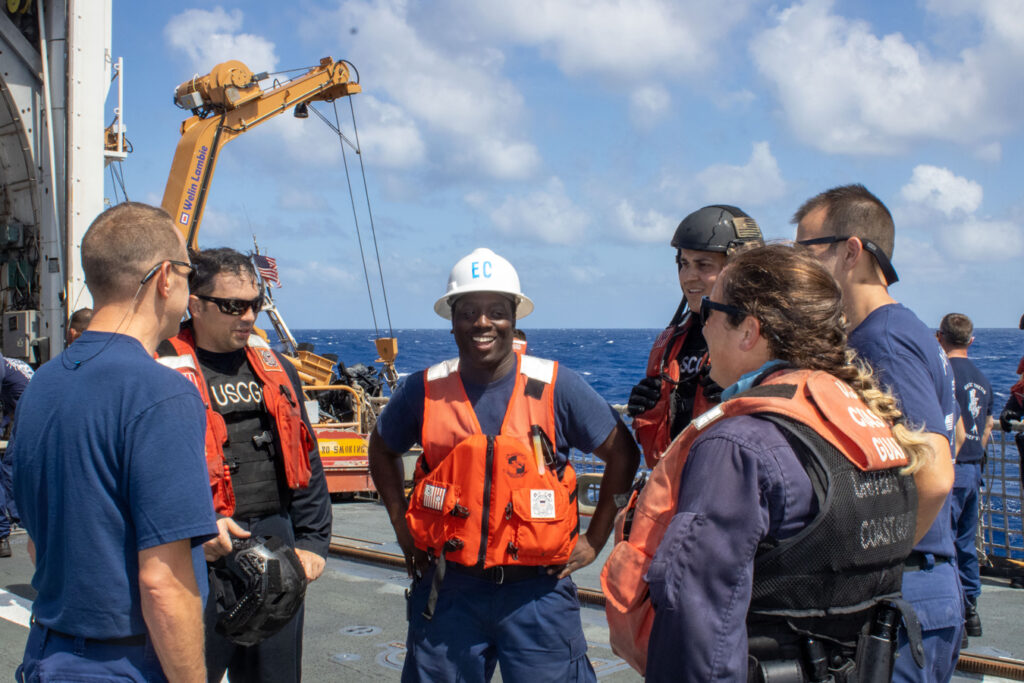
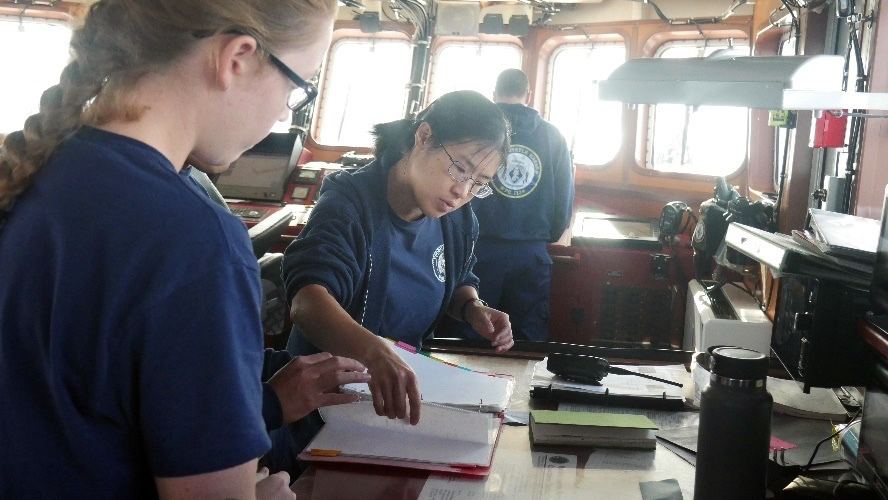
U.S. Coast Guardsmen assigned to the U.S. Coast Guard Cutter Thetis (WMEC 910), boost morale during a 77-day counter-narcotic deployment in the Caribbean sea, June 19. U.S. COAST GUARD
KEY WEST, Fla. — The U.S. Coast Guard Cutter Thetis (WMEC 910) crew returned to homeport in Key West, June 21, after a 77-day counter-narcotics patrol in the Caribbean Sea, the Coast Guard Atlantic Area said in a release.
The Thetis crew repatriated 88 Haitian migrants to Cap Haitien, Haiti, after they were reported to be on an unseaworthy sailing vessel in the Windward Passage between Cuba and Haiti.
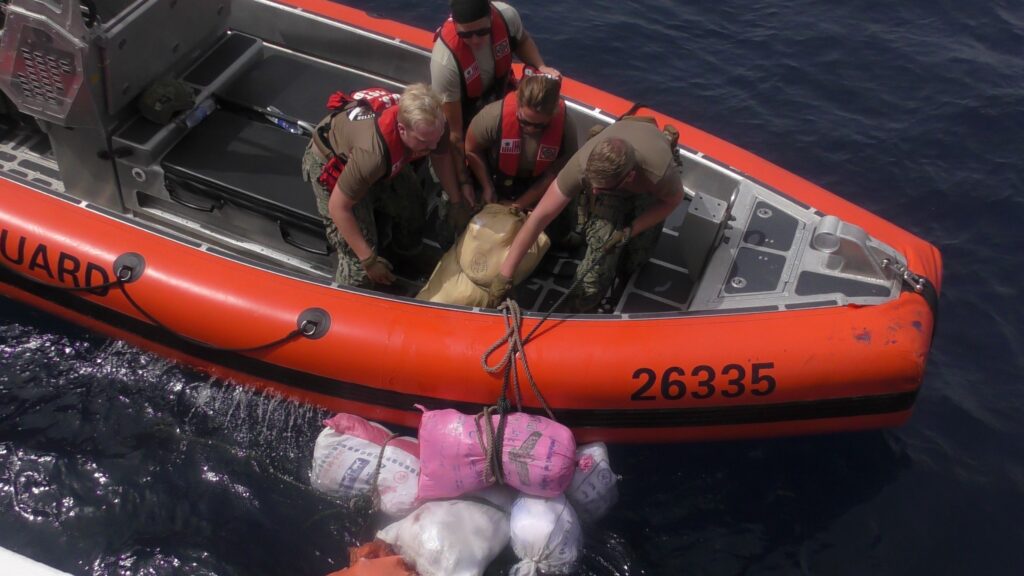
An embarked U.S. Coast Guard law enforcement detachment disabled a smuggling vessel transporting an estimated 1,323 pounds of cocaine in the Central Caribbean.
The Thetis’s crew assisted with a search and rescue case of 14 mariners that went into the water after their commercial ship began taking on water in the middle of the Caribbean Sea.
“While on a counter-narcotics patrol, our crew quickly shifted gears to help locate and provide situational awareness during an unfortunate search and rescue case,” said Cmdr. Justin Nadolny, the commanding officer of the Thetis. “Working alongside our international and commercial partners showcased the can-do spirit of mariners and our universally shared duty of assisting those in distress and ensuring safety of life at sea.”
The Thetis’s crew strengthened international partnerships while in Cartagena, Colombia, hosting Colombian naval officers aboard to gain a deeper understanding of maritime activity in the region and to develop relationships with international maritime partners operating in Caribbean waters.
The Thetis, a 270-foot Famous-class cutter homeported in Key West and has a crew of 104. Their primary missions are counter-drug operations, migrant interdiction, the enforcement of federal fisheries laws, and search and rescue in support of U.S. Coast Guard operations throughout the Western Hemisphere.
Cutter Offloads More than $99M in Illegal Narcotics at Base Miami Beach
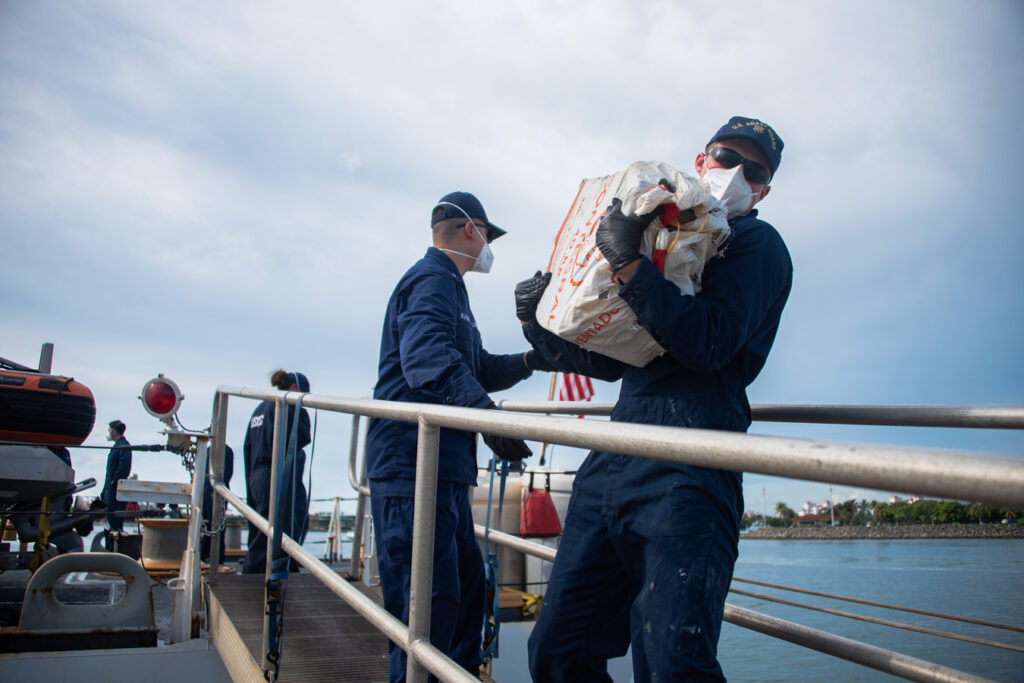
U.S. Coast Guard Cutter Thetis’ (WMEC 910) crew offloads approximately 5,237 pounds of illegal narcotics on June 17 at Coast Guard Base Miami Beach. U.S. COAST GUARD / Petty Officer 3rd Class Vincent Moreno
MIAMI — U.S. Coast Guard Cutter Thetis’ crew offloaded more than $99 million in illegal narcotics at Base Miami Beach, June 18, the Coast Guard 7th District said in a release.
Coast Guard and partner agency crews seized approximately 5,237 pounds of cocaine in the Caribbean Sea.
The drugs were interdicted in the international waters of the Caribbean Sea by crews from Coast Guard Cutter Donald Horsley, His Netherlands Majesty’s Ship Friesland and His Netherlands Majesty’s Ship Groningen.
“Interdicting drug traffickers on the open ocean is challenging work and every interdiction is complex and unique,” said Cmdr. Justin Nadolny, commanding officer of Thetis. “This offload is a testament to the teamwork and devotion of every crew assigned to carry out this mission, and it showcases the strength of the valuable international partnerships united to combat transnational organized crime.”
The fight against drug cartels in the Caribbean Sea requires unity of effort in all phases from detection, monitoring and interdictions, to criminal prosecutions by international partners and U.S. Attorneys’ Offices in districts across the nation.
During at-sea interdictions, a suspect vessel is initially detected and monitored by allied, military or law enforcement personnel coordinated by Joint Interagency Task Force-South based in Key West, Florida. The law enforcement phase of operations in the Caribbean Sea is conducted under the authority of the Seventh Coast Guard District, headquartered in Miami. The interdictions, including the actual boardings, are led and conducted by members of the U.S. Coast Guard.
The Thetis, a 270-foot Famous-class medium-endurance cutter, is homeported in Key West and patrols the Caribbean Sea and the Gulf of Mexico, performing counter-drug operations, migrant interdiction operations, search and rescue, and fisheries enforcement.
Coast Guard’s Force in Middle East Supports National Security Mission
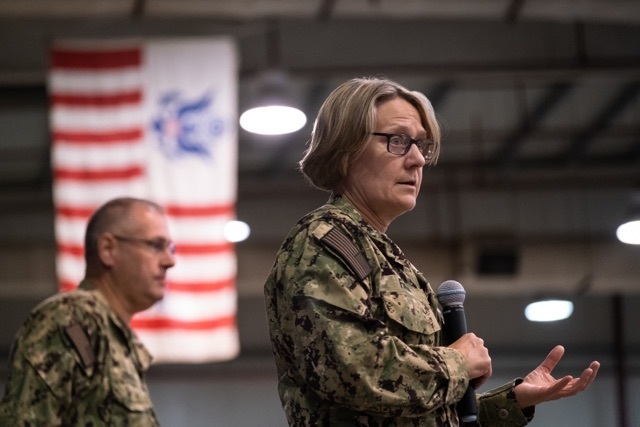
Commandant of the U.S. Coast Guard Adm. Linda Fagan speaks to Coast Guardsmen assigned to Patrol Forces Southwest Asia in Bahrain, June 15, as part of her first official visit overseas after assuming her new role as the service’s top officer. U.S. COAST GUARD / Petty Officer 1st Class Brandon Giles
MANAMA, Bahrain — U.S. Coast Guard Patrol Forces Southwest Asia (PATFORSWA) conducted a change of command ceremony on Thursday, June 16 at Manama, Bahrain, as Capt. Eric Helgen relieved Capt. Benjamin Berg.
Presiding over the ceremony was Adm. Linda Fagan, Commandant of the Coast Guard.
“PATFORSWA has a unique area of operations and mission,” Fagan said. “The cutters homeported here are attached to Commander, Task Force 55 to support U.S. Naval Forces Central Command and Combined Maritime Forces strategic objectives. They provide a constant and reliable presence to maintain maritime domain awareness, deter acts of maritime piracy and smuggling, protect critical maritime infrastructure, and ensure the safe flow of goods and materials. There is no other Coast Guard unit that has a stronger link to the joint force in support of the national defense mission.”
Fagan said the cutters have participated in many high-impact operations. “They were on scene for tense boardings of commercial vessels; they navigated interactions with the Iranian Revolutionary Guard Corps Navy; and they conducted extensive interdiction operations.”
Fagan recognized the 110-foot Patrol Boats that served in PATFORSWA. “Adak, Aquidneck, Maui, Monomoy and Wrangell stayed on mission to the very end with operations in the Arabian Gulf and Gulf of Oman.”
One remains, USCGC Baranof, which will be decommissioned soon. “The Baranof is out conducting critical missions as we speak,” Fagan said.
The 110-foot patrol boats are being replaced by the new Fast Response Cutters. “Taking the baton from the 110s, the Fast Response Cutters have proven to be an exceptional platform to project the Coast Guard’s regional expertise to national and coalition forces,” said Fagan.
The four FRCs now in PATFOR SWA are USCGC Charles Moulthrope (WPC 1141), USCGC Robert Goldman (WPC-1142), USCGC Glen Harris (WPC 1144) and USCGC Emlen Tunnell (WPC 1145). Two more FRCs, USCG John Scheuerman (WPC 1146) and USCGC Clarence Sutphin (WPC 1147) arrive in PATFORSWA soon.
While operating with CTF-150, a task force within the Combined Maritime Forces, newly reporting FRCs conducted boardings in the Gulf of Oman that resulted in seizures of heroine, methamphetamine and hashish with a U.S. street value of 17 million dollars.
PATFORSWA provides shoreside teams to support the cutter crews with antiterrorism/force protection, naval engineering, supply and personnel administration along the way. Training teams also support the Navy and partner nations. The Advanced Interdiction Teams embark on the U.S. warships to conduct boardings and seizures of illicit cargos. Several months ago, AITs aboard USS Tempest and USS Typhoon seized 1,400 AK-47 rifles and 226 thousand rounds of ammunition from a stateless fishing vessel in the North Arabian Sea.
“That illegal arms shipment would have contributed to violence and instability in the region had it reached its destination,” Fagan said.
“Any illegal activity at sea — whether it is drug smuggling, weapons shipments, or illegal, unreported or unregulated fishing — erodes the rule of law and regional stability,” Fagan said. “The United States Coast Guard is the global model for maritime governance, the positive force that protects maritime safety, security and economic prosperity.”
Critical Partnerships
In today’s connected world, maritime governance is a collaborative effort. Fagan said partnerships are critically important.
“PATFORSWA leads the way with international engagement throughout the region. The Maritime Engagement Team supports CENTCOM’s theater campaign plan through participation in multi-lateral, interagency exercises and subject matter expert exchanges with foreign militaries. This year the team engaged with more than 350 people from 16 partner nations, sharing expertise on boarding tactics and small boat operations,” she said.
And the Shoreside team contributed in this area, too. “In addition to supporting the 110s and FRCs, they provided electronics and engineering assistance to the Yemeni Coast Guard, and the Lebanese Armed Forces – Navy, a critical 5th Fleet partner who will soon receive three 87-foot Coastal Patrol Boats.”
Additionally, the Shoreside team deployed 25 people for three weeks of support to Operation Allies Refuge, the DoD and DHS operation to safely vet, protec, and transport more than 7,000 evacuees from Afghanistan to Bahrain.
“They were the first people the non-combat evacuees encountered on the flight line after arriving direct from Kabul,” Fagan said.
Helgen is reporting from the 7th Coast Guard District in Miami where he served as the deputy of the Office of Maritime Enforcement.
“I’m exceptionally honored and deeply humbled to have the opportunity to be part of a team whose members sacrifice a year away from their families to execute such a vital mission in support of the United States,” Helgen said.
“PATFORSWA excelled under Captain Berg’s leadership because this crew trusted him, they responded to his vision and leadership, and they rose to the challenge,” said Fagan.
“It has been my absolute pleasure to serve with the outstanding Coast Guard women and men of Patrol Forces Southwest Asia. The dedication and professionalism was evident in every patrol, repair and forward deployment,” Berg said. “I’m certainly pleased of the operational accomplishments of our cutters, crews and partner nation engagements, but I was more energized each day to observe the crews taking pride knowing their work was bringing stability and rule of law to the region.”
Coast Guard, DHS Partners Establish Joint Coordination Center in Houston
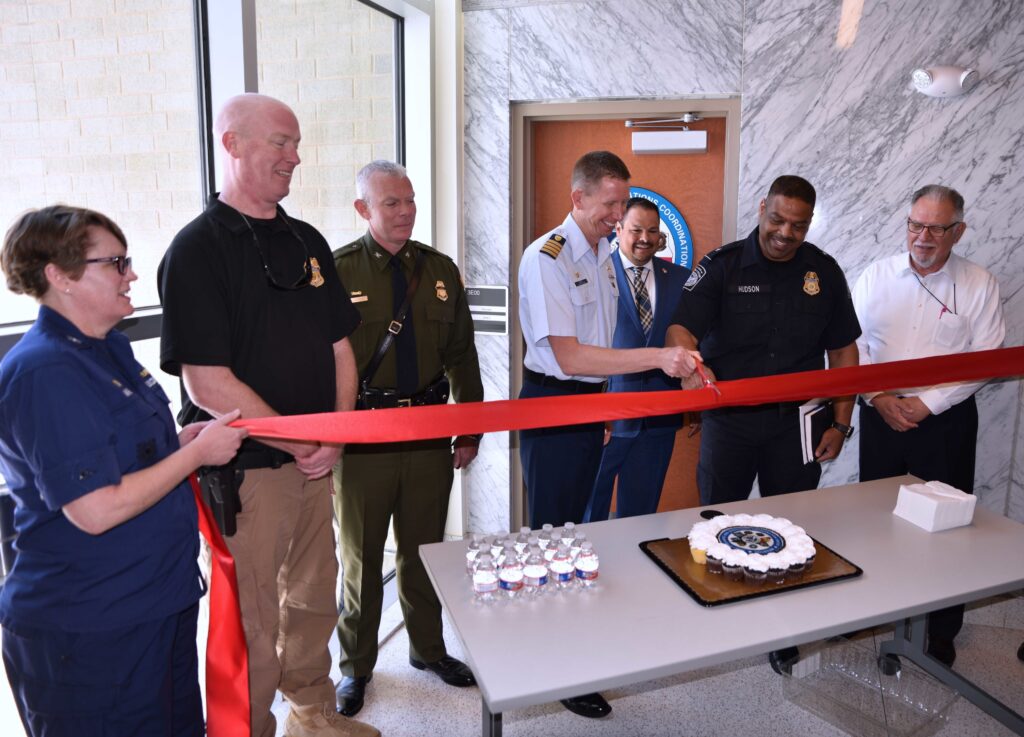
Leaders from Coast Guard Sector Houston-Galveston, Homeland Security Investigations Houston, U.S. Customs and Border Protection Houston and Transportation Security Administration Houston commemorate the establishment of a Joint Intelligence and Operations Coordination Center June 7. U.S. COAST GUARD / Tim Oberle
HOUSTON — Leaders from Coast Guard Sector Houston-Galveston, Homeland Security Investigations Houston, U.S. Customs and Border Protection Houston and Transportation Security Administration Houston announced June 9 the establishment of a Joint Intelligence and Operations Coordination Center.
Located within Sector Houston-Galveston, the new multi-agency coordination center will directly support the Southeast Texas and Southwest Louisiana Regional Coordinating Mechanism and be staffed with personnel from the Coast Guard, HSI, CBP and TSA. JIOCC staff will include a full-time counterdrug analyst from the Texas National Guard whose focus will be providing analytical support to DHS components.
The JIOCC’s primary purpose is to act as a unified control center and coordinate operations between participating agencies to bolster interoperability and deconflict where an agency’s operations may overlap with others. Additionally, the JIOCC will serve as a ready-made event command post in the event of a natural disaster or other emergency, such as a strong hurricane.
The establishment of the JIOCC is part of DHS efforts to modernize the Maritime Operations Coordination Plan by establishing coordination cells in strategic locations around the country to facilitate intelligence sharing and coordinate operations for an efficient, effective and unified departmental response to threats against the United States in the maritime environment.
“By bringing together and leveraging each agency’s unique strengths, authorities and capabilities, we are better postured to protect the ports and waterways of Southeast Texas and Southwest Louisiana,” said Coast Guard Capt. Jason Smith, commander, Sector Houston-Galveston and ReCoM executive committee member. “The establishment of this JIOCC illustrates our commitment to enhancing maritime homeland security by improving intelligence and information sharing and increasing operational integration and deconfliction.”
Coast Guard Cutter Spencer Returns to Portsmouth after Patrolling Eastern Pacific
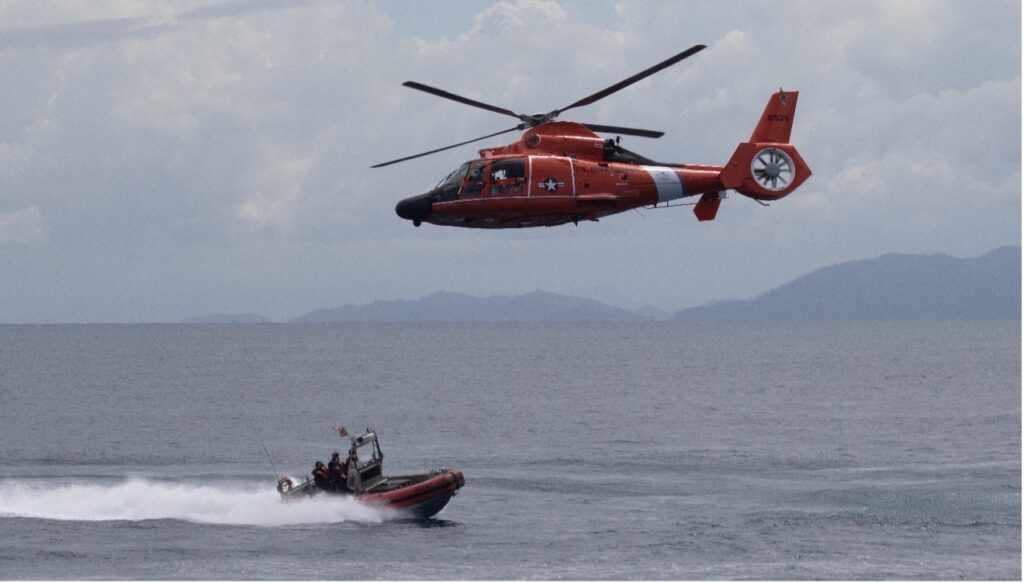
The crew of a small boat from Coast Guard Cutter Spencer conducting maneuvers with a Coast Guard HITRON helicopter off the coast of Honduras. U.S. COAST GUARD / Chief Petty Officer Katharine Ingham
PORTSMOUTH, Va. — The crew of U.S. Coast Guard Cutter Spencer returned to its homeport in Portsmouth, Virginia after a 78-day patrol off the shores of Central America, the Coast Guard 5th District said June 7.
USCGC Spencer departed Portsmouth Feb. 12 and headed south, making a stop in Mayport, Florida, to bring aboard a Coast Guard Helicopter Interdiction Tactical Squadron crew. From Mayport, the medium endurance cutter steamed to Honduran territorial seas and conducted tactical demonstrations with members of the Honduran Naval Special Forces.
After transiting through the Panama Canal, USCGC Spencer conducted operations in the Eastern Pacific ocean with the objective of disrupting illicit narcotics trafficking. Law enforcement teams from USCGC Spencer successfully interdicted a go-fast vessel with over 300 kilograms of cocaine and 1,000 pounds of marijuana. Later during the patrol, the embarked HITRON element spotted another smuggling vessel near USCGC Spencer’s location. The boat caught on fire and USCGC Spencer’s crew recovered three survivors along with several bales of cocaine that were thrown off the boat shortly before it sank. USCGC Spencer also assisted Costa Rican authorities in the detention of six suspected narco-traffickers who were caught smuggling laundered money on a fishing vessel in the region.
Transnational criminal organizations pose a serious threat to the national security of the United States and are funded primarily through the trade of illicit narcotics. While in the Pacific theater, USCGC Spencer’s crew worked with regional law enforcement authorities to deter the flow of contraband to the United States and to hold lawbreakers accountable.
“We were able to provide effective coverage of known drug smuggling routes alongside our domestic and foreign partners during this patrol,” said Cmdr. Corey Kerns, commanding officer of USCGC Spencer. “I am grateful that we were able to support the counter narcotics mission in the Eastern Pacific and most importantly that everyone returned home safely. These deployments are undoubtedly the most challenging for our members due to their stressful operational tempo and distance from home. The crew demonstrated incredible perseverance day in and day out, worked as a team, and had fun along the way, which made the experience meaningful and memorable for us all.”
USCGC Spencer is a 270-foot medium-endurance cutter with a 100-person crew complement.
Hamilton Returns From Multi-Mission Patrol in Caribbean Sea, Eastern Pacific Ocean
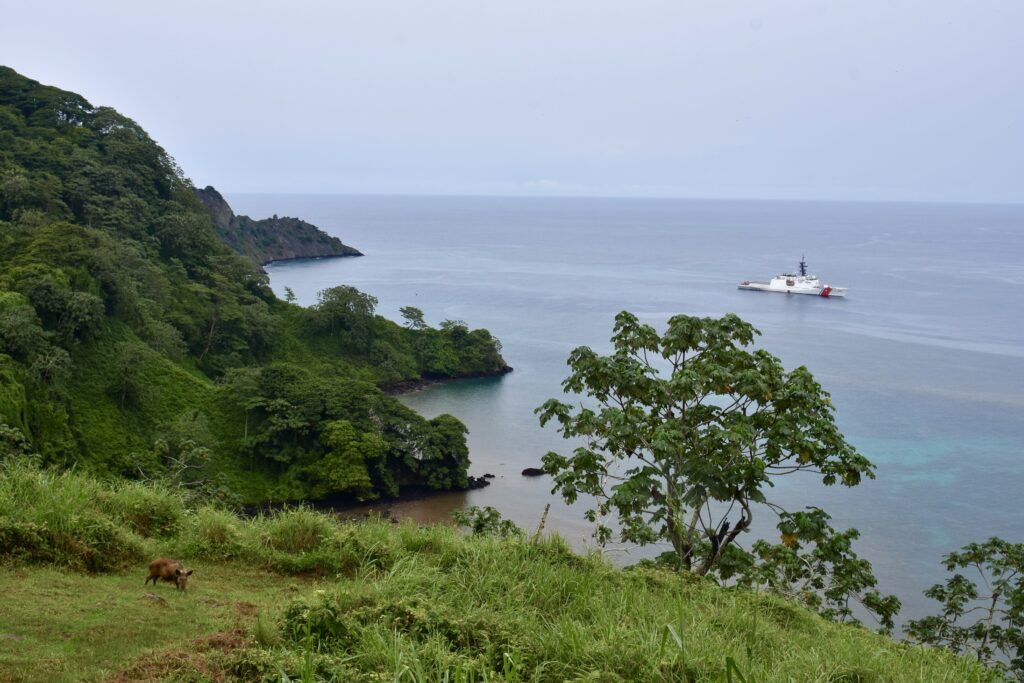
The Legend-class National Security Cutter USCGC Hamilton (WMSL 753) anchors in Chatham Bay of Isla del Cocos, the Republic of Costa Rica, on April 22. Hamilton’s crew conducted a 12-week multi-mission deployment in the Eastern Pacific Ocean and the Caribbean Sea. U.S. COAST GUARD / Ensign Joshua Romano
NORTH CHARLESTON, S.C. — USCGC Hamilton (WMSL 753) returned home June 3 following a 12-week multi-mission deployment in the Eastern Pacific Ocean and the Caribbean Sea, the Coast Guard Atlantic Area said in a release.
The crew deployed in early March to participate in the Tailored Ship Training Availability, a three-week training program was testing the crew in naval warfare, damage control, engineering, navigation, and seamanship drills and exercises. Hamilton’s crew performed exceptionally well, achieving a 98% average score across all training categories. The team also interacted with the Coast Guard Office of Boat Forces and Aviation Forces to conduct necessary integration testing for future Coast Guard cutter boats and aircraft.
After completing TSTA, Hamilton transited to Costa Rica. The crew hosted the Costa Rican minister of environment and energy and other government representatives and U.S. diplomats for an official visit to Isla del Coco, or Cocos Island. The Costa Rican government’s ceremonial announcements of three executive decrees to increase protection over one of the world’s most productive and biodiverse habitats highlighted the historic visit. The ceremony signified Costa Rica’s commitment to protecting the Cocos Island Marine Reserve and demonstrated the U.S. government’s support for marine conservation and protection.
Hamilton’s crew proceeded to patrol the Eastern Pacific Ocean, conducting narcotics operations supporting the U.S. Coast Guard’s Western Hemisphere Strategy. The embarked Helicopter Interdiction Tactical Squadron aviation team, based out of Jacksonville, Florida, and Hamilton’s cutter boat teams collaborated to detect a go-fast vessel that jettisoned contraband. The crew interdicted a go-fast, detained four suspected smugglers, and recovered 811 kilograms (1,788 pounds) of cocaine worth over $24 million in street value.
“I am extraordinarily proud of this crew and everything we accomplished during this deployment,” said Capt. Matthew Brown, the commanding officer of Hamilton. “We honed our capability to operate, defend, fight, and protect our cutter and applied it to directly combat the scourge of illicit narcotics and the destabilizing effects their presence has on the streets of our nation and those of our allies in the transshipment zone. Our partnerships with countries like Costa Rica and their coast guard strengthen our ability to dismantle transnational criminal organizations, protect the environment, and reinforce a rules-based maritime order.”
HII Christens National Security Cutter Calhoun (WMSL 759)
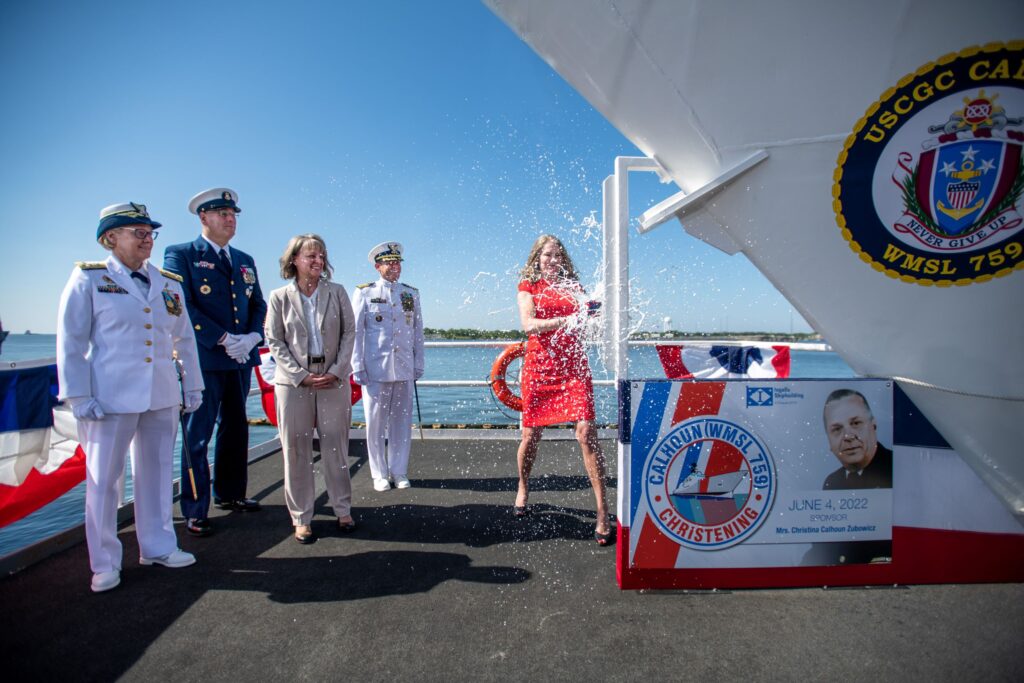
Christina Calhoun Zubowicz, ship sponsor and granddaughter of its namesake, christened the ship on June 4. HII
PASCAGOULA, Miss. — HII christened Legend-class national security cutter Calhoun (WMSL 759) June 4 at the company’s Ingalls Shipbuilding division, the company said in a release.
Calhoun(WMSL 759) is named to honor Charles L. Calhoun, the first master chief petty officer of the U.S. Coast Guard. Calhoun served in the U.S. Navy for three years during World War II and was honorably discharged in 1946 as a torpedoman second class. He enlisted in the Coast Guard that same year and held varying positions of leadership over the course of his career.
“Today’s christening is an acknowledgement of an important and valued partnership between our shipyard and the United States Coast Guard,” Ingalls Shipbuilding President Kari Wilkinson said. “We consider it a privilege to build these magnificent ships and as shipbuilders, we are humbled to further Master Chief Calhoun’s legacy.”
The keynote speaker was commandant of the U.S. Coast Guard Adm. Linda Fagan, who was recently appointed to lead the Coast Guard and is the armed forces’ first female service chief.
“I’m super proud of the Ingalls team, I know how much heart and soul goes into building a ship like this,” Fagan said. “These national security cutters are absolutely vital to our national security and economic prosperity. We are a global coast guard, forward deployed — conducting exercises with maritime forces, strengthening security partnerships and maritime governance in critical parts of the world right now.”
Christina Calhoun Zubowicz, ship sponsor and granddaughter of the namesake, christened the ship by breaking a bottle of sparkling wine across the bow.
“On behalf of the Calhoun family, I would like to extend our sincere appreciation for the tremendous work being done here at Ingalls Shipbuilding,” Zubowicz said. “Rest assured that my grandfather would be admiring this ship with great pride today knowing that his name would continue his life’s work of carrying out Coast Guard missions.”
U.S. Rep. Steven Palazzo joined Ingalls Shipbuilding to celebrate the ship christening.
“The national security cutters coming out of Ingalls are contributing greatly to our national security, stemming the flow of drugs throughout our oceans, and proving that we have the best shipbuilders right here in south Mississippi,” Palazzo said. “Congratulations to everyone at Ingalls on another successful christening, and I look forward to seeing the Calhoun(WMSL 759) in action.”
Ingalls Shipbuilding is the sole designer and provider of the Coast Guard Legend-class national security cutter. The flagship of the Coast Guard fleet, national security cutters are capable of embarking and supporting a wide range of Coast Guard, Navy and NATO manned and unmanned aircraft. National security cutters have proven to be ideal platforms for drug interdiction, global illegal fishing, disaster relief and defense support operations.
Ingalls has delivered nine Legend-class national security cutters, and two more are under construction. Calhoun, the 10th national security cutter, is scheduled to be delivered early next year.
Coast Guard Accepts Delivery of 49th Fast Response Cutter Douglas Denman
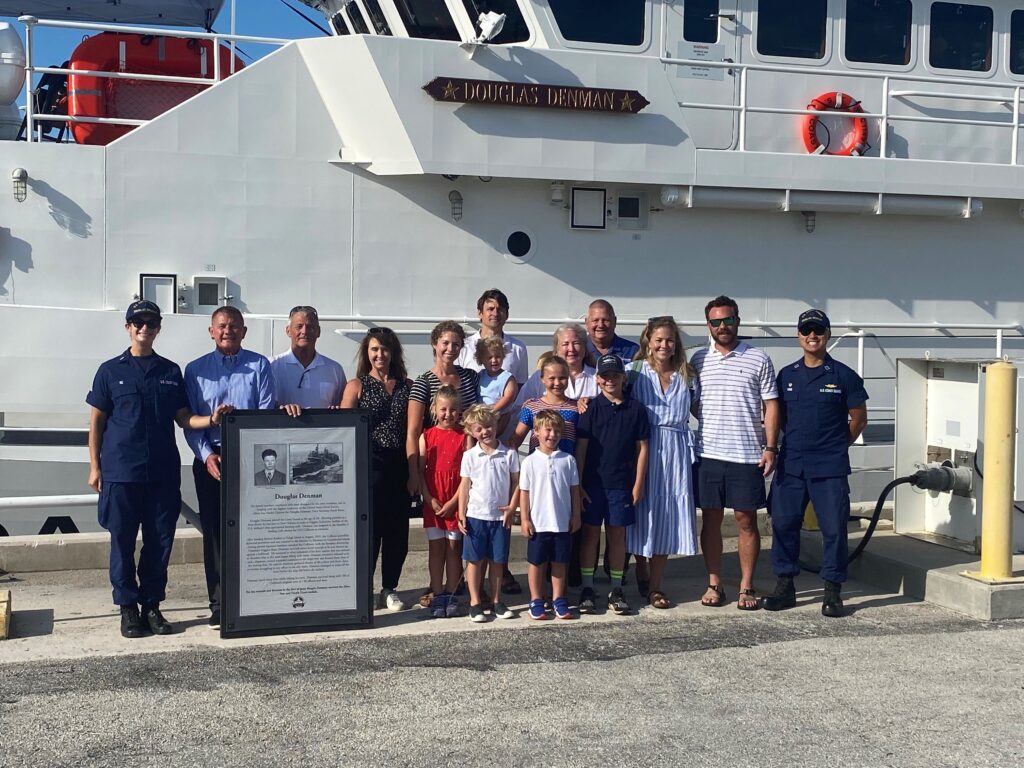
The Coast Guard accepts delivery of the 49th Fast Response Cutter Douglas Denman, in Key West, Florida, May 26, alongside the Denman family. The cutter will be homeported in Ketchikan, Alaska. U.S. COAST GUARD
KEY WEST, Fla. — The Coast Guard accepted the Coast Guard Cutter Douglas Denman (WPC 1149), the 24th Fast Response Cutter built by Bollinger Shipyards, during a May 26 ceremony at Coast Guard Sector Key West, the Coast Guard 17th District said June 2.
“We were honored to have Douglas Denman’s son, Doug Jr., and daughter Karen there for the momentous occasion,” said Lt. Paul Kang, commanding officer of the cutter. “In addition to that, two of Douglas Denman’s granddaughters drove down from Georgia with their families.”
The cutter, which is 154 feet long and has a crew complement of 24, will be homeported in Ketchikan, Alaska.
The Douglas Denman is scheduled for commissioning in September in Ketchikan. It is the third Fast Response Cutter to be stationed in the Coast Guard’s 17th Coast Guard District, which covers the state of Alaska and the North Pacific. The Denman will join the John McCormick (WPC 1121) and the Bailey Barco (WPC 1122), which arrived in Alaska in 2016 and 2017.
Born in Tallapoosa, Georgia, the cutter’s namesake joined the U.S. Coast Guard in 1940 and was eventually assigned as a coxswain to the USS Colhoun (DD-85), a Wickes-class destroyer in the U.S. Navy during World War I and later re-designated APD-2 in World War II. On Aug. 30, 1942, the Colhoun was positioned off the coast of Guadalcanal when it was attacked by hostile aircraft. Denman was seriously wounded during the attack but remained at his duty station. When the order was given to abandon ship, Denman and another crew member helped evacuate the crew and get life jackets to those already in the water. Because of Denman’s selfless actions, 100 of the 150 officers and staff survived the attack and sinking of Colhoun. Denman received the Silver Star and Purple Heart medals for his heroic efforts. He served for 20 years in the Coast Guard, retiring as a senior chief petty officer in 1961.
The Fast Response Cutter is replacing the aging Island-class 110-foot patrol boats and features advanced command, control, communications, computers, intelligence, surveillance, reconnaissance equipment, and an over-the-horizon cutter boat. The cutter features advanced seakeeping capabilities and can achieve more than 32 mph (28 knots). The cutter has an endurance of five days. The Coast Guard is in the middle of the FRC acquisition program.
Earlier this year, President Biden signed the Consolidated Appropriations Act for Fiscal Year 2022, which included a $130 million increase for two additional FRCs, continuing the program beyond its 64-vessel program of record. This is the second time Congress has added FRCs beyond the original 58 vessel program of record.
Douglas Denman is designed for multiple missions, including law enforcement, fisheries enforcement, waterways and coastal security, search and rescue, and national defense.
U.S. Coast Guard Cutter Helps Solomon Islands Patrol Their Waters
Crewmembers aboard the Coast Guard Cutter Myrtle Hazard stand watch on the bridge while underway in Oceania. The crew recently helped to fill the operational presence needed by conducting maritime surveillance to deter illegal, unreported, and unregulated fishing in the northern Solomon Islands. U.S. COAST GUARD
SOLOMON ISLANDS — The U.S. Coast Guard has responded to a request from the Solomon Islands to help patrol that country’s exclusive economic zone while maintenance was being conducted on the Royal Solomon Islands Police Vessel Taro.
The Fast Response Cutter Myrtle Hazard (WPC 1139) was dispatched on short notice to provide operational presence by conducting maritime surveillance to deter illegal, unreported, and unregulated fishing in the northern Solomon Islands.
The 154-foot Myrtle Hazard was already deployed on an expeditionary patrol in support of Operation Blue Pacific, where the is cutter was protecting against IUU fishing in the EEZs of five different Pacific Island Countries and the high seas.
According to a Coast Guard statement, IUU fishing has replaced piracy as the leading global maritime security threat and has the potential to jeopardize the efforts of PICs to conserve fish stocks, an important renewable resource in the region.
The Solomon Islands has a population of 652,000 people, and encompasses more than 900 islands. The capital, Honiara, is located on the island of Guadalcanal. It has an EEZ of more than 600,000 square miles. Like its neighbors in Oceania, the country is reliant of fisheries for sustenance and income.
Myrtle Hazard’s mission followed coordination between the Coast Guard, the Solomon Islands’ commissioner of police, assistant commissioner of police, and the deputy commissioner for national security and operations.
The Coast Guard’s assistance is significant because the government of the Solomon Islands recently signed an agreement on policing cooperation with China and is reportedly in the process of concluding a security agreement that could allow an ongoing Chinese military and naval presence. Such an agreement has been characterized by some as “destabilizing” for the region.
According to the Washington Post, China is trying to formalize agreements with other Pacific island countries on policing, cybersecurity, maritime surveillance, fishing rights and the creation of a free-trade area.
“We need to respond to this because this is China seeking to increase its influence in the region of the world where Australia has been the security partner of choice since the Second World War,” said Australian Prime Minister Anthony Albanese in an interview with the Australian Broadcasting Corporation.
Federated States of Micronesia President David Panuelo called the deal a “smokescreen” hiding a Chinese attempt to “acquire access and control of our region.”
“Through Operation Blue Pacific, the United States Coast Guard looks for opportunities to assist our regional partners with maritime governance and security,” said Capt. Craig O’Brien, chief of response of Coast Guard District 14. “Working closely with the Forum Fisheries Agency and the government of Solomon Islands, it was a privilege for the United States Coast Guard to assist the Solomon Islands while their police vessel was down for maintenance.”
With the controversy over China’s engagement with the Pacific nations, and the Solomon Islands in particular, the request from the Solomon Islands to the U.S. Coast Guard is especially meaningful.
U.S. Coast Guard Seizes Heroin Shipment in Gulf of Oman
Personnel from U.S. Coast Guard fast response cutter Glen Harris (WPC 1144) recover bags of illegal narcotics discarded by a fishing vessel interdicted in the Gulf of Oman, May 31. U.S. COAST GUARD
MANAMA, Bahrain — A U.S. Coast Guard fast response cutter seized 310 kilograms of heroin worth an estimated U.S. street value of $11 million from a fishing vessel while conducting patrols in the Gulf of Oman, May 31, U.S. Naval Forces Central Command Public Affairs said June 2.
USCGC Glen Harris (WPC 1144) was operating as part of Combined Task Force 150, one of four task forces under the Combined Maritime Forces.
The fast response cutter arrived in the U.S. 5th Fleet region in January and operates from Bahrain where Combined Maritime Forces is headquartered with U.S. Naval Forces Central Command and U.S. 5th Fleet.
Combined Maritime Forces is the largest multinational naval partnership in the world. The U.S.-led international naval force has 34 member nations, which have increased regional patrols to locate and disrupt unlawful maritime activity.