Coast Guard Cutter Midgett Returns Home from 3-Month Alaskan Patrol
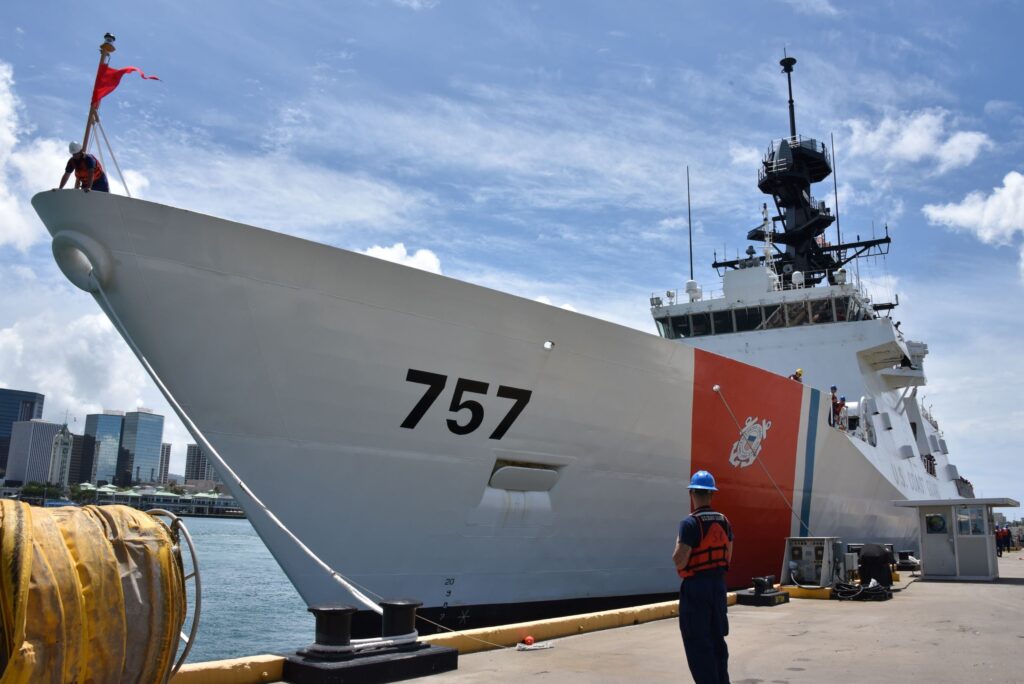
The U.S. Coast Guard Cutter Midgett (WMSL 757) moors at its new homeport at Base Honolulu Aug. 16, 2019. U.S. COAST GUARD / Chief Petty Officer Sherri Eng
KODIAK, Alaska — The crew of Coast Guard Cutter Midgett returned to homeport in Honolulu, Hawaii, Friday after a three-month long Bering Sea patrol, the Coast Guard 14th District said March 4.
The crew of the Midgett enforced federal laws and regulations in the U.S. Exclusive Economic Zone near Alaska’s Aleutian Islands chain.
They played a strategic role in protecting the nation’s critical marine resources, enforcing fisheries and safety regulations, and were forward positioned to safeguard the U.S. commercial fishing fleet.
The crew of the Midgett also acted as a search and rescue platform while providing support to helicopter crews operating out of Dutch Harbor and Cold Bay, Alaska. This increased operational range for the aircrews and provided them with fuel for high-endurance missions.
The crew also conducted training and emergency response drills.
“Navigating Alaskan waters was extremely exciting and rewarding,” said the Midgett’s commanding officer, Capt. Willie Carmichael. “I’m proud and impressed by my crew’s service and commitment to promote safety and security in Alaskan fisheries that are so vital to the U.S. economy.”
Coast Guard Academy Cadets Prepare to Join the Fleet
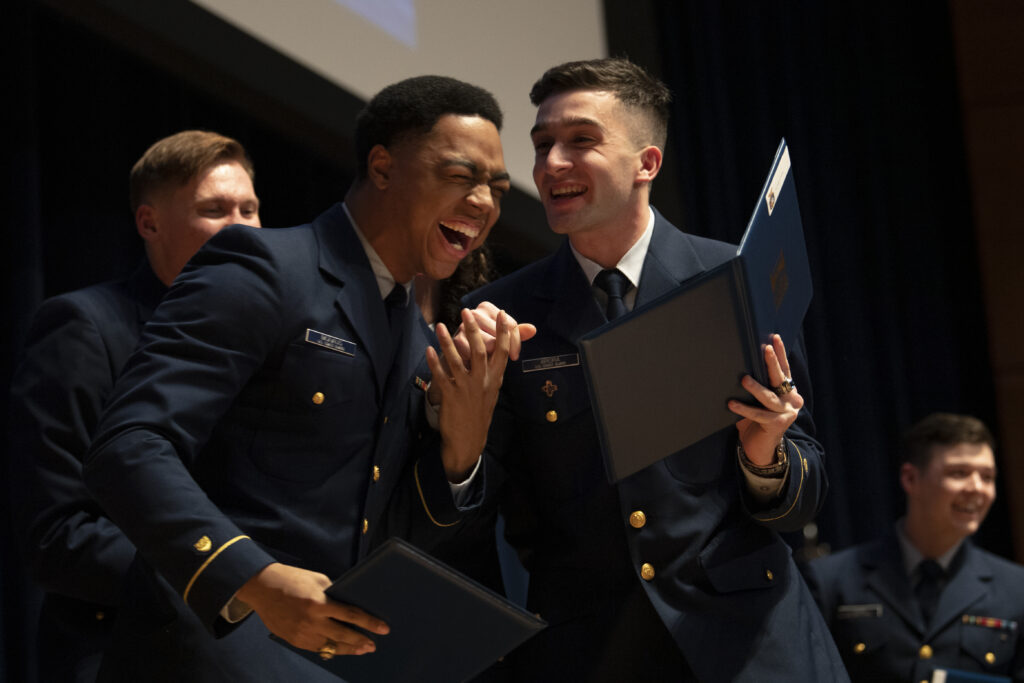
Cadets from the Class of 2022 at the U.S. Coast Guard Academy receive their first duty assignments during Billet Night, March 3, 2022. U.S. Coast Guard / Petty Officer 3rd Class Matthew Abban
NEW LONDON, Conn. — Cadets from the Class of 2022 received their first duty assignments during Billet Night at the U.S. Coast Guard Academy, March 3, the Academy said.
One of the most anticipated events of the 200-week cadet program, Billet Night is a night of energy and excitement as the cadets are less than three months away from commencement when they commission as officers in the U.S. Coast Guard on May 18, 2022.
This year’s class is made up of 257 cadets, including nine international cadets. After graduation, more than 200 newly commissioned officers will report to cutters as near as Coast Guard Cutter Eagle homeported near the Academy in New London, Connecticut, to the Coast Guard Cutter Sequoia, homeported nearly 8,000 miles away in Apra Harbor, Guam.
Twenty others will report to flight school in Pensacola, Florida, to begin pilot training before reporting to Coast Guard Air Stations across the country.
Cadets will engage in a variety of Coast Guard operations at their new units upon graduation. Coast Guard units throughout the nation routinely conduct domestic missions as well as joint exercises with partner nations in which the Coast Guard assists fellow coast guards and navies to adapt or expand their maritime security capabilities.
The remaining graduates will report to various shore units, including the first graduates of the Academy’s Cyber Systems program. The newly established Cyber Systems degree provides graduates with the skills and ability to defend cyberspace, enable operations, and protect critical maritime infrastructure.
The Coast Guard protects America’s vast Maritime Transportation System as a ready, relevant, and responsive force engaging in defense operations, maritime law enforcement, search and rescue, marine safety, and environmental protection operations.
“Every day our graduates are leading vital missions across the globe,” said Rear Adm. Bill Kelly, Coast Guard Academy superintendent. “I’m excited that the members of the class of 2022 will soon take their places in the Coast Guard fleet and join our service’s efforts to address the nation’s complex maritime challenges.”
Founded in 1876, the Coast Guard Academy is one of the five U.S. service academies that emphasizes leadership, physical fitness and professional development leading to a guaranteed job upon graduation as a commissioned officer in the U.S. Coast Guard.
Coast Guard Cutter Polar Star Reaches Southernmost Navigable Waters on Earth
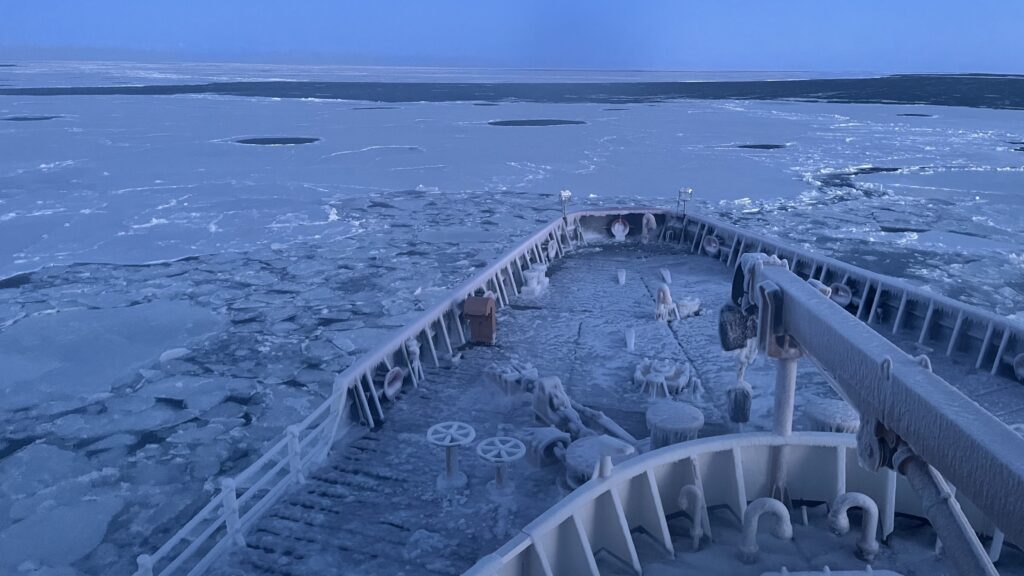
U.S. Coast Guard Cutter Polar Star (WAGB 10) transits away from the ice shelf near the Bay of Whales, Antarctica, Feb. 17. Polar Star navigated to the Southernmost navigable seas and entered uncharted waters, reaching the edge of the ice shelf. U.S. COAST GUARD / Petty Officer 3rd Class Diolanda Caballero
MCMURDO STATION, Antarctica — The U.S. Coast Guard Cutter Polar Star (WAGB 10) reached the southernmost navigable waters on the planet Feb. 17 while underway in the Bay of Whales, Antarctica, the Coast Guard Pacific Area said March 1.
Polar Star reached a position of 78 degrees, 44 minutes, 1.32 seconds south latitude at 12:55 p.m. New Zealand time, holding a distance of approximately 500 yards from the edge of the Ross Ice Shelf, further south than the current Guinness World Record holder.
While underway, Polar Star sailed in waters previously charted as part of the ice shelf that are now navigable waters. Today, portions of the Ross Ice Shelf deviate approximately 12 nautical miles from the positions depicted on official charts.
During Polar Star’s transit to and from the Bay of Whales, Polar Star surveyed 396 nautical miles of the ice shelf for potential future navigational use.
Crewmembers aboard the cutter are working with the staff at Guinness World Records to officially become the new record holders.
On Feb. 7, 1997, U.S. Coast Guard Cutter Polar Sea (WAGB 11), Polar Star’s sister ship, reached 78 degrees, 29 minutes south latitude.
In 1908, Ernest Shackleton gave the Bay of Whales its name during the Nimrod Expedition on the basis of the numerous whales he and his crew sighted. Three years later, Roald Amundsen established a base camp in the bay, from which he set out on his successful endeavor to become the first person to reach the South Pole. Years later, U.S. Navy Rear Adm. Richard E. Byrd established Little America in the Bay of Whales during his first, second, and third Antarctic Expeditions, exploring more than 60% of the Antarctic continent.
“The crew of Polar Star is proud to follow in the footsteps of legendary Antarctic explorers like Shackleton, Amundsen, and Byrd,” said Capt. William Woityra, commanding officer of Polar Star. “Even today, more than a century later, we carry on that legacy of exploration, reaching new places, and expanding human understanding of our planet.”
Cutter Diligence Returns to Homeport after 60-Day Eastern Pacific Ocean Patrol
The crew of the U.S. Coast Guard Cutter Diligence, shown conducting small boat training in the Eastern Pacific Ocean. COAST GUARD / BM3 Cayne Wattigney
PENSACOLA, Fla. — The crew of Coast Guard Cutter Diligence returned to their homeport of Pensacola, Florida, Feb. 20 following a 60-day counter-drug patrol in Eastern Pacific Ocean, the Coast Guard 8th District said Feb. 25.
Partnering with three other Coast Guard cutters, Diligence interdicted three suspected drug-smuggling vessels resulting in the apprehension of 12 detainees and the interdiction of more than 4,321 pounds of cocaine with a street value of approximately $82 million.
“Diligence’s crew demonstrated professionalism, resilience and perseverance while conducting complex high-speed boat pursuits in the drug transit zone,” said Cmdr. Jared Trusz, Diligence’s commanding officer. “I am honored to serve with and proud of the crew’s superlative efforts that directly support the United States national security interests.”
Numerous U.S. agencies from the Departments of Defense, Justice and Homeland Security cooperated in the effort to combat transnational organized crime. The Coast Guard, Navy, Customs and Border Protection, FBI, Drug Enforcement Administration and Immigration and Customs Enforcement, along with allied and international partner agencies, play a role in counter-drug operations.
The fight against drug cartels in the Eastern Pacific Ocean requires unity of effort in all phases from detection, monitoring and interdictions, to criminal prosecutions by international partners and U.S. Attorneys’ Offices in districts across the nation. The law enforcement phase of counter-smuggling operations in the Eastern Pacific Ocean is conducted under the authority of the Coast Guard 11th District, headquartered in Alameda, California. The interdictions, including the actual boardings, are led and conducted by members of the U.S. Coast Guard.
The Diligence is a 210-foot medium-endurance cutter homeported in Pensacola with 78 crewmembers. The cutter’s primary missions are counter-drug operations, migrant interdiction, enforcing federal fishery laws and search and rescue in support of Coast Guard operations throughout the Western Hemisphere.
U.S. Coast Guard Patrols EEZ in Partnership With Samoa
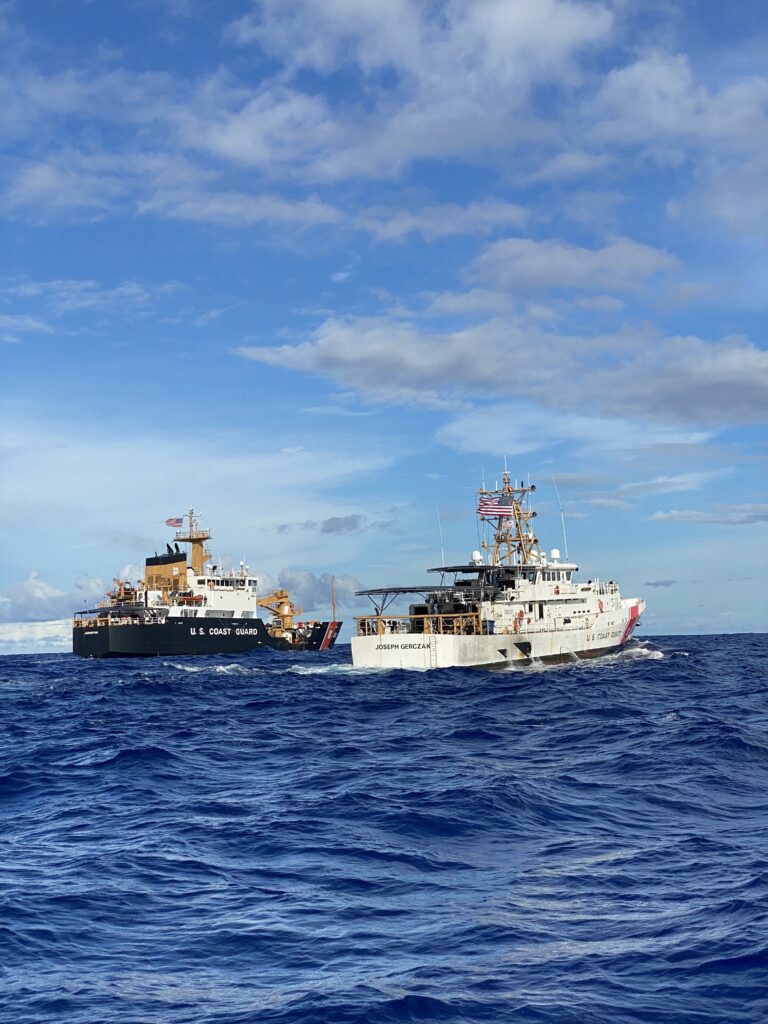
Crews from the U.S. Coast Guard Cutter Juniper (WLB 201) and USCGC Joseph Gerczak (WPC 1126) conducted security patrol operations in Samoa’s exclusive economic zone throughout February 2022, to protect fisheries and other natural resources. U.S. COAST GUARD
HONOLULU — Working with the government of Samoa, crews from the U.S. Coast Guard Cutter Juniper (WLB 201) and USCGC Joseph Gerczak (WPC 1126) conducted security patrol operations in Samoa’s exclusive economic zone throughout February 2022, to protect fisheries and other natural resources, the Coast Guard 14th District said Feb. 28.
The Juniper and Joseph Gerczak crews helped fill the operational presence needed to deter illegal, unreported, and unregulated fishing while Samoa’s Nafanua II patrol boat is down.
“We always look forward to assisting our partners in the region,” said Cmdr. Jeff Bryant, the 14th District’s chief of enforcement. “The United States offered to assist the government of Samoa by providing security and sovereignty operations in Samoan waters due to the absence of their patrol boat.”
The cutters have been underway in Oceania supporting Operation Aiga, designed to integrate Coast Guard capabilities and operations with the United States’ Pacific Island Country partners to effectively and efficiently protect shared national interests, combat IUU fishing and strengthen maritime governance on the high seas.
As a trusted partner in the Pacific, the Coast Guard employs 11 bilateral shiprider agreements with Pacific Island Forum nations, like Samoa, to support resource security and fisheries enforcement. These agreements enabled the Coast Guard to aid host-nation sovereignty while patrolling Samoa’s EEZ.
The United States Coast Guard and the government of Samoa have a history of partnership. In 2019, the Coast Guard cutters Walnut and Joseph Gerczak visited Apia Harbor and conducted patrol operations with officials from Samoa’s Ministry of Police and Ministry of Fisheries on board. In 2021, the crew of the Oliver Berry conducted similar patrols while Samoa’s patrol boat underwent repairs.
“Operation Aiga is named that for a reason. Aiga means family in Samoan and that’s how we view our Pacific neighbors,” says U.S. Ambassador to Samoa Tom Udall. “This is real partnership. Together we can stop those who seek to steal valuable resources that simply don’t belong to them.”
With a population of approximately 40 million people covering an area of 3.3 million square miles, Oceania is regularly patrolled by the Coast Guard and its international partners to protect and support those who call it home.
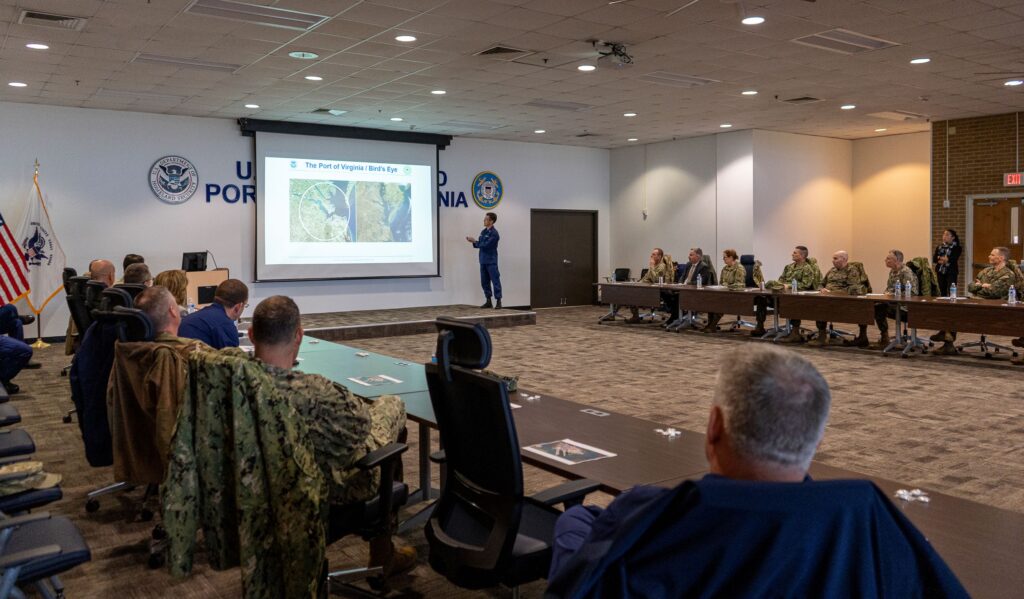
Coast Guard Capt. Samson Stevens shows an aerial view of the Port of Virginia during the Cyber Component Commanders’ Conference aboard Coast Guard Base Portsmouth, Virginia, March 6, 2020. The service has now created a cyber mission specialist rating. U.S. COAST GUARD / Seaman Katlin Kilroy
ARLINGTON, Va. — The Coast Guard commandant has announced the creation of a cyber mission specialist rating and corresponding chief warrant officer specialty to increase the focus and professionalism of the service’s cyber capabilities.
Commandant Adm. Karl Schultz made the announcement during his Feb. 24 annual “State of the Coast Guard Address” before an audience at Coast Guard Air Station Clearwater, Florida.
In a Feb. 25 message to the Coast Guard, Shultz further amplified the announcement, saying, “Cyberspace is an operational domain continuously evolving while growing in importance and complexity. Operations in cyberspace require a professional and skilled workforce [military and civilian]. Competition to recruit, retain, and grow cyber talent is constant. A dedicated CMS enlisted rating with accessions beginning at the E-5 paygrade, as is done with the diver rating and an accompanying CYBR [cyber] specialty, will best provide a trained, proficient, and professional workforce to enable and conduct cyberspace operations.
“Members of the CMS rating and CYBR specialty will have the opportunity to serve in a broad range of missions,” he said. “The Coast Guard’s cyber program plays a critical role operating a secure cyberspace for the Service, protecting the Marine Transportation System against malicious actors seeking to identify new ways to exploit cyberspace, and countering adversaries’ intent on disrupting Coast Guard operations or negatively impacting national interests. Members of the CMS rating and CYBR specialty will continue to serve in critical positions within [Coast Guard] Cyber Command, U.S. Cyber Command, DHS Cybersecurity and Infrastructure Security Agency areas, districts and sectors and elsewhere as required.
The Coast Guard Cutter Polar Star (WAGB 10) transits in the Chukchi Sea, Dec. 19, 2020. The first future polar security cutter will be named Polar Sentinel. U.S. COAST GUARD / Lt. Jared Payne
ARLINGTON, Va. — The commandant of the Coast Guard used the occasion of his annual “State of the Coast Guard” address to announce the name of the first future polar security cutter.
“Today, I am excited to name the first polar security cutter; that name will be Polar Sentinel,” said Commandant Adm. Karl Schultz, speaking Feb. 24 before an audience at Coast Guard Air Station Clearwater in Florida.
The name is in keeping with the Coast Guard’s earlier class of polar icebreakers, one of which — the Polar Star — is the only operational heavy icebreaker in the U.S. military services and is badly in need of replacement. The first PSC is expected to be delivered by Halter Marine in 2025. Halter Marine also is under contract for a second PSC.
“Detailed work remains underway in preparation for construction of our first polar security cutter,” Schultz said. “That will be a state-of-the-art ship requiring exacting designs, complex steel work and systems integration. … When our fleet of polar security cutters becomes operational, the work of these uniquely capable assets will be essential to protecting our economic, our environmental and our national security interests in what we call the high latitude regions.”
The commandant said the Our Coast Guard “is amidst [its] largest shipbuilding effort since the Second World War as we build the fleet that will serve the nation for decades to come.”
He said the the 10th national security cutter to be named for the first master chief petty officer of the Coast Guard, the Charles Calhoun, will be christened in June.
He also noted the first offshore patrol cutter, the Argus, is more than 60% complete and the second OPC, the Chase, is “well on its way.”
Shultz said the Coast Guard anticipates “awarding the largest acquisition contract in the history of our service for the next 11 offshore patrol cutter hulls” this spring.
The newly competed OPC contract award follows the earlier OPC contract award to Eastern Shipbuilding Group for the first nine OPCs. The Coast Guard plans to procure a total of 25 OPCs, which will replace 28 medium-endurance cutters, some of which are more than 50 years old.
“That legacy fleet [of medium-endurance cutters] loses nearly 500 patrol days on an annual basis due to unplanned maintenance and repairs,” the admiral said, noting that if all those days were lost from counter-narcotics patrols, it would result in 44,000 pounds of illegal drugs that could have been interdicted from reaching the United States.
Shultz also said the service is making progress on the acquisition of 30 waterways commerce cutters, noting that “these new tenders will have greater endurance, speed and deck-load capacity to efficiently maintain 28,000 aids to navigation, marking over 12,000 miles of navigable inland waterways. These aids to navigation are a critical component of our marine transportation system, upon which cargoes and commodities comprising 25% of our nation’s gross domestic product move annually.
“For the first time in history, our inland fleet will be able to accommodate mixed-gender crews, providing all enlisted members of our service these unique afloat experiences,” he said.
Coast Guard Commissions 46th Sentinel-Class Fast Response Cutter
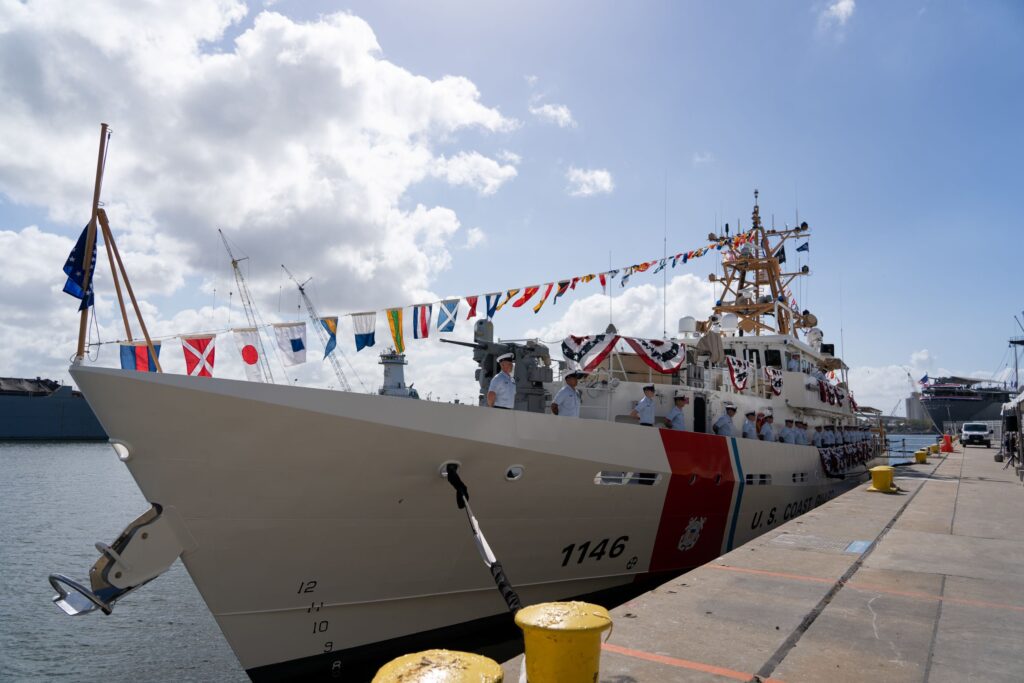
The Coast Guard Cutter John Scheuerman’s crew stand at attention during the vessel’s commissioning ceremony in Tampa, Florida, Feb. 23. U.S. COAST GUARD / Petty Officer 1st Class Travis Magee
TAMPA, Fla. — The U.S. Coast Guard commissioned the USCGC John Scheuerman (WPC 1146), Patrol Forces Southwest Asia’s fifth 154-foot Sentinel-class cutter, into service at the Port of Tampa in Tampa, Florida, Feb. 23, the Coast Guard Atlantic Area said in a release.
Adm. Karl Schultz, commandant of the U.S. Coast Guard, presided over the ceremony. Nancy Vannoy, John Scheuerman’s niece, is the ship’s sponsor.
The cutter’s namesake is Seaman 1st Class John Scheuerman, a native of Toledo, Ohio, who served in the U.S. Coast Guard Reserves from Oct. 16. 1942, to Sept. 9, 1943. While serving aboard the U.S.S. LCI (L) 319 during the amphibious allied invasion of Italy, Scheuerman exhibited conspicuous gallantry and intrepidness in action. Observing an enemy fighter plane diving for a strafing attack as his vessel approached the assault beaches in the Gulf of Salerno, Scheuerman manned his battle station at an exposed antiaircraft gun and, with courage and aggressive determination, exerted every effort to direct accurate gunfire against the hostile aircraft. Although mortally wounded before he could deliver effective fire, he remained steadfast at his post in the face of imminent death, thereby contributing materially to the protection of his ship against further attack. The U.S. Coast Guard awarded the Silver Star and Purple Heart Medals to Scheuerman posthumously for his heroism.
“This is an exciting time for each member of the crew,” said Lt. Trent Moon. “We’re honored to be a part of this historical day and look forward to our upcoming transit to Bahrain and continuing the legacy of the ship’s namesake.”
The John Scheuerman was officially delivered to the U.S. Coast Guard on Oct. 21, 2021, in Key West, Florida. It is the 46th Sentinel-class fast response cutter and the fifth of six Fast response cutters to be homeported in Manama, Bahrain, which will replace the aging 110-foot Island-class patrol boats, built by Bollinger Shipyards 30 years ago. Each of these cutters carries the name of a U.S. Coast Guard enlisted hero.
USCGC Reliance Returns to Homeport Following 52-day Patrol
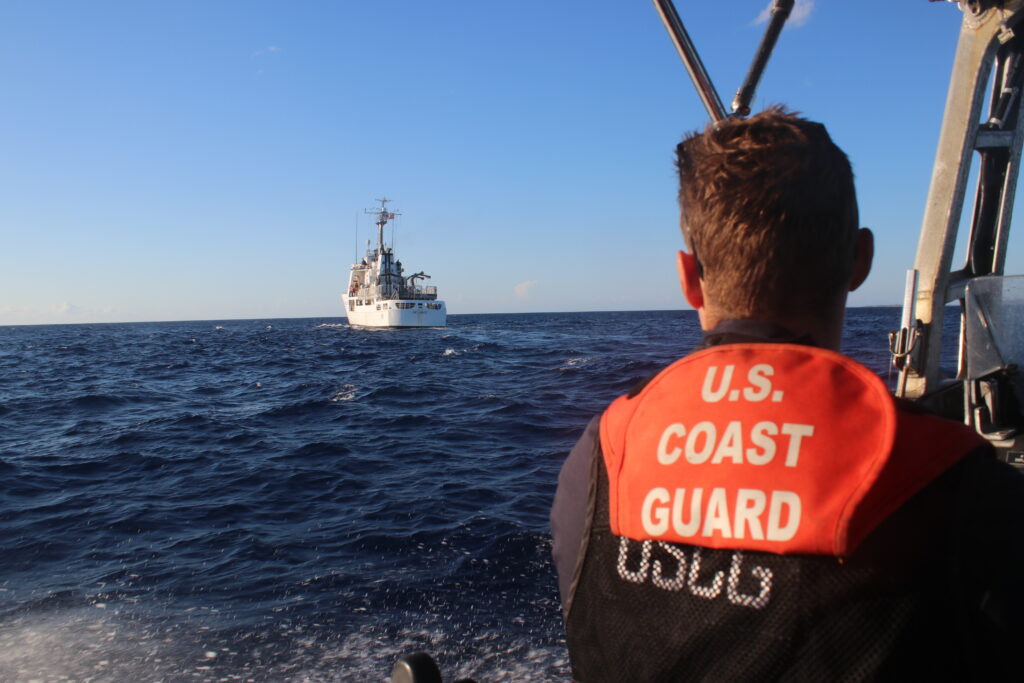
A response boat crew member steers toward the Coast Guard Cutter Reliance during a 52-day patrol in the Atlantic Ocean. U.S. COAST GUARD
PENSACOLA, Fla. — The crew of the Coast Guard Cutter Reliance (WMEC-615) returned to homeport in Pensacola, Florida, Feb. 18, following a 52-day patrol in the Caribbean Sea in support of the Coast Guard 7th District.
The Reliance crew supported the U.S. Coast Guard 7th District throughout their patrol, aiding in missions to interdict and disrupt the flow of illegal drugs and migrant trafficking while supporting national security and strengthening relationships with regional partners throughout the Caribbean.
During the patrol, the crew traveled over approximately 8,631 miles, assisted in the transference of more than 12,564 pounds of narcotics with an estimated combined street value of $250 million and intercepted 157 undocumented migrants. The cutter’s crew also transferred eight suspected narcotics smugglers from other U.S. Coast Guard cutters operating in the region.
Working jointly with the crew of U.S. Coast Guard Cutter Kathleen Moore (WPC-1109), the Reliance’s crew also rescued 191 Haitian nationals from an unseaworthy vessel off the coast of Cuba.
The patrol was critical in enhancing operational readiness through shipboard training and qualifications, resulting in the successful completion of a five day major shipboard inspection and exercise, which tested the crew’s readiness in all aspects of aviation training, equipment and capabilities.
The Reliance is a 210-foot medium-endurance cutter homeported in Pensacola with a crew of 74 personnel. The cutter’s primary missions include counter drug operations, migrant interdiction, enforcing federal fishery laws and search and rescue in support of U.S. Coast Guard operations throughout the Western Hemisphere.
Coast Guard Cutter James offloads More than $1.06 Billion in Illegal Narcotics
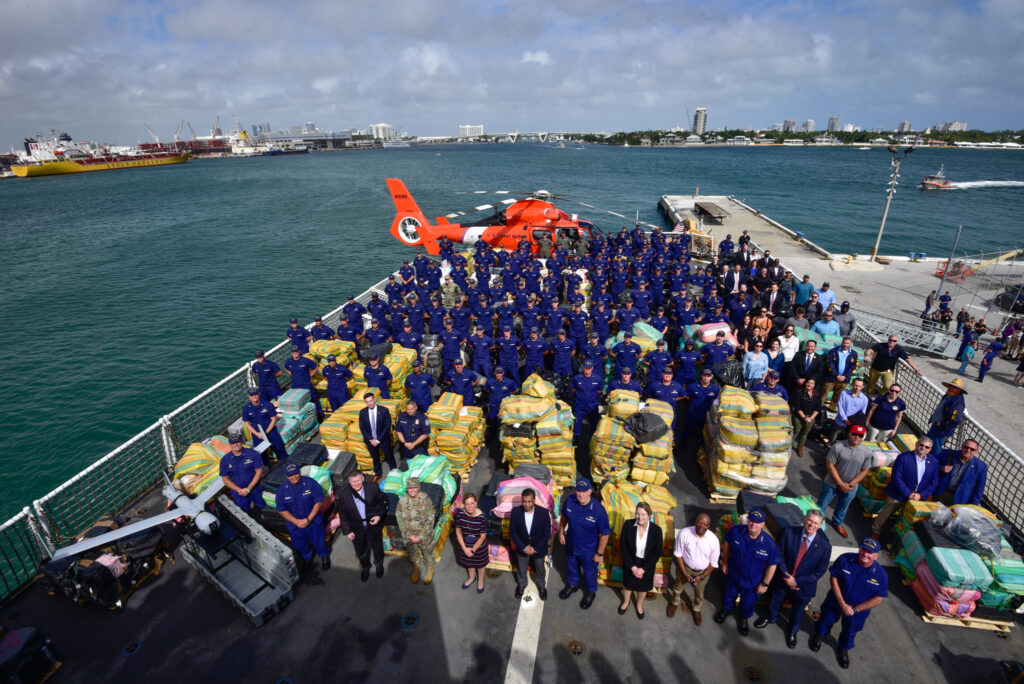
The Coast Guard Cutter James’ (WMSL 754) crew offloaded approximately 54,500 pounds of cocaine and 15,800 pounds of marijuana, worth approximately $1.06 billion, Feb. 17, in Port Everglades, Florida. U.S. COAST GUARD / Petty Officer 3rd Class Jose Hernandez
MIAMI — Coast Guard Cutter James’ crew offloaded approximately 54,500 pounds of cocaine and 15,800 pounds of marijuana worth approximately $1.06 billion on Feb. 17 at Port Everglades, Florida, the Coast Guard 7th District said in a release.
The ship’s crew set new records during their 90-day patrol for the largest single cocaine interdiction at 10,915 pounds, worth $206.4 million, and the largest single marijuana interdiction at 3,962 pounds, worth $3.59 million, the greatest amount of contraband interdicted during an Eastern Pacific patrol.
The Coast Guard’s strong international relationships, specialized capabilities and unmatched authorities, allowed for a unity of effort to disrupt transnational criminal organizations.
The drugs were interdicted in international waters of the Eastern Pacific Ocean and Caribbean Sea by crews from:
Coast Guard Station San Juan
Coast Guard Cutter James
His Netherlands Majesty’s Ship Holland
Coast Guard Cutter Stone
Coast Guard Cutter Griesser
USS Milwaukee
Coast Guard Cutter Northland
Coast Guard Cutter Diligence
Coast Guard Cutter Margaret Norvell
“The best part of my job is being able to stand here at the end of a patrol and provide visibility on the incredible efforts from crewmembers who have volunteered for the challenging and dangerous duties to keep our shores safe,” said Capt. Todd Vance, the commanding officer of the Coast Guard Cutter James. “Each interdiction is a complex evolution and no two interdictions are the same. In fact, the James’ crew conducted simultaneous interdictions of two go-fast vessels 55 miles apart this patrol, showcasing their dedication and professional execution of the counter-drug mission.”
Numerous U.S. agencies from the departments of Defense, Justice and Homeland Security cooperated in the effort to combat transnational organized crime. The Coast Guard, Navy, Customs and Border Protection, FBI, Drug Enforcement Administration and Immigration and Customs Enforcement, along with allied and international partner agencies, play a role in counter-drug operations.
The fight against drug cartels in the Eastern Pacific Ocean and the Caribbean Sea requires unity of effort in all phases from detection, monitoring and interdictions, to criminal prosecutions by international partners and U.S. Attorneys’ Offices in districts across the nation. The law enforcement phase of counter-smuggling operations in the Eastern Pacific Ocean is conducted under the authority of the Coast Guard 11th District, headquartered in Alameda, California, and the law enforcement phase of operations in the Caribbean is conducted under the authority of the Coast Guard 7th District, headquartered in Miami. The interdictions, including the actual boardings, are led and conducted by members of the U.S. Coast Guard.
The Coast Guard Cutter James is a 418-foot national security cutter homeported in Charleston, South Carolina.