Fairbanks Morse to Provide Engine Parts for Coast Guard Icebreaking Tugboats
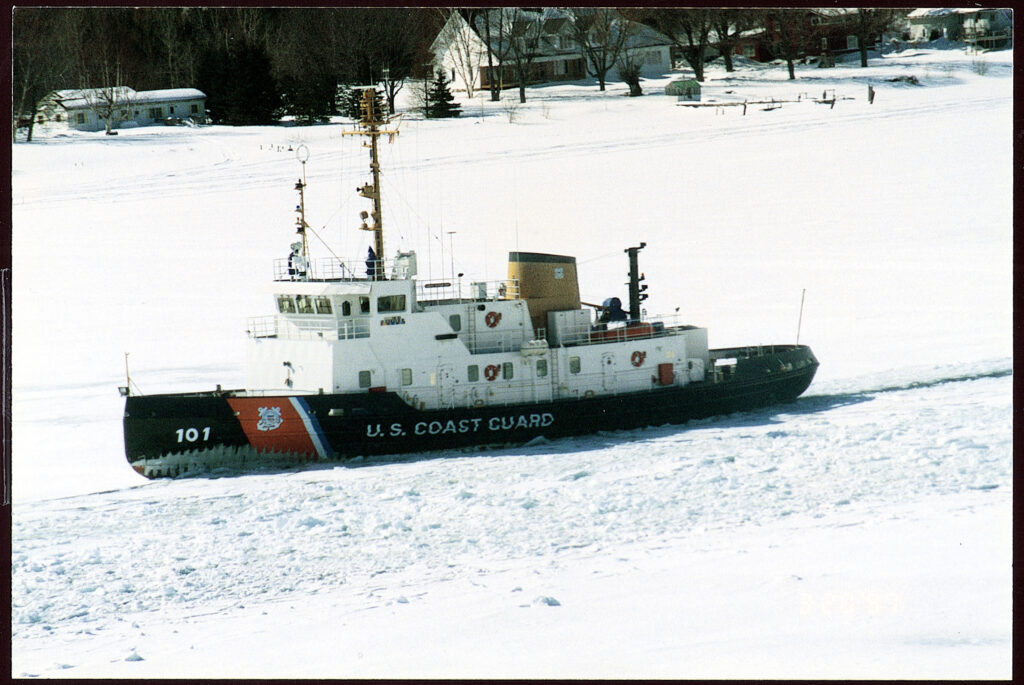
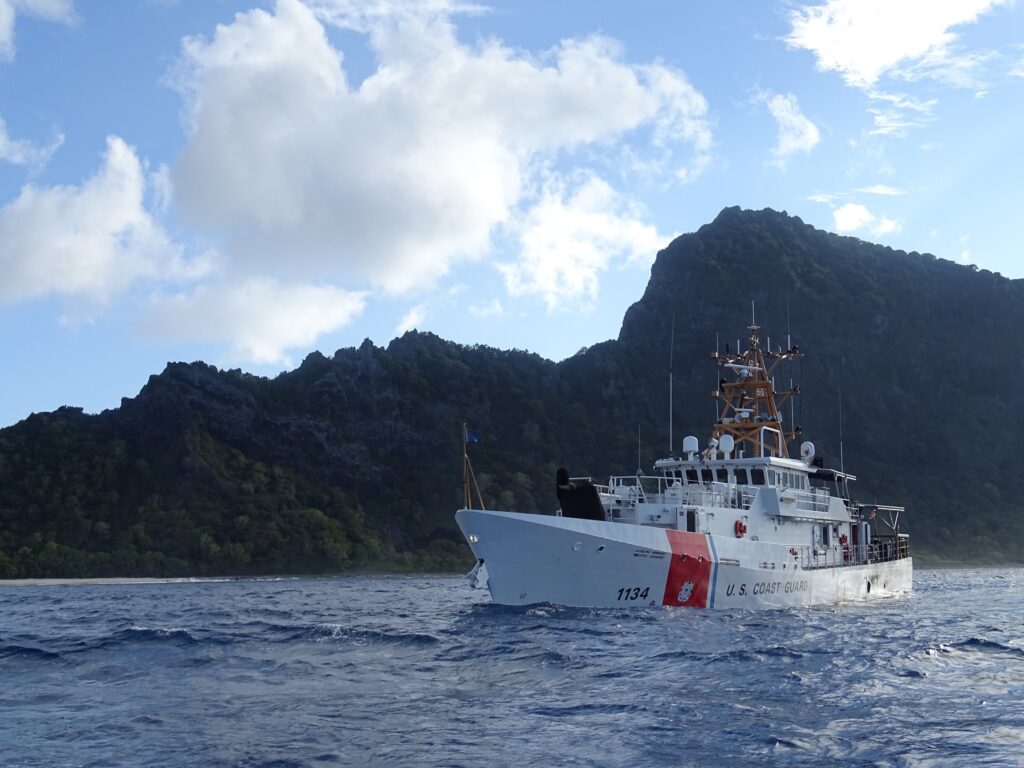
The Coast Guard Cutter Katmai Bay (WTGB 101) was the first of nine 140-foot Bay Class tugs built for the Coast Guard’s domestic icebreaking mission. U.S. COAST GUARD
BELOIT, Wis. — Fairbanks Morse Defense, a portfolio company of Arcline Investment Management, has been awarded a five-year indefinite-delivery/indefinite-quantity requirements contract by the U.S. Coast Guard Surface Forces Logistic Center, the company announced Jan. 10.
The agreement, worth up to $13 million, makes FMD the required source of supply for all opposed piston engine parts listed in the contract’s schedule of supplies. These parts primarily support OP engines on nine 140-foot Bay Class Icebreaking Tugboats (WTGBs).
Since 1977, WTGBs have been used as critical icebreakers on many Northeast and Midwestern U.S. rivers and the Great Lakes, ensuring waterways remain open year-round. More than 15 million tons of cargo such as food and petroleum products, as well as 90% of the nation’s home heating oil, are transported annually in January and February along Northeast waterways, making it essential that these channels are kept open to avoid supply chain disruptions.
The contract also includes provisions for engine parts onboard the U.S. Coast Guard’s decommissioned high endurance cutters (WHECs) that have been transferred or are in the process of being transferred to foreign navies.
“Fairbanks Morse Defense delivers an advantage to the U.S. Coast Guard by offering best-in-class marine technologies, OEM [original equipment manufacturer] parts, and turnkey services,” said FMD CEO George Whittier. “As a trusted partner to the Coast Guard, we live our ironclad commitment to the fleet and crew every day, on every job. Manufactured in the U.S. and serviced worldwide, our proven marine technology is engineered for excellence to ensure reliable operation and minimal downtime.”
USCGC Stone Returns to Homeport after 61-Day Patrol
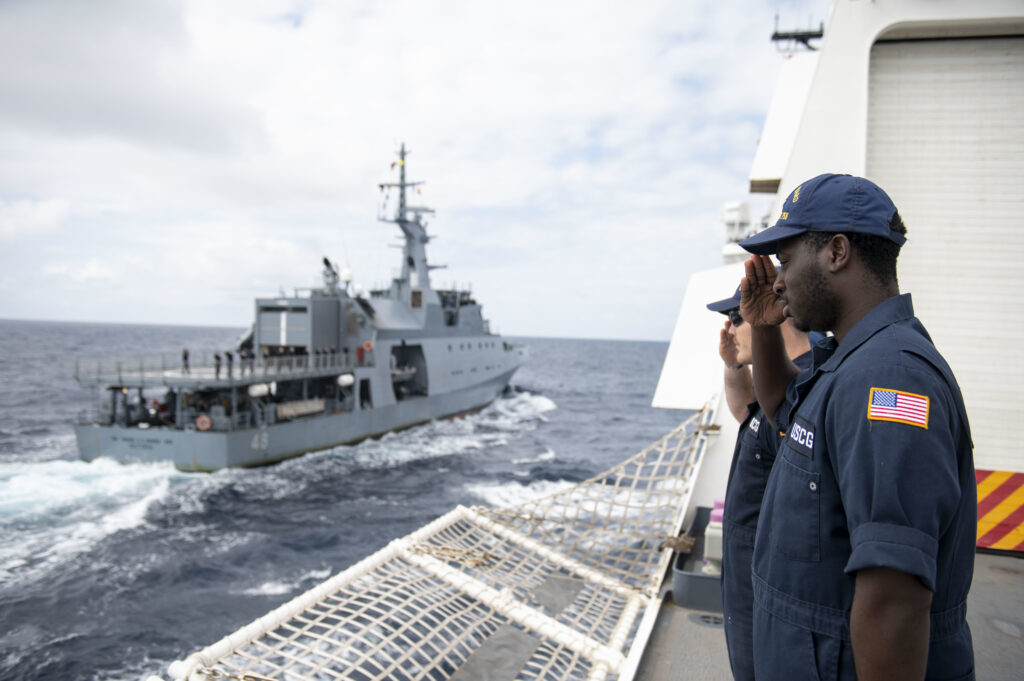
The crews of U.S. Coast Guard Legend-class national security cutter USCGC Stone (WMSL 758) and the Colombian navy OPV-80 offshore patrol vessel ARC Victoria (PZE-48) conduct passing exercises in the Eastern Pacific Ocean, Dec. 4, 2021. U.S. Coast Guard / Petty Officer 2nd Class Shannon Kearney
NORTH CHARLESTON, S.C. — USCGC Stone (WMSL 758) returned to its homeport in Charleston following a 61-day patrol in the Caribbean Sea and Eastern Pacific Ocean in support of the U.S. Coast Guard Pacific Area, the Coast Guard’s Joint Interagency Task Force South and the Coast Guard 11th District, the Coast Guard Atlantic Area said Jan. 7.
Stone’s crew successfully interdicted two suspected drug smuggling vessels, recovering approximately 2,246 pounds of cocaine and 4,870 pounds of marijuana with an estimated combined street value of $57.1 million. The cutter’s crew subsequently transferred 20 suspected narcotics smugglers to the 7th Coast Guard District and U.S. Drug Enforcement Administration personnel, signaling the culmination of a successful joint interagency effort in the Eastern Pacific.
The Stone embarked observers from Panama, Costa Rica, Colombia, Ecuador, and the National Oceanic and Atmospheric Administration to perform joint operations to combat illegal, unreported, and unregulated fishing and conduct counter-drug operations off the coast of South America.
An embarked MH-65 helicopter aircrew from the U.S. Coast Guard’s Helicopter Interdiction Tactical Squadron was integral in counter-drug operations. Interagency partners provided additional aerial surveillance and reconnaissance support throughout the patrol.
During the cutter’s port call in Manta, Ecuador, Stone’s commanding officer, Capt. Clinton Carlson, attended an international IUUF symposium with Arthur Young, the embarked National Oceanic and Atmospheric Administration enforcement officer, to share experiences and increase awareness of the regional issue. The crew of the Stone also participated in a friendly soccer match with Cuerpo de Guardacostas de la Armada personnel from the local coast guard station while in Manta.
“This is our crew’s first patrol outside of their initial shakedown cruise, and I am extremely proud of the dedication and pride they have shown toward getting qualified to conduct the missions expected of a national security cutter crew,” said Carlson. “Throughout these past months, everyone aboard displayed enthusiasm during the drills we’ve run every week and have proven that through teamwork and a shared understanding of the mission, we can accomplish even the most difficult tasks. I am honored to lead this impressive crew of Coast Guard women and men.”
The fight against drug cartels in the Eastern Pacific Ocean and the Caribbean Sea requires unity of effort in all phases from detection, monitoring, and interdictions, to criminal prosecutions for these interdictions by U.S. attorney’s offices from the Middle District of Florida, the Southern District of Florida and the Southern District of California. The law enforcement phase of counter-smuggling operations in the Eastern Pacific Ocean is conducted under the authority of the 11th Coast Guard District, headquartered in Alameda. The interdictions, including actual boardings, are led and conducted by U.S. Coast Guard members.
The Stone is the ninth Legend-class national security cutter in the Coast Guard fleet and currently is homeported in Charleston, South Carolina. The national security cutters can execute the most challenging national security missions, including support to U.S. combatant commanders.
The Charleston-based Legend-class cutters fall under the command of the U.S. Coast Guard Atlantic Area. Based in Portsmouth, Virginia, U.S. Coast Guard Atlantic Area oversees all Coast Guard operations east of the Rocky Mountains to the Arabian Gulf. In addition to surge operations, they also allocate ships to work with partner commands and deploy to the Caribbean and Eastern Pacific to combat transnational organized crime and illicit maritime activity.
Bollinger Delivers to Coast Guard Sixth FRC for Basing in Bahrain
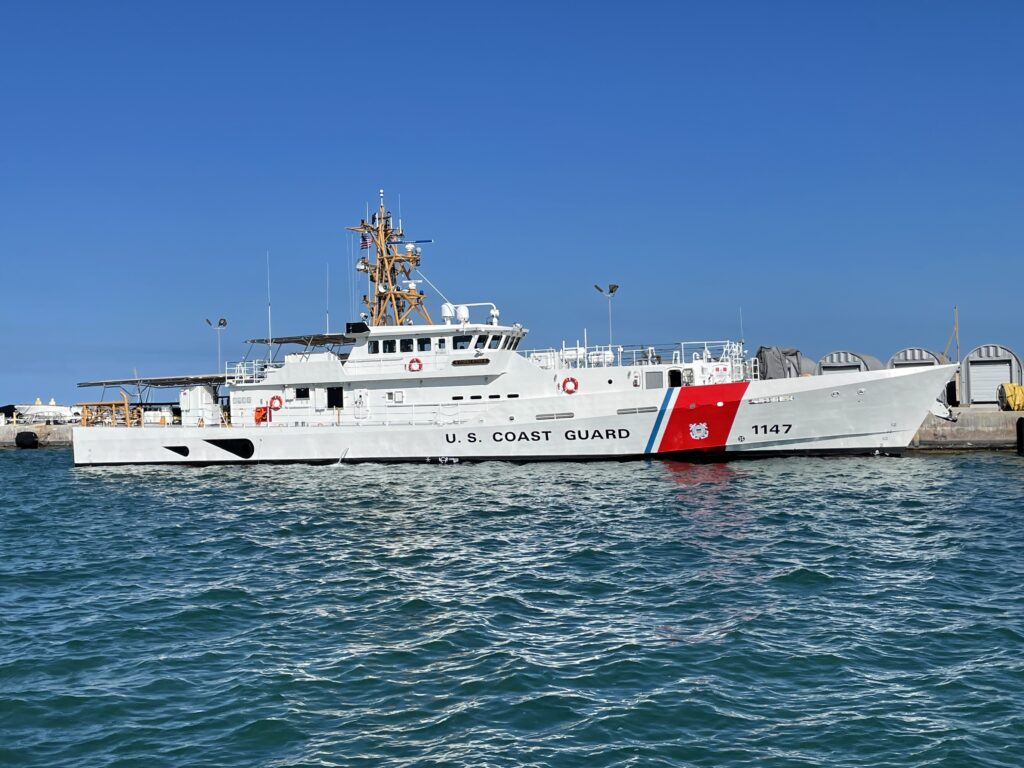
The U.S. Coast Guard Cutter Clarence Sutphin, now delivered to the service in Key West, Florida, and bound for Bahrain. BOLLINGER SHIPYARDS LLC
LOCKPORT, La. — Bollinger Shipyards LLC has delivered the USCGC Clarence Sutphin to the U.S. Coast Guard in Key West, Florida, the company said Jan. 6. This is the 170th vessel Bollinger has delivered to the U.S. Coast Guard over a 35-year period and the 47thFast Response Cutter delivered under the current program.
The Clarence Sutphin is the final of six FRCs to be home-ported in Manama, Bahrain, which will replace the aging 110-foot Island-class patrol boats, built by Bollinger Shipyards 30 years ago, supporting the Patrol Forces Southwest Asia, the U.S. Coast Guard’s largest overseas presence outside the United States.
“Ensuring that the brave men and women of the U.S. Coast Guard have the most state-of-the-art, advanced vessels as they work to build and maintain the necessary regional alliances to ensure maritime security in the region is a top priority,” said Bollinger President and CEO Ben Bordelon. “Bollinger is proud to continue enhancing and supporting the U.S. Coast Guard’s operational presence in the Middle East and ensuring it remains the preferred partner around the world.”
Earlier this year at the commissioning ceremony of the USCGC Charles Moulthrope, U.S. Coast Guard Commandant Adm. Karl Schultz lauded the “enhanced seakeeping” capabilities of the PATFORSWA-bound FRCs, saying “these ships are truly going to be game changing in their new theater of operations” and “offer increased opportunities for integrated joint operations with our Navy and Marine Corps colleagues” as the Coast Guard seeks to be part of the whole-of-government solution set in the region.
PATFORSWA is composed of six cutters, shoreside support personnel, and the Maritime Engagement Team. The unit’s mission is to train, organize, equip, support and deploy combat-ready Coast Guard Forces in support of U.S. Central Command and national security objectives. PATFORSWA works with Naval Forces Central Command in furthering their goals to conduct persistent maritime operations to forward U.S. interests, deter and counter disruptive countries, defeat violent extremism and strengthen partner nations’ maritime capabilities in order to promote a secure maritime environment.
Each FRC is named for an enlisted Coast Guard hero who distinguished themselves in the line of duty. Clarence Sutphin, Boatswain Mate First Class, USCG, was awarded the Bronze Star Medal for his courageous actions during the invasion of Saipan Island in 1944. His citation reads: “For heroic achievement in action against enemy Japanese forces during the invasion of Saipan, Marianas Islands, on June 15 and 16, 1944. Swimming with a line through heavy surf to a tank lighter stranded on a reef, SUTPHIN remained aboard under mortar and artillery fire until the boat was salvaged. Returning to the beach, he aided in salvaging another tank lighter under enemy fire and, when a mortar shell struck a group of eight Marines, promptly treated the wounded and moved them to a first aid station. His courage and grave concern for the safety of others reflects the highest credit upon SUTPHIN and the United States naval service.”
USCGC Mohawk Returns from Eastern Pacific Patrol, Conducts International Collaboration
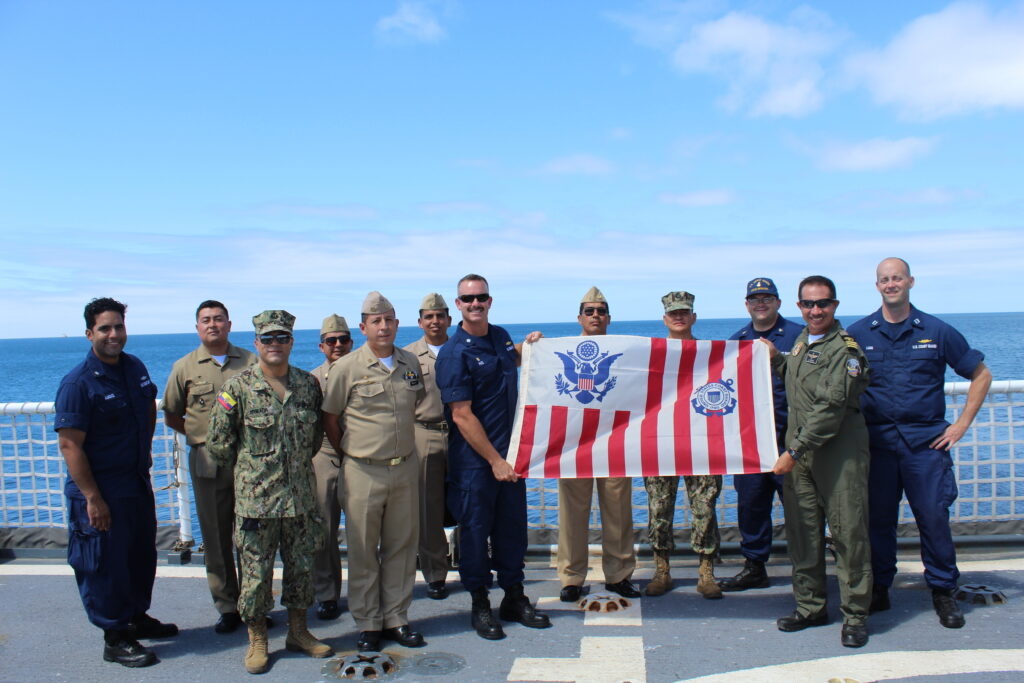
The USCGC Mohawk (WMEC 913) hosts senior officials from the coast guard, navy, and marines of Ecuador for a professional exchange on Nov. 28, 2021, at sea off Ecuador. The Famous-class medium endurance cutter returned to homeport in Key West Sunday after completing a groundbreaking 45-day deployment to the Eastern Pacific Ocean. U.S. COAST GUARD
KEY WEST, Florida — The Famous-class medium endurance cutter USCGC Mohawk (WMEC 913) returned to homeport in Key West Dec. 19 after completing a groundbreaking 45-day deployment to the Eastern Pacific Ocean, U.S. Coast Guard Atlantic Area said Dec. 20.
While on patrol, the Mohawk crew disrupted illegal narcotics smuggling, interdicting more than 3,200 pounds of cocaine. The team conducted joint training missions with crews from Panama and Ecuador to strengthen regional partnerships in the Western Hemisphere.
Patrolling in support of Joint Interagency Task Force South, the Mohawk team interdicted a low-profile drug smuggling vessel with approximately 3,200 pounds of cocaine aboard and apprehended three suspected narcotics smugglers. These low-profile vessels are purpose-built to evade detection and transport illicit contraband across thousand-mile stretches of ocean. The drugs, worth more than $60 million, were seized in international waters of the Eastern Pacific Ocean off the coast of Ecuador. While in theater, Mohawk aided in stopping 17 suspected drug smugglers, contributing directly to U.S. Southern Command objectives to combat transnational criminal organizations.
During the Mohawk’s deployment, the crew took multiple opportunities to strengthen ties with partner nations in the region, including conducting joint rescue and assistance drills, exchanging law enforcement and boarding techniques, and practicing towing with Panamanian Servicio Nacional Aeronaval vessels. Mohawk’s crew also completed a passing exercise with the Armada del Ecuador offshore patrol vessel LAE Isla San Cristobal (LG 30) and conducted a two-day joint counter-narcotics patrol through Ecuador’s exclusive economic zone in the Galápagos Islands.
“International partnerships are critical to detecting and deterring illicit narcotics smuggling; engagements such as these with foreign partners enhance interoperability and interdiction capabilities,” said Cmdr. Andrew Pate, commanding officer of the Mohawk.
Mohawk made history during its deployment as the first U.S. Coast Guard cutter to visit and anchor in the Galápagos Islands. The islands are a province of Ecuador and a UNESCO World Heritage site, made famous for species diversity and unique terrain. While at anchor in San Cristobal, Galápagos, Mohawk conducted a professional exchange with senior ranking officials from Armada del Ecuador, held joint law enforcement training, enjoyed a cultural exchange ashore, and took part in a friendly U.S. versus Ecuador game of soccer.
“The U.S. Coast Guard’s ability to forge strong and lasting international partnerships that further the national interest is what makes us such a unique instrument of national security. I am very proud of the Mohawk crew for their work as envoys of the U.S. Coast Guard. The opportunity to work alongside the maritime professionals of Ecuador and Panama during this deployment, as well as our interdiction success sends a strong signal to transnational criminal organizations that the United States values enduring commitments in the region,” Pate said. “Our interactions with the Armada del Ecuador in Galápagos left a profound impression on my crew. Choosing to go to sea and serve on a U.S. Coast Guard cutter opens the door to experiences and camaraderie that you don’t get in a normal nine to five job.”
While underway, the cutter’s crew completed aviation, damage control, engineering, seamanship, navigation, and combat systems training to maintain operational readiness and prepare for future multi-mission deployments.
Commissioned in March of 1991, Mohawk is the 13th and final of the 270-foot Famous-class cutters built. The medium endurance cutters fall under the command of the U.S. Coast Guard Atlantic Area. Based in Portsmouth, Virginia, U.S. Coast Guard Atlantic Area oversees all Coast Guard operations east of the Rocky Mountains to the Arabian Gulf. In addition to surge operations, they also allocate ships to deploy to the Caribbean and Eastern Pacific to combat transnational organized crime and illicit maritime activity.
USCGC Vigilant Offloads 17,000 Pounds of Illegal Narcotics in Port Everglades
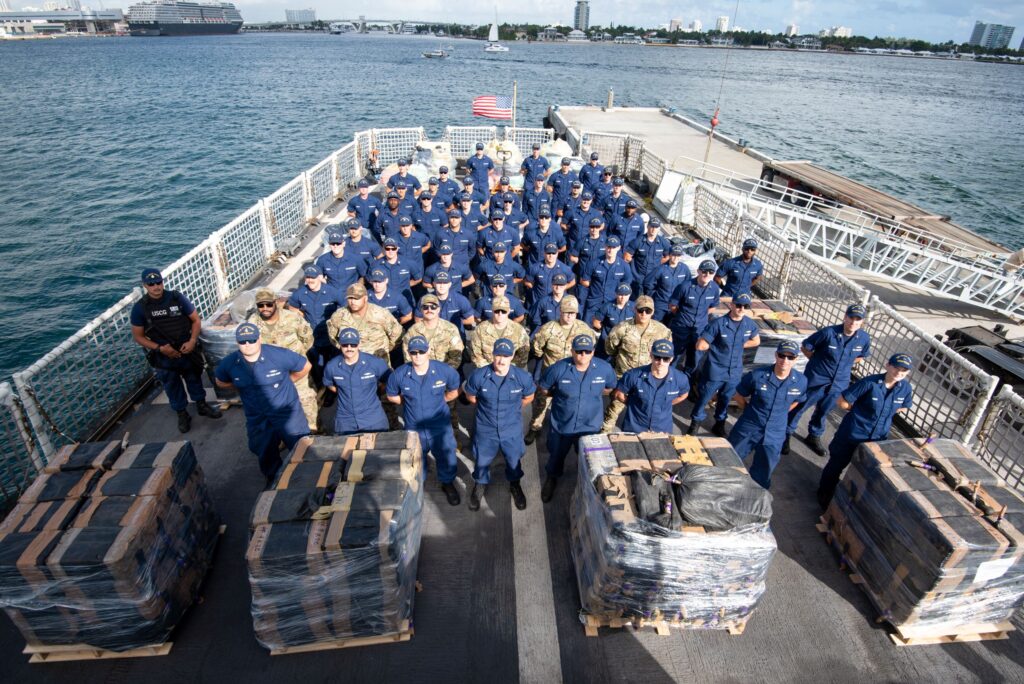
U.S. Coast Guard Cutter Vigilant (WMEC-624) crewmembers pose with approximately 17,000 pounds of illegal narcotics at Port Everglades, Florida, Dec. 15. U.S. COAST GUARD / Petty Officer 3rd Class Ryan Estrada
PORT EVERGLADES, Fla. — The USCGC Vigilant crew (WMEC 617) offloaded illegal narcotics worth an estimated $236 million on Wednesday in Port Everglades before returning to homeport in Port Canaveral, the Coast Guard 7th District said in a release.
The crew of the 67-year-old Vigilant offloaded more than 17,000 pounds of cocaine and marijuana following a 45-day patrol in the Eastern Pacific Ocean. An embarked U.S. Coast Guard law enforcement detachment augmented the ship’s crew, leveraging the service’s unique capabilities and authorities to perform law enforcement operations in international waters.
The drugs, which include nearly 12,000 pounds of cocaine and more than 5,000 pounds of marijuana, were seized during five interdictions conducted by crews of the Vigilant, USCGC Tampa (WMEC 902), and the Royal Canadian Navy’s HMCS Harry Dewolf (AOPV 430) in international waters off the coasts of Mexico, Central and South America.
Numerous U.S. and partner nation agencies cooperate to combat transnational organized crime.
“The successful interdiction of over 17,000 pounds of illegal narcotics and the apprehension of 17 suspected traffickers are the result of tremendous teamwork,” said Cmdr. Jay Guyer, commanding officer of the Vigilant. “We are thankful for coordinated efforts across the U.S. Coast Guard, the Department of Defense, Customs and Border Protection, as well as our international partners from Canada and throughout Central and South America.”
Vigilant, a 210-foot Reliance-class medium endurance cutter, patrols the Caribbean Sea and Eastern Pacific Ocean, performing counter-drug operations, migrant interdiction operations, search and rescue and fisheries enforcement.
Coast Guard, Partners Stop 3 Human Smuggling Attempts, Detain 100 People
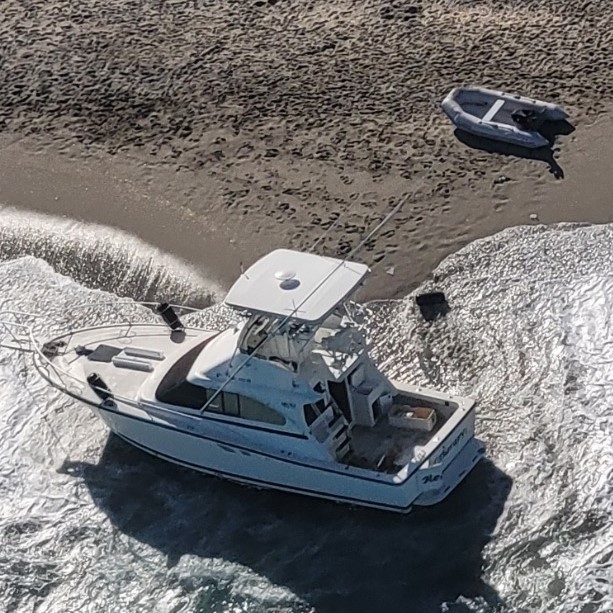
An abandoned vessel on Juno Beach, Florida, Dec. 12. U.S. Border Patrol officers apprehended 26 people following a maritime smuggling event. U.S. BORDER PATROL
MIAMI — Coast Guard, U.S Customs and Border Protection Air and Marine Operations and U.S. Border Patrol officers stopped three human smuggling attempts and detained 100 people between Dec. 12 and Dec. 14, the Coast Guard 7th District said in a release.
Coast Guard and CBP AMO officers detained 43 people at sea, and one suspected smuggler was transferred to Homeland Security Investigation officers for further investigation, Sunday, off the coast of Jupiter, Florida. Additionally, 26 people were apprehended by Border Patrol officers after a maritime smuggling event landed in the vicinity of Ocean Blvd.
Coast Guard and CBP AMO officers detained 28 people of various nationalities at sea, and the case is under investigation by Homeland Security Investigation officers, Dec. 14, off Pompano’s coast.
Additionally, two landings happened off Pompano Beach, Dec. 12 and Dec. 14, and approximately 26 people were not apprehended.
“Human smuggling is dangerous and illegal,” said Rear Adm. Brendan McPherson, commander of Coast Guard 7th District and director of Homeland Security Task Force-Southeast. “Smugglers exploit vulnerable people for profit with no regard for their safety. We work hard, along with our dedicated local law enforcement and fellow DHS partners, to protect all lives on and offshore.”
“Air and Marine Operations has the duty to patrol the waters around the Florida Straits, and along with our partners, we work every day to defeat the efforts of smugglers who have little regard for the human suffering they cause,” said Gerald Burgess, spokesman for Air and Marine Operations, Southeast Region. “Together with DHS partners, we work to keep the waters safe and secure.”
Those intercepted at sea are transferred or repatriated to their country of origin.
Homeland Security Task Force-Southeast is a standing task force that provides the organizational framework to detect a mass migration event or other contingency operation, facilitate the assignment of roles to participating agencies, and establishes processes for intra-departmental and inter-departmental collaboration. Partners within HSTF-SE routinely conduct a broad range of readiness activities, including periodic surge operations and exercises.
Schultz: Two FRCs Soon to Depart for Basing in Persian Gulf
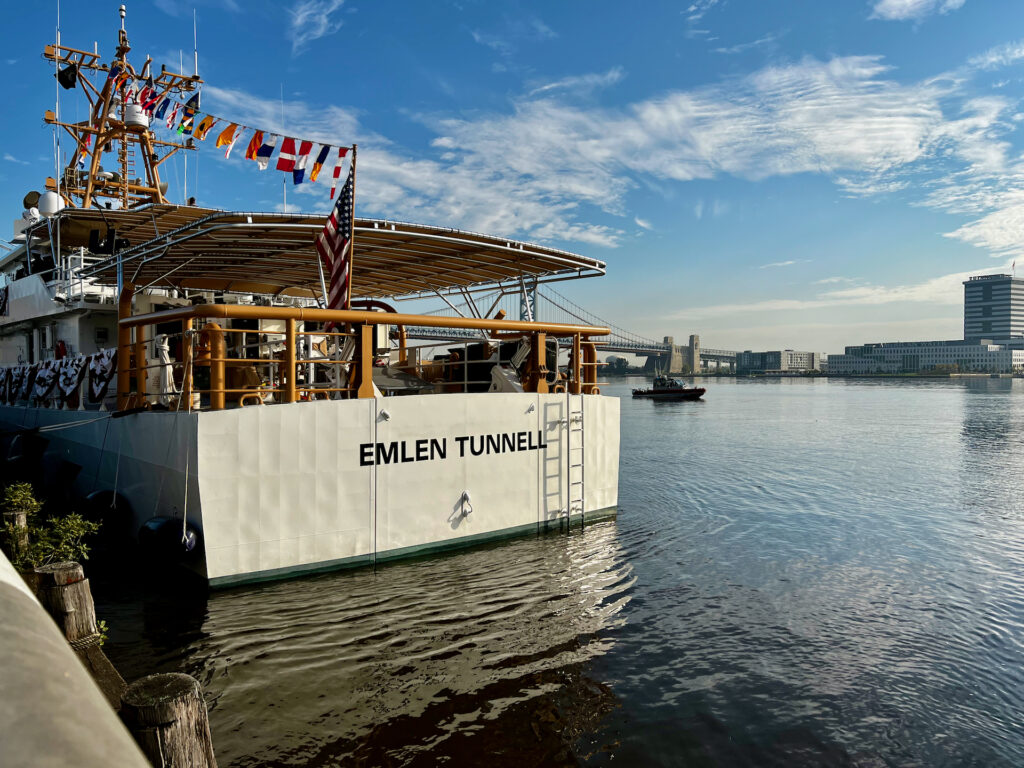
The U.S. Coast Guard commissioned the USCGC Emlen Tunnell (WPC 1145), Patrol Forces Southwest Asia’s fourth 154-foot Sentinel-class cutter, into service at Penn’s Landing in Philadelphia on Oct. 15. The ship will soon be bound for basing in Bahrain along with the USGCG Glenn Harris (WPF 1144). U.S. COAST GUARD / Clinton Muir
ARLINGTON, Va. — The second pair of Sentinel fast-response cutters are soon to depart U.S. waters on a voyage across the Atlantic Ocean bound for permanent basing in the Persian Gulf.
Coast Guard Commandant Karl Schultz, speaking Dec. 8 at a Navy League Special Topic Breakfast, said the two 154-foot-long FRCs will be escorted across the ocean by the USCGC Thetis (WMEC 910), a Famous-class medium-endurance cutter that was topping off with fuel in Puerto Rico. Schultz said that after the escort mission the Thetis will be operating off Africa.
The two FRCs, USCGC Glenn Harris (WPC 1144) and USCGC Emlen Tunnell (WPC 1145), will replace two of the four remaining Island-class 110-foot-long patrol boats in Patrol Forces Southwest Asia at their base in Bahrain.
Earlier this year, the first two FRCs assigned to the Persian Gulf, USCGC Charles Moulthrope (WPC 1141) and USCGC Robert Goldman (WPC 1142), were escorted across the Atlantic by the national security cutter USCGC Hamilton (WMSL 753).
The first two FRCs in the Gulf replaced the Island-class patrol boats USCGC Adak (WPB 1333) and USCGC Aquidneck (WPB 1309), which were decommissioned on June 15 for transfer to Indonesia.
Patrol Forces Southwest Asia conducts maritime security patrols in the Persian Gulf in concert with the U.S. 5th Fleet and other allies and partners
The voyage to Bahrain from the U.S. East Coast covers 9,000 nautical miles.
Coast Guard Offloads More than $148 Million of Illegal Narcotics in Miami
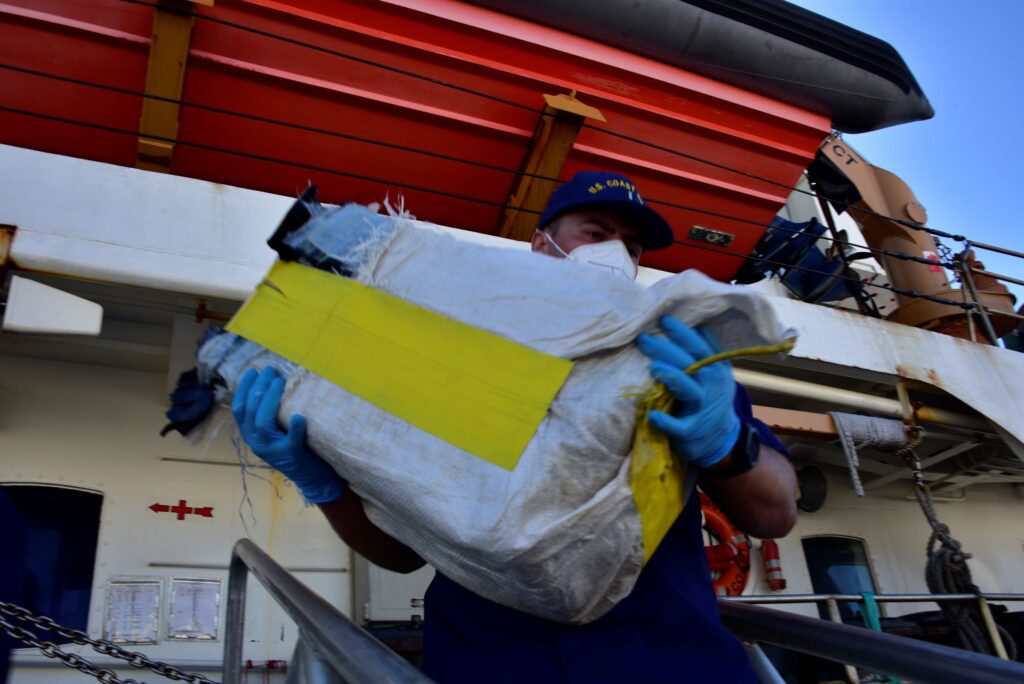
A crew member of the Coast Guard Cutter Dauntless offloads a bale of illegal narcotics at Base Miami Beach, Florida, Dec. 7. The contraband was seized by members of the Royal Fleet Auxiliary Wave Knight and the His Netherlands Majesty’s Ship Holland during three separate interdictions in the Caribbean Sea. U.S. COAST GUARD / Petty Officer 3rd Class Brian Zimmerman
MIAMI — Coast Guard Cutter Dauntless’ crew offloaded more than $148 million of illegal narcotics at Base Miami Beach, Dec. 7, from three separate interdictions in the Caribbean Sea in the past two weeks, the Coast Guard 7th District said Dec. 9.
Following the three interdictions, nine suspected drug smugglers with Dominican Republic and Colombian nationalities were apprehended. The Royal Fleet Auxiliary Wave Knight crew seized approximately 1,200 pounds of cocaine, and Coast Guard Cutter William Trump and the His Netherlands Majesty’s Ship Hollands’ crew seized approximately 6,700 pounds of cocaine in two interdictions.
The U.S. Attorney’s Offices for the District of Puerto Rico, Southern District of Florida and the Eastern District of Virginia are prosecuting these cases.
“These successful interdictions are the result of professional partnerships between the Coast Guard, RFA Wave Knight, and HNLMS Holland crews,” said Hansel Pintos, 7th District spokesperson. “The Coast Guard’s strong international partnerships, counter threats in the maritime domain, protect each of our countries from transnational organized crime, and work to stabilize and promote good governance in the region.”
This effort is part of an Organized Crime Drug Enforcement Task Forces operation. OCDETF identifies, disrupts and dismantles the highest-level criminal organizations that threaten the United States using a prosecutor-led, intelligence-driven, multi-agency approach.
The fight against drug cartels in the Caribbean Sea requires unity of effort in all phases from detection, monitoring and interdictions, to criminal prosecutions by international partners and U.S. Attorneys’ Offices in districts across the nation.
During at-sea interdictions, a suspect vessel is initially detected and monitored by allied, military or law enforcement personnel coordinated by Joint Interagency Task Force-South based in Key West, Florida. The law enforcement phase of operations in the Caribbean Sea is conducted under the authority of the Seventh Coast Guard District, headquartered in Miami. The interdictions, including the actual boardings, are led and conducted by members of the U.S. Coast Guard.
Coast Guard Cutter Completes Operation Blue Pacific Patrol in Oceania
The Coast Guard Cutter William Hart participates in the Pacific Islands Forum Fisheries Agency’s Operation Kurukuru off American Samoa, Oct. 29. U.S. COAST GUARD
HONOLULU — The crew of the Coast Guard Cutter William Hart completed its 39-day patrol over 7,000 nautical miles in Oceania in support of the Coast Guard’s Operation Blue Pacific, last week, said the Coast Guard 14th District.
Operation Blue Pacific is an overarching multi-mission Coast Guard endeavor promoting security, safety, sovereignty and economic prosperity in Oceania while strengthening relationships between our partners in the region.
“This patrol had multiple goals, which really displayed the adaptability of our crew,” said Lt. Cmdr. Cynthia Travers, the commanding officer of the William Hart. “While we continued to support international efforts to combat illegal, unreported, and unregulated fishing in the region, we’ve also worked with our partners including New Zealand’s National Maritime Coordination Centre, the nation of Samoa, the National Park Service, and the National Oceanic and Atmospheric Administration on a number of joint endeavors.”
In November, the crew of the William Hart, one of the Coast Guard’s new Fast Response Cutters, participated in the Pacific Islands Forum Fisheries Agency’s Operation Kurukuru, an annual coordinated maritime surveillance operation with the goal of combating IUU fishing.
IUU fishing presents a direct threat to the efforts of Pacific Island countries and territories to conserve fish stocks, an important renewable resource in the region.
Following the successful conclusion of Operation Kurukuru, the William Hart’s crew continued to patrol the exclusive economic zones of the United States, Samoa, Tonga, Kiribati and Fiji to prevent illicit maritime activity.
Upon request from NOAA, the crew visited Fagatele Bay in the National Marine Sanctuary of American Samoa, using the cutter’s small boat to ensure there was no fishing or activity which would damage the coral within the United States’ largest national marine sanctuary.
The crew of the William Hart also supported a National Park Service boat during a transit between Tutuila Island and the Manu’a Islands, providing search and rescue coverage.
The cutter’s crew then departed for Fiji’s EEZ, where they supported New Zealand’s NMCC by locating an adrift Deep-ocean Assessment and Reporting of Tsunamis buoy and reporting the buoy’s condition to Headquarters Joint Forces New Zealand and other stakeholders.
DART buoys are real-time monitoring systems strategically deployed throughout the Pacific to provide important tsunami forecasting data to researchers.
“These expeditionary patrols are important to the continued stability and prosperity of Oceania,” said Lt. Cmdr. Jessica Conway, a Coast Guard 14th District operations planner. “Partnerships are key to promoting a free and open Indo-Pacific. Operation Blue Pacific allows us to coordinate with regional partners and most effectively employ our assets towards shared goals.”
Coast Guard Conducted 78 Lancha Interdictions in Fiscal 2021 Along Texas Coast
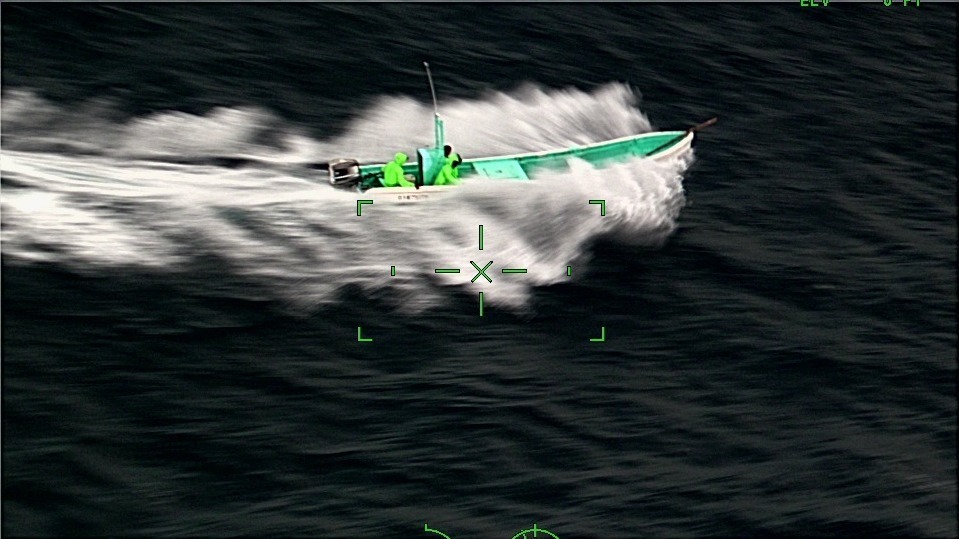
A Coast Guard Sector and Air Station Corpus Christi HC-144 Ocean Sentry captures imagery of a lancha near South Padre Island, Texas, Sept. 30. U.S. COAST GUARD
CORPUS CHRISTI, Texas — Coast Guard law enforcement crews interdicted 78 lanchas, seized 15,484 pounds of catch and detained 208 fishermen during fiscal year 2021 along the Texas coast, the Coast Guard 8th District said Dec. 5.
Since the first recorded lancha interdiction in the late 1980s, the Coast Guard has seen a significant uptick in the detection of the vessels, recording close to 300 lancha interdictions in the past three fiscal years combined.
A noteworthy case from this year was on Aug. 4, when Coast Guard Station South Padre Island worked with Coast Guard Sector and Air Station Corpus Christi, Texas Parks and Wildlife and the Coast Guard Cutter Pelican to interdict four lanchas with a total of 320 pounds of red snapper and 1,160 pounds of shark in one day.
In cooperation with other law enforcement agencies, the Coast Guard uses a layered approach to combat illegal, unreported, and unregulated fishing through aircraft, small boats and cutters, as well as improved technology on those assets, resulting in the drastic increase in lancha interdictions.
“The crew at Station South Padre Island takes their role of protecting our natural resources from poaching along the Maritime Boundary Line very seriously,” said Lt. Cmdr. Daniel Ippolito, commanding officer of Coast Guard Station South Padre Island. “The last few years of record-breaking lancha interdictions speak to the steadfast commitment, professionalism, and teamwork of the Coast Guard crews and our partners at Texas Parks and Wildlife to this mission. We ask that the public continue to stay vigilant and report any instances of illegal fishing to the Coast Guard or Texas Parks and Wildlife.”
A lancha is a fishing boat used by Mexican fishermen that is approximately 20-30 feet long with a slender profile. They typically have one outboard motor and are capable of traveling at speeds exceeding 30 mph. Lanchas pose a major threat, usually entering the United States’ exclusive economic zone near the U.S.-Mexico border in the Gulf of Mexico with the intent to smuggle people, drugs, or poach natural resources.