Coast Guard Increasing Engagement with Pacific Allies, Partners, U.S. Navy

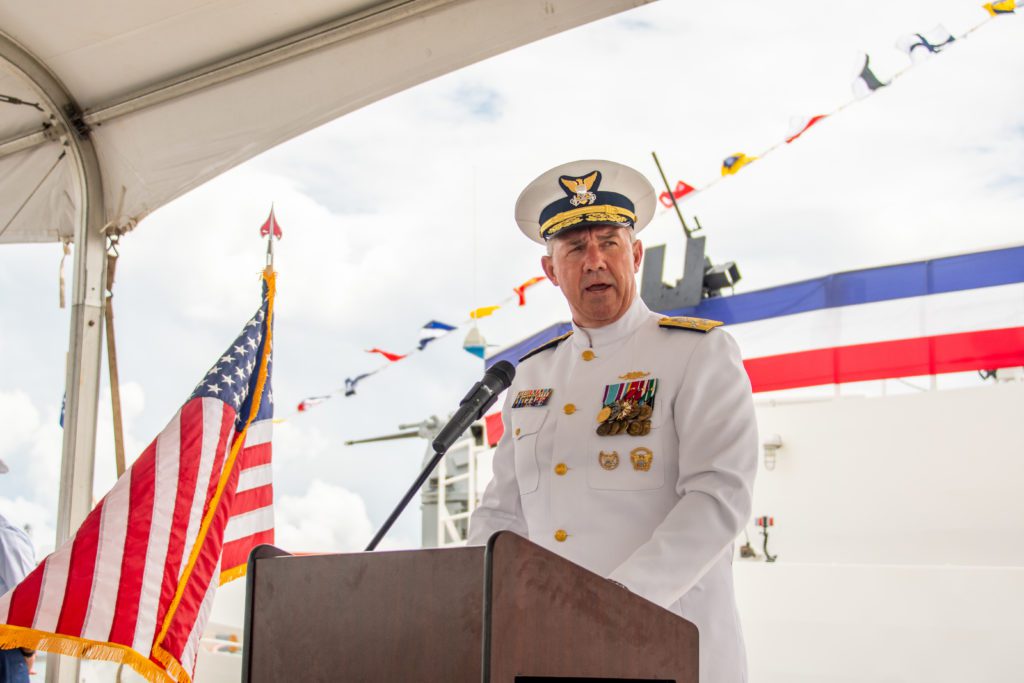
Adm. Karl Schultz, Coast Guard Commandant addressed the Coast Guard 8th District personnel and guests attending a change-of-command ceremony June 25, 2021 at the Port of New Orleans. U.S. COAST GUARD / Petty Officer 3rd Class John Michelli

ARLINGTON, Va. — The U.S. Coast Guard’s top officer said the service has taken steps to increase its integration with allies and partners in the Western Pacific Ocean area to provide more effective cooperation and provide more presence. 

In a June 28 webinar discussion with the Brookings Institution’s Michael O’Hanlon, Adm. Karl Schultz, commandant of the Coast Guard, detailed some of the ways in which the Coast Guard is reaching out to promote international cooperation. 

Schultz said the Coast Guard assigned an attaché to Australia in 2020 who will represent the service in that nation plus New Zealand and Papua New Guinea. Australia has new patrol boats, some of which will operate in Oceania, and the U.S. Coast Guard could provide training on law enforcement on the high seas. New Zealand has a new auxiliary ship that could provide opportunities for cooperation.   

Next summer the Coast Guard will assign an attaché to Singapore. It already has an adviser in Vietnam, to which the Coast Guard has or will transfer three Secretary-class high-endurance cutters. 

The service also has transferred three Secretary-class cutters to the Philippines, which is growing its own coast guard from 5,000 personnel to 40,000 personnel. 

The Coast Guard also is helping Indonesia set up a new training center. 

Schultz also has assigned a captain to the operations/plans directorate of U.S. Indo-Pacific Command and a captain and a commander to the Asia-Pacific Center for Security Studies in Hawaii. 

“We’ve got mobile training teams that operate through the region,” the admiral said. “We bring Indo-Pacific partners into our schoolhouses here [to the United States], to the International Maritime Officers Course.” 

The Coast Guard also has been backing up the U.S. Pacific Fleet, providing two national security cutters in 2019 and one in 2020 to help fill a void left while the USS John McCain and USS Fitzgerald were being repaired following their collisions. These cutters performed sanction work against the North Koreans. The USCGC Kimball also conducted a patrol of the South Pacific this year, calling in Fiji. In the future, the USCGC Kimball will patrol in the Western Pacific on patrol against illegal, unreported and unregulated fishing.  

The three fast response cutters [FRCs] assigned or slated for Guam, combined with the ocean-going buoy tender assigned there, will give the Coast Guard an increased reach and presence in the Western Pacific. 

“I anticipate our being throughout the Oceania region with those patrol boats [FRCs], [and] a periodic national security cutter,” Schultz said.  

The commandant stressed the value of the Coast Guard presence in providing “human-to-human partnership to counter Chinese checkbook diplomacy. 

“The Chinese Coast Guard is antagonistic, running down Philippine, Indonesian, Malaysian fishermen in dispute,” he said, also noting the abusive maritime actions of the Chinese Peoples Armed Militia. 

“We don’t use our Coast Guard as an arm of the government to press in coercively over disputed regions,” he said. 


Coast Guard Transfers 18 Migrants to Bahamas

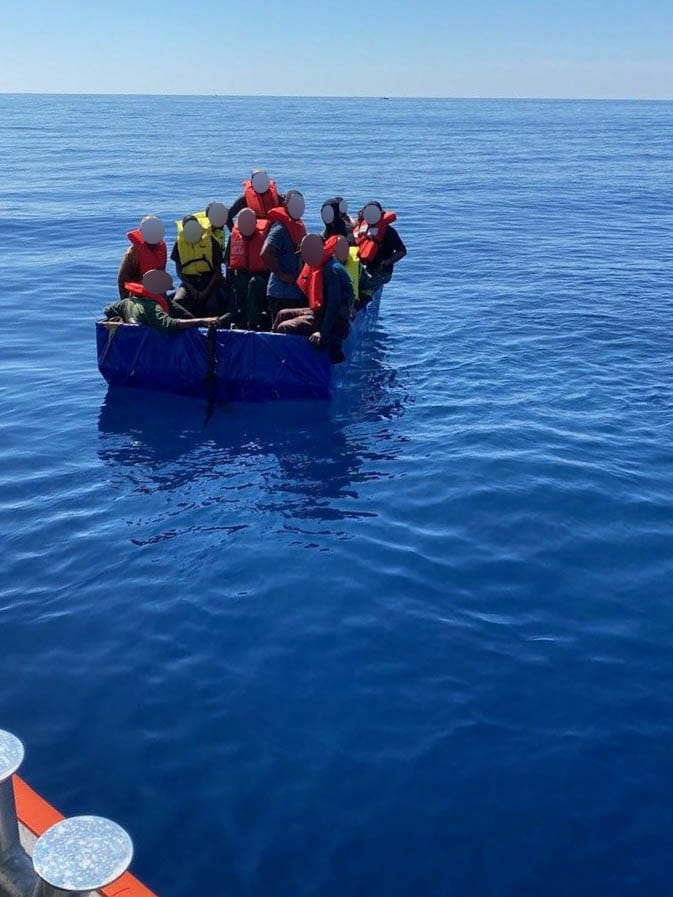
A 27-foot vessel stopped off the coast of Palm Beach, Florida, Jun. 24, 2021. 18 Haitian migrants aboard were transferred to Bahamian authorities. U.S. COAST GUARD

MIAMI — Coast Guard Cutter Raymond Evans’ crew transferred 18 Haitian migrants to the Bahamas, June 26, following an interdiction, Thursday, approximately one mile east of Lake Worth Inlet, the Coast Guard 7th District said in a release.  

Palm Beach Sheriff officers reported to Sector Miami watchstanders, June 24, a 27-foot vessel was located boating without lights at night. They were stopped for safety concerns and it was discovered the vessel was overloaded with 18 Haitians and one Bahamian.  

The Bahamian national was brought ashore for further questioning by Homeland Security Investigations. 

Customs and Border Protection Air and Marine Operations law enforcement officers took custody of the vessel.  

“The ventures are dangerous and can often lead to casualties,” said Lt. Cmdr. Jacob McMillian, Coast Guard Liaison officer, Bahamas. “Seas are unpredictable and when you’re traveling on a vessel that isn’t sea worthy, you should expect the unexpected.” 

The Coast Guard interdicted approximately 262 Haitian migrants in fiscal year 2021, which began Oct. 1, 2020, compared to 418 Haitian migrants in fiscal year 2020, and 932 in fiscal year 2019. These numbers represent the total number of at-sea interdictions, landings and disruptions in the Florida Straits, Caribbean Sea and Atlantic Ocean. 

Once aboard a Coast Guard cutter, all migrants receive food, water, shelter and basic medical attention. Throughout the interdiction, Coast Guard crew members were equipped with personal protective equipment to minimize potential exposure to any possible case of COVID-19. 


More Presence Needed in Both Polar Regions, Commandant Said

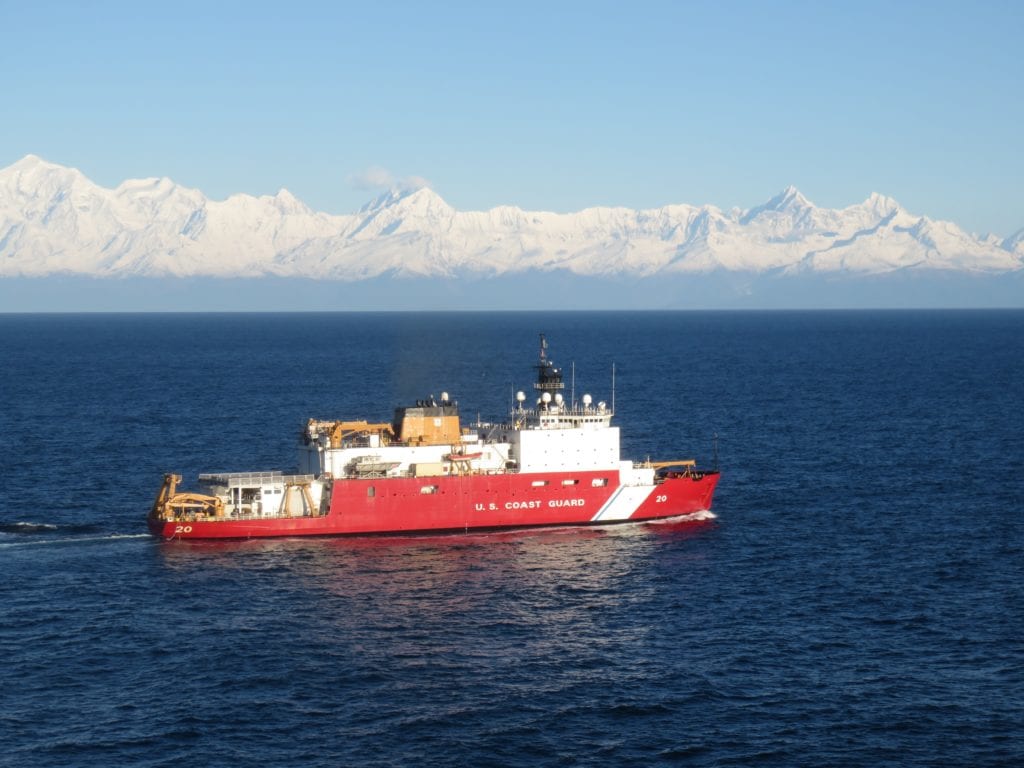
The Coast Guard Cutter Healy (WAGB-20), a polar-class icebreaker, transits Southeast Alaskan waters, Nov. 24, 2018. The Healy is one of two ice breakers in U.S. service. U.S. COAST GUARD / Lt. Kellen Browne

ARLINGTON, Va. – The Coast Guard’s senior admiral made his case before Congress for an increased presence in the Arctic and Antarctic and reaffirmed the need for more heavy icebreakers. 

“We absolutely need to be up in the Arctic and down in the Antarctic on a more persistent basis than we are today,” said Adm. Karl Schultz, commandant of the Coast Guard, testifying June 23 before the House Committee on Homeland Security. “The great power competition is alive and well there [in the Arctic]. China had operated off the Alaskan Arctic for six of the last nine to 12 years. Russia is building an increasingly large fleet of icebreakers that intends to use the Northern Sea Route, potentially as a toll route. 

“There will be freedom-of-navigation issues in the future, and we will have the organic domestic capability to press into that and project our sovereign interests,” Schultz said. 

He said the Coast Guard is sending the medium icebreaker USCGC Healy to the Arctic this summer for some scientific research for about 30 days, followed by a transit of the Northwest Passage over the north coast of Canada. Some Canadian researchers, British sailors and others will be on board the Healy for the voyage. Current plans call for a port call in Greenland and then return to Seattle via the Panama Canal. 

Shultz also pointed out that Coast Guard medium-endurance cutters have exercised with Dutch and French forces in the Arctic region. 

The Coast Guard has assigned an attaché to Copenhagen, Denmark, the country with sovereignty over Greenland. 

“We’re trying to make sure we’re touching the entire Arctic Council membership,” he said.  

The Coast Guard has only one operational heavy icebreaker, USCGC Polar Star. Congress has provided funding for the first two Polar Security Cutters (PSCs), which will be heavy icebreakers. A contract was awarded to VT Halter in 2019 for the first PSC. 

“We are woefully underinvested in high-latitude capability and capacity in terms of icebreakers,” Schultz said. “We haven’t built a heavy icebreaker in more than 45 years. … Four to six heavy icebreakers are what we really need, and we need some medium breakers. 


USCGC Tahoma Returns from 79-Day Counter-Narcotics Patrol

A boat crew from USCGC Tahoma (WMEC 908) conducts training on assisting vessels in distress during the cutter’s deployment to the Eastern Pacific Ocean, May 19, 2021. The Tahoma’s crew participated in Operation Orion VI, an international naval campaign to combat drug trafficking. U.S. COAST GUARD

KITTERY, Maine — The crew of the USCGC Tahoma (WMEC 908) returned to Kittery on Friday after a successful 79-day counter-narcotics and smuggling patrol in the Eastern Pacific, the Coast Guard Atlantic Area said in a June 21 release. 

The Tahoma’s crew interdicted two vessels, seizing 7,300 pounds of cocaine, worth a combined total of roughly $105 million, and detained eight suspected drug smugglers. 

The crew also coordinated operations with U.S. Coast Guard Law Enforcement Detachment deployed aboard the Canadian Kingston-class coastal defense vessel HMCS Saskatoon (MM 709). The collaboration supported the seizure of an additional 4,000 pounds of cocaine and the detention of four suspected smugglers. 

A flight crew and aviation detachment from the Coast Guard’s Helicopter Interdiction Tactical Squadron deployed aboard the Tahoma for the patrol. Helicopter Interdiction Squadron crews are the Coast Guard’s airborne sharpshooters, specializing in disabling the engines of vessels that refuse to stop with precision rifle fire. 

The Tahoma’s crew participated in Operation Orion VI, an international naval campaign to combat drug trafficking. During the operation, Tahoma patrolled in coordinated areas with the Colombian coastal patrol vessel Arc Punta Ardita (CPV 147) and rendezvoused for a formation steaming exercise. 

“It’s been an extremely successful deployment for us – the crew demonstrated great resilience and perseverance with each challenge, and I am proud to serve with each and every one of them,” said Cmdr. Eric Johnson, commanding officer of Tahoma. 

Tahoma is a 270-foot cutter homeported in Kittery. The vessel and 100-person crew execute maritime law enforcement, homeland security, and search and rescue missions supporting U.S. Coast Guard operations throughout the Western Hemisphere. 


Coast Guard Decommissions Bahrain-based Cutters Aquidneck, Adak

Coast Guardsmen present pennants from the USCGC Adak (WPB 1333) and USCGC Aquidneck (WPB 1309) during the decommissioning ceremony for Adak and Aquidneck onboard Naval Support Activity Bahrain, June 15. U.S. NAVY / Mass Communication Specialist 3rd Class Dawson Roth

MANAMA, Bahrain — After more than 30 years of active service, U.S. Coast Guard Island-class patrol boats USCGC Aquidneck (WPB 1309) and USCGC Adak (WPB 1333) were decommissioned in a ceremony aboard Naval Support Activity Bahrain, June 15, the Coast Guard Atlantic Area announced. 

Vice Adm. Steven Poulin, commander of U.S. Coast Guard Atlantic Area, was in attendance to honor the years of service Aquidneck, Adak, and their crews, provided to the Coast Guard.  

“Thank you to every single crew member who has ever served aboard Aquidneck and Adak, from the plank owners to the final crew and all the crews in between,” said Poulin. “You selflessly volunteered to deploy from your family, friends, and home, accepting the inherent risks and adversities to serve your country. You built a legacy for these two cutters that will not soon be forgotten.” 

As part of the Coast Guard’s Fast Response Cutter program, the service is acquiring 64 fast response cutters total, with six of those assigned to U.S. Coast Guard Patrol Forces Southwest Asia. Aquidneck and Adak were replaced by the Sentinel-class FRCs USCGC Charles Moulthrope (WPC 1141) and USCGC Robert Goldman (WPC 1142), which arrived at NSA Bahrain on May 25. 

Aquidneck’s namesake comes from Aquidneck Island in Rhode Island. It was originally homeported in Portsmouth, Virginia, and later shifted to Fort Macon, North Carolina. It was employed in search and rescue, counter-drug, and other law enforcement operations domestically for more than 16 years. 

Adak’s namesake comes from Adak Island in Alaska. It was originally stationed in Sandy Hook, New Jersey, in 1991 and laid claim to the third-largest cocaine bust in Coast Guard history when the crew stopped a fishing vessel off the coast of New York. In August 1994, it took part in Operation Able Vigil, which rescued over 29,000 Cuban migrants from unsafe rafts and makeshift craft attempting to reach American shores. The operation consisted of over 50 Coast Guard cutters and U.S. Navy ships, making it the largest Coast Guard-led naval operation since World War II. 

In late 2002, Aquidneck and Adak received orders to the U.S. 5th Fleet area of operations supporting Operation Iraqi Freedom. Within one week of their arrival in Bahrain, they were underway conducting maritime interdiction operations in the North Arabian Gulf. 

For the next 18 years, the two cutters remained forward deployed out of Bahrain under U.S. Patrol Forces Southwest Asia, attached to Commander, Task Force 55, conducting operations to ensure the free flow of commerce throughout the region’s critical waterways. 

Patrol Force Southwest Asia is composed of six patrol vessels, shoreside mission support personnel, and the Maritime Engagement Team. They play a crucial role in maritime security, maritime infrastructure protection, and theater security cooperation in the region. The unit also supports other U.S. Coast Guard deployable specialized forces operating throughout the U.S. Central Command area of responsibility. 

Commander, Task Force 55 operates in the U.S. 5th Fleet area of operations, supporting naval operations to ensure maritime stability and security in the Central Region, connecting the Mediterranean and Pacific through the Western Indian Ocean and three critical chokepoints to the free flow of global commerce.


Fairbanks Morse Engines to Power Fourth OPC

An artist’s rendering of the Offshore Patrol Cutter. EASTERN SHIPBUILDING GROUP

BELOIT, Wis. — Fairbanks Morse Defense, a portfolio company of Arcline Investment Management, announced June 22 that its Fairbanks Morse Engine (FME) division was awarded a contract by Eastern Shipbuilding Group (ESG) to build and deliver the two main propulsion diesel engines (MPDE) for the U.S. Coast Guard’s fourth Offshore Patrol Cutter (OPC) the Rush (WMSM-918). FME will build the engines at its Beloit, Wisconsin manufacturing facility. 

“Fairbanks Morse engines will help the OPCs perform the mission-critical task of preserving the country’s maritime security. We are honored to continue providing powerful and reliable engines to this essential program,” said Fairbanks Morse Defense CEO George Whittier. “No matter what the temperature is or how big the seas are, FME’s resilient engines are ready for the challenge of serving alongside each and every cutterman that crew an OPC.”  

The OPCs will act as a capability bridge between the National Security Cutter, which patrols the open ocean, and the Fast Response Cutter, which serves closer to shore. The vessels will also be capable of carrying an MH-60 or MH-65 Helicopter and three operational Over-The-Horizon small boats. They will be equipped with highly sophisticated combat systems and will enhance the USCG’s ability to execute various missions that range from drug interdiction to marine environmental protection.  

The U.S. military has turned to Fairbanks Morse Defense for more than 70 years to provide quality diesel engines, parts, repair, and service solutions for marine propulsion and ship service systems. 


U.S. Coast Guard Welcomes New Vice Commandant

Adm. Linda Fagan relieved Adm. Charles Ray as the 32nd Vice Commandant of the Coast Guard during a Change of Watch ceremony at Coast Guard Headquarters, June 18, 2021. Ray retired after more than 40 years of service in the Coast Guard. U.S. COAST GUARD / Petty Officer 1st Class Travis Magee

WASHINGTON – Adm. Charles W. Ray was relieved as vice commandant of the U.S. Coast Guard by Adm. Linda L. Fagan during a military change-of-command ceremony held June 18 at U.S. Coast Guard Headquarters, the service said in a release. 

Ray served as the vice commandant since May of 2018 and led the Service’s recapitalization of its legacy fleet of ships and aircraft while ensuring the Coast Guard’s 81,000 active duty, reserve, civilian, and auxiliary members were “Always Ready” to answer the nation’s call. Ray retired from the Coast Guard after 40 years of service and received the Department of Homeland Security Distinguished Service Medal from the Secretary of Homeland Security, Alejandro Mayorkas. 

“I am extremely proud of the dedication and resiliency I have seen throughout our service and throughout my career,” said Ray. “It has been an honor to serve with the men and women of the Coast Guard and it is my privilege to pass the reigns of vice commandant to Adm. Fagan, a true trailblazer and inspiration to so many.” 

Adm. Fagan most recently served as the commander of the Coast Guard Pacific Area, overseeing all Coast Guard operations in the Pacific, covering more than 74 million square miles of ocean, from the U.S. Western States to Asia, and from the Arctic to Antarctica. 

“Thank you, Adm. Ray for your service and your extraordinary leadership. You have made a tremendous, and long-lasting impact on our great service and we will strive to build upon your extraordinary work,” said Adm. Karl L. Schultz, commandant, U.S. Coast Guard. “Adm. Fagan, it is an honor to welcome you as the first woman to serve as a four-star admiral in the U.S. Coast Guard, and I congratulate you as you assume the duties as our 33rd vice commandant. I am proud to be part of this historic moment and look forward to leading the Coast Guard alongside of you.” 

A change-of-command is a time-honored ceremony that signifies the absolute transfer of responsibility, authority, and accountability from one person to another.


Coast Guard Repatriates 59 Migrants to Cuba

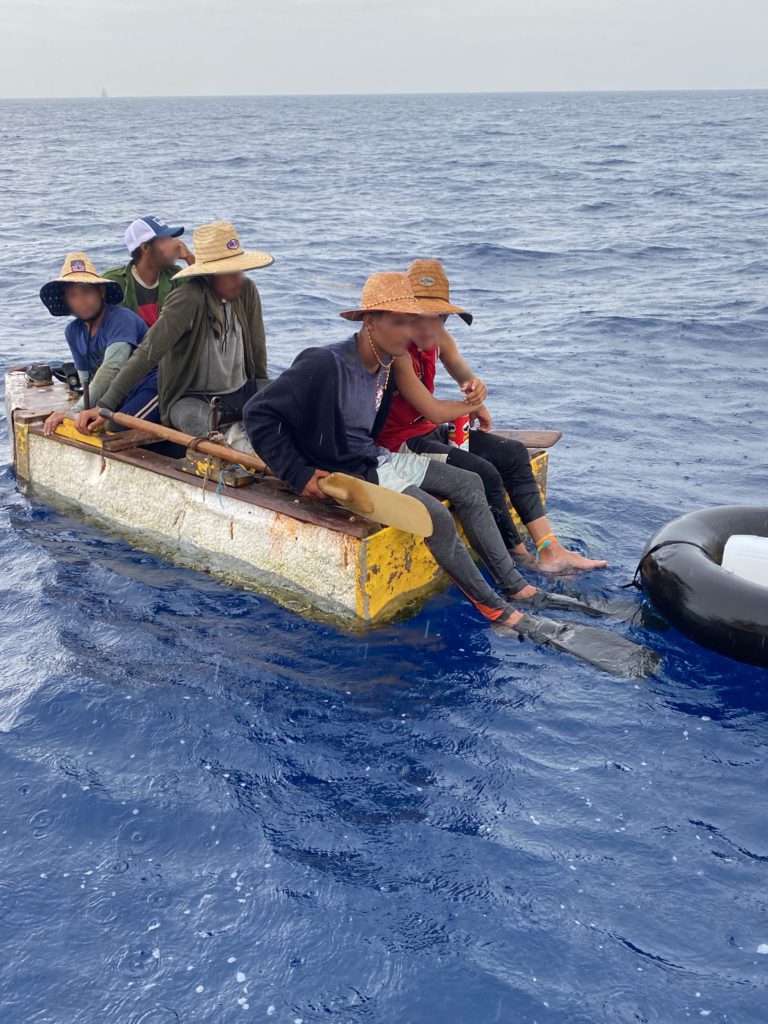
An unseaworthy migrant craft sits in front of the Coast Guard Cutter Isaac Mayo, 27 miles south of Long Key, Florida, June 9, 2021. A law enforcement team from the cutter interdicted 16 Cuban migrants from the craft. U.S. COAST GUARD

MIAMI — Coast Guard cutter Kathleen Moore and Charles Sexton crews repatriated 59 Cubans to Cuba, June 14 and 15, following four interdictions south of the Florida Keys, the Coast Guard 7th District said in a June 15 release. 

A Coast Guard Cutter Isaac Mayo law enforcement team launched at approximately 3:30 p.m. June 9, after a good Samaritan reported seeing more than 10 people aboard an unseaworthy boat 27 miles south of Long Key. The law enforcement team interdicted 16 Cuban migrants. The migrants were transferred to the cutter and reported in good health. Eleven of the migrants were repatriated June 14 by the Coast Guard Cutter Kathleen Moore crew and five were repatriated June 15 by the Charles Sexton crew. 

A Station Islamorada law enforcement team launched at approximately 1 p.m. June 9, after a Customs and Border Protection Air and Marine Operations crew reported an unseaworthy boat heading north from 20 miles east of Key Largo with four people aboard. The law enforcement team interdicted four Cuban migrants and transferred them to the cutter. The migrants were repatriated June 14 by the Kathleen Moore crew and reported in good health. 

A Station Key West law enforcement team launched at approximately 12:30 p.m. June 10, after a good Samaritan reported more than 20 people signaling for help on an unseaworthy boat 40 miles north of Havana, Cuba. The law enforcement team interdicted 29 Cuban migrants and transferred them to the cutter. One migrant was taken to shore for higher medical care and the remaining 28 were repatriated Monday by the Kathleen Moore crew, reporting in good health. 

A Station Miami Beach law enforcement team launched at approximately 10 a.m. June 12, after a good Samaritan reported people aboard an unseaworthy craft 10 miles east of Elliot Key. The law enforcement team interdicted 11 Cuban migrants and transferred them to the cutter reporting in good health. The migrants were repatriated June 15 by the Charles Sexton crew. 

“U.S. Coast Guard and partner agencies actively patrol the Straits of Florida. The U.S. Government strongly discourages attempts to illegally enter the United States by taking to the sea,” said Lt. Cmdr. Mario Gil, Coast Guard Liaison, U.S. Embassy Havana. “Taking to the sea on unseaworthy vessels is not only illegal, but highly dangerous, and attempts to transit these unforgiving waters often turn out deadly.” 

Since Oct. 1, 2020, Coast Guard crews have interdicted 465 Cubans compared to: 

5,396 Cuban migrants in Fiscal Year 2016  
1,468 Cuban migrants in Fiscal Year 2017  
259 Cuban migrants in Fiscal Year 2018  
313 Cuban migrants in Fiscal Year 2019  
49 Cuban migrants in Fiscal Year 2020  

Once aboard a Coast Guard cutter, all migrants receive food, water, shelter and basic medical attention. Throughout the interdiction, Coast Guard crew members were equipped with personal protective equipment to minimize potential exposure to any possible case of COVID-19.  


USCGC Eagle Hosts U.S.-Iceland Meeting

On approach to Iceland on June 6, 2021, the USCGC Eagle (WIX 3287) crew conducted a wreath-laying in memory of the Treasury-class USCGC Hamilton (WPG 34), torpedoed by German submarine U-132 in 1942 while patrolling the Icelandic coast near Reykjavík. Of the 221 person crew, 26 members were lost. U.S. COAST GUARD / Ensign Elena Calese

REYKJAVIK, Iceland — USCGC Eagle (WIX 327), “America’s Tall Ship,” arrived in Reykjavik on June 9 and proceeded to host tours and senior officials through the weekend, the Coast Guard Atlantic Area said in a June 14 release. 

Aboard Eagle, which was moored in the harbor, Vice Adm. Steven Poulin, commander U.S. Coast Guard Atlantic Area, joined by Jonathan Moore, principal deputy assistant secretary, Bureau of Oceans and International Environmental and Scientific Affairs, met with Commodore Asgrimur Asgrimsson of the Icelandic coast guard, Chargé d’Affaires Harry Kamian, and Byrndis Kjartansdottir, director of security and defense directorate in the Icelandic Ministry of Foreign Affairs. 

“I congratulate Iceland on a successful Arctic Council and Arctic Coast Guard Forum chairmanship, and I thank them for their persistent and reliable partnership in the Arctic Council and Arctic Coast Guard Forum. Maintaining a strong, rules-based order in the Arctic remains a top priority, both for my command and the U.S. Coast Guard. Steadfast partners like Iceland enable and enforce this,” said Vice Adm. Steven Poulin. “It was a great pleasure to discuss the challenges we share with such dedicated colleagues learning more about our partner agencies and their operations.”  

The United States was the first country to recognize Iceland’s independence in 1944. In addition to being founding members of NATO, the United States and Iceland signed a bilateral defense agreement in 1951. Cooperation and mutual support are the foundation of the U.S.-Icelandic relationship. Visits such as Eagle’s allow opportunities to further effective partnerships, collaboration, and interoperability for various issues that can occur in the Arctic.    

For more than a century, the U.S. Coast Guard has been the visible U.S. surface presence in the Arctic, ensuring adherence to the rules-based order. The service works with High North nations to safeguard and enable the uninterrupted flow of maritime commerce throughout the entire Marine Transportation System, including the burgeoning Arctic and ensure responsible stewardship of its resources. Allies and partners like Iceland are integral to protecting the United States’ enduring interests, preserving our mutual interests, and upholding the rules-based international order supporting good maritime governance.   

On approach to Iceland, Eagle’s crew conducted a wreath-laying in memory of the Treasury-class USCGC Hamilton (WPG 34), torpedoed by German submarine U-132 on January 30, 1942, patrolling the Icelandic coast near Reykjavík. Hamilton capsized and sank 28 miles (45 km) from the Icelandic coast on January 30, at the cost of 26 of the ship’s 221-person crew. In 2009, divers discovered the wreck in over 300 feet of water, and in 2013, a memorial plaque was placed in honor of those lost.   

Eagle is currently conducting summer U.S. Coast Guard Academy cadet training in at-sea leadership and professional development. Their first port call was Portugal in late May. Eagle has served as a classroom at sea to future Coast Guard officers since 1946, offering an at-sea leadership and professional development experience as part of the Coast Guard Academy curriculum.   

Eagle is a three-masted barque with more than 6,797 square meters (22,300 square feet) of sail and 9.7 kilometers (6 miles) of rigging. At 90 meters (295 feet) in length, Eagle is the largest tall ship flying the stars and stripes and the only active square-rigger in United States government service. For information about Eagle, including port cities, tour schedules, current events, as well as cadet and active-duty crewmember photographs, follow the “United States Coast Guard Barque EAGLE” Facebook page or on Instagram @barqueeagle. 


Cutter Tahoma Offloads $143.5M in Cocaine at Port Everglades

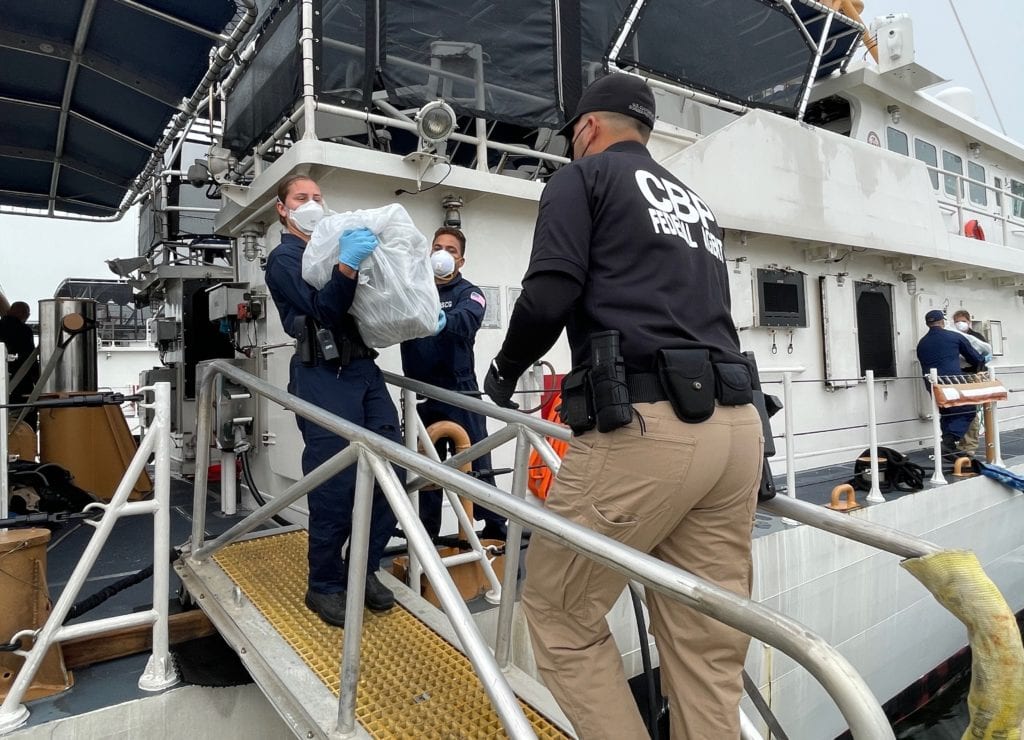
Coast Guard Cutter Tahoma’s crew offloads more than 7,500 pounds of cocaine, an estimated street value of $143.5 million, at Port Everglades, in Fort Lauderdale, Florida, June 14, 2021. U.S. COAST GUARD / Chief Petty Officer Charly Tautfest

MIAMI — Coast Guard Cutter Tahoma’s crew offloaded more than 7,500 pounds of cocaine in Port Everglades, Florida, an estimated street value of $143.5 million, Monday, after three interdictions in the Eastern Pacific Ocean, the Coast Guard 7th District said in a June 14 release. 

A maritime patrol flight spotted a vessel on April 16, and a Coast Guard law enforcement detachment team on the HMCS Saskatoon apprehended five suspects and nearly 4,000 pounds of cocaine from the low-profile vessel.  The vessel was destroyed as a hazard to navigation. 

A maritime patrol flight spotted a vessel on April 20, and Tahoma’s law enforcement team apprehended four suspects and 2,400 pounds of cocaine from the low-profile vessel, and again the vessel was destroyed.  

While on patrol, a Tahoma crewmember found cocaine bales floating in the water on April 23. The bales were recovered, totaling nearly 1,200 pounds of cocaine.