Coast Guard Cutter Tampa Offloads $94.6M in Cocaine in Miami
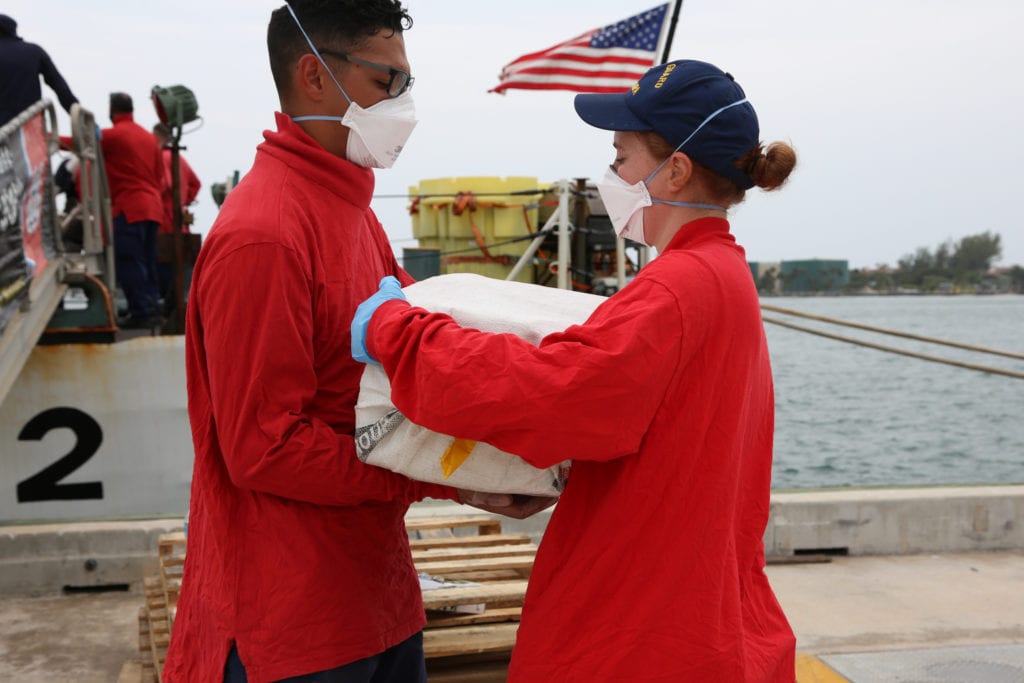
Coast Guard Cutter Tampa crew offloads approximately 5,500 pounds of cocaine, worth an estimated $94.6 million, at Base Miami Beach, Miami, Florida, April 20, 2021. On April 9, a maritime patrol flight spotted a vessel, and a Tampa law enforcement team interdicted a low profile vesseloff the coast of Punta Gallinas, Colombia. U.S. COAST GUARD / Chief Petty Officer Charly Tautfest
MIAMI — Coast Guard Cutter Tampa’s crew offloaded approximately 5,500 pounds of cocaine, worth an estimated $94.6 million, in Miami, April 20, after interdicting a low-profile vessel off the coast of Punta Gallinas, Colombia, the Coast Guard 7th District said in a release.
A maritime patrol flight spotted the vessel on April 9, and a law enforcement team from the cutter detained three suspects and discovered 87 bales of cocaine. The vessel was destroyed as a hazard to navigation and the suspects are reported to be in good health.
“This event is the perfect example of numerous key partners unifying our efforts to counter transnational criminal organizations who look to exploit the maritime environment,” said Lt. Cmdr. Jason Neiman, Seventh District public affairs officer. “By strengthening partnerships, we counter threats together.”
The interdiction was the result of multi-agency efforts in support of U.S. Southern Command’s enhanced counter-narcotics operations in the Western Hemisphere, the Organized Crime Drug Enforcement Task Force and High Intensity Drug Trafficking Area programs, and the Caribbean Corridor Strike Force.
Once aboard a Coast Guard cutter, all suspects receive food, water, shelter and basic medical attention. Throughout the interdiction, Coast Guard crew members were equipped with personal protective equipment to minimize potential exposure to any possible case of COVID-19. There were no suspects in these cases reported to have any COVID-19 related symptoms.
Coast Guard Offloads Nearly $20 million in Seized Cocaine in San Juan, Puerto Rico
The Coast Guard Cutter Richard Dixon crew offloaded nearly $20 million in seized cocaine at Coast Guard Base San Juan on April 20. U.S. COAST GUARD
SAN JUAN, Puerto Rico — The Coast Guard Cutter Richard Dixon crew offloaded nearly $20 million in seized cocaine at Coast Guard Base San Juan on April 20, following the interdiction of a suspected drug smuggling vessel, approximately 45 nautical miles north of Aguadilla, Puerto Rico, the Coast Guard 7th District said in an April 21 release.
A Customs and Border Protection Caribbean Air and Marine Branch maritime patrol aircraft crew detected a vessel on April 17 with three people aboard suspected of drug trafficking. The Coast Guard Cutter Paul Clark and a Coast Guard MH-60 helicopter responded to intercept the vessel.
The Coast Guard Jayhawk aircrew successfully stopped the vessel. Following the interdiction, it was discovered one of the suspected smugglers was injured and needed to be medevaced. A Coast Guard Air Station Borinquen MH-65 Dolphin aircrew transported the person to a hospital in Puerto Rico to receive further medical care.
The Paul Clark crew embarked the two remaining suspected smugglers and recovered close to 18 bales, which weighed approximately 1,052 pounds and tested positive for cocaine.
The three suspects are two men and a woman, Dominican Republic nationals, who are facing possible federal prosecution on drug trafficking criminal charges. Department of Justice partners in the U.S. Attorney’s Office for the District of Puerto Rico are leading prosecution efforts in this case.
“Stopping illegal drug trafficking vessels like the one interdicted Saturday is inherently dangerous and involves a high level of skill and risk,” said Capt. Gregory H. Magee, Commander of U.S. Coast Guard Sector San Juan. “These vessels represent a serious threat to the Caribbean region. The professionalism of the interdicting crews and strong partnerships with federal, local and regional law enforcement led to the apprehension of three smugglers and seizure of a major drug shipment in our shared resolve to protect the people of Puerto Rico and the U.S. Virgin Islands from this threat.”
The interdiction resulted from multi-agency efforts in support of U.S. Southern Command’s enhanced counter-narcotics operations in the Western Hemisphere, the Organized Crime Drug-Enforcement Task Force and High-Intensity Drug-Trafficking Area programs and the DEA Caribbean Division Financial Investigative Team.
“This Organized Crime Drug Enforcement Task Force investigation is one of several cases targeting transnational criminal organizations operating out of South America, Dominican Republic, and Puerto Rico,” said A.J. Collazo, DEA Caribbean Division special agent in charge. “DEA will continue to work alongside other federal agencies as more seizures like this one can be expected.”
Cutters Paul Clark and Richard Dixon are 154-foot fast response cutters respectively homeported in Miami and San Juan, Puerto Rico.
Coast Guard Cutter Escanaba Returns Home to Boston After 61-Day Patrol
The crew of Coast Guard Cutter Escanaba (WMEC 907), returned home to Boston, Tuesday, following a 61-day counter-narcotics patrol in the Caribbean Ocean. U.S. COAST GUARD
BOSTON —The crew of Coast Guard Cutter Escanaba (WMEC 907), returned home to Boston, Tuesday, following a 61-day counter-narcotics patrol in the Caribbean Ocean, the Coast Guard 1st District said in an April 19 release.
The 270-foot Escanaba’s 100-person crew supported operation Leeward Horizon and Unified Resolve, presidential initiatives designed to disrupt transnational criminal organizations in Central and South America.
Escanaba’s crew deployed with two members from the Barbadian Coast Guard, helping strengthen a vital maritime partnership and improving the interoperability between the two nations.
While transiting to their operational area, Escanaba’s crew provided humanitarian and medical assistance to 25 Haitian migrants including five children and a pregnant woman. The migrants were rescued from an unseaworthy vessel and were ultimately repatriated to Haiti.
The crew of Escanaba also rescued two mariners stranded at sea approximately 25 miles from St. Lucia and conducted two boardings of Venezuelan fishing vessels actively fishing in the territorial seas of other countries These boardings assisted in the disruption and reporting of wide spread illegal, unregulated and unreported fishing (IUU) in the area.
“I am very pleased with the total team effort from our crew on this patrol,” said Cmdr. Mike Nalli, Escanaba’s commanding officer. “We completed multiple training events with partner nations to combat the flow of illegal drugs into our country and disrupt the criminal networks which operate in that part of the Caribbean. Overall, the crew and I are thrilled with what we accomplished and are excited to be home.”
In addition, the crew of Escanaba also completed a biennial training assessments in Mayport, Florida prior to patrol departure. This training evaluated their overall readiness in five warfare categories: Weapons Systems, Command and Control, Damage Control and Medical, Engineering, and Navigation and Seamanship. Demonstrating proficient mission capabilities, the crew completed over 65 drills and evaluations, earning an overall score of 96%.
Known as “The Pride of Boston,” the Escanaba is a medium-endurance cutter homeported in Boston.
Vice Adm. Linda L. Fagan Nominated to be Coast Guard Vice Commandant, First Coast Guard Female 4-Star Admiral
Vice Adm. Linda L. Fagan, nominated to be the next vice commandant of the U.S. Coast Guard. U.S. COAST GUARD
WASHINGTON – Vice Adm. Linda L. Fagan has been nominated by the White House to be the next vice commandant of the U.S. Coast Guard, the service’s headquarters announced in an April 19 release.
She currently serves as the commander of the Coast Guard Pacific Area, overseeing all Coast Guard missions from the Rocky Mountains to the waters off the East Coast of Africa. Fagan concurrently serves as commander, Defense Force West and provides Coast Guard mission support to the Department of Defense and Combatant Commanders. Fagan is a 1985 graduate of the Coast Guard Academy and is the Coast Guard’s first-ever Gold Ancient Trident, the officer with the longest service record in the Marine Safety field.
“Vice Adm. Fagan is an outstanding leader with 36 years of Coast Guard operations, policy-making, joint service, and interagency experience,” said Adm. Karl L. Schultz, commandant of the U.S. Coast Guard. “Throughout her distinguished career, she has been a top performer and a trailblazer. As the Coast Guard’s first female four-star admiral, and President Biden’s nominee to serve as the Coast Guard’s 32nd vice commandant, Adm. Fagan will be instrumental in moving the Service forward at a critical juncture in our history.”
Secretary of Homeland Security Alejandro N. Mayorkas released a statement on Fagan’s nomination.
“I am pleased that President Biden has nominated Vice Admiral Linda Fagan to be the vice commandant of the United States Coast Guard,” it says. “She is a superb leader who, as the 32nd vice commandant, will guide the Coast Guard at a time when its mission of securing our maritime borders, ports, and waterways has never been more important. If confirmed, Vice Admiral Fagan would serve as the first woman to be promoted to a 4-star rank in the Coast Guard. We are grateful to Vice Admiral Fagan for continuing her service to country, for the trail she has blazed, and for inspiring us all.”
Pending confirmation, Fagan is expected to relieve current Vice Commandant of the Coast Guard Adm. Charles W. Ray on June 18.
Coast Guard Cutter Shearwater Decommissioned after 19 Years of Service
Coast Guard Cutter Shearwater, homeported in Cape May, New Jersey, is moored to the pier prior to the cutter’s decommissioning ceremony at Coast Guard Training Center Cape May, April 15, 2021. Coast Guard Cutter Shearwater was the 49th vessel of the Marine Protector Class of Coast Guard Patrol Boats. U.S. COAST GUARD / Petty Officer 3rd Class Kimberly Reaves
CAPE MAY, N.J. – The Coast Guard decommissioned the cutter Shearwater during a ceremony at Coast Guard Training Center Cape May that was presided over by Capt. Jonathan Theel, the commanding officer of Coast Guard Sector Delaware Bay, April 15, 2021, the Coast Guard 5th District said in a release.
Shearwater was one of the Coast Guard’s 70 remaining 87-foot Marine Protector-class patrol boats. Training Center Cape May is now the homeport to three Coast Guard Fast Response Cutters.
Commissioned in 2002, the Shearwater was the 49th of 73 coastal patrol boats built for search and rescue, ports, waterways, and coastal security, living marine resource enforcement, marine safety, and marine environmental protection.
“Shearwater is a special ship that has served District 5 throughout the course of her history,” said Master Chief Petty Officer Tony Martinez, commanding officer of the Shearwater. “With a who’s who of prominent Coast Guard members, including high profile command master chiefs and command cadres with multiple tours, Shearwater boasted some of the finest crews throughout her tenure. She has been a fixture in both of her homeports, remaining durable and dependable throughout her history. I personally want to thank all of the crews for their dedication and service to our great nation as they were instrumental to Shearwater’s mission of takin’ care of business.”
Shearwater’s keel was laid on April 30, 2002 at Bollinger Shipyards in Lockport, Louisiana. Shearwater was launched on Aug. 6, 2002, and commissioned on Oct. 5, 2002.
Over the past 19 years of service, Shearwater’s crews conducted a wide range of operations. Living up to the Shearwater’s motto “Takin’ Care of Business,” coined by the commissioning crew, crews completed 1,664 activities ranging from law enforcement boardings to search and rescue responses throughout the Mid-Atlantic region. From 2002 to 2018, the ship was homeported at Coast Guard Base Portsmouth, Virginia. Upon relocating to Cape May in 2018, the ship was dubbed “the Queen of the Cape” by a Coast Guard Auxiliarist.
During the cutter’s last year of service, the sunset crew of 12 enlisted crew members continued this legacy, conducting high profile operations including the disentanglement of a leatherback turtle off of Cape May in August of 2020, and an 18-hour tow of a disabled fishing vessel 70 nautical miles east of Cape Charles, Virginia.
“With a strong personal connection to the first officer in charge of this ship, I felt an immense honor being the final OIC aboard Shearwater,” said Martinez. “As I pause and reflect, remembering the first time I saw the ship from an 87 on the other end of the pier, the pride I feel commanding this ship is indescribable. To lead this sunset crew and watch them grow over the past two years has been humbling and rewarding. I am grateful for their dedication and service and look forward to staying in touch and following their careers. While our business here is done, we will proudly carry on Shearwater’s legacy of hard work and reliability.”
Navy, Coast Guard Formalize Partnership Between Naval Postgraduate School and Coast Guard Research and Development Center
A Coast Guard crewmember jettisons a Maritime Object Tracking Technology marker as part of a Coast Guard Research and Development Center technology demonstration on the Thames River, New London, Connecticut, Thursday, Feb. 15, 2018. U.S. COAST GUARD RESEARCH AND DEVELOPMENT CENTER
The U.S. Naval Postgraduate School (NPS) and Coast Guard Research and Development Center (RDC) signed a new five-year memorandum of understanding (MOU) on April 14, 2021, which facilitates collaboration on joint research that directly supports common defense priorities and Coast Guard statutory missions.
NPS President retired Vice Adm. Ann E. Rondeau and RDC Commanding Officer Capt. Dan Keane met on a virtual platform to both sign the document that will continue and enhance collaborative research and educational cooperation between the two institutions. The document establishes a framework for future collaboration, joint research and access to capabilities.
“The Tri-Service Maritime Strategy (TSMS), Advantage at Sea, prioritizes developing future capability and capacity for both the Navy and the Coast Guard,” said Rondeau. “Our formalized partnership not only strengthens the strong ties between NPS and the Coast Guard, but it brings to bear our defense-focused faculty and operationally experienced Navy and Coast Guard students in joint projects to develop our future force and support that strategy.”
Keane said partnerships are vital to the RDC portfolio accomplishment strategy, such as with Department of Defense and Department of Energy labs, the Federal Lab Consortium, and academia. “Perhaps one our strongest and most impactful partnerships is with the Naval Postgraduate School,” he said.
“Since an MOU was signed three years ago, the RDC has become a topic sponsor, we have proposed questions related to our portfolio that have turned into academic products; NPS researchers have worked with our researchers on summer studies; and we have provided platforms for NPS experimentation. We believe that we have just scratched the surface and the future is incredibly bright,” said Keane. “The partnership is strong today, and is only going to grow stronger in the future. We are excited about the next five years.”
According to a joint statement about the signing, the MOU will help focus NPS on aspects of the TSMS that chiefly fall to the Coast Guard to define research projects that those students, and NPS faculty, can work on together and advance toward solving key maritime challenges. “In addition to identifying thesis topics of mutual interest, the MOU includes access and use of each institution’s unique laboratories and facilities, and involves other key research exchanges to mutually advance their mission of research and education for warfighting advantage,” the statement said.
Planning is underway to facilitate joint research projects on such things including renewable energy, additive manufacturing, maritime-domain awareness and wargaming.
There is a small cohort of mid-career Coast Guard officers attending NPS as students, joining the 600 naval officers and 300 Marine Corps officers attending the school.
According to NPS Dean of Research Dr. Jeffery Paduan, NPS has an impressive cadre of subject matter experts. The school offers masters and doctorate programs in 70 different fields of studies with 227 tenure-track faculty and 347 non-tenure track faculty.
Paduan said both NPS and RDC have distinguished histories as leading research institutions. “The Navy and Coast Guard face overlapping challenges at sea, and both of our organizations complement each other in addressing these problems. This MOU will lead to many more joint projects and shared benefits.”
Students will benefit from thesis topics and capstone projects of mutual interest, with access to each institution’s unique laboratories, facilities, expertise and research capabilities at sea and ashore.
Rondeau said the teaming brings opportunities to understand and solve problems, and solidifies a promising “partnership in science, technology, education, learning and teaming — and in the end, winning. This MOU opens up our apertures to possibilities that are in front of us. I truly believe this has power beyond even what we can imagine today.”
Coast Guard Repatriates 14 Migrants to Cuba
Coast Guard crews took 14 migrants off a rustic vessel, April 10, 2021, due to safety of life at sea concerns off Key West, Florida. They were repatriated to Cuba on April 13, 2021. U.S. COAST GUARD
MIAMI — Coast Guard Cutter Raymond Evans’ crew repatriated 14 Cuban migrants to Cuba April 13, the Coast Guard 7th District said in a release.
A good Samaritan reported the rustic vessel with 14 people aboard to Coast Guard Sector Key West watchstanders Saturday approximately 35 miles northwest of Key West.
Station Key West rescue crews arrived on scene to find the people showing signs of dehydration and being sunburnt. They were taken off their vessel due to safety of life at sea concerns.
“The Florida Straits are unpredictable,” said Coast Guard Liaison Officer Lt. Cmdr. Mario Gil, U.S. Embassy Havana. “It is not safe to take to the seas in makeshift vessels that aren’t seaworthy.”
Since Oct. 1, 2020, Coast Guard crews have interdicted 166 Cubans compared to fiscal year 2019, Oct. 1, 2018 – Sept. 30, 2019, where crews interdicted 314 Cubans.
Once aboard a Coast Guard cutter, all migrants receive food, water, shelter and basic medical attention. Throughout the interdiction, Coast Guard crew members were equipped with personal protective equipment to minimize potential exposure to any possible case of COVID-19. There were no migrants in these cases reported to have any COVID-19 related symptoms.
Coast Guard Cutter Forward Returns Home after Drug-Busting Patrol
Coast Guard Cutter Forward and Coast Guard Cutter Bear, homeported in Portsmouth, Virginia, finish an at-sea transfer while underway on a two-month patrol. Coast Guard Cutter Forward returned to homeport on April 10, 2021. U.S. COAST GUARD
PORTSMOUTH, Va. — The Coast Guard Cutter Forward (WMEC 911) returned to its homeport in Portsmouth April 12 after a two-month patrol in the Eastern Pacific Ocean, working to suppress and eradicate the movement of illegal drugs in the region, the Coast Guard 5th District said in an April 13 release.
The crew of the Forward worked in conjunction with U.S. Customs and Border Protection (CBP) Air and Marine Operations (AMO) and the Canadian Navy to execute the mission, resulting in the seizure of 6,800 pounds of cocaine, 5,300 pounds of marijuana, two pounds of methamphetamine and the detainment of 14 suspected drug smugglers.
“These deployments highlight our successful interoperability with multiple domestic and international partners all committed to curbing the flow of illegal drugs to our borders,” said Lt. Vincent Zieser, the operations officer and lead coordinator aboard the Forward. “We certainly enjoyed their support and teamwork.”
U.S. Southern Command began what was then known as Enhanced Counter-Narcotics Operations in the Western Hemisphere to increase drug traffic disruption on April 1, 2020. This counter Transnational Criminal Organizations operational approach, which is now enduring, supports objectives to degrade the capabilities of TCOs and ultimately save lives. With increased presence, collaborative efforts have bolstered support to U.S. and partner nations’ law enforcement agencies by sharing information and intelligence. Key partners have been involved in over 60% of drug disruptions since April 2020, an increase of 50% from 2019. By strengthening partnerships, we maximize regional coverage and increase effectiveness.
There are numerous U.S. agencies from the Departments of Defense, Justice and Homeland Security cooperated in the effort to combat transnational organized crime. The Coast Guard, Navy, Customs and Border Protection, FBI, Drug Enforcement Administration, and Immigration and Customs Enforcement, along with allied and international partner agencies, play a role in counter-drug operations.
The fight against drug cartels in the Eastern Pacific Ocean requires unity of effort in all phases from detection, monitoring and interdictions, to criminal prosecutions by international partners and U.S. Attorneys’ Offices in districts across the nation. The law enforcement phase of counter-smuggling operations in the Eastern Pacific Ocean is conducted under the authority of the 11th Coast Guard District, headquartered in Alameda. The interdictions, including the actual boardings, are led and conducted by members of the U.S. Coast Guard
The Forward is a 270-foot medium-endurance cutter homeported in Portsmouth. The cutter’s primary mission includes search and rescue, illegal drug interdictions, alien migrant interdictions, ensuring safety of life at sea and enforcing international and domestic maritime laws.
Cutter Kimball Returns Home from Expeditionary Patrol in the Pacific
The crew of the Coast Guard Cutter Kimball (WMSL 756) underway in the Pacific, April 4, 2021. The Kimball was conducting an expeditionary patrol supporting Operation Blue Pacific, Op Rai Balang, and Op Aloha Shield. U.S. COAST GUARD
HONOLULU — The crew of the Coast Guard Cutter Kimball (WMSL 756) returned to Honolulu April 9 after completing an expeditionary patrol supporting Operation Blue Pacific, Operation Rai Balang and Operation Aloha Shield in the Pacific, the Coast Guard 14th District said in an April 9 release.
During the 82-day patrol, the cutter’s crew worked closely with partners and allied nations on numerous missions ranging from search and rescue to the prevention of illegal, unreported, and unregulated fishing (IUU) while promoting stability and security throughout the region.
“I’m tremendously proud of my crew’s exceptional performance, especially considering how their dedication and teamwork allowed them to overcome the many challenges associated with operating by ourselves for long periods of time in remote locations and the difficulties created by the global pandemic,” said Capt. Holly Harrison, the Kimball’s commanding officer. “They adapted and overcame every obstacle and challenge put in their way with ease, exactly what you’d expect from our phenomenal Coast Guardsmen and women.”
One of the main goals of the 20,000 nautical-mile patrol was to assist the United States’ partners in the region with combating IUU.
Throughout the deployment the cutter’s crew worked closely with the Pacific Islands Forum Fisheries Agency (FFA) during Op Rai Balang, a coordinated effort between partners in the region to combat IUU, while also enforcing Western and Central Fisheries Commission regulations on the high seas to protect the region’s fish stocks.
Fish stocks are a vital renewable resource for many nations in the Pacific. Because of the migratory nature of fish, efforts towards their conservation requires teamwork between the partner nations.
The multi-million-dollar IUU fishing industry represents a direct threat to the partners efforts to ensure these resources remain sustainable for years to come and throughout the patrol the crew of the Kimball worked with the governments of the Solomon Islands, Federated States of Micronesia, and Papau New Guinea to strengthen domain awareness and resource security within the nation’s economic exclusive zones.
During the patrol, the crew queried 21 foreign fishing vessels and boarded six, generating vital information reports for the partners in their efforts to combat IUU.
“The National Security Cutters bring a capacity and capability into the Coast Guard which are truly game changing when it comes to curbing IUU in the Pacific,” said Rear Adm. Matthew Sibley, commander, Coast Guard 14th District. “Patrols such as the Kimball’s display these cutters ability to cover large swaths of the Pacific and support our partners in joint conservation efforts while contributing to the overall stability of the region.”
The Kimball is one of the Coast Guard’s newer 420-foot Legend-class National Security Cutter and boasts a wide array of modern capabilities helping the crew to complete their varied missions.
Throughout the patrol, the crew used the cutter’s ability to deploy unmanned aircraft systems (UAS) to collect observation reports on vessels of interest which were shared with Maritime Security Advisors and the FFA Regional Fisheries Surveillance Center.
The UAS was also utilized during both day and night searches for a missing mariner southwest of Guam, displaying the versatility of the new technology and its potential in multiple types of missions.
Another key goal of the patrol was to increase interoperability between the Coast Guard and partners in the region.
The Kimball’s crew participated in a number of exercises with partners in the region, including training with a Royal Australian Navy Sea Dragon aircraft crew during the FFA Op Rai Balang, joint interdiction training with the Japan coast guard ship Akitsushima, and an exercise with the USS Tulsa.
“Over the past 82-days, Kimball’s crew conducted joint operations with the Japanese coast guard, Royal Australian Navy, Pacific Islands Forum Fisheries Agency and U.S. Navy.” said Harrison. “In each operation, we were thoroughly impressed with our partners’ professionalism, skill, and commitment to Oceania and regional security.”
Cutter Returns Home following Eastern Pacific Law-Enforcement Patrol
The USCGC Alert (WMEC 127) and its crew return to homeport in Astoria, Oregon, Wednesday, April 7, 2021, following a 63-day patrol that began in early February. The cutter and crew patrolled off the coast of Mexico and in the vicinity of the United States-Mexico Maritime Boundary Line enforcing international laws and treaties to disrupt illegal narcotics and migrant smuggling. U.S. Coast Guard photo by Petty Officer 1st Class Cynthia Oldham.
ASTORIA, Ore. — The Coast Guard Cutter Alert (WMEC 630) returned home to Astoria, Oregon, April 7 following a 63-day counterdrug patrol in the Eastern Pacific Ocean, the Coast Guard Pacific Area said in a release.
Working in conjunction with different Coast Guard and Mexican law enforcement agencies, Alert’s crew disrupted more than 2,100 pounds of cocaine, valued at over $41 million wholesale, from entering the United States.
The Oregon-based cutter and crew patrolled international waters off the coast of Mexico and the United States-Mexico Maritime Boundary Line, enforcing international laws and treaties throughout their deployment and disrupting the flow of illegal narcotics and migrant smuggling.
While on patrol, a maritime patrol aircraft spotted a suspected smuggling vessel. Alert’s crews launched both cutter small boats and pursued the vessel until it ran out of fuel. The case was transferred to Mexican law enforcement officials from the Secretaría de Marina (SEMAR).
Through the collaborative and international team effort, the smugglers were successfully apprehended, and 1,600 pounds of illegal narcotics seized by Mexican Law Enforcement.
Within 48 hours, Alert’s crew identified another law enforcement case for interdiction and changed course to intercept the suspected smuggling vessel. After a multi-hour pursuit, the crew successfully interdicted approximately 550 pounds of cocaine and apprehended six suspected narco-traffickers for prosecution in the United States.
Numerous U.S. agencies from the Departments of Defense, Justice and Homeland Security cooperated in the effort to combat transnational organized crime. The Coast Guard, Navy, Customs and Border Protection, FBI, Drug Enforcement Administration, and Immigration and Customs Enforcement, along with allied and international partner agencies, play a role in counter-drug operations.
Alert’s crew transferred the seized narcotics and suspected drug traffickers to the Department of Justice, via Coast Guard Station San Diego March 1 before steaming north to complete their three-week Tailored Ship Training Assessment, a bi-annual assessment designed to evaluate the cutter’s training teams and operational readiness.
“Once again, the crew of Alert was able to overcome the challenges of the COVID-19 pandemic and equipment failures on a 50-year-old ship to execute a wide range of Coast Guard missions from the US-Canada Border to the Mexico-Guatemala border over a two-month period,” said Cmdr. Tyson Scofield, Alert’s commanding officer. “Overall, Coast Guard Cutter Alert successfully completed a variety of operations through the combined effort of every member of the crew.”
While patrolling the Eastern Pacific, Alert’s watchstanders identified a sea turtle entangled in fishing debris. The cutter maneuvered into position and launched its small boat to help the endangered sea animal, ultimately setting the sea turtle free from the entwined debris. Marine environmental protection is a statutory mission of the Coast Guard and every year approximately 300 sea turtles are saved by the Coast Guard.
“Marine life has always had a special place in my heart. When the opportunity to save a turtle arose, I was beyond excited to help,” said Petty Officer Third Class Timothy Waters who was aboard the small board to help free the entangled sea turtle. “I am honored to have done something so small that contributes to something much larger than me.”