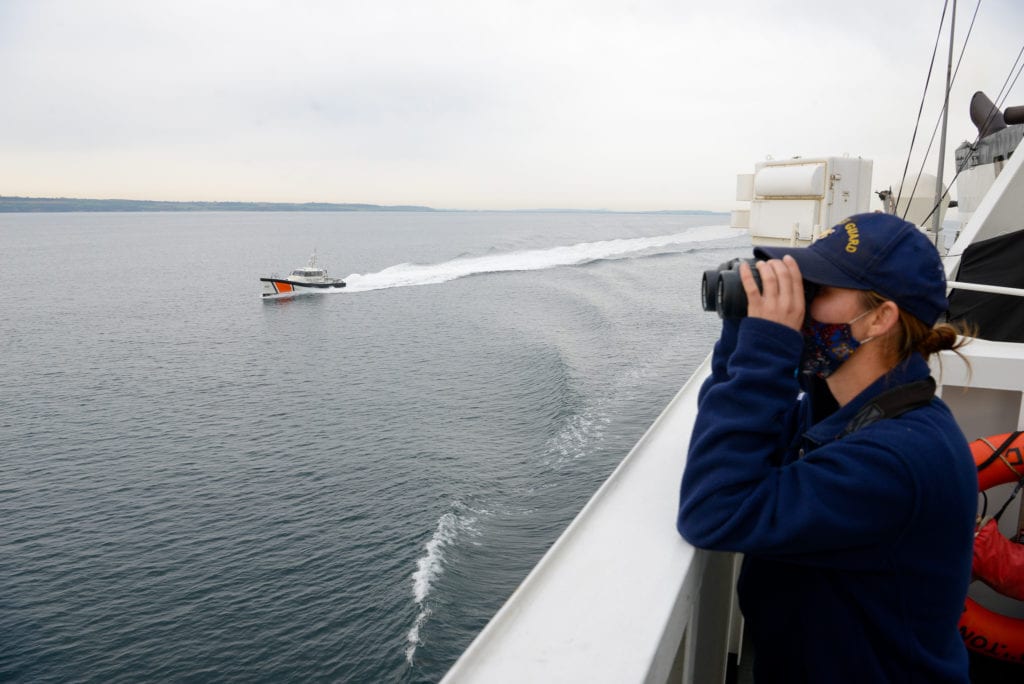
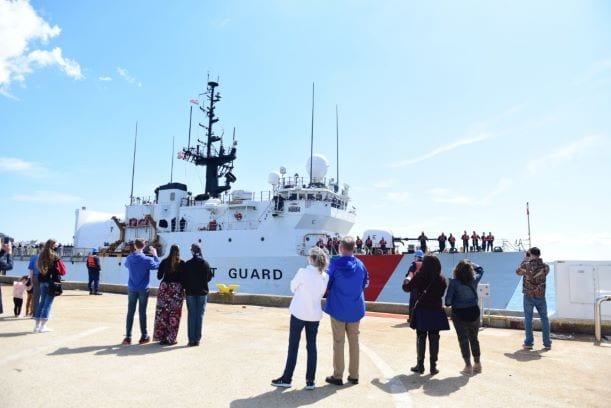
Seaman Cheyenne Solis Headlam looks out from the bridge wing of USCGC Hamilton (WMSL 753) while the Turkish coast guard escorts Hamilton in the Mediterranean Sea, April 27, 2021. U.S. Coast Guard Cutter Hamilton is on a routine deployment in the U.S. 6th Fleet area of operations in support of U.S. national interests and security in Europe and Africa. U.S. COAST GUARD photo by Petty Officer 3rd Class Sydney Phoenix
BLACK SEA — The Legend-class national security cutter USCGC Hamilton (WMSL 753) transited into the Black Sea to support NATO Allies and partners, April 27, 2021, the U.S. U.S. Naval Forces Europe and Africa/U.S. 6th Fleet Public Affairs said in an April 27 release.
Hamilton is the first U.S. Coast Guard cutter to visit the Black Sea since 2008. The last U.S. Coast Guard cutter to visit the Black Sea, USCGC Dallas (WHEC 716), sailed to the Black Sea twice, in 2008 and 1995.
The Ticonderoga-class guided-missile cruiser USS Monterey (CG 61) and Arleigh Burke-class guided-missile destroyer USS Thomas Hudner (DDG 116) conducted Black Sea operations on a routine patrol to maintain maritime security alongside other NATO Allies and partners in March 2021.
This patrol comes after Hamilton conducted logistics visits to Naples, Italy, and Rota, Spain. The U.S. Coast Guard is conducting a routine deployment in U.S. 6th Fleet, working alongside allies, building maritime domain awareness and sharing best practices with partner nation navies and coast guards.
The U.S. Navy and U.S. Coast Guard operate forward, from the littoral to the open ocean, ensuring stability and open sea lanes across all maritime domains. U.S 6th Fleet routinely conducts operations in the Black Sea.
Hamilton is the fourth national security cutter and is the fifth named for the father of the U.S. Coast Guard — Alexander Hamilton, the first secretary of the Treasury and advocate for creating the U.S. Revenue Cutter Service.
The U.S. Coast Guard remains operational during COVID-19, following all COVID-19 safety precautions and regulations.
Coast Guard Cutter Delivers Emergency Supplies to Palau following Typhoon Surigae
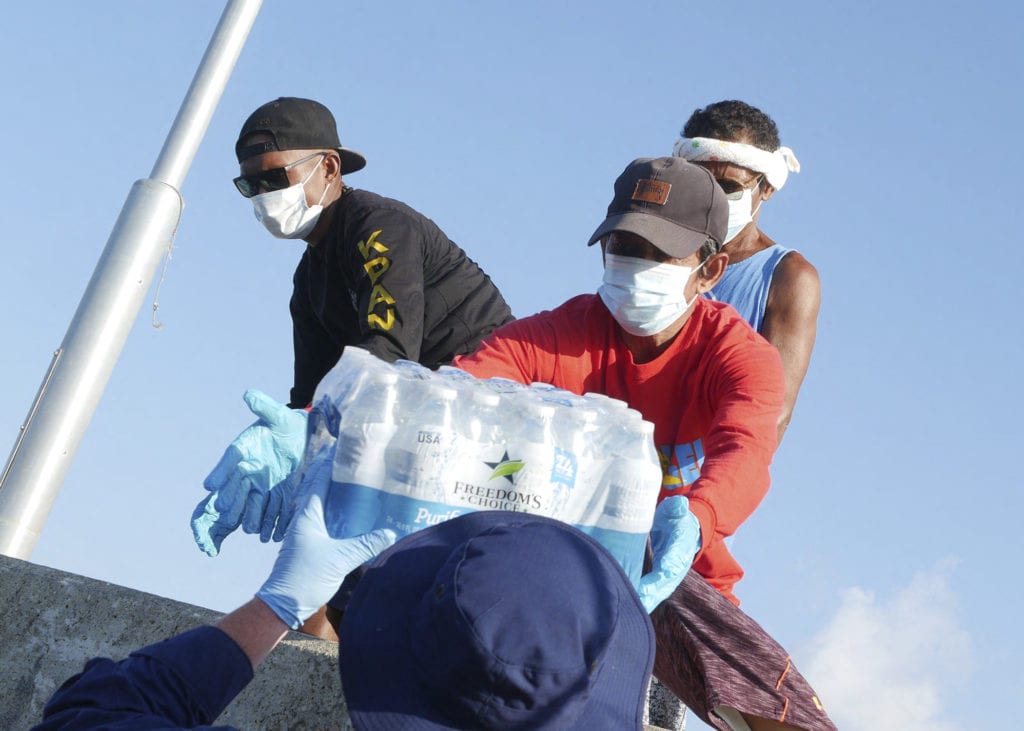
The crew of the Coast Guard Cutter Myrtle Hazard (WPC 1139) deliver emergency supplies to the island of Kayangel, Palau, following Typhoon Surigae, April 24, 2021.The supplies included water and food for the people of Kayangel. U.S. COAST GUARD photo courtesy of Petty Officer 3rd Class Philip Groff
SANTA RITA, Guam — The crew of the Coast Guard Cutter Myrtle Hazard (WPC 1139) delivered emergency supplies including water and food to the island of Kayangel, April 24, the Coast Guard 14th District said in an April 26 release.
The mission was in response to a national emergency declared by President Surangel Whipps Jr. of Palau after Typhoon Surigae devastated the region last week.
“Today, our crew had a unique opportunity to conduct one of the most satisfying missions the United States Coast Guard is known for, humanitarian aid,” said Petty Officer 2nd Class Andrew Johnson, a coxswain aboard the Myrtle Hazard. “We were extremely excited to be able to offer help, which for a small island such as Kayangel makes a major impact. I am proud I was able to be a part of it.”
Last week the slow-moving typhoon made landfall in Palau bringing significant rainfall and heavy winds. The storm caused flooding and resulted in damage to homes and properties throughout the islands.
On April 18, the president of Palau declared a national emergency and made an official request to the United States embassy for assistance. Capt. Christopher Chase, commander, Coast Guard Sector Guam and Ambassador John Hennessey-Niland, U.S. Embassy Koror, spoke by phone and determined what supplies were needed and the best method to deliver them.
At the time, the Myrtle Hazard’s crew was conducting an illegal, unreported and unregulated fisheries patrol north of Guam and was recalled back to homeport for the humanitarian mission.
On Guam, supplies were being donated and collected by a number of different organizations including the Chief Petty Officers Association Marianas Chapter, the U.S Naval Base Chapel, the Orotte Commissary, the Ngaraad Club of Guam, the Kayangel Club of Guam and the Guam Paluan community.
The cutter then departed Guam for the 800 nautical mile transit to Palau with the supplies.
Upon arriving in Palau the crew worked closely with the government and the U.S. embassy to coordinate a safe, contactless transfer of the supplies to Kayangel and to ensure the safety of both the people of Palau and the cutters crew while conserving the nation’s vital medical supplies.
“It’s a rewarding mission to deliver aid whenever required,” said Lt. Tony Seleznick, the Myrtle Hazard’s commanding officer. “This operation exemplified the great partnership between the U.S. and the Republic of Palau. The crew of Myrtle Hazard performed excellently and highlighted why the U.S. Coast Guard is the world’s best Coast Guard.”
Coast Guard Decommissions Service’s Final High-Endurance Cutter
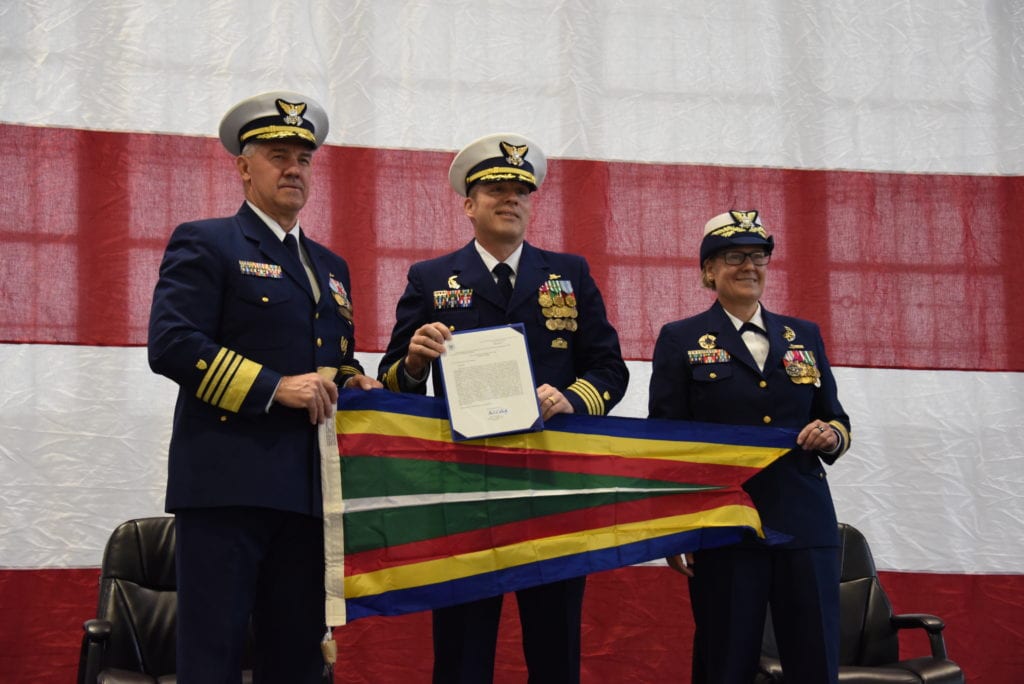
Coast Guard Commandant Adm. Karl L. Schultz, Vice Adm. Linda Fagan, and Capt. Riley Gatewood, hold a pennant during the Coast Guard Cutter Douglas Munro (WHEC 724) decommissioning ceremony in Kodiak, Alaska, on April 24, 2021. In 1998, the cutter interdicted over 11.5 tons of cocaine on a Mexican flagged vessel, the Xolesuientle, to this day one of the largest single drug seizures in Coast Guard history. COAST GUARD / Petty Officer 3rd Class Janessa Warschkow
KODIAK, Alaska — The Coast Guard Cutter Douglas Munro (WHEC 724) was decommissioned during a ceremony Saturday at Coast Guard Base Kodiak and presided over by Coast Guard Commandant Adm. Karl Schultz, the Coast Guard Pacific Area said in an April 24 release.
The Douglas Munro was the Coast Guard’s last remaining 378-foot Hamilton-class high-endurance cutter. The fleet of high-endurance cutters is being replaced by 418-foot Legend-class national security cutters, which serve as the Coast Guard’s primary long-range asset.
Commissioned in 1971, Douglas Munro was the tenth of 12 high-endurance cutters built for long-range, high-endurance missions, including maritime security roles, drug interdiction, illegal migrant interception and fisheries patrols.
The cutter was named after Signalman 1st Class Douglas Albert Munro, who was awarded the Medal of Honor for acts of extraordinary heroism during World War II.
Munro was the officer-in-charge of an eight-craft amphibious landing force during the Guadalcanal Campaign and used his landing craft and its .30 caliber machine gun to shield and protect several hundred Marines who were under heavy enemy fire. He was mortally wounded during this effort, but his actions allowed for the Marines to be extracted by other landing craft. For these actions Munro was posthumously bestowed the Medal of Honor, making him the only person to receive the medal for actions performed during service in the Coast Guard.
“Today we say thank you and goodbye to the end of an era — an era of nearly 50 years when high endurance cutters took our service’s racing stripe around the globe, modeling the maritime rules-based order,” said Schultz during the ceremony. “Today we say thank you and goodbye to cutter Douglas Munro — the first cutter to be named after Coast Guard hero — Signalman First Class Douglas Munro.”
Over the past 49-years of distinguished service, Douglas Munro’s crews have served in a multitude of domestic and international theaters including the Bering Sea and Gulf of Alaska, Persian Gulf and Horn of Africa, and Southeast Asia and the Eastern Pacific. The cutters proud legacy of honorable service to the nation began in the early 1970s patrolling Ocean Stations Delta, Bravo and November, providing weather data to trans-Pacific flights, supporting oceanographic research missions and performing search-and-rescue operations.
The crew of Douglas Munro also patrolled the Pacific for decades as an enforcer of fisheries regulations. In 1998, Douglas Munro’s crew discovered and seized over 11.5 tons of cocaine from a Mexican flagged vessel, the Xolesuientle, in what remains to this day one of the largest single drug seizures in Coast Guard history. The following year, Douglas Munro’s crew seized the motor vessel Wing Fung Lung, which was attempting to transport 259 illegal Chinese migrants to the United States.
In early 2005, at the beginning of a six-month, 37,000 mile global circumnavigation that included support to Operations Iraqi Freedom and Enduring Freedom, the crew of Douglas Munro was diverted to render assistance to countries affected by the Indian Ocean tsunami on December 26, 2004.
The legacy of Douglas Munro was epitomized on March 23, 2008 when the cutter’s crew and their embarked MH-65 Aviation Detachment worked with a forward deployed Air Station Kodiak MH-60 helicopter crew to recover 20 survivors from the fishing vessel Alaska Ranger that sank in the Bering Sea early that morning. The 17th Coast Guard District commander at the time of the rescue, Rear Adm. Arthur Brooks, declared it “One of the greatest search and rescue efforts in modern history.”
“Serving as the final crew aboard the Coast Guard Cutter Douglas Munro, the last 378-foot cutter in the Coast Guard has been an exciting and rewarding experience for myself and my shipmates,” said Capt. Riley Gatewood, commanding officer of the Douglas Munro. “During my time aboard I have witnessed the sacrifices of the crew as they spent time away from their loved ones in service to their country. This dedication echoes the hard work put forth by our predecessors during the cutter’s 49-years of service and embodies the ships motto ‘Honoring the past by serving the present.’ While Coast Guard Cutter Douglas Munro is being decommissioned, I know that the legacy and service of Signalman 1st Class Douglas Albert Munro lives on in the Coast Guard men and women serving around the world today, and in the national security cutter Munro that continues to bear his name.”
Cutter Bear Returns Home After Interdicting $140+ Million of Illicit Drugs
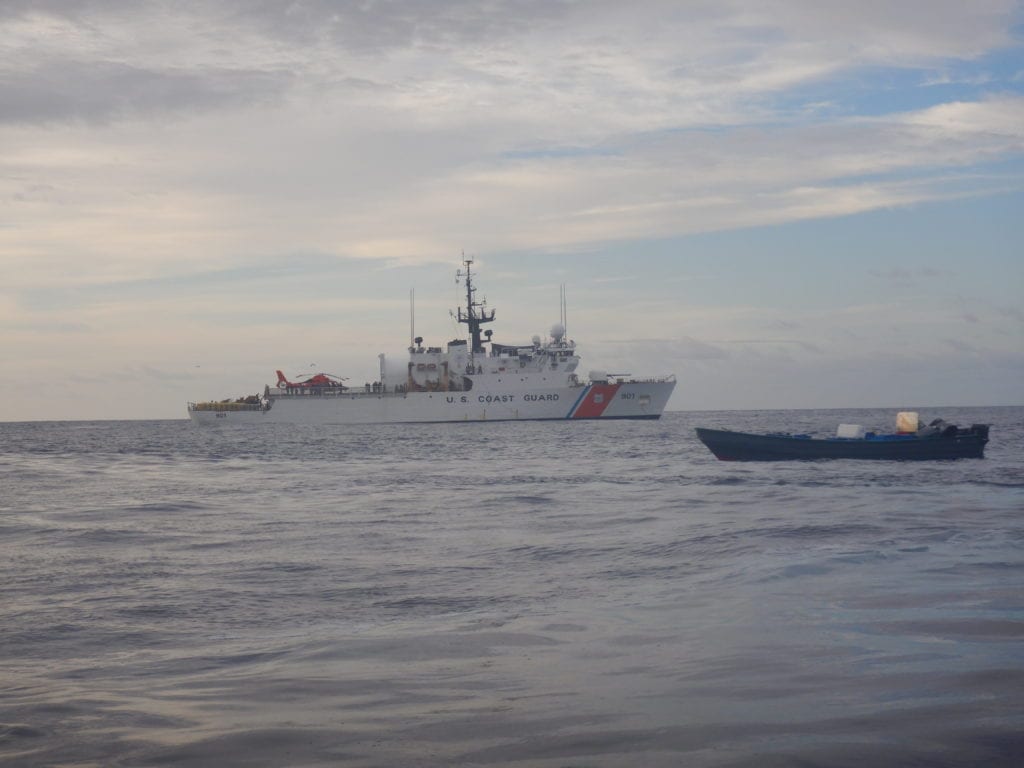
Coast Guard Cutter Bear personnel offload approximately 2,300 lbs of cocaine worth more than $43.7 million at Port Everglades in Ft. Lauderdale, Florida, April 20, 2021. On April 1, 2020, U.S. Southern Command began what was then known as Enhanced Counter Narcotics (CN) Operations in the Western Hemisphere to increase the disruption of drugs. U.S. COAST GUARD photo by Chief Petty Officer Charly Tautfest
PORTSMOUTH, Va. — The crew of the Coast Guard Cutter Bear (WMEC 901) returned home to Portsmouth Sunday following an 86-day counter-drug patrol in the Eastern Pacific Ocean, the Coast Guard 5th District said in an April 26 release.
The Bear’s crew interdicted three vessels, seized approximately 8,158 pounds of cocaine, two pounds of methamphetamines, as well as marijuana, worth a combined total of over $140 million, and detained 12 suspected drug smugglers.
The Bear’s crew also coordinated operations with the U.S. Coast Guard’s Tactical Law Enforcement Team South Law Enforcement Detachment (LEDET-108), who were deployed aboard the HMCS Saskatoon, a Kingston-class coastal defense vessel from the Canadian Navy. The collaboration supported LEDET-108’s seizure of an additional 2,866 pounds of cocaine and the detention of three suspected smugglers.
A flight crew and aviation detachment from the Coast Guard’s Helicopter Interdiction Tactical Squadron (HITRON), deployed aboard the Bear for the patrol. HITRON crews specialize in airborne use of force, and are based out of Jacksonville, Florida. The crew of the Bear worked in preparation for the counter-narcotics mission, partaking in numerous flight operations to recertify the flight crew and enhance crew proficiency in shipboard helicopter operations and non-complaint vessel training.
The Bear’s crew departed Portsmouth to conduct joint training exercises with the U.S. Navy on January 31. The Bear supported the Navy’s training exercise while operating off the coast of Virginia and the Carolinas, and the crew took advantage of the unique opportunity to become more proficient at wartime steaming.
“I am extremely proud of this crew and honored to be their commanding officer,” said Cmdr. Jeff Ferlauto, the Bear’s commanding officer. “It’s been an extremely successful deployment and the crew met each challenge head-on. Since our initial transit through the Panama Canal into the Eastern Pacific, this crew dominated! As we get ready for the home stretch, I want to personally thank all the families and friends for their continued support. I realize that our personal lives and our devotion to duty are in constant tension. We have chosen to serve our country and execute missions that take us far from home and require extended absences from our loved ones.”
The Bear is a 270-foot medium-endurance cutter homeported in Portsmouth.
Coast Guard Repatriates 18 Migrants to the Dominican Republic
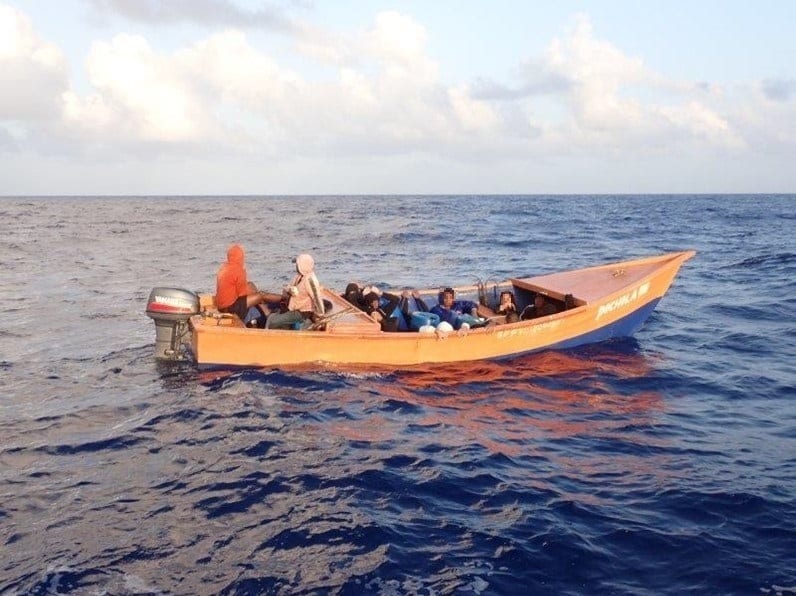
A makeshift vessel, with 18 migrants aboard interdicted in Mona Passage waters by the crew of the Coast Guard Cutter Joseph Tezanos April 20, 2021. The migrants, 17 men and a woman, who claimed to be Dominican Republic nationals, were repatriated to a Dominican Republic Navy vessel just off the Dominican Republic April 22, 2021. U.S. COAST GUARD
SAN JUAN, Puerto Rico — The Coast Guard Joseph Tezanos crew repatriated 18 migrants to a Dominican Republic Navy vessel April 22, following the interdiction of migrant voyage in Mona Passage waters between the Dominican Republic and Puerto Rico, the Coast Guard 7th District said in an April 22 release.
The migrant group consists of 17 men and a woman, who claimed to be Dominican Republic nationals.
The interdiction is the result of ongoing efforts by Caribbean Border Interagency Group (CBIG) partner agencies to combat illegal migrant smuggling.
The aircrew of a Customs and Border Protection maritime patrol aircraft detected the illegal voyage on April 20; a grossly overloaded 25-foot makeshift vessel in waters northwest of Aguadilla, Puerto Rico. The Coast Guard Cutter Joseph Tezanos responded and, with the assistance of the cutter’s small boat, stopped the migrant vessel. The Joseph Tezanos crew embarked the migrants due to safety of life at sea concerns and destroyed the makeshift vessel as a hazard to navigation.
Prior to embarking, the Joseph Tezanos crew provided the migrants with lifejackets. Once aboard the cutter, the migrants received food, water and basic medical attention.
“These 18 migrants are among the hundreds of others who risk their lives yearly to enter Puerto Rico illegally on makeshift grossly overloaded vessels,” said Lt. Anthony Orr, Coast Guard Cutter Joseph Tezanos commanding officer. “I could not be prouder of my crew for working efficiently and tirelessly to care for these migrants and ensure their safe repatriation. The success of this operation was due to the impeccable teamwork that we had with CBP, Coast Guard Air Station Borinquen, and Sector San Juan’s Command Center and Enforcement Division.”
Cutter Joseph Tezanos is a 154-foot fast response cutter homeported in San Juan, Puerto Rico.
LOCKPORT, La. — Bollinger Shipyards LLC has delivered the USCGC Glenn Harris to the U.S. Coast Guard in Key West, Florida, the company said in an April 22 release. This is the 167th vessel Bollinger has delivered to the U.S. Coast Guard over a 35-year period and the 44th fast response cutter (FRC) delivered under the current program.
The Glenn Harris is the third of six FRCs to be home-ported in Manama, Bahrain, which will replace the aging 110-foot Island-class Patrol Boats, built by Bollinger Shipyards 30 years ago, supporting the Patrol Forces Southwest Asia (PATFORSWA), the U.S. Coast Guard’s largest overseas presence outside the United States.
“Bollinger is proud to continue enhancing and supporting the U.S. Coast Guard’s operational presence and ensuring it remains the preferred partner around the world,” said Bollinger President and Chief Executive Ben Bordelon. “It is our top priority to ensure that the brave men and women of the Coast Guard stationed in PATFORSWA have the most state-of-the-art, advanced vessels as they work to build and maintain the necessary regional alliances to ensure maritime security in the region. Building ships for the Coast Guard provides critical assets to bolster our national security and advance America’s interests, both at home and abroad.”
Earlier this year at the commissioning ceremony of the USCGC Charles Moulthrope, U.S. Coast Guard Commandant Adm. Karl Schultz lauded the “enhanced seakeeping” capabilities of the PATFORSWA-bound FRCs, saying “these ships are truly going to be game changing in their new theater of operations” and “offer increased opportunities for integrated joint operations with our Navy and Marine Corps colleagues” as the Coast Guard seeks to be part of the whole-of-government solution set in the region.
PATFORSWA is composed of six cutters, shoreside support personnel and the Maritime Engagement Team. The unit’s mission is to train, organize, equip, support and deploy combat-ready Coast Guard Forces in support of U.S. Central Command and national security objectives. PATFORSWA works with Naval Forces Central Command in furthering their goals to conduct persistent maritime operations to forward U.S. interests, deter and counter disruptive countries, defeat violent extremism and strengthen partner nations’ maritime capabilities in order to promote a secure maritime environment.
Earlier this week, Bollinger announced the acquisition of Gulf Island Fabrication Inc.’s Terrebonne Parish shipyard facilities, expanding the company’s new construction and repair capacity and capabilities to better serve its key defense and commercial customers. The acquisition increases the shipyard’s growing new construction and repair portfolio. Gulf Island had been building the Towing, Salvage and Rescue Ships (T-ATS) for the U.S. Navy and Regional Class Research Vessels for the National Science Foundation and Oregon State University. These projects conveyed with the transaction.
The crew of the Coast Guard Cutter Glenn Harris, a pre-commissioned 154-foot Fast Response Cutter, pulls a person from the water April 13, 2021, after a 175-foot commercial lift boat capsized 8 miles south of Grand Isle, Louisiana. The Coast Guard and multiple good Samaritan vessels responded to the capsized vessel and searched for multiple missing people in the water. U.S. COAST GUARD / Coast Guard Cutter Glenn Harris
Each FRC is named for an enlisted Coast Guard hero who distinguished themselves in the line of duty. Surfman Glen Harris piloted the first wave of landing craft on Tulagi Island in the Pacific Theater during World War II, and also made a landing against a Japanese force on Guadalcanal Island. Harris was awarded a Silver Star medal by Adm. Chester Nimitz for his heroic combat actions.
The FRC is an operational “game changer,” according to senior Coast Guard officials. FRCs are consistently being deployed in support of the full range of missions within the United States Coast Guard and other branches of our armed services. This is due to its exceptional performance, expanded operational reach and capabilities, and ability to transform and adapt to the mission. FRCs have conducted operations as far as the Marshall Islands—a 4,400 nautical mile trip from their homeport. Measuring in at 154 feet, FRCs have a flank speed of 28 knots, state of the art C4ISR suite (command, control, communications, computers, intelligence, surveillance and reconnaissance) and stern launch and recovery ramp for a 26-foot, over-the-horizon interceptor cutter boat.
Coast Guard Cutter Tampa Offloads $94.6M in Cocaine in Miami
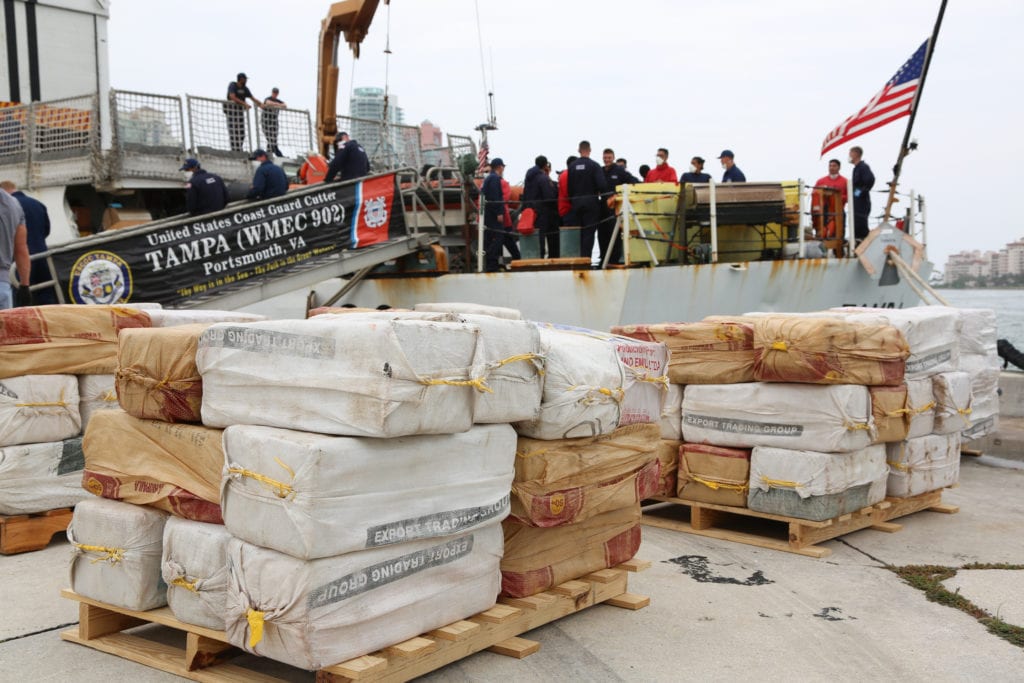
Coast Guard Cutter Tampa crew offloads approximately 5,500 pounds of cocaine, worth an estimated $94.6 million, at Base Miami Beach, Miami, Florida, April 20, 2021. On April 9, a maritime patrol flight spotted a vessel, and a Tampa law enforcement team interdicted a low profile vesseloff the coast of Punta Gallinas, Colombia. U.S. COAST GUARD / Chief Petty Officer Charly Tautfest
MIAMI — Coast Guard Cutter Tampa’s crew offloaded approximately 5,500 pounds of cocaine, worth an estimated $94.6 million, in Miami, April 20, after interdicting a low-profile vessel off the coast of Punta Gallinas, Colombia, the Coast Guard 7th District said in a release.
A maritime patrol flight spotted the vessel on April 9, and a law enforcement team from the cutter detained three suspects and discovered 87 bales of cocaine. The vessel was destroyed as a hazard to navigation and the suspects are reported to be in good health.
“This event is the perfect example of numerous key partners unifying our efforts to counter transnational criminal organizations who look to exploit the maritime environment,” said Lt. Cmdr. Jason Neiman, Seventh District public affairs officer. “By strengthening partnerships, we counter threats together.”
The interdiction was the result of multi-agency efforts in support of U.S. Southern Command’s enhanced counter-narcotics operations in the Western Hemisphere, the Organized Crime Drug Enforcement Task Force and High Intensity Drug Trafficking Area programs, and the Caribbean Corridor Strike Force.
Once aboard a Coast Guard cutter, all suspects receive food, water, shelter and basic medical attention. Throughout the interdiction, Coast Guard crew members were equipped with personal protective equipment to minimize potential exposure to any possible case of COVID-19. There were no suspects in these cases reported to have any COVID-19 related symptoms.
Coast Guard Offloads Nearly $20 million in Seized Cocaine in San Juan, Puerto Rico
The Coast Guard Cutter Richard Dixon crew offloaded nearly $20 million in seized cocaine at Coast Guard Base San Juan on April 20. U.S. COAST GUARD
SAN JUAN, Puerto Rico — The Coast Guard Cutter Richard Dixon crew offloaded nearly $20 million in seized cocaine at Coast Guard Base San Juan on April 20, following the interdiction of a suspected drug smuggling vessel, approximately 45 nautical miles north of Aguadilla, Puerto Rico, the Coast Guard 7th District said in an April 21 release.
A Customs and Border Protection Caribbean Air and Marine Branch maritime patrol aircraft crew detected a vessel on April 17 with three people aboard suspected of drug trafficking. The Coast Guard Cutter Paul Clark and a Coast Guard MH-60 helicopter responded to intercept the vessel.
The Coast Guard Jayhawk aircrew successfully stopped the vessel. Following the interdiction, it was discovered one of the suspected smugglers was injured and needed to be medevaced. A Coast Guard Air Station Borinquen MH-65 Dolphin aircrew transported the person to a hospital in Puerto Rico to receive further medical care.
The Paul Clark crew embarked the two remaining suspected smugglers and recovered close to 18 bales, which weighed approximately 1,052 pounds and tested positive for cocaine.
The three suspects are two men and a woman, Dominican Republic nationals, who are facing possible federal prosecution on drug trafficking criminal charges. Department of Justice partners in the U.S. Attorney’s Office for the District of Puerto Rico are leading prosecution efforts in this case.
“Stopping illegal drug trafficking vessels like the one interdicted Saturday is inherently dangerous and involves a high level of skill and risk,” said Capt. Gregory H. Magee, Commander of U.S. Coast Guard Sector San Juan. “These vessels represent a serious threat to the Caribbean region. The professionalism of the interdicting crews and strong partnerships with federal, local and regional law enforcement led to the apprehension of three smugglers and seizure of a major drug shipment in our shared resolve to protect the people of Puerto Rico and the U.S. Virgin Islands from this threat.”
The interdiction resulted from multi-agency efforts in support of U.S. Southern Command’s enhanced counter-narcotics operations in the Western Hemisphere, the Organized Crime Drug-Enforcement Task Force and High-Intensity Drug-Trafficking Area programs and the DEA Caribbean Division Financial Investigative Team.
“This Organized Crime Drug Enforcement Task Force investigation is one of several cases targeting transnational criminal organizations operating out of South America, Dominican Republic, and Puerto Rico,” said A.J. Collazo, DEA Caribbean Division special agent in charge. “DEA will continue to work alongside other federal agencies as more seizures like this one can be expected.”
Cutters Paul Clark and Richard Dixon are 154-foot fast response cutters respectively homeported in Miami and San Juan, Puerto Rico.
Coast Guard Cutter Escanaba Returns Home to Boston After 61-Day Patrol
The crew of Coast Guard Cutter Escanaba (WMEC 907), returned home to Boston, Tuesday, following a 61-day counter-narcotics patrol in the Caribbean Ocean. U.S. COAST GUARD
BOSTON —The crew of Coast Guard Cutter Escanaba (WMEC 907), returned home to Boston, Tuesday, following a 61-day counter-narcotics patrol in the Caribbean Ocean, the Coast Guard 1st District said in an April 19 release.
The 270-foot Escanaba’s 100-person crew supported operation Leeward Horizon and Unified Resolve, presidential initiatives designed to disrupt transnational criminal organizations in Central and South America.
Escanaba’s crew deployed with two members from the Barbadian Coast Guard, helping strengthen a vital maritime partnership and improving the interoperability between the two nations.
While transiting to their operational area, Escanaba’s crew provided humanitarian and medical assistance to 25 Haitian migrants including five children and a pregnant woman. The migrants were rescued from an unseaworthy vessel and were ultimately repatriated to Haiti.
The crew of Escanaba also rescued two mariners stranded at sea approximately 25 miles from St. Lucia and conducted two boardings of Venezuelan fishing vessels actively fishing in the territorial seas of other countries These boardings assisted in the disruption and reporting of wide spread illegal, unregulated and unreported fishing (IUU) in the area.
“I am very pleased with the total team effort from our crew on this patrol,” said Cmdr. Mike Nalli, Escanaba’s commanding officer. “We completed multiple training events with partner nations to combat the flow of illegal drugs into our country and disrupt the criminal networks which operate in that part of the Caribbean. Overall, the crew and I are thrilled with what we accomplished and are excited to be home.”
In addition, the crew of Escanaba also completed a biennial training assessments in Mayport, Florida prior to patrol departure. This training evaluated their overall readiness in five warfare categories: Weapons Systems, Command and Control, Damage Control and Medical, Engineering, and Navigation and Seamanship. Demonstrating proficient mission capabilities, the crew completed over 65 drills and evaluations, earning an overall score of 96%.
Known as “The Pride of Boston,” the Escanaba is a medium-endurance cutter homeported in Boston.
Vice Adm. Linda L. Fagan Nominated to be Coast Guard Vice Commandant, First Coast Guard Female 4-Star Admiral
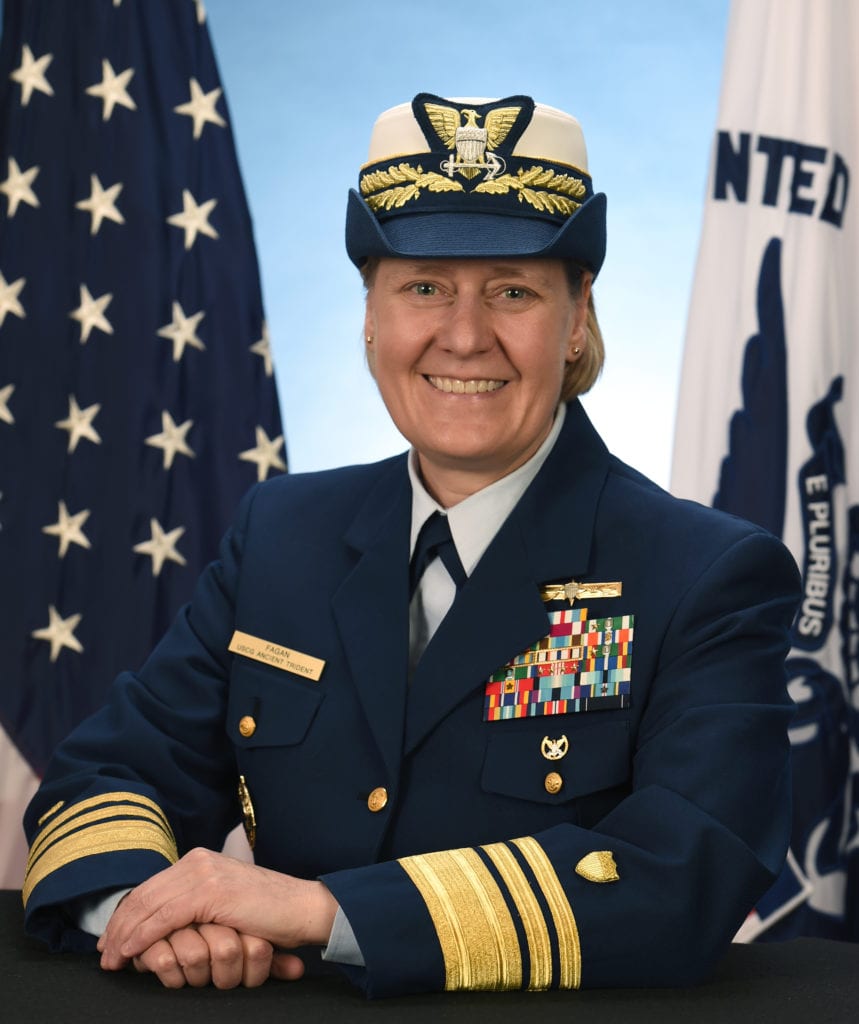
Vice Adm. Linda L. Fagan, nominated to be the next vice commandant of the U.S. Coast Guard. U.S. COAST GUARD
WASHINGTON – Vice Adm. Linda L. Fagan has been nominated by the White House to be the next vice commandant of the U.S. Coast Guard, the service’s headquarters announced in an April 19 release.
She currently serves as the commander of the Coast Guard Pacific Area, overseeing all Coast Guard missions from the Rocky Mountains to the waters off the East Coast of Africa. Fagan concurrently serves as commander, Defense Force West and provides Coast Guard mission support to the Department of Defense and Combatant Commanders. Fagan is a 1985 graduate of the Coast Guard Academy and is the Coast Guard’s first-ever Gold Ancient Trident, the officer with the longest service record in the Marine Safety field.
“Vice Adm. Fagan is an outstanding leader with 36 years of Coast Guard operations, policy-making, joint service, and interagency experience,” said Adm. Karl L. Schultz, commandant of the U.S. Coast Guard. “Throughout her distinguished career, she has been a top performer and a trailblazer. As the Coast Guard’s first female four-star admiral, and President Biden’s nominee to serve as the Coast Guard’s 32nd vice commandant, Adm. Fagan will be instrumental in moving the Service forward at a critical juncture in our history.”
Secretary of Homeland Security Alejandro N. Mayorkas released a statement on Fagan’s nomination.
“I am pleased that President Biden has nominated Vice Admiral Linda Fagan to be the vice commandant of the United States Coast Guard,” it says. “She is a superb leader who, as the 32nd vice commandant, will guide the Coast Guard at a time when its mission of securing our maritime borders, ports, and waterways has never been more important. If confirmed, Vice Admiral Fagan would serve as the first woman to be promoted to a 4-star rank in the Coast Guard. We are grateful to Vice Admiral Fagan for continuing her service to country, for the trail she has blazed, and for inspiring us all.”
Pending confirmation, Fagan is expected to relieve current Vice Commandant of the Coast Guard Adm. Charles W. Ray on June 18.