Ex-Navy Helos Providing Folding Rotors, Tails for Cutter-Deploying H-60 Helos
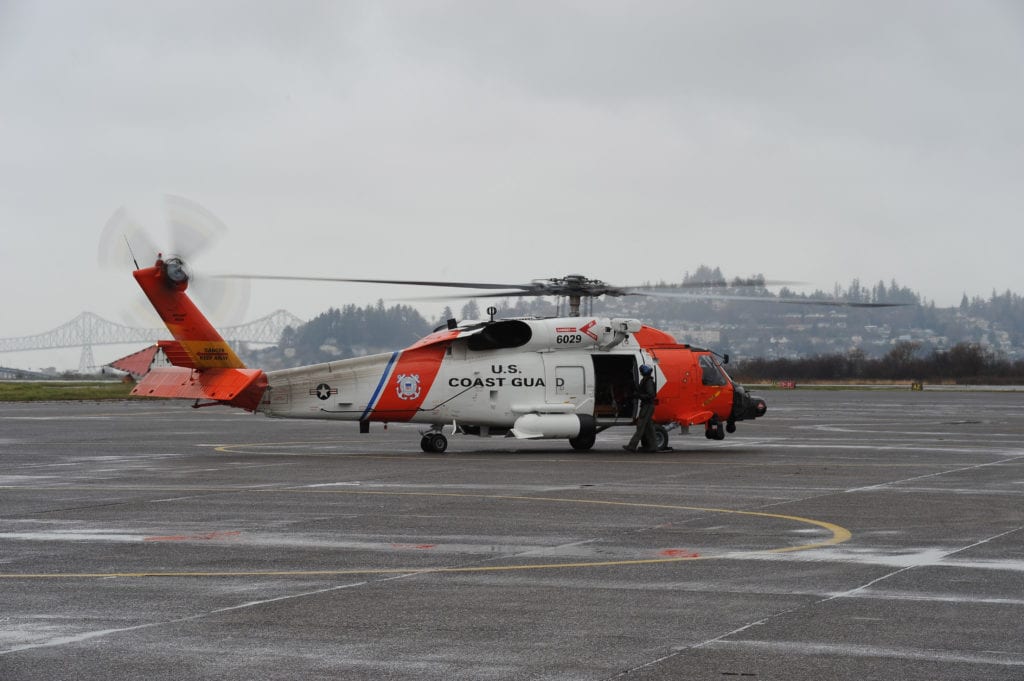
A crew prepares to power down a Coast Guard MH-60T Jayhawk helicopter after landing at Sector Columbia River, Oregon, in 2012. The service is shifting the focus of some of its MH-60T fleet to use on board its large cutters. U.S. Coast Guard / Petty Officer 3rd Class Nate Littlejohn
ARLINGTON, Va. — The U.S. Coast Guard is shifting the focus of some of its MH-60T Jayhawk helicopter fleet to use on board its large cutters and is using components from some ex-U.S. Navy H-60 Seahawk helicopters to make that possible.
The Coast Guard operates a fleet of 45 Sikorsky-built MH-60Ts from eight air stations for medium-range missions that include search, rescue, drug interdiction and law enforcement. They can operate from the decks of the service’s larger cutters but because they do not have folding tail rotors and tail booms, they cannot be hangered inside the superstructure of the larger cutters, such as the Legend-class national security cutters, future Argus-class offshore patrol cutters and the future class of Polar Security Cutters.
In his March 11 State-of-the-Coast Guard address, Coast Guard Commandant Adm. Karl Schultz said the service will convert some MH-60Ts with folding rotors and tail booms to enable them to operate from the larger cutters and give the cutters a longer reach with their embarked helicopters. Currently the Coast Guard deploys the smaller MH-65D/E Dolphin helicopters on its larger cutters.
“Two weeks ago, in Elizabeth City, North Carolina, I observed our first MH-60T Jayhawk outfitted with Blade-fold/ Tail-fold capability that will enable deployment aboard National Security Cutters, and our future Polar Security and Offshore Patrol Cutters,” Schultz said.
The commandant noted the range and endurance of the MH-60T would serve well on a polar security deployment to Antarctica, particularly for treaty inspections.
The Coast Guard has long used parts and structures from ex-Navy H-60 helicopters to help sustain its MH-60T fleet and even be rebuilt into MH-60Ts. Beginning in 2005, the Coast Guard Air Logistics Center (ALC) has converted six ex-Navy SH-60Fs to MH-60Ts. The ALC also has “overhauled and modified another SH-60F hull and four HH-60Hs (by July 2020) as part of the plan to retain the aircraft and extend the service life,” said Tom Kaminski, an expert on Coast Guard aviation. “They also are reactivating the mechanisms that permit the tail to be folded.
“The service acquired 65 retired SH-60F and HH-60Hs from the U.S. Navy and a number of the Seahawk airframes were stripped by the ALC in preparation for conversion, ” Kaminski said. “The plan is for a mix of reworked low-time hulls and the new production hulls from Sikorsky.”
Schultz also said in his address that MH-60Ts will replace MH-65s at two air stations.
“This year we will transition Air Station Borinquen in Puerto Rico from a Dolphin to Jayhawk unit, adding additional reach and contingency response capability to the Eastern Caribbean, not to mention a likely land-based Aviation Use of Force capability,” he said. “Air Station New Orleans will be the next to transition.”
Coast Guard, Navy Help Rescue Cold-Stunned Turtles, Return Them to Warmer Waters
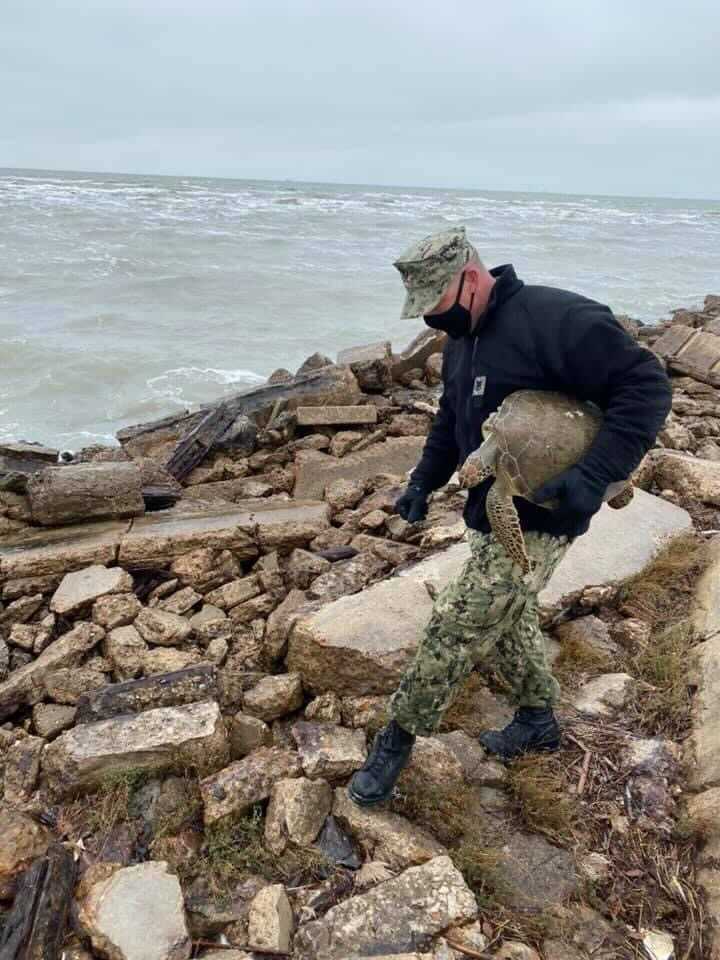
Command Master Chief Eric Kinnaman rescues a cold-stunned green sea turtle from the waterfront at Naval Air Station (NAS) Corpus Christi. Sailors, civilians and family members worked with the Texas Parks and Wildlife department and the National Park Service to transport the turtles to safety. The NAS Corpus Christi environmental team lead the multi-agency wildlife protection effort and rescued more than 600 turtles. U.S. Navy / Capt. Christopher Jason
Texas recently experienced record-breaking cold temperatures, causing the largest cold-stunning event for sea turtles in the state’s history. As the water temperate dropped to the mid-30s Fahrenheit, thousands of turtles were found stranded on beaches or floating in the water.
In the shallow bays and inlets of the Laguna Madre next to Padre Island, water temperatures can change rapidly. As reptiles, turtles are cold-blooded and cannot regulate their body temperature. Cold-stunned turtles experience hypothermia when the sea water drops to about 50°F or below, and become lethargic and unable to swim.
According to Sea Turtle Inc., a non-profit organization on South Padre Island, “cold-stun events happen when the water gets too cold for sea turtles to maintain their body temperature. As a result, the turtles are awake but unable to move or swim. If not rescued, while they are awake and alive, the turtles will drown from being unable to lift their head to draw their breath.”
Fortunately, the Coast Guard and Navy were ready, willing and able to join in the effort with a team of organizations to help the turtles.
A consortium of organizations including the Turtle Survival Alliance, Sea Turtles, Inc., the Gladys Porter Zoo in Brownsville, the Texas Sealife Center, Texas Department of Parks and Wildlife and the National Park Service make up the South Padre Island Sea Turtle Stranding and Salvage Network, which works to rescue and care for cold-stunned turtles. While the area has experienced cold weather before, the February 2021 cold weather event was unprecedented. With 7,000 or more turtles knocked out by the frigid waters, ranging in size from a few pounds to more than 400 pounds. The rescuers were overwhelmed.
Active-duty Sailors, Marines and Coast Guardsmen pitched in, including student pilots for Naval Air Station Corpus Christi. Volunteers also included Navy civilian employees, retirees, spouses and family members.
NAS Corpus Christi and Coast Guard Sector Corpus Christi, like many military installations, are used to encountering wildlife suffering from severe weather. But this 2021 event has resulted in thousands of turtles stupefied by the cold. It is remarkable that so few of them died, but without the intervention of the Navy, Coast Guard and others, the toll would have been much higher.
Capt. Christopher Jason, the commanding officer of Naval Air Station Corpus Christi, used his kayak to paddle out to the turtles and pull them out of the water. Turtles were kept in a hanger and later moved to a Defense Logistics Agency temperature-controlled warehouse to recover.
The rescues started with a base resident wanting to help a couple of injured birds. It turned into a large-scale operation involving dozens of volunteers rescuing more than 1,200 threatened sea turtles, at the same time as many of those volunteers did not have heat or water because of the unusually cold winter storm.
“The scale of the effort was unprecedented,” said Biji Pandisseril, NASCC environmental director. “Usually, about 20 to 30 turtles are rescued here after a cold snap.”
U.S. Coast Guard Rescue swimmers from Air Station Corpus Christi swam through rough and cold water to reach turtles far away from the shore. Petty Officer 3rd Class Will Groskritz and Petty Officer 2nd Class Russell Grizzard brought 60 turtles to safety in one day. The next day, Grizzard and Petty Officer 1st Class Rob Rendon saved another 40 to 50 turtles.
Responding to cold stun events is one of Sea Turtle Inc.’s ongoing rescue and rehabilitation efforts. For example, Sea Turtle Inc. has released over 55,000 sea turtle hatchlings into the Gulf of Mexico, and each year helps with any cold-stunned turtles that are found. But, with more recued turtles coming in the Sea Turtle Inc.’s facility could handle. The rescued turtle filled the facility to capacity, with many turtles placed in children’s play pools. A makeshift rescue center was established at the South Padre Island Convention Center and Visitors Bureau.
In addition to the turtles being affected by the cold, their rescuers also had to contend with power outages and water shortages of their own as the cold snap surprised Texans.
Aerospace Company SpaceX donated a large power generator from their Boca Chica launch facility in Brownsville to provide electricity to the Sea Turtles Inc. facility, which already had hatchlings and other turtles being cared for. The power helped to keep the water in facility’s tanks warm enough for the turtles to survive.
“This event had the potential to be devastating to both the sea turtle population and our hospital and residents. We prepare for cold stun events, but to respond as efficiently as we have although the additional challenge of no power speaks volumes about the passion and commitment of the Sea Turtle Inc staff and the Rio Grande Valley community,” said Wendy Knight, executive director of Sea Turtle Inc.
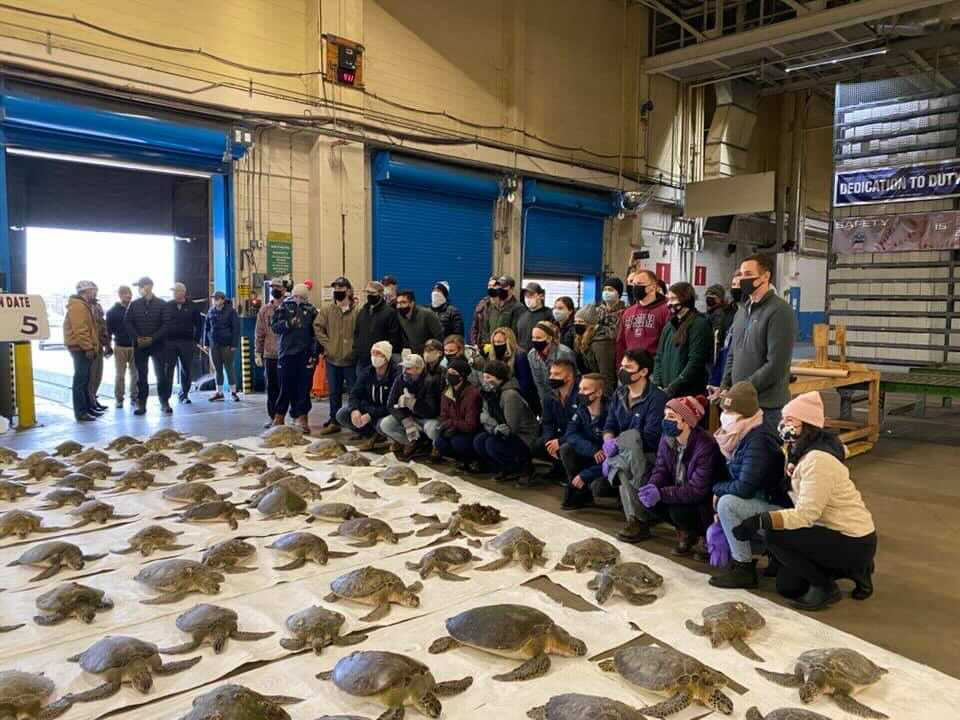
Volunteers pose with rescued green sea turtles at Naval Air Station (NAS) Corpus Christi, Texas. Sailors, civilians and family members worked with the Texas Parks and Wildlife department and the National Park Service to transport the turtles to safety. U.S. Navy
Unique ecosystem
Dr. Donna Shaver, chief of the division of sea turtle science and recovery with the National Park Service at Padre Island National Seashore, is the Texas coordinator of the Sea Turtle Stranding and Salvage Network.
Shaver and her team were not completely unprepared. Back in October, Shaver, along with Texas State Aquarium and U.S. Coast Guard representatives, held a tabletop exercise to discuss what the response to a mass cold-stunning event such as this would look like. Because of the planning and preparation of that exercise, rescue, rehabilitation, and release of these animals was swift and effective.
Shaver said the February cold snap was the coldest event since 1895, when a cold-stunning event was thought to have decimated the Green Sea Turtle population in Texas. She called it the “perfect storm” for cold study.
Shaver explained that the Laguna Madre, the salt water lagoon between mainland Texas and Padre Island, with lush sea grasses and algae, is a prime habitat for the juvenile green turtles, which represent the vast majority of the cold-stunned turtles.
Once-numerous, the green sea turtle is today a threatened species in Texas. Considered a delicacy, there was once a large commercial fishery harvesting turtles in the area. “This used to be a thriving population in Texas until it was decimated in the late 1800s. It’s rebuilding, but now needs our help with these rescues,” Shaver said.
At about 125 miles long, Laguna Madre is one of the few hypersaline lagoon systems in the world, meaning it is saltier than most seawater. There isn’t much inflow of fresh water or rainwater, and circulation with the Gulf of Mexico is limited. Laguna Madre is one of the most productive estuarine systems and a valuable habitat for wildlife. It is protected by Padre Island, the longest stretch of undeveloped barrier island in the world, and there are only a few channels that allow access to open water. The precipitous decline of the temperatures, how long it stayed cold, and the depth of the cold water spelled trouble for the trapped turtles.
The water temperature can change temperature rapidly, and sea turtles swimming in Laguna Madre may not have had enough time to swim out of to the deeper, warmer waters of the Gulf of Mexico before becoming cold stunned.
Rehabilitation is fairly straight forward, Shaver said. “The first step is to bring in them in out of the elements and gradually warm up — but not too quickly — and then determine which ones are still alive, because we can’t tell for many of these turtles.”
“When they start to move around, we can put them in the water, let them expel some gas, and give them a swim test. Then we wait until the Gulf of Mexico waters when the waters are warm enough so we can release them there,” Shaver said. “We don’t want to release them back into the Laguna Madre, because they could become cold-stunned again.”
“Working with our partners in the Texas State Aquarium and Texas Game Wardens to release these animals back into the wild is a surreal experience,” said Coast Guard Ensign Austin Sawicki. “Getting to play a small part in keeping the green sea turtle population safe is a very rewarding experience.”
Coast Guard Sector Corpus Christi and Station Port Aransas crewmembers assisted partner organizations to release the rehabilitated sea turtles back into the Gulf of Mexico in areas where the water was at least 55 degrees Fahrenheit were selected.
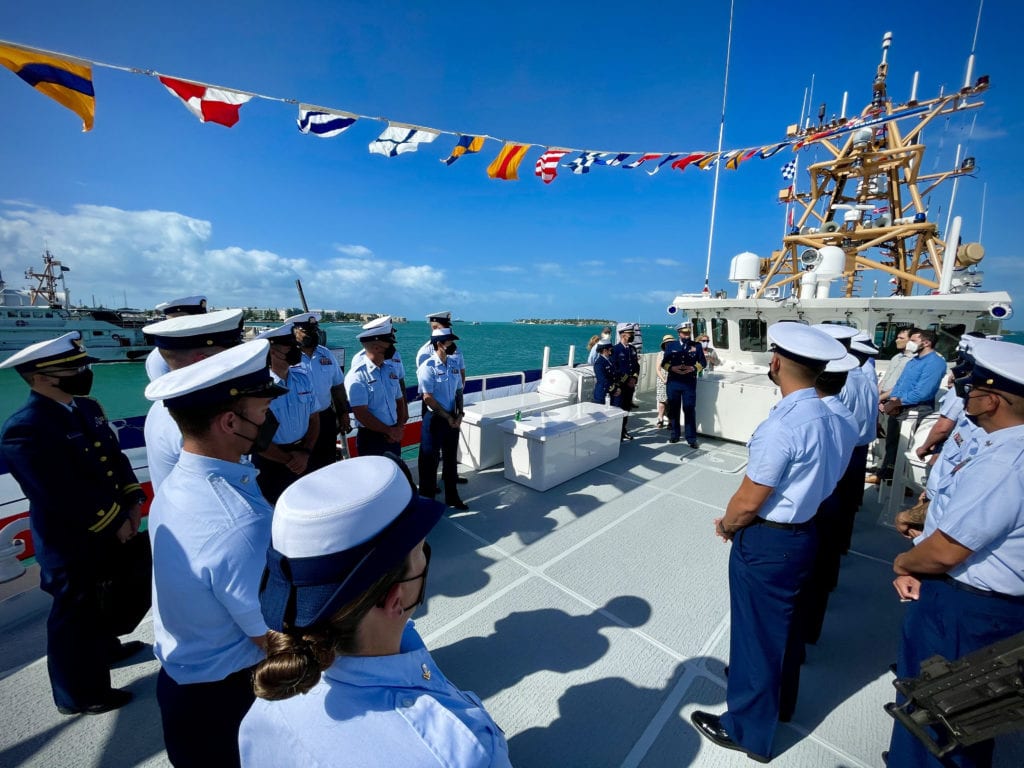
Vice Adm. Scott Buschman, the deputy commandant for operations, addresses the USCGC Robert Goldman (WPC 1142) crew on March 12, 2021, in Key West, Florida. The Robert Goldman was officially commissioned into service and will now transit to Bahrain for service as part of Patrol Forces Southwest Asia. U.S. Coast Guard / Senior Chief Petty Officer Sara Muir
KEY WEST, Fla. — The USCGC Robert Goldman (WPC 1142), Patrol Forces Southwest Asia’s (PATFORSWA’s) second Sentinel-class cutter, was commissioned into service at Coast Guard Sector Key West, March 12, the Coast Guard Atlantic Area said in March 12 release.
Vice Adm. Scott Buschman, the deputy commandant for operations, presided over the 42nd Sentinel-class cutter ceremony.
The Robert Goldman is the second of six FRCs to be homeported in Manama, Bahrain, which will replace the aging 110-foot Island Class Patrol Boats built 30 years ago. Stationing FRCs in Bahrain supports PATFORSWA, the Coast Guard’s largest unit outside of the U.S., and its mission to train, organize, equip, support and deploy combat-ready Coast Guard forces in support of Central Command and national security objectives.
PATFORSWA works with Naval Forces Central Command to conduct maritime operations forwarding U.S. interests. These efforts are to deter and counter disruptive countries, defeat violent extremism, and strengthen partner nations’ maritime capabilities to secure the maritime environment in the Central Command area of responsibility.
Each FRC bears the name of an enlisted Coast Guard hero who distinguished himself or herself in the line of duty. Robert Goldman enlisted in the Coast Guard in October 1942 as a pharmacist’s mate. In 1944 he reported for duty aboard the Coast Guard-manned, 328-foot Landing Ship, Tank-66, taking part in a campaign to retake the Philippines from the Japanese.
On Nov. 12, 1944, a Japanese plane flew straight for the men gathered on the starboard side of the LST’s stern. Goldman witnessed the enemy fighter crash into the deck and exploded. Goldman’s back was on fire from the aviation fuel, his right leg received shrapnel from the crashing fighter, and he suffered severe shock from the sudden crash and the resulting carnage. Disregarding his injuries, Goldman courageously treated the wounded and dying. For his heroic deeds, Goldman received the Purple Heart and Bronze Star medals.
Several Goldman family members were in attendance, including his three sons and his daughter-in-law, Elly Goldman, the ship’s sponsor, and daughter-in-law, Ms. Gail Fresia. Fresia, in nautical tradition, presented the long glass to the crew to set the first official watch aboard the ship.
The Coast Guard took delivery of Robert Goldman on Dec. 21, 2020, in Key West. They will transit to Bahrain later this year with their sister ship, the Charles Moulthrope (WPC 1141), delivered on Oct. 22, 2020, and commissioned on Jan. 21, in Portsmouth, Virginia.
The Coast Guard has ordered 64 FRCs to date. Over 40 are now in service: Charles Moulthrope and Robert Goldman, 12 in Florida, seven in Puerto Rico, four in California, three each in Hawaii, Texas, and New Jersey, and two each in Alaska, Mississippi, and North Carolina. Two FRCs arrived in their homeport of Apra Harbor, Guam, in 2020, with one more to come.
The fast response cutters are designed to patrol coastal regions and are operating in an increasingly expeditionary manner. They feature advanced command, control, communications, computers, intelligence, surveillance, and reconnaissance equipment and launch and recover standardized small boats from the stern.
Cutter Bertholf Returns to Alameda following Three-Month Patrol
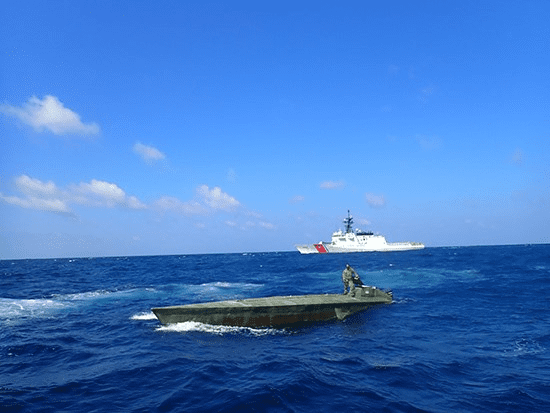
A boarding team member from the U.S. Coast Guard Cutter Bertholf stands on top of a semi-submersible boat Feb. 1, 2021, in the Eastern Pacific Ocean. The Bertholf crew completed a 3-month, 15,000 mile, multi-mission patrol. U.S. Coast Guard
ALAMEDA, Calif. — The crew of the Coast Guard Cutter Bertholf (WMSL 750) returned home to Alameda March 15 following a three-month, 15,000-mile, multi-mission patrol, the Coast Guard Pacific Area said in a release.
In January, the Bertholf’s crew boarded three vessels in the Eastern Pacific Ocean.
“Early in the patrol, we interdicted three go-fast vessels over a span of six hours,” said Capt. Brian Anderson, Bertholf commanding officer. “We used every available resource including all three pursuit boats, our helicopter and Scan Eagle drone to successfully stop them in their tracks, resulting in the apprehension of four suspected drug smugglers and seizure of over 1,700 pounds of cocaine. It was quite an exciting evening and demonstrated our full capabilities and our commitment to keeping America safe and secure.”
The Bertholf mobilized its advanced capabilities that included a small unmanned aircraft system, an attached Helicopter Interdiction Tactical Squadron MH-65 helicopter and aircrew, and an embarked Law Enforcement Detachment from the Pacific Tactical Law Enforcement Team. The crew spent more than 50 days patrolling the Eastern Pacific Ocean on a counter-narcotics mission that resulted in the apprehension of approximately 6,200 pounds of cocaine with an estimated value of more than $107 million.
“This is my last deployment aboard the Bertholf,” Anderson said. “It’s been a privilege to serve, especially with this crew, who have gone above and beyond in every respect to accomplishing the mission safely and effectively amidst a pandemic. I couldn’t be more proud of them.”
The Bertholf is a 418-foot national security cutter, commissioned in 2008 and homeported in Alameda.
Coast Guard Reducing Some Marine Protector Patrol Boats for Budget Reasons, Commandant Says
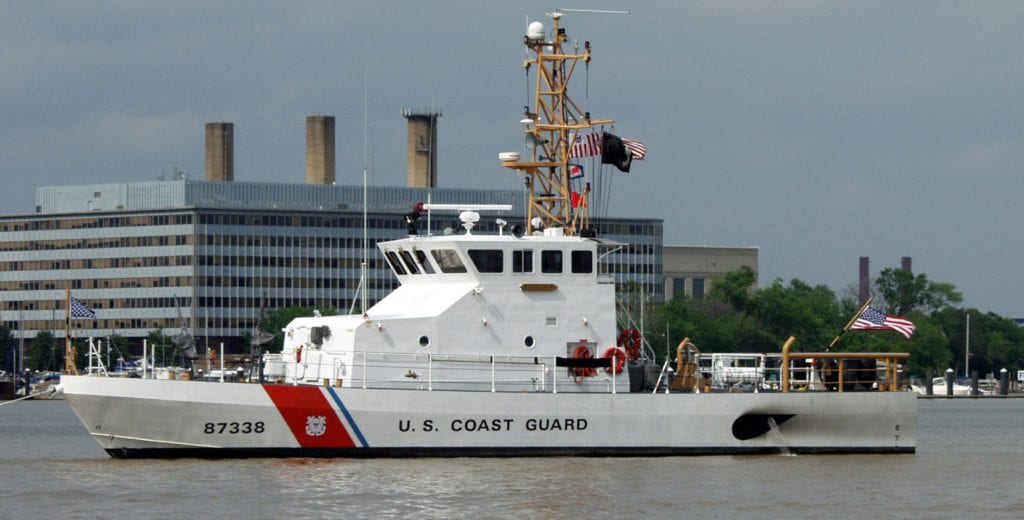
U.S. Coast Guard Cutter Ibis (WPB 87338), anchored in the Anacostia River in Washington, D.C. in May, 2003. Ibis is an 87-foot Coastal Patrol Boat and part of the Coast Guard’s Marine Protector Class of vessels. U.S. Coast Guard / Joseph P. Cirone
ARLINGTON, Va. — Budget constraints are the main reason the Coast Guard is decommissioning a few 87-foot Marine Protector-class patrol boats, the Coast Guard commandant said, but the capabilities of other boats will compensate for the change.
“We are taking some 87-footers out of service,” said Coast Guard Commandant Adm. Karl Schultz, responding to a question from Seapower during a March 11 in a teleconference with reporters following his State-of-the-Coast Guard address in San Diego. “That’s a budget reality.”
Schultz explained that, during the 1980s, 49 Island-class 110-foot patrol boats were built, but with six deployed to the Persian Gulf with Patrol Force Southwest Asia and six retired after a failed hull-length extension, the fleet in domestic waters was down to 34 and has been reduced since to less than 20. However, the 64 larger Sentinel-class 154-foot responses cutters (FRCs) being built — of which 58 will be stationed in the United States and its territories — have been replacing the Inland-class boats.
“So, there is a lot more new ship capacity,” Schultz said. “When you look at an FRC versus an Island-class patrol boat — significantly more linear feet across the waterline, significantly more tonnage, about 28 to 30-knot speed, eight more crew members, an over-the-horizon boat capability, just a lot more C5 [command, control, communications, computers, combat systems, intelligence capability]. So, there’s a lot more capability and capacity on the waterfront with the swap out.”
Schultz said the Congress funded more 87-foot patrol boats than the program of record’s requirement when the Marine Protector program started.
The commandant said some of the Marine Protectors may be declared excess defense articles and offered to foreign navies and coast guards, just as some Island -class patrol boats have been.
“We may hold some to bring back into service,” he said.
It is absolutely budgetarily influenced and informed within the topline, he said. “I’m the last guy as a cutterman who wants to remove a cutter from service, but I think we’ll have plenty of capacity. That fast response cutter — its seakeeping, its legs — is considerably more [capable] than the patrol boats it’s replacing.”
Referring to the March 10 decommissioning of the Marine Protector-class USCGC Dorado at Crescent City, California, Schultz pointed out that with the mission demands and capabilities in that area resident in the Coast Guard’s heavy-weather-capable 45-foot response boats and the nearby aviation capability, ‘taking out some of those 87’s was a relatively rational, hard choice we had to make.”
Coast Guard Commandant Outlines Future of Service in San Diego
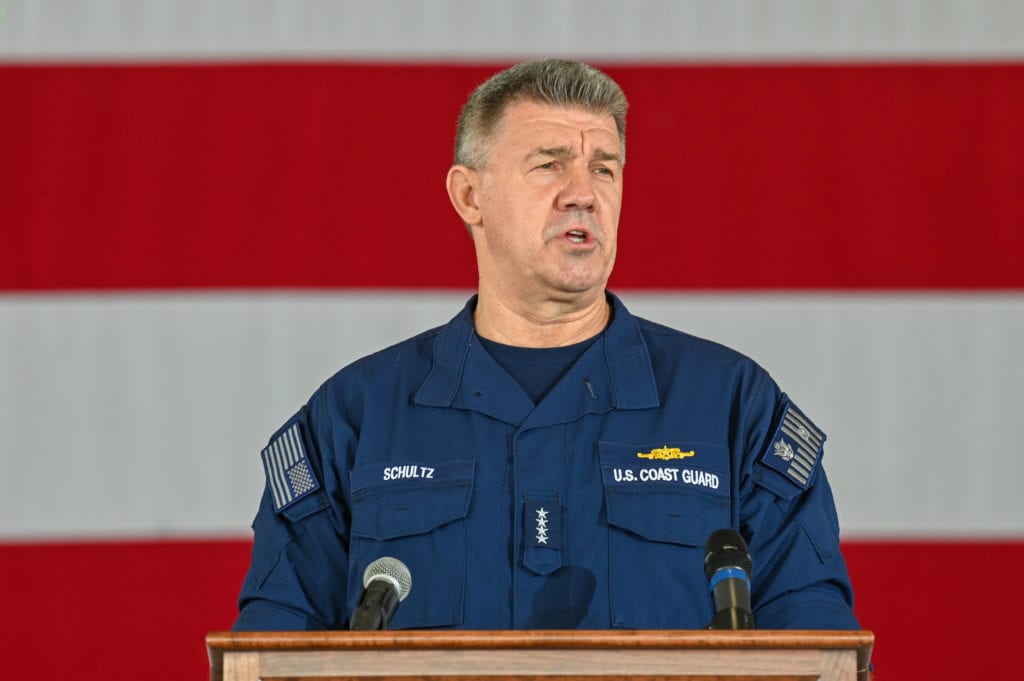
Adm. Karl Schultz, the commandant of the Coast Guard, speaks during the 2021 State of the Coast Guard Address in San Diego March 11, 2021. During the annual address, Schultz reflected on the organization’s successes over the past year and outlined the shared vision for the future of the Coast Guard. U.S. Coast Guard / Petty Officer 2nd Class Travis Magee
SAN DIEGO — The Commandant of the United States Coast Guard delivered his third state of the Coast Guard address March 11 at Coast Guard Sector San Diego, Coast Guard Headquarters said in a release.
Adm. Karl Schultz outlined his vision for the service to protect the homeland, enhance economic prosperity, and advance America’s national security interests. Schultz accentuated the dedication and sacrifice of Coast Guard members stationed across the country and deployed during this past year of unprecedented challenges.
“Across the Service, I see individual Coast Guard members contributing to their communities, and standing the watch to secure the Homeland, enhance our economic prosperity, and advance our national interests across the globe,” Schultz said.
During the annual address, Schultz reflected on the organization’s success over the past year and featured members of the Coast Guard who excelled in crisis, rescued mariners in distress, interdicted illicit narcotics, and responded to a record-setting Atlantic basin hurricane season, all complicated by the challenges presented by the COVID-19 global pandemic.
“Coast Guard members stood the watch amidst adversity, showcasing what makes our Service special — our people,” Schultz told the mostly virtual attendees this year due to COVID-19 restrictions.
He also underscored new Coast Guard capabilities in Southern California. “In April, we will break ground on our first new aviation unit in more than two decades — located right here in Southern California. Air Station Ventura County will significantly enhance our aviation multi-mission capability in the region,” Schultz said.
The service chief discussed a variety of ongoing and emerging fleet recapitalization programs, providing updates on the Polar Security and Offshore Patrol Cutter acquisitions; efforts to replace the aging fleet of inland buoy and construction tenders with Waterways Commerce Cutters; and initial steps to transition to an all MH-60 Jayhawk helicopter fleet.
Schultz further highlighted the Coast Guard’s operations in the nation’s system of ports and waterways, better known as the Marine Transportation System (MTS). The MTS is a key economic engine for the nation, fueling 26% of America’s gross domestic product (GDP) which equates to $5.4 trillion of annual economic activity and 31 million jobs.
“Our seaports are the gateways for 90% of international trade, and the Coast Guard helps to oversee this vital economic engine that ensures energy products and other goods arrive at businesses and storefronts in every corner of our country,” Schultz highlighted.
Coast Guard Cutter Dorado Decommissioned after 23 Years of Service
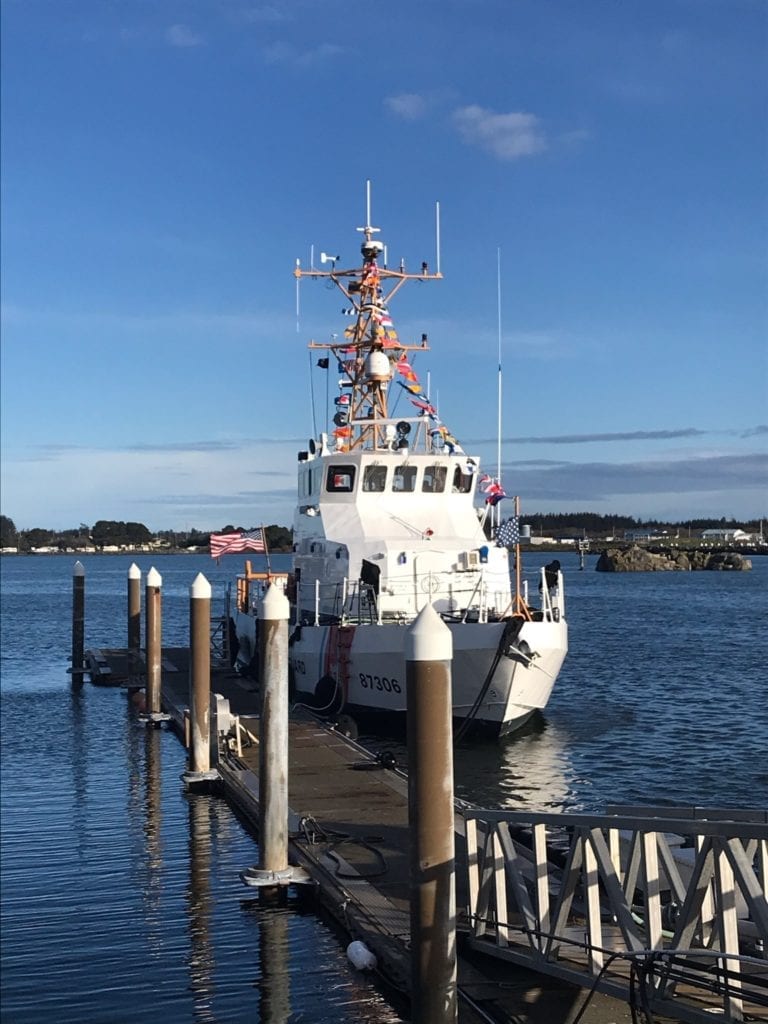
The Coast Guard Cutter Dorado (WPB-87306) is shown before a decommissioning ceremony for the cutter, March 10, 2021 in Crescent City, California. The Dorado is being decommissioned after 23 years of service in the Coast Guard from 1999 to 2021. U.S. Coast Guard
MCKINLEYVILLE, Calif. — The Coast Guard Cutter Dorado (WPB-87306) was decommissioned March 10 after 23 years of service during a ceremony in Crescent City, California.
The Dorado was the Coast Guard’s sixth 87-foot Marine Protector-class patrol boat to serve as the Coast Guard’s primary nearshore patrol asset.
“I would like to thank my crew and all previous sailors for bolstering her highly successful service life,” said Lt. Rebecca Cotton, the Dorado’s commanding officer. “They made the Dorado an unforgettable cutter in which to serve the West Coast for the past 23 years. Equally important are our partners at the 11th Coast Guard District, Coast Guard Sector Humboldt Bay and the city of Crescent City. I would like to extend tremendous thanks as Dorado’s success throughout the years would not have been possible without their support.”
The Dorado was built in 1998 by Bollinger Machine Shop and Shipyard, Inc. in Lockport, Louisiana. Once construction was complete, Dorado’s crew transited the ship through the Panama Canal to reach its new homeport in Crescent City where it was officially placed into commission.
During Dorado’s time in service, the crew completed more than 135 search and rescue cases and 1,000 law enforcement and fishery boardings.
“The Coast Guard Cutter Dorado and her crew have been vital to our mission of safeguarding the waters of Northern California,” said Capt. Mark Hiigel, the Sector Humboldt Bay commander. “No matter what was asked of them, they answered the call and I am extremely grateful for their hard work and dedication. Dorado will be missed along our coast. However, we always stand ready to ensure the safety and security of our waterways.”
Dorado’s crew is scheduled to sail the ship to Baltimore where it is slated to be turned in to the Foreign Military Sales program.
Marine Protector-class patrol boats are primarily used for combating drug smuggling, illegal immigration, marine fisheries enforcement and search and rescue.
The Coast Guard commissioned four 154-foot fast response cutters in California between 2018 and 2019, which operate along California’s entire coast and international waters off Mexico and Central America conducting missions such as search and rescue, fishery patrols, national defense and port, waterways and coastal security.
Cutter Offloads 7,500 Pounds of Interdicted Cocaine, Marijuana in San Diego
The crew of the Coast Guard Cutter Bertholf (WMSL-750) offloads approximately 7,500 pounds of seized cocaine and marijuana in San Diego, March 20, 2021. U.S. Coast Guard / Petty Officer 2nd Class Travis Magee
SAN DIEGO — The crew of the Coast Guard Cutter Bertholf (WMSL-750) offloaded approximately 7,500 pounds of seized cocaine and marijuana in San Diego, March 10, the Coast Guard 11th District said in a release.
The drugs, worth an estimated $126.7 million, were seized in international waters of the eastern Pacific Ocean between January and February, representing 10 suspected drug smuggling vessel interdictions off the coasts of Mexico, Central and South America by the following Coast Guard and Navy ships:
The Coast Guard Cutter Bertholf (WMSL 750) crew was responsible for four interdictions seizing approximately 6,200 pounds of cocaine.
The Coast Guard Cutter Munro (WMSL 755) crew was responsible for three interdictions seizing approximately 1,100 pounds of cocaine and 50 pounds of marijuana.
The Coast Guard Law Enforcement Detachment 107 deployed aboard the USS Freedom (LCS 1) was responsible for one interdiction seizing approximately 22 pounds of cocaine.
The Coast Guard Cutter Harriet Lane (WMEC 903) crew was responsible for one interdiction seizing approximately 50 pounds of marijuana.
The Coast Guard Cutter Vigilant (WMEC 617) crew was responsible for one interdiction seizing approximately 22 pounds of cocaine.
Speakers at the event included Adm. Karl Schultz, the Coast Guard commandant, and Capt. Brian Anderson, the Bertholf commanding officer.
“The 7,000 pounds of cocaine offloaded today was interdicted as a result of extraordinary effort and joint and interagency partnerships,” said Schultz. “While the Bertholf may have physically stopped or interdicted the drug smuggling vessels, our DoD and DHS partners, particularly CBP Air and Marine Operations maritime patrol aircraft, coordinated through Joint Interagency Task Force-South, put the Bertholf in the right place at the right time to conduct at-sea interdictions.”
On April 1, U.S. Southern Command increased counter-narcotics operations in the Western Hemisphere to disrupt the flow of drugs. Numerous U.S. agencies from the departments of Defense, Justice, and Homeland Security cooperated in the effort to combat transnational organized crime. The Coast Guard, Navy, Customs and Border Protection, FBI, Drug Enforcement Administration, and Immigration and Customs Enforcement, along with allied and international partner agencies, play a role in counter-drug operations.
The fight against drug cartels in the Eastern Pacific Ocean requires unity of effort in all phases from detection, monitoring, and interdictions, to criminal prosecutions by international partners and U.S. Attorneys’ Offices in districts across the nation. The law enforcement phase of counter-smuggling operations in the eastern Pacific Ocean is conducted under the authority of the 11th Coast Guard District, headquartered in Alameda. The interdictions, including the actual boardings, are led and conducted by members of the U.S. Coast Guard.
“The crew is lauded for their dedication to duty and resiliency throughout this patrol,” Anderson said. “Tasks that once seemed routine, became more complex with personal protective equipment and decontamination procedures added to our standard operating procedures. Early in the deployment, we interdicted three go-fast vessels over a span of six hours, which demonstrated our full capabilities and our commitment to keeping America safe and secure. I couldn’t be more proud of my crew.”
The Bertholf is a 418-foot national security cutter, commissioned in 2008 and homeported in Alameda. The Munro is a 418-foot national security cutter homeported in Alameda. The Freedom is a 387-foot littoral combat ship homeported in San Diego. The Harriet Lane is a 270-foot medium-endurance cutter homeported in Portsmouth, Virginia. The Vigilant is a 210-foot medium-endurance cutter homeported in Port Canaveral, Florida.
Bill Introduced to Boost Coast Guard Icebreaking Mission, Great Lakes Icebreaking Capacity
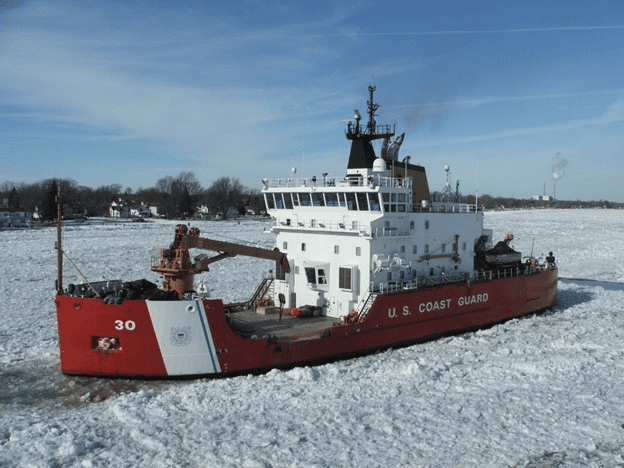
The Coast Guard Cutter Mackinaw, a 240-foot heavy icebreaker, breaks ice near Marine City, Michigan, along the St. Clair River, 2015. U.S. Coast Guard / Daniel R. Michelson
Recognizing the importance of maritime commerce on the Great Lakes, three U.S. senators are calling for legislation to help the Coast Guard keep the shipping lanes open during the winter.
“Inadequate icebreaking capacity in the Great Lakes is costing us thousands of American jobs and millions in business revenue. We must boost our icebreaking capacity in the Great Lakes to keep our maritime commerce moving,” said Sen. Tammy Baldwin (D-Wisconsin), who along with Sens. Todd Young (R-Indiana) and Gary Peters (D-Michigan) are reintroducing the Great Lakes Winter Commerce Act.
The bill would update the U.S. Coast Guard’s (USCG) Great Lakes icebreaking mission and increase the icebreaking capacity of the Great Lakes fleet to support “reasonable demands of commerce.”
According to a statement from Baldwin’s office, “the Coast Guard currently interprets the ‘reasonable demands of commerce’ as meaning that an ice-covered waterway is open until a second vessel is stuck in the ice for more than 24 hours as a result of another vessel’s inability to move. They only report to Congress ice restrictions in four connecting channels for the entire Great Lakes.”
The bill defines “reasonable demands of commerce” as the “safe movement of commercial vessels transiting ice-covered waterways in the Great Lakes, regardless of type of cargo, at a speed consistent with the design capability of Coast Guard icebreakers operating in the Great Lakes.”
A study commissioned by the Lake Carriers’ Association found that during the 2018-2019 ice-season, businesses that depend upon the Great Lakes maritime industry lost over $1 billion in revenues because of delays caused by inadequate icebreaking.
“This historic bill will codify into law a long time Coast Guard mission that protects national and economic security,” said Jim Weakley, president of the Lake Carriers’ Association.
The legislation authorizes $350 million for the construction of a new Great Lakes icebreaker.
The Coast Guard currently has one heavy icebreaker based at Cheboygan, Michigan, as well as six icebreaking tugs. The Great Lakes icebreaker USCGC Mackinaw (WLBB 30) can break ice up to 32 inches thick at continuous speeds of 3 knots. Commissioned in 2006, the 240-foot heavy icebreaker is the largest Coast Guard vessel on the Great Lakes. There are also Bay-class 140-foot icebreaking tugs that can break ice up to 22 inches thick, based at Cleveland, Detroit, Sault Ste. Marie, Michigan, Sturgeon Bay, Wisconsin, and St. Ignace in Michigan.
“Icebreaking in the Great Lakes is critical not just for Michigan’s economy, but for our entire country. As we have seen this winter, the economic crisis caused by the coronavirus pandemic has made the importance of icebreaking more vital than ever to our small business community,” Peters said.
Icebreaking capacity in the Great Lakes supports more than 90 million tons of cargo annually.
“Our legislation will support icebreaking missions to expand capacity to ship goods, create jobs, and strengthen the economy in Indiana and other Great Lake states,” Young said.
Cutter Vigilant Returns Home after 52-day Caribbean Counter-Drug Patrol
The Coast Guard Cutter Vigilant crew interdicts a 70-foot fishing vessel suspected of drug smuggling during a 52-day counter-drug patrol in the Eastern Pacific Ocean. The Vigilant is a 210-foot medium endurance cutter homeported in Cape Canaveral. U.S. Coast Guard
CAPE CANAVERAL, Fla. – The Coast Guard Cutter Vigilant and crew returned to Cape Canaveral March 5 following a 52-day counter-drug patrol in the Eastern Pacific Ocean, the Coast Guard7th District said in a March 9 release.
During their patrol in the Pacific, Vigilant’s crew worked with several U.S. and partner nation assets, including Panama’s National Aeronaval Service (SENAN), Costa Rica’s drug enforcement agency, a U.S. Navy warship, and three Coast Guard cutters. Vigilant’s crew participated in a two-day multi-domain enhanced counternarcotic subject matter exchange with SENAN, demonstrating and practicing procedures for stopping drug smuggling vessels and medical evacuations. This promoted regional stability, economic prosperity, and security through collaborative engagement.
The Vigilant’s crew interdicted a 70-foot fishing vessel suspected of drug smuggling. The cutter’s crew discovered 1,900 pounds of cocaine hidden in the vessel’s fuel tanks with an estimated wholesale value of $26 million.
During the course of the patrol, over 45 suspected narco-traffickers crossed Vigilant’s deck from 13 different interdictions executed by various Coast Guard cutters and Navy ships.
“Our crew did an exceptional job providing care and security for so many detainees, especially with the additional challenges created by COVID,” said Cmdr. Fred S. Bertsch, commanding officer of Vigilant.
The fight against drug cartels in the Eastern Pacific Ocean and the Caribbean Sea requires unity of effort in all phases from detection, monitoring and interdictions, to criminal prosecutions for these interdictions by United States Attorney’s Offices from the Middle District of Florida and the Southern District of Florida and the Southern District of California. The law enforcement phase of counter-smuggling operations in the Eastern Pacific Ocean is conducted under the authority of the 11th Coast Guard District, headquartered in Alameda. The interdictions, including the actual boardings, are led and conducted by members of the U.S. Coast Guard.
The Vigilant is a 210-foot medium-endurance cutter homeported in Cape Canaveral. The cutter primary mission include search and rescue, illegal drug interdictions, alien migrant interdictions ensuring safety of life at sea and enforcing international and domestic maritime laws.