Coast Guard Repatriates 58 migrants to the Dominican Republic

The crew of the Coast Guard Cutter Joseph Tezanos small boat is on scene with one of two illegal voyages that were interdicted by the cutter, during separate cases, in the Mona Passage waters March 6, 2021. The 58 migrants from both interdictions were repatriated at-sea to a Dominican Republic Navy vessel near the Dominican Republic March 7, 2021. U.S. Coast Guard

SAN JUAN, Puerto Rico — The Coast Guard repatriated 58 migrants to the Dominican Republic March 8, following the interdiction of two illegal voyages in Mona Passage waters between the Dominican Republic and Puerto Rico, the Coast Guard 7th District said in a March 8 release. 

The interdicted migrants claimed to be Dominican Republic nationals. 

The interdictions are the result of ongoing efforts by Caribbean Border Interagency Group (CBIG) partner agencies to combat illegal migrant smuggling. 

“These illegal voyages are the most deadly means of conveyance,” said Cmdr. Beau Powers, Sector San Juan chief of response. “They are dangerous and mostly involve makeshift, grossly overloaded and unseaworthy vessels. These vessels continuously flood and have the potential to capsize at any given time. To those considering taking part in an illegal voyage, do not take to the sea! You are putting your life at risk as well as the life of everyone else.” 

The aircrew of a Customs and Border Protection marine patrol aircraft detected the first illegal voyage Saturday morning. The CBP aircrew spotted a grossly overloaded 30-foot makeshift vessel 49 nautical miles west of Aguadilla, Puerto Rico. Coast Guard watchstanders launched an MH-65 Dolphin helicopter from Air Station Borinquen and diverted the Coast Guard Cutter Joseph Tezanos to interdict the suspect vessel. Shortly thereafter, the cutter Joseph Tezanos arrived on scene and stopped the migrant vessel with the assistance of the cutter’s small boat. The crew of the cutter Joseph Tezanos safely embarked 34 migrants, 32 men and two women. 

The second interdiction occurred Saturday afternoon, after the crew of a U.S. Customs and Border Protection marine patrol aircraft detected a suspect illegal voyage, in waters northeast of Punta Cana, Dominican Republic. Coast Guard watchstanders at Sector San Juan diverted the cutter Joseph Tezanos to interdict the suspect vessel. Once on scene, the cutter Joseph Tezanos interdicted a 25-foot grossly overloaded makeshift boat and safely embarked the 24 migrants, 20 men and four women, who were aboard. 
 
In both cases, the crew of the cutter Joseph Tezanos had to provide lifejackets/personal flotation devices to the migrants. Once they were safely aboard the cutter, the migrants also received food, water and basic medical attention. 

The cutter Joseph Tezanos later rendezvoused with and transferred the migrants to a Dominican Republic Navy vessel in waters just off the Dominican Republic completing their repatriation. 


Coast Guard Interdicts 25 Migrants off West Palm Beach

Coast Guard Station Lake Worth Inlet rescue crews arrived on scene to a 30-foot reportedly taking on water approximately 30 miles off Jupiter, Florida, March 4, 2021. The crew determined the vessel was not in distress just overloaded with people. U.S. Coast Guard

MIAMI — Coast Guard Station Lake Worth Inlet and Customs and Border Protection Air and Marine Operations rescue crews interdicted a 30-foot vessel with 25 people aboard March 3 after they called for help reporting they were taking on water approximately 30 miles northeast of Jupiter, the Coast Guard7th District said in a release.  

The Station Lake Worth Inlet rescue crew determined the vessel was overloaded and not in danger of sinking. There were no reported medical concerns.  

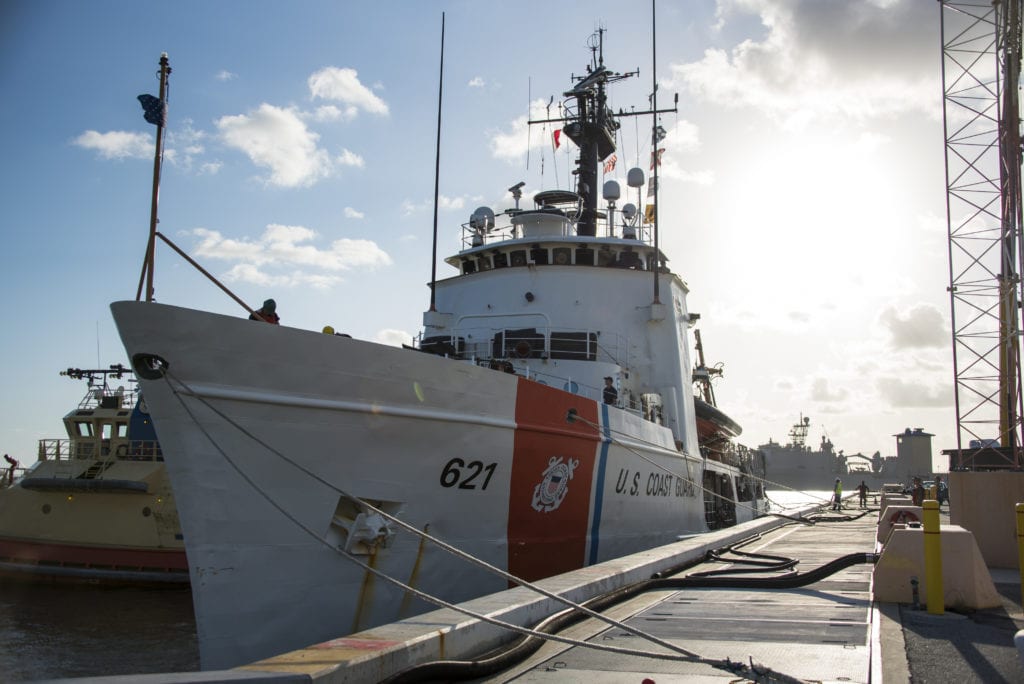
Coast Guard Cutter William Flores arrived on scene and embarked 25 Haitian nationals: nine adult males, nine adult females, and seven accompanied minors for repatriation to Haiti.  

“Thankfully, the people aboard this vessel had a VHF radio in order to call for help, but there wasn’t any other lifesaving equipment on board,” said Senior Chief Petty Officer Jason Reynolds, command duty officer, Sector Miami. “The risk of loss of life is too great to take to the seas in overloaded, unseaworthy vessels and no lifesaving gear.” 

Since Oct. 1, 2020, Coast Guard crews have interdicted 181 Haitians compared to fiscal year 2020, Oct. 1, 2019 – Sept. 30, 2020, where crews interdicted 418 Haitians.   

Once aboard a Coast Guard cutter, all migrants receive food, water, shelter and basic medical attention. Throughout the interdiction, Coast Guard crew members were equipped with personal protective equipment to minimize potential exposure to any possible case of COVID-19.  There were no migrants in these cases reported to have any COVID-19 related symptoms. 


Coast Guard Set to Retire Last High-Endurance Cutter, Commandant Says

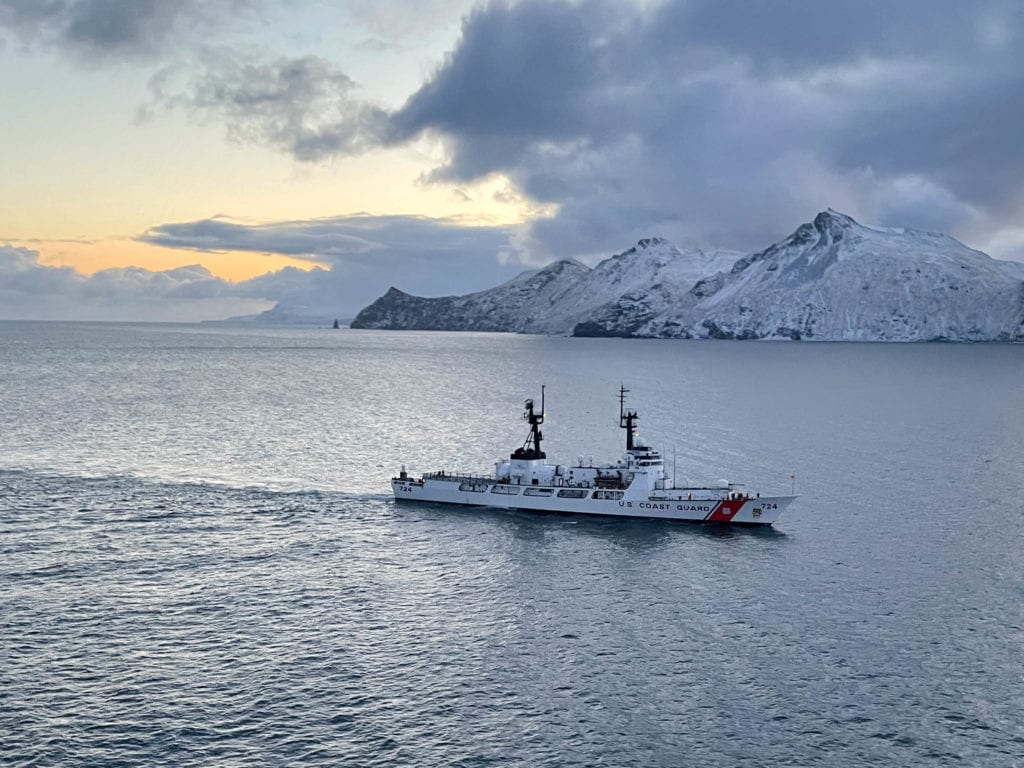
Members from Coast Guard Cutter Douglas Munro stand in formation on the back of the cutter, July 24, 2020. The cutter’s hull day, July 24, correlates with its hull number, 724. U.S. Coast Guard

WASHINGTON —The Coast Guard will retire USCGC Douglas Munro at the end of March, concluding 49 years of Coast Guard service for the cutter and 54 years for the Secretary-class 378-Foot cutters. 

In a March 4 message to the Coast Guard, Commandant Adm. Karl L. Schultz said that on March 31 the Douglas Munro would be placed in In-Commission Special Status, which begins the decommissioning process.  

The 12 Secretary-class cutters were the mainstay of the Coast Guard’s ocean-going fleet until their replacement began 13 years ago by the new Legend-class national security cutters. Some deployed with carrier strike groups and operated in the Persian Gulf. They had an anti-submarine warfare (ASW) capability until 1992, when it was removed. The same year some were armed with Harpoon anti-ship missiles. The original 5-inch gun mounts were replace in the late 1980s to mid-1990s with Mk75 76mm guns. 

The Douglas Munro, built by Avondale Shipyards in Louisiana, was commissioned on Sept. 27, 1971. It was named Munro until the Coast Guard’s new Legend-class national security cutter USCGC Munro was built. 

As the high-endurance cutters were decommissioned, they were transferred to foreign navies or coast guards. Hamilton, Dallas and Boutwell have been transferred to the Philippines; Chase and Gallatin to Nigeria; Jarvis and Rush to Bangladesh; Morgenthau to Vietnam; Sherman to Sri Lanka, and Mellon to Bahrain. John Midgette is in Seattle being prepared for delivery to Vietnam. Douglas Munro likely will serve in a foreign navy as well, though transfer has not yet been announced.


U.S. Coast Guard Cutter Stone Completes Operation Southern Cross

U.S. Coast Guard Lt. Cmdr. Jason McCarthey, operations officer of the USCGC Stone (WMSL 758), bumps elbows, as a COVID mitigation, with a member of the Guyana coast guard off the coast of Guyana on Jan. 9, 2021, to celebrate the joint exercise. The U.S. Coast Guard and Guyana coast guard completed their first cooperative exercise in training to combat illicit marine traffic since the enactment of a bilateral agreement between the two on Sep. 18, 2020. U.S. Coast Guard / Petty Officer 3rd Class John Hightower

PORTSMOUTH, Va. — The USCGC Stone (WMSL 758) crew arrived in their homeport of North Charleston, S.C., March 1, following the conclusion of the Operation Southern Cross, a patrol to the South Atlantic in support of counter illegal, unreported, and unregulated fishing (IUUF), the Coast Guard Atlantic Area said in a March 4 release. 
 
Taking the newly accepted cutter on its shakedown cruise, Stone’s crew covered over 21,000 miles (18,250 nautical miles) over 68 days. A mutual interest in combating IUUF activities offered an opportunity to collaborate for Stone’s crew. They interacted with partners in Guyana, Brazil, Uruguay, and Portugal, strengthening relationships and laying the foundation for increased partnerships to counter illicit maritime activity. 
 
“I could not be more proud of this crew,” said Capt. Adam Morrison, the Stone’s commanding officer. “It was no easy feat to assemble a crew and ready a cutter for sea, but to do so in a COVID-19 environment followed by a two-month patrol is truly quite amazing. While at sea, we completed all patrol objectives and strategic engagements with like-minded partners. Our crew training was balanced with shining a big spotlight on illegal fishing practices in the South Atlantic. We arrived at our homeport on Monday after nearly five months away from families and will now receive some well-deserved rest.”  
 
Even before leaving the pier, the Stone set milestones. They are the first U.S. Coast Guard cutter with a Portuguese navy member to serve aboard. Lt. Miguel Dias Pinheiro, a Portuguese navy helicopter pilot, joined the Stone’s crew for the entirety of their first patrol. 
 
Pinheiro served as both an observer and a linguist for daily operations. Further, he lent shipboard aviation experience. On this patrol, Stone certified their flight deck for aviation operations and embarked an aviation detachment from Air Station Houston. His participation in the patrol has already led to reciprocal activity with Portugal. 
 
“Working with our partner nations has not only strengthened our working relationships but has allowed the crew of the Stone to conduct training evolutions that we don’t often get to do,” said Lt. Cmdr. Jason McCarthey, the Stone’s operations officer. 
 
While in transit to conduct joint operations off Guyana’s coast, Stone encountered and interdicted a suspected narcotic trafficking vessel south of the Dominican Republic. Having stopped the illicit activity, Stone handed off the case to the USCGC Raymond Evans (WPC 1110), a fast response cutter from Key West, Florida, and continued its patrol south. 
 
Stone’s team practiced communications with the Guyana Defense Force during a fast-paced interdiction scenario. This evolution required focus and attention on both sides of the radio. 
 
In Brazil, the crew practiced communications and steaming in close formation, an essential skill for joint and combined operations. Stone’s team also gave presentations to the Brazil navy members on maritime law enforcement practices and tactics. 

“Having the opportunity to work together and exchange ideas helps us all become more proficient in achieving our shared goals,” said McCarthey. 
 
Stone was the first U.S. Coast Guard cutter to call in Uruguay in more than a decade. Stone’s crew familiarized their hosts on the Coast Guard’s full range of mission and operations, answering technical questions and sharing best practices. Uruguay expressed further interest in additional professional exchange opportunities and joint operations in the future.  
 
The Stone crew were given a unique opportunity to forge new bonds and strengthen the foundations of previous alliances in the face of a global crisis and did so through in-person and virtual engagement, conscious of the risks involved. 
 
“We are very keen to not only negotiate international agreements to address IUU fishing, as we did with the Port State Measures Agreement. We’re also very supportive of the work the Coast Guard is doing to build relationships and strengthen the operational effectiveness of all of the coastal states to combat IUU fishing,” said David Hogan, acting director of The Office of Marine Conservation, Bureau of Oceans and International Environmental and Scientific Affairs, U.S. Department of State. 
 
Operation Southern Cross promises to expand U.S. relationships with these partner governments. Beyond Operation Southern Cross’s immediacy, the U.S. government intends these collaborations to promote long-term regional stability, security, and economic prosperity.  
 
Stone’s crew now prepares for the cutter’s commissioning on March 19. 
 
The cutter’s namesake is the late Cmdr. Elmer “Archie” Fowler Stone, who in 1917 became the Coast Guard’s first aviator and, two years later, was one of two pilots to successfully make a transatlantic flight in a Navy seaplane, landing in Portugal.  


U.S., Canadian Coast Guards, RCAF Rescue 31 Fishermen from Sinking Vessel

An MH-60 Jayhawk helicopter, shown here in a 2008 photo. A similar helicopter aided in the rescue of a disabled Canadian fishing vessel on March 2. Coast Guard / Petty Officer Richard Brahm

BOSTON — The U.S. and Canadian Coast Guards and Royal Canadian Air Force rescued 31 fishermen from a disabled, Canadian fishing vessel over 130 miles south of Halifax, Nova Scotia, during the night of March 2. 

At 7:05 p.m., March 2, the Rescue Coordination Center in Halifax notified watchstanders at the Coast Guard First District Command Center that the 143-foot vessel, Atlantic Destiny, was disabled with a fire on board, and was taking on water. 

A U.S. Coast Guard Air Station Cape Cod HC-144 Ocean Sentry fixed-wing crew, and two MH-60 Jayhawk helicopter crews launched and arrived on scene. 

A Royal Canadian Air Force CH-149 helicopter crew from 14 Wing Greenwood, in Nova Scotia, Canada, hoisted six crewmembers from the vessel, and dropped off two search and rescue technicians to assist in dewatering the vessel. 

The U.S. Coast Guard Jayhawk crews hoisted another 21 fishermen between the two helicopters. All hoisted crewmembers were taken to Yarmouth, Nova Scotia, where they were transferred for any medical treatment. 

The remaining four crewmembers and two SAR technicians ceased dewatering efforts and were transferred to the Canadian Coast Guard Ship Cape Roger. 

The vessel owner is coordinating any salvage efforts. 

The weather on scene was 35 mph winds and 15-foot seas. 


Coast Guard Transfers 3 Smugglers, Over $5.6M in Seized Cocaine to Federal Agents

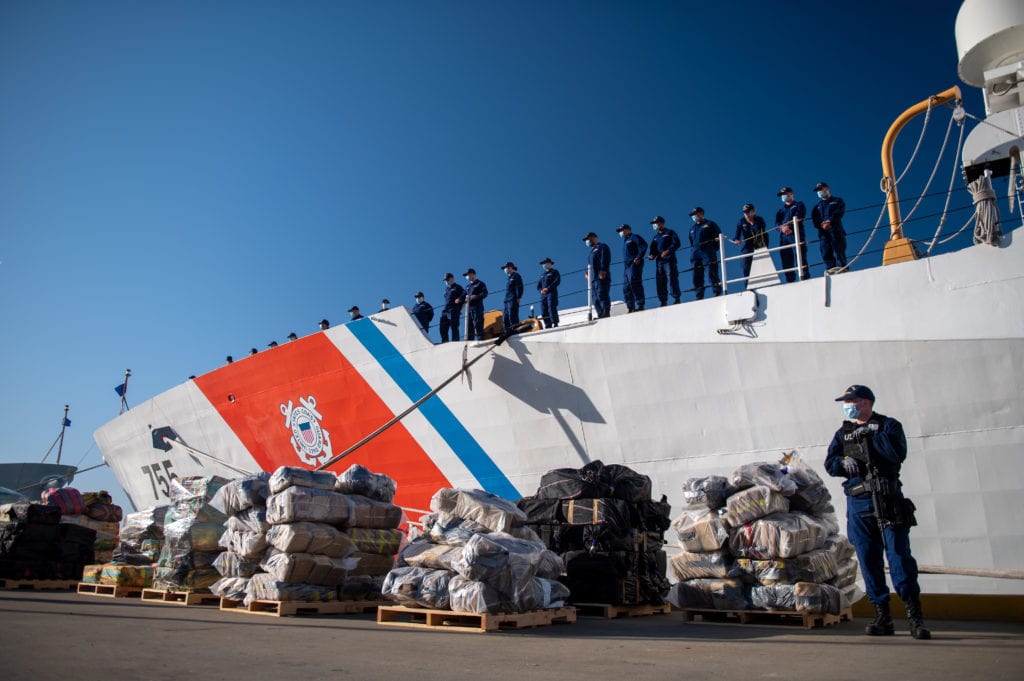
Coast Guard Cutter Heriberto Hernandez crew members offload over 200 kilograms of cocaine, valued at over $5.6 million, and transfer three suspected smugglers, one Venezuelan and two Dominicans to federal agents from the Caribbean Corridor Strike Force March 2, 2021 at Coast Guard Base San Juan. U.S. Coast Guard

SAN JUAN, Puerto Rico – The Coast Guard Cutter Heriberto Hernandez transferred custody of three suspected smugglers and $5.6 million in seized cocaine to federal agents at Coast Guard Base on San Juan March 2, following the interdiction of a drug smuggling vessel in the Caribbean Sea off St. Croix, U.S. Virgin Islands, the Coast Guard 7th District said in a March 3 release. 

The suspected smugglers are three males, one Venezuelan and two Dominican Republic nationals, who now face criminal charges by Department of Justice prosecution partners in the U.S. Attorney’s Office for the District of Puerto Rico. 

The interdiction resulted from multi-agency efforts in support of U.S. Southern Command’s enhanced counter-narcotics operations in the Western Hemisphere, the Organized Crime Drug Enforcement Task Force (OCDETF) and High Intensity Drug Trafficking Area (HIDTA) programs, and the Caribbean Corridor Strike Force (CCSF). 

“This interdiction was the result of great teamwork from beginning to end with our interagency partners.” said Lt. Peter Kelly, Coast Guard Cutter Richard Dixon commanding officer. “I am extremely proud of the execution of the Richard Dixon crew in what was not an easy mission, and we are pleased to have kept such a large amount of cocaine from reaching U.S. streets.”   

The bust occurred during the afternoon of Feb. 23, 2021, after the aircrew of a Customs and Border Protection Caribbean Air and Marine Branch maritime patrol aircraft detected a suspicious go-fast vessel in international waters southeast of St. Croix, U.S. Virgin Islands.   

The Coast Guard Cutter Richard Dixon diverted to interdict the go-fast vessel with the assistance of the cutter’s small boat. Following the interdiction, the Cutter Richard Dixon’s boarding team located and seized over 200 kilograms of cocaine. 

The crew of the cutter Richard Dixon embarked the three men and seized contraband from the go-fast vessel, and later transferred them aboard the Coast Guard Cutter Heriberto Hernandez for transport and offload in San Juan, Puerto Rico, where CCSF federal agents received custody. Cutters Richard Dixon and Heriberto Hernandez are 154-foot fast response cutters homeported in San Juan, Puerto Rico. 


Cutter Kimball Conducts Patrol to Increase Maritime Presence and Support in Pacific

While patrolling approximately 3,600 miles in the Philippine Sea, the Coast Guard Cutter Kimball’s law enforcement team conducted its first at-sea boarding, Feb. 10, 2021. As part of Operation Blue Pacific, the crew of the Kimball deployed in support of national security goals of stability and security throughout the Indo-Pacific. U.S. Coast Guard

HONOLULU — The Coast Guard Cutter Kimball (WMSL-756) concluded a successful two-week expeditionary patrol in support of counter-illegal, unreported and unregulated fisheries enforcement, furthering the United States’ commitment to regional security and partnerships, the Coast Guard 14th District said in a Feb. 24 release. 

As part of Operation Blue Pacific, the crew of the Kimball deployed in support of national security goals of stability and security throughout the Indo-Pacific. The crew of the Kimball remains prepared to use training in targeted and intelligence-driven enforcement actions as well as counter predatory irresponsible maritime behavior. 

While patrolling approximately 3,600 miles in the Philippine Sea, the Kimball’s law enforcement team conducted its first at-sea boarding and expanded on the multilateral fisheries enforcement cooperation such as the Western and Central Pacific Fisheries Commission.  

The WCPFC is an international body made up of 43 nations and international organizations. Members agree to allow the 13 countries in the pact to board and record any potential violations on their nationally flagged vessels. The findings go to the WCPFC, which notifies the vessel’s flag state of the suspected infraction for further investigation. 

“Our presence in the area shows our partners the Coast Guard’s enduring efforts to provide search and rescue response and oversight of important economic resources,” said Lt. Cmdr. Drew Cavanagh, operations officer for the Kimball. “The ongoing presence of a Coast Guard cutter in this part of the Pacific to assist in determining compliance with conservation management measures established by the WCPFC demonstrates the U.S. commitment to the region and our partners.” 

The Coast Guard combats illegal fishing and other maritime threats across the Pacific to protect the United States and Pacific Island Countries resource security and sovereignty. Combating illegal fishing is part of promoting maritime governance and a rules-based international order that is essential to a free and open Oceania.  

While on patrol, the Kimball was briefly diverted to assist in a search and rescue case in the Federated States of Micronesia, where they used a small unmanned aircraft system, or SUAS. The use of SUAS expands maritime domain awareness and provides persistent airborne surveillance on maritime hazards, threats, and rescue operations.  

“Training is also an important component of underway time and affects our readiness,” said Lt.j.g. Joseph Fox, assistant combat systems officer for the Kimball. “The team conducted law enforcement training as well as disabled vessel towing training for our newest crewmembers.” 

The Kimball is one of the newest national security cutters to be homeported in Honolulu. These technologically advanced ships are 418 feet long, 54 feet wide and have a 4,600 long-ton displacement. They have a top speed in excess of 28 knots, a range of 12,000 nautical miles, endurance of up to 90 days and can accommodate a crew of up to 150. 

Advanced command-and-control capabilities and an unmatched combination of range, speed and ability to operate in extreme weather enable these ships to confront national security threats, strengthen maritime governance, support economic prosperity, and promote individual sovereignty. 


Cutter Thetis Returns Home from a 43-day Drug-Busting Caribbean Patrol Sea

The Coast Guard Cutter Thetis (WMEC-910) underway in the West Caribbean, Jan. 14, 2021. The Coast Guard Cutter Thetis crew returned to Key West, Florida, on Feb. 21 after a 65-day Caribbean Sea patrol in support of Coast Guard 7th District. U.S. Coast Guard

KEY WEST, Fla. — The crew of Coast Guard Cutter Thetis (WMEC-910) returned home to Key West, Florida, on Feb. 21 after a 43-day patrol to the Caribbean Sea, the Coast Guard 7th District said in a Feb. 22 release. 

The crew interdicted three drug vessels and seized close to 6,000 pounds of cocaine with a street value of approximately $82 million. 

“By making our presence known in the Caribbean, we continue to disrupt the flow of illicit and dangerous drugs into the United States,” said Cmdr. Justin Nadolny, cutter Thetis commanding officer. “Despite strong winds and rough seas throughout the patrol, the crew persevered and did an outstanding job in executing the mission. I couldn’t be more proud to be part of such a fine team. This crew achieved superior results while maintaining positive attitudes and keeping morale high. I’m also thankful for the support of our Thetis family back in Key West. It’s not easy when your loved ones are deployed for long periods of time and their continued love and support kept us all motivated and focused.” 

Working in support of U.S. Southern Command’s Joint Interagency Task Force South, the Thetis crew played a critical role in executing the nation’s counter drug mission. Thetis deployed with an MH-65 Dolphin helicopter and aviation detachment capable of conducting airborne use of force from the Coast Guard’s Helicopter Interdiction Tactical Squadron based in Jacksonville, Florida.  

In one case, Thetis’ crew assumed tactical control of Port Canaveral-based Coast Guard Cutter Confidence’s (WMEC-619) pursuit boat and boarding team. Thetis’ crew launched an MH-65 helicopter, which stopped the go-fast vessel with disabling fire, and resulted in an estimated 1,100 pounds of cocaine disrupted and the apprehension of two suspected smugglers. Thetis’ crew also conducted a joint interdiction with its Key West sister ship, Coast Guard Cutter Mohawk (WMEC-13) and crew. During this case, Thetis’ crew used an MH-65 helicopter and stopped a go-fast vessel with precision fire to the vessel’s outboard engine, resulting in an estimated 1,220 pounds of cocaine seized and the apprehension of three suspected smugglers. 

The crew also conducted joint counter-narcotic operations with the Colombian navy. While patrolling with one of the partner nation’s ships, Thetis’ crew conducted communications exercises, showcasing the teamwork and joint interoperability between the United States and Colombia. 

“I am exceedingly proud to sail with the Thetis crew,” said Lt. Moriba George, cutter Thetis’ engineering officer. “The engineering department demonstrated their ability to improvise, adapt and overcome with the many challenges and rigors that being underway in turbulent seas can pose. Their continual positive energy and dedication to the mission in the midst of the COVID-19 pandemic is incredibly admirable. We are looking forward to a productive maintenance period and spending some well-earned time at home with our loved ones.” 

Counternarcotic interdictions were in support of Campaign Martillo, a multinational counter-narcotics collaboration to disrupt transnational criminal organizations that threaten global security and prosperity. Martillo is led by Joint Interagency Task Force South, a component of U.S. Southern Command, and supported by 15 U.S. and 21 international agencies. 

Named for the famous Greek mythology sea nymph and mother of Achilles, Thetis is a 270-foot Famous-class cutter homeported in Key West with a crew of 104. 


Cutter Harriet Lane Returns Home following Interdiction of $40M Worth of Drugs

An MH-65 Dolphin Helicopter rests on the deck of the Coast Guard Cutter Harriet Lane during their 71-day patrol. The Coast Guard Cutter Harriet Lane is home-ported in Portsmouth, Virginia. U.S. Coast Guard

PORTSMOUTH, Va. – The Coast Guard Cutter Harriet Lane returned to its homeport in Portsmouth, Virginia, after a 71-day counter-drug patrol Feb. 12, the Coast Guard 5th District said in a Feb. 18 release.  

In support of the Coast Guard’s 11th District and Joint Interagency Task Force South, the Harriet Lane crew worked throughout the duration of the patrol in conjunction with a deployed aviation detachment from the Helicopter Interdiction Tactical Squadron (HITRON) based in Jacksonville, Fla. HITRON specializes in the execution of airborne use of force for the purpose of disabling non-compliant vessels suspected of illicit drug smuggling.  

Harriet Lane joined forces with the Colombian navy to conduct joint maritime operations in the Caribbean, focusing on interoperability, communications, and counter-narcotics efforts. Upon crossing into the Pacific via the Panama Canal, the Harriet Lane crew and her embarked aviation detachment interdicted two non-compliant vessels suspected of illicit drug smuggling.

These interdictions included the seizure of 980 kilograms of cocaine and 1,600 pounds of marijuana, an estimated street value of $40 million. Harriet Lane also detained seven suspected drug smugglers associated with the interdictions. Between operational tasking, the cutter crew completed aviation, damage control, seamanship and navigation training to maintain operational readiness and prepare for future multi-mission deployments. 

“I could not be more proud of the crew of Harriet Lane for their perseverance and operational success amid the continued pandemic,” said Cmdr. Dorothy Hernaez, commanding officer of the Harriet Lane. “The crew flawlessly executed COVID-19 mitigation protocols leading up to and during the deployment to remain healthy and operationally ready throughout. The success we had during this deployment would not have been possible without the continued support of our families and friends, who we are looking forward to seeing again upon our return to port.”  

Prior to returning home, Harriet Lane stopped in Port Everglades, Florida, to transfer 17 suspected drug smugglers and $206 million of illicit drugs to partner agencies for prosecution. In addition to the interdictions by Harriet Lane, people and drug evidence transferred in this evolution came from interdictions in the eastern Pacific and Caribbean by Coast Guard Cutters Bertholf, Munro, and Mohawk, as well as the USS William P. Lawrence with Coast Guard Law Enforcement Detachment Team 101 and USS Comstock with Coast Guard Law Enforcement Detachment Team 403.  

Harriet Lane is a 270-foot medium endurance cutter responsible for a variety of Coast Guard missions, including search and rescue, enforcement of laws and treaties, maritime defense, and protection of the marine environment. 


Heavy icebreaker Polar Star Completes Months-Long Arctic Deployment

The Seattle-based Coast Guard Cutter Polar Star (WAGB 10) sits at anchor in Taylor Bay, Alaska, Feb. 10, ahead of its scheduled logistics stop in Juneau, Alaska, near the end of its months-long Arctic deployment and return to its Seattle homeport. U.S. Coast Guard photo by Petty Officer 1st Class Cindy Oldham

SEATTLE — The Coast Guard Cutter Polar Star (WAGB 10) returned to its homeport in Seattle Feb. 20 following a months-long Arctic deployment to defend the nation’s maritime sovereignty and security throughout the region, develop future Arctic Sailors, and gather high-latitude scientific data, the Coast Guard Pacific Area said in a release. 

The 45-year-old heavy icebreaker’s crew spent a majority of the patrol operating in the Bering and Chukchi Seas. Notably, on Dec. 25 the crew traversed a historic winter latitude when they navigated through dense sea ice to patrol beyond 72 degrees latitude, farther north than any U.S. surface asset ever traversed in the winter. 

Additionally, in mid-January, the Polar Star crew and a Russian Border Guard aircraft crew patrolled a portion of the 1,700-mile international maritime boundary line. The joint effort supported mutual agreements to prepare for a potential natural or manmade maritime disaster and reduce any impacts it might have. 

Capt. Bill Woityra, the Polar Star’s commanding officer, said he is incredibly proud of Polar Star’s crew for their hard work and perseverance through the long and arduous mission. 

“Spending a majority of the patrol navigating dense, constantly shifting sea ice, consistently below-zero temperatures and day-long darkness, the crew’s resilience was unyielding,” said Woityra. “With their tremendous effort and positive attitudes, we accomplished everything we set out to do, and more.” 

Throughout the patrol, the crew continued progress toward developing future icebreaker leadership by honing ice navigation proficiency and regional familiarity. The crew also hosted scientists and researchers aboard to better understand Arctic operational capabilities and lessen the void of winter data available from the world’s most northern oceans. 

Woityra said the United States and the Coast Guard are fiercely committed to defending national interests in the Arctic and, looking to the future, the U.S. must continue to invest in the infrastructure and platforms that will enable year-round Arctic operations, and continue to pursue technologies that will mitigate operational risks and enable mission performance in such a challenging environment. 

In April 2019, the Coast Guard released the Arctic Strategic Outlook, which reaffirms the service’s commitment to American leadership in the region through partnership, unity of effort, and continuous innovation. 

The Coast Guard has been the sole provider of the nation’s polar icebreaking capability since 1965 and is seeking to increase its icebreaking fleet with up to six new polar security cutters (PSCs) to ensure continued national presence and access to the Polar Regions. 

The Coast Guard awarded VT Halter Marine Inc. of Pascagoula, Mississippi, a contract for the design and construction of the Coast Guard’s lead polar security cutter, which will also be homeported in Seattle. The contract also includes options for the construction of two additional PSCs.