Cutter Delivers Water to Alaska Residents Experiencing Waterline Failures
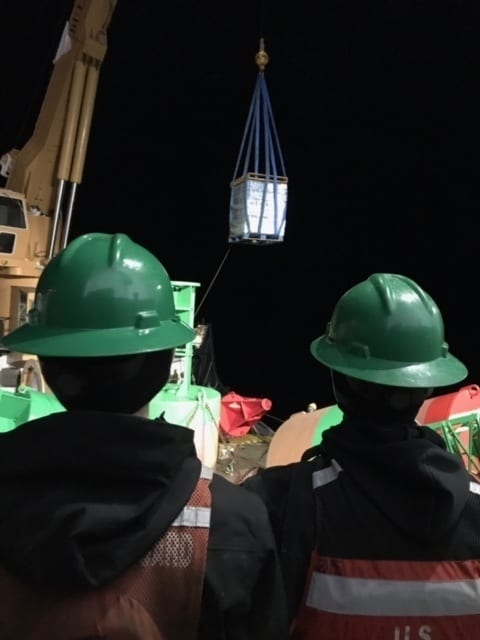
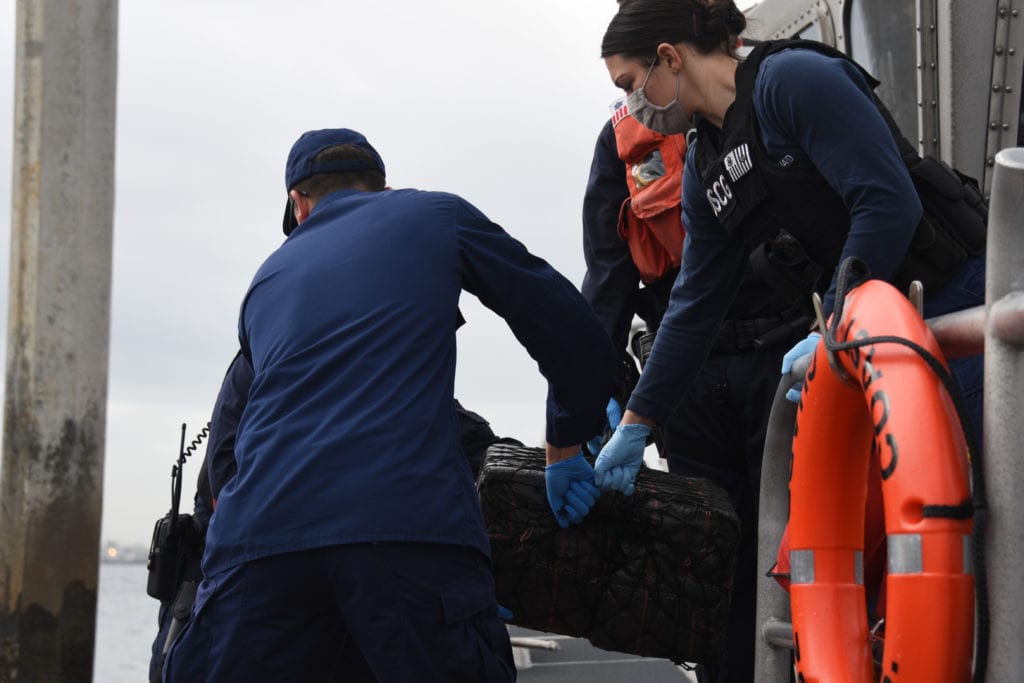
Coast Guard Cutter Hickory crewmembers offload pallets of water in a humanitarian effort to deliver goods to the small community of Angoon, Alaska, Feb. 14, 2021. U.S. Coast Guard
KODIAK, Alaska — The Coast Guard Cutter Hickory crewmembers delivered pallets of water to the remote community of Angoon, Alaska, on Feb. 14, after the residents experienced waterline failures, the Coast Guard 17th District said in a Feb. 16 release.
The cutter crew loaded four pallets of water onto the ship with each pallet containing 1,700 bottles and delivered the supplies to Angoon Sunday evening.
Along with the nearly 7,000 bottles of water being delivered, the Hickory crew reportedly had 8,000 gallons of potable water onboard that could be offloaded to the residents if needed.
Coast Guard District 17 Command Center watchstanders received a call Saturday afternoon from the Alaska Emergency Operations Center requesting assistance in delivering the pallets.
Angoon, a small community with a population of 400, is experiencing waterline failures resulting in one third of the community being completely without water while the rest of the residents have been advised to boil water before consumption.
There was no water available at the local store and commercial services are not available to deliver water until late next week. The waterline failures are expected to last for a couple of weeks.
The Hickory is a 225-foot sea-going buoy tender homeported in Homer, Alaska.
Cutters Interdict 3 Suspected Smuggling Vessels, $156M of Cocaine in Eastern Pacific
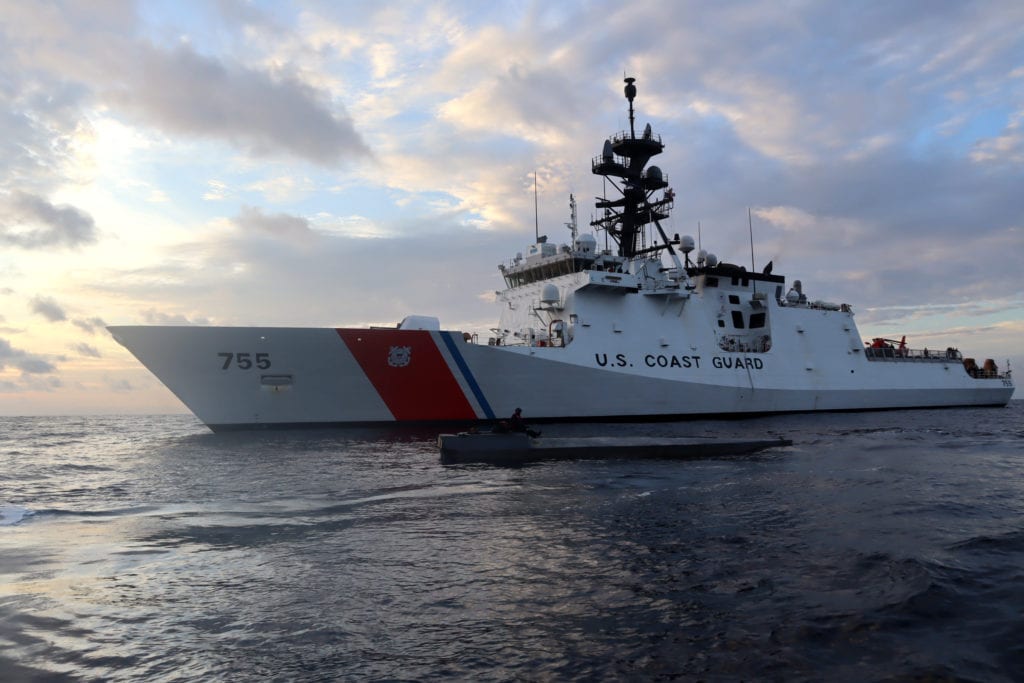
Coast Guard Cutter Munro (WMSL 755) boarding team member sits atop an interdicted low-profile vessel in the Eastern Pacific Ocean after crews seized 3,439 pounds of cocaine from the LPV, Jan. 27, 2021. U.S. Coast Guard
ALAMEDA, Calif. – Crews aboard two Alameda-based Coast Guard cutters interdicted three suspected drug smuggling vessels in the Eastern Pacific Ocean between Jan. 26 and Feb. 1 and seized more than 9,000 pounds of cocaine worth an estimated $156 million, the Coast Guard Pacific Area said in a Feb. 17 release.
Conducting the operations were the crews of the Coast Guard Cutters Munro (WMSL 755) and Bertholf (WMSL 750).
Munro’s crew boarded a fishing vessel Jan. 26 suspected of smuggling illicit narcotics. Exercising a bilateral agreement with a partner nation, the boarding teams searched and discovered 1,300 pounds of cocaine concealed within the vessel.
Munro’s crew interdicted a second suspected drug smuggling vessel hours later after a maritime patrol aircraft detected a suspicious vessel and directed Munro’s crew towards it. Munro launched a helicopter aircrew and boarding teams, and together they interdicted a low-profile vessel. The boarding teams discovered 3,439 pounds of cocaine aboard the purpose-built drug smuggling vessel.
“Having back-to-back cases lasting 31 hours pushed our limits, but our crew took on the challenge,” said Capt. Blake Novak, commanding officer of the Munro. “Cartels are cunning and sophisticated, and this is a dynamic environment, which required interagency and international coordination which yielded results. I am proud of our crew, but these successes would not be possible without our Central and South American partnerships.”
On Feb. 1, Bertholf’s boarding teams also interdicted a low-profile vessel, seizing more than 4,380 pounds of cocaine.
Cartels design low-profile vessels specifically to evade law enforcement by being difficult to detect. These vessels are built to ferry large quantities of illicit contraband while riding low in the water.
“The crew continues to impress me as they rise above challenges, stand a taut watch, and conduct themselves in a professional manner as we go about our business of stemming the flow of narcotics in the Eastern Pacific,” said Capt. Brian Anderson, commanding officer of the Bertholf. “I could not be more pleased with the overall teamwork between the aircraft, our small boats, and my crew in the interdiction of this drug laden vessel. Together we are making a difference.”
Nine suspected traffickers were taken into custody between the three interdictions.
Munro and Bertholf are two of four 418-foot Legend-class national security cutters homeported in Alameda. National security cutters have a crew of more than 150 and are among the largest and most technologically sophisticated vessels in the Coast Guard’s fleet. The cutters can operate globally in the most demanding open ocean environments, from the North Pacific’s hazardous fishing grounds to the Eastern Pacific’s vast approaches, where its crews battle transnational crime.
Cutter Mohawk Returns to Key West after Interdicting $69 Million in Drugs
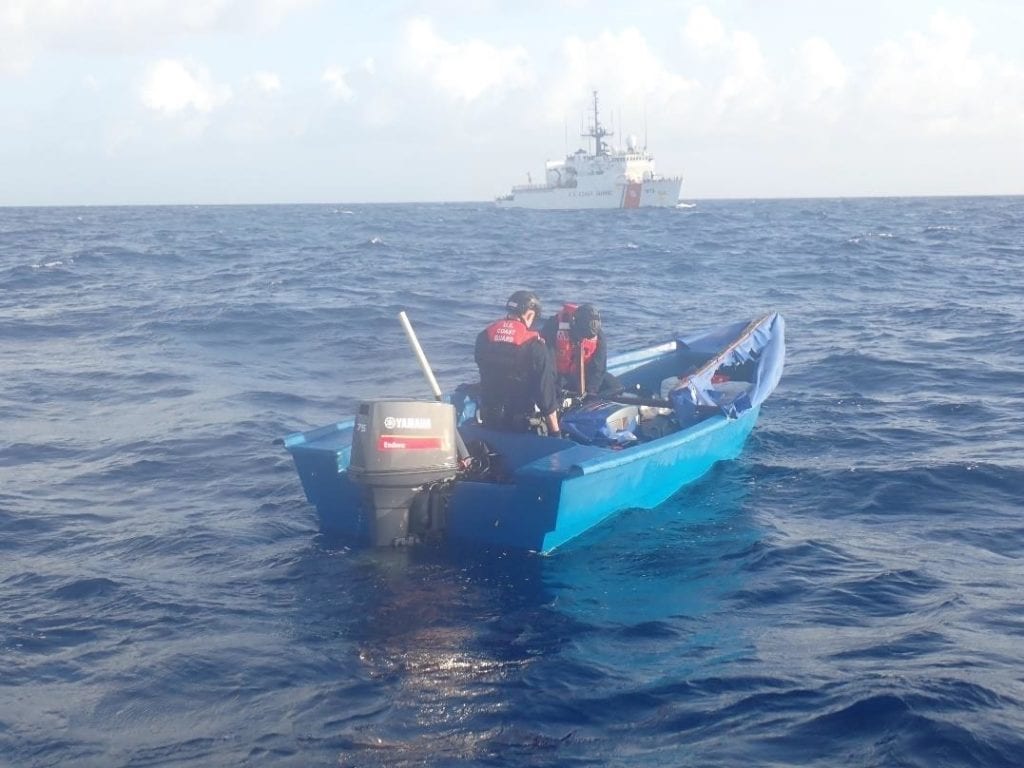
Coast Guard Cutter Mohawk (WMEC 913) crewmembers interdicted a 25-foot vessel with two suspected smugglers and over 660 pounds of cocaine in Caribbean waters Jan. 24, 2021. U.S. Coast Guard
KEY WEST, Fla. — Coast Guard Cutter Mohawk’s (WMEC 913) crew returned home to Key West Feb. 12 after a 59-day patrol in the Caribbean Sea.
The crew interdicted four drug vessels, detained five suspected drug smugglers and seized approximately 4,000 pounds of cocaine with a street value of approximately $69 million.
“These interdictions reflect teamwork and the unwavering resolve between the Coast Guard, federal law enforcement, Department of Defense, and our international partners to protect the region against the scourge of transnational criminal organizations,” said Cmdr. James L. Jarnac, Coast Guard Cutter Mohawk commanding officer. “The crew of Mohawk demonstrated remarkable enthusiasm and commitment during the execution of our missions over the last eight weeks, and it remains my pleasure to serve with and for them.”
During the patrol, Mohawk’s crew worked with multiple interagency and international maritime patrol aircraft and surface assets to counter transnational criminal organizations and hinder the illicit flow of drugs, people, and other dangerous cargo into the United States. This includes joint operations with the Dominican Republic navy, and Panamanian law enforcement officers, which further strengthened foreign partnerships and to detect, deter, and interdict vessels engaged in illegal, unreported, and unregulated fishing within the Exclusive Economic Zone of Panama.
Coast Guard Cutter Mohawk is a 270-foot medium-endurance cutter with a crew complement of 80.
Coast Guard Cutter Polar Star Collects High-Latitude Data of Remote Arctic Region
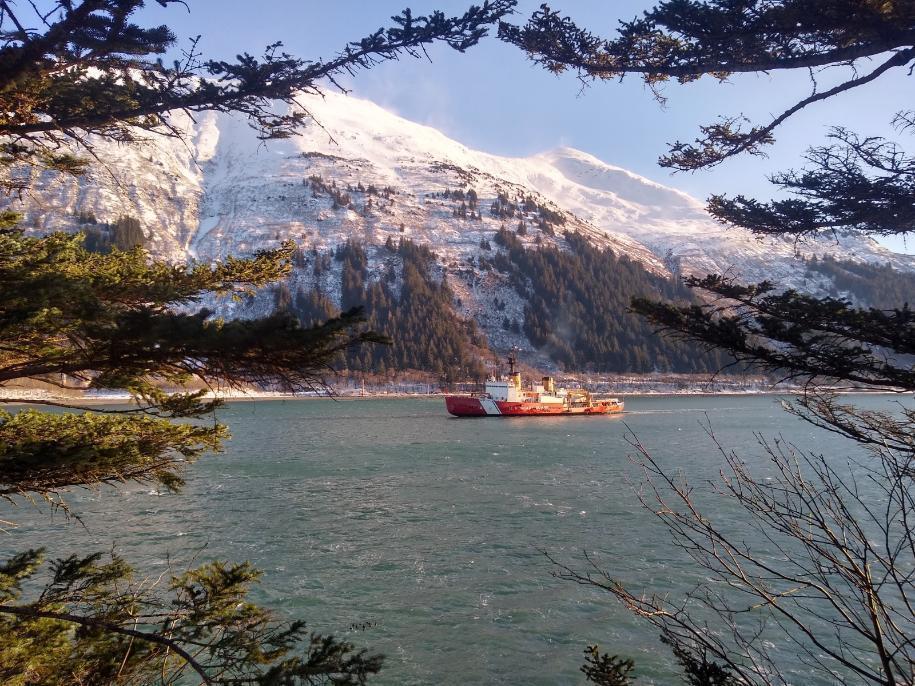
U.S. Coast Guard Cutter Polar Star transits the Gastineau Channel to moor up in Juneau, Alaska, on Feb. 12, 2021, as the crew nears the end of their months-long Arctic deployment. U.S. Coast Guard / Senior Chief Petty Officer Trevor Bannerman
JUNEAU, Alaska — The Seattle-based Coast Guard Cutter Polar Star (WAGB 10) arrived in Juneau, Alaska on Feb. 12, for a logistics stop as the crew nears the end of their months-long Arctic deployment conducting scientific research and protecting the nation’s maritime sovereignty and security throughout the polar region, the Coast Guard 17th District said in a release.
“The Arctic is cold, dark, and difficult to navigate in the winter,” said Capt. Bill Woityra, the Polar Star’s commanding officer. “Deploying with researchers and scientists aboard has aided in the development, understanding and pursuit of technologies that will mitigate risks and enable future mission performance so that looking forward, the Coast Guard can safely operate continually and effectively in this remote environment.”
Working aboard Polar Star, Shalane Regan, a member of the Coast Guard Research and Development Center (RDC), teamed up with Lt. Lydia Ames, a NOAA Corps officer, to assist CRREL researchers by deploying buoys onto the ice where they will, over time, collect and transmit information about ice flow to help fill in data gaps for higher-latitude oceans.
The Polar Star crew also aided in a research project concerning water flow regimes in the Arctic, specifically the Chukchi Sea, a study developed by Dr. Robert Pickart of WHOI. The data collected during Polar Star’s patrol will be used to develop a more complete understanding of the hydrology of the dynamic region.
To support Dr. Pickart’s research, WHOI provided 120 Expendable Conductivity-Temperature-Depth (XCTD) instruments to measure temperature and salinity. These profiles of the water column will give a better picture of what water and nutrient flow look like in the Arctic winter. Polar Star crew members deployed the probes every 12 hours when above 65 degrees north.
Additionally, Regan, a mechanical engineer and researcher with the RDC Surface Branch, worked with other scientists and researchers on board to find ways to operate most effectively in the frigid Arctic environment.
For technology, Regan brought a 3-D printer and remotely operated vehicle aboard Polar Star to evaluate how the systems would react to the Arctic climate and ship life.
“I used the 3-D printer to complete many small projects that resulted in large lifestyle improvements for the crew,” said Regan. “Most importantly, the knowledge I was able to gather about larger issues the crew faces, for example, visibility issues due to frost accumulation on the bridge windows, I can take home for my team to develop solutions that will create a better-equipped, mission-ready fleet.”
Another big item the RDC team is focusing on is underway connectivity, specifically in the Arctic region.
To better understand high latitude communications, The Mobile User Objective System (MUOS) was installed on Polar Star to test its abilities at high latitudes in the harsh Arctic winter conditions. Developed for the U.S. Navy by Lockheed Martin, the MUOS is an ultra-high frequency satellite communications system that provides secure connections for mobile forces.
“Looking towards the future, all signs point toward the Coast Guard deploying more platforms to the Arctic, more often and during different seasons of the year,” said Woityra. “The Coast Guard is robustly proficient at summer-time Arctic operations, while winter presents an entirely new set of challenges. Polar Star’s winter Arctic deployment has served to better understand and prepare for the challenges of operating in such a harsh and unforgiving environment.”
Bollinger Shipyards Delivers 43rd Fast Response Cutter
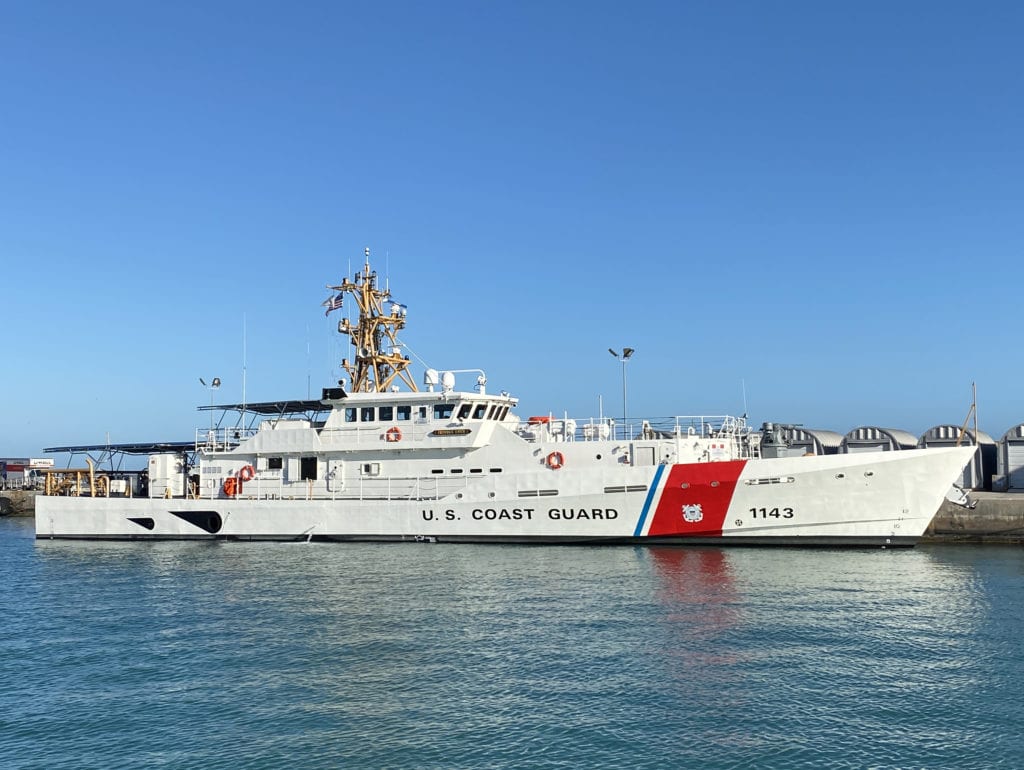
U.S. Coast Guard Cutter Frederick Hatch, the 43rd Fast Response Cutter delivered by Bollinger Shipyards LLC under the current program. Bollinger Shipyards.
LOCKPORT, La.—Bollinger Shipyards LLC has delivered the USCGC Frederick Hatch to the U.S. Coast Guard in Key West, Florida, the company said in a Feb. 10 release. This is the 166th vessel Bollinger has delivered to the U.S. Coast Guard over a 35-year period and the 43rd Fast Response Cutter (FRC) delivered under the current program.
The Frederick Hatch is the final of three FRCs to be home-ported in Apra Harbor, Guam, increasing the presence for the U.S. Coast Guard in the Indo-Pacific Theater. Additionally, in 2020, Bollinger delivered two of six FRCs that will be home-ported in Manama, Bahrain, which are replacing the Island-class patrol boats supporting the Patrol Forces Southwest Asia, the U. S. Coast Guard’s largest unit outside of the United States.
“Bollinger is proud to continue enhancing and supporting the Coast Guard’s operational presence and mission in the Indo-Pacific region with the delivery of the Frederick Hatch,”said Ben Bordelon, Bollinger president and CEO. “Building ships for the U.S. Coast Guard provides critical assets to bolster our national security interests, both domestically and abroad. We are proud and humbled to be partners in the FRC program.”
The homeporting of three FRCs in Guam is part of the U.S. Coast Guard’s “doubling down on Oceania,” allowing more frequent and longer patrols in an area where the U.S. Coast Guard has increased its presence over the past two years and is aligned with the U.S. position on maritime security in the Indo-Pacific. In the early days of the new administration, President Joe Biden has assured U.S. allies in the region that the United States is committed to “maintaining a secure and prosperous Indo-Pacific region.”
U.S. Coast Guard Commandant Adm. Karl Schultz has previously stressed the strategic importance of the service’s presence in the region, saying, “We’re on a trajectory where the geostrategic importance of the Oceania region has not been higher here in decades, and it’s a place that the Coast Guard’s looking to be part of the whole-of-government solution set.”
The majority of the Frederick Hatch build occurred despite the COVID-19 global pandemic and six named storms impacting the Gulf region, all of which affected Louisiana and two of which made landfall in the state as hurricanes, including Hurricane Laura, a Category 4 storm and the strongest to hit the state since the Great Storm of 1856. Despite these challenges, Bollinger undertook precautions to ensure the health and safety of employees and maintained its record of on-time deliveries to the Coast Guard.
Bordelon continued, “Delivering vessels on schedule and on budget to the Coast Guard in these unprecedented times given the COVID-19 challenges that we are all facing shows the resiliency and dedication of our incredibly capable workforce. The FRC hot production line continues to produce and provide stability in the industrial base for the U.S. government and our Bollinger workforce, assuring economic benefit for the Lafourche Parish Louisiana region, our vendor partners in the 40-plus states that support the FRC program, and our country.“
Each FRC is named for an enlisted Coast Guard hero who distinguished himself or herself in the line of duty. Surfman Frederick Hatch was a two-time winner of the Gold Lifesaving Medal. Hatch was awarded his first medal in 1884 for his actions as a surfman at the Cleveland Life-Saving Station for rescuing the crew of the schooner Sophia Minch. He was awarded his second gold medal in 1890, for his selfless act of courage as he rescued those on board the schooner Wahnapitae, which grounded near the Cleveland Breakwater lighthouse where he served as keeper. His career exemplified the Coast Guard’s core values of “honor, respect and devotion to duty” and serves as an inspiration to other enlisted men and women.
The FRC is an operational “game changer,” according to senior Coast Guard officials. FRCs are consistently being deployed in support of the full range of missions within the United States Coast Guard and other branches of our armed services. This is due to its exceptional performance, expanded operational reach and capabilities, and ability to transform and adapt to the mission. FRCs have conducted operations as far as the Marshall Islands — a 4,400 nautical mile trip from their homeport. Measuring in at 154-feet, FRCs have a flank speed of 28 knots, state of the art C4ISR suite (command, control, communications, computers, intelligence, surveillance, and reconnaissance), and stern launch and recovery ramp for a 26-foot, over-the-horizon interceptor cutter boat.
Atlantic Area-based Coast Guard Cutters Offload More than $330M Worth of Illegal Narcotics
The Coast Guard Cutter Campbell (WMEC 909) crew and crane operator offloads approximately 7,250 pounds of cocaine at Port Everglades, Florida, Feb. 4, 2021. The Campbell’s crew patrolled the Eastern Pacific Ocean in support of counter-narcotics operations in the Western Hemisphere to disrupt transnational crime organizations. U.S. Coast Guard / Petty Officer 3rd Class Jose Hernandez
MIAMI — Two Coast Guard Atlantic Area-based cutters offloaded more than $330 million worth of illegal narcotics, Feb. 4 and Feb. 8, at Port Everglades, in Ft. Lauderdale, Florida, the Coast Guard 7th District said in a Feb. 8 release.
The Coast Guard Cutter Campbell crew offloaded on Feb. 4 more than 7,200 pounds of cocaine, worth more than $123 million, and on Feb. 8 the Coast Guard Cutter Harriet Lane crew offloaded more than 11,800 pounds of cocaine and marijuana, Monday, worth more than $206 million.
The illegal narcotics offloaded are a direct reflection of 14 interdictions that occurred in the Eastern Pacific Ocean involving seven Coast Guard and two US Navy assets.
On April 1, U.S. Southern Command increased counter-narcotics operations in the Western Hemisphere to disrupt the flow of drugs. Numerous U.S. agencies from the Departments of Defense, Justice and Homeland Security cooperated in the effort to combat transnational organized crime. The Coast Guard, Navy, Customs and Border Protection, FBI, Drug Enforcement Administration, and Immigration and Customs Enforcement, along with allied and international partner agencies, play a role in counter-drug operations.
The fight against drug cartels in the Eastern Pacific Ocean and the Caribbean Sea requires unity of effort in all phases from detection, monitoring and interdictions, to criminal prosecutions for these interdictions by United States Attorney’s Offices from the Middle District of Florida, the Southern District of Florida, and the Southern District of California. The law enforcement phase of counter-smuggling operations in the Eastern Pacific Ocean is conducted under the authority of the 11th Coast Guard District, headquartered in Alameda. The law enforcement phase of counter-smuggling operations in the Caribbean Sea is conducted under the authority of the 7th Coast Guard District, headquartered in Miami. The interdictions, including the actual boardings, are led and conducted by members of the U.S. Coast Guard.
The medium-endurance cutter USCGC Campbell is homeported in Kittery, Maine. The medium-endurance cutter USCGC Harriet Lane is homeported in Portsmouth, Virginia.
CGC Steadfast Returns Home after 45-Day Counter-Narcotics Patrol
U.S. Coast Guard members conduct drug offload in San Diego, Jan. 22. The drugs were offloaded after Coast Guard Cutter Steadfast interdicted 1,675 pounds of cocaine, worth more than $28 million. U.S. Coast Guard / Petty Officer 3rd Class Alex Gray
ASTORIA, Ore. — The Coast Guard Cutter Steadfast returned to its homeport of Astoria, Oregon, Jan. 30 following a 45-day counter-narcotics patrol, where the crew transited more than 10,000 miles conducting law enforcement operations in the Eastern Pacific Ocean, the Coast Guard 13th District said in a Feb. 4 release.
During the deployment, the Steadfast’s crew interdicted four vessels suspected of smuggling illicit narcotics. Steadfast boarding teams discovered and seized 1,675 pounds of cocaine, worth more than $28 million, and detained seven suspected narco-traffickers.
Steadfast also completed biennial Aviation Standardization Training, certifying the cutter for Aerial Use of Force, and served as a training platform for tactical law enforcement units from Maritime Security Response Team-West.
The Steadfast crew celebrated Christmas and rang in the New Year while on patrol. The Steadfast’s ombudsman coordinated gifts and a compilation video with holiday wishes from crewmembers’ families. Crewmembers were surprised on Christmas morning when Santa visited and shared the personalized messages and gifts.
“The Steadfast crew, families, and friends really came together to keep spirits high while deployed over the holidays,” said Cmdr. Craig Allen, Jr., commanding officer of the Steadfast. “During the patrol, the crew displayed superb skill and professionalism in achieving a perfect detection-to-interdiction record, thus ensuring the holidays were considerably less jolly for narco-traffickers.”
To ensure the safety of Steadfast’s crew during the COVID-19 global pandemic, the crew conducted pre-deployment COVID-19 testing, followed by a 14-day monitoring period.
Throughout their patrol, Steadfast’s crew maintained strict health precautions during all interactions with the public, including wearing face coverings at all times and undergoing intensive health screenings prior to each boarding.
The Steadfast is a 210-foot medium-endurance cutter homeported in Astoria.
U.S., Russia Sign Joint Contingency Plan for Pollution Response in the Bering and Chukchi Seas
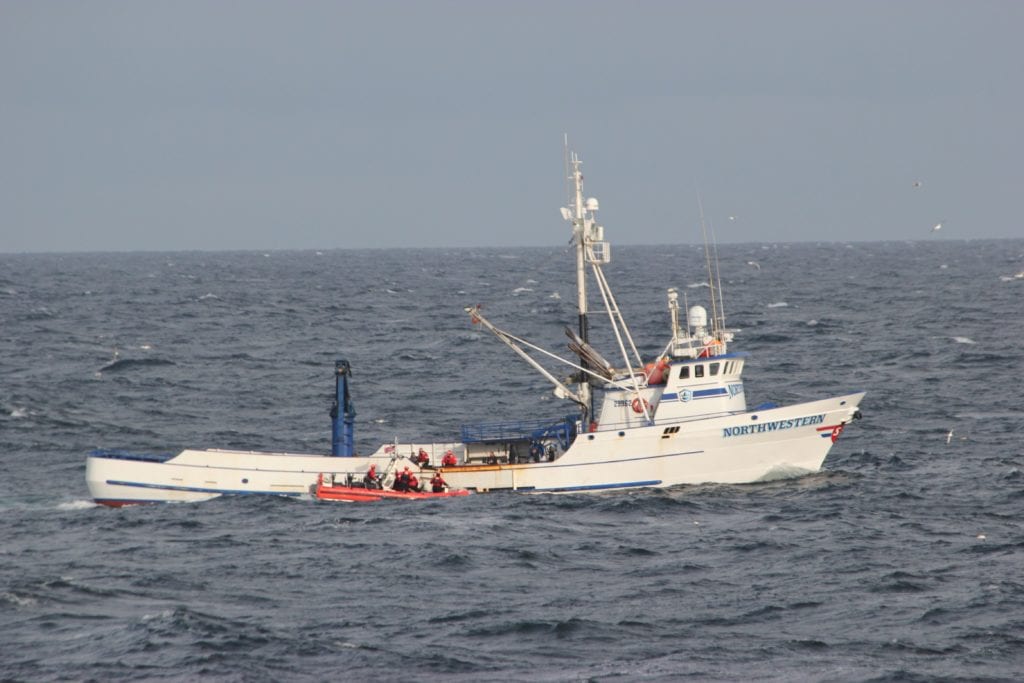
The Coast Guard Cutter Alex Haley’s small boat transfers their boarding team onto the fishing vessel Northwestern to conduct a safety inspection in the Bering Sea in this 2018 photo. U.S. Coast Guard / Ens. Douglas Zimmerman
WASHINGTON – The U.S. Coast Guard and the Russian Federation’s Marine Rescue Service recently signed the 2020 Joint Contingency Plan of the United States of America & the Russian Federation in Combating Pollution on the Bering & Chukchi Seas, the Coast Guard 17th District said in a Feb. 2 release.
On Feb. 1, 2021, Acting Director Andrey Khaustov of the Russian Federation’s Marine Rescue Service (MRS) and the U.S. Coast Guard’s deputy commandant for operations, Vice Adm. Scott Buschman, signed the 2020 update to the Joint Contingency Plan (JCP), a bilateral agreement focused on preparing for and responding to transboundary maritime pollution incidents.
The updated JCP promotes a coordinated system for planning, preparing and responding to pollutant substance incidents in the waters between the U.S. and Russia. The U.S. and Russian Federation have shared a cooperative bilateral agreement on transboundary marine pollution preparedness and response in this area since 1989. The newest JCP revision requires joint planning and transboundary exercise efforts to be coordinated by a Joint Planning Group led by Coast Guard District 17, and is guided by a non-binding two-year work plan. In addition, the updated JCP creates the new International Coordinating Officer role to help facilitate the critical sharing of information during coordinated response efforts.
“This is an important agreement between the U.S and the Russian Federation that ensures coordination between respective authorities and actively promotes the protection of our shared interests in these environmentally and culturally significant trans-boundary waters,” Buschman said. “We look forward to continuing our necessary and productive relationship with the Marine Rescue Service and the opportunity to conduct joint training and exercises in the near future in order to ensure the protection of our nations’ critical natural resources.”
The shared maritime boundary between the U.S. and Russia in the Bering and Chukchi seas has notoriously poor weather conditions and limited resources to respond to pollution incidents. This plan primarily addresses international collaboration matters and as such is meant to augment each country’s national response system as well as state, regional, and local plans. In the United States, the operational aspects of the plan fall under the responsibility of the U.S. Coast Guard’s 17th District Commander and Sector Anchorage.
Polar Star Takes Cuttermen to School in the Arctic
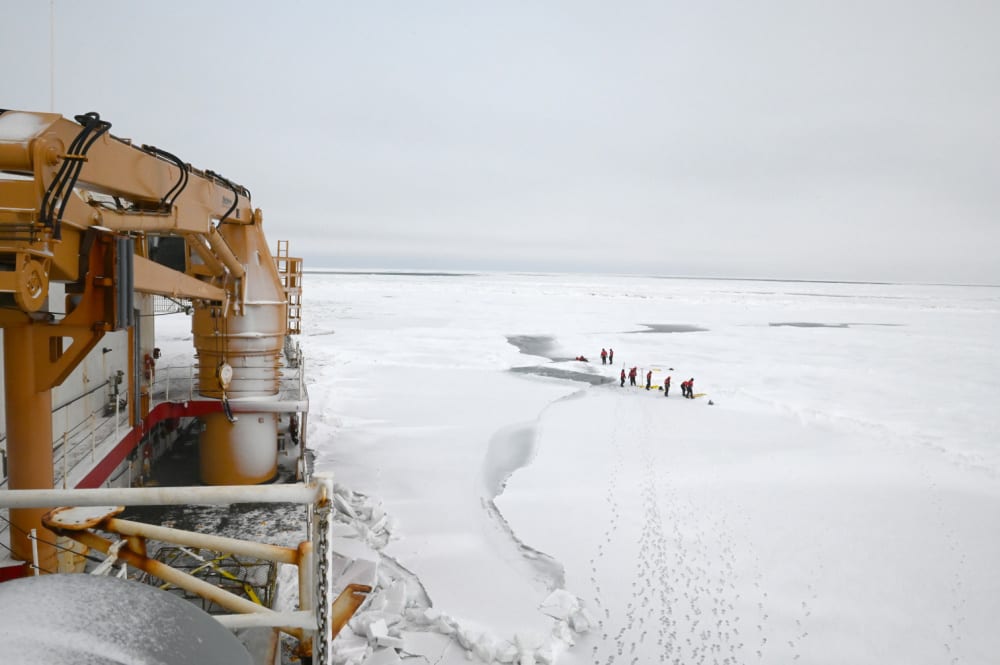
Coast Guard Cutter Polar Star (WAGB 10) crewmembers participate in ice rescue training in the Bering Strait, Wednesday, Jan. 20, 2020. The 45-year-old heavy icebreaker is underway to project power and support national security objectives throughout Alaskan waters and into the Arctic, including along the Maritime Boundary Line between the United States and Russia. U.S. Coast Guard / Petty Officer 1st Class Cynthia Oldham
America’s only heavy icebreaker is conducting training in a realistic environment — the Arctic.
When the National Science Foundation scaled back the research activities at McMurdo Station in Antarctica because of COVID 19, USCGC Polar Star’s annual deployment in support of Operation Deep Freeze was put on ice. To maintain crew skills in icebreaking and polar operations, the Polar Star’s crew was presented a unique opportunity to get some realistic training.
“When 44-year-old Cutter Polar Star’s annual trip to resupply McMurdo Station in Antarctica was cancelled this year by the National Science Foundation, and Cutter Healy, which typically heads North experienced a major engineering casualty — a main propulsion generator catastrophic failure — we saw an opportunity to send Polar Star to the Bering Sea and North,” said Commandant of the Coast Guard Adm. Karl Schultz, speaking at the Surface Navy Association Annual Symposium last month.
The Coast Guard has another polar icebreaker, the 399-foot, 13,000-ton Polar Sea (WAGB 10), but it is not operational. The 420-foot, 16,000-ton medium icebreaker USCGC Healy (WAGB 20) suffered a fire about 60 nautical miles from Seward, Alaska, in August of last year on her way to the high north, and is currently undergoing major repairs to replace her propulsion motor.
Schultz said a replacement polar icebreaker is a priority. The Polar Security Cutter (PSC) program, which currently has one 460-foot, 23,000-ton multi-mission PSCs on order with options for two more, is so important.
“We need a minimum of six icebreakers. Within that six, three need to be heavy, or Polar Security Cutters. And we need one now,” Schultz said at the symposium.
But with Healy undergoing repairs, and the first PCS not expected to be delivered until 2024, it’s important to keep the services icebreaking knowledge, expertise and experience. Polar operations are more challenging, especially in winter darkness, and the Antarctic and Arctic environments are not the same. When the new cutters come on line, they will need qualified crews.
“We need to train more cuttermen to break ice,” Schultz said.
Schultz said there’s no better place to learn about Arctic operations that the Arctic.
“On Christmas Day, Polar Star set a cutter record, traveling North of the 72-degree, 11-minute North latitude line in Chukchi Sea, breaking four-feet thick ice along the way. Aboard Polar Star, there are University of Washington scientists, British sailors from the Royal Navy, midshipmen from the U.S. Merchant Marine Academy, and Ice Pilots from Cutter Healy — another example of partnerships. This is Polar Star’s first Arctic winter deployment since 1982 … presence equals influence in the high latitudes.”
Coast Guard, Navy offload more than $211M worth of cocaine, marijuana in San Diego
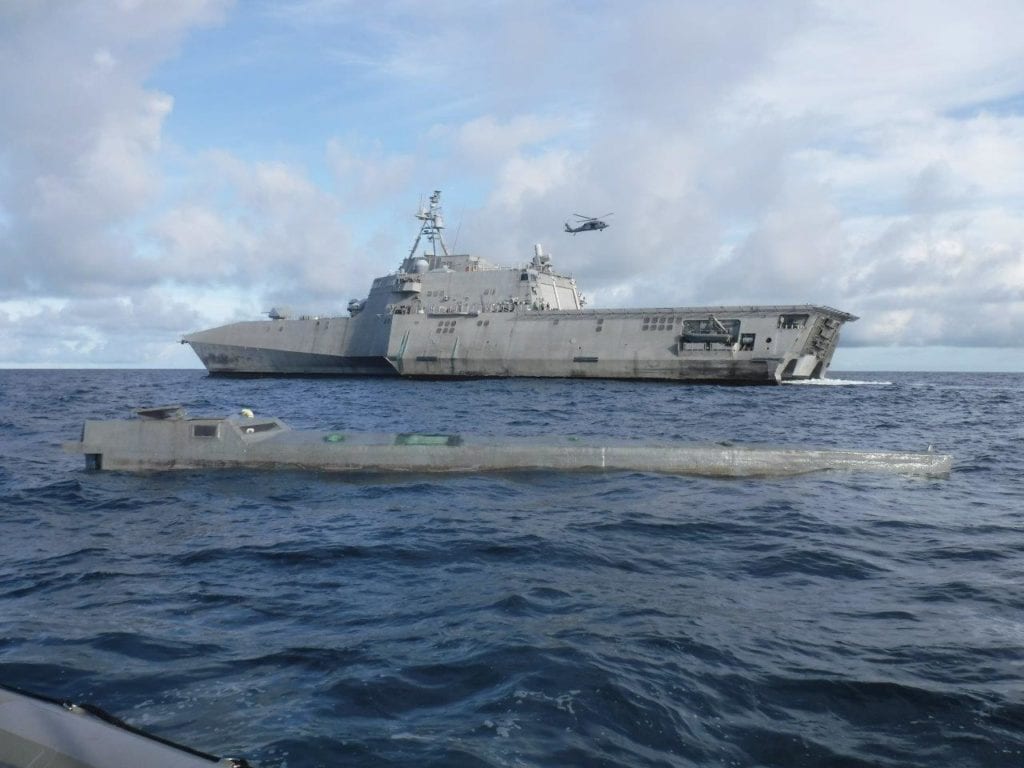
The Independence-variant littoral combat ship USS Gabrielle Giffords (LCS 10) with embarked U.S. Coast Guard Law Enforcement Detachment (LEDET) 407 conducts enhanced counter-narcotics operations, Dec. 5, 2020. Gabrielle Giffords is deployed to the U.S. 4th Fleet area of operations to support Joint Interagency Task Force South’s mission, which includes counter illicit drug trafficking in the Caribbean and Eastern Pacific. U.S. Navy photo.
SAN DIEGO – Coast Guard and Navy personnel offloaded approximately 11,400 pounds of cocaine and 9,000 pounds of marijuana Feb. 1, amounting to more than $211 million from seizures in international waters of the Eastern Pacific Ocean.
The offload is the result of interdictions made by Coast Guard Law Enforcement Detachment 407 (LEDET) personnel, who operated aboard the USS Gabrielle Giffords, and three separate Coast Guard cutter crews between October and December.
“When you are covering a drug-smuggling transit zone the size of the continental United States, every ship makes a huge difference,” said Lt. Jonathan Dietrich. “The seamless integration between our Law Enforcement Detachment and the crew of the USS Gabrielle Giffords was a major reason why we were successful in interdicting such a large amount of drugs and prevent them from reaching our streets.”
The total amount of drugs offloaded included the following unit and Coast Guard ships:
LEDET 407 was responsible for five cases seizing 10,570 pounds of cocaine and 4,100 pounds of marijuana
The Seneca (WMEC-906) was responsible for one case seizing 350 pounds of cocaine
The Legare (WMEC-912) was responsible for one case seizing 53 pounds of cocaine and 3,400 pounds of marijuana
The Spencer (WMEC-905) was responsible for one case seizing 420 pounds of cocaine and 1,450 pounds of marijuana
“The impressive results of the USS Gabrielle Giffords deployment and drug offload represent more than just a local victory of keeping drugs off our streets,” said Rear Admiral Brian Penoyer. “The Coast Guard and the Navy have worked together for years to keep our waters and shores safe from a number of maritime threats, and we are honored to continue that tradition as we look toward the future.”
The Coast Guard narcotics interdiction efforts are aimed at thwarting transnational criminal organizations, which are fueled by drug trafficking money. Operations like these attack supply networks in Central and South America. The offload highlights the joint impacts that a Coast Guard unit along with the Navy can have, when working together.
On April 1, U.S. Southern Command increased counter-narcotics operations in the Western Hemisphere to disrupt the flow of drugs. Numerous U.S. agencies from the Departments of Defense, Justice, and Homeland Security cooperated in the effort to combat transnational organized crime. The Coast Guard, Navy, Customs and Border Protection, FBI, Drug Enforcement Administration, and Immigration and Customs Enforcement, along with allied and international partner agencies, play a role in counter-drug operations.
The fight against drug cartels in the Eastern Pacific Ocean and the Caribbean Sea requires unity of effort in all phases from detection, monitoring and interdictions, to criminal prosecutions for these interdictions by United States Attorney’s Offices from the Middle District of Florida, the Southern District of Florida, and the Southern District of California. The law enforcement phase of counter-smuggling operations in the Eastern Pacific Ocean is conducted under the authority of the 11th Coast Guard District, headquartered in Alameda. The interdictions, including the actual boardings, are led and conducted by members of the U.S. Coast Guard.
LEDET 407 is part of Tactical Law Enforcement Team-South based in Miami. The Seneca is a 270-foot medium endurance cutter homeported in Boston. The Legare is a 270-foot medium endurance cutter homeported in Portsmouth, Virginia. The Spencer is a 270-foot medium endurance cutter homeported in Boston.