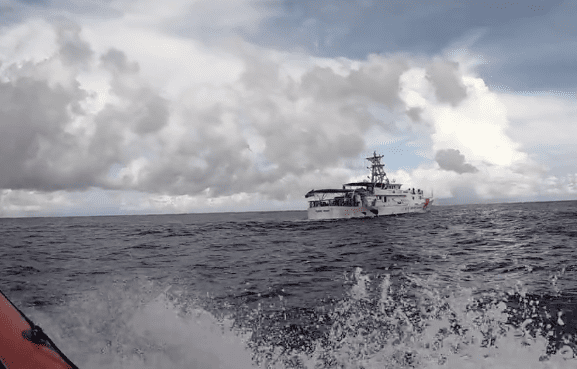
Coast Guard Cutter Spencer Returns After $10M Cocaine, Marijuana Bust
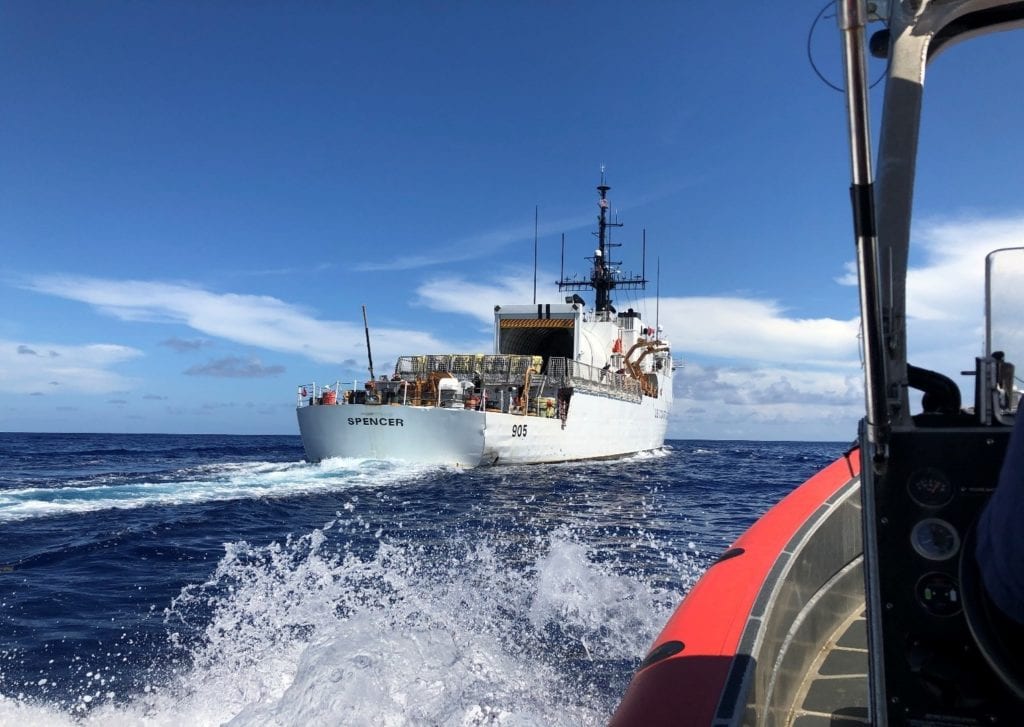
U.S. Coast Guard Cutter Spencer (WMEC 905) underway on patrol in the Eastern Pacific, January 2021. The crew covered over 11,000 miles seizing over $10 million of drugs and assisted in disrupting transnational crime organizations. U.S. Coast Guard
BOSTON — The Coast Guard Cutter Spencer (WMEC 905) crew returned home to Boston, Massachusetts, Jan. 28, after a 59-day patrol, the Coast Guard 1st District said in a release.
The crew’s seizure of 440 pounds of cocaine and 1,500 pounds of marijuana is valued at over $10 million and assisted in disrupting transnational crime organizations.
“After conducting operations in the Eastern Pacific, our crew is looking forward to returning home,” said Cmdr. Thomas Rodzewicz, commanding officer. “We provided effective mission critical assets in multiple cases and were able to stop illicit drugs from landing on U.S. shores. As a crew, we came together to enjoy the holidays in a meaningful and memorable way while carrying out our duties. I am extremely proud of the crew’s performance during this challenging patrol.”
The Coast Guard’s Helicopter Interdiction Tactical Squadron, an advanced aerial interdiction unit, joined the Spencer crew to conduct the counter drug operations. These crews served in support of U.S. operations in partnership with other law enforcement agencies and fellow armed services dedicated to preserving the national security of the United States.
Since departing Boston in December, The Spencer crew covered over 11,000 miles and made two transits through the Panama Canal.
Coast Guard Cutter Spencer is a 270-foot medium endurance cutter with a crew of 100 members.
Coast Guard Transfers 2 Suspected Smugglers, $8.5M in Seized Cocaine
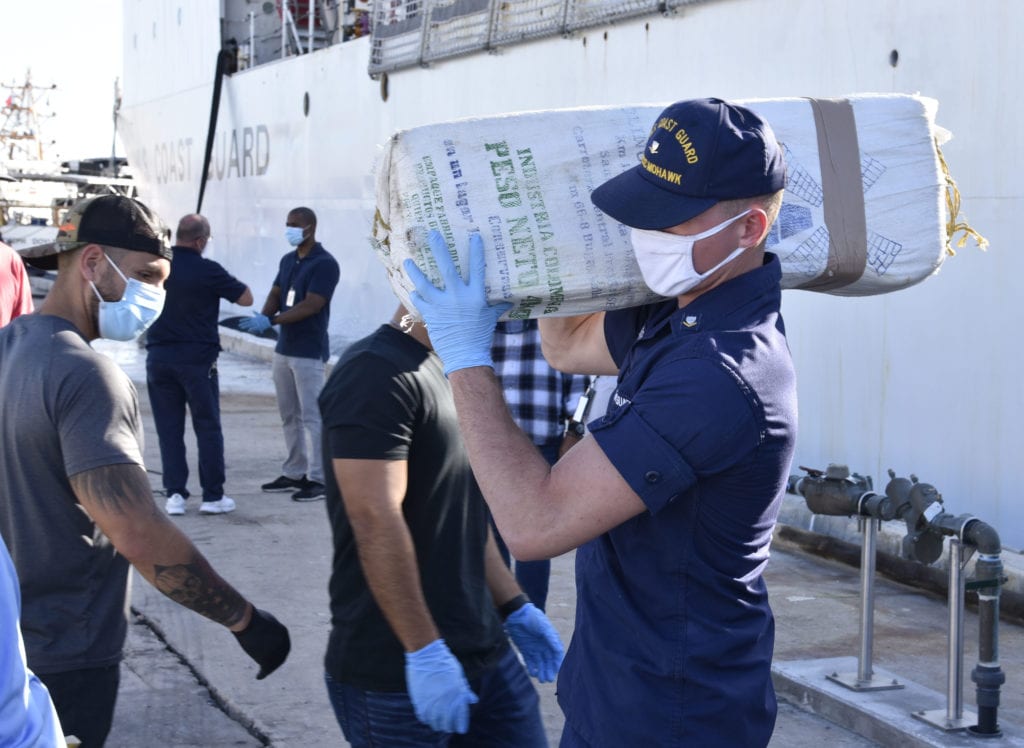
Coast Guard offloads 302 kilograms of cocaine valued at $8.5 million, and transfers custody of two suspected smugglers to Caribbean Corridor Strike Force federal agents in San Juan, Puerto Rico Jan. 28, 2021, following the interdiction of a go-fast vessel in the Caribbean Sea. U.S. Coast Guard
SAN JUAN, Puerto Rico — The Coast Guard Cutters Mohawk and Charles David Jr. transferred custody of two suspected smugglers and $8.5 million in seized cocaine to federal agents at Coast Guard Base San Juan Jan. 28, following the interdiction of a drug smuggling go-fast vessel in the Caribbean Sea, the Coast Guard 7th District said in a Jan. 29 release.
The interdiction was the result of multi-agency efforts in support of U.S. Southern Command’s enhanced counter-narcotics operations in the Western Hemisphere, the Organized Crime Drug Enforcement Task Force (OCDETF) and High Intensity Drug Trafficking Area (HIDTA) programs, and the Caribbean Corridor Strike Force (CCSF). The United States Attorney’s Office for the District of Puerto Rico is leading the prosecution for this case.
“This successful interdiction is a reflection of the seamless teamwork and the unwavering resolve between the Coast Guard, our federal law enforcement and Department of Defense partners to protect the nation’s southernmost maritime border against narcotrafficking threats,” said Cmdr. James L. Jarnac, Coast Guard Cutter Mohawk commanding officer. “The strength of our joint collaboration and partnerships is key to a safer Caribbean Region and disrupting transnational criminal organization activities through the interdiction of drug smuggling vessel’s in the maritime domain.”
The bust occurred during the afternoon of Jan. 24, 2021, after the aircrew of a maritime patrol aircraft detected a suspicious 25-foot go-fast vessel, approximately 200 nautical miles south of the Dominican Republic.
The Coast Guard Cutter Mohawk diverted in response to the sighting and interdicted the go-fast vessel with the assistance of the cutter’s small boat. Following the interdiction, the Coast Guard Mohawk’s boarding team located and recovered nine bales of suspected contraband, which weighed approximately 302 kilograms (666 pounds) and tested positive for cocaine.
The crew of the cutter Mohawk embarked the seized contraband and the two men from the go-fast vessel, who both claimed to be Dominican Republic nationals. The Coast Guard Cutter Charles David Jr. later embarked the two suspected smugglers and a representative sample of the contraband that were disembarked in San Juan, Puerto Rico, where Caribbean Corridor Strike Force federal law enforcement agents received custody.
Cutter Charles David Jr. is a 154-foot fast response cutter, while the Cutter Mohawk is a 270-foot medium-endurance cutter, both homeported in Key West, Florida.
U.S. Coast Guard, Russian Border Guard Patrolled Maritime Boundary Line
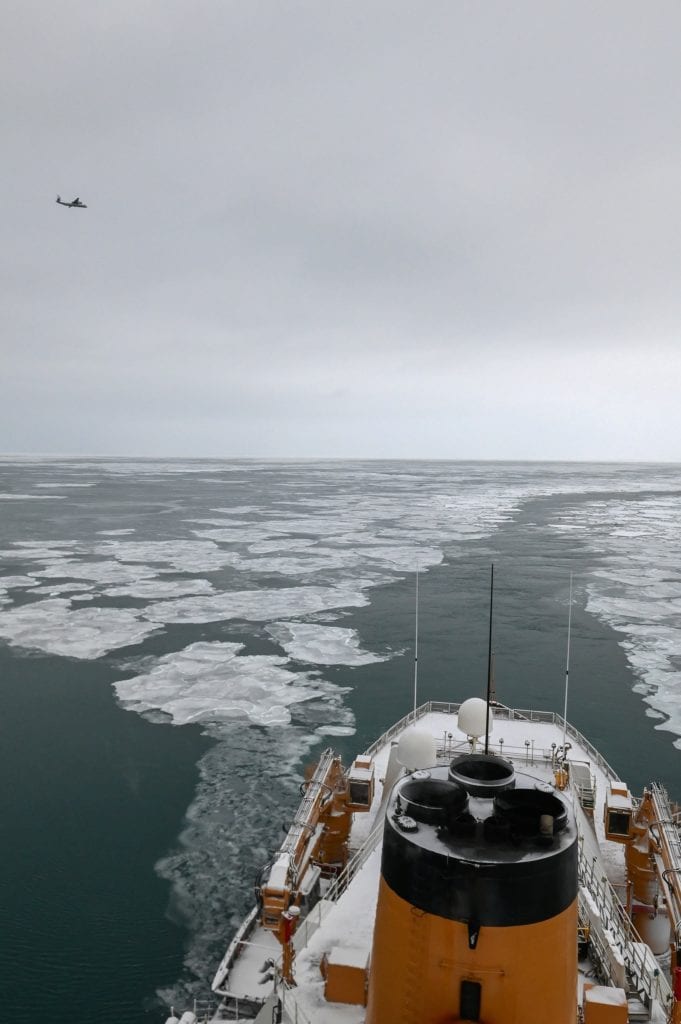
Coast Guard Cutter Polar Star crew and a Russian aircraft crew patrolled the Bering Sea maritime boundary line between Russia and the United States in mid-January. The 45-year-old heavy icebreaker is underway for a months-long patrol to support national security objectives throughout Alaskan waters and into the Arctic, including along the Maritime Boundary Line between the United States and Russia. U.S. Coast Guard / Petty Officer 1st Class Cynthia Oldham
JUNEAU, Alaska – The Coast Guard Cutter Polar Star crew and a Russian aircraft crew patrolled the Bering Sea maritime boundary line between Russia and the United States in mid-January, the Coast Guard 17th District said in a Jan. 27 release.
Following routine coordinated communications between the Russian Border Guard Directorate for the Eastern Arctic District and the Coast Guard Seventeenth District in Juneau, Alaska, the cutter Polar Star crew and a Russian Border Guard AN-26 aircraft crew patrolled a portion of the 1,700-mile maritime boundary line to support mutual agreements. The agreements consist of combined operations including search and rescue missions, contingency operations, routine communications exercises, and operations to counter illegal, unreported, and unregulated fishing.
The purpose of combined operations and communications exercises are to enforce rules and regulations and protect the sovereign rights and economies of both countries. The routine coordination maintains a strong working relationship and improves joint response capabilities for pollution, law enforcement, and search and rescue cases along our shared maritime border.
A working relationship at the operational level between the Coast Guard and Russian Border Guard remains critical to ensuring stability in the region. The partnership protects shared interests in fish stocks, safety of life at sea, coordinates environmental responses, and counters illicit activity on the high seas.
In July 2020, Coast Guard Cutter Munro conducted a similar communications exercise with the Russian Border Guard Vessel Kamchatka in the Bering Strait.
The Russian Border Guard’s effective enforcement of the maritime boundary line, and direct communication with their fishing industry, significantly reduces foreign fishing vessel incursions of the U.S. exclusive economic zone.
Since 2018, the Coast Guard has detected only one Russian fishing vessel incursion along the maritime boundary line. The Russian Border Guard immediately conducted an investigation of the incident and issued fines for that incursion.
“The United States Coast Guard works diligently to maintain a unique cooperative relationship with the Russian Border Guard in an effort to enhance the protection of shared interests in and around the Arctic region. The coordinated communications exercises on the high seas these past weeks with Polar Star demonstrate a recognition of the importance of that relationship,” said Capt. Jason Brennell, chief of enforcement for the Coast Guard’s 17th District.
Coast Guard, Border Patrol Seize $1.9 million in Cocaine; Apprehend 2 Smugglers
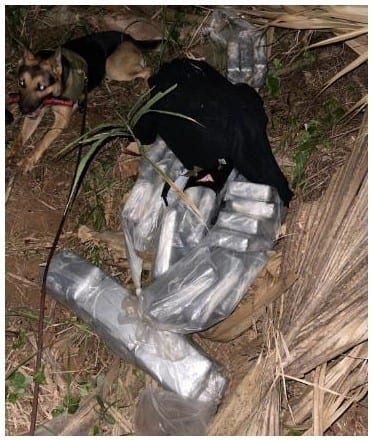
A U.S. Border Patrol K-9 rests after U.S. Ramey Sector Border Patrol agents, with the assistance of a U.S. Coast Guard HC-144 Ocean Sentry aircrew, apprehended two male Dominican Republic nationals and seized 157 pounds (71 Kilos) of cocaine with a wholesale value of $1.9 million, during a maritime drug smuggling attempt near Villa Montana in Isabela, Puerto Rico Jan. 23. U.S. Border Patrol
AGUADILLA, Puerto Rico – A Coast Guard aircrew combined efforts with U.S. Border Patrol agents during a drug smuggling event Jan. 23 that resulted in the seizure of 157 pounds (71 Kilos) of cocaine and the arrest of two suspected smugglers from the Dominican Republic near Villa Montana in Isabela, Puerto Rico, the Coast Guard 7th District said in a Jan. 27 release.
The estimated wholesale value of the seized cocaine is $1.9 million.
The joint collaboration is the result of ongoing Caribbean Border Interagency Group CBIG multiagency efforts in their common goal of securing the borders of Puerto Rico against illegal threats.
“We continue to disrupt and apprehend smugglers that attempt to smuggle people and narcotics across our borders,” said Xavier Morales, chief patrol agent for the Ramey Sector.
“Once our crew located the vessel, U.S. Border Patrol responded quickly to seize the suspects and narcotics. Our partnership is integral to protecting our shores and keeping our community safe,” said Lt. Karl Alejandre, Coast Guard Air Station Miami HC-144 Ocean Sentry aircraft commander.
While on a routine patrol Saturday night, the crew of a Coast Guard aircraft detected a suspect 21-foot go-fast vessel, approximately four nautical miles northwest of Aguadilla, Puerto Rico. Coast Guard watchstanders in Sector San Juan alerted the U.S. Border Patrol from Ramey Sector and placed the Coast Guard aircrew in direct communication with responding Border Patrol units ashore. While maintaining aerial surveillance of the vessel, the Coast Guard aircrew vectored in the Border Patrol units to the location where the suspected smugglers made landfall. Shortly thereafter, the Border Patrol agents, which included a K-9 unit, apprehended the two men and seized 58 packages of cocaine.
U.S. Immigration and Customs Enforcement — Homeland Security Investigations assumed custody the contraband and the suspected smugglers for investigation and prosecution.
Coast Guard Cutter Tahoma returns home after 58-day patrol in Northern Atlantic
Coast Guard members from U.S. Coast Guard Cutter Tahoma conduct a tow of fishing vessel Fearless 164NM east of Nantucket, Massachusetts, December 9, 2020. U.S. Coast Guard / Petty Officer 3rd Class Owen Hillberry
BOSTON — The crew of USCGC Tahoma (WMEC 908) returned to Kittery, Maine, Jan. 26 after a 58-day fisheries patrol in the Northern Atlantic, the Coast Guard 1st District said in a release.
The crew’s efforts support the Coast Guard 1st District’s living marine resource priorities of ensuring the safety of life at sea and protection of fisheries resources in a region home to one of the nation’s largest economies.
“The value of U.S. commercial fisheries in 2018 was $5.8 billion,” said Rear Adm. Tom Allan, U.S. Coast Guard 1st District commander. “Illegally caught or misreported fish entering the marketplace puts the livelihood of honest fishermen at risk. During this patrol, the Tahoma crew supported our 1st District fisheries effort to protect the sustainability of the region’s fish stocks and maintain a level playing field for all Northeast fishermen. The U.S. Coast Guard is committed to combatting illegal fishing in New England.”
Over the course of the eight-week patrol, Tahoma’s crew conducted 28 at-sea law-enforcement boardings of commercial fishing vessels, resulting in the discovery of eight violations of safety and fishing regulations. The boarding team inspected each vessel to ensure they met fishing gear requirements, catch limitations and possessed required and serviceable safety equipment. The Tahoma crew also focused on overfishing prevention in protected and closed fishing areas.
During the patrol, Tahoma’s crew responded to three search and rescue cases resulting in nine lives saved. On Dec. 6, the crew received a report from the 1st District command center of the disabled fishing vessel Fearless, located 170 nautical miles east of Nantucket, Massachusetts. The Tahoma crew arrived on scene and towed Fearless 260 nautical miles over five days until relieved by a commercial tug near Buzzards Bay, Massachusetts.
They also responded to the disabled fishing vessel Angela Michelle, located 100 miles east of Portsmouth, New Hampshire. The Tahoma crew diverted to assist the fishing vessel ahead of a severe winter storm, safely bringing it into port with assistance from Coast Guard Station Gloucester on Christmas Eve.
“The search and rescue cases we’ve had reminded me of why I joined the Coast Guard — to save lives,” said Seaman Patrick Byrne, lead seaman of Tahoma. “The beginning of the patrol seemed to be slow, but as we got called on each case, the reason for why we’re out here became more evident. Us being out here makes a difference. We’re able to make sure crews of the fishing vessels like the Angela Michelle and the Fearless return home safely to their families for holidays.”
Tahoma is a 270-foot medium endurance cutter with a crew complement of 100. They conduct maritime enforcement and homeland security missions in support of Coast Guard operations throughout the Western Hemisphere.
Fairbanks Morse Awarded Contract to Service U.S. Coast Guard Cutters
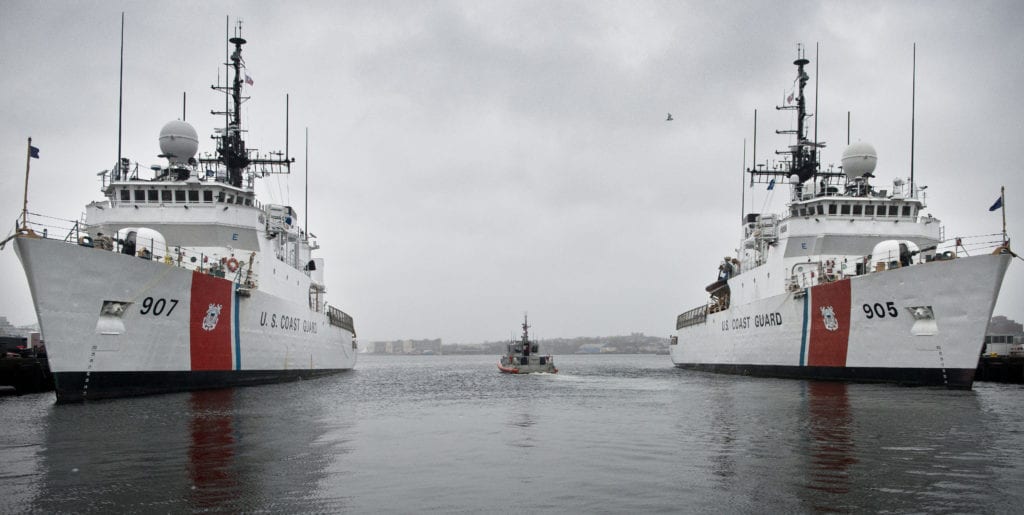
A Coast Guard Station Boston crew transits between Coast Guard Cutter Escanaba and Coast Guard Cutter Spencer in Boston on Nov. 24, 2014. The Escanaba and Spencer are 270-foot Famous-class medium endurance cutters. U.S. Coast Guard / Petty Officer 3rd Class MyeongHi Clegg
BELOIT, Wis. — Fairbanks Morse, a portfolio company of Arcline Investment Management, was awarded a six-year indefinite-delivery/indefinite-quantity (IDIQ) contract by the U.S. Coast Guard, the company said in a Jan. 26 release.
The agreement, worth approximately $53 million, enables Fairbanks Morse to maximize and improve engine lifecycle support for the Coast Guard’s 270-foot Famous-class cutters.
As part of the Famous class service life-extension program (SLEP), Fairbanks Morse was awarded this contract to provide services, personnel, facilities, expertise, technological information, special tools, supplies and incidental materials necessary to ensure the longevity of the fleet’s 18-cylinder FM 251F engines. The contract also includes delivery and installation of new engines, spare parts and nonrecurring engineering work.
“Fairbanks Morse has been a trusted engine and service provider to the U.S. Coast Guard for many decades, and it’s an immense honor to be selected to provide engines and services for its vessels,” said George Whittier, chief executive officer of Fairbanks Morse. “We are fully committed to supporting our country’s national defense by delivering reliable products and quality service that facilitate mission-critical operations.”
Through an IDIQ contract, pricing for support services is streamlined under a single agreement, eliminating the administrative, time and cost burdens associated with working through an intermediate party. Fairbanks Morse provides factory certified original equipment manufacturer technicians who undergo rigorous qualifications to meet the company’s high standards for delivering best-in-class support. These technicians will deliver enhanced performance and improved service life while ensuring the highest level of reliability and efficiency for Famous-class cutters.
The U.S. Coast Guard and U.S. Navy have turned to Fairbanks Morse for over 70 years to provide quality diesel engines for marine propulsion and ship service systems. Today, Fairbanks Morse engines are installed on approximately 80% of U.S. Navy ships with a medium speed power application.
U.S. Coast Guard Commissions 41st Fast Response Cutter
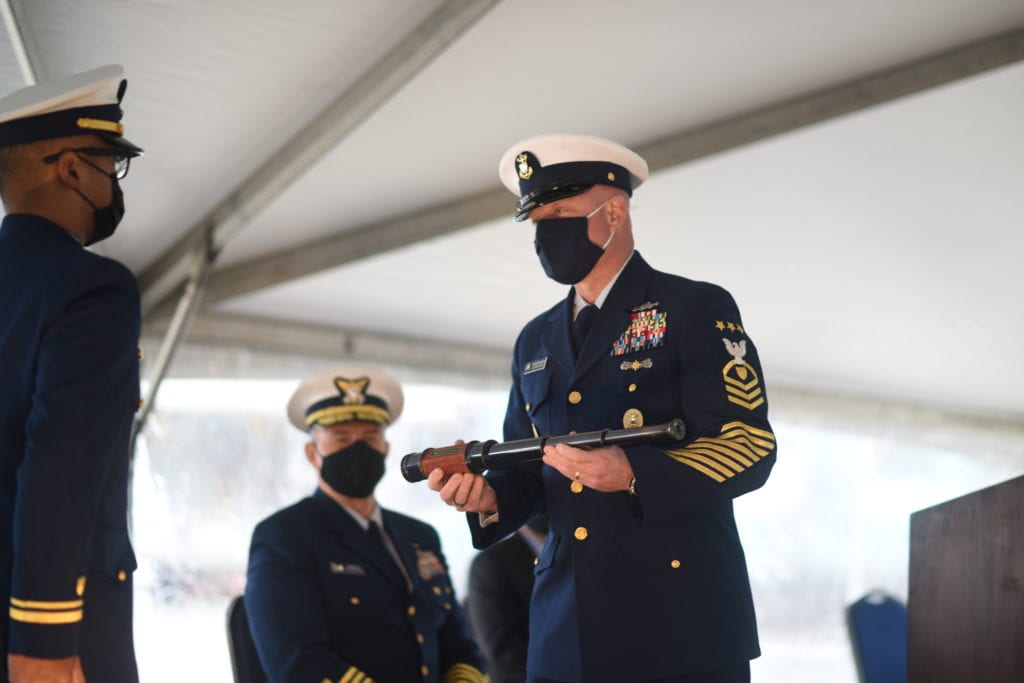
Master Chief Petty Officer Jason M. Vanderhaden, the senior enlisted leader of the Coast Guard, presents Lt. j.g Paul Kang, the official USCGC Charles Moulthrope’s (WPC 1141) long glass on Coast Guard Base Portsmouth, Va., Jan. 21, 2021. Each FRC is named for an enlisted Coast Guard hero who distinguished himself or herself in the line of duty. The Moulthrope is one of six fast response cutters destined for the Patrol Forces Southwest Asia (PATFORSWA) mission. U.S. Coast Guard / Petty Officer 1st Class Adam Stanton
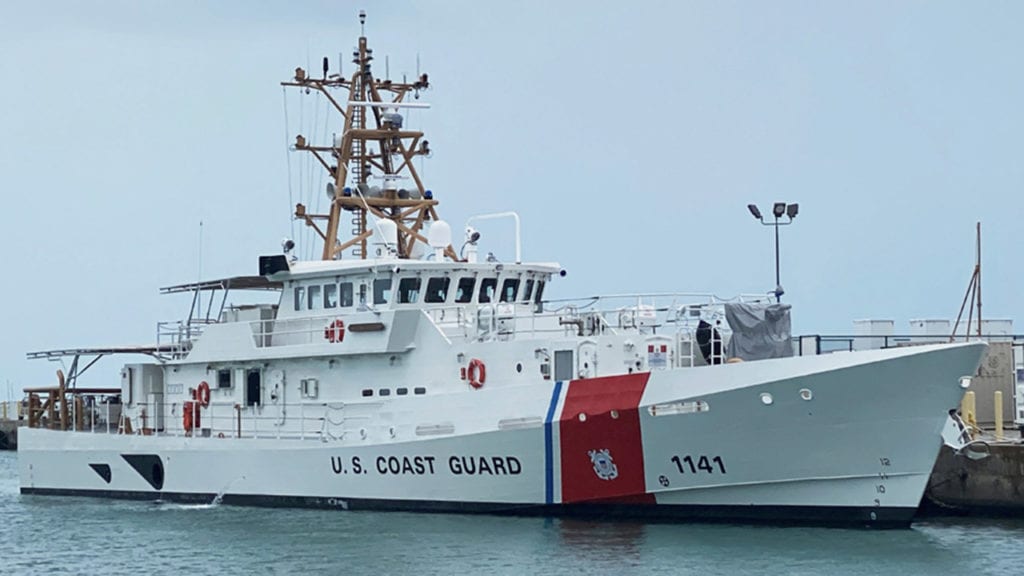
PORTSMOUTH, Va.,— The USCGC Charles Moulthrope (WPC 1141), Patrol Forces Southwest Asia’s first Sentinel-class fast response cutter, was commissioned into service at Coast Guard Base Portsmouth, Jan. 22, the Coast Guard Atlantic Area said in a release.
Adm. Karl Shultz, commandant, U.S. Coast Guard, presided over the 41st Sentinel-classcutter ceremony. Moulthrope is the first of six FRCs to be homeported in Manama, Bahrain.
The cutter’s sponsor is Mrs. Dawn Schultz, spouse of Adm. Karl Schultz.
The Charles Moulthrope is the first of six FRCs planned for service in Manama, Bahrain. Stationing FRCs in Bahrain supports Patrol Force, South-West Asia (PATFORSWA), the Coast Guard’s largest unit outside of the U.S., and its mission to train, organize, equip, support and deploy combat-ready Coast Guard forces in support of Central Command and national security objectives.
PATFORSWA works with Naval Forces Central Command to conduct maritime operations to forward U.S. interests, deter, and counter disruptive countries, defeat violent extremism, and strengthen partner nations’ maritime capabilities to secure the maritime environment in the Central Command area of responsibility.
The cutter is named after Seaman Charles Moulthrope, remembered for heroic and selfless service as a member of the Revenue Cutter Service cutter Commodore Perry, en route to patrol Alaska, when he rescued multiple shipmates who ended up in the sea. They had attempted to rescue another crewman who was swept overboard during heavy seas. Moulthrope “grabbed a line and leaped over the side” into the freezing water to save the four men. Not long after, he lost his life in the performance of duties in Unalaska, Alaska, in 1896, when he fell from a mast while trying to free a fouled pennant. This ship will be the first modern Coast Guard cutter named for an enlisted man of the Revenue Cutter Service, bringing recognition to the service and sacrifice of hundreds of sailors who served their country aboard the ships of this precursor of the Coast Guard.
The Coast Guard has ordered 64 FRCs to date. Forty are in service: 12 in Florida, seven in Puerto Rico; four in California; three each in Hawaii, Texas, and New Jersey, and two each in Alaska, Mississippi, and North Carolina. Two FRCs arrived in their homeport of Apra Harbor, Guam, in 2020, with one more to come.
The Coast Guard took delivery of Charles Moulthrope on Oct. 22, 2020, in Key West. They will transit to Bahrain later this year with their sister ship, the Robert Goldman (WPC 1142), delivered Dec. 22, 2020, and due to be commissioned in February in Key West.
The fast response cutters were designed to patrol coastal regions and are operating in an increasingly expeditionary manner. They feature advanced command, control, communications, computers, intelligence, surveillance, and reconnaissance equipment, and launch and recover standardized small boats from the stern.
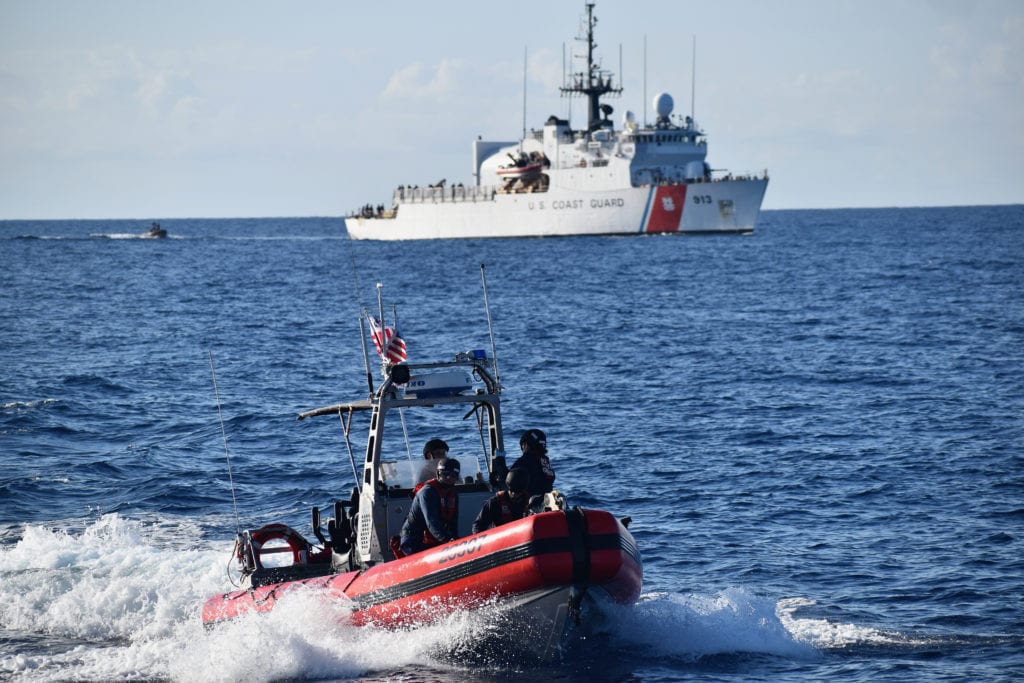
The USCGC Resolute crew (WMEC 620) conducts an at-sea transfer with USCGC Mohawk (WMEC 913) in the Caribbean on Dec. 27, 2020. Resolute returned to St. Petersburg, Florida, on Jan. 14, 2021, following a 42-day patrol in support of Operation Southeast Watch and others. U.S. Coast Guard / Ensign Alexander Cordes
PORTSMOUTH, Va. — The crew of USCGC Resolute (WMEC 620) returned to St. Petersburg, Florida, on Jan. 14, following a 42-day patrol in support of Operation Southeast Watch and others, the Coast Guard Atlantic Area said in a Jan. 21 release.
Resolute traveled over 5,000 miles, rescued and repatriated 110 Haitian migrants and stopped 500 kilograms of contraband.
The crew departed Florida, Dec. 4, 2020, to Windward Pass, patrolling off Haiti’s northern coast to deter illegal immigration and promote regional stability. They responded to a report of a dangerously overcrowded and unseaworthy vessel received from a Coast Guard MH-60 Jayhawk helicopter on station off the coast of Haiti. From the air, the Jayhawk crew described the boat as having approximately 50 to 80 people aboard.
The Jayhawk crew guided Resolute’s small boats to the vessel, and once on the scene, the boarding team embarked on the 40-foot wooden boat and discovered 110 Haitian migrants. Working through the night, the small boat crews safely rescued all 110 migrants, including six children, and ferried them back to the cutter, where they received food, water, and medical attention. All 110 migrants were subsequently repatriated back to Cap Haitian with the Coast Guard liaison officer’s assistance in Haiti and the Haitian coast guard.
Transitioning to the Caribbean Sea, the crew intercepted a northbound vessel, resulting in more than 500 kilograms of contraband. Coast Guard boarding teams detained the suspected smugglers and took positive control of the boat. The contraband, detainees, and vessel were transported to the United States for final case disposition.
Resolute’s crew conducted numerous at-sea transfers of contraband and detainees with other U.S. Coast Guard and Navy surface assets, including cutters William Trump, Raymond Evans, Mohawk, James, Decisive, Richard Etheridge, and the U.S. naval warship USS Comstock (LSD 45). Resolute’s crew worked closely with these units to safely embark and transport suspected smugglers and contraband to the United States, ensuring numerous cases’ timely disposition.
Resolute completed more than 40 shipboard-helicopter evolutions with Coast Guard Air Station Miami’s assistance before returning home. Conducting these flight operations helped Air Station Miami pilots maintain critical flight currencies and allowed Resolute to train new crew and maintain shipboard-helicopter proficiency for future patrols.
Through this patrol, Resolute supported international, multi-agency operations, including Operation Unified Resolve, Operation Southeast Watch, Operation Caribbean Guard, Enhanced Counternarcotics Operations, Campaign Martillo, and the Caribbean Corridor Strike Force.
“Working for the Coast Guard’s 7th District was a rewarding experience for the crew of Resolute,” said Cmdr. Justin Vanden Heuvel, commanding officer of Resolute. “We stood the watch throughout the holiday season and into the new year, transitioning seamlessly between alien-migration interdiction operations to enforcing counter drug regulations on the high seas.”
“The crew of the Resolute has done a fantastic job during this recent patrol, and their successes illustrate the vital partnerships that are essential in combating transnational criminal organizations that threaten global security and prosperity,” said Rear Adm. Douglas Fears, director of Joint Interagency Task Force (JIATF)-South. “The U.S. Coast Guard and JIATF-South work together every day, as well as with our other U.S. and international partners, to disrupt the flow of illicit drugs that are a major funding source for criminal organizations operating within the Western Hemisphere.”
Resolute homeported in St. Petersburg, is a 210-foot Reliance-class cutter and has a crew of 78. Their motto is Fama Extendere Factis, fame through good deeds.
Bollinger Shipyards LLC delivered the USCGC Charles Moulthrope to the U.S. Coast Guard in Key West, Florida. This is the 41st Fast Response Cutter delivered under the current program. The FRC is the first of six to be home-ported in Manama, Bahrain, supporting the Patrol Forces Southwest Asia. Bollinger Shipyards
ARLINGTON, Va. — The U.S. Coast Guard will bring a less militaristic face to the persistent global presence of U.S. naval power outlined in the new Tri-Service Maritime Strategy, the Coast Guard’s commandant says.
The strategy, unveiled in mid-December, seeks an integrated, all-domain naval power consisting of the U.S. Navy, Marine Corps and Coast Guard, that will maintain freedom of navigation globally, defend the homeland and “prevail across a continuum of competition — composed of interactions with other nations from cooperation to conflict.”
The Tri-Services strategy focuses on an emerging China and resurgent Russia as “the most significant threats” to the rules-based international system that existed since the end of World War II.
“The Coast Guard is poised today, more than ever, to seamlessly integrate into our nation’s joint maritime naval force, as captured in this document,” Adm. Karl L. Schultz, the Coast Guard’s commandant, said Jan. 13 at the Surface Navy Association’s Virtual Symposium.
With its unique law enforcement and military authorities, multi-mission capabilities, wealth of multilateral and bilateral agreements and partnerships, the Coast Guard has unfettered access to the global commons, he added, making the agency “a perfect complement to the lethality of the Navy and Marine Corps. And united, we bring a range of maritime capabilities to employ across the cooperation, competition, lethality continuum.”
The Coast Guard operates generally below the level of conflict or lethality and that’s the bridge between “State Department diplomacy and Defense Department lethality,” Schultz said. “Coast Guards offer a less militaristic face of state power in disputed maritime areas. They present options. They’re like Swiss Army Knives,” he said.
Other maritime nations have also recognized the agility and capability of their coast guards to operate along this continuum below lethality, Schultz said. Between 2010 and 2016, China increased the tonnage of its Coast Guard by 73% percent, and Japan did so by 50%, he said, citing RAND Corp. research.
While the U.S. Coast Guard is part of the Department of Homeland Security, charged with law enforcement at sea, fisheries protection, marine safety and maritime security, the tri-service strategy noted Navy and Coast Guard ships conduct freedom of navigation operations globally, challenging excessive and illegal maritime claims. Coast Guard cutters and law enforcement detachments aboard Navy and allied ships exercise unique authorities to counter terrorism, weapons proliferation, transnational crime and piracy, the strategy document stated.
Coast Guard cutters have supported all six combatant commands from Indo-Pacific Command to Africa Command, Schultz said, noting the next commissioned Fast Response Cutter will be the first of that class sent to Bahrain. “We’ve been operating in that theater since 2003 and we will bring additional capabilities and additional capacity with these new cutters,” he said.
The Coast Guard’s fleet modernization, including acquisition of the Offshore Patrol Cutter, Polar Security Cutter, Arctic Security Cutter and Waterways Commerce Cutter, will provide the capacity and capabilities necessary to facilitate advancing maritime governance and protecting U.S. maritime sovereignty, according to the strategy document.
Cutter Joseph Gerczak Conducts Patrol to Increase Maritime Presence in Pacific
The Coast Guard Cutter Joseph Gerczak (WPC 1126) has completed the first stage of its expeditionary patrol in the Pacific to counter illegal fishing. U.S. Coast Guard
HONOLULU — The Coast Guard Cutter Joseph Gerczak (WPC 1126) conducted a port call in Honolulu after completing the first stage of its expeditionary patrol in the Pacific to curtail illegal fishing and strengthen maritime law enforcement self-sufficiency with Kiribati partners, the Coast Guard 14th District said in a Jan. 12 release.
The crew of the Joseph Gerczak traveled from Dec. 28, 2020, to Jan. 3, 2021, from Hawaii to Kiribati, covering a distance of approximately 2,400 miles.
“We’re working to increase awareness of unlawful fishing operations in remote territories of the United States, the Pacific, and the Republic of Kiribati’s exclusive economic zones,” said Lt. James Provost, commanding officer of the Joseph Gerczak. “Over the course of our patrol we queried one Chinese fishing vessel while enforcing Kiribati’s sovereignty.”
As part of Operation Blue Pacific Task Force, the crew of the Joseph Gerczak deployed in support of strategic national security goals of stability and security throughout the Indo-Pacific.
The crew of the Joseph Gerczak used intelligence-driven enforcement actions, counter predatory and irresponsible maritime behavior, and expanded multilateral fisheries enforcement cooperation.
Illegal, unreported, and unregulated fishing results in tens of billions of dollars in lost revenue to legal fishers every year. IUU operates without legal constraints, avoids overhead licensing costs, and often falsifies their documentation creating an unfair advantage.
The Coast Guard combats illegal fishing and other maritime threats across the Pacific to protect the United States and Pacific Island Countries resource security and sovereignty. Combating illegal fishing is part of promoting maritime governance and a rules-based international order that is essential to a free and open Oceania.
Oceania covers an area of 3.3 million square miles and has a population of approximately 40 million diverse people.
“Effective maritime domain awareness requires unprecedented information sharing,” said Cmdr. Jason Brand, chief of enforcement, Coast Guard District 14. “We are eager to collaborate with Kiribati on initiatives of common interest.”
Fast Response Cutters, such as the Joseph Gerczak, are outfitted with new and advanced command, communications, control, computers, intelligence, and surveillance systems and boast greater range and endurance compared to their forerunner, the 30-year old 110-foot Island-class patrol boats. Like their predecessors, the FRCs are designed as multi-mission platforms ranging from maritime law enforcement to search and rescue.