Coast Guard Captures Alleged Murderer; Transfers Custody to U.S. Marshals
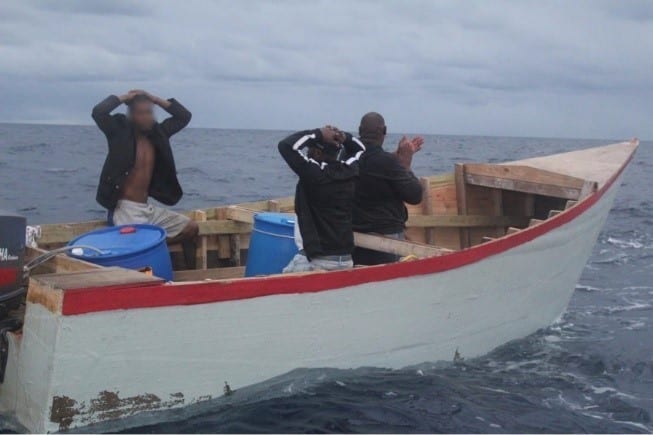
The crew of the Coast Guard Cutter Heriberto Hernandez interdicts a makeshift boat with three Dominican Republic nationals in the Mona Passage Jan. 5, 2021. One of the men was a fugitive with a standing warrant for an alleged murder who was transferred to the custody of U.S. Marshals agents in Mayaguez, Puerto Rico Jan. 7. U.S. Coast Guard photo
SAN JUAN, Puerto Rico – The crew of the Coast Guard Cutter Heriberto Hernandez transferred custody of a man wanted for an alleged murder to the U.S. Marshals Jan. 7 in Mayaguez, Puerto Rico, following the interdiction of a makeshift vessel in Mona Passage waters near Puerto Rico.
Gustavo Guerrero-Reyes, 37, was arrested on an outstanding Puerto Rico state warrant, following his apprehension while traveling aboard a makeshift boat with two other men, whom all claimed to be Dominican Republic Nationals.
The interdiction is the result of ongoing Caribbean Border Interagency Group multiagency efforts in their common goal of securing the borders of Puerto Rico against illegal threats.
“This case was complex and the crew of the cutter Heriberto Hernandez did an outstanding job interdicting this voyage and working with our partners from U.S. Customs and Border Protection (CBP) and the U.S. Marshals, which led to the apprehension of a wanted fugitive with a standing warrant for murder,” said Cmdr. Beau Powers, Sector San Juan chief of response. “This case is a testament to the professionalism of all interdicting agencies in securing and defending the United States’ southeastern border.”
Coast Guard watchstanders in Sector San Juan received a call Jan. 5 from a CBP Air and Marine Operations (AMO) agent, who reported the crew of an AMO maritime patrol aircraft detected a suspect vessel approximately 37 nautical miles north of Desecheo Island, Puerto Rico. Coast Guard watchstanders diverted the cutter Heriberto Hernandez to assess the situation.
Once on scene, the cutter’s over the horizon small boat launched and approached the suspect vessel. The Coast Guard boat crew identified the 22-foot white colored makeshift vessel was of wooden construction, unseaworthy, and had no markings or indication of nationality. The passengers onboard were also unable to provide a registration for the vessel.
The crew of the Heriberto Hernandez embarked the three men for safety of life at sea concerns and conducted biometrics processing, which revealed one of the men wanted in connection to a murder allegedly committed in March 2020.
The cutter Heriberto Hernandez rendezvoused with a Dominican Republic navy patrol boat Jan. 6 just off the Dominican Republic and transferred the two other passengers of the makeshift vessel for their return to the Dominican Republic.
Cutter Heriberto Hernandez is a 154-foot fast response cutter homeported in Miami and San Juan, Puerto Rico.
On First Voyage, USCGC Stone Crew Interdicts Narcotics in Caribbean
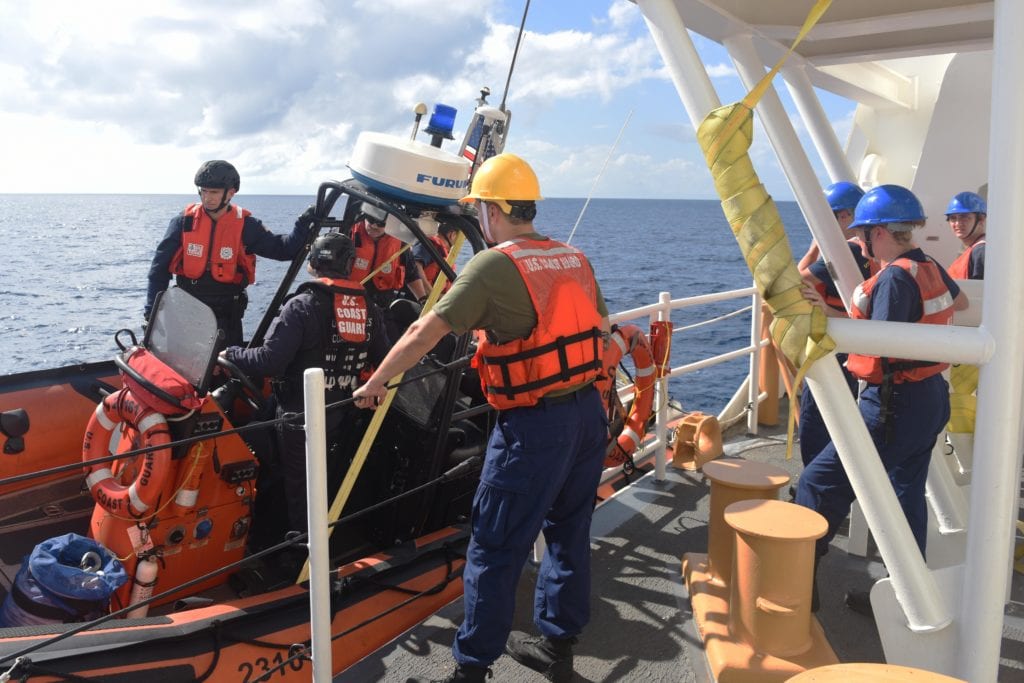
The crew on the USCGC Stone (WMSL 758) prepare to launch one of the ship’s small boats in the Caribbean Sea on Jan. 6, 2021. The Stone sent a boarding team on the boat to intercept a vessel suspected of engaging in illegal activity. U.S. Coast Guard / Petty Officer 3rd Class John Hightower
PORTSMOUTH, Va. — While in transit to conduct joint operations off the coast of Guyana as part of Operation Southern Cross, USCGC Stone (WMSL 758) encountered and interdicted a suspected narcotic trafficking vessel south of the Dominican Republic Jan. 7, the Coast Guard Atlantic Area said in a Jan. 11 release.
Having stopped the illicit activity, Stone handed off the case to the USCGC Raymond Evans (WPC 1110), a fast response cutter from Key West, Florida, and continued its patrol south.
Early on Jan. 7, acting on information from a maritime patrol aircraft, the Stone crew approached the vessel of interest and exercised U.S. Coast Guard authorities to stop their transit and interdict illicit maritime trade.
The USCGC Raymond Evans arrived on the scene shortly after. A Coast Guard boarding team from the Raymond Evans conducted a law enforcement boarding, testing packages found aboard the vessel, revealing bales of cocaine estimated at 2,148.5 pounds (970 kilograms) total.
Stone’s crew remained on scene during the search of the vessel to assist if need. Following the boarding, the Raymond Evans crew took possession of the contraband and detained the four suspected narcotics trafficking vessel members. They are working with the U.S. Coast Guard 7th District and Department of Justice on the next steps.
“I’m very proud of the crew for completing this evolution safely and making an immediate impact on our first patrol,” said Capt. Adam Morrison, commanding officer of USCGC Stone (WMSL 758). “This case illustrates that Stone is a competent partner, and our crew is ready for the front-lines. We look forward to our upcoming engagements, first with Guyana.”
Vice Adm. Steven Poulin, commander of U.S. Coast Guard Atlantic Area, said USCGC Stone “is a highly-capable multipurpose platform and ready to conduct missions to save lives, support lawful activities on the high seas, and highlight and build Coast Guard partnerships with other nations.
“I am not surprised that Stone interdicted drug smugglers – it is what the captain, crew, and every U.S. Coast Guard member is prepared to do every day underway. Stone’s crew is exhibiting the highest professional competence, reinforcing that Stone is well-suited to help our partners in the South Atlantic expose and address illicit activities in the maritime domain. These transnational criminal activities – be it illegal fishing or the trafficking of people, drugs, money, etc. – challenge global security, and only together can we combat these threats.”
“Our teammates aboard USCGC Stone are helping keep our shared neighborhood, the Western Hemisphere, safe, successfully stopping illicit narcotics smuggling, while continuing their equally important mission to counter predatory and irresponsible IUU fishing, a growing threat to our partner nations’ sovereignty and our collective regional security,” said Rear Adm. Andrew J. Tiongson, director of operations, U.S. Southern Command.
Operation Southern Cross is a multi-month deployment to the South Atlantic countering illegal, unregulated, and unreported fishing while strengthening relationships for maritime sovereignty and security throughout the region.
Halter Marine Upgrades Launch Way in preparation for Polar Security Cutter
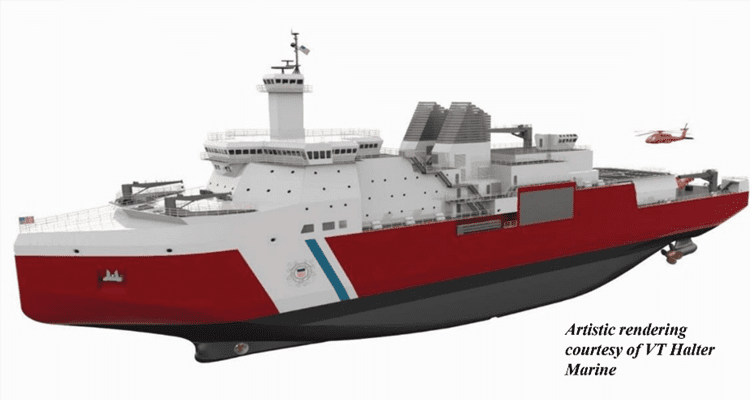
A rendering of the U.S. Coast Guard’s forthcoming Polar Security Cutter. U.S. Coast Guard
PASCAGOULA, Miss. — The U.S Coast Guard’s Polar Security Cutter (PSC) is rapidly progressing through the detailed design phase, and Halter Marine is actively preparing for its construction, the company said in a Jan. 6 release.
In July 2021, Halter Marine will complete upgrades to the launch way area where the PSC will be constructed. The 460-foot icebreaker is the heaviest vessel per foot of length that Halter Marine has constructed at its Pascagoula, Mississippi, shipyard. The launch way has been fortified to accommodate the PSC’s 19,000-ton launch weight.
The Crowley Taino and El Coqui were the heaviest vessels previously to launch from the company’s dock. These two vessels are 720 feet in length, providing a greater distance to leverage their weight.
“Based on weight per foot, the PSC outweighs those vessels,” said Bob Merchent, president and CEO of Halter Marine. “The PSC needs 22 tons of capacity per linear foot of rail line, and we have designed the new launch way to accommodate 27 tons per linear foot. We are preparing for our newest vessel while also looking forward to future, larger vessels.”
The upgrade project began in July by removing 11 launch way rail lines. Next, crews dug 1,283 holes that were filled with grout and concrete to serve as new piles. These piles will transfer the PSC’s heavy load to a deeper level than previously possible.
“Each drilled hole is 110 feet long, and we are pouring 27 miles of piles,” said Kevin Amis, executive vice president of operations for Halter Marine. “We are completing this project with a perfect safety record. I’m proud of the women and men at Halter Marine and Malouf Construction for accomplishing this invaluable project with a true focus on safety.”
The launch way upgrade project is funded with a generous grant from the Mississippi Development Authority (MDA).
“We appreciate the continued support of the MDA along with our federal, state and local officials,” Merchent said. “We are thankful for that, and we are all proud to support the men and women of the U.S. Coast Guard by providing them with better capabilities to operate in the Arctic.”
Omnibus Spending Bill Funds Four Additional Fast Response Cutters
The Coast Guard accepted delivery of the newest Sentinel-class fast response cutter (FRC), the Coast Guard Cutter Oliver Henry (WPC-1140), from Bollinger Shipyards, July 30th, 2020. The fiscal 2021 omnibus spending bill funds four more Sentinel-class FRCs. U.S. Coast Guard
LOCKPORT, La. — President Trump on Dec. 27 signed into law the omnibus spending bill for fiscal Year 2021, which included funding for four more Sentinel-class Fast Response Cutters (FRCs), allowing Bollinger Shipyards to build and deliver four more FRCs to the U.S. Coast Guard, the company said in an Dec. 28 release. This increases the total number of funded boats to 64.
“It’s a great honor to have the confidence of the U.S. Congress to continue the work we’re doing in support of the U.S. Coast Guard,” said Ben Bordelon, Bollinger Shipyards president and CEO.“The Fast Response Cutter program is something we’re all proud of here in Louisiana. Delivering vessels on schedule and on budget to the Coast Guard during these challenging times shows the determination and resiliency of our workforce.”
All four of the newly appropriated FRCs will be built at Bollinger’s Lockport, Louisiana, facility.
Earlier this month, Bordelon wrote an opinion piece on how an expanded U.S. Coast Guard presence around the globe can “help further the regional partnerships and alliances necessary to curb the creeping influence of America’s strategic competitors and adversaries.” Bordelon argues that the Coast Guard has the opportunity to establish itself as the preferred regional partner through its work with Patrol Forces Southwest Asia, Operation Aiga and elsewhere. Bordelon concludes that “white-hull diplomacy should be looked to more and more as a complementary arrow in the whole-of-government quiver.”
The FRC program has had a total economic impact of $1.2 billion since inception and directly supports 650 jobs in Southeast Louisiana. The program has indirectly created 1,690 new jobs from operations and capital investment and has an annual economic impact on GDP of $202 million, according to the most recent data from the U.S. Maritime Administration on the economic importance of the U.S. Shipbuilding and Repair Industry. Bollinger sources over 271,000 different items for the FRC consisting of 282 million components and parts from 965 suppliers in 37 states.
“We’re proud that Bollinger continues to be an economic pillar and job creator in south Louisiana,” Bordelon said. “More than 600 of our 1,500-plus employees have important roles related to the FRC program. Without the support of the Coast Guard and Congress for the continuation of this critical program, the security of these jobs would be thrown into question.”
The FRC is one of many U.S. government shipbuilding programs Bollinger is proud to support. In addition to construction of the FRC, Bollinger is now participating in industry studies for five programs, including the U.S. Coast Guard’s Offshore Patrol Cutter program, the U.S. Navy’s Common Hull Auxiliary Multi-Mission Platform program, the U.S. Navy’s Auxiliary General Ocean Surveillance (T-AGOS(X)) program, the U.S. Navy’s Large Unmanned Surface Vehicle program and the U.S. Navy’s Light Amphibious Warship program.
The FRC is an operational “game changer,” according to senior Coast Guard officials. FRCs are consistently being deployed in support of the full range of missions within the United States Coast Guard and other branches of our armed services. This is due to its exceptional performance, expanded operational reach and capabilities, and ability to transform and adapt to the mission. FRCs have conducted operations all over the globe and embarked on journeys as far as 10,620 nautical miles from its port of origin. Measuring in at 154-feet, FRCs have a flank speed of 28 knots, state of the art C4ISR suite (command, control, communications, computers, intelligence, surveillance, and reconnaissance), and stern launch and recovery ramp for a 26-foot, over-the-horizon interceptor cutter boat.
Coast Guard Reports Busy December with IUU Missions, Rescues, Repatriations
USCGC Stone (WMSL 758) crew members learn how to use immersion suits during an abandon ship drill on the Stone in the waters south of Pensacola, Florida, on Dec. 23, 2020. U.S. Coast Guard / Petty Officer 3rd Class John Hightower
The U.S. Coast Guard announced a spate of activities around the holidays, most recently that the brand-new Coast Guard Cutter Stone (WMSL 758), having just been delivered from builder Huntington Ingalls Industries’ Ingalls Shipbuilding, has embarked on a multi-month deployment to the South Atlantic.
There, Stone will counter illegal, unregulated, and unreported (IUU) fishing while strengthening relationships for maritime sovereignty and security throughout the region.
The brand new Legend-class national security cutter, one of the U.S. Coast Guard’s flagships, will provide a presence and support national security objectives throughout the Atlantic. This patrol is the cutter’s initial shakedown cruise following its delivery in November.
This the service’s first patrol to South America in recent memory, engaging partners including Guyana, Brazil, Uruguay, Argentina, and Portugal. The cutter also embarked an observer from the Portuguese navy for the operation’s duration.
Operation Southern Cross is conducted in conjunction with U.S. Southern Command, charged with managing operations in Central and South America by working collaboratively to ensure the Western Hemisphere is secure, free, and prosperous.
Christmas Rescue
On Christmas Day, the Coast Guard rescued four boaters Friday from Yamani Islets, 27 miles south of Sitka, Alaska.
A Coast Guard Air Station Sitka MH-60 Jayhawk helicopter crew hoisted the four boaters, a 50-year-old female, and her three children, ages 21, 17, and 13, from shore after their 15-foot vessel capsized. The helicopter crew transported them to Coast Guard Air Station Sitka where they were reported to be in stable condition.
Watchstanders in the Sector Juneau command center received initial notification from a friend at approximately 11 p.m. of an overdue vessel. Sector watchstanders directed the launch of an aircrew from Air Station Sitka and the crew of Coast Guard Cutter Bailey Barco.
During their search, the aircrew received a distress call over VHF radio channel 16 at the entrance of Necker Bay and was able to make contact with the boaters confirming they were all ashore after their vessel capsized.
Counter-Drug Deployment
The week before, Coast Guard Cutter Active returned to its homeport of Port Angeles following a 46-day deployment to the Eastern Pacific Ocean.
Nicknamed “Lil Tough Guy,” the Active’s crew patrolled 10,056 total nautical miles off the coast of Central America, deployed with an armed Coast Guard MH-65 Dolphin helicopter crew from the Helicopter Interdiction Tactical Squadron (HITRON) in Jacksonville, Florida.
HITRON helped Active search for, detect and stop, drug smuggling vessels.
Pacific Area Tactical Law Enforcement Team (TACLET) personnel sailed with the Active and augmented the unit’s law enforcement capabilities, proving critical during interdictions. TACLET are Coast Guard members that specialize in counter-narcotics tactics and procedures and deploy aboard U.S. and allied navy ships that transit drug trafficking areas.
In just 72 hours, the Active crew interdicted two vessels suspected of drug smuggling and seized approximately 4,200 kilograms of cocaine worth $159 million. These efforts resulted in the detainment of 13 suspected narcotics traffickers.
The Active is a 210-foot medium endurance cutter homeported in Port Angeles and routinely deploys in support of counter-drug, migrant interdiction, fisheries, and search and rescue and homeland security missions.
Repatriation
On Dec. 18, the crew of Coast Guard Cutter Resolute repatriated 110 Haitian migrants after stopping a voyage approximately 50 miles north of Cap-Haitien, Haiti.
A forward-deployed Coast Guard Air Station Clearwater MH-60 Jayhawk helicopter crew spotted a 40-foot vessel overloaded with people. Resolute’s crew diverted and brought the people aboard out of abundance of caution for safety of life at sea.
“I could not be prouder of the crew for safely interdicting and deterring migrant ventures through coordinated efforts to enforce U.S and partner nation treaties and laws,” Cmdr. Justin Vanden Heuvel, commander, Coast Guard Cutter Resolute. “Resolute’s crew was exceptional in ensuring safety of life at sea, as well as providing around-the-clock care for 110 guests and creating an atmosphere of compassion and dignity prior to repatriation.”
IUU Fishing
Earlier in the month, the crew of the Palau Division of Marine Law Enforcement patrol boat PSS President HI Remeliik II coordinated with the U.S. Coast Guard to apprehend a suspected illegal fishing vessel off Helen Reef.
The U.S. Coast Guard dispatched resources that included an Air Station Barbers Point HC-130 Hercules search plane and the Coast Guard Cutter Myrtle Hazard, from Sector Guam, to support the government of Palau to protect their sovereignty and natural resources. The law enforcement action by the crew of the Remeliik II represents the continued cooperation between the Republic of Palau, United States, Australia, Japan, and other partners to halt IUU fishing in the Pacific.
“Our bilateral agreements with Palau and other island nations are proving highly impactful,” said Cmdr. Jason Brand, the Coast Guard Fourteenth District Chief of Enforcement. “IUU fishing has replaced piracy as the leading global maritime security threat. If IUU fishing continues unchecked, we can expect a deterioration of fragile coastal States, collapse of critical fish stock populations and increased tension among foreign-fishing nations, threatening geopolitical stability around the world.”
On Dec. 9, Palau Rangers near Helen Reef reported witnessing an 80-foot vessel illegally fishing nearby. In coordination with the U.S. Coast Guard and the U.S. Global Defense Reform Program contractor assigned to Palau’s Maritime Law Center, the crew of the Remeliik II was dispatched from Koror to apprehend the vessel.
National Security Cutter Stone Sails Away from Ingalls Shipbuilding
National Security Cutter Stone (WMSL 758), which has sailed to its homeport in Charleston, South Carolina. Huntington Ingalls Industries
The U.S. Coast Guard’s newest Legend-class national security cutter, Stone (WMSL 758), departed from Huntington Ingalls Industries’ Ingalls Shipbuilding division Dec. 22, sailing to its homeport in Charleston, South Carolina, the company said.
“I cannot think of a better ending to 2020 than seeing the look of pride on the faces of our shipbuilders as Stone sails away from our shipyard to join the Coast Guard’s cutter fleet,” Ingalls Shipbuilding President Brian Cuccias said. “Our workforce has provided the Coast Guard with another state-of-the-art, highly capable national security cutter that will work for decades to come to ensure our nation’s maritime safety and security.”
Stone will be commissioned in early 2021 in Charleston, which is also home to cutters Hamilton (WMSL 753) and James (WMSL 754).
Ingalls is the builder-of-record for the Legend-class NSC program and has delivered nine cutters with one more under construction and one additional under contract.
Stone is named to honor Coast Guard Commander Elmer “Archie” Fowler Stone, Coast Guard aviator number one, who made history in 1919 for being one of two Coast Guard pilots in the four-man air crew who completed the first trans-Atlantic flight in a Navy seaplane.
The Legend-class NSC is the most technologically advanced ship in the Coast Guard’s fleet, which enables it to meet the high demands required for maritime and homeland security, law enforcement, marine safety, environmental protection and national defense missions. NSCs are 418 feet long with a top speed of 28 knots, a range of 12,000 miles, an endurance of 60 days and a crew of 120.
Coast Guard Cutter Reliance Returns to Homeport After 36-Day Caribbean Patrol
Ensigns Ayleen Brewer, Allyson Holfinger and Zachary Brigham, (left to right) officers aboard the Coast Guard Cutter Reliance, are promoted to the rank of lieutenant junior grade during a promotion ceremony while underway in the Caribbean Sea Nov. 22, 2020. U.S. Coast Guard
PENSACOLA, Fla. — The crew of Coast Guard Cutter Reliance returned to homeport in Pensacola Saturday, Dec. 19, after a 36-day Caribbean Sea patrol, the Coast Guard 8th District announced Dec. 21.
During the patrol the Reliance crew performed counter-drug operations in support of the U.S. Government’s Joint Interagency Task Force–South, and intercepted three vessels attempting to smuggle more than 3,300 pounds of cocaine and detained a total of nine suspected smugglers. Additionally, the cutter crew received more than 8,875 pounds of cocaine that were interdicted by other U.S. law enforcement agencies. The patrol was also critical in allowing Reliance’s crew to work on shipboard training, qualifications and proficiency to maintain operational readiness.
“I’m proud of my crew and what they were able to accomplish during our interdiction operations,” said Cmdr. Robert P. Hill, commanding office of the cutter Reliance. “We are essentially saving lives in a different way by keeping these illegal drugs out of our country.”
The U.S. Coast Guard works alongside interagency and international partners to prevent and respond to dangerous and illegal maritime smuggling from Central and South America. Reliance supported these efforts by patrolling the Southwestern Caribbean Sea in an effort to detect and deter maritime drug smuggling in the region.
Reliance is a 210-foot medium endurance cutter, which recently shifted its homeport from Kittery, Maine to Pensacola, Florida with a crew of 77. The cutter’s primary missions are counter drug operations, migrant interdiction, enforcing federal fishery laws, and search and rescue in support of Coast Guard operations throughout the Western Hemisphere.
Bollinger Shipyards Delivers 42nd Fast Response Cutter, USCGC Robert Goldman
Coast Guard Cutter Robert Goldman, delivered to the service Dec. 22. Bollinger Shipyards
LOCKPORT, La. – Bollinger Shipyards LLC on Dec. 22 delivered the USCGC Robert Goldman to the U.S. Coast Guard in Key West, Florida. This is the 165th vessel Bollinger has delivered to the Coast Guard over a 35-year period and the 42nd Fast Response Cutter delivered under the current program.
The USCGC Robert Goldman is the second of six FRCs to be home-ported in Manama, Bahrain, which will replace the aging 110-foot Island Class Patrol Boats, built by Bollinger Shipyards 30 years ago, supporting the Patrol Forces Southwest Asia (PATFORSWA), the U.S. Coast Guard’s largest overseas presence outside the United States.
“Bollinger is proud to continue enhancing and supporting the U.S. Coast Guard’s operational presence and ensuring it remains the preferred partner around the world,” said Bollinger President & C.E.O. Ben Bordelon. “It is our top priority to ensure that the brave men and women of the Coast Guard stationed in PATFORSWA have the most state-of-the-art, advanced vessels as they work to build and maintain the necessary regional alliances to ensure maritime security in the region. Building ships for the Coast Guard provides critical assets to bolster our national security and advance America’s interests, both at home and abroad.”
At a PATFORSWA change of command ceremony earlier in the summer, U.S. Coast Guard Atlantic Area Commander Vice Adm. Steven D. Poulin emphasized the importance of the unit, saying, “During these historical times it is important, now more than ever, that we maintain maritime security operations throughout the U.S. Central Command area of responsibility. [PATFORSWA is] pushing forward into the unknown to protect American interests in the region.”
PATFORSWA is composed of six cutters, shoreside support personnel, and the Maritime Engagement Team. The unit’s mission is to train, organize, equip, support and deploy combat-ready Coast Guard Forces in support of U.S. Central Command and national security objectives. PATFORSWA works with Naval Forces Central Command in furthering their goals to conduct persistent maritime operations to forward U.S. interests, deter and counter disruptive countries, defeat violent extremism and strengthen partner nations’ maritime capabilities in order to promote a secure maritime environment.
The majority of the USCGC Robert Goldman build occurred despite the COVID-19 global pandemic and six named storms impacting the Gulf region, all of which affected Louisiana and two of which made landfall in the state as hurricanes, including Hurricane Laura, a Category 4 storm and the strongest to hit the state since the Great Storm of 1856. Bollinger undertook precautions to ensure the health and safety of employees and not only maintained its schedule but delivered the vessel 3 weeks early.
Each FRC is named for an enlisted Coast Guard hero who distinguished himself or herself in the line of duty. Robert Goldman enlisted in the Coast Guard in October 1942 as a pharmacist’s mate. In 1944 he reported for duty aboard the Coast Guard-manned, 328-foot Landing Ship, Tank-66, taking part in a campaign to retake the Philippines from the Japanese. On November 12, 1944, a Japanese kamikaze plane flew straight for the men gathered on the starboard side of the LST’s stern. Goldman witnessed the enemy fighter crash into the deck and explode. Goldman’s back was on fire from the aviation fuel, his right leg received shrapnel from the crashing fighter, and he suffered severe shock from the sudden crash and resulting carnage. Disregarding his own injuries, Goldman courageously treated the wounded and dying. For his heroic deeds, Goldman received the Purple Heart and Bronze Star medals.
Coast Guard, Partners Interdict 7 Suspected Drug-Smuggling Vessels in the Caribbean over 10 days
The crew of the Coast Guard Cutter Joseph Napier offloads 430 kilograms of cocaine at Sector San Juan in this photo from August. In more recent activities, the Napier took part in interdictions that netted more than 3,700 pounds of cocaine and 19 suspected drug smugglers over 10 days. U.S. Coast Guard / Ricardo Castrodad
SAN JUAN, Puerto Rico – Coast Guard, U.S. Navy, Customs and Border Protection, Air and Marine Operations and the Dutch Caribbean coast guard interdicted seven suspected drug smuggling vessels over 10 days near Dominican Republic and Puerto Rico in the Eastern Caribbean, the Coast Guard 7th District said in a Dec. 18 release.
The collaboration between the federal agencies resulted in more than 3,700 pounds of cocaine, worth more than $64 million and 19 suspected drug smugglers being apprehended. These individuals may now face criminal charges by prosecution partners in the Department of Justice.
“Seven successful drug smuggling ventures disrupted in10 days is a clear example of the mission ready team we have here in the Seventh District’s area of responsibility,” said Rear Adm. Eric C. Jones, Seventh Coast Guard District commander. “I am proud of the diverse Coast Guard teams that enable us to deliver mission excellence anytime, anywhere. However, these cases represent the collective work of a larger interagency and international team whose unified efforts counter the nefarious activities of transnational criminal organizations that seek to disrupt and destabilize everywhere they operate. Thanks to our enduring partnerships and daily cooperation between numerous agencies, notably the US Navy, CBP Air and Marine Operations, and our fellow Dutch Caribbean coast guard teammates, we were able to disrupt drug smuggling efforts where they were most vulnerable; the maritime domain.”
On April 1, U.S. Southern Command began enhanced counter-narcotics operations in the Western Hemisphere to disrupt the flow of drugs in support of presidential national security objectives. Numerous U.S. agencies from the departments of Defense, Justice and Homeland Security cooperated in the effort to combat transnational organized crime. The Coast Guard, Navy, Customs and Border Protection, Federal Bureau of Investigation, Drug Enforcement Administration, and Immigration and Customs Enforcement, along with allied and international partner agencies, play a role in counter-drug operations.
The fight against drug cartels in the Caribbean Sea requires unity of effort in all phases from detection, monitoring and interdictions, to criminal prosecutions by international partners and U.S. Attorneys Offices in districts across the nation. The law enforcement phase of counter-smuggling operations in the Caribbean Sea is conducted under the authority of the Coast Guard 7th District, headquartered in Miami, Florida. The interdictions, including the actual boardings, are led and conducted by members of the U.S. Coast Guard.
The Caribbean Corridor Strike Force (CCSF) is a multi-agency Organized Crime Drug Enforcement Task Force group operating in the District of Puerto Rico focusing on Caribbean and South American-based Transnational Criminal Organizations involved in the maritime and air smuggling shipments of narcotics from Puerto Rico to the Continental U.S. and in the laundering of drug proceeds using bulk cash smuggling and sophisticated laundering activities. CCSF signatory agencies include the DEA, HSI, FBI, CGIS, USMS, and the U.S. Attorney’s Office.
CG Cutter James offloads More Than $411.3M in Cocaine, Marijuana at Port Everglades
Coast Guard Petty Officer 3rd Class Garret Byrd wraps bails at Port Everglades, Florida, Dec. 16, 2020. Coast Guard Cutter James is homeported in Charleston, South Carolina. Coast Guard / Petty Officer 3rd Class Jose Hernandez
MIAMI—The crew of the Coast Guard Cutter James offloaded more than 23,000 pounds of cocaine and nearly 8,800 pounds of marijuana worth more than $411.3 million Wednesday at Port Everglades, the Coast Guard 7th District said in a Dec. 16 release.
The drugs were interdicted in international waters of the Eastern Pacific Ocean off the coasts of Mexico, Central and South America, including contraband seized and recovered during 20 interdictions of suspected drug smuggling vessels by eight American and United Kingdom ships:
“This patrol highlights our crew’s continued commitment to protecting the American people from our adversaries,” said Capt. Todd Vance, James’ commanding officer. “Despite COVID, the James crew demonstrated supreme resilience, and the results of their exceptional performance are being showcased today.”
“I am honoured to be able to pay tribute to the successes of the team here today, and recognize the role the Royal Navy and UK National Crime Agency has played in this joint operation,” said Commodore Phil Nash, Royal Attaché, United Kingdom Embassy. “Working seamlessly with U.S. and international colleagues, the presence of RFA Argus has prevented the $54 million of drugs offloaded here from reaching the streets in the last few months; taken together with a wider effort this year by UK ships HMS Medway and RFA Mounts Bay, around $650 million of drugs have been stopped. This has been a genuine team effort. The key to success continues to be the close working relationship and collaboration between our nations.”
Numerous U.S. agencies from the Departments of Defense, Justice and Homeland Security cooperated in the effort to combat transnational organized crime. The Coast Guard, Navy, Customs and Border Protection, FBI, Drug Enforcement Administration, and Immigration and Customs Enforcement, along with allied and international partner agencies, play a role in counter-drug operations. The fight against drug cartels in the Eastern Pacific Ocean requires unity of effort in all phases from detection, monitoring and interdictions, to criminal prosecutions by U.S. Attorneys in districts across the nation.
During at-sea interdictions, a suspect vessel is initially detected and monitored by allied, military or law enforcement personnel coordinated by Joint Interagency Task Force-South based in Key West, Florida. The law enforcement phase of counter-smuggling operations in the Eastern Pacific is conducted under the authority of the Coast Guard 11th District, headquartered in Alameda, California. The interdictions, including the actual boardings, are led and conducted by members of the U.S. Coast Guard.
The fight against drug cartels in the Eastern Pacific Ocean and the Caribbean Sea requires unity of effort in all phases from detection, monitoring and interdictions, to criminal prosecutions by international partners and U.S. Attorneys’ Offices in districts across the nation. The law enforcement phase of counter-smuggling operations in the Eastern Pacific Ocean is conducted under the authority of the Coast Guard 11th District, headquartered in Alameda, California, and the law enforcement phase of operations in the Caribbean is conducted under the authority of the Coast Guard 7th District, headquartered in Miami. The interdictions, including the actual boardings, are led and conducted by members of the U.S. Coast Guard.
The cutter James is a 418-foot national security cutter home ported in Charleston, South Carolina. The cutter Legare is a 270-foot medium endurance cutter home ported in Portsmouth, Virginia. The cutter Seneca is a 270-foot medium endurance cutter homeported in Boston, Massachusetts. The cutter Reliance is a 210-foot medium endurance cutter homeported in Pensacola, Florida. The cutter Joseph Doyle is a 154-foot fast-response cutter homeported in San Juan, Puerto Rico. The USS William P. Lawrence is a 509-foot Arleigh Burke-class guided missile destroyer homeported in Pearl Harbor, Hawaii. The USS Gabrielle Giffords is a 418-foot Independence-class littoral combat ship homeported in San Diego, California. The Royal Fleet Auxiliary Argus is a 574-foot ship homeported in Portsmouth, United Kingdom.