Lessons Learned From Teddy Roosevelt Outbreak Help Ease COVID-19 Impact on USS Kidd

A Sailor salutes the national ensign as he disembarks the USS Kidd at Naval Base San Diego on April 28 as part of the Navy’s response to the COVID-19 outbreak on board the guided-missile destroyer. While in San Diego, the Navy will provide medical care for the crew and clean and disinfect the Kidd. U.S. Navy/Mass Communication Specialist 2nd Class Alex Corona

ARLINGTON, Va. — The safe return to port of the guided-missile destroyer USS Kidd — with none of its crew needing hospitalization after a COVID-19 outbreak at sea — is due largely to lessons learned from the spread of the virus more than a month ago aboard the aircraft carrier USS Theodore Roosevelt that turned deadly, according to a Defense Department spokesman.

The Arleigh-Burke class destroyer Kidd was participating in counter-narcotics operations in the U.S. Southern Command area of responsibility in the Pacific Ocean when several of its Sailors began exhibiting flu-like symptoms in late April. 

See: Navy Opens Deeper Inquiry Into Theodore Roosevelt; Move Delays Decision on Captain’s Reinstatement

See: A Timeline From the First Month of the Outbreak in the Sea Services

See: Hospital Ship Comfort Departs NYC, Prepared for Future COVID-19 Response

One Sailor aboard the Kidd was evacuated to the U.S. mainland for testing on April 22 after experiencing shortness of breath. The commander of the U.S. Pacific Fleet redirected the amphibious assault ship USS Makin Island — which is equipped with an intensive care unit, ventilators and additional testing capability — to rendezvous with the Kidd. Even before that, an eight-member medical team flew out to the Kidd on a helicopter and began testing the crew for symptoms of the virus. As of April 25, 33 Sailors aboard the Kidd had tested positive for it.

“The effort by the captain and the crew of the Kidd, the Makin Island and the rest of the medical team should be lauded for what they did and how they were able to get that ship back to port and how they were able to get the crew off,” Pentagon spokesman Jonathan Rath Hoffman told a press briefing on May 1. “Right now, there’s a large number of sick but, fortunately, none are hospitalized, and we’re going to continue to hope that everybody recovers quickly.”

The USS Kidd arrives in San Diego on April 28. U.S. Navy/Mass Communication Specialist 2nd Class Alex Millar

The Kidd reached San Diego, not its homeport, on April 28. After testing 100% of the more than 300 crew members, the U.S. Navy said 78 active COVID-19 cases were detected. None of the Kidd’s crew is hospitalized, according to the Navy.

All crew members will complete at least 14 days in quarantine or isolation and must achieve two negative tests for the virus before returning to the ship. Medical professionals, chaplains, a resiliency counselor and a psychologist are supporting the Sailors in isolation and quarantine.

While in San Diego, the USS Kidd will undergo a deep cleaning that balances decontamination with preventing damage to the ship’s systems. It is not known how COVID-19 made its way onto the destroyer.

“Fortunately, we are able to take many of the lessons learned from the Theodore Roosevelt and apply them to the Kidd so that we were able to address the outbreak — obviously, a very different ship, a different size.”

Pentagon spokesman Jonathan Rath Hoffman

“Fortunately, we are able to take many of the lessons learned from the Theodore Roosevelt and apply them to the Kidd so that we were able to address the outbreak — obviously, a very different ship, a different size — but was able to address it rapidly in a way that we were able to get the ship to port,” Hoffman said.

The Theodore Roosevelt, which also was at sea when COVID-19 broke out, is still sidelined in Guam, more than a month after the first Sailors there were diagnosed.

As case numbers spiked, the carrier’s captain sent a lengthy e-mail, which was leaked to a newspaper, complaining that the evacuation of the 4,000-plus Sailors of the Roosevelt was occurring too slowly, endangering the crew. This led then-acting Navy Secretary Thomas Modly to relieve the skipper, Capt. Brett Crozier, of his command. The ensuing controversy and a speech highly critical of Crozier that Modly delivered a few days later to the Roosevelt’s crew sparked Modly’s resignation on April 7.

The Roosevelt’s entire crew has been tested for COVID-19, the Navy said in its May 1 update. There are 1,102 active cases left from the carrier — an increase due to exit testing of Sailors who are asymptomatic, the Navy said, adding that 53 Sailors have recovered after completing at least 14 days in isolation and clearing two successive tests with negative results.

Three Sailors are being treated in U.S. Naval Hospital Guam for COVID-19 symptoms. None of those crew members are in the intensive care unit. A Roosevelt Sailor did die in mid-April from COVID-19 complications.

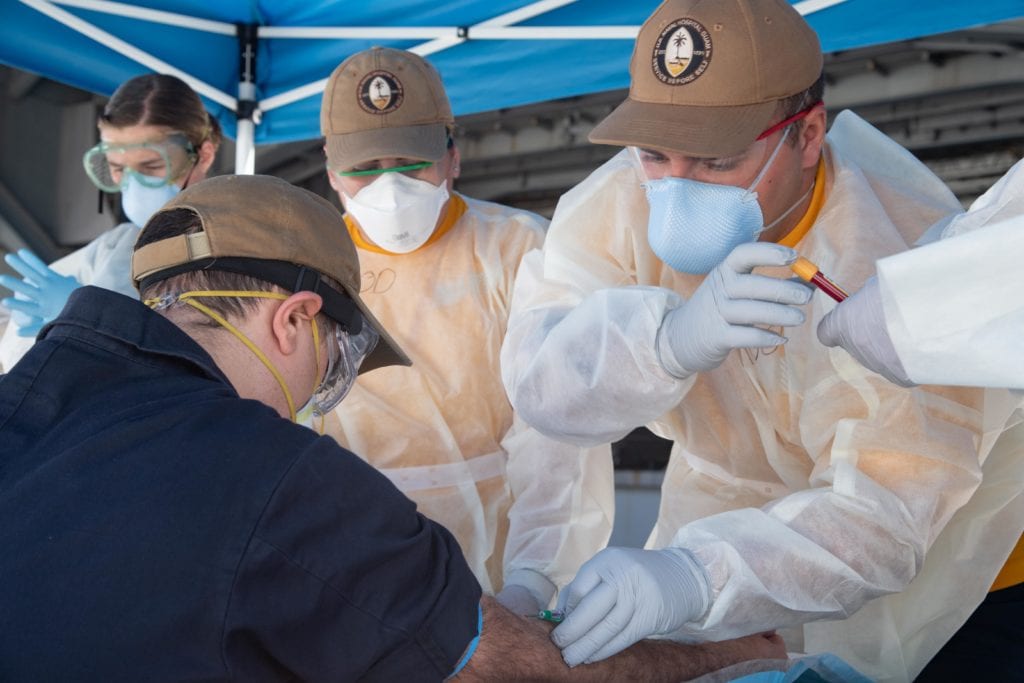
Hospital Corpsman 2nd Class Shane Miller (left) and Hospital Corpsman 2nd Class Austin Kelly draw blood for COVID-19 testing from a Sailor assigned to the USS Kidd after its arrival in San Diego on April 28. U.S. Navy/Mass Communication Specialist 2nd Class Alex Corona


DoD’s Lord: Potential for 3-Month Slowdown in Defense Acquisition

Ellen M. Lord, deputy secretary of defense for acquisition and sustainment, told reporters on April 30 that the COVID-19 pandemic might cause a three-month slowdown in procurement and sustainment. National Defense Industrial Association via YouTube

ARLINGTON, Va. — The Defense Department’s top acquisition official said the department is working closely with the industrial base to mitigate the effects of the COVID-19 pandemic but said there is the potential for a three-month slowdown in procurement and sustainment.  

“We continue to assess the impact of a potential three-month slowdown to many programs due to COVID-19,” said Ellen M. Lord, deputy secretary of defense for acquisition and sustainment, speaking April 30 at the Pentagon to reporters.   

“I intentionally used the word slowdown and impact and not saying the word ‘delay,’ which carries a very different connotation,” Lord added. “We have seen inefficiencies across many programs. COVID-19 is temporarily shutting down defense manufacturing facilities and production lines, disrupting supply chains and distressing the financial stability of the companies DoD relies on to protect the nation. DoD continues to partner with industry to do everything possible to keep programs on schedule and to minimize the cost and schedule impacts.” 

Lord praised the work of the Defense Contracting Management Agency (DCMA) and Defense Logistics Agency (DLA) in tracking the status of companies up and down the defense supply chain.  

“Out of the 10,509 companies DCMA tracks, 93 are closed, down 13 from last week, with 141 companies having closed and reopened, up very significantly 73 from last week’s number of 68,” she said. “This is the first time we have seen reopening numbers larger than the number of closures.  

“Out of the 11,413 companies DLA tracks, 437 are closed with 237 having closed and re-opened, almost 100 companies from last week.” 

Lord noted that “while we have seen minor improvements, we continue to see the greatest impacts in the aviation supply chain, shipbuilding and small space launch [companies].” 

Lord said her office’s policy team led by Jen Santos is “leading multiple industry calls making calls every week with 18 industrial associations.”  

“Tim Harrington, director of Defense Pricing and Contracting, has issued 22 defense pricing and cost memos, aggressively responding to industry needs and impacts. The memos include guidance for increased telecommuting, increased progress payment rates, acquisition timeline impacts, reimbursement for those prevented from working, and more,” she said. 

Lord gave an update on the $3 billion of increased cash flow due to increased progress payment rates, noting that this week the Defense Department processed more than $1.2 billion in invoices at the higher progress payment rate. 

“We have spoken with each of our major prime companies, and they have each confirmed their detailed plans to work with their supply chains to accelerate payments and to identify distressed companies and small businesses,” she said. “I want to particularly commend Lockheed Martin, who publicly committed to accelerating $450 million to their supply chain.” 

Lord said that her acquisition and sustainment team “remains focused on partnering with industry to maintain readiness and drive modernization.”


Pacific Fleet to Host At-Sea-Only RIMPAC Exercise in August

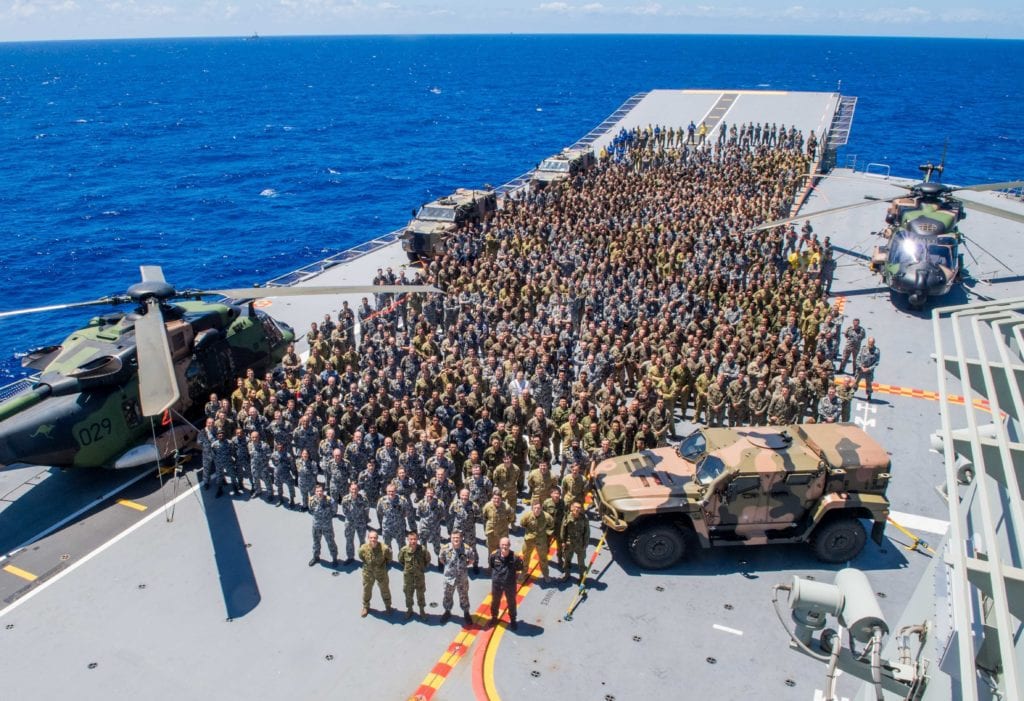
Military members from the Royal Australian Navy, Australian army, U.S. Marines, Sri Lankan navy and marines, Royal Malaysian Army, His Majesty’s Armed Forces of Brunei, the Japan Ground Self-Defense Force and the New Zealand army gather for a group photo on the flight deck of the landing helicopter dock ship HMAS Adelaide during the last RIMPAC two years ago. U.S. Navy/Mass Communication Specialist 2nd Class Kelsey J. Hockenberger

PEARL HARBOR, Hawaii — The U.S. Navy will sponsor the 27th Rim of the Pacific exercise, from Aug. 17 to Aug. 31, the U.S. Pacific Fleet said in a release. 

Hosted by the commander, U.S. Pacific Fleet, this biennial maritime exercise will be an at-sea-only event in light of COVID-19 concerns. The theme of RIMPAC 2020 is “Capable, Adaptive, Partners.” 

The at-sea-only construct for RIMPAC 2020 was developed to ensure the safety of all forces participating by minimizing shore-based contingents. Commander, U.S. Pacific Fleet crafted the modified RIMPAC plan as a way to conduct a meaningful exercise with maximum training value and minimum risk to the force, allies and partners, and the people of Hawaii. 

The world’s largest international maritime exercise, RIMPAC is designed to foster and sustain cooperative relationships, critical to ensuring the safety of sea lanes and security in support of a free and open Indo-Pacific region. 

The exercise, which takes place in the waters surrounding the Hawaiian Islands, is a training platform designed to enhance interoperability and strategic maritime partnerships. In 2018, during the last RIMPAC, 26 nations participated in and around Hawaii. 

“In these challenging times, it is more important than ever that our maritime forces work together to protect vital shipping lanes and ensure freedom of navigation through international waters,” said Adm. John Aquilino, commander, U.S. Pacific Fleet. “And we will operate safely, using prudent mitigation measures.” 

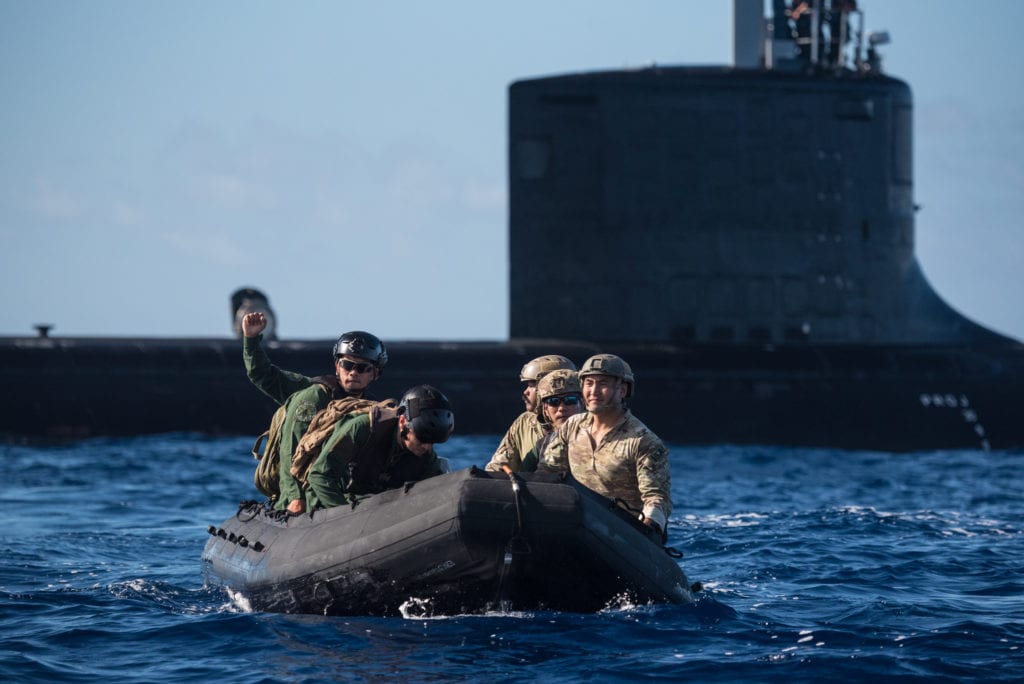
Multinational special operations forces participate in a submarine insertion exercise with the Virginia-class fast-attack submarine USS Hawaii and combat rubber raiding craft off the coast of Oahu, Hawaii, during RIMPAC 2018. U.S. Navy/Mass Communication Specialist 1st Class Daniel Hinton

As the U.S. Navy continues to limit the spread of COVID-19, RIMPAC 2020 is not scheduled to include social events ashore. Joint Base Pearl Harbor-Hickam will be accessible for logistics support, with a minimal footprint of staff ashore for command and control, logistics and other support functions. 

This year’s exercise will include multinational anti-submarine warfare, maritime intercept operations and live-fire training events, among other cooperative training opportunities. Continued planning will remain flexible as Navy leaders monitor and assess evolving circumstances. 

“We remain committed to and capable of safeguarding allies and partners throughout the Indo-Pacific region,” Aquilino said. “The flexible approach to RIMPAC 2020 strikes the right balance between combatting future adversaries and the COVID-19 threat.” 

RIMPAC 2020 will be led by the commander of the U.S. 3rd Fleet, Vice Adm. Scott D. Conn. 

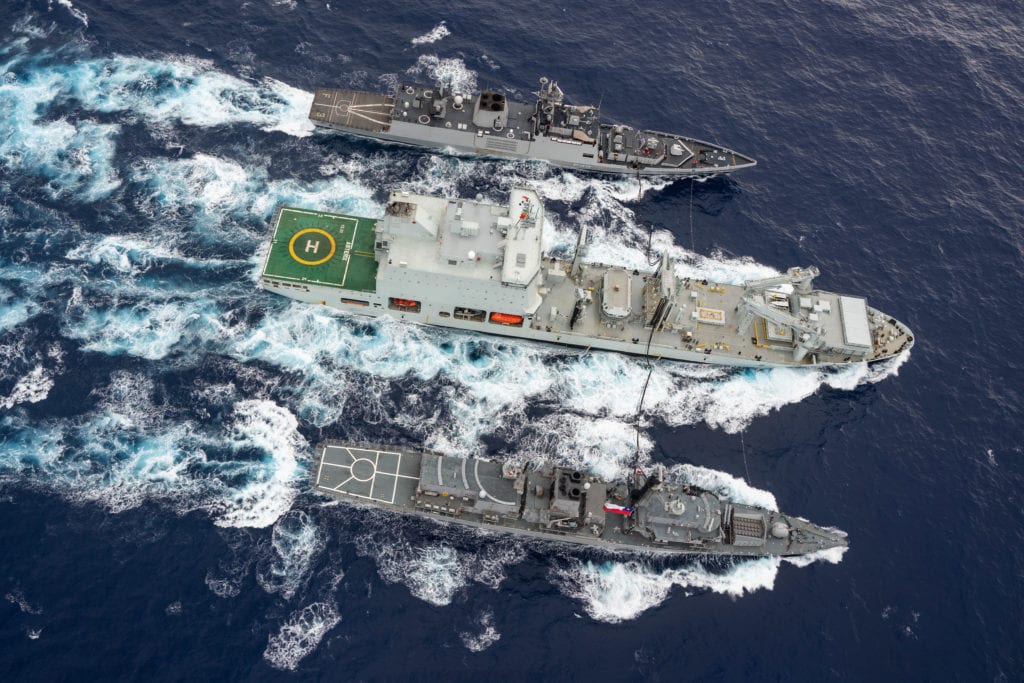
The Chilean navy frigate CNS Almirante Lynch and the Indian navy stealth multi-role frigate INS Sahyadri perform a replenishment-at-sea with the Royal Canadian Navy supply ship MV Asterix off the coast of Hawaii during RIMPAC 2018. Twenty-five nations, 46 ships, five submarines and about 200 aircraft and 25,000 personnel participated. U.S. Navy/Mass Communication Specialist 1st Class Arthurgwain L. Marquez


Navy Opens Deeper Inquiry Into Theodore Roosevelt; Move Delays Decision on Captain’s Reinstatement

Navy Hospitalman Rudy Flores (right), assigned to Naval Hospital Guam, takes a blood sample on April 23 from Mass Communication Specialist 1st Class Christopher Liaghat, a crewman assigned to the USS Theodore Roosevelt, as part of an investigation of the COVID-19 outbreak there. U.S. Navy/Mass Communication Specialist Seaman Kaylianna Genier

ARLINGTON, Va. — Acting U.S. Navy Secretary James McPherson has directed Chief of Naval Operations Adm. Mike Gilday to conduct a second deeper investigation of the events surrounding the COVID-19 outbreak on the aircraft carrier USS Theodore Roosevelt that has claimed the life of a Roosevelt Sailor, hospitalized others and infected hundreds more.

The results of a first preliminary investigation were forwarded last week by Gilday to McPherson, who took them under review. McPherson is a retired Navy flag officer in the Judge Advocate General Corps.

See: Navy Provides Medical Care to Infected Sailors of USS Kidd, Will Disinfect Ship

See: A Timeline From the First Month of the Outbreak in the Sea Services

See: Military Consumers React to Life During the Pandemic

“Following [discussion with Gilday], I have unanswered questions that the preliminary inquiry has identified and that can only be answered by a deeper review,” McPherson said in an April 29 statement. 

“This investigation will build on the good work of the initial inquiry to provide a more fulsome understanding of the sequence of events, actions and decisions of the chain of command surrounding the COVID-19 outbreak aboard USS Theodore Roosevelt.”

Vice Chief of Naval Operations Adm. Robert Burke will be in charge of the second investigation, which is expected to wrap up by May 27, unless an extension is granted, according to an April 30 statement from Cmdr. Nate Christensen, a spokesman for Gilday. From there, Gilday is expected to review the results and issue any recommendations.

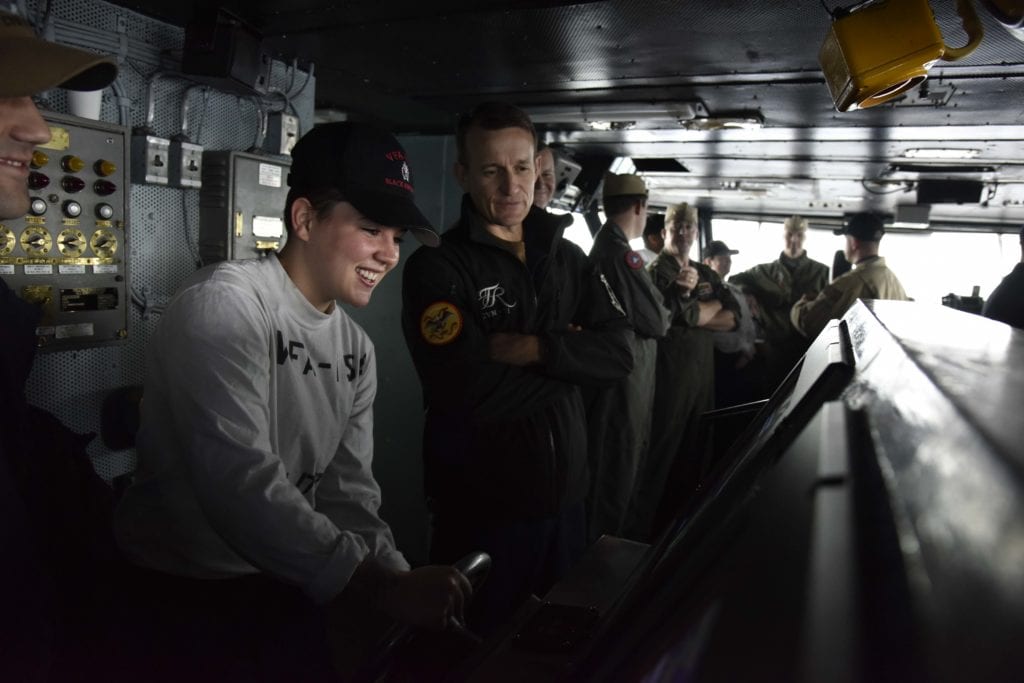
Capt. Brett Crozier (center), at the time commanding officer of the USS Theodore Roosevelt, in February instructs Information Systems Technician 3rd Class Eden Betzler on how to steer the ship. U.S. Navy/Mass Communication Specialist 2nd Class Pyoung K. Yi

The Navy reported as of April 25 that the entire crew of the Theodore Roosevelt had been tested for the virus, resulting in 4,105 negatives but 833 positives — including the carrier’s former commanding officer, Capt. Brett Crozier. 

Of the total cases, 112 Sailors had recovered and 4,273 Sailors from the Roosevelt had been moved ashore. Also, as of April 25, two of the ship’s Sailors were in U.S. Naval Hospital Guam under treatment for COVID-19 symptoms. Another Sailor died from complications of the infection, the Navy announced on April 13. 

The Theodore Roosevelt’s public affairs office announced April 29 that the ship was preparing to return to sea following a bow-to-stern cleaning process. The crew members that were quarantined ashore are beginning to move back on board.

“This investigation will build on the good work of the initial inquiry to provide a more fulsome understanding of the sequence of events, actions and decisions of the chain of command surrounding the COVID-19 outbreak aboard USS Theodore Roosevelt.”

Acting Navy Secretary James McPherson

Since March 27, the Roosevelt has been sidelined in Apra Harbor, Guam. Crozier was relieved of his command on April 2 by then-acting Navy Secretary Thomas Modly after fallout from a letter written by the captain to his chain of command leaked to a San Francisco newspaper. A few days later, Modly flew to Guam to visit the ship and address the crew, but he stepped down on April 7 after his address  — which was highly critical of Crozier — generated many calls for Modly’s resignation. 

According to several press reports, Gilday recommended Crozier’s reinstatement to McPherson. Defense Secretary Mark Esper received a verbal update from Gilday on April 24. Another report said that U.S. Army Gen. Mark Milley, chairman of the Joint Chiefs of Staff, recommended the more extensive investigation. 

Gilday had directed Burke to probe the circumstances and climate of the entire Pacific Fleet “to help determine what may have contributed to a breakdown in the chain of command,” Modly said April 2, the day he relieved Crozier as commander of the ship only months after Crozier had assumed command. 

A day earlier, at a press briefing on the Roosevelt virus outbreak, Gilday spoke of “a potential comms breakdown, wherever it occurred. We’re not looking to shoot the messenger here, we want to get this right.” 

Deputy Editor Scott Achelpohl and Seapower Correspondent John M. Doyle contributed to this report.

U.S. Navy Airman Andrue Barraza departs the Theodore Roosevelt on April 25 for quarantine after completing essential watch-standing duties. U.S. Navy/Mass Communication Specialist 1st Class Chris Liaghat


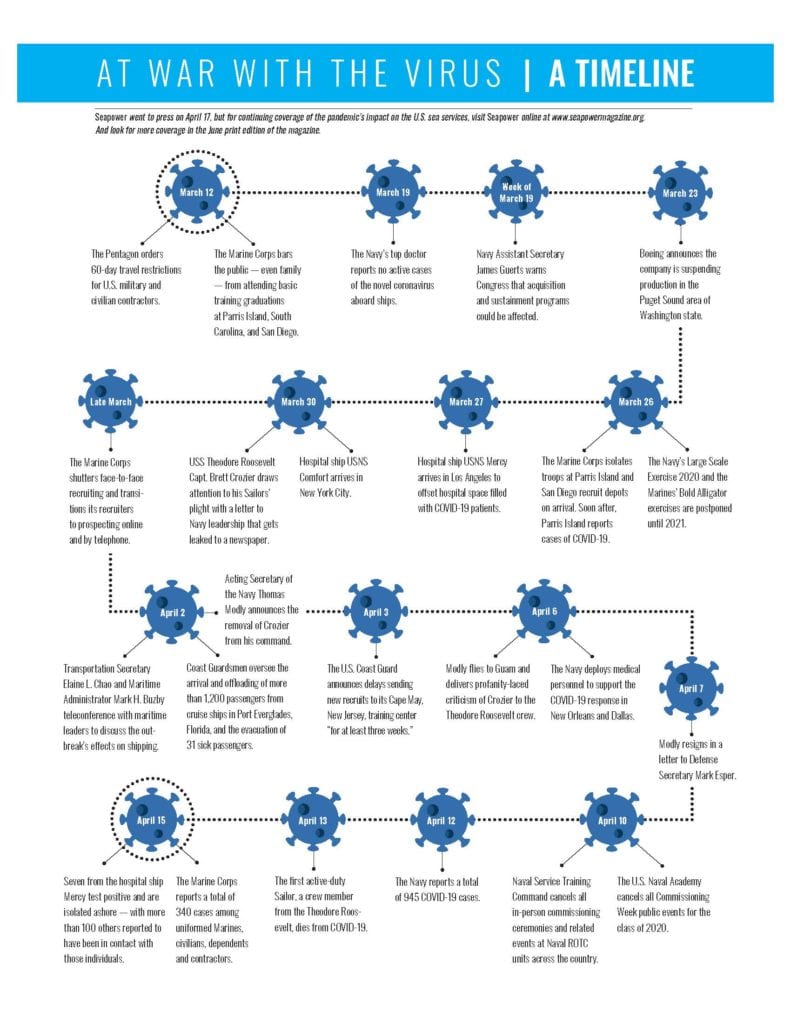
At War With the Virus — A Timeline


At War With the Virus: Sea Services Forced to Radically Change Course to Battle the COVID-19 Outbreak

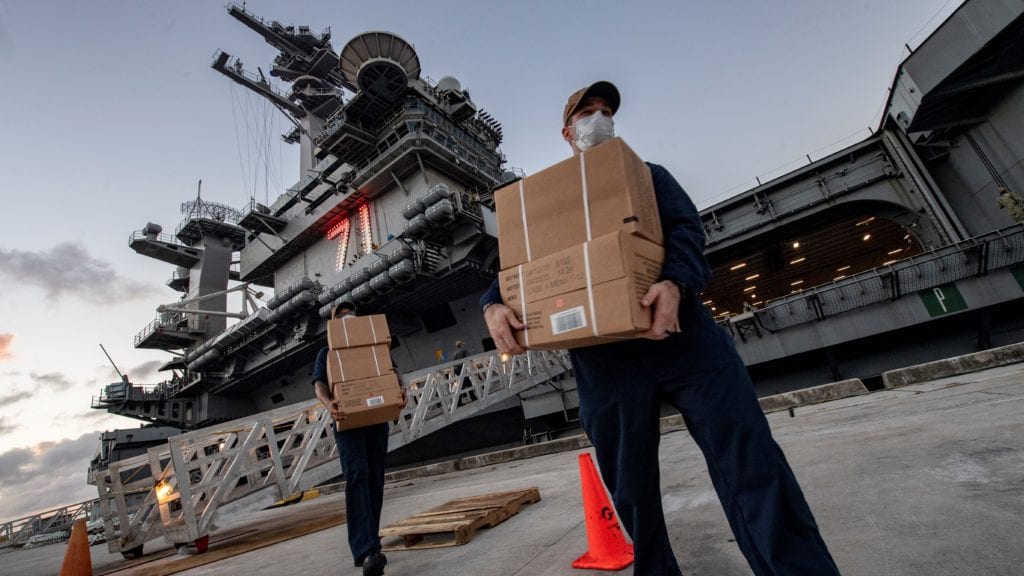
Sailors assigned to the aircraft carrier USS Theodore Roosevelt move meals ready to eat for Sailors who were negative for COVID-19 and asymptomatic at local hotels in an effort to implement social distancing and stop the spread of COVID-19. U.S. Navy/Mass Communication Specialist 1st Class Julio Rivera

The novel coronavirus has been a stunning and tragic disrupter of U.S. sea service operations — both major and routine, traditional events as well as long-planned operations.

Shortly after the World Health Organization declared COVID-19 a pandemic on March 11, the effect on America’s military started to come into sharper focus.

Check out the digital edition of the May Seapower magazine here.

See: At War With the Virus — A Timeline

By April 16, the U.S. Navy had reported 1,224 novel coronavirus cases. Most of those, 983, were Sailors, including 655 from the USS Theodore Roosevelt — the ship that is the hot spot for the virus. Another 134 cases were civilians, 53 dependents and 54 contractors.

A total of 13 Sailors, 13 civilians, three dependents and six contractors had been hospitalized. Also by April 16, 200 had recovered, the Navy said.
On April 13, the Navy said that the first active-duty Sailor had died — a Roosevelt crew member — joining three civilian employees and two Navy contractors who perished.

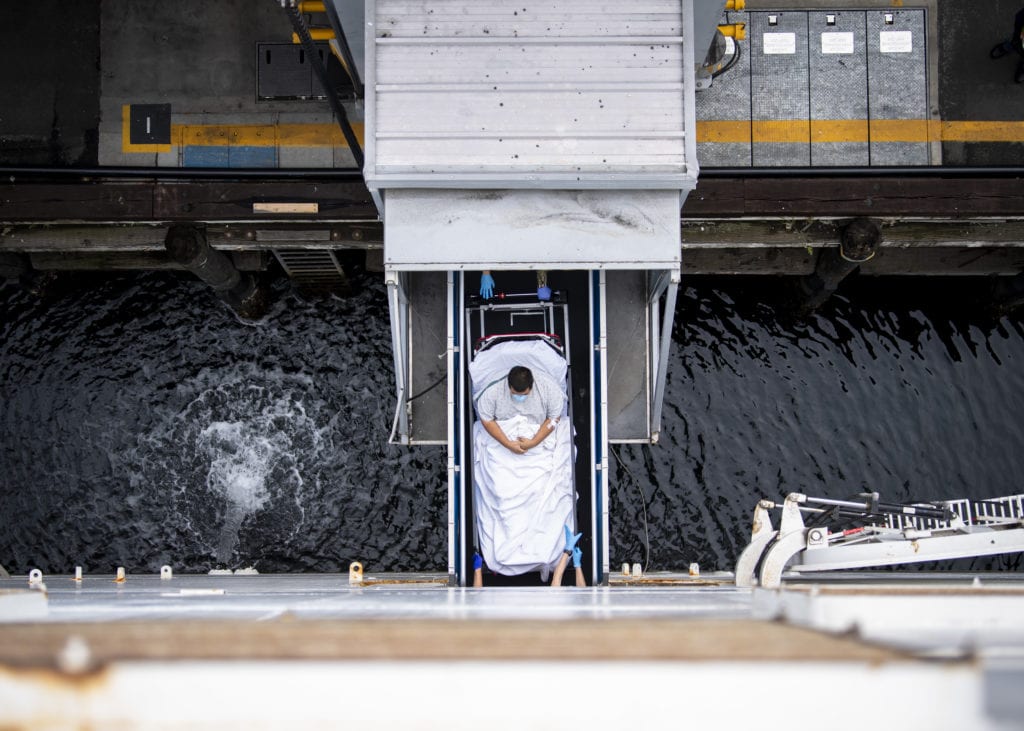
Sailors transport a patient to the hospital ship USNS Mercy. U.S. Navy/Mass Communication Specialist 2nd Class Ryan M. Breeden

As of April 16, the U.S. Marine Corps reported 340 COVID-19 positives among uniformed Marines, dependants, civilians and contractors.
The U.S. Coast Guard had 90 cases but 31 had recovered by that date.
Also by April 15, the hospital ship Mercy, docked in L.A., had seven test positive and sent into isolation. More than 100 had been in contact with those who tested positive there.

Spotlight on the Teddy Roosevelt

By mid-April, four aircraft carriers — the cornerstone of the Navy’s ability to project power forward — had at least one Sailor on board test positive for the viral infection. The USS Nimitz and USS Carl Vinson, both based in Bremerton, Washington, and the USS Ronald Reagan in Japan all were in port when their COVID-19 cases were discovered.

But nowhere was the outbreak more acute or visible to the world than on the fourth aircraft carrier, the Theodore Roosevelt, which put into port at Guam. That carrier became the first ship at sea to report a case.

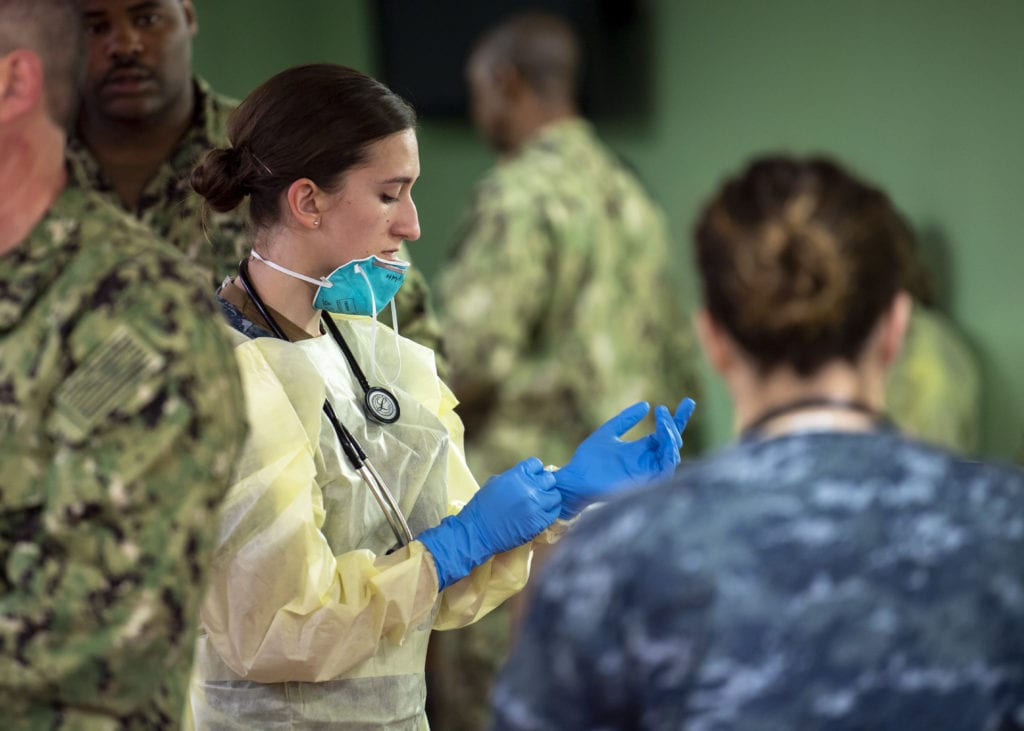
Hospital Corpsman 3rd Class Kimberly Wyss dons surgical gloves aboard the hospital ship USNS Mercy, which is deployed to Los Angeles in support of the nation’s COVID-19 response efforts and serves as a referral hospital for non-COVID-19 patients admitted to L.A.-area hospitals. U.S. Navy/Mass Communication Specialist 2nd Class Ryan M. Breeden

The then-captain of the Theodore Roosevelt, Brett Crozier, who later tested positive and went into quarantine himself, drew attention to his Sailors’ plight with a March 30 letter to Navy leadership. The letter was leaked and ran the next day with a story in the San Francisco Chronicle, drawing worldwide media attention.

As outcry grew over the fate of the Roosevelt’s crew, then-acting Navy Secretary Thomas Modly announced April 2 the removal of Crozier from his command. Modly then flew to Guam, where he would compound the controversy in a speech to the crew that included profanity-laced criticism of Crozier. The speech stirred more criticism of the Navy and Modly, who submitted his resignation on April 7.

By April 15, it was reported that Chief of Naval Operations Adm. Mike Gilday, after prelimary findings from a follow-on report of the affair, was considering reinstating Crozier.

As of April 16, 94% of the Theodore Roosevelt’s crew had been tested; 3,919 were negative with the 655 positives. Five were hospitalized in Guam, with one in intensive care. Of the 4,800 crew, 4,059 Sailors had moved ashore.

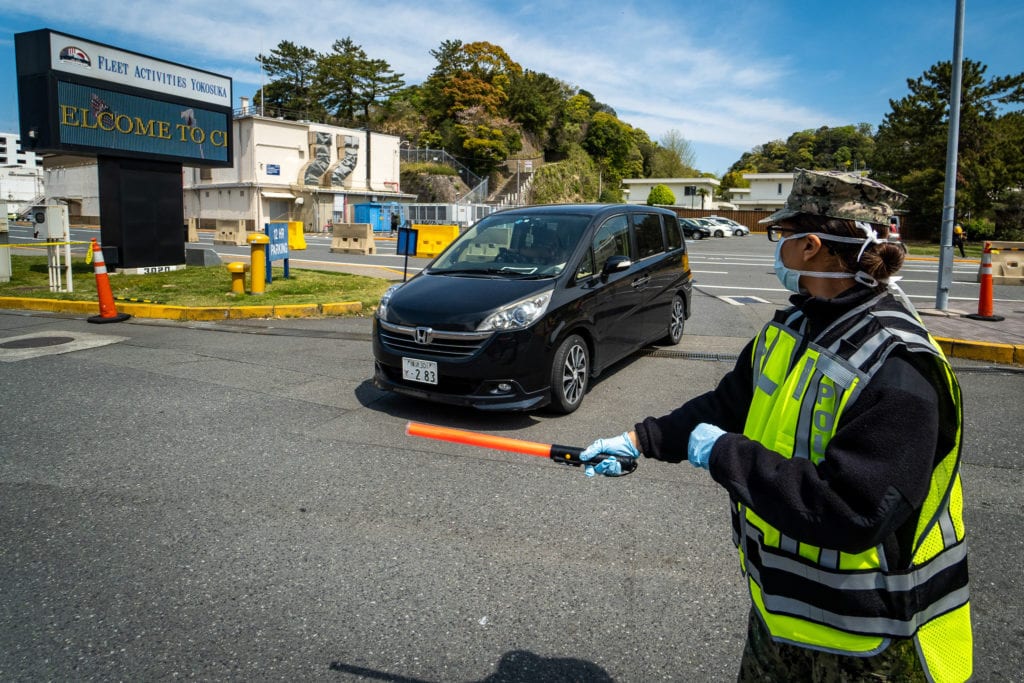
Commander, Fleet Activities Yokosuka, security department Sailors direct incoming gate traffic to COVID-19 screening stations on base. U.S. Navy/Taylor Curry

Concern for the Submarine Fleet

Of special concern is the health of the ballistic missile submarine force — the maritime leg of the nuclear triad with bombers and ground-based missiles — and other subs.

Crew members were undergoing enhanced medical screenings and 14-day isolation before beginning training or deployment aboard a sub, Gilday announced on March 24.

As of press time for Seapower in mid-April, no cases had been reported within the submarine force, but the Navy and all other services, starting in late March, were not reporting COVID-19 cases broken down by specific sectors of the fleet to protect operational security.

Wargame Foreshadows a Real Pandemic

Three months before the outbreak was detected in China, 50 experts participated in a wargame, Urban Outbreak 2019, that simulated the rapid spread of a disease.

The scenario involved a nation of 21 million people hit by a virus that led to respiratory failure and death.

The wargame generated a debate among “players” over the need for mass-enforced quarantine, like the U.S. population faces today. The players split between those who espoused quarantine as a reality and those who believed it would drive the infection underground and spread the disease faster.

The game’s results were scheduled to be discussed at a workshop in March, but like so many events in and out of the military these days, the real-life COVID-19 risk forced officials to postpone the workshop until
at least this summer.


Navy Provides Medical Care to Infected Sailors of USS Kidd, Will Disinfect Ship

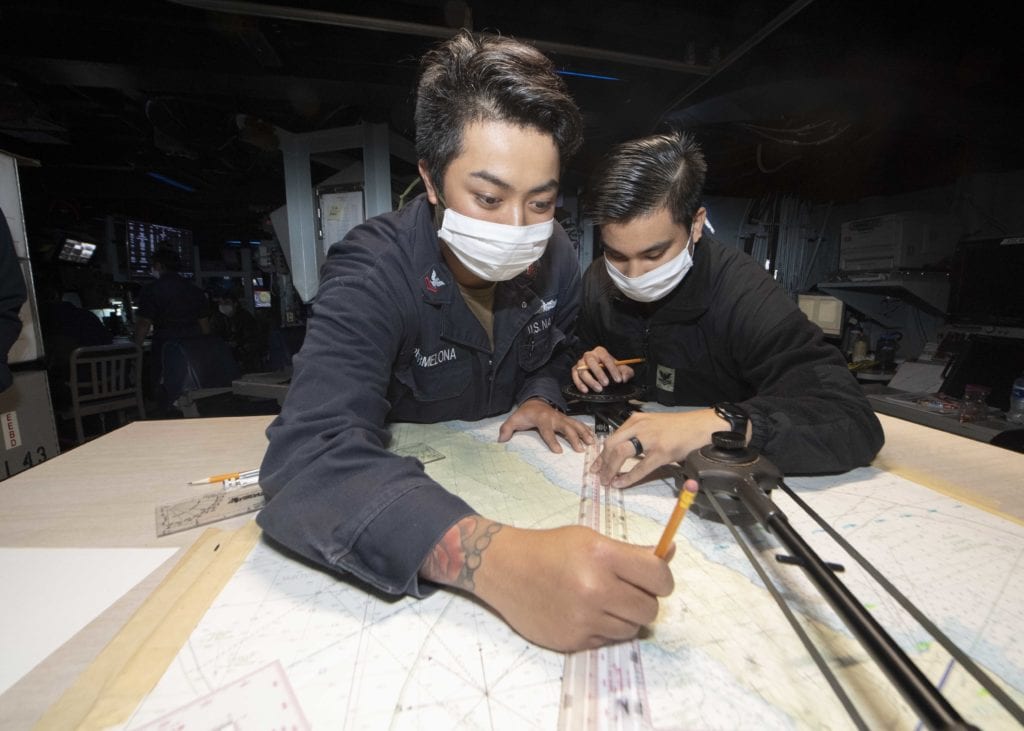
Operations Specialist 2nd Class Yves Permelona (left) and Operations Specialist 2nd Class June Canuel practice plotting courses during training aboard the USS Kidd, which is headed to San Diego for medical care for crew members and cleaning and disinfecting of the ship. Several Sailors there have tested positive for COVID-19. U.S. Navy/Mass Communication Specialist 3rd Class Brandie Nuzzi

SAN DIEGO — As part of the U.S. Navy’s response to the COVID-19 outbreak on board the guided-missile destroyer USS Kidd, the ship was to arrive at Naval Base San Diego on April 28 for medical care for its Sailors and for cleaning and disinfecting of the ship, according to Naval Surface Forces public affairs. 

“Sailors have called San Diego home for many years, and we’re especially thankful for that relationship now,” said Vice Adm. Richard Brown, commander of Naval Surface Forces. “Taking care of our Sailors and cleaning this ship is a team effort, and we’re fortunate that the partnership between the Navy and the city of San Diego is allowing us to focus on that mission.”

See: Decision on Crozier’s Fate Next in the Hands of Pentagon Officials 

See: Military Consumers React to Life During Pandemic

USS Kidd was at sea participating in counter-narcotics operations in the U.S. Southern Command area of responsibility when several of its Sailors began exhibiting flu-like symptoms. 

One Sailor was evacuated to the U.S. on April 22 after experiencing shortness of breath. The commander of the U.S. Pacific Fleet redirected the amphibious assault ship USS Makin Island — with its medical facility, including an intensive care unit, ventilators and additional testing capability — to rendezvous with the Kidd. 

“Taking care of our Sailors and cleaning this ship is a team effort, and we’re fortunate that the partnership between the Navy and the city of San Diego is allowing us to focus on that mission.”

Vice Adm. Richard Brown, commander of Naval Surface Forces

On April 23, eight medical personnel arrived on board the Kidd with equipment to begin testing the crew for COVID-19. As of April 25, 33 Sailors there had tested positive for the virus, the Navy reported. 

The Kidd’s executive officer, Cmdr. Matt Noland, released a letter via social media to friends and family on April 24. In it, Noland wrote, “The Navy pulled out all the stops — specialist doctors have already arrived from the United States to test and help care for our shipmates.” 

As Navy leadership solidified plans to return the ship to port, Sailors who warranted closer observation were transported from the Kidd to the Makin Island out of caution. An additional Sailor was medically evacuated to the United States. Meanwhile, the ship’s crew began intensive cleaning efforts while still underway. 

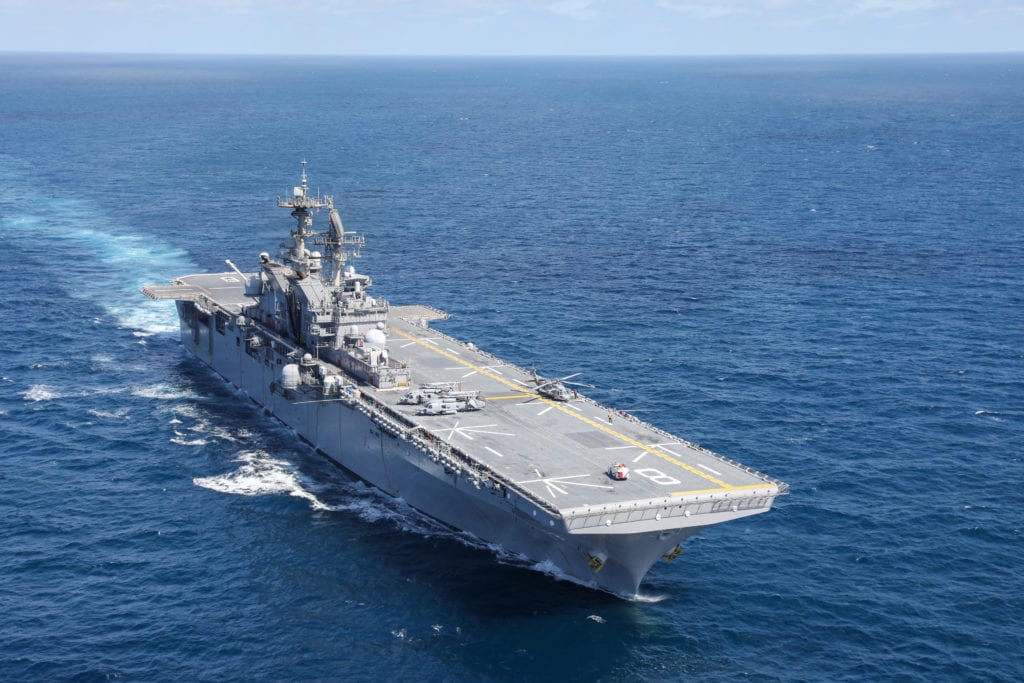
The amphibious assault ship USS Makin Island and its medical facilities and testing capabilities were diverted from routine operations in the eastern Pacific to rendezvous with the USS Kidd. U.S. Navy/Mass Communication Specialist 3rd Class Jacob D. Bergh

All Sailors will be isolated off the ship with twice-daily medical screenings. Crew members who have tested negative will quarantine for a period of observation, to include daily visits from military health professionals. 

A small contingent of Sailors who have tested negative will remain on the ship for essential services and deep cleaning. These Sailors will be outfitted with appropriate personal protective equipment (PPE) and will maintain social distancing, in accordance with U.S. Centers for Disease Control (CDC) guidance. 

“San Diego may not be USS Kidd’s home port, but we are definitely being made to feel at home,” said Cmdr. Nathan Wemett, commanding officer of the Naval Station Everett, Washington-based ship. “I am personally grateful to know that we have such a strong bond with our Navy communities. It’s the strength of those bonds that helps us work together in challenging situations.” 

While in San Diego, the Kidd will undergo a deep cleaning that balances decontamination with preventing damage to the ship’s systems. The cleaning process begins with spaces being vacated for seven days — four days longer than the minimum recommended by the CDC. The ship will be cleansed room-by-room, with access to each space restricted. The process is expected to take about two weeks, at which time Sailors who are confirmed to be healthy will return to the Kidd and Sailors moving off the ship will go into isolation. 

The Navy is providing a resiliency counselor, team of chaplains and psychologist for Sailors in isolation and quarantine. The Navy has also established a 24-hour roving patrol to ensure that Sailors who are sequestered off the ship are adhering to all public health and safety policies, the Navy said. 

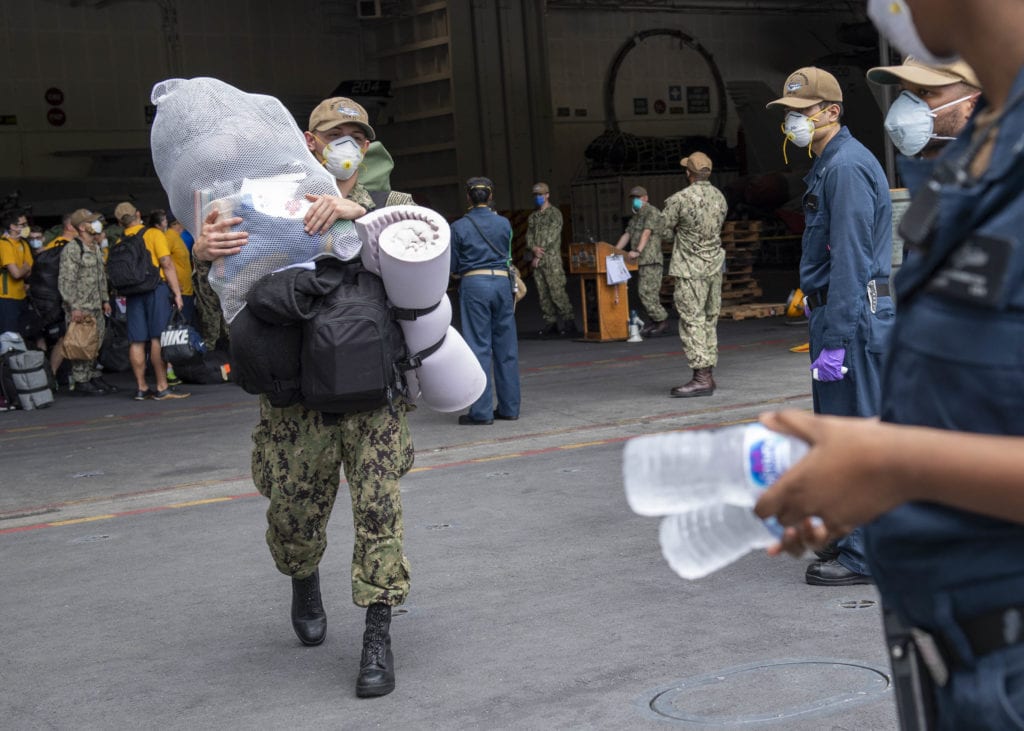
USS Kidd Sailors have been told to immediately report any flu-like symptoms — a lesson learned from the USS Theodore Roosevelt and its Sailors, all of whom are now housed in Guam. 

As of April 25, the entire crew of the Roosevelt had been tested for the virus, with 833 total positive and 4,105 negative results, the Navy reported. A small number of results were pending. Of the total cases, 112 Sailors have recovered and 4,273 Sailors have moved ashore, the Navy said. 

Also, as of April 25, two assigned to the Roosevelt were in U.S. Naval Hospital Guam under treatment for COVID-19 symptoms. One Sailor from the Roosevelt died there earlier this month from complications of the infection, the Navy reported.


Military Consumers React to Life During Pandemic

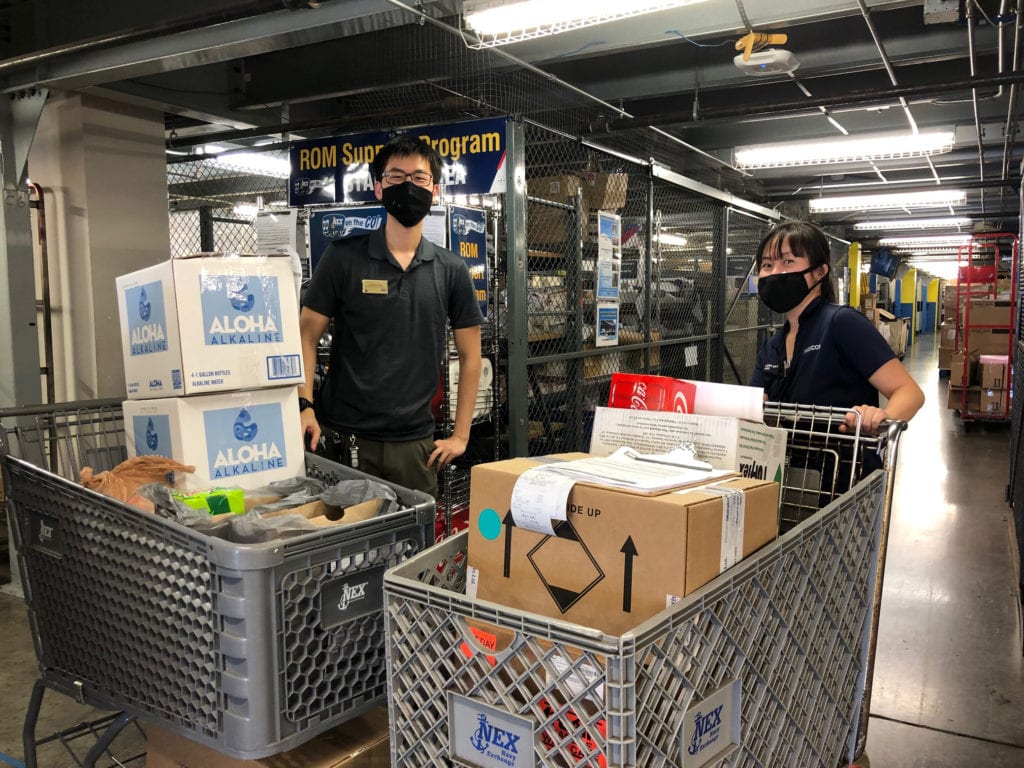
NEX Pearl Harbor launched its Quarantine Support Program by taking orders and delivering goods to military members on restriction of movement orders and quarantined in rooms on Joint Reserve Base Pearl Harbor-Hickam, Hawaii. U.S. Navy/NEXCOM Public Affairs

The COVID-19 crisis has cut back on time spent shopping for food and necessities, changing some military and dependent shopping habits and causing sales of some items — both essential and nonessential — to jump.

Kristine Sturkie, a spokesperson for the Navy Exchange Service Command, said the U.S. Navy Exchanges haven’t seen a rush to stockpile items, although there are limits on some essential items such as toilet paper, hand sanitizers and some cleaning products, so that more customers have access to these needed products. Sturkie said the stores have seen an increase in sales of personal items such as hair clippers.

NEX associates are accepting requests and delivering orders to military patrons who are in a restricted movement status or confined to quarters while under quarantine.

Since fewer people are commuting to work or venturing out, gasoline sales are down, as they are for civilians. Sturkie said the number of gallons sold at Navy Exchange gas stations was down about 21% worldwide compared to last year, and although the data is not available yet for April, she expects gallon purchases to be down for the month as well.

“Laptop and home office supply sales have spiked with more people teleworking, along with light fitness equipment to support home workouts,” Sturkie said. “Sales of outdoor items like bubbles, sidewalk chalk, basketballs and footballs and games, coloring books and playing cards are trending with the kids spending more time at home as well as home-organization and home-improvement type products.”

“Laptop and home office supply sales have spiked with more people teleworking, along with light fitness equipment to support home workouts.”

Kristine Sturkie, Navy Exchange Service Command spokesperson

Even though people are at home, many are conducting business in Zoom and other online platform meetings, where they must look presentable. As salons are closed, the health-and-beauty aids industry is seeing a sharp increase in the sale of do-it-yourself hair coloring products.

While online shopping has been strong, many more consumers are resorting to the web as a last resort. Online retailers like Amazon have seen dramatic increases in sales of both food and non-food items. While the nation is seeing huge unemployment numbers, parcel delivery companies like UPS and FedEx are hiring.

John Blythe, the Defense Commissary Activity Fort Belvoir store director, said there are no food shortages, but the commissary is having some challenges in replenishing merchandise from manufacturers during the novel coronavirus crisis. 

The commissary stores sell military Meals-Ready-to-Eat (MRE) year-round and for camping, hunting and for use in the event of adverse weather like blizzards or hurricanes. With the COVID-19 crisis, Blythe said some customers are worried and purchasing MREs at a higher rate than normal. Large pallets of MREs by the case are on display immediately as you enter the Fort Belvoir Commissary.

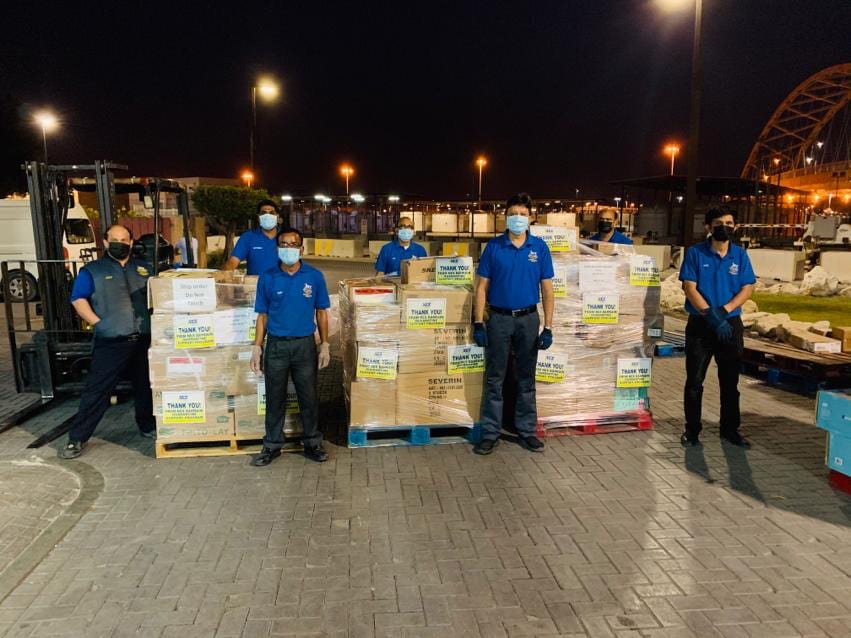
NEX Bahrain Distribution Center associates prepare NEX Quarantine Support Program orders for a portside delivery to a ship in port at Naval Support Activity Bahrain. U.S. Navy/NEXCOM Public Affairs

“In speaking with customers, many are concerned with food shortages and purchasing them for home use or shipping them to family members who are serving overseas,” Blythe said. “MRE sales usually peak in the summer months but we have never had such a demand for them as we had in the past 30 to 45 days.”

Hugo Ostreng of the Norwegian company DryTech, which makes Arctic rations for NATO forces, camping and backpacking as well as survival meals, said his company has seen an increase in the number of orders from both civilian as well as military customers. DryTech is a manufacturer of freeze-dried meals and as well an assembler of food rations for field applications for the military and outdoor markets.

“DryTech saw a sudden increase in the sale of freeze-dried meals for the civilian market,” said Jan Trondsen, key account manager for military sales.

“Many households thought it was a good idea to build up a little more food on stock in their own houses. We also had an increase in the orders to units and institutions because the system of distributing food from buffets and serving lines in not currently permitted. Our products proved very useful as they can be prepared, distributed and consumed without a kitchen or food-service personnel.”

Jessica Davis of Patagonia Provisions said sales of the company’s shelf-stable food products have seen a large spike. Backpacking food is usually expensive, but Davis said people are willing to pay a premium for lightweight, healthy, easy-to-prepare meals that are nutritious and taste good, especially after a long day of outdoor activities. 

“Our customer base is expanding due to COVID-19 with folks filling their pantries in preparation for what’s ahead. But our existing customers are also coming back and placing larger-than-normal orders. Our supply chain and distribution system are healthy and equipped to handle the increased demand,” Davis said.

“We’ve been selling a lot of selling a lot of buffalo jerky, soups and chilis, seafood and the gift boxes. High-protein freeze-dried meals last a long time and you can live off them, so people are stocking the pantry. Patagonia Provisions is certainly feeling those effects.”


Decision on Crozier’s Fate Next in the Hands of Pentagon Officials

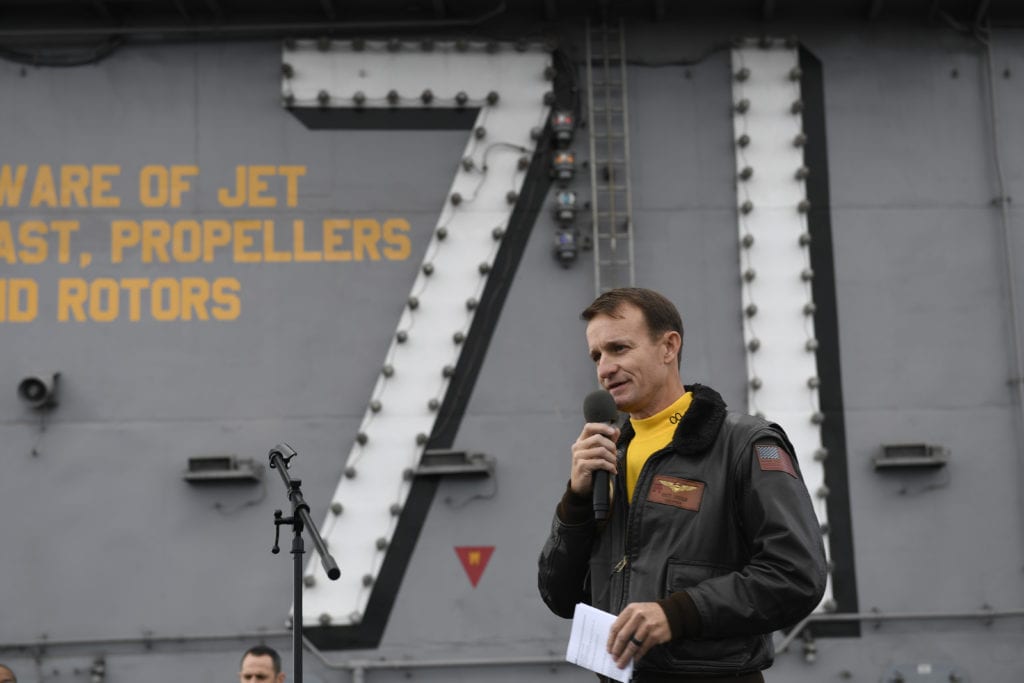
Capt. Brett Crozier, then-commanding officer of the aircraft carrier USS Theodore Roosevelt, addresses his crew during an all-hands call on the ship’s flight deck last November. U.S. Navy/Mass Communication Specialist 3rd Class Nicholas Huynh

ARLINGTON, Va. — Defense Department officials are reportedly split on reinstatement of Capt. Brett Crozier following his ouster as commander of the aircraft carrier USS Theodore Roosevelt earlier this month by then-Navy Secretary Thomas Modly.

After the end of a preliminary investigation into Crozier’s dismissal, top U.S. Navy officials announced April 24 that a recommendation on Crozier’s fate had been delivered to Modly’s replacement, acting Navy Secretary James McPherson, and that McPherson was still in talks with Defense Secretary Mark Esper on the question of restoring Crozier to his previous position.

See: Navy Provides Medical Care to Infected Sailors of USS Kidd, Will Disinfect Ship

See: Military Consumers React to Life During Pandemic

However, several media outlets have reported April 24 and since that McPherson and Chief of Naval Operations Adm. Mike Gilday recommended that Crozier be restored to his former command.

Another outlet said Chairman of the Joint Chiefs of Staff U.S. Army Gen. Mark Milley wanted to pump the brakes and recommended a longer and more detailed investigation before Crozier’s status is determined.

Rep. Adam Smith (D-Wash.), chairman of the House Armed Services Committee, emphatically weighed in April 24 in favor of Crozier’s reinstatement. “The secretary of defense needs to reinstate Capt. Brett Crozier as commanding officer of the USS Theodore Roosevelt,” Smith said in his statement.

Roosevelt Sailors stand by to depart the ship for quarantine after completing watch-standing duties on April 25. Upon arriving in Guam on March 27, the ship established an emergency command center, initiated a roving and deep cleaning team and started educating the crew on social distancing and protective procedures and behaviors. U.S. Navy/Mass Communication Specialist 1st Class Chris Liaghat

The Navy was less committal, at least publicly, that day — so a final decision may take days or weeks longer. President Trump may also reportedly weigh in.

“This afternoon, Secretary Esper received a verbal update from the acting secretary of the Navy and the chief of naval operations on the Navy’s preliminary inquiry into the COVID-19 outbreak on the [Roosevelt],” Jonathan Rath Hoffman, public affairs assistant to Esper, said April 24.

“After the secretary receives a written copy of the completed inquiry, he intends to thoroughly review the report and will meet again with Navy leadership to discuss next steps. He remains focused on and committed to restoring the full health of the crew and getting the ship at sea again soon.”

Gilday directed Vice Chief of Naval Operations Adm. Robert Burke to investigate the circumstances and climate of the entire Pacific Fleet “to help determine what may have contributed to a breakdown in the chain of command,” Modly said April 2, the day he announced that Crozier was relieved of his command.

A day earlier, at a press briefing on the Roosevelt virus outbreak, Gilday spoke of “a potential comms breakdown, wherever it occurred,” adding “we’re not looking to shoot the messenger here, we want to get this right.”

Crozier was fired by Modly after a March 30 letter the captain wrote to top Navy officers and fellow naval aviators leaked to a San Francisco newspaper, the San Francisco Chronicle, which published a story the next day. The publication of the letter sparked an outcry and worldwide media attention over Crozier’s actions and the fate of the carrier’s crew.

“The secretary of defense needs to reinstate Capt. Brett Crozier as commanding officer of the USS Theodore Roosevelt.”

Rep. Adam Smith, House Armed Services Committee chairman

A week later, Modly added fuel to the fire with a profanity-laced speech criticizing Crozier in front of the nuclear carrier’s crew that went viral on social media. Modly had to resign the next day, April 7, in the wake of the expanding controversy.

At the time Crozier wrote his letter, three Sailors on the Theodore Roosevelt had tested positive for COVID-19, but many more were later found to be infected after the carrier made a scheduled port visit to Guam. As of April 25, the Navy reported that the entire crew had been tested for the virus, with 833 total positive and 4,105 negative results. A small number of results were pending, the Navy added. Of the total cases, 112 Sailors have recovered and 4,273 Sailors have moved ashore.

Two Sailors assigned to the Roosevelt were in U.S. Naval Hospital Guam under treatment for COVID-19 symptoms. None of those hospitalized for the virus was in the intensive care unit. However, one Sailor from the Roosevelt did die there earlier this month from complications of the infection, the Navy reported.

In his letter, the captain wrote that he believed the carrier had inadequate space to isolate or quarantine Sailors. He also pleaded for faster intervention from his superiors to assist his crew. “We are not at war. Sailors do not need to die,” Crozier wrote. “If we do not act now, we are failing to properly take care of our most trusted asset — our Sailors.”

He was hailed as a hero by his crew — who were seen on video cheering him on during his departure from the ship in Guam — as well as some in and out of the military, while others criticized him for circumventing the Navy’s chain of command.

“What we’ve learned from the TR is very informative,” Hoffman said April 24 of the rapid rise of COVID-19 cases on the carrier.

That has led to a priority-based, tiered system of testing starting with critical national capabilities, like strategic nuclear deterrent units, working its way through fielded forces around the world, forward-deployed and redeploying forces and the rest of the force.

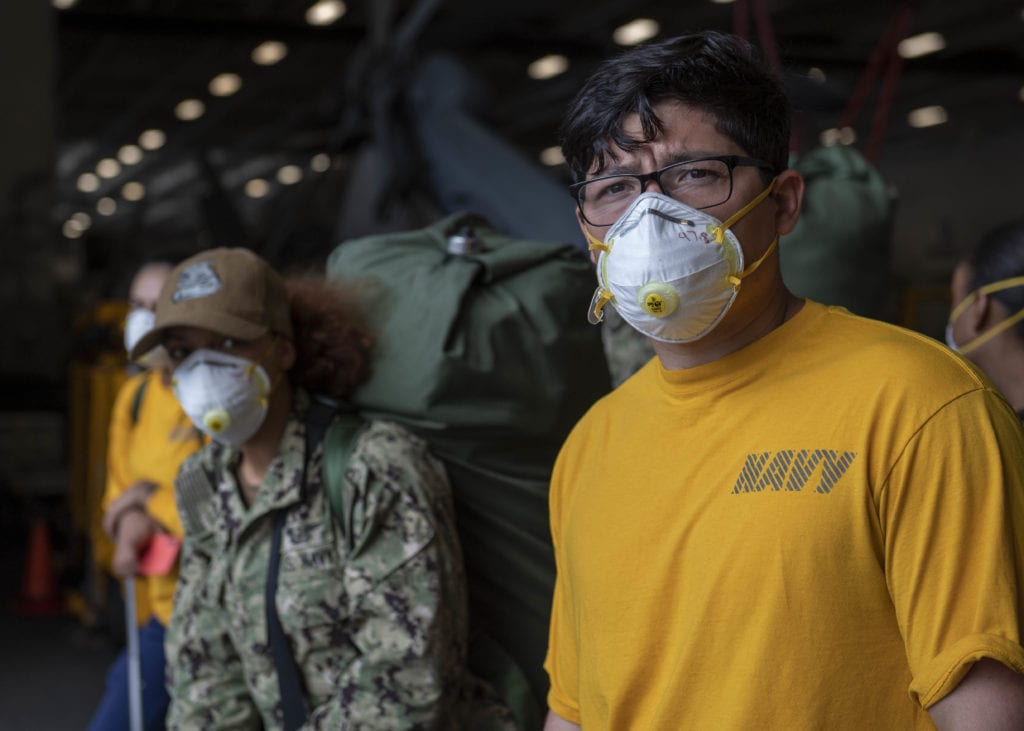
Meanwhile, an embarked medical team continues testing aboard the guided missile destroyer USS Kidd in the eastern Pacific, where 33 Sailors have tested positive for COVID-19. Two Sailors have been medically evacuated to the United States. Sailors aboard the Kidd are wearing PPE and N95 masks. The amphibious ship USS Makin Island, with a fleet surgical team, ICU capacity and ventilators and additional testing capability, is en route to rendezvous with the Kidd in case medical support is required at sea.

The Navy continues to lead all armed services with 1,659 cases of the novel coronavirus, followed by the Army with 995, the National Guard with 792, the Air Force with 347 and the Marine Corps with 304, according to the latest data released by the Defense Department on April 27. There have been only two deaths among military personnel.

Seapower Correspondent John M. Doyle contributed to this report.


Pentagon Plans Testing, Screening, Manufacturing Push in COVID-19 Battle

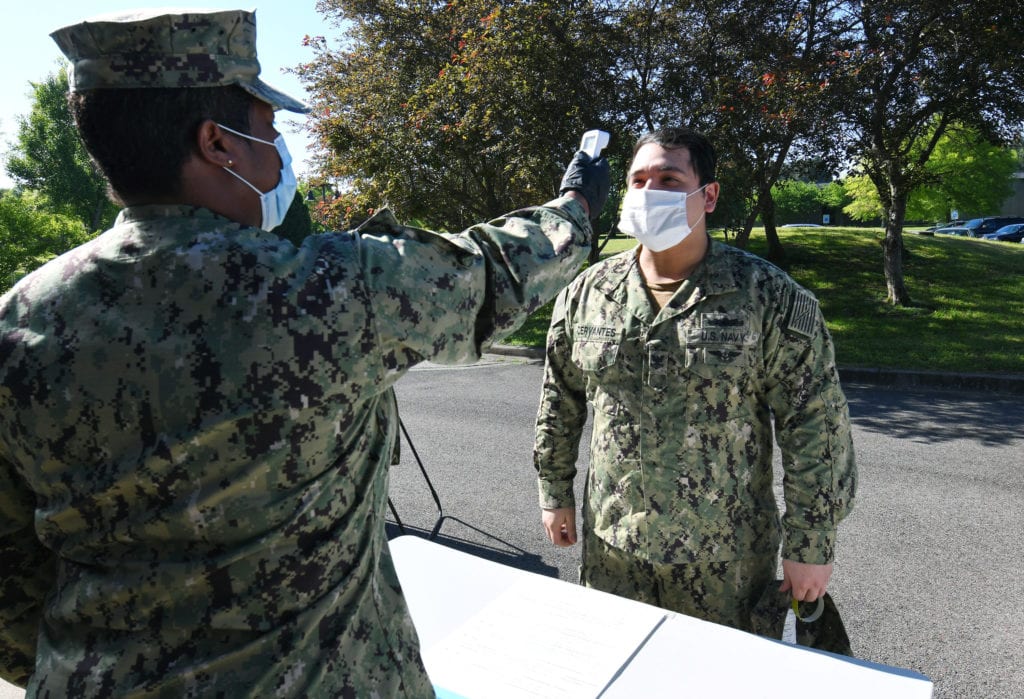
Master Chief Personnel Specialist Nikita Maher (left) uses a touchless thermometer on Personnel Specialist 2nd Class Francisco Cervantes at an entrance checkpoint of Goetsch Hall at Navy Personnel Command in Millington, Tennessee. U.S. Navy/Chief Mass Communication Specialist Michael Russell

ARLINGTON, Va. — The Defense Department is rolling out new strategies for screening the force for the novel coronavirus to halt the spread, spot those needing medical treatment early and still enable the military to fulfill its mission, according to two top Pentagon officials.

“As we learn more about the virus, we will continue to evolve our approach,” Deputy Defense Secretary David Norquist told a Pentagon press briefing that was live-streamed on April 22.

He noted that hundreds of thousands of active-duty and civilian personnel are teleworking. However, for thousands more who cannot practice social distancing because they work in constrained spaces like new recruits in training or Sailors and Marines on ships or submarines at sea, there is a new general process to screen for COVID-19.

For those groups, the first of four containment steps is screening with the use of questionnaires and thermometers to identify at-risk individuals. Next comes 14 to 21 days of quarantine, depending on a unit’s risk tolerance, to identify those who are infected but not yet showing symptoms. A third step calls for conducting swab tests and temperature checks, prior to leaving quarantine, to identify those who have since become infected but remain asymptomatic. Finally, as a unit moves to its mission, Norquist said, “we’ll keep this group together but limit its outside interaction to prevent the introduction of infection.”

“As we learn more about the virus, we will continue to evolve our approach.”

Deputy Defense Secretary David Norquist

Procedures like face coverings, hand washing, maintaining clean workspaces and continued monitoring will all still apply as units move forward while therapeutic treatments and vaccines are still being developed, he said.

COVID-19 had infected more than 802,000 people in the U.S. and had killed 44,575 as of April 21, according to the U.S. Centers for Disease Control and Prevention. The Pentagon reported on April 22 that 3,578 cases of COVID-19 have been detected among U.S. military and civilian personnel, dependents and contractors; 25 have of those have died. The U.S. Navy continues to have the largest number of cases — 1,298 — compared to 841 for the Army, 337 for the Air Force, 259 for the Marine Corps and 713 for the National Guard.

Meanwhile, under the authorities granted by the Defense Production Act, the government is moving to increase production of critical N95 masks to 39 million in the next 90 days and to 141 million over the next six months, Norquist said. The Pentagon is working with vendors to increase swab production from three million a month to 20 million, also boosting production of personal protective equipment for medical personnel, reagents for testing kits and active pharmaceutical ingredients.

As testing supplies become more prevalent, testing will be conducted through a priority-based, tiered system recently approved by Defense Secretary Mark Esper, Air Force Gen. John Hyten, the vice chairman of the Joint Chiefs of Staff, told the press briefing.

Tier 1 will focus on critical national capabilities, like strategic nuclear deterrent units. Tier 2 will focus on engaged, fielded forces around the world. Tier 3 is for forward-deployed and redeploying forces and Tier 4 includes the remainder of the military.

Hyten was asked if he thought it was unwise for the Army Corps of Engineers to continue building treatment facilities, with hundreds of beds, in big city convention centers, even as existing ones are under-used.

“For gosh sakes, no! That’s what I want to see,” he said. If the beds are all filled, that means local hospitals have been overwhelmed. “You always want to have excess capacity, not too little capacity,” he added.