Littoral OpTech Workshop Will Examine Operational, Geopolitical Challenges in Baltic Sea
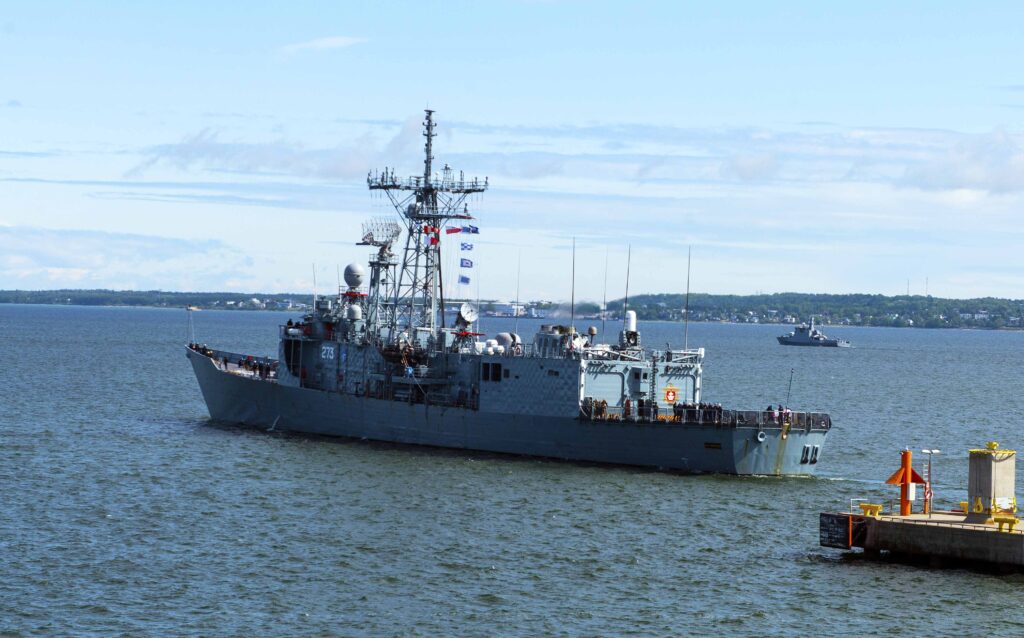
The Polish Navy, Oliver Hazard Perry-class guided-missile frigate ORP General Tadeusz Kosciuszko (273), departs for sea in support of BALTOPS 23. BALTOPS 23 is the premier maritime-focused exercise in the Baltic Region. U.S. Navy | Mass Communication Specialist 2nd Class Mario Coto

The 2024 Littoral OpTech workshop, an invitation-only event, will be held May 21-22 at the Polish Naval Academy in Gdynia, Poland. Participants will listen to a number of speakers and panels exploring the current trends in operational, economic and geo-political environment in and around the Baltic Sea.

According to retired Swedish Navy Captain Bo Wallander, the event moderator, Littoral OpTech workshops are typically two-day conferences that bring together key partners and advanced technical and operational expertise to explore and identify the technologies that will enable effective littoral operations.

“The workshops expand the growing global community of interest and garner stakeholder support for addressing the technical challenges in the world’s littorals,” Wallander said.

Wallander described the maritime littorals as “a very complex environment with limited space where it is easy to hide and difficult to detect targets. This means very short reaction times. The proximity to islands and shores means a broad spectrum of threats in all domains. The littorals are also characterized as having a great number of non-military actors like merchant ships, fishing and pleasure boats.”

Wallander referred to the Baltic Sea, in particular, as an “extreme littoral.”

“What makes the Baltic Sea special are the short distances in an east-west direction and the large archipelagos in both Finland and Sweden. There are different currents and counter currents; varying sea bottom topography, water salinity and temperatures,” he said.

Wallander said the workshop will focus on both operations, political issues and technologies with an emphasis on Northern Europe and the evolving security concerns in Northern Europe, as well as the importance of the fact that both Sweden and Finland have become NATO allies.

The last Littoral OpTech workshop was held in Helsinki, Finland, and also focused on the Baltic Sea.  Besides the 2022 event in Finland, previous Littoral OpTech seminars, colloquiums and workshops have been held in Monterey, California; Stockholm, Sweden; Tokyo, Japan; Cartagena, Colombia; Halifax, Canada; and Souda Bay, Crete, Greece.

Wallander said the Polish Naval Academy is working together with the Swedish defense company Saab to host the 2024 workshop.   

“The naval academy is located in a very a very significant historical area,” Wallander said. “Gdynia is also an important base for the Polish navy.”

“This area of the world continues to be of great geopolitical, economic and military importance,” Wallander said. “The Baltic Sea is both a very sensitive environment and an important transport link for the Russian Federation. Since the last OpTech event the war in Ukraine has raged on, and both Finland and Sweden have become full-fledged members of NATO.”

The Polish Naval Academy in Gdynia will host the 2024 Littoral OpTech workshop. Polish Naval Academy

Poland is situated on the Baltic Sea, with a 328-mile mostly sandy coastline. The country was under Soviet domination after World War II and was a charter member of the Warsaw Pact from 1955 to 1991.  In 1999, Poland joined Czechia and Hungary to become the first former members of the Warsaw Pact to join NATO.

The Baltic Sea is an arm of the Atlantic Ocean enclosed by Denmark, Estonia, Finland, Germany, Latvia, Lithuania, Poland, Sweden and Russia, with a coastline of approximately 5,000 miles. Today, all of those countries are part of the NATO Alliance, except Russia. Russia’s Baltic Sea exclave of Kaliningrad is surrounded by Poland to the south and Lithuania to the north and east.

Polish Naval Academy

The Littoral OpTech workshop will be hosted by the Polish Naval Academy, which is named after the “the Heroes of the Westerplatte.” The academy offers both civil and military undergraduate and graduate study programs. The name refers to the 1939 battle at the Westerplatte peninsula when the Polish forces fought off a vastly superior German army. The battle is revered as a symbol of resistance in modern Poland.

The Polish navy was established in 1918. The academy was established soon after, in 1922. It has been in continuous operation, albeit under different names, ever since.  The school is currently under the command of Rector-Commandant Rear Admiral Professor Tomasz Szubrycht.

The undergraduate and graduate courses are taught in Polish and English, and a number of international students attending the school. The military cadets receive commissions in the Polish military upon graduation, mostly in the navy. There are also serving officers working on graduate degrees.

Today, the Polish navy consists of about 12,000 commissioned and enlisted personnel, many of them serving abord the service’s 46 ships.

The Polish Navy’s two largest surface combatants ORP General Kazimierz Pulaski and ORP General Tadeusz Kościuszko, are the former U.S. Navy Oliver Hazard Perry-class guided missile frigates USS Clark (FFG 11) and USS Wadsworth (FFG 9).  The service is ordering new Arrowhead 140 frigates, to be delivered by Polish Armament Group in cooperation with Babcock, U.K.


SAIC Advances Scalable Open-Architecture Counter-UAS Systems

From left to right: the vehicles are the Polaris MRZR, Polaris DAGOR, and the EOS Defense HMMWV, all of which are enabled by SAIC’s CUAS. (SAIC photo)

By Richard R. Burgess, Senior Editor 

ARLINGTON, Va. — SAIC’s counter-unmanned aerial system (CUAS) concepts will be further tested in a June 2024 demonstration, a company official said. The company has two types of CUAS systems deployed and is in competition for two Department of the Navy programs. 

“We’re really excited about the [June] counter-swarm demo that we’ve been selected to participate in,” said Greg Fortier, SAIC’s senior vice president for Army aviation, fires, and C2 in the Army business group, in an interview with Seapower. 

SAIC, which has been developing CUAS systems for more than a decade, already has two CUAS systems fielded with U.S. agencies.  

The company’s Valkyrie CUAS System is “operational in a few parts of our country,” Fortier said, with “[O]perational forces in the U.S. Army right now on a pilot type of effort. The predecessor of our system [the Medusa] is also active across the CENTCOM AOR [U.S. Central Command area of responsibility] in certain capacities, and that’s mostly with the Department of the Air Force.” 

Fortier said that SAIC has “continued to evolve our solutions, continued to understand the different requirements from all of the services — frankly all of the agencies in our nation — and then really have driven for the past couple of years into a modular, 100% open system that is a scalable approach to meeting all the different threats within counter-UAS. That’s not just in the all-domain warfighting imperative but it’s also things like the border of the future as well as the general overall citizen experience for our country. 

“SAIC is pivoting on five national imperatives: all-domain warfighting, undersea dominance, citizen experience, border of the future, and next-gen space. CUAS applies to four of the five across multiple agencies,” he said. “The company has multiple lines of effort with these imperatives. We go at it in terms of four phases: detect, track, identify, and mitigate. There are multiple technologies that apply across the board—kinetic and non-kinetic solutions. Every customer, every requirement is a little bit different.” 

“It’s all about our open architecture that allows us to integrate very quickly to any of the different modalities that support detect, identify, track, and mitigate,” said Jeremy Davidson, SAIC’s counter-UAS lead, also speaking during the interview. “Multi-functional capability within each of those mission domains from detect to mitigate — including all of your different non-kinetic and kinetic modalities as well, including lasers, but also traditional small arms, rockets, ATM [air traffic management], drone interceptors, things like that. 

“We bring all of the sensors that feed into that, from radars, to RF [radio frequency], to EW [electronic warfare], and of course the last one is the eye, which is identify where you  get into your EO/IR [electro-optical/infrared] sensors,” Davidson said. 

“We are a tech-agnostic integrator,” Fortier said. “We feel like we are a world-wide leader in technology agnostic integration. That makes our systems more powerful in that we can take multiple technologies as we’ve already done in the past couple of years, integrate and learn, understand, and then pass that along [and] make that connection among the multiple agencies within the United States.” 

He stresses that the company’s integration of technology is not just with hardware but also with software, and that cost reduction and operational effectiveness are achieved through open architecture. 

“When you have an open system, and you have an obsolete part, you can pull that part off, and if the technology or the threat changes, you can plug and play new technology at pennies on the dollar because you’re not re-integrating or re-configurating an entire system,” Fortier said. 

SAIC continues to participate in multiple demonstrations for the Joint Capabilities Office and for the Department of Homeland Security on the border, he said. 

“There are two offices right now in the Department of the Navy, both of which we are pursuing,” Fortier. “We were down-selected in one of those opportunities to continue in the competition, but that competition is still active.” 

The two Department of the Navy competitions are the MADIS-CES (Marine Air Defense Integrated System-CUAS Engagement System) Lethality Upgrade and Marine Corps Installation CUAS. 

SAIC has 25 partners and integrates more than 45 technologies. Most of its current integration work is performed in Huntsville, Alabama. The company has had discussions with foreign countries in Europe and elsewhere about its integration technology. 


BlueHalo to Test C-UAS System on Marine Corps JLTV

By Richard R. Burgess, Senior Editor 

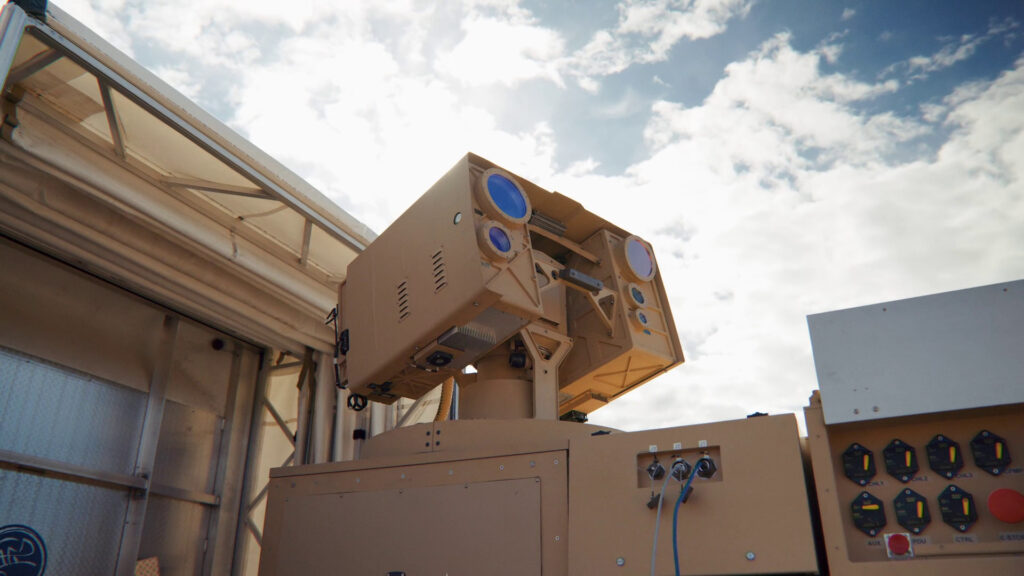
ARLINGTON, Va. — BlueHalo will be testing its LOCUST Laser Weapon System on a U.S. Marine Corps Joint Light Tactical Vehicle (JLTV), the company’s chief executive officer (CEO) said. 

BlueHalo’ s primary focus is on defeating Group1, 2, and 3 unmanned aerial systems (UAS), as well as counter-rocket and counter-mortar systems, said Jonathan Moneymaker, CEO of Blue Halo, in an interview with Seapower

“As the foundation of P-HEL, BlueHalo’s LOCUST Laser Weapon System (LWS) combines precision optical and laser hardware with advanced software, artificial intelligence (AI), and processing to enable and enhance the directed energy “kill chain,” the company said in a release. “LOCUST LWS addresses the inherent need for mobility and quick deployment–tracking, identifying, and engaging of a wide variety of targets with its hard-kill high energy laser.  

“We look at it from an integrated layered defense strategy,” Moneymaker said. “Five years ago, we saw the evolution of drone warfare, today one of the fastest-evolving threat vectors. We wanted to engage that from a variety of modalities. We offer solutions and products that range from passive detection in our Skyview product to RF detect-and-defeat in our Titan product, our LOCUST Laser Weapon System, expanding into more global C2 [command and control], and starting to expand into our next-gen kinetic interceptor. 

As of April 2024, BlueHalo had delivered two P-HEL systems to the U.S. Army, which has deployed them to unspecified locations.  

“It is most certainly [deployed] in areas of conflict,” Moneymaker said. “It’s real, it’s deployable, it’s reliable, and frankly needed to bring service members home.”

“We’re very proud to be the first operationally deployed [HEL] system,” Moneymaker said, noting that its system has surpassed operational 10,000 hours and that the customer having a system that “has finally reached a level of reliability that they’ve been looking for as they’ve been fielding these capabilities.” 

He said that the next expansion would be a mobile high-energy laser weapon — on an infantry squad vehicle or a JLTV. The first mobile system was delivered in late March. 

“The JLTV integration will be on the Marine Corps’ JLTV, so we’ve been working with all of the services as it relates to deployment of LOCUST,” he said. “We certainly have been having initial conversations with afloat Navy on how can we deploy these systems in the best configuration to counter some of the activity we’re seeing in the Red Sea.” 

Moneymaker said he sees great potential in the “proven, ready [P-HEL] system” for naval use with its roll-on/roll-off capability.  

The work for the Marine JLTV is through the Department of the Navy’s Ground-Based Air Defense program, as well as through the Joint Capabilities Office and U.S. Army Rapid Capabilities and Critical Technologies Office (RCCTO). 

Moneymaker said the LOCUST is very effective against a [drone] swarm, noting that the capability is part of the test criteria. The LOCUST uses Wizard artificial intelligence and machine learning for target identification and aimpoint recognition. 

The P-HEL is powered by a generator or batteries, and the company is looking at how to tie the HEL into shipboard power. 

The company’s HEL is built primarily at the BlueHalo campus in Albuquerque, New Mexico, with work expanding to Huntsville, Alabama, and Rockville, Maryland. BlueHalo, headquartered in Arlington, Virginia, employs 2,400 workers and is approaching revenue of $1 billion annually. The company has other facilities in Dayton, Ohio, and Fort Lauderdale, Florida. 


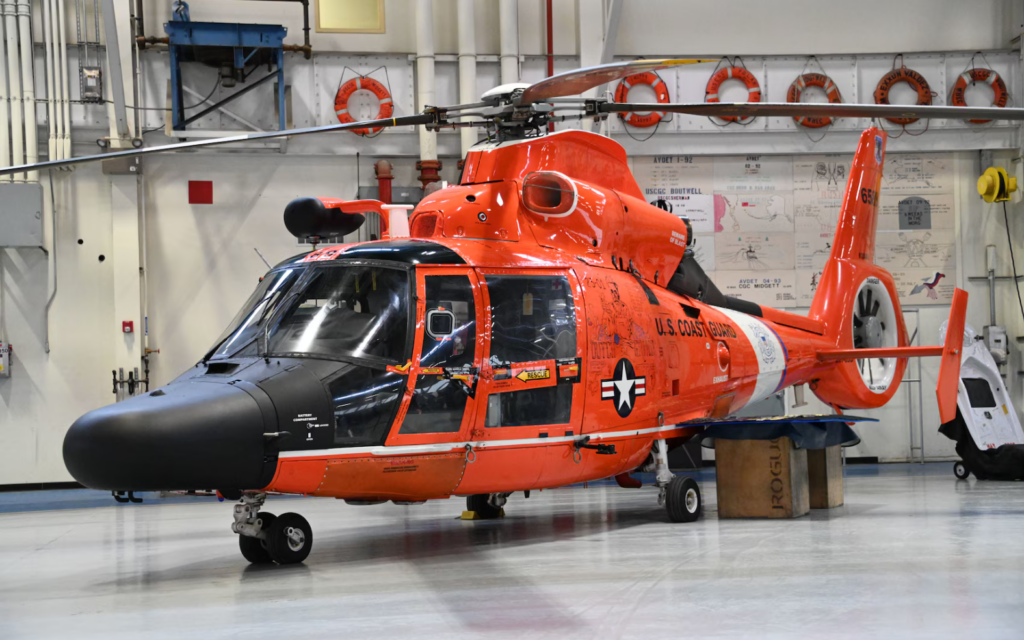
Coast Guard Station Kodiak Retires its MH-65 Dolphin Helicopters After 36 Years of Service in Alaska 

U.S. Coast Guard 17th District Public Affairs, April 24,2024 

KODIAK, Alaska – The Coast Guard retired the Air Station Kodiak MH-65 Dolphin helicopter fleet during a ceremony, Tuesday. 

Capt. Timothy Williams, commanding officer of Air Station Kodiak, presided over the ceremony honoring the 36 years of service the MH-65 Dolphin airframe and its crews provided to the Arctic region. 

Air Station Kodiak currently has a rotary-wing fleet of six MH-60 Jayhawk helicopters. The unit will shift to a rotary-wing ship-and-shore based fleet of nine MH-60 Jayhawks in 2025. 

Air Station Kodiak will be the fourth Coast Guard Air Station to transition to a single rotary wing fleet of MH-60 Jayhawk helicopters. Air Stations Borinquen, Traverse City, and New Orleans all recently completed similar transitions. 

“For decades, the cutter and helicopter team were the core of the ALPAT mission,” said Cmdr. James Kenshalo, MH-65 Dolphin pilot. “Together they projected force and protection to the most extreme remote regions of our nation’s territories, operating beyond where help could reach. Countless lives have been saved because of these dedicated crews.” 
 
Commissioned in January of 1988, the Alaksa Patrol (ALPAT) mission executed solely by MH-65 Dolphin aircrews provided Coast Guard Cutters with a reliable airborne asset during Alaska Patrols. 

To read more about the Coast Guard MH-65 Dolphin and MH-60 Jayhawk helicopters click the following links: 

SRR – MH-65 (uscg.mil) 

MH-60T Service Life Extension Program (uscg.mil) 


HASC Members Prepare to Dive into Navy Budget

Members of the House Armed Services Committee seem prepared to overturn some Navy decisions as outlined in the fiscal 2025 budget request, including retiring some ships early and funding only one Virginia-class submarine. 

“What has happened is, as the top line is increased, the game has become, ‘we’ll add a bunch of the stuff that we know Congress won’t add, and we’ll take out stuff that we know Congress is going to put back in.’ And that will be a net gain. That game has to stop,” said Rep. Wittman (R-Virginia), chair of the House Subcommittee on Tactical Air and Land Forces. 

As for the Virginia-class sub, Wittman said the Navy position that the program is behind anyway and the shipbuilders can’t keep up doesn’t make sense. 

“It really is about demand signal and, and you can’t have it both ways. You can’t say, well, the reason we are reducing the submarine request is because we don’t think the industrial base can do it. That’s wrong,” he said. “The industrial base can do it if you send them the demand signal. We’re at about 1.6, I think, submarines today annually, we need to be at 2.3. The way we get there is to send the proper demand signal.” 

Rep. Joe Courtney (D-Connecticut), the ranking member on the Subcommittee on Seapower and Projection Forces, said a defense industry report issued in December highlighted the need for procurement stability. 

“Procurement stability was the watchword throughout that report,” he said. “And, we’re sacrificing that. I mean, literally, within weeks” of the report. 

Naval aviation is also an issue, as the Navy has an air attack shortfall, noted moderator Bryan Clark, a senior fellow at the Hudson Institute. 

“There are some, thanks to Congress, some Super Hornets being procured in this year’s appropriations,” he said. “But there doesn’t seem to be a clear path ahead for the carrier air wing.” 

This drew an animated response from Wittman, who said there doesn’t seem to be a sense of urgency about the situation. 

“The challenge now is to make sure we get enough F-35s in production to be able to sustain these carrier wings,” and to make sure there’s not a “valley” as the Super Hornets retire, “where now all of a sudden you have aircraft carriers sitting at the dock because there’s no aircraft on board. That means we have to get those lines to intersect. That’s more of a challenge than what a lot of folks think because the tactical air component of that is about maintaining production.” 

The aircraft also need technical refresh three, an upgraded software capability that contractor Lockheed Martin warned will be delayed.  

“I mean, there needs to be an all hands on deck mentality to go, no, that’s not acceptable. We need these aircraft and now we’re going to have hundreds of aircraft sitting on the tarmac waiting to get a software upgrade, right?” 

Wittman continued, “F-35 is it, right? That’s all we have, right? Let’s get our fanny in gear and get this thing going and get it on the decks of the aircraft carriers, get it in the hands of our pilots in the Air Force. Get our fanny in gear. I mean, this is it. I hate to get fired up about it, but I’m fired up about it because this is the future of tactile air for this nation. Get our fanny in gear,” he said, slapping the arms of his chair for emphasis. 

Workforce Woes 

The panel, which included Reps. Donald Norcross (D-New Jersey), Jen Kiggans (R-Virginia) and Ronny Jackson (R-Texas), also discussed the workforce issues plaguing the defense industry. 

Kiggans, a former Navy helicopter pilot, said she sat on a HASC task force looking at recruitment and retention and what rose to the top were several issues: Compensation, housing and child care. 

“That 5.2% pay raise that we just gave our servicemen and women in the appropriations bills that were passed a couple weeks ago, that’s a good starting place, but there’s still more work to do,” Kiggans said.  

As for housing, she said college dorms are better than the places junior enlisted Sailors and Marines are asked to live. “We have to do better for our junior Soldiers, Sailors and Airmen and Marines to be able to expect them to want to do the job that we ask,” she said. 

On the pay issue, Wittman said, “this 5.2% increase this year was great, but remember, the lower you are on the salary scale, the percentage is not as quite as much in your paycheck. Take for example, if you come into our services, if you are a private in the Army, the Marine Corps, third-class Seamen, third-class Airman, your starting salary is $23,000 a year. That’s 11 dollars and 50 cents an hour asking you to do the most dangerous work of the nation, putting your life on the line. And guess what? You go to Chick-fil-A and serve chicken sandwiches and make more money in a much, much less challenging or dangerous environment. We have got to fix the junior enlisted salary differential.” 


Additive Manufacturing, Small Business Collaboration Highlight First Day of Sea-Air-Space 2024

By NAVAIR

Naval Air Systems Command (NAVAIR) kicked off the 2024 Sea-Air-Space Expo on Monday with panel discussions on manned/unmanned and weapon systems advancements, additive manufacturing success stories and collaborative opportunities for small businesses to join with NAVAIR to aid the warfighter.  

The first panel was led by Rear Admiral Stephen Tedford, executive officer of the Program Executive Office for Unmanned Aviation and Strike Weapons (see Tuesday’s Show Daily for a story on his presentation). 

Theodore Gronda, program manager for the NAVAIR Additive Manufacturing (AM) Team, began his panel discussion by highlighting that the AM team was established in order to create parts in small quantities, when needed, to get a grounded aircraft back in service in a faster time than relying on industry partners for supply chain gaps. Additive Manufacturing is the ability to “print” an object based on information fed into a device, much like a 3D printer.  

Gronda said NAVAIR began supporting AM developments by separating them into three tiers. Tier 1 AM printers focus on “Commodity Polymers,” and is responsible for creating non-critical, smaller items such as knobs, clips and caps. Tier 2 AM printers focus on “Industrial Polymers,” including non-critical and critical parts such as tools, covers, brackets and mounts. Tier 3 AM printers are “Industrial Metal” and create non-critical and critical metal parts including valve bodies, gearboxes, fuel and engine components and manifolds.  

One of the newer capabilities Gronda announced was the addition of a “Solid State” cold spray technology, which uses a metal powder to spray and build up or repair a designated item.  

Currently, there are 96 AM devices deployed to 33 sites, including deployed aircraft carriers.   

A recent victory for the AM team’s capabilities was when they received word that a ship’s optical landing system had failed. There were aircraft aboard the ship that depended upon that critical landing system and were unable to fly. The ship contacted the AM team and they got to work, learning that the damaged part was simply a coupler, no bigger than four quarters. Within 12 hours, the team was able to redesign the coupler, test it, receive approval, and send the coupler data electronically to the ship where it was then printed. As they were about to install the part, the ship received orders to deploy and the repair was put on hold for a few hours to enable the ship to transit to its destination. Once it arrived, the coupler was installed, and aircraft from that ship were deployed to intercept UASs that were targeting allies.  

Another victory for the team, several E-6B Mercury customers found themselves in need of fuel cell interconnecting fittings replacements, as the previous vendor for the part went under during the Covid-19 pandemic. The AM team received a call in October, requesting 12 replacements for the fuel cell interconnectors. Within four months, the team was able to produce the parts and get them to the customers.  

Gronda stressed that this was just one example of how the pandemic affected the Naval Supply Systems Command (NAVSUP) ability to maintain sustainment capabilities and how the AM team is rising to meet those areas impacted by supply chain gaps created by the pandemic.  

Recognizing the increasing need of AM implementations, Gronda said the Naval Aviation Schoolhouse for Additive Manufacturing was established in February in Danville, Virginia, and will aim to create a pipeline of AM artisans to meet growing AM needs. The Schoolhouse is a collaborative effort with Naval Sea Systems Command (NAVSEA).  

Another success story related to the team was the ability to repair tire rim assemblies on F/A-18 Hornets. Gronda said pilots often land hard on carrier decks, causing the landing gear wheel hub to oblong and the tire to shake. If the tire shakes, it is taken off and discarded.  

“That tire is wildly expensive,” Gronda said. “There wasn’t an effective way to repair it. We go through 166 of these tires a year and they cost six figures apiece. Eighty percent of those tires are repairable with cold spray technology. It takes me two hours and costs $300. It’s a big deal for us. And what that’s done is taught us to think different. Stuff that we previously thought was not repairable is repairable now with cool spray and our additive manufacturing repair machines.”  

Small Business Opportunities 

The final panel of the day began with an overview of the NAVAIR Office of Small Business Programs (OSBP) and how collaborations with modestly sized operations can be mutually beneficial.   

The panel gave step-by-step guidance in how the team guides prospective partners through meeting with OSBP, specifically directing them to the OSBP website, https://www.navair.navy.mil/osbp/.  

Irma Alexander, deputy director for the OSBP, summed up whole purpose attendees were at Sea-Air-Space this week — market research.  

“The government is here to learn about you. You’re here to learn about us, about your competitors, about potential future collaborations,” Alexander said. “But how do you make those decisions? You make them through market research. That’s our common purpose. So, when you go home and you’re tired, think about the motivation you felt this morning, because that’s the motivation you need to go do your homework so you can come see us. Market research is the foundation from where you build your business decisions, where you decide how you’re going to capture that business, and how you’re going to mark it. The good news is we offer a lot of awesome market research resources.”  


AUKUS Program Marks ‘Greatest Industrial Undertaking’ for Australia

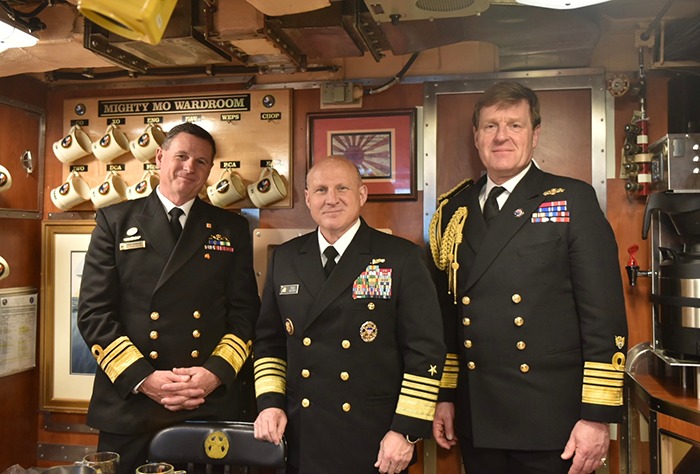
Then-CNO Admiral Mike Gilday, Royal Navy First Sea Lord and Chief of Naval Staff Adm. Sir Ben Key, and Chief of the Royal Australian Navy Vice Adm. Mark Hammond, tour the Virginia-class fast-attack submarine USS Missouri following the AUKUS bilateral announcement in San Diego, Calif, March 13, 2023. 
CREDIT: U.S. Navy | Commander Courtney Hillson 

The AUKUS program, the multination effort to provide Australia with nuclear-powered submarines, will kick-start that country’s ability to build nuclear subs, an Australian minister said in a panel discussion at Sea-Air-Space on April 8. 

Pat Conroy, Australia’s minister for defense industry and minister for international development and the Pacific, said the effort will be a challenge but it was a logical choice to select a partnership of Australian Submarine Corp. and BAE Systems to build the subs, as ASC built Australia’s diesel-electric submarines and BAE builds the United Kingdom’s Astute and Dreadnought-class submarines. 

“For them to form a joint venture for us was the right model,” Conroy said. He said it will be a “step up” for them to move to nuclear standards, but they’ve had a long partnership with General Dynamics Electric Boat in the United States.  

“Electric Boat was instrument in fixing some of the challenges that we encountered earlier in the Collins class,” Conroy said. “So, we’re confident we’ll put the ecosystem in and we’re investing around $30 billion Australia to increase our industrial place uplift that will really underpin what is the greatest industrial undertaking our country’s ever attempted.” 

Moderator Megan Eckstein of Defense News noted the United States and United Kingdom are talking about building up the nuclear industrial base, but for Australia, “you’re starting from scratch.” 

Conroy replied, “it’s an incredible effort, and lots of progress has been made from legislative rules to establishing a nuclear regulatory authority to starting to train our workers, our industry in the nuclear mindset. It has been a challenge, but also a great opportunity to include Australian companies from the ground floor.” 

Australia is mounting a full national mobilization, he said, including funding 4,000 additional permanent university places in STEM subjects to grow the workforce. 

“We think we need 20,000 workers. We’ve got Royal Australian Navy sailors working on U.S. submarine tenders in Guam right now, and a hundred ASC employees will be working for harbor sustainment next year,” he said. 

“So, we’re starting that training pipeline. That $30 billion dollars will be a massive investment. And while it’s a challenge, there’s also opportunities,” he said.  

“I’ve had the privilege of going through Barrow-in-Furness in the U.K. [home of BAE Systems Submarines] and the Groton, Connecticut yard here [home of Electric Boat] and they’ve got tremendous expertise built up over a century. But they’ve also got the challenges of that, of being built around towns like in Barrow-in-Furness. You’ve got terrace houses next to assembly halls because the town and a shipyard being built up together. Having a brownfield site where we can build with the best equipment, with lots of open space, will really allow us to maximize efficiencies and learnings from our oldest partners.” 


Atlantic Commander: Industry-Government Partnership Essential to Coast Guard Innovation

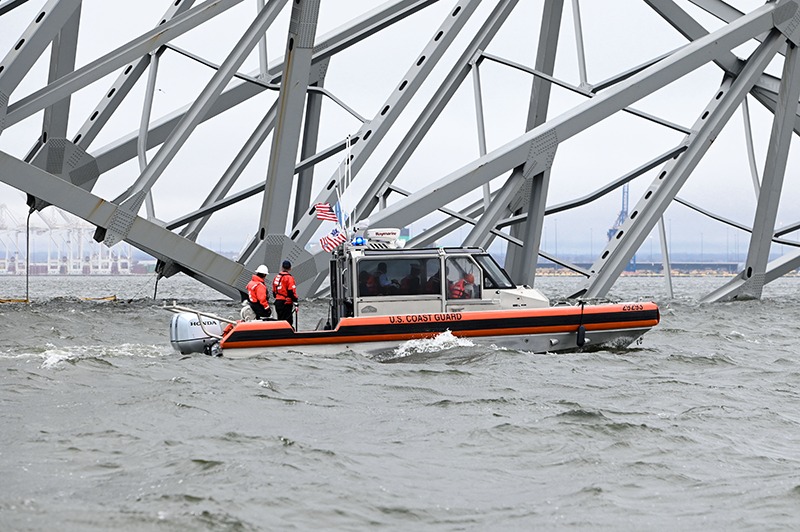
U.S. Coast Guard response boat crews enforce a safety zone, April 2, 2024, after the collapse of the Francis Scott Key Bridge in Baltimore, Maryland. 

By Erika Fitzpatrick, Contributor 

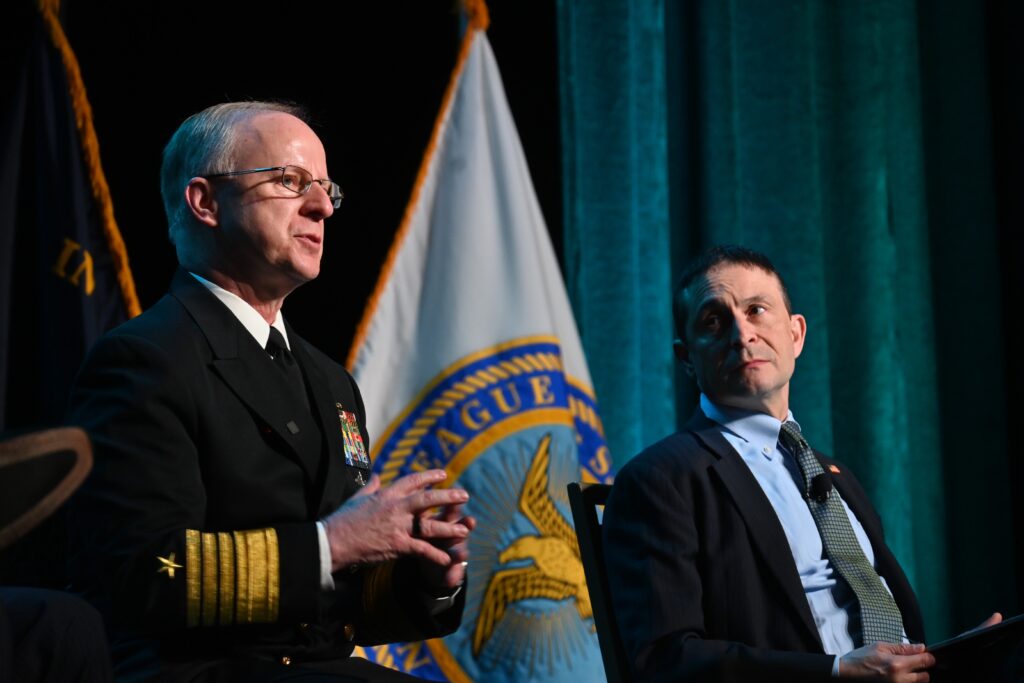
Future innovation within the U.S. Coast Guard comes from listening to and partnering with the defense industry, Vice Admiral Kevin E. Lunday, U.S. Coast Guard Commander of the Atlantic Area and Defense Force East, said April 8 at Sea-Air-Space 2024. 

“Most of the innovation, most of the great ideas — the kernel, the incubator for those — is within the defense industrial base,” he said. The Navy League’s symposium, which he called the premiere industry-government event, is a “special opportunity to have a conversation and a dialogue.”  

In addition to supporting U.S. Combatant Commands, Lunday directs Coast Guard forces and operations involving navigable waterways east of the Rocky Mountains to the East Coast, throughout the Atlantic Ocean, and in parts of the Arctic Ocean to the Arabian Gulf.  

As such, his command is involved in a range of often high-profile events and issues. 

For instance, when Baltimore’s Francis Scott Key bridge collapsed on March 26 within minutes of being rammed by a massive, malfunctioning container ship, Lunday directed forces there within hours for active search and rescue and follow-on recovery efforts. In cooperation with federal, state, and local partners, the USCG set up and now helps lead the Key Bridge Response Unified Command.  

“While that may seem like a very unusual operation in some respects — a bridge collapse after a ship hitting it — that kind of emergency response that the Coast Guard is involved in leading is very common for what we do across the Atlantic area, across the service, every day,” he said.  

Other Atlantic-area USCG operations include:  

  • Helping prevent and prepare for maritime mass migration incidents and fighting transnational crime in the eastern Caribbean through participation in the Joint Task Force-East.  

  • Controlling, reducing, and preventing deaths from irregular maritime migration, particularly in stemming the flow of migrants from the economically and politically stressed countries of Haiti and Cuba, through Homeland Security Task Force-Southeast.  

  • Looking into the circumstances involved in the June 2023 implosion of the Titan submersible, an ongoing review conducted by the Coast Guard Marine Board of Investigation.  

Lunday credited USCG’s successful involvement in these and other endeavors to long-term investments in incident command response and in technological systems that shed light on maritime migration patterns and provide other mission-critical information. 

Need to Think Differently  

Lunday said USCG is intently focused on readiness — how to carefully balance the readiness of the force with the demand for execution. 

However, he said, new solutions are needed, and the Coast Guard looks to private industry to provide many of them.  

Our leadership challenges us is to “think differently about how we conduct operations,” Lunday said, “because the increased demands for services and readiness challenges are forcing us to think differently.”  

For instance, the Coast Guard needs effective technologies with government and mission application. These include artificial intelligence and data tools to better analyze, understand, model, and predict patterns of human behavior. 

Because industry is thinking about where we need to be going, Lunday said, we should “open our mind and our ears and listen to what they’re saying about how we move forward.”  


CMS Breakfast: Pursuing Ways to Strengthen the Workforce, Boost Readiness

Government and industry need to work together to solve the problems of shipbuilding schedules, workforce retention and getting deployable technology into the hands of warfighters at scale, speakers said at the Center for Maritime Strategy breakfast on April 9. 

“Is it time to call for the Defense Production Act?” asked Admiral James Foggo, the dean of CMS and panel moderator, noting the number of shipyards have declined over the decades from 55 to just six today. 

“It’s about setting conditions,” said Nickolas Guertin, the Navy’s relatively new assistant secretary for research, development and acquisition, noting the industry saw the need to ramp up shipbuilding in the 1930s, providing critical capability when World War II began. “Setting conditions is part of what I can do.” 

Guertin said defense officials and industry need to stop thinking of themselves as carrier people or submarine people, “but as delivering game-changing capability across the tyranny of distance.” 

He said government and industry need to look at the workforce as national strategic assets and create environments where they want to stay in an industry adversely affected by COVID.  

“Their happiness at work is a primary task for industry … we are bleeding people on the waterfront and we need to turn that around,” he said. 

Admiral Daryl Caudle, commander of Fleet Forces Command, said it has become obvious to Chief of Naval Operations Admiral Lisa Franchetti that the Navy she has inherited “will not fundamentally change in size. It just will not. We have a responsibility to wring out every ounce of readiness we can.” 

The Navy needs to innovate on force generation, defining what combat surge readiness looks like, and coupling revolutionary technology like artificial intelligence and machine learning with actual problems they can help solve, “so we can actually apply [them] where those technologies need to land,” he said. 

It would also be helpful to give industry clear demand signals through clear requirements and multi-year procurements, Caudle said, and the service must turn concepts of operations into concepts of deployment. “How do I get this into the theater?” 

DIU Evolution 

That is one of the jobs of DIU, the Defense Innovation Unit directed by Doug Beck, recruited by the late secretary of defense Ash Carter, who Beck said was prescient about the direction industry was going and realized “we must leverage the incredible technology in our commercial tech sector,” Beck said. 

“What he saw was that in so many areas of technology — artificial intelligence, autonomy, biotech, space, cyber — those areas of technology are going faster in order to meet the relentless demands of billions of consumers around the world,” much faster than “they possibly could in our bespoke only” defense market. 

The nation is now at a tipping point, he said, where the president, secretary of defense, commercial tech sector and Congress all “get it” and need to move that technology to the field. DIU’s first iteration was building a bridge to the tech sector, version 2.0 was proving that commercial technology could help solve military problems and the latest version, call it DIU 3.0, is aimed applying technology “with strategic effect,” and doing so at scale. 

One such effort is Replicator, a Department of Defense effort to field thousands of attritable, autonomous, uncrewed systems to counter China’s growing naval capability. The initial effort is about creating the capability and then doing that “over and over again,” Beck said. “We are on track for both of those objectives.” 

He said he couldn’t talk about actual systems that are part of the effort, but said tranche 1 is “off to the races” and they are working on tranche 2, with a deadline of August 2025. 

Columbia Status 

Matthew Sermon, the executive director, PEO Strategic Submarines, addressed the Columbia-class submarine program, identified as being well behind schedule, according to a Navy shipbuilding review. 

“Columbia is becoming a ship,” with the lead ship is under construction, stable requirements and a mature design, he said. However, it has experienced “lead ship challenges,” which he said could be expected in the first ship designed entirely in a 3D model. 

“We’re not going to surrender that lead ship schedule,” he said, and the program is moving to match the production cadence required by the Navy. 

Speaking of innovative technology, he said additive manufacturing is entering the workforce, although it may not be as widely distributed as previously thought. 

“We have narrowed that down to six critical materials” and the related parts, he said. “We’re going to prove it out, we’re going to destructively test it … we’re going to get it right.” 


Future Challenges May Involve Rethinking How the U.S. Fights, Speakers Say

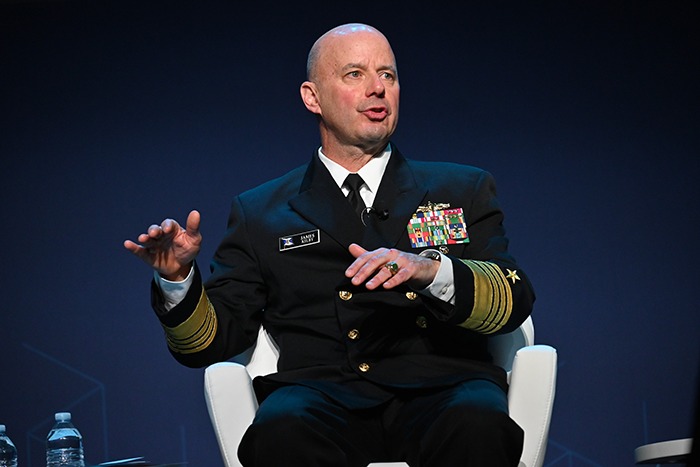
Amiral James Kilby, the Vice Chief of Naval Operations, speaks at the luncheon panel on Monday. 

The United States is facing a variety of challenges, from Houthi rebels in the Red Sea to the People’s Republic of China, but the preferred American way of fighting — massive overmatch — may not be tenable for the future, two panelists said during the luncheon event at the opening day of Sea-Air-Space. 

China is investing in its military faster than the U.S. is, and the new U.S. defense budget is a 1% increase in the top line, which amounts to a decrease with inflation, said retired Admiral James “Sandy” Winnefeld, chair of the President’s Intelligence Committee. 

“Even if we could build the ships that we wanted to build, we would have trouble maintaining them all,” he said. “And then manning is a challenge for us. So, it’s entirely possible that the means that we want to apply to this problem … are not going to be there.” 

What the nation may need to do is adopt a “whole of nation approach, not just a military-on-military approach, which involves diplomacy, economics, information, and of course the military,” he said. 

Vice Chief of Naval Operations Admiral James Kilby said one way forward is with disruptive technology, the sort being developed by the Disruptive Capabilities Office, the group set up last fall by Secretary of the Navy Carlos Del Toro to more quickly move technology to the field. 

He wouldn’t go into specifics of what the office is working on, but it’s intended to look at a broad swatch of technology and see what can be tested and moved rapidly to the warfighter. 

“The Disruptive Capabilities Office is meant to look across the whole DoD spectrum and understand what can be brought to bear quickly and to put that together in a test environment, test it, and have some confidence in it before we go after it,” he said. 

“… That is different behavior than how we’re used to doing it, and it’s basically capability focused,” he said. It builds on the work of Task Force 59, which deployed maritime unmanned systems, and is aimed at ways to “produce some capability now versus the perfect in future,” he said.