STRATCOM Commander Affirms Need for Sea-Launched Cruise Missile-Nuclear
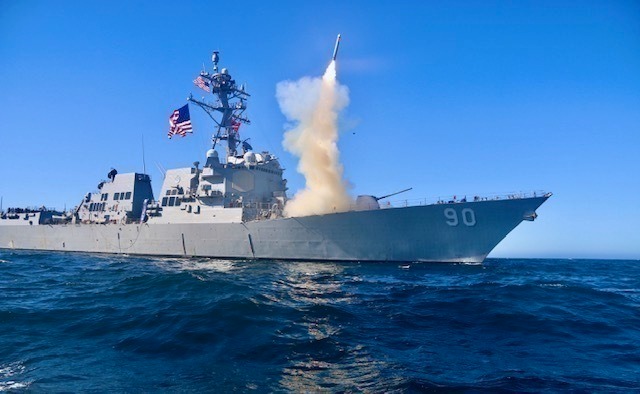
Caption: PACIFIC OCEAN (Nov. 30, 2020) The guided-missile destroyer USS Chafee (DDG 90) launches a Block V Tomahawk, the weapon’s newest variant, during a three-day missile exercise. The Navy is developing a nuclear-tipped sea-launched cruise missile as a future nuclear deterrent. (U.S. Navy photo by Ensign Sean Ianno)
By Richard R. Burgess, Senior Editor
ARLINGTON, Va.—The operational commander of the nation’s nuclear arsenal has reiterated to Congress the requirement for a sea-based nuclear-tipped cruise missile.
Testifying Feb. 29 before the Senate Armed Services Committee, Air force General Anthony J. Cotton, commander, U.S. Strategic Command called for development and deployment of the Sea-Launched Cruise Missile – Nuclear (SLCM-N), a program called for in the 2018 Nuclear Posture Review (NPR).
Cotton called for continued modernization of the U.S. nuclear deterrent forces, including the SLCM-N.
“While our legacy systems continue to hold potential adversaries at risk, it is absolutely critical we continue at speed with the modernization of our nuclear triad, including land-based ICBMs [intercontinental ballistic missiles], the B-21 [bomber], the B-52 [bomber], the Columbia-class submarine, the nuclear sea-launched cruise missile, and LRSO [Long-Range Stand-Off weapon],” Cotton said.
The 2018 NPR called for the United States to “pursue a nuclear-armed SLCM, leveraging existing technologies to help ensure its cost effectiveness. SLCM will provide a needed non-strategic regional presence, an assured response capability. It also will provide an arms-control-compliant response to Russia’s non-compliance with the Intermediate-range Nuclear Forces Treaty, its non-strategic nuclear arsenal, and its other destabilizing behaviors.”
The Biden administration, with support of Democratic representatives in the Congress, has opposed development of the SLCM-N, citing what they said was the cost of the program, the adequacy of the current nuclear deterrent arsenal, and a risk to nuclear stability.
Despite the administration’s opposition, Congress authorized $25 million in the 2023 National Defense Authorization Act for research for the SLCM-N. The administration did not request funding for research for the SLCM-N in its fiscal 2024 budget request, but Congress approved establishing the SLCM-N as a program of record.
The fiscal 2024 NDAA “authorized the Sea-Launched Cruise Missile – Nuclear, or SLCM-N, as part of the program of record with initial operating capability by 2034, said Jill Hruby, National Nuclear Security Administration administrator, speaking Feb. 1 at the 2024 Nuclear Deterrence Summit. “SLCM-N will provide a new low yield at sea nuclear deterrent. NNSA is working closely with the Navy and Office of Secretary of Defense to develop a recommendation for Congress by early March on the details of the SLCM-N program.”
The Navy used to field a nuclear-armed version of the Tomahawk Land-Attack Missile — the TLAN-N — which was retired about 2010.
Raven Warns of CR Impact on Navy Department Budget
By Richard R. Burgess, Senior Editor
ARLINGTON, Va. — The Department of the Navy (DON) is facing a reduction of $12 billion of buying power if the Defense Department has to operate through fiscal 2024 under a continuing resolution (CR) and Congress does not pass a supplemental budget, a top DON official said.
“The misalignment in funding lines results in $26 billion of funding misalignments that we may have in our coffers — but not be able to spend it on the programs that matter,” said Under Secretary of the Navy Erik Raven, speaking Feb. 28 to reporters. “When you add all this up, this is nearly a 10% impact to our topline. This is getting into the territory of the 2013 sequester in terms of fiscal impacts. So, this is a very serious situation.”
Raven said that if a full-year CR is the case, the DON’s priorities would be readiness first and people second. “[W]hat that means is taking risk and investment programs. And I’m very concerned about our ability not only to execute that strategy unless given really unprecedented flexibilities by Congress, but also the follow-on impacts on industrial base and our modernization plans.”
Regarding readiness, Raven said that current operations, such as the effort to defend commercial shipping in the Red Sea from Houthi rebels, would take precedence.
“We need to be able to perform our mission,” he said. “And simply if we don’t have the resources that we need to execute all of our missions, we have to make tough choices. But between the ability to fight tonight and be ready for all the threats versus preparing for the future and modernizing our forces it is a tough decision. But we have to lay our chips somewhere and that’s on the ability to perform our missions today.”
He listed a few programs that would be severely affected by a year-long CR and lack of a supplemental from Congress:
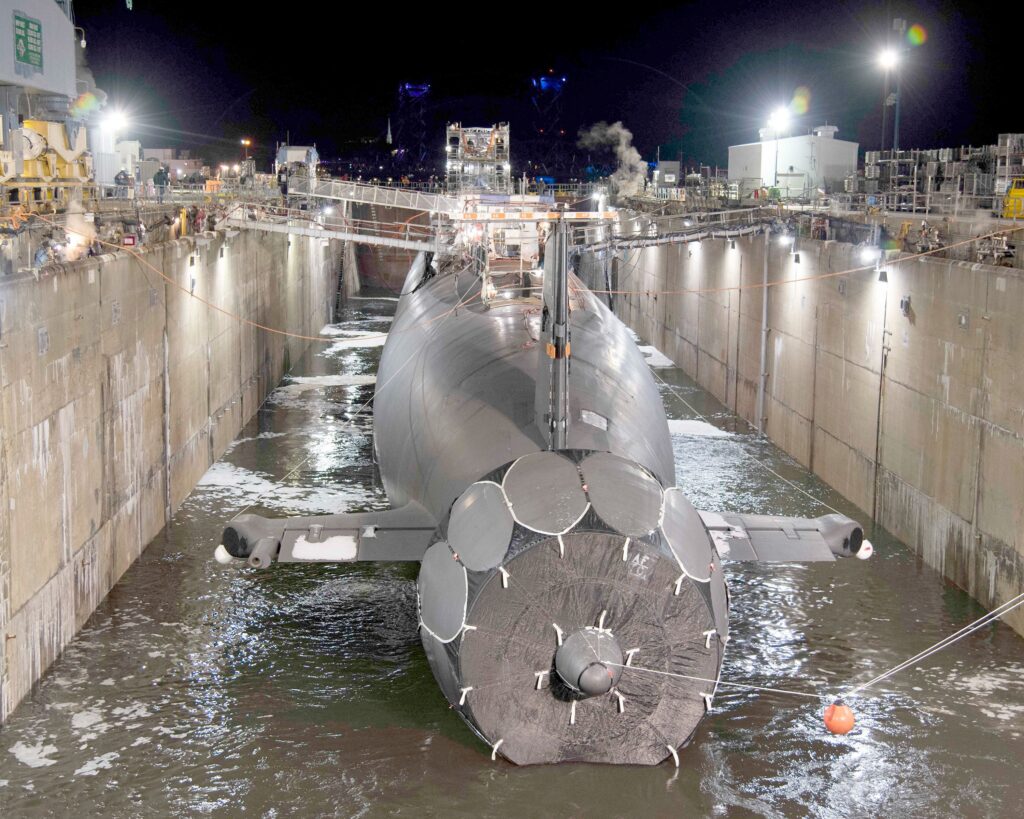
The overhaul of the attack submarine USS Boise, delayed for seven years and finally slated, would not be executed.
The amphibious assault ship construction program would not be kept on track.
The Virginia-class attack submarine program would face a $2 billion shortfall.
Munition funding would suffer “across the board.”
Construction of three child-development centers — two in Virginia and one in Guam — would be delayed.
Doubling of funds for SM-6 missiles — used in the Red Sea operations — would not be doable.
A $3.4 billion investment in the submarine industrial base — to enable production of submarines at a rate of one Columbia ballistic-missile submarine and two Virginia-class submarines — would have to be delayed.
SURFACE WARFARE: The Nucleus of American Naval Power
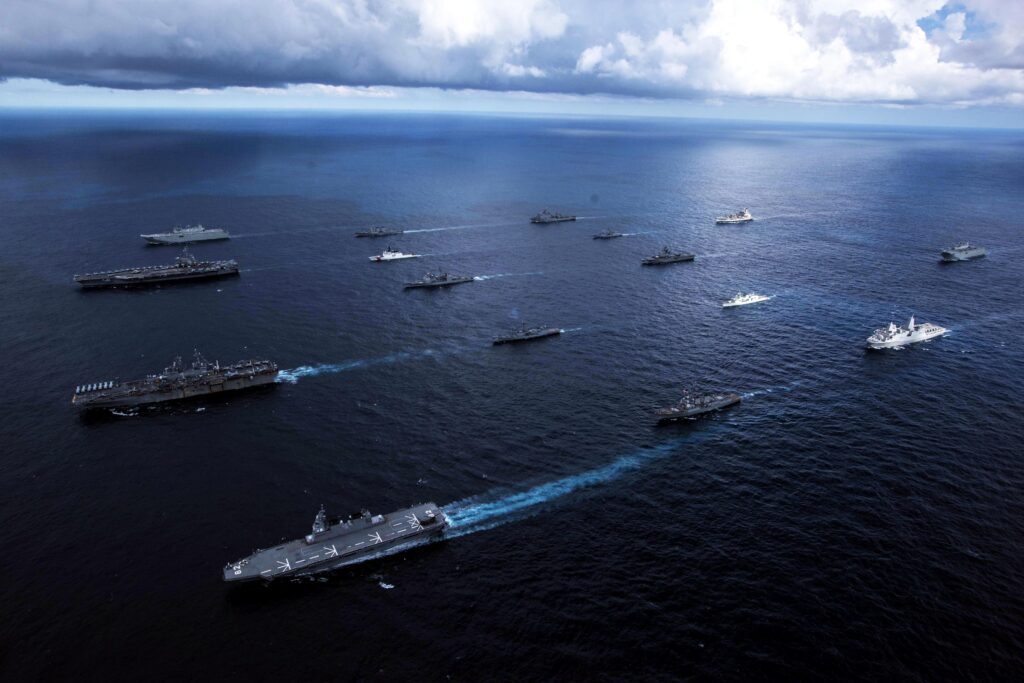
190711-N-PJ626-5159 CORAL SEA (July 11, 2019) U.S. Navy, U.S. Coast Guard, Australian Navy, Canadian Navy and Japan Maritime Self Defense Force ships sail together in formation during Talisman Sabre 2019 . Talisman Sabre 2019 illustrates the closeness of the Australian and U.S. alliance and the strength of the military-to-military relationship. This is the eighth iteration of this exercise. (U.S. Navy photo by Mass Communication Specialist 2nd Class Kaila V. Peters)
By Bryan McGrath
The U.S. Navy is too small for what is asked of it, and what is asked of it is insufficient to meet the nation’s needs. We have too few ships, submarines, aircraft, aircraft carriers, people, sensors, weapons and networks. China’s People’s Liberation Army Navy(PLAN) is growing faster than any navy has since the U.S. buildup to the Second World War, while the U.S. remains committed to efficient peacetime production levels that ignore the reality of this competition. Relative to the threats it faces, American naval power is weaker than at any time since the start of World War II. While the U.S. Navy remains the world’s most powerful seaborne combat force, not even the Soviet navy posed as dangerous a threat as China’s PLAN does today. The nature of that threat presents the prospect of a PLAN so powerful it could dominate the Western Pacific, destroying the legitimacy and effectiveness of America’s network of friends and allies by raising questions about America’s will and capability to support that network. The ability to dominate a region of the world responsible for 65% of global GDP represents a profound threat to U.S. national security and prosperity, and that of like-minded nations globally. A broad-based naval building program is required to meet China’s challenge and all elements of the modern, balanced fleet should expand. This essay focuses on the surface force, comprised of large surface combatants, small surface combatants and amphibious ships. For the purposes of this essay, critical surface platforms are excluded, but they are no less critical as a result. These include logistics ships, special mission ships, ocean-going tugs, sealift ships, tenders and the like. The surface force cannot operate without these other ships, and their importance to a coherent fleet design should not be discerned by their exclusion in this essay.
Navy Mission
The Navy shall be organized, trained and equipped for the peacetime promotion of the national security interests and prosperity of the United States and for prompt and sustained combat incident to operations at sea. It is responsible for the preparation of naval forces necessary for the duties described in the preceding sentence except as otherwise assigned and, in accordance with integrated joint mobilization plans, for the expansion of the peacetime components of the Navy to meet the needs of war. (10 USC Sec. 8062).
Members of the Navy League and readers of Seapower can be forgiven if this mission statement looks unfamiliar, as it has appeared in this form only since the passage of the 2023 National Defense Authorization Act (NDAA) in December 2022. Prior to this, Title 10 did not mention peacetime security interests or the promotion of American prosperity, functions the Navy has conducted since the earliest days of the republic. This disconnect between the Navy’s legal mission and what was routinely demanded of it was stark, and the sole focus on “… prompt and sustained combat incident to operations at sea” led to bureaucratic maneuvering inside the Pentagon by other services and the Office of the Secretary of Defense when Navy officials sought a fleet large enough to carry out both its wartime and peacetime roles. The answer to the additional capacity necessary for operations other than war often was reduced to “that is not your mission.” No more.
Congress is constitutionally obligated to “provide and maintain a Navy” (Art I Sec. 8) and the Navy is legally obligated to protect and promote the nation’s security and prosperity in peace and be prepared to fight and win in war. No element of the modern fleet is as central to these missions as the surface force, and that force must be properly resourced for the things that are asked of it.
Tasks of the Surface Force
The tasks of the surface force are the tasks of the Navy, and while the following list is not doctrine, it represents a solid foundation for discussion. Conventional deterrence.
To deter aggression against American interests, the U.S. Navy must be able to control the seas and skies where it operates and project power from there. It must also be capable of denying control of the sea to others. A controlled sea is an unnatural condition; the seas are, and ought to be, free. Imposing and maintaining sea control is a function of conflict, and the ability to control the sea in order to project power is the Navy’s primary contribution to conventional deterrence. Lethal, networked, sustainable and forward-deployed surface ships are the linchpin of the nation’s forward-based efforts to promote security and prosperity, and they represent the vanguard of seapower that would turn immediately to Joint wartime operations should deterrence fail. One benefit of a strong deterrence posture is the assurance provided to allies and like-minded friends that the United States is a trusted local partner. Strategic (or nuclear) deterrence is a foundational task of the Navy, but it is the domain of the submarine force.
Crisis response
Crises occur where our interests lie, and those crises are both man-made and natural. Capable, flexible, available surface forces represent the humanity of the American people when disaster strikes or aggression flares. The forces we design and build for the delivery of violence are also forces of charity and relief, and they move from one role to the other without modification.
Naval diplomacy. This historic and critical task includes building partner capacity, assuring allies and friends, asserting U.S. rights and interests (including freedom of navigation), and exercising U.S. authority.
Warfighting. The Navy acts as the predominant maritime portion of the joint force in the waging and winning of war. It exercises sea control and sea denial to project power or to confound adversary power projection.
War termination. The Navy must prevent war, wage war and end war. The termination of war is a pursuit — especially at sea — that differs sufficiently from war-waging as to merit its own task, and it levies different demands upon the fleet architecture. Platforms and capabilities with less value in deterring or waging war can be of significant value in the termination of war. How war is brought to conclusion cannot be an afterthought.
Note that “naval presence” or “forward presence” is not included in this list. This is because forward presence is not a mission, it is a posture, a habit of operating. It unfortunately entered the pantheon of Navy missions in the mid-1970s in a famous essay by then Naval War College President Vice Adm. Stansfield Turner, and Navy leaders have tied themselves in knots ever since attempting to explain why “being there” is a mission, as if being there were an end unto itself. If the Navy could perform its Title 10 mission and associated tasks by surging from home ports when the nation’s interests were threatened, it should be made to do so. If the Navy could perform its Title 10 mission and associated tasks as a coastal and territorial waters defense force (or coast guard) when the nation’s interests were threatened, it should be made to do so. If the Navy could perform its Title 10 mission and associated tasks by occasionally sending forth cruising squadrons to “show the flag” when the nation’s interests were threatened, it should be made to do so. All of these operating postures offer the possibility of a smaller and more economical Navy due to vastly different (from today’s) fleet architectures. None of these alternative postures offer the prospect of mission accomplishment, and that is why forward presence is the preferred posture for the U.S. Navy.
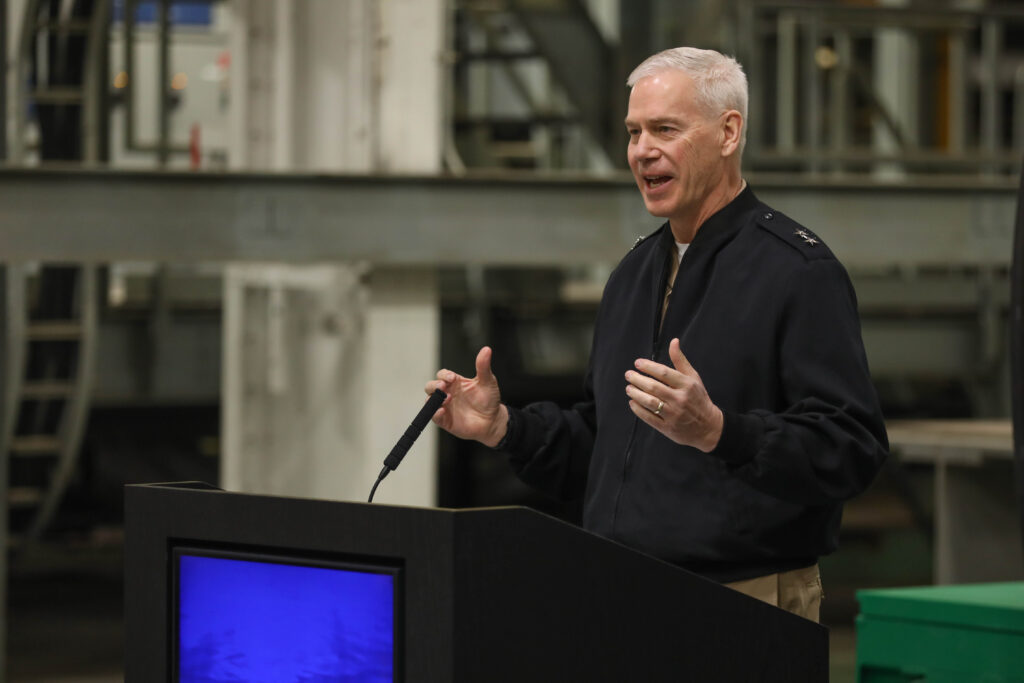
Director, Surface Warfare Division (N96) Office of the Chief of Naval Operations Rear Adm. Fred Pyle speaks on the significance of the new Next Generation Guided-Missile Destroyer (DD Test Site (LBTS) during a ribbon cutting ceremony in Philadelphia on March 21, 2023.
Vulnerability of the Surface Force
Surface ships are vulnerable to a variety of enemy threats, including missiles, mines, and torpedoes. Adversary targeting methods and competence have improved, and it grows increasingly harder to “hide” surface ships — especially large surface ships — at sea. It is true that China’s vast buildup increases the vulnerability of the surface force in the Western Pacific, but this is an incomplete understanding of the dynamic.
First, everything on the modern battlefield has become more vulnerable. This does not mean those things are no longer valued. The war in Ukraine has demonstrated both the vulnerability and the value of heavy armor, and the same would be expected to apply to the surface force in the event of its wartime employment. How the fleet is operated influences its vulnerability, and the sea remains a difficult environment for precision targeting, especially against a competent Navy.
Second, vulnerability is a feature of conflict, after the shooting starts. Yet the Navy spends the overwhelming portion of its time not being shot at while it pursues the other functions and tasks derived from its Title 10 mission. The fleet must be capable enough to win in combat and large enough to conduct its global peacetime tasks. There is a tradeoff between the exquisite capabilities needed for the former and the mass/capacity of necessary for the former and the latter. Both must be resourced. Next, for the United States to conduct its mission of conventional deterrence, it must have powerful, lethal, networked surface forces forward — again, not for the sake of being forward, but to demonstrate both the will and capability to deter. What in wartime contributes to vulnerability is, in peacetime, a vital contributor to deterrence: known, visible power on the horizon. There is no substitute for the certainty of response this force provides to the conventional deterrence posture. A serious threat to the surface force comes not from the Chinese navy but from American political leadership. Insufficient demand for ships caused the shipbuilding industry to shrink to the point where it is challenged to provide the peacetime needs of the Navy when the country needs to produce at a war footing. There is an “if you build it, they will come” aspect to growing the shipbuilding industrial base, and the first step is for political leadership to agree to a substantial naval buildup, one that workers with options can depend on, and that attracts new workers to critical trades. Pointing at the industrial base as the reason we cannot expand our Navy confuses cause and effect.
Needs of the Surface Force It must grow. As indicated in the previous paragraph, the surface force must grow. The Navy’s 30-year shipbuilding plan should commit to three large surface combatants a year, four small surface combatants a year, and a building rate sufficient to meet and maintain a fleet of 38 amphibious ships. The Navy and Marine Corps should continue to develop the landing ship medium class, but not at the expense of 38 large, capable amphibious ships.
It must be more lethal. There is no excuse for any ship of the surface force to be without offensive missiles capable of targeting other ships, targets ashore, or both. Whether through bolt-on expeditionary launchers or installed and integrated systems, amphibious ships and all littoral combat ships retained in service must become more lethal. By creating additional operational dilemmas for the adversary, each individual ship becomes less vulnerable. Those launchers (and the launchers already fielded) must be filled with increasingly more capable missiles, and more of those missiles must be acquired. Expeditionary reloading of any launching system we field cannot no longer be delayed. It must be more capable. The operational dilemmas posed by a more lethal surface force are increased when that surface force can employ its weapons at their maximum range. To do so, the surface force must have a capable organic intelligence, surveillance, and reconnaissance platform to replace its aging helicopter fleet, one that can find and fix targets hundreds of miles from the ship from which it launched. Finally, we must build on the legacy of excellence in the Aegis Weapon System by moving to the Navy’s Integrated Combat System, or ICS, an approach to command and control that ties individual ships together in a fighting network that provides in-stream battle management, weapons pairing and allocation and response options across the ensemble. It must evolve. We cannot build Arleigh Burke-class destroyers forever and continuing to avoid moving to the next-generation destroyer (DDG(X)) will preclude fielding of advanced weapons the fleet needs today. The Navy must propose, and the Congress ratify, a plan to move from building three Flight III DDG’s a year to three DDG(X)’s a year in the next decade. We must move faster in supplementing the current fleet with unmanned platforms that extend sensor coverage and magazine depth. And we must field a class of single-mission patrol boats built in numbers to employ surface-to-surface missiles in archipelagic seas. We can no longer aim for efficient peacetime production as the standard for acquisition; we must prepare for conflict and accept that there may be inefficiency involved.
Conclusion
This essay is timed for publication coincident to the January 2024 gathering of the Surface Navy Association in Arlington, Virginia, and is designed to encourage conversation and debate there and elsewhere. To this point, there is no evidence the alteration to the Title 10 mission of the Navy has had any impact on Department of Defense resource allocation, at least as can be discerned from the fiscal year 2024 DoD budget submission. It is for those interested in seapower — readers of this journal and members of the Navy League — to demand that our elected officials hold DoD and Navy officials accountable for fully implementing the Navy mission and resourcing accordingly. A strong, capable surface force is central to that mission, and there is considerable work to be done in achieving it.
Bryan McGrath is the Managing Director of The FerryBridge Group LLC defense consultancy. The views expressed in this essay are his.
Houthi Explosive USV Detonated in Red Sea Attack
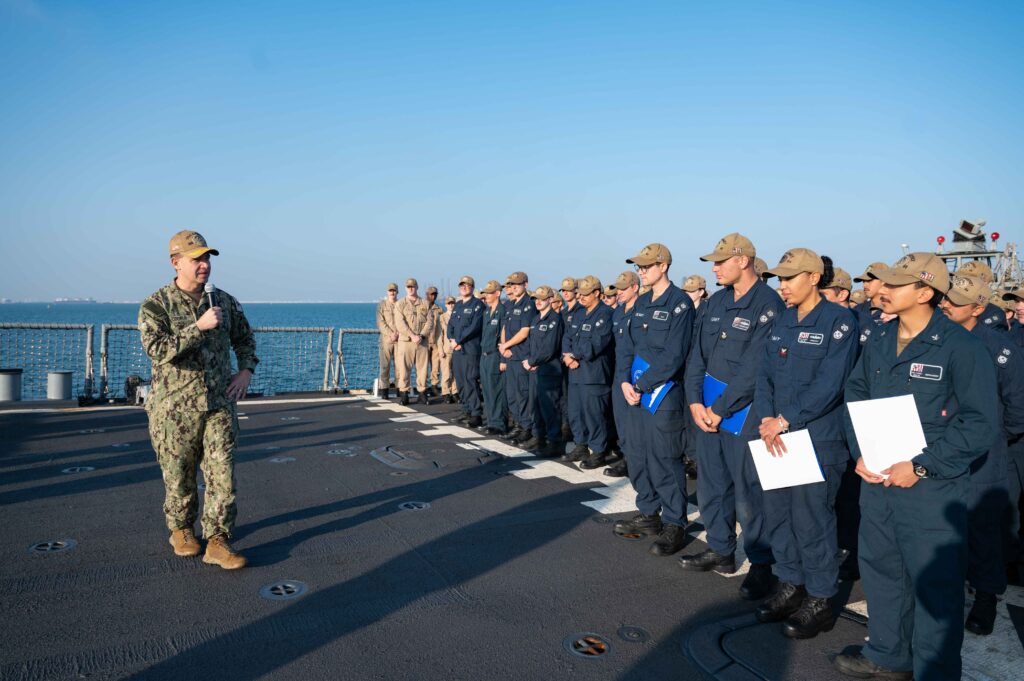
BAHRAIN (Jan. 2, 2024) Vice Adm. Brad Cooper, commander of U.S. 5th Fleet, speaks with Sailors aboard the Arleigh Burke-class guided-missile destroyer USS Carney (DDG 64) after presenting combat medals to Sailors while the ship is in Bahrain, Jan. 2, 2024. Cooper also recognized the whole Carney crew with the Combat Action Ribbon. On Dec. 16, Carney Sailors shot down 14 Houthi unmanned aerial vehicles in the Red Sea. (U.S. Navy photo by Mass Communication Specialist 2nd Class Jacob Vernier)
By Richard R. Burgess, Senior Editor
ARLINGTON, Va.—An uncrewed surface vessel (USV) was detonated in the international shipping lanes Jan. 4 in the latest attack launched from Yemen by Houthi rebels.
“Fortunately, there were no casualties, and no ships were hit, but the introduction of a one-way attack USV is of concern,” said U.S. Navy Vice Admiral Brad Cooper, commander, U.S. Fifth Fleet and commander, U.S. Naval Forces Central Command, and commander, Combined Maritime Forces, speaking to reporters in a June 4 teleconference.
The attack was the 25th against merchant ships in the Red Sea since mid-November.
In response to the attacks, Secretary of Defense Lloyd J. Austin III on Dec. 18 launched Operation Prosperity Guardian, a multinational effort to protect shipping through the Red Sea and Bab-el-Mandeb Strait. The Combined Maritime Forces under Commander, Task Force 153, are conducting the operation.
Cooper said that the coalition forces had shot down 11 drones, two cruise missiles, and two antiship ballistic missiles launched from Yemen since the operation began. In addition, three of four Houthi attack boats, which fired on U.S. Navy helicopters, were then destroyed by U.S. Navy MH-60 helicopters from the Arleigh Burke-class guided-missile destroyer USS Gravely and the aircraft carrier USS Dwight D. Eisenhower.
Cooper said a total of 61 drones and missiles had been shot down by U.S. Navy destroyers and F/A-18 Super Hornet strike fighters over the last two months. Other drones and missiles have been shot down by ships of the Royal Navy and French Navy.
Cooper made three key points in the conference:
“By number one, the number of nations participating has grown. Their contributions are meaningful, and our partners are doing great work at sea. Number two, about 1,500 merchant ships have safely transited the waters of the Red Sea since the operation began. And then number three, our collaboration with the maritime shipping industry has increased dramatically. We’re reassuring them through persistent communications that are characterized as two-way, both before and during transits, so that’s going well.
“Now, having said this, the Houthi ruthless attacks have continued, as you know, and there are no signs their irresponsible behavior is abating,” he said.
Coast Guard Upgrades Two Detachments to Full Bases
By Richard R. Burgess, Senior Editor
ARLINGTON, Va. — The Coast Guard has upgraded two of its land-based detachments stations to full bases, according to two Coast Guard directives.
The Coast Guard’s Operational Logistics Command formally established Base St. Louis, Missouri, in ceremonies held Nov. 30, with Lieutenant Commander John Waters in command, and established Base Borinquen, Puerto Rico, on Dec. 12, with Lieutenant Commander Thomas Kai in command.
The directives noted that each base “provides a new junior command opportunity for the mission support enterprise.”
Base St. Louis will provice support to Coast Guard operations in the Western Rivers and heartland of the United States. Base Borinquen will provide support to Coast Guard operations in the Caribbean Sea and Atlantic Ocean.
Stand-off Offensive Sea Mine Capability Needed, Former Vice Chairman Said
*****
By Richard R. Burgess, Senior Editor
WASHINGTON — The United States needs a more capable and expanded offensive sea mine capability in order to deter China and defend Taiwan, said a retired former admiral who served as vice chairman of the Joint Chiefs of Staff.
“Mine warfare is going to be very important in a future conflict, especially if we can do it quickly after the start of the fight,” said retired Adm. James A. Winnefeld Jr., a former naval aviator, speaking Dec. 7 on a panel at the Defense Forum Washington of the U.S. Naval Institute and sponsored by Lockheed Martin and HII.
“Mine warfare has a key role to play — if you think of the Chinese military as a center of gravity — but also has a key role to play if you think of the Chinese leadership as a center of gravity — by shutting down all of their ports fairly quickly,” Winnefeld said. “You can do that to counter a military … but also in legal terms understand that commerce can be a collateral damage associated with that.
“Frankly, we’re just not there,” the admiral said. “We are terribly short in numbers and technology of those systems. “There are some actions we can take—very quickly—at least partially rectify that. There are some technical actions we can take in the mid-term that would make it even better, but unless we focus on that, we will not be where we need to be.
Winnefeld pointed out that there is no community of offensive mine warfare officers in the Navy, and no champion of offensive mine warfare among flag officers, and he attributed that shortcoming as a reason for a lack of program support for offensive mine warfare. He noted that mine warfare and counter-mine warfare are “dramatically different from each other, and we need to have that community of offensive mine warfare.”
He referred to the occasions when U.S. ships were sunk or damaged by enemy mines in various conflicts and that the United States aircraft and submarines used offensive mining with great success against Japanese shipping and ports during World War II.
The principal U.S. mine is the Quickstrike, a conventional 500- or 1,000-pound bomb with a fuse and a Joint Direct Attack munition kit for precision guidance. It can be fitted with a wing kit that allows deployment at a standoff range of about 35 miles away from the aimpoint.
Because only a few aircraft types can deliver those mines close to China and survive the mission, Winnefeld recommends a small propulsion engine such as a rocket motor be attached to the mines to allow the mines to be launched from a longer distance and in larger quantities.
“You could shut down every single Chinese port almost overnight if you did that,” Winnefeld said. “That’s powerful. That will strike fear into their hearts.”
Speaking later in the forum was Rep. Rob Wittman, R-Virginia, who said that offensive mine warfare “was a great capability that we have undersold through the years. If you look at our adversaries, they have very advanced mining technology.”
Wittman pointed out that mines are inexpensive and can be deployed with latency and activated when desired. They can be replenished relatively quickly. When combined with a more robust sensor networks, “we can have a tremendous deterrent effect at a very low cost per weapon.”
Coast Guard to SLEP, Expand MH-60T Helicopter Fleet as Sikorsky Delivers First New Airframe
Sikorsky delivered the first of 45 new airframes to the Coast Guard for the service-life extension of the service’s MH-60T helicopter fleet.
*****
By Richard R. Burgess, Senior Editor
ARLINGTON, Va.—The U.S. Coast Guard has confirmed plans to expand is MH-60T Jayhawk helicopter fleet and make it the standard service-wide helicopter. The service life-extension of the current MH-60T fleet is being highlighted as Sikorsky, a Lockheed Martin company, delivers the first of 45 replacement MH-60T airframes to the Coast Guard.
Sikorsky on Nov. 30, 2023, delivered the first new “hull,” as the airframe is called, which consists of the nose, cabin, and aft transition structure, combined as a single assembly, Sikorsky said in a release. Upon delivery, the new hull will be used to rebuild an older MH-60T with new and updated components by the Coast Guard’s Aviation Logistics Center (ALC) in Elizabeth City, North Carolina starting in December 2023.
The Coast Guard’s MH-60T fleet, the first of which originally began service as an HH-60J in 1990, is approaching the end of its service life of 20,000 hours per aircraft, with a current average of 16,000 flight hours per aircraft.
During the SLEP of 45 MH-60Ts, “the Coast Guard ALC will remove all dynamic (moving) components, digital cockpit, mission systems, and engines, then rebuild each aircraft around an all-new airframe,” Sikorsky said, noting that the company’s Troy, Alabama, facility is the site of the hull manufacture.
Sikorsky President Paul Lemmo told reporters at a Nov. 30 teleconference that the new hulls would be identical to those in the HH-60Js delivered between 1990 and 1996, but also would receive an anti-corrosion sealant in the joints.
The Coast Guard awarded Sikorsky a $374 million contract to deliver all 45 MH-60T airframes to the ALC at a rate of 12 per year through 2027. Full-rate production will begin with fabrication of the fourth hull. The MH-60Ts going through SLEP will retain their Coast Guard serial numbers.
Rear Adm. Michael Campbell, Coast Guard director of Acquisition Programs and program executive officer, also speaking at the teleconference, said that the Jayhawk fleet went through an earlier SLEP during which the airframe life was extended from 10,000 to 20,000 flight hours. He said that without the SLEP the MH-60T fleet would have to be grounded by 2028. With the current SLEP, the MH-60T fleet would serve into the late 2040s.
The first MH-60T with the new hull is expected to fly in June at the ALC.
The Jayhawks are put through overhaul every four years, with six in overhaul at any given time.
The Coast Guard currently operates 48 MH-60Ts, three of which will not receive the new hulls under this program because they were re-built with ex-U.S. Navy SH-60F or HH-60H helicopters. Some of the 45 Jayhawks receiving the new hulls also are ex-U.S. Navy H-60s that were re-built as Jayhawks.
According to the Coast Guard, the H-60 Jayhawk medium range recovery helicopter fleet has saved more than 11,900 lives during more than 48,300 search and rescue missions since 1990, accumulating more than 730,430 flight hours,” Sikorsky said in the release.
Campbell said the Coast Guard plans to increase the size of its Jayhawk fleet because of the capabilities of its national security cutters and forthcoming offshore patrol cutters and polar security cutters to hangar H-60 helicopters. The rotors and tail rotor boom of the MH-60T can be manually folded, but the rotors of the Navy H-60s have the capability to be electrically folded. The Coast Guard plans to install the electrical fold capability beginning in 2024.
The Coast Guard also plans to replace its fleet of 98 MH-65 Dolphin helicopters with MH-60Ts.
“The Coast Guard is moving forward with plans to transition the service’s rotary wing fleet to a standardized, single-platform fleet of MH-60Ts,” said Loretta Haring, Office of Strategic Planning and Communication (CG-925) Acquisition Directorate, in an email to reporters. “The Service plans to operate 127 airframes nationwide and intends to source the additional MH-60T hulls (termed “fleet growth”) through a combination of both newly manufactured hulls and Navy conversion hulls. The number of each to be used has not yet been determined. The initial phase of fleet growth likely will be 36 hulls.”
Navy’s Second Ford CVN to Join the U.S. Pacific Fleet
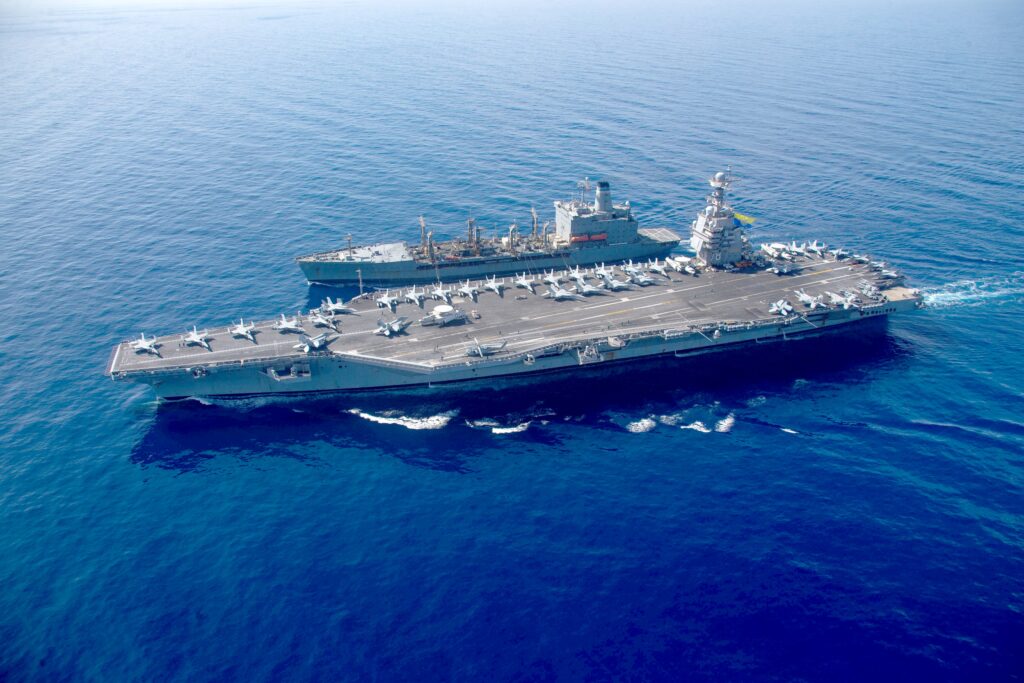
MEDITERRANEAN SEA (Oct. 11, 2023) The world’s largest aircraft carrier USS Gerald R. Ford (CVN 78) refuels from the underway replenishment oiler USNS Laramie (T-AO 203) in the eastern Mediterranean Sea, Oct. 11, 2023. The second Ford-class CVN, the future USS John F. Kennedy (CVN 79), will become a unit of the U.S. Pacific Fleet. (U.S. Navy photo by Mass Communication Specialist 2nd Class Jacob Mattingly)
By Richard R. Burgess, Senior Editor
ARLINGTON, Va. — The Navy’s second Gerald R. Ford-class aircraft carrier, the future USS John F. Kennedy (CVN 79), will become a unit of the U.S. Pacific Fleet when it makes its first deployment.
Captain Brian Metcalf, the Navy’s program manager for the Ford-class aircraft carriers, speaking Nov. 28 in a panel of the American Society of Naval Engineers’ Technology Systems and Ships seminar, said the Kennedy would be delivered to the Navy in 2025. After commissioning and training work ups, the carrier would make a deployment to the Indo-Pacific region and arrive at its new homeport on the U.S. West Coast, he said.
Metcalf said the Kennedy is 90% complete at HII’s Newport News shipyard.
He said that his program office plans to complete much of the Kennedy’s Post-Shakedown Availability (PSA) work — that on the USS Gerald R. Ford (CVN 78) was completed during its own PSA and added a year of delay to delivery to the fleet — would be completed on the Kennedy during its construction before commissioning and would enable the Kennedy to enter its basic training phase on time.
The lead ship, Gerald R. Ford, is deployed to the eastern Mediterranean Sea and has had its deployment extended twice because of the Israel-Hamas War. Metcalf said the Ford’s systems, including the Electro-Magnetic Aircraft Launch System and the ship’s once-controversial weapon elevators were performing well.
He said that maintenance and modernization work on the Ford planned for early 2024 would have to wait, given the Ford’s deployment extensions.
The next two Ford-class CVNs—Enterprise (CVN 80) and Doris Miller (CVN 81)—did not start as a two-ship procurement but since have been combined as a program to achieve cost reductions. Metcalf said that his program office is working within the current Future Years Defense Plan to ensure that procurement of CVN 82 and CVN 83 is a two-ship procurement.
P-8 Mishap in Hawaii Is Possible First Loss in Aircraft’s Career
By Richard R. Burgess, Senior Editor
*****
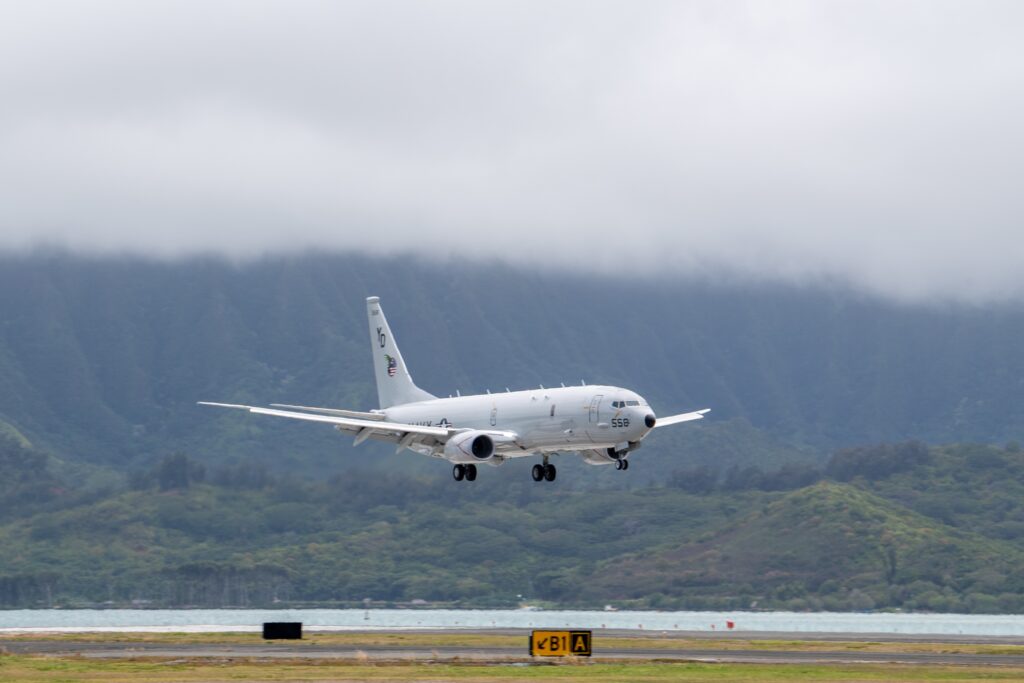
ARLINGTON, Va. — A U.S. Navy P-8A Poseidon maritime patrol aircraft ran off a runway at Marine Corps Air Station Kaneohe Bay, Hawaii on Nov. 20, likely resulting in the first loss of one of the aircraft in the 10 years since it achieved initial operational capability.
“At approximately 2 p.m. local (Hawaii), a U.S. Navy P-8 Poseidon overshot the runway on landing at Marine Corps Air Station, Kaneohe Bay, and ended up in nearby water,” the U.S. Third Fleet public affairs office said in a Nov. 20 release. “All personnel safely evacuated the aircraft. First responders and emergency crews acted immediately to conduct an initial assessment and employed a temporary floating barrier, which is used to protect the environment.”
The P-8A, shown in news photographs sitting partially submerged in the surf of Kaneohe Bay — is assigned to Patrol Squadron Four (VP-4), based at Naval Air Station Whidbey Island, Washington. No P-8s are permanently based at Kaneohe Bay but frequently rotate in for exercises and for detachments in support of homeland defense.
The P-8 equips 12 U.S. fleet and two reserve patrol squadrons. The Poseidon made its first operational deployment nearly a decade ago, in December 2013, with VP-16. Until now, none have been destroyed in mishaps. The Navy has not yet made a determination if the P-8A in Kaneohe Bay suffered strike damage.
“An investigation will be initiated,” the 3rd Fleet release said. “More details will be released as they become available.”
USS Thomas Hudner Shoots Down Drone from Yemen
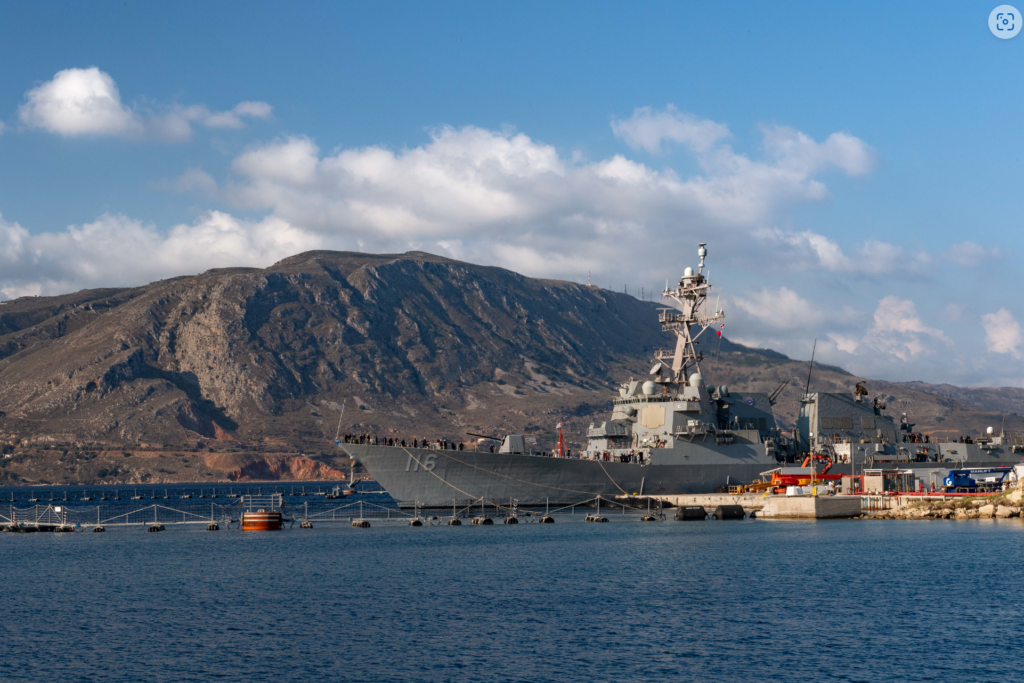
NAVAL SUPPORT ACTIVITY SOUDA BAY, Greece (Oct. 2, 2023) The Arleigh Burke-class guided-missile destroyer USS Thomas Hudner (DDG 116) moors at the NATO Marathi Pier Complex as part of a scheduled visit to receive fuel and logistical support from Sailors and personnel assigned to Naval Support Activity (NSA) Souda Bay. NSA Souda Bay is an operational ashore installation which enables and supports U.S., Allied, Coalition, and Partner nation forces to preserve security and stability in the European, African, and Central Command areas of responsibility. (U.S. Navy photo by Nicholas S. Tenorio)
By Richard R. Burgess, Senior Editor
*****
ARLINGTON, Va. — A. U.S. Navy guided-missile destroyer (DDG) shot down a drone over the Red Sea, the Department of Defense said in a Nov. 15 release.
The release, relayed by Cmdr. Rick Chernitzer, force public affairs officer for U.S. Naval Forces Central Command, reads as follows:
“On November 15th and while transiting the international waters of the Red Sea, the crew of the USS Thomas Hudner (DDG 116) engaged a drone that originated from Yemen and was heading in the direction of the ship. The Hudner’s crew engaged and shot down the drone to ensure the safety of U.S. personnel. There were no U.S. casualties or any damage to the ship.”
The engagement is the second in the Red Sea is the second within the last month in which cruise missiles or drones have been shot down by U.S. Navy Arleigh Burke-class DDGs. On Oct. 19, the USS Carney (DDG 64) engaged and shot down four land-attack cruise missiles and approximately 15 drones launched by Houthi forces over the Red Sea in Yemen.
The Houthi missiles launched on Oct. 19 apparently were headed in the direction of Israel or the Carney. Israel has been engaged in combat with Hamas terrorists since Oct. 7. The Iran-backed Houthis have a history of using drones and missiles against Saudi petroleum infrastructure and U.S. Navy and other ships in the Arabian Sea.