Coast Guard to Lay Up Some Cutters, Boats in Face of Recruit Shortfall
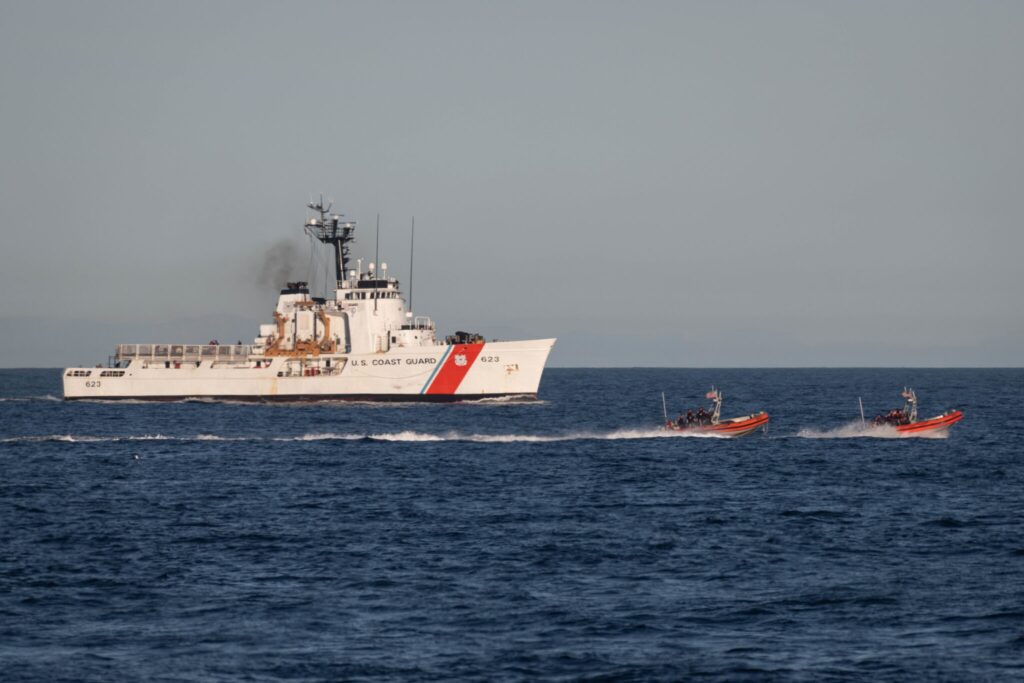
The Reliance-class medium-endurance cutter Reliance, shown here in 2022, will be decommissioned and three sister cutters will be laid up, pending decommissioning. U.S. Coast Guard 

By Richard R. Burgess, Senior Editor 

***** 

ARINGTON, Va.—The U.S. Coast Guard will lay up several cutters and patrol boats because of a service-wide manning shortage, moves that will reduce the Coast Guard’s capacity for operations in the near term as the service grapples with the shortage of personnel. 

The Coast Guard is short of some 3,000 personnel because in large part of shortfalls in recruiting in fiscal 2024. 

“The Coast Guard is short nearly 10% of the entire enlisted workforce and cannot continue to operate as we have historically with fewer people,” wrote AJ Pulkkinen in the October 31 announcement posted on the Coast Guard website. “To mitigate the workforce challenge risk in a deliberative and strategic fashion, the Vice Commandant, Adm. Steven Poulin, has provided specific temporary operational guidance to adapt our operations while prioritizing lifesaving missions, national security and protection of the marine transportation system.”  

“The Coast Guard cannot maintain the same level of operations with our current shortfall – we cannot do the same with less. Conducting our missions is often inherently dangerous, and doing so without enough crew puts our members and the American public at increased risk,” wrote Commandant Adm. Linda Fagan and Master Chief Petty Officer of the Coast Guard Heath Jones.  

“There will be no loss of search and rescue (SAR) capabilities,” the announcement said. “However, we will temporarily adjust operations to prioritize our lifesaving missions, national security, and protection of the Marine transportation System. “ 

“As cutter crews are not scalable, the only way to reduce the workforce of the cutter fleet is to reduce the number of operating cutters,” the announcement said. “Previously planned cutter decommissionings will continue, including the [Reliance-class] Coast Guard Cutter Steadfast [WMEC 623]. Some cutters will be placed in a special status awaiting either decommissioning or future reactivation. In some cases, the crews will do a hull swap to lay up the cutter with the largest pending maintenance requirement.  

The cutters and patrol boats affected include: 

  • Three 210-foot Reliance-class medium-endurance cutters (WMECs) will be placed in layup, pending decommissioning. 
  • Seven 87-foot Marine Protector-class patrol boats (WPBs) will be placed in layup, pending reactivation. 
  • Five 65-foot harbor tugs (WYTLs) will temporarily not be continuously manned but will be kept in a ready status in case icebreaking is needed.  

  • Two 154-foot Sentinel-class fast response cutters (WPCs) will commence uncrewed Recurring Depot Availability Program (RDAP) at the Coast Guard Yard in Baltimore, Maryland. The next 154-foot WPC scheduled for RDAP will deliver the hull to the Coast Guard Yard and swap hulls with a cutter that has completed drydock.  

The cutbacks will affect 44 shore stations and 36 aids-to-navigation teams (ANTs) as well, which have more personnel than the prescribed staffing standards.  

“The stations will be reduced to their staffing standards and the ANTs to one billet below their staffing standards,” the announcement said.  

Other shoreside changes include, but are not limited to:  

  • Crews at all 23 seasonal station smalls will transfer to their parent command. 
  • The six non-response units (boat forces units without SAR responsibilities) will suspend operations and their crews will be reassigned in assignment year (AY) 2024. 
  • The identified 19 stations whose SAR response capabilities are redundant will be deemed Scheduled Mission Units. Three of these 19 stations will be ports, waterways, and coastal security (PWCS) level one-Scheduled Mission Units.”  

“The ‘Trackline to 10,000,’ to have ten thousand members assigned to afloat units, is still the goal for our future fleet and we will get there,” said Capt. John Driscoll, the Chief of the Office of Cutter Forces, in the release. “We need to adjust our operating capacity now so we can prepare for the future. We will gradually grow fleet capacity back through continued construction of ships with the latest technology and the best crew habitability. Our cutter fleet is in demand globally, and I can see our cuttermen continuing to explore new locations as our ship operations are dedicated to the highest priority missions.  

“The Coast Guard has always answered the call when faced with incredible challenges,” Driscoll said. “We will take this challenge head-on and use it as an opportunity to prepare for the future.” 


AI-Powered Drones: A Revolutionary Solution to Navy Corrosion Challenges 

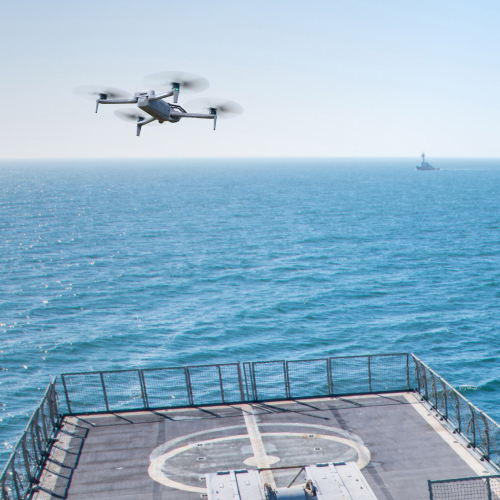
Unmanned aerial vehicles have played an important role in combat since the late 1960s, particularly in reconnaissance missions. Today, with the help of AI, small, autonomous drones such as Skydio’s sUAS platforms can leverage this reconnaissance capability to combat one of the most stubborn challenges to fleet readiness: corrosion. These smart drones can  simplify the detection of this  $7 billion dollar annual problem for the U.S. Navy, and also reduce the cost of controlling it.  

A Smarter Approach to Predictive Maintenance

Corrosion can be mitigated to some extent, but it can never be eliminated. Furthermore, the rate of corrosion on any given ship on any given mission cannot be accurately predicted. This means that scheduled preventive maintenance often takes place either too early, which wastes money, or too late, which can put the structural integrity of a ship’s hull at risk, while  giving ships an appearance not reflective of the United States as a world naval power. 

In contrast, condition-based maintenance aligned to the most current condition of a hull ensures optimal timing for maintenance. This is where autonomous drones come into play. Visual data gives commanders and naval engineering teams a corrosion assessment in near-real time, so they can accurately determine the timing and the level of maintenance required for optimized maintenance operations.

The Value of Visual Data

Today, hull inspections are still often conducted by sailors on painter boards. This antiquated  approach has three problems. First, it takes crew members away from their primary tasks at a time when many ships are already undermanned. Second, the results of personal observations are conveyed verbally or in written form, and words are limited. The level of detail and the potential urgency could be subject to misinterpretation, depending on the individuals providing and receiving the reports. Third, personal observation is a slow and tedious process.

The visual data drones provide is more precise than words, and is available in near-real time. This speed, convenient  for inspections, is crucial during or after  kinetic or dynamic events. The AI-powered platform can obtain immediate damage assessments. Detailed visual data can be forwarded to  shipyards prior to the ship’s arrival, allowing for optimal planning, so resources are properly allocated, aligned and timed; reducing maintenance backlogs and getting ships back to sea faster. 

AI-Powered Obstacle Avoidance

Manually flown small drones have a well-earned reputation for being difficult to fly. Skydio’s sUAS platforms use AI to deliver new consistency to flight operations, enabling safe, secure, repeatable and reproducible results in anyone’s hands. Software-defined obstacle avoidance simplifies and automates pilot operations while reducing training time for the operators to be proficient to fly their missions. More personnel can be trained faster, complex flying missions can be executed and critical infrastructure can be inspected safely and routinely. Other AI-powered features include automated workflows that produce textured models on the drone in just minutes, with no additional computers or systems needed – and no special training burdens.  Machines should aid human team-mates, rather than adding unaccounted for burdens, and the right autonomous drones can do exactly that for ship commanders, sailors, and maintainers, ultimately changing the landscape of naval maintenance. 

About Skydio

Founded in 2014, Skydio is the leading US manufacturer of autonomous drones utilizing breakthrough AI. Skydio designs, assembles, and supports its products in the US from its San Mateo, CA headquarters, offering the highest standards of supply chain and manufacturing security. 


Systems Models Keep Submarines Mission Ready

BY TRACY GREGORIO

An important, yet often underappreciated challenge for undersea warfare is keeping submarine systems well-maintained and available. Every command has a budget for reliability, maintainability, and availability (RMA), but those resources are limited and need to be carefully allocated to keep warfighting systems mission-ready.

For decades now, maintenance planning has been performed by seasoned engineers who understand how component lifecycles and failure rates can affect their systems. This process of expert-driven failure modes and effects analysis (FMEA) is time consuming, expensive, and can take months to complete by veterans whose expertise is sorely needed elsewhere.

Additional time is also needed to evaluate changes using the Risk Management Framework (RMF), to identify cybersecurity vulnerabilities that may degrade system availability.

Model-Based Approach.

To address this challenge, a model-based system engineering (MBSE) approach is starting to automate failure mode analysis, facilitating more efficient RMA planning. This shift provides additional time for design optimization, refinement of reliability predictions, and comprehensive analysis of casualty reporting. The result is better mission-readiness for our fleet, while consuming fewer resources.

Reliability analysis is important to ensure that a warfighting platform has no single point of failure across its many components. Between a ship’s tight spaces and funding limitations, it’s impossible to go to sea with spares for everything.

One organization using this new MBSE approach is the Undersea Communications & Integration Program Office, PEO C4I / Program Manager, Warfare (PMW 770). Their Program Manager, Captain David Kuhn explained, “If spares are not available, we have to plan for alternate ways of accomplishing a mission, even if it’s less stealthily. To ensure we optimize our ability to change parts and/or have redundant paths for missions, we build forecasts based on how often parts are used. If a component fails early and there is no spare on board, it could be a mission kill.”

The MBSE models enable program managers, like Kuhn, to create forecasts better and faster, while
tying together different engineering disciplines and stakeholder communities. “Engineers specialized in systems design, cyber, and reliably each have their own approach,” said Kuhn. “They need different views and have historically used different models. Now they use the same model, each getting the views they need, and enabling analysis that just couldn’t be done before.”

Confidence in Outcomes

These consolidated models enable analysis and simulation on a fully validated data set that increases confidence in predicted outcomes. Kuhn illustrated the value of this analysis by describing a recent upgrade needed to improve system monitoring through the addition of passive data taps. “What normally would have needed 60 or 90 days we accomplished in a couple weeks, letting us quickly deploy the upgrades to the fleet.”
The models also enable green or less experienced engineers to address critical maintenance planning elements. “MBSE helps new people coming on to look at a failure diagram and understand it faster and more accurately,” notes Kuhn.
This MBSE approach is being used by engineers adapting systems to field on the new classes of submarine to plan and optimize their maintenance schemes. This approach will ensure that component failures don’t interfere with the platform’s most important mission threads.
“The hull designs of the new sub class have an impact on how we design and maintain our antenna systems,” explained Kuhn. “Through the MBSE model, we saw how a change in one subsystem increased tensions in another. While each element was meeting its defined requirements, the model showed that failure risk increased. While we might have eventually caught the issue, the model helped us see it easily and early in the design cycle.”

The MBSE model also generates the reports and views needed to get system changes through the
RMF approval process. Kuhn, explaining the practical consequences, stated, “We use the model to assess RMF compliance faster and with more accuracy, in part by eliminating the possibility of ‘fat finger’ data re-entry errors. Our team says they can complete RMF diagrams in a third of the normal time.”
That is a huge time-saver for engineers, and a safety net against errors. The system uses the following key components:

  1. A digital model of the warfighting platform is created to replicate all components, connections, and system functionality. This model is capable
    of simulating every system operation, effectively capturing the interactions between various components. It also illustrates their relationship with the officers and sailors who are responsible for the operation and maintenance of the system.
  2. The model is populated with reliability data
    from COTS manufacturers and field experience, generating reliability diagrams correlated to mission threads.
  3. Engineers use the model to simulate planned maintenance or upgrades and test operational threads for mission success, reviewing different alternatives for impacts on mission readiness.
  4. The models export field-level instructional resources directly into interactive electronic technical manuals (ITEMs). This reduces the
    cost and time needed to give sailors up-to-date information for their individual hull, so they can maintain mission readiness and quickly respond to unexpected failures.

This approach is not limited to the latest-generation submarines. Maintenance planners are constantly dealing with obsolescence replacement.

“Our C4I systems make heavy use of commercial off-the-shelf servers and hard drives that go obsolete in as little as four years,” said Kuhn. “The models help us identify where one change drives a companion change in another system. For instance, we might need to make a firewall change for data to flow properly. We have to replace those elements quickly without waiting for a major availability cycle that might be five years out. We can’t afford for our systems to be the reason a sub is not out at sea.”

Transition Challenges

There are challenges in moving to a new approach in terms of the tools and skillsets needed by the workforce. Comparing MBSE transition challenges to those encountered during the shift to Computer-Aided Design (CAD), Kuhn said, “Just as we had to transition from engineers with drafting expertise into those who could work in CAD, now we need engineers that know how to use MBSE tools. It’s not as easy as opening Microsoft Word, but it can be done. The real key will be changing entire processes to adapt to the MBSE models. Using the same old processes, but just layering on the new tools will not be effective. It requires a cultural change, just as happened when we went from pencil drafting to CAD.”

This approach can improve the maintainability of any sea-going platform with integrated MBSE models that span engineering disciplines, cyber, RMF compliance, and reliability. It doesn‘t happen overnight, but can make an impact, one model and one command at a time.


Australia Announces Procurement of Fourth MQ-4C Triton UAV

By Richard R. Burgess, Senior Editor

ARLINGTON, Va.—The Australian Defence Force (ADF) will procure a fourth MQ-4C Triton high-altitude, long-endurance unmanned aerial vehicle UAV), the Australian government announced in a Sept. 19 release.

The Triton’s builder, Northrop Grumman Corporation, is scheduled to deliver Australia’s first Triton and its ground and support systems in 2024. The UAVs will be operated from RAAF Tindal, in the Northern Territories by 9 Squadron, which will be headquartered RAAF Edinburgh, South Australia. 

“Defence Industry Minister Patna Conroy said the purchase of the additional Triton will enhance operations from Australia’s northern bases, a priority under the Defence Strategic Review,” the release said. 

Northrop Grumman continues production of the latest configuration of the Triton, the multi-intelligence Integrated Functional Configuration 4 (IFC-4) for the U.S. Navy. Earlier this month, the U.S. Navy declared Initial Operational Capability for the Triton, which has been deployed to Guam to establish its first orbit. The Triton deployed to Guam in 2020 for Early Operational Capability. The Navy’s program of record for the Triton calls for 27 aircraft, including the development aircraft. 

Australia also plans to upgrade its fleet of 14 P-8A Poseidon maritime patrol aircraft between 2026 and 2030 with “enhancements to anti-submarine warfare, maritime strike and intelligence collection capabilities,” the release said. 


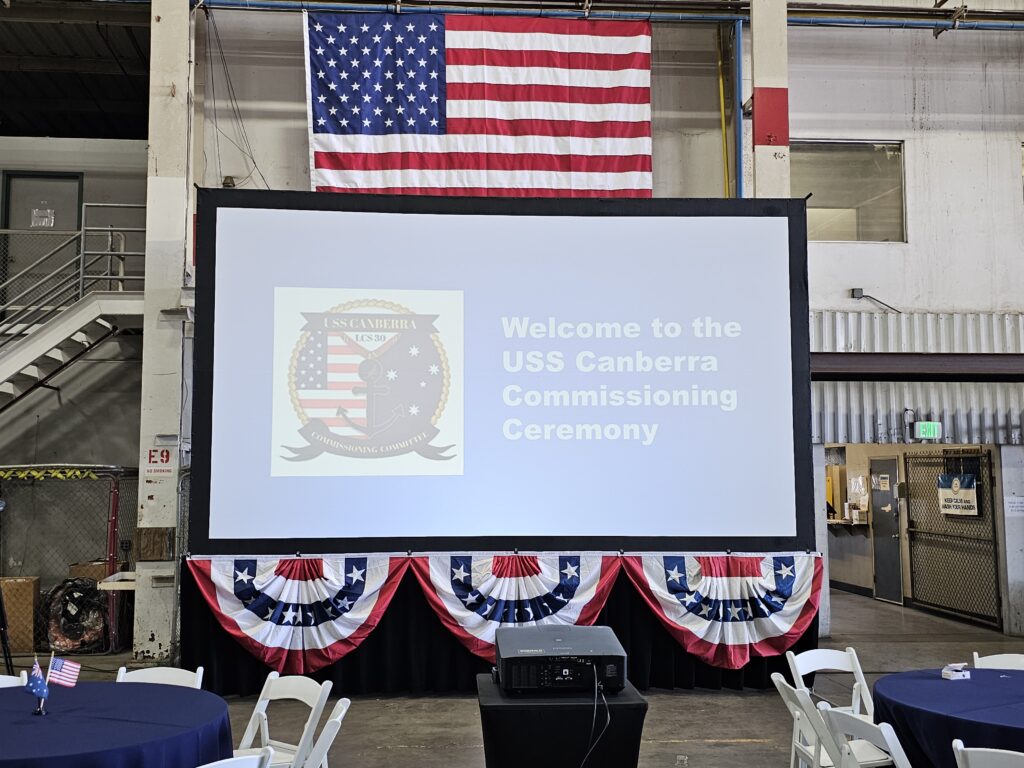
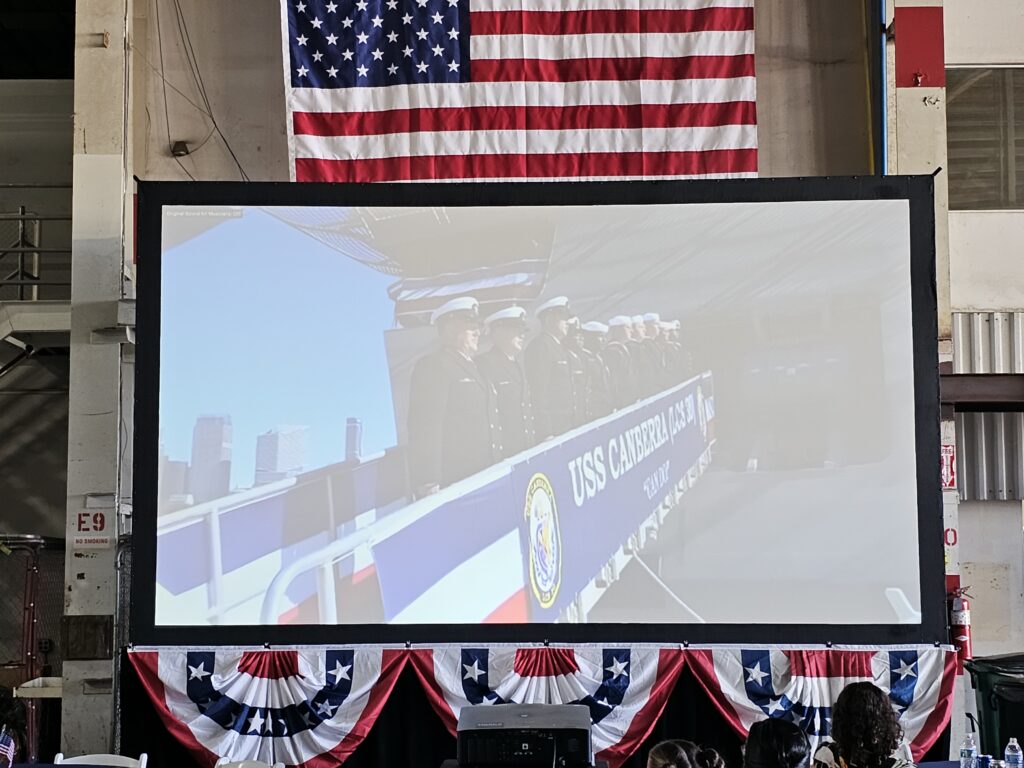
USS Canberra Commissioning Touched Hearts

The rare commissioning abroad brought people together from across the globe. 

It’s always a special occasion when a new ship is commissioned and brought to life with crew, family, and friends, but the recent commissioning of the USS Canberra (LCS 30) was particularly meaningful. Seapower recently got the scuttlebutt from Ron Spence, Commissioning Committee Gift Coordinator and learned a little more about how this particular commissioning was celebrated.  

While nearly every commissioning involves recognition of those designated as plank owners, the individuals honored with that title for the Canberra received something extra special. “The plank owners’ plaques were made by a gentleman names Joseph Nolin, a native citizen from Australia who now lives in Portland, Oregon,” said Spence. “His company, Lumberjack Wood Products, custom made these plaques from authentic Australian Beech wood that Mr. Nolin brought from Australia.” 

Spence said, “I felt having them made from Australian wood, by a native from Australia in the shape of the continent of Australia was very special and a great way to honor the commissioning.” 

“I have seen many plank owners’ plaques, but nothing as unique as this one,” he said. 

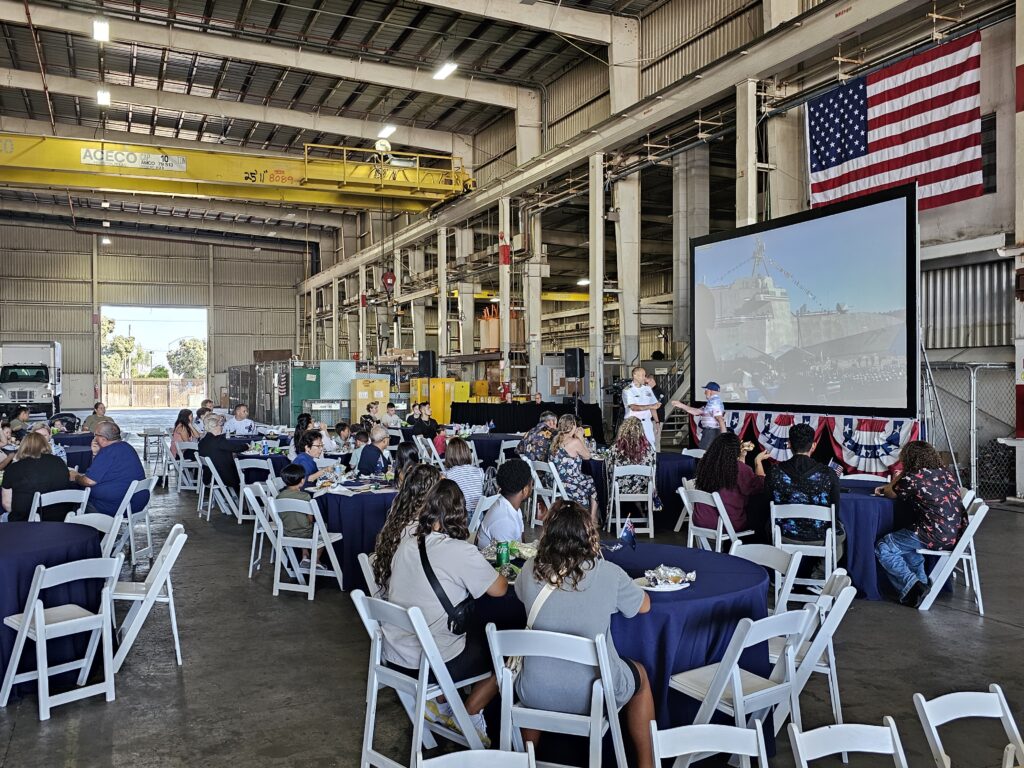
The Commissioning Committee also hosted a watch party in San Diego, attended by friends, families, and supporters of the of the new LCS, including many members of the United States Navy League, which has a long history of supporting and ship commissionings. “It was a wonderful experience,” said Spence, “especially when we heard family members say, ‘there is my daddy on TV.’”  

“All of the events and gifts were put together by the women and men of the Commissioning Committee,” said Spence. Many of the members responsible had never met in person, “but they came together from across the globe to help make this a most memorable event,” he said.  

“Something such as this had never been done before, but it was done, and done right,” Spence said. 


USS Milwaukee (LCS 5) Decommissions

Release from Littoral Combat Ship Squadron Two 

***** 

11 September 2023 

NAVAL STATION MAYPORT (Sept. 8, 2023) – Freedom-variant littoral combat ship (LCS) USS Milwaukee (LCS 5) was decommissioned in Mayport, Fla., September 8. 

As an operational unit, Milwaukee and its crew played an important role in the defense of our nation and maritime freedom. Milwaukee and its Sailors were key to determine the operational success and deployment capabilities of today’s LCS platform. 
 
During the ceremony guest speaker, Vice Adm. Dirk Debbink (USN, Ret), former chairman of Milwaukee’s commissioning committee wished the crew of Milwaukee fair winds and following seas as they bid farewell to their ship. 
 
“We are all very proud of the way this ship served our Navy and our nation since that cold day in November 2015.” said Vice Adm. Dirk Debbink (USN, Ret), former chairman of Milwaukee’s commissioning committee. “She was the first true serial production ship of the Freedom Class, having incorporated literally hundreds of changes, lessons learned from Freedom and Fort Worth.” 
 
Milwaukee and its Sailors contributed a tremendous amount of work and time to ensure success of the LCS program during the ship’s time in naval service. Milwaukee completed two successful deployments in April 2022 and June 2023. The ship deployed to U.S. Fourth Fleet and integrated with the embarked US Coast Guard Law Enforcement Detachment (LEDET), other US warships, Department of Defense, Department of Justice, Department of Homeland Security, and SOUTHCOM/JIATF-S. During their second deployment, Milwaukee and her embarked LEDETs, seized an estimated $30 million in suspected cocaine and three detainees during interdictions as sea, preventing 954kgs of cocaine from entering the United States. She also transported six detainees and case packages on behalf of USCGC BEAR in support of the counter-narcotic/interdiction mission. While deployed, Milwaukee provided maritime security presence enabling the free flow of commerce in key corridors of trade. 
 
“Throughout the life of the ship, the Sailors that sailed Milwaukee led the way in training and operations that led to fleet improvements and culminated with operational success that supported national security objectives and demonstrated U.S. commitment to our allies.” said Cmdr. Jason Knox, Milwaukee’s commanding officer. “Not only can her Sailors be proud of their distinctive accomplishments, but the City of Milwaukee, Wisconsin can be proud of their ship, too.” 
 
Milwaukee was designed by Lockheed Martin and constructed by Marinette Marine Corporation (Fincantieri) Marinette, Wisconsin, Milwaukee was commissioned November 21, 2015, in Lake Michigan at Milwaukee’s Veteran’s Park. Mrs. Sylvia Panetta, wife of former Secretary of Defense Leon Panetta, served as the ship’s sponsor. 
 
USS Milwaukee (LCS 5) is the fifth United States Navy Warship named after the city of Milwaukee, Wisconsin. The ship represents the proud people of the Milwaukee community. Upon decommissioning, Milwaukee’s Sailors will receive follow-on orders to new assignments. 
 
LCS are fast, agile, mission-focused platforms designed to operate in near-shore environments, winning against 21st-century coastal threats. LCS are versatile and are capable to support a broad spectrum of fleet missions and operate alongside regional navies and coast guards while supporting forward presence, maritime security, sea control, and deterrence missions around the globe. 
 
For more news from Commander, Littoral Combat Ship Squadron Two, visit https://www.surflant.usff.navy.mil/lcsron2/ or follow on Facebook at https://www.facebook.com/comlcsron2/ 


A Day to Remember 

This is the anniversary of the 9/11 terrorist attacks on America, and on the world. 

Once again, it is a day to reflect and remember.  In fact, we who experienced the events of that day in any way must remember and share, lest we not forget.  If you don’t know about what happened that day, then you must become educated, and made aware of the events of that day in New York, Washington and Somerset County, Pennsylvania.  It was an attack driven by hate, and an attack on all of us. 

There is a saying that you die three times: when you take your last breath; when they cover your grave after your funeral; and when your name is uttered for the last time. 

This is what I remember, and what I choose to reflect upon every year on this day. You will indulge me, I hope, because it is necessary for me to share this with others and share it every year on this day for as long as I can do so.  It is the least I can do for a shipmate. 

So, join me in saying his name: Michael Noeth. 

*** Linseed oil: 

Some things have an evocative smell. 

When I was in command of the Naval Media Center in Washington, D.C., the executive officer of a ship based at Pearl Harbor – USS Russell (DDG 59) – called my staff at All Hands magazine in our Publishing Department.  The XO had a Sailor aboard the ship who wanted to be a draftsman. 

The “undesignated seamen” or SNs on a ship usually work in the deck force, chipping paint and handling lines. As they see what professional opportunities are available on board their ship, they can “strike” for a rating, like Radioman or Quartermaster. A “Striker Board” will convene and review the needs of the ship, and the desires of the individual. If the Sailor is squared away, has done a good job with the deck force and the ship needs a Quartermaster (QM), for example, he or she can strike for that rating, and becomes a QMSN. 

Seaman Michael Noeth wanted to be a Draftsman. The DM rating was one of the smallest ratings in the Navy. There were very few of them compared to Gunner’s Mates or Machinist’s Mates, and certainly none aboard a surface combatant. In fact, today the rating has been disestablished and the functions combined into the Mass Communications Specialist (MC) rating.   

In this case, the executive officer wanted to do something good for his Sailor. And this was extraordinary, because USS Russell was about to depart on deployment.  In spite of the fact that the ship was about to be on cruise for six months, the XO called us and asked if his Sailor could come and work with us to learn the DM rating so he would be prepared to take the DM test for Third Class Petty Officer. If he passed, he could become a DM3. If not, he could return to the ship and eventually strike for another rating. For our part of the deal, we had to cover his travel expenses.  We said yes. 

There are never enough Sailors in the Deck Force, especially on deployment, but the XO wanted to help a Sailor.  So, SN Michael Noeth came to work for us in the Publishing Department at the Naval Media Center in Washington, D.C.  

He was placed under the expert tutelage of our Draftsman First Class (DM1) Rhea Mackenzie.  Seaman Noeth quickly made himself at home in a back corner of the All Hands magazine production spaces.  And it was here he set up his easels, canvasses a and paints. When I would come by — which was often, because I was always wandering around Building 168 to see all of the interesting stories and projects our people were working on — I could smell the linseed oil he used for his brushes long before I reached his work area. He would have various canvasses and illustrations in various stages of completion posted around his desk, as well as examples of artwork he admired or wanted to emulate. 

As one of the 450 men and women of the Naval Media Center, he learned his trade from an experienced draftsman, created artistic content for All Hands magazine, and became a well-liked and contributing member of the command. At our Halloween party, he came in second place in our costume contest. He was a dead ringer “Alex” from Clockwork Orange, and was topped only by an even more convincing Cruella Deville from 101 Dalmatians. 

Whenever I got near his work area, I would be greeted by the smell of his linseed oil, and I knew I would be in for some kind of surprise. Seaman Noeth painted the cover for several issues of All Hands magazine (such as the one with a cut-out porthole that opened to an ocean panorama. To see him tackle these assignments was a joy, probably because he was enjoying his work, and appreciative of the opportunity. On my visits, I would see the many versions and sketches he was working on, and I could see it all come together with the finished product. 

He took the advancement exam and passed it. As his six-month temporary assignment came to an end, his command allowed him to transfer to my command on a permanent basis as they did not have any billets for a draftsman, and we did. Soon, he moved on to other Navy assignments as a Draftsman, all because his ship wanted to give him a chance to realize his dream, and my command wanted to help him get there. We felt good about helping him attain his goal.  But most of all, because he was a Sailor who deserved it. 

He did, indeed, become a talented Navy illustrator and draftsman. He served aboard amphibious assault ship USS Wasp (LHD 1), and was later assigned to the Navy Command Center where he skillfully created briefings and presentations for Navy leadership. He was doing just that on September 11, 2001, when terrorists forced an airliner to crash into that building. 

We must not forget.  So, I choose to remember a bright, ambitious, creative young striker today, and whenever I smell linseed oil. 

We will continue to speak his name. 

-30- 

Please also see: 

https://allhands.navy.mil/Stories/Display-Story/Article/1839561/we-will-never-forget/

https://www.washingtonpost.com/wp-srv/metro/specials/attacked/victims/v_358.html

https://pentagonmemorial.org/explore/biographies/dm2-michael-noeth-usn


Marine Corps Looking at Stealthy Autonomous Vessels for Logistics

***** 

ARLINGTON, Va.—The U.S. Marine Corps is exploring a concept to enhance its ability to supply its forces its forces inside a contested environment: low-profile vessels used by drug-running cartels.  

The Corps, however, is looking at autonomous low-profile vessels (LPVs), said Lieutenant General Karsten Heckl, deputy commandant for Combat Development and Integration, speaking Sept. 6 at the Defense News Conference in Arlington, who advocated the use of autonomous unmanned systems wherever possible. 

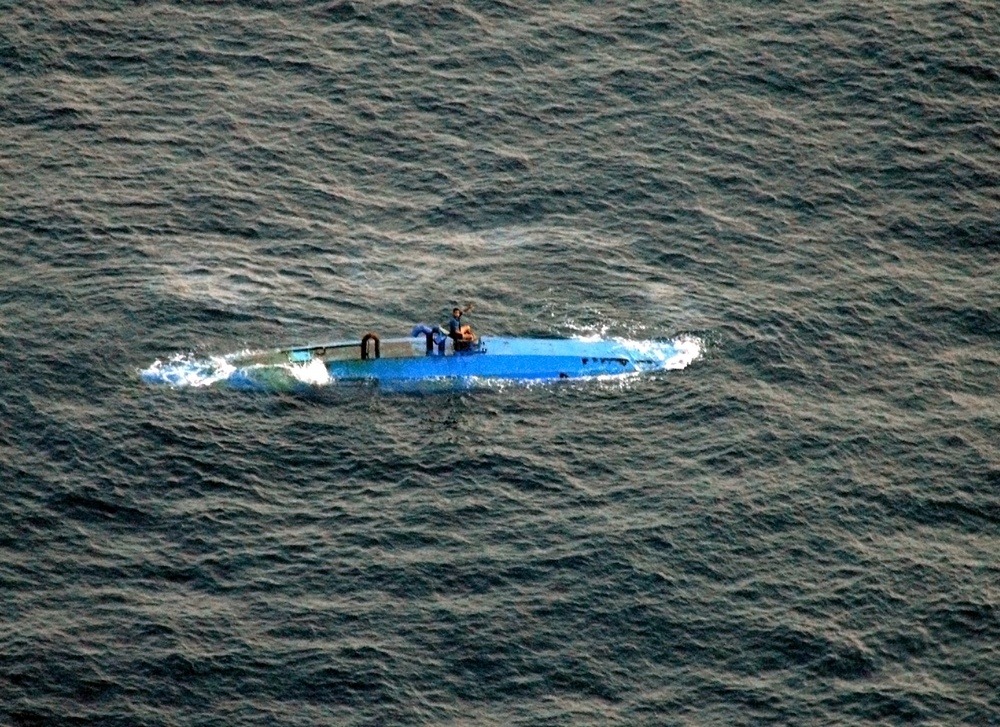
Drug runners have built and used manned LPVs frequently over the last two decade to carry loads of illegal drugs from Latin America to the United States. The LPVs, called semisubmersibles, are fabricated in secret locations and, with a small crew, carry their payload along the transit lanes, trying to avoid visual and radar detection with their very low profiles. 

 “We just copy the drug lords down south running drugs,” Heckl said. “They are hard to find, so now we figure, hey, it works, right?  

The Marine Corps has recently focused on logistics in a contested environment as part of its Force Design 2030 to address the challenge of supplying its forces inside the enemy’s weapons engagement zone — inside the first island chain off China, for example. 

Heckl addressed the concept pairing it with uncrewed autonomy, noting the lower cost of unmanned systems without having to accommodate humans and the supplies and safety systems needed to sustain them. 

The required scale of autonomous LPVs is so far undetermined, but Heckl pointed to the success of an unmanned expeditionary fast ship (T-EPF) in autonomous operations. Austal built the Miliary Sealift Command’s 13th T-EPF, USNS Apalachicola — a fast catamaran logistics ship–with autonomous control systems to demonstrate the potential of autonomous operations of a ship of its size. 

“T-EPF 13 went out and did 1,500 nautical miles completely autonomously,” Heckl said. “They had human beings on board as back-ups, but what an amazing capability, a ship that can go 45 knots in Sea State 3 that can operate autonomously. Autonomous—from a logistics perspective—absolutely. 

“I want autonomous everything, if we can get there,” he said. 


Marine Aviator Killed in F./A-18D Hornet Crash 

EL CENTRO, Calif. (Sept. 28, 2020) Marines with Marine All Weather Attack Squadron 224 (VMFA 224), Marine Aircraft Group 31, 2nd Marine Aircraft Wing, prepare F/A-18s for flight operations aboard Naval Air Facility El Centro, Calif. on Sept. 28, 2020. (U.S. Marine Corps photo by Lance Cpl. Nicholas Buss) 

***** 

ARLINGTON, Va. — A Marine Corps aviator was killed in the crash of his F/A-18D Hornet strike fighter on Aug. 24. 

The two-seat Hornet, with only the pilot on board, crashed near Marine Corps Air Station Miramar, California, at 11:54 PST, according to a release from the 2nd Marine Aircraft Wing. The name of the pilot will not be released until the next of kin has been notified. The mishap is under investigation. 

The aircraft was assigned to Marine All-Weather Fighter Attack Squadron (VMFA (AW)) 224, based at MCAS Beaufort, South Carolina. The squadron is one of only two VMFA(AW) squadrons remaining in the Marine Corps, the other being VMFA(AW)-533. The Marine Corps is in transition from the F/A-18 Hornet to the F-35B/C Lightning II strike fighter. 


Fleet Forces Commander Caudle: Navy Is Flexing Proficiency in Operational Level of War

*****

ARLINGTON, Va. — The Navy’s ability to plan and execute war at the operational level in a joint environment is one factor being tested in an upcoming large-scale exercise, with fleet commander staffs and their fleets set to be stressed in various scenarios. The Navy is leveraging the operational planning expertise of the Marine Corps officers integrated in its staffs.

Admiral Daryl Caudle, commander, U.S. Fleet Forces Command, speaking July 24 to reporters during a briefing on the upcoming Large-Scale Exercise 2023, was asked by Seapower to address the Navy’s proficiency in the operational level of war, the lack of which was years ago a noted weakness.

“Our ships are fantastically engineered and built, they’ve got all the kit,” Caudle said. “We embark on those, lean forward, and can sustain in operations … so the ability for the Navy to think about how we actually plan and utilize those forces was somewhat dampened maybe by the fact that our ability to conduct warfare with those ships was so good. So, we found ourselves in a place where we needed to improve our ability to plan.

“We are — in a very prescribed and repeated manner — sending more of our Navy leaders to planning school,” the admiral said. “We’re building naval planners. We’re getting them in position of fleet command staffs, combatant command staffs, to actually exercise that level of Navy planning required to conduct this global warfare more effectively.

“We integrate with the Marine Corps who are excellent at this, and we bring our Marine partners into our planning cells,” he said. “Our future planning cells at all of our MOCs [Maritime Operations Centers] is part of that. Our future operations — where talk about that three-to-six-month time frame — where Marine Corps officers really bring a lot of knowledge and capability to Navy staffs. We’re completely integrated there. Our targeting cells are completely integrated. The things that the Marines have a lot of expertise in this that the Navy is still learning how to do at that level. It’s been a great success story.”

Over the last two decades the Navy has established Maritime Operations Centers to support fleet staffs and other commanders in planning and executing operations.

Caudle described the MOCs as “really a maritime operational concept … that informs the commander’s decision cycle. When you hear the word ‘MOC,’ what should really come to your mind is a battle rhythm. We can scale that level of battle rhythm to the conflict that it needs to scale to. So, we’re going to test the different echelons of scale during Large-Scale Exercise 23 to enable a global battle rhythm between three fleet commanders, exercising that decision cycle…. So, that’s part of this as well, testing out how that operational concept works.”

Large-Scale Exercise 2023, scheduled for Aug. 9 through Aug. 18, is a global exercise that will involve 22 time zones, six combatant commanders, seven fleets, nine MOCs, six carrier strike groups (four virtually in Live Virtual Constructive (LVC)), three amphibious ready groups (two in LVC), 25 ships and submarines (plus another 50+ LVC), and 25,000 Sailors and Marines.