TRANSCOM to Double Sealift Tanker Force 

*****

ARLINGTON, Va. — The U.S. Transportation Command (TRANSCOM) plan to double the number of fuel tankers in its Tanker Security Program to improve the capacity to deliver fuel to forward operating forces, particularly in the Pacific, the TRANSCOM’s commander said. 

“We are concerned about not having enough U.S-flagged vessels to meet our requirements, so we are absolutely getting after that with the support of Congress,” said Air Force General Jacqueline Van Ovost, commander, U.S. Transportation Command, speaking June 6 to an audience of the Brookings Institution, a Washington think tank. “We have stood up the Tanker Security Program. We now have 10 U.S.-flagged tankers — manned with U.S. merchant mariners — medium-range tankers that we will be able to use to assuredly be able to have access to in times of conflict. And we’re working on the next 10 as well to assuredly move fuel to inside the first and second island chain, more shallow-draft vessels that we didn’t have before.” 

TRANSCOM has taken on from the Defense Logistics Agency (DLA)the role of transporting and delivering fuel to U.S. forces abroad. 

“The new strategic environment exposes vulnerabilities to our supply chain management that we just didn’t have before,” Van Ovost said. “So, this new global fuel mission allows us to take the very best of DLA Energy and what they’re doing, which is the business end of managing supply chains and allows us to put our TRANSCOM expertise of command and control and planning and posture to ensure that we can deliver that fuel wherever and whenever we need it.  

“We also need to re-look where our fuel posture is to meet the requirements — what do have to have forward, where are the refineries, etc., how are going to move that fuel and how are we going to have the assets to do it,” she said.  


Marine Corps Generals to Integrate with Navy Numbered Fleet Staffs

CAMP COURTNEY, Okinawa (Feb.16, 2023) U.S. Navy Rear Adm. Derek Trinque, commander Task Force 76/3, left, Japan Maritime Self-Defense Force Rear Admiral Motoyuki Kanezashi, commander, Amphibious and Mine Warfare Force, left-center, Japan Ground Self-Defense Force Maj. Gen. Shingo Nashinoki, commander, Amphibious Rapid Deployment Brigade, right-center, and U.S. Marine Brig. Gen. Fridrik Fridriksson, deputy commander TF 76/3, right, pose for a photo during Iron Fist 23 aboard Camp Courtney, Okinawa, Japan, Feb. 16, 2023. This visit took place during Exercise Iron Fist and provided an overview of TF 76/3, focusing on the command-and-control structure and command position, and how it improves the commander’s ability to control forces and command from ashore without the need to embark. Iron Fist is a U.S. Marine Corps Forces Pacific-directed, 31st Marine Expeditionary Unit-executed, bilateral training exercise between the U.S. Marine Corps and the Japan Ground Self-Defense Force and aims to improve staff planning, enhance core competencies in amphibious operations and interoperability, and maintain a positive military-to-military relationship between Japan and the United States. (U.S. Marine Corps photo by Staff Sgt. Andrew Ochoa)

***** 

ARLINGTON, Va. — The U.S. Marine Corps is planning to establish integrated staffs with two U.S. Navy numbered fleets next year, according to the latest update to is Force Design 2030 concept. 

The Corps plans to integrate a brigadier general in the headquarters staffs of U.S. Sixth Fleet and the U.S. Seventh Fleet.   

“We need to formalize the process for establishing integrated Navy-Marine Corps staffs with numbered fleets while giving the MEF CGs [Marine Expeditionary Force commanding generals] the ability to adapt organizations to the specific needs of their partner numbered fleets,” said General David H. Berger in the latest Force Design 2030 document. “Whenever feasible, and in coordination with the efforts of the appropriate combatant commanders, these integrated staffs should also include key ally and partner representation to strengthen our integrated deterrence, offering a mature approach to campaigning. 

“NLT 1 September 2024, Commander, Marine Corps Forces Pacific (COMMARFORPAC) and Commander, Marine Corps Forces Europe and Africa (COMMARFOREUR/ AF) will formalize the establishment of O-7 staffs within Sixth and Seventh Fleet headquarters.” 

Lieutenant General Karsten S. Heckl, deputy commandant for Combat Development and Integration and commanding general, Marine Corps Combat Development Command, speaking June 2 to reporters in press conference, said the move would be in accordance with the commandant’s guidance to returning to a Fleet Marine Force. 

“A big piece of that is getting the staffs right,” Heckl said. “We realize now more than ever that in this operating environment — now that we’re back to great power competition, without question — it is important that these staffs be properly, fully integrated, or we’re going to have problems. 

“A mentor of mine told me 30 years ago that if you get the command and control of any problem figured out, you’ve got 90% of it solved, and that’s what we’re doing here” he said.   

Brigadier General Kyle Ellison, commanding general of the Marine Corps Warfighting Lab, also speaking at the press conference, stressed that such a staff would be integrated to the point that it could have a Navy rear admiral in command with a Marine Corps brigadier general as deputy, or vice versa. He mentioned Task Force 79 — III Marine Expeditionary Force — and Task Force 76 — the 7th Fleet’s amphibious force — as a “completely integrated staff with an integrated maritime operations center right there on Camp Courtney [Okinawa]. 

“It’s critically important to recognize that it’s not just the O-7,” Ellison said. “It’s integrating the staffs so you have a truly naval staff to execute naval operations in support force. That is exciting in that typically happens only when you are task-organized and for a specific mission. Now we’re standing it up and experimenting with it as a permanent structure, and that’s happening as we speak as an 18-month experimentation that was agreed upon by two three-stars — commander of III MEF and the 7th Fleet commander.” 


Navy F-5 Jet Crashes Near Key West

KEY WEST, Fla. (Nov. 6, 2020) An F-5N Tiger-II from the “Sun Downers” of Fighter Squadron Composite (VFC) 111 takes off from Naval Air Station Key West’s Boca Chica Field during the last day of training before the potential bad weather resulting from Tropical Storm Eta. Naval Air Station Key West is the state-of-the-art facility for combat fighter aircraft of all military services, provides world-class pierside support to U.S. and foreign naval vessels, and is the premier training center for surface and subsurface military operations. (U.S. Navy photo by Danette Baso Silvers)

Release from NAS Key West

************************** 

ARLINGTON, Va. — A U.S. Navy F-5N Tiger II jet crashed near Key West. Florida, on May 31, the Navy said. 

Naval Air Station (NAS) Key West said in a Facebook post that the aircraft’s pilot “ejected from an F-5N aircraft approximately 25 miles from Boca Chica Field at approximately 9:20 a.m. today. A NAS Key West Search and Rescue crew launched an MH-60S helicopter and rescued the pilot, who is being transported to a Miami-area hospital for further evaluation.” 

The pilot and F-5N were assigned to Fighter Squadron Composite (VFC) 111, which is a reserve adversary squadron based at NAS Key West. Adversary squadrons provide training in combating enemy aircraft to fleet units. The Navy and Marine Corps have four such squadrons on strength.  

The Navy is investigating the cause of the mishap. 


Smith Nominated as Next Commandant of the Marine Corps

*********** 

ARLINGTON, Va. — President Joe Biden has nominated Marine Corps General Eric M. Smith as the next commandant of the U.S. Marine Corps, Defense Secretary of Defense Lloyd J. Austin III said in a May 31 release.  

Smith currently is serving as the 36th assistant commandant of the Marine Corps. If confirmed by the Senate, Smith would be come the 38th commandant.  

Smith, a combat veteran of the wars in Iraq and Afghanistan, has served in senior positions that developed the doctrine of the Marine Corps and has been instrumental in implementing Commandant General David H. Berger’s Force Design 2030 concept, a plan to re-design the Corps to meet the challenges of great power competition and higher-end warfare.   

Below is an excerpt from Smith’s official biography posted on the Marine Corps’ website: 

“Born in Kansas City, Missouri, and raised in Plano, Texas, General Smith graduated from Texas A&M University and was commissioned in 1987. He has commanded at every level, including Weapons Company, 2nd Battalion, 2nd Marine Regiment during Operation Assured Response in Monrovia, Liberia; 1st Battalion, 5th Marine Regiment during Operation Iraqi Freedom; and 8th Marine Regiment/ Regimental Combat Team 8 during Operation Enduring Freedom. He also served in Caracas, Venezuela as part of the U.S. Military Group. 

As a General Officer, he commanded U.S. Marine Corps Forces Southern Command, 1st Marine Division, III Marine Expeditionary Force, and Marine Corps Combat Development Command. 

General Smith’s staff assignments as a General Officer include serving as the Director of Capability Development Directorate, Combat Development and Integration; Senior Military Assistant to both the Deputy Secretary of Defense and Secretary of Defense; and Deputy Commandant for Combat Development and Integration.” 


Navy Scaling Back Planned Triton Deployable Sites from Five to Three

***** 

ARLINGTON, Va. — The U.S. Navy is planning to reduce the number of planned deployment sites for its MQ-4C Triton high-altitude, long-endurance unmanned aerial vehicles in accordance with its planned reduction in the number of Tritons being procured.   

“FY24 quantity is being reduced from four to two aircraft; a total program of record procurement is being reduced from 70 aircraft to 27,” said a Navy spokesperson in response to a query from Seapower. “This quantity reduction is based on the Joint Requirements Oversite Council re-evaluation of worldwide ISR&T [intelligence, surveillance, reconnaissance, and targeting] requirements that resulted in direction to reduce total MQ-4C deployable locations (orbits) from five to three.” 

The Navy had originally planned to establish orbits in Jacksonville, Florida; Whidbey Island, Washington; Sigonella, Sicily; Guam; and a base in the U.S. Central Command area of responsibility. The Navy did not specify which three sites were still planned for the Triton. 

At five orbits and four Tritons per orbit — able to keep an aircraft on station 24/7 — the 20 aircraft required was far lower than the planned for procurement of 70. The original planned procurement would have allowed the Navy to purchase them at economic quantities, keep some in storage, and to sustain Triton operations over many years as the early aircraft reached the end of their service lives. 

With three orbits, the total number of 12 Tritons required to sustain them would leave 15 available for attrition, training, and depot-level maintenance.    

“When determining the number of air vehicles for a program of record, attrition is a part of the equation when considering the lifespan of the program,” the spokesperson said. 

Unmanned Patrol Squadron (VUP) 19, home-based at Naval Air Station Jacksonville, Florida, deployed two MQ-4Cs to Andersen Air Force Base in Guam in 2020 to provide MISR&T for the U.S. 7th Fleet while developing the concept of operations and the tactics to refine the Triton’s operations. The detachment operated from Guam; Naval Air Facility Misawa, Japan; and Marine Corps Air Station Iwakuni, Japan, the Navy said in a March 16 release. The detachment returned from deployment in March.  

The two deployed Tritons were of the baseline Integrated Functional Capability (IFC) 3 configuration. The squadron has since received newer versions in the IFC 4 configuration, which are equipped with a more capable sensor suite that will allow them to replace the Navy’s fleet of EP-3E Orion electronic reconnaissance aircraft. The MQ-4C will supplement the Navy’s P-8A Poseidon maritime patrol aircraft.   

VUP-19 is bringing the Triton to Initial Operational Capability in 2023 with the establishment of an orbit in Guam in support of the 7th Fleet’s Task Force 72.  

Northrop Grumman delivered the fourth IFC 4 Triton to the squadron in May to complete the set of aircraft for the Guam orbit while the first aircraft for the second orbit is scheduled to deliver in June, according to Rho Cauley-Bruner, director, Triton program.


Navy Orders Ninth John Lewis-Class Fleet Replenishment Oiler 

***** 

ARLINGTON, Va. — The U.S. Navy has ordered construction of the ninth fleet replenishment oiler of the new John Lewis class for the Military Sealift Command. 

The Naval Sea Systems Command awarded to General Dynamics National Steel and Shipbuilding Co., San Diego, California, a $736 million contract modification for the detail design and construction of T-AO 213. Work is expected to be completed by March 2028, the Department of Defense said in a May 22 announcement. 

NASSCO delivered the lead ship of the class, USNS John Lewis (T-AO 205), in 2022, the first of six ordered under a 2016 contract. Two more were ordered under a 2022 contract modification, with an option for a third. That option was exercised with the contract award T-AO 213.  

Five ships of the class currently are under construction: Harvey Milk (T-AO 206), which will be delivered this year; Earl Warren (T-AO 207); Robert F. Kennedy (T-AO 208); Lucy Stone (T-AO 209); and Sojourner Truth (T-AO 210). Future ships include Thurgood Marshall (T-AO 211) and Ruth Bader Ginsburg (T-AO 212). The Navy plans to procure a total of 20 ships of the class.  

The John Lewis class is replacing the Henry J. Kaiser class of fleet replenishment oilers. The new ships can carry 57,000 barrels of oil as well as some dry cargo and frozen stores. They can operate at 20 knots.  


Cargo Preference Essential Element For Us Merchant Marine, National Security

Rear Admiral Mark H. Buzby, USN (Ret)

Recently, there have been renewed calls by some to do away with – or greatly diminish – the requirements that govern the sea transportation of cargo that is owned, procured, furnished, or financed by the US Government – better known as Cargo Preference.

A removal of the current 50% requirement would have immediate and devastating effect on the US flag fleet. I state this with the confidence of having observed multiple US flag ships “flag out” of US registry when a change to Cargo preference statutes in 2013 reduced the required US carriage percentage of non-DOD government cargo from 75% to 50%.  Doing away with Cargo preference requirements would directly result in the reduction in the size of the already small US flag deep sea fleet, adversely impact the size of the correspondingly small pool of US citizen seafarers, and jeopardize our Nation’s ability to execute sealift of US forces in times of crisis or conflict.  

As MARAD Administrator, I testified often of the “three -legged stool” of maritime policy that underpins and supports the U.S.-flag merchant marine: the Jones Act, the Maritime Security Program (and newly enacted Tanker Security Program), and Cargo preference.  Cargo preference is the least understood of the three, and it is under direct attack now.  Short-sighted detractors are now pushing to end cargo preference for food aid programs like Food for Peace, in which American-grown food is moved on American-flagged ships to help those in need in the some of the poorest parts of the world.  This has been a successful program for nearly 70 years helping to provide much needed food and aid to families starving and suffering from famine and conflict. At the same time, these programs support American famers, American truckers, American rail operators, American manufacturers, American milliners, American oil and flour producers, American longshoremen, and American mariners.  Currently, only half of all those cargos must travel in US flagged vessels.

We should not underestimate the strong signal that a US flag ship delivering life saving food and aid sends to everyone that the US is there and engaged.   Putting food aid on flags of convenience says nothing…just another government hand out.  Cargo preference is an important component of global engagement, non lethal and peaceful.

Other Cargo preference statutes date back to 1904, stipulating that 100% of Department of Defense cargo must travel in US flagged vessels, ensuring a safe and secure means to deliver our fighting forces and their sustainment around the globe.  Imagine if such a statute was not in place and the movement of military cargos was dependent on the whims of a foreign flag carrier during times of heightened tension or crisis.  I don’t think we want to go there.

Lacking a comprehensive national maritime strategy that coherently and comprehensively ties together the contributions of our civilian merchant marine and our uniformed sea services (Navy, Marine Corps, Coast Guard, and NOAA) to our national defense and economic security, the individual elements of maritime policy which are “sailing in loose formation” today are susceptible to attack from special interests not aware of the important role each plays in support of the other.  The attacks on Cargo preference are a perfect example; a seemingly detached policy focused on moving food aid and other government cargos helps sustain a sizeable percentage of the US Flag fleet, which provides jobs for the maritime work force, which is the same pool of mariners the US government will depend upon to activate and sail our Ready Reserve Force sealift fleet to transport and sustain US and allied forces in times of national emergency.  The math is simple:  reduced cargo equals reduced ships, fewer ships equals fewer crews, and fewer crews means we cannot man our sealift ships.

President Xi and the Chinese Communist Party (CCP) have has made their interest in dominating the maritime sector perfectly clear:  they construct 80% of ship to shore cranes, 86% of intermodal chassis, and 95% of the worlds shipping containers.  Their shipyards turnout 47% of the world’s shipbuilding tonnage, and PRC companies operate over 5,500 merchant ships.  They subsidized their shipbuilding industry by over $132 billion from 2010-2018.  The CCP knows what the British Empire knew, what the Founding Fathers knew, what Rear Admiral Alfred Thayer Mahan postulated in 1890: control the seas, control the world.

I want to be clear:  ending cargo preference will create national security risks, and lack of cargo will continue to shrink the size of the US maritime fleet and reduce US sealift capability at a time when we cannot afford to give up one ship or lose a single mariner. The adverse ripple effect will extend to the shore side maritime and shipbuilding industry as well.  I encourage Congress to reject misguided and unwise proposals that will make us even more dependent on the Chinese Communist Party for our economic health and instead support a robust US maritime policy that will sustain the US commercial sealift needed to support US national security.

Rear Admiral Buzby served as Maritime Administrator from 2017-2021.  He retired from the US Navy in 2013 after 34 years of service which included command of the US Navy’s Military Sealift Command.  Prior to serving as MARAD Administrator, he was President of the National Defense Transportation Association.


Admiral: Ecosystems Around Shipyards Can Attract, Retain Workers

***** 

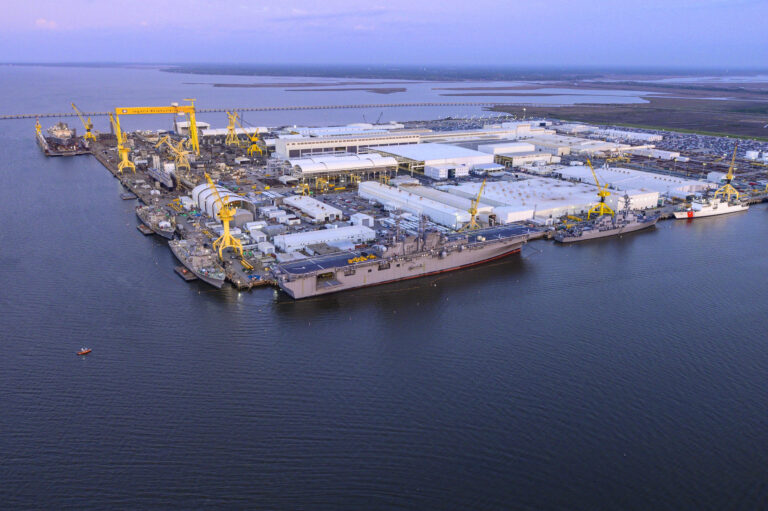
ARLINGTON, Va. — The services offered by communities adjacent to shipyards can help attract and retain skilled shipbuilding and repair workers, a Navy admiral in charge of shipbuilding said.  

“One of the things we’ve seen that is very successful is building ecosystems around the shipyards — Congress working with state and local governments to aid in the development of systems around shipyards that really provide opportunity, said Rear Admiral Thomas J. Anderson, Navy Program Executive Officer for Ships, testifying May 11 before the House Oversight and Accountability Subcommittee on National Security, the Border, and Foreign Affairs.  

“If there is no housing in the area of a shipyard, you’re going to have a hard time having blue-collar labor come in and be interested in a job there,” Anderson said. “Things like health care, day care, [and] housing are really important to have in the vicinity of the yards to attract the talent that we need to build the ships we need in the future.” 

Anderson said that “[o]ne of the real challenges we have in this country is availability of blue-collar labor. We saw that as a challenge as we were in COVID and when we came out of COVID and we continue to struggle to identify talent to come in, people who are interested in the blue-collar trades.  

“So, support of our budget requests that provide funding to develop the work force that comes in two ways: the submarine industrial base, which I mentioned earlier, has targeted funds to help advance the work force,” he said. “Additionally, last year in the NDAA [2023 National Defense Authorization Act], Section 122, provided a requirement for the Navy — when awarding shipbuilding contracts in the future — to fund a percentage of the overall cost of the ship to go toward workforce development items.”  

Anderson noted that supplier industrial base funds are being used “to get people interested in blue-collar labor, get them married up with companies that support that supply chain. The submarine industrial base is where we really need efforts.” 

The admiral said that “somewhere between 80,000 and 100,000 tradespeople [need] to be hired over the next 10 years” for the submarine shipbuilders. 

Anderson touched on a more inspirational aspect of attracting shipyard workers: “Growing the work force, making sure that young people understand that it is an honorable and important profession to build ships or to repair ships for the U.S. Navy, something that not just the Congress but at all levels of our country is something that we can stress and will pay dividends as we expand our capacity.” 


Navy Orders Four CMV-22B Osprey COD Aircraft, Bringing Total to 48

SASEBO, Japan (Feb. 23, 2022) A CMV-22B Osprey tiltrotor aircraft assigned to the “Titans” of Fleet Logistics Multi-Mission Squadron (VRM) 30, prepares to land at Commander, Fleet Activities Sasebo (CFAS) while conducting passenger and cargo transfer operations. For 75 years, CFAS has provided, maintained, and operated base facilities and services to empower forward-deployed U.S. and Allied Forces while providing superior support to their families and the community. (U.S. Navy photo by Mass Communication Specialist 1st Class Jeremy Graham)

************* 

ARLINGTON, Va. — The U.S. Navy has ordered four additional CMV-22B Osprey carrier-onboard delivery aircraft, according to a March 5 Defense Department contract announcement.   

The Bell Boeing Joint Project Office, Amarillo, Texas, was awarded a $482.3 million contract modification by the Naval Air Systems Command for the four CMV-22Bs, the announcement said. The order follows a Feb. 26 order for four CMV-22Bs.  

The order completes the Navy’s plan to procure 48 CMV-22Bs. The aircraft are scheduled to be delivered by June 26 under the June 2018 multiyear procurement contract.      

The Navy’s CMV-22B replaces the C-2A Greyhound for the Carrier On-Board Delivery (COD) mission. Its mission is to transport personnel, mail, supplies and cargo from shore bases to aircraft carriers at sea.  

The CMV-22B differs from the MV-22B by having a high-frequency radio, extra fuel capacity, improved fuel dump capability, improved lighting for cargo handling and a public address system. The aircraft can carry up to 6,000 pounds up to a range of 1,150 nautical miles. It is capable of internally carrying the F-135 engine power module for the F-35 Lightning II.     

The first CMV-22B squadron, VRM-30, is working up a detachment to deploy on board USS Carl Vinson (CVN 70). VRM-30 detachments have completed two deployments to the Western Pacific.    

Full operational capability of the CMV-22B is scheduled for 2024.


Vietnam War Commemoration to Host ‘Epic Event’

Arlington, VA – The United States of America Vietnam War Commemoration is set to host its biggest event to date to honor Vietnam veterans, said Major General Ed Chrystal and Commander Brian Wierzbicki, acting director and chief of public engagement, respectively, in a media roundtable held on April 25. 

The “Welcome Home! A Nation Honors our Vietnam Veterans and their Families,” event will be held on the National Mall in Washington, D.C. May 11-13.  The Commemoration expects thousands to attend over the three-day event, featuring special guest speakers and concerts. The opening ceremony, concerts, and speaking events will also be streamed live for those who cannot attend in person. 

“This national once-in-a-lifetime event will honor Vietnam veterans and their enduring legacy of service inspiring Americans to thank them and their families for their service and sacrifice,” the Commemoration stated in a press release. 

In 2008, Congress authorized the establishment of the Vietnam War Commemoration, signed into law by President George W. Bush in January of that year. President Obama inaugurated Commemoration at the Vietnam Veterans Memorial in 2012. Since that time, the Commemoration has worked to build partnerships to reach as many of the approximately 7 million Vietnam veterans both in the U.S. and abroad. 

So far, the Commemoration has reached approximately 3.7 million Vietnam veterans, according to Wierzbicki. The Welcome Home event is designed to “serve as a catalyst” to reach others so that they may be recognized and thanked, he said. Both Wiezbicki and Chrystal talked about the importance of honoring our veterans, stating that, “how we treat those who fought our past wars will have a direct impact” on who will be willing to fight our wars in the future. 

You can read more about the United States of America Vietnam War Commemoration and the upcoming Welcome Home! event at the organization’s website