Shall We Play a Game? Winning Isn’t the Point, Experts Say
NATIONAL HARBOR, Md. — War games may be a useful tool for leaders dealing with regional conflicts and great power rivalry, but the purpose isn’t to win, according to a panel of gaming experts.
“Many people think war games are a boot camp for victory, in reality, war games get you to think about multiple choices, courses of action for the tactical, the operational and the strategic levels of war, so it’s really not necessarily about winning,” said panel moderator Dr. Steven Wills, Navalist, at the Center for Maritime Strategy, Navy League of the United States.
Panel members echoed Wills’ comment at the Navy League’s 2023 Sea-Air-Space Expo.
“A single, well-designed game predicts ‘a’ future, not ‘the’ future,” said Commander Phillip Pournelle, USN (Ret.), Senior Operations Analyst and Wargame Design at Group W, an analysis, modeling and research company. The best it can do is provide insights into the future, “in a manner similar to how a shotgun hits a duck.”
“Winning is the wrong way to look at wargaming,” said Jeremy Sepinsky, Lead Wargame Designer, CNA. “If you win a war game, you have discovered one potential way of success among an infinite number of choices that all must follow that exact alignment for your success to be realized.” But losing a wargame identifies “how your systems are going to fail,” Sepinsky said, adding even if you don’t know how it failed it can point to what happens if it fails and how to mitigate that failure.
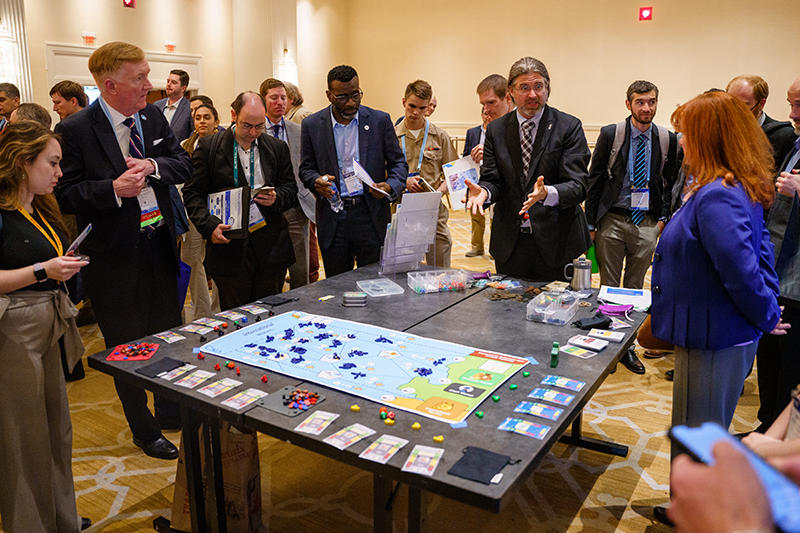
The session ended with all of the panelists demonstrating wargames they had developed like the Taiwan Straits game by Dr. Matt Cancian, of the U.S. Naval War College and the Center for Strategic and International Studies.
Most were complex with a blizzard of rules like IUU (illegal, Unreported, Unregulated) Fishing game, with a variety of dice, playing cards representing fishing boats, tiny fish, zoned areas marked with numbers indicating fisheries’ size. “You are a fishing fleet, your job is to fish,” explained Sepinsky, “each of the ships has a certain profit quota that you’re trying to make.”
The cards representing the ships have two sets of gauges “one for the welfare of the people on your ship. What are you wages. How are your social security benefits? Are you paying into their retirement plans,” said the game-co-creator.” On the right hand side you’ve got the safety of the ship. Is it patched? Is it leaking oil. Does it meet regulations and standards for the waters you’re going to be fighting in?”
In some wargames “you want them to lose just a little bit,” Dr. Yuna Wong of the Institute for Defense Analyses said. The purpose was to see what could go wrong and identify potential problems and weaknesses. Some organizations want to use wargames to validate or prove plans. “Remember wargames can’t prove anything and they can’t validate anything,” she said.
Navy’s Newest Carrier to Deploy in May, Program Official Says
Caption: Captain Kevin Smith responds to workforce pipeline question from Ann Tropea, Editor-in-Chief at Seapower.
NATIONAL HARBOR, Md. —The Navy is pressing full bore to ensure that its new guided-missile frigate joins the fleet on time, the ship’s program manager said.
“We’re pushing hard with our industry partners to deliver that ship in 2026,” said Captain Kevin Smith, program manager, Constellation Class Frigate, speaking to an audience at the Navy League’s Sea-Air-Space Expo in National Harbor. “A lot of hard work has gone into the design, the production readiness, and now we’re actually building it up in Marinette, Wisconsin.”
A frigate, in modern terminology, is “primarily an escort for high value units that don’t have their own self-defense,” Smith said. “It’s also to help offset some of the work of the large surface combatants like the cruisers and destroyers. It is a primary anti-submarine warfare platform, just like the FFG 7 [the Perry class frigates which have been decommissioned].”
“I am very happy with the performance we’re seeing thus far,” Smith said. “Obviously, we did change to a different variable to sonar a few years ago. … The performance is astounding. … Its integration with the [SQQ]-89 [antisubmarine warfare system] is going to be huge for the United States Navy and will be welcomed by the fleet.”
Smith also said the Aegis Baseline 10 combat system and the Enterprise Air Search Radar will give the new ship “a lot of capability.”
Fincantieri Partnership
The future USS Constellation (FFG 62) is one of three frigates under contract to Fincantieri’s Marinette Marine shipyard, the others being FFGs 63 and 64, under a 10-ship contract, including options. Smith said construction of FFG 62 will start soon and he expects the option for FFG 64 to be awarded this year as part of a four-ship buy.
The Navy worked with Fincantieri to design an advanced construction pilot, “to really exercise all of the capital improvements, all of their workflow processes, all of their instructions, all the way through the value stream … from materials planning and getting the work orders to the workforce, making sure all those are understood.”
The frigate’s Aegis Combat System and SPY-6 Enterprise Air Search Radar are being integrated at the Lockheed Martin test lab in Moorestown, New Jersey, and at Wallops Island, Virginia. The propulsion plant and machinery control systems will be tested at a land-based test site in Philadelphia.
Need for Skilled Workforce
Smith said the Navy is working closely with Marinette Marine in strengthening the company’s supply chain and develop and retain its skilled work force “to make sure we have a good strong industrial base workforce to build these frigates for the next decade and decades to come. We need that as part of our industrial base risk reduction.”
The program manager also discussed the challenges of recruiting a skilled work force, in response to a question from Seapower.
“How do you build a community that people want to live and grow and raise families and be shipbuilders?” he asked rhetorically. “We have people on our staff that have experience in that. The other part is working with Marinette on how we can really build the workforce. There’s training, there’s investments on how they can get people to come work and stay and then be retained.”
“Some shipbuilding people come out of high school … and they stay there a year, maybe two,” Smith said. “But if they don’t make it past two years, they’re not going to stay. So how do we get people to stay for longer than a year or two? And how do we how do we really get them excited about shipbuilding?”
“You may read about some of the things Colombia [the Columbia-class ballistic-missile submarine program] is doing,” continued Smith. “We’re looking at doing the same exact thing … to think about Wisconsin … There’s other jobs out there that maybe are better … but we’re working on a lot of those things with the company and kind of coaching them with some of this funding we got from Congress. The big message here is I would predict that this company is going to be around for a long time and we need to get into the shipbuilding business long term as far as a prime and then we’ll be able to count on them for decades.”
CMS Panelists Envision Future American Sea Power
L to R – Admiral James Foggo (Ret.) Dr. William LaPlante, Admiral Christopher Grady, USN, General Eric Smith, USMC and James Geurts discuss issues relating to Reestablishing American Seapower at the CMS breakfast.
During the Center for Maritime Strategy (CMS) Breakfast on Tuesday morning, eggs and pastries provided food for the body, while four leaders from the maritime security community provided food for thought.
The breakfast panel, “Reestablishing American Seapower,” offered a front-row view of how the U.S. military is addressing new threats from adversaries and foreign regimes.
“We face far more challenges today than I have ever seen in my 40 of years of active service,” said moderator Admiral James Foggo, USN (Ret.), dean, Center for Maritime Strategy, Navy League of the United States. He asked each panelist to explain how their teams are addressing those challenges.
William LaPlante, PhD, under secretary of defense for acquisition and sustainment, said what really matters is, “production, production, production. Everything depends on it.”
LaPlante said Navy production is defined as ship construction and other weapons development. He said since the start of fiscal year 2022, the Navy has delivered 14 battle ships, and there are plans to build seven more ships this year and as many as 17 in the following 12 months.
“But we have to do more procurement, more production, and the Navy is going to lead the way,” he said.
Capital Acquisition is Key
The magic bullet is figuring out how to acquire capital, and LaPlante said the Office of Strategic Capital (OSC) is instrumental in that. “But if we’re trying to attract capital, investors want to see a return on investment,” he said. “We need to do a better job explaining that there are production and sustainability possibilities, not just prototypes.”
Admiral Christopher Grady, USN, vice chairman, Joint Chiefs of Staff, discussed his role as head of the Joint Requirements Oversight Council (JROC). He said four transformations are taking place in the JROC:
Building on the work of predecessors who established more of a top-down culture.
Breaking out of system-oriented stovepipes and getting into consolidation management.
Transitioning to Intelligence Advanced Research Projects Activity (IARPA) process acquisition review. “It helps us go faster,” Grady said.
Keeping a scorecard for what the JROC does.
General Eric Smith, assistant commandant of the U.S. Marine Corps, detailed how the force is pivoting from several decades of land fighting in the Middle East and transforming for the future of combat.
Training and Retaining the Force
“The threat is getting more assertive, more challenging,” he said. “If you want to be ready for the next fight and not the last fight, you have to move.”
Smith said when people talk about force design, they focus on how it affects quantifiable things. “But there’s more than that. It’s about a force that’s mature, experienced and that you can retain,” he said.
“We’re doing better at training,” Smith said, noting that basic infantry training has gone from eight weeks to 14 weeks, with more of an emphasis on teams rather than individuals. In terms of retention, “we hit our recruiting numbers last year and will hit them this year,” he said.
Currently, the Marine Corps is working on organic mobility, which Smith said “provides opportunity to get where you need to go and cuts down on risk.”
Industry Partnerships
James Geurts, former assistant secretary of the Navy for research, development and acquisition; distinguished fellow for Business Executives for National Security, closed the panel session with a discussion of how the Navy is working with private industry.
The key is to transition to network thinking on the industrial base — “what I call the future industrial network,” he said. “The industrial base is not going to carry us for the next 30, 40 years.” The future industrial network is more dynamic and diverse, including international partners, venture-backed startups, traditional contractors and the tech base, he said.
Geurts also touched on capability, which he defined as a combination of equipment and training tactics supported by logistics. “Too much in the industrial base focuses only on equipment,” he said. On the industry side, Geurts said it’s key to think about networking, to reverse the urge to vertically integrate everything, and to concentrate on how to apply new technologies and innovation to more than just equipment.
A Navy of 1,000 Ships
The Honorable Carolos Del Toro sees a global navy as vital to our future
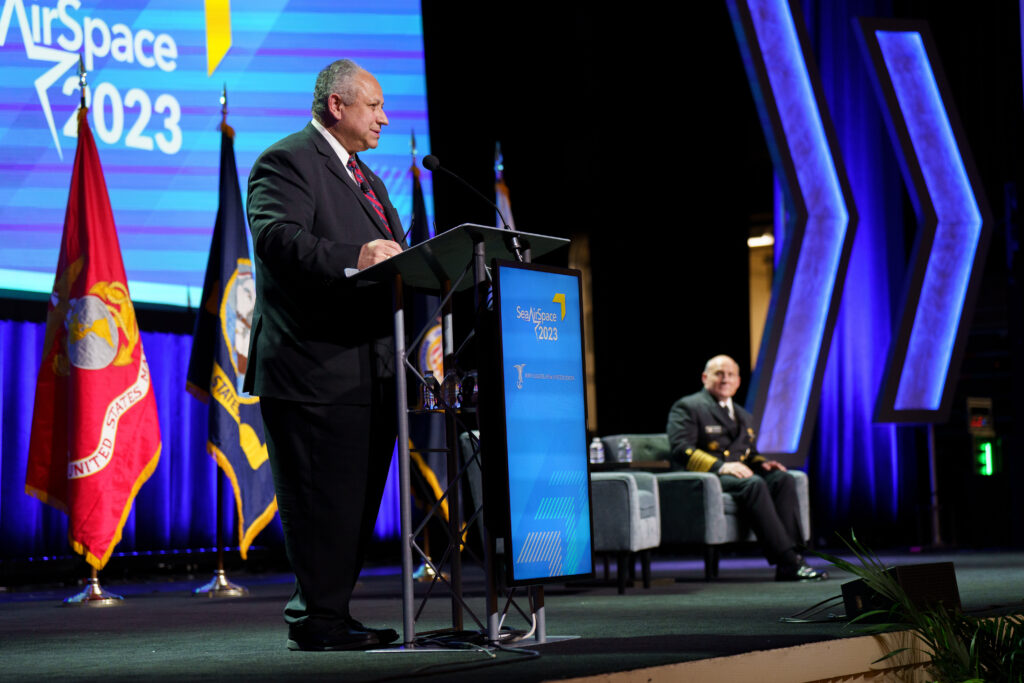
Keynote speakers: The Honorable Carlos Del Toro, Secretary of the Navy and Admiral Mike Gilday, Chief of Naval Operations
In a ballroom filled to capacity, the Honorable Carlos Del Toro once again took the stage to provide leadership, guidance, and a vision for the future of our Navy at the annual Navy League Luncheon at Sea-Air-Space 2023.
That vision includes a commitment to allies and partners from navies across the globe. Indeed, he prefaced his formal remarks by asking the entire Finnish delegation to stand and be recognized in honor of that commitment — the ballroom echoed with the claps and cheers of a standing ovation.
“Isn’t it great to be back in force?” Del Toro said as the applause died down. “Our national defense strategy calls upon the joint force to be ready to meet our nation’s challenges, from countering China in the Indo-Pacific, to reassuring our allies and partners in Europe as Russia continues its campaign in Ukraine, annexing territory in a flagrant violation of Ukraine’s sovereignty. And we will not give up. We will continue to support the Ukrainian people and the Ukrainian military for as long as it takes,” he said.
“We’re working to strengthen our partnerships both internationally and here at home,” said Del Toro, asking for all the international partners in attendance to stand and be recognized. “Now, I’d love to have a thousand ship navy myself. Maybe one day we’ll get there. Let’s work on it incrementally [with] the power of all our allies and partners working together across the world,” he said.
Del Toro also acknowledged the contribution of the legislative and executive branches, praising the “president’s administration and the Congress for their commitment to our Navy and Marine Corps team,” and citing the budget increase from $210 billion in 2021 to over $250 billion in the upcoming fiscal year.
We Can Do More
“There’s still a lot more work and a lot more commitment that needs to come here at home,” Del Toro said. “We are working with our defense industrial based partners, all of you, to reduce the maintenance delays for ships and submarines, to improve our shipyard infrastructure, develop a skilled workforce to deliver game changing technologies and capabilities to our sailors and marines and subs. If there’s one thing that’s easy to do in Washington, D.C., it’s to criticize, to constantly criticize the efforts that are going on. Let me tell you, this leadership team here, the CNO, the entire aviation team, has worked […] tirelessly to produce these ships faster and work with industry to come up with solutions that make sense,” he said.
Del Toro went on to laud the innovations and efforts of small businesses as vital contributors to the success of our fleet. “Between my previous experience as small business owner in the defense ecosystem and current position as a secretary, I’m aware of how critical our planning, partnership and industry is to fielding advance capabilities,” he said. “We have to continue to grow the department, the Navy and Partner Defense Marketplace, inviting new small businesses, medium sized businesses, and even large businesses that don’t traditionally do work with the department. It’s the only way that we’re actually going to fix the problems that we face today,” said Del Toro.
A Hybrid Navy
Admiral Mike Gilday, Chief of Naval Operations reiterated the need to partner with new companies able to innovate and expand technological capabilities that can “improve our ability to command and control this ocean of things that a manned and unmanned Navy brings to the fore.”
He also spoke of the need for a hybrid navy that routinely employed an increased number of unmanned systems and craft, citing Task For 59 as a way to, “bring together the very best in platform engineers and software designers so that we make the magic happen and improve maritime domain awareness.”
Speaking about the vast coastline of the Middle East, Gilday remarked that, “These waters are vital to the global economy. With these [hybrid] systems and artificial intelligence, we’re building a better picture of the surrounding seas by getting our hands on new systems. We’ve got to figure out what works and what doesn’t. Or apply what we’ve learned with a suite of unmanned systems deployed across the region right now. Adding value to the mission by enabling human operators to make smarter decisions faster,” Gilday said.
Del Toro ended with enthusiasm for the future. “I cannot express to you how excited I am about our endeavors in unmanned in both the Fourth and Fifth Fleet areas of responsibility as we advance towards our integration of unmanned platforms to the fleet and support of distributed maritime operations,” he said.
“If that doesn’t excite you, I don’t know what will,” said Del Toro.
A Maritime Century
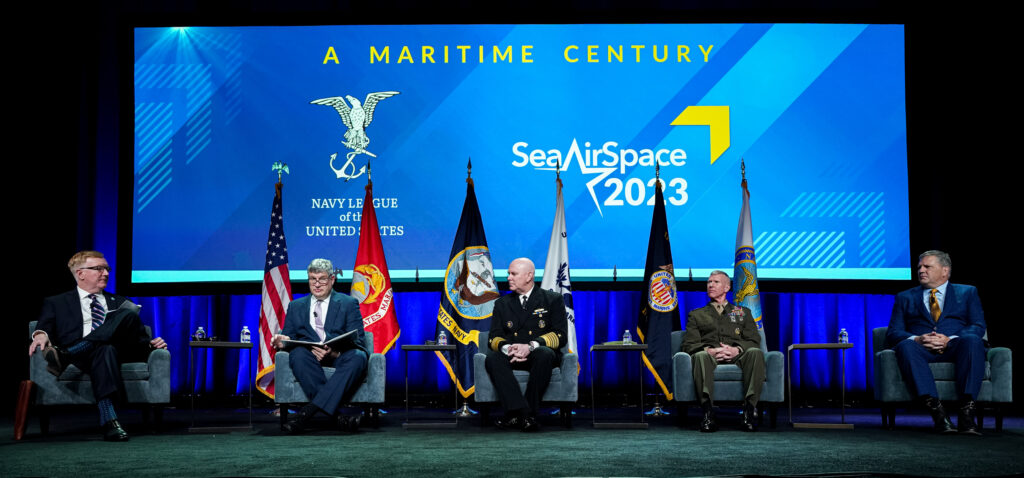
Admiral Mike Gilday, USN, Chief of Naval Operations, General David Berger USMC, Admiral Linda Fagan, USGC, Ann Phillips, Maritime Administrator, Speak during the Sea Security 2030 and Beyond: Building the Nation’s Future Force Now.
Sea-Air-Space 2023 kicked off its largest conference in history in fitting fashion — with leaders from the Navy, Marine Corps, Coast Guard, and Maritime Administration discussing the future of their forces over the next decade
To comply with the new National Defense Strategy and National Security Strategy, the sea forces are reevaluating how they recruit and retain personnel, and acquire hardware and software. During the Monday morning Sea Service Chiefs Leadership Panel discussion, “Sea Security 2030 and Beyond,” Moderator Francis Rose, founder and host of “The Federal Government Today,” concentrated on two key questions in those areas.
People First
All of you have talked about the importance of investments in people. What investments are you currently making or would like to make?
Ann C. Phillips, RDML USN (Ret.), administrator of the Maritime Administration, said safety for mariners at sea is the “north star of the department.” In late 2021, the Merchant Marine Academy launched its Every Mariner Builds A Respectful Culture (EMBARC) program that improved safety at sea, especially for women and minorities.
Only 7 percent of Merchant Marine mariners are women, and Phillips hopes EMBARC will help boost those numbers. “We don’t want them to be afraid of what will happen to them while at sea,” she said. “We are committed to investing in everyone’s safety at sea.”
Phillips said the Maritime Administration is also building state-of-the-art vessels to train future generations of mariners and encourage them to serve. The first ship, Empire State, is scheduled to be delivered this summer.
The Maritime Administration is also committed to listening to and delivering what’s important to young mariners, Phillips said, including internet access, gym equipment, good food, and vessels that are well maintained and cared for.
“Our goal is to get them at sea and get them to see there’s a place at sea for them to advance and move up,” she said.
Admiral Linda Fagan, commandant of the Coast Guard, said one of the biggest problems in attracting people to the Coast Guard is that many Americans don’t even know we have a Coast Guard, let alone the “true opportunity for service it represents. We always hear: ‘Had I known about the Coast Guard, I would have joined sooner.’”
The Coast Guard is committed to doing a better job of marketing and recruiting, Fagan said, including opening nine new recruiting offices and new junior ROTC programs. It’s also committed to quality-of life initiatives like childcare, healthcare and medical access for families.
“Our highest priority is our people,” Fagan said.
Gen. David Berger, commandant of the Marine Corps, said the Corps’ force-modernization program is focused more on people than operations. Noting ruefully that the 18-30 age group, “is not bashful about telling us what their priorities are,” Berger said not all Marine facilities or services are at the standard that service members expect.
“What’s important is where they live, the fitness centers, child development centers, where they work, where they eat. We must invest in that now,” he said.
Berger said Marine quality-of-life priorities include healthcare. “We have to make sure military members get the very best care in the world, including mental and reproductive healthcare and training.”
“The thing most people intuitively think about in terms of quality of life is the best and most realistic training, because that’s our best chance at winning,” he said. “We need to train for today, not 30 years ago.” This includes acknowledging that people learn at different paces, and weaving live, virtual and constructive training alongside our allies and partners, he said.
Adm. Mike Gilday, chief of naval operations, U.S. Navy, said the Navy is also making significant investments in live, virtual constructive training, including leveraging technology from the gaming community.
“That is the future, and we’ve found it to be highly effective,” he said, noting that the Navy is also investing in ready relevant learning, including training that’s “not cookie cutter — more creative.”
Talent management is another key Navy recruitment and retention initiative. “We want to be more transparent about what’s available to sailors and how they can manage their own career,” Gilday said. “They’re thirsty for that, and we’re very committed to delivering that.”
Shipbuilding Support
What platforms are you asking for now, and what is the status of those in progress?
“We’re in very good shape in support for shipbuilding. All of our production lines are humming,” Gilday said. “We’re optimistic about stable, predictable funding for ships, and we hope to sustain that.”
Berger said the equipment each Marine wears now is “extraordinary.” And “aircraft modernization is so far down the road, the capability is pretty eye-watering.”
The goal now is to focus on logistics. “The time to set the theater, which we grew up thinking was 30-60 days, is shorter now,” Berger said. “I can’t say it any more strongly: The power of information in a conflict is key to the ability to make adjustments.”
Fagan said the Coast Guard needs more ships with polar capacity, and the Polar Security Cutter Program is dedicated to doing that.
“We’re working on great state-of-the-art vessels and are in a great place in regard to acquisition, but we still have significant infrastructure backlog,” she said. Some shore facilities are in poor shape, and the Coast Guard would like 3 to 5 percent growth in infrastructure funding. Any current increases in funding are going to operations, including information-technology investments, she said.
Phillips said the average Maritime Administration Ready Reserve vessel is 45 years old. Consequently, the Administration, which is funded jointly by the U.S. Department of Defense and the Department of Transportation, is working to service existing vessels and buy two new, used vessels a year.
The Maritime Administration has also launched a port infrastructure-development grant program as part of its mission to foster, promote and develop the U.S. maritime industry. Last year the program funded $700 million in grants, and it has an equivalent amount available this year, Phillips said.
Northrop Grumman Introduces Team for Capture of Navy’s E-XX Program
By Ann Tropea, Editor in Chief, and Richard R. Burgess, Senior Editor
NATIONAL HARBOR, Md. — Northrop Grumman Corporation has formed its team to bid on the E-XX program, the recapitalization of the U.S. Navy’s strategic communications aircraft, a component of the nation’s nuclear strategic deterrent force.
The E-XX program is designed to produce a replacement for the Navy’s E-6B Mercury strategic communications aircraft that provides reliable command-and-control connectivity to the ballistic-missile submarines that carry Trident nuclear-armed missiles and the Air Force’s ground-based strategic missiles.
“We are very excited about the opportunity that we have today to announce the superior team that we have put together to pursue, capture, and deliver the United States Navy’s next powerful weapon system,” said Jane Bishop, vice president & general manager, Northrop Grumman, briefing reporters at the Navy League’s Sea-Air-Space Expo in National Harbor. “The expected cargo aircraft will be based upon the C-130J-30 platform and it will provide survivable, reliable and endurable command, control and communications connectivity, which is obviously very important for our national command authority to be able to communicate with ballistic submarines that are obviously capable of delivering nuclear weapons. It is absolutely crucial that the team that we put together has extensive knowledge as well as experience and weapons system integration and battle management, command, and control.”
Bishop announced the members of the Northrop Grumman capture team:
Lockheed Martin Skunk Works
Raytheon Intelligence and Space
Crescent Systems Inc.
Long Wave Inc.
“This is an all-star lineup of domain experts that we feel positioned us very well,” she said.
“Developing this team has been strategic and intentional to ensure that collectively we are an unmatched and unparalleled team, making us the optimal choice, as Jane said, to right size this mission for the United States Navy,” said Henry Cyr, director of Multi-Domain Command and Control Capture Programs for Northrop Grumman. “Together, we will go fast. We will be secure on this. Can’t fail the nuclear command control communication mission. And we are ready to take charge and move out.”
“Our 21st century security vision is designed to help the U.S. and its allies leverage emerging technologies, capitalizing on advancements in artificial intelligence, capitalizing on the increase of processing power,” said Mike Acree, director, Lockheed Martin Aeronautics, Skunk Works. “And as the 5G mil infrastructure continues to build, ensuring that the U.S. and its allies is leveraging all those technologies to ensure it’s effective in the future in constant, increasingly more complex battlespace. This mission advances the highly capable national security platform’s command and control access across all domains. … We’re developing operations in an integrated digital environment and we’re going to deliver an open system architecture that meets the compliance standards for open systems. We look forward to working with this industry dream team and will bring to bear this work C-130 mission systems integration expertise to develop a survival solution tailored to the U.S. Navy’s most critical missions in support of its tactical fleet.”
“Our resilient communication solutions are critical enablers to what we do around multi-domain operations and the nuclear command control communications enterprise,” said Paul Mongillo, vice president, Requirements and Capabilities Group, Surveillance and Network Systems. So, we’re looking forward to being part of that environment. We’re proud to be able to provide our systems integration expertise to the Navy’s E-XX program.”
“We’re excited to be part of this team,” said Clark Red, chief executive officer and co-founder of Crescent Systems. “Our focus has always been on providing the men and women who stay on alert with the best tools possible to do their job. We understand the significance of this critical system. We understand the importance as it runs 24/7/365 and the importance of it as a never-fail mission.”
“Long Wave’s first contract about 30 years ago was with the VLF Propagation Analysis for Strategic Communications,” said Tom “TC” Conroe, executive vice president of Long Wave Inc. “The E-6 community has been central to our business. It’s been a true focus on everything we do.”
.
BAE Systems to manufacture advanced Block 4 F-35 electronic warfare systems to defeat evolving threats
NASHUA, N.H. — April. 3, 2023 — BAE Systems has received $491 million in contracts from Lockheed Martin to produce state-of-the-art Block 4 electronic warfare (EW) systems for future Lot 17 F-35 Lightning II fighter jets, adding to the 1,200 F-35 EW systems it has delivered to date. The powerful Block 4 systems will accelerate the delivery of advanced EW capabilities to warfighters by combining adaptable hardware and incremental software updates.
“The Block 4 EW system will offer greater situational awareness, enhanced survivability and increased capabilities to counter modern threats, and is upgradable to address evolving threats,” said Lisa Aucoin, vice president of F-35 Solutions at BAE Systems. “Our adaptable EW system will help warfighters execute missions today and into the future, and will reduce engineering and sustainment costs for the U.S. Department of Defense and its allies.”
The Block 4 EW systems will include significantly upgraded hardware and software that improves sensing and signal-processing capabilities. New, high-performance sensors will boost the system’s ability to detect difficult-to-observe threats and more threats simultaneously.
“Our modern facilities allow us to manufacture complex, intricate electronics at scale to deliver an affordable EW capability,” said Chris Rossi, director of F-35 production at BAE Systems. “The flexibility of our active production line will allow us to seamlessly transition to the Block 4 design without skipping a beat.”
The AN/ASQ-239 provides F-35s with fully integrated offensive and defense EW capabilities, including long-range threat warning, self-protection, and targeting support. It provides 360-degree, full-spectrum situational awareness and rapid-response capabilities—allowing the F-35 to evade, engage, counter, and jam threats, and reach well-defended targets.
BAE Systems is a leader in electronic warfare, and its strength is its people—a team of knowledgeable, intelligent, and resourceful engineers, project managers, and skilled workers committed to protecting those who protect us. As the company advances next-generation EW technology, it applies its engineering and production expertise as a force multiplier, maximizing its customers’ investments in EW. BAE Systems’ next-generation Storm EWTM spectrum warfare suite is built on a common core architecture that can be customized for multiple airborne platforms, and can be upgraded in the field with software updates.
The AN/ASQ-239 system is designed and manufactured at BAE Systems’ facilities in Manchester, New Hampshire and Nashua, New Hampshire. Additional information is available at www.baesystems.com/ew and www.baesystems.com/en-us/product/f-35.
Additional Information:
As a key partner on the F-35 program, BAE Systems contributes to the aircraft in many ways. Beyond electronic warfare, the company designs and manufactures the F-35’s active inceptor control stick, vehicle management computer, and other electronics. The company also designs and builds the aft fuselage and horizontal and vertical tails, as well as the wingfold for F-35Cs and the nozzle bay doors for F-35Bs.
Navy Studying Arming P-8A Aircraft with the AARGM-ER Missile
*************
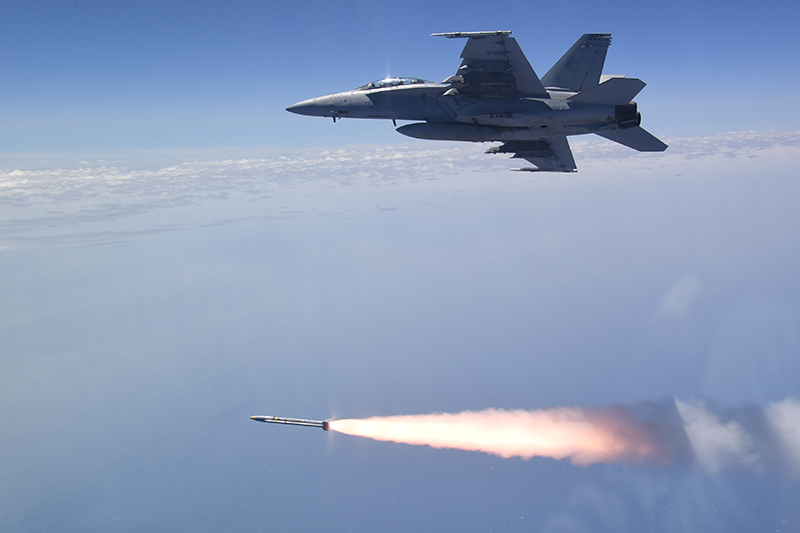
NATIONAL HARBOR, Md. — The Navy is conducting an integration study for arming its P-8A maritime patrol aircraft with the AGM-88G Advanced Anti-Radiation Guided Missile – Extended Range (AARGM-ER), a Navy program official said.
Capt. Alex Dutko, program manager for Direct and Time-Sensitive Strike, speaking April 3 to reporters in person and remotely at the Navy League’s Sea-Air-Space Expo in National Harbor, said the integration of AARGM-ER on the P-8A would be for external carriage on the aircraft’s wing stations.
The AARGM-ER, the latest version of the anti-radar missile designed to neutralize or destroy enemy air-defense radar stations, is an upgrade of the AGM-88E AARGM and is designed for internal or external carriage. The ER version integrates the AGM-88E sensors and electronics with a new solid-fuel rocket motor and tail control. The ER has a diameter of 11.5 inches, compared with the baseline’s 10-inch diameter.
The new version is designed to be carried internally in a weapons bay as well as externally. The AARGM-ER will be carried internally on the F-35A and F-35C versions of the Lightning II strike fighter and externally on those aircraft plus the F-35B, F/A-18E/F Super Hornet strike fighter, and the EA-18G electronic attack aircraft.
The AARGM-ER entered Low-Rate Initial Production (LRIP) during the fourth quarter of fiscal 2021 and has completed three of four Developmental Test firings. The fourth is scheduled for April. The second LRIP contract was awarded during the first quarter of fiscal 2022. LRIP 3 currently is in negotiation with Northrop Grumman, Dutko said.
Operational Test of the AARGM-ER is scheduled for completion during fiscal 2024, with Initial Operational Capability slated for the first quarter of that year. Full-Rate Production is expected to begin in fiscal 2025.
The missile will be available for Foreign Military Sales with LRIP 4, with deliveries occurring in fiscal 2026. Dutko said that the Navy is working to expand a cooperative agreement with the Italian Air Force — which carries the AARGM on its Toronado strike fighters — to include the AARGM-ER version. He said that multiple countries have expressed interest in the AARGM-ER.
U.S. Goal: Maintaining Extended Presence in Arctic’s Harsh Environment
NATIONAL HARBOR, Md. — U.S. Navy and Coast Guard officials say maintaining a reliable presence in the Arctic, by ship, aircraft or submarine, is crucial to protecting American interests and sovereignty in the High North.
However, Coast Guard Vice Commandant Admiral Steven Poulin said maritime patrol planes and ice breakers aren’t enough to achieve his “top priority’’ of forward presence in the Arctic’s hostile environment.
Speaking on an Arctic strategy panel April 3, Poulin said consideration of the supply and repair needs of those systems and the care of the men and women who crew those systems requires investment in infrastructure to support forward basing. Both Poulin and another panel member, Vice Admiral William Houston, Commander of Naval Submarine Forces and the U.S. Atlantic Fleet, agreed there were three U.S. strategic objectives in the Arctic: sovereignty, safety, and security. They also agreed that to accomplish them U.S. Arctic maritime operations must extend beyond Alaskan waters.
Allies and partners that share values like freedom of navigation, environmental concerns and the rule of law are needed, especially since the United States has only two ice breakers and no deepwater ports or air bases bordering the Arctic Ocean. Kodiak, Alaska near the Bering Sea, is a thousand miles from Alaska’s Arctic coast.
Melting Arctic sea ice due to climate change has been opening new sea lanes, untapped fisheries, and previously unreachable petroleum, natural gas, and mineral deposits across the top of the world. The Arctic is “an area of increasing human activity” and “increasing global competition, whether it’s for resources, access or presence. And so, for us, the key is good governance, a rules-based order that increases stability for the region. It’s also about protecting America’s sovereignty and sovereign rights,” Poulin said.
Russia has increased its military presence along its Arctic coast, reopening Cold War era bases and building several new ones. China, which styles itself a “near Arctic nation,” has made several scientific expeditions in the region and has conducted at least one naval exercise with Russia inside U.S. territorial waters.
Houston said Navy submarines have plied polar waters since 1947, and U.S. submarines, aircraft and other surface vessels have conducted 100 exercises like ICEX and Northern Edge with the United Kingdom, France, and Canada among other nations’ navies. U.S. submarines are now stopping in Tromso, Norway to pick up supplies and drop off and pick up crewmembers.
Both Poulin and Houston said communications at high latitudes was a challenge. The Navy is investing “a quarter of a billion dollars” in the Arctic where communications is absolutely key, said Houston. “If you cannot communicate, you can get yourself in a lot of trouble.” The Navy has no surface vessels with ice hardened hulls. The Coast Guard’s first polar security cutter, a heavy, armed ice breaker, is not expected to be available for years. Poulin said the Coast Guard was hoping for delivery in Fiscal 2026.
Navy Commissions First LCS with New GE Composite Engine Enclosure
NATIONAL HARBOR, Md. — The littoral combat ship (LCS) commissioned April 1 is the first equipped with the new lightweight gas turbine engine enclosure designed by GE Marine to provide greater safety and more comfortable engineering spaces for Sailors, a GE Marine official said.
Steve Rogers, director of Marketing and Business Development for GE Marine Engines, told Seapower in an April 3 interview at the Navy League’s Sea-Air-Space Expo in National Harbor, said that the Independence-class littoral combat ship USS Santa Barbara (LCS 32) is the first LCS to be fitted with the new lightweight composite-material enclosure for its engines.
“Traditionally what the Navy has used is a is a steel base on which it sits and then an enclosure with steel walls. So … loud, noisy, hot,” Rogers said. “Now it’s a single forward composite piece for the walls and the roof. So, you don’t have rust maintenance and things like that. But more importantly, [there’s] 60% less airborne noise in the engine room.”
Rogers said the temperature of the enclosure walls, “is anywhere from 25 to 50 degrees cooler. So, a lot less heat is being ejected into the engine room and the Sailors have more access, better access to the engine.”
He said the composite enclosure is 2.5 tons lighter than the steel enclosure with the same footprint, providing ship designers with the flexibility to devote more weight capacity to fuel, payloads, or other uses. The new enclosure meets the Navy’s standards for fire protection and toxicity.
The U.S. Navy will be installing the composite enclosures on its Flight III Arleigh Burke-class guided-missile destroyers and Constellation-class guided-missile frigates. The enclosure also is being installed on the Finnish Navy’s Pohjanmaa-class corvettes.
Rogers said his company has seen no supply chain issues with producing the composite enclosure, pointing out that composite material is made five miles from the plant where the enclosure is made.
GE Marine Engines is working to improve the efficiency of its gas turbine engines while maintaining the same power output and reliability, Rogers said, also noting that the company is working to meet power requirements for warships to deploy such systems as laser weapons.
He said GE Marine Engines is expanding its global network — maintenance, repair, and overhaul (MRO) facilities and service technicians — to meet the requirements of its far-flung customers. The company maintains MROs in Canada, Germany, India, Italy, Japan, and South Korea.