Naval Research Laboratory Takes Science from the Lab to the Fleet

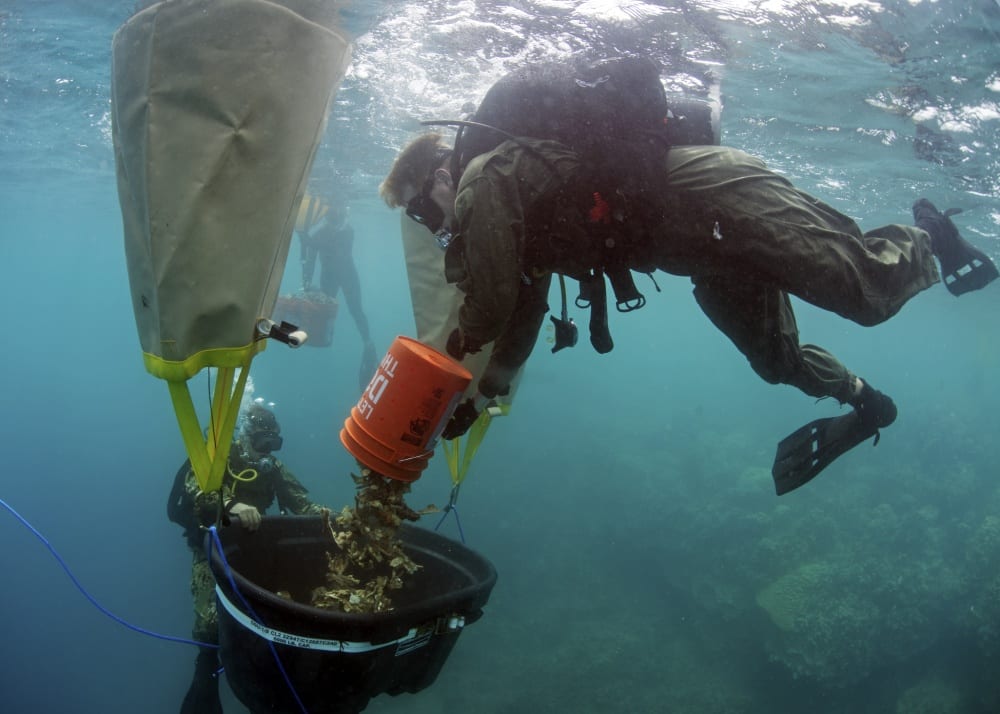
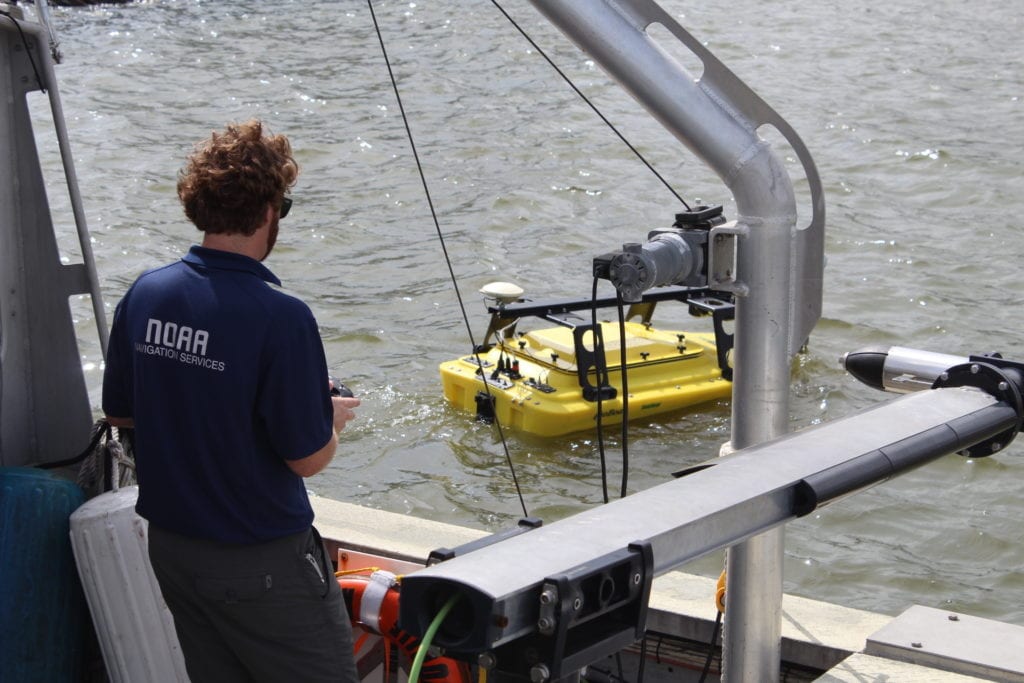
Senior Chief Mineman Abraham Garcia, left, and Aerographer’s Mate 1st Class Joshua Gaskill, members of the Knifefish unmanned underwater vehicle test team, work tending lines during crane operations as part of an operational assessment conducted by members from Operational Test and Evaluation Force. U.S. Navy / Mass Communication Specialist 1st Class Brian M. Brooks

As the U.S. Navy’s corporate laboratory, the purpose of the Naval Research Lab in Washington, D.C., is to be cognizant of – and have world-class expertise in – the very basic sciences that are fundamental to all the technologies that we have in our society, and to create new technology through continued investment in science at the very basic level.

NRL comes under the Chief of Naval Research as head of the Office of Naval Research (ONR). ONR directs much of the work of the Naval Research Enterprise (NRE), of which NRL is a part, along with Navy warfare centers, academic institutions and federally funded research and development centers.

“We are a working laboratory at NRL, and we execute science and technology development and transition it to the fleet,” said NRL’s Acoustics Division Superintendent Dr. Brian Houston.

“Our work is basic and exploratory, all the way up to applied research and transitions. Unlike many of the organizations in the NRE, we do very basic science work — so-called 6.1 level work, where you have people on the lab, for example, that are developing new mathematical theories, and making new materials using surface science techniques, or developing new optics and lasers at the very fundamental level. Like much of NRL, in the acoustics division we intertwine that very basic science with exploratory research [6.2 research] where it’s more applied, taking what we’ve learned from the basic science and identify what can evolve into technology that might eventually benefit our warfighters,” Houston said.

According to Houston, NRL must be aware of the work being conducted by colleagues in the other organizations in the NRE. But, he said, while the other organizations tend to engage in engineering refinement, NRL explores new basic science and develops technologies from it.

“When you see some NRL research that’s resulted in a breakthrough technology or capability, you’re just seeing the tip of the iceberg. That’s because there is so much basic science behind it. Our technology development teams that are bringing new capabilities and systems to our ships, aircraft and submarines have scientists who understand the very basic physics integrated with those technology teams.”

Houston came to NRL as a student, but says, “It just became a home very quickly because of the people, the facilities here and the really great problems we have to solve. I’ve been here 35 years and have never worked anywhere else.

“The acoustics piece of undersea warfare represents a lot of what we do — and it’s a very challenging area,” Houston said. “That includes finding things in the water, like submarines and things on the seabed, like mines. A major area encompassed by undersea warfare is mine warfare and not just offensive mines, but how to detect and localize adversary mines and how to deal with them. A mine is a very inexpensive weapon, and it’s relatively easy to make effective. It costs very little compared to the targets it goes after, like a billion-dollar warship, for example. They’re very difficult to detect and classify. We worry about mines today as much as we ever did.

“With regards to detection, there is a lot of stuff in the water column and even more stuff on the bottom. Mines are typically used in close proximity to the bottom, so you have to sort out the mines and detect and classify them in the context of all of this clutter and the topology of the bottom itself.”

Transcending Platforms

Houston said his work transcends platforms, sensors and processing, to include the systematic employment of all of that together. NRL has developed both a sensor approach as well as methods to analyze the data to carry out missions. From the sensor perspective, that whole technology area is what NRL calls low-frequency broad- band (LFBB), an active sonar that employs synthetic aperture processing, with processing that employs artificial intelligence for detection and classification.

“LFBB exploits the structural acoustics involved with underwater sonar. When you transmit sound, the acoustic return is very different depending on the physical object reflecting that acoustic energy. It might be a naturally occurring thing like a rock on the bottom or something that’s man-made, like a mine. In the water column, it might be a submarine versus a whale. What’s in the acoustic return is very different for each of those targets. Sonar has traditionally helped us know where something is, how far a way it is and sometime provides an image. But in addition to bearing and range, we can now determine what it is,” Houston said. “That return has specific physics in it that we can exploit, and we can know something about the physical object and based on how it responds.”

Houston said structural acoustics focuses on the inter- action of the sound with structures in a fluid — in this case, water.

“If I ping on an object underwater, the sound will propagate across the water volume and interact with the structure. The acoustic energy will cause the casing of a mine, or the hull of a submarine, to vibrate. So, the interaction of sound with a structure, and then the re-radiation of sound, is the realm of structural acoustics. Some years ago, we put together our one-of-a- kind Laboratory for Structural Acoustics here at NRL to focus on precision measurements.”

Houston’s team frequently uses unmanned systems in their research, and not just as platforms to hang sensors on or as scientific measurement tools.

“We’re also trying to figure out how to use them in under- sea warfare,” Houston said. “We’re engaging in the development of the artificial intelligence that’s needed to make those platforms work for the Navy. We’re figuring out how to best use them in terms of sensor platforms, in an applied way, the way the Navy might apply them in terms of an offensive capability. There’s a lot going on here.”

The NRL team has used their autonomous underwater vehicles Reliant and Black Pearl to develop LFBB for mine countermeasures, ASW and counter-UUV applications. Many mine-hunting UUVs employ change detection — knowing what’s on the bottom and coming back later to see if anything has changed.

“You can do change detection with almost any sonar system, including our systems, but we do not rely on change detection. Our system operates at a very high-performance level to go into an area and you can rely on the results from just a single pass,” said Houston. “That’s the objective.”

The Reliant and Black Pearl vehicles are unique compared with other platforms.

“The major difference is the sonar itself,” Houston said. “One of the reasons why we like the General Dynamics Bluefin Robotics 21-inch vehicle — both Reliant and Black Pearl are Bluefin vehicles — is they are ‘open ocean capable.’ They have a lot of energy on them, fairly high- end navigation systems, plus we have other things on them to make them very useable and capable in the open ocean. We also can go into shallow water areas and even very shallow water areas. So, we like that aspect of it. We want to have some ‘legs’ on the vehicle and navigate accurately. The sensors themselves aren’t consistent with a small vehicle, particularly because the low frequencies require larger sources and sensor apertures. We are doing a lot of onboard processing, so we can take the data and process it on board the vehicle to enable autonomous decision making enabled by the sensors, so it has access to the real-time processing of the sensor data, and it makes decisions based on that.”

Cuts Like a Knifefish

NRL has worked closely with the acquisition community. The LFBB sonar is now operational aboard the Knifefish Surface Mine Countermeasure Unmanned Undersea Vehicle Program, used to find buried, bottom and volume targets in highly cluttered environment. The system consists of two unmanned undersea vehicles along with support systems and equipment and is a critical element of the Littoral Combat Ship (LCS) Mine Countermeasure Mission Package. Knifefish received Milestone C approval last year, and the system entered low-rate initial production.

Knifefish is being built in blocks to incorporate new technology as it matures, to increase performance in each block. In addition to the LCS mine countermeasures mission package, the system can also be employed from other vessels of opportunity. Like NRL’s Reliant and Black Pearl reserve vehicles, Knifefish employs a General Dynamics Mission System Bluefin-21 vehicle.

“Knifefish’s common open systems architecture design and modularity provides the ability to quickly reconfigure the mission package to respond to evolving and dynamic mission requirements, and can be readily upgraded as new technologies or payloads are developed,” said Dr. Andrew Rogers, vice president, Undersea Defense Systems at General Dynamics Mission Systems.

For Houston and the NRL team, the scientists, engineers, and the people who know how to bend metal and make it function, are all working together in an integrated fashion to accelerate the transition of scientific discoveries to applications.

“If you don’t have that connectivity, you just can’t make the arguments that will bring a new piece of science to an application that the fleet needs,” Houston said.

The result is a program of record that will help the fleet safely find mines. “We demonstrated at-sea performance and were successful in transitioning the technology into a program of record,” Houston said. “It was basic research — the science — that started it all.”


NPS Annual Workshop Goes Mostly Virtual, Seeks to Prepare Military for Future Conflicts

The 2020 WIC annual workshop was largely virtual but tackled real-world issues focusing on future conflict scenarios. Naval Postgraduate School

The Warfare Innovation Continuum (WIC) at the Naval Postgraduate School (NPS) in Monterey, California, conducts an annual workshop to better understand a major issue that will be the subject of study for the year to follow.

In 2020, the school examined “Resurrecting War Plan Blue,” which refers to an examination conducted by the War Department between the first and second world wars about the nation’s ability to support and sustain a major conflict. 

The September 2020 Workshop, the 13th in the series, tasked participants to consider a conflict scenario in the year 2035 requiring the U.S. to quickly mobilize forces and assets in response to a rapidly deteriorating global security environment.

The three-and-a-half-day experience allowed NPS students focused interaction with faculty, staff, fleet officers, and guest engineers from Navy labs, system commands and industry. The workshop tasked participants to apply emerging technologies to shape the way we fight in a 2035 global conflict. Concept generation teams were given a design challenge: How might emerging technologies and concepts and joint, combined and coalition forces contribute to enhancing the resiliency of naval forces, logistics, and support facilities in an extended campaign against a peer adversary?

The intent was to explore technologies and policies to undertake now to increase the nation’s resiliency for an extended conflict.

The 2020 WIC workshop included 157 registered participants in the roles of concept generation team members, facilitators, panelists, mentors and observers. The full participant pool included representatives from 72 different organizations, most participating virtually. Half of the workshop participants were NPS students drawn from all naval warfare domains, as well as from the full range of armed services on campus.

Prof. Jeff Kline, Director of the Naval Warfare Studies Institute and Professor of Practice in Operations Research, said the proposed topics each year were narrowed down by employing selection criteria.

“Is the concept feasible, either physically or fiscally; is the concept unique; does the concept solve a key problem or fill a key gap; and is the concept testable?” he asked.

The issues examined for War Plan Blue are relevant today, Kline said. “We want to investigate our vulnerabilities in mobilization and industrialization, and potentially in our ability to operate forward with our infrastructure as it currently exists.” 

“Our junior officers are focused on their course of study at NPS, and early career engineers at the labs or with industry are focused on their particular project work … mixing them together in this way to work within these problem spaces is a really rich environment to not only explore what’s in the realm of the possible, but understand what that exploration can be.

“We want our own students to have an appreciation for operational challenges that are going to be emerging over the next 10 years, and [we are] teaching them how to do critical thinking to find solutions for them.”

Trending topics

In addition to supplying topics for further NPS research, past WIC Workshops have informed senior leadership and provided information and concept ideas to Naval Warfare Development Command (NWDC) and the Marine Corps Warfighting Lab (MCWL). The September 2017 workshop tasked participants to apply emerging “Distributed Maritime Operations” technologies within a near-future conflict in an urban littoral environment, and the 2018 “Cross Domain Operations” workshop looked at integration of assets. The September 2019 workshop “Logistics in Contested Environments” asked teams to focus on how to maintain forces in a sustained conflict.

Kline said the workshop brings together a mix of faculty and students with the field, fleet, academia and industry. 

“We examine the issues, and take the best ideas to inspire research and prototyping for the whole academic year. By taking on these topics suggested by senior leadership, and by socializing the results with our stakeholders, we are maintaining NPS as a thought leader, both in emerging technologies and developing concepts,” Kline said.

“Our officer students bring the tactical operational experience of this environment, and they walk away with a broadened experience in order to be able to tackle the unknown in the future,” Kline said.  “We also hope to build informal networks among the junior engineers of the nation and the operating naval officers here at NPS and those that participate, so that they start to maintain contact across both industry and the services to know how to find some of these solutions to complex problems.”

NPS students have completed several tours of duty before coming to Monterey. “They have tactical experience, and they have operational experience, although not at a senior level,” said another facilitator, Matt Largent, head of forecasting, assessment and transition at Naval Information Warfare Center Atlantic in Charleston, South Carolina. “This workshop invites them to be part of the higher-level conversation.”

Another facilitator, retired Marine Col. Todd Lyons, vice president for the NPS Alumni Association and Foundation, said the workshop was as much about problem framing as problem solving.

Prof. Lyla Englehorn was the workshop facilitator.

“My biggest goal in any of these workshops is to introduce a new toolbox to approach a complex problem space — what we call ‘wicked problems,’” she said. “You can’t propose a solution or solve a problem until you understand the status quo.”

“When we present these emerging technologies in this forum, it gives our concept generation team members a sense of what’s just outside of the box, what’s the adjacent possible,” she said. “We hear ‘thinking outside the box’ all the time. But stand on the edge of that box, what can you touch? What’s within the potential 2035 time-frame?”

Following panel discussions and presentations from leading technical experts, the teams and their embedded facilitators had seven hours of scheduled concept generation time to meet that challenge, and presented their best concepts on the final morning of the workshop.

According to Englehorn, this applied approach ensures that NPS provides defense-focused graduate education, including classified studies and interdisciplinary research, to advance the operational effectiveness, technological leadership and warfighting advantage of the naval service.

Avoiding Cost, Time, Jetlag

While the coronavirus presented challenges, there were also opportunities. The COVID-19 pandemic pushed all resident work at the Monterey campus to a remote environment, so WIC workshop became a mostly virtual affair. 

Englehorn said in spite of the pandemic, the workshop was able to include a greater breadth of participants around the world this year.

“We broadened our participation quite extensively. Technology allowed us to do that. We had students participating remotely from Singapore and Romania, and a U.S. Marine Corps officer who is on an exchange program at the Colombian Naval Academy.”

The NPS Virtual Campus employs a combination of remote learning tools, including Microsoft Teams for plenary session and concept generation team breakout rooms. The NPS distance learning platform, Sakai, supported all materials for the workshop which allowed for participants to review materials in advance, reference them throughout the workshop as well after the results have been posted. The teams also used the MURAL3 collaboration tool for concept generation work in an unclassified remote environment.

“We normally conduct this as a resident activity. Most of the teams were working at unclassified levels because of the way we executed the event. However, one team of select NPS students was able to gather in person on campus (following strict COVID 19 protocols) working on technologies related to informational warfare at the classified level. They brainstormed the old-fashioned way, with whiteboards, Post-it notes and Sharpies,” Englehorn said.

Even if Covid-19 restrictions are removed next year, Englehorn said NPS may keep some of its newly learned best practices.

“Having hybrid events using these online tools allows us to involve many more people working on these problems,” he said. “We’re not looking at the ‘new normal,’ but the ‘new next.’”


Q&A: Rear Adm. Mark H. Buzby, Maritime Administrator

Rear Adm. Buzby, right, on the California State University Maritime Academy’s Golden Bear Training Ship. Department of Transportation

Rear Adm. Mark H. Buzby was appointed by President Donald Trump and sworn in as Maritime Administrator on Aug. 8, 2017. Prior to his appointment, Buzby served as president of the National Defense Transportation Association, a position he has held since retiring from the U.S. Navy in 2013 with over 34 years of service.

A 1979 graduate of the U.S. Merchant Marine Academy, Buzby earned his Bachelor of Science in nautical science and U.S. Coast Guard 3rd Mate License. He was commissioned in the U.S. Navy in June 1979, is a graduate of the Joint Forces Staff College and holds master’s degrees from the U.S. Naval War College and Salve Regina University in strategic studies and international relations, respectively.

Buzby commanded destroyer USS Carney (DDG 64), Destroy- er Squadron 31, Surface Warfare Officers School Command and Joint Task Force Guantanamo Bay. As a junior officer, Buzby served in USS Connole (FF1056), USS Aries (PHM 5), USS Yorktown (CG 48), USS John Paul Jones (DDG 53) and USS Shiloh (CG 67), primarily in operations and combat systems billets. In 1985, he was the Atlantic Fleet Junior Officer Shiphandler of the Year.

Ashore, he served on staffs of U.S. 6th Fleet, U.S. Fleet Forces Command, the Navy staff and the Joint Staff. Buzby served as the commander of the U.S. Navy’s Military Sealift Command from October 2009 to March 2013.

Buzby discussed the concerns of the Maritime Administration (MARAD) on Sept. 28 with Senior Editor Richard R. Burgess. Excerpts follow. Check out the digital edition of the November issue of Seapower magazine here.

What concerns do you have about the nation’s sealift capabilities? Could the sealift force handle the cargo demand for a major conflict overseas?

BUZBY: My concerns are in the quantity of ships that we have, the reliability of the ships that we have and resilience of the force: in other words, the ability either repair it or to replace it if we need to due to combat loss. Theoretically, right now, we have the square footage required, about 19.2 or so million square feet, to meet the nation’s sealift requirements — the most stressing requirements — to include the commercial merchant marine plus the government-owned sealift forces. Theoretically, we’ve got enough but that’s before the first loss, that’s before any breakdowns — a lot of qualifiers there. But I don’t like living right on the edge. We need more depth on our bench than we have right now.

What can be done to strengthen the nation’s sealift force?

BUZBY: The obvious answer is it needs to be enlarged across the board both on the commercial side and the government side. The commercial side gets driven by basically peacetime economics. Is there sufficient cargo for our commercial U.S.-flag merchant marine to carry? The more cargo that is available to carry equates to more ships. That’s a good thing that adds into our sealift capacity. On the government side, it’s a matter of ensuring we recapitalize our sealift forces in a timely manner. One would argue that we are not timely right now. The force that we have is aged and its reliability is becoming more questionable every year. Getting on with recapitalizing our government sealift ships, which we’re working on, figuring out how to incentivize or to make more cargo available for the commercial side, making that playing field for our commercial entities more level in competition with the foreign flag shipping are all parts of the solution.

What concerns do you have about the Ready Reserve Force in particular?

BUZBY: There are 61 government ships in the sealift force, 15 that the Military Sealift Command operates and the 46 that MARAD operates in the RRF. They’re funded to be maintained at 85% readiness level and, unfortunately, we’re not making that level and haven’t for some time. That gets borne out in the turbo-activation tests that we do every year. We’re seeing casualties coming up and just in the day-to-day maintenance of the ships. We’re seeing it becoming increasingly difficult to keep the ships ready to go when the bell rings in the five-day readiness status. When you’re looking at a 47-year-old ship, or older, with obsolescent equipment or the availability of mariners who could operate the equipment — I’m talking steam engineers in particular — or just the physical condition of the ship itself, it is just becoming more and more of a challenge and more expensive to maintain that fleet.

How has the COVID-19 pandemic affected the U.S. Merchant Marine force?

BUZBY: It has definitely stressed it, like it has stressed all other modes of transportation. It has stressed the maritime transportation system significantly, but I would be quick to point out that [the force] has not faltered. Even though there have been greatly reduced cargoes and challenges in that respect, getting people tested and getting people certified to fill shipboard billets, the Merchant Marine has not faltered. We’ve continued to carry the goods for the nation and without the benefit of any grants or loans. Many of the other modes [of transportation] were the beneficiaries of lots of CARES Act funding to keep them viable and moving. Maritime hasn’t got any of that.

Meanwhile, we’ve managed to keep the ships sailing and figured out how to keep the crews healthy and maintain a healthy shipboard environment. We’ve put the mitigations in place to keep the ships healthy and operational. And that continues today. I’m really proud of this industry and how all the players — shipping companies, unions, the government — all came together to make that happen. It’s a real positive story, a positive chapter in our merchant marine’s history.

What role does MARAD have in physical and cybersecurity of the U.S.-flag merchant fleet?

BUZBY: We kind of stepped in and helped out with physical security during the period a few years ago when piracy was a serious threat. That has been pretty much mitigated. Now, it really, truly is the cybersecurity threat. Just literally yesterday, CMA CGM [a worldwide shipping group] of which APL — one of our Maritime Security Program carriers — is a part, had a major ransomware cyberattack against them. Just before this interview, I was talking with the president of APL, discussing the mitigations they’re having to put in place to remain operational. They are fighting through, and I am afraid that this is going to become a more common occurrence in the future, whether done by criminal actors or as part of a national-level cyberattack by a potential adversary.

Later this week, I’ll be talking to an industry group being sponsored by NMIO, the National Maritime Intelligence-Integration Office, talking about what we need to do and how to strengthen the posture of our operating forces out there because a lot of what goes on still could be mitigated to a large extent just by having up-to-date patched programs for the systems that are on the ship, plus just good hygiene practices by the operators and by the crews. Systems often have to be used by many users and crews cycle on and off and lots of times get a little lax on passwords and other security measures. We’re doing our best to try and get that word out and help people understand the need to have good cyber defenses just like they have good strong physical security on their ships.

What role does MARAD have in supporting the U.S. port facilities in modernizing and in increasing their capacity?

BUZBY: We are very much involved, especially since of all those commercial ports that are spread around our country, 16 of which are designated as strategic ports, which we would use to load military equipment in any kind of a deployment and follow-on sustainment of those forces. We pay attention to all the ports but those 16 in particular to ensure that they have all of the intermodal connections necessary to handle modern rail connections, modern road connections, marine highway connections to not only support our military movements, but also, to remain viable commercially. Our ports are this country’s economic gateways. Our economy flows through our seaports and, to a lesser extent, our airports, but certainly the vast majority of goods that come and go out of this country come through our ports. They are absolutely vital.

We’ve begun to make some strong investments in our ports. We have awarded BUILD grants and INFRA-grants that have benefitted ports over the years. In 2019 and 2020 we have dedicated port infrastructure development grants — $297 million and $225 million, respectively — that are all focused directly on port improvement and port development.

What is the status of the National Security Multi-Mission Vessel (NSMV)? Which maritime academy will receive the first one?

BUZBY: The builder has been chosen: Philly Shipyard in Philadelphia. We are well down the road in getting the final design completed. TOTE Services, our vessel construction manager, is doing a tremendous job of managing the build of the class – the “State Class.” We expect the first ship to begin fabrication in December. When complete in early 2023, it will go to the State University of New York Maritime College in Fort Schuyler. The second ship, about eight months behind the first, will be going up to Massachusetts Maritime Academy.

Will one NMSV be assigned to the U.S. Merchant Marine Academy?

BUZBY: No. At Kings Point, we train our midshipmen by sending them to sea in the active Merchant Marine. Rather than using a school ship for their training, USMMA’s training model sends Cadets to sea for four to eight months on all types of vessels in our regular commercial merchant vessel fleet, as well as Military Sealift Command and U.S. Navy vessels. That’s not to say that some Kings Pointers might end up on a training ship, if they have to make up some days or something like that, but primarily the school ships are going to the state maritime academies. We do maintain a 176-foot training vessel at the Academy, the T/V Kings Pointer, which is used for ship handling and navigation training.

Adm. Buzby visits the SS Flicktertail State, a crane ship in ready reserve for the U.S. Navy, stationed at Newport News, Virginia. Department of Transportation

What is your assessment of the preparedness of the graduates of your alma mater, the U.S. Merchant Marine Academy, to meet the challenges of the future?

BUZBY: I have absolutely tremendous faith in the U.S. Merchant Marine Academy’s ability to prepare world-class mariners. I could not compete with the quality of midshipmen that are there these days who are preparing for their maritime careers. They are just so smart in grasping and understanding technology and anxious to get out there and become a part of the industry.

Amidst the COVID crisis, the academy has done a tremendous job in remaining operational and remaining safe. They were able to graduate the class of 2020 in June COVID-free and to bring on board in July the new class of 2024 — about 280 young men and women — get them through indoctrination COVID-free, and then at the end of July brought back all the rest of the regiment of midshipmen. They’re up to almost 800 people on board all maintaining a COVID-free environment, conducting their classes and doing their sea training. There is a group of about 250 that are out at sea right now getting the Sea Year training. As I mentioned before, they are participating with the ships to make sure the ships stay clean and keep those mitigation efforts in place. They’re getting a real first-hand look at how our Merchant Marine functions even in a COVID crisis. Kings Point is doing a tremendous job. I’m very, very pleased and impressed with the job that the superintendent, Rear Adm. Jack Buono and his staff are doing up there.

What do you say to critics of the Jones Act who consider it a protectionism that is detrimental to the national economy?

BUZBY: I say it is protection for our country. The national security implications of what would happen if we were to strike the Jones Act are absolutely profound in the negative. I’ve been asked on several occasions before Congress what would happen if the Jones Act went away and I answer directly back with, we would not be able to deploy our nation’s armed forces by sea if we were to do that, not because of the ships but because of the pool of trained mariners who crew those ships. The domestic Jones Act fleet employs the largest number of unlimited tonnage/unlimited horsepower mariners of all of our ships that sail under the U.S. flag.

You get rid of the Jones Act and its requirement for U.S. mariners in U.S. ships, those mariners won’t have sailing jobs anymore and will leave the industry. Those U.S. mariners on vessels trading in the United States are the same people that I absolutely rely upon along with others from the rest of the Merchant Marine to crew up our Ready Reserve Force — all of our sealift ships in time of crisis.

I therefore lose my ability to man those sealift ships and have them available to take our nation to war if necessary. Not to mention the impact on shipbuilding and ship repair in this country — the 124 or so shipyards that we still have in this country — they would go away with the exception of just the very few yards that would be building military vessels because that requirement to build in the United States and repair in the United States would go away as well. So, it would be, perhaps the worst thing we could do from a national security point of view.


Specialized Undersea Rescue Force on Call to Aid Submariners in Trouble

Sailors from Undersea Rescue Command (URC) and Argentines load the Submarine Rescue Chamber (SRC) onto the Norwegian construction support vessel Skandi Patagonia. Undersea Rescue Command, the U.S. Navy’s only submarine rescue unit, mobilized to support the Argentine government’s search and rescue efforts for the Argentine Navy diesel-electric submarine ARA San Juan. U.S. Navy / Lcdr. John Babick

Within days of an Argentine navy submarine reported missing in 2017, several hundred tons of U.S. Navy rescue equipment arrived in South America and went to sea in a hastily assembled international rescue mission.

The diesel-electric submarine ARA San Juan (S-42) had last made contact with the Argentine Navy on Nov. 15, 2017, when the captain of the 44-member crew reported the boat had taken on water while surfacing in heavy seas to get air through its snorkel. Two days later, Argentina mobilized a search-and-rescue mission with the help of the U.S. Navy and international partners.

Within a day, crews with Undersea Rescue Command (URC) at North Island Naval Air Station, California, loaded equipment cranes, a rigid-hull boat and conex boxes packed with the Submarine Rescue Diving and Recompression System (SRDRS) onto an Air Force C-5M Super Galaxy plane, one of several that transported equipment to Argentina. The rescue system included a Sibitzky remotely operated vehicle to assess the disabled sub and rescue hatch clearance, a tethered Pressurized Rescue Module ROV to carry up to 16 personnel at a time to the surface and a transfer-under-pressure capability to decompress rescued personnel.

A week later, the mission transitioned to search and recovery. One year after San Juan went missing, the seabed exploration company Ocean Infinity found its wreckage in a ravine at 3,018 feet at the edge of the continental shelf, near where international anti-nuclear proliferation monitors had first detected an underwater explosion.

URC crews, at one point in the operation, thought they had found the sub. “But it turned out not to be the San Juan. It was an old ship,” recalled Cmdr. John Babick, Submarine Squadron 11 deputy for undersea rescue, speaking at his office at Naval Base Point Loma, California. “Unfortunately, in that case, the visual verification target was not the target that they were looking for.”

The Argentine mission was URC’s first real-world operational use of the Sibitzky ROV, which came online in 2016. Most recently, in August, crews deployed the ROV for visual verification and initial survey of a Marine Corps amphibious assault vehicle that sank off California’s San Clemente Island, killing eight Marines and a Navy corpsman that were trapped inside.

URC’s unique team of undersea and rescue specialists – about 140 active-duty Sailors, Reservists and contractors – constantly train and prepare 24/7 to surge and deploy to help rescue a disabled submarine down to depths of 2,000 feet. “Our mission is primarily a humanitarian one,” said Cmdr. Josh Powers, URC’s commander. “Thankfully, we’re not called upon to respond very much, which is a good thing.

“Rescuing a submarine,” Powers said, “is a no-fail mission.”

Time is most critical. “If there is some tragedy that occurs, if asked, our job is to remain ready to go on an airplane and fly anywhere,” said Capt. Patrick Friedman, who as Submarine Squadron 11 commander is the immediate-superior-in-charge responsible for the unit. Friedman also is the first person to leave if the call comes. “I’m the United States combined rescue forces commander. If it’s a United States-led rescue effort, I would fly immediately to the location.”

Sailors from Undersea Rescue Command (URC) and Argentines load submarine rescue equipment onto the Norwegian construction support vessel Skandi Patagonia. Undersea Rescue Command, the U.S. Navy’s only submarine rescue unit, mobilized to support the Argentine government’s search and rescue efforts for the Argentine Navy diesel-electric submarine ARA San Juan. U.S. Navy / Lcdr. John Babick

Challenges in Rescue

Submarine rescue is a complex military operation, requiring deploying search-and-rescue capabilities – from URC, Supervisor of Salvage and Diving, international military partners and contracted firms – to an airport and seaport closest to the disabled sub’s last-reported location, if known. Remote locations are harder on logistics. Then there is locating the submarine and grappling with weather and sea conditions that can hamper search-and-rescue efforts.

“It’s a big ocean, and if a DISSUB [distressed submarine] goes down, you’re really hoping that they’re able to launch a radio buoy or something to alert you to where they are – because this all starts with you have to find them first,” Babick said.

The Sibitzky usually arrives first, ahead of the rescue module. It can attach a beacon to mark location and can survey the disabled sub.

“It’s going to try to make communications, if it can, either underwater telephone or hull taps. They’re going to want to know how many survivors you have, what your atmospheres are. It’s going to want to know what the list and the trim of the boat is on the bottom,” said Babick. “It’s also going to be taking a look at the hatches, to make sure … you’re going to use has a clean and free rescue seat to mate with.” If needed, operators can use the ROV’s arms to cut netting or move debris blocking a hatch.

If the sub’s hull is intact and deemed survivable, the rescue module Falcon (PRM-1) swims down and mates to the boat. “If the internal pressure of the submarine is pressurized, you can take that Sailor … all the way to the surface support ship … [and] put him into a decompression chamber,” Babick said.

But likely scenarios of flooding or fire mean higher internal pressures put the crew at greater risk of decompression sickness that worsens with each hour and day waiting for rescue.

“You just can’t take that Sailor, him or her, straight to the surface,” he said. “You do need that transfer under pressure capability to ensure that the Sailor does not suffer from a decompression sickness, the bends.”

Rescue teams also have a submarine rescue chamber, a system largely unchanged since its inception in the 1930s. An SRC rescued 33 men from the sub USS Squalus (SS-192) in 1939, “and the system has been relatively unchanged since then,” Babick said. It can carry up to six personnel per sortie, “so it takes time to get everyone off, and the submarine cannot be pressurized, which is the biggest limitation.” The SRC operates at depths to 850 feet, pulling itself along a cable to mate to the disabled sub.

The PRM is “the most advanced capability that we have,” Friedman said, noting “we’re taking some steps toward the digital age. Connections to the units are via fiber optics, so we can get faster connections to be able to get more information on and off the ship or off the rescue asset.” SRDRS in 2008 replaced the deep submergence rescue vehicles Avalon and Mystic, part of the DSRV program developed after the 1963 loss of USS Thresher (SSN-593).

Navy Leads The Way

The worldwide proliferation of inexpensive, small diesel-electric submarines makes undersea rescue capability even more critical. “There’s a lot of interest in submarines, especially smaller countries,” said Friedman, who participated in international sub rescue exercise Pacific Reach off Australia last year. “More than 40 countries are operating submarines – more than 400 throughout the world.”

Undersea Rescue Command has to be ready to mate with different types of subs, said Babick, so it’s important to understand particular features of those subs, such as where a hatch is located and how it opens. “If you want your submarine to have the opportunity to be rescued from the U.S., there is a NATO standard that your rescue seat has to mate to.” Otherwise, those subs might only have escape as an option if no available rescue system matches up.

“It’s important to partner with nations all over the world to make sure we lend our expertise and support in different areas of the world so that we can affect a submarine rescue,” said Powers. “If there’s a submarine on the bottom waiting to be saved, it’s going to be the news story of the day and the event that everybody’s focused on,” he added.

Exercises like Pacific Reach help identify differences and commonalities in navies’ boat and rescue capabilities. “We did a lot of work on how we cooperate with other submarine rescue systems operating together in close proximity in the waterspace above the disabled submarine and how we would conduct that command-and-control needed to have two submarine rescue vehicles in the same waterspace at the same time so, we minimize rescue vehicle sortie times and speed up how fast it takes to get all of those survivors off of the submarine,” Powers said.

“You can’t afford to have complacency toward any aspect of this mission if you want to be successful when you’re called on to respond. There’s always things to learn. Every time you take the system out, you learn something new,” he said. “We just had the decompression complex delivered for the first time as part of our equipment at the end of last year. We are just finishing our first operations periods at sea with that system, and we’re learning a lot about how to decompress Sailors, the different scenarios we might encounter on a disabled submarine, and how we communicate internally inside and outside the decompression complex, as well as how we coordinate with assets off of our vessel for follow-on medical care.”

Friedman noted that while its capabilities have been rarely used for real-world missions, URC remains ready to deploy at a moment’s notice. “Our commitment to Sailors is: If you’re in rescueable waters, we’re coming to get you,” he said. “We will do everything we can to make sure we can live up to that commitment.”

This story is from the October edition of Seapower magazine. Check out the digital version of the full magazine here.


Q&A with Steven J. DiTullio, VP, Strategic Systems, Draper

Steven J. DiTullio

One of the legs of the United States’ nuclear strategic deterrent is the submarine-launched ballistic missile (SLBM). Since 1960, ballistic-missile submarines (SSBNs) of the U.S. Navy have patrolled the seas, armed initially with Polaris, then Poseidon, Trident C4, and today Trident D5 and D5LE (Life Extension) SLBMs. Since the beginning of the SLBM program in the mid-1950s, the guidance systems of all Navy SLBMs have been built by The Charles Stark Draper Laboratory, now known as Draper.

DiTullio joined the company in 1984 following a five-year career in the Navy, where he conducted five deterrent patrols while serving as a nuclear-trained officer on the SSBN USS George Bancroft. Upon joining Draper, he supported the company’s Strategic Systems program in positions of increasing responsibility before becoming vice president in 2012. In 2017, DiTullio was awarded the Fleet Ballistic Missile Lifetime Achievement Award in recognition of his accomplishments in support of the Navy’s strategic missile program.

Getting an SLBM to hit its target perhaps 4,000 nautical miles away is no small feat. DiTullio discussed the guidance system of the Trident missile with Senior Editor Richard R. Burgess. Check out the digital edition of the October issue of Seapower magazine here.

What is the scope of Draper’s role in the design and production of the SLBM guidance systems?

DiTULLIO: Historically, Draper acted in what we call a design agent role. We did the design and development. The Navy themselves contracted for the production, and Draper assisted the government with the industrial support team that was building them. In the late-1990s or early 2000s, the Navy asked Draper to take on the more classic prime [contractor] role, basically to take over for the lifecycle support of the entire guidance program, not only the design and development, but the procurement and direct management of the subcontractors who build and support the systems.

Today, Draper operates like a classic prime [for the guidance system], no different than Lockheed Martin for the missile or General Dynamics for the fire control system or for some of the other subsystems. Now that Draper is the prime, we have the capability to be a little more dynamic in setting where we operate at any given time. We have been able to gain some synergies in terms of being able to take some development activities and use them as part of our sustainment. If we have a current fleet issue or an obsolescence issue, it is a little more seamless now to bring some technology development, maybe for a future system, and accelerate that to meet an emergent need. Not that we weren’t able to do that before but, again, now that it’s all under one omnibus contract, it makes that a lot more seamless. We work intimately with the Navy to make sure we always have that right balance.

What kind of guidance system is used on the Trident SLBM?

DiTULLIO: The current system, the Mark 6, is what we would call an all-inertial system. It basically runs autonomously, but we do have the ability to use an external aid: a star sighting.

It’s celestial navigation, not much different than the era of wooden ships and iron men. We have a star catalog that sits in [the submarine’s] fire control system. As we currently are mechanized with an all-inertial system and because of the types of gyroscopes that we traditionally had used, we are prohibited from moving the guidance systems inertial platform in flight because of the errors that that would induce.

The one big difference between the Air Force ICBM [intercontinental ballistic missile] and the Navy SLBM is the fact that the ICBM has a fixed base and the SLBM has a moving base — on a submarine platform that moves throughout the ocean. The submerged submarine has no ability to know exactly where it is at the time of launch. We do have a pretty good shipboard navigator to assist in that but even that isn’t precise enough. The way that we handle that uncertainty is by taking a star sighting during missile flight to then effectively correct for the initial position error.

In general, for the classic gyroscopes that we have used up until the most recent Mark 6 life extension, they were spinning mass gyros, so we apply small amounts of torque to the gyro to maintain the platform fixed in inertial space — we would need to apply a significant amount of torque if we were to use the gyro, because you actually wanted to move the platform. When you apply torque to an electromechanical gyroscope and move the platform, you impart currents. Currents hold a lot of heat and heat causes an error. To avoid that error source, we effectively do not allow the platform to move in flight. We basically just align the platform to a known position based on the star selected in the fire control system. In flight, the idea of a gyro is to keep the platform null to whatever we align it to. That minimizes the disturbances on the gyro.

To do a star sighting with that constraint, we basically are only able to take one star sighting. That would not be a very good fix if you only took one star sighting; you can’t really triangulate where you are on the Earth. The way we get around that is that if you can pick a star that is directly over your target, you then are able to basically make some simplifying assumptions that allow you to get the same level of accuracy. The accuracy of the current system is directly related to having what we call an optimum star, the star that is directly over the target. Now, you can’t always get that due to occlusion angles from either the sun or moon, or there just are no stars at the time that you want to launch, so that’s an accuracy impact that the current system just has to absorb and we’ve designed for.

In this case, you’re actually trying to pick a star based on some conditions that have to do with the target itself. It is not unlimited — then there are also some star characteristics: brightness, stability and others in order to, when we do sight the star, be able to gain the accuracies that we want, but those are second and third order effects.

An MK6 LE guidance system is installed into a pod, which then was installed and flown under the wing of a F-15 during a test of the system. Draper

Does the missile have a lens that enables the star sighting to be made?

DiTULLIO: Yes. The current guidance system is made up of two sections. One is the electronics assembly, an enclosure or a box that houses most of the power supplies, computers, input devices and output devices. The inertial measurement unit [IMU] that holds accelerometers and the gyroscopes has — in the case of the Mark 6 — the stellar sensor, which has a camera that looks out a window on the side of the IMU at an appropriate time when the missile has shed the first three stages. Prior to that, the window is covered by the missile skin.

You must have to make this system very robust to withstand the stress of a launch from a submarine.

DiTULLIO: Yes. One of the things that separates these systems from others is the fact that it’s on a 125,000-pound rocket — a lot of vibration and shock. The other is the fact that it needs to operate continuously through adversaries’ weapons and operate in any environment it may encounter.

Does Draper get feedback from the Navy’s Trident to track the performance of the guidance system?

DiTULLIO: Yes. Every flight that the Navy flies is instrumented such that we can reconstitute and analyze the entire flight trajectory from launch point all the way through impact. We instrument the submarine, the missile and the impact area. All that data can be parsed back together to allow you to effectively pull out what are called Level 3 errors, meaning you can get down to a specific instrument scale factor or bias error.

The Navy undertakes, at a minimum, at least four test flights per year, commissioned for U.S. Strategic Command. Four times per year, Strategic Command sends a message out to an alert submarine to come back into port. At that point, the crew is prohibited from doing any maintenance. The tactical re-entry bodies are removed from a missile and a test missile kit is inserted. The aeroshell itself is the same. Then the boat goes back out to sea and launches the missile. We know the trajectory and the splash point as well as telemetered data from the missile body, which really gives us the factual data. If there were anything broken, any maintenance that was needed that would have prohibited, then they’re still prohibited. That’s how the Navy certifies the reliability and accuracy to Strategic Command and the Office of the Secretary of Defense.

How is the target location loaded into the guidance system?

DiTULLIO: Through optical data disks — the aim points are loaded into the guidance system through the fire control system. Included in that is also the star catalog information we talked about earlier. There are also files for ballistic parameters such as weather at the targets. And then, based on the launch commands, the system will choose from those target points that are loaded into the fire control system. They will routinely conduct “achievability” checks to make sure that whatever targets in their target package is achievable are based on the submarine’s location. It goes without saying there are some range limitations. You can’t hit every target from one position on the Earth.

As you think to future systems going forward, more and more we want to be able to push that capability out to the warfighter so that the submarines themselves can adapt to whatever changing targets might be based on the situation without necessarily having to have a data load from land.

Back in the day, when you had punch cards to load target data, you didn’t have nearly enough capability or memory to be able to do that. There just wasn’t enough computational capability in the shipboard systems and even in some of the flight systems, so there had to be simplifying assumptions that were made about things like gravity and some trajectory perturbations. Part of the improved accuracy of these systems over time has been the fact that, as we’ve been able to provide more throughput, memory and things like that, we’re able to reduce the number of simplifying assumptions needed to be able to accomplish the mission. Today, our system can operate in an accuracy domain like a regular tactical GPS system or even a commercial GPS system based on its ability to calculate the solution.

For these systems to be robust to the environments, you just aren’t able to operate at the state-of-the-art technology node. Today, if the fastest processor is, say, a gigabyte, we’re probably operating at a megabit. We tend to be one, two, even sometimes three generations behind whatever is current state-of-the-art. In the current system we just deployed — the Mark 6 Mod 1 Life Extension — the largest data rate that we have is a million bits. Your iPad has devices that are significantly larger than that.

Is Draper working on a next-generation SLBM guidance system?

DiTULLIO: Yes. Under the current timeline, the Ohio-class SSBN hulls have been extended out to 2040 by increasing the reactor core life. That meant we needed to have a weapons system out there. The solution was to extend the current Trident D5 Mark 6 guidance system, which we did with the D5 Life Extension program. Now, the Columbia class submarine that will begin to deploy in the early 2030s will have a service life out to 2084. The current weapons system is not designed for that lifespan. The D5 Life Extension 2 program is meant to extend the service life of the Strategic Weapons System out to 2084.

An unarmed Trident II D5 missile launches from the Ohio-class ballistic missile submarine USS Nebraska (SSBN 739) off the coast of California. U.S. Navy photo by Mass Communication Specialist 1st Class Ronald Gutridge

Is Draper working on the Defense Department’s hypersonics program?

DiTULLIO: Yes. We’ve been part of the national team from the start. Draper developed the guidance and navigation system for the Flight Experiments FE-1 and FE-2 that have flown.

The Army and Navy are under OSD [Office of the Secretary of Defense] guidance to come up with the common hypersonic vehicle. The difference is that the Army intends to launch it off the back of a truck and the Navy will look to launch it off either guided-missile submarines or guided-missile destroyers. The Strategic Systems Program office — the customer that manages the Navy’s strategic missiles — is the development agent for the common hypersonic glide body. We are helping with the guidance and navigation. For the flight experiments, we worked with Sandia, the U.S. Army Combat Capabilities Development Command Aviation & Missile Center and other government labs. The government then subsequently awarded a contract to Lockheed Martin with Raytheon to transition that design into production.


Courtney Reacts to Esper’s Battle Force 2045 Comments on Submarine Shipbuilding

Rep. Joe Courtney of Connecticut, left, shakes hands with Aviation Boatswain’s Mate Launch/Recovery (Equipment) Jeremy Stoecklein prior to a 2016 tour of the ship’s Electromagnetic Aircraft Launching System during a scheduled visit. U.S. Navy / Mass Communication Specialist 1st Class Patrick Grieco

NORWICH, Conn. — Rep. Joe Courtney, D-Connecticut, chairman of the House Armed Services Subcommittee on Seapower and Projection Forces, issued on Oct. 6 the following statement regarding Defense Secretary Mark T. Esper’s Oct. 6 comments on submarine shipbuilding during a preview of future Navy Force Structure Plan. 
 
“Today, Secretary Esper previewed a long-overdue force structure plan that begs for more detail and explanation,” Courtney said. “Notably, the Secretary shared the predictable outcome of these months of review and study — that we need a bigger and more capable submarine force. After four long years of stonewalling Congress’s commitment to enlarging our nation’s submarine fleet — including submitting a budget this year that proposed a 19% cut to the submarine budget and eliminated a planned Virginia class submarine — the Trump administration today acknowledged what has long been blindingly obvious: Our undersea fleet is dangerously small. 
 
“If Secretary Esper is serious about boosting production, he could direct his department to support the House-passed authorization and funding levels for a second Virginia-class submarine in 2021 that reverses the Administration’s anemic shipbuilding budget in the House-Senate conference process happening right now,” Courtney added. 


Coast Guard Cutter Northland Returns Home from Patrol

The crew of Coast Guard Cutter Northland conducts a live firing of the MK 75 76mm weapons system while underway, September 20, 2020, in the Atlantic Ocean. The cutter returned to its homeport of Portsmouth, Virginia, Wednesday after a 47-day patrol . U.S. Coast Guard / Seaman Vincent Bologno

PORTSMOUTH, Va. — The Coast Guard Cutter Northland (WMEC-904) returned to its homeport in Portsmouth after a 47-day patrol conducting counter-drug and migrant interdiction operations in the Caribbean Sea and Atlantic Ocean, Sept. 30, the Coast Guard 5th District said in an Oct. 1 release. 

The Northland deployed in August and offered pre-storm information and assistance to locals off the coast of Haiti.  

Prior to the arrival of Tropical Storm Laura off the island of Hispaniola, Northland crewmembers located a disoriented fisherman who had drifted approximately 17 miles offshore. The crew provided him with food and water as the ship escorted him back to land well ahead of the storm’s passage. 

The Northland also hosted a civilian Haitian-Creole interpreter for the majority of the patrol to assist with translations. 

“Before this mission I did not know anything about the Coast Guard,” said Rishi Jolivian, a Haitian-Creole interpreter aboard the Northland. “But, now I have so much gratitude and appreciation for what the Coast Guard does. I have tremendous respect for the Northland and it’s truly an awesome place to be.” 

The Northland crewmembers provided Coast Guard presence along the north coast of Haiti by conducting 20 transits through the Canal de Tortue. The crew also maintained a robust training schedule earning more than 160 qualifications in addition to running over 60 shipboard drills and over 30 hours of small boat training. A highlight for the crew was the live-fire gunnery exercise of the 76mm Mk75 Gun Weapon System. 

“I am truly humbled to command a crew that diligently works to get the job done,” stated Cmdr. Patricia Bennett, commanding officer of of the Northland. “Their remarkable ability to overcome the inherent challenges of serving aboard an aging 36-year old asset downrange during a global pandemic cannot be overstated. The crew maintained a high level of morale and camaraderie that, in my opinion, is really only encountered by those of us who serve aboard Coast Guard cutters. This crew truly demonstrates the spirit of why I go to sea.” 

Upon the Northland’s return to homeport, the crew will conduct critical maintenance and repairs to extend the ship’s service life and will undergo a rigorous training assessment to ensure emergency readiness for future deployments. 

The Northland is a 270-foot medium-endurance cutter homeported in Portsmouth, Virginia and routinely deploys in support of counter-drug, migrant interdiction, fisheries, and search and rescue and homeland security missions. 


Guam’s First Coast Guard Fast Response Cutter Arrives at Apra Harbor

Coast Guard Cutter Myrtle Hazard (WPC 1139) steams through Apra Harbor before arriving at its new homeport in Santa Rita, Guam. U.S. Navy / Mass Communication Specialist 3rd Class MacAdam Kane Weissman

HONOLULU — The Coast Guard Cutter Myrtle Hazard (WPC 1139) arrived at its new homeport in Santa Rita, Guam, Sept. 24, the Coast Guard 14th District said in a release. 
 
The crew of the Myrtle Hazard traveled from Key West, Florida to Guam, covering a distance of over 10,000 nautical miles during the two-month journey.  
 
The new Fast Response Cutter (FRC) is the first of three scheduled to be stationed on Guam and replaces the 30-year old 110-foot Island-class patrol boats. FRCs are equipped with advanced command, control, communications, computers, intelligence, surveillance, and reconnaissance systems and boast greater range and endurance. 
 
“FRCs in Guam strengthen and affirm the U.S. Coast Guard’s operational presence in Oceania,” said Lt. Tony Seleznick, commanding officer of the Myrtle Hazard. “We increase the fleet’s range, endurance, and capabilities to deter illegal behavior, support search and rescue, promote maritime stability, and strengthen partnerships.” 
 
The FRCs represent the Coast Guard’s commitment to modernizing service assets to address the increasingly complex global Maritime Transportation System. Like the Island-class patrol boats before them, the Myrtle Hazard will support the people of Guam, the Commonwealth of the Northern Mariana Islands, and our international partners throughout Oceania. 
 
FRC’s are designed for various missions including drug interdiction, defense operations, maritime law enforcement, search and rescue, marine safety, and environmental protection. FRC’s can reach speeds of up to 28 knots and endure five days at sea while covering over 2,500 nautical miles.  
 
“Myrtle Hazard will significantly increase the capabilities of the Coast Guard throughout the region,” said Capt. Chris Chase, commander, Coast Guard Sector Guam. “I am excited to welcome the crew of the Myrtle Hazard home and look forward to them conducting operations with our partners in the near future.”  
 
Myrtle Hazard, the cutter’s namesake, was the first female to enlist in the Coast Guard. Enlisting in January 1918, she became a radio operator during World War I. She ended her service in 1919 as an Electrician’s Mate 1st Class.  
 
Each FRC has a standard 24-person crew. This will bring over 70 new Coast Guard members to Guam, along with a projected 100 family members. In addition to the crews of the three ships additional Coast Guard support members and their families will also be in Guam. 


NAVSEA Commander: Planning Critical to On-Time Maintenance of Ships

Gas Turbine System Technician (Mechanical) 3rd Class Jonathan Gancayco, from Oakland, California, right, and Seaman Brice Rodgers, from Philadelphia, operate a lift on the pier beside the Nimitz-class aircraft carrier USS Dwight D. Eisenhower (CVN 69). Ike is currently pier side in Naval Station Norfolk conducting routine maintenance. U.S. Navy / Mass Communication Specialist 3rd Class Asheka Lawrence-Reid

ARLINGTON, Va. — The on-time delivery of ships, submarines and systems from the Navy’s repair yards and the private shipyards as well as on-time delivery of new construction ships remains the Naval Sea Systems Command’s (NAVSEA’s) top priority, the NAVSEA commander said.  

“It all starts with advance planning,” said Vice Adm. William Galinis, the NAVSEA commander, speaking Sept. 16 in a webinar of the Virtual Fleet Maintenance & Modernization Symposium of the American Society of Naval Engineers. “We’re going to be relentless to get the planning right.” 

Advance planning is critical in determining what work a ship will need so that materials can be ordered and delivered in time and the necessary work force assigned and mustered to perform the maintenance before the work starts. Each day matters, he said. 

Galinis noted that the duration and complexity of ship maintenance and modernization availabilities is increasing.   

“We need to be absolutely relentless in execution,” he said.  

One of the planning actions that has proved beneficial is sending assessment teams to do ship checks, inspecting a ship in advance of the availability to determine the condition and needs of the ship to develop the work package as completely as possible.  

Galinis said that one of the biggest challenges is unplanned work that emerges. Managing that change is critical to minimizing its impact on the schedule. 

He also said, “We are challenged in some areas by capacity. We need to build additional capacity.” 

The admiral said that currently 47 CNO [chief of naval operations] availabilities are being executed in private shipyards (including three nuclear-powered attack submarines at Newport News Shipbuilding). Of those, he said, approximately half are “tracking to the schedule,” he said, with the other half being challenges. In addition, 13 nuclear-powered ships — 11 submarines and two aircraft carriers — are in availabilities in the Navy’s shipyards. 

Galinis stressed the importance of teamwork between the Navy, the ship repair industry and the supply chain in meeting the challenges of on-time delivery. 

Achieving a predictable and stable workload in ship repair yards benefits both the Navy and industry, enabling the yards to hire and retain a skilled, right-sized work force, a feature that also enables suppliers to get backlogs of orders. It benefits the populations and economies of the communities located by the yards and suppliers as well. 


Cruise Missiles in the Arctic Seen as Another Outcome of Great Power Competition

The crew of the Seawolf-class fast-attack submarine, USS Connecticut (SSN 22), enjoys ice liberty after surfacing in the Arctic Circle during Ice Exercise (ICEX) 2020. ICEX 2020 is a biennial submarine exercise which promotes interoperability between allies and partners to maintain operational readiness and regional stability, while improving capabilities to operate in the Arctic environment. U.S. Navy photo by Mass Communication Specialist 1st Class Michael B. Zingaro

ARLINGTON, Va. —The Arctic, already an area of competing maritime, commercial and territorial claims among nations bordering the high latitudes, is also “an ideal site” for the launch of  strategic missiles, say two retired admirals from the United States and the United Kingdom.

“Russia is building ice-capable combatants that can launch cruise missiles,” former U.S. Coast Guard commandant Adm. Paul Zukunft told a livestreamed panel discussion at the 2020 Defense News Conference Sept. 9, adding that those missiles can range as far south as Miami, Florida. The Coast Guard has only two ice breakers and one was recently sidelined by a shipboard fire. The Navy has no vessels with ice-hardened hulls (see  https://seapowermagazine.org/u-s-lacks-ice-hardened-ships-repair-and-refueling-ports-for-arctic-ops/)

Retired British Rear Adm. Simon Williams, a former submarine commander and senior Royal Navy and Defence Ministry planner, went even further on the strategic importance of the region at the top of the globe.

“It can be used, because of its location, as a very short missile launching site,” he said. During the Cold War, when Soviet, U.S. and NATO allies’ submarines patrolled beneath Arctic seas, “we spent a huge amount of effort in tracking submarines into the High Arctic.”

While the Cold War is over “the physics don’t change,” he noted. “The reality of the High Arctic is that as a strategic area, it is of great interest for all of us for that very reason. It provides us an ideal site for the strategic launch” and with new missiles in the near future “for tactical launch as well.”

The increasing decline of sea ice in the Arctic has opened potential sea lanes in the summer months, sparking territorial disputes. Russia, Norway, Canada and the United States all have boosted their military presence in the Arctic at a rate not seen for decades. China, calling itself a near-Arctic nation, is eager to use a trans-Arctic route to move its goods and is building its own ice breakers while partnering with Russia on commercial projects in the region.

Russia has opened a new large new base while refitting seven former Soviet bases within the Arctic Circle. Moscow also has modernized its powerful Northern Fleet, increasing submarine activity and building polar icebreakers armed with cruise missiles. In response, the United States has reconstituted the 2nd Fleet, adding the North Pole to its area of responsibility.

Currently the most viable trans-Arctic crossing is the Northern sea route bordering Russia, which considers it sovereign territory. A new Russian agency requires foreign naval ships to give 45 days advance notice before transiting, provide crew manifests and declare their intentions.  The United States sees the northern route as an international waterway, said Zukunft, adding Russia’s demands are complete violation of the freedom of navigation. “Unfortunately, we don’t have reliable ships to challenge Russia on that front,” he said, suggesting working with Canada and other allies to protect U.S. interests.