Space Mission Support: Coast Guard Patrols Restricted Areas Around Launches, Re-Entries
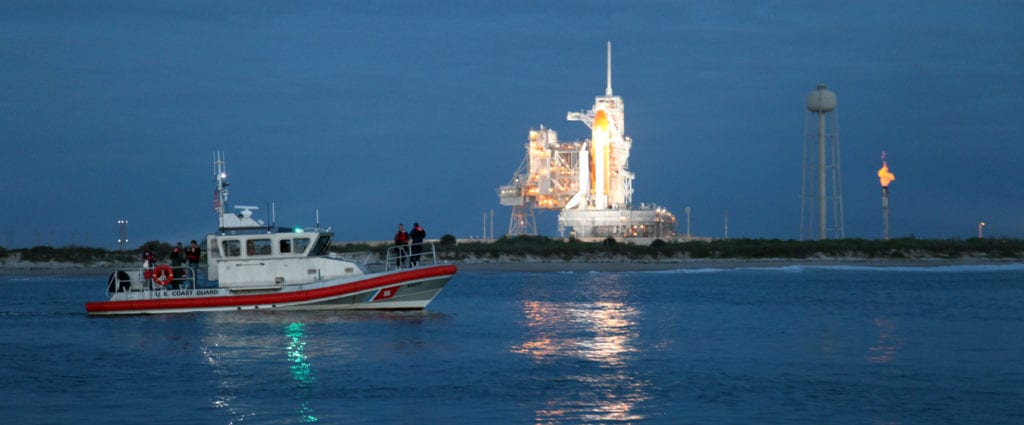
A Coast Guard Station Port Canaveral crew aboard a 45-foot response boat protects the waters near Cape Canaveral, Florida. U.S. COAST GUARD

The world was transfixed with the images of the NASA Perseverance rover landing on Mars in February. Like all space missions, it involved a myriad of partners and collaborators. Even the U.S. Coast Guard plays an important but little-known role in launch operations. In fact, the service is involved in ensuring maritime safety and security for almost every U.S. space launch.

NASA, Department of Defense and commercial space launch sites are located next to the ocean. In addition to the Kennedy Space Center (KSC) at Cape Canaveral in Florida, NASA and the Air Force also use Vandenberg Air Force Base near Lompoc, California, on the West Coast. NASA also conducts launches from its Wallops Island facility near Chincoteague, Virginia, and SpaceX has developed a commercial launch facility at Boca Chica near Brownsville, Texas, on the Gulf of Mexico. The Navy has the ability to launch targets from the Pacific Missile Range Facility on the island of Kauai, but these are not orbital missions. Other space ports are planned.

“We’ve been a mission supporter since 1955,” said Cmdr. Jill Lamb, chief of response for Sector Jacksonville, Florida.

When the space shuttle program shut down, major missions departing from the U.S. also wound down. That’s changed, however. The volume of space missions is growing as companies provide more opportunities to launch payloads, and space tourism is becoming a thing. Business is booming.

“We use a local risk assessment tool for each launch,” said Lamb. “It’s scalable, so we can look at all the factors and adjust our force laydown. It might vary, depending on if were dealing with a satellite launch or an astronaut launch.”

The Coast Guard has a memorandum of agreement with the Space Force’s 45th Space Wing. During major evolutions at the space center, the 45th, working with NASA and the commercial providers, will publish the limited access safety zone and establish a command center where the Coast Guard will participate. On launch day, the Coast Guard will monitor and patrol that zone.

Lamb said the captain of the port (COTP) promulgates a notice to mariners and local notice to mariners to set forth those limited access safety areas. In the case of the KSC launches, the COTP is the sector commander at Jacksonville, assisted by the commanding officer of Station Port Canaveral. On the day of the launch, the warnings are broadcast on marine radio channels. The restricted areas are created to keep unwary boaters or gawkers from being under an area where debris or hazardous materials might fall during a launch.

According to Chief Warrant Officer John Chandler, Station Port Canaveral’s commanding officer, the highest risk during a launch is typically within the first minute or minute and a half, depending on launch vehicle, configuration, and other factors. In some cases, flight abort tests intentionally come down shortly after launch.
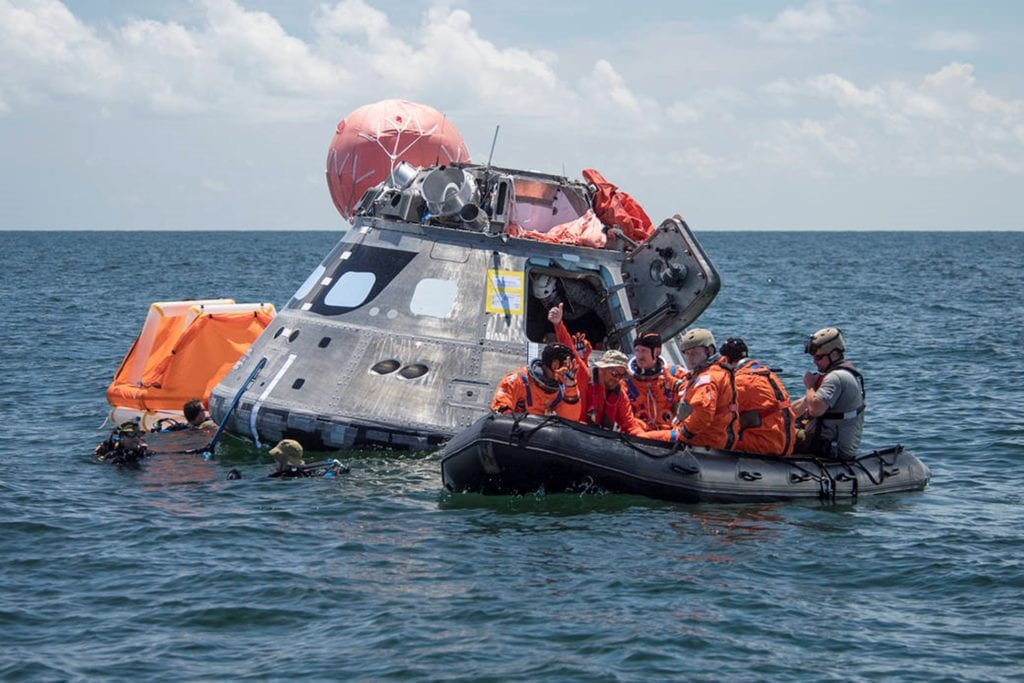
The Coast Guard provides security for landing zones when astronauts return to Earth in the Pacific or Gulf of Mexico. This 2017 test demonstrates how they will safely egress the spacecraft. NASA / Josh Valcarel

“As the local unit, we always maintain a standby SAR [search and rescue] posture,” Chandler said. “During those launches that are deemed high risk, or when we receive a request from the 45th for surveillance assets, our vessels would patrol within the launch danger area, ensuring vessel masters are aware of the hazardous areas and CG enforceable limited access areas [LAAs]. Our job with the USSF day of launch is to provide CG authority in the event a boater is causing the overall risk analysis to increase, which can affect proceeding to launch, hold or scrub.”

Usually, the mere act of informing the boaters to clear out is enough.

“No one really wants to place their vessels in any unwarranted danger. But, if our crews encounter vessels within the LAAs, we are authorized by the COTP to provide notification of violation and initiate additional enforcement documentation if necessary. Thus, for those masters who are less than cooperative, we make sure they understand that these areas are under Coast Guard authority and civil and criminal penalties can be applied.”

While space launches were traditionally a NASA show, today’s launch activities are increasing commercial operations.

“We interact with Canaveral Port Authority, Brevard County Sheriff’s Office, and Florida Fish and Wildlife,” Chandler said. “Our launch partnerships include Space Force, Air Force, NASA, FAA, as well as the launch providers themselves, such as SpaceX, United Launch Alliance, Blue Origin, Boeing and Orbital ATK.”

The sector commander also wears the officer in charge of marine inspection hat and, as such, is involved with inspecting and approving vessels such as the autonomous barges used to recover the booster sections and return them to port.

“They use some highly specialized maritime vessels, and we go aboard to ensure compliance with regulations and safety requirements,” Lamb said. “It’s becoming more challenging to learn these new vessels. They don’t fit squarely into the typical ship categories we’re used to, and each of these commercial operators have their own types of vessels. And as the technology advances and their experience grows, the operators are constantly adjusting their procedures and modifying their vessels, which means we need to conduct frequent inspections to deal with the changes.”

Historic Role

From its Cape Canaveral location just south of the Kennedy Space Center and the launch complexes operated by NASA and the U.S. Air Force, Port Canaveral has played a long and historic role in the development and growth of the space industry on Florida’s Space Coast.

Large assemblies and materials such as bulk fuels can arrive by sea at Port Canaveral. The port is an extremely busy cruise ship homeport, and also hosts Navy submarines when they call at the Navy Ordnance Test Unit.

According to Port Canaveral CEO Capt. John Murray, “Public interest in commercial space operations such as crew capsule splashdowns and recovery of space-related assets has grown as the industry’s operational cadence has increased.”

The port worked with the Coast Guard and local and state law enforcement agencies to create the security model for recovery missions off the coast of Florida.
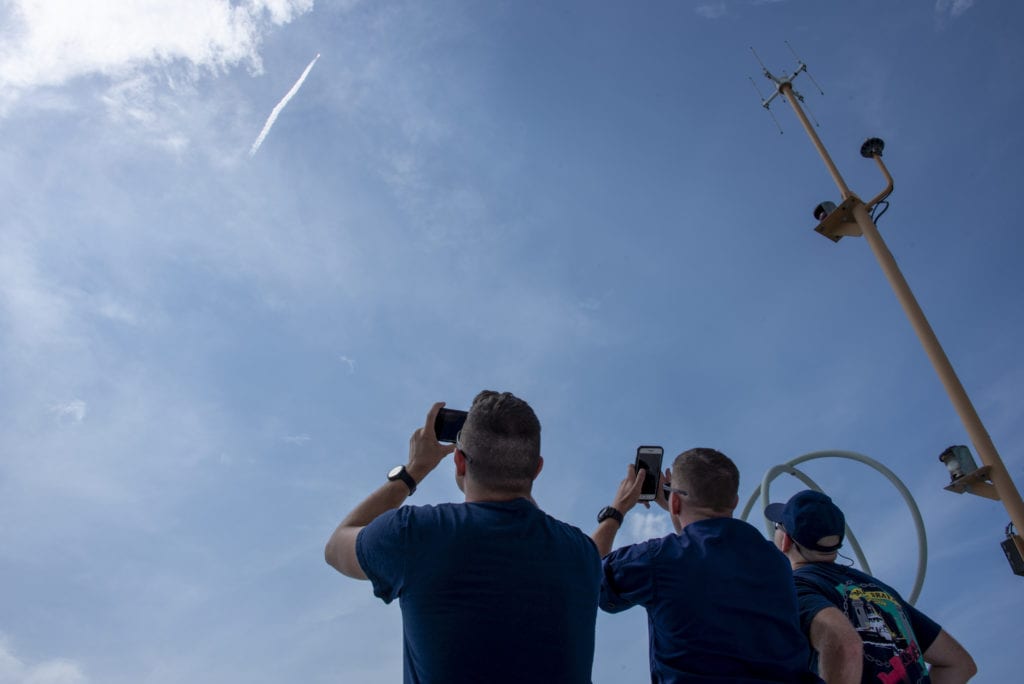
Crew members aboard the Coast Guard Cutter Maria Bray watch as a SpaceX Falcon 9 rocket carrying NASA astronauts Doug Hurley and Bob Behnken in the Crew Dragon spacecraft launches from Launch Complex 39A at Kennedy Space Center, May 30, 2020, in Cape Canaveral, Florida. Coast Guard units and crews supported the launch by enforcing safety and security zones during the rocket’s launch in order to protect members of the public, vessels, harbors, ports and waterfront facilities. U.S. COAST GUARD / Petty Officer 2nd Class Ryan Dickinson

Traditionally, Coast Guard safety zones may not extend beyond U.S. waters. In December 2020, Congress included a provision to expand the safety zone authority from 12 miles up to 200 miles offshore in the National Defense Authorization Act. This gives the Coast Guard the ability and authority to set and enforce restricted vessel navigation zones to protect the safety and security of offshore and at sea space recovery operations.

Port Canaveral also worked with its state law enforcement partners at the Florida Fish and Wildlife Conservation Commission (FWC) and commercial and military space partners to craft proposed legislation that would allow for FWC personnel to come alongside the U.S. Coast Guard in enforcing restricted vessel traffic and access to near-shore recovery operations in Florida’s coastal waters.

A new space port is being established in the Gulf of Mexico. The SpaceX South Texas launch site, also known as the Boca Chica launch site, is a private rocket production facility, test site and spaceport constructed by SpaceX, located approximately 32 kilometers east of Brownsville, Texas, on the U.S. Gulf Coast. Those launches will be supported by Sector Corpus Christi and Station South Padre Island.

The Coast Guard has the additional job of recovering rocket boosters and returning them to port. Due to the trajectories, the boosters are not jettisoned close to the launch sites — in the case of Canaveral launches, they are recovered off North Carolina. This work started in the era of the space shuttle but continues, although now some booster sections are landing on autonomous barges so they can return to port and be reloaded for a subsequent flight.

Now that U.S. capsules are once again returning to Earth, the Coast Guard has worked closely with NASA and SpaceX to plan the recovery of the SpaceX Dragon crew in August 2020. The Coast Guard established a safety zone and warned boaters to stay out of the zone before splashdown. Mariners were alerted to pending hazardous operations within a specified boundary by a broadcast notice to mariners. The zone went into effect three hours before the capsule splashed into the Gulf.

“When a when capsule detaches from the ISS, it’s coming home pretty quick,” Lamb said. “We need to be in the right place at the right time.”

When the two NASA astronauts landed in the water near Pensacola, Florida, boaters basically ignored the safety zone. The Coast Guard was not involved in recovering the crew or the capsule but was helping to keep the area clear. Boaters crowded around the spacecraft while recovery crews tried to get to the Dragon capsule and get the crew safely onto the recovery boat.

The Coast Guard said later that “numerous boaters ignored the Coast Guard crews’ warnings and decided to encroach the area, putting themselves and those involved in the operation in potential danger,” according to a statement.

More recently, an unmanned SpaceX CRS-21 Cargo Dragon capsule came down in the Gulf of Mexico west of Tampa Bay in January of this year. The Coast Guard established the safety zone and warned boaters to stay out before splashdown. The zone went into effect three hours before the capsule splashed into the Gulf exactly on time, and this time there was no interference.

While launches are becoming more routine, Lamb said they’re still spectacular to observe. “It’s a pretty incredible view.”
Adding to the Fleet: Navy Evolves to Counter Changing Threats

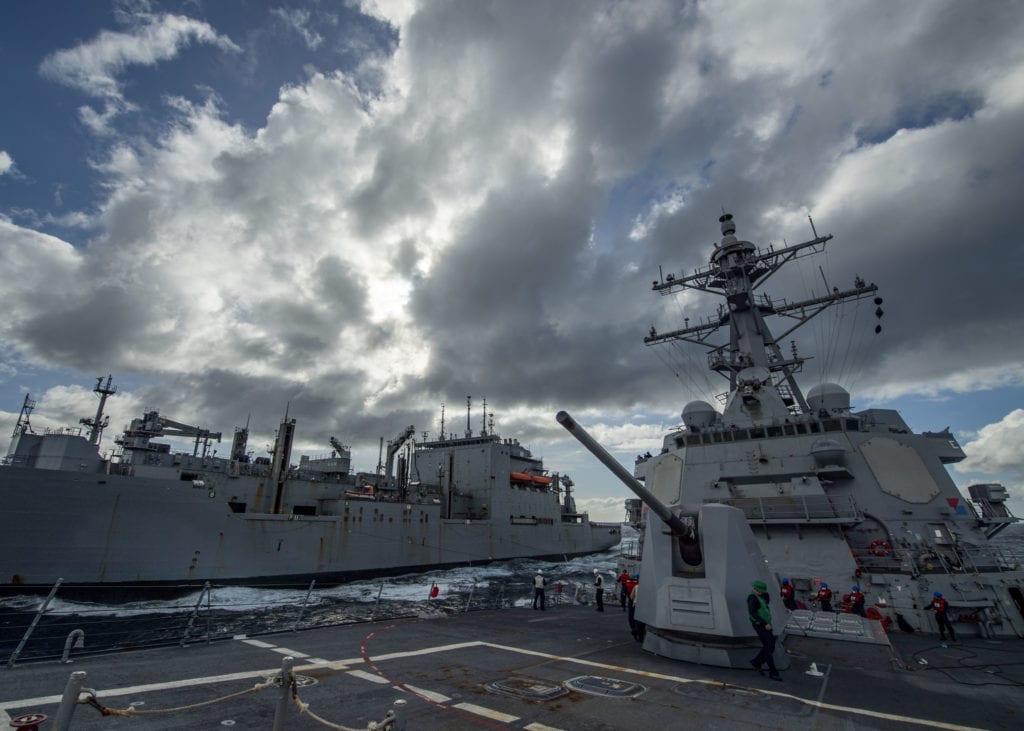
The Arleigh Burke-class guided-missile destroyer USS John Finn (DDG 113), front, transits alongside the Military Sealift Command dry cargo and ammunition ship USNS Matthew Perry (T-AKE 9) during a replenishment-at-sea Feb. 4, 2021. John Finn is on a scheduled deployment to the U.S. 7th Fleet area of operations. As the U.S. Navy’s largest forward deployed fleet, with its approximate 50-70 ships and submarines, 140 aircraft, and 20,000 Sailors in the area of operations at any given time, 7th Fleet conducts forward-deployed naval operations in support of U.S. national interests throughout a free and open Indo-Pacific area of operations. U.S. Navy/ Mass Communication Specialist 3rd Class Jason Waite

Last December, then-Navy Secretary Kenneth J. Braithwaite announced plans to bring back the U.S. Atlantic Fleet in a name change that was a deliberate message to the world — in particular the near-peer competitor nations of Russia and China as well as U.S allies — that the Atlantic Ocean and Arctic region were no longer quiet naval backwaters but areas of intense U.S. geopolitical focus.

The previous month, Braithwaite also announced plans to establish another numbered fleet for the Navy — the U.S. 1st Fleet — adding it to the seven other numbered fleets that are the main operational arms of the U.S. Navy. The service, which waged the Cold War with only four numbered fleets, has added three numbered fleets since then.

Chief of Naval Operations Adm. Mike Gilday said on Jan. 11 in a webinar of the Surface Navy Association convention that then-President Donald Trump signed off on Braithwaite’s proposed redesignation of U.S. Fleet Forces Command as the U.S. Atlantic Fleet. A timetable for the change has not been announced, but Fleet Forces Commander Adm. Chris Grady is “putting together an implementation plan for my review,” Gilday said.

Venerable Pedigree

The original U.S. Atlantic Fleet has a long pedigree that began in 1906, when the North Atlantic Squadron and South Atlantic Squadron were combined. The fleet existed in various forms until 2006, when the chief of naval operations renamed commander, U.S. Atlantic Fleet, to commander, U.S. Fleet Forces Command, which assumed the duties of the former fleet plus the mission of the former commander, Fleet Forces Command, which was “to serve as the primary advocate for fleet personnel, training, requirements, maintenance and operations issues,” according to the Fleet Forces Command website.

Sailors who had served in both Atlantic and Pacific Fleets often expressed the notion that the two fleets were like two different navies in their policies, traditions and the way they operated. The role of Fleet Forces Command in part was to standardize administration, manning, training and equipping across the entire U.S. fleet.

The move to the return of the Atlantic Fleet moniker was deliberate. Braithwaite announced the redesignation plan Dec. 2 during testimony before the Senate Armed Services Committee’s Readiness and Management Support sub- committee, noting the changing world requires the Navy to evolve to meet the threat.

“Our existing structure operates on the premise that we still live in a post-9/11 state, where NATO’s flanks are secure, the Russian fleet is tied to the pier and terrorism is our biggest problem,” Braithwaite said. “That is not the world of today. As the world changes, we must be bold, evolved and change with it. Instead of perpetuating a structure designed to support Joint Forces Command, we are aligning to today’s threat.

“To meet the maritime challenges of the Atlantic theater, we will rename Fleet Forces Command as the U.S. Atlantic Fleet and will refocus our naval forces in this important region on their original mission, to controlling the maritime approaches to the United States and those of our allies. The Atlantic Fleet will confront the re-assertive Russian navy, which has been deploying closer and closer to our East Coast with a tailored maritime presence, capability and lethality,” Braithwaite said.

“It underscores the importance of the Atlantic in a way that the title ‘Fleet Forces’ doesn’t,” Gilday said. “It actually is a testament to recent tangible decisions that we made to increase our power in that body of water, to include bringing 2nd Fleet back, standing up SubGru 2 [Submarine Group Two]. It will also include standing up [NATO’s] Joint Force Command Norfolk, which is focused on the Atlantic. In a day and age when the homeland is no longer a sanctuary and homeland defense is at the fore of every plan the combatant commanders have put together, the name ‘Atlantic Fleet’ always carries some gravitas with respect to defense of the nation.”

He noted the complexity of the redesignation, saying the command “also has responsibilities as a component [command] for [U.S.] Northern Command and the Eastern Pacific that extend up to the Arctic as well as their role as component of the [U.S] Strategic Command. They really have a global responsibility with respect to the command and control of our SSBNs [ballistic-missile submarines].”

Grady seconded the complexity in a Jan. 13 webinar at the convention, noting the “downside “might be that we would lose emphasis on what we do for the homeland.

Indeed, I control forces in both the Pacific and down south [in U.S. Southern Command area of responsibility]. So, we will balance all that, and in the end the name change is an important branding opportunity, and we will move out on that.”

“We are walking through this very methodically and deliberately before we finally execute,” Gilday said.

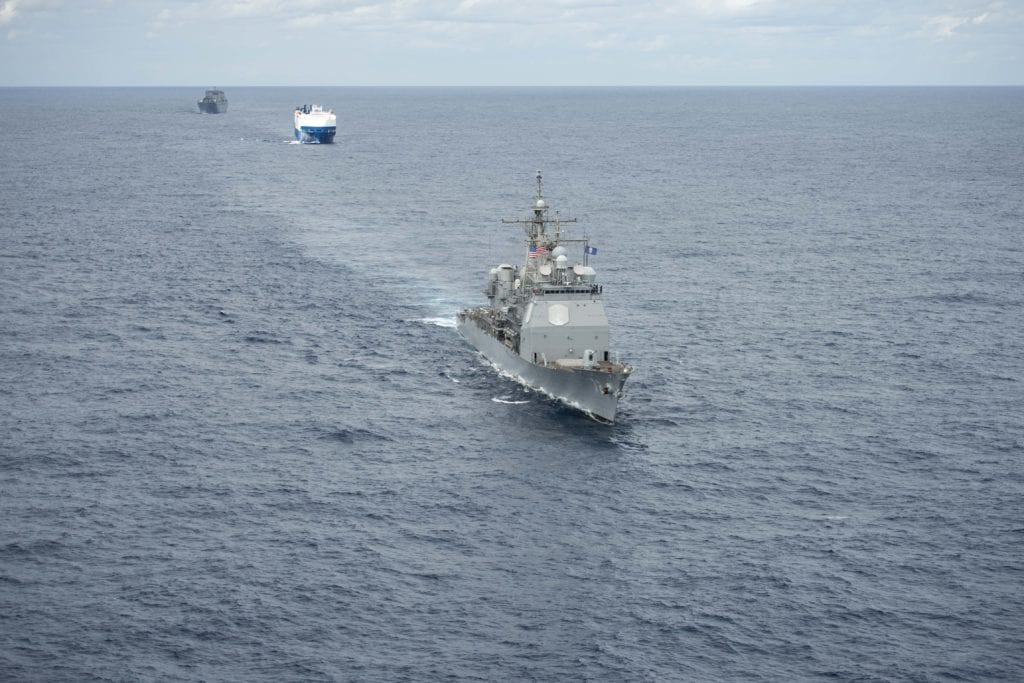
A convoy of the Ticonderoga-class guided-missile cruiser USS Vella Gulf (CG 72), right, MV Resolve, center, and USNS Benavidez (T-AKR 306), part of the 2nd Fleet, steam in formation in this 2020 photo. U.S. Navy / Mass Communication Specialist 3rd Class Andrew Waters

U.S. 1st Fleet Returning?

Braithwaite, noting the increasing Chinese hegemony in the South China Sea, the increasingly close relationship of the U.S. Navy to the Indian navy and the expanse of ocean covered by the Japan-based U.S. 7th Fleet, proposed a new fleet to cover Southeast Asia and the Indian Ocean, an area of extensive shipping traffic vital to world commerce.

“If we’re really going to have an INDOPACOM [U.S. Indo-Pacific Command] footprint, we can’t just rely on the 7th Fleet in Japan,” Braithwaite said during a Nov. 17 to webinar of the annual symposium of the Naval Submarine League. “We have to look to our other allies and partners like Singapore, like India, and actually put a numbered fleet where it would be extremely relevant if, God forbid, we were to get in any kind of a dust-up.”

Braithwaite proposed the new fleet be designated the U.S. 1st Fleet, a resurrection of a fleet staff which formerly was based in San Diego and disestablished in 1973 when the U.S. 3rd Fleet was established in Hawaii. (The 3rd Fleet headquarters later was moved to San Diego.)

He mentioned Singapore as a possible site for a headquarters for the U.S. 1st Fleet. The Navy has a logistics group staged there and has forward-deployed littoral combat ships to the base. As an alternative, the 1st Fleet staff could be “more expeditionary oriented and move it across the Pacific until it is where our allies and partners see that it could best assist them as well as assist us.”

“The establishment of 1st Fleet is still in development,” said Capt. Jereal Dorsey, special assistant for Public Affairs for the secretary of the Navy, in a Jan. 29 statement to Seapower.

“Establishing a new fleet dedicated to the Indian Ocean is a good idea,” said Bryan Clark, a senior fellow at the Hudson Institute. “India is a longtime maritime power that is modernizing its fleet and growing its cooperation with the U.S. Navy and the rest of the ‘Quad’ [Japan, Australia, United Stated, India]. A key question for the Navy to address is the area of responsibility for 1st Fleet. Incorporating East and South Africa in 1st Fleet rather than Naval Forces Europe and 6th Fleet, as they are today, would be a good idea because in many cases these countries have stronger ties to Asian countries than to Europe.

“I think including Australia or Southeast Asian nations under 1st Fleet would, in general, be disadvantageous because of the numerous maritime cooperation initiatives underway between these navies and those of the United States and Japan. However, the fleet has to be based some- where, so Myanmar, Singapore, and Malaysia could be included in 1st Fleet if the fleet were based in Singapore.

“The more important issue is whether 1st Fleet will have a substantial naval presence or any permanently assigned ships. Every other fleet has both. Adding a 1st Fleet but then only deploying forces to it in transit or for exercises may defeat the purpose of having a dedicated staff focused on the region. When the LCS [littoral combat ship] is ready for more sustained deployments, the Navy could implement the rotational crewing concept it intended in Singapore, providing assigned ships to 1st Fleet that would change out every year to 18 months. To increase presence, DoD [Department of Defense] could adjust its Central Command footprint to use locally based air, ground, and naval forces to deter Iran and allow other ships to deploy more broadly throughout the Indian Ocean.”

Changing Realities

The expansion of numbered fleets since the Cold War may seem counterintuitive with the much-shrunken size of the U.S. fleet since 1991, now roughly half the size in terms of numbers of ships. During the Cold War, the 1st and later the 3rd Fleet covered the Eastern Pacific, including the antisubmarine patrols to counter the patrolling Soviet ballistic-missile submarines off the U.S. West Coast. The 7th Fleet covered the Western Pacific and Indian Oceans. The 6th Fleet patrolled the Mediterranean. The 2nd Fleet covered the North Atlantic Ocean.

Since the end of the Cold War, the Navy has disestablished and reestablished the 2nd Fleet and has reestablished the 4th, 5th and 10th Fleets, dormant since the early post- World War II period, to adjust to changing geopolitical realities. The 5th Fleet was established to replace the Middle Eastern Force in the Persian Gulf in July 1995 in recognition of the increased need for forces in the volatile Gulf, Southwest Asia and the North Arabian Sea, and became the naval component of U.S. Central Command. The 4th Fleet was reestablished in July 2008, to serve as the naval component of U.S. Southern Command, to operate in the Caribbean Sea, and in Central and South America.

The 10th Fleet, which in World War II oversaw the campaign against German U-boats in the Battle of the Atlantic, was reestablished in July 2010 as the operational arm of Fleet Cyber Command. It commands no ships but oversees the operations of the cyber teams and other units for information warfare operations, including cyberwarfare and signals intelligence collection.

During September 2011, the 2nd Fleet was disestablished in recognition of the reduction of threats in the North Atlantic in the post-Cold War era. But with the resurgence of Russia and in particular its submarine forces, the 2nd Fleet was reestablished in August 2018.

Seapower correspondent John Doyle contributed to this report.


Navy Aims to Fast-Track Artificial Intelligence, Machine Learning to Maintain Dominance

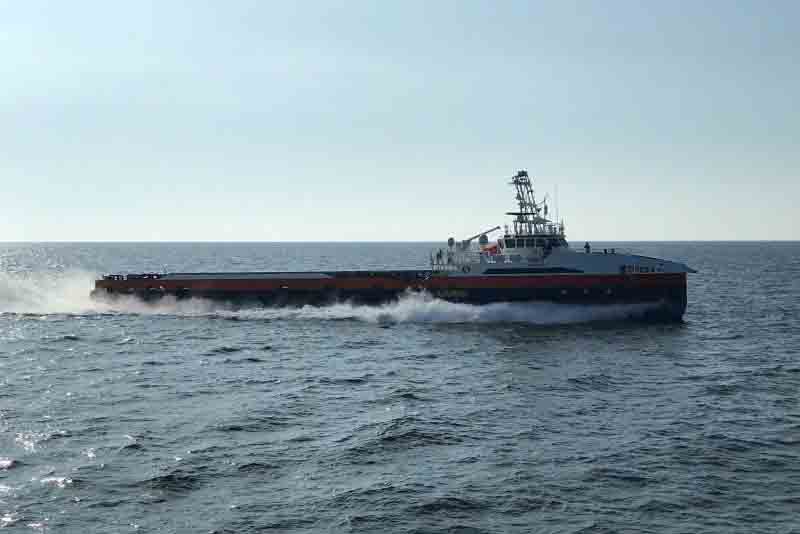
This unmanned surface vessel, part of the Strategic Capabilities Office’s Ghost Fleet Overlord program, recently made a trip from the Gulf Coast to the coast of California, almost entirely by traveling autonomously. In December, it participated in exercise Dawn Blitz, where it also demonstrated its autonomous capabilities. Defense Department Strategic Capabilities Office

Like a bolt from the blue, the Navy has a new modernization priority — Project Overmatch, a campaign to accelerate delivery of artificial intelligence, machine learning and tools needed to allow the fleet to disperse forces, mass fires, integrate unmanned ships and, in the view of service leaders, maintain maritime dominance in the future.

The project aims to begin delivering the Naval Operational Architecture (NOA), a lackluster name for a breathtaking effort whose results will determine nothing less than the service’s future ability to establish and sustain sea control by integrating network infrastructure, data and analytic tools to provide decision-advantage in a fight.

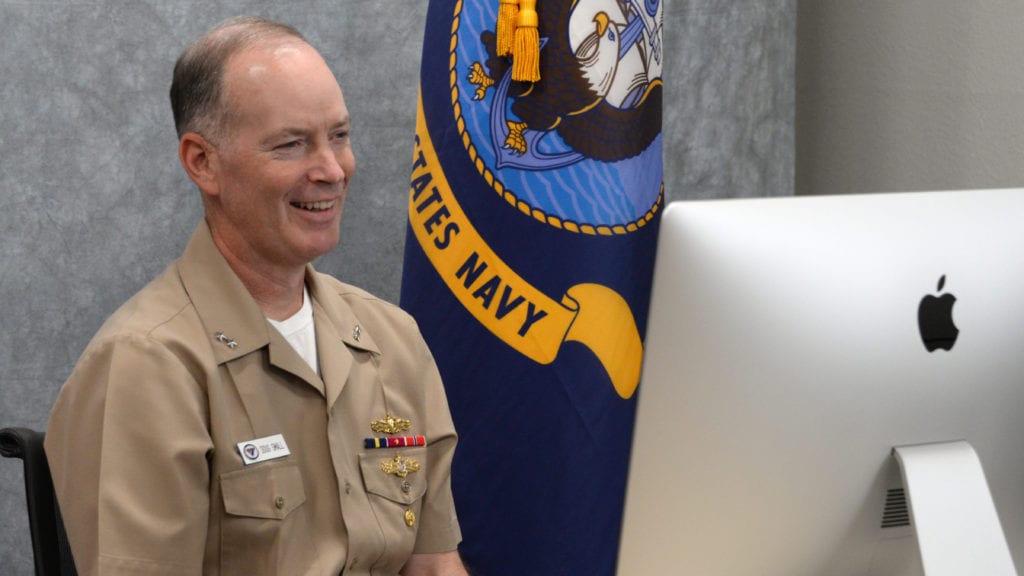
“Beyond recapitalizing our undersea nuclear deterrent, there is no higher developmental priority in the U.S. Navy,” Chief of Naval Operations Adm. Mike Gilday wrote in Oct. 1, 2020, memo to Rear Adm. Douglas Small establishing Project Overmatch. “Your goal is to enable a Navy that swarms the sea, delivering synchronized lethal and nonlethal effects from near and far, every axis and every domain.”

Small, who in addition to heading Project Overmatch is head of Naval Information Warfare Systems Command, was further tasked by the CNO “to develop the networks, infrastructure, data architecture, tools, and analytics that support the operational and developmental environment that will enable our sustained maritime dominance.”

The two-star admiral says he has committed the memo to memory and, for good measure, carries a copy at all times. Why? Gilday likens Project Overmatch to some of the most important Navy engineering and development challenges ever, including adopting nuclear power, developing the Polaris Missile and creating the Aegis Combat System.

Project Overmatch is not only about technical linkages and new software tools, according to a service official, it aims to speed development of concepts of operations for test, evaluation and capability exploitation of long-range fires, helping pave the way for new fleets of large and medium unmanned ships.

Vice Adm. James Kilby, deputy chief of naval operations for warfighting requirements and capabilities, told an online audience in January that Project Over- match plans to deliver a “minimally viable capability” — including new artificial intelligence and machine learning combat tools — to the Theodore Roosevelt aircraft carrier strike group in 2023.

Rear Adm. Douglas Small, Commander, Naval Information Warfare Systems Command (NAVWAR), discusses NAVWAR’s role in Project Overmatch to a virtual audience at the 2021 Surface Navy Association symposium from the systems command’s Old Town San Diego complex. U.S. Navy photo by Rick Naystatt

Small, speaking at a separate online conference at the end of January, described the effort in broad strokes.

“When you have a project the size of Project Overmatch — connecting everything and bringing [artificial intelligence] and [machine learning] to every- thing — you have to go at it in an agile manner,” Small said. “Step one for us was: Let’s break this thing down into agile chunks and take a look at what are the things that we’re working on currently now that we could take advantage of and grow from there.

“It consists of things like networks that are brought in as part of Overmatch,” Small said. “Certain configurations of networking gear like CANES [Consolidated Afloat Networks and Enterprise Services], certain sets of management aids and planners and things like that. And then defining data structures right for that first increment of capability. So that’s, that’s the concept behind a minimum viable product … so we’ll take some time to develop that and then get it out as it’s ready.”

Once delivered to the carrier strike group, Project Over- match aims to accelerate user feedback to developers to refine fielding of new capabilities and ensure functionality as new tools are integrated into the NOA. The effort also includes using live virtual events and training to execute and practice fleet-centered design.

JADC2

Project Overmatch is effectively the naval component of the Defense Department-wide effort to establish a Joint All-Domain Command and Control capability, which aims to network the entire U.S. weapons inventory in a manner similar to the way commercial handheld devices are linked, with each able to access an information cloud.

The U.S. military wants combat capabilities akin to Uber, Amazon and Facebook in their ability to scale and serve unique needs of different military users.

JADC2 was spearheaded by the Air Force in 2019; in 2020 the Army announced a similar campaign called Project Convergence. Last fall, the two services signed a joint memorandum of agreement to explore close integration.

While the Navy has not inked any formal agreements with the Army and Air Force, service leaders stress they are collaborating. The Navy, for instance, participated in Air Force-sponsored JADC2 events — contributing a DDG-51 Arleigh Burke-class destroyer and an aircraft carrier capable F-35C Joint Strike Fighter to a January 2020 all-service experiment that focused on defending the United States against a cruise missile attack. Navy leaders were present during the Army’s initial Project Convergence event last fall. And now projects Overmatch and Convergence are eyeing a collaborative event this summer.

Meantime, the Joint Staff is working to establish a frame- work to coordinate efforts of the three military departments. Gen. John Hyten, the No. 2 military officer and chairman of the Joint Requirements Oversight Council, estimates that by late spring the Pentagon will issue a new Joint Warfighting Concept to provide an overarching blueprint for JADC2 as well as three other key areas: joint glob- al fires, contested logistics and information advantage.

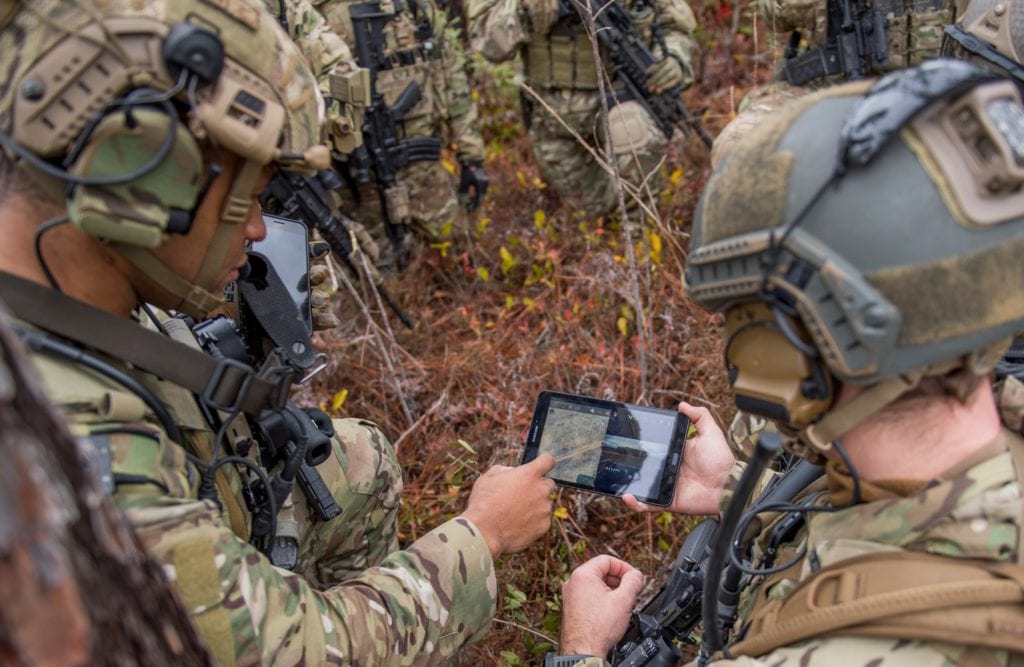
Members of the 6th Special Operations Squadron use a tablet to upload coordinates during an exercise showcasing the capabilities of the Advanced Battle Management System at Duke Field, Florida, Dec. 17, 2019. During the first demonstration of the ABMS, operators across the Air Force, Army, Navy and industry tested multiple real-time data sharing tools and technology in a homeland defense-based scenario enacted by U.S. Northern Command and enabled by Air Force senior leaders. U.S. Air Force / Tech. Sgt. Joshua J. Garcia

Building on Experience

“We’re not starting this journey from a cold start,” Kilby said of the complex effort to create new technical linkages across platforms. “We’ve been working toward it for some time.”

For instance, the Navy has developed Naval Integrated Fire Control-Counter Air, an “any sensor, any shooter” capability that extends the air and missile defense battlespace to the maximum kinematic range of weapons for air, surface and strike warfare missions. NIFC-CA allows aircraft and surface ships to pass data that enable shooters to attack targets beyond their organic detection range.

Similarly, the Cooperative Engagement Capability — through connecting sensors and communications tools — makes possible the ability for multiple surface ships and aircrafts to form an air defense network for the pur- pose of sharing radar target measurements in real-time.

The adoption of commercial-off-the-shelf hardware into the Aegis Combat System and the introduction of a common source library now allows the Navy to scale the power of the air and missile defense system across ship classes and land- based systems.

Project Overmatch seeks to replicate these sorts of integrations, but on a much larger scale.

“Our end state: We have to pass the best sensing to the best kinetic or non-kinetic platforms to create the tactical battle network, where the whole system fights as one regardless of how many units are in,” said Kilby. “Great power competition demands that we deliver distributed, networked and lethal naval force. Time is of the essence.”

On Dec. 15, Small hosted a classified conference on the West Coast for defense contractors to explain Project Overmatch. Interest was high: Representatives from 150 companies attended.

“I laid out basically everything that we’re doing, the why of everything that we’re doing, and made specific asks for help,” Small said in January. “One of the specific things that I asked for is imagination.

“We think we understand where we’re headed in terms of the future and the things that you can unleash from a connected Navy,” Small said, but noted that sometimes a new technology’s utility — he mentioned the introduction of the iPad — is not always obvious.

“There’s no user when presented with an iPad back in the day that would have said, ‘Oh my gosh, yes I need this large cell phone that’s between my laptop and my cell phone.’ It would have never hit the market,” Small said. “But the fact is by watching people and understanding the state of technology and what could be needed, the iPad is now this ubiquitous device.”

Small said he is hoping for industry’s help identifying potential in new technologies — waveforms, machine learning algorithms and such — for Project Overmatch.

“This is not something the Navy is at a standstill on,” said Small. “We’ve done some incredible things tying various networks and sensors together. So, we’re taking that to the next level and beyond.”


Fatigue at Sea: Researching How Lack of Sleep Can Affect Sailors

Naval Postgraduate School (NPS) Department of Operations Research Associate Professor Nita Shattuck, center, has led a long line of NPS students on a mission to improve the lives of their fellow service members around the world. For more than 15 years, she has devoted herself to a singular task: ensuring service members get enough rest to perform their best, especially when they are deployed and must deal with potentially life-threatening situations. Naval Postgraduate School / Javier Chagoya

Lack of sleep is problem that’s long dogged sailors at sea. Insomnia and general fatigue often are blamed for leading to mistakes, mishaps and collisions at sea, some fatal.

It’s not just anecdotal. Recent research studies have found long workdays and inconsistent sleep schedules driven by varying watchbills, undermanned crews, busy shipboard routines and high-operational tempo created fatigued crews. Limited time for rest and even noise and bright lights cut into getting a good slumber at sea.

The problem became obvious in 2017 when guided-mis- sile destroyers USS Fitzgerald (DDG 62) ran into a cargo ship and USS John McCain (DDG 56) collided with a tank- er ship in the predawn hours, the latter which resulted in the deaths of 10 Sailors. Then-Chief of Naval Operations Adm. John Richardson told a congressional committee several months later that “both of these accidents were preventable” and he ordered an overhaul of how the fleet trains, mans and operates to prevent future mishaps and bolster safer operations.

Along with recent adoptions across the surface fleet of watchbills providing more consistent periods for sleep and rest, new research projects are using high-tech devices and collecting data to fine-tune those changes and identify ways for skippers and crews to sleep more soundly and perform better, whether at sea, in the air or in the field. Researchers already are finding simple, low-tech solutions to thwart light and sound to ensure a sounder snooze at sea. And the “Crew Endurance” team at Naval Postgraduate School in Monterey, Cali- fornia, is developing online training tools and videos to help skippers and Sailors become a well-rested, more focused force.

Navy officials “are changing the culture about sleep,” said Nita Shattuck, operations research professor at Naval Postgraduate School, who leads the Crew Endurance team. “It’s been slow in coming, but I absolutely think it’s happening.”

Shattuck has spent more than 30 years studying sleep, fatigue and performance issues in the Navy, Coast Guard and Marine Corps, and her work has led to the recent changes in watchbills. “There’s still more work to be done,” she said, “but I think they’ve made huge inroads.”

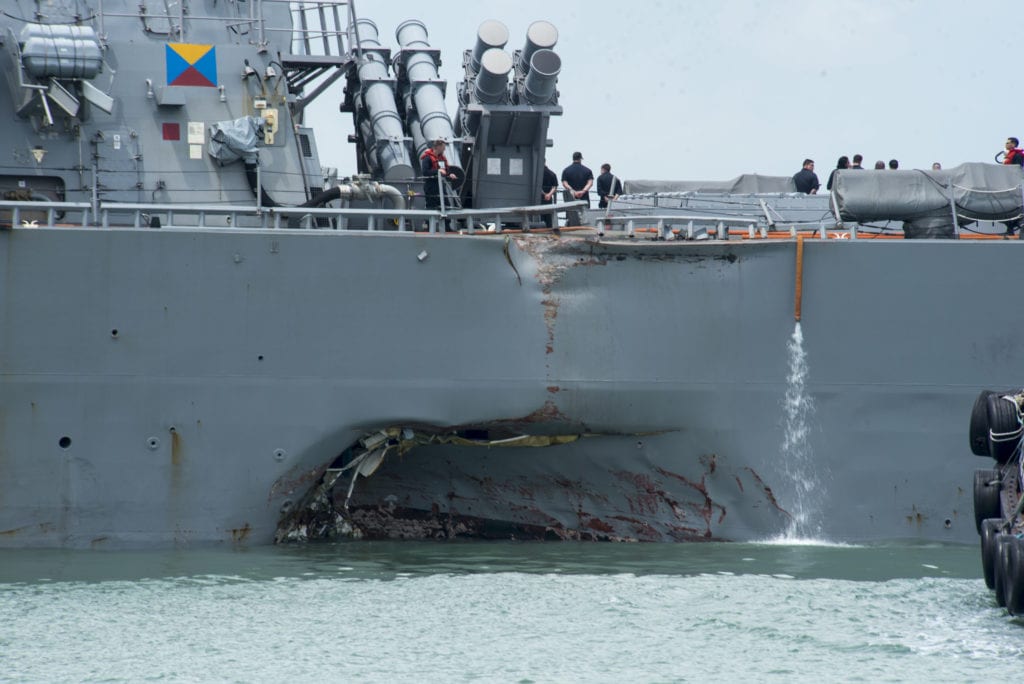
Damage to the portside is visible as the Guided-missile destroyer USS John S. McCain (DDG 56) steers towards Changi Naval Base, Republic of Singapore, following a collision with the merchant vessel Alnic MC while underway east of the Straits of Malacca and Singapore on Aug. 21. The National Transportation Safety Board found that fatigue from lack of sleep played a role in the collision and others. U.S. Navy / Mass Communication Specialist 2nd Class Joshua Fulton

Lack of Sleep

Adults need seven hours of sleep, at a minimum, but the National Sleep Foundation estimates that nearly one- third of adults averaged fewer than six hours. There’s a cost to fatigue — especially at sea.

USS John McCain’s bridge watch team, including the com- manding officer and executive officer, averaged nearly five hours of sleep in the previous 24 hours before the collision due to shifting watch schedules and lack of sleep- ing time, the National Transportation Safety Board found. Moreover, the “bridge watchstanders, particularly the lee helmsman, were acutely fatigued at the time of the accident, which impacted their situation awareness and their ability to respond to the perceived steering emergency.”

The collision happened at 5:24 a.m. in the Singapore Strait, a time which NTSB noted was “considered to be a circadian low (roughly 2 a.m. to 6 a.m.), when the body is normally more fatigued and prone to diminished alertness and degraded performance,” and the ship’s shifting watch schedules changed sleep periods daily, “which compounds fatigue related to lack of sleep and circadian lows.”

Circadian rhythms are the body’s internal clock based on the 24-hour periods of daylight and dark, but according to the National Sleep Foundation, “a disturbed sleep-wake circadian rhythm can give rise to serious sleeping problems.”

Undoubtedly, the 2017 collisions — along with prior collision of the guided-missile cruiser USS Lake Champlain (CG 57) with a fishing boat and grounding by USS Antietam (CG 54) — shook the Navy. Just months later, Naval Surface Force leaders ordered changes to give crews sufficient rest and sleep.

“The role exhaustion played in the four incidents in 2017 varies from ship to ship; however, there is no debate about the wisdom of implementing circadian rhythm–based watchbills and shipboard routines on surface force ships to provide predictable, protected periods of sleep for our Sailors and optimize alertness and recuperation,” then-Vice Adm. Thomas S. Rowden, Surface Force commander, wrote in a 2018 paper, “Surface Forces are Refocused,” directing all ships to implement those principles or incorporate circadian-rhythm principles.

Shattuck noted the surface fleet moved quickly as it already was working on improvements driven by ongoing research into fatigue and sleep. But previous years’ mishaps had met with little appetite to institute changes, even after earlier studies found links between sleep and performance.

In 2002, a study found shifting a ship’s crew from day to night air operations disrupted sleep and caused fatigue for “a large number” of Sailors, who slept during day- light hours and worked all night. Participants in the study on USS John C. Stennis (CVN 74), deployed supporting combat operations in Afghanistan, wore watch-like ActiGraphs on their wrist that collected sleep and activity data and logged their sleep, work and other activities. The workday ran from about 6 p.m. until 10 a.m. the next day.

After 30 days, Sailors reported less sleep, especially those who spent any time outside. “It is evident that sleep deprivation and fatigue due to the reversed schedule was a major problem for many of the participants in this study, Shattuck and Lt. John Nguyen wrote in the May 2003 paper for the Aerospace Medical Association. They added, “other factors may have contributed to the differences observed in sleep hours and predicted effectiveness, (e.g., working conditions, light exposure levels, type of work performed, health issues and combat stress).”

New Studies

In the two decades since that study, amid higher optempos and combat operations in Afghanistan and Iraq, military researchers and sleep labs across the services, including NPS, Naval Health Research Center in San Diego and Walter Reed National Military Medical Center in Bethesda, Maryland, have been delving into sleep and operational performance. NPS researchers have more than a half-dozen projects focused on sleep issues and solutions. These include projects on fully manned watches, sleep inertia, leaders and stress inoculation, aviator sleep and video gaming.

In one study of circadian-based watch schedules, an NPS team is collecting sleep data on guided-missile destroyer USS Gonzalez (DDG 66) “to see how are people implementing that,” Shattuck said. The study is looking at the ship’s engineering department, which got additional personnel to round out requirements, “so we are looking to see how does extra manning affect workload and sleep?

“Ships are always undermanned,” she noted, “but we’re looking to see what would happen if they do have the manning that the Navy says that they need.”

Another study focuses on sleep inertia. Someone jolted awake from deep sleep usually feels a disorienting brain fog or grogginess for some time, but that can be a critical decision-making time when out at sea. A study is looking at the problem to find ways to make that transition to full attention and performance quicker, and safer.

“How can we help somebody, like a commanding officer, if something happens in the middle of the night [and] you’ve got to awaken and make decisions?” Shattuck said. “We are monitoring people’s brainwaves with an EEG [electroencephalogram] and monitoring their sleep, so we’ll see when they go into deep sleep, we awaken them.” They then sit up and do a battery of tests and are “either exposed to bright light or to an olfactory stimulus, like a smell like wasabi … that’ll awaken them.”

A study kicked off in early January at Surface Warfare Officers School, where researchers are monitoring prospective COs and XOs “to see how they can help them perform better in case of emergencies, if something happens,” Shattuck said, focusing on leaders and stress inoculation.

The officers will use the wearable titanium Oura ring and armband stress monitors to track heart rate and other data as they go through several trainers and tests. “We’re collecting physiological data in these prospective COs and XOs and basically documenting what they’re doing to them,” she said.

In a study on aviator sleep requested by the Marine Corps, NPS researchers are using bright lights and a flight simulator in the NPS sleep lab to see how they could be used to help adjust aviators’ internal clock by tracking melatonin levels in transitioning between day and night flight schedules. Exposure to high-energy, blue-enhanced white light at their “normal” bedtime will hasten what’s called “Circadian entrainment,” Shattuck said, and presumably help them for that night flight simulating F/A-18 Hornet jet missions of several hours in different light conditions.

“So you’ve been flying days and now we’ve got to transition you to flying nights safely, and how do we do that?” she said. The study also seeks to determine how long it takes to adjust to the new schedule and how flight performance is impacted.

Two new separate studies by NPS will look at the prevalence of video gaming in the Marine Corps and in the Navy. Some recent studies have shown psychological benefits to video gaming but also problems including addiction, insomnia and lower performance.

Shattuck has seen the problem firsthand at sea among Sailors and Marines during her sleep research. “I’ve collected all of this data on ships and we’ve ridden the ships and … here are these folks that are supposed to be sleeping and they’re on the mess decks or they’re in their racks playing video games,” she said. Playing an occasional video game “is totally understandable, it’s just kind of a way to decompress, perhaps. But when you’re doing it to the exclusion of sleeping and having it impact your work and that’s what we’re concerned about.”

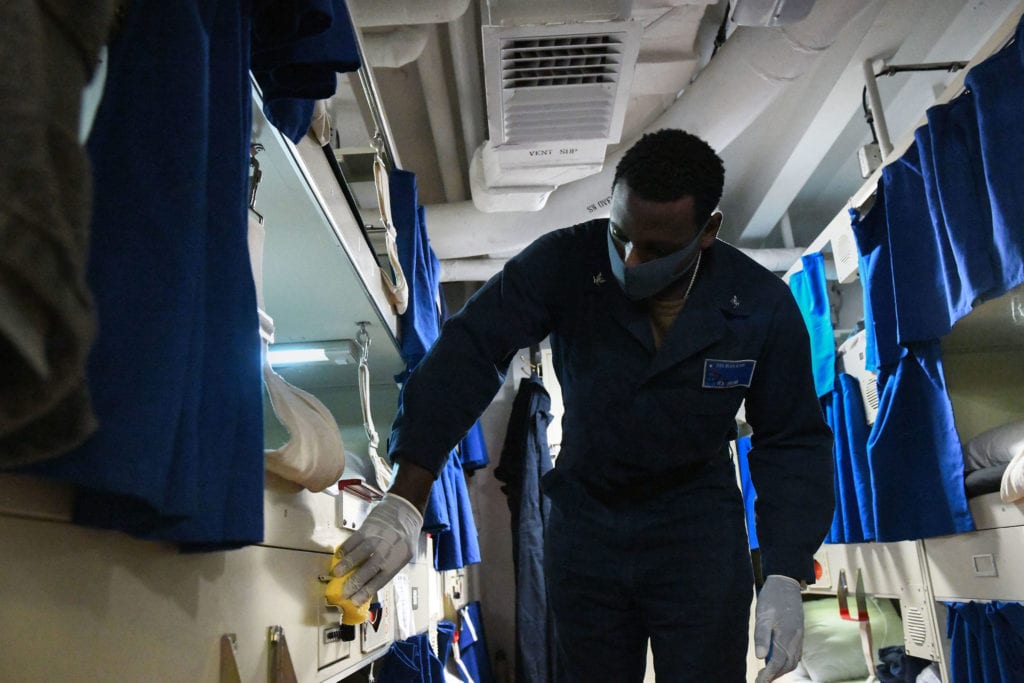
Berthing racks on the USS Blue Ridge (LCC 19), shown here being cleaned by Information Systems Technician 3rd Class Delvonte Brown. Researchers at the Naval Postgraduate School are considering new light-tight rack curtains and special sleep kits to help tune out light and noise. U.S. Navy / Mass Communication Specialist Seaman Apprentice Erik M. Rivera Jr.

Low-Tech Solutions

With noise and bright lights a constant on ship, another study is looking at whether thicker curtains on berthing racks can help Sailors get better sleep. Earlier this year, NPS bought and installed 300 pairs of heavy, flame-retardant canvas rack curtains on the guided-missile destroyer USS Paul Hamilton (DDG 60) and, with the help of wrist activity monitors, researchers are tracking the quality of sleep the crew gets.

The curtains reduce light intrusion and have pockets where Sailors can stash personal items. “Oh yeah, they love them,” Shattuck said. The curtains are made by NavyRackPacks, a small company founded by a Navy spouse and sold online and in some exchanges.

NPS also has distributed to ships’ crews involved in ongoing studies “warfighter sleep kits” that include eye coverings, a sleep mask that is convex so it doesn’t press against the eyes, a set of soft ear plugs and a card with advice about sleep, she said.

“They’re so nice to let us to come out and study the ship and everything, I want to do something nice for the crew,” she added.


Q&A: Rear Adm. John Korka, Commander, Naval Facilities Engineering Systems Command

Rear Adm. John Korka, commander, Naval Facilities Engineering Systems Command and chief of Civil Engineers, assesses progress on a construction project at the U.S. Naval Observatory in Washington, D.C., Nov. 16, 2020. U.S. Navy / Mass Communication Specialist 1st Class Gary Granger/Released)

Rear Adm. John Korka, Civil Engineer Corps (CEC), is the commander of Naval Facilities Engineering Systems Command (NAVFAC) and chief of Civil Engineers. He leads NAVFAC’s CEC officers, civilians and contractors who serve as engineers, architects, contract specialists and technical professionals. His command delivers facilities engineering, expeditionary, and acquisition support to the Navy and Marine Corps, Unified Commanders, and Department of Defense agencies.

Korka discussed NAVFAC’s activities with Senior Editor Richard R. Burgess. Excerpts follow:

The Navy acquisition community has pushed contracts ahead of schedule to help industry get through the COVID crisis. What has NAVFAC done to advance contract awards or task orders to help in the current pandemic?

KORKA: At the start of this global pandemic, the CNO [chief of naval operations] and [James F. Geurts, assistant secretary of the Navy for research, development and acquisition] did something that I thought was critical. They set the tone and established priorities for operating in the COVID-19 environment. First and foremost, the health and safety of our military and civilian workforces was absolute. Second, we needed to maintain readiness and ensure the Navy does not come to an all stop. Lastly, it was important to support the whole of government approach in tackling COVID-19. Along with these priorities, Secretary Geurts released policy and emphasized our responsibility to keep execution moving forward smartly, support efforts to sustain a healthy industrial base, and to make sure that we did not use COVID as a rationale to stop efforts — I am talking primarily our construction work and sustaining functions to support base operations.  

We used the priorities from the CNO and secretary to quickly move out as a SYSCOM [systems command] along three fronts — safety protocols, operating virtually and ceaseless communications. From the onset we strictly enforced adhering and complying with COVID-19 protocols. We were not going to compromise safety in any evolution, and we also wanted to make sure that our contractors were mindful of these requirements since protocols would be enforced.

The next leap was even more important — our jump into the digital domain. By that I mean we already had a good plan to move into online processing and pressing ahead into the virtual front. The pandemic actually accelerated that effort for us. Since the start of the COVID-19 emergency, we’ve had virtual site visits to accommodate contractors who were restricted in movement; we’ve held virtual safety training to educate contractors on bidding government work; and we’ve established policy and procedures for accepting electronic proposal submissions. All these happened quickly and allowed us to still do things that, typically, would have required a physical presence.

Lastly, we implemented a pretty aggressive outreach campaign with our industry partners to improve lines of communication. We held monthly virtual roundtable discussions with the construction/engineering industry, base operating support services contractors, and small business. These efforts definitely helped us better understand some of their challenges and recognize if industry needed our help with any policy relief. The monthly communication meetings are still occurring and have proven to be very successful.

Overall, I am proud of how everything came together within NAVFAC to continue to award and manage contracts during an unprecedented and challenging period of time.  

Last year you discussed NAVFAC’s efforts to help the Columbia-class submarine join the fleet in the future. What major projects do you have in work right now, particularly in the Shipyard Infrastructure Optimization Program (SIOP)?

KORKA: In August, NAVFAC celebrated its 178th birthday, and what is interesting is that since the command’s commissioning we have always been responsible for building, maintaining, and recapitalizing shipyards. In fact, that is why we were established as a SYSCOM. Right now, our infrastructure recapitalization efforts remain ongoing, which is at the heart of our heritage, so that is pretty motivating.

When it comes to SIOP — this massive and daunting 20-year, $20 billion plus program — we continue to stay in close alliance with the fleet from a requirements standpoint which rests at NAVSEA [Naval Sea Systems Command], as well as supporting the shore enterprise at CNIC [Commander, Navy Installations Command]. Right now, we are looking at the development of “digital twins” at each of the shipyards [which] should really help us understand the optimal workflow configuration. This initiative will allow us to develop plans and engineering designs for specific projects with the proper sequence. Today, work is ongoing across all the shipyards — Portsmouth Naval Shipyard in Maine; Norfolk Naval Shipyard in Portsmouth, Virginia; Pearl Harbor Naval Shipyard in Hawaii; and Puget Sound Naval Shipyard in Washington — at each one of these locations, we have planning and construction efforts underway.

We are furthest along at the Portsmouth Naval Shipyard, where we have over $300 million worth of projects associated with the new multi-mission drydock facility and planning to support the future construction of a super flood basin project. All this work supports the future refueling of the SSN-688 [Los Angeles-class attack submarines]. At Norfolk Naval Shipyard, over $320 million in construction and repair work is going towards drydock and utility upgrades. In Pearl Harbor, we are doing some of the design to support the Virginia class Block V extension for the drydock. At Puget Sound Naval Shipyard, we are doing preliminary design and environmental work. All of this shipyard work is aimed at repairing, modernizing, and returning ships back to the fleet and preparing infrastructure for the fleet of the future.

Without question, this effort is probably one of the most significant and direct contributions that we will be making as a SYSCOM for enabling lethality and maximizing our Navy readiness for many years to come. We are pretty charged up and inspired by the challenges and opportunities provided by SIOP.

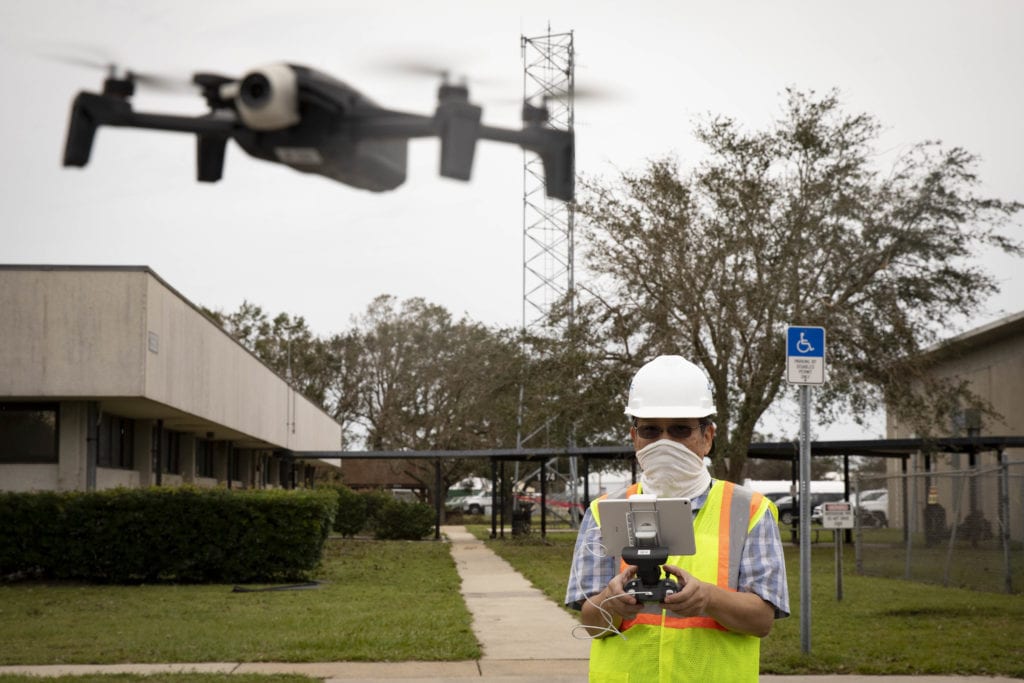
Jonathan Feng, a civilian assigned to the Naval Facilities Engineering Command Southeast (NAVFAC SE) Community Emergency Response Team (CERT), pre-flight checks a camera drone for damage assessment at Naval Air Station Pensacola, Florida. CERT was providing disaster relief efforts following Hurricane Sally. U.S. Navy / Mass Communication Specialist 2nd Class Anderson W. Branch

With the nation being hit with a lot of hurricanes and an earthquake in the last couple years, what progress has been made by NAVFAC in those recovery efforts?

KORKA: NAVFAC has a lot to be proud of with regard to responding to natural disasters that damaged infrastructure at our Navy and Marine Corps bases over the past two years. We showed our agility and technical know-how as a SYSCOM with these events — the hurricane that hit [Marine Corps bases at] Camp Lejeune, Cherry Point and New River [in North Carolina] pretty hard, as well as the earthquake at China Lake, California — tested our technical and acquisition acumen. Thanks to our responsiveness, agility, and technical and contracting authorities, we were able to get a significant number of construction projects awarded.

To support the surge of construction and repair work, we established two new commands, OICC [Officer in Charge Construction] China Lake, and OICC Florence [for bases in North Carolina] that are solely responsible for directing and managing these efforts. We have about 200 people on the ground today at both locations that we did not have in the past to oversee all the construction work. At China Lake, we are looking to award 18 military construction projects valued at $2.3 billion in total. So far, we awarded nine of these projects at a little over a billion dollars, only 14 months after the earthquake occurred, which alone is an impressive feat. The projects consist of an array of work, from an advanced weapons hangar to a mission integration lab, weapons magazines, an aircraft control tower, and even a new aircraft-parking apron. In fiscal year 2021, we plan to award an additional $1 billion dollars for work in China Lake. The teams are in place, projects have been awarded, and we are making good progress.

For the Hurricane Florence recovery, we have 30 military construction projects underway valued at $1.7 billion. Some of these projects include a Marine special operations training facility, maintenance hangars, service support facilities, a logistics operations school, and an array of troop support facilities.

For both disasters, we greatly benefitted from swift funding support as well as tremendous coordination with the Office of the Secretariat, OPNAV and Headquarters Marine Corps staff, NAVAIR [Naval Air Systems Command], and CNIC for defining requirements. We are pressing ahead even in the face of COVID, which has not slowed us down. I see this as a great testament to our resiliency, commitment, and our technical competence.

What are the trends with building and operating military housing, public and private?

KORKA: Quality housing is probably one of the most important contributions to enabling warfighter lethality. Giving our men and women in uniform places that they can call home and where their families will be safe is something that helps them to focus on their mission while they are deployed. We’ve gotten some unfavorable media coverage regarding the PPV [public-private venture] housing program over the past two years, so we looked at four main efforts to improve the quality of our military housing to ensure that our warfighters and their families live in safe, quality homes.

First, about a year ago we refocused our efforts, exercising our authorities under the Housing Revitalization Act in 1996 to regain the trust of our residents by reinforcing the Navy’s oversight role and responsibilities.

Second, early in 2020 we conducted a thorough review of how we work with our PPV partners to ensure that they were responsive to the residents’ work orders with quality results. We used data analytics, developed a standardized way to measure their performance and took a hard look at the recurring problems to figure out root causes and develop long-term solutions.

Third, we also shifted our focus from just property management to evaluating the financial management of our public/private ventures. This meant improving and standardizing some of the financial reporting and performing portfolio reviews in greater detail to recognize and prevent deficiencies.

Lastly, to address the health of these agreements, we are working with OSD [the Office of the Secretary of Defense] as well as Congress to make policy changes and apply lessons learned from our sister services, the Army and Air Force. In the end, we owe it to our Sailors, Marines and their families to provide them safe and quality homes. It’s important to remember that these are long-term agreements, 30-50 years in length, so effective sustainment and oversight of our DoN PPV housing portfolio must be taken seriously. Regaining the trust of our families is the most important outcome here, and we are committed to success in this area.

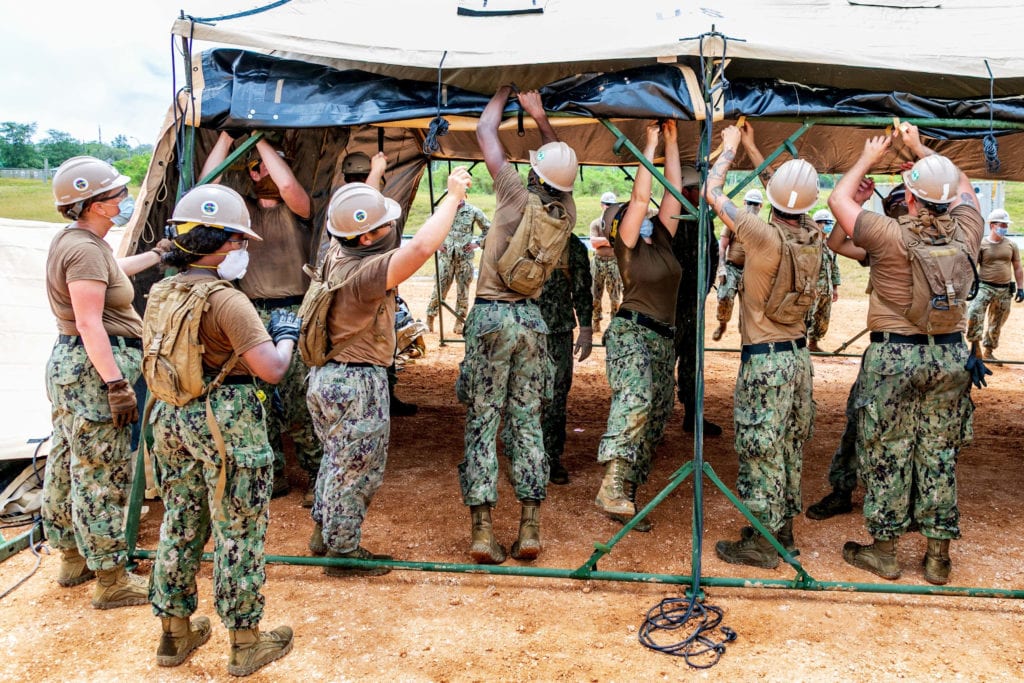
Sailors assigned to Task Force 75.5 assemble a tent during construction of a 150-bed Expeditionary Medical Facility on board Naval Base Guam. The EMF will provide expanded medical capabilities in support of DoD’s COVID-19 response and will enable forces to be postured to support Guam and the region if a Defense Support of Civil Authorities mission is requested. U.S. Navy / Chief Mass Communication Specialist Matthew R. White

NAVFAC has been building and upgrading facilities on Guam and the Marianas to host the Marine Corps forces. What progress has been made in those facilities?

KORKA: My previous flag assignment was as the commander, NAVFAC Pacific, in Hawaii, where I was dual-hatted as the U.S. Pacific Fleet engineer. We had the responsibility of overseeing all the work in Guam and throughout the Marianas Islands, and across the Pacific theater. The posturing of forces is extremely critical in this era of great power competition and the construction work underway in that region is an important element of the strategic objectives in the Pacific AO [area of operations].  We are still doing a lot of the environmental impact statements, and some training requirements are still being finalized.  Work is definitely underway, and our job is to support Marine Corps needs.

In Guam, we have 103 projects valued at $6.5 billion. So far, more than 500 acres have been cleared, we have completed 14 projects, 15 are still underway, and five more are in the process of being awarded. These projects are spread across Andersen Air Force Base, Apra Harbor, Finegayan, and Marianas islands. They cover everything from aviation to sea embarkation, non-live firing training, some off-base improvements in the utility system, and roads. Today, you can now see a base called Camp Blaz that did not exist over a year ago.  

Our Pacific work goes beyond the Marianas islands. We have projects that support the posture initiatives throughout the Indo-Pacific region to include Darwin, Australia, Indonesia and Palau. The bottom line is our SYSCOM is taking on this once-in-a-lifetime construction surge with urgency and flexibility. We’re on the right course and vector to continue to deliver at the speed of relevance for the Marine Corps.

How are the Seabees performing in the COVID environment?

KORKA: The Seabees that were deployed in Guam played a role in the construction of a 150-bed Expeditionary Medical Facility onboard Naval Base Guam for expanded medical capabilities in support of DoD’s COVID-19 response. Their performance personified our “can do” rally cry.

Some deployment cycles were affected in terms of extensions or delays, but in the end, our Seabee units continued the mission our Navy and Marine Corps called upon them to execute.

From a readiness standpoint, we’ve been very disciplined on adhering to the CNO’s priorities and following the established COVID protocols, which has gone a very long way to maintaining our level of readiness.  

Anything else you would like to add?

KORKA: Thank you.  I would like to take advantage of this question to brag a little bit about NAVFAC. As a SYSCOM, we have done a lot this year around the world. I believe that our SYSCOM has shown the responsiveness, resiliency and agility that our Navy and Marine Corps needed. It was a record-breaking year… the volume of work was about $13 billion in contracts — the prior year was only $10.9 billion, the highest since 2009 — and we did all this while facing COVID.  I think that says a great deal about the talent and commitment of the people of this command.

In response to the global pandemic, we were able to assist the Army Corps of Engineers in the conversion of hotels to alternative care facilities. We supported the Corps at 14 locations in the Midwest and Mid-Atlantic [states], as well as in the Southeast and Guam.

Over the last 18 months, we have put a special focus on our technical and contracting authorities and capabilities to better enable warfighting and also support of distributed maritime operations and expeditionary advanced base operations. As an example, our warfare center in Port Hueneme, California, executed the first ever landing of the rotary-wing aircraft on a Navy lighterage system. This proved out a viable concept of refueling and re-arming in a contested environment.

Using a Perform to Plan (P2P) approach, we are employing data and analytic capabilities to inform investment priorities and focus leadership engagement … at every echelon around the globe our sights are squarely aimed on speed, agility, and costs in support of fleet readiness. We stood up an analytics office to better monitor and accelerate our performance and to improve our execution. We also stood up a real estate acquisition office to promote projects that enhance warfighting readiness and avoid costs. Overseas, our team designed and deployed two miles of port security barriers for the Navy’s Fifth Fleet within nine months of request.

While this was a big year in terms of business volume, we still have a lot of work ahead of us. However, I believe that we are on the correct vector and we are moving ahead with urgency to support the Navy and Marine Corps. It is a unique period with great power competition and I believe we are adjusting to this in the right ways. It is an honor for me to serve in this command and support the fleet and our great nation.


Q&A: Rear Adm. Paul Schlise, Director, Surface Warfare Division, N96, Office of the Chief of Naval Operations

Rear Adm. Paul Schlise

A native of Sturgeon Bay, Wisconsin, Rear Adm. Paul Schlise is a surface warfare officer and a 1989 graduate of Marquette University’s College of Business. He was commissioned through Marquette’s Naval Reserve Officer Training Corps program. He holds a master’s degree in National Security Strategy from the National War College and was a 2015-2016 Massachusetts Institute of Technology Seminar XXI Fellow.

He has completed nine deployments, participating in Operation Desert Shield, Desert Storm, Southern Watch, Enduring Freedom, Desert Fox and Tomodachi. He served aboard USS Flint (AE 32), USS Antietam (CG 54), USS Hopper (DDG 70), and USS John Paul Jones (DDG 53) and commanded USS Halsey (DDG 97) and Destroyer Squadron (DESRON) 7. In 2012, he executed DESRON Seven’s homeport shift to U.S. 7th Fleet forward-deployed naval forces in Singapore.

Ashore, he served twice on the Chief of Naval Operations staff for director, Surface Warfare. He also served at Navy Personnel Command, Surface Officer Distribution Division and on the Joint Staff, Strategic Plans & Policy Directorate. His initial flag assignment was as deputy commander, U.S. Naval Forces Central Command/U.S. 5th Fleet in Bahrain. He then commanded Carrier Strike Group 10/USS Dwight D. Eisenhower Strike Group during its 2020 deployment.

He assumed duties as director, Surface Warfare Division, N96, Office of the Chief of Naval Operations in June 2020.

Schlise responded to questions about the surface force’s drive to increase its lethality from Senior Editor Richard R. Burgess. Excerpts follow. Check out the digital edition of the December issue of Seapower magazine here.

Why is the Navy pressing hard for distributed lethality in the surface force?

SCHLISE: The Surface Combatant Force is the key enabler for the Navy’s Distributed Maritime Operations concept. Enhancing lethality across all of our ships at sea operationalizes DMO and ensures the fleet has requisite capability and capacity to fight and win. Our efforts to up-gun our combatants are directly in step with the Navy’s Naval Tactical Grid initiatives.

What new surface weapons are adding to that lethality?

SCHLISE: The Surface Navy is moving out aggressively to improve lethality across the spectrum of warfare. The Naval Strike Missile is in the fleet providing a multi-mission weapon for our littoral combat ships [LCSs] and future frigates. The SM-6 is a multi-domain missile, deployed on ships today, providing surface combatants improved capability and flexibility against advanced threats. As we continue to procure the SM-6, spiral development of the SM-6 family is ongoing to provide greater range and speed. The Maritime Strike Tomahawk provides versatility over long distances against targets at sea or on land.

In addition to extended missile ranges, we’re also increasing our close-in battlespace lethality. The updated Mk38 Mod 4 Gun Weapon System provides an updated electro-optical sensor system with combat system integration for improved accuracy and close-in engagements against fast-attack craft and fast inland attack craft threats. In the near future, these guns will be paired with other weapon systems for greater lethality against close- in air threats as well.

The surface fleet is also improving terminal defense weapons with spiral developments to the existing Rolling Airframe Missile and Evolved Sea Sparrow Missile. A new Vertical-Launch Anti-submarine Rocket Extended Range is proposed to significantly increase the range a ship will be able to engage a submarine target.

Rear Adm. Paul Schlise, outgoing commander of Carrier Strike Group (CSG) 10, departs a change of command ceremony aboard the aircraft carrier USS Dwight D. Eisenhower (CVN 69) May 19, 2020. U.S. Navy / Mass Communication Specialist 2nd Class Kaleb J. Sarten

What future weapons are being considered for the surface fleet?

SCHLISE: Versatility in our VLS [vertical launch systems] is important, and we are continuing to look at current multi-domain weapons and evolve them to pace the threat. We are also improving our terminal defense capability with more formidable weapon systems, including directed energy.

What are the goals and prospects of fielding directed energy weapons, including the rail gun?

SCHLISE: As part of a joint effort by the Navy’s Acquisition and S&T [Science and Technology] communities, the Navy Laser Family of Systems is accelerating fleet integration and informing requirements for future acquisition by providing multiple systems that support counter-intelligence, surveillance, reconnaissance, counter-unmanned aircraft systems and intelligence collection. These efforts include Optical Dazzling Interdictor – Navy (ODIN) – laser systems providing capability enhancements to DDG 51 Flight IIA ships; ONR’s [Office of Naval Research] Solid-State Laser Technology Maturation — a laser system already installed on the amphibious transport dock ship USS Portland and slated for deployment in 2021; [and] Surface Navy Laser Weapon System, also known as HELIOS — a laser system and integrated optical dazzler with surveillance designed for full integration into the Aegis Combat System on DDG 51 Flight IIA ships.

The long-term goal of the Navy’s High-Energy Laser effort is destructive capabilities against missile threats.

Through technology developed under the Rail Gun program, the Navy continues to monitor developments in high-velocity projectiles for the Mk45 5-inch Gun- Launched Guided Projectiles. Similar to directed energy options, each of these systems provide capable defensive weapons outside of VLS.

How will the new Constellation-class FFG add to the fleet’s lethality?

SCHLISE: The new FFG 62 class will be more lethal, more survivable, have greater range, endurance and self-sufficiency than previous small surface combatants. With increased operational availability and enhanced fire- power, FFG 62 will be a multi-mission ship capable of operating independently, as part of surface action groups or with carrier or expeditionary strike groups in contest- ed environments.

The Constellation will be a multi-mission ship, equipped to conduct air warfare [AW]; antisubmarine warfare [ASW]; surface warfare [SUW]; electromagnetic warfare [EW]; and intelligence, surveillance, reconnaissance operations.

As an AW platform, FFG 62 will be outfitted with a SPY-6 derived Enterprise Air Search Radar, AEGIS BL10 Combat System, Cooperative Engagement Capability and 32 VLS cells. As an SUW platform, the ship will carry 16 Naval Strike Missiles and a counter-small boat capability with her 57 mm gun and precision guided ALaMO [Advanced Low-Cost Munitions Ordnance] rounds. As an ASW platform, FFG 62 will feature a variable depth sonar and multi-function towed array as an evolution on the proven SQQ-89 (V) 15 ASW suite. The ship’s EW/IO capabilities will include Surface Electronic Warfare Program Block II (SEWIP Blk II) missile detection system, signals intelligence systems and the Nulka decoy system. FFG 62 will also include an organic aviation capability supporting one MH-60R helicopter and one MQ-8C unmanned helicopter.

The “Connie” class will be suited for future weapons/mission flexibility and incorporates room for future growth/upgrades.

Chief of Naval Operations (CNO) Mike Gilday referred to “DDG Next.” What’s the concept for such a ship?

SCHLISE: The class CNO referred to as “DDG Next” will be a new hull form to follow the DDG-51 Flight III. This ship is predicted as the next high-end surface combatant and will include non-developmental Flight III program-of-record technologies, including a variant of the SPY-6 radar and Aegis Baseline 10 Combat System, while emphasizing space, weight, power and cooling margins to accommodate future capabilities over the lifespan of the class.

The CNO gave us a brief preview of the projected size of the ship. We expect it to be smaller than a Zumwalt [DDG 1000], but larger than DDG 51 Flight III.

How will the planned unmanned surface vessels (USVs), such as Large USV (LUSV) and Medium USV (MUSV), contribute to the fleet’s lethality?

SCHLISE: USVs can bring additional capacity and capability to the manned combatant force to support distributed maritime operations. Results from our Future Surface Combatant Force Analysis of Alternatives and Future Navy Force Structure study both show the value in USVs and support continuing investment, prototyping and experimentation to mature this capability for future force integration. LUSVs, as a distributed fires platform, can increase the fleet’s missile carrying capacity and MUSVs, as a distributed sensor platform, improve the commander’s battlespace awareness. Our Surface Development Squadron (CSDS-1) is involved in testing these concepts using current prototypes in fleet exercises and experimentation. The lessons learned from CSDS-1 and results from our continued study and war gaming will help us refine concepts and inform further platform development to provide the fleet with a capability that can and increase lethality and capacity.

What plans are there to add firepower to littoral combat ships and amphibious warfare ships?

SCHLISE: We’ve increased the reach and lethality of the LCS platform with the addition of the Naval Strike Missile. We were able to accelerate installation on USS Gabrielle Giffords for her successful deployment to Southeast Asia this past year. The system will ultimately be added to all LCS, regardless of mission package.

In addition, the initial round of lethality and survivability modifications planned for both LCS variants will further enable fleet integration and operational capability with the addition of Link 16, EHF [extremely high-frequency] communications, Nulka and SEWIP [Surface Electronic Warfare Improvement Program].

Is the Zumwalt-class DDG being considered as a platform for hypersonic weapons?

SCHLISE: The Navy is looking into all classes of ships, including the Zumwalt class, as possible candidates for hypersonic weapons.

What progress, if any, has been made toward solving the need for a projectile for the Zumwalt’s Advanced Gun System (AGS)?

SCHLISE: When the decision was made to reduce the class to three ships, it caused the unit price of the AGS precision-guided rounds to become unaffordable. We have not identified a suitable replacement. But, with our decision to shift the ship’s mission to offensive surface strike, we’re adding other capabilities. This will sustain the Zumwalt class as an integral part of the surface fight.

What has the Navy done to increase the tactical and weapons proficiency of its surface warship crews?

SCHLISE: The Surface Training Advanced Virtual Environment [STAVE] program and Fleet Training Wholeness efforts have been at the forefront of efforts to improve individual and team training. STAVE has transformed training ashore by delivering enhanced electronic classrooms that are instructor-led, using high-fidelity virtual tools combined with hands-on labs.

Approximately 70% of the 850 courses of instruction taught by Surface Warfare Schools Command and Center Surface Combat Systems have been modernized or are funded to be. Combined with the fiscal establishment of STAVE-Network and its integration of students, instructors, classrooms and labs, the STAVE program greatly improves the tactical and technical proficiency of our Sailors and crews.

Through the Fleet Training Wholeness effort, the Navy continues to invest to improve live, virtual and constructive [LVC] training of ships and strike groups. Continued efforts will enable the permanent integration of all Aegis and SSDS [Ship Self-Defense System]-equipped ships to connect at sea and the delivery of high-fidelity LVC tactical training capabilities to all afloat platforms. The results will ensure advanced and integrated training across the strike force level — Fleet Training Wholeness — where carrier air wing simulators, live aircraft and ships can train together in a virtual environment for the high-end fight.

As ever, great training doesn’t happen without a world-class training organization. All of the above programmatic initiatives continue to be brought to the fleet during the advanced and integrated phases by the Surface and Mine Warfare Development Command [SMWDC] and our highly skilled weapons and tactics instructors [WTIs]. SMWDC WTIs continue to “raise our game” with more challenging and realistic training and certification exercises.

How does today’s surface fires capability compare to when you were commissioned in the Navy?

SCHLISE: The Navy has progressed in every dimension over the past several decades. Compared to when I commissioned in 1989, the ability to integrate weapons and sensors across a carrier strike group has expanded beyond my wildest dreams. Our ships are able to coordinate fires across the spectrum of warfare with combat systems, sensors and missiles that are smarter and better integrated with the platforms that operate them. Our Sailors are far more talented and benefit from tremendous virtual multi-domain training capability. To put it plainly, when compared to when I first commissioned, our surface fires capability is like comparing an old “brick” phone from the ’90s to a brand-new iPhone 12 today. We’re smarter, faster and more lethal than ever before.


Naval Research Laboratory Takes Science from the Lab to the Fleet

Senior Chief Mineman Abraham Garcia, left, and Aerographer’s Mate 1st Class Joshua Gaskill, members of the Knifefish unmanned underwater vehicle test team, work tending lines during crane operations as part of an operational assessment conducted by members from Operational Test and Evaluation Force. U.S. Navy / Mass Communication Specialist 1st Class Brian M. Brooks

As the U.S. Navy’s corporate laboratory, the purpose of the Naval Research Lab in Washington, D.C., is to be cognizant of – and have world-class expertise in – the very basic sciences that are fundamental to all the technologies that we have in our society, and to create new technology through continued investment in science at the very basic level.

NRL comes under the Chief of Naval Research as head of the Office of Naval Research (ONR). ONR directs much of the work of the Naval Research Enterprise (NRE), of which NRL is a part, along with Navy warfare centers, academic institutions and federally funded research and development centers.

“We are a working laboratory at NRL, and we execute science and technology development and transition it to the fleet,” said NRL’s Acoustics Division Superintendent Dr. Brian Houston.

“Our work is basic and exploratory, all the way up to applied research and transitions. Unlike many of the organizations in the NRE, we do very basic science work — so-called 6.1 level work, where you have people on the lab, for example, that are developing new mathematical theories, and making new materials using surface science techniques, or developing new optics and lasers at the very fundamental level. Like much of NRL, in the acoustics division we intertwine that very basic science with exploratory research [6.2 research] where it’s more applied, taking what we’ve learned from the basic science and identify what can evolve into technology that might eventually benefit our warfighters,” Houston said.

According to Houston, NRL must be aware of the work being conducted by colleagues in the other organizations in the NRE. But, he said, while the other organizations tend to engage in engineering refinement, NRL explores new basic science and develops technologies from it.

“When you see some NRL research that’s resulted in a breakthrough technology or capability, you’re just seeing the tip of the iceberg. That’s because there is so much basic science behind it. Our technology development teams that are bringing new capabilities and systems to our ships, aircraft and submarines have scientists who understand the very basic physics integrated with those technology teams.”

Houston came to NRL as a student, but says, “It just became a home very quickly because of the people, the facilities here and the really great problems we have to solve. I’ve been here 35 years and have never worked anywhere else.

“The acoustics piece of undersea warfare represents a lot of what we do — and it’s a very challenging area,” Houston said. “That includes finding things in the water, like submarines and things on the seabed, like mines. A major area encompassed by undersea warfare is mine warfare and not just offensive mines, but how to detect and localize adversary mines and how to deal with them. A mine is a very inexpensive weapon, and it’s relatively easy to make effective. It costs very little compared to the targets it goes after, like a billion-dollar warship, for example. They’re very difficult to detect and classify. We worry about mines today as much as we ever did.

“With regards to detection, there is a lot of stuff in the water column and even more stuff on the bottom. Mines are typically used in close proximity to the bottom, so you have to sort out the mines and detect and classify them in the context of all of this clutter and the topology of the bottom itself.”

Transcending Platforms

Houston said his work transcends platforms, sensors and processing, to include the systematic employment of all of that together. NRL has developed both a sensor approach as well as methods to analyze the data to carry out missions. From the sensor perspective, that whole technology area is what NRL calls low-frequency broad- band (LFBB), an active sonar that employs synthetic aperture processing, with processing that employs artificial intelligence for detection and classification.

“LFBB exploits the structural acoustics involved with underwater sonar. When you transmit sound, the acoustic return is very different depending on the physical object reflecting that acoustic energy. It might be a naturally occurring thing like a rock on the bottom or something that’s man-made, like a mine. In the water column, it might be a submarine versus a whale. What’s in the acoustic return is very different for each of those targets. Sonar has traditionally helped us know where something is, how far a way it is and sometime provides an image. But in addition to bearing and range, we can now determine what it is,” Houston said. “That return has specific physics in it that we can exploit, and we can know something about the physical object and based on how it responds.”

Houston said structural acoustics focuses on the inter- action of the sound with structures in a fluid — in this case, water.

“If I ping on an object underwater, the sound will propagate across the water volume and interact with the structure. The acoustic energy will cause the casing of a mine, or the hull of a submarine, to vibrate. So, the interaction of sound with a structure, and then the re-radiation of sound, is the realm of structural acoustics. Some years ago, we put together our one-of-a- kind Laboratory for Structural Acoustics here at NRL to focus on precision measurements.”

Houston’s team frequently uses unmanned systems in their research, and not just as platforms to hang sensors on or as scientific measurement tools.

“We’re also trying to figure out how to use them in under- sea warfare,” Houston said. “We’re engaging in the development of the artificial intelligence that’s needed to make those platforms work for the Navy. We’re figuring out how to best use them in terms of sensor platforms, in an applied way, the way the Navy might apply them in terms of an offensive capability. There’s a lot going on here.”

The NRL team has used their autonomous underwater vehicles Reliant and Black Pearl to develop LFBB for mine countermeasures, ASW and counter-UUV applications. Many mine-hunting UUVs employ change detection — knowing what’s on the bottom and coming back later to see if anything has changed.

“You can do change detection with almost any sonar system, including our systems, but we do not rely on change detection. Our system operates at a very high-performance level to go into an area and you can rely on the results from just a single pass,” said Houston. “That’s the objective.”

The Reliant and Black Pearl vehicles are unique compared with other platforms.

“The major difference is the sonar itself,” Houston said. “One of the reasons why we like the General Dynamics Bluefin Robotics 21-inch vehicle — both Reliant and Black Pearl are Bluefin vehicles — is they are ‘open ocean capable.’ They have a lot of energy on them, fairly high- end navigation systems, plus we have other things on them to make them very useable and capable in the open ocean. We also can go into shallow water areas and even very shallow water areas. So, we like that aspect of it. We want to have some ‘legs’ on the vehicle and navigate accurately. The sensors themselves aren’t consistent with a small vehicle, particularly because the low frequencies require larger sources and sensor apertures. We are doing a lot of onboard processing, so we can take the data and process it on board the vehicle to enable autonomous decision making enabled by the sensors, so it has access to the real-time processing of the sensor data, and it makes decisions based on that.”

Cuts Like a Knifefish

NRL has worked closely with the acquisition community. The LFBB sonar is now operational aboard the Knifefish Surface Mine Countermeasure Unmanned Undersea Vehicle Program, used to find buried, bottom and volume targets in highly cluttered environment. The system consists of two unmanned undersea vehicles along with support systems and equipment and is a critical element of the Littoral Combat Ship (LCS) Mine Countermeasure Mission Package. Knifefish received Milestone C approval last year, and the system entered low-rate initial production.

Knifefish is being built in blocks to incorporate new technology as it matures, to increase performance in each block. In addition to the LCS mine countermeasures mission package, the system can also be employed from other vessels of opportunity. Like NRL’s Reliant and Black Pearl reserve vehicles, Knifefish employs a General Dynamics Mission System Bluefin-21 vehicle.

“Knifefish’s common open systems architecture design and modularity provides the ability to quickly reconfigure the mission package to respond to evolving and dynamic mission requirements, and can be readily upgraded as new technologies or payloads are developed,” said Dr. Andrew Rogers, vice president, Undersea Defense Systems at General Dynamics Mission Systems.

For Houston and the NRL team, the scientists, engineers, and the people who know how to bend metal and make it function, are all working together in an integrated fashion to accelerate the transition of scientific discoveries to applications.

“If you don’t have that connectivity, you just can’t make the arguments that will bring a new piece of science to an application that the fleet needs,” Houston said.

The result is a program of record that will help the fleet safely find mines. “We demonstrated at-sea performance and were successful in transitioning the technology into a program of record,” Houston said. “It was basic research — the science — that started it all.”


NPS Annual Workshop Goes Mostly Virtual, Seeks to Prepare Military for Future Conflicts

The 2020 WIC annual workshop was largely virtual but tackled real-world issues focusing on future conflict scenarios. Naval Postgraduate School

The Warfare Innovation Continuum (WIC) at the Naval Postgraduate School (NPS) in Monterey, California, conducts an annual workshop to better understand a major issue that will be the subject of study for the year to follow.

In 2020, the school examined “Resurrecting War Plan Blue,” which refers to an examination conducted by the War Department between the first and second world wars about the nation’s ability to support and sustain a major conflict. 

The September 2020 Workshop, the 13th in the series, tasked participants to consider a conflict scenario in the year 2035 requiring the U.S. to quickly mobilize forces and assets in response to a rapidly deteriorating global security environment.

The three-and-a-half-day experience allowed NPS students focused interaction with faculty, staff, fleet officers, and guest engineers from Navy labs, system commands and industry. The workshop tasked participants to apply emerging technologies to shape the way we fight in a 2035 global conflict. Concept generation teams were given a design challenge: How might emerging technologies and concepts and joint, combined and coalition forces contribute to enhancing the resiliency of naval forces, logistics, and support facilities in an extended campaign against a peer adversary?

The intent was to explore technologies and policies to undertake now to increase the nation’s resiliency for an extended conflict.

The 2020 WIC workshop included 157 registered participants in the roles of concept generation team members, facilitators, panelists, mentors and observers. The full participant pool included representatives from 72 different organizations, most participating virtually. Half of the workshop participants were NPS students drawn from all naval warfare domains, as well as from the full range of armed services on campus.

Prof. Jeff Kline, Director of the Naval Warfare Studies Institute and Professor of Practice in Operations Research, said the proposed topics each year were narrowed down by employing selection criteria.

“Is the concept feasible, either physically or fiscally; is the concept unique; does the concept solve a key problem or fill a key gap; and is the concept testable?” he asked.

The issues examined for War Plan Blue are relevant today, Kline said. “We want to investigate our vulnerabilities in mobilization and industrialization, and potentially in our ability to operate forward with our infrastructure as it currently exists.” 

“Our junior officers are focused on their course of study at NPS, and early career engineers at the labs or with industry are focused on their particular project work … mixing them together in this way to work within these problem spaces is a really rich environment to not only explore what’s in the realm of the possible, but understand what that exploration can be.

“We want our own students to have an appreciation for operational challenges that are going to be emerging over the next 10 years, and [we are] teaching them how to do critical thinking to find solutions for them.”

Trending topics

In addition to supplying topics for further NPS research, past WIC Workshops have informed senior leadership and provided information and concept ideas to Naval Warfare Development Command (NWDC) and the Marine Corps Warfighting Lab (MCWL). The September 2017 workshop tasked participants to apply emerging “Distributed Maritime Operations” technologies within a near-future conflict in an urban littoral environment, and the 2018 “Cross Domain Operations” workshop looked at integration of assets. The September 2019 workshop “Logistics in Contested Environments” asked teams to focus on how to maintain forces in a sustained conflict.

Kline said the workshop brings together a mix of faculty and students with the field, fleet, academia and industry. 

“We examine the issues, and take the best ideas to inspire research and prototyping for the whole academic year. By taking on these topics suggested by senior leadership, and by socializing the results with our stakeholders, we are maintaining NPS as a thought leader, both in emerging technologies and developing concepts,” Kline said.

“Our officer students bring the tactical operational experience of this environment, and they walk away with a broadened experience in order to be able to tackle the unknown in the future,” Kline said.  “We also hope to build informal networks among the junior engineers of the nation and the operating naval officers here at NPS and those that participate, so that they start to maintain contact across both industry and the services to know how to find some of these solutions to complex problems.”

NPS students have completed several tours of duty before coming to Monterey. “They have tactical experience, and they have operational experience, although not at a senior level,” said another facilitator, Matt Largent, head of forecasting, assessment and transition at Naval Information Warfare Center Atlantic in Charleston, South Carolina. “This workshop invites them to be part of the higher-level conversation.”

Another facilitator, retired Marine Col. Todd Lyons, vice president for the NPS Alumni Association and Foundation, said the workshop was as much about problem framing as problem solving.

Prof. Lyla Englehorn was the workshop facilitator.

“My biggest goal in any of these workshops is to introduce a new toolbox to approach a complex problem space — what we call ‘wicked problems,’” she said. “You can’t propose a solution or solve a problem until you understand the status quo.”

“When we present these emerging technologies in this forum, it gives our concept generation team members a sense of what’s just outside of the box, what’s the adjacent possible,” she said. “We hear ‘thinking outside the box’ all the time. But stand on the edge of that box, what can you touch? What’s within the potential 2035 time-frame?”

Following panel discussions and presentations from leading technical experts, the teams and their embedded facilitators had seven hours of scheduled concept generation time to meet that challenge, and presented their best concepts on the final morning of the workshop.

According to Englehorn, this applied approach ensures that NPS provides defense-focused graduate education, including classified studies and interdisciplinary research, to advance the operational effectiveness, technological leadership and warfighting advantage of the naval service.

Avoiding Cost, Time, Jetlag

While the coronavirus presented challenges, there were also opportunities. The COVID-19 pandemic pushed all resident work at the Monterey campus to a remote environment, so WIC workshop became a mostly virtual affair. 

Englehorn said in spite of the pandemic, the workshop was able to include a greater breadth of participants around the world this year.

“We broadened our participation quite extensively. Technology allowed us to do that. We had students participating remotely from Singapore and Romania, and a U.S. Marine Corps officer who is on an exchange program at the Colombian Naval Academy.”

The NPS Virtual Campus employs a combination of remote learning tools, including Microsoft Teams for plenary session and concept generation team breakout rooms. The NPS distance learning platform, Sakai, supported all materials for the workshop which allowed for participants to review materials in advance, reference them throughout the workshop as well after the results have been posted. The teams also used the MURAL3 collaboration tool for concept generation work in an unclassified remote environment.

“We normally conduct this as a resident activity. Most of the teams were working at unclassified levels because of the way we executed the event. However, one team of select NPS students was able to gather in person on campus (following strict COVID 19 protocols) working on technologies related to informational warfare at the classified level. They brainstormed the old-fashioned way, with whiteboards, Post-it notes and Sharpies,” Englehorn said.

Even if Covid-19 restrictions are removed next year, Englehorn said NPS may keep some of its newly learned best practices.

“Having hybrid events using these online tools allows us to involve many more people working on these problems,” he said. “We’re not looking at the ‘new normal,’ but the ‘new next.’”


Q&A: Rear Adm. Mark H. Buzby, Maritime Administrator

Rear Adm. Buzby, right, on the California State University Maritime Academy’s Golden Bear Training Ship. Department of Transportation

Rear Adm. Mark H. Buzby was appointed by President Donald Trump and sworn in as Maritime Administrator on Aug. 8, 2017. Prior to his appointment, Buzby served as president of the National Defense Transportation Association, a position he has held since retiring from the U.S. Navy in 2013 with over 34 years of service.

A 1979 graduate of the U.S. Merchant Marine Academy, Buzby earned his Bachelor of Science in nautical science and U.S. Coast Guard 3rd Mate License. He was commissioned in the U.S. Navy in June 1979, is a graduate of the Joint Forces Staff College and holds master’s degrees from the U.S. Naval War College and Salve Regina University in strategic studies and international relations, respectively.

Buzby commanded destroyer USS Carney (DDG 64), Destroy- er Squadron 31, Surface Warfare Officers School Command and Joint Task Force Guantanamo Bay. As a junior officer, Buzby served in USS Connole (FF1056), USS Aries (PHM 5), USS Yorktown (CG 48), USS John Paul Jones (DDG 53) and USS Shiloh (CG 67), primarily in operations and combat systems billets. In 1985, he was the Atlantic Fleet Junior Officer Shiphandler of the Year.

Ashore, he served on staffs of U.S. 6th Fleet, U.S. Fleet Forces Command, the Navy staff and the Joint Staff. Buzby served as the commander of the U.S. Navy’s Military Sealift Command from October 2009 to March 2013.

Buzby discussed the concerns of the Maritime Administration (MARAD) on Sept. 28 with Senior Editor Richard R. Burgess. Excerpts follow. Check out the digital edition of the November issue of Seapower magazine here.

What concerns do you have about the nation’s sealift capabilities? Could the sealift force handle the cargo demand for a major conflict overseas?

BUZBY: My concerns are in the quantity of ships that we have, the reliability of the ships that we have and resilience of the force: in other words, the ability either repair it or to replace it if we need to due to combat loss. Theoretically, right now, we have the square footage required, about 19.2 or so million square feet, to meet the nation’s sealift requirements — the most stressing requirements — to include the commercial merchant marine plus the government-owned sealift forces. Theoretically, we’ve got enough but that’s before the first loss, that’s before any breakdowns — a lot of qualifiers there. But I don’t like living right on the edge. We need more depth on our bench than we have right now.

What can be done to strengthen the nation’s sealift force?

BUZBY: The obvious answer is it needs to be enlarged across the board both on the commercial side and the government side. The commercial side gets driven by basically peacetime economics. Is there sufficient cargo for our commercial U.S.-flag merchant marine to carry? The more cargo that is available to carry equates to more ships. That’s a good thing that adds into our sealift capacity. On the government side, it’s a matter of ensuring we recapitalize our sealift forces in a timely manner. One would argue that we are not timely right now. The force that we have is aged and its reliability is becoming more questionable every year. Getting on with recapitalizing our government sealift ships, which we’re working on, figuring out how to incentivize or to make more cargo available for the commercial side, making that playing field for our commercial entities more level in competition with the foreign flag shipping are all parts of the solution.

What concerns do you have about the Ready Reserve Force in particular?

BUZBY: There are 61 government ships in the sealift force, 15 that the Military Sealift Command operates and the 46 that MARAD operates in the RRF. They’re funded to be maintained at 85% readiness level and, unfortunately, we’re not making that level and haven’t for some time. That gets borne out in the turbo-activation tests that we do every year. We’re seeing casualties coming up and just in the day-to-day maintenance of the ships. We’re seeing it becoming increasingly difficult to keep the ships ready to go when the bell rings in the five-day readiness status. When you’re looking at a 47-year-old ship, or older, with obsolescent equipment or the availability of mariners who could operate the equipment — I’m talking steam engineers in particular — or just the physical condition of the ship itself, it is just becoming more and more of a challenge and more expensive to maintain that fleet.

How has the COVID-19 pandemic affected the U.S. Merchant Marine force?

BUZBY: It has definitely stressed it, like it has stressed all other modes of transportation. It has stressed the maritime transportation system significantly, but I would be quick to point out that [the force] has not faltered. Even though there have been greatly reduced cargoes and challenges in that respect, getting people tested and getting people certified to fill shipboard billets, the Merchant Marine has not faltered. We’ve continued to carry the goods for the nation and without the benefit of any grants or loans. Many of the other modes [of transportation] were the beneficiaries of lots of CARES Act funding to keep them viable and moving. Maritime hasn’t got any of that.

Meanwhile, we’ve managed to keep the ships sailing and figured out how to keep the crews healthy and maintain a healthy shipboard environment. We’ve put the mitigations in place to keep the ships healthy and operational. And that continues today. I’m really proud of this industry and how all the players — shipping companies, unions, the government — all came together to make that happen. It’s a real positive story, a positive chapter in our merchant marine’s history.

What role does MARAD have in physical and cybersecurity of the U.S.-flag merchant fleet?

BUZBY: We kind of stepped in and helped out with physical security during the period a few years ago when piracy was a serious threat. That has been pretty much mitigated. Now, it really, truly is the cybersecurity threat. Just literally yesterday, CMA CGM [a worldwide shipping group] of which APL — one of our Maritime Security Program carriers — is a part, had a major ransomware cyberattack against them. Just before this interview, I was talking with the president of APL, discussing the mitigations they’re having to put in place to remain operational. They are fighting through, and I am afraid that this is going to become a more common occurrence in the future, whether done by criminal actors or as part of a national-level cyberattack by a potential adversary.

Later this week, I’ll be talking to an industry group being sponsored by NMIO, the National Maritime Intelligence-Integration Office, talking about what we need to do and how to strengthen the posture of our operating forces out there because a lot of what goes on still could be mitigated to a large extent just by having up-to-date patched programs for the systems that are on the ship, plus just good hygiene practices by the operators and by the crews. Systems often have to be used by many users and crews cycle on and off and lots of times get a little lax on passwords and other security measures. We’re doing our best to try and get that word out and help people understand the need to have good cyber defenses just like they have good strong physical security on their ships.

What role does MARAD have in supporting the U.S. port facilities in modernizing and in increasing their capacity?

BUZBY: We are very much involved, especially since of all those commercial ports that are spread around our country, 16 of which are designated as strategic ports, which we would use to load military equipment in any kind of a deployment and follow-on sustainment of those forces. We pay attention to all the ports but those 16 in particular to ensure that they have all of the intermodal connections necessary to handle modern rail connections, modern road connections, marine highway connections to not only support our military movements, but also, to remain viable commercially. Our ports are this country’s economic gateways. Our economy flows through our seaports and, to a lesser extent, our airports, but certainly the vast majority of goods that come and go out of this country come through our ports. They are absolutely vital.

We’ve begun to make some strong investments in our ports. We have awarded BUILD grants and INFRA-grants that have benefitted ports over the years. In 2019 and 2020 we have dedicated port infrastructure development grants — $297 million and $225 million, respectively — that are all focused directly on port improvement and port development.

What is the status of the National Security Multi-Mission Vessel (NSMV)? Which maritime academy will receive the first one?

BUZBY: The builder has been chosen: Philly Shipyard in Philadelphia. We are well down the road in getting the final design completed. TOTE Services, our vessel construction manager, is doing a tremendous job of managing the build of the class – the “State Class.” We expect the first ship to begin fabrication in December. When complete in early 2023, it will go to the State University of New York Maritime College in Fort Schuyler. The second ship, about eight months behind the first, will be going up to Massachusetts Maritime Academy.

Will one NMSV be assigned to the U.S. Merchant Marine Academy?

BUZBY: No. At Kings Point, we train our midshipmen by sending them to sea in the active Merchant Marine. Rather than using a school ship for their training, USMMA’s training model sends Cadets to sea for four to eight months on all types of vessels in our regular commercial merchant vessel fleet, as well as Military Sealift Command and U.S. Navy vessels. That’s not to say that some Kings Pointers might end up on a training ship, if they have to make up some days or something like that, but primarily the school ships are going to the state maritime academies. We do maintain a 176-foot training vessel at the Academy, the T/V Kings Pointer, which is used for ship handling and navigation training.

Adm. Buzby visits the SS Flicktertail State, a crane ship in ready reserve for the U.S. Navy, stationed at Newport News, Virginia. Department of Transportation

What is your assessment of the preparedness of the graduates of your alma mater, the U.S. Merchant Marine Academy, to meet the challenges of the future?

BUZBY: I have absolutely tremendous faith in the U.S. Merchant Marine Academy’s ability to prepare world-class mariners. I could not compete with the quality of midshipmen that are there these days who are preparing for their maritime careers. They are just so smart in grasping and understanding technology and anxious to get out there and become a part of the industry.

Amidst the COVID crisis, the academy has done a tremendous job in remaining operational and remaining safe. They were able to graduate the class of 2020 in June COVID-free and to bring on board in July the new class of 2024 — about 280 young men and women — get them through indoctrination COVID-free, and then at the end of July brought back all the rest of the regiment of midshipmen. They’re up to almost 800 people on board all maintaining a COVID-free environment, conducting their classes and doing their sea training. There is a group of about 250 that are out at sea right now getting the Sea Year training. As I mentioned before, they are participating with the ships to make sure the ships stay clean and keep those mitigation efforts in place. They’re getting a real first-hand look at how our Merchant Marine functions even in a COVID crisis. Kings Point is doing a tremendous job. I’m very, very pleased and impressed with the job that the superintendent, Rear Adm. Jack Buono and his staff are doing up there.

What do you say to critics of the Jones Act who consider it a protectionism that is detrimental to the national economy?

BUZBY: I say it is protection for our country. The national security implications of what would happen if we were to strike the Jones Act are absolutely profound in the negative. I’ve been asked on several occasions before Congress what would happen if the Jones Act went away and I answer directly back with, we would not be able to deploy our nation’s armed forces by sea if we were to do that, not because of the ships but because of the pool of trained mariners who crew those ships. The domestic Jones Act fleet employs the largest number of unlimited tonnage/unlimited horsepower mariners of all of our ships that sail under the U.S. flag.

You get rid of the Jones Act and its requirement for U.S. mariners in U.S. ships, those mariners won’t have sailing jobs anymore and will leave the industry. Those U.S. mariners on vessels trading in the United States are the same people that I absolutely rely upon along with others from the rest of the Merchant Marine to crew up our Ready Reserve Force — all of our sealift ships in time of crisis.

I therefore lose my ability to man those sealift ships and have them available to take our nation to war if necessary. Not to mention the impact on shipbuilding and ship repair in this country — the 124 or so shipyards that we still have in this country — they would go away with the exception of just the very few yards that would be building military vessels because that requirement to build in the United States and repair in the United States would go away as well. So, it would be, perhaps the worst thing we could do from a national security point of view.


Specialized Undersea Rescue Force on Call to Aid Submariners in Trouble

Sailors from Undersea Rescue Command (URC) and Argentines load the Submarine Rescue Chamber (SRC) onto the Norwegian construction support vessel Skandi Patagonia. Undersea Rescue Command, the U.S. Navy’s only submarine rescue unit, mobilized to support the Argentine government’s search and rescue efforts for the Argentine Navy diesel-electric submarine ARA San Juan. U.S. Navy / Lcdr. John Babick

Within days of an Argentine navy submarine reported missing in 2017, several hundred tons of U.S. Navy rescue equipment arrived in South America and went to sea in a hastily assembled international rescue mission.

The diesel-electric submarine ARA San Juan (S-42) had last made contact with the Argentine Navy on Nov. 15, 2017, when the captain of the 44-member crew reported the boat had taken on water while surfacing in heavy seas to get air through its snorkel. Two days later, Argentina mobilized a search-and-rescue mission with the help of the U.S. Navy and international partners.

Within a day, crews with Undersea Rescue Command (URC) at North Island Naval Air Station, California, loaded equipment cranes, a rigid-hull boat and conex boxes packed with the Submarine Rescue Diving and Recompression System (SRDRS) onto an Air Force C-5M Super Galaxy plane, one of several that transported equipment to Argentina. The rescue system included a Sibitzky remotely operated vehicle to assess the disabled sub and rescue hatch clearance, a tethered Pressurized Rescue Module ROV to carry up to 16 personnel at a time to the surface and a transfer-under-pressure capability to decompress rescued personnel.

A week later, the mission transitioned to search and recovery. One year after San Juan went missing, the seabed exploration company Ocean Infinity found its wreckage in a ravine at 3,018 feet at the edge of the continental shelf, near where international anti-nuclear proliferation monitors had first detected an underwater explosion.

URC crews, at one point in the operation, thought they had found the sub. “But it turned out not to be the San Juan. It was an old ship,” recalled Cmdr. John Babick, Submarine Squadron 11 deputy for undersea rescue, speaking at his office at Naval Base Point Loma, California. “Unfortunately, in that case, the visual verification target was not the target that they were looking for.”

The Argentine mission was URC’s first real-world operational use of the Sibitzky ROV, which came online in 2016. Most recently, in August, crews deployed the ROV for visual verification and initial survey of a Marine Corps amphibious assault vehicle that sank off California’s San Clemente Island, killing eight Marines and a Navy corpsman that were trapped inside.

URC’s unique team of undersea and rescue specialists – about 140 active-duty Sailors, Reservists and contractors – constantly train and prepare 24/7 to surge and deploy to help rescue a disabled submarine down to depths of 2,000 feet. “Our mission is primarily a humanitarian one,” said Cmdr. Josh Powers, URC’s commander. “Thankfully, we’re not called upon to respond very much, which is a good thing.

“Rescuing a submarine,” Powers said, “is a no-fail mission.”

Time is most critical. “If there is some tragedy that occurs, if asked, our job is to remain ready to go on an airplane and fly anywhere,” said Capt. Patrick Friedman, who as Submarine Squadron 11 commander is the immediate-superior-in-charge responsible for the unit. Friedman also is the first person to leave if the call comes. “I’m the United States combined rescue forces commander. If it’s a United States-led rescue effort, I would fly immediately to the location.”

Sailors from Undersea Rescue Command (URC) and Argentines load submarine rescue equipment onto the Norwegian construction support vessel Skandi Patagonia. Undersea Rescue Command, the U.S. Navy’s only submarine rescue unit, mobilized to support the Argentine government’s search and rescue efforts for the Argentine Navy diesel-electric submarine ARA San Juan. U.S. Navy / Lcdr. John Babick

Challenges in Rescue

Submarine rescue is a complex military operation, requiring deploying search-and-rescue capabilities – from URC, Supervisor of Salvage and Diving, international military partners and contracted firms – to an airport and seaport closest to the disabled sub’s last-reported location, if known. Remote locations are harder on logistics. Then there is locating the submarine and grappling with weather and sea conditions that can hamper search-and-rescue efforts.

“It’s a big ocean, and if a DISSUB [distressed submarine] goes down, you’re really hoping that they’re able to launch a radio buoy or something to alert you to where they are – because this all starts with you have to find them first,” Babick said.

The Sibitzky usually arrives first, ahead of the rescue module. It can attach a beacon to mark location and can survey the disabled sub.

“It’s going to try to make communications, if it can, either underwater telephone or hull taps. They’re going to want to know how many survivors you have, what your atmospheres are. It’s going to want to know what the list and the trim of the boat is on the bottom,” said Babick. “It’s also going to be taking a look at the hatches, to make sure … you’re going to use has a clean and free rescue seat to mate with.” If needed, operators can use the ROV’s arms to cut netting or move debris blocking a hatch.

If the sub’s hull is intact and deemed survivable, the rescue module Falcon (PRM-1) swims down and mates to the boat. “If the internal pressure of the submarine is pressurized, you can take that Sailor … all the way to the surface support ship … [and] put him into a decompression chamber,” Babick said.

But likely scenarios of flooding or fire mean higher internal pressures put the crew at greater risk of decompression sickness that worsens with each hour and day waiting for rescue.

“You just can’t take that Sailor, him or her, straight to the surface,” he said. “You do need that transfer under pressure capability to ensure that the Sailor does not suffer from a decompression sickness, the bends.”

Rescue teams also have a submarine rescue chamber, a system largely unchanged since its inception in the 1930s. An SRC rescued 33 men from the sub USS Squalus (SS-192) in 1939, “and the system has been relatively unchanged since then,” Babick said. It can carry up to six personnel per sortie, “so it takes time to get everyone off, and the submarine cannot be pressurized, which is the biggest limitation.” The SRC operates at depths to 850 feet, pulling itself along a cable to mate to the disabled sub.

The PRM is “the most advanced capability that we have,” Friedman said, noting “we’re taking some steps toward the digital age. Connections to the units are via fiber optics, so we can get faster connections to be able to get more information on and off the ship or off the rescue asset.” SRDRS in 2008 replaced the deep submergence rescue vehicles Avalon and Mystic, part of the DSRV program developed after the 1963 loss of USS Thresher (SSN-593).

Navy Leads The Way

The worldwide proliferation of inexpensive, small diesel-electric submarines makes undersea rescue capability even more critical. “There’s a lot of interest in submarines, especially smaller countries,” said Friedman, who participated in international sub rescue exercise Pacific Reach off Australia last year. “More than 40 countries are operating submarines – more than 400 throughout the world.”

Undersea Rescue Command has to be ready to mate with different types of subs, said Babick, so it’s important to understand particular features of those subs, such as where a hatch is located and how it opens. “If you want your submarine to have the opportunity to be rescued from the U.S., there is a NATO standard that your rescue seat has to mate to.” Otherwise, those subs might only have escape as an option if no available rescue system matches up.

“It’s important to partner with nations all over the world to make sure we lend our expertise and support in different areas of the world so that we can affect a submarine rescue,” said Powers. “If there’s a submarine on the bottom waiting to be saved, it’s going to be the news story of the day and the event that everybody’s focused on,” he added.

Exercises like Pacific Reach help identify differences and commonalities in navies’ boat and rescue capabilities. “We did a lot of work on how we cooperate with other submarine rescue systems operating together in close proximity in the waterspace above the disabled submarine and how we would conduct that command-and-control needed to have two submarine rescue vehicles in the same waterspace at the same time so, we minimize rescue vehicle sortie times and speed up how fast it takes to get all of those survivors off of the submarine,” Powers said.

“You can’t afford to have complacency toward any aspect of this mission if you want to be successful when you’re called on to respond. There’s always things to learn. Every time you take the system out, you learn something new,” he said. “We just had the decompression complex delivered for the first time as part of our equipment at the end of last year. We are just finishing our first operations periods at sea with that system, and we’re learning a lot about how to decompress Sailors, the different scenarios we might encounter on a disabled submarine, and how we communicate internally inside and outside the decompression complex, as well as how we coordinate with assets off of our vessel for follow-on medical care.”

Friedman noted that while its capabilities have been rarely used for real-world missions, URC remains ready to deploy at a moment’s notice. “Our commitment to Sailors is: If you’re in rescueable waters, we’re coming to get you,” he said. “We will do everything we can to make sure we can live up to that commitment.”

This story is from the October edition of Seapower magazine. Check out the digital version of the full magazine here.