Masked members of the cutter James crew and Commandant Adm. Karl L. Schultz (front, center), along with interagency partners, stand among interdicted narcotics at Port Everglades, Florida, on June 9. U.S. COAST GUARD / Petty Officer 3rd Class Brandon Murray
All of the U.S. armed forces have been heavily impacted by the novel coronavirus — perhaps none more acutely than the U.S. Coast Guard.
A service focused on activities such as rescuing stranded boaters, apprehending criminals and boarding vessels for inspection has a lot of the human-to-human contact that everyone is trying to limit due to the COVID-19 pandemic. As a result, the service is having to walk a tightrope these days.
Check out the digital edition of the July-August Seapower magazine and other past issues here.
Coast Guard spokesperson Lt. Cmdr. Brittany Panetta told Seapower that the sea service is working hard to properly balance the safety of Coast Guardsmen with continuing operations that are entirely necessary. The Coast Guard ramped up counter-drug operations in support of U.S. Southern Command (SOUTHCOM) following an April 1 presidential directive, as the pandemic began to take hold worldwide.
In the meantime, the service has formed a coronavirus coordination team (CCT) that is working to improve productivity, share information and remove “unnecessary burdens” to ensure “mission readiness for Coast Guard personnel and their families,” Panetta said.
Now’s No Time for the Coast Guard to Lower Its Guard
As many governments stateside relax measures during the pandemic — even in several places where case numbers are skyrocketing — there is no timeline in the Coast Guard for easing mitigation measures due to COVID-19. In fact, the service is taking an aggressive approach to ensure Coast Guard personnel follow all guidelines when it comes to the virus and personally do their part to stop the spread, Panetta said.
“In [off-duty risk management], we expect members to employ a similar risk-based decision approach to off-duty behavior,” reads a July 1 directive posted on the Coast Guard website. “This health care crisis is not over, and the Coast Guard is not immune to the increasing COVID-19 cases occurring across the nation.”
“You’re going to have to interact with [people from interdicted vessels], and you don’t have a good idea of their medical history.”
Capt. Jeffrey Randall, commanding officer of the cutter James
That means all personnel are expected to “carefully consider” the risks of engaging in certain activities. Specifically, the Coast Guard should consider three fundamental COVID-19-related risk criteria: the physical location of the activity (indoors is a greater risk), the number and expected behavior of others at that location (proper spacing and mask-wearing) and the duration of time in close contact of others (contact that is longer than 10 minutes and within 6 feet is a high risk).
Interdicting People Who Are Possibly Infected
Capt. Jeffrey Randall, commanding officer of the Legend-class national security cutter James, told Seapower in an interview that his ship spends about 70 to 90 days at sea twice per year, and the most recent trip departed in early April and returned about 65 days later. The crew did a few stops, but just anchored off the coasts of Colombia, Ecuador, and Panama and avoided port visits as a COVID-19 mitigation measure.
The ship was involved in counter-narcotics work, which always carries a risk of virus exposure because the crew has to interact with people on vessels from places unknown who are suspected of running drugs. “You’re going to have to interact with them, and you don’t have a good idea of their medical history,” Randall said.
“So, we have processes in place. When we go to send a boarding party to do an inspection of a vessel, they’re wearing masks, gloves, long sleeves, and sunglasses or eyeglasses. Then once we stop the vessel, we’re going to ask some questions and observe for visible symptoms, then we’ll conduct a boarding of the vessel with personal protective equipment on.”
Once the boarding party returns, they have a team that decontaminates the weapons, body armor and the people themselves. “All of their stuff stays on the outside of the skin of the ship,” Randall said.
Coast Guard Cutter Tern crew members transfer a cruise ship Grand Princess passenger in her mid-70s and her husband to EMS personnel awaiting at Coast Guard Sector San Francisco on March 7. U.S. COAST GUARD / Petty Officer 3rd Class Taylor Bacon
The crew has had risky encounters, coming across two separate groups of detainees who ended up testing positive for COVID-19. Fortunately, because of the processes on board, nobody from the crew came down with the illness.
But there’s always risk. Even if the crew does everything right on ship, there’s still the question of how they handle themselves after a deployment. That’s why the Coast Guard also implements safety measures such as a restriction of movement for 14 days prior, limiting the crew to only the most essential activities like going to the grocery store. The crew of the James is tested for COVID-19 before the ship departs.
“They basically have a self-isolation order,” Randall said, adding that the crew aims to finish all work requirements at least two weeks before deployment to limit the exposure of the crew during that critical period. COVID-19 hasn’t limited operations but has crews have to be more methodical. The James also has a team of eight people who deal exclusively with detainees and are in a separate berthing area of the cutter.
The ODIN Shipboard Laser: Science Fiction No More
The U.S. Navy installed the first Optical Dazzling Interdictor, Navy (ODIN), a laser weapon system that allows a ship to counter unmanned aerial systems, aboard the Arleigh Burke-class guided missile destroyer USS Dewey during a recent dry-docking. Chris Cavas
The engineers behind the development of so many cutting-edge U.S. Navy systems have long dreamed of creating a laser weapon that could defeat the fleet’s enemies. Now, they may be closer than ever to making that dream a reality.
Earlier this year, the Navy installed the first Optical Dazzling Interdictor, Navy (ODIN) on the Arleigh Burke-class guided missile destroyer USS Dewey.
The system came out of Naval Surface Warfare Center (NSWC) Dahlgren Division in Virginia as part of Program Executive Office Integrated Warfare Systems, and it promises to radically change the way the Navy responds to a variety of threats at sea.
Check out the digital edition of the June Seapower magazine here.
NSWC Dahlgren is the same group that worked on the Laser Weapon System (LaWS), which had a similar purpose: blasting unmanned aircraft out of the sky with a concentrated beam. Perhaps “dazzling” is a more accurate way to describe what LaWS does to airborne drones.
LaWS was a 30-kilowatt laser that was installed on the amphibious transport dock USS Ponce in 2014. It underwent a few years of testing and experiments but ultimately never was slated for operational use. LaWS did provide a lot of the lessons learned for the latest generation of ODIN.
“[ODIN is] one of those cases where a naval warfare center was pretty much the main agency responsible for it, and it seems to have worked out pretty well.”
ODIN took just two and a half years for the Navy to move the system from an approved idea through design, construction and testing to actual installation aboard the Dewey — a notable achievement in defense program development.
“The Pacific Fleet Commander identified this urgent counter-intelligence, surveillance and reconnaissance need, and the chief of naval operations directed us to fill it as quickly as possible,” said Cmdr. David Wolfe, head of the directed energy program within the Integrated Warfare Systems program executive office.
An Infant System More Advanced Than Its Predecessors
The ODIN program is still in its infancy, but the Navy hopes to roll it out with other ships in the fleet over the next couple of years. The sea service is concerned with the growing prevalence of enemy unmanned aircraft and seeks ways to counter this threat.
The Navy hopes to learn lessons from the installation of ODIN on the Dewey, which will inform commanders about how the system could be implemented on other ships in the future. ODIN, like LaWS, could lead to the development of other laser weapon systems.
The Navy requested $299 million for shipboard laser systems in its fiscal 2019 budget.
Bradley Martin, a senior policy researcher at the Rand Corp., said ODIN is not going to be used like laser weapons you would see in science fiction movies, but rather as something that would scramble a unmanned aerial vehicle’s optical sensor. UAVs right now aren’t a threat to attack a ship, so destroying them quickly isn’t necessary.
“Typically, a UAV is not going to be used as a striking kind of weapon,” Martin said.
An artist’s rendering of the High Energy Laser with Integrated Optical-dazzler and Surveillance (HELIOS) system at work. HELIOS, developed by Lockheed Martin, is another laser system that bears close observation. Lockheed Martin
Instead, the laser would cause a drone to “lose its way” and eventually crash because it loses the ability to target and navigate. Any adversary using the drone to conduct surveillance of Navy activities would lose access to that asset.
Martin said that laser weapons have shown increasing maturity in recent years.
“Based on everything I’ve seen, [ODIN] is well-developed and on its way to being delivered,” he said. “It’s one of those cases where a naval warfare center was pretty much the main agency responsible for it, and it seems to have worked out pretty well.”
Cost-Effective Solution Best Suited for Smaller Surface Combatants
This type of system is best suited for surface combatants like cruisers and destroyers. Theoretically, it could be put on any class of ship, but ODIN is not a point-defense type of weapon so installing it on other types of vessels might be counterproductive, Martin noted.
The ultimate scenario when it comes to lasers for anyone in Navy leadership is a powerful laser weapon that would be precise in targeting and capable of destroying enemy craft without the need to use expensive munitions that cost millions for each shot. But the technology appears to be nowhere near that kind of capability.
However, as ODIN shows, this is not the only way to make lasers useful as weapons. ODIN works by emitting an infrared light that interferes with electronic sensors. This disrupts a drone’s ability to target or even navigate, which can cause a threat to crash harmlessly into the water.
ODIN will have some of the same limitations all lasers have: rain, smog and smoke could limit its effectiveness, but it’s another tool in the Navy’s toolbox.
Other systems such as the Laser Weapon System (LaWS), a less powerful directed energy device, and the U.S.-Israeli Tactical High Energy Laser (THEL) have been developed but abandoned. LaWS was ruled out of operational use and THEL (pictured) was used by the U.S. Army to shoot down rockets and artillery shells but was canceled because it was too bulky, too expensive and didn’t yield effective enough results. U.S. Army
ODIN has turned out to be a cost-effective weapon in a number of ways. Devoting power to a laser is less expensive than destroying an aerial threat such as a drone. Also, the system was developed rapidly and for not a lot of money (at least by Defense Department standards).
“It’s a well-developed concept and something that’s in the millions — not many millions — of dollars, and it could be used across the fleet,” Martin said.
He added that he believes we’ll see widespread use of this kind of technology in the Navy within a couple of years. “It’s an urgent need, and it could be used in very short order,” he said.
Martin called it a “good news story” for the Navy.
“A lot of the things they develop, it takes a long time and has to go to somebody outside the Navy to do the work,” Martin said.
Other systems in addition to ODIN are worth watching. With the Navy, Lockheed Martin has been developing the High Energy Laser with Integrated Optical-dazzler and Surveillance (HELIOS) system. HELIOS recently underwent a successful critical design review and could itself be installed on a destroyer.
“HELIOS will provide an additional layer of protection for the fleet — deep magazine, low cost per kill, speed-of-light delivery and precision response,” Brendan Scanlon, HELIOS program director at Lockheed, said in a statement. “Additional HELIOS systems will accelerate the warfighter learning curve, provide risk reduction for future laser weapon system increments and provide a stronger demand signal to the supply base.”
Radical Realignment: The Marine Plan to Reshape Battalions and Squadrons Over the Coming Decade
U.S. Marines with Bridge Company, 8th Engineer Support Battalion, 2nd Marine Logistics Group, and 2nd Tank Battalion, 2nd Marine Division, transport two M1A1 Abram tanks across the New River during an exercise at Camp Lejeune, North Carolina. The Corps plans to totally divest itself of law enforcement and tank battalions during a 10-year reorganization. U.S. Marine Corps/Lance Cpl. Damion Hatch Jr.
Editor’s note: This is the second straight month that Seapower has taken an in-depth look at the profound structural changes ahead for the U.S. Marine Corps. Within the May issue, in “Rejoined at the Hip,” we examined how the Corps is reintegrating with the Navy. Here, we examine structural changes that will be required to make that shift and how those changes affect the Corps’ conduct of expeditionary warfare.
A profound structural shift is coming to the U.S. Marine Corps over the next decade.
The Corps in late March announced new force design initiatives intended to make the service the sea-based force it once was. To describe these collectively as a tectonic shift might be an understatement.
Check out the digital edition of the June Seapower magazine here.
Under the new plan, the Marine Corps will totally divest itself of law enforcement and tank battalions, decrease infantry battalions from 24 to 21, slash artillery cannon batteries from 21 to just five, reduce amphibious vehicle companies from six to four, and cut the number of helicopter and tilt-rotor squadrons.
Specifically, the Corps will deactivate Marine Medium Tiltrotor Squadron 264; Marine Heavy Helicopter Squadron 462; Marine Light Attack Helicopter Squadron 469; Marine Wing Support Groups 27 and 37; the 8th Marine Regiment Headquarters Company; and 3rd Battalion, 8th Marines. The service also will deactivate Marine Light Attack Helicopter Squadron 367 and relocate it to Camp Pendleton, California. And there will be 10 F-35B and C Lightning II joint strike fighters per squadron instead of 16.
Lt. Patrick Leahey (right), air boss of the amphibious transport dock ship USS Somerset, and Lt. Ken Fisher watch a CH-53E Super Stallion of Marine Heavy Helicopter Squadron 462 take off during Pacific Ocean operations. Heavy Helicopter Squadron 462 is set to be among those units deactivated during the 10-year realignment. U.S. Navy/Mass Communication Specialist 2nd Class Kyle Carlstrom
Why are the Marines making this shift? It’s all about making the future “Fleet Marine Force” a modernized force with “new organic capabilities” by 2030, the Corps said in a statement.
“Throughout this 10-year initiative, the Marine Corps will be making investments in capabilities to include increasing long-range precision fires, advanced reconnaissance capabilities, unmanned systems and resilient networks,” the statement reads. “Future budget requests will include an expanded list of viable unmanned capabilities that will create significant opportunity for industries across the country.”
“Being a supporting asset to the Navy is a wholly new way of thinking for today’s Marines. This is the biggest change of all.”
Jonathan Wong, associate policy researcher, Rand Corp.
It is a dramatic departure from what the Corps has been doing since the Sept. 11, 2001, terrorist attacks. In Iraq and Afghanistan, the Marine Corps essentially acted as a second land army, despite its origins as an amphibious force. But the Marines always believed this was a temporary diversion and that they would at some point get back to the sea. Now, it appears that is really happening.
Arming and Manning to Match ‘Great Power Competition’
But the Marines have spent the better part of two decades investing in equipment and structuring itself in an entirely different way, so these 10 years of changes will not be easy. To make them happen, the Marines believe they need to get smaller and start eliminating “legacy” capabilities that don’t match up with future strategy.
This will result in a major personnel reduction — a total force cut of 12,000 over the next decade.
As a result of this shift, III Marine Expeditionary Force (MEF) will become a major focal point for the service. The Marines expect to have three Marine Littoral Regiments (MLRs) that can handle sea denial and sea control in maritime spaces as part of III MEF — a far cry from the work the Marines were doing in Iraq and Afghanistan but more in line with the service’s amphibious roots.
The realignment places a bigger emphasis on the Pacific Ocean, and the Marines will operate three Marine expeditionary units (MEUs) there to support the realignment.
Marines with Fox Battery, Battalion Landing Team, 1st Battalion, 5th Marines, 31st Marine Expeditionary Unit, fire an M777A2 lightweight 155 mm howitzer during exercise Cobra Gold 2020 in Thailand. Artillery cannon batteries will be slashed from 21 to just five under the Marines’ 10-year restructuring. U.S. Marine Corps/Lance Cpl. Kenny Nunez Bigay
Jonathan Wong, associate policy researcher at Rand Corp., said the most impactful changes have nothing to do with divesting or investing in certain forces or equipment but in how the Marine Corps will approach warfare. And the focus is countering a “Great Power Competitor” — the People’s Republic of China.
“The Marines realize that the Navy will face great difficulty projecting power in the Pacific in the future; there are too many accurate, long-range Chinese missiles for that to be feasible,” Wong said.
“So, the Marines’ response is to scatter themselves across islands in the Pacific before a conflict with sensors and long-range rockets and missiles of their own. This puts them in a position to degrade China’s missile advantage and protect the fleet. Being a supporting asset to the Navy is a wholly new way of thinking for today’s Marines. This is the biggest change of all.”
Indeed, the Marines say they expect to expand long-range fires, including a 300% increase in rocket artillery capacity along with anti-ship missiles, which they hope will “profoundly enhance our ability to support the fleet commander in sea control and denial.”
There are other major adjustments to the characteristics of the future force beyond more long-range attack capabilities. Infantry battalions also will be smaller and lighter. The Marines will double the number of unmanned aircraft squadrons. There will be an increase in littoral maritime mobility, including a new light amphibious warship. And the service expects to make big investments in directed-energy systems, electronic warfare, loitering munitions and other cutting-edge technologies.
Lower Budgets Bring About ‘All-In’ on Optimized Force for Peer Conflict
“If defense budgets were on the upswing, the Marine Corps could try to make this concept a reality while preserving their ability to project power, conduct crisis response, wage counter-insurgencies, or any of the other missions that the [Corps] has taken on in the past 20 years,” Wong said. “However, [Commandant Gen. David] Berger believes — rightfully so, I think — that budgets will be flat or decline in the near future. This forces the Marine Corps to make a choice: be a jack of all trades and master of none or go all-in on a force optimized for peer conflict. The Marine Corps has chosen to go all-in, so the reorganization is necessary to enable that.”
Seaman Cesar Ramirez-Fajardo, a field medical service technician with 3rd Law Enforcement Battalion, III Marine Expeditionary Force Information Group, maneuvers through razor wire at Camp Gonsalves in Okinawa, Japan. The Marines will eliminate all law enforcement battalions under their 10-year restructuring. U.S. Marine Corps/Pfc. Andrew R. Bray
Wong said a forceful execution of this plan could improve the “initiative and decision-making abilities of its leadership up and down the chain of command” over the next decade.
“Instead of deploying as battalions in defined battlespaces, companies or even platoons will be operating beyond the range of support, sometimes without reliable communications,” he added. “This will force commanders to trust their subordinates to a much greater extent. Those subordinates will be forced to make decisions with truly nothing more than commander’s intent.”
He added: “I hesitate to make any predictions about force designs or capabilities 10 years hence, but I am very certain that the decision-making qualities of Marine leaders will be forced to mature dramatically if the Marine Corps follows through with their new operating concept.”
Senate Confirms Braithwaite as Next SECNAV
Braithwaite said in his confirmation hearing that the Navy was in “troubled waters” due to failure of leadership. U.S. NAVY / Mass Communication Specialist Seaman Apprentice Travis Baley
WASHINGTON — The U.S. Senate confirmed retired admiral and current ambassador Kenneth J. Braithwaite to be the 77th Secretary of the Navy. Braithwaite’s nomination was approved on a voice vote May 21 before the Senate left for a weeklong Memorial Day break.
Braithwaite, who was nominated to the top civilian job in the Navy Department by President Donald Trump in November, is a retired Navy rear admiral and current U.S. ambassador to Norway. A 1984 graduate of the U.S. Naval Academy, Braithwaite is a former P-3 naval aviator who became a public affairs officer. He left active duty in 1993, resuming service in the Navy Reserve until 2011. He worked in the private sector and government after leaving active duty.
At his May 7 confirmation hearing before the Armed Services Committee, Braithwaite pledged to restore good order and discipline in the Navy, which he said was in “troubled waters” after being rocked in recent years by the “Fat Leonard” corruption scandal, fatal at-sea collisions in 2017, recent judicial missteps and the COVID-19 crisis aboard the USS Theodore Roosevelt.
“It saddens me to say the Department of the Navy is in troubled waters due to many factors, primarily the failure of leadership,” Braithwaite told the panel. “Successful organizations have a strong culture, which always starts with leadership,” he said, adding that his No. 1 priority, if confirmed, would be ‘’to restore the appropriate culture in the United States Navy.” The Navy’s culture wasn’t broke, he noted, but “I think it’s been tarnished.”
Trump tapped Braithwaite for the Navy job after Richard Spencer abruptly left last November following the president’s decision to intervene in the discipline of a Navy SEAL convicted in the military justice system of posing with the corpse of an ISIS fighter. Thomas Modly, who replaced Spencer, serving as acting Navy Secretary, resigned in the midst of the Roosevelt COVID-19 crisis, which grew into a political imbroglio after Modly relieved the aircraft carrier’s captain. Army Undersecretary James McPherson, a retired Navy admiral, was appointed acting Navy secretary until a permanent secretary could be confirmed.
Triton Deploys at Last: The Navy Takes Its New UAV to the Western Pacific
An MQ-4C Triton sits in a hangar at Andersen Air Force Base, Guam, after arriving for a deployment as part of an early operational capability test. U.S. Air Force/Senior Airman Ryan Brooks
In January, the U.S. Navy’s newest surveillance aircraft, the Northrop Grumman-built MQ-4C Triton, a high-altitude, long-endurance unmanned aerial vehicle (UAV), embarked on its first deployment, a move to demonstrate what the Navy calls early operational capability.
Two MQ-4Cs assigned to Unmanned Patrol Squadron 19 (VUP-19), the first Triton squadron, deployed to Andersen Air Force Base on Guam and were in place by Jan. 26 to fly missions in support of the U.S. 7th Fleet.
Check out the digital edition of the May Seapower magazine here.
“VUP-19 is operating Triton to further develop the concept of operations and fleet learning associated with operating a high-altitude, long-endurance system in the maritime domain,” Capt. Dan Mackin, the Navy’s Triton program manager, said in response to a query from Seapower. “The squadron plans to conduct multiple flights per month in support of Commander Task Force 72, 7th Fleet and Indo-Pacific Command.”
“The fielding of the Navy’s premier unmanned aircraft system and its additive, persistent, multisensor data collection and real-time dissemination capability will revolutionize the way maritime intelligence, surveillance and reconnaissance [ISR] is performed,” Mackin said in a Jan. 26 Navy release.
“While developing the concept of operations, the MQ-4C Triton is actively conducting missions that are complementing the P-8A Poseidon,” said Cmdr. Kim DaCosta-Azar, commanding officer of VUP-19, in an email response to Seapower. “This complement brings increased persistence, capability and capacity through its multisensor mission payload.”
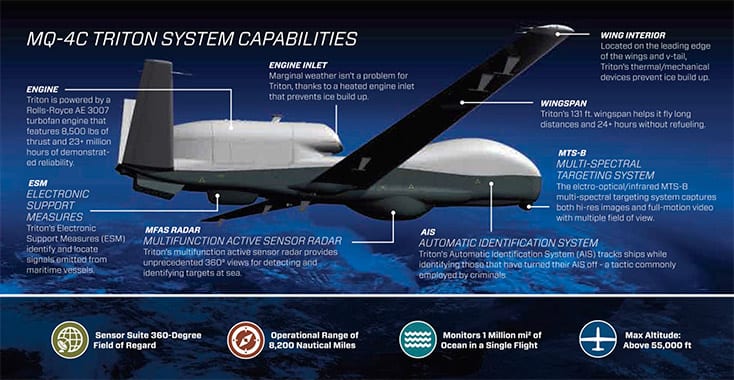
The MQ-4C’s mission payload includes a Northrop Grumman-built ZPY-3 Multifunction Active Sensor, an X-band radar with modes that include maritime surface search, spot synthetic aperture radar (SAR), strip SAR, inverse SAR snapshot and inverse SAR high-resolution. The radar’s 360-degree scan enables the Triton to cover 2.7 million square miles during a mission.
The Triton’s suite also includes a Sierra Nevada-built ZLQ-1 electronic surveillance measures sensor equipped with specific emitter identification and with an automatic identification system. A Raytheon-built MTS-B multispectral electro/optical/infrared sensor with a laser designator/pointer/range-finder capability also is installed.
“The fielding of the Navy’s premier unmanned aircraft system and its additive, persistent, multisensor data collection and real-time dissemination capability will revolutionize the way maritime [ISR] is performed.”
Capt. Dan Mackin, the Navy’s Triton program manager
The Triton can transmit its data to a ground station, including video live-streaming. It also can be an alternative communications relay to space-based satellites.
“The MQ-4C Triton will provide 7th Fleet with a round-the-clock ISR capability, as the aircraft have capability to fly more than 24 hours during each mission,” DaCosta-Azar said. “The VUP-19 detachment has the ability to pilot the MQ-4C from Guam or from Jacksonville, Florida, mission-control station. The majority of the VUP-19 crew operates from Naval Air Station Jacksonville.”
VUP-19 is headquartered at Naval Air Station Jacksonville, but its Tritons are home-based at Naval Air Station Point Mugu, California.
“The introduction of MQ-4C Triton to the 7th Fleet area of operations expands the reach of the U.S. Navy’s maritime patrol and reconnaissance force in the Western Pacific,” said Capt. Matt Rutherford, Task Force 72’s commander. “Coupling the capabilities of the MQ-4C with the proven performance of P-8, P-3 and EP-3 will enable improved maritime domain awareness in support of regional and national security objectives.”
Praise for — and Commitment to — the MQ-4C
Chief of Naval Operations Adm. Michael Gilday praised the Triton during March 11 testimony before the Senate Appropriations Committee’s Defense subcommittee.
“The capabilities that the MQ-4 brings are game-changing in terms of long-range ISR at altitude, with sensors that we haven’t had supporting the fleet before,” he said. “We’re still committed” to the Triton.
Mackin said the Navy’s program of record remains at 68 UAVs, despite a gap of two years — 2021 and 2022 — proposed in the Navy’s 2021 budget proposal. The total does not include the two Navy-owned and one Northrop Grumman-owned test aircraft.
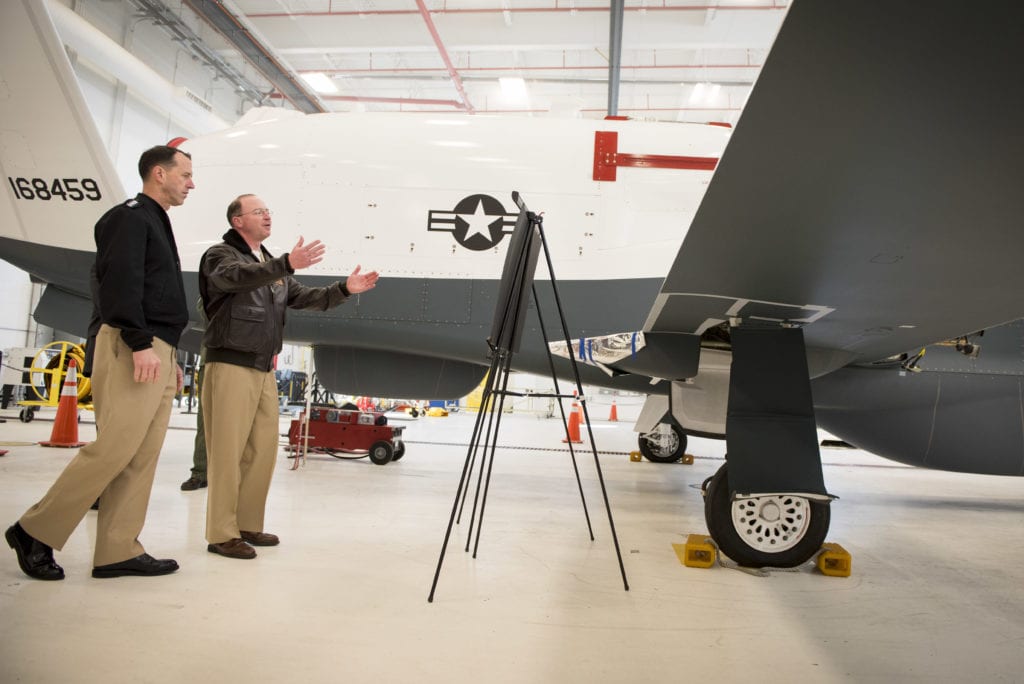
Then-Chief of Naval Operations Adm. John Richardson views the Triton at Naval Air Station Patuxent River, Maryland, in 2016. U.S. Navy/Mass Communication Specialist 1st Class Nathan Laird
The Navy has ordered 20 Tritons to date and has accepted delivery of seven: three flyable test aircraft (including one owned by Northrop Grumman), one fatigue test article and three production aircraft, the latter three delivered to VUP-19. One of the VUP-19 Tritons was involved in a flight mishap during a landing at NAS Point Mugu on Sept. 13, 2018.
“The Triton aircraft damaged during the gear-up landing at Point Mugu has been stricken from inventory although some components were salvaged for use on training devices,” Mackin said.
Configurations With More Advanced Capabilities
He said the two MQ-4Cs deployed to Guam are in the Triton’s baseline configuration known as IFC 3 (Integrated Functional Capability 3). The Navy is working on deploying the Triton with IFC 4, which gives the UAV a signals intelligence capability and will put it on the path to replace the Navy’s EP-3E electronic reconnaissance aircraft. IFC 4, also called the multi-int (multi-intelligence) capability, is planned for fiscal 2022.
Multi-int capability deployed in four Tritons at a single site to establish a 24/7 orbit over the Western Pacific area of operations also will mark the achievement of initial operational capability for the Triton.
The Northrop Grumman-owned MQ-4C in the test program is being used to advance the Triton’s capabilities.
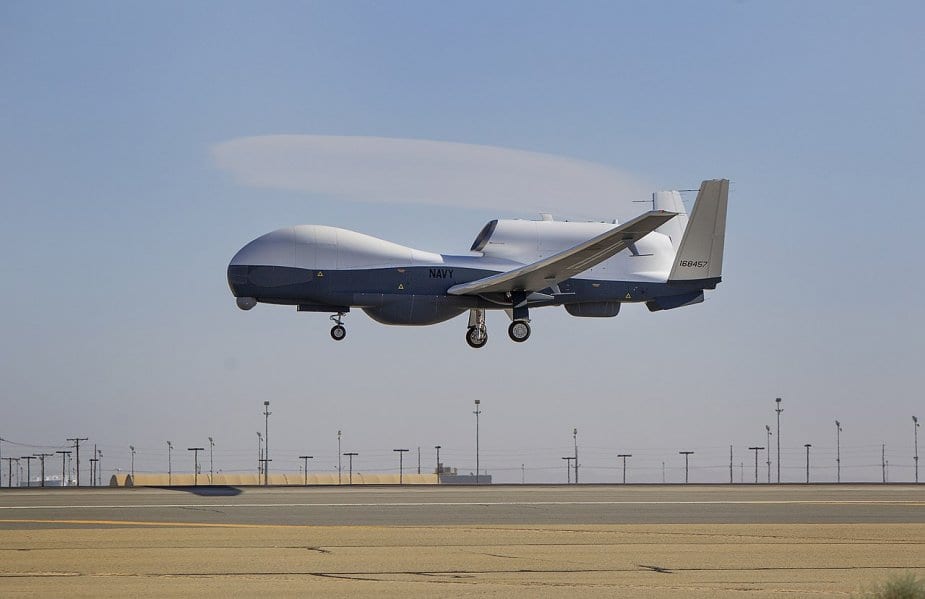
The Triton completes its first flight on May 22, 2013, from the Northrop Grumman manufacturing facility in Palmdale, California. U.S. Navy via Northrop Grumman/Alex Evers
“We are … integrating and testing IFC-4 upgrades to meet the U.S. Navy’s and Australia’s multi-intelligence requirement, which will ultimately enable the U.S. Navy to retire the EP-3,” said Doug Shaffer, vice president and program manager, Triton program, Northrop Grumman, in response to a query from Seapower.
Mackin said there “is a plan for upgrading older aircraft to the multi-int configuration with some [aircraft] already” in the works.
VUP-19 eventually will operate 12 MQ-4Cs operated and maintained by 500 personnel. The Navy plans to establish a second Triton squadron, VUP-11, at Naval Air Station Whidbey Island, Washington. The two squadrons together eventually will field 20 Tritons at five sites to sustain five around-the-clock orbits. The remaining 48 Tritons would be used for training, attrition and the maintenance pipeline over the service life of the UAV.
The groundwork for the MQ-4C, based on the U.S. Air Force Block 20 RQ-4A Global Hawk, was laid more than a decade ago with the Broad-Area Maritime Surveillance Demonstration (BAMS-D) program, in which the Navy acquired from the Air Force two Block 10 RQ-4As and their integrated sensors that included an electro-optical sensor, SAR with a ground moving target indicator and wide-area search modes. The Navy added an LR-100 electronic surveillance measures sensor, the automatic identification system, inverse SAR capability, and maritime moving target and maritime search sensing.
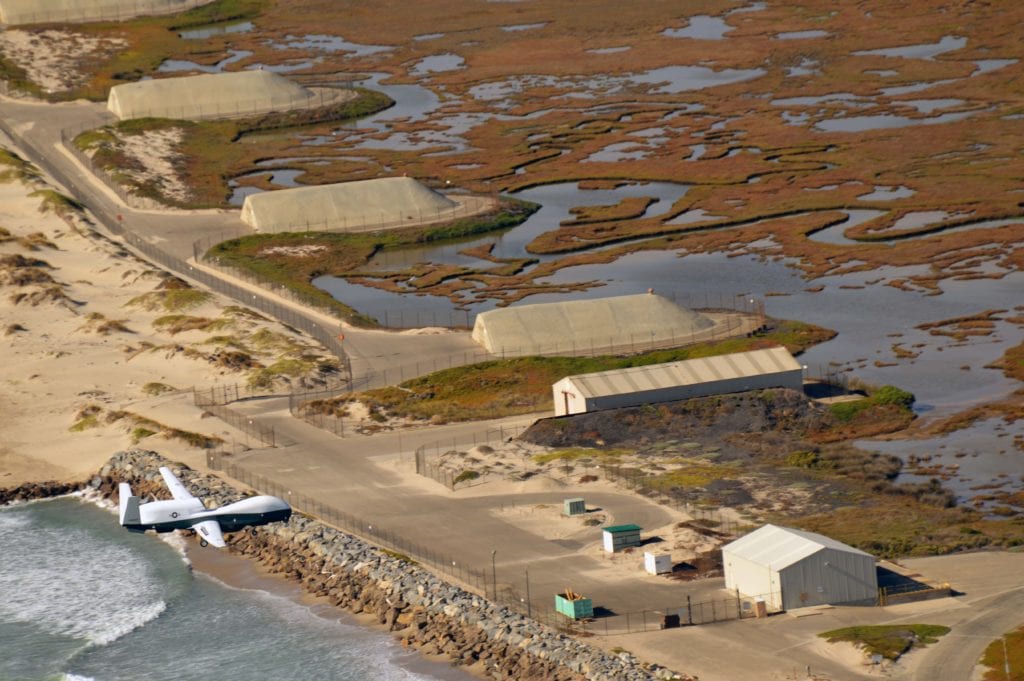
The first Triton, assigned to VUP-19, Detachment Point Mugu, arrives at Naval Base Ventura County, California, in 2017. U.S. Navy/Public Affairs Specialist Theresa Miller
The Navy in 2011 received three more RQ-4As from the Air Force for the BAMS-D. Since then, one RQ-4A was lost in a mishap in eastern Maryland in 2012 and another was shot down by Iranian forces last June. A third was damaged in a takeoff mishap in November. Mackin said repair is underway on the damaged RQ-4A.
The Navy deployed the RQ-4A to the U.S. Central Command area of responsibility in early 2009 for a planned six-month deployment. Now, more than 11 years later, after continuous deployment, the Navy still values the BAMS-D program as it awaits more deployments of the MQ-4C Triton.
According to the 2021 budget proposal, the Navy plans to phase out the BAMS-D, beginning in fiscal 2023, to allow the sea service to fund the whole MQ-4C program. “The MQ-4C will assume the signal intelligence mission from the EP-3E in [fiscal] 2022, which will require aircraft and control station modifications and calibrations to keep pace with emerging signals of interest at greater sensitivity thresholds.”
Allies See Triton’s Value, Sign Up to Take Delivery
Two allied nations are on track to operate the Triton. Australia signed a memorandum of understanding for up to six Tritons in June 2019, with delivery of the first scheduled for 2023. Germany also has announced its intention to procure three Tritons. Foreign procurement may be key in sustaining a steady Triton production line if the Navy gaps the procurement in 2021 and 2022.
“A two-year gap in production would have significant negative effects on the production line and the supplier base,” Shaffer said. “A pause would mean we lose the lessons learned that have enabled our suppliers and Northrop Grumman to achieve production efficiencies and get to this mature point of the program, which would then add more risks and costs to the program.
“We estimate that stopping and restarting the line alone will cost roughly $100 million to $150 million and then each aircraft likely costs about $20 million more. We are working closely with the Navy on multiple options [that] could keep the production line open and potentially result in cost savings for both the Navy and Australia.
“We have had multiple discussions with the U.S. Navy and Australia about options to fill the [fiscal] ’21 and ’22 production lines with Australian aircraft,” he said. “An acceleration of the Australian program would result in significant savings to Australia and ensure cost savings to the U.S. Navy by preventing a pause in Triton production. While any decision to accelerate the Australian program is between the U.S. Navy and Australia, we are prepared to provide the necessary support to an accelerated Australian program.”
At War With the Virus: Sea Services Forced to Radically Change Course to Battle the COVID-19 Outbreak
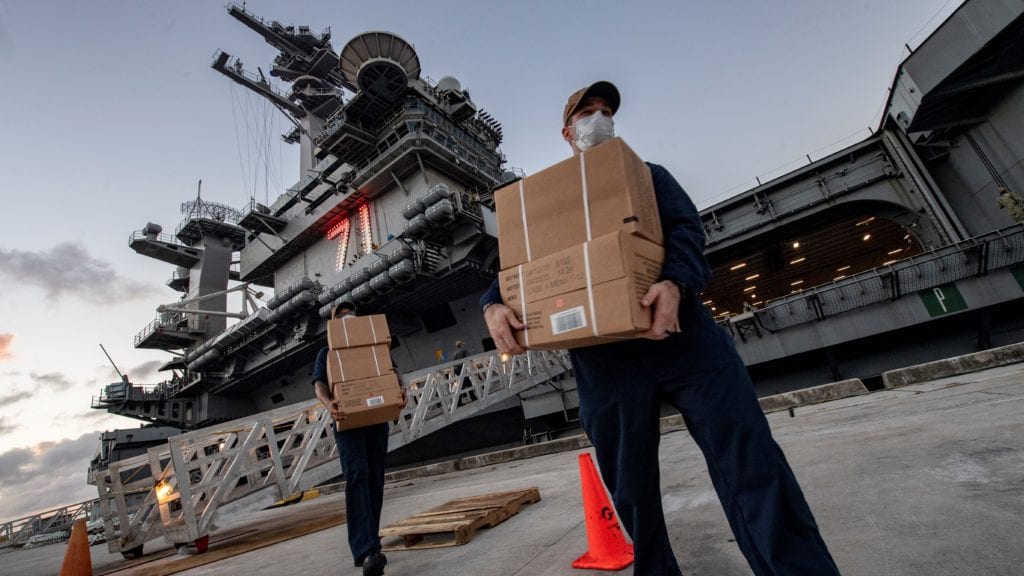
Sailors assigned to the aircraft carrier USS Theodore Roosevelt move meals ready to eat for Sailors who were negative for COVID-19 and asymptomatic at local hotels in an effort to implement social distancing and stop the spread of COVID-19. U.S. Navy/Mass Communication Specialist 1st Class Julio Rivera
The novel coronavirus has been a stunning and tragic disrupter of U.S. sea service operations — both major and routine, traditional events as well as long-planned operations.
Shortly after the World Health Organization declared COVID-19 a pandemic on March 11, the effect on America’s military started to come into sharper focus.
Check out the digital edition of the May Seapower magazine here.
By April 16, the U.S. Navy had reported 1,224 novel coronavirus cases. Most of those, 983, were Sailors, including 655 from the USS Theodore Roosevelt — the ship that is the hot spot for the virus. Another 134 cases were civilians, 53 dependents and 54 contractors.
A total of 13 Sailors, 13 civilians, three dependents and six contractors had been hospitalized. Also by April 16, 200 had recovered, the Navy said. On April 13, the Navy said that the first active-duty Sailor had died — a Roosevelt crew member — joining three civilian employees and two Navy contractors who perished.
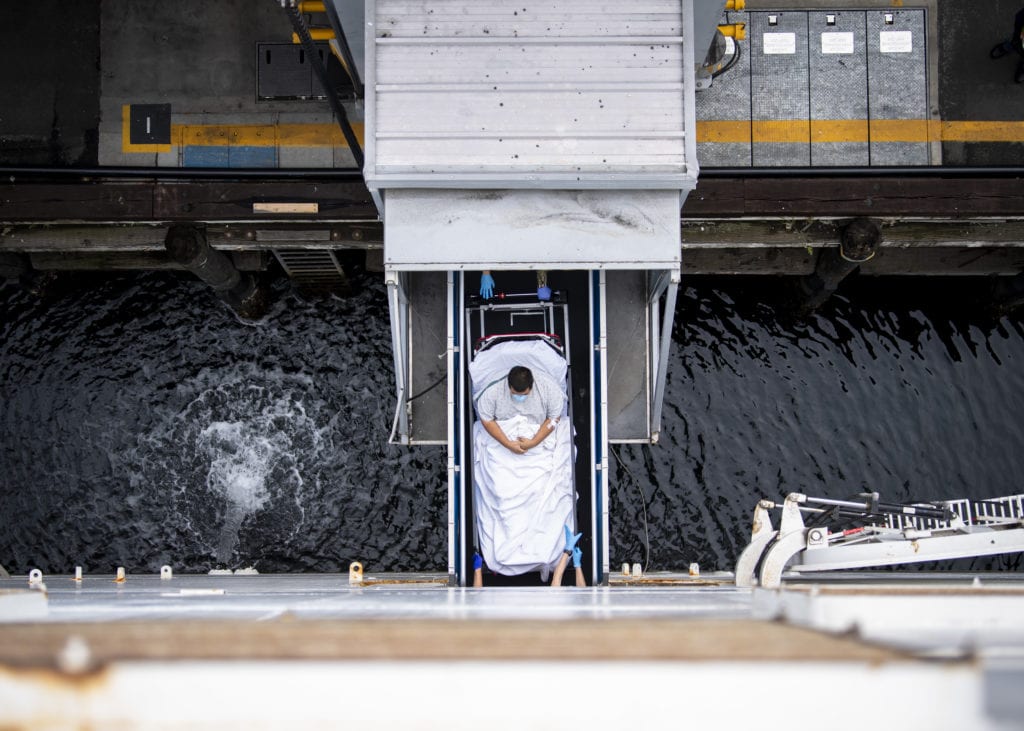
Sailors transport a patient to the hospital ship USNS Mercy. U.S. Navy/Mass Communication Specialist 2nd Class Ryan M. Breeden
As of April 16, the U.S. Marine Corps reported 340 COVID-19 positives among uniformed Marines, dependants, civilians and contractors. The U.S. Coast Guard had 90 cases but 31 had recovered by that date. Also by April 15, the hospital ship Mercy, docked in L.A., had seven test positive and sent into isolation. More than 100 had been in contact with those who tested positive there.
Spotlight on the Teddy Roosevelt
By mid-April, four aircraft carriers — the cornerstone of the Navy’s ability to project power forward — had at least one Sailor on board test positive for the viral infection. The USS Nimitz and USS Carl Vinson, both based in Bremerton, Washington, and the USS Ronald Reagan in Japan all were in port when their COVID-19 cases were discovered.
But nowhere was the outbreak more acute or visible to the world than on the fourth aircraft carrier, the Theodore Roosevelt, which put into port at Guam. That carrier became the first ship at sea to report a case.
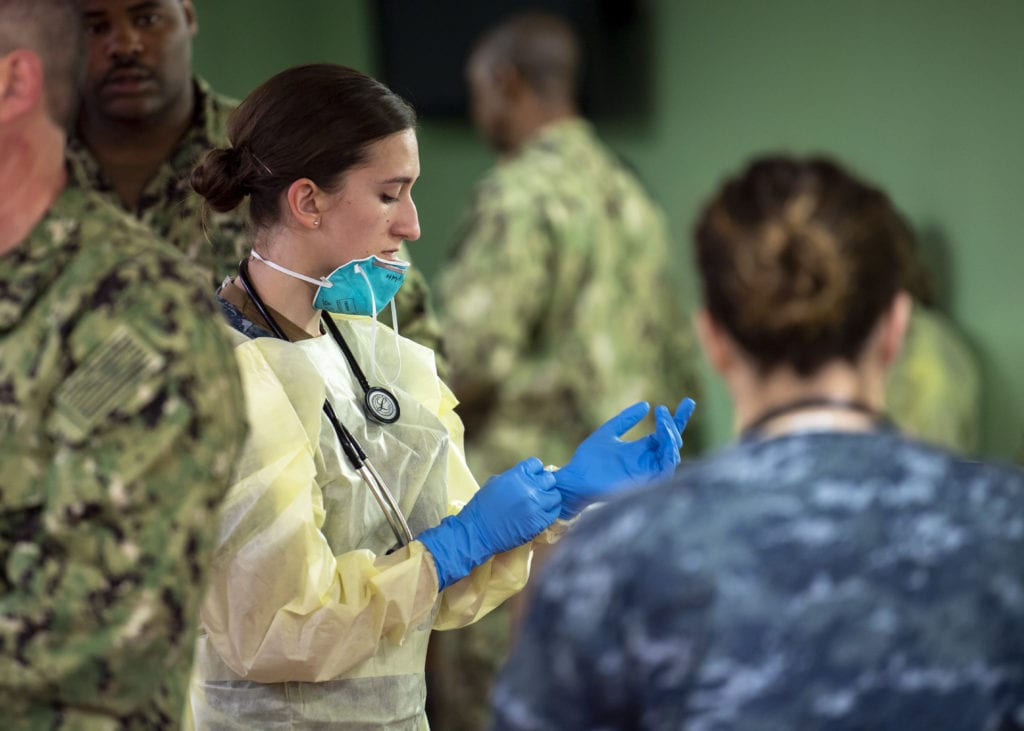
Hospital Corpsman 3rd Class Kimberly Wyss dons surgical gloves aboard the hospital ship USNS Mercy, which is deployed to Los Angeles in support of the nation’s COVID-19 response efforts and serves as a referral hospital for non-COVID-19 patients admitted to L.A.-area hospitals. U.S. Navy/Mass Communication Specialist 2nd Class Ryan M. Breeden
The then-captain of the Theodore Roosevelt, Brett Crozier, who later tested positive and went into quarantine himself, drew attention to his Sailors’ plight with a March 30 letter to Navy leadership. The letter was leaked and ran the next day with a story in the San Francisco Chronicle, drawing worldwide media attention.
As outcry grew over the fate of the Roosevelt’s crew, then-acting Navy Secretary Thomas Modly announced April 2 the removal of Crozier from his command. Modly then flew to Guam, where he would compound the controversy in a speech to the crew that included profanity-laced criticism of Crozier. The speech stirred more criticism of the Navy and Modly, who submitted his resignation on April 7.
By April 15, it was reported that Chief of Naval Operations Adm. Mike Gilday, after prelimary findings from a follow-on report of the affair, was considering reinstating Crozier.
As of April 16, 94% of the Theodore Roosevelt’s crew had been tested; 3,919 were negative with the 655 positives. Five were hospitalized in Guam, with one in intensive care. Of the 4,800 crew, 4,059 Sailors had moved ashore.
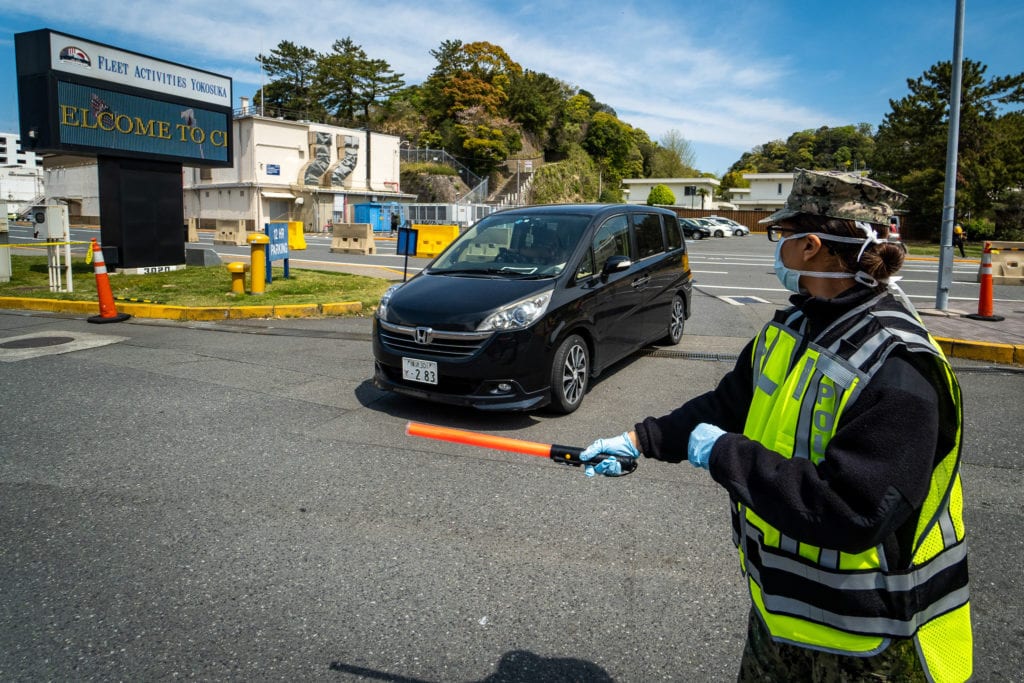
Commander, Fleet Activities Yokosuka, security department Sailors direct incoming gate traffic to COVID-19 screening stations on base. U.S. Navy/Taylor Curry
Concern for the Submarine Fleet
Of special concern is the health of the ballistic missile submarine force — the maritime leg of the nuclear triad with bombers and ground-based missiles — and other subs.
Crew members were undergoing enhanced medical screenings and 14-day isolation before beginning training or deployment aboard a sub, Gilday announced on March 24.
As of press time for Seapower in mid-April, no cases had been reported within the submarine force, but the Navy and all other services, starting in late March, were not reporting COVID-19 cases broken down by specific sectors of the fleet to protect operational security.
Wargame Foreshadows a Real Pandemic
Three months before the outbreak was detected in China, 50 experts participated in a wargame, Urban Outbreak 2019, that simulated the rapid spread of a disease.
The scenario involved a nation of 21 million people hit by a virus that led to respiratory failure and death.
The wargame generated a debate among “players” over the need for mass-enforced quarantine, like the U.S. population faces today. The players split between those who espoused quarantine as a reality and those who believed it would drive the infection underground and spread the disease faster.
The game’s results were scheduled to be discussed at a workshop in March, but like so many events in and out of the military these days, the real-life COVID-19 risk forced officials to postpone the workshop until at least this summer.
Getting and Staying Tough: With Elements Borrowed from SEALs, a Navy Pilot Program Aims to Teach Sailors How to Perform Under Extreme Stress
Sailors assigned to the Blue crew of the Ohio-class ballistic missile submarine USS Maryland observe sea and anchor detail upon returning to the boat’s homeport at Naval Submarine Base Kings Bay, Georgia. The Maryland is serving as a testbed for the Warrior Toughness program. U.S. Navy/Lt. Katherine Diener
The U.S. Navy wants Sailors to toughen up.
That’s not to suggest Sailors lack in the toughness department. But working in today’s Navy can be stressful, and Sailors need the tools to handle the burden. Soon they may get them — thanks to a program in its pilot stage, Warrior Toughness.
The 3-year-old program — confined to the crews of some Ohio-class ballistic missile submarines, principally the USS Maryland — could one day be used all across the sea service.
Check out the digital edition of the April Seapower magazine here.
Rear Adm. Michael D. Bernacchi, commander of Submarine Group 10, told Seapower that the program is a new approach to making sure Sailors are prepared for stressful jobs.
“What we were looking to do was to arm Sailors with additional tools to allow them to deal with stress so that they could perform better in stressful situations — both chronic and acute stress,” he said.
In creating the program, Bernacchi took lessons from the Navy SEALs, who are famous for their ability to adapt and even thrive in the most stressful situations imaginable.
“We wanted to adapt that to the general Sailor to give them more tools, whether that be standing the midwatch or dealing with a fire or whatever the case may be, you could respond well in any stressful situation and recall information,” he said.
Back to the Basics of Mind, Body, Soul
Bernacchi said there was nothing “new or magical” about the Warrior Toughness Program — it’s just about getting back to the basics of the mind, body, and soul and recognizing that they are all integral to the success of individuals.
“It’s about training your mind, understanding why it does the things that it does, making sure you’re in physical shape, understanding Navy core values — it’s a lot of different things, and we took a lot of it from the SEALs,” he said.
“What we were looking to do was to arm Sailors with additional tools to allow them to deal with stress so that they could perform better in stressful situations — both chronic and acute stress.”
Rear Adm. Michael D. Bernacchi, commander, Submarine Group 10
Right now, the program is just being tested on submarines, where Sailors have to deal with a lot of chronic stress just from living in that environment. However, Bernacchi envisions developing a fleet version that could be used in individual units.
When it was first rolled out at Navy Recruit Training Command, some Sailors were a little bit hesitant to embrace the new way of approaching training, but eventually most were on board, he said.
“When we started it at boot camp, most people didn’t want to do it,” he said. “I remember it getting called ‘recruit yoga’ and all kinds of other things. But you saw a huge increase in the performance of divisions, and then people wanted it. That’s the same thing we’ve seen here [aboard submarines].”
But what does the Warrior Toughness program look like from a Sailor’s point of view? Master Chief Matthew Glisson, Sub Group 10’s engineering department master chief (EDMC) and the Warrior Toughness lead, said there are many components. “There are psychology and a mindfulness techniques,” he said. “We’ve got a breathing technique called ‘recalibrate’ … where one learns to focus. The other benefit is that it lowers the heart rate.”
Capt. Seth Burton, commanding officer of the USS Florida, observes his crew’s performance during “angles and dangles” operation in the Mediterranean Sea. The Warrior Toughness program is being tested on submarines, where Sailors must deal with a lot of chronic stress just to live in cramped environments. U.S. Navy/Mass Communication Specialist 3rd Class Drew Verbis
Another technique practiced in Warrior Toughness is the “body scan” — where a Sailor tenses as many muscles in their body as possible to find out where the tension is located. Then there’s “mental rehearsal,” where a Sailor envisions, in as much detail as possible, a stressful scenario and then rehearses what their immediate actions would be and where they can draw on certain tools to cope with and perform in that situation.
Four Pilot Programs on Four Subs — Then Off to Study the Data
Four pilot programs on four submarines will be up and running by the end of 2020, including the one that started on the USS Maryland last October. The next pilot will launch in April, and then another a month after. Once Warrior Toughness gathers enough data from the first three, the program will determine which sub should get the fourth pilot. After the fourth, the program will examine the data, see what has been and what has not been successful, and then potentially create a larger program from it.
The program’s exists because the Navy recognized that it hadn’t ever focused on the issue of stress, Bernacchi said. “We have never in the Navy sat down and taught you, ‘Hey, this is how you physically deal with stress,'” he said. “No one’s ever taught me how to meditate before. No one’s ever taught me, ‘Hey, this is how chemistry in your brain works.’ I’ve never had a psychologist sit there and explain to me that this is the chemical reaction when fear strikes, and this is how you counter it.”
“In the training cycle we just came out of, we found a lot of uses in the strategic and tactical warfare simulator training environment, and we were able to apply stress-management and mindfulness exercises.”
Cmdr. Michael Paisant, commanding officer, USS Maryland Gold crew
Cmdr. Michael Paisant, commanding officer of the USS Maryland Gold crew, said the crew has already just about reached the “run” phase of “crawl-walk-run” with this program.
“We’re still trying to figure out — specifically on board — how we’re going to apply it,” he said. “In the training cycle we just came out of, we found a lot of uses in the strategic and tactical warfare simulator training environment, and we were able to apply stress management and mindfulness exercises.”
For example, during a portion of the training that involved piloting the submarine into ports, Sailors underwent breathing and mindfulness exercises as well as a visualization exercise as they went through each stage of the navigation process. The crew is also looking at ways to apply Warrior Toughness in a maintenance environment and not just operationally.
Paisant acknowledged that some of the crew was skeptical of the program at first, but since it began he says there’s been a lot of buy-in.
Sailors assigned to the Gold crew of Ohio-class ballistic-missile submarine USS Maryland attend Warrior Toughness introductory training in the Trident Training Facility at Naval Submarine Base Kings Bay, Georgia, last November. The Maryland Gold crew was the first to implement Warrior Toughness into their training. U.S. Navy/Mass Communication Specialist 1st Class Ashley Berumen
“They initially may have thought it would be another thing added to their plate, which it is not,” he said. “It’s focused on the individual Sailor, and on being a better spouse, a better leader. I think they’ve seen the benefits of it, and I’ve had a lot of folks say, ‘Hey, I do this all the time now. I do this in my personal life.’ I think my crew has really embraced it.”
Bernacchi hopes to see the program continue to evolve and eventually make all Sailors ready to protect the nation while dealing with any kind of stress — even the worst trauma imaginable. “When we take a missile hit to a carrier and lose 1,300 Sailors, are we going to be able to take a knee, gather ourselves, and then turn around and deliver the blow to kill the enemy who did that?” he said. “The answer is, we have to. But I don’t want to wait. Throughout our history we’ve shown we can do that, but it takes time to adapt. It takes time to get over the shock.
“The next battle, because of the speed of weaponry and everything else, we may not have that time,” he added. “So, I need to have Sailors who are ready to fight from the very second it goes off. And that’s what this is about.”
Q&A With CNO Adm. Mike Gilday
Chief of Naval Operations Adm. Mike Gilday visits with Sailors aboard USS Kearsarge in August during his first ship visit following the CNO change-of-office ceremony. U.S. Navy/Chief Mass Communication Specialist 2nd Class Nick Brown
Since August, Adm. Mike Gilday has
led the world’s most powerful navy as the 32nd chief of naval operations. The son
of a Sailor and a native of Lowell, Massachusetts, he is a surface warfare
officer who graduated from the U.S. Naval Academy and holds master’s degrees
from the Harvard Kennedy School and the National War College.
At sea, he deployed with USS Chandler
(DDG 996), USS Princeton (CG 59) and USS Gettysburg (CG 64). He commanded
destroyers USS Higgins (DDG 76) and USS Benfold (DDG 65) and subsequently
commanded Destroyer Squadron 7, serving as sea combat commander for the Ronald
Reagan Carrier Strike Group.
As a flag officer, he served as commander, Carrier Strike Group 8, embarked aboard the USS Dwight D. Eisenhower (CVN 69), and as commander, U.S. Fleet Cyber Command and U.S 10th Fleet.
Check out the digital edition of the April Seapower magazine here.
His staff assignments include the
Bureau of Naval Personnel, staff of the CNO and staff of the vice CNO. Joint
assignments include executive assistant to the chairman of the Joint Chiefs of
Staff and naval aide to the president.
As a flag officer, he served in joint
positions as director of operations for NATO’s Joint Force Command Lisbon; as
chief of staff for Naval Striking and Support Forces NATO; director of
operations, J3, for U.S. Cyber Command; and as director of operations, J3, for
the Joint Staff. He recently served as director, Joint Staff.
Gilday answered questions from Senior
Editor Richard R. Burgess in writing.
Why the renewed
emphasis on mastering fleet-level warfare?
GILDAY: The nature of
war at sea today is changing. Maritime operations stretch from the seabed to
space and across the electromagnetic spectrum. Long-range missiles that fly at
supersonic and hypersonic speed have decreased the amount of time a commander
has to make decisions, and the emergence of cyber and space as warfighting
domains have created a much more complex operating environment for our Sailors.
To meet these challenges, our fleets must
be the operational center of warfare. Fleet commanders must own the physical
and virtual battlespace they are responsible for and drive the fight, if
required to do so.
“We fight and win as a team, and we are better when we integrate more closely with the Marine Corps. We will build capability with our most natural partner, tying more closely with them at all levels.”
However, to be able to fight as a fleet,
we must exercise as a fleet. We have made great investments in our maritime
operational centers [MOCs], which gives fleet commanders the ability to do just
that. We need to exercise — and the only way to do that is with iron out there
at scale.
Upcoming fleet exercises, like Large
Scale Exercise 2020, will leverage operational concepts like Distributed
Maritime Operations, Expeditionary Advanced Base Operations and Littoral Operations
in a Contested Environment. Combined with war-gaming, future exercises will
serve as the key opportunity for experimentation and the development and
testing of alternative concepts. These exercises and experiments will inform
doctrine and tactics, and future fleet headquarters requirements, capacity and
size, and investments in future platforms and capabilities.
Going forward, we must leverage experience from combatant command, joint and other service exercises to better prepare the Navy to integrate, support and lead the joint force in a future fight.
Gilday delivers remarks Feb. 7 during a full honors ceremony for Vice Adm. Michael Noonan, chief of the Royal Australian Navy, at the Navy Yard in Washington, D.C. U.S. Navy/Mass Communication Specialist 1st Class Raymond D. Diaz III
The Optimized Fleet Readiness Plan and Dynamic Force Employment, in theory, would seem to be in tension. How should the Navy ensure a sustainable personnel tempo while keeping adversaries off balance?
GILDAY: People are our most important resource, and the Navy cannot succeed without its Sailors — they are our asymmetric advantage.
While we strive to have a predictable model for our Sailors and their families, it’s important to remember that sometimes the world gets a vote, which may require us to respond at a moment’s notice — and differently than we planned.
In which aspects do you see integration with the U.S. Marine Corps as having the greatest potential for improving naval power?
GILDAY: We fight and win as a team, and we are better when we integrate more closely with the Marine Corps. We will build capability with our most natural partner, tying more closely with them at all levels.
Together, we will build Navy-Marine Corps integration by aligning concepts, capabilities, programming, planning, budgeting and operations to provide integrated American naval power to the Joint Force. Opportunities for increased integration include our cyberspace operations, war-game and exercise programs, development of the Naval Tactical Grid, and potential Dynamic Force Employment options.
Alongside the United States Marine Corps, our Navy is the bedrock of integrated American naval power.
Gilday visits with Sailors assigned to Helicopter Maritime Strike Squadron 40 during his first visit as CNO to Naval Air Station Jacksonville and Naval Station Mayport, Florida, on Sept. 17. U.S. Navy/Chief Mass Communication Specialist Nick Brown
Where
do you see the best application of unmanned systems for naval warfare?
GILDAY: Unmanned is an
important part of the future. It must be a central component of our future
battle force to support the way we want to fight in a distributed way. Going
forward, I believe there will be a requirement for seaborne-launched vehicles
to deliver effects downrange, likely using a mix of manned and unmanned assets.
Ultimately, we must leverage technology to expand our reach, lethality and
warfighter awareness in undersea, surface and air domains. We must continue to
experiment more with unmanned, and we need to do it with greater speed.
Based on your experience, what does the Navy need to do to be prepared for war in the cyber domain?
GILDAY: Cybersecurity is commanders’ business. Commanders need to own it. Commanders must understand the status of their networks and systems and the potential operational risk they are assuming if readiness has degraded.
Going forward, we need to invest in training and retaining the best and brightest, and in cyber infrastructure; treat the network ([Navy-Marine Corps Intranet], ONE-NET, afloat networks) like the warfighting platform it is, giving priority to ensure it is secure and defended; defend forward — disrupt threats before they reach our networks; develop cyber-resiliency (think shipboard damage control) — identify, protect, detect, react and restore the network; integrate MOC to MOC, across the fleets and interagency, in every major exercise and operation; [and] partner with other services, interagency, industry, allies and partner nations.
“We must ensure the fleet’s readiness today so we can deliver credible ready forces tomorrow. This includes the prioritization of force design and the delivery of naval forces capable of imposing lethal power to any adversary and aggressive pursuit of increased lethality and modernization across the Navy.”
What have you learned the most about your role so far as a member of the Joint Chiefs?
GILDAY: My role as a Joint Chief is one that I take extremely seriously, and it is important that I provide the president, secretary of defense and chairman of the Joint Chiefs the best military advice I can. That is why I spend a lot of time studying and thinking about near-peer competitors, potential adversaries and our future force.
What are the main priorities of the Navy’s 2021 budget?
GILDAY: The Navy’s first acquisition priority is recapitalizing our strategic nuclear deterrent. We will continue to drive affordability, technology development and engineering integration efforts to support Columbia’s [ballistic-missile submarine] fleet introduction on time or earlier, maintain mastery of the undersea domain and sustain a formidable forward presence through our aircraft carrier fleet.
We must ensure the fleet’s readiness today so we can deliver credible ready forces tomorrow. This includes the prioritization of force design and the delivery of naval forces capable of imposing lethal power to any adversary and aggressive pursuit of increased lethality and modernization across the Navy.
Gilday visits with Sailors on Sept. 17 at the Littoral Combat Ship Operational Trainer Facility at Naval Station Mayport, Florida. U.S. Navy/Chief Mass Communication Specialist Nick Brown
How do you explain the lower shipbuilding budget and the early ship retirements given the need for a larger fleet?
GILDAY: The fiscal 2021 budget supports implementation of the National Defense Strategy, which remains our guidepost and drives our decision-making. While we are committed to building the largest Navy we can, the capacity reductions in the recent budget submissions were made with the service’s priorities of strategic deterrence, readiness, lethality and modernization in mind. We remain focused on maximizing the naval power of our ships, aircraft, unmanned vehicles, weapons and systems we have today in our fleet.
Our balanced approach in our budget submission provides a Navy ready to fight today while committing to the training, maintenance and modernization to provide a Navy ready to fight tomorrow. Naval power is critical to implementing the National Defense Strategy. But naval power is not just a function of fleet size: It is a combination of the readiness, lethality and capacity of that fleet.
Our
No. 1 priority is the Columbia-class ballistic-missile submarine. This request
also heavily invests in readiness accounts, such as ship and aircraft depot
maintenance and modernization, manpower, live virtual constructive training,
steaming days, and flying hours. It invests in new systems to make our fleet
more lethal, including increasing our weapons inventory, bolstering the range
and speed of those weapons, exploring directed energy weapons, and
incorporating new technologies such as hypersonics. This request grows our
fleet in size, generating sustainable, capable capacity.
The
configurations in some older platforms require a significant amount of
modernization, and we believe that the significant investment necessary for modernization
necessary to ensure platforms can operate in contested environments is better
utilized in other programs.
Looking to the next 10 years, how can the Navy best balance the funding needs between current readiness and new acquisition
GILDAY: Mission No. 1 for every Sailor — active and Reserve, civilian and uniform — is the operational readiness of the fleet.
We
must ensure the fleet’s readiness so we can deliver credible ready forces. This
includes the prioritization of force design and the delivery of naval forces
capable of imposing lethal power to any
adversary. That must be balanced with an aggressive pursuit of increased
lethality and modernization across the Navy, against the constraints of our
budget topline.
Going forward, we will continue to
prioritize investments using the National Defense Strategy as our
guidepost.
With the nuclear deterrent as the Navy’s No. 1 priority, what concerns do you have about the Columbia SSBN being on track to deploy on time?
GILDAY: Lead-ship construction for Columbia began in 2020 and the Navy continues to identify opportunities to drive schedule and cost margin. While the construction schedule is aggressive, it is achievable. The Navy is actively overseeing shipbuilders as they manage the submarine and aircraft carrier industrial base suppliers to minimize risk and incorporate recent lessons learned.
Why is the Navy asking for more Sailors
for the fleet?
GILDAY: To operate effectively as a force, we
need to properly man our ships, submarines and aviation squadrons, and this
budget request supports that effort with a 2% increase in active-duty Sailors (plus
7,300 from fiscal 2020 to 2021). Recruiting, developing and retaining a
high-quality military and civilian workforce is essential for our warfighting
success.
How is the budget strengthening the nation’s sealift capability?
GILDAY: We have a three-prong approach to strengthening our sealift capability, which includes the procurement of commercial vessels with 20 to 25 years of life remaining at a cost of $30 million, as opposed to acquiring new vessels at a cost of $300 million, $400 million or $500 million. Additionally, the Navy is conducting at service life extension [SLE] on existing sealift ships, which includes six service life extensions, put in place last year. The Navy intends to increase SLEs from six to 10 in 2021.
With Focus on Future Capabilities, U.S. 4th Fleet Is ‘Fleet for Innovation’
A VBAT vertical take-off and landing (VTOL) unmanned aerial system (UAS) prepares to land on the flight deck of the Military Sealift Command expeditionary fast transport vessel USNS Spearhead. The C4F “innovation cell” directed the test of the VTOL. U.S. Navy/Mass Communication Specialist 2nd Class Anderson W. Branch
When it comes to evaluating new naval technologies and
concepts in an operational environment, the U.S. 4th Fleet could be called “the
fleet for innovation.”
Christopher Heagney is the science adviser to Commander, U.S. Naval Forces Southern Command/U.S. 4th Fleet, detailed from the Office of Naval Research (ONR). In this capacity, Heagney is helping to ensure the Chief of Naval Research-managed $2.1 billion annual science and technology (S&T) budget meets the fleet’s needs.
Check out the digital edition of the February/March Seapower magazine here.
He also leads a team he calls the “innovation cell,”
helping the Navy get new capabilities into the hands of warfighters. Other
members of the cell include Robert
Trost, an econometrician from the Center for Naval Analyses (CNA), and Ted
Venable, a retired Navy captain and F/A-18 pilot and the unmanned aircraft system (UAS)
and counter illicit trafficking program manager on the staff.
“We’re essentially technology scouts,” Heagney said.
“We’re out looking for the latest and greatest technologies being developed by
DoD labs, industry and academia that we can pull forward and bring to the fleet
to solve operational needs.”
Exercises like Unitas bring navies and coast guards
together, but for the U.S. it is also an opportunity for experimentation when a
variety of assets are combined such as Coast Guard cutters, Military Sealift
Command expeditionary fast transports (EPFs) and UAS like ScanEagle, Puma and V-BAT.
A Knifefish unmanned undersea vehicle (UUV) training model undergoes crane operations aboard the Spearhead. The “innovation cell” also oversaw testing of the Knifefish. U.S. Navy/Mass Communication Specialist 2nd Class Anderson W. Branch
A top priority for the fleet commander is persistent
maritime domain awareness. “When I talk to my counterparts at the other fleets,
that’s really the big thing,” Heagney said. “If it’s not No. 1, it’s No. 2 or 3
on their list of priorities. ‘What is out there in the maritime domain that I
don’t know about?’ That’s been a naval objective since the beginning of time,
and it’s something we still struggle today with. We have overhead satellites,
unmanned surface and subsurface and aerial vehicles, and we still can’t get
enough. So, how can we help scratch that itch of the commander? That’s really
what we’re trying to get at.”
Because intelligence, surveillance and reconnaissance is
a capability gap for the theater, Venable said, the team needs to get creative.
“We are resource-limited in aircraft and ships, so we have worked together with
industry to provide unmanned maritime aircraft — both land-based and sea-based.
Some are programs-of-record [POR] and then there are non-POR aircraft. We had a
large UAS operate from El Salvador International Airport and Panama’s
International Airport in 2009 and 2010 to help the partner nations in the
counter-narcotics detection and the monitoring role,” Venable said.
“We’re essentially technology scouts. “We’re out looking for the latest and greatest technologies being developed by DoD labs, industry and academia that we can pull forward and bring to the fleet to solve operational needs.”
Christopher Heagney, science adviser to Commander, U.S. Naval Forces Southern Command/U.S. 4th Fleet
The Stark Aerospace’s Heron deployment to Panama was
successful, helping the Panamanians seize more than 12 metric tons of cocaine,
Venable said. The team also experimented with the ship-based AeroVironment Puma
AE (all-environment) unmanned aerial vehicle (UAV). Puma AE is a handheld UAV
and contractor-owned/contractor-operated (COCO). “Most of the operations we do
are COCO, because we can contract for services instead of owning the airplane
and having to worry about the training and maintenance. We contract for a
flight-hour requirement, and the company is responsible for satisfying that.
“One of the technologies we’ve been looking at is very
simple, but will help in the landing of our UAVs,” Venable said. “It’s an
optical landing system by Planck Aerosystems that uses something like a QR code
that is about 3 feet square, and the aircraft scan it, locks on and lands on
it.”
4th Fleet Covers Theater Friendly to
Innovation
Venable said there are three key factors that make the 4th
Fleet area of operations a good place to do the testing. “One, it’s a benign
environment; two, it’s right in our backyard and three, we have assets and air
space available to industry to come down and demonstrate their technology
either as a proof of concept or in an actual operational deployment. It’s
mutually beneficial to the company and the Navy.”
Heagney said the innovation cell also focuses on theater
security and cooperation and humanitarian assistance and disaster relief
(HA/DR). Whether it’s a hurricane, earthquake, flood or a country that becomes
unstable, C4F has had to respond. “As a naval force, we respond rapidly when
we’re called forward. So, we’re interested in what kind of technologies can we
find that will help with that mission, whether its medical, or moving supplies,
or conducting search and rescue. We want to find where people are in the most
need when a disaster hits and make sure our response can get what they need to
them. We focus on medical and HA/DR because we don’t have a major kinetic
priority,” he said. “We have a little more flexibility to focus on things other
than warheads on foreheads.”
Key to the success of the innovation efforts are the
experiment designs, data collection, analysis and reports that capture what
they did and why it’s important.
Trost was an economics professor for 33 years. He’s
involved in designing the experiments, collecting the data during the
experiments and providing the post-mission analyses.
“I design the data collection analysis plans and pass
them on to Ted and Chris for comments,” Trost said. “After the experiments are
complete, I write up the results and again get their comments.”
In updating data or improving computer models and
simulations, the right data must be collected and it must be in the appropriate
format.
“We might look at 10 things and only two or three of them
turn out successful,” Heagney said. “It’s important for the warfighters to know
what works and what doesn’t. We can help
find that out. And we have the data to back that up.”
Some of the experiments require little or no supervision
or intervention. “We’ve been working with a SBIR [Small Business Innovation
Research] and RIF [Rapid Innovation Fund] project for a new coating for
aircraft. We’ve taking aluminum panels called coupons that have the new
coating, as well as some with no coating, and we’ve taken them to sea aboard a
leased commercial vessel for at-sea data collection,” Heagney said. “We’re
getting real, no-kidding at-sea data on how do these perform in the environment
that our aircraft operate in. Instead of having an F-18 corrode because we
picked the wrong one, we let these corrode and we pick the perfect one.”
The U.S. 4th Fleet is responsible for 14 million square
miles of water from the Caribbean Sea, Atlantic and Pacific oceans. While it
has a lot of ocean, it doesn’t have a lot of ships. But the 4th Fleet does have
platforms, such as the Military Sealift Command expeditionary fast transport
USNS Spearhead (T-EPF 1), which supports a number of logistics and theater
security cooperation missions, and leased offshore support vessels, which can
be used as platforms for testing.
With the Navy procuring 24 mine countermeasure (MCM) mission
packages for littoral combat ships (LCS), Heagney and his team are looking at
how they can employ components of those mission packages even if an LCS is not
available.
“If we think of LCS as the truck, and the mission package
as the payload, why can’t we use another vessel of opportunity to accomplish
that mission with an MCM adaptive force package? We’re stepping up and saying,
‘Well, we’ve got an EPF if you want to try it on other ships — what other ships
do we have that could potentially do this? The EPF is a good one.’ ”
Heagney points to a test with Naval Warfare Development
Command using a British Royal Fleet Auxiliary ship, the RFA Mounts Bay, to use
elements of the LCS MCM mission package from a vessel of opportunity, as a good
example. The test used elements of the mission package such as the Common
Unmanned Surface Vessel (CUSV), the Knifefish UUV, Airborne Laser Mine
Detection System (ALMDS), Airborne Mine Neutralization System (AMNS), the Mark
18 Mod 1 Swordfish, and the Mark 18 Mod 2 Kingfish UUVs and involved LCS
Squadron (LCSRON) 2 Helicopter Sea Combat Squadron (HSC) 2 and HSC-28 and Explosive
Ordnance Disposal Mobile Unit (EODMU) 2.
“It’s not necessarily the capability of that one
particular system, because we assume the vehicle does what it’s supposed to do,”
Heagney said. “We want to develop a concept for doing it. It’s proving that we
can get it on the ship, that there is battery storage and the ability to
recharge them, that there are procedures down so we can actually get it to the
crane and be able to safely deploy the vehicle in the water and then be able to
recover it. That’s what we want to demonstrate, because I If you put in the
water and tell it to ‘go find mines’ it will find mines, right? But it’s all
the ability to launch and recover and do that from multiple ships. I think
that’s what really adds to the punch that the Navy can deliver. We’re not just
tied to these couple ships to do this mission.”
“We don’t really have mine equities, but our sister
fleets — 2nd, 5th, 6th and 7th— definitely do. And we can test it
here for their benefit. We can be the theater innovation,” Heagney added. “It’s
really a benefit for the Navy as a whole.”
‘Unparalleled Opportunities’ to Test, Refine
New Capabilities
“Fourth fleet offers unparalleled opportunities to test
and refine new capabilities and tactics in a risk-controlled environment,
versus a well-resourced, determined, creative adversary that also has a high
capture benefit,” said Rear Adm. Don Gabrielson, commander of the 4th Fleet. “This
team values every opportunity to contribute to national security and is
dedicated to partnering with the U.S. Coast Guard and all our partner nations
in bringing every resource to bear. These innovative systems operate in an
unparalleled learning environment with real national security benefits. We
are grateful for their contributions.”
Heagney said, “When we’re going and doing these
innovation events, we bring scientists out with us. We want them to get out of
the lab and see what it’s like to interface with the fleet.”
A lot of the demonstrations and testing sound simple and
straightforward, but the devil is in the details.
“It is amazing the simple things that you think, ‘Oh yeah, that should be no problem,’ ” Heagney said. “But when you get out on the water, on a new or different ship, things just go south really quick. The maritime environment is crazy difficult. When we take a brand-new technology, and it’s the first time an operator has seen it, and you put in the water, you will be shocked by the results you have. And that’s why we do what we do. We learn.”
Edward Lundquist spoke with the U.S. 4th Fleet innovation cell at Mayport, Florida.
America’s Largest Port Home to Mighty Surface Warship USS Iowa
Fireworks over the Battleship Iowa during fleet week in Los Angeles. Port of Los Angeles
The Port of Los Angeles waterfront in San Pedro is home to the Pacific Battleship Center (PBC) and Battleship Iowa (BB 61) Museum. With its 16-inch guns, Tomahawk missiles and other weapons, the 45,000-ton Iowa was once a forceful and imposing instrument of “battleship diplomacy.” Even moored as a museum, Iowa still conveys a powerful message about the importance of the U.S. Navy today and into the future.
Check out the digital edition of the February/March Seapower magazine here.
Located
next to the Port of Long Beach, the Port of Los Angeles is one of the busiest
in the world with 270 berths, 17 marinas with 3,800 boat slips, 20-plus cargo
terminals, and 75 container cranes and a cruise ship terminal that moves more
than a million cruise passengers each year. While the Iowa is a magnet there to
veterans and naval buffs, it also serves a wider audience. The ship educates
the public on why the Navy and maritime commerce are so important.
“We’ve
worked hard to change our audience from those with a natural affinity, such as
veterans and history buffs, into public engagement,” said Jonathan Williams, president
and CEO of Pacific Battleship Center, the nonprofit organization tasked to
operate the Battleship Iowa Museum.
While
history at the museum is important, the relevancy of the surface Navy to the
public is probably the most important component.
“Surface
warriors understand the importance of their own community and their
contribution to the Navy and the nation. But a museum’s purpose is to educate
the public, and we see our role expanding to educate the public on the
importance of the role of the surface Navy,” Williams said.
“A
large percentage of the general public has no idea of the breadth of the surface
Navy’s role and how it affects the average person’s life. In my opinion,
there’s no better place to do that than right here in the largest port in the
United States, because our Navy helps maintain safe and secure sea lanes to
ensure the passage of all that wonderful cargo that we enjoy as American
consumers and the exports and humanitarian assistance that we send overseas and
all of those different things that make our country what it is.”
Despite
the size of the port, most Los Angeles residents have never been inside it. “There
are young people who live 5 miles from here who have never been on a ship or
even seen one up close,” Williams said.
“Earlier
this year, we announced plans to become the National Museum of the Surface Navy
at Battleship Iowa. We’re in the final design process of our capital campaign
package to raise the necessary funds,” Williams added.
“We’ve worked hard to change our audience from those with a natural affinity, such as veterans and history buffs, into public engagement.”
Jonathan Williams, president and CEO, Pacific Battleship Center
“This
transition will have a tremendous impact locally and regionally and,
ultimately, will raise awareness about the relevancy of the surface Navy today.
As we develop the National Museum of the Surface Navy concept, our capital
campaign package discusses each one of the components of the surface Navy and
why they’re important — not only reflecting on the past in the historical
context of ‘look at this artifact,’ or ‘look at this historical story,’ but why
that component is a relevant aspect of maintaining the future of our country
and international relations.”
Williams
said the focus is on the basics.
“We
realized that only ship lovers like us really care to go inside to see the nuts
and bolts of a ship. The majority of the general public is more interested in
the human connection versus technical facts, which drives a broader level of
storytelling. We have worked really hard to change our audience over the past
seven years from the natural affinity audience of veterans and history buffs to
more of a public engaging audience.”
According
to Williams, the National Museum of the Surface Navy will be more than a
museum. “We want to become the place where we can have conversations about
international trade, safe and secure commerce at sea, disaster response, and
important facets of the surface Navy’s impact to society. We have our wardroom
and our CPO [chief petty officer] mess and our fantail available for meetings,
presentations and seminars. The ship itself can serve to stimulate these
discussions.”
Home
to Exhibits — and a Connection to Active-Duty Sailors
Iowa
is not just a Navy museum — it showcases other maritime themes as well. One
5,000-square-foot former berthing compartment is now Robert Ballard’s “Lost at
Sea” exhibit. The formula seems to be working. According to TripAdvisor, the
Battleship Iowa Museum is the fourth most popular museum of 131 and the sixth
most popular of 623 tourist attractions in the Los Angeles metropolitan area.
“We announce the arrival of every veteran who walks aboard.”
JONATHAN WILLIAMS
In
fact, the Battleship Iowa Museum already hosts junior naval officers attending the
basic division officer course at Surface Warfare Officers School who come up
from San Diego for instruction in the history and heritage of the surface Navy.
CPO selects come to the ship from Port Hueneme and San Diego each year for
indoctrination. “We do a lot of enlistments, re-enlistments, retirements and promotion
ceremonies. We also have Army, Marines, Air Force and Coast Guard coming here,”
Williams said. “It’s not just Navy.”
The
ship has become a home to various organizations. American Legion Post 61
transferred from Sacramento to San Pedro and is based aboard the Iowa. The U.S.
Naval Sea Cadets Battleship Iowa Division holds its meetings on the ship, and
there is a weekly amateur radio club. The new Battleship Iowa Surface Navy
Association Chapter held its first meeting in the wardroom recently, with more
than half of its membership in attendance.
The
museum offers two STEM programs to encourage students to learn about science,
technology, engineering and math. One is called “Day of Discovery” with Los
Angeles Unified School District — the second largest school district in the
country. The other is called “STEM at Sea” for any other school district in Los
Angeles or Orange County. “We currently focus on 4th through 6th grades,”
Williams said. “We have trained volunteer tour guides that help us deliver the
program.”
Sailors aboard the Arleigh Burke-class guided-missile destroyer USS Spruance render honors to the Iowa while transiting through the Port of Los Angeles during fleet week last year. U.S. Navy/Mass Communication Specialist 3rd Class Hector Carrera
The
emphasis on educating the public doesn’t mean veterans are forgotten. The USS
Iowa association holds its reunion on the ship every four years and meets at
other locations around the country on the other three years.
“We
announce the arrival of every veteran who walks aboard,” Williams said.
Rear
Adm. Mike Shatynski, the chairman of the PBC’s board of directors, said veterans
are still an important part of the Iowa family. “The Iowa would be razor blades
now if not for veterans. As a veteran that has found a home aboard Iowa, I can
speak for my shipmates that it fills that hole in our lives that we have had
since we left active duty. Without exaggeration, I can tell you that Iowa has
changed and saved many lives.”
Serving
aboard Iowa today is serving as a nexus between the military and the civilian
world for transitioning service members.
“One
of the things we didn’t realize is the organic nature of the ship and how being
part of the crew here today has helped vets and civilians alike bridge that gap
and provide a comfortable environment to be part of something greater than
themselves,” Williams said. “Veterans have always found in service to one’s
country something that’s greater than themselves, feeling like they’re part of
something bigger.
USS Iowa passes under the Golden Gate Bridge in San Francisco in 2012 during its final voyage to Los Angeles.
“And
today the ship and this organization continues that experience by organically
helping veterans’ transition into the civilian world — we’re integrating both
civilians and vets aboard a ship platform versus walking into a building or a
workforce development center. We’re hosting a lot of seminars and programs to
build on this unique environment, and we are working with partners like Reboot
out of San Diego, LA County Department of Mental Health, the Wounded Warrior
Project as well, and we’ve received some funding from Philadelphia Gear and the
Johnny Carson Foundation to make this happen.”
According
to Dave Way, the museum’s curator, the Pacific Battleship Center employs 16
full-time employees, with 390 part-timers and several contract personnel who
run the concessions. And there are several hundred volunteers, who Way
described as “incredible beyond words.”
In
addition to grants and corporate sponsorships, the PBC receives revenue from
ticket sales, hosting events and receptions, sleepovers by Boy Scouts and other
groups participating in Camp Battleship, which has 210 original berths, and
even filming by Hollywood production companies.
The
ship has both contractor and volunteers to help maintain the ship in a
condition “satisfactory to the Secretary of the Navy.” The original teak decks,
for example, have been a challenge to maintain. Way said it’s difficult to find
enough quality teak and the oakum caulking needed to make the decks watertight,
so new planking is being installed using Douglas Fir and is being bolted to the
deck.
A
significant donation came from the state of Iowa to keep their namesake ship in
good material condition. It’s no surprise that a big ship in a saltwater
environment needs plenty of upkeep, and the Iowa team takes maintenance
seriously. For example, the active anti-corrosion system uses an electrical
current to protect the hull.
Williams
said that raising money for any historic ship is a challenge, but he is
encouraged by the fact that the organization already has a large donor list of
about 36,000 people who have supported the Iowa, many of which have already
shown interest in the National Museum of the Surface Navy transition. Surprisingly,
Williams said the supporters don’t mind being asked again for donations.
“I
tend to find that we will actually turn off a donor if we don’t ask them to
support the programs or maintain the ship condition. Donors like to make an
impact and involving them in the organization allows them to become a part of
something greater than themselves.”
Other
Historic Navy Ships Find Access Becoming a Challenge
Other
large historic Navy ships open to visitors find similar challenges as well as opportunities.
Norfolk
is well-known as a Navy town, but it’s not as easy to get on base to take a
tour and see the ships as it once was. According to Stephen Kirkland is the
director of Nauticus National Maritime Center and the Battleship Wisconsin at
Waterside in Norfolk, for many people who come to visit Williamsburg and
Virginia Beach, this is as close as they’re going to get.
Kirkland
said he and his staff have two kinds of visitors. There are the aficionados who
are passionate about the Navy and its ships, especially battleships. “They’re
going to come to see us. We get visitors who have been aboard all four of the
Iowa class ships.”
But,
Kirkland said, “The majority of our guests have no conception. It’s our job and
privilege to give them a better understanding.”
It’s
not just about telling the story of the USS Wisconsin, Kirkland said. “How can
we use this ship to tell the story of the U.S. Navy, and why it’s so important
to our nation and the world?”
Kirkland said his team is trying different ways to get people aboard the ship, such as concerts or holiday-themed events such as Halloween, to appeal to a wider audience. He said Wisconsin is the first battleship to offer an “escape room,” where people must solve a series of problems and figure out how to get out of the room.
“We did it to reach those people who might not come aboard for any other reason than that. But once we get them on the ship, they will immediately have an understanding of how impressive it is. And with that comes more eyeballs and more funding. That’s important, because we’ve got to make sure the ship is in good shape for years to come,” he said.