USS Gravely Deploys to U.S. Northern Command Area of Responsibility 
From U.S. Northern Command Public Affairs, March 15, 2025 

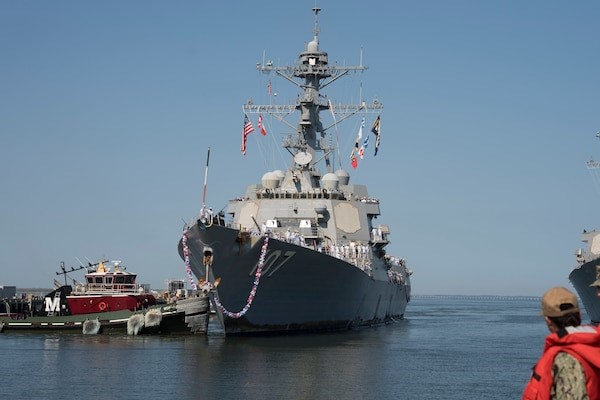
PETERSON SPACE FORCE BASE, Colo. – The Arleigh Burke-class guided-missile destroyer USS Gravely (DDG 107) departed Naval Weapons Station Yorktown for a scheduled deployment to the U.S. Northern Command Area of Responsibility (USNORTHCOM AOR), March 15. The ship will operate in U.S. and international waters. 

“USS Gravely’s deployment will contribute to the U.S. Northern Command southern border mission as part of the DOD’s coordinated effort in response to the Presidential Executive Order. Gravely’s sea-going capacity improves our ability to protect the United States’ territorial integrity, sovereignty, and security,” said Gen. Gregory Guillot, Commander, U.S. Northern Command. 

In support of U.S. Northern Command’s mission to restore territorial integrity at the U.S. southern border, Gravely reinforces the nation’s commitment to border security by enhancing maritime efforts and supporting interagency collaboration. The ship’s deployment highlights the Department of Defense and Navy’s dedication to national security priorities, contributing to a coordinated and robust response to combating maritime related terrorism, weapons proliferation, transnational crime, piracy, environmental destruction, and illegal seaborne immigration. 

“The deployment of Gravely marks a vital enhancement to our nation’s border security framework,” said Adm. Daryl Caudle, commander, U.S. Naval Forces Northern Command. “In collaboration with our interagency partners, Gravely strengthens our maritime presence and exemplifies the Navy’s commitment to national security and safeguarding our territorial integrity with professionalism and resolve.” 

Gravely brings maritime capabilities to the USNORTHCOM AOR in response to Presidential executive orders and a national emergency declaration and clarification of the military’s role in protecting the territorial integrity of the United States. 

A U.S. Coast Guard Law Enforcement Detachment (LEDET) will be embarked aboard Gravely. Founded in 1982, Coast Guard LEDETs carry out a variety of maritime interdiction missions, including counter-piracy, military combat operations, alien migration interdiction, military force protection, counter terrorism, homeland security, and humanitarian response.  

USNORTHCOM was named the DoD’s operational lead for the employment of U.S. military forces to carry out President Trump’s southern border Executive Orders. The combatant command continues to fill critical capabilities gaps in support of DHS and CBP. 
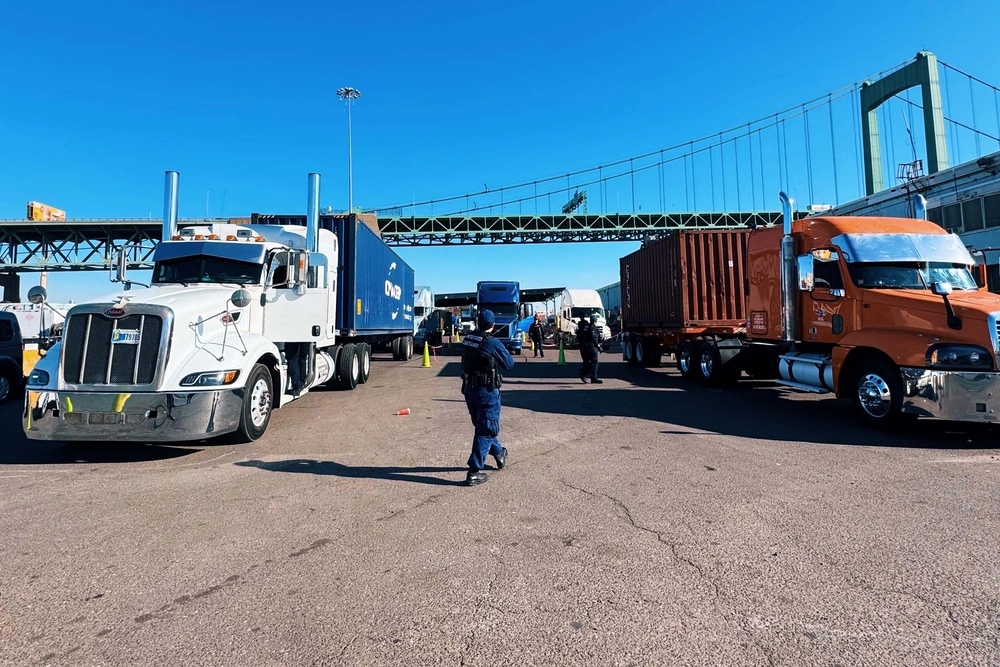


Coast Guard Conducts Joint Operation to Disrupt Illicit Maritime Activity in Philadelphia 

Coast Guard service members from Sector Delaware Bay lead a joint operation with partner agencies to ensure compliance with federal regulations at the Packer Avenue Marine Terminal, Philadelphia, March 11, 2025. (U.S. Coast Guard photo courtesy of Sector Delaware Bay)

From U.S. Coast Guard 5th District, March 14, 2025 

PHILADELPHIA — A Coast Guard law enforcement team from Sector Delaware Bay led a joint operation with partner agencies to ensure compliance with federal regulations at the Packer Avenue Marine Terminal, Tuesday. 

The joint operation included 27 officers. The goal was to ensure the facility was in compliance with the Maritime Transportation Security Act while deterring and detecting illicit activity within a key port area. The team screened 121 trucks and containers resulting in a shipping container being detained for a hazardous material violation. 

“Operations like this one are an important part of the Coast Guard’s mission of detecting and disrupting potential illicit maritime activity” said Capt. Kate Higgins-Bloom, captain of the port and commander of Coast Guard Sector Delaware Bay. “We are fortunate to have a great group of federal, state, and local partners here in Philadelphia.  Working as an interagency team is one of the most efficient ways for us to secure and defend the ports and waterways that fuel our national economic security.” 

This operation was led by members of Sector Delaware Bay’s response and prevention departments. Participating agencies included the Philadelphia Police Department and Transportation Security Administration’s Vehicle Intermodal Prevention and Response team. 

The Maritime Transportation Security Act provides a framework for ensuring the security of maritime commerce and domestic ports. The act’s main goal is to prevent a transportation security incident which is defined as any incident that results in significant loss of life, environmental damage, transportation system disruption and economic disruption to a particular area. 

“When we conduct these missions, we focus our efforts towards dismantling the exploitation of the maritime transportation system from drug trafficking operations and other maritime crime,” said Lt. Cmdr. Matthew Zangle, the enforcement division chief at Sector Delaware Bay. “Our partnership with local and federal agencies to disrupt the smuggling of narcotics like fentanyl and to deter illicit activity within the port not only increases our maritime security and resilience but also ensures the safety of the general public.” 

While conducting the operation, the Coast Guard’s prevention inspectors ensured compliance of federal regulations which resulted in the positive identification of improperly stowed hazardous materials inside a shipping container. The container was detained and released upon corrective action taken by the responsible party. 

“What this operation proved is we have the know-how and interagency relationships necessary to get the job done and ensure a major point of entry in our country remains safe and secure,” said Higgins-Bloom. 


Golden Dome ‘Only Hope Against the Existential Threat of an EMP Attack,’ Expert Says

From Ascot Media News, March 17, 2025 

Washington, D.C., March 14, 2025 — A “Golden Dome” missile defense shield designed to detect, track and intercept incoming ballistic weapons would offer the United States the best protection possible against advanced missile threats, including electromagnetic pulse (EMP) weapons, explains William R. Forstchen, Ph.D., widely recognized as a leading authority on EMP technology and its potential consequences. 
 
“The Golden Dome is our only hope against the existential threat of an EMP attack,” Forstchen said. “Every day we go without such a defense is yet another day when we are vulnerable to an EMP attack that could destroy America’s electrical and electronic infrastructure, setting our 21st-century society back to the 19th century or even earlier. Within a year, the majority of Americans would perish.” 
 
Forstchen has provided guidance to federal, state and local governments, as well as private organizations, on the potential widespread impact of an EMP event. A sought-after speaker, Forstchen has shared his expertise at conferences across the United States, educating audiences on the critical need for preparedness. 
 
Citing the country’s already vulnerable energy grid, Forstchen said an EMP attack would wipe out power and set off a cascade of deadly events. The first necessity people would lose is water, followed by food supply and medication. Then, disease would set in. Long-term survival, he added, would depend on being in the right place at the right time with the right food supply. 
 
“I believe the threat of America being hit by an EMP weapon is the single greatest danger to our survival,” Forstchen said. “Electricity is the fundamental building block of our society. Everything is predicated on electrification.” 
 
An EMP causes widespread cataclysmic damage to power grids due to what’s called the Compton effect, he explained. 
 
“An electromagnetic pulse is the byproduct of detonating a nuclear weapon. When a nuclear weapon is detonated 200 to 250 miles above the earth, the gamma ray burst when it hits the upper atmosphere sets off the Compton effect. In essence, a giant electrostatic discharge hits the earth’s surface and wipes out electronic devices as well as entire power grids, leaving affected areas in the dark,” he said. 
 
Forstchen has written extensively about the devastating impact of EMP strikes, beginning with his New York Times bestseller, One Second After, which offers a realistic look at a weapon and its awesome power to destroy the entire United States, literally within one second. One Second After spawned three sequels, each of which is a fictional exploration rooted in the cold, solid facts of how an EMP strike above U.S. soil would impact society. 


ZE Government Solutions Partners with HavocAI to Deliver Computer Vision Capabilities

Object Detection Software to be Integrated into Unmanned Maritime Vessels 

PHILADELPHIA, March 17, 2025 — ZE Government Solutions (ZEGS), a wholly owned subsidiary of A.I.-based gun detection leader ZeroEyes, today announced it has partnered with HavocAI Inc., a leading innovator in autonomous uncrewed surface vessel technology, to deliver customized computer vision capabilities that will be integrated with HavocAI’s maritime autonomy platforms. 

HavocAI’s technology enables a single operator to command and control thousands of autonomous assets. The company’s platform is designed to provide significant cost efficiencies, operational reliability, and scalable solutions for a wide range of applications, from defense missions to commercial ventures. 

“We are thrilled to partner with the ZeroEyes team, many of whom are military veterans, to work with us on developing and delivering computer vision capability to our defense customers,” said Paul Lwin, CEO of HavocAI. “These capabilities will help us to build mission-critical aspects of our autonomy platform.” 

“ZeroEyes has mastered the ability to build and deploy customized computer vision solutions for a wide range of government customers,” noted Dustin Kisling, Executive Vice President of ZE Government Solutions. “We are very excited to partner with the HavocAI team, who are leaders in deploying maritime autonomy and unmanned surface vessels for critical national security mission sets.”  


USS Truxtun Deploys from Naval Station Norfolk 

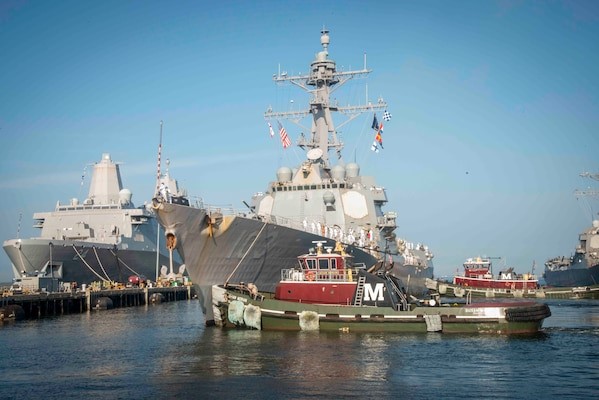
NAVAL STATION NORFOLK (Aug. 10, 2020) – The Arleigh Burke-class guided-missile destroyer USS Truxtun (DDG 103) returns to Naval Station Norfolk following a seven-month deployment. As part of the Dwight D. Eisenhower Carrier Strike Group, Truxtun operated in the U.S. 5th and 6th fleet area of operations to maintain maritime stability and security and ensure access, deter aggression and defend U.S., allied and partner interests. (U.S. Navy photo by Mass Communication Specialist 2nd Class Jacob Milham/RELEASED)

From U.S. 2nd Fleet Public Affairs, March 15, 2025 

NORFOLK, Va. (Mar. 15, 2025) – The Arleigh Burke-class guided-missile destroyer USS Truxtun (DDG 103) departed Naval Station Norfolk for a scheduled independent deployment today. 

The ship’s departure comes after months of training, maintenance, and certification events, which ultimately prepared the ship for a multitude of operations. Ultimately enhancing the Navy’s ability to detect and counter threats when directed. 
 
“Being ready to fight and win isn’t just a goal, it’s a way of life for Truxtun Sailors. This crew is unmatched in their perseverance and dedication to the ship’s warfighting readiness and tactical proficiency,” said Cmdr. James Koffi, Truxtun’s commanding officer.  
 
“I am confident that our team will perform to the highest standards of excellence, providing sustained credible combat power and remaining a warship ready for tasking anywhere when called upon around the globe.” 
 
Truxtun, stationed in Norfolk, Va., is a multi-mission guided-missile destroyer with air warfare, anti-submarine warfare, naval surface fire support, and surface warfare capability. Its ship’s company includes approximately 300 Sailors, with an additional 40 embarked air wing personnel assigned to the “Vipers” of Helicopter Maritime Strike Squadron 48. 
 
“The maritime environment presents complex challenges, and the Navy demands well-trained and capable warfighters, and Truxton will deliver when called upon,” said, Vice Adm. Doug Perry, commander, U.S. 2nd Fleet. “These Sailors are adaptable, and our Navy has charged them to press forward and challenge threats against our nation, Allies and partners.” 
 
Truxtun last deployed in 2023 with the George H.W. Bush Carrier Strike Group. During this time, the ship operated in U.S. 5th and 6th Fleet areas of operation and participated in Exercise AMAN, Exercise Juniper Oak 23-2, and International Maritime Exercise 2023. 
 
“Our Navy, our crew, and our ships combine to make the U.S. a capable force,” said Perry. “For 250 years, the Navy has been a force to be reckoned with, and we stand ready to fight. I am confident in Truxtun delivering when called upon.” 
 
Truxtun was commissioned on April 25, 2009. The ship is named for Commodore Thomas Truxtun, who was selected as one of the Navy’s initial six captains on June 4, 1798. 
 
U.S. 2nd Fleet, reestablished in 2018 in response to the changing global security environment, develops and employs maritime ready forces to fight across multiple domains in the Atlantic and Arctic in order to ensure access, deter aggression and defend U.S., allied, and partner interests. 
 
For more U.S. 2nd Fleet news and photos, visit facebook.com/US2ndFleet, https://www.c2f.usff.navy.mil/, X – @US2ndFleet, and https://www.linkedin.com/company/commander-u-s-2nd-fleet. 


Coast Guard Cutter Reliance Returns Home After 60-Day Maritime Border Security Patrol 

From U.S. Coast Guard 8th District, March 14, 2025 

PENSACOLA, Fla. — The crew of Coast Guard Cutter Reliance (WMEC 615) returned to their home port in Pensacola, Monday, following a 60-day patrol in the Florida Straits, Windward Passage and Gulf of America. 

Reliance deployed in support of Homeland Security Task Force – Southeast (HSTF-SE) and Operation Vigilant Sentry (OVS) while underway in the Seventh Coast Guard District’s area of responsibility, where crew members contributed to safeguarding America by patrolling U.S. maritime borders. 

While underway, the crew assisted in the interdiction of 12 aliens attempting to reach the United States unlawfully by sea, including several young children. Crew members provided humanitarian aid and care until the aliens were repatriated to their country of origin.  

Reliance maintained presence and directed operations for additional Coast Guard assets to deter dangerous and unlawful alien migration departures in the Windward Passage, which enabled other Coast Guard crews to assist with joint force operations for the Department of Homeland Security (DHS)-led mission at Naval Station Guantanamo Bay, Cuba. 

While at sea in the Eighth Coast Guard District area of responsibility, Reliance’s crew patrolled the U.S.-Mexico maritime border in the Gulf of America to deter illicit activity such as illegal maritime migration, fishing and smuggling at sea. 

Reliance’s crew also worked with two nearby Coast Guard air stations to conduct flight operations and maintain critical ship-helicopter interoperability. 

“I am enormously proud and impressed by the Reliance crew’s exceptional professionalism, versatility and adaptability, which they demonstrated across multiple dynamic, high-profile and demanding missions during this patrol,” said Cmdr. Aaron Kowalczk, commanding officer of Reliance. “Their tireless commitment to the aggressive deterrence of alien maritime migration ventures and the relentless compassion displayed in their dedication to the Coast Guard’s humanitarian mission was exemplary, once again saving countless lives while safeguarding our borders.” 

Established in 2003, HSTF-SE is the DHS-led interagency task force charged with directing operational and tactical planning, command and control, and functions as a standing organization to deter, mitigate and respond to maritime mass migration in the Caribbean Sea and Florida Straits.   

OVS is the 2004 DHS plan that provides the structure for deploying joint air and surface assets and personnel to respond to irregular maritime migration in the Caribbean corridor of the United States. Its primary objectives are to prevent the unnecessary loss of life at sea while deterring and dissuading maritime mass migration alongside our federal, state and local partners.    

Reliance is a 210-foot, Reliance-class medium endurance cutter with a crew of 77. The cutter’s primary missions are counter-narcotics and migrant interdiction operations, living marine resources protection, and search and rescue in support of U.S. Coast Guard operations throughout the Western Hemisphere.  

For information on how to join the U.S. Coast Guard, visit GoCoastGuard.com to learn about active duty, reserve, officer and enlisted opportunities. Information on how to apply to the U.S. Coast Guard Academy can be found here.   


USNS Wally Schirra Completes Major Maintenance at South Korean Shipyard 

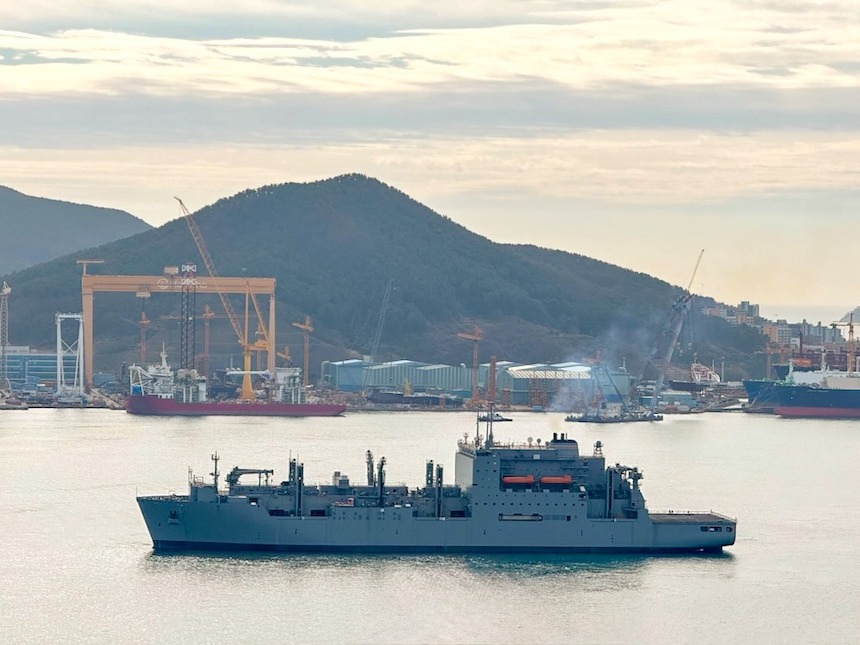
GYEONGSANGNAM-DO, Republic of Korea—Military Sealift Command’s (MSC) Lewis and Clark-class dry cargo ship USNS Wally Schirra (T-AKE 8) departs Hanwha Ocean shipyard after a seven-month overhaul at Gyeongsangnam-do, Republic of Korea, March 12, 2025. (Courtesy photo)

GYEONGSANGNAM-DO, Republic of Korea – Military Sealift Command’s (MSC) Lewis and Clark-class dry cargo ship USNS Wally Schirra (T-AKE 8) completed a seven-month regular overhaul (ROH) at Hanwha Ocean, Gyeongsangnam-do, Republic of Korea, March 12, 2025. 

The ROH marks the first time that a Republic of Korea shipyard has bid on and won an ROH contract of this scale for an MSC vessel. The ROH is much larger work vice voyage repairs (VRs), which are conducted routinely in the Republic of Korea. 
 
“The Republic of Korea’s ability to conduct large-scale maintenance to USNS ships within the Indo-Pacific Theater demonstrates the strong strategic partnership between the Republic of Korea and the United States,” said Rear Adm. Neil Koprowski, Commander, U.S. Naval Forces Korea. “Maintenance in Theater reduces downtime and costs, while enhancing operational readiness. This is a landmark achievement to be celebrated as a symbol of our strengthened partnership and ironclad commitment to the ROK-U.S. alliance.” 

ROH conducted aboard Wally Schirra in the Republic of Korea included dry docking, and more than 300 work items that addressed hull corrosion and a full rudder replacement. 
 
“Hanwha addressed extensive deterioration and damage to the hull, propeller, rudder, and rudder post/steering gear,” said Cmdr. Patrick J. Moore, commanding officer, MSC Office-Korea. “Notably, Hanwha engineers reverse-engineered the damaged rudder, completely replacing the unit when blueprint were not available. This saved significant time and resources in getting Wally Schirra back to sea, a testament to their resilient supply chains, advanced automations, and skilled workforce.” 
 
Wally Schirra is one of the many ships that are part of the U.S. Navy’s Combat Logistics Force (CLF). CLF are the supply lines to U.S. Navy ships while at sea. These ships provide virtually everything Navy ships need including fuel, food, fleet ordnance, dry cargo, spare parts, mail, and other supplies. 
 
“We appreciated the opportunity to complete this maintenance in the Republic of Korea, which will ensure Wally Schirra is ready for any tasking,” said Moore. “The addition of ROH capability for MSC ships in the Republic of Korea’s shipping industry adds additional means to deliver repair of military logistics vessels in order to sustain the readiness necessary to support Fleet operations.” 
 
CLF ships enable the Navy fleet to remain at sea and combat ready for extended periods of time. In addition to U.S. Navy ships, CLF ships also resupply international partners and allies operating in the Indo-Pacific Region. 
 
MSC Far East supports the U.S. 7th Fleet and ensures approximately 50 ships in the Indo-Pacific Region are manned, trained, and equipped to deliver essential supplies, fuel, cargo, and equipment to U.S. forces and coalition partners, both at sea and on shore. 


Saab Receives Order For Additional Live Training Equipment From U.S. Marine Corps

From Saab, March 14, 2025 

Saab has received a contract modification award from the U.S. Marine Corps for additional Marine Corps Training Instrumentation Systems (MCTIS) equipment. The order value for this award is USD $37 million (SEK 375 million) with deliveries taking place from 2025 to 2027.  

This award ensures the U.S. Marine Corps will continue implementing Saab’s deployable and expeditionary MCTIS capability. This advanced, interoperable live training solution helps Marines train in the most realistic environments, significantly improving their performance and survivability on the battlefield.  

The system focuses on developing and reinforcing effective tactics, techniques and procedures, while also facilitating joint training with NATO allies during multinational exercises. 

“We are honored that the U.S. Marine Corps continues to rely on us as their training partner for the next generation of Marine warfighters,” said Erik Smith, President and CEO of Saab in the U.S. “Our training capability enhances combat readiness by immersing Marines in realistic scenarios and rigorously analyzing their decision-making and actions, ultimately delivering on the objective of saving American lives. We take pride in providing the premier interoperable, land-based live training capability in the world.” 

Saab’s collaboration with the U.S. Marine Corps began with a contract awarded in June 2021, marking the transition from the previous Instrumentation and Tactical Engagement Simulation System II (ITESS – II) to the MCTIS training system.  


Navy Accepts Delivery of Ship to Shore Connector, LCAC 112

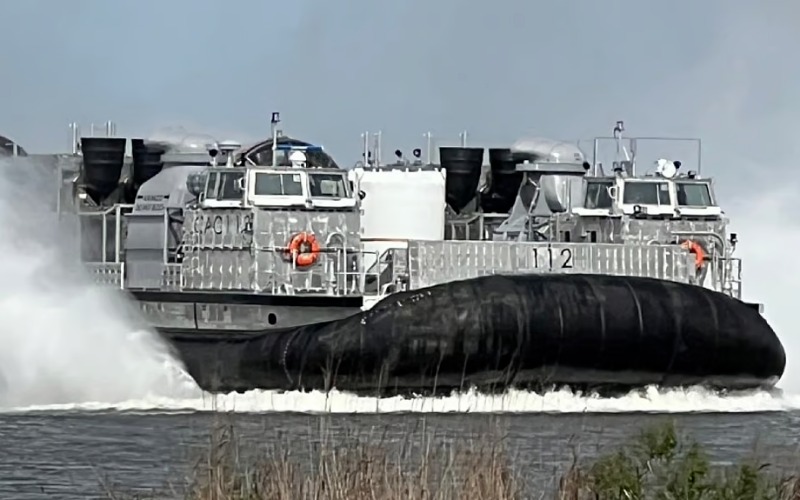
LCAC 112 was delivered to the Navy on March 13. US Naval Sea Systems Command (NAVSEA) photo.

By Team Ships Public Affairs, March 13, 2025 

NEW ORLEANS – The U.S. Navy accepted delivery of Ship to Shore Connector, Landing Craft, Air Cushion (LCAC) 112, from Textron Systems, March 13. 

Delivery of LCAC 112 follows completion of acceptance trials and represents the official transfer of the craft from the shipbuilder to the Navy. During acceptance trials, the Navy’s Board of Inspection and Survey tested the readiness and capability of the craft to effectively meet requirements. 

This addition to the fleet enhances Navy’s amphibious capability, providing a vital asset for rapid deployment and logistical support. 

“This new craft will provide the Navy and Marine Corps team with unparalleled capability in amphibious warfare, ensuring we remain agile and responsive to emerging threats and global challenges,” said Angela Bonner, program manager for Amphibious Assault and Connectors Programs, Program Executive Office, Ships (PEO Ships). “The introduction of LCAC 112 into our fleet marks another significant milestone in our ongoing efforts to maintain and enhance operational readiness.” 

The current LCAC is built with configurations, dimensions, and clearances similar to legacy LCACs—ensuring that it is fully compatible with existing well deck-equipped amphibious ships. LCACs can carry an approximate 60 to 75-ton payload and primarily transport weapon systems, equipment, cargo, and assault element personnel through a wide range of conditions, including over-the-beach. 

“The successful delivery of LCAC 112 demonstrates the strong partnership between the Navy and Textron Systems,” said Bonner. “This advanced craft will significantly enhance operations, providing a critical link in our ability to project power and support joint operations across the globe.” Textron Systems is currently in serial production of LCACs 113-125. 

PEO Ships, one of the Department of Defense’s largest acquisition organizations, is responsible for executing the development and procurement of all destroyers, amphibious ships and craft, and auxiliary ships, including special mission ships, sealift ships and support ships. 


Marines Value Accountability, Are Eager to Deploy, Commandant Says

March 14, 2025 | By David Vergun, DoD News  

Marines don’t want to be constrained to a stateside location. They want to deploy, said Commandant of the Marine Corps Gen. Eric M. Smith, who spoke yesterday at Defense One’s “State of Defense 2025” digital event. 

If they don’t, then they won’t reenlist, Smith continued, noting that Marines are currently deployed to every geographic combatant command. 

To remain operationally ready, Marines must be taken care of properly, he said. They need to live in a decent barracks, they need to have a say in where their next duty station will be, and they need to receive pay commensurate with their service. 

Marines also value accountability, Smith said, mentioning the Marine Corps has passed the last two annual audits and will do so again. 

When Marines check in to a new unit, they’re issued a rucksack, shelter and other gear. When they check out, they’re expected to turn in all the gear they were issued. If they don’t, then they’re expected to go to the surplus store and purchase what is missing. That’s accountability, he said. 

“It’s just ruthless adherence to standards. I mean that there’s no secret to it, other than that’s how we make Marines,” Smith said. 

The Marine Corps has been meeting its recruiting mission “because we don’t fail. We put our best and brightest on recruiting duty, and we will reward them for successful completion, and we relieve them when they don’t make their mission,” he said. “We don’t know how to fail.” 

Smith said he hopes for a budget because a continuing resolution is detrimental to the Marine Corps’ modernization efforts. 

Also, the Marine Corps needs more amphibious ships, he said, so Marines can move about where they are needed. 

“Everything we do is about warfighting and lethality. That’s all we know. That’s who we are. Any additional funding that we would get will go toward operational readiness and lethality,” he said.