Caine Nominated for JCS Chariman 

From the U.S. Department of Defense, March 11, 2025 

Secretary of Defense Pete Hegseth announced today that the president has made the following nomination: 

Air Force Lt. Gen. John D. Caine (Ret.) for appointment to the grade of general, with assignment as chairman of the Joint Chiefs of Staff, Pentagon, Washington, D.C. 

Below is the Air Force’s official biography of Caine: 

Lt. Gen. Dan Caine was the Associate Director for Military Affairs. His most recent assignment was as the Director of Special Programs and the Department of Defense Special Access Program Central Office at the Pentagon, Arlington, Virginia, where he served as the principal staff assistant and advisor to the Secretary of Defense for all programs protected under special access controls. He has served in a wide range of operational, staff and joint assignments, primarily as an F-16 fighter pilot, weapons officer, member of the White House staff and special operations officer. 
 
Lt. Gen. Caine was commissioned in 1990 through the ROTC program at the Virginia Military Institute, and he has an Master of Arts in Air Warfare from the American Military University. He has completed a range of national security and leadership courses, including Harvard Kennedy School’s course for Senior Executives in National and International Security, and the Syracuse University Maxwell School’s Program on National Security. As a Command Pilot, he has logged more than 2,800 hours in the F-16, including more than 150 combat hours. From 2009-2016, Lt. Gen. Caine was a part-time member of the National Guard and a serial entrepreneur and investor. 
 
EDUCATION 
1990 Bachelor of Arts, Economics, Virginia Military Institute, Lexington 
1998 Squadron Officer School, Maxwell Air Force Base, Ala., by correspondence 
1999 Air Force Weapons School Instructor Course, Nellis Air Force Base, Nev. 
2001 Air Force Air to Ground Operations School, Nellis, AFB, Nev. 
2004 Air Command and Staff College, Maxwell AFB, Ala., by correspondence 
2005 Master of Arts, Air Warfare, American Military University, Charles Town, W.Va. 
2006 White House Fellow, Air Force Fellows Program, U.S. Department of Agriculture, Washington, D.C. 
2012 North American Aerospace Defense Command/U.S. Northern Command Joint Task Force Commander Training Course, Peterson AFB, Colo. 
2012 Senior Leaders Maintenance Course, Washington, D.C. 
2017 Joint and Combined Warfighting Course (JPME-2), Norfolk, Va. 
2019 Capstone, National Defense University, Fort Lesley J. McNair, Washington, D.C. 
2019 Senior Executives for National and International Security, The Harvard Kennedy School, Cambridge, Mass. 
2020 Advanced Senior Leader Development Seminar (ASLDS), Arlie Center, Warrenton, Va. 
2020 National and International Security Leadership Seminar (NISLS), Alan L. Freed Associates, Alexandria, Va. 
2021 National Security Studies Management Course (NSSMC), Syracuse University, Syracuse, N.Y. 
 
ASSIGNMENTS 
1. November 1992–December 1993, Student, EURO-NATO Undergraduate Pilot Training, 80th Flying Training Wing, Sheppard Air Force Base, Texas 
2. January 1994–April 1994, F-16 Pilot/Assistant Training Officer/Scheduling Officer, 138th Fighter Squadron, Syracuse Air National Guard Base, N.Y. 
3. April 1994–June 1995, F-16 Pilot/Assistant Weapons Officer, 138th FS, Syracuse ANG, N.Y. 
4. June 1995–November 1995, F-16 Instructor Pilot/Chief of Scheduling and Training, 138th FS, Syracuse ANG, N.Y. 
5. November 1995–April 1998, F-16 Instructor Pilot/Chief of Training, 138th FS, Syracuse ANG, N.Y. 
6. April 1998–July 1998, F-16 Instructor Pilot/Chief of Weapons, 138th FS, Syracuse ANG, N.Y. 
7. July 1998–January 1999, F-16 Instructor Pilot/Chief of Weapons, 121st FS, Andrews AFB, Md. 
8. January 1999–June 1999, Student, F-16 Fighter Weapons School, 57th Fighter Wing, Nellis AFB, Nev. 
9. June 1999–November 2001, F-16 Instructor Pilot/Flight Commander/Chief of Weapons and Tactics, 121st FS, Andrews AFB, Md. 
10. November 2001–February 2002, F-16 Mission Commander/Chief of Group Weapons and Tactics, 332d Air Expeditionary Group, Ahmed Al Jaber Air Base, Kuwait 
11. February 2002–January 2003, Counter SCUD Project Officer, United States Central Command, MacDill AFB, Fla. 
12. January 2003–May 2003, F-16 Mission Commander/Flight Commander/Chief of Wing Weapons and Tactics, 410th Air Expeditionary Wing, Location Masked 
13. May 2003–January 2005, Chief of Weapons and Current Operations, ANG AFRC Test Center, Tucson ANG, Ariz. 
14. January 2005–August 2005, Director of Operations, ANG AFRC Test Center, Tucson ANG, Ariz. 
15. August 2005–September 2006, White House Fellow, Special Assistant to the Secretary, United States Department of Agriculture, Washington, D.C. 
16. October 2006–January 2008, Policy Director for Counterterrorism and Strategy, White House Homeland Security Council, Executive Office of the President, Washington, D.C. 
17. January 2008–July 2008, J3 and Commander, Joint Special Operations Task Force – Air Directorate, Balad, Iraq 
18. July 2008–November 2010, F-16 Instructor Pilot/Mission Commander, 121st FS, Andrews AFB, Md. (July 2008–March 2010, Special Tactics Air Liaison Officer, 24th Special Tactics Squadron, Joint Special Operations Command, Pope AFB, N.C.) 
19. November 2010–June 2012, Director of Operations (A3)/Deputy Director of Joint Operations (J3), Joint Force Headquarters, District of Columbia ANG, Washington, D.C. 
20. June 2012–June 2014, Commander, 113th Maintenance Group, Joint Base Andrews, Md. 
21. June 2014–May 2016, Director of Joint Operations and Training (J3), Joint Force Headquarters, District of Columbia ANG, Washington, D.C. 
22. May 2016–June 2016, Deputy Commanding General, Air, Joint Force Headquarters, District of Columbia ANG, Washington, D.C. 
23. June 2016–May 2018, June 2016–May 2018, Assistant to the Vice Commander, U.S. Special Operations Command, Special Operations Command Washington Office, the Pentagon, Arlington, Va. and Assistant Commanding General, Joint Special Operations Command, U.S. Special Operations Command, Fort Bragg, N.C. (Concurrently) 
24. May 2018–September 2019, Deputy Commanding General, U.S. Central Command Special Operations Component and Deputy Commanding General–Special Operations Joint Task Force – Operation Inherent Resolve (Iraq) (Concurrently) 
25. September 2019–September 2021, Director, Special Programs and Director, Special Access Programs Central Office, Va. 
26. September 2021–November 2021, Special Assistant to the Chief, National Guard Bureau, Washington, D.C. 
27. November 2021–December 2024, Associate Director for Military Affairs, Central Intelligence Agency, Washington, D.C. 
 
SUMMARY OF JOINT ASSIGNMENTS 
1. February 2002–January 2003, Counter SCUD Project Officer, United States Central Command, MacDill Air Force Base, Fla. as a major 
2. August 2005–September 2006, White House Fellow, Special Assistant to the Secretary, United States Department of Agriculture, Washington, D.C. as a lieutenant colonel 
3. October 2006–January 2008, Policy Director for Counterterrorism and Strategy, White House Homeland Security Council, Executive Office of the President, Washington, D.C., as a lieutenant colonel 
4. January 2008–July 2008, J3 and Commander, Joint Special Operations Task Force – Air Directorate, Balad, Iraq, as a lieutenant colonel 
5. June 2016–May 2018, June 2016–May 2018, Assistant to the Vice Commander, U.S. Special Operations Command, Special Operations Command Washington Office, the Pentagon, Arlington, Va. and Assistant Commanding General, Joint Special Operations Command, U.S. Special Operations Command, Fort Bragg, N.C. (Concurrently), as a brigadier general 
6. May 2018–September 2019, Deputy Commanding General, U.S. Central Command Special Operations Component and Deputy Commanding General - Special Operations Joint Task Force – Operation Inherent Resolve (Iraq) (Concurrently), as a brigadier general 
 
FLIGHT INFORMATION 
Rating:  command pilot 
Flight hours:  2,800 hours, to include more than 100 combat hours 
Aircraft flown: T-37, T-38 and F-16 
 
MAJOR AWARDS AND DECORATIONS 
Distinguished Service Medal 
Defense Superior Service Medal with bronze oak leaf cluster 
Distinguished Flying Cross 
Bronze Star Medal with bronze oak leaf cluster 
Defense Meritorious Service Medal 
Meritorious Service Medal with bronze oak leaf cluster 
Air Medal with bronze oak leaf cluster 
Aerial Achievement Medal 
Air Force Commendation Medal with two bronze oak leaf clusters 
Joint Service Achievement Medal 
Air Force Achievement Medal 
Air Force Outstanding Unit Award with “V” device and four bronze oak leaf clusters 
Combat Readiness Medal 
National Defense Service Medal with bronze campaign star 
Iraq Campaign Medal 
Global War on Terrorism Expeditionary Medal 
Global War on Terrorism Service Medal 
Air Force Expeditionary Service Medal 
Air Force Longevity Service Award with three bronze oak leaf clusters 
Armed Forces Reserve Medal with hourglass device 
Air Force Training Ribbon 
Presidential Service Badge 
 
OTHER ACHIEVEMENTS 
1992 Distinguished Graduate, EURO-NATO Undergraduate Pilot Training 
1999 Outstanding Graduate, USAF F-16 Weapons School 
2004 Lieutenant General Claire Chennault Award as the Air Force’s Outstanding Aerial Tactician 
Multiple Civilian Pilot Ratings, including Air Transport Pilot 
 
PUBLICATIONS 
“The Air Force Book,” The Air Force Association, September 11th vignette 
“Concept of Operations for the location, identification and destruction of Scud Missiles,” Operation Iraqi Freedom, 2003 
“Hurricane Katrina Lessons Learned Report,” The White House, March 2006 
“The National Strategy for Homeland Security,” The White House, October 2007 
 
(Current as of February 2025) 


SECDEF: Rapid Force-Wide Review of Military Standards 

From DoD News, March 12, 2025 

Today Secretary of Defense Pete Hegseth ordered a department-wide review of existing standards set by U.S. military branches pertaining to physical fitness, body composition, and grooming, which includes but is not limited to beards. 

“We must remain vigilant in maintaining the standards that enable the men and women of our military to protect the American people and our homeland as the world’s most lethal and effective fighting force,” Hegseth said. 

“Our adversaries are not growing weaker, and our tasks are not growing less challenging. This review will illuminate how the Department has maintained the level of standards required over the recent past and the trajectory of any change in those standards,” he added. 

The full memo is attached


Saildrone and Palantir Announce Strategic Partnership to Advance AI-Powered Maritime Intelligence 

Saildrone will leverage Palantir’s AI technology to deliver unprecedented insights for maritime intelligence, surveillance, and targeting applications. 

From Saildrone, March 13, 2025 

ALAMEDA, Calif. — Saildrone today announced a strategic partnership with Palantir Technologies set to revolutionize maritime intelligence capabilities. This collaboration will enable the rapid scaling of autonomous systems to deliver advanced maritime AI solutions—at a time when conventional naval assets are scarce. In an era of mounting global threats and critically constrained shipbuilding capacity, this partnership represents a paradigm shift in maritime security operations. 

Saildrone operates the world’s largest fleet of operationally deployed USVs, providing critical maritime domain awareness to the US Navy, Department of Homeland Security, and international allies. These autonomous vehicles utilize sophisticated and proprietary edge-computing AI/ML algorithms to monitor activities both above and below the sea surface, detecting threats including narcotics trafficking, illegal fishing operations, and adversary submarines.  

As demand for Saildrone services surges, the company will integrate Palantir’s sophisticated AI cloud infrastructure to enable rapid scaling across its entire operational spectrum—from transforming its manufacturing, supply chain, and fleet operations with Warp Speed to enabling AI-powered tasking of autonomous assets in the field. 

“As global threats continue to evolve, we’re seeing rapidly increasing demand for our maritime security solutions,” said Richard Jenkins, founder and CEO at Saildrone. “Leveraging Palantir’s sophisticated manufacturing and AI tools will allow us to streamline manufacturing and radically enhance fleet capabilities. While others make promises about tomorrow’s technology, we face complex global threats today. This partnership with Palantir ensures we deliver solutions today that outpace tomorrow’s threats.” 

With a decade of operations and nearly 2 million nautical miles sailed globally, Saildrone has amassed the world’s most comprehensive dataset of maritime intelligence at the sea surface. Palantir’s advanced AI capabilities will fuse this vast proprietary dataset with other external sources, delivering unprecedented insights for maritime intelligence, surveillance, and targeting applications. 

“We built Warp Speed to accelerate the organizations at the forefront of American reindustrialization—from the factory floor to the open ocean,” said Emily Nguyen, Palantir’s Head of Industrials. “Saildrone is delivering the future of Maritime AI, and we are extremely proud to provide software that supports the sustained competitive advantage of their USVs.” 


U.S. Coast Guard cutter arrives in Papua New Guinea, embarks law enforcement officers to conduct joint maritime patrol 

International partners from Papua New Guinea, the Solomon Islands, Indonesia, New Zealand, the United Nations, the European Union and the United States, stand on the flight deck of the Coast Guard Cutter Midgett (WMSL 757) in Port Moresby, Papua New Guinea Mar. 6, 2025. (U.S. Coast Guard photo by Petty Officer 3rd Class Jennifer Nilson) 

From U.S. Coast Guard Pacific Area, March 12, 2025 

PORT MORESBY, Papua New Guinea — At the invitation of the Papua New Guinea government, the U.S. Coast Guard Cutter Midgett (WMSL 757) arrived in Port Moresby, Thursday, to embark Papua New Guinean law enforcement officers. This visit directly supports Papua New Guinea’s leadership in the Pacific Islands and its commitment to maritime security, specifically in combatting illegal, unreported, and unregulated fishing. 

Midgett’s presence reinforces the U.S. Coast Guard’s commitment to deeper relations with Pacific Island nations and regional stability. This collaborative effort marks the first time a national security cutter, the U.S. Coast Guard’s most capable law enforcement cutter, will conduct bilateral maritime law enforcement operations in Papua New Guinea’s Exclusive Economic Zone (EEZ), under the existing bilateral agreement that was singed in May 2023. 

This joint patrol will represent a tangible demonstration of the bilateral agreement between the United States and Papua New Guinea, strengthening maritime governance within the Pacific and deterring illegal activities within Papua New Guinea’s EEZ to promote the sustainable use of marine resources. 

Midgett, commissioned in 2019 and homeported in Honolulu, is the eighth Legend-class national security cutter. These 418-foot vessels are equipped with advanced technology and a range of capabilities, making them ideally suited to support a wide range of missions, including maritime security, law enforcement, and search and rescue operations. Midgett’s deployment to Oceania highlights the United States’ enduring commitment to promoting a peaceful, secure, prosperous, and resilient Pacific Islands region 


Sound-Absorbing Chamber Allows Navy to Test Torpedoes Indoors 

March 13, 2025 | By Katie Lange, DoD News  

The Navy has various methods of testing torpedoes and other underwater weapons, including at tracking ranges. One unique Navy facility in Keyport, Washington allows experts to test these systems indoors.   

The Weapons System Test Facility at Naval Undersea Warfare Center Division was built in the 1980s to conduct land-based testing and evaluation of various undersea weapons capabilities including torpedoes and the sensors attached to them.  

“Back the Cold War, they running every torpedo on our test ranges. Every single one that’s produced … before deploying it to the fleet. Obviously, there’s a lot of cost and schedule associated with that,” said Will Buck, the deputy division head of the Undersea Systems Acquisition and Assessment Division that runs the facility.    

To save time and money, the Navy built the facility that contains a pressure chamber that’s 45 feet long and 12 feet in diameter. The chamber can hold 40,000 gallons of water that Buck’s team of about 20 people can pressurize and heat up or cool down to test torpedoes, sensors and unmanned underwater vehicles in their operational environments.  

“It only takes about 30 minutes to fill and drain the tank, turn the wrench and test again,” Buck said. “So, it just helps us quickly move through test evolutions to make sure that Navy systems are working the way they’re supposed to.”   

While the facility was first set up in the 1980s, it sat dormant for about 20 years after an accident in 1996 at a similar U.S. facility led to its closure. About a decade ago, Buck and his team knew the space could be useful, so they got approval to revitalize and modernize it.   

Typically, undersea weapons find their targets through sounds created underwater. The current facility includes an anechoic chamber — a box within the primary pressure chamber that absorbs sound waves — that can simulate the acoustics of an undersea environment.   

Buck’s team tests weapons in the chamber to find answers to questions such as, what direction the sounds are traveling, if they’re loud enough and if they’ll be heard far enough away.  

There were other questions the team considered. “What’s the directivity of this source? How long is the pulse? How loud is it? What frequency is it?” Buck said. “We’re trying to make sure that  meets the performance requirements of the system,” Buck said.  

If those parameters aren’t up to par, the risk for a weapon to miss its target is higher, he said. 

The team has tested several Mark 48 and Mark 54 torpedoes in the pressure chamber, as well as torpedo warning systems parts, the Gavia UUV and submarine sonar known as the high-frequency chin array.   

“We can put almost any kind of naval system — I mean, outside of a submarine or something really, really big — and we can recreate the physical characteristics it’s going to operate under and provide high-confidence data in how it’s going to react, how it’s going to perform and what changes, if any, are going to be made to the system before it goes out into the hands of the fleet.”  

Buck said his versatile team constantly gets to flex its design and engineering muscles with the wide variety of work it’s asked to do, especially with all the new technological capabilities that are coming onto the scene.   

“Everything we’re doing with UUVs is relatively modern and novel,” Buck said.   

Buck, who’s been at NUWC Division, Keyport, for more than a decade, has a bachelor’s degree in physics and a master’s degree in acoustics. He said for many in his field of work, there aren’t a lot of opportunities outside of academia, so the Navy has been a great place for him to put those skills to work and make a real difference.  

“They value competent and well-thought-out ideas and will put investment behind that,” Buck said of his division. “We’ve come a long way as a result. I’ve loved being here.”   

The facility has partnered with various institutions on some of its work, including the Applied Research Lab at Pennsylvania State University. Several of the members of the team have published their work and presented at scientific conferences, helping them to stay engaged with academia.


America ARG Completes Westpac Patrol

12 March 2025 

SASEBO, Japan – The America Amphibious Ready Group (ARG) and the 31st Marine Expeditionary Unit (MEU) completed their first patrol of 2025, March 6. 

This routine patrol, coordinated between the U.S. Pacific Fleet (PACFLT) and U.S. Marine Corps Forces, Pacific (MARFORPAC), served to maintain a consistent presence in the U.S. 7th Fleet area of operations. 
 
“Throughout our time at sea, we have remained on plan and on target conducting routine operations in the U.S. 7th Fleet area to enhance interoperability with our allies and partners,” said Commander, Amphibious Squadron (PHIBRON) 11, Capt. Patrick German. “Together, we continued to serve cohesively as a ready-response force to defend peace and stability in the Indo-Pacific region.” 
 
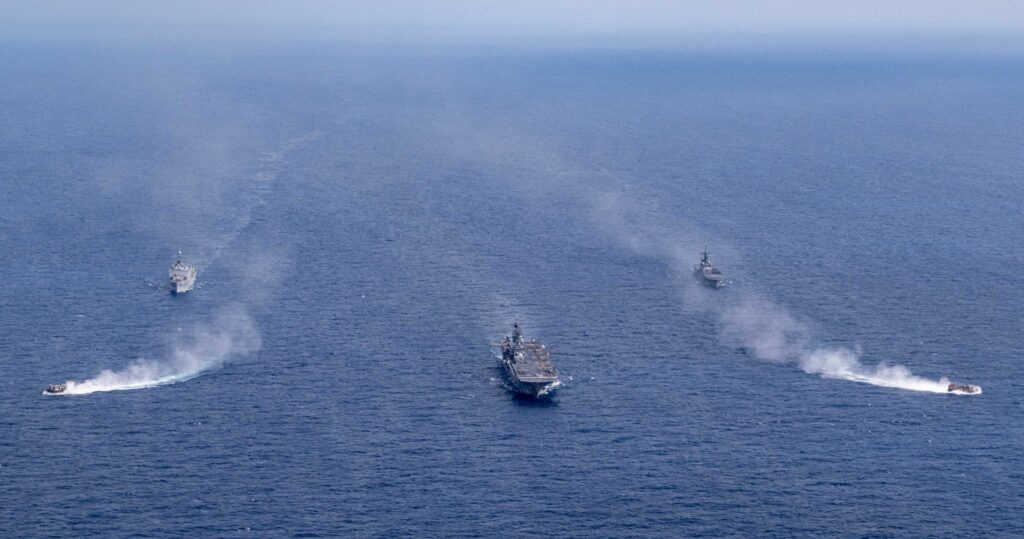
During the winter patrol, the America ARG consisted of PHIBRON 11, the America-class amphibious assault ship USS America (LHA 6), the San Antonio-class amphibious transport dock ship USS San Diego (LPD 22), and the Whidbey Island-class dock landing ship USS Rushmore (LSD 47). Additionall y, the San Antonio-class amphibious transport dock ship USS New Orleans (LPD 18) briefly joined the team of ships at sea, while conducting routine operations. 
 
“It has been great to have all our assets underway,” said German, who previously served as New Orleans commanding officer. “I am extremely proud to have all four amphibious ships underway simultaneously. Having all ships underway simultaneously goes a long way in ensuring our allies and partners that we are a ready force here to assist when and where it’s necessary.” 
 
From an amphibious assault ship, to an amphibious transport dock ship, to a dock landing ship, each vessel brought its own capabilities to form one, united ARG, operating at sea. 
 
“Each ship has a specific role and while there’s some overlap, some of those roles are specific to that particular ship,” said German. “For instance, LSDs have the largest well decks in the Navy’s amphibious fleet. Then you have the LHA, which is a floating airport. Even though we have aviation capabilities on the LPDs and the LSDs, they can’t assume the same role as the LHA or LHD. So, the aggregate of a three to four ship ARG increases strength and enhances the multi-role capability of an amphibious outfit.” 
 
Additionally, the 31st MEU integrated into the ARG to form a powerful and cohesive blue-green team. Its aviation combat element comprised of Marine Medium Tiltrotor Squadron 262 (Reinforced) and a detachment from Marine Fighter Attack Squadron 242; the ground combat element comprised of Battalion Landing Team 2nd Battalion, 4th Marines (2/4); and the logistics combat element comprised of Combat Logistics Battalion 31. 
 
“Working alongside the Marines was critical for us,” said San Diego Commanding Officer Capt. Timothy Carter. “As we continued to learn from each other, we also built on the foundations of our partnerships within our own organization, so that when the time comes to provide support to our allies and partners, we are ready, welding, and prepared to execute our mission.” 
 
Carter added having Marines and Sailors working together is the name of the game in an ARG; having a Blue-Green team is vital to the strength of amphibious operations and capabilities. 
 
During 25.1, America and Rushmore also participated in Iron Fist 2025, while San Diego became the third U.S. ship to visit Ishigaki, Japan in three years, underscoring the strength and commitment of the U.S.-Japan alliance as a cornerstone to peace and stability in the Indo-Pacific. 
Throughout 25.1, the ARG worked as one team in response to operational tasking, from start to end. 
 
“It has been phenomenal watching our teams come together,” said Carter. “We all bring different types of capabilities to the fight. Everyone has a unique art and everyone plays a valuable role in what we have accomplished here. Throughout our interoperability and certifying exercises, we truly came together as a unit, both sea force and landing force while operating as one.” 
 
Based in Sasebo, Japan, and consisting of the amphibious assault ship USS America (LHA 6), transport dock ships USS San Diego (LPD 22) and USS New Orleans (LPD 18), and the dock landing ship USS Rushmore (LSD 47); PHIBRON 11 provides centralized planning embarkation, movement control, coordination and integration of all aspects of amphibious warfare. 


Navy Intends to Ramp Up Shipbuilding Through Collaborative Efforts

March 11, 2025 | By David Vergun, DoD News 

U.S. shipbuilders continue to produce the highest quality, safest and most advanced warships on the planet, said Brett A. Seidle, deputy assistant secretary of the Navy for research, development, and acquisition, who testified today at a House Armed Services Committee’s seapower and projection forces subcommittee hearing on the state of U.S. shipbuilding. 

“We have the finest Navy ever assembled in the history of the world,” Seidle said. “They’re coming to a theater near you, bringing their A game.”   

However, at a time when adversaries around the globe challenge the maritime commons, the U.S. shipbuilding industry is challenged to produce the quantity of ships at the rate required, he said.  

Cost and schedule performance remain challenging with deliveries approximately one to three years late and cost rising faster than overall inflation. These issues are prevalent across the nuclear and conventional shipbuilding communities with both the Navy and industry sharing responsibility, Seidle said.  

Some things brought this about, he said, including reduced competition and capacity at tier-one shipyards. Additionally, suppliers have experienced atrophy of the manufacturing sector, shifting Navy requirements, burdensome acquisition processes, depressed investment, workforce shortages, diminished proficiency, supply chain disruptions, historic underinvestment and industry consolidation following the end of the Cold War. 

“I was not raised in the shipbuilding environment and therefore am not saddled with preconceived notions of ‘this is how we’ve always done it.’ I certainly welcome informed perspectives from those who are passionate about strengthening our fleet,” Seidle said.  

He believes these collective challenges can be overcome, he said.  

“This committee has my passionate commitment to collaborate with Congress, industry, academia, training organizations, trade associations, as well as all levels of government in pursuit of improved cost and schedule performance,” Seidle testified.   

“Our nation and the world need the strength of our Navy, and my intent is do everything in my power to deliver on that promise,” he said. 


Mass Timber, 3D Printing May be Future of Military Construction for Army, Navy

March 11, 2025 | By C. Todd Lopez, DoD News 

Army and Navy barracks may one day be 3D printed or built using mass timber construction that involves large wooden structural beams manufactured from smaller lumber. 

Today on Capitol Hill, Dave Morrow, director of military programs for Army Corps of Engineers, and Keith Hamilton, chief engineer for Naval Facilities Engineering Systems Command, met with lawmakers from the House appropriations committee, subcommittee on defense, to discuss the current and potential future uses of innovative construction techniques and technologies by the armed forces.  

Additive construction — 3D printing buildings — high performance cement and concrete mixes, geosynthetics, mass timber, composite materials, industrialized construction, tension fabric structures, and carbon fiber reinforced polymers were all part of the discussion with lawmakers about how the Army and Navy can develop the most cost efficient and resilient military construction projects.  

“In an increasingly complex global security environment, our commitment to innovation in military construction is not just about building structures, it’s about building the resilience and readiness our forces need to prevail,” Morrow said. “By working with industry to leverage these advancements, we can deliver more durable, sustainable and cost-effective infrastructure for our military, ensuring taxpayer dollars are used efficiently, while equipping our troops with the best facilities in the world.”  

The Army Corps of Engineers, Morrow said, has already piloted 3D printed construction at Tyndall Air Force Base, Florida, and Fort Bliss, Texas. At Fort Bliss, three new projects, involving barracks, were constructed using 3D printing technology.  

Morrow said this technology can be used in garrison or in expeditionary environments.  

“Additive construction has [the] potential to reduce costs, manpower, logistics and time, while opening the door for improved and new applications, such as unconventional countermeasures,” he told lawmakers.  

The USACE’s Engineer Research and Development Center, has played a part in the development of unified facilities criteria, to allow additive construction in 80% of the United States, Morrow said. The criteria, developed jointly, sets basic technical requirements that must be followed to deliver code-compliant, complete and usable military facilities.  

In Hampton Roads, Virginia, the Navy is now piloting the use of mass timber, also called cross-laminated timber for construction of a child development center, Hamilton said.  

In testimony submitted to the committee, Hamilton said the new facility will use a hybrid mass timber exterior envelope consisting of cross-laminated walls and diaphragms.  

“DOD has expressly acknowledged the applicability of CLT with the creation of a guide specification,” Hamilton said. “As the CLT construction industry matures, CLT may prove more competitive and could be utilized more broadly in DOD construction.”  

The USACE is also working with mass timber projects, Morrow said.  

“We recently designed the Army’s first barracks made primarily with mass timber structural elements and are soliciting interest in construction of a project at Mountain Home Air Force Base, calling for the incorporations of mass timber design,” he said, adding that mass timber construction in those projects may reduce construction timelines.  

Hamilton told lawmakers, at Marine Corps Air Station Cherry Point, North Carolina, NAVFAC was involved in piloting the use of high-performance concrete to build a new F-35 Lighting II hanger.  

Advancements within HPC include durability, strength, and resistance to extreme environmental conditions, as well as improved thermal and acoustic properties.  

“HPC has been used extensively for our piers, runways and other critical infrastructure; and we are broadening its application,” Hamilton wrote in submitted testimony.  

Like USACE, Hamilton said, NAVFAC is looking to newer technologies to provide better facilities and better capabilities to warfighters.  

“NAVFAC is actively testing and employing innovative technologies, materials and methods for design and construction today, and we are leaning forward to increase collaboration with industry, academia and other government partners to identify and leverage future opportunities,” Hamilton said.  

Within the Navy, he told lawmakers, new guidance requires NAVFAC planners and engineers to evaluate if new military construction projects can use alternative construction methods to meet warfighting requirements, lower costs and accelerate project delivery. 


Curtiss-Wright Awarded $50 Million IDIQ Contract by Naval Air Systems Command for High-Speed Data Acquisition Systems

ASHBURN, Va. – March 11, 2025 – Curtiss-Wright’s Defense Solutions Division today announced it has been awarded an approximately $50 million firm-fixed-price Indefinite Delivery, Indefinite Quantity (IDIQ) contract by Naval Air Systems Command to provide its high-speed data acquisition systems hardware and associated repair services in support of the Naval Air Systems Command Special Flight Test Instrumentation Pool.  The contract, which is scheduled to run through January 2030, covers Curtiss-Wright’s full line of flight test instrumentation products, including data acquisition units, network switches, data recorders, network gateways, Ethernet radios, RF transmitters, C-Band transponders, and high-speed cameras supporting fixed-wing and rotary military aircraft. This contract will support numerous platforms including the F-35, F-18, CH-53K, E-2D, EA-18, C-130, and future U.S. Navy development programs. 

“We are honored that our high-speed data acquisition technology and services have been selected by Naval Air Systems Command,” said Brian Perry, Senior Vice President and General Manager, Curtiss-Wright Defense Solutions Division. “This IDIQ contract, which is the renewal of an existing contract that has been in use for over 15 years, represents Naval Air Systems Command’s continued endorsement of the reliability and performance of our flight test instrumentation technology to support critical naval air deployments and future U.S. Navy development programs.” 


Fairbanks Morse Defense to Supply Engines for Future USNS Dolores Huerta

Fairbanks Morse Defense is supplying main propulsion engines for several fleet replenishment oilers to Military Sealift Command, including the future USNS Dolores Huerta. Photo credit: Fairbanks Morse Defense.

BELOIT, Wis. — Fairbanks Morse Defense has been awarded a contract by General Dynamics NASSCO to build and deliver the main propulsion diesel engines for the Military Sealift Command’s future USNS Dolores Huerta (T-AO 214).

“Fairbanks Morse Defense understands that victory at sea begins in the engine room. Over the years, we’ve been honored to work with the military in delivering reliable engines built on proven technology, and we hold that responsibility with the utmost seriousness,” said George Whittier, CEO of Fairbanks Morse Defense. “Our commitment remains steadfast: to equip every ship in the U.S. fleet with the most advanced equipment and technologies, ensuring our sailors can successfully fulfill their mission to protect the freedom of the seas.”

The USNS Dolores Huerta is the 10th vessel in the John Lewis-class of fleet replenishment oilers. It will be powered by two 12V 48/60 CR main propulsion engines and two 71 32/44 CR service diesel engines, all manufactured at FMD’s Beloit, Wisconsin facility. Each engine will feature FMD’s common rail fuel injection system, which improves fuel atomization and combustion efficiency.

Engine delivery for the USNS Dolores Huerta is scheduled for late 2026. Fairbanks Morse Defense has previously supplied engines for T-AO 205 through T-AO 211 and is currently working on engines for T-AO 212 and T-AO 213.

John Lewis-class oilers, also known as T-AO 205-class, have the capacity to carry 162,000 barrels of oil and a significant amount of dry cargo, providing vital fuel supplies to the U.S. Navy’s carrier strike groups. The ships in this class are named after civil rights leaders such as John Lewis, Harvey Milk, Robert F. Kennedy, Ruth Bader Ginsburg, and Sojourner Truth. T-AO 214 is named in honor of Dolores Huerta, a prominent labor leader and civil rights activist who, alongside Cesar Chavez, played a pivotal role in the farmworkers’ labor movement in the 20th century.