HII to Strengthen Nuclear-Powered Submarine Supply Chain 

Largest U.S. Shipbuilder Teams with Australian Submarine Agency to Qualify Suppliers 

From HII 
 

CANBERRA, Australia, March 11, 2025 (GLOBE NEWSWIRE) — HII (NYSE: HII), the largest military shipbuilder in the United States and a global leader in nuclear-powered submarine construction, was awarded a contract to deliver the new Australian Submarine Supplier Qualification (AUSSQ) pilot program over the next two years to accelerate the identification and qualification of Australian suppliers and products into the United States submarine industrial base. 

The contract’s initial value is $9.6 million (AUD) with the option to extend based on achievement. 

The pilot program will support the development of a sovereign robust, internationally integrated supply chain, accelerating Australian industry’s critical contribution to the success of the AUKUS trilateral security partnership between Australia, the United Kingdom, and the United States. 

“This contract represents a significant milestone in building a resilient and globally integrated supply chain for nuclear-powered submarines,” said Chris Kastner, president and CEO of HII. “HII has a long history of working with suppliers to ensure they meet the highest standards in safety, security, and performance. We welcome Australian partners to help build out this critical nuclear shipbuilding capability and ensure the long-term success of AUKUS.” 

A photo accompanying this release is available at: http://hii.com/news/hii-to-strengthen-nuclear-powered-submarine-supply-chain/

The HII led AUSSQ pilot program is part of the Australian Government’s comprehensive “AUKUS Submarine Industry Strategy,” released by the Australian Submarine Agency on March 5, 2025. The Industry Strategy “identifies the conditions to develop the sovereign industrial capability needed to deliver, operate and sustain our future conventionally-armed, nuclear-powered submarines, while also ensuring our existing Collins-class submarines are sustained and upgraded until their eventual withdrawal from service.” 

The AUKUS Submarine Industry Strategy states, “The [AUSSQ Pilot program] will use a B2B model, enabling HII Australia to work directly with Australian businesses to qualify both the businesses and their products, and subsequently assist them to tender for supply into the US programs.” 

“An Australian submarine industrial base capable of building and sustaining a persistent, potent and sovereign multi-class submarine capability is vital to the defense of Australia, and this Pilot initiative with HII Australia is another important step to this being achieved,” stated Richard Marles, deputy prime minister of Australia and Australia minister for Defence.  

The AUSSQ pilot program will engage with Australian companies nationwide, building on the success of the recent partnership of HII Australia with both the South Australian Government and the Western Australian government, and complements the Australian government’s existing Defence Industry Vendor Qualification (DIVQ) Program.  

With over 60 years of experience managing complex supplier networks for U.S. Navy nuclear-powered submarine programs and maintaining a strong nuclear stewardship culture for the U.S. Department of Energy (DOE) on critical national security projects, HII’s expertise in quality assurance, safety, and technical training will support Australian industry in meeting the stringent requirements for nuclear-powered submarine construction. The company also brings a record of advancing science, technology, and environmental protection, as well as proven performance in developing and sustaining a highly skilled nuclear workforce, including by investing in education and training programs that attract, develop, and retain top talent in local communities. By leveraging this extensive experience, HII is prepared to support Australia’s efforts to build and sustain a robust industrial base capable of supporting these highly sophisticated vessels. 

Every year HII spends approximately $1 billion with more than 2,000 suppliers in the United States, with nearly half of this amount going to small businesses. 

HII’s engagement will focus on assessing and developing Australian suppliers, providing technical guidance, and implementing best practices to ensure compliance with the precise specifications required for nuclear submarine components. By leveraging HII’s deep experience in supply chain management and industrial base expansion, the program aims to establish a sustainable pipeline of qualified suppliers, reinforcing the broader AUKUS effort.  This contract works in conjunction with our Global Supply Chain Program’s broader Australian supplier initiatives.  

The contract will be managed by HII’s Australian operations leveraging the company’s local and international strengths and skills delivered, and in partnership with H&B Defence – a HII and Babcock joint venture.  

For more information about HII’s role in nuclear-powered shipbuilding and supplier development, visit https://hii.com/what-we-do/sectors/hii-australia


Update on the Stena Immaculate Incident in the North Sea 

From Crowley, March 10, 2025   

HULL, UNITED KINGDOM – March 10, 2025 — At approximately 10 a.m. UTC/5 a.m. EDT on March 10, 2025, while stationary and anchored off the North Sea coast near Hull, United Kingdom, the Crowley-managed tanker Stena Immaculate was struck on its port side by the container ship Solong. As a result, at least one cargo tank containing Jet-A1 fuel was ruptured.   

Crowley is working closely with response agencies including the HM Coastguard to secure the vessel in a restricted safety area and initiate spill containment response. All 23 Crowley mariners that were on board are safe and accounted for with no reported injuries at this time.   

“As with all our operations, Crowley’s priority is to protect the safety of mariners, and the environment. We greatly appreciate the quick actions and support of the U.K. authorities, rescue workers and others to today’s incident and remain committed to working with them on the continued response efforts,” said Cal Hayden, vice president, Crowley global ship management.   

The Stena Immaculate is managed by Crowley through a joint venture with owner Stena Bulk USA. In 2023, the tanker was selected by the U.S. Maritime Administration (MARAD) to serve in its Tanker Security Program. While under charter on this voyage for the Military Sealift Command, the tanker was anchored while it awaited berth availability at the Port of Killingholme, where it was due to make a standard delivery of fuel as part of a routine service under this program when it was struck.   

At this stage, it is unclear what volume of fuel may have been released as a result of the incident. At the time it was struck, the 183-meter (596-foot) Stena Immaculate was carrying 220,000 barrels of jet fuel in 16 segregated cargo tanks. Crowley is supporting the relevant authorities in the UK who are investigating the incident and will defer to them for any further questions on potential cause.  

Crowley will also provide further updates on official company social media channels.   


Marine Corps MQ-9 Reapers Enhanced With Advanced Payload Upgrade 

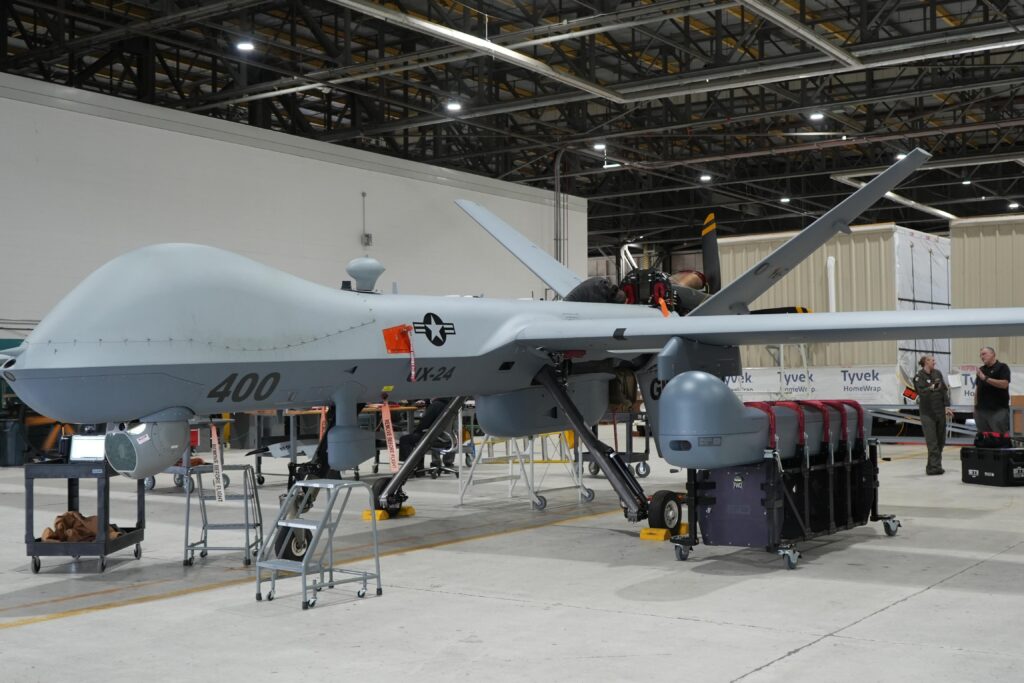
An MQ-9 Reaper is upgraded with SkyTower II Pod that will be deployed to Marine Corps’ squadron next year to enhance operational capability.  (U.S. Navy photo) 

From Naval Air Systems Command, March 10, 2025 

NAS PATUXENT RIVER, Md. — The Navy’s MQ-9 Reaper test squadron at Pax River received the first SkyTower II (STII) pod in preparation for the system’s initial operational capability (IOC) next year. 

Air Test and Evaluation (UX) 24 loaded the new pod onto the aircraft Feb. 25, conducting initial power on checks, the first step into integrating the new capability into the aircraft platform. 

“The program is excited to deliver SkyTower II for testing, marking a major milestone in our development journey,” said Capt. Dennis Monagle, Multi-Mission Tactical UAS program manager. “Over the past two years, we’ve partnered with GALT, a small business prime vendor, to rapidly develop this unique capability using middle-tier acquisition, accelerating innovation for the warfighter. With robust system and integration testing now underway, we remain on track to achieve initial operating capability this year, delivering critical capability to the U.S. Marine Corps and the joint forces.” 

STII is an airborne network extension pod that enhances cross-domain communication capabilities and links communications between disparate forces. It is required to execute the Intelligence, Surveillance, and Reconnaissance (ISR) concept of operations by providing tactically relevant operational communications and data sharing capabilities with many forces in support of the MQ-9 Reapers’ operational mission. 

UX-24 also completed a fit check of the MQ-9 in the large anechoic chamber at Pax River in late February. The team conducted a number of tests and hoisted the aircraft for the first time as a risk reduction for upcoming program efforts.  The tests proved the ability to safely hang the aircraft while providing power, cooling and satellite link with the aircraft for communications, command and control. 

Over the next several months, UX-24 will conduct final test events before delivering the upgraded MQ-9s to the fleet. 

 “The team has been able to accomplish a lot of work in a very compressed timeline by developing and executing these test plans for the chamber event and STII testing,” said Cmdr. Lauren Lawson, MQ-9 government flight test director.  ”The dedication shown and technical challenges they’ve overcome to conduct this critical testing to help develop the best product possible to support the Marines is truly commendable.”   

VMU-3 is currently flying MQ-9’s in theater today and will be the first to deploy with this new system in 2026. 

The MQ-9 Reaper provides Marines with a long-range ISR capability in support of maritime domain awareness and expeditionary advanced based operations in contested environments. 


Chief of Naval Air Training Awarded Meritorious Unit Commendation for Training Excellence 

(U.S. Navy photo by Ensign Alan Wang) 

By CNATRA Public Affairs 
 
CORPUS CHRISTI, Texas – The Chief of Naval Air Training (CNATRA) has been awarded the Meritorious Unit Commendation (MUC) by the Chief of Naval Operations in recognition of its exceptional performance in training student naval aviators. This honor highlights CNATRA’s commitment to excellence in naval aviation training from October 2022 to March 2024. 
 
During this period, CNATRA achieved unprecedented success in preparing the next generation of naval aviators. CNATRA stayed committed to providing top-notch aviation training, using the latest technology and embracing new, innovative methods, which resulted in two consecutive years of exceeding Naval Aviation production requirements. 
 
“The men and women of CNATRA have demonstrated an extraordinary level of commitment to the mission,” said Rear Admiral Rich Brophy, Chief of Naval Air Training. “This commendation is a testament to their hard work meeting our North Star requirement of producing high quality Naval Aviators.” 
 
CNATRA oversees all primary, intermediate, and advanced flight training for student naval aviators. This commendation is awarded to the five training air wings and 17 training squadrons under the CNATRA. The command plays a vital role in the Navy’s operational readiness, producing highly capable pilots who will go on to serve in fleet squadrons around the globe. 
 
The MUC is awarded to units that distinguish themselves through outstanding meritorious achievement or service in combat or non-combat situations. CNATRA’s recognition underscores its critical role in maintaining the Navy’s warfighting edge through superior training and tactical effectiveness. 


USS Oregon Completes Homeport Shift to Norfolk

From Petty Officer 1st Class Justin Yarborough, March 10, 2025 

NORFOLK — The Virginia-class fast-attack submarine USS Oregon (SSN 793) arrived at Naval Station Norfolk, following a change of homeport from Naval Submarine Base New London, March 7, 2024.

Oregon’s arrival marks the sixth Virginia-class fast-attack submarine currently homeported at Norfolk’s waterfront, and the submarine will be assigned to Submarine Squadron Six. 
 
Cmdr. John H. Ross, commanding officer of Oregon, took time to express his excitement and gratitude to his crew for their support and hard work in anticipation of the homeport shift. 
 
“Speaking on behalf of the Oregon crew, we are excited to be here,” said Ross. “After finishing sea trials and building our tactical warfighting edge, we’re looking forward to working with our Squadron Six teammates and bringing the fight to the enemy.” 
 
Before completing the homeport shift from Groton, Connecticut, Oregon completed a post-shakedown availability. 
 
Commissioned in May 2022, Oregon is the third U.S. naval vessel to be named for the 33rd state, the 20th Virginia-class fast attack submarine built, and the second Block IV Virginia-class submarine. 
 
Block IV Virginia-class submarines incorporate design changes focused on reduced total ownership cost. By making these smaller-scale design changes to increase the component-level life cycle of the submarine, the Navy will increase the periodicity between depot maintenance availabilities and increase the number of deployments. 
 
Blocks I-III Virginia-class submarines are planned to undergo four depot maintenance availabilities and conduct 14 deployments. Block IV design changes are intended to reduce planned availabilities by one to three, and increase deployments to 15. 
 
Fast-attack submarines are multi-mission platforms enabling five of the six Navy maritime strategy core capabilities – sea control, power projection, forward presence, maritime security, and deterrence. They are designed to excel in anti-submarine warfare, anti-ship warfare, strike warfare, special operations, intelligence, surveillance and reconnaissance, irregular warfare and mine warfare. Fast-attack submarines project power ashore with special operations forces and Tomahawk cruise missiles in the prevention or preparation of regional crises. 
 
The Virginia-class submarine is 377 feet long and 34 feet wide, and weighs about 7,900 tons when submerged. Underwater, it can reach speeds in excess of 25 knots. 


Saildrone Launches in St. Pete for First Ocean Mapping Mission of Florida’s Coastal Waters

Saildrone Launches in St. Pete for First Ocean Mapping Mission of Florida’s Coastal Waters 

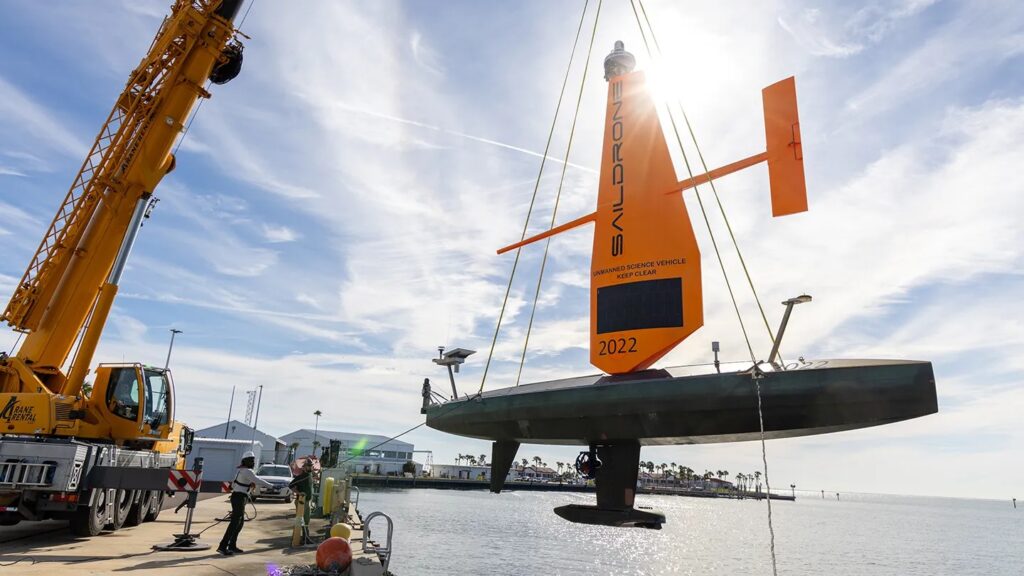
Two Saildrone Voyager USVs have been deployed from St. Petersburg for the first time to map Florida’s coastal waters within the continental shelf. 

From Saildrone, March 10, 2025 

ST. PETERSBURG, Florida: Saildrone is launching two 10-meter Saildrone Voyager uncrewed surface vehicles (USVs) from its facility in St. Petersburg, FL, to begin a mapping mission as part of the Florida Seafloor Mapping Initiative (FSMI), a multiyear effort to provide statewide stakeholders with accessible, high-quality, and high-resolution seafloor data of Florida’s coastal waters within the continental shelf.  

At 2,170 kilometers long, Florida’s coastline is second only to Alaska among US states. Many parts of the Florida coast remain unsurveyed, with existing nautical charts relying on outdated and low-resolution data. The goal of the Florida Department of Environmental Protection (FDEP) initiative is to provide updated mapping data of coastal systems, which is critical for protecting offshore infrastructure, habitat mapping, restoration projects, emergency response, coastal resilience, and hazard studies for the state’s citizens.  

“Saildrone is proud to support the Florida Seafloor Mapping Initiative with our unique and innovative Voyager USVs.  As a member of the St. Petersburg community, we are excited to contribute to a project that seeks to improve our coastal resilience and enhance our ability to predict storm surge impacts by providing high-resolution bathymetry,” said Brian Connon, Saildrone VP Ocean Mapping. “Saildrone USVs efficiently and safely collect high-resolution bathymetric data while minimizing environmental impact.” 

Saildrone has been tasked with collecting high-resolution multibeam data in a region known as Middle Grounds. The mission, valued at $1.66M, Saildrone will map 2,817 square kilometers of seafloor, approximately 130 kilometers northwest of St. Petersburg. 

This is the first time that Saildrone has deployed Voyager USVs, equipped with NORBIT WINGHEAD i80s echo sounders for high-resolution mapping, and radar, AIS, and cameras for maritime domain awareness, out of Tampa Bay. In 2024, Saildrone Voyagers were used to map a portion of the Gulf of Maine to identify deep-water coral habitat. In Florida, Saildrone has previously deployed Voyager USVs for the US 4th Fleet out of Key West and currently has a fleet of Voyager USVs operating in the Caribbean in support of Joint Interagency Task Force South (JIATF-S) and US Naval Forces Southern Command/US Navy Fourth Fleet (NAVSOUTH/FOURTHFLT). 

FSMI builds on the efforts of the Florida Coastal Mapping Program (FCMaP), an initiative led by federal and Florida state agencies and other community stakeholders to promote the need for a comprehensive high-resolution seafloor data set of Florida’s coastal waters by 2028. The data will be available to update navigational charts and identify navigation hazards, provide fundamental baseline data for scientific research, and provide information for use by emergency managers and responders. 

The data Saildrone collects will help better understand Florida’s coastal vulnerability and hurricane impact, evaluate the performance of restoration projects, and support ongoing coastal resilience efforts and flood risk mapping. 


USCGC Polar Star Crew Concludes Operation Deep Freeze 2025, Departs Antarctica 

The crew of U.S. Coast Guard Cutter Polar Star (WAGB 10) stand for a photo while the cutter is hove-to in McMurdo Sound during Operation Deep Freeze, Jan. 7, 2025. (U.S. Coast Guard photo by Petty Officer 2nd Class Briana Carter)

From U.S. Coast Guard Pacific Area, March 6, 2025 

SOUTHERN OCEAN — Accomplishing its missions, the U.S. Coast Guard Cutter Polar Star (WAGB 10) and crew departed the Antarctic region Tuesday, after 65 days south of the Antarctic Circle in support of Operation Deep Freeze 2025. 

Operation Deep Freeze is an annual event, led by the U.S. Antarctic Program (USAP) in conjunction with the Department of Defense, to support the U.S. National Science Foundation (NSF). The USAP advances the nation’s goals to support the Antarctic Treaty, fosters cooperative research with other nations, protects Antarctic resources, and develops measures to ensure the wise use of those resources. 

Operation Deep Freeze showcases a complex symphony of strategic inter-theater airlift, tactical intra-theater airlift and airdrop, aeromedical evacuation support, search and rescue response, sealift, seaport access, bulk fuel supply, port cargo handling, and transportation requirements. Polar Star’s crew performed icebreaking duties in McMurdo Sound, clearing routes to ensure safe passage for cargo vessels for McMurdo Station and New Zealand’s Scott Base. 

“The surface ice conditions in McMurdo Sound were abnormally light this year, a welcome change of pace from the extreme conditions experienced last year,” said Capt Jeff Rasnake, Polar Star’s commanding officer. “Operation Deep Freeze presented a number of challenges, beyond those inherent in maintaining and operating a 49-year-old ship to complete this arduous mission. We benefitted tremendously from a great deployment plan which allowed us to take advantage of favorable conditions and use the elements to stay ahead of events without pressing the cutter or crew excessively. That up-front planning made a big difference.” 

Polar Star also conducted a crew exchange with the New Zealand Defense Force ship Aotearoa.  

“Operation Deep Freeze works closely with other Antarctic programs to include those of New Zealand and Australia, as well as their respective defense forces,” said Lt. Cmdr. Rachel Rand, Polar Star’s operations officer. “The ability to collaborate with others to achieve mission success and ensure the United States’ vital interests in the Polar regions makes this assignment so unique.” 

Polar Star also worked with the Commission for the Conservation of Antarctic Marine Living Resources (CCAMLR) to support a secure and sustainable Southern Ocean. Polar Star was the first United States surface asset to support CCAMLR. The crew’s efforts to observe and monitor fishing and other activity on the high seas safeguarded resources and U.S. national interests in the Antarctic region. 

“Each trip to Antarctica for Operation Deep Freeze requires careful planning and coordination due to the extreme weather and inhospitable environment,” said Rasnake. “The joint-agency teamwork within Joint Task Force – Support Forces Antarctica this year was outstanding and certainly lived up to the proud tradition of U.S. military support to the U.S. Antarctic Program in promoting security and stability across the region.” 

The crew has transited nearly 16,000 miles since departing its Seattle homeport in November with stops in Honolulu, Sydney, and McMurdo Station. Polar Star celebrated its 49th year of Service to the Nation and visited Cape Polar Star in the northern part of the Ross Sea. Cape Polar Star was named after Polar Star for the scientific support provided by the cutter in the area during Operation Deep Freeze 86. 

The Polar Star is the United States’ only asset capable of providing access to both Polar Regions. The Seattle-based cutter is a 399-foot heavy polar icebreaker commissioned in 1976, weighing 13,500 tons and is 84-feet wide with a 34-foot draft. The cutter’s six diesel and three gas turbine engines produce up to 75,000 horsepower. 


Transcom Asks Lawmakers for More Used Vessels 

March 6, 2025 | By C. Todd Lopez, DoD News 

To bolster America’s Ready Reserve Force fleet, U.S. Transportation Command wants to buy as many as 10 used shipping vessels.  

“We need to both build it here, and we actually need to buy used,” Air Force Gen. Randall Reed, Transcom’s commander, told the Senate Armed Services Committee yesterday while testifying on Capitol Hill.  

The Ready Reserve Force fleet of ships is part of the U.S. military’s strategic sealift capability that provides the ability to rapidly conduct initial resupply missions and to transport Army and Marine Corps equipment during critical surge periods.  

The government-owned RRF fleet is made up of commercial vessels crewed by civilian mariners and it is ageing. The median age of the 46 roll-on/roll-off ships in the fleet is 47 years.  

“These ships are really, really old,” Reed said. “The reliability of them sometimes in question because of that. I take my hat off to the crews that are actually on them to keep them warm. But to give an idea of the state of the ships, some of these ships are still run by steam.”  

Reed said it is vital to recapitalize and modernize the RRF fleet to ensure continued credible global deterrence.  

“In the short term, we would need maximum flexibility to buy used foreign ships on the commercial market, obtain those ships, them here in the states, and then put those ships to sea,” Reed told lawmakers.  

Already, Transcom has received permission from Congress to buy as many as 10 used ships. It’s already bought seven and wants to buy two more this year, Reed said.  

The most immediate need is to secure two ships on the open market, get them into a shipyard, and then reflag them within nine to 14 months, he said.  

The last of the ships will be bought in fiscal year 2026, closing out the command’s ability to procure used vessels. Reed told senators he’d like permission to get as many as 10 more used ships to fill out the ageing fleet.  

“I am asking for the limit to be raised beyond 10 to allow us to actually shop the market,” he said. “Currently, there are 10 ships available for us to pursue.”  

Permission for Transcom to recapitalize the fleet though the purchase of additional used ships needs to be written into the National Defense Authorization Act, Reed told lawmakers.  

“If we can get that change, ideally, what we would need to the fleet four ships a year, and if they’re available on the market, we would pursue that,” he said. “At a minimum, we would need two a year.”  

Buying used ships to recapitalize the fleet is one option. Reed said buying new is also a possibility. During an address before a joint session of Congress, March 4, 2025, President Donald J. Trump promised an expansion of American shipbuilding.  

“We are also going to resurrect the American shipbuilding industry, including commercial shipbuilding and military shipbuilding,” Trump said during his address.  

The president announced the creation of a new Office of Shipbuilding and made plans to create tax incentives to enhance and grow America’s domestic shipbuilding industry.  

“We used to make so many ships,” Trump said. “We don’t make them anymore, very much. But we’re going to make them very fast, very soon.”  


Coast Guard Offloads Over $141M in Illicit Drugs Interdicted in Caribbean Sea 

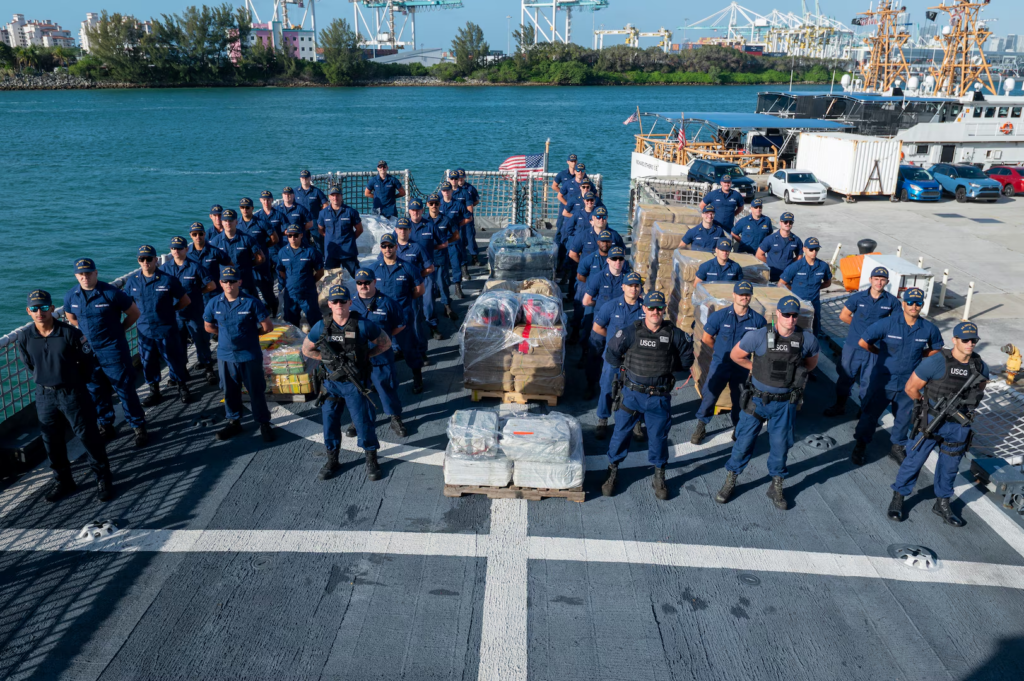
Crew members from USCGC Valiant (WMEC 621) stand at parade rest in front of interdicted narcotics at Base Miami Beach, Florida, Mar. 6, 2025. The Valiant’s crew secured the illegal drugs from six interdictions in the international waters of the Caribbean. (U.S. Coast Guard photo by Petty Officer 3rd Class Nicholas Strasburg)

From U.S. Coast Guard District 7, March 6, 2025 

MIAMI – U.S. Coast Guard Cutter Valiant’s crew offloaded approximately 12,470 pounds of cocaine, Thursday, worth an estimated $141.4 million at Coast Guard Base Miami Beach.  

The seized contraband was the result of six interdictions in the Caribbean Sea, and 17 suspected smugglers were transferred ashore to face federal prosecution in U.S. courts.   

“These seizures are a testament to the Coast Guard’s continued dedication to safeguard America by securing our maritime borders,” said Lt. j.g. Jesus Martinez Borges, a Seventh Coast Guard District enforcement officer. “The Coast Guard and our partners work tirelessly to deny drug trafficking organizations access to smuggling routes bound for the United States. Our efforts contribute to federal investigations and prosecutions that further seek to disrupt and dismantle transnational criminal activity abroad, which threaten Americans here at home.”   

On Feb. 2, a Dutch Caribbean Coast Guard aircrew detected a suspicious vessel in international waters approximately 30 miles north of Venezuela. The Netherlands Royal Navy ship HNLMS Groningen crew, with an embarked U.S. Coast Guard law enforcement detachment 105 crew, interdicted a go-fast vessel, apprehending five suspected smugglers and seizing approximately 6,220 pounds of cocaine.   

That same day, a forward-deployed HC-144 Ocean Sentry aircrew from Coast Guard Air Station Miami detected a suspicious vessel in international waters approximately 35 miles southwest of the U.S. Virgin Islands. The aircrew vectored in U.S. Coast Guard Cutter Joseph Doyle’s crew who interdicted the go-fast vessel, apprehending three suspected smugglers and seizing approximately 2,200 pounds of cocaine.   

“I am proud of the dedication and professionalism demonstrated by the crew of Coast Guard Cutter Joseph Doyle in securing our maritime border,” said Lt. Cmdr. David Radin, commanding officer of Joseph Doyle. “It was a smooth operation working with Air Station Miami’s forward-deployed aircraft to detect these traffickers, which enabled our crew to interdict and prevent these deadly narcotics from reaching our nation’s borders.”   

On Feb. 14, a Dutch maritime patrol aircrew located a suspicious vessel in international waters approximately 18 miles north of Venezuela. The Groningen crew deployed two small boats with an embarked U.S. Coast Guard LEDET 105 crew to interdict the vessel. The go-fast vessel jettisoned bales of contraband during the pursuit and fled into Venezuelan territorial waters. The Groningen crew recovered the approximate 571 pounds of cocaine.   

On Feb. 17, a U.S. Customs and Border Protection Air and Marine Operations aircrew detected a suspicious vessel in international waters approximately 50 miles northeast of the Dominican Republic. The aircrew vectored in the Valiant crew who interdicted the go-fast vessel, apprehending five suspected smugglers and seizing approximately 1,280 pounds of cocaine.   

“The Valiant crew’s interdiction is one of many law enforcement actions highlighting the time-tested partnership and outstanding coordination of the Seventh Coast Guard District, Coast Guard Sector San Juan, and U.S. Customs and Border Protection Caribbean Air and Marine Branch,” said Cmdr. Matthew Press, commanding officer of Valiant.   

“AMO continues to predict, detect, identify, classify, track, deter and interdict threats through the coordinated application of aviation and maritime law enforcement resources within the air and sea,” said Christopher Hunter, director of CBP Air and Marine Operations in the Caribbean.  

Tuesday, a Dutch maritime patrol aircrew notified the HNLMS Groningen crew of a suspicious vessel in international waters approximately 120 miles northwest of Aruba. The Groningen crew launched a helicopter aircrew who signaled the non-compliant go-fast vessel and employed warning shots to compel the suspected smugglers to stop with no injuries reported. The Groningen crew apprehended two suspected smugglers and seized approximately 545 pounds of cocaine.   

Saturday, a Caribbean maritime patrol aircrew notified the Royal Canadian Navy ship HMCS Harry DeWolf’s crew of a suspicious vessel in international waters approximately 176 miles north of Cabo De La Vela, Colombia. The Harry DeWolf crew and an embarked U.S. Coast Guard LEDET 402 crew intercepted the go-fast vessel, apprehending three suspected smugglers and seizing approximately 1,650 pounds of cocaine.   

The following assets and crews were involved in the interdiction operations:   

  • U.S. Coast Guard Tactical Law Enforcement Team South   

  • U.S. Coast Guard Tactical Law Enforcement Team Pacific   

Detecting and interdicting illicit drug traffickers on the high seas involves significant interagency and international coordination. Joint Interagency Task Force-South, in Key West, conducts the detection and monitoring of aerial and maritime transit of illegal drugs. Once an interdiction becomes imminent, the law enforcement phase of the operation begins, and control of the operation shifts to the U.S. Coast Guard for the interdiction and apprehension phases. Interdictions in the Caribbean Sea are performed by members of the U.S. Coast Guard under the authority and control of the Seventh Coast Guard District, headquartered in Miami.   

These interdictions relate to Organized Crime Drug Enforcement Task Forces’ (OCDETF) Strike Force initiatives and designated investigations. OCDETF identifies, disrupts, and dismantles the highest-level criminal organizations that threaten the United States using a prosecutor-led, intelligence-driven, multi-agency approach. Additional information about the OCDETF program can be found at https://www.justice.gov/OCDETF.   

USCGC Valiant is a 210-foot Reliance-class medium endurance cutter homeported at U.S. Naval Station Mayport in Jacksonville under U.S. Coast Guard Atlantic Area Command.   


Leonardo DRS Announces Delivery of Voice Communication Systems for Navy Destroyers 

ARLINGTON, Va. MARCH 6, 2025 –Leonardo DRS, Inc. (NASDAQ: DRS) announced today the delivery of its first next-generation Integrated Voice Communication Systems (IVCS) in support of the U.S. Navy’s Arleigh Burke DDG51-class destroyers. The state-of-the-art systems provide mission-critical ship-wide communications vital for ensuring effective operations across all surface navy missions. 

IVCS is the latest generation shipboard communications technology that provides reliable, tactical communications for Navy operators. The computer-controlled telephone system connects to a ship’s announcing system, shore telephone lines, radio communications and battle sound-powered telephone circuits. 

The advanced IVCS was designed, built, tested, and delivered as an upgrade to its long line of voice communication systems, including the company’s Shipboard Integrated Communications Systems and Secure Voice Switching systems. These systems are in use on destroyers and frigates of the US, Canadian, Australian, New Zealand, Japanese, and South Korean navies underscoring the company’s leadership in delivering cutting-edge secure naval communications solutions. 

“This delivery marks a significant milestone in the ongoing partnership between Leonardo DRS and the U.S. Navy, reaffirming the company’s commitment to supporting global naval operations with advanced, reliable and secure communication technologies,” said Cari Ossenfort, senior vice president and general manager of the Leonardo DRS Naval Electronics business unit. “We are proud to continue to answer the call by fielding modern network communications supporting our warfighters today and into the future.” 

Leonardo DRS has been a key supplier for the U.S. Navy Cruiser and Destroyer Aegis Modernization program providing mission-critical, tactical communications systems supporting command and control operations on the ships. It is another example of the company’s deep experience as a leader in complex design and manufacturing supporting a wide range of missions and capabilities. Leonardo DRS’s abilities extend across all domains to support naval, ground, air, space, and cyber missions in areas of sensing, force protection, computer networking, as well as naval power and propulsion systems.