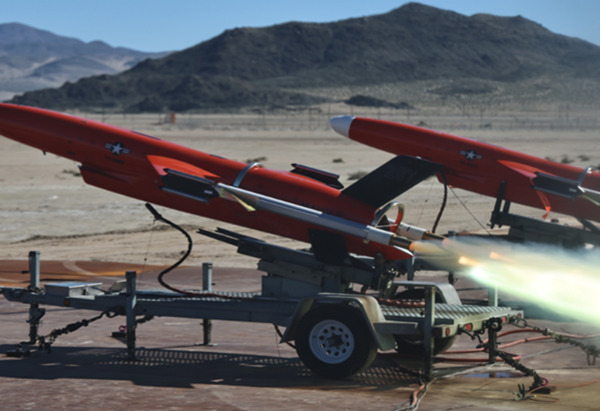
NAVAIR Awards Kratos Additional $59.3M for BQM-177A Subsonic Aerial Target Systems 

BQM-177A Subsonic Aerial Target Systems

From Kratos Defense & Security Solutions, March 6, 2025  

SAN DIEGO, March 06, 2025 (GLOBE NEWSWIRE) – Kratos Defense & Security Solutions, Inc. (NASDAQ: KTOS), a Technology Company in the Defense, National Security and Global Markets, and industry-leading provider of high-performance, jet-powered unmanned aerial systems, announced today that Kratos has received $59,338,010 for an additional 70 BQM-177A Subsonic Aerial Target (SSAT) aircraft through the exercise of the contract option for Full Rate Production (FRP) Lot 6. When combined with the base award and exercise of FRP Lot 5, the resulting overall value of FRP Lots 4 through 6 totals $177,702,962. Total contract value if the remaining option for Lot 7 is exercised at the maximum production quantity will be $227,647,890. 

Steve Fendley, President of Kratos Unmanned Systems Division, said, “Since the first Full Rate Production contract award in October 2020, the world has undergone impactful economic and political shifts creating significant production challenges across our industry and increased need for development, test, and training associated with our country’s current and upcoming weapons systems. On behalf of all the dedicated men and women at Kratos, we will collectively continue to do our utmost to support our warfighters with this high-fidelity threat surrogate.” 

The majority of the work under this contract will be conducted in Kratos facilities in Sacramento, CA, and Fort Walton Beach, FL. 


Blue Angels Certified Airshow Ready for 2025 Season 

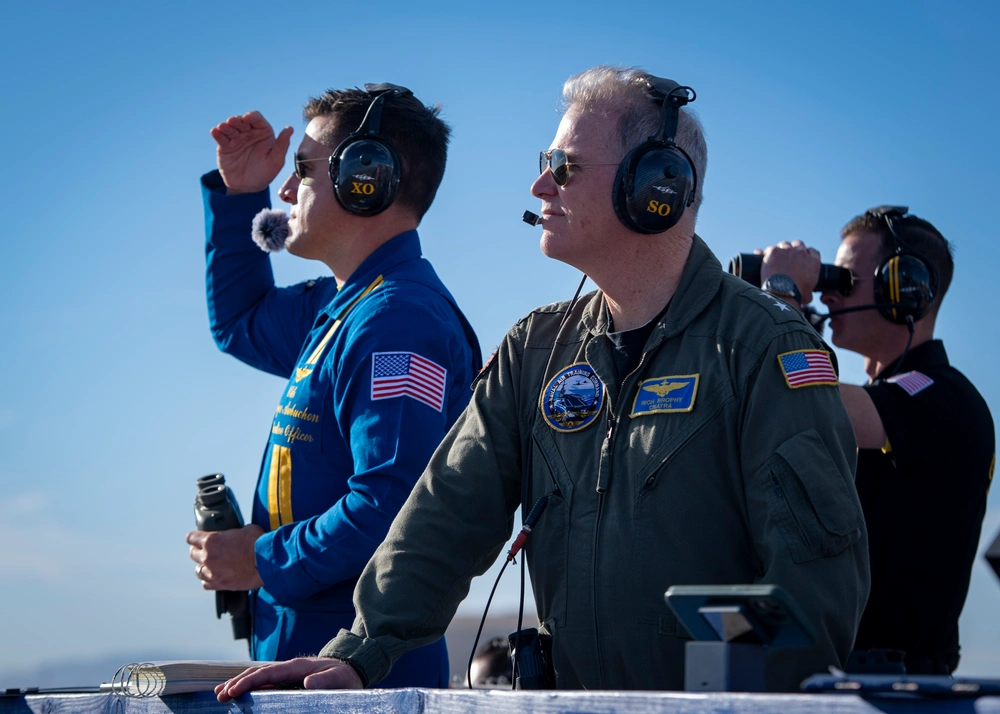
After rigorous training and evaluations, Rear Admiral Rich Brophy, Chief of Naval Air Training, officially certified the team “airshow ready”.

From Chief of Naval Air Training, March 3, 2025 

EL CENTRO, California – The United States Navy Blue Angels have successfully completed their annual certification in El Centro, California, for the 2025 air show season. After rigorous training and evaluations, Rear Admiral Rich Brophy, Chief of Naval Air Training, officially certified the team “airshow ready”. Since 1946, the Blue Angels have showcased the teamwork and professionalism of the United States Navy and Marine Corps through flight demonstrations and community outreach. 
 
“As we head into the 2025 airshow season, this team has once again met the Navy’s high standards for safety, precision, and professionalism,” said Rear Adm. Brophy. “After the success of 2024, these men and women have proven they are more than ready to perform as the Navy’s premier flight demonstration team. They continue to inspire and connect with the next generation of Americans. It’s my pleasure to certify them for the 2025 season.” 
 
Every year, Chief of Naval Air Training (CNATRA) travels to El Centro to ensure the readiness of the Blue Angels for the upcoming airshow season. This is a crucial milestone for the Blue Angels, ensuring that the team’s pilots, aircraft, and support personnel are fully prepared to execute their performances to the highest standard. The Blue Angels commanding officer, Commander Adam Bryan, hosts CNATRA to observe the final days of the team’s winter training. 
 
“It’s always a privilege to welcome Rear Adm. Brophy and highlight the dedication and training that go into preparing our squadron for the upcoming air show season,” said Cmdr. Adam Bryan, commanding officer and flight leader of the Blue Angels. “This certification marks a key milestone, allowing our team to perform for the American public and showcase the exceptional teamwork and professionalism that distinguish the United States Navy and Marine Corps.” 
 
This year marks Cmdr. Bryan’s first season as the commanding officer of the Blue Angels. He assumed command in November 2024 and is ready to showcase the team’s exceptional skills and precision during their first performance on March 15. After each winter training, the Blues perform their first show of the year in El Centro for the community who hosts them during training. 
 
The Blue Angels are renowned for their high-energy performances, showcasing the precision and teamwork of the Navy’s top aviators. Throughout the season, the team will perform at various air shows, community events, and military ceremonies, continuing their mission to inspire a culture of excellence and service to country while promoting naval aviation. 
 
The Blue Angels team consists of 158 active-duty Sailors and Marines including pilots, aircrew, maintainers, and many other support personnel. The last show of the season will be the Blue Angels Homecoming Airshow at Naval Air Station (NAS) Pensacola on November 7. Pensacola, Florida is where the Blue Angels call home during the show season and conduct practices in preparation for events across the country. 


Trilateral Maritime Exercise Supports Allied Interoperability 

By U.S. Naval Forces Southern Command / U.S. 4th Fleet Public Affairs 

March 6, 2025 

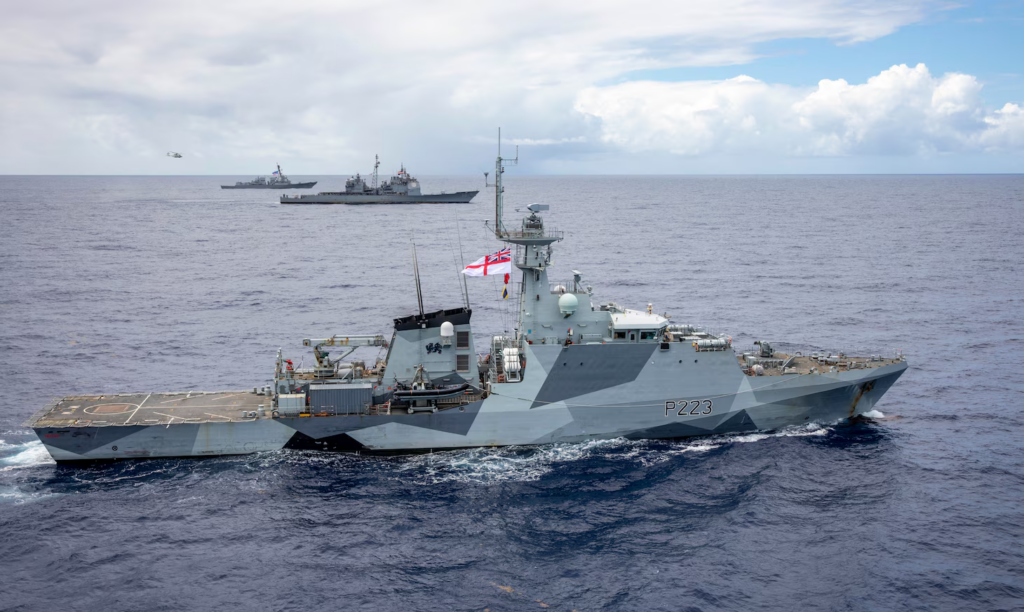
CARIBBEAN SEA  –  Showing the benefits of maritime presence in the Caribbean, three warships and one aircraft from three allies conducted a passing exercise (PASSEX) on Mar. 3 designed to increase interoperability and enhance capability. 
 
The U.S. Navy Ticonderoga-class guided-missile cruiser USS Normandy (CG-60) and Arleigh Burke-class guided missile destroyer USS Thomas Hudner (DDG-116) joined the United Kingdom (U.K.) Royal Navy River-class offshore patrol vessel HMS Medway (P223) and a NH90 Neptune helicopter assigned to the Royal Netherlands Navy Holland-class offshore patrol vessel HNLMS Groningen (P843) for the PASSEX. 
 
The trilateral maritime PASSEX is part of U.S. and allied collaboration in the Western Hemisphere. Adopted in 2023, allies and partners from the U.K., Canada, France, the Netherlands, and the United States committed to more frequently share information and work more closely together on aligned strategic interests, specifically in the U.S. Southern Command Area of Responsibility (AOR). The collaboration includes maritime operations and exercises at sea and Theater Security Cooperation (TSC) port visits designed to meet that commitment. 
 
“One of the best ways to address today’s security challenges is with shared maritime presence in our region, operating at sea with our allies and partners,” said Rear Adm. Carlos Sardiello, commander of U.S. Naval Forces Southern Command/U.S. 4th Fleet, the operational commander of the trilateral maritime exercise. “We know that through operations and exercises like this one in coordination with committed allies, we strengthen U.S. and regional security.” 
 
A PASSEX is an exercise conducted between two or more navies to ensure best practices for communicate and cooperation and normally include communication and maneuvering drills. This trilateral maritime PASSEX also included an air defense event, a low-slow flyer event, and Sailor crossdecks among the four warships. 
 
“We always look forward to any opportunity to operate alongside partners and allies like the Royal Navy and the Royal Netherlands Navy,” said Capt. Nathan Diaz, USS Normandy Commanding Officer. “Maritime exercises such as these provide a great opportunity for Normandy Sailors to improve their skills and work closely with their counterparts from partnered and allied naval forces.” 
 
“We relish at sea exercises as they allow us to build our team as we operate with allies and partners,” said Cmdr. Cameron Ingram, USS Thomas Hudner Commanding Officer. “It was an honor to meet, operate and collaborate with the other commands’ leadership and teams, and a reassurance of our collaborative capabilities and resolve.” 
 
U.S. Naval Forces Southern Command/U.S. 4th Fleet serves as a trusted maritime partner for Caribbean, Central and South American maritime forces, promoting unity, security, and stability in the region. 


Unified Response: An Inside Look at 300 Coast Guardsmen responding to Potomac Plane Crash

U.S. Coast Guard Petty Officer 2nd Class Lance Ide, left, and Petty Officer 3rd Class Corbin Singleton, boatswain’s mates at Station St. Inigoes, respond to the aircraft collision on the Potomac River, Washington, Jan. 30, 2025. The Coast Guard responded to the incident with local, city, state and federal partners. Photo credit: U.S. Coast Guard | Petty Officer 3rd Class Christopher Bokum

WASHINGTON — On the evening of January 29, while most of the city slept, hundreds of Coast Guardsmen from across the East Coast deployed to the Potomac River, ready to face the unimaginable. 

Crew members launched from Coast Guard Station Washington and arrived at the freezing river as a commercial jet and Army helicopter lay shattered. 

For those directing first responders from the command center at Sector Maryland – National Capital Region, managing the unimaginable is a part of the job. 

“Having also responded to the Key Bridge collapse last year, this aircraft collision was another heartbreaking reminder of how quickly tragedy can unfold,” said Sector Maryland – National Capital Region command center chief Lieutenant Stasia Ellis. “Our thoughts still go out to the families who lost loved ones. Coast Guard first responders demonstrated exceptional courage and dedication, working tirelessly alongside our partners to bring answers and closure to those affected.” 

By 5 a.m., Station Philadelphia was traveling over 100 miles to Washington in support of the mission. 

At dawn, response boat crews from Stations Curtis Bay, Annapolis, Oxford, Crisfield and Coast Guard Cutter Sailfish were on scene. 

In a unified effort, 278 Coast Guard service members and Auxiliarists from 33 units across the East Coast responded to the incident with an urgent mission — search, recover, and bring closure to a nation reeling from disaster.

Within hours after the incident, Sector Maryland – National Capital Region and subordinate commands stood up an Incident Management Team at Station Washington to coordinate the mission and streamline real-time communications.  

“We came from over 70 miles away that morning before sunrise, not really sure what to expect on-scene,” said Petty Officer 3rd Class Corbin Singleton, a machinery technician with Station St. Inigoes. “Whether it was search and rescue or enforcing the safety zone, we were determined to help and support the mission however we could.” 

As Singleton and his crew supported the mission from the water, Captain Patrick Burkett, commander, Sector Maryland – National Capital Region, welcomed the acting commandant, Admiral Kevin E. Lunday, and the Secretary of the Department of Homeland Security, Kristi Noem, to meet with first responders at Station Washington. 

Shortly after 10 a.m., Lunday and Noem were underway visiting the wreckage site on a Station Washington small boat. 

“There were a lot of moving parts that morning as traumatic as it was, but I am so incredibly proud of our team’s efforts throughout this response,” said Burkett. “From the moment the accident took place, we’ve been here to support the American public.” 

The Coast Guard rapidly integrated into the incident unified command to support local, city, state, and federal partners. 

Beyond search and rescue, the Coast Guard’s objectives included ensuring the safety of the public and first responders on the water, aiding in victim recovery efforts, assisting salvage operations, and supporting the National Transportation Safety Board’s incident investigation. 

“We put all available resources to bear on this response,” said Burkett. “We had many Coast Guard small boat stations and cutters arrive at the scene that morning and days after. We called in additional crews to help from Sector Delaware Bay to make sure we kept a 24/7 presence on the waterway and support by any means we could.” 

A week after the accident, a total of 11 small boat stations and five cutters were deployed, including support from two Coast Guard sectors, Coast Guard headquarters, and the Coast Guard Auxiliary. 

“We worked together as a unified command,” said Burkett. “Everybody has their responsibilities from our responding units to the agencies in the unified command. We worked as a team to ensure we got the mission accomplished. This is what we do. This is what we train to do. That’s why we train with our partner agencies here in the greater Washington area to prepare for these types of tragedies.” 


LRASM Performs Flight Test in F-35 Integration Test Series

From Lockheed Martin 

NAVAL AIR STATION PATUXENT RIVER, Md., March 4, 2025 – Lockheed Martin [NYSE: LMT] and the F-35 Pax River Integrated Test Force (ITF) completed an initial flight test integrating the Long Range Anti-Ship Missile (LRASM) weapon system onto the F-35B Lightning II stealth fighter jet. This most recent test follows a flight test with LRASM on F-35C in September 2024

As part of the F-35’s Block 4 upgrade, AGM-158 strike systems (Joint Air-to-Surface Standoff Missile and LRASM) are being integrated for external carriage on the F-35, adding more multi-role mission capabilities to the quarterback of the fighting force. The flight marks the beginning of the F-35B AGM-158 strike systems flight sciences test program, a critical step toward bringing this advanced technology to America’s warfighter. 

“Integration of the AGM-158 strike systems family delivers increased reach and lethality against heavily protected, strategic targets.” said Jon Hill, vice president and general manager, Air Dominance and Strike Weapons at Lockheed Martin Missiles and Fire Control. 

“The integration of these systems further demonstrates how we continue to add the most advanced capabilities to the F-35 to ensure it will remain a dominant force, owning the skies for decades to come,” said Chauncey McIntosh, vice president and general manager of the F-35 program at Lockheed Martin Aeronautics. 

With more than 20 years of experience providing highly survivable and accurate cruise missiles, Lockheed Martin is combining F-35 air dominance with the unique capabilities of the JASSM and LRASM weapon systems to enhance combat readiness. More than 1,100 F-35s are currently operational around the globe, and the fleet has surpassed 983,400+ flight hours. 


President Says Military Recruiting Up, So Too Will Be American Shipbuilding, ‘Golden Dome’ 

March 5, 2025 | By C. Todd Lopez, DoD News

During his first address to a joint session of Congress, March 4, 2025, President Donald J. Trump said that the changes he’s made since his inauguration in January have enhanced recruiting within the U.S. military in ways that haven’t been seen in years.  

On his first day in office, the president signed an executive order ending diversity, equity and inclusion programs across the federal government. Less than a week later, newly sworn-in Defense Secretary Pete Hegseth drafted a message to the force that mirrored the president’s words, saying he would rebuild the U.S. military with a focus on lethality, meritocracy, accountability, standards and readiness.  

“Our service members won’t be activists and ideologues,” Trump said. “They will be fighters and warriors. They will fight for our country.”  

The president said the result of his executive order has filtered down into the armed forces, putting a new focus on merit and spurring renewed interest in serving.  

“I am pleased to report that in January, the U.S. Army had its single best recruiting month in 15 years and that all armed services are having among the best recruiting results ever in the history of our services,” Trump said. “What a tremendous turnaround. It’s really a beautiful thing to see people love our country again … they love our country, and they love being in our military again.”  

The president also said the United States will pursue a “Golden Dome,” similar to Israel’s own “Iron Dome” defense system, which is designed to protect against inbound missile attacks.  

“My focus is on building the most powerful military of the future,” Trump said. “As a first step, I’m asking Congress to fund a state-of-the-art, ‘Golden Dome’ missile defense shield to protect our homeland — all made in the USA.”  

The president said that President Ronald Reagan had wanted to build a similar system during his term, but the technology wasn’t available at the time to bring that project to fruition. But now, he said, that technology exists.  

“Israel has it, other places have it, and the United States should have it, too,” he said. “This is a very dangerous world. We should have it. We want to be protected. And we’re going to protect our citizens like never before.”  

Trump also promised an expansion of American shipbuilding in order to support both the U.S. military and the commercial sector. American shipbuilding is at a low point today, but the president promised new efforts to increase America’s shipbuilding efforts.  

“We are also going to resurrect the American shipbuilding industry, including commercial shipbuilding and military shipbuilding,” Trump said. “I am announcing tonight that we will create a new Office of Shipbuilding in the White House and offer special tax incentives to bring this industry home to America, where it belongs.”  

The president said the U.S. once had a great domestic shipbuilding industry, which has largely died down now. That will change, he promised.  

“We used to make so many ships. We don’t make them anymore, very much,” he said. “But we’re going to make them very fast, very soon.”  

The president also said he planned to take action to expand domestic production of rare earth elements, which are critical to U.S. defense.  

“Later this week, I will also take historic action to dramatically expand production of critical minerals and rare earths here in the USA,” he said.  

Rare earth permanent magnets, for instance, are not only essential components in a range of defense capabilities, including the F-35 Lightning II aircraft, Virginia and Columbia class submarines and unmanned aerial vehicles, but are also a critical part of commercial applications in the United States. They are also used to generate electricity for electronic systems in aircraft and focus microwave energy in radar systems.  

Finally, Trump said that the mastermind behind the terrorist attack at Abbey Gate during the August 2021 withdrawal from Afghanistan has been captured. Some 13 American service members were killed during that attack.  

“I am pleased to announce that we have just apprehended the top terrorist responsible for that atrocity, and he is right now on his way here to face the swift sword of American justice,” Trump said. 


Coast Guard Teams Deploy to American Samoa to Patrol Border, Conduct Boardings 

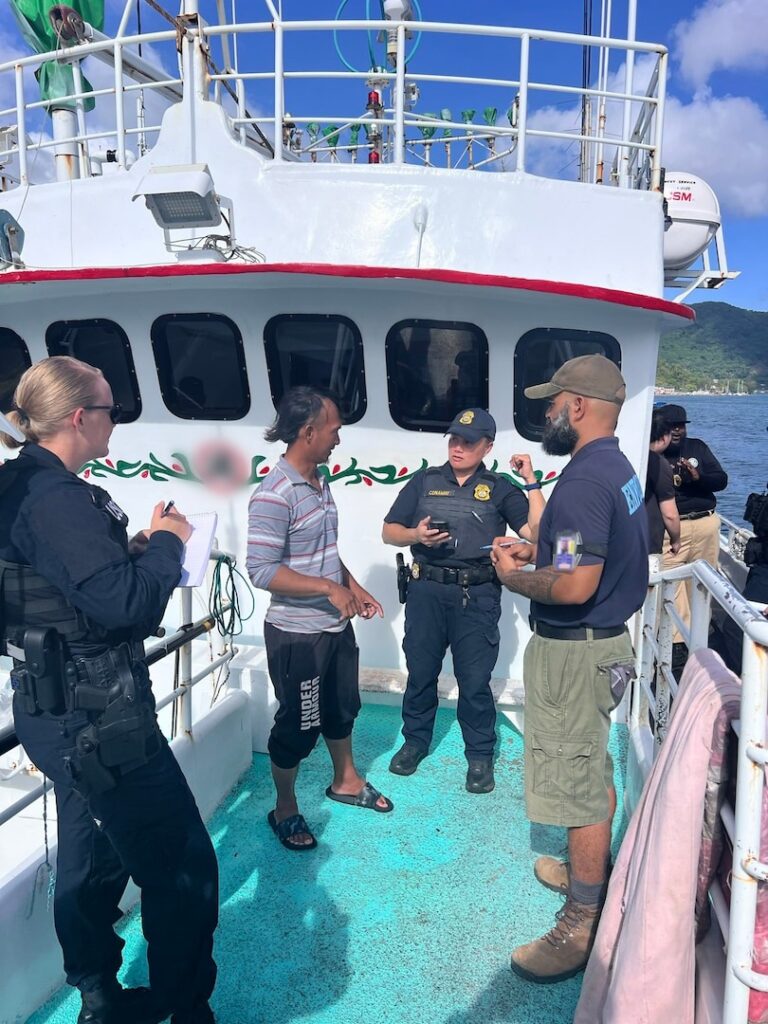
A U.S. Coast Guardsman assigned to a Coast Guard Sector Honolulu boarding team, National Oceanic and Atmospheric Administration Office of Law Enforcement officer and American Samoa Department of Marine and Wildlife Resources officer speak to the master of a foreign-flagged fishing vessel during a boarding offshore Pago Pago, American Samoa, Feb. 26, 2025. (U.S. Coast Guard photo, courtesy Sector Honolulu) 

From Coast Guard District 14 External Affairs, March 4, 2025 

HONOLULU – Coast Guard Maritime Safety and Security Team Honolulu personnel and a boarding team from Coast Guard Sector Honolulu deployed to American Samoa from Feb. 10-27 to protect the U.S. maritime border, enforce U.S. laws and regulations, enhance maritime domain awareness and coordinate with agency partners.  

During the deployment, team members boarded six U.S.-flagged commercial fishing vessels, six foreign-flagged commercial fishing vessels, and five recreational boating safety boardings, resulting in the termination of one recreational voyage due to deficient safety equipment.   

Crews patrolled the U.S. territorial maritime border and the U.S. Exclusive Economic Zone surrounding American Samoa, which extends up to 200 miles offshore.  

Additionally, MSST Honolulu and Sector Honolulu personnel conducted over 26 hours of training with the American Samoa Department of Homeland Security and American Samoa Marine Patrol, a law enforcement unit within the American Samoa Department of Marine and Wildlife Resources. Training primarily focused on boarding procedures and weapons proficiency.  

“Working closely with partners in American Samoa heightens our awareness of any illicit activities in the area and hones our combined ability to safeguard the maritime border,” said Lt. Cmdr. Nic Iannarone, enforcement division chief, Sector Honolulu. “Teamwork is a key component of taking a stand against threats to our ports and waterways.”  

In accordance with the President’s Executive Orders and direction from Adm. Kevin Lunday, the acting commandant of the Coast Guard, the Coast Guard is increasing cutter patrols and operations in American Samoa. The Coast Guard is surging assets to increase presence in key areas to protect America’s maritime borders, territorial integrity, and sovereignty.  

Maritime Safety and Security Team Honolulu is a specialized unit of the Coast Guard dedicated to enhancing maritime security and safety in the Pacific region. With a highly trained personnel team equipped to conduct law enforcement operations, port security assessments, and emergency response activities, MSST Honolulu collaborates closely with local, state, and federal agencies to safeguard vital maritime infrastructure and natural resources.  

Sector Honolulu serves a broad expanse of the Pacific that includes 200 nautical miles surrounding the State of Hawaii, the islands and atolls of the Hawaiian Island Chain and American Samoa. The sector’s primary missions include ensuring maritime security, conducting search and rescue operations, enforcing environmental protection laws, and facilitating law enforcement activities.   


Navy Undersea Warfare Units Start Exercise Black Widow 2025

JOINT BASE PEARL HARBOR-HICKAM (March 3, 2025) — The Virginia-class fast-attack submarine USS Montana (SSN 794) gets underway from Joint Base Pearl Harbor-Hickam in preparation for exercise Black Widow 2025, March 3, 2025. (U.S. Navy photo by MC1 Scott Barnes) 

From Cmdr. Rick Moore, March 5, 2025 

JOINT BASE PEARL HARBOR-HICKAM, Hawaii – U.S. Navy submarines, ships and aircraft commenced exercise Black Widow 2025 in the Hawaii Operating Area, March 4, 2025. Black Widow is the premier tactical development exercise for U.S. Navy undersea warfare (USW) forces, integrating submarines, surface ships, and aircraft into a team tasked to track and engage a simulated adversary submarine in a realistic and challenging training environment.  

In addition to providing live training to USW operators, exercise Black Widow incorporates real-world lessons learned into the tactical development and training of units operating under a theater undersea warfare (TUSW) construct. During Black Widow 2025, Commander, Task Force (CTF) 34 will serve as the TUSW commander, responsible for exercising command and control over exercise units and validating new tactics, techniques and procedures introduced by the Undersea Warfighting Development Center. 
 
“The Black Widow exercise series is our annual pinnacle event to deliver high-end integrated theater undersea warfare tactical development and combat readiness. It’s incredibly valuable to work across domains to deliver cutting edge capabilities that make us more capable and more lethal,” said Rear Adm. Rick Seif, commander of the Pacific Submarine Force and CTF 34. “Conducting Black Widow in the Indo-Pacific allows our forces to train like we fight and ensure we are postured to deter, and if necessary defeat, any potential adversary.” 
 
Commander, Destroyer Squadron (DESRON) 23 will embark aboard the Arleigh Burke-class guided-missile destroyer USS Frank E. Petersen Jr. (DDG 121) as the scene of action commander for the exercise. In this role, DESRON 23 will coordinate the localized multi-domain search and tracking of a submarine during scenarios that will grow increasingly more complex over the course of the exercise. 
 
“Undersea warfare is a team sport, and we want our surface and aviation teammates to be ready to seamlessly operate shoulder-to-shoulder with our undersea force when called upon,” said Capt. Ryan Leary, commodore, DESRON 23. “Participation in Black Widow 2025 reinforces the proficiency of our operators through realistic exercises with live submarines, best posturing our force to deter aggression throughout the Indo-Pacific.” 
Other units participating in this year’s exercise are the Arleigh Burke-class guided-missile destroyers USS Michael Murphy (DDG 112), the Virginia-class fast-attack submarines USS Mississippi (SSN 782) and USS Montana (SSN 794), P-8A Poseidon aircraft from Patrol Squadron (VP) 4, and an MH-60R Sea Hawk from Helicopter Maritime Strike Squadron (HSM) 37, embarked aboard Michael Murphy. 
 
Black Widow and other USW exercises and operations emphasize the strategic importance of the Indo-Pacific region and the submarine force’s critical role in enabling all-domain access for the joint force. USW is a team effort that requires frequent realistic training among air, surface and undersea forces to maintain a high level of readiness and interoperability. 
 
Exercise Black Widow 2023 took place in the Hawaii Operating Area. The exercise allows Navy units to continue to develop warfighting skills while working through the unique environmental challenges resident within the Indo-Pacific region. Previous iterations of this exercise have taken place in the Atlantic Ocean. 
 
The Pacific Submarine Force provides strategic deterrence, anti-submarine warfare; anti-surface warfare; precision land strike; intelligence, surveillance, reconnaissance and early warning; and special warfare capabilities around the globe. 


USCGC Vigorous Returns After Alien Interdiction Operations, Maritime Border Security Patrol 

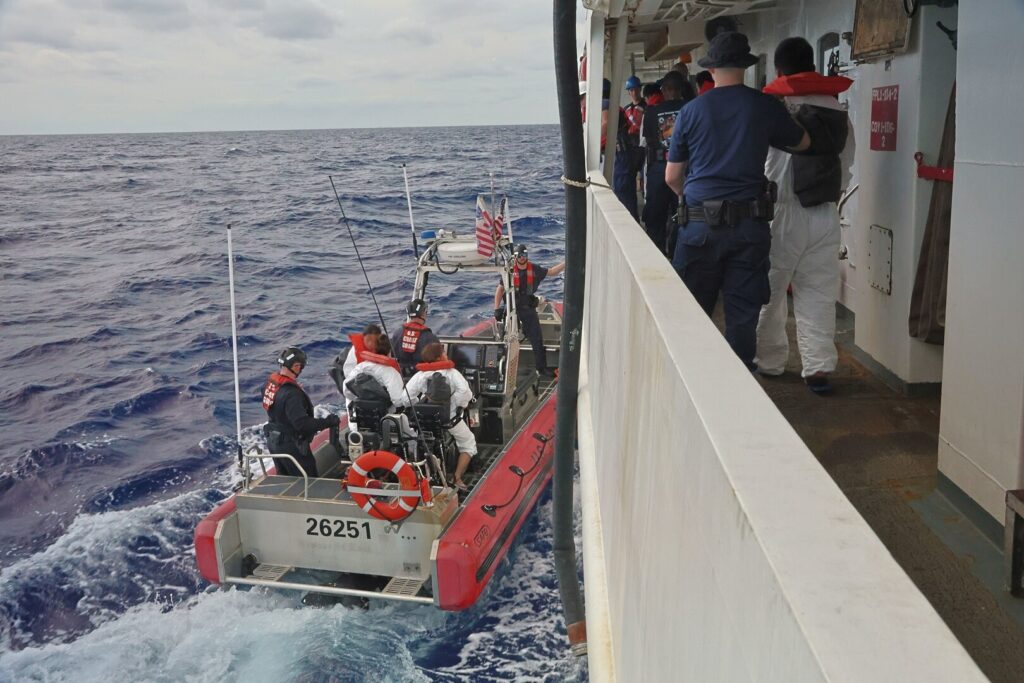
Coast Guard Cutter Vigorous’ crew transfers aliens to the Margaret Norvell in the Florida Straits, Feb. 19, 2025. The aliens were transferred to The Bahamas following an illegal maritime venture interdiction off Key Biscayne, Florida. (U.S. Coast Guard photo by Chief Petty Officer Ryan Youngblood) 

From U.S. Coast Guard Atlantic Area, March 5, 2025 

PORTSMOUTH, Va. — The crew of the Coast Guard Cutter Vigorous (WMEC 627) returned to their homeport in Portsmouth, Wednesday, following a 46-day maritime border security patrol in the Florida Straits.  

Vigorous deployed in support of Homeland Security Task Force – Southeast and Operation Vigilant Sentry while underway in the Seventh Coast Guard District’s area of responsibility, where crew members conducted alien interdiction and border security operations. The crew worked alongside other Coast Guard units and partner agencies such as U.S. Customs and Border Protection – Air and Marine Operations and Homeland Security Investigations.   

Throughout the patrol, Vigorous’ crew interdicted, processed and repatriated more than 67 aliens attempting to enter the United States illegally, and transferred six suspected smugglers ashore to HSI custody to support further investigation for potential federal prosecution. 

While at sea, the cutter participated in five interdictions of vessels attempting to smuggle aliens into the U.S. illegally. The aliens interdicted were from multiple countries including Honduras, Bangladesh, Haiti, and China.  

“The integrity of our maritime borders is vital to national security, and I am proud of our crew’s hard work and determination throughout this deployment,” said Cmdr. Todd Batten, commanding officer of Vigorous. “Together with our partner agencies, including CBP AMO, HSI, and Florida state and local law enforcement, we were able to effectively enforce United States customs and immigration laws against illegal entry.”  

Vigorous, along with other Coast Guard assets and additional HSTF-SE partners, maintained a continual presence with air, land and sea assets in the Florida Straits in support of OVS. HSTF-SE combines a multi-layered approach to maritime border security, which is designed to protect the safety of life at sea while preventing illegal entry into the U.S. and its territories.  

Vigorous is a 210-foot, Reliance-class medium-endurance cutter. The cutter’s primary missions are counter-drug operations, alien interdiction, enforcement of federal fishery laws and search and rescue in support of U.S. Coast Guard operations throughout the Western Hemisphere.  

For information on how to join the U.S. Coast Guard, visit GoCoastGuard.com to learn about active duty, reserve, officer, and enlisted opportunities. Information on how to apply to the U.S. Coast Guard Academy can be found here.  


U.S. Coast Guard Cutter Visits Australia, Furthers Collaboration and Maritime Security 

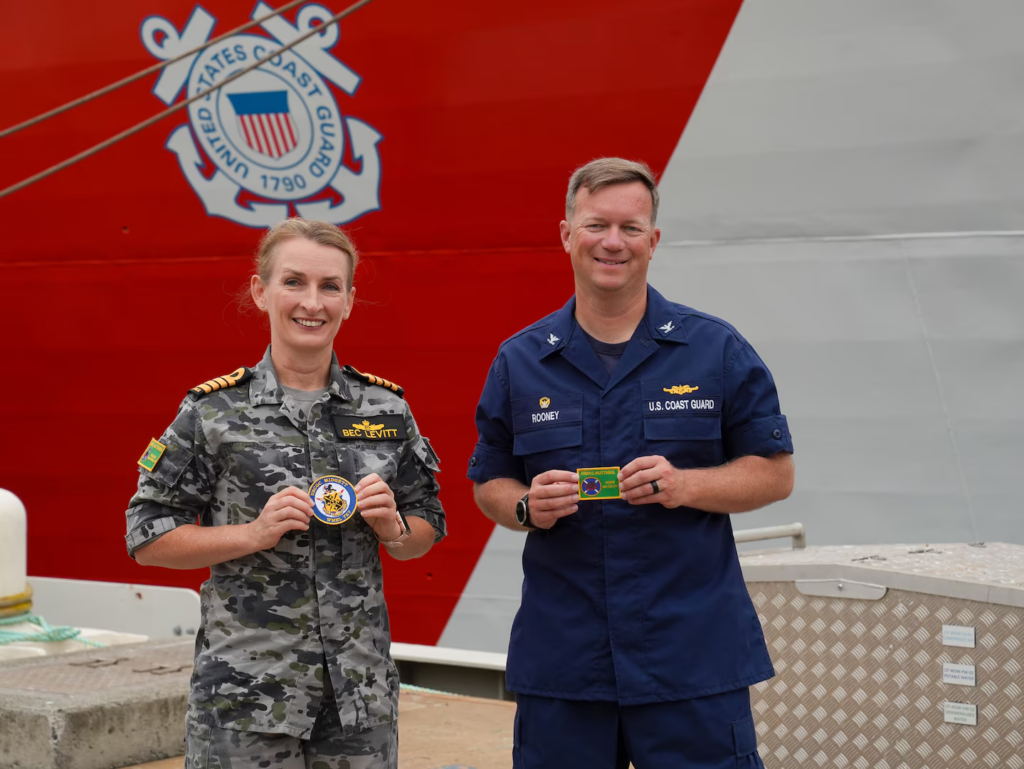
Coast Guard Capt. Matthew Rooney, the commanding officer of the Coast Guard Cutter Midgett (WMSL 757) and Royal Australian Navy Capt. Rebecca Levitt, the commanding officer of His Majesty’s Australian Ship Kuttabul, exchange patches during a media engagement in Sydney, Feb. 25, 2025. (U.S. Coast Guard photo by Petty Officer 3rd Class Jennifer Nilson)

From U.S. Coast Guard Pacific Area, March 4, 2025 

SYDNEY – The U.S. Coast Guard Cutter Midgett (WMSL 757) recently completed a port call in Sydney, Feb. 25, 2025, conducting several engagements with Australian partners that strengthened ties and furthered collaborative maritime security throughout Oceania. Reflecting the spirit of the Pacific Quadrilateral Defense Coordinating Group, the U.S. Coast Guard continues its vital collaboration with Australian law enforcement to identify maritime vulnerabilities and cooperate on solutions that reduce risks to safety, health, and security throughout the region. 

While in Sydney, Midgett hosted a law enforcement partnership event with Australian and United States stakeholders. Participants, including U.S. Consul General in Sydney Christine Elder, U.S. Coast Guard Attaché Capt. Amanda Ramassini, representatives from U.S. Homeland Security Investigations, U.S. Secret Service, and Australian law enforcement and maritime security partners, joined the crew for breakfast and roundtable discussions in the wardroom, followed by a tour of the cutter. Law enforcement partners received a briefing on Midgett’s capabilities and its current mission in the Pacific. Highlighting the close bond between the two nations and their agencies, Midgett’s Lt. Jake Behne recently deployed to the Torres Strait as an observer with the Australian Border Force (ABF) Fast Response Boat unit, and now an ABF Officer in Charge is set to sail aboard Midgett as an observer. 

Separately, Sydney media outlets were invited aboard with the assistance of U.S. Consulate Sydney; the subsequent reporting on partnerships reached more than a million Australians. 

Beyond official engagements, the crew of Midgett embraced the opportunity to experience Australian culture and history during a visit to the Australian National Maritime Museum. 

“This visit to Sydney was more than just a port call; it was a chance to reinforce the vital link between the U.S. Coast Guard and our Australian counterparts,” said Capt. Matthew Rooney, Midgett’s commanding officer. “The support we received from HMAS Kuttabul was first rate and the warm welcome from our Royal Australian Navy shipmates made our time here truly memorable.” 

The United States’ alliance with Australia remains a cornerstone of peace and stability in the Indo-Pacific region. The U.S. Coast Guard looks forward to continuing partnerships with Australia’s maritime and border forces to ensure a connected, prosperous, secure, and resilient Pacific. 

Midgett, commissioned in 2019 and homeported in Honolulu, is the eighth Legend-class national security cutter. These 418-foot vessels are equipped with advanced technology, making them ideally suited to support a wide range of missions, including maritime security, law enforcement, and search and rescue operations.