HII Moves Further into Physical AI for Shipbuilding

 A GrayMatter Robotics technology performs autonomous grinding to an HII foundation project that used internal research and development funds.

By Brett Davis 

Shipbuilding giant HII (Booth 923) has added another artificial intelligence partner to its shipbuilding program, taking another step toward adding “physical AI” to the process of constructing Navy ships. 

In early April, the company announced it signed a memorandum of understanding with Carson, California-based GrayMatter Robotics to explore integrating GMR’s physical AI into shipbuilding operations, including for surface preparation, coating and inspection. 

The companies will identify and potentially pursue future opportunities in four areas that include autonomous shipbuilding capability development; integration of GMR technologies with other shipbuilding technology initiatives; workforce training to extend automation; and acceleration and scaling of unmanned system production.  

“Our shipbuilding throughput was up 14% in 2025 and we are looking for an additional 15% increase in 2026,” said Eric Chewning, HII’s executive vice president of maritime systems and corporate strategy. “By working with new partners like GMR we can further augment our workforce and speed up U.S. Navy shipbuilding production.” 

This follows on to a similar announcement from February, when HII signed an MOU with Ohio-based Path Robotics to incorporate physical AI for welding.  

HII said much of the work that would be pursued by these companies currently is “hands-on and highly skilled,” but AI-driven technologies “offer promising opportunities to support these critical processes by reducing repetitive work and improving consistency to help accelerate delivery timelines and meet the U.S. Navy’s growing demand.” 

Chewning said the introduction of physical AI is just one step of a series of actions HII is taking to improve shipbuilding, from increasing its supplier base to hiring and retaining new workers to making capital investments. 

“And finally, what brings us here today, we are investing in new industry 4.0 technologies like digital engineering, additive manufacturing, enterprise AI and physical AI to drive overall shipyard efficiency,” he told reporters in a call about the announcement. “By working with new physical AI partners like GrayMatter Robotics and integrating them into our high-yield production robotics initiative, or HYPR, we can further augment the AI workforce and speed up the shipbuilding process by bringing automation into more areas of production.” 

So far, shipyard automation remains limited to repeatable activities, where one robot might do a single task 100,000 times, but “there’s a broader set of industrial use cases where we need a single robot to do a hundred thousand tasks just once,” Chewning said. “And that’s where physical AI is a game changer and our partnership with GrayMatter Robotics is so important.” 

Ariyan Kabir, GrayMatter Robotics’ CEO and cofounder, said his company’s technology will help HII do the work it needs at a time when there aren’t enough skilled workers to do it. 

“These are physically brutal tasks,” he told reporters on the press call. “These require incredible precision and we don’t have enough people, skilled people anymore in the U.S. to do these jobs, who are capable of doing these jobs. And that is the problem we solve at GrayMatter Robotics. We build physical AI systems that learn how to perform these skilled manufacturing tasks autonomously — no pre-programmed robots — robots that understand complex material physics and environmental physics, the physics of force friction, contact tool wearing out, temperature and humidity affecting the material behavior, so on and so forth.” 

HII will discuss its physical AI efforts at 1:30 p.m. today at its booth, along with the CEOs of its new physical AI partners. 



STEM Expo Enchants Students with Science, Games and Fun

Kids raise their hands to answer a question during a Mad Science presentation

The annual STEM Expo kicked off Sea-Air-Space 2026 by giving students of all ages a look at the various technologies that underpin the maritime world of the sea services. 

Attendees got examples of chemical reactions from Mad Science presentations, learned some of the principles of aerodynamics, saw how many marbles an aluminum foil boat could hold, and more, including getting a close-up look at welding to build ships. 

STEM Expo sponsor HII featured a variety of exhibits at its booth, including the marble-carrying boats and welding systems. John Walker, O43 facilities manager at Newport News Shipbuilding, helped students work with an introductory welding program. 

“This introduces these kids to things that they’re probably not exposed to on a daily basis,” he said. “Even at the schools, they probably don’t talk a lot about welding, or fitting up steel, or even shipbuilding. So, STEM is very important to expose these kids to this type of technology and the things we do at the shipyard.” 

The Navy League created the STEM Expo to give students interested in science, technology, engineering and math an opportunity to enjoy interactive workshops and hands-on demonstrations while accessing real-world career information.  

Students are captivated by dry ice during a Mad Science demonstration at STEM Expo. 

HII’s Buzz Donnelly, vice president of customer affairs and a former Navy carrier pilot and ship commander, said he has “spent a lot of time reaping the benefits of forums like this.” He said the STEM event is a great lead-off event for local visitors and for Sea-Air-Space attendees from all over the world to share with their families.  

“It’s extremely important to what we need as a defense industry, because these are the future engineers, the future tradesmen and laborers, that our heavy labor-centric force structure depends on. Regardless of how much we modernize with technology, automation, robots and cobots, we still rely on the people,” Donnelly said. 

An attendee gets up close and personal with a pair of virtual-reality goggles at STEM Expo

“Having these young folks here today to see how exciting all the different aspects are, from the shipbuilding to the missiles and aerospace industry, [and] medicines here, is just a real motivating opportunity for them to get them excited about all the things that we do in this industry, to get excited about school, and I know for certain we’re going to have some of them that come in and benefit our nation and this industrial base in the future.” 

Exhibitors at the event, which was also sponsored by Smart Learning Solutions, included universities, defense-related government agencies, science organizations and others. 


Navy Awards Marinette Marine $30 million Contract toward Medium Landing Ships 

Navy Awards Marinette Marine $30 million Contract toward Medium Landing Ships 

By Richard R. Burgess, Senior Editor 

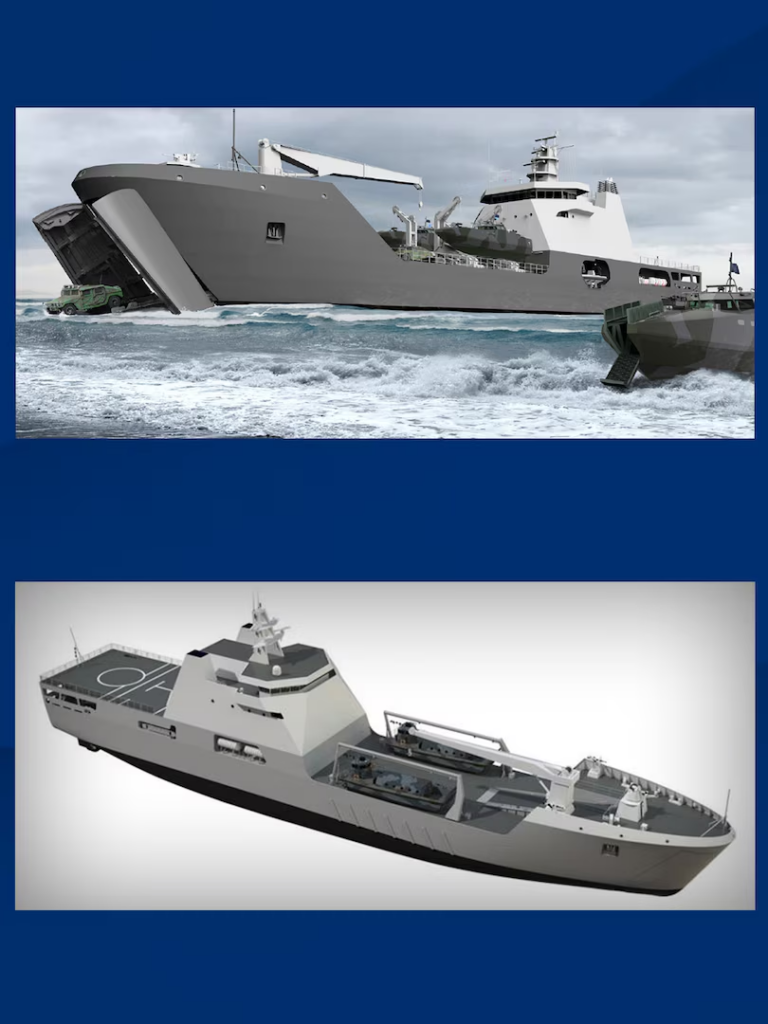
ARLINGTON, Va. — The U.S. Navy has awarded a contract to a shipbuilder for materials and engineering activities for the first four Block 1 medium landing ships (LSMs). 

“Marinette Marine Corp., Marinette, Wisconsin, is awarded a $30,000,000 not-to-exceed undefinitized contract action for advance procurement of long lead time material and associated engineering and design activities in support of four Medium Landing Ship Block 1,” the Department of War said in an April 14 contract announcement. 

Marinette Marine Corp. is a unit of Fincantieri Marine Group FMG), which also is building two Constellation-class guided-missile frigates for the U.S. Navy. The Naval Sea Systems Command obligated $15 million of fiscal 2025 funda at the time of the contract award. 

The Navy plans to procure 35 LSMs to support the Marine Corps’ expeditionary advance base operations. 

“Enhancing our maritime dominance depends on a modernized fleet and a strong industrial base, and today’s contract helps with both — it reduces schedule risk and enables our shipbuilders to rapidly transition to ship construction,” said Secretary of the Navy John C. Phelan in a post on X that also announced the contract award.  

“Work will be performed in Marinette, Wisconsin (46%); De Pere, Wisconsin (39%); and Kenner, Louisiana (15%),” the Department of War’s announcement said. “Work is expected to be completed by September 2027.” 

In December 2025, the Navy and Marine Corps jointly announced Damen Naval’s LST 100 landing ship would serve as the baseline to field a “proven, non-developmental design – would serve as the baseline to help rapidly field LSM capability,” according to the Naval Sea Systems Command. “The LSM will fill the capability gap between smaller, short-range landing craft and the Navy’s long-duration, multi-purpose amphibious warfare ships. It is essential for the maneuver and sustainment of Marine forces, providing the critical littoral mobility required in contested environments. The program will deliver a 35-ship fleet that enhances expeditionary agility and supports the Marine Corps’ concept of distributed maneuver and logistics.”   

Key points made in Fincantieri’s follow-up email announcement included the following:  

  • The contract supports long‑lead materials procurement and early engineering and production readiness activities, enabling a potential start of construction as early as Q4 2026.  

  • The LSM program is a foundational element of U.S. Navy and Marine Corps force design, with up to 35 vessels planned; FMG is designated to build at least the initial four.  

  • The award builds on more than $800 million in U.S. shipyard investments by Fincantieri over the past decade, supporting long‑term naval and industrial capacity.  


L3Harris Announces Billion Dollar Expansion to Boost Solid Rocket Motor Production in Orange County, Virginia 

Virginia Gov. Abigail Spanberger, L3Harris VP Mark Farley, and state and local leaders announce major solid rocket motor expansion in Orange County.

From L3Harris 

ORANGE COUNTY, Va., April 15, 2026 — L3Harris Technologies (NYSE: LHX), Virginia Gov. Abigail Spanberger and the Orange County Board of Supervisors have announced an agreement to further expand L3Harris’ solid rocket motor production capacity at its site in Orange County with the creation of the Virginia Advanced Propulsion Facilities (VAPF).  

The more than $1 billion expansion project, which builds on a previously announced expansion at the Orange County site, is expected to more than double the manufacturing space and create more than 350 jobs over the next five years. 

“L3Harris’ continued investments in solid rocket motor facilities are bolstering manufacturing capacity for key national defense programs,” said Ken Bedingfield, President, Missile Solutions, L3Harris. “With a talented workforce and a community committed to long-term success, our expanded presence in Virginia will deliver additional capability to the Department of War and our allies.” 

“I congratulate L3Harris on its historic expansion in Central Virginia,” said Gov. Spanberger. “With a deep talent pipeline and strong track record in the defense and advanced manufacturing sectors, the Commonwealth is ready to fill the hundreds of new positions coming to Orange County. L3Harris exemplifies the kind of partnership that builds the future of Virginia, and we look forward to celebrating this investment for many years to come.” 

“On behalf of the Board of Supervisors and our Economic Development team, we are thrilled to recognize and support L3Harris’ $1.265 Billion expansion and the creation of 350+ new jobs in Orange County. This is a transformational announcement that will benefit Orange County for decades,” said Orange County Board of Supervisors Chairman Bryan Nicol. “L3Harris has been an important, long-time member of our business community – making their growth and continued investment here particularly gratifying.  This project is a recognition of Orange County’s strong business climate, its economic vitality and our region’s qualified workforce. The Board is grateful to be receiving a grant from Governor Spanberger’s Commonwealth’s Opportunity Fund and support from the General Assembly’s Major Employment Investment Project Approval Commission to bring this opportunity to the Commonwealth.” 

“I’m pleased to see L3Harris expanding its operations in Virginia, bringing hundreds of good-paying jobs to Orange County while strengthening manufacturing capacity for critical national defense programs,” said Rep. Eugene Vindman, D-Va. “This investment will more than double their footprint and build on a long track record of success in the region. I look forward to continuing to partner with L3Harris to support this growth, create new opportunities for our workforce, and advance the aerospace innovation that drives both our economy and our national security.” 

L3Harris plans to construct new facilities at the site to support key solid rocket motor production operations spanning multiple Department of War programs. The VAPF will support company operations such as mixing, grinding, casting and final assembly. 

L3Harris’ site in Virginia currently has 256,000 square feet of manufacturing space and serves as the company’s Center of Excellence for Propellant Research and Small to Medium-sized Solid Rocket Motor Production. 

L3Harris is also modernizing and expanding solid rocket motor production at its sites in Camden, Arkansas, and Huntsville, Alabama. The company’s ongoing investments in new facilities, equipment and processes will enable it to double, triple and quadruple solid rocket motor production rates for a range of key programs. 


Secretary of War Announces Marine General, Navy Flag Officer Nominations 

From the Department of War, April 15, 2026 

ARLINGTON, Va. — Secretary of War Pete Hegseth announced that President Donald J. Trump has made the following nominations: 

Marine Corps Lt. Gen. Roger B. Turner Jr. for reappointment to the grade of lieutenant general, with assignment as commander, U.S. Marine Corps Forces Pacific and commanding general, Fleet Marine Force Pacific, Camp H. M. Smith, Hawaii.  Turner is currently serving as commanding general, III Marine Expeditionary Force and commander, Marine Forces Japan, Okinawa, Japan. 

Marine Corps Maj. Gen. Keith D. Reventlow for appointment to the grade of lieutenant general, with assignment as director for Logistics, J-4, Joint Staff, Pentagon, Washington, D.C.  Reventlow is currently serving as commanding general, Marine Corps Logistics Command, Albany, Georgia. 

Marine Corps Maj. Gen. George B. Rowell IV for appointment to the grade of lieutenant general, with assignment as deputy commander, U.S. Indo-Pacific Command, Camp H. M. Smith, Hawaii.  Rowell is currently serving as director, J-5, U.S. Indo-Pacific Command, Camp H. M. Smith, Hawaii. 

Marine Corps Maj. Gen. Thomas B. Savage for appointment to the grade of lieutenant general, with assignment as deputy commandant, Training and Education, and commanding general, Training and Education Command, Quantico, Virginia.  Savage is currently serving as commanding general, 1st Marine Division, Camp Pendleton, California. 

Marine Corps Maj. Gen. James B. Wellons for appointment to the grade of lieutenant general, with assignment as deputy commandant for Programs and Resources, Headquarters, U.S. Marine Corps, Pentagon, Washington, D.C.  Wellons is currently serving as special projects officer to the Assistant Commandant of the Marine Corps, Pentagon, Washington, D.C.  

Marine Corps Col. Peter D. Houtz for appointment to the grade of brigadier general.  Houtz is currently serving as assistant judge advocate general of the Navy, Office of the Judge Advocate General, Office of the Secretary of the Navy, Washington Navy Yard, Washington, D.C. 

Navy Vice Adm. John F. Wade for reappointment to the grade of vice admiral, with assignment as senior military assistant to the Secretary of War, Pentagon, Washington, D.C.  Wade is currently serving as commander, Third Fleet, San Diego, California. 

Navy Rear Adm. Douglas L. Williams, for appointment to the grade of vice admiral, with assignment as director for Strategic Systems Programs, Washington Navy Yard, Washington, D.C.  Williams is currently serving as director for Test, Missile Defense Agency, Fort Belvoir, Virginia.  


RTX’s Raytheon completes first flight test for RAIVEN® sensing system 

April 15, 2026  

Next-generation intelligent sensor provides superior situational awareness 

ARLINGTON, Va., April 15, 2026 /PRNewswire/ — Raytheon, an RTX (NYSE: RTX) business, has successfully completed the first flight test of its RAIVEN® Staring system, an air-cooled sensor suite that delivers greater situational awareness and operator survivability, on a UH-60 Black Hawk helicopter. During the test, the system, which included three sensors, accurately mapped urban landscape, marshes and coastline in zero illumination and with 270-degree situational awareness. 

RAIVEN Staring, part of the RAIVEN product family, is a next-generation electro-optical and infrared (EO/IR) solution that is platform agnostic, scalable and customizable for missions across air, ground and sea. Its open systems architecture allows for easy system integration and component upgrades. 

“This test showcases the RAIVEN Staring system’s advanced sensing capabilities, enabling partners and allies to better identify and respond to threats through integrated situational awareness,” said Dan Theisen, president of Advanced Products and Solutions at Raytheon. “This offering will provide a significant increase in survivability and mission effectiveness through unprecedented situational awareness, high-resolution pilotage functions as well as passive missile detection, warning and tracking.” 

The RAIVEN EO/IR product family is configurable and can support up to a spherical 360-degree field of view, which significantly improves the speed and accuracy of object detection, recognition and identification. This provides operators with increased visibility in a variety of degraded visual environments, terrains and battle scenarios. 

The sensors are produced in McKinney, Texas. Additional flight tests will take place throughout 2026. 


Airbus and Lakota Connector Partners Successfully Execute Fourth Autonomous Flight Test

WASHINGTON (April 15, 2026)—Airbus U.S. Space & Defense, in partnership with Shield AI, L3Harris Technologies (NYSE: LHX), and Parry Labs, completed its fourth autonomous flight test on the H145 Airbus helicopter and successfully integrated all four company’s technologies into a single aircraft together for the first time. 

The test flights, which took place at the Airbus facility in Grand Prairie, Texas, focused on refining the aircraft’s perception system to ensure it provides accurate, real-time information to an autonomous pilot ensuring obstacles are avoided within a landing zone.  
“This test was vital for us to show the Lakota Connector’s development in performing aerial logistics missions for the U.S. Marine Corps,”

said Rob Geckle, Chairman and CEO of Airbus U.S. Space and Defense. “Perception systems can make or break the success of an unmanned mission in the field, and I am excited to see our aircraft perform so well under uncertain conditions.” 

During the tests, each partner’s contribution enabled the H145 aircraft to autonomously evaluate a landing zone, detect any obstacles obstructing it, and reroute to an alternate site as needed. 

“L3Harris is delivering the digital backbone that advances autonomous aviation from concept to combat-ready capability,” said Jason Lambert, President, Intelligence, Surveillance and Reconnaissance, L3Harris. “Our Modular Open System Architecture enabled this team to integrate four partner technologies seamlessly, demonstrating the speed and interoperability that will define the future of unmanned logistics for the Marine Corps.” 

Shield AI’s Hivemind demonstrated its core capabilities and autonomous perception of the aircraft. 

“This H145 flight test proves Hivemind delivers scalable autonomy across rotary and fixed-wing aircraft without custom redesign,” said Christian Gutierrez, vice president of Hivemind Solutions at Shield AI. “That speed and flexibility are critical in contested logistics.” 

Parry Labs provided edge compute and autonomy-enabling software infrastructure supporting onboard perception processing and real-time decision-making.  

“Autonomy only works when perception and mission software operate together at the edge,” said Parry Labs CEO John “JD” Parkes. “This flight test showed how partner technologies can be rapidly integrated to deliver real-world operational capabilities.” 

Airbus U.S. is currently in the second year of the Aerial Logistics Connector Middle Tier of Acquisition (MTA) Rapid Prototyping Program, which aims to provide the service with aircraft prototypes to demonstrate capabilities to the warfighter through a series of operational demonstrations and experiments. 

In May 2024, Naval Air Systems Command (NAVAIR) awarded Airbus U.S. Space & Defense a Phase I Other Transaction Authority (OTA) through the Naval Aviation Systems Consortium, based on its unmanned UH-72 Logistics Connector concept, a variant of the proven UH-72 Lakota platform. 

The Aerial Logistics Connector effort is one of several initiatives across the Department of Defense aimed at delivering logistical support in distributed environments during peer or near- peer conflicts. 


Navy Announces Commissioning Date, Location for the Future USS Cleveland  

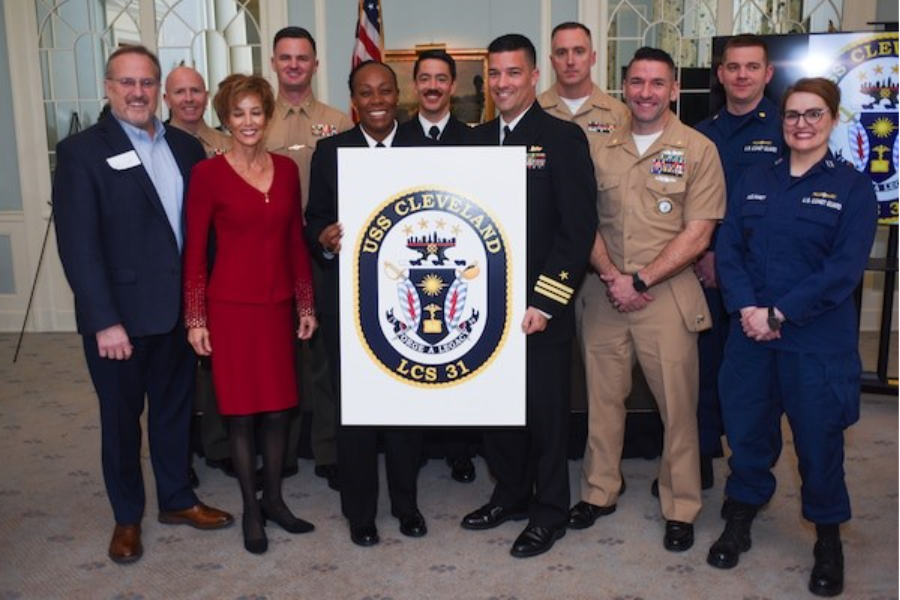
Cmdr. Bruce Hallett, commanding officer of the Freedom-class Littoral Combat Ship USS Cleveland (LCS-31) and Command Master Chief Carla Bellamy take a group photo with the Cleveland Legacy Foundation and active duty service members after revealing the ships crest with Friday, April 5, 2024.

From U.S. Fleet Forces Command, 14 April 2026 

The U.S. Navy will commission the future Freedom-variant Littoral Combat Ship USS Cleveland (LCS 31) on May 16, 2026, in Cleveland, Ohio. 

Cmdr. Bruce Hallett, commanding officer of the Freedom-class Littoral Combat Ship USS Cleveland (LCS-31) and Command Master Chief Carla Bellamy take a group photo with the Cleveland Legacy Foundation and active-duty service members after revealing the ships crest with Friday, April 5, 2024. 

The commissioning marks the completion of the final Freedom-variant Littoral Combat Ship construction phase, a sustained acquisition effort between the Navy and industry partners for two decades. 

The sponsor of LCS 31 is Robyn Modly, the wife of former Acting Secretary of the Navy Thomas Modly. In keeping with Navy tradition, Modly will give the order during the ceremony to “man our ship and bring her to life!” At that moment, the commissioning pennant will be hoisted, and USS Cleveland will officially enter the fleet. 

The ship’s motto, “Forge a Legacy,” honors Cleveland’s industrial history and the strength of its citizens. The ship’s crest features an anvil and a red stripe, symbolizing the city’s steel manufacturing roots, and sixteen rays of sun representing USS Cleveland as the sixteenth Freedom-class ship. It is the fourth U.S. Navy ship to bear its name. 

Following its commissioning, LCS 31 will be homeported at Mayport, Florida. Littoral combat ships are fast, optimally manned, mission-tailored surface combatants that operate in both near-shore and open-ocean environments, countering 21st-century coastal threats. LCS ships integrate with joint, combined, manned, and unmanned teams to support forward presence, maritime security, sea control, and deterrence missions around the globe. 

The commissioning ceremony for the future USS Cleveland (LCS 31) will be livestreamed at http://www.dvidshub.net/webcast/37601. The webcast is scheduled to begin at 9:45 a.m. EST, and the ceremony begins at 10 a.m. EST on May 16. 

The mission of Commander, Naval Surface Force, U.S. Pacific Fleet (CNSP) is to man, train, and equip the Surface Force to provide fleet commanders with credible naval power to control the sea and project power ashore. 


U.S. to Blockade Ships Entering or Exiting Iranian Ports 

From U.S. Central Command, April 12, 2026 

TAMPA, Fla. — U.S. Central Command (CENTCOM) forces will begin implementing a blockade of all maritime traffic entering and exiting Iranian ports on April 13 at 10 a.m. ET, in accordance with the President’s proclamation. 

The blockade will be enforced impartially against vessels of all nations entering or departing Iranian ports and coastal areas, including all Iranian ports on the Arabian Gulf and Gulf of Oman. CENTCOM forces will not impede freedom of navigation for vessels transiting the Strait of Hormuz to and from non-Iranian ports. 

Additional information will be provided to commercial mariners through a formal notice prior to the start of the blockade. All mariners are advised to monitor Notice to Mariners broadcasts and contact U.S. naval forces on bridge-to-bridge channel 16 when operating in the Gulf of Oman and Strait of Hormuz approaches. 


Philippine, U.S. Forces Kick Off Most Expansive Balikatan Exercise to Date 

From the I Marine Expeditionary Force 

CAMP AGUINALDO, Quezon City, Philippines – The Armed Forces of the Philippines and the U.S. military will conduct the 41st iteration of Exercise Balikatan across the Philippine archipelago from April 20 to May 8. 

Coinciding with the 75th anniversary of the U.S.-Philippine Mutual Defense Treaty, more than 17,000 personnel from the Philippines, United States, Australia, Japan, Canada, France, and New Zealand will train shoulder-to-shoulder, and an additional 17 nations will participate as part of the international observer program. 

“Balikatan is the embodiment of our nation’s commitment to a strong and credible defense posture” said Philippine Army Maj. Gen. Francisco F. Lorenzo Jr., Armed Forces of the Philippines Education and Training Command Commander. “This exercise is a prime opportunity for the Armed Forces of the Philippines to accelerate our modernization and enhance our capabilities as a vanguard of regional peace. Training shoulder-to-shoulder with our oldest ally and our many partners ensures our forces are prepared to face any challenge, together.” 

The exercise will feature cutting-edge training across the air, land, sea, space, and cyber domains. Key events include: 

  • AFP and U.S. forces will sharpen their ability to command and control by establishing parallel exercise joint task forces to navigate a challenging training scenario.  

  • Field training exercises throughout the Philippines will culminate in capstone events to rehearse warfighting skills in maritime security, coastal defense, and the integration of combined and joint fires.  

  • Dynamic maritime sustainment and distributed logistics through ship-to-shore equipment offloads and movements. Prior to the start of Balikatan 2026, the AFP and U.S. forces rehearsed equipment and supply offload from maritime prepositioning force shipping at Port of Cagayan de Oro that was transported and distributed across Luzon. Supplies and equipment movement and distribution will continue throughout the exercise in support of the training.  

  • Ships from four countries will participate in a multi-day multilateral maritime exercise along the west coast of the Philippines conducting deck landing qualifications, live-fire gunnery, anti-submarine warfare, and search and rescue training.  

  • Humanitarian and civic assistance activities including engineering and construction projects and community health engagements at five locations across the archipelago to directly benefit Filipino communities and strengthen humanitarian assistance preparedness.  

“Our alliance with the Philippines has been a cornerstone of peace and stability in the Indo-Pacific for 75 years,” said U.S. Marine Corps Lt. Gen. Christian Wortman, I Marine Expeditionary Force Commanding General. “Balikatan 2026 is a powerful demonstration of our ironclad commitment to that alliance. By training together with our friends and partners using the most advanced systems, we are not just enhancing our shared capabilities; we are forging the trust and readiness required to secure a prosperous and peaceful future for the region.”