U.S. Trains First Australian Radiological Control Technicians to Support AUKUS Submarine Force 

In a milestone for the AUKUS (Australia, United Kingdom, United States) enhanced trilateral security partnership, four Australian civilian maintenance technicians, pictured with Norfolk Naval Shipyard commander Capt. James Mosman, graduated from the U.S. Navy’s Radiological Controls Technician Qualifying School (RCTQS) at the Norfolk Naval Shipyard March 26, 2025.  

By Norfolk Naval Shipyard, Pearl Harbor Naval Shipyard & Intermediate Maintenance Facility, and AUKUS Integration and Acquisition Public Affairs, March 27, 2025 

PORTSMOUTH, Va. – In a milestone for the AUKUS (Australia, United Kingdom, United States) enhanced trilateral security partnership, four Australian civilian maintenance technicians from the Australian government’s submarine company, ASC, graduated from the U.S. Navy’s Radiological Controls Technician Qualifying School (RCTQS) at the Norfolk Naval Shipyard March 26, 2025. The group’s successful completion of this specialized training marks a key step in supporting Australia’s acquisition of sovereign conventionally armed, nuclear-powered submarines under AUKUS Pillar I Optimal Pathway. 

The RCTQS provides the specialized training required to uphold the U.S. Navy’s nuclear and radiological safety standards and ensure compliance with U.S. regulatory requirements. The rigorous six-month program provides detailed theoretical and practical-skills training with participants demonstrating their knowledge and abilities through comprehensive assessments and examinations. Upon qualification, these technicians are responsible for ensuring adherence to U.S. radiological controls requirements and standards during the operation and maintenance of naval nuclear propulsion plants at nuclear shipyards and maintenance activities. Since its inception, RCTQS has been instrumental in developing personnel with the knowledge and skills necessary to protect Sailors, workers, the public and the environment. 

“This is an intense, demanding school that teaches complex theory and application of radiological controls,” said RCTQS instructor Donald Sweeney. “The Australian students were well prepared, focused, and committed from day one. They continue to exceed expectations at every step and are well positioned to perform their roles on conventionally armed, nuclear-powered submarines in their home country. I look forward to hearing about their future success.” 

The ASC technicians started their training in the fall of 2024 after spending three months training at the Pearl Harbor Naval Shipyard and Intermediate Maintenance Facility (PHNSY & IMF) in Hawaii. Over the next three years, approximately ten ASC technicians will enter the RCTQS program. 

“Having the Australian maintenance personnel training and working side-by-side with our American trainees builds Australia’s technical expertise and readiness to keep the U.S. submarines assigned to Submarine Rotational Force – West ready to operate,” said Meganne Atkins, acting director of the AUKUS Integration and Acquisition Office. 

Norfolk Naval Shipyard (NNSY) Commander Capt. James “Jip” Mosman emphasized the benefits of the collaboration: “Incorporating the Australian technicians into our training facility has been a great opportunity to build a positive and productive partnership. The intensive training they received lays the groundwork for them to effectively lead and execute radiological operations.” 

Participating in the training has been an invaluable experience for the Australian cohort. 

“The skills and knowledge we have gained as well as the professional relationships we have forged are essential for us to safely and securely steward Australia’s conventionally armed, nuclear-powered submarines,” said ASC trainee Steve*. “We are more confident than ever in our ability to meet Australia’s regulation requirements and to uphold the responsibility imposed upon us in our duties to maintain the integrity and viability of the program.” 

More than 130 Australian civilian submarine maintainers are currently training at PHNSY & IMF to maintain nuclear-powered fast-attack submarines. “As the lead maintenance activity for Submarine Rotational Force – West, we are charged with ensuring the Australian personnel are ready to conduct maintenance on U.S. submarines,” said Capt. Ryan McCrillis, PHNSY & IMF’s commander. “Being able to send RCTQS trainees to Norfolk, Virginia, where the Navy has established this centralized high-quality training facility, ensures that when our submarines start rotating to Western Australia, the right people with the right training are ready to keep them fit to fight.” 

The AUKUS trilateral security partnership strengthens the participating nations’ lethality and warfighting capabilities, enhances readiness by adding capacity and resilience to the submarine industrial base and is essential to securing a free and open Indo-Pacific region through operating more interoperable high-end allied warships to deter aggression. 

The AUKUS I&A Program Office is the U.S. Navy office responsible for executing the trilateral partnership to assist Australia in acquiring conventionally armed, nuclear-powered attack submarines at the earliest possible date while setting the highest nuclear stewardship standards and continuing to maintain the highest nonproliferation standard. 

Norfolk Naval Shipyard, one of the nation’s four public shipyards, focuses on generating fleet readiness and putting more combat-ready platforms at sea. As part of a broader effort to standardize radiological training across the service, the U.S. Navy established the RCTQS at the shipyard in 1996. Developed with input from multiple naval shipyards, the program has continuously evolved to incorporate the latest safety protocols and technological advancements. To date, RCTQS has trained nearly 7,000 radiological control technicians, playing a vital role in supporting the Naval Nuclear Propulsion Program. 

Pearl Harbor Naval Shipyard & Intermediate Maintenance Facility is a field activity of Naval Sea Systems Command and a one-stop regional maintenance center for the U.S. Navy’s surface ships and submarines. It is the largest industrial employer in the state of Hawaii, with a combined civilian and military workforce of approximately 6,400. It is the most comprehensive fleet repair and maintenance facility between the U.S. West Coast and the Far East, strategically located in the heart of the Pacific, being about a week’s steaming time closer to potential regional contingencies in the Indo-Pacific. 

*Per ASC protocols, employee last names are not publicly released 


U.S. Coast Guard cutter promotes regional security in the Pacific with Papua New Guinea 

East New Britain Province Governor Michael Marum and members from the East New Britian Province government, Papua New Guinea pose with crew from the Coast Guard Cutter Midgett (WMSL 757) on the flight deck in Rabaul, Papua New Guinea March 17, 2025. (U.S. Coast Guard photo by Petty Officer 3rd Class Jennifer Nilson)

From U.S. Coast Guard 14th District, March 26, 2025 

RABAUL, Papua New Guinea – The U.S. Coast Guard Cutter Midgett (WMSL 757) recently concluded its second port call in Papua New Guinea (PNG), following nine days of shiprider operations with representatives from the PNG Defence Force, PNG Customs Service, and PNG National Fisheries Authority. 

Midgett was invited by the Papua New Guinea government to participate in the operation. The PNG shipriders led the mission by selecting vessels of interests and conducting boardings while the U.S. Coast Guard provided ship based and shoreside support. The successful shiprider operations reinforced the importance of deepening and expanding strong bilateral relationships. 

During the nine-day operation, Midgett facilitated six at-sea inspections within the PNG Exclusive Economic Zone (EEZ) under the PNG-U.S. bilateral agreement. The U.S Coast Guard and PNG’s bilateral maritime law enforcement agreements enhance PNG sovereignty with the capacity to enforce PNG’s maritime laws through shared information exchanges and joint patrols that deter illegal activities and malign behavior in PNG’s EEZ. 

While in Rabaul, Midgett hosted a key leadership engagement with the East New Britain Governor, Michael Marum, and PNG fisheries stakeholders. During the engagement, members of Midgett and PNG representatives participated in roundtable discussions focused on PNG-U.S. bilateral agreements and security within the PNG EEZ and received a tour of the cutter. 

Midgett crewmembers visited a local school to participate in sports and seamanship activities. Midgett also hosted students on board, allowing students to learn about shipboard life and participated in firefighting training. 

Commissioned in 2019 and homeported in Honolulu, Midgett is the eighth Legend-class National Security Cutter. At 418-feet, these cutters are the largest and most capable in the U.S. Coast Guard fleet. Equipped with advanced technology, they are ideally suited to support a wide range of missions, including maritime security, law enforcement, and search and rescue operations. 


US Navy to Christen Future USNS Billy Frank Jr. 

From the U.S. Navy Office of Information, March 27, 2025 

MOBILE, Ala.—The U.S. Navy will christen the future USNS Billy Frank Jr. (T-ATS 11) during a ceremony on Saturday, March 29, at 10:00 a.m. CDT at Austal USA in Mobile, Alabama. 

The Honorable William Frank III, former chairman of the Nisqually Tribe and son of the ship’s namesake will deliver the principal address followed by remarks from Dr. Brett Seidle, acting assistant secretary of the Navy for Research, Development, and Acquisition; Rear Adm. Thomas Anderson, program executive officer, Program Executive Office, Ships; Rear Adm. Mark Haigis, deputy commander, Military Sealift Command; and Michelle Kruger, president of Austal USA. 

In a time-honored Navy tradition, Ship Sponsor Peggen Frank will christen the ship by breaking a bottle of sparkling wine across the bow. Frank is the executive director of Salmon Defense and daughter-in-law of the ship’s namesake. 

The ship is named in honor of Korean War veteran and Nisqually tribal member Billy Frank Jr., who received an Albert Schweitzer Prize for humanitarianism; a Martin Luther King Jr. Distinguished Service Award; and, posthumously, a Presidential Medal of Freedom for his over 30-years of service to the Northwest Indian Fisheries Commission. 

The Navajo-class ship is a multi-mission, common hull platform that will deploy to support a range of missions such as towing, rescue, salvage, humanitarian assistance, oil spill response, and wide-area search and surveillance. Navajo-class ships will be capable of towing U.S. Navy ships and will have 6,000 square feet of deck space for embarked systems. 


Heritage Congratulates Brent Sadler on Maritime Administrator Nomination   

From the Heritage Foundation, March 27, 2025  

WASHINGTON — The Heritage Foundation released the following statement in response to President Donald Trump’s nomination of Brent Sadler (Captain, U.S. Navy, Retired) as the next Maritime Administrator in the Department of Transportation’s Maritime Administration (MARAD). MARAD supports America’s maritime transportation infrastructure – including ships and shipping, port and vessel operations, national security, environment, and safety.   

Brent joined Heritage after a 26-year Navy career that included numerous operational tours on nuclear-powered submarines, staffing of senior Defense Department leaders, and as a military diplomat in Asia. As a Senior Research Fellow, Brent has focused on maritime security and the technologies shaping our future maritime forces.  

Heritage Vice President of the Kathryn and Shelby Cullom Davis Institute for National Security and Foreign Policy Victoria Coates commented:      

“We are deeply proud to see Brent Sadler nominated for this critical position related to America’s national and economic security. His comprehensive and successful Naval career as well as his policy work at Heritage position him well to serve this role with excellence and integrity. We will miss him, but he is the best candidate for this role.”    

Heritage Director of the Allison Center for National Security Robert Greenway added:    

“Having worked alongside Brent for several years, I’ve seen firsthand his leadership, passion, and knowledge related to the maritime domain and the revolution in shipping required to transform a vital industry. His nomination is a testament to the Trump administration’s unwavering commitment to addressing America’s depleted maritime sector amid global uncertainty.”   


Bollinger Shipyards Gets Coast Guard Contract Modification for Polar Security Cutter Program 

Since acquiring the facilities in 2022, Bollinger has nearly tripled its Mississippi production workforce 

From Bollinger Shipyards, March 25, 2025 

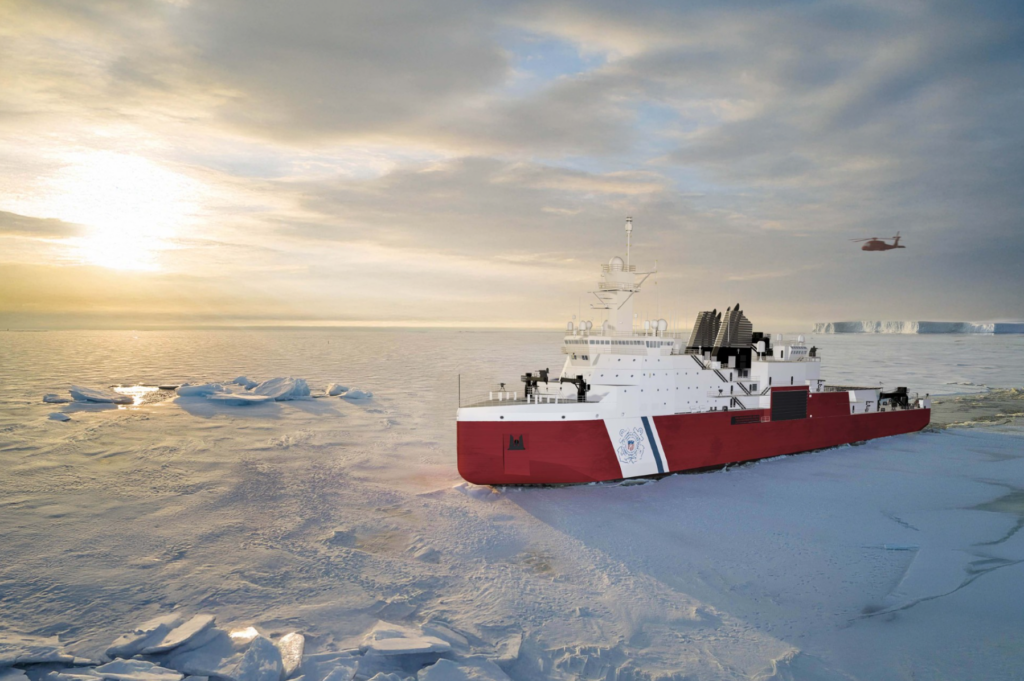
PASCAGOULA, Miss. – Tuesday, March 25, 2025 – Bollinger Shipyards announced today it has received a $951.6 million Fixed-Price-Incentive-Firm Target (FPIF) contract modification from the United States Coast Guard, advancing the Detail Design and Construction phase of the Polar Security Cutter (PSC) Program. This milestone underscores Bollinger’s integral role in strengthening America’s maritime presence and operational capabilities in the Arctic. 

“Securing this contract modification has truly been a herculean effort and underscores the incredible trust the U.S. Government has placed in Bollinger to build and deliver the first heavy polar icebreaker in half a century,” said Ben Bordelon, President and CEO of Bollinger Shipyards. “We wouldn’t be in the solid position we’re in today without the leadership and the tireless efforts of the entire team at Bollinger Mississippi Shipbuilding. Their hard work and dedication have successfully put the PSC program on a strong path forward after a rocky start under the previous, foreign-owned builder. We now look forward to receiving the green light to begin full production.” 

Bordelon also expressed gratitude for the role of national and state leadership in moving this program forward.   

“I am also grateful for the leadership of President Trump and his Administration in recognizing the urgent need for American-made icebreakers. Because of his foresight and commitment to rebuilding America’s shipbuilding capabilities, this historic project is now moving forward.”  

Bordelon also acknowledged Mississippi’s leadership for championing the PSC Program and state as a dominant force in shipbuilding.   

“I also want to thank Governor Reeves and Mississippi’s Congressional Delegation for their leadership and support, especially as we leverage ongoing state and local investments to ensure Bollinger Mississippi remains the premier example of American shipbuilding.” 

“As the Arctic grows as an arena of great power competition, the United States will require far more icebreaking capability from the U.S. Coast Guard to defend our interests in the region. Today’s award is a testament to the good work that Bollinger continues to do on the Polar Security Cutter program and the growing urgency with which their platforms are needed to boost our national defense,” said U.S. Sen. Roger Wicker (R-MS), Chairman of the Senate Armed Services Committee. “The Mississippi Gulf Coast will not only benefit from even more national security-focused quality jobs and economic development, but it will also continue to be a national player and powerhouse in mission-critical innovation and military capability.” 

“Mississippi continues to prove its status as the premier destination for American shipbuilding—driving both national defense and commercial maritime strength,” said U.S. Senator Cindy Hyde-Smith (R-MS). “This milestone not only reinforces the Gulf Coast’s strategic importance, but it also reflects the value of returning critical shipbuilding programs to experienced, American-owned hands. Under Bollinger Shipyards’ strong leadership and investment, a once-stalled program will move forward with renewed urgency. I fully support this effort, which brings more high-quality jobs to Mississippi and ensures the Coast Guard is able to meet the growing challenges in the Arctic and beyond.” 

Bollinger’s continued investment and growth on the Mississippi Gulf Coast reflect the skills, strength and talent of Mississippi’s workforce,” said Mississippi Governor Tate Reeves. “This announcement reinforces Mississippi’s pivotal role in American shipbuilding and solidifies Mississippi’s reputation as a national leader in maritime innovation and excellence.” 

“Bollinger Mississippi Shipyards has a strong track record in American shipbuilding, and their role in the Polar Security Cutter program is another important step. This historic milestone strengthens national security, supports the domestic shipbuilding workforce, and enhances our Arctic presence. Ensuring the U.S. Coast Guard has the tools it needs is critical, and I look forward to seeing this project move forward,” said U.S. Rep. Mike Ezell (R-MS-04). 

As Bollinger continues to enhance its operations in Mississippi into world-class shipyards, the company remains committed to making strategic investments to modernize and expand its capabilities. Additionally, the contract modification ensures Bollinger continues to provide its workforce with industry-leading wages throughout the life of the PSC program. Since acquiring foreign-owned VT Halter in November 2022, Bollinger has made a significant economic impact in the state through targeted investments and workforce expansion. To date, Bollinger has invested $76 million across its Mississippi facilities, including Bollinger Mississippi Shipbuilding (BMS), Bollinger Mississippi Repair (BMR), Bollinger Gulfport Shipyard (BGS), and CHAND Gulf Coast.  

Since the acquisition in 2022, Bollinger has increased its Mississippi workforce by over 61%, with production roles at BMS alone increasing by more than 178%.  These numbers are expected to rise as the program reaches full production over the coming years. A key driver of this growth has been Bollinger’s innovative Bootcamp workforce development programs, which continue to strengthen the skilled labor pipeline.   

“Our investment in developing the next generation of skilled American workers not only strengthens our competitive edge in the shipbuilding industry but also underscores our commitment to fostering economic growth and American innovation,” added Bordelon. “We are committed to providing high-quality careers that positively impact the families and communities we support along Mississippi’s Gulf coast.” 

This contract modification primarily supports operations at Bollinger Mississippi Shipbuilding, with additional project contributions from facilities located in Massachusetts, Illinois, Virginia, Georgia, Louisiana, and other regions. Completion of the first Polar Security Cutter is anticipated by May 2030. 

The Polar Security Cutter will provide the United States with enhanced operational capability in polar regions, playing a critical role in safeguarding national security, economic stability, and supporting vital maritime and commercial interests. 


USS Minneapolis-Saint Paul Departs for First Deployment 

The Freedom-variant littoral combat ship USS Minneapolis-Saint Paul (LCS 21), along with the “Valkyries” of Helicopter Maritime Strike Squadron (HSM) 50 Detachment 3 and embarked U.S. Coast Guard Law Enforcement Detachment, departed from Naval Station Mayport March 26, beginning her maiden deployment to support U.S. 4th Fleet area of operations.

From Littoral Combat Ship Squadron Two, 26 March 2025

MAYPORT, Fla. — The Freedom-variant littoral combat ship USS Minneapolis-Saint Paul (LCS 21), along with the “Valkyries” of Helicopter Maritime Strike Squadron (HSM) 50 Detachment 3 and embarked U.S. Coast Guard Law Enforcement Detachment, departed from Naval Station Mayport March 26, beginning its first deployment to support U.S. 4th Fleet area of operations. 
 
USS Minneapolis-Saint Paul’s primary mission will be to support counter-illicit drug trafficking in the Caribbean. Minneapolis-Saint Paul operations will involve practical exercises and exchanges with partner nations, supporting U.S. 4th Fleet interoperability, and reinforcing the U.S. position as the regional partner of choice. 
 
Among the key accomplishments, USS Minneapolis-Saint Paul certified in Visit, Board, Search, and Seizure (VBSS) operations, enabling the ship to conduct Maritime Interdiction Operations and support for the embarked Coast Guard Law Enforcement Detachment. 
 
This capability is vital for countering illicit drug trafficking and ensuring the safety of international waters. In addition, the ship embarked its aviation detachment, which includes the MH-60 R helicopter. This addition significantly enhances the ship’s ability to conduct reconnaissance, track contacts of interest, and engage in maritime interdiction operations. The MH-60 R will serve as the ship’s eyes in the sky, providing real-time intelligence and provide capabilities to effectively conduct our mission. 
 
“I have watched this crew tackle a challenging and condensed schedule to ensure we are prepared for our [first] deployment to the 4th Fleet. We have overcome every obstacle in our path and have demonstrated that we are a resilient team ready to execute our mission,” said Cmdr. Steven Fresse, USS Minneapolis-Saint Paul’s commanding officer. “This will be USS Minneapolis-Saint Paul’s first deployment, as well as the first for many of my crew members. However, we are eager to accomplish the mission we have been rigorously training for. I am very proud of this crew, and I am confident they will continue to exceed my expectations.” 
 
The crew also completed multiple certifications in a range of critical warfare areas, including Air Warfare, Electronic Warfare, Intelligence, Surface Warfare, Cyber Warfare, and Search and Rescue. These certifications showcase the team’s proficiency across multiple domains, proving that they are well-equipped and prepared to handle the complex and multifaceted nature of modern naval operations. This remarkable achievement demonstrates that the Minneapolis Saint Paul is not only combat-ready but also adaptable to a wide spectrum of missions. All of which resulted in the ship exiting the basic phase and entering the advanced phase of the ship’s life cycle. 
 
Deploying an LCS to the region aims to demonstrate the U.S. commitment to international cooperation, security, freedom and prosperity. The ship’s size, speed, and agility make LCS ideal for narcotics interdictions, partner engagements and port access. 
 
“It has been an honor to watch this crew adjust and adapt to every task we have had to accomplish as a team and get prepared for our first deployment”, said Master Chief Ariel Ampier, USS Minneapolis-Saint Paul’s command master chief. “I am excited to be a part of a team that has been diligently working through every phase to maintain the readiness and success of this ship!” 
 
LCS are a fast, agile, mission-focused platform designed to operate in near-shore environments defeat 21st-century coastal threats. The LCS is capable of supporting forward presence, maritime security, sea control, and deterrence. 
 
USS Minneapolis-Saint Paul will operationally be assigned to U.S. 4th Fleet. It is homeported in Mayport, Florida and assigned to Littoral Combat Ship Squadron 2.  


Navy Seeks Ways to Streamline Shipbuilding 

March 25, 2025 | By David Vergun, DoD News 

The United States projects its presence around the globe through its warships, impacting geopolitical decisions daily while maintaining the American way of life, said Brett A. Seidle, acting assistant secretary of the Navy for research, development and acquisition.  

Seidle testified today before the Senate Armed Services Committee’s subcommittee on seapower regarding the state of conventional surface shipbuilding. 

“We have fielded the finest Navy ever assembled in the history of the world, and I believe that is still true,” he said.  

The backbone of a strong Navy is its shipbuilding enterprise, Seidle added. Those who build ships are passionate about what they do and their role in supporting national security.  

He said there’s a need to reinvigorate the nation’s industrial might, particularly in shipbuilding. Various challenges hinder more ships from being delivered on time and budget. Costs are rising faster than inflation, and schedules on multiple programs are delayed one to three years.  

“We need increased modernization, infrastructure investment, better workforce hiring and retention, and improved supply chain performance,” Seidle noted, adding that the assistance of Congress and the Navy’s industrial partners will be key to solving these challenges.  

Navy Vice Adm. James P. Downey, commander of Naval Sea Systems Command, also testified.  

Downey said Navsea is committed to appropriately evaluating cost, schedule and technical requirements to deliver the right capabilities to the warfighters.  

He said the command continually reviews its shipbuilding military specifications and is committed to collaborating with industry to simplify and streamline wherever possible. Also, the command is transitioning design plans into digitized formats, thereby reducing the burden on shipbuilders.  

Downey said Navsea continues to face mounting challenges, from shifting demographics and workforce shortages to supply chain disruptions that collectively continue to pressurize shipbuilding contracts.  

“We need strategic solutions to improve waterfront productivity, and we are evaluating contracting approaches and incentives while also centralizing that data to better access what levers are needed to improve shipbuilding performance,” the vice admiral said.  

Currently, the Navy has 92 ships under contract, with 56 vessels actively in construction. In addition to these prime shipbuilding contracts, Navsea has several shipyards that outsource work. Downey said the process results in a more distributed shipbuilding model with somewhat more complex oversight required. 

He said Navsea is committed to helping industry create productive and safe workspaces on the waterfront to attract and retain the skilled workforce needed to build the Navy the nation needs.  

“When you visit the shipyards and speak to the workers, whether it’s welders, machinists, front office staff or engineers, you understand what it means to them to build a great ship from the keel up, to start with nothing, and then to deliver a fully capable warship — that’s the product of teamwork in its purest form of execution,” he said. 


Ingalls Shipbuilding Launches Destroyer Future USS Jeremiah Denton (DDG 129) 

From HII, March 25, 2025 
 

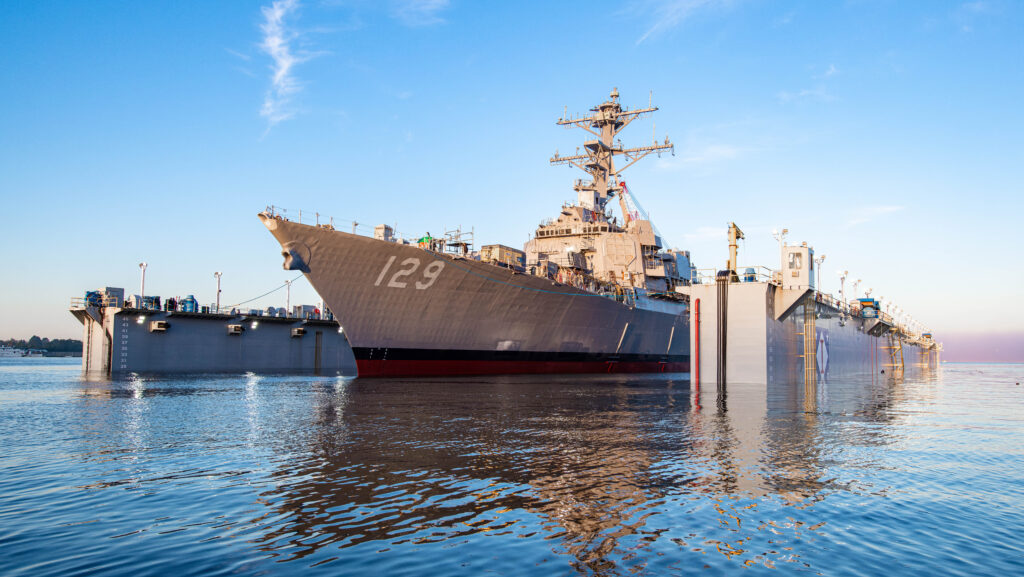
PASCAGOULA, Miss., March 25, 2025 (GLOBE NEWSWIRE) — HII’s (NYSE: HII) Ingalls Shipbuilding division successfully launched future USS Jeremiah Denton (DDG 129) today, the third Flight III Arleigh Burke-class destroyer to be built at the shipyard. 

Shipbuilders transferred DDG 129 from land to the company’s dry dock using translation railcars to support the ship during the move. Once in the dry dock, the ship was floated and moved by tugboats to a pier at the shipyard. 

“The launch of DDG 129 is a testament to the hard work and dedication of our Ingalls shipbuilders and a collaborative achievement with our Navy partners,” Ingalls Shipbuilding DDG Program Manager Ben Barnett said. “The future USS Jeremiah Denton will now undergo final outfitting, systems activation, and testing before entering the fleet.” 

DDG 129 is named for former U.S. Sen. Jeremiah Denton Jr., a Vietnam War veteran who was awarded the Navy Cross for his heroism as a prisoner of war. Following his Navy career, he was elected to the U.S. Senate representing his home state of Alabama in 1980. 

Photos accompanying this release are available at: http://hii.com/news/hiis-ingalls-shipbuilding-launches-guided-missile-destroyer-future-uss-jeremiah-denton-ddg-129/

An Arleigh Burke-class Flight III destroyer features the AN/SPY-6(V)1 Air and Missile Defense Radar (AMDR) and the Aegis Baseline 10 Combat System that is required to keep pace with the threats well into the 21st century. Ingalls Shipbuilding has five Flight IIIs currently under construction including Ted Stevens (DDG 128), Jeremiah Denton (DDG 129), George M. Neal (DDG 131), Sam Nunn (DDG 133) and Thad Cochran (DDG 135). 


Silver Ships Delivers 25th Assault Amphibian Safety Boat to U.S. Marine Corps

From Silver Ships, March 24, 2025 

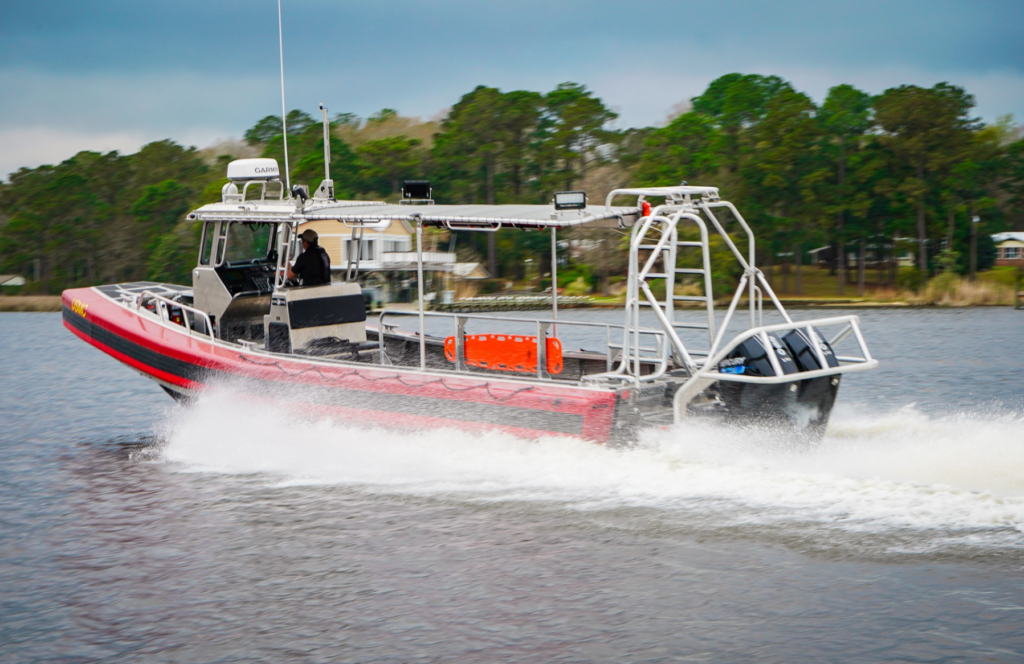
MOBILE, Ala. (March 24, 2025) – Silver Ships, a leading manufacturer of military aluminum workboats, has completed, tested and delivered a new Assault Amphibian Safety Boat (AASB) for the U.S. Marine Corps and the U.S. Navy. Silver Ships has now delivered 25 of 31 AASB on time since production has been in place. A noteworthy achievement of this project is that the first hull was built and tested less than nine months after the initial contract was awarded.   

The AASB is used for the U.S. Marine Corps amphibious training with Amphibious Assault Vehicles (AAV) and the follow-on Amphibious Combat Vehicles (ACVs) in the continental United States and overseas. The vessels can carry 28 passengers and have tailored communications, safety and rescue equipment to support offshore and nighttime operations. 

AASBs feature a 2-foot draft which allows the vessel to navigate through shallow waters quietly. The vessel’s full load weight is 16,195 pounds and it holds 250 gallons of fuel. The vessel features twin 250 HP Mercury SeaPro Outboard engines that allow it to reach its destination quickly and efficiently. The vessel is 39 feet long, with a 10-foot beam and 25-degree deadrise, allowing it to cut through harsh waters with ease.  

“The AASB project has been tremendously rewarding for Silver Ships due to the teamwork and cooperation we have fostered. We made this project a top priority for rapid production because our U.S. Marine Corps and U.S. Navy customers had an urgent operational need for the boats to be built quickly. We worked closely with our U.S. Marine Corps and U.S. Navy partners to deliver a reliable and very rugged boat that can stand up to continuous use in harsh marine environments,” said Shawn Lobree, Silver Ships Director of Federal Programs.  

For more than 35 years, Silver Ships has collaborated with the U.S. Military to design and build mission-specific boats. Silver Ships takes great pride in supporting the U.S. Military and are committed to fulfilling all operational requirements while ensuring the highest level of crew safety and exceptional performance.  


DON Authorizes Attendance at Sea-Air-Space 2025 for Military, Civilian Personnel

FOR IMMEDIATE RELEASE
March 25, 2025

ARLINGTON, Va. — Travel for the Navy League’s Sea-Air-Space Symposium has been authorized for all Department of Navy military speakers, moderators, and panelists, and attendance at the event has been approved for all National Capital Region (local) Navy federal civilian employees and uniformed military personnel.

A memo released by acting Under Secretary of the Navy Terrence Emmert, dated 20 March 2025, says, “I approve the Department of the Navy’s attendance at the Navy League’s Sea-Air-Space Symposium, 6-9 April 2025, at National Harbor, Maryland.”

Sea-Air-Space, the nation’s largest maritime national security symposium, is critical, as it “provides a platform for the professional development of Department of the Navy personnel on the latest developments in naval warfare, as well as an opportunity for Navy engagement with representatives from a broad cross-section of government, industry, academia, and the international community.” (GENADMIN released 24 MARCH 2025).

The Navy League of the United States, the host for Sea-Air-Space, is offering federal active-duty and civilian employees admission and transportation to the event, as well as one complimentary meal event. The Navy League also offers them discounted parking and meals for purchase at a discounted rate. Local bus services to and from the Gaylord National Harbor is also available for all federal civilian employees and uniformed military. Please see website, www.seaairspace.org for further details. Attendees not opting for these services are responsible for their own commuting costs to the event.

Newly confirmed 79th Secretary of the Navy, the Honorable John C. Phelan, will address Sea-Air-Space attendees on his priorities for the Department, including ways to revitalize U.S. shipbuilding, strengthen warfighting culture, and recruit America’s best and brightest. Top speakers also include acting Commandant of the United States Coast Guard Admiral Kevin Lunday, Acting Chief of Naval Operations Admiral Jim Kilby, and Commandant of the Marine Corps General Eric Smith.

To register for Sea-Air-Space, click here.