Coast Guard National Security Cutter Returns to CA Following 130-Day Bering Sea Patrol 

Coast Guard Cutter Bertholf (WMSL 750) transits through Glacier Bay, Alaska, Oct. 24, 2024. During the patrol, Bertholf’s crew operated as far north as the Arctic Circle, patrolling along the maritime boundary line between the United States and Russia and supporting U.S. strategic interests in the North Pacific Ocean. (U.S. Coast Guard photo by Troy Spence.)

From U.S. Coast Guard Pacific Area, Feb. 7, 2025 

ALAMEDA, Calif. — The U.S. Coast Guard Cutter Bertholf (WMSL 750) and crew returned to Alameda Friday, after completing a 130-day deployment patrolling the Bering Sea. 
 
The Bertolf’s crew showcased how the U.S. Coast Guard is a unique instrument of national power that bridges the divide between defense, diplomacy, and law enforcement and creates opportunities to further national objectives and priorities. 
 
During the patrol, Bertholf’s crew operated as far north as the Arctic Circle. They provided U.S. maritime presence in the region patrolling along the maritime boundary line between the United States and Russia and supported U.S. strategic interests in the North Pacific Ocean by promoting maritime governance, enforcing domestic fishery regulations, and strengthening U.S. presence along the maritime boundary line. 
 
Bertholf conducted joint operations in the region with the Coast Guard Cutter Healy (WAGB 20) and an Air Station Kodiak MH-60 helicopter aircrew, enhancing collaboration and improving capabilities across the national security cutter and polar icebreaker mission sets. 
 
While patrolling the region, Bertholf’s crew conducted 24 boardings of commercial fishing vessels, enforcing safety and living marine resource regulations. 
 
The crews worked closely with National Oceanic and Atmospheric Administration law enforcement officers and Alaskan Wildlife State Troopers, notably conducting two boardings of foreign flagged tramper vessels. The Coast Guard’s efforts in ensuring safe and sustainable fishing practices are essential to the long-term health of this vital renewable resource, and the security of the United States. 
 
Bertholf’s crew provided search and rescue (SAR) coverage of the Bering Sea showcasing the national security cutter and crew’s multi-mission agility. The crew responded to a disabled fishing vessel 80 nautical miles northeast of Dutch Harbor, Alaska. The fishing vessel Seabrooke had lost all electrical power, including navigation equipment and steering as a significant storm was approaching their position. Bertholf arrived on scene and placed the disabled vessel in tow using a bridle that Bertholf’s crew handcrafted. Bertholf was relieved of the tow by commercial salvage vessel Makushin Bay who towed the disabled vessel safely into port at Akutan, Alaska.  
 
“This crew excelled in one of the most challenging maritime environments through the holiday season, safeguarding U.S. fishermen, engaging with local communities, and delivering comprehensive search and rescue coverage across the Bering Sea,” said Capt. Billy Mees, Bertholf’s commanding officer. “I hold the entire crew, along with their families, in the highest regard for the sacrifices they make to serve our country.” 
 
To maintain and enhance SAR proficiency, Bertholf’s crew conducted 46 helicopter deck landings with a U.S. Coast Guard Air Station Port Angeles HH-65 helicopter aircrew while operating in the Strait of Juan de Fuca. Bertholf also conducted flight operations with Air Station Kodiak’s MH-60 helicopter aircrews operating near Cold Bay, Alaska. Coordination of flight operations provided critical training opportunities for both helicopter crews and Bertholf’s crew, supporting Bertholf’s ability to respond to emergencies.  
 
Bertholf crew members fostered relationships while in port Juneau and Adak, Alaska with community relations engagements. They met with city leadership and devoted several hours to cleaning out the local tsunami shelter and engaging with the local population, less than 30 of whom were currently on the island, aiding in the service’s understanding of the Aleutian community and how to optimize support for remote Alaskan communities. 
 
Bertholf began the patrol representing the Coast Guard by participating in San Francisco’s 2024 Fleet Week. The crew provided ship tours to over 2,500 visitors over a three-day period and sailed in formation during the parade of ships. The crew showcased their capabilities and commitment to the community through various public engagements including recruiting booths, Coast Guard Museum displays, and collaborations with other Coast Guard units across the Bay Area. 
 
“We were honored to be a part of San Francisco Fleet Week – the Coast Guard is the largest branch of service in the Bay Area, and we were thrilled to interact with the community in this time-honored event.” said Mees. 
 
Bertholf is named for Commodore Ellsworth Price Bertholf, the Coast Guard’s first commandant. Bertholf’s most notable service was his role in the famous Alaska Overland Expedition in 1897. When over 200 American whalers became trapped in ice at Point Barrow, Bertholf led the relief party traveling 1,600 miles via dogsled. Along with Lt. David Jarvis and Dr. Samuel Call, Bertholf herded almost 400 reindeer through a frozen Alaska winter to feed the starving whalers, an act that would later earn him the Congressional Gold Medal.  The ship’s motto is “Legends Begin Here.” 
 
Homeported in Alameda, Bertholf was commissioned on August 4, 2008, as the Coast Guard’s first Legend class national security cutter. National security cutters are 418-feet long, 54-feet wide, and have a 4,600 long-ton displacement. They have a top speed of 28 knots, a range of 12,000 nautical miles, and can hold a crew of up to 170. Bertholf routinely conducts operations throughout the Pacific, where the cutter’s combination of range, speed, and ability to operate in extreme-weather conditions provides the mission flexibility necessary to conduct vital strategic missions. 
 
The U.S. Coast Guard provides service to the American people. As part of the Department of Homeland Security team, Coast Guard men and women protect our nation and are at all times a military service–part of the joint force defending it. 


USS O’Kane Returns Home after 7-Month Deployment to 5th, 7th Fleets 

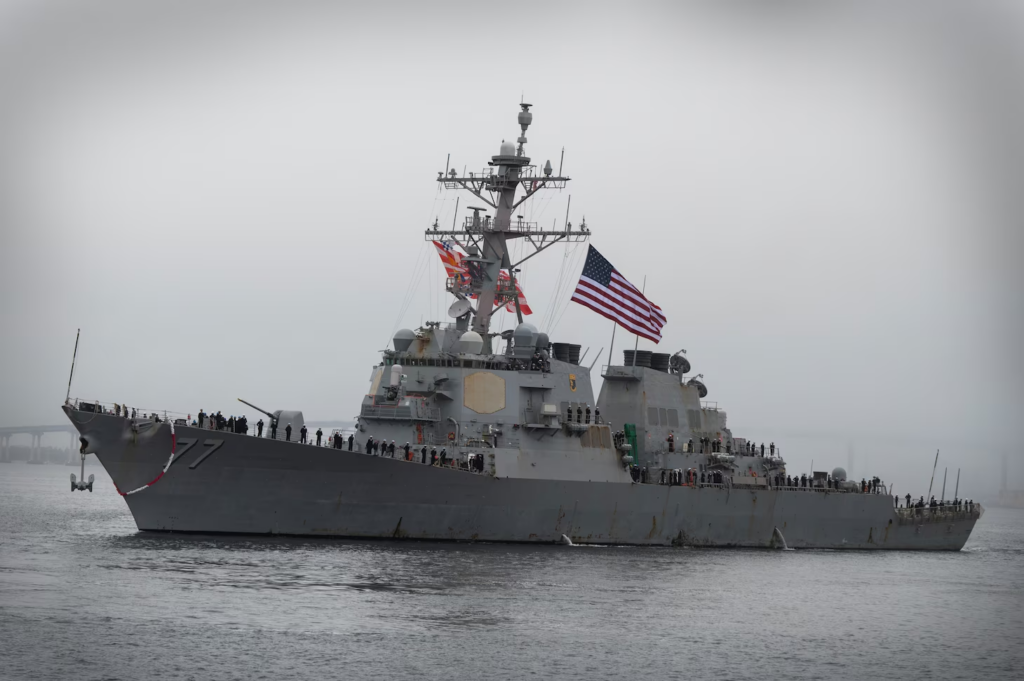
The Arleigh Burke-class guided-missile destroyer USS O’Kane (DDG 77), assigned to the USS Abraham Lincoln Carrier Strike Group (ABECSG), returned to their homeport, Naval Base San Diego, after a seven-month deployment to the U.S. 3rd, 7th and 5th Fleet area of operations, Feb. 7. (U.S. Navy photo by IC2 Ulrika Mendiola) 

From U.S. 3rd Fleet, Feb, 10, 2025 

NAVAL BASE SAN DIEGO – The Arleigh Burke-class guided-missile destroyer USS O’Kane (DDG 77), assigned to the USS Abraham Lincoln Carrier Strike Group (ABECSG), returned to their homeport, Naval Base San Diego, after a seven-month deployment to the U.S. 3rd, 7th and 5th Fleet area of operations, Feb. 7.  

 
O’Kane departed San Diego with the ABECSG, July 17, 2024, and remained in U.S. 5th Fleet following the departure of ABECSG who returned to their homeport in December 2024. 
 
“I am incredibly proud of the exemplary work this team has invested in themselves and their equipment over the past few months,” said Cmdr. Rich Ray, commanding officer, O’Kane. “We are proud of the work we accomplished this deployment, and we are looking forward to continuing that success into the next challenge.” 
 
Following the departure of the USS Abraham Lincoln (CVN 72) and the Arleigh Burke-class guided-class missile destroyers USS Frank E. Petersen, Jr. (DDG 121), USS Michael Murphy (DDG 112) and USS Spruance (DDG 111) from U.S. 5th Fleet, O’Kane and the USS Stockdale (DDG 106) remained in the U.S. Central Command (USCENTCOM) area of responsibility to support global maritime security operations. 
 
O’Kane and Stockdale successfully escorted U.S. flagged and crewed merchant vessels in the Gulf of Aden. During the escort, the destroyers worked alongside other U.S. Central Command forces in successfully repelling multiple Iranian-backed Houthi attacks during transits of the Bab el-Mandeb strait. During the transit, the destroyers were attacked by one-way attack un-crewed Aerial systems, anti-ship ballistic missiles and anti-ship cruise missiles which were successfully engaged and defeated. The vessels were not damaged, and no personnel were hurt. The ships were well prepared, supported, and the well-trained Sailors successfully defended the ship. 
 

Throughout deployment, O’Kane successfully completed 75 flight quarters, including 84 rotary-wing landings, 26 rotary-wing refueling evolutions, and nine vertical replenishments. In addition, O’Kane conducted 24 replenishments-at-sea, and 22 mooring evolutions. 
 
Additionally, O’Kane visited Karachi, Pakistan to promote the diplomatic relationship between the United States and Pakistan. Following the port visit, O’Kane conducted a maritime exercise to build interoperability with the Pakistan Navy. 
 
ABECSG initially deployed to the Indo-Pacific region to support regional security and stability, and to reassure our allies and partners of the U.S. Navy’s unwavering commitment, highlighted by the first-ever U.S.-Italy multi-large deck event with the Italian Navy’s ITS Cavour Carrier Strike Group held in the Indo-Pacific on Aug. 9, 2024. 
 
The strike group was ordered to the USCENTCOM area of responsibility to bolster U.S. military force posture in the Middle East, deter regional escalation, degrade Houthi capabilities, defend U.S. forces, and again sailed alongside our Italian allies and other partners to promote security, stability and prosperity. Assigned destroyers of the ABECSG, to include O’Kane, were essential to providing a layer of defense to U.S. forces and ensure the safe passage of commercial vessels and partner nations transiting in international waterways like the Red Sea, Bab el-Mandeb Strait and the Gulf of Aden. 
 
As an integral part of U.S. Pacific Fleet, Commander, U.S. 3rd Fleet operates naval forces in the Indo-Pacific and provides the realistic and relevant training to ensure the readiness necessary to execute the U.S. Navy’s timeless role across the full spectrum of military operations. U.S. 3rd Fleet works together with our allies and partners to advance freedom of navigation, the rule of law, and other principles that underpin security for the Indo-Pacific region. 


Portsmouth Naval Shipyard Successfully Undocks USS Cheyenne 

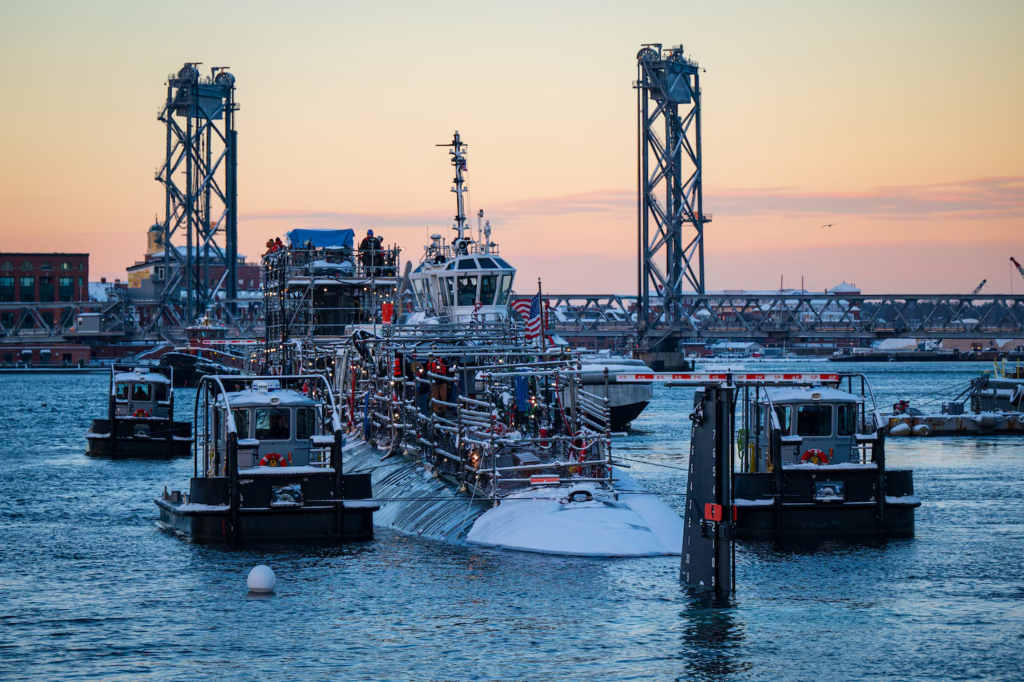
The Los Angeles improved-class attack submarine USS Cheyenne (SSN 773) moves berths following an undocking evolution at Portsmouth Naval Shipyard in Kittery, Maine, Feb. 7, 2025. (U.S. Navy photo by Branden Bourque) 

by Branden Bourque, Feb. 10, 2025 

KITTERY, Maine – The Los Angeles improved-class attack submarine USS Cheyenne (SSN 773) was successfully undocked Feb. 6, marking a significant milestone in its service life extension program at Portsmouth Naval Shipyard. 
 
“I couldn’t be more proud of the Cheyenne crew and the men and women of Portsmouth Naval Shipyard for all the work to achieve this significant milestone,” said Cheyenne Commanding Officer Cmdr. Kyle Calton. “Undocking is one of the most meaningful events in our overhaul period, returning Cheyenne to the water where she belongs and putting a huge gust of wind in our sails as we prepare to return to sea.” 
 
Cheyenne has undergone major repairs, structural inspections, and replacements of mechanical and electrical systems. This extensive work, led by the project team, has enhanced the submarine’s capabilities, ensuring advanced systems are delivered to warfighters at the tip of the spear. These efforts contribute to the fleet’s operational readiness and support national defense priorities. 
 
As Cheyenne’s undocking is a significant achievement, it’s especially noteworthy considering the ongoing construction work of the multi-mission dry dock project as part of the Navy’s Shipyard Infrastructure Optimization Program. It also underscores the innovative approach of the nation’s public shipyards to meet the chief of naval operations’ goals of restoring critical infrastructure and increasing the number of combat-ready platforms available to the fleet. 
 
“Reaching the undocking milestone is a big win during any maintenance availability. The efforts on Cheyenne are even more impressive as the team executed their highly complex work amid an active construction zone for our multi-mission dry dock,” said shipyard commander Capt. Michael Oberdorf. “It’s like cooking Thanksgiving dinner while renovating your kitchen – it requires thoughtful planning, coordination, and superb execution. Cheyenne’s undocking underscores our shipyard’s commitment to not only meet our current mission but ensures we can meet the future needs of America’s warfighting Navy to support and defend our nation.” 
 
“I am incredibly proud of the men and women of Portsmouth Naval Shipyard and the crew of Cheyenne for all their hard work to complete the work necessary to undock on-time,” said Cheyenne project superintendent Jerry Legere. “They met every challenge head-on with tenacity and selflessness – they are all heroes. Through this incredible effort we have postured Cheyenne to be delivered as a fully mission capable submarine operated by a highly skilled crew ready to answer the nation’s call.” 
 
Attack submarines are multi-mission platforms that enable five of the six core capabilities of the Navy’s maritime strategy: sea control, power projection, forward presence, maritime security, and deterrence. They are designed for excellence in anti-submarine warfare, anti-ship warfare, strike warfare, special operations, intelligence, surveillance and reconnaissance, irregular warfare, and mine warfare. Attack submarines also project power ashore through special operations forces and Tomahawk cruise missiles, playing a critical role in preventing or preparing for regional crises. 
 
As the Navy’s leader in attack submarine maintenance and modernization, PNSY enhances critical warfighting capabilities by safely delivering first-time quality work, ensuring our undersea warf-ighters are battle-ready when called upon. 


L3Harris Unveils AMORPHOUS C2 Software

An L3Harris graphic illustrating the types of autonomous systems AMORPHOUS could control.

WASHINGTON — L3Harris has taken the wraps off AMORPHOUS, a new software that uses a single user interface to control thousands of autonomous, uncrewed platforms simultaneously, across all domains.

Officials from the Melbourne, Florida-based company briefed reporters on Amorphous on Feb. 6 in Washington, where they also purchased public advertising touting the new system.

AMORPHOUS stands for Autonomous Multi-domain Operations Resiliency Platform for Heterogenous Unmanned Systems and includes a distributed command-and-control interface.

“Autonomy is a force multiplier, which is why we have designed AMORPHOUS as a multi-domain, multi-mission capability that rapidly integrates a variety of uncrewed systems across the battlespace,” said Jon Rambeau, president of L3Harris’ Integrated Mission Systems. “This project also highlights L3Harris’ partnerships with venture-backed and non-traditional companies to mature emerging defense capabilities more quickly and affordably.”

L3Harris is currently developing prototypes using the AMORPHOUS architecture on contracts for the U.S. Army and the Defense Innovation Unit. The company has demonstrated the system’s flexibility and interoperability by controlling multiple, separate assets across multiple vehicle types operating in different domains during government-managed tests.          

The software allows one operator to oversee multiple platforms, which can make their own decisions within the network — for instance, if one drone is damaged or lost, the others in a swarm can adjust formations to compensate.

Although the system has just been publicly revealed, Rambeau and Toby Magsig, the vice president and general manager of Enterprise Autonomous Solutions, said AMORPHOUS is under “multiple contracts” to military customers.

And, although it has so far controlled a few systems, it is aimed at being able to control and oversee thousands, they said.

To do that at speed, AMORPHOUS relies on what Magsig called “thin messages,” akin to SMS text message on a phone, to communicate at speed with dispersed systems in multiple domains. The system could be used for counter-UAS operations; intelligence, surveillance, reconnaissance and targeting; swarming kinetic effects; electromagnetic spectrum operations and even autonomous breaching.

“All the services are asking for the same thing,” Magsig said. “This is not service specific.”

Underwater systems have traditionally posed communications problems, and Magsig was vague on how the company has addressed and possibly overcome them, saying when it comes to the underwater domain, “what happens there needs to stay there.”

Rambeau said AMORPHOUS is open architecture and platform and sensor agnostic, and training time can be very short due to its intuitive interface.


U.S. Navy Leaders Observe Joint Task Force Southern Guard Operations

GUANTANAMO BAY, Cuba (Feb. 5, 2025) U.S. Naval Forces Southern Command/U.S. 4th Fleet Commander Rear Adm. Carlos Sardiello meets with Sailors attached to Freedom-variant Littoral Combat Ship USS Saint Louis (LCS 19) aboard the ship during their support of Operation Southern Guard at Naval Station Guantanamo Bay, Cuba, Feb. 5, 2025. (U.S. Navy photo by Naval Station Guantanamo Bay Public Affairs)

From U.S. Naval Forces Southern Command, Feb. 7, 2025 

NAVAL STATION GUANTANAMO BAY, Cuba — Rear Adm. Carlos Sardiello, Commander U.S. Naval Forces Southern Command/U.S. 4th Fleet, and Rear Adm. John Hewitt, Commander, Navy Region Southeast, visited Joint Task Force Southern Guard onboard Naval Station Guantanamo Bay (NSGB) Feb. 5 and 6, as the Joint Task Force prepares to receive illegal aliens from the United States. Sardiello and Hewitt accompanied Adm. Alvin Holsey, Commander, U.S. Southern Command, during the visit. 

At the direction of the President to the Department of Homeland Security (DHS) and the Department of Defense (DOD), U.S. military service members are supporting Illegal Aliens holding operations led by DHS at NGSB. U.S. Southern Command (USSOUTHCOM) has set up Joint Task Force Southern Guard at the Naval Station to execute the directive. 

“The Naval Station is fully committed to ensuring we have the infrastructure and resources in place to support this vital mission,” said Capt. Michael Stephen, Commander, Naval Station Guantanamo Bay. “From the moment we received the mission, our team has worked with urgency, executing contingency plans, and rapidly strengthening our capabilities. 

“The level of teamwork—both within the base and across the joint force—has been outstanding,” said Stephen “Everyone is engaged, working together seamlessly to tackle challenges and ensure we’re ready for what’s ahead. The progress we’ve made in such a short time is a testament to their dedication and professionalism,” he said. 

As the United States’ oldest overseas military installation, established in 1903, Naval Station Guantanamo Bay is in the USSOUTHCOM Area of Responsibility. U.S. Naval Forces Southern Command/U.S. Fourth Fleet serves as USSOUTHCOM’s maritime component commander and therefore has responsibilities in contingency plans involving the naval station. U.S. Navy Region Southeast manages and oversees shore installation support for the naval station as it does for a total of 18 Navy bases in the Southeast region. 

“We are very proud of our Sailors, Marines and civilians who have responded to this contingency plan at Naval Station Guantanamo Bay, which is a critical forward-operating base that enables the United States to maintain a persistent presence in the Caribbean,” said Rear Adm. Sardiello. “This mission exemplifies how we integrate and deploy all-domain combat power to respond to crises, maintain regional security, and protect U.S. interests.” 

Military service members and contractors have provided the manpower and organization to accommodate thousands’ illegal aliens. Additional phases of expansion will follow to meet the President’s directive to host up to 30,000 illegal aliens. This work includes the construction of large, secure tent facilities to house illegal aliens, the installation of high-security fencing and barriers to protect all personnel, and a huge increase in providing essential services, including food, medical care, and housing, to all DOD and DHS personnel. The Navy is also delivering comprehensive logistical support, ensuring the infrastructure and resources needed to sustain operations are in place. 

Naval Station Guantanamo Bay ensures the freedom of action in the maritime domain and contributes to enhancing U.S. alliances and partnerships throughout the region. By executing this critical role in the enforcement of national immigration policies, the station continues to be an integral asset in supporting the defense and security objectives of the United States. 


USCGC Campbell Returns After Interdicting $91M in Narcotics during Eastern Pacific Ocean Patrol 

The crew of USCGC Campbell (WMEC 909) stands for a photo accompanied by more than 8,000 pounds of cocaine worth an assessed street value of approximately $91.3 million in Port Everglades, Florida, Jan. 27, 2025. The Campbell crew offloaded the illegal drugs from two interdictions in the international waters of the Eastern Pacific Ocean. (U.S. Coast Guard photo by Petty Officer 1st Class Diana Sherbs)

From U.S. Coast Guard Atlantic Area, Feb. 5, 2025 

NEWPORT, R.I.  — The crew of Coast Guard Cutter Campbell (WMEC 909) returned to their home port in Newport, Monday, following a 63-day multi-mission patrol to the Caribbean and Eastern Pacific Ocean.  

Campbell deployed in support of Joint Interagency Task Force – South (JIATF-S) to advance the primary mission of interdicting illegal narcotics in known drug trafficking zones. Campbell’s crew conducted maritime safety and security missions while working to detect, deter and intercept drug-smuggling vessels.   

While on patrol, Campbell interdicted a suspected drug-smuggling operation involving six panga boats engaged in illicit activity on the high seas. During the pursuit, Campbell’s crew seized approximately 8,061 pounds of cocaine worth an estimated street value of more than $91 million and detained two suspected drug traffickers.   

Throughout their deployment, Campbell’s crew embarked and provided care for two search and rescue survivors and maintained custody of a total of 49 suspected drug smugglers suspected of engaging in illicit trafficking activities at sea.   

The crew of Campbell offloaded the drugs at Port Everglades in Ft. Lauderdale, Florida, January 27, and transferred 26 suspected drug smugglers to authorities, who will now face federal prosecution by the Department of Justice.   

Between January 2024 and February 2025, the crew of Campbell transferred a total of 87 suspected smugglers to federal law enforcement authorities, resulting from 24 interdictions by U. S. Coast Guard cutters in the Eastern Pacific Ocean and Caribbean Sea.  

During the patrol, Campbell’s crew partnered with numerous additional Coast Guard assets during the deployment by hosting a law enforcement detachment from the Opa Locka, Florida-based Coast Guard Tactical Law Enforcement Team – South, and conducted joint patrols and at-sea transfers with Coast Guard Cutter Waesche (WMSL 751), Coast Guard Cutter James (WMSL 754), and Coast Guard Cutter Stone (WMSL 758). These units also leveraged international and interagency partners to ensure that U.S. Coast Guard presence resulted in both the interdiction and deterrence of illicit trafficking in the Eastern Pacific.  
  
Prior to returning to Newport, Campbell crew members conducted three days of helicopter to deck landing qualifications at sea with multiple aircrews from the Coast Guard Helicopter Interdiction Tactical Squadron based out of Jacksonville, Florida. Campbell also embarked nearly sixty personnel from other Coast Guard cutter crews for hands-on shipboard-helicopter operations training that will improve mission readiness across the cutter fleet.  

“I am incredibly proud of Campbell’s crew,” said Cmdr. Jonathan Harris, commanding officer of Campbell. “We overcame many obstacles to stand vigilant watches away from our loved ones during the holiday season and worked tirelessly to prevent transnational criminal organizations from harming our communities by seizing tons of narcotics that will no longer cross our maritime borders. More importantly, we contributed to the cycle of justice by ensuring dozens of suspected drug traffickers will stand trial in the United States.”   

JIATF-S, in conjunction with partner nations, works to target, detect and monitor illicit drug trafficking within the joint operating area. The organization facilitates the interdiction and apprehension of illicit traffickers to dismantle transnational criminal organizations while reducing the flow of drugs to the public. Once interdiction becomes imminent, the law enforcement phase of the operation begins, and control of the operation shifts to the U.S. Coast Guard throughout the interdiction and apprehension. Interdictions in the Eastern Pacific Ocean are performed by members of the U.S. Coast Guard under the authority and control of the Coast Guard’s Eleventh District, headquartered in Alameda, California.    

Campbell is a 270-foot, Famous-class medium endurance cutter. The cutter’s primary missions are counter-drug and migrant interdiction operations, enforcement of federal fishery laws and search and rescue in support of U.S. Coast Guard operations throughout the Western Hemisphere. The cutter falls under the command of U.S. Coast Guard Atlantic Area, which is based in Portsmouth, Virginia.    

For more information on how to join the U.S. Coast Guard, visit GoCoastGuard.com to learn about active duty, reserve, officer and enlisted opportunities. Information on how to apply to the U.S. Coast Guard Academy can be found here.   


Navy League Releases 2025-2026 Maritime Policy Statement 

Shipbuilding shortfalls, readiness gaps, and emerging threats jeopardize U.S. maritime security and economic stability 

Feb. 6, 2025 

The Navy League of the United States is proud to announce the release of its 2025-2026 Maritime Policy Statement, a comprehensive report outlining the strategic priorities and legislative recommendations necessary to strengthen America’s sea services. This biennial publication serves as a guiding document for policymakers, industry leaders, and the public, advocating for investments that ensure the continued security, prosperity, and global leadership of the United States through maritime power. 

The Maritime Policy Statement forms the foundation of the Navy League’s Legislative Affairs Program over the course of a two-year Congress. It is both highly educational for staff members and highly actionable for legislators. Based on extensive research from members of the Navy League’s Maritime Policy Committee, this document covers all aspects of the maritime domain. It also provides policy prescriptions for Congress to address any issues impacting America’s readiness and future capabilities.   

“The Maritime Policy Statement has long been a source of pride for the Navy League. I deeply appreciate the dedication and effort that goes into crafting this important document, which serves as a vital resource for Congressional offices. It not only informs policy debates in Washington, D.C., but also acts as a compelling call to action for lawmakers,” says Navy League CEO Mike Stevens, 13th Master Chief Petty Officer of the Navy. 

Key recommendations outlined in the report include: 

  • Appropriate at least $40 billion annually for the Navy Shipbuilding and Conversion budget to rapidly expand the fleet and account for the rising cost of labor and materials. 

  • Increase and accelerate funding for the Shipyard Infrastructure Optimization Plan to ensure the expanded submarine fleet can be properly maintained. 

  • Continue to support allies while investing in the production of depleted munitions to ensure that American forces have the firepower needed for a possible great power conflict. 

  • Incorporate National Defense Features on other vessels. Navy funding of such features on both U.S.- and foreign-built onboard TSP and MSP vessels (e.g. TSP CONSOL systems) is needed to enhance their military utility in support of contingency operations. 

  • Invest in military quality of life priorities such as affordable military housing, base and barracks modernization/renovation, increased access to childcare, and food security. 

The full 2025-2026 Maritime Policy Statement is available for download here.  

For more information or to schedule an interview with a Navy League representative, please contact [email protected]. 


Navy F/A-18 Fleet Gets Enhanced Target Tracking as IR Search and Track System Achieves IOC

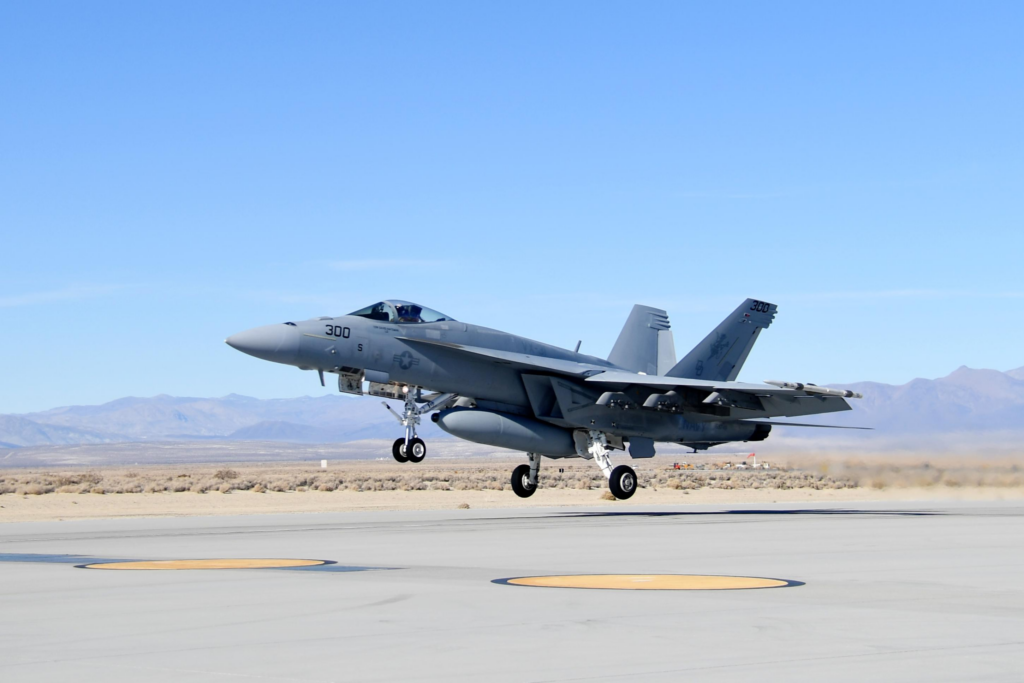
The U.S. Navy has declared initial operational capability for the F/A-18 E/F Infrared Search and Track Block II system. (U.S. Navy photo by Katie Archibald)

From Naval Air Systems Command, Feb 4, 2025 

PATUXENT RIVER, Md. — The U.S. Navy declared initial operational capability (IOC) for the F/A-18 E/F Infrared Search and Track (IRST) Block II system in November 2024, providing the fleet with an enhanced capability to search, detect and track airborne targets at long range. 

“Reaching IRST IOC is an important milestone in our overarching efforts to deliver advanced integrated warfighting capability to the fleet,” said Rear Adm. John Lemmon, Program Executive Officer for Tactical Aircraft Programs. “IRST provides data for our aircrew to improve reaction time and survivability while remaining unaffected by radio frequency jamming.” 

IRST increases aircrew situational awareness by supplementing air-to-air detection and track capabilities, and autonomously or in combination with other sensors, supports the guidance of beyond visual range missiles. It acts as a complementary sensor to the aircraft’s AN/APG-79 fire control radar in a heavy electronic attack or radar-denied environment. 

The system achieved IOC after completing Initial Operational Test and Evaluation with Air Test and Evaluation Squadron (VX) 9. The F/A-18 and EA-18G Program Office (PMA-265) partnered with military, civilian and contractor personnel from VX-31 and VX-23 to leverage a novel combination of operational and developmental test facilities and assets throughout the past year. 

“IRST IOC reflects the hard work, dedication and resilience of a collaborative team of government and industry professionals in delivering this essential capability to the warfighters,” said Capt. Michael Burks, PMA-265 Program Manager. 

The Navy brought IRST to the fleet through an evolutionary acquisition approach across two phased blocks. In 2011, Block I integrated an existing IRST system onto the F/A-18 fuel tank and in 2019, the fleet operated the system as a part of an early deployment. Block II added an improved sensor, upgraded processor and additional software with a first deployment planned in 2025. 

The full rate production decision is scheduled for spring 2025 to authorize the U.S. Navy to fully outfit its carrier-based F/A-18E/F Super Hornet squadrons with IRST Block II. 

PMA-265 is responsible for supporting, sustaining, and advancing the F/A-18A-D Hornet, F/A-18E/F Super Hornet and EA-18G Growler aircraft, providing naval aviators with capabilities that enable mission success. 


USS St. Louis Supports Operation Southern Guard at Naval Station Guantanamo Bay 

GUANTANAMO BAY, Cuba (Feb. 2, 2025) – Sailors assigned to Freedom-variant littoral combat ship USS St. Louis (LCS 19) and Coast Guardsmen assigned to Coast Guard Cutter Resolute erect expeditionary shelter tents in support of the Naval Station Guantanamo Bay’s Migrant Operations Center expansion February 2, 2025, as part of Operation Southern Guard. (U.S. Navy photo by MC2 Raphael Dorne) 

By USNAVSOUTH/4TH FLEET PUBLIC AFFAIRS, Feb. 4, 2025 

NAVAL STATION GUANTANAMO BAY, Cuba   –  The Freedom-variant littoral combat ship USS St. Louis (LCS 19) is moored at U.S. Naval Station Guantanamo Bay (NSGB) and the crew is supporting the expansion of the base’s Migrant Operations Center as part of Operation Southern Guard. 
 
At the direction of the President of the United States to the Department of Homeland Security (DHS) and the Department of Defense (DOD), U.S. military service members are supporting removal operations led by DHS at NGSB. U.S. Southern Command has set up a Joint Task Force Migrant Operations (JTF-MIGOPS) at the Naval Station to execute the directive. 
 
The USS St. Louis is currently deployed to the Caribbean conducting counter-illicit drug trafficking operations in support of Joint Interagency Task Force South (JIATF-South), and participating in operations with partner nations in support of U.S. Naval Forces Southern Command/U.S. 4th Fleet. USS St. Louis arrived at NSGB on January 30, and the crew has been steadily assisting ever since. 
  
“As a forward-deployed asset, our crew is ready to respond to emerging tasks and missions at a moment’s notice,” said Cmdr. Timothy J. Orth, commanding officer of the USS St. Louis. “We’re honored to work alongside our joint task force partners and play a role in this important effort, which reflects U.S. Naval Forces Southern Command and U.S. Fourth Fleet’s commitment to security and cooperation.” 
 
While USS St. Louis is moored at NSGB, the Sailors are helping to set up tents and participating in other logistics activities in expanding the Migrant Operations Center. The first phase of expansion will increase the center’s capacity to approximately 2,000 migrants, with additional phases to follow at NSGB. 
 
U.S. Naval Station Guantanamo Bay is a critical forward-operating base that enables the United States to maintain persistent presence in the Caribbean, support regional security objectives, and defend the Homeland. 
  
“In support of DHS, we often practice our migrant contingency plan at U.S. Naval Station Guantanamo Bay” said Rear Adm. Carlos Sardiello, Commander, U.S. Naval Forces Southern Command/U.S. Fourth Fleet. “The naval station routinely provides support to joint and interagency operations like this.” 
 
U.S. Naval Forces Southern Command/U.S. 4th Fleet integrates and deploys all-domain combat power to expose, deter, degrade malign influences and activities, prevent and to respond to crises, and, if necessary, conduct decisive operations to prevail in conflict in the USSOUTHCOM AOR to protect the Homeland, ensure freedom of action in the maritime domain, protect U.S. interests throughout the region and enhance U.S. Alliances and partnerships. 


Marine Corps Passes Fiscal 2024 Audit 

HEADQUARTERS, MARINE CORPS – For the second year in a row, independent auditors verified that the Marine Corps’ financial records are materially accurate, complete, and compliant with federal regulations and issued an unmodified opinion for Fiscal Year 2024. 

This repeat achievement reinforces the service’s reputation for accountability, discipline, and leadership; and this is only the second time such success has been achieved for a military service in Department of Defense history and twice attributed to the Marines.  
 
The findings produced by the audit help the service to more efficiently and accurately plan, program, budget, and spend funds appropriated by Congress. 

The Marine Corps’ audit process enabled accurate global tracking and reporting of financial transactions, inventory of facilities, equipment and assets, and accounting for taxpayer dollars spent during the last fiscal year. The auditors also tested the Marines Corps’ network, key business systems, and internal controls. 

“I am immensely proud of this historic achievement and the hard work done by the thousands of Marines, sailors, and civilians across the Marine Corps that made this happen,” said Gen. Eric M. Smith, Commandant of the Marine Corps. “Their efforts tell the American people that a dollar invested in the Marine Corps is a dollar well spent. Passing a second annual audit demonstrates our commitment to being good stewards of our nation’s tax dollars and is part of how we distinguish ourselves as a professional warfighting organization. Make no mistake, passing an audit makes us more ready to fight when our nation calls.” 

Since becoming the first service to pass an annual financial audit, the Marine Corps took additional steps to stabilize its new accounting system and procedures. Independent public accountants contracted by the Department of Defense Inspector General audited all records. Financial management personnel also gained more hands-on experience, which set conditions for a smoother audit this year.  

“The Marine Corps culture has always emphasized accountability to yourself, your fellow Marines, your unit, down to the lowest tactical levels,” said LtGen. James Adams III, Deputy Commandant for Programs and Resources. “But financial reporting for $49 billion in financial assets requires a holistic view from the ground level up to the highest service levels. The audit process demonstrates Marines’ inherent integrity – opening up and illuminating potential audit mistakes and inventory miscounts across the entire chain of command. That can be an uncomfortable experience for Marine leaders of all ranks. Now magnify that across an entire service. By educating all Marines on the importance of accurate counts, and through our use of independent audit and inspection teams, we were able to gain an accurate accounting of the resources entrusted to the Corps.” 

The auditor’s final report, enclosed in the Marine Corps’ Fiscal Year 2024 Agency Financial Report, highlights seven areas for the Marine Corps to improve upon, referred to as material weaknesses.  

The Marine Corps will continue to drive to eliminate these weaknesses through systems improvement and internal controls. While doing this, the Corps will still prioritize the accurate counting and management of its global assets, a challenging task given the vast scope of its operations. By repeating and refining this process, the Corps aims to develop a more fluid and efficient enterprise resource planning system, ultimately positioning itself for long-term mission success and accountability. 

The Agency Financial Report for Fiscal Year 2024 is available at: https://www.pandr.marines.mil/