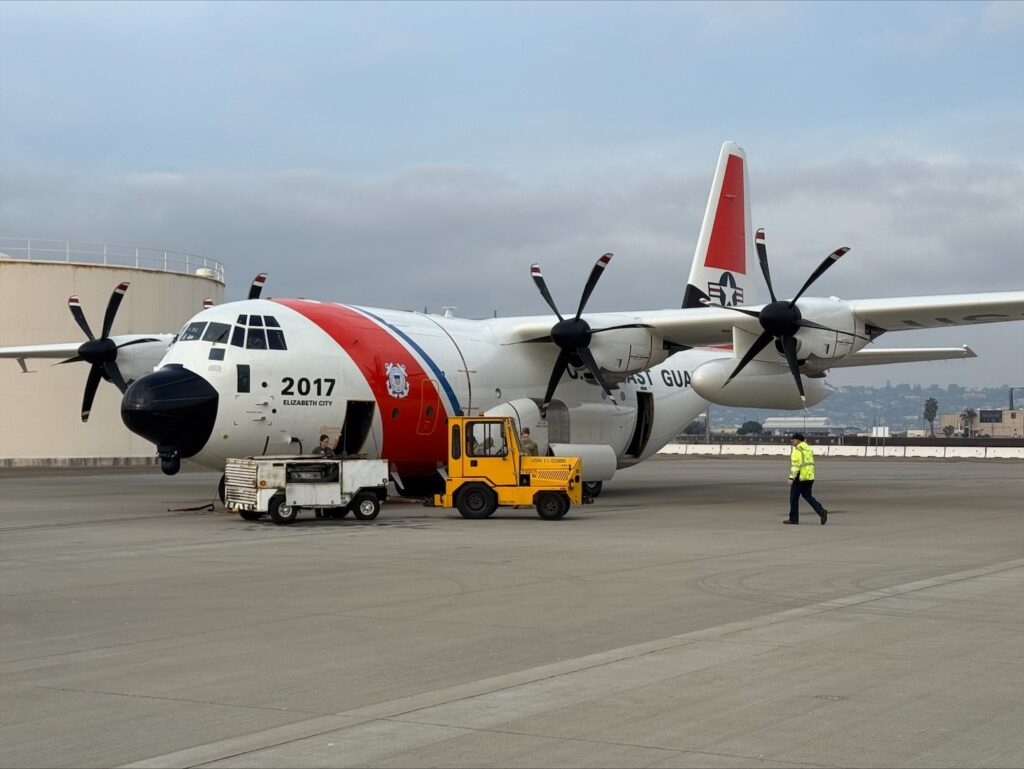
Coast Guard Continues Alien Expulsion Flight Operations Between California and Texas 

A U.S. Coast Guard C-130 takes-off in support of alien expulsion flight operations between California and Texas.

From U.S. Coast Guard Headquarters, Jan. 28, 2025 

SAN DIEGO – Jan. 28, 2025, the Coast Guard conducted Alien Expulsion Flight Operations between California and Texas, in coordination with U.S. Customs and Border Protection.  

In accordance with the President’s Executive Orders, these flights continue the Coast Guard’s actions to enforce the immigration laws of our country. Through these ongoing operations, and in close cooperation with our Department of Homeland Security and Department of Defense teammates, the Coast Guard is detecting, deterring, and interdicting aliens, drug smugglers, and individuals intent on terrorism or other hostile activity before they reach our border.  

Led by the Eleventh Coast Guard District in California, the Coast Guard is coordinating the actions of multiple units in support of this operation. The Coast Guard is surging assets and personnel from around the nation – including Air Stations Elizabeth City, Kodiak, Sacramento, San Diego, and Hawaii – to support this Department of Homeland Security-led operation.  

The Coast Guard’s current role is to assist with the national transport of aliens to designated locations in Texas and California, where the Department of Defense will transport the aliens internationally. 


Maxim Watermakers Completes Testing of First U.S. Navy Closed Loop Cooling System 

From Fairbanks Morse Defense, Jan. 28, 2025 

Maxim Watermakers, a business unit of Fairbanks Morse Defense, has successfully completed qualification testing for a first-of-its-kind submarine maintenance Closed Loop Cooling System (CLCS) for Pearl Harbor Naval Shipyard and Intermediate Maintenance Facility (PHNS and IMF). This qualification is the first CLCS implementation for the U.S. Navy and Maxim’s initial application of this groundbreaking technology at naval facilities. 

The testing, funded by the Maritime Sustainment Technology and Innovation Consortium (MSTIC), highlights Maxim’s engineering expertise and commitment to advancing U.S. Navy operations. 

The innovative CLCS is designed to support submarines during dry dock maintenance by enhancing operational efficiency, reducing corrosion, optimizing maintenance schedules, and ensuring long-term system reliability. These advantages are particularly critical for naval vessels operating in environmentally sensitive regions or areas with stringent water resource management regulations. 

The system features a ship service skid to circulate cooling water through the submarine and a chilled water skid to circulate water through high-capacity air-cooled chillers. 

Maxim’s full-scale testing flawlessly executed 14 separate evaluations, proving the system meets U.S. Navy requirements. The rigorous, four-day testing process verified normal operations, emergency responses, test modes, and essential filling and draining functionalities. 

“This milestone reflects the engineering excellence of Maxim Watermakers and Fairbanks Morse Defense’s dedication to innovation in naval systems,” said Monica Rogers of Maxim Watermakers.“By leveraging MSTIC’s support alongside our technical capabilities, we deliver state-of-the-art solutions that address evolving client needs and enhance critical naval operations worldwide.” 

Fairbanks Morse Defense and Maxim Watermakers continue to lead the development of advanced water treatment technologies. Through ongoing innovation, the companies aim to deliver reliable, high-performance water systems that address critical challenges and support their customers’ operational needs. 


U.S. Coast Guard Awards Verizon Business $66M Enterprise Infrastructure Solutions Task Order 

From Verizon, Jan. 29, 2025 

WASHINGTON, D.C. – The U.S. Coast Guard has awarded Verizon Business an 8-year Enterprise Infrastructure Solutions (EIS) task order worth up to $66 million over the life of the contract. Under this agreement, Verizon will provide Wi-Fi, phone, data, and other services to the U.S. Coast Guard’s C5I (Command, Control, Communication, Computer, Cyber, and Intelligence) office. 

Verizon will be partnering with the Coast Guard to phase out end-of-life TDM services, implementing solutions like a cellular-based POTS replacement for essential voice communications. This includes offering Contact Center as a Service (CCaaS), delivering secure IL-4 (Impact Level 4) software-based solutions for Coast Guard call centers. 

“The U.S. Coast Guard task order is yet another example of the strong relationship Verizon enjoys with a number of federal agencies, to include the Department of Homeland Security (DHS), the Department of Defense (DoD), the Department of Veterans Affairs and more” said Michael Adams, associate vice president for federal civilian services at Verizon. “The trust placed in Verizon by the federal government is indicative of the reliability and security of our enterprise solutions.” 

While the base task order spans 12 months, it may extend up to an eight-year period of performance. Verizon will deliver EIS services, including internet protocol service (IPS), broadband internet service (BIS), internet protocol voice service (IPVS), toll-free service, managed network services, managed security services, contact center services, and related equipment. 

Verizon has earned the trust of the U.S. Armed Forces through a number of contract wins, including a 10-year, $2.67 billion multiple award contract with the U.S. Navy, a $1 billion DoD engagement to overhaul the Pentagon’s network, and a $78 million digital modernization contract with Naval District Washington. 


Airbus and U.S. Coast Guard Sign Support Agreement for MH-65 Fleet 

From Airbus Helicopters 

GRAND PRAIRIE, Texas, 29 January 2025 – Airbus Helicopters has signed a Memorandum of Understanding (MOU) with the United States Coast Guard (USCG) to continue providing support for the service’s fleet of MH-65 Dolphin helicopters through 2037. The agreement reaffirms Airbus Helicopters’ commitment to ensuring the mission readiness of the USCG’s fleet as it performs critical search and rescue, law enforcement, and disaster response missions. 
 
Under the terms of the MOU, Airbus Helicopters will deliver enhanced maintenance, spare parts, and technical support to optimize the performance and availability of the MH-65 fleet. The agreement also includes provisions for fleet modernization and engineering services to extend the operational life of the aircraft. 
 
“The U.S. Coast Guard’s MH-65 helicopters are at the forefront of safeguarding our nation’s coastlines and saving lives,” said Bart Reijnen, President of Airbus Helicopters in the U.S. and Head of the North America region. “We are honored to continue working with the Coast Guard to ensure their fleet remains mission-ready for years to come. This agreement demonstrates our shared commitment to safety, reliability, and operational excellence.” 
 
The MH-65 Dolphin has been the backbone of the Coast Guard’s aviation fleet for more than four decades. With this new MOU, Airbus Helicopters and the USCG aim to maintain the fleet’s high level of operational capability, enabling continued support for critical missions across the country. 
 
Airbus Helicopters has a long-standing partnership with the USCG, providing tailored solutions to meet the service’s dynamic operational demands. The extended collaboration will build on this history, leveraging Airbus’ global support network and industry-leading expertise.


Lockheed Martin Offers Mk70 Launcher to Increase Lethality of LCS

An SM-6 missile is launched from a containerized launcher on board USS Savannah (LCS 28) on Oct. 24, 2023. (U.S. Navy photo) 

By Richard R. Burgess, Senior Editor 

ARLINGTON, Va. — Lockheed Martin has adapted its Mk41 vertical missile launcher into a scalable containerized system than can be deployed on U.S. Navy ships, including the littoral combat ships (LCS) and non-traditional platforms of opportunity to increase their lethality with mid-range precision strike and air defense capabilities. company officials said. 

The system, called the Mk70 Payload Delivery System, is a 40-foot-long ISO container in which four VLS cells can be fitted. The Mk70 system, designed for and deployed with the U.S. Army in a land-based configuration, can launch any type of missile certified for the Mk41, including the Tomahawk cruise missile, the various Standard surface-to-air missiles, the antisubmarine rocket, and the Evolved SeaSparrow missile. The Mk70 container is transportable on a C-17 cargo aircraft.   

Ed Dobeck, director for launching systems at Lockheed Martin, told Seapower that the Mk70 was developed two years ago in concert with the Defense Department’s Strategic Capabilities Office to provide the Army with the ability to deploy and fire the Raytheon-built SM-6 Standard missile. 

The same container can be secured on the flight deck or helicopter landing pad of a Navy ship using helicopter tie-down chains, occupying 400 square feet of a flight deck. Power from the ship’s electrical system can supply 400 volts to the Mk70. No modifications are required to the ship itself. The container can be installed within hours with a pier-side crane. A command shelter with virtual Aegis and Tomahawk control systems controls the launch of the missiles. 

The flight deck of the Freedom-class LCS can accommodate three Mk70 containers, while the Independence-class LCS can accommodate four containers, Dobeck said. With one or more containers installed, the ships are unable to launch or land helicopters. The missile tubes can be reloaded horizontally, an advantage over the ship-installed Mk41’s need for vertical re-load by cranes.  

Lockheed Martin has demonstrated containerized launch of SM-6 missiles from two Navy ships. An SM-6 missile was fired from the USS Savannah (LCS 28) in October 2023 and before that another was fired from the Overlord medium unmanned surface vessel Ranger during an exercise. 

Dobeck said that the Navy has shown great interest in the Mk70 system, which already has been delivered to the Army. Two full batteries — totaling eight missile cells — have been delivered to the Army and two have been delivered to other customers. The Army has deployed the Mk70 to the Philippines


Operation Southern Spear: Latest Development in Operationalizing Robotic and Autonomous Systems 

Operation Southern Spear will deploy unmanned air and surface vessels to help determine combinations of unmanned vehicles and manned forces to provide coordinated maritime domain awareness and conduct counternarcotics operations. 

From U.S. 4th Fleet, Jan. 28, 2025

MAYPORT, Fla.  –  U.S. Naval Forces Southern Command/U.S. 4th Fleet is advancing the Navy’s Hybrid Fleet Campaign through Operation Southern Spear, which will start later this month in U.S. Southern Command Area of Responsibility (USSOUTHCOM AOR) and at U.S. 4th Fleet Headquarters at Naval Station Mayport. 
  
“Southern Spear will operationalize a heterogeneous mix of Robotic and Autonomous Systems (RAS) to support the detection and monitoring of illicit trafficking while learning lessons for other theaters,” said Cmdr. Foster Edwards, 4th Fleet’s Hybrid Fleet Director. “Southern Spear will continue our (4th Fleet’s) move away from short-duration experimentation into long-duration operations that will help develop critical techniques and procedures in integrating RAS into the maritime environment.” 
  
Specifically, Operation Southern Spear will deploy long-dwell robotic surface vessels, small robotic interceptor boats, and vertical take-off and landing robotic air vessels to the USSOUTHCOM AOR. 4th Fleet will operationalize these unmanned systems through integration with U.S. Coast Guard cutters at sea and operations centers at 4th Fleet and Joint Interagency Task Force South. Southern Spear’s results will help determine combinations of unmanned vehicles and manned forces needed to provide coordinated maritime domain awareness and conduct counternarcotics operations. 
  
U.S. 4th Fleet is conducting Operation Southern Spear in support of our Navy’s Project 33 targets to operationalize RAS. Using RAS to increase presence in, and awareness of, strategically and economically important maritime regions will help decision-making, strengthen sovereignty, and facilitate regional cooperation. 
  
“Operation Southern Spear is the next step in our Hybrid Fleet Campaign,” said Rear Adm. Carlos Sardiello, Commander, U.S. Naval Forces Southern Command/U.S. Fourth Fleet. “We look forward to the results of Southern Spear. Hybrid Fleet operations increase our collaboration with partners in the region while furthering the Navy’s tactics, techniques, procedures, and processes.” 
  
U.S. Naval Forces Southern Command/U.S. 4th Fleet is the trusted maritime partner for Caribbean, Central and South America maritime forces leading to improved unity, security and stability. 


Secretary Hegseth’s Message to the Force

From U.S. Department of Defense Public Affairs, Jan. 25, 2025 

ARLINGTON, Va. — The following message to the U.S. armed forces was released by the new Defense Secretary, Pete Hegseth:   

“It is the privilege of a lifetime to lead the warriors of the Department of Defense, under the leadership of our Commander in Chief Donald J. Trump. We will put America First, and we will never back down. 
  
The President gave us a clear mission: achieve Peace through Strength. We will do this in three ways — by restoring the warrior ethos, rebuilding our military, and reestablishing deterrence.    
  
o    We will revive the warrior ethos and restore trust in our military.  We are American warriors. We will defend our country.  Our standards will be high, uncompromising, and clear. The strength of our military is our unity and our shared purpose.   
  
o    We will rebuild our military by matching threats to capabilities. This means reviving our defense industrial base, reforming our acquisition process, passing a financial audit, and rapidly fielding emerging technologies. We will remain the strongest and most lethal force in the world.  
  
o    We will reestablish deterrence by defending our homeland — on the ground and in the sky. We will work with allies and partners to deter aggression in the Indo-Pacific by Communist China, as well as supporting the President’s priority to end wars responsibly and reorient to key threats. We will stand by our allies — and our enemies are on notice. 
  
All of this will be done with a focus on lethality, meritocracy, accountability, standards, and readiness. 
  
I have committed my life to warfighters and their families.  Just as my fellow soldiers had my back on the battlefield, know that I will always have your back. We serve together at a dangerous time.  Our enemies will neither rest nor relent.  And neither will we.  We will stand shoulder to shoulder to meet the urgency of this moment.     
  
Like each of you, I love my country and swore an oath to defend the Constitution. We will do that each and every day, as one team.  Together we will accomplish the President’s mission to deter war, and if necessary, defeat and destroy our enemies. Godspeed!” 


HII Closes on Asset Acquisition to Expand Shipbuilding Capacity  

Operations Are Underway at Newport News Shipbuilding Charleston Operations 

From HII 

GOOSE CREEK, S.C., Jan. 27, 2025 (GLOBE NEWSWIRE) — HII (NYSE: HII) announced today it has closed on its acquisition of an advanced manufacturing facility and assets and begun work at its Newport News Shipbuilding (NNS) — Charleston Operations site in South Carolina. 

“HII is committed to going where the labor is to increase shipbuilding capacity and increase throughput for our national security customers,” HII President and CEO Chris Kastner said. “This lets us efficiently add trained talent and state-of-the-art manufacturing capabilities to the urgent job of building ships, making it a unique opportunity to immediately accelerate throughput at Newport News Shipbuilding in support of the Navy and AUKUS.” 

HII announced last month its intent to acquire the facility and associated assets. Since then, more than 99% of the legacy workforce have accepted offers to continue to work on site, supporting the construction of nuclear-powered submarine modules and aircraft carrier units for U.S. Navy programs. Working closely with the South Carolina state and regional leadership, HII plans to create hundreds of additional jobs to support the increased demand and growth at the Charleston facility. 

Photos accompanying this release are available at: https://hii.com/news/hii-closes-on-asset-acquisition-to-expand-shipbuilding-capacity/

In addition to existing trained talent, HII’s acquisition also provides: 

Advanced production facilities with state-of-the-art manufacturing equipment, tooling and infrastructure used to fabricate complex metal modules and structures. 

Facility location on 45-acres with more than 480,000 square feet of manufacturing space. 

Access to barge and rail transportation. 

Access in nearby Charleston and surrounding region to rapidly growing shipbuilding ecosystem and capacity to expand a highly skilled maritime trades workforce. 

“This is great news for the South Carolina economy. This investment will allow us to expand our manufacturing footprint more aggressively in the shipbuilding industry,” U.S. Sen. Lindsey Graham, R-S.C., said. “If you can drive it, fly it, shoot it or float it, South Carolina makes it.” 

“The expansion of our nation’s largest military shipbuilder in South Carolina underscores the pivotal role our state plays in strengthening America’s national security,” U.S. Sen. Tim Scott, R-S.C., said. “The dedicated shipbuilders in the Charleston area are part of a highly skilled workforce that will propel our nation forward. This innovation and modernization in our defense industrial base will create jobs and draw resources to our state’s already robust Navy presence.” 


Coast Guard Conducts Alien Expulsion Flight Operations Between California and Texas 

U.S. Coast Guard conducts Alien Expulsion Flight Operations in coordination with U.S. Customs and Border Patrol. (U.S. Coast Guard)

From Coast Guard Headquarters Public Affairs, Jan. 25, 2025 

SAN DIEGO – Today, the Coast Guard conducted several Alien Expulsion Flight Operations between California and Texas, in coordination with U.S. Customs and Border Protection. 

“In accordance with the President’s Executive Orders, the Coast Guard continues to surge assets and leverage its unique capabilities to protect America’s borders, territorial integrity, and sovereignty,” said Adm. Kevin Lunday, the Coast Guard’s Acting Commandant. “Today’s operation exemplifies our coordination with our Department of Homeland Security and Department of Defense teammates, through which we are detecting, deterring, and interdicting aliens, drug smuggling, and other terrorist or hostile activity before it reaches our border.” 

The Coast Guard is coordinating the operations of multiple Coast Guard units in support of this operation. Led by the Eleventh Coast Guard District in California, the Service is surging assets and personnel from around the nation to support the Department of Homeland Security-led operation. 

The Coast Guard’s current role is to assist with the national transport of aliens to designated locations in Texas and California, where the Department of Defense will transport the aliens internationally. 


3d Marine Littoral Regiment Fires the Marine Air Defense Integrated System (MADIS)

From 3d Marine Littoral Regiment, Jan. 25, 2025 

POHAKULOA TRAINING AREA, Hawaii – U.S. Marines with 3d Marine Littoral Regiment, 3d Marine Division, conducted a counter unmanned aerial system live-fire training event utilizing the Marine Air Defense Integrated System – a ground-based air defense capability, on January 25, 2025, to commemorate the addition of the MADIS and the months of operational testing and evaluation required to field this new weapon system. 

Lt. Col. Matthew E. Sladek, Commanding Officer, 3d Littoral Anti-Air Battalion, stated, “The fielding of the Marine Air Defense Integrated System to the Marines of 3d Littoral Anti-Air Battalion is the culmination of years of tireless work from government and industry teammates across the country. The delivery of the critical capabilities the system provides to 3d Littoral Anti-Air Battalion and by extension 3d Marine Littoral Regiment, makes the stand-in-force more survivable and lethal in the conduct of contested littoral operations against emerging aerial threats. As a career Low Altitude Air Defender Marine, it is truly amazing to have watched the Marine Air Defense Integrated System transition from an idea to a capability and with it, the modernization of Marine Corps short range air defense capabilities. Now the real work begins.” 

The MADIS is operated by the Marines of 3d LAAB’s Ground-Based Air Defense Battery. Giving low-altitude air defense Marines the ability to detect, track, identify, and engage various unmanned aerial systems with various missiles, air-to-air launchers, chain guns, machine guns, and simulated munitions – all of which are part of the MADIS weapon system.  

The MADIS live-fire event marked the first time this weapon system has been fired on a Hawaiian island since it’s fielding in December, attendees were able ask questions to commanders and subject matter experts about the fielding process and the operational value of the system. Training with the MADIS reinforces the Marine Corps’ threat-informed, concept-based approach to Force Design and modernization, and 3d MLR’s support to allies and partners in the Indo-Pacific region.   

Col. John G. Lehane, Commanding Officer, 3d MLR, emphasized the importance of the MADIS capability, stating, “Fielding of MADIS to the 3d Marine Littoral Regiment enhances our collective lethality, and provides remarkable tactical flexibility given them system’s reach, range and mobility. We are really excited to have this capability added to our already robust ability to coordinate air and missile defense actions, as it adds an organic layer to defeat a would-be adversary’s ability to attack our formations.” 

The addition of the MADIS – a highly mobile, short-range, surface-to-air defense weapon – provides 3d MLR an enhanced air and missile defense capability. A key component of the Marine Corps’ Force Design initiative, the mobile MADIS weapons system increases 3d MLR’s tactical flexibility by extending the range of the airspace which 3d MLR is able to sense and defend without support from the Joint Force. 

3d Marine Littoral Regiment is a dedicated U.S. Marine Corps unit specializing in amphibious and littoral warfare operations. Stationed on Oahu, Hawaii, and deployed throughout the Indo-Pacific region, 3d MLR is committed to promoting regional security and stability through strategic partnerships and collaborative efforts with partner nations and Allies.