USS Dwight D. Eisenhower Transits to Norfolk Naval Shipyard for a Planned Incremental Availability Following Historic Deployment
USS Dwight D. Eisenhower (CVN 69) gets underway from Naval Station Norfolk to begin a scheduled PIA at Norfolk Naval Shipyard. (MCSN Evan Antonisse)
From U.S. Fleet Forces Command, Jan. 15, 2025
PORTSMOUTH, Virginia — Dwight D. Eisenhower departed on its most recent deployment in Oct. 2023 and returned to Naval Station Norfolk in July 2024 having executed sustained operations in the U.S. 5th Fleet area of operations. As the ship transitions to its maintenance phase, the focus shifts to ensuring its long-term mission readiness and technical upgrades to maintain its edge as a forward-deployed force and extend its service life.
USS Dwight D. Eisenhower (CVN 69) gets underway from Naval Station Norfolk to begin a scheduled PIA at Norfolk Naval Shipyard. (MCSN Evan Antonisse)
“Our Sailors have demonstrated extraordinary resilience and operational excellence during our recent deployment,” said Capt. Chris Hill, commanding officer, Dwight D. Eisenhower. “We look forward to working with America’s finest shipyard workers to address necessary repairs and prepare the ship for a few more deployments.”
PIA 2025 will include comprehensive work on the carrier’s propulsion systems, crew habitability, combat systems, and aviation support capabilities. In addition to routine maintenance, upgrades to critical systems will ensure the carrier remains mission-ready and extends its operational effectiveness.
A PIA is part of the maintenance phase of the Navy’s Optimized Fleet Response Plan (OFRP). OFRP is a plan that helps the Navy balance operational requirements with time for training and maintenance, enabling readiness and ensuring deployability with the right skills and equipment.
“This maintenance period is a crucial opportunity to reset and upgrade the IKE after an exceptional deployment,” said Lt. Cmdr. Nicholas Meadors, ship’s maintenance manager. “Our team, alongside the skilled workforce at NNSY, will ensure that IKE is prepared to meet the Navy’s evolving mission requirements. This effort reflects a strong partnership and a shared commitment to excellence.”
The maintenance period also marks a significant opportunity for the crew to focus on professional development, family reintegration, and personal readiness after a demanding deployment.
“While our ship undergoes maintenance, our Sailors will continue to exemplify the same dedication they’ve shown throughout the deployment,” added Hill. “We will emerge from this phase stronger, ready, and more capable than ever before.”
For more information about USS Dwight D. Eisenhower, head to Facebook (/TheCVN69) or Instagram (@TheCVN69). For inquiries, email [email protected].
Groundbreaking Ceremony Launches Construction of Nuclear Regional Maintenance Facility at Kings Bay
From left: Joseph Singer, production facilities and equipment manager at Norfolk Naval Shipyard; Sherri Eriksen, project manager for AECOM; Capt. Juan Hines, commanding officer of Strategic Weapons Facility, Atlantic (SWFLANT); Capt. Miguel Dieguez, commanding officer of Naval Facilities Engineering Systems Command (NAVFAC) Southeast; Jeremy Pipkin, vice president of BL Harbert International; Brian Logan, deputy director of the Nuclear Regional Maintenance Department (NRMD); and Capt. Michael Paisant, commanding officer of the TRIDENT Refit Facility at Kings Bay, break ground with ceremonial shovels during the groundbreaking ceremony for the new Nuclear Regional Maintenance facility at Naval Submarine Base Kings Bay, Georgia. The facility will enhance maintenance capabilities for Trident-equipped submarines. (U.S. Navy photo by Keith Boydston)
From Jeffrey Hamlin, Jan. 16, 2025
NAVAL SUBMARINE BASE KINGS BAY, Ga. — Naval Facilities Engineering Systems Command (NAVFAC) Southeast hosted a groundbreaking ceremony Tuesday for the construction of a new facility for the Nuclear Regional Maintenance Department (NRMD) at Naval Submarine Base (NSB) Kings Bay, Georgia. The facility will serve as a centralized, state-of-the-art hub for NRMD, enabling critical maintenance and repair operations for Trident-equipped submarines.
The event brought together senior Navy leaders, local officials, and project stakeholders to celebrate the milestone.
“This groundbreaking represents NAVFAC Southeast’s commitment to providing state-of-the-art facilities that directly enhance the fleet’s operational readiness,” said Capt. Miguel Dieguez, NAVFAC Southeast commanding officer. “This new Nuclear Regional Maintenance facility will consolidate resources, improve collaboration, and ensure that our submarine force has the maintenance infrastructure it needs to remain at the forefront of our national defense.”
The NRMD plays a vital role in supporting the operational readiness of the U.S. Atlantic Fleet’s ballistic missile submarine force. It provides intermediate-level repair and maintenance of propulsion plant systems and components, ensuring submarines remain mission-ready for both rapid 28-day overhauls and extended 270-day major maintenance periods.
Currently, NRMD operations are dispersed across NSB Kings Bay in temporary trailers, CONEX boxes, and facilities shared with the TRIDENT Refit Facility at Kings Bay (TRF-KB). This project will consolidate these functions into a single, purpose-built structure, enhancing communication and collaboration between engineers and mechanics on the waterfront.
“There has been a tremendous amount of effort to get us to this point, and from our perspective, it has been a collaborative and satisfying experience,” said Brian Logan, deputy director, Naval Regional Maintenance Department, Kings Bay. “The final design turned out to be spectacular…and today it is satisfying to take pause…and reflect on what all has been accomplished and what is coming.”
The new low-rise facility will feature a reinforced concrete slab-on-grade with a steel and precast concrete superstructure supported by a pile foundation. The building will include nuclear repair shops, ship services support areas, applied instruction spaces, and a parking facility accommodating up to 300 employees.
The contract for this $136 million project was awarded to BL Harbert International on Dec. 13, 2023.
“BL Harbert is profoundly grateful and humbled by the opportunity to contribute our construction expertise to execute this project with the Navy,” said Jeremy Pipkin, senior vice president at BL Harbert International. “Over the next few years, we look forward to integrating into the Kings Bay community as we work diligently to deliver a facility that embodies the highest standards of craftsmanship and reflects the immense importance of the work that will occur within its walls.”
The company will oversee the design and construction of the facility, which is scheduled for completion by Dec. 15, 2028.
The Nuclear Regional Maintenance facility at Kings Bay underscores the Navy’s commitment to maintaining its strategic deterrence capabilities by providing cutting-edge infrastructure to support its submarine fleet.
NAVFAC Southeast, headquartered in Jacksonville, Florida, provides planning, design, construction, contracting, environmental services, public works, real estate, and facility maintenance for the U.S. Navy, Marine Corps, Army, Air Force, Space Force, and other federal agencies across the Southeast. Its area of responsibility covers installations from Charleston, South Carolina, to Corpus Christi, Texas, and extends south to Guantanamo Bay, Cuba.
SECNAV Del Toro Names Future Virginia-class Submarines SSN 814, SSN 815, and SSN 816
From SECNAV Public Affairs, Jan. 13, 2025
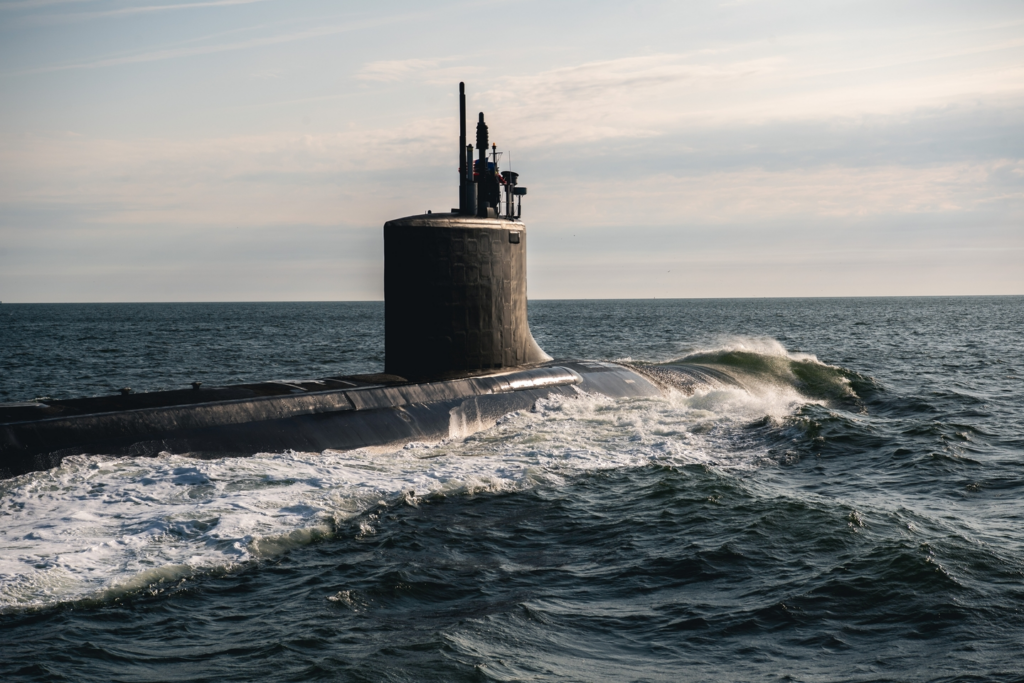
WASHINGTON – Secretary of the Navy Carlos Del Toro announced the names of three Virginia-class submarines to be the future USS Potomac (SSN 814), the future USS Norfolk (SSN 815), and the future USS Brooklyn (SSN 816)
Secretary Del Toro detailed the announcement Jan. 13 during video remarks directed to the Department of Navy’s (DoN) submarine community.
“Today’s submarine force is the most capable force in the world and in the history of U.S. Navy,” said Secretary Del Toro. “It is my honor and privilege to announce the names of the future submarines which will protect us from deep below the ocean’s waves.”
Secretary Del Toro previously named USS Long Island (SSN 809), USS San Francisco (SSN 810), USS Miami (SSN 811), USS Baltimore (SSN 812), and USS Atlanta (SSN 813).
The naming of the future USS Potomac (SSN 814) honors a river on the Eastern seaboard of the United States and six prior ships so named. Rising in West Virginia and emptying into Chesapeake Bay, the Potomac’s banks are home to Washington, District of Columbia, and running through three states.
The first Potomac was a frigate laid down in the Washington Navy Yard in 1819. She served in the Pacific, the Mexican-American War, and the Civil War. The second Potomac was part of the “Stone Fleet” to block the entrances to Confederate harbors. The third Potomac (AT-50) was acquired for service in the Spanish-American War, later serving as a fleet and submarine tender, as well as supporting Marine Corps operations in the West Indies. The fourth Potomac (AG-125) was launched as the Coast Guard ship Electra, but taken into Navy service in 1935 to serve as President Franklin Delano Roosevelt’s yacht. She is preserved as a museum ship in Oakland, California. The fifth Potomac (T-AO-150) was wrecked by a fatal fire at a refueling pier in 1961, after which the forward part of the ship was declared a total loss. Rebuilt, she served in the Military Sea Transportation Service as Shenandoah. She became the sixth Potomac (T-AO-181) in 1976 when accepted back into Navy service as part of Military Sealift Command. In 1990 she joined the Maritime Administration’s Maritime Prepositioning Force. She took part in the Persian Gulf War, provided humanitarian relief during the Rwandan Genocide, supported military operations in Bosnia, and assisted Hurricane Katrina relief efforts.
The future USS Norfolk (SSN 815) honors the city of Norfolk, VA (2023 pop. 230,930) and three previous U.S. Navy vessels: a brigantine (1798–1800); destroyer leader DL-1 (1953–1970); and Los Angeles-Class nuclear attack submarine SSN-714 (1983–2015). The first Norfolk undertook convoy duty during the Quasi-War with France to protect American commerce. The second Norfolk served as an antisubmarine hunter-killer ship in the Atlantic. The third and most recent Norfolk spent her time in the silent service conducting operations in the Atlantic during both the Cold War and the Global War on Terror.
Founded in 1682, the city grew into a major center of trade and shipbuilding, with Gosport Shipyard (present-day Norfolk Naval Shipyard) in particular playing a critical role in both the city and the Navy’s development. The shipyard completed construction of Chesapeake, one of the original six frigates, in 1799. The Federal Government subsequently purchased the shipyard in 1801. From this point on, the Navy’s presence would only continue to grow, leading to the eventual establishment of Naval Operating Base Hampton Roads (present-day Naval Station Norfolk) in 1917. As of 2024, Norfolk and the surrounding area hosts over 82,000 active-duty military personnel and multiple installations including Naval Station Norfolk, which is now the world’s largest naval station, and Naval Support Activity Hampton Roads, which serves as headquarters for U.S. Fleet Forces and NATO Allied Command Transformation.
The future USS Brooklyn (SSN 816) is named to honor the New York City borough of Brooklyn (2020 pop. 2,736,074) and three previous Navy vessels: a screw sloop of war (1859–1889), armored cruiser CA-3 (1896–1921), and light cruiser CL-40 (1937–1947). The first Brooklyn participated in the U.S. Navy blockade of the Confederacy and fought at both the Battle of Mobile Bay and Fort Fisher. CA-3 also proved her mettle in battle, playing an important role at the Battle of Santiago de Cuba in 1898 during the Spanish-American War. Finally, CL-40 participated in antisubmarine warfare operations in the Caribbean during WWII, as well as the Allied invasions of North Africa, Sicily, Anzio, and southern France, earning four battle stars in the process.
Founded by Dutch settlers in the 17th century on the western edge of Long Island on lands inhabited by the Lenape tribe, Brooklyn was incorporated as a city in 1834 and subsequently consolidated into New York City in 1898 as one of its five boroughs. Critical to Brookyln’s growth and development was the Brooklyn Navy Yard, which was established in 1801. During its 165-year history, the navy yard constructed some of the Navy’s most famous vessels, including second-class battleship Maine, battleship Arizona (Battleship No. 39), and battleship Missouri (BB-63). Although it closed in 1966, the Navy Yard continues to serve as an industrial park, playing a vital role in Brookyln’s ongoing economic development.
Along with the ship names, Del Toro has also selected the sponsors for the three newly named submarines. The sponsor plays an important role in the life of each ship and is typically selected because of a relationship to the namesake or to the ship’s current mission. In their role as the ship’s sponsor, they will represent a lifelong relationship with the ship and crew. The following individuals were identified as sponsors:
Lisa Collis, spouse of Sen. Warner, will sponsor the future USS Potomac (SSN 814).
Ann Holton, spouse of Sen. Kaine, will sponsor the future USS Norfolk (SSN 815).
Dorothy McAuliffe, spouse of former Virginia Gov. McAuliffe, will sponsor the future USS Brooklyn (SSN 816).
Attack submarines are designed to seek and destroy enemy submarines and surface ships; project power ashore with Tomahawk cruise missiles and Special Operation Forces (SOF); carry out Intelligence, Surveillance and Reconnaissance (ISR) missions; support battle group operations; and engage in mine warfare.
USS Higgins, HMCS Ottawa Conduct Bilateral Operations
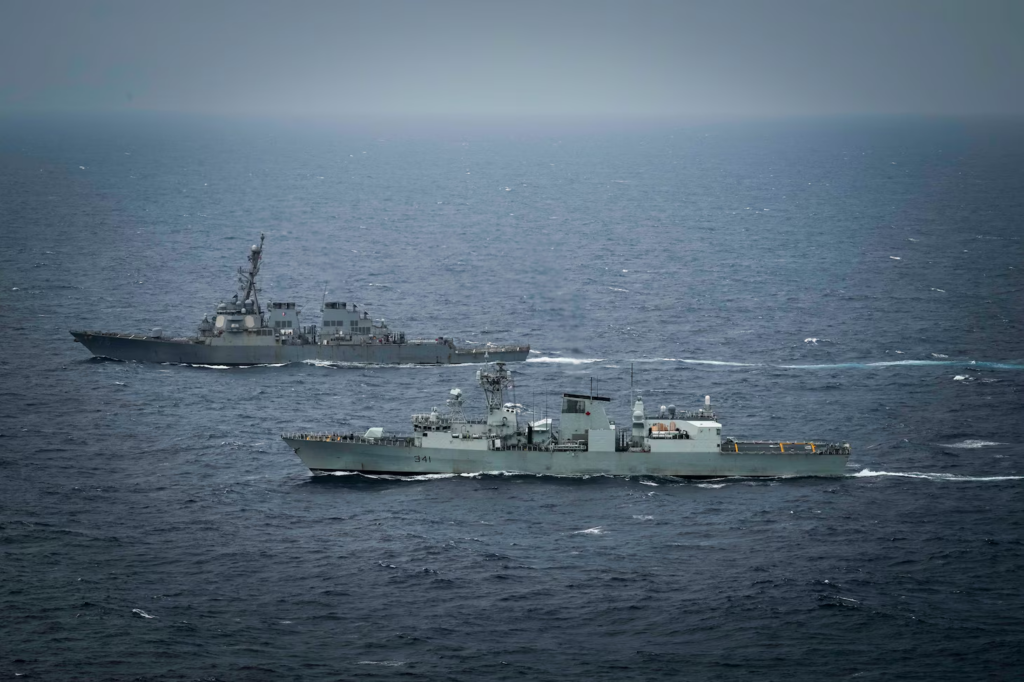
USS Higgins (DDG76) and HMCS Ottawa conduct maneuvers in international waters during exercise Noble Wolverine in the South China Sea on 11 January 2025. (Photo by Sailor 3rd Class Jacob Saunders/ Canadian Armed Forces).
From Commander, Task Force 71/Destroyer Squadron 15 Public Affairs, Jan. 15, 2025
USS Higgins (DDG76) and HMCS Ottawa conduct maneuvers in international waters during exercise Noble Wolverine in the South China Sea on 11 January 2025. Photo Credit: Sailor 3rd Class Jacob Saunders, Canadian Armed Forces Photo.
The U.S. Navy (USN) and Royal Canadian Navy (RCN) joined forces to conduct bilateral operations in support of a free and open Indo-Pacific in the South China Sea, Jan. 8-11.
The bilateral operations included the U.S. Navy Arleigh Burke-class guided-missile destroyer USS Higgins (DDG 76) and the Royal Canadian Navy Halifax-class frigate HMCS Ottawa (FFH 341).
“Operating alongside our Royal Navy partners shows a unified front,” said Capt. Justin Harts, Commander, Destroyer Squadron 15. “We are committed to strengthening and demonstrating interoperability with our allies.”
During the operations, Higgins and Ottawa conducted maritime communications training and dynamic coordinated maneuvering.
“Exercise Noble Wolverine was, for our team, another successful integration between two highly trained and capable navies. The anti-submarine warfare, communications exercises and flying operations were seamless as usual, and occurred in the international waters of an area of the world where undisrupted movement of maritime trade is critical to the region and greater global community,” said Cmdr. Adriano Lozer, commanding officer of HMCS Ottawa. “This activity served once again to demonstrate how strong historic partners in defence at home and around the world, with enduring relationships that promote international law in a free and open Indo Pacific, can interchangeably play an active role in contributing to peace and security”
The U.S. Navy regularly operates alongside our allies in the Indo-Pacific region as a demonstration of our shared commitment to the rules-based international order. Bilateral operations such as this one provide valuable opportunities to train, exercise and develop tactical interoperability across allied navies in the Indo-Pacific.
DESRON 15 is the Navy’s largest destroyer squadron and the U.S. 7th Fleet’s principal surface force. It is forward deployed to the U.S. 7th Fleet area of operations in support of security and stability in the Indo-Pacific.
U.S. 7th Fleet is the U.S. Navy’s largest forward-deployed numbered fleet, and routinely interacts and operates with allies and partners in preserving a free and open Indo-Pacific region.
C-130 Hercules 70 Years Strong and Growing
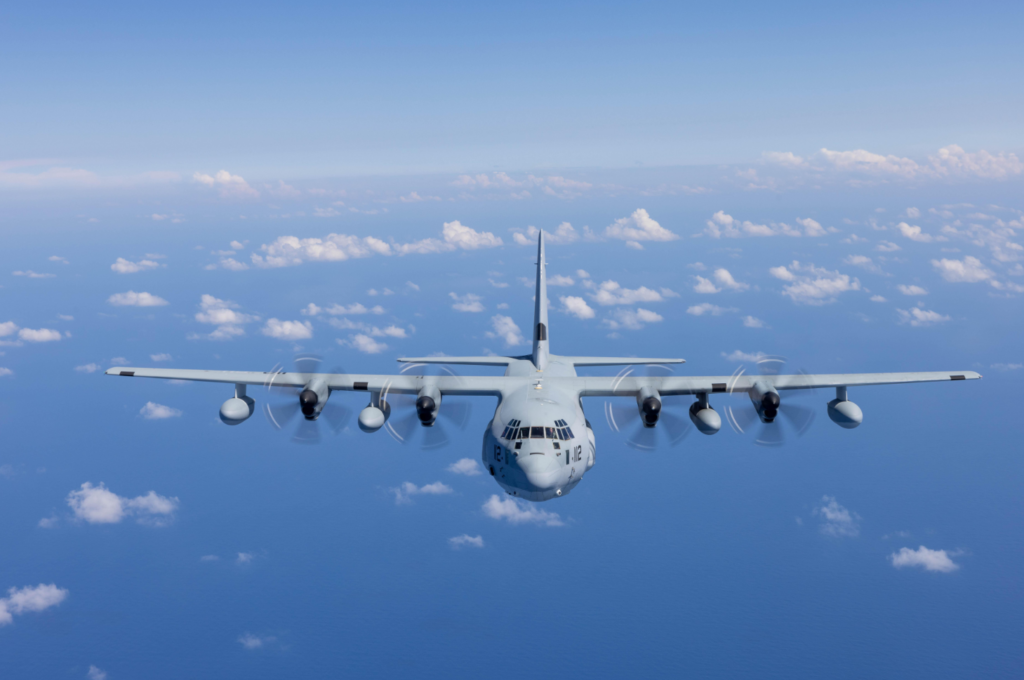
A KC-130J Super Hercules, assigned to Marine Aerial Refueler Transport Squadron 252, 2nd Marine Aircraft Wing, flies during a training exercise. The Hercules is celebrating 70 years and counting since its inception in 1954. Today, the C-130 Hercules is used in over 70 countries with more than a million flight hours and growing. (U.S. Marine Corps photo)
From Naval Air Systems Command, Jan. 14, 2025
PATUXENT RIVER, Md.–The ever-enduring C-130 Hercules celebrated 70 years of unwavering service last year. Since its inception in 1954, the Hercules continues to be used in over 70 countries with more than a million flight hours and growing.
Seven decades ago, the C-130 had an original usage as a medium cargo plane able to land in short, confined runways. As the mission and needs of the fleet changed, the aircraft moved into providing tactical airlift, humanitarian aid, air support, and various mission support across the globe.
The C-130 has had over 70 variants, 15 of which are actively being produced by Lockheed Martin today, and is distinguished by having the longest continuous military aircraft production run in history. From aerial command centers to weather observation and, occasionally, an aerial drone carrier, the Hercules meets the needs of the fleet. The C-130 has lent its services to nearly every mission capability needed for military or civilian application.
The U.S. Navy and Marine Corps employ multiple variants to provide assault and logistics support, including the KC-130J “Super” Hercules. This “super” plane includes the troops and cargo transport capabilities of other C-130 variants and adds air-to-air refueling capability for helicopter, fixed wing, and tilt-rotor receiver aircraft to its mission.
One standout variant is the C-130J assigned to the U.S. Navy Flight Demonstration Squadron. Affectionally named Fat Albert, the C-130 made its Blue Angels debut in 1970 and continues to fly alongside F/A-18E Super Hornets in airshows around the world.
The C-130 is responsible for supplying mission critical troops and materials in every American military conflict since the mid-20th century. This stellar aircraft can deliver a variety of airlift support, including parachute or ground delivered combat troops or cargo, such as vehicles, supplies, and evacuation support.
“There is no more versatile aircraft than the C-130,” said Col. Steven Puckett, program manager Tactical Airlift Program Office (PMA-207). “As a C-130 pilot and now the program manager for Navy and Marine Corps variants of the platform, maintaining the combat relevance and reliability of this critical logistics support aircraft is my organization’s highest priority.”
Tactical Airlift Program Office manages the cradle to grave procurement, development, support, fielding and disposal of the Navy’s tactical airlift platforms, including the C-130.
SECNAV Del Toro Names Future Aircraft Carriers CVN 82 and CVN 83
From SECNAV Public Affairs, Jan. 13, 2025
WASHINGTON – Secretary of the Navy Carlos Del Toro announced the names of two future Gerald R. Ford-class of aircraft carriers as the future USS William J. Clinton (CVN 82) and the future USS George W. Bush (CVN 83).
The future USS William J. Clinton honors President William J. Clinton, 42nd President of the United States of America, serving two terms from 1993 to 2001. The future USS George W. Bush honors President George W. Bush, 43rd President of the United States of America, serving two terms from 2001 to 2009. This will be the first Navy vessel named for either president.
The names follow the Navy tradition of often naming aircraft carriers after U.S. presidents.
“President Clinton and President Bush led the United States through some of the most challenging moments in U.S. history,” said Secretary Del Toro. “Their legacies will endure through these aircraft carriers, which serve as formidable platforms dedicated to safeguarding our national security and strengthening our resolve to protect this Nation against any who would threaten our freedoms and way of life.”
As Commander-in-Chief, Clinton was responsible for multiple military operations that achieved success with no combat casualties including Operation Uphold Democracy in 1994, Operation Deliberate Force in 1995, and Operation Allied Force in 1999. In response to a reported Iraqi attempt to assassinate former President H.W. Bush, President Clinton directed a U.S. Navy cruise missile strike against Iraqi intelligence headquarters in 1993, and another cruise missile strike in 1996, Operation Desert Strike, to deter Iraqi aggression. These strikes were followed in 1998 by Operation Desert Fox, an air campaign to degrade Iraqi capability to produce weapons of mass destruction. In 1996, he directed the largest deployment of U.S. naval forces since the Vietnam War in response to the Third Taiwan Straits Crisis to deter Chinese aggression.
Among his numerous diplomatic achievements, President Clinton had a pivotal role in the Oslo Accords, which established a framework for peace between Israel and Palestinians and was also instrumental in the Good Friday Agreement of 1998, which ended conflict in Northern Ireland. He declared Iran a “state sponsor of terrorism” and imposed substantial sanctions on Iran. An integral part of the “Agreed Framework” of 1994, his efforts temporarily halted North Korean attempts to develop nuclear weapons. He established full diplomatic relations with Vietnam and oversaw the first expansion of NATO since 1982, with the addition of Poland, Hungary and the Czech Republic, as well as creating the Partnership-for-Peace program with nations of the former Soviet Union.
“It’s never far from my mind that the precious freedoms Americans enjoy are safeguarded by our armed forces, anchored by a strong, modern, and agile Navy. I’m honored that future servicemembers carrying on that proud tradition will serve on a carrier bearing my name,” said President Bill Clinton.
During a private ceremony at the White House on Jan. 3, 2025, along with the ship’s name, Secretary Del Toro announced the sponsor for the future USS William J. Clinton (CVN 82) will be Ms. Chelsea Clinton, daughter of President Clinton. She will represent a lifelong relationship with the ship and crew.
As Commander-in-Chief, President Bush rallied the nation in the immediate aftermath of the terrorist attacks on 11 September 2001. He forged an international coalition of 25 NATO members and 17 partner nations to execute Operation Enduring Freedom, dismantling terrorist networks in Afghanistan. He spearheaded the largest U.S. government reorganization since 1947, creating the Department of Homeland Security by combining 22 federal agencies and establishing the Office of the Director of National Intelligence to integrate operations across 18 intelligence agencies. He also signed the USA Patriot Act, updated the Foreign Intelligence Surveillance Act, and directed deployment of aggressive financial measures to freeze terrorists’ assets.
In 2003, he directed Operation Iraqi Freedom, which ended the dictatorship of Saddam Hussein and enabled Iraq’s first direct elections in over three decades. On the global stage, President Bush supported a further expansion of NATO into Eastern Europe and the Baltic States, while working with Russia to reduce nuclear weapons stockpiles. Recognizing the evolving nature of global threats, he directed the establishment of the U.S. Africa Command and advanced the planning for U.S. Cyber Command. He also launched the President’s Emergency Plan for AIDS Relief (PEPFAR), a historic humanitarian initiative that saved millions of lives. Throughout his tenure, President Bush increased defense spending by more than a third to modernize the military and accelerate technological advancements, ensuring the United States Armed Forces remained the most capable in the world.
“I am honored that my name will be associated with the United States Navy and a symbol of our Nation’s might,” said former President Bush. “I have a special admiration for the men and women of our Navy – including my dad – and ask God to watch over this ship and those who sail aboard her.”
Aircraft carriers are the centerpiece of America’s Naval forces – the most adaptable and survivable airfields in the world. On any given day, Sailors aboard an aircraft carrier and its air wing come to the fight trained and equipped to fulfill a wide range of missions. They are ready to control the sea, conduct strikes, and maneuver across the electromagnetic spectrum and cyberspace. No other naval force fields a commensurate range and depth of combat capabilities.
Ex-USS John F. Kennedy to Commence Final Transit, Jan. 16
By NAVSEA Public Affairs, Jan. 14, 2025
PHILADELPHIA — The ex-John F. Kennedy (CV 67) is scheduled to commence its final transit from the U.S. Navy’s Inactive Ships Maintenance Facility in Philadelphia to Brownsville, Texas for dismantling, Jan. 16.
Upon departure early on Wednesday morning, the ship will be visible from the waterfronts along the Delaware River as the ship transits through the Delaware Bay and into the North Atlantic Ocean.
Commissioned on Sept. 7, 1968, CV 67 was the first Navy ship to be named John F. Kennedy and was the last conventionally powered aircraft carrier built by the U.S. Navy.
The ship conducted 18 deployments including to the Mediterranean, Tyrrhenian, Ionian, Ligurian, Aegean and Adriatic seas, during a period of escalating tension in the Middle East and North Africa, often while under the surveillance of Soviet ships.
In the wake of the September 2001 terrorist attacks, the John F. Kennedy and her battle group established air security along the mid-Atlantic seaboard, “to help calm a fearful and shocked Nation,” in support of Operation Noble Eagle. In February 2002, the ship deployed in support of Operations Anaconda and Enduring Freedom, followed by support of Operation Iraqi Freedom in July of 2004.
In 2005-2006, she served as a training platform and her final port visit was to Boston, MA in March 2007. After more than 39 years of conducting U.S. Navy missions worldwide, CV 67 was removed from service on August 1, 2007.
For more about Ex- USS John F. Kennedy’s historic contributions to the nation, visit:
BAE Systems Awarded $85 Million Contract to Deliver Network Tactical Common Data Links to the U.S. Navy
NTCDL enhances situational awareness and tactical battlefield advantage of the U.S. Navy through real-time and simultaneous networked operations
From BAE Systems, Jan. 14, 2025
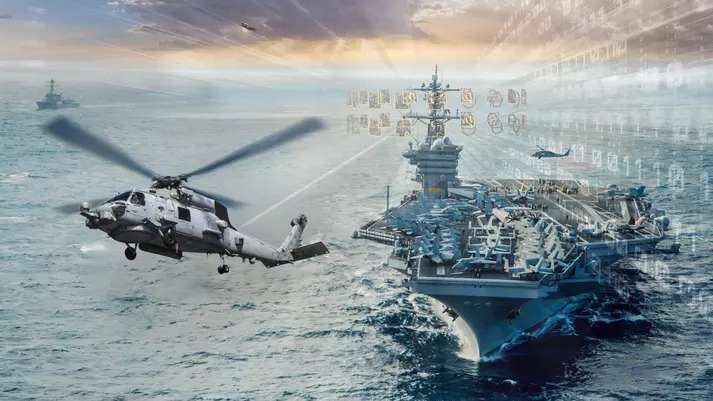
WAYNE, N.J. — Jan. 14, 2025 – In 2024, the U.S. Navy awarded BAE Systems an $85 million production contract to deliver additional Network Tactical Common Data Link (NTCDL) systems. NTCDL will enable a real-time exchange of voice, data, imagery, and full-motion video from a variety of air, surface, subsurface, and man-portable sources. Systems under the company’s current contract are presently being installed on U.S. Navy aircraft carriers and will be installed on new Constellation-class frigates.
“We have designed and produced a faster next-generation system to meet the demands of our customers’ evolving connectivity mission requirements,” said Amber Dolan, director of Adaptive Communications and Sensing at BAE Systems. “BAE Systems is committed to providing the U.S. Navy with a trusted and secure solution to transmit and receive the critical information needed to successfully accomplish its missions across the fleet.”
NTCDL is a multi-platform solution for all U.S. Navy Common Data Link (CDL) requirements. It is a modular, scalable system designed to increase link capacity and embrace waveform evolution. NTCDL supports multiple, simultaneous, networked operations using currently fielded CDL equipment, as well as next-generation manned and unmanned platforms. It enables operators to simultaneously transmit and receive real-time intelligence, surveillance, and reconnaissance data from multiple sources and exchange command and control information across separate or independent networks. This allows for effective communication among forces to maintain an advantage.
This award modifies an existing BAE Systems contract to extend the program’s total period of performance by three years. As the original developer and manufacturer of the NTCDL system, BAE Systems has the engineering and production capabilities to meet the program’s urgent fielding timeline requirements.
Work on this contract is performed at BAE Systems’ facilities in Maryland, Colorado, New Jersey, and New York.
Florida-Based Cutter Returns Home After 40-day Patrol in the Eastern Pacific Ocean
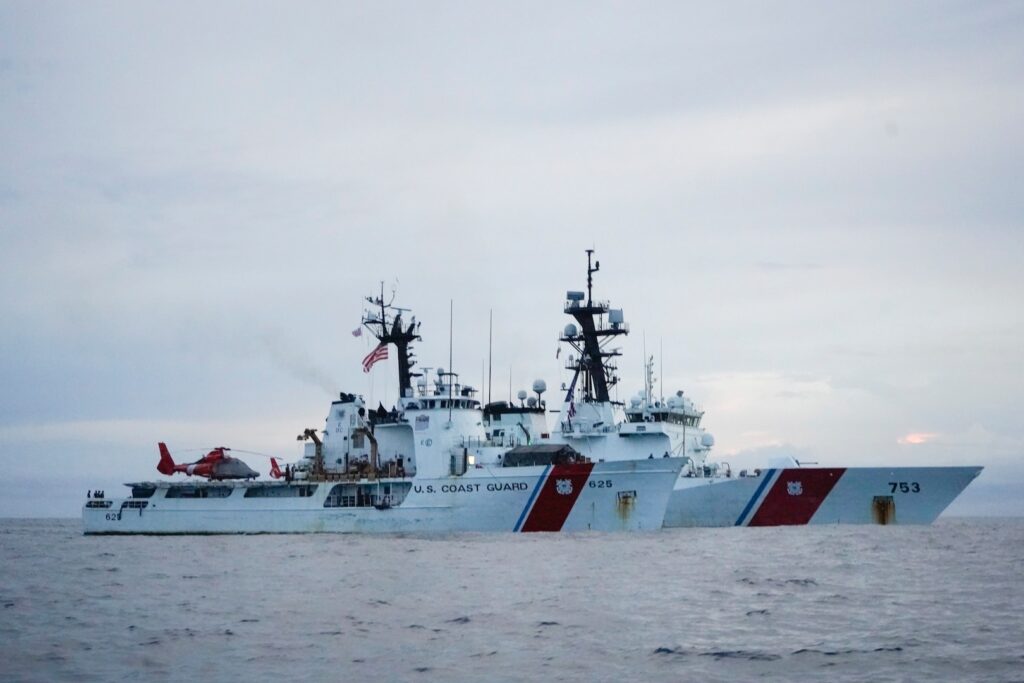
Coast Guard Cutters Venturous (WMEC 625) and Hamilton (WMSL 753) rendezvous at sea, Nov. 21, 2024, in the Eastern Pacific Ocean. Venturous’ crew conducted a 40-day counter drug patrol within the Coast Guard Eleventh District area of responsibility in support of Joint Interagency Task Force – South. (U.S. Coast Guard photo)
From U.S. Coast Guard Atlantic Area, Jan. 13, 2025
ST. PETERSBURG, Fla. — The crew of Coast Guard Cutter Venturous (WMEC 625) returned to their home port in St. Petersburg, Dec. 11, following a 40-day patrol in the Eastern Pacific Ocean.
Venturous’ crew deployed in support of Joint Interagency Task Force – South (JIATF-S) and conducted counter-drug missions in the Coast Guard Eleventh District’s area of responsibility.
Crew members worked alongside an embarked MH-65E Dolphin aircrew from the Coast Guard Helicopter Interdiction Tactical Squadron (HITRON) and law enforcement detachment boarding team members from the Tactical Law Enforcement Team – Pacific.
While underway, Venturous’ crew stopped two drug-smuggling vessels during separate interdictions at sea. During one interdiction, the cutter’s embarked HITRON aircrew assisted in interdicting a vessel carrying 4,270 pounds of marijuana.
Days later, the cutter’s boarding team interdicted a low-profile vessel and seized approximately 165 pounds of cocaine.
Along with the illicit narcotics, Coast Guard crew members apprehended six suspected smugglers who will face prosecution in federal courts by the U.S. Department of Justice.
While deployed, Venturous’ crew navigated the Panama Canal enroute to the Pacific Ocean, crossed the equator, travelled more than 8,800 nautical miles and made ports of call in Central and South America.
During a port of call in Manta, Ecuador, the crew hosted five senior officers from the Ecuadorian Navy (Armada del Ecuador) for a tour and diplomatic engagement. The partner-building event highlighted the recent success of enacting a bilateral agreement between the two nations. The “Agreement Between the United States of America and the Republic of Ecuador Concerning Counter Illicit Transnational Maritime Activity Operations” was entered in force on Feb. 23. Venturous also embarked an Ecuadorian Coast Guard (Armada del Ecuador Guardacostas) officer for two-weeks as part of the new shiprider program to help combat illicit maritime activity, including narcotic smuggling operations and illegal, unreported and unregulated fishing in the region.
“A St. Petersburg-based cutter, we were hit by both Hurricanes Helene and Milton a month before the scheduled patrol. We took care of each other and Atlantic Area Command shifted our schedule to accommodate the devastation our crew and their families faced,” said Cmdr. Karen Kutkiewicz, commanding officer of Venturous. “I am super proud of my crew, their resilience, and their devotion to duty. Our training came to fruition, and we optimized our time in vector with two drug busts within one week, including an elusive low-profile vessel.”
The Coast Guard plays a critical role in securing U.S. maritime borders and is the lead federal maritime law enforcement agency for drug interdiction on the high seas.
Detecting and interdicting illicit drug traffickers on the high seas involves significant interagency and international coordination. JIATF-S based in Key West, Florida conducts the detection and monitoring of aerial and maritime transit of illegal drugs.
Venturous is a 210-foot, Reliance-class medium endurance cutter with a crew complement of 76. The cutter’s primary missions are counter-drug and migrant interdiction operations, enforcement of federal fishery laws and search and rescue in support of U.S. Coast Guard operations throughout the Western Hemisphere. The cutter was commissioned in 1968 and falls under the command of U.S. Coast Guard Atlantic Area, which is based in Portsmouth, Virginia.
For information on how to join the U.S. Coast Guard, visit GoCoastGuard.com to learn about active duty, reserve, officer, and enlisted opportunities. Information on how to apply to the U.S. Coast Guard Academy can be found here.
RTX’s Raytheon awarded $333 million contract for SM-6 Block IA production
Missile supports anti-air, anti-surface warfare and sea-based terminal ballistic missile defense in one solution
From RTX, Jan. 13, 2025
TUCSON, Ariz., Jan. 13, 2025 /PRNewswire/ — Raytheon, an RTX (NYSE: RTX) business, was awarded a $333 million contract from the U.S. Navy to produce Standard Missile-6 (SM-6) Block IA missiles.
“SM-6 has a proven performance, and this contract is an important step for providing this urgently needed weapon to our armed forces,” said Barbara Borgonovi, president of Naval Power at Raytheon. “Raytheon continues to work closely with our customers to ensure our military has an unfair advantage at sea and to keep our adversaries guessing.”
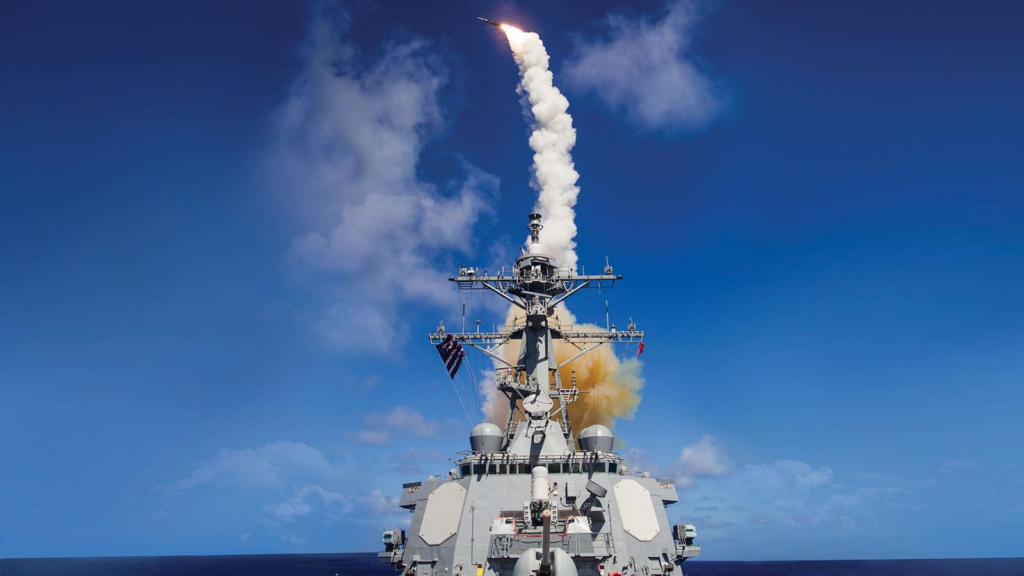
Deployed on U.S. Navy ships, SM-6 delivers a proven, over-the-horizon offensive and defensive capability by leveraging the time-tested Standard Missile airframe and propulsion system. It’s the only missile that supports anti-air and anti-surface warfare and sea-based terminal ballistic missile defense in one solution, enabling the U.S. and its allies to cost-effectively increase the offensive might of surface forces.
SM-6 has been successfully fired from various U.S. Navy ships, unmanned vessels, and launchers on land. In March 2024, SM-6 demonstrated its anti-missile capabilities by successfully intercepting a medium-range ballistic missile target at sea during the Flight Test Aegis Weapon System (FTM)-32 exercise.
Production under this contract will be completed at Raytheon facilities in Tucson, Ariz., Huntsville, Ala., Andover, Mass., and Dine, N.M. with expected completion by 2027.