Teledyne FLIR Defense Awarded $74 Million IDIQ Contract to Modernize U.S. Coast Guard Surveillance Systems
Company has provided Coast Guard imaging solutions used for search & rescue and other maritime missions for 20 years
From Teledyne FLIR Defense, Jan. 13, 2025
BOSTON, Mass., January 13, 2025 ― Teledyne FLIR Defense, part of Teledyne Technologies Incorporated (NYSE:TDY), announced it has been awarded a five-year Indefinite Delivery Indefinite Quantity (IDIQ) contract worth up to $74.2 million to provide modernized imaging surveillance systems to the United States Coast Guard (USCG).
FLIR Defense will deliver more than 125 Electro-Optic Sensor System-Modernized (ESS-M) systems for use on USCG rotary wing aircraft, specifically the MH-60 and MH-65. The advanced ESS-M platform features a full-HD sensor suite and updated user interfaces, as well as advanced processing capabilities and software enhancements that will support future growth.
The ESS-M systems provide operators with high-definition daylight, low light, and infrared imagery and will be used in support of all Coast Guard missions, with an emphasis on search and rescue, living marine resources, and law enforcement. The new technology also will augment coastal security, drug and migrant interdiction, ports and waterways protection, and other Coast Guard rapid response needs.
Teledyne FLIR Defense has been delivering and supporting legacy ESS systems for USCG medium- and short-range recovery aircraft since 2005.
“The significant updates through ESS-M will enable the U.S. Coast Guard to stay on technology’s cutting edge while conducting its wide range of key maritime operations,” said Dr. JihFen Lei, president of Teledyne FLIR Defense. “We’re proud to extend our history of support and look forward to building our relationship across all missions areas.”
Deliveries will begin in Q4-2025. For more on Teledyne FLIR’s maritime surveillance solutions, visit us online.
SECNAV Del Toro Names Future Columbia-class Submarine SSBN 828
From SECNAV Public Affairs, Jan. 13, 2025
WASHINGTON – Secretary of the Navy Carlos Del Toro announced Jan. 13 that the newest Columbia-class ballistic missile submarine will be named the future USS Groton (SSBN 828).
The announcement was made during Del Toro’s video remarks directed to the Department of Navy’s (DoN) submarine community.
“Our ballistic-missile submarines form a critical pillar of the Nation’s nuclear triad, playing an indispensable role in deterring conflict while upholding strategic stability,” said Secretary Del Toro. “Building on this strategic foundation, it is with great pride that I now turn to the next chapter in our Navy’s capabilities.”
Groton honors the port town in Connecticut and three previous vessels so named: a frigate (1944-1946), a patrol craft (1945-1960), and a nuclear fast attack submarine (1978-1997). USS Groton (SSBN 828) will be the third named Columbia-class submarine.
Both Senators for Connecticut expressed their appreciation for the naming and the constituents of the city of Groton.
“Naming the USS Groton recognizes this iconic Connecticut town as the submarine capital of the world — honoring the unsurpassed skill and dedication of men and women who work there. Groton has a rich shipbuilding legacy, and proven commitment to our national defense — manufacturing and maintaining vital weapons platforms, sustaining our undersea superiority,” said Sen. Blumenthal. “It is a proud community of hard workers, veterans, patriots, and public servants, and this honor celebrates them.”
“It’s only fitting the U.S. Navy is naming our next Columbia-class submarine after Groton, Connecticut — the submarine capital of the world,” said Sen. Murphy. “This is a well-deserved recognition of Groton’s rich history as a global leader in submarine technology and innovation, and a home to the thousands of Electric Boat workers and small businesses who power our nation’s naval defense. I will continue to use my seat on the Senate Appropriations Committee to make sure the next administration advances our submarine programs quickly and cost-effectively,
supports our maritime industrial workforce, and ensures the full and timely delivery of the cutting-edge submarines we need to uphold our national security.”
Rep. Courtney highlighted the legacy of Groton and the impact of Del Toro’s decision to name SSBN 828.
“Today’s decision by the US Navy to honor Groton, Connecticut as the name of its next submarine is welcome news. Groton is the birthplace of the modern nuclear-powered Navy under Admiral Hyman G. Rickover and home to our nation’s oldest submarine base as well as the Electric Boat shipyard whose talented shipbuilders have played a leading role since World War II where they constructed 74 submarines to fight the Axis powers. The naming of the third Columbia-class submarine as the future USS Groton is a well-deserved badge of honor that rightly acknowledges our community’s historic role in the United States submarine force,” said Courtney.
Located on lands originally settled by the Pequot, Groton was founded in 1705 when it split from New London. The English settlers turned to shipbuilding, and Groton ever since has excelled in the industry. A Navy Yard was established in 1868. It became a submarine base during World War I and the home to Electric Boat, which launched 74 diesel submarines during World War II. Today, Groton is celebrated as the Submarine Capital of the World and hosts the Electric Boat Division of General Dynamics, the Naval History and Heritage Command’s Submarine Force Library and Museum, and the first nuclear submarine, USS Nautilus.
The first Groton (PF 29) served on a North Atlantic weather station operating from Newfoundland and guiding wartime maritime traffic safely to Europe. She was subsequently transferred to the Coast Guard in 1946. The second Groton (PCE 900) operated in Hawaiian waters during World War II before serving as a Naval Reserve training ship out of Boston. Transferred to the Atlantic Fleet in 1955, she was renamed Groton and served until struck from the Navy List in 1960. The third Groton (SSN 694) completed an around-the-world cruise in 1980 on her first deployment to the Indian Ocean. She was decommissioned in 1997.
Along with announcing the ship’s name, Secretary Del Toro announced the sponsor for the future USS Groton (SSBN 828) as Mrs. Cynthia M. Blumenthal, who in her role as the ship’s sponsor will represent a lifelong relationship with the ship and crew.
Mrs. Blumenthal is not only the wife of Sen. Blumenthal, but she is also a military mother, who advocates for service members and their families. She has served as a senior advisor for fourteen successful campaigns for Sen. Blumenthal, while also serving on multiple boards for charitable organizations assisting wide-ranging communities, dedicating her life’s work to supporting others.
“I am tremendously honored to sponsor the future USS Groton (SSBN 828) and look forward to a lifelong relationship with the ship and its crew. Connecticut’s contributions to our nation’s maritime strength and national security are a source of great pride to all Nutmeggers,” said Cynthia M. Blumenthal. “On behalf of Connecticut’s citizens, I thank the Secretary of the Navy for this recognition. As a military parent, I know firsthand the commitment military families make in support of their members who serve. Those families also serve. It is a privilege to be allowed to dedicate myself to both the USS Groton and the submariners who be deployed on her as she protects our shores and our people.”
Sen. Blumenthal expressed his gratitude to Secretary Del Toro upon Mrs. Blumenthal’s invitation to sponsor the future USS Groton.
“I am proud that my wife, Cynthia, will be the sponsor of the USS Groton and serve as a bond between the vessel, her crew, and our nation – an honor and privilege Cynthia is perfectly qualified to take on,” said Blumenthal.
The Columbia-class submarine, formerly known as the SSBN-X Future Follow-on Submarine, is a new class of nuclear submarines designed to replace the U.S. Navy’s Ohio-class ballistic missile submarines.
The Navy’s ballistic missile submarines, often referred to as “boomers,” serve as an undetectable launch platform for submarine-launched ballistic missiles (SLBMs). They are designed specifically for stealth and the precise delivery of nuclear warheads.
U.S Navy to Christen Future USS Harrisburg
From the Navy Office of Information, Jan. 13, 2025
The U.S. Navy will christen the future USS Harrisburg (LPD 30) during a ceremony on Saturday, January 11, 2025, at 10:00 AM CST at HII’s Ingalls Shipbuilding division in Pascagoula, Mississippi.
The Honorable Carlos Del Toro, Secretary of the Navy, will deliver the ceremonial address.
In a time-honored Navy tradition, the ship’s sponsors, Pennsylvania residents Alexandra Curry and Jennifer Díaz, will christen the ship by breaking a bottle of sparkling wine across the bow. Ms. Curry is the wife of the Honorable Jim Curry, Mayor of Middletown, PA, and Ms. Díaz is the wife of Mr. Chris Díaz, Chief of Staff to the Secretary of the Navy.
The city of Harrisburg is vital to the Navy as it hosts defense logistics and naval supply support activities and plays a central role in the Navy’s national defense infrastructure. The city was originally a trading outpost and later became a top industrialized city in the 19th century with the construction of the Pennsylvania Canal and the Pennsylvania Railroad.
This is the second ship to honor the city of Harrisburg.
San Antonio-class amphibious transport dock ships (LPD) are warships that embark, transport, and land elements of a landing force for a variety of expeditionary warfare missions, humanitarian assistance, and disaster relief. They provide the Navy and Marine Corps with modern, sea-based platforms that are networked, survivable, and built to operate with 21st-century transformational platforms such as air-cushioned landing craft (LCAC), modern helicopters, and vertical take-off landing craft (MV-22). Harrisburg (LPD 30) is the first LPD Flight II ship, with additional follow-on ships (LPD 31-35) under contract with HII.
SECNAV Del Toro Names Future Amphibious Transport Dock the Future USS Travis Manion (LPD 33)
From SECNAV Public Affairs, Jan. 10, 2025
ANNAPOLIS, Md. – Secretary of the Navy Carlos Del Toro announced that a future San Antonio-class amphibious transport dock (LPD 33) will be named USS Travis Manion. Secretary Del Toro made the announcement on January 10, during a ceremony with the Travis Manion Foundation.
The future USS Travis Manion honors Silver Star recipient, 1st Lieutenant Travis Manion and his service. The future LPD 33 will be the first Navy vessel named for Travis Manion.
“The San Antonio-class amphibious ship represents the combined power of the Navy and Marine Corps team and relies on the seamless integration of Sailors and Marines working together,” said Del Toro. “Here, at his alma mater, I am proud to announce that the next San Antonio-class amphibious transport dock, LPD 33, will be named USS Travis Manion, serving as a symbol of courage, bravery, and selfless service for all who follow in her wake.”
Born to a Marine family, Manion graduated from the United States Naval Academy in 2004. After completion of entry-level officer training, he was assigned to 1st Reconnaissance Battalion and deployed to Iraq for his first tour of duty. In 2006, he was assigned to a military transition team advising the Iraqi Army and returned to Iraq in December that year.
On patrol in April 2007, Manion and his fellow Marines were ambushed. With his corpsman wounded, Manion exposed himself to enemy fire to recover the corpsman. Attacking the ambushers, Manion again moved through enemy fire to rescue another wounded Marine. With Iraqi reinforcements blocked, Manion again exposed himself to fire in attempt to find a better fighting position. He was fatally wounded by an enemy sniper. For his actions, he was awarded a Silver Star.
Manion Hall, a student barracks at The Basic School aboard Marine Corps Base Quantico, Virginia, is named in his honor. This is the first ship to be named after 1st Lieutenant Manion.
“The naming of this ship, the USS Travis Manion, is an incredible honor for Travis and our family, and an honor for all of those who stepped up to serve when our country called after September 11, 2001,” said Col. Thomas Manion, USMC, (Ret.) and Chairman Emeritus, Travis Manion Foundation. “Through the words he spoke before his final deployment, ‘If Not Me, Then Who…’, Travis left a legacy of service that lives on through the hundreds of thousands of veterans and families of the fallen across the country who share this ethos. Today, as our men and women continue to serve on the front lines, I know Travis would want this ship to be a tribute to this entire generation of veterans and a reminder to honor and remember their service and sacrifice.”
Along with the ship’s name, Secretary Del Toro announced the sponsors for the USS Travis Manion as sister, Ryan Manion, and nieces Maggie and Honor Borek. They, in their role as sponsors, will represent a lifelong relationship with the ship and crew.
“I never would have thought when we lost my brother Travis in 2007 that I – alongside Travis’ nieces, Maggie and Honor – would one day serve as sponsors of a ship named after him,” said Ryan Manion, CEO of Travis Manion Foundation. “Travis would be so proud to know that the USS Travis Manion will one day carry Marines – men and women like those he walked beside in the halls of Naval Academy and those he served beside on the battlefield. He’d also be adamant that this honor is not only about him, but about remembering the legacies of all of those who wore the uniform.”
Amphibious transport dock ships are warships that embark, transport and land elements of a landing force for a variety of expeditionary warfare missions. LPDs are used to transport and land Marines, their equipment, and supplies by embarked Landing Craft Air Cushion (LCAC) or conventional landing craft and amphibious assault vehicles (AAV) augmented by helicopters or vertical take-off and landing aircraft (MV 22). These ships support amphibious assault, special operations, or expeditionary warfare missions and serve as secondary aviation platforms for amphibious operations.
SECNAV Del Toro Names T-AGOS Explorer-Class and First Two Ships
From SECNAV Public Affairs, Jan. 10, 2025
ANNAPOLIS, Md. (Jan. 10, 2025) – Secretary of the Navy Carlos Del Toro named the T-AGOS ocean surveillance ships the Explorer class, the future USNS Don Walsh (T-AGOS 25) and the second ship the future USNS Victor Vescovo (T-AGOS 26).
Del Toro made the announcement during a ship naming ceremony amongst members of Congress, National Geographic Explorers, local civic leaders, educators, scientists and a wide multitude of explorers at the U.S. Naval Academy in Maryland, on Jan. 10.
In 2022, the Navy procured the first of seven larger, faster surveillance ships known as T-AGOS 25. Today, I am proud to announce these vessels will be known as the Explorer-class of ocean surveillance ships, named in honor of those who made discoveries under sea, on land, and in the skies above.
“These ships are essential to maintaining strategic deterrence and operational awareness in the world’s oceans,” said Del Toro. “There is no one better to name for the first ship than Captain Don Walsh, a man whose life and career embody the very essence of exploration, innovation, and dedication to our Navy and our Nation. In naming the second T-AGOS, no one is more deserving than Commander Victor Vescovo, for his explorations in the air, on land and under the seas as well as his many scientific contributions. I am proud to name today, the future USNS Don Walsh (T-AGOS 25) and the future USNS Victor Vescovo (T-AGOS 26).”
Operated by the Military Sea Lift Command, the Explorer-class will play an integral role in the Navy’s anti-submarine warfare operations. T-AGOS ships align with the class’s mission of ocean surveillance and highlights the wide-range of careers in the Navy and Marine Corps, encompassing opportunities to explore land, air, and sea.
“I am honored to stand side-by-side with the Navy to launch the new Explorer Class of ocean surveillance ships” said Jean Case, Chairman of the National Geographic Society. “We could not be more proud that the inaugural vessel in this class honors our beloved National Geographic Explorer, retired US Navy Captain Don Walsh. We are grateful for the long-standing partnership the National Geographic Society and the US Navy have shared embracing the spirit of exploration and commitment to go to the front lines of the unknown. Together, we champion the courage and curiosity that drive humanity to discover, protect, and build a better understanding of our world.”
The future USNS Don Walsh is the first-in-class, named in honor of the late Captain Don Walsh, USN, a renowned explorer and pioneer of deep-see submergence. Walsh is a 1954 graduate of the U.S. Naval Academy and served first in the amphibious forces before being selected for submarine duty aboard USS Rasher (SS-269). Later while assigned to the staff of Submarine Flotilla 1, he volunteered for the fledgling deep-dive program and became Navy Submersible Pilot No.1. On Jan. 23, 1960, Walsh, accompanied by scientist Jacques Piccard, successfully piloted bathyscaphe Trieste 35,797 feet down to Challenger-Deep, the deepest known point of the ocean, located southwest of Guam in the Mariana Trench. President Dwight D. Eisenhower subsequently presented Walsh with a Legion of Merit for his pioneering work in “innerspace.”
Walsh went on to earn a doctorate in Physical Oceanography while in the service and would ultimately command USS Bashaw (AGSS-241) before retiring as a Captain and going on to be a world-renowned ocean scientist and explorer, with countless awards and accolades. Captain Walsh recently passed away on Nov. 12, 2023, at his home in Oregon. This will be the first Navy vessel named for Walsh.
“My father was many things to many people- explorer, educator, colleague and mentor. But if you asked him what most defined his character, Navy Man, would be top of the list. His contributions to ocean exploration and advocacy spanned 60 plus years and he “wrote the book” on how we talk about, research and protect our planet’s circulatory system. His historic dive to Challenger Deep as a Navy Lieutenant was just part of what would become a life of service to the country, the oceans and the global community,” said Kelly Walsh, son of the late Don Walsh. “To me he was dad: a brilliant example of living a life full of adventure and curiosity. He shared the world with his family over the years, and in turn, we got to share him with the world. His legacy will remain- on the waves, over the horizon and just beyond the next great discovery. He will be there in practice and spirit.”
Secretary Del Toro named Mrs. Joan Walsh, spouse of the late Walsh, and his daughter, Liz Walsh, as sponsors of TAGOS-25. Sponsors are selected by the Secretary of the Navy and hold a unique role in maintaining a lifelong relationship with the ship and crew.
“The Walsh family is profoundly honored that the Navy has chosen to recognize Don Walsh’s lifetime of service and dedication by naming this new TAGOS ship after him. Don sometimes described being a kid in the San Francisco Bay area, daydreaming about where all those ships were going as they sailed to and for over the horizon; that little boy would certainly marvel that one day his legacy would be memorialized in such an enduring way,” said Liz Walsh. “As the ship’s Sponsors, my mother Joan and I are proud to now become a small part of the Navy’s future. We eagerly look forward to developing bonds with the future ship, officers, and crew who will be a key part in protecting America at sea.”
The future USNS Victor Vescovo is named to honor Commander Victor Lance Vescovo, USNR (Ret) (1966 — present). Vescovo, a private equity investor, explorer, and retired naval intelligence officer who currently holds the world record for the deepest dive of a crewed vessel to Challenger Deep in the Mariana Trench, was the first person to reach Earth’s highest and lowest points. Vescovo has also completed the Explorers’ Grand Slam (Last Degree), in which he climbed the highest mountain on each continent and attained both the North and South Poles. Following his dive to Challenger Deep in his custom-built submersible Limiting Factor, Vescovo completed his own Five Deeps challenge, descending to the lowest points in the Earth’s oceans.
He confirmed the identity of the wreck of Johnston (DD 557), which was sunk following a valiant stand against an overwhelming Japanese force during the Battle off Samar in Leyte Gulf, October 1944, which had been discovered but not confirmed by Vulcan, Inc., in 2019. The following year he discovered the wreck of Samuel B. Roberts (DE 413), lost in that same battle. Samuel B. Roberts is the deepest identified wreck at a depth of 22,621 feet. In 2021, Vescovo won the 2021 Captain Don Walsh Award for Ocean Exploration alongside Patrick Lahey for their 2019 Five Deeps Expedition and history of further dives of scientific and historical interest. There have been no previous Navy vessels named for Vescovo.
“It is a great privilege to honor my friend and colleague in the US Navy and ocean exploration, Captain Don Walsh. Vessels such as this upgraded T-AGOS class are essential to the US Navy’s mission to safeguard the security of the world ocean as well as contribute to its greater understanding,” said Vescovo, namesake of T-AGOS 26. “I am also beyond honored to follow in Captain Walsh’s footsteps both to the bottom of the ocean and in the line of succession of naming these great ships.”
During the naming ceremony, Del Toro also announced the sponsor of the future USNS Victor Vescovo, Victoria Vescovo Webster, the sister of CDR Vescovo.
“The naming of this ship for my brother, as the USNS Victor Vescovo, is a very deep and moving honor to me and our family,” said Vescovo Webster. “The role of this ship will be such a perfect combination of his tremendous achievements as an explorer, and his service as a Naval Intelligence officer. I am truly grateful to be named as the sponsor for this ship, and will endeavor to fulfill that role with the same spirit of service as the ship’s namesake.”
T-AGOS 25 class will be part of the tactical auxiliary general ocean surveillance (TAGOS) ships fleet operated by the Military Sealift Command (MSC) of the US Navy. The Navy in FY2022 procured the first of a planned class of seven new T-AGOS 25 class ocean surveillance ships. T-AGOS ships support Navy antisubmarine warfare (ASW) operations and gather underwater acoustical data to support the mission of the Integrated Undersea Surveillance System (IUSS) by providing a ship platform capable of theater anti-submarine acoustic passive and active surveillance.
T-AGOS 25 class ships will be 356ft (110m) long and feature a steel small waterplane area twin hull (SWATH) design. The upper section of the ship is supported by two struts that reach down to a set of submerged hulls resembling those of a submarine. The struts feature a slender profile where they meet the waterline, resulting in a minimal waterplane area.
The ships will have an 8,500t displacement and accommodation for 68 personnel. They will support the navy’s Integrated Undersea Surveillance System (IUSS) for collecting underwater acoustical data, using Surveillance Towed-Array Sensor System (SURTASS) equipment. The high stability of the SWATH design in adverse weather conditions is useful for SURTASS operations.
The other associated electronic equipment on the ships will help in processing and transmitting the data to shore stations through satellite, for evaluation. The ship will be able to sail at a maximum speed of 20 knots.
Navy Names Third Expeditionary Medical Ship USNS Portsmouth (EMS 3)
From SECNAV Public Affairs, Jan. 8, 2025
PORTSMOUTH – Secretary of the Navy Carlos Del Toro named the future Bethesda-class expeditionary medical ship (EMS 3) USNS Portsmouth during a ship naming ceremony at Naval Medical Center Portsmouth on Jan. 8.
The decision to select Portsmouth was made to honor the legacy and commitment of the Navy doctors, nurses, corpsmen and staff of Naval Medical Center Portsmouth and the city of Portsmouth, Virgina.
“As Secretary of the Navy, I remain committed to the readiness of our Sailors and Marines and that readiness includes the crucial work to ensure the healthcare and vitality of our people,” said Secretary Del Toro. “I am proud to honor the city of Portsmouth and the Navy’s first operating hospital, Navy Medical Center Portsmouth, by naming the future USNS Portsmouth (EMS 3).”
The naming selection of the future USNS Portsmouth (EMS 3) follows the tradition of naming expeditionary medical ships after prominent military hospitals. Secretary Del Toro previously named USNS Bethesda (EMS 1) and USNS Balboa (EMS 2).
EMS 3 will be the fifth Navy vessel named Portsmouth. The four previous vessels were a full-rigged ship (1798–1801), a sloop-of-war (1844–1915), a light cruiser (1945–1970), and a nuclear-powered submarine (1983–2005).
Rear Adm. Darin Via, the U.S. Navy Surgeon General and chief, U.S. Navy Bureau of Medicine and Surgery, who spent the majority of his professional military and medical life at the medical center, reaffirmed the Navy’s commitment to military readiness and healthcare support.
“USNS Portsmouth, a symbol of our Navy’s progress, also carries the weight of our history. It represents a significant advancement in our Navy’s warfighting capability and will provide essential medical support across the maritime environment,” said Via. “Together with USNS Bethesda and USNS Balboa, USNS Portsmouth will deliver agile and responsive medical care, advanced trauma management, and support to naval operations and humanitarian and disaster relief missions.”
Representing the city of Portsmouth, Mayor and Navy Veteran Shannon Glover spoke about the honor and meaning behind the naming of the Navy’s newest expeditionary medical ship.
“Today, we stand united in pride and gratitude as we honor the incredible contributions of the dedicated medical professionals at Naval Medical Center Portsmouth. For generations, they have provided compassionate care and unwavering commitment to our military families, veterans, and the Portsmouth community,” said Shannon Glover, Mayor of Portsmouth. “The USNS Portsmouth represents more than just a ship – it is a testament to the resilience, care, and service that define the heart of Portsmouth. And this is an appropriate and fitting tribute to the selfless men and women who serve at Naval Medical Center Portsmouth.”
Located along the banks of the Elizabeth River in Virginia, Naval Medical Center Portsmouth is a nationally acclaimed, state-of-the art Defense Health Agency military treatment facility (MTF), where 5,000 medical professionals provide quality healthcare to warfighters, veterans, and their families in the Hampton Roads area.
Originally established in 1830 as the Navy’s first and oldest continuously operating hospital, today it is home to Navy Medicine Readiness and Training Command (NMRTC) Portsmouth, which provides a skilled and combat-ready medical force to support warfighting requirements and enables the Department’s highly skilled personnel to maintain mission critical proficiencies through valuable training in a military treatment facility. Navy medical personnel lead pioneering research and teaching programs to prepare new doctors, nurses, allied health professionals, and hospital corpsmen for combat operations and public health crises.
In addition to the medical center, the city of Portsmouth, Virginia, is home to the Norfolk Naval Shipyard, the Navy’s oldest shipyard (est. 1767) and one of its key facilities for overhauling and repairing its largest ships.
For every Navy ship named, a sponsor is chosen to advocate for both the ship and crew. Sponsors participate in key milestones in the life of their ship and form lifelong relationships that contribute to the well-being of the ship and her crew members. For the future USNS Portsmouth, Mrs. Terri Ann Via, spouse of Rear Adm. Via, Surgeon General of the Navy, was hand-selected for this important role.
“Portsmouth is more than just a name to me; it has been the cornerstone of my family’s life in the Navy. Portsmouth has been our home for as long as I can remember,” said Mrs. Via. “As the sponsor of the Portsmouth, I am committed to upholding the values of service, courage, and compassion that define both the Navy and Naval Medical Center Portsmouth. Having had the honor and opportunity to stand alongside my husband throughout his Navy career and now as the Surgeon General of the Navy, I look forward to sharing in the adventures, triumphs, and challenges that lie ahead for this ship and crew. May this ship always be a source of pride for our nation, a symbol of our strength and resolve, and a living tribute to the heroes of Naval Medical Center Portsmouth.”
Bethesda-class expeditionary medical ships are designed as a dedicated medical ship that optimizes hospital-level medical care in support of distributed maritime operations (DMO). EMS will feature a shallow draft enabling greater reach and allowing direct access to shallow austere ports, while also providing a flight deck that accommodates military helicopters. This design provides a full range of medical capabilities including triage/critical care, three operating rooms, medical laboratory, radiological capability, blood bank, dental, mental health, OB/GYN and primary care, rapid stabilization and follow-on evacuation of multiple casualties and combat search and rescue including recovery at sea.
The primary mission of the EMS as a high-speed forward-deployed medical ship is to provide rapid responsive sea-based and near-shore hospital level critical care, humanitarian assistance, disaster relief, non-combatant evacuation operations and special operations. The EMS is designed to respond and provide care at a more rapid pace than their predecessors, USNS Mercy and USNS Comfort, sailing at speeds of at least 30 knots with a range of 5,500 nautical miles at 24 knots.
Navy Medicine – represented by more than 44,000 highly-trained military and civilian health care professionals – provides enduring expeditionary medical support to the warfighter on, below, and above the sea, and ashore.
U.S. National Security Advisor Jake Sullivan Announces First-of-Its-Kind Partnership Between Ultra Maritime and Bharat Dynamics Limited
From Ultra Marine, Jan. 7, 2025
COLUMBIA CITY, Ind. – During a visit to Delhi, India, on Jan. 6, National Security Advisor Jake Sullivan shared news that the White House is “welcoming a new initiative between Ultra Maritime and Bharat Dynamics Limited that will enhance undersea domain awareness through a first-of-its-kind partnership on the co-production of U.S. sonobuoys.”
Ultra Maritime, a U.S.-based world-leader in the design and production of undersea warfare capabilities, has partnered with Bharat Dynamics Limited (BDL), an Indian Defence Public Sector Undertaking, to supply and manufacture sonobuoys for the Indian Navy to U.S. Navy standards, with production split across the U.S. and India, in accordance with “Make in India” principles.
In line with the U.S.-India Initiative on Critical and Emerging Technologies (ICET) launched in May 2022, the Ultra Maritime and BDL teams will also pursue new sonobuoy technologies to optimize their acoustic performance in the unique environment of the Indian Ocean, enabling wide area search through bespoke multi-static active solutions.
“The announcement today by National Security Advisor Jake Sullivan reflects Ultra Maritime’s commitment to the Indian Navy in partnering with Bharat Dynamics Limited for production and delivery of world-class sonobuoys, and our resolute commitment to continue to develop forward leaning solutions to unique undersea challenges,” said Ultra Maritime CEO Carlo Zaffanella.
“Bharat Dynamics Limited is completely aligned with the Indian Navy to meet the operational demand for Make in India sonobuoys and is committed to standing up joint production with Ultra Maritime in Vishakhapatnam,” added Chairman of BDL Commodore (ret) A. Madhavarao. “This initiative highlights the strategic importance of U.S.-Indian defense industry cooperation and our ability to jointly move forward with urgency to enhance global security.”
“Having experienced the Indian Navy’s Anti-Submarine Warfare prowess firsthand during Indian Malabar naval exercises in the past, it is an honor today to support both the U.S. Navy and Indian Navy in maintaining Undersea Domian Awareness in the Indian Ocean theater through the Make in India sonobuoy initiative,” said Rear Admiral USN (ret) Mark Kenny, Ultra Maritime Senior Vice President for Strategy and Business Development. “The Ultra Maritime sonobuoys co-produced in India are interchangeable and interoperable between U.S. Navy, Indian Navy and allied P-8, MH-60R and the MQ-9B Sea Guardian aircraft.”
USS Cole Returns from Deployment to 5th and 6th Fleets
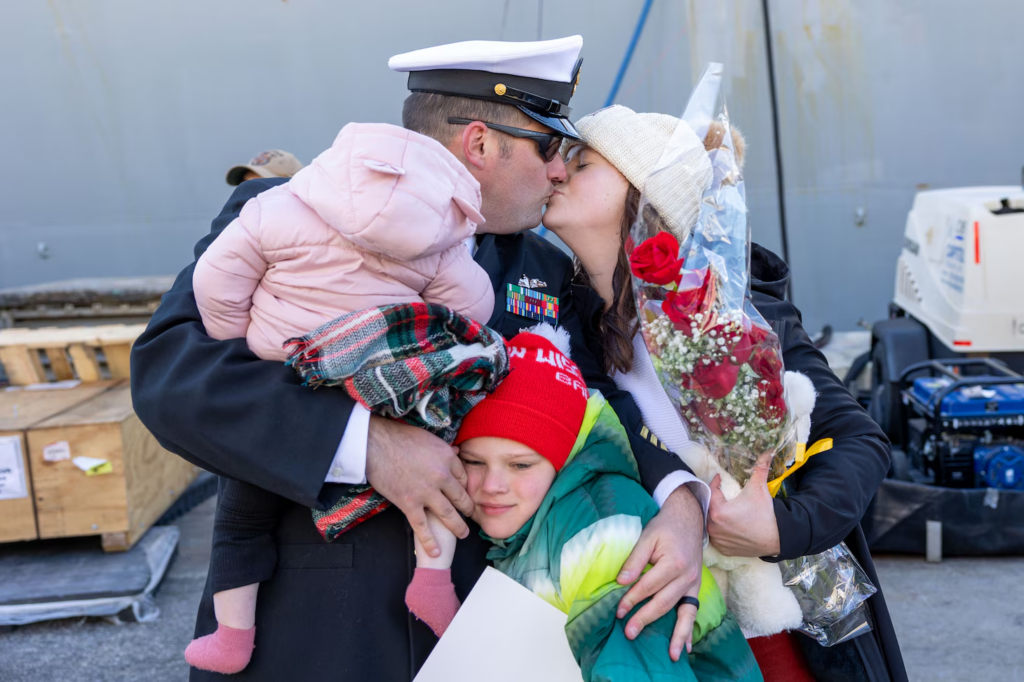
NORFOLK, Va. (December 23, 2024) Chief Gunner’s Mate Tyler Kaltenberg, assigned to the Arleigh Burke-class guided-missile destroyer USS Cole (DDG 67), greets family on the pier after returning from deployment. (U.S. Navy photo by MC1 Nathan T. Beard)
From U.S. Fleet Forces Command, Dec. 23 2024
NORFOLK, Va. - The Arleigh Burke-class guided-missile destroyer USS Cole (DDG 67) returned to Naval Station Norfolk, Dec. 23, after being deployed for more than seven months to the U.S. Naval Forces Europe – Africa and U.S. Naval Forces Central Command areas of operation.
Cole deployed for 224 days to the Mediterranean Sea, Red Sea, Gulf of Aden and Arabian Gulf, providing deterrence and defense to U.S. Allies and partners.
The ship served as an air defense unit for strike group forces in the Red Sea and worked closely with Allies and partners during a variety of missions, contributing to stability in the region.
“I am proud of the determined warriors of Cole for continuing this ship’s legacy of outstanding service during a challenging combat deployment,” said Cmdr. Matt Faulkenberry, Commanding Officer of USS Cole. “Cole demonstrated professionalism and lethality across all domains.”
Cole supported ballistic missile operations in the Levant region, firing interceptors alongside USS Bulkeley on Oct. 1. Additionally, Cole was engaged in combat operations in the Red Sea, earning a star on the ship’s Combat Action Ribbon.
U.S. 5th Fleet area of operations encompasses about 2.5 million square miles of water area and includes the Arabian Gulf, Gulf of Oman, Red Sea, and parts of the Indian Ocean. The expanse comprises 20 countries and includes three critical choke points at the Strait of Hormuz, the Suez Canal and the Strait of Bab al Mandeb at the southern tip of Yemen.
NAVEUR-NAVAF, headquartered in Naples, Italy, operates U.S. naval forces in the U.S. European Command (USEUCOM) and U.S. Africa Command (USAFRICOM) areas of responsibility. U.S. Sixth Fleet is permanently assigned to NAVEUR-NAVAF, and employs maritime forces through the full spectrum of joint and naval operations.
TAMPA, Fla. - U.S. Central Command (CENTCOM) forces conducted multiple precision strikes against two Iranian-backed Houthi underground Advanced Conventional Weapon (ACW) storage facilities within Houthi-controlled territories of Yemen, Jan. 8. The Houthis used these facilities to conduct attacks against U.S. Navy warships and merchant vessels in the southern Red Sea and Gulf of Aden.
There were no injuries or damage to U.S. personnel or equipment.
The strikes are part of CENTCOM’s effort to degrade Iranian-backed Houthi attempts to threaten regional partners and military and merchant vessels in the region.
USS Bulkeley returns home after 5-and-a-half-month patrol
NAVAL STATION ROTA, Spain (Dec. 20, 2024) The Arleigh Burke-class guided-missile destroyer USS Bulkeley (DDG 84) returned to Naval Station (NAVSTA) Rota, Spain, Dec. 20, 2024, after a five-and-a-half-month patrol in the U.S. 6th Fleet area of operations. (U.S. Navy photo by IC2 Marlin Dominguez)
From U.S. 6th Fleet, Dec. 20, 2024
NAVAL STATION ROTA, Spain The Arleigh Burke-class guided-missile destroyer USS Bulkeley (DDG 84) returned home Friday after a five and a half month patrol in the U.S. 6th Fleet area of operations.
Since arriving in Rota and joining the forward deployed Naval Forces Europe (FDNF-E) forces in August 2022, Bulkeley’s crew has completed their third patrol working alongside Allies and partners to ensure security and stability throughout European and African waters.
The 78th Secretary of the Navy Carlos Del Toro, who was the ship’s first commanding officer, welcomed the ship home.
“You have all operated with incredible professionalism and lethality in a situation that is not easy to navigate,” said Secretary Del Toro “Thank you all for your selfless service to this Nation and for your sacrifices while on patrol.”
This patrol saw significant operational milestones, including engaging multiple Iranian ballistic missiles in defense of Israel; assisting in the rescue of 65 people stranded adrift-at-sea; operating with NATO allies, leadership engagements and bilateral operations with the Republic of Cyprus; Carrier Strike Group Operations, and numerous gunshoot qualifications, underway replenishments, flight quarters, and small boat operations.
“The crew demonstrated an incredible amount of proficiency, teamwork, and resiliency on this highly successful patrol,” said Cmdr. Art Trejo, current commanding officer of Bulkeley. “I could not be more proud of their achievements, positive attitude, and high morale.”
After 168 days away from home and over 34,000 miles traveled, the ship returned to friends and family just in time for the holidays.
Commander, U.S. 6th Fleet, headquartered in Naples, Italy, conducts the full spectrum of joint and naval operations, often in concert with Allied and interagency partners to advance U.S. national interests, security and stability in Europe and Africa.