The Department of the Navy is Establishing a Naval Strategic Studies Group (NSSG) Program

From the U.S. Navy Office of Information, 31 October 2024 

The Department of the Navy is establishing a Naval Strategic Studies Group (NSSG) program in January administered by the DON Office of Strategic Assessment (OSA). 

The Department of the Navy is establishing a Naval Strategic Studies Group (NSSG) program in January administered by the DON Office of Strategic Assessment (OSA). 
 
The NSSG will be modeled after the Strategic Studies Group created during the Cold War, which had a twofold mission to train future flag officers in strategic thinking and to conduct research on some of the DON’s most vexing strategic challenges. 
 
The first cohort will include uniformed and civilian members from the Navy and Marine Corps. These plank-owners will conduct a capstone research project that advances Secretary of the Navy Carlos Del Toro’s strategic maritime statecraft initiative. 
 
“I expect my seasoned, mid-grade officers to be brilliant on naval tactics and operations by the time they report for graduate education,” Del Toro said. “I need future flag and general officers who will think strategically about how to lead naval forces in an increasingly contested maritime domain and amidst intense economic, technological and military competition.” 
 
The education in strategic studies the NSSG members will receive supports DON’s focus on reinvigorating the strategic workforce, under the Secretary’s enduring priority of building a culture of warfighting excellence. 
 
Members’ research – focused on broad strategic challenges, rather than narrower problems already addressed by fleet experimentation on specific tactics or technologies – will support DON’s aim of strengthening maritime dominance. 
 
“The Department of the Navy meets our nation’s maritime needs, both today and into the future. As the Office of Strategic Assessment builds a net assessment capability for the DON to understand the complex challenges we face, the Naval Strategic Studies Group will bring together a cohort of rising leaders who will address these challenges and build the strategic leadership skills to guide our Navy and Marine Corps in a dynamic and shifting global environment,” OSA Director Dr. Cara LaPointe said. 
 
The chief of naval operations created the previous SSG in 1981 to tackle key strategic challenges related to the Cold War. Over time, the SSG’s focus evolved to reflect the needs of the Navy until 2016, when it was sundowned. 
 
As the Department of the Navy returns to an era of competition, stakeholders have agreed on the need to amplify strategic leader education as the United States faces an increasingly complex web of threats that includes China, Russia, Iran and North Korea. In 2023 Secretary Del Toro released a Naval Education Strategy to guide investments to modernize naval schools and professional military education. The NSSG will focus students’ strategic leadership studies on DON’s most pressing strategic challenges for greater effect. 
 
“Today we face a comprehensive maritime power in the Indo-Pacific, Russian aggression in Ukraine, and Houthi attacks in the Red Sea – all of which will shape our security environment for several decades,” Del Toro said. “A revitalized, Naval SSG will help the Department of the Navy engage with and look ahead of these trends with sufficient access, resources, and guidance from leadership.” 
 
The first cohort will also tackle questions that will help shape the enduring NSSG program, including working with the Naval University System to deliver a world-class curriculum, and will be located in Washington, D.C. 
 
Lt. Gen. Benjamin Watson, the commanding general of the Marine Corps Training and Education Command, said recent conflicts have reinforced the importance of having Marine Corps leaders at all levels who can outthink the enemy. 
 
“Domains like information and cyber, along with the rise of non-state actors, don’t fit neatly into old frameworks. Our current operating environment demands nothing less than a renaissance in strategic thinking,” said Watson. “To stay ahead of our adversaries, we need to keep evolving—updating our training, sharpening our minds, and learning – not just observing – the lessons of contemporary conflict. The fight isn’t just on the battlefield anymore, and we need every Marine to possess the training, education, and intellectual agility to adapt and overcome.” 
 
Vice Adm. Daniel Dwyer, Deputy Chief of Naval Operations for Operations, Plans, Strategy and Warfighting Development, agreed the Navy needs Sailors and civilians “with superb education and training, who are able to think, act and operate differently to ensure we can defeat our adversaries.” 
“The establishment of the NSSG will enhance our culture of warfighting excellence and strengthen our maritime dominance by developing strategically minded warfighters who will be the future senior leaders of the service and will lead our Navy through uncertain times,” said Dwyer. 
 
Del Toro established the Office of Strategic Assessment in October 2023 and tasked the office to reconstitute the strategic studies program to help rebuild the naval strategist community. 
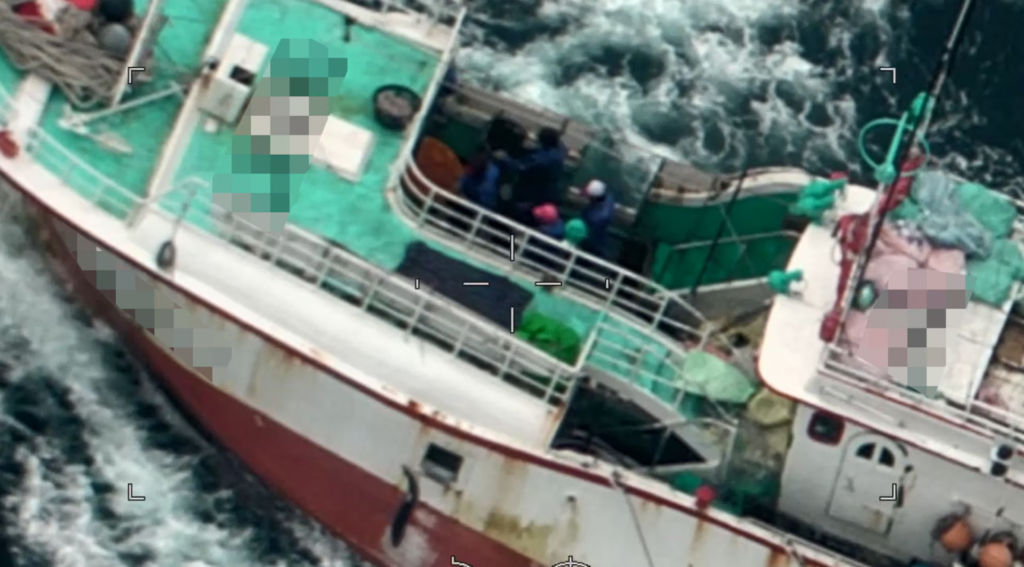


Coast Guard, Canadian Forces, Partners Wrap Up Operation North Pacific Guard 2024  

A foreign fishing vessel discarding a finless shark carcass while conducting shark finning operations in the North Pacific, May 12, 2024. Regional Fisheries Management Organizations regulate the process of shark finning through Conservation and Management Measures. These measures require fully utilizing retained catches of sharks and limits on amounts of fins onboard in relation to those sharks. (U.S. Coast Guard courtesy photo)

From U.S. Coast Guard District 17 Oct. 29, 2024 

JUNEAU, Alaska – The U.S. Coast Guard, Canadian forces, and international partners wrap-up Northern Pacific counter Illegal, Unreported, and Unregulated (IUU) Fishing patrol, Operation North Pacific Guard 2024.   

Operation North Pacific Guard is an annual multi-mission effort between international partners that provides surface and air patrols and shares intelligence that guides patrol assets to detect and intercept illicit fishing activity.   

The joint mission included U.S. Coast Guard Cutter Midgett, U.S. Coast Guard Air Station Kodiak, U.S. Coast Guard District Seventeen, the United States National Oceanic and Atmospheric Administration, Fisheries and Oceans Canada, the Canadian Coast Guard Ship (CCGS) Sir Wilfrid Laurier, Japan Coast Guard, Fisheries Agency of Japan, and Korea Coast Guard.   

As a result of the high seas patrols, air surveillance, and electronic monitoring, the joint crews identified potential instances of illegal harvesting of shark fins and dark vessels, a term for vessels that intentionally turn off their monitoring systems.  
   
U.S. Coast Guard Cutter Midgett patrolled the North Pacific for 65 days and conducted 21 high-seas boardings and inspections which detected four potential violations of conservation and management measures under the Western and Central Pacific Fisheries Commission (WCPFC) and North Pacific Fisheries Commission (NPFC).   
   
U.S. Coast Guard Air Station Kodiak HC-130J Super Hercules airplane crewmembers conducted five 12-day deployments near Yokota Air Base and Misawa, Japan and observed 411 vessels. The crews observed potential shark finning violations and improper fishing vessel markings on multiple vessels.   
   
“IUU fishing is a complex and global problem that calls for an international unified response,” said Capt. Ryan Waters, chief of enforcement for the Coast Guard’s Seventeenth District. “North Pacific Guard is a prime example of a strong, sustained multi-lateral partnership to maximize the impact of collective counter-IUU fishing enforcement efforts and promote the rule of law at sea.”   
   
IUU fishing is detrimental to long-term, stable national security, international relations, and global economics. Up to 27 million tons of fish are caught illegally each year worldwide. The U.S Coast Guard leads U.S. Government efforts in multinational campaigns like North Pacific Guard that counter IUU fishing at-sea, uphold global rules-based order, and promote economic prosperity. 

For breaking news, follow @USCGAlaska on X (formerly twitter)  


Lockheed Martin Makes First International SEWIP Sale to Japan 

From Lockheed Martin 

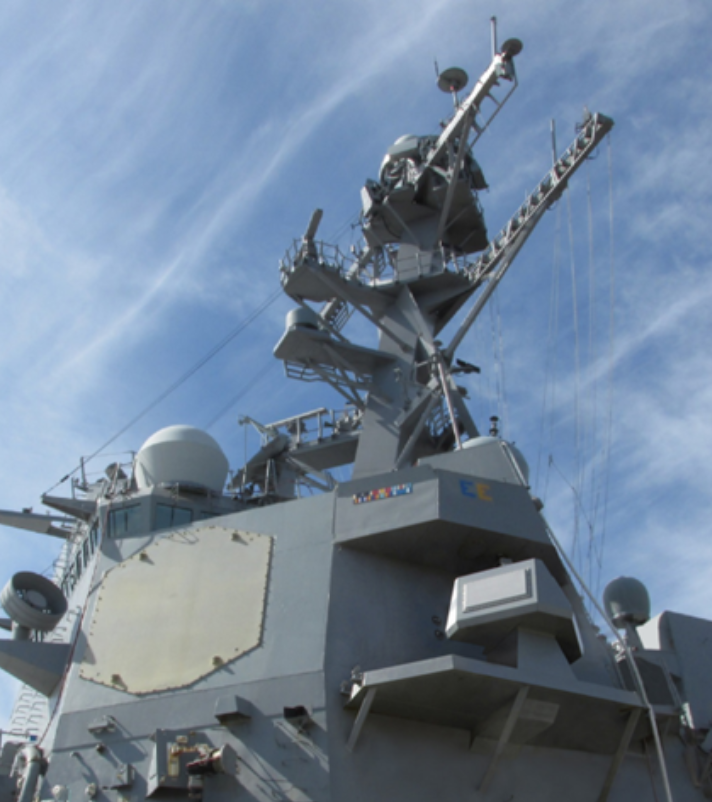
SYRACUSE, N.Y., Oct. 29, 2024 – Lockheed Martin (NYSE: LMT) was awarded a $113 million contract by Naval Sea Systems Command for full rate production of Surface Electronic Warfare Improvement Program (SEWIP) Block 2 AN/SLQ-32(V)6 and AN/SLQ-32C(V)6 systems.   

This contract combines purchases for the U.S. Navy and the government of Japan under the Foreign Military Sales (FMS) program. It serves as a modification to a previously awarded SEWIP full rate production contract, that allowed for additional production based on need.  

The purchase for Japan marks the first international sale of the premier shipboard electronic warfare system in the world. Japan is a critical ally in the Western Pacific. Having SEWIP provides the same state-of-the-art system for detecting and identifying threats that the U.S. Navy uses, enhancing shipboard capabilities, and increasing interoperability with the U.S. Navy.   

“The SEWIP program has proven critical for the U.S. Navy in the early detection of threats,” said Deon Viergutz, vice president of Spectrum Convergence, Lockheed Martin Rotary & Mission Systems. “With this first purchase in Japan, we are setting the stage to continue to expand this key technology around the globe for an improved network of electronic surveillance, enabling U.S., allied and partner forces to continue to evolve and outpace modern threats.”  

For more than 13 years, Lockheed Martin has partnered with the U.S. Navy to develop and produce SEWIP Block 2, producing over 130 units. Work on this new contract will be performed in Liverpool, New York and Lansdale, Pennsylvania, and is expected to be completed by October 2026.   


Leidos Awarded $93M Contract to Support Navy and Marine Corps Weapons Systems 

From Leidos 

RESTON, Va. (Oct. 30, 2024) – Leidos (NYSE:LDOS) announced today a new contract to provide critical supply support for weapons systems that keep the U.S. Navy and Marine Corps forces mission-ready. The Technical Assistance for Repairables Processing (TARP) contract was awarded by the Naval Supply Systems Command (NAVSUP) Fleet Logistics Center, supporting NAVSUP’s Weapon Systems Support (WSS). The contract has a base period of performance of one year with four one-year options and one six-month option.  

“Leidos’ solutions in advanced traceability and control support our Navy and Marine forces in moving, controlling, and tracking depot-level repairables worldwide – ultimately helping to reduce repair pipeline time and the cost of future investment,” said Jason McCarthy, Leidos senior vice president, Engineering, Integration & Operations. “We are proud to continue to deliver mission-enabling technology and data-driven logistics to our long-time customer.” 

New under this contract, Leidos plans to develop a business intelligence dashboard with live data and reporting to put a powerful decision support system at the fingertips of the NAVSUP WSS customer, including in offline environments.  

Under the TARP program, global field representatives train and assist the U.S. Navy field and fleet on all aspects of the Reverse Supply Chain (RSC). The training covers the proper packaging of expensive military assets as well as use of the electronic Retrograde Management System (eRMS), an IT system that provides visibility and accountability for repairables moved through RSC transportation channels.  

This is the seventh TARP program contract awarded to Leidos. Since 2000, the Leidos team has consistently delivered innovations, including automated reporting and multi-platform mobile applications to capture project data. 


Amentum Awarded $490M to Modernize Navy’s Multi-Engine Training Aircraft Fleet

A T-54 multi-engine aircraft sits on the flightline of Naval Air Station (NAS) Corpus Christi, April 18, 2024 (U.S. Navy Photo by Anne Owens/Released) 

From Amentum 

CHANTILLY, Va., October 28, 2024 – The U.S. Navy awarded Amentum (NYSE: AMTM) a $490 million contract to deliver comprehensive contractor logistics support (CLS) of the state-of-the-art T-54A Multi Engine Training System (METS). This innovative system will supersede the aging T-44C aircraft, as Amentum collaborates with the Navy and Textron, the original equipment manufacturer, to modernize the Navy’s training aircraft fleet. 

Amentum’s expert fleet management support to the METS program strategically positions the U.S. Navy’s pilot training for unparalleled success. By offering its services to the Chief of Naval Air Training (CNATRA) for the cutting-edge multi-engine platform, Amentum will be instrumental in shaping the future of naval aviation. The METS program will seamlessly enable future Navy, Marine Corps, Coast Guard, and select U.S. allied pilots to transition into advanced multi-engine and tilt-rotor fleet aircraft such as the V-22 Osprey, E-2D Hawkeye, C-130 Hercules, and P-8 Poseidon ensuring operational readiness through 2055.   

“Amentum’s extensive experience delivering comprehensive fleet management—encompassing modifications and engineering to sustainment and logistics—makes us the premier partner for modernizing the Navy’s training aircraft fleet,” said Dr. Karl Spinnenweber, President of the Mission Solutions Group. “Our team, understanding the critical nature of our mission, excels in the accelerated pilot training environment and is fully committed to providing ready-to-train aircraft every single day.” 

Amentum’s dynamic, highly skilled workforce consistently delivers ready-for-production (RFP) aircraft for daily training missions, ensuring excellence through both scheduled or un-scheduled maintenance and modifications in a highly demanding student training environment. These aircraft systems provide the foundation for advanced fleet aircraft training syllabi. Amentum delivers critical training on full system maintenance, service, and repair of avionics, airframes, and power plants, as well as overhaul of aircraft engines, propellers, and avionics components, enabling continuous flight operations. 

“Our partnership with the U.S. Navy and CNATRA strengthens as Amentum delivers innovative engineering, modification and sustainment solutions to maximize aircraft availability for naval aviator training,” said Joe Kelly, Senior Vice President for Sustainment and Analytics. 

The task order transition phase in began June 1, 2024, and full performance started Sept. 1 under the CMMARS Indefinite Delivery/Indefinite Quantity Multiple Award Contract. It has a one-year base period and four additional one-year option periods and is contracted through Naval Air Systems Command (NAVAIR). Operations will be conducted at Naval Air Station Corpus Christi, Texas supporting the phase-out and divestiture of all T-44C aircraft and the introduction of all T-54A fleet over the next three years. 

About Amentum 


CNO Franchetti and MCPON Honea Visit NSWC Panama City Division 

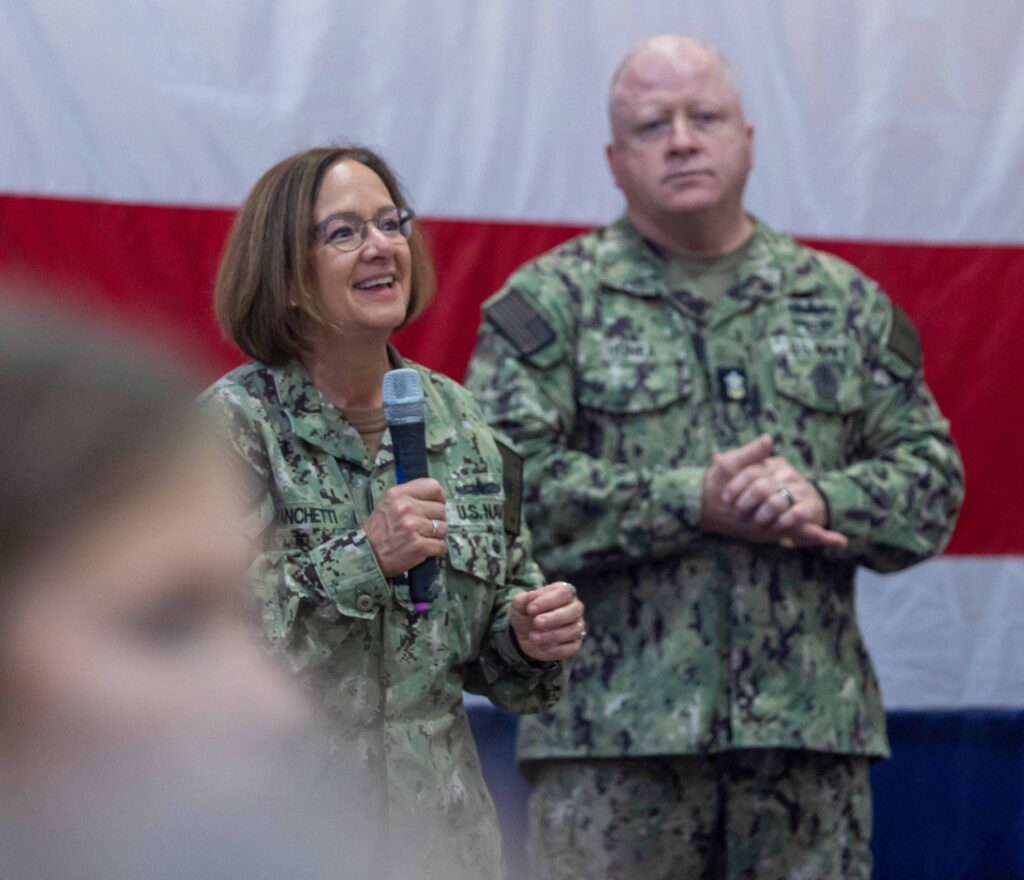
CNO Adm. Lisa Franchetti addresses attendees at an all hands call at Naval Support Activity Panama City, Fla. (Eddie Green) 

29 October 2024 

From Cierra Burch, Shauna Love-vonKnoblauch, Katherine Mapp and Jeremy Roman 

PANAMA CITY, Florida – Chief of Naval Operations (CNO) Adm. Lisa Franchetti and Master Chief Petty Officer of the Navy (MCPON) James Honea visited Naval Surface Warfare Center Panama City Division (NSWC PCD), Oct. 24. 

Franchetti and Honea’s visit provided the opportunity for them to see firsthand how NSWC PCD, one of the Navy’s premiere research, development, test and evaluation laboratories, supports the fleet through capabilities including mine warfare, expeditionary warfare, robotics, autonomous systems, and naval special warfare. 

“It was really exciting to see all the amazing work that is going on all around here. I got to walk around and talk with many [people from this workforce], the commands here and the service members,” said Franchetti. “I’m very excited about the future. It is a very bright future thanks to all the great work that you’re doing here today and have been doing for quite some time.” 
 
Franchetti and Honea spent the first part of their visit engaging with sailors and civilians, while learning more about capabilities to ensure wartime readiness. 
 
“NSWC PCD continues to meet mission readiness by ensuring alignment to the CNO’s Navigation Plan, which poises our Navy to enhance the Navy’s long-term advantage,” said Capt. David Back, NSWC PCD commanding officer. “It is an honor to host the CNO and MCPON.” 
 
Dr. Peter Adair, SES, NSWC PCD technical director, emphasized the significance of getting NSWC PCD’s capabilities to the fleet rapidly. 
 
“Taking sailors and marines out of harm’s way and reducing the operational timeline is imperative. Unmanned technologies are how we are going to get there,” said Adair. “It is our role to ensure the fleet has the capabilities they need for today, tomorrow and the Navy after next.” 
 
The visit concluded with a CNO and MCPON-led All Hands Call with sailors and civilians across Naval Support Activity Panama City. 
 
The warfighter is the Navy’s asymmetric advantage. Franchetti’s Navigation Plan 2024 America’s Warfighting Navy outlines the need to build our unmatched warfighting teams—active and reserve Sailors, with Navy civilians—through a relentless focus on training and learning. 
 
“When I am asked ‘who is the warfighter’ many groups of people come to mind. There are our sailors, on the frontline, but there are also those in the behind the scenes that contribute significantly to Project 33 and to the Navy getting real, getting better,” said Franchetti during her All-Hands address. “I am incredibly grateful for the hard work each of you put into ensuring our mission not only advances operationally, but processes continue to improve so we can support the frontline more efficiently and safely.” 
 
Fourteen individuals were recognized for their significant contributions to the Navy, including 13 sailor recognitions for achievements. 
 
CNO and MCPON presented a Meritorious Civilian Service Award to Andrea Perles, leader in mine warfare for the U.S. Navy. NSWC PCD also announced Hospital Corpsman Second Class Nicholas Harburckak from Chambers, Neb., as the Junior Sailor of the Year and Aviation Ordnanceman First Class Kevin Rodriguez from Smithfield, Va., as the Sailor of the Year at this installation. 
 
The visit provided Franchetti and Honea with a richer understanding of NSWC PCD’s mission to support the America’s Warfighting Navy. 
 
“It is your efforts, your dedication, and your expertise that provides us with the capabilities and enablement of manned and unmanned vessels in the fleet,” said Honea. “Whether you are wearing a uniform or intricately in the behind the scenes, the work you do matters.” 
 
This was Franchetti and Honea’s first visit to NSWC PCD as Chief of Naval Operations and Master Chief Petty Officer of the Navy. 


BAE Systems Ship Repair Begins Production of Submarine Components 

From BAE Systems, Oct. 28, 2024 

BAE Systems has been awarded a contract by General Dynamics Electric Boat for deck module fabrication in support of U.S. Navy submarine programs. The contract between the companies will cover the production and shipment of structural steel components for both Columbia- and Virginia-class submarines from BAE Systems’ facility in Jacksonville, Florida. 

BAE Systems currently provides support to the U.S. Navy Submarine Industrial Base through various business operations, particularly the company’s Louisville, Kentucky facility. Earlier this year, Jacksonville shipyard employees began supporting submarine fabrication at multiple sites across the industrial base. For its upcoming work, the shipyard has also drawn upon the expertise of the company’s business unit that fabricates other submarine components. 

“BAE Systems has a long history of manufacturing components for U.S. Navy submarines, and we are committed to continuing our company’s service in this area,” said Paul Smith, vice president and general manager of BAE Systems Ship Repair. “We have been adding capability and resources at our Jacksonville shipyard and are ready now to start executing this important work of building high-quality, reliable structures for Electric Boat and the U.S. Navy.” 

BAE Systems’ 101-acre shipyard in Jacksonville currently sustains and provides fabrication services for a wide variety of surface vessels. Concurrent with its submarine production work, the shipyard is undergoing a significant transformation with a new 25,000-ton lifting capacity shiplift and four-acre land-level repair facility coming online in spring 2025. 

Across its facilities, BAE Systems is ready to support the submarine production requirements of the U.S. shipbuilding community to meet the needs of the U.S. Navy and its allies.   


USCGC Vigorous Returns Home Following 51-day Deployment in the Eastern Pacific Ocean

USCGC Vigorous (WMEC 627) underway in the South Florida Straits, Nov. 18, 2022. The cutter’s primary missions are counterdrug operations, migrant interdiction, enforcing federal fishery laws and search and rescue in support of U.S. Coast Guard operations throughout the Western Hemisphere. (U.S. Coast Guard Photo by Petty Officer 3rd Class Payton Ray)

From U.S. Coast Guard Atlantic Area, Oct. 29, 2024 

PORTSMOUTH, Va. —The crew of Coast Guard Cutter Vigorous (WMEC 627) moored at Naval Station Norfolk, Oct. 15, following a 51-day deployment in the Eastern Pacific Ocean.  

Deployed in support of Joint Interagency Task Force – South and patrolling within the Coast Guard Eleventh District area of responsibility, Vigorous’ crew conducted counter-drug missions to prevent the flow of narcotics and other illicit smuggling into the United States by transnational criminal organizations.  

Vigorous’ crew partnered with the Coast Guard Tactical Law Enforcement Team – South’s (TACLET-S) Law Enforcement Detachment 405 (LEDET 405) to detect, intercept and board vessels suspected of illicit trafficking in the region.  

During the patrol, Vigorous and LEDET 405 were successful in seizing 2,923 pounds of cocaine and detained 3 suspected smugglers, preventing an estimated $40.4 million in drugs from hitting U.S. streets.  

“Our crew has displayed an extraordinary level of dedication and resilience throughout this deployment,” said Cmdr. Todd Batten, commanding officer of Vigorous. “Their tireless efforts and strategic collaboration with our international partners have resulted in this successful interdiction and the continued strengthening of relationships with our regional allies. I am profoundly proud of each member of this team. This achievement not only enhances maritime security but also underscores the power of collective resolve against the destabilizing effects of the drug trade.”  

Support from TACLET-S, which is based in Miami, improves mission capability. As part of the Coast Guard’s deployable specialized forces, LEDETs deliver boarding officer teams for high-risk maritime interdiction operations. These units are highly-skilled and experienced in counter-drug missions and enforcing U.S. law at sea.  

Following patrol, Vigorous’ command and crew had the unique opportunity to share the importance of Coast Guard missions with the local community it serves. Vigorous participated in Fleet Fest 2024, which was held at Naval Station Norfolk. Joining Coast Guard Cutter Nathan Bruckenthal (WPC 1128) and U.S. Navy vessels Wasp-class amphibious assault ship USS Iwo Jima (LHD 7) and Arleigh Burke-class guided-missile destroyer USS Gonzalez (DDG 66), the crew of Vigorous provided tours and took part in an event that hosted thousands from the local area.   

Vigorous is a 210-foot, Reliance-class medium-endurance cutter commissioned in 1969. Homeported in Portsmouth, the cutter’s primary missions are counter-drug and migrant interdiction operations, enforcement of federal fishery laws, and search and rescue in support of U.S. Coast Guard operations throughout the Western Hemisphere.  

For information on how to join the U.S. Coast Guard, visit GoCoastGuard.com to learn about active duty, reserve, officer and enlisted opportunities. Information on how to apply to the U.S. Coast Guard Academy can be found here.  

For more, follow us on Facebook, Instagram and X.     


FRCE Delivers Final AV-8 Harrier to Fleet 

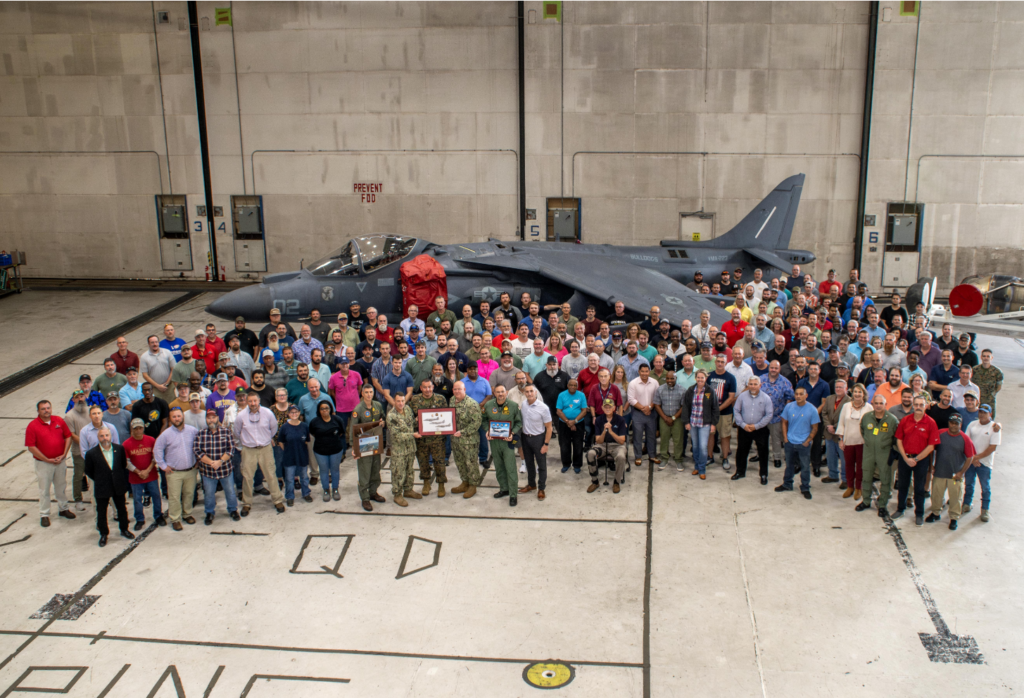
Fleet Readiness Center East (FRCE) celebrated its final AV-8B Harrier maintenance event with an informal celebration in the facility’s AV-8B hangar Sept. 20. FRCE delivered the completed aircraft to Marine Attack Squadron 223 onboard Marine Air Station Cherry Point Sept. 26.

From Naval Air Systems Command, Oct. 28, 2024 

MARINE CORPS AIR STATION CHERRY POINT, N.C. — Fleet Readiness Center East (FRCE) marked the end of an era with the completion of its final AV-8B Harrier maintenance event, delivering the aircraft to Marine Attack Squadron 223 onboard Marine Air Station Cherry Point Sept. 26. 

FRCE celebrated the platform’s depot maintenance finale with an informal ceremony Sept. 20 in the command’s AV-8 hangar. FRCE Commanding Officer Capt. Randy Berti and leaders from the AV-8B Weapon Systems Program Office (PMA-257) recognized members of the depot’s Harrier team, both past and present, for their efforts in supporting the legendary aircraft throughout the years. 

Berti said the command’s AV-8B team has been instrumental in ensuring readiness within the Harrier community.   

“It’s an honor to lead a facility with such a remarkable legacy,” said Berti. “For five decades, FRC East has been a cornerstone in supporting the Harrier program for both the Marine Corps and our nation’s international allies. Our AV-8 platform’s success is directly attributed to the hard work and dedication of multiple generations of FRC East employees. I am proud of all this team has accomplished throughout the years and I look forward to what’s next.”    

FRCE has supported the Harrier since 1973, beginning with its assignment of the AV-8A Harrier and F402 engine workload. With the platform sundowning as the Marine Corps replaces it with the F-35 Lightning II, the depot’s Harrier program will continue its transition to supporting other weapons platforms, including the F-35. 

Many of the depot’s AV-8 aircraft maintenance professionals have spent a significant portion of their careers working on the Harrier. Aircraft Overhaul and Repair Supervisor Mike Stewart said it’s hard to see the platform come to an end.   

“I’ve been working on the AV-8 platform for the past 30 years,” said Stewart. “It’s the only platform I’ve ever known, dating back to the start of my career in the Marine Corps in 1994 to 2011, when I began working here at FRC East. 

“With that, I know that every aircraft has its service life,” Stewart continued. “We must evolve by improving our technology and tactics. F-35 is that new technology; it’s how we keep up and move to the future. Although the AV-8 is a great aircraft, it has served its purpose. It’s time to move on to the newer weapons platforms with more capabilities.” 

Jeff Broughton, business operations specialist, said the depot’s Harrier team has an impressive track record, often working under budget and ahead of schedule. On average, the team completed AV-8B depot-level maintenance events nearly 10% faster than originally estimated, according to Broughton. 

“Our goal is to stay within our customers’ budgets and be good stewards of their funding,” Broughton said. “We have met and exceeded that goal time and time again. Many of the aircraft we have worked on have been returned to the fleet earlier than originally planned and under our original cost estimates.” 

Broughton said during his 22 years on the AV-8B platform, he has witnessed many successes, with the most memorable being in 2015. 

“One of our more outstanding inductions was an AV-8 that was damaged during the attack on Camp Bastion, Afghanistan,” said Broughton. “It was one of our fastest turnarounds for a special rework induction, and I think that was partially because we knew the circumstances and were highly motivated to get it back to the squadron. Not only did we return that aircraft nearly a week ahead of schedule, we also did it under the original estimate. 

“We play an important role in warfighter readiness here at FRC East,” Broughton continued. “When something tragic like that happens, we come together and do whatever we can to help get the fleet back up and running.”   

The AV-8 team’s reputation has set FRCE up to be the repair facility of choice for future squadrons, according to Broughton. 

“For many years, we have established ourselves as being a successful and affordable option for the AV-8 community,” said Broughton. “We have established good rapport with our customers and local squadrons because they know we get the work done. They know we provide high-quality product within a good price range that is in-line with their funding. 

“We continue to be good stewards of their funding and continue to provide this quality of work, so they continue to choose us,” Broughton continued. “As time goes on and platforms evolve, the way the AV-8 is transitioning to the F-35, we hope to remain their preferred depot source of repair.” 

Broughton said working together has been a key factor in the team’s success. 

“Our day-to-day plan is teamwork,” said Broughton. “We do everything we can to be role models to each other. Instead of just having one mentor or role model, we strive to all be a role model because a supervisor may be strong in one area, while the planner may be strong in another. We all come together as one team, one fight, all strong.” 

Ike Rettenmair, head of the AV-8 and F-35 branches at FRCE, said while the change in focus from the AV-8B Harrier to F-35 Lightning II is bittersweet, it represents an important step forward in the depot’s support of the warfighter. 

“I was filled with mixed emotions the day we rolled the last Harrier out,” said Rettenmair. “I’ve supported the Harrier for 30 years in some capacity, starting with my time in the Marine Corps as an airframe mechanic. Throughout my time on the platform, I’ve had the privilege of meeting many remarkable individuals who possess a warrior mentality and take great pride in their service to the fleet. Even though this transition will be a big change for many of us, we remain proud and motivated in our support of the warfighter.”  

FRCE is North Carolina’s largest maintenance, repair, overhaul and technical services provider, with more than 4,000 civilian, military and contract workers. Its annual revenue exceeds $1 billion. The depot provides service to the fleet while functioning as an integral part of the greater U.S. Navy; Naval Air Systems Command; and Commander, Fleet Readiness Centers. 


USS Mobile Returns to Homeport San Diego 

USS Mobile (LCS 26) returns to Naval Base San Diego following a 19-month rotational deployment. (MC1 Vance Hand)

From Petty Officer 1st Class Vance Hand, 28 October 2024 

SAN DIEGO – The Independence-variant littoral combat ship USS Mobile (LCS 26) returned to its San Diego homeport Oct. 25, following a 19-month deployment. 

“Mobile’s maiden deployment to 7th fleet was incredibly successful, and we are extremely proud of the accomplishments of both crews,” said Capt. Douglas Meagher, commodore, Littoral Combat Ship Squadron One. “Mobile operated alongside other U.S. Navy assets as well as international allies and partners to not only strengthen our relationships but to demonstrate the tactical capabilities and strategic value of littoral combat ships.” 

Mobile participated in freedom of navigation operations in the South China Sea, maritime domain awareness and patrol alongside the Philippine Navy, Cooperation Afloat Readiness and Training (CARAT) Thailand 2023, Malaysia’s Langkawi International Maritime Aerospace Exhibition 2023 (LIMA 2023), and Noble Dingo with the Royal Australian Navy. Mobile also participated in trilateral exercises alongside the French Navy and Royal Australian Navy, multinational maritime cooperative activity exercises with Philippine Navy, Royal Australian Navy and Japan Maritime Self-Defense Force, and bilateral operations with the Royal Netherlands Navy and Italian Navy. 

“I am particularly proud of the resiliency and self-sufficiency that our Sailors demonstrated throughout the deployment,” said Cmdr. David Gardner, commanding officer of Mobile Gold crew. “Mobile operated for extensive periods of time outside of the normal U.S. Navy logistics umbrella, which necessitated deliberate planning and at times time-critical actions to ensure that Mobile was fully mission-ready despite the prolonged operations and distance from shore-based support. The man-hours and money saved through Mobile’s self-sufficiency and can-do attitude was a key to our success.” 

Mobile was showcased at the International Maritime Defense Exhibition (IMDEX) Asia 2023 at Changi Naval Base in Singapore. The exhibition included displays and tours of 22 warships from 13 countries. 

Mobile participated in CARAT Thailand 2023, a bilateral exercise between Thailand and the United States designed to promote regional security cooperation, maintain and strengthen maritime partnerships, and enhance maritime interoperability. 
Mobile was an active participant in LIMA 2023, which included industry stakeholders, government, and military officials from more than a dozen countries dedicated to the maritime and aerospace sectors for defense, civil, and commercial applications. Apart from exhibits, forums and conferences, LIMA 23 also organized various activities such as cultural exchanges, flight simulators, technology talks, and career fairs for participants. 
Mobile conducted bilateral operations with the Royal Netherlands Navy in the South China Sea to improve allied interoperability and conduct complex scenarios to improve combined readiness. The operation was followed by a separate bilateral operation with the Italian Navy that was also held in the South China Sea. 

“These Sailors are returning home to their families with significant operational experience. Given the nature of our minimally manned crew each of these Sailors has amassed hundreds of hours of experience in specialized evolutions, both in real-world events and through training while deployed,” said Gardner. “The result is Mobile Sailors are highly qualified within rate and rapidly advancing in their careers. Mobile flies both the Enlisted Surface Warfare Specialist and Surface Warfare Officer pennants as a visual indication of our highly warfare-qualified team.” 

Mobile is homeported in San Diego as a part of Littoral Combat Ship Squadron One. Littoral combat ships are fast, optimally-manned, mission-tailored surface combatants that operate in near-shore and open-ocean environments, winning against 21st-century threats. LCS integrate with joint, combined, manned and unmanned teams to support forward-presence, maritime security, sea control, and deterrence missions around the globe. 
For more news from Commander, Littoral Combat Ship Squadron One, visit https://www.surfpac.navy.mil/comlcsron1/ or follow on Facebook at https://www.facebook.com/COMLCSRONONE/.