U.S. Central Command Weekly Updates for 10/18, 10/24 
From U.S. Central Command 

Oct. 24, 2024 
 

TAMPA, Fla. – During the early morning of Oct. 22, Iraqi Security Forces (ISF), enabled by Coalition Forces as part of Combined Joint Task Force-Operation Inherent Resolve (CJTF-OIR), conducted strikes and follow raids on multiple ISIS locations in Central Iraq, targeting several senior ISIS leaders and killing at least seven ISIS operatives. During the Iraqi-led operation, two U.S. military personnel were wounded while assisting Iraqi forces with site exploitation. They are in stable condition. Also as previously released, ISF, enabled by CJTF-OIR, conducted precision airstrikes in Northeastern Iraq, Oct. 14-15, that killed four members of ISIS, including an ISIS senior leader. Both Iraqi-led strikes were conducted to disrupt and degrade ISIS attack networks in Iraq.  

Also in the past week, U.S. Central Command (CENTCOM) forces successfully destroyed 15 one-way attack uncrewed aerial systems (OWAUAS), Land Attack Cruise Missiles (LACMs), and Surface-to-Air Missiles (SAMs) in the CENTCOM area of responsibility (AOR). These Iranian-supplied weapons, launched episodically by the Houthis and Iranian-Aligned Militia Groups (IAMGs) over several days during the week, posed a significant risk to United States, allies, and partner forces, as well as civilians in the region. The weapons systems were downed by a combination of U.S. Air Force and U.S. Navy assets deployed to the region. 

U.S. and coalition forces remain at a high level of readiness, postured to defend U.S. interests and those of our allies and partners in the region. 

Oct. 18, 2024 

TAMPA, Fla. (Oct. 18, 2024) – In the past week, U.S. Central Command (CENTCOM) forces successfully destroyed 20 one-way attack uncrewed aerial systems (OWAUAS) and Land Attack Cruise Missiles (LACMs) in the CENTCOM area of responsibility (AOR). These Iranian-supplied weapons, launched episodically by the Houthis and Iranian-Aligned Militia Groups (IAMGs) over several days during the week, posed a significant risk to United States, allies, and partner forces, as well as civilians in the region and beyond. The drones and missiles were downed by a combination of U.S. Air Force and U.S Navy assets deployed to the region. 

No U.S. service members were injured in these actions. U.S. and coalition forces remain at a high level of readiness, postured to defend U.S. interests and those of our allies and partners in the region. 

Here’s a general timeline of CENTCOM operational activities during the past week: 

· As previously released, CENTCOM forces conducted a series of airstrikes Oct. 11 against multiple known ISIS camps in Syria, resulting in at least 35 ISIS operatives killed, to include several ISIS leaders. The strikes will disrupt the ability of ISIS to plan, organize, and conduct attacks against the United States, its allies and partners, and civilians. Battle damage assessments are still underway and do not indicate civilian casualties. U.S. and partner forces continue to execute these critical operations that contribute to the enduring defeat of terrorist organizations in the CENTCOM AOR and the support of regional stability. 

  • On Oct. 13, at the direction of the President, the Secretary of Defense authorized the deployment of a Terminal High-Altitude Area Defense (THAAD) battery and associated crew of U.S. military personnel to Israel to help bolster Israel’s air defenses following Iran’s unprecedented attacks against Israel on April 13 and again on Oct. 1. The THAAD battery is now integrated into the regional air defense architecture. 

  • Separately, during the past week, CENTCOM forces conducted a successful strike against a Houthi Surface-to-Air Missile (SAM) launcher and its associated radar that presented a threat to U.S. and coalition aircraft. Additionally, CENTCOM forces conducted strikes against multiple UAS Ground Control Stations (GCS) used to direct Houthi OWAUAS targeting of U.S. and coalition forces against international shipping in the Red Sea and Gulf of Aden. For operations security reasons, we won’t discuss specific dates or locations of these self-defense strikes. 

  • U.S. and coalition forces assigned to Combined Joint Task Force – Operation Inherent Resolve (CJTF-OIR) twice came under rocket attacks from IAMGs. In both instances, the rockets were successfully intercepted. No U.S. service members were injured in either incident. 

  • Finally, on the evening of Oct. 16 EDT, CENTCOM forces conducted multiple airstrikes on numerous Iran-backed Houthi weapons storage facilities within Houthi-controlled areas of Yemen that contained various advanced conventional weapons used to target military and civilian vessels navigating international waters throughout the Red Sea and Gulf of Aden. CENTCOM forces targeted the Houthi’s hardened underground facilities housing missiles, weapons components, and other munitions used to target military and civilian vessels throughout the region. U.S. Air Force and U.S. Navy assets, including U.S. Air Force B-2 Spirit long-range stealth bombers, were part of the operation. 

### 

Editor’s Note: This U.S. Central Command Weekly Update replaces the previous daily updates released by the command regarding significant operational activities within the CENTCOM area of responsibility. 


Navy, Industry Launch Program to Bolster Welders at Critical Nuclear Supplier 

By Team Submarine Public Affairs, Oct. 25, 2024 

MOUNT VERNON, Ind. — The Navy Submarine Industrial Base (SIB) program announced the grand opening of the John D. Haynes School of Welding Technology at Mount Vernon High School, Oct. 24. The initiative, a collaboration between BWX Technologies (BWXT) and non-profit integrator BlueForge Alliance, seeks to address the critical shortage of skilled workers needed to build the Navy’s next generation of submarines. 

The welding school offers students a unique dual-track educational opportunity to complete their high school diploma and a welding certification. Graduates will have direct entry into BWXT’s Nuclear Operations Group, positioning them to work on projects vital to U.S. national defense. 

“This program isn’t just about filling jobs—it’s about creating pathways for more people to support a critical national security mission, and to do so while building a vital, family-sustaining career as a highly skilled and valued member of our team,” said Matt Sermon, Executive Director of Program Executive Office Strategic Submarines, in a video message played during the ribbon-cutting ceremony. “The skills learned here are critical to building and maintaining the submarines that will safeguard our shores for generations to come, and the men and women who pass through these doors will be the backbone of our national security efforts.” 

Highlighting the broader implications, Sermon added, “As we scale up submarine production, programs like the Haynes School of Welding Technology will ensure we have the skilled tradespeople needed to meet our goals. This type of focused collaboration between the Navy, industry, and educational institutions is essential in keeping America at the forefront of innovation and defense.” 

The state-of-the-art facility, featuring cutting-edge training technologies, can accommodate up to 60 students annually. It’s part of a broader Navy SIB program initiative to strengthen the submarine industrial base, which faces the challenging task of hiring 140,000 skilled workers over the next decade. 

Sermon ended his comments highlighting that as submarines continue to play a pivotal role in global security, this high school in Indiana may be shaping the future of America’s undersea capabilities. 

The event included remarks from other key figures, such as BWXT CEO Rex Geveden, school officials and welding students, and concluded with tours of the new facility. 

Viewed as a potential blueprint for similar programs nationwide, the John D. Haynes School of Welding Technology represents an innovative approach across government, industry, and academia to meet the demand for welders crucial to national defense priorities. Likewise, this model and partnership serves as a benchmark as Navy expands industrial base efforts across the broader maritime enterprise of surface, subsurface, and mission systems. 


Coast Guard Establishes First Junior ROTC Unit in New England

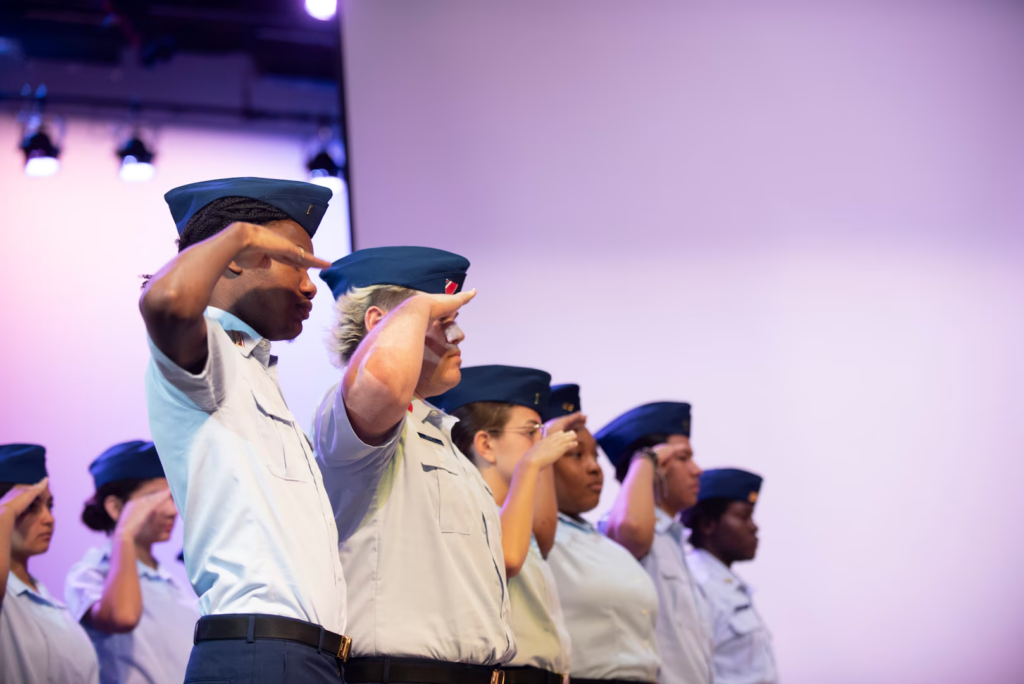
Rear Adm. Will Watson speaks at the commissioning ceremony for the first Coast Guard Junior Reserve Officer Training Corps unit in New England at Barnstable High School on Friday. (U.S. Coast Guard photo by Chief Petty Officer Richard Brahm) 

From U.S. Coast Guard 1st District, Oct. 25, 2024 

BOSTON — The Coast Guard and Barnstable High School conducted a commissioning ceremony for the first Coast Guard Junior Reserve Officer Training Corps (JROTC) in the New England area, Friday morning. 
 
The Coast Guard JROTC is a youth outreach program that instills the values of citizenship, service to the country, personal responsibility and a sense of accomplishment in students. 
 
During the event, Rear Adm. Will Watson, Coast Guard Director of Governmental and Public Affairs, talked about the program’s objectives, curriculum and the benefits it will offer to develop service-minded citizens of character. 
 
“The Coast Guard looks forward to this valuable partnership with Barnstable High School,” said Rear Adm. Will Watson. “We are eager to watch cadets grow from personal discipline and self-confidence to leadership and teamwork. The school’s unique values and strengths will elevate the heights to which the program and its cadets will climb.”   
 
In 1992, the Coast Guard established its first JROTC unit in Miami. Recent legislation mandated the Coast Guard to establish and maintain one JROTC unit in every Coast Guard District by 2025. 


Coast Guard Commissions Second Pacific Northwest-Based Fast Response Cutter 

Coast Guard Cutter Florence Finch (WPC 1157) moves closer to the pier before mooring in its new homeport of Astoria, Ore., Aug. 17, 2024. The Florence Finch will primarily serve in the Pacific Ocean, Puget Sound, Strait of Juan de Fuca, and the Columbia River. (U.S. Coast Guard photo by Petty Officer Will Kirk) 

From the U.S. Coast Guard 13th District, Oct. 24, 2024 

SEATTLE — The Coast Guard commissioned its 57th Fast Response Cutter during a ceremony held at Coast Guard Base Seattle, Thursday. 

Coast Guard Cutter Florence Finch (WPC-1157) is the second of three planned Fast Response Cutter’s (FRC) to be homeported in Astoria. 

The ceremony was presided by Coast Guard Rear. Adm. Charles Fosse, 13th District Commander. Members of the Finch family were also in attendance, including the cutter’s sponsor and Mrs. Finch’s daughter, Mrs. Betty Murphy. 

The cutters namesake, Florence Ebersole Smith Finch, was a Filipino-American and a member of the World War II resistance against the Japanese occupation of the Philippines. During the war, she assisted the movement by diverting fuel destined for enemy use, falsifying documents for resistance members to obtain supplies, and using her position to facilitate acts of sabotage. In 1944, she was discovered and arrested, tortured, tried, and sentenced to three years of imprisonment. She remained in captivity until early 1945, when American forces liberated the Philippines. 

Finch moved back to America following the war and joined the U.S. Coast Guard Reserves. Finch was awarded the Medal of Freedom in 1947 and was also awarded the Asiatic–Pacific Campaign Ribbon, the first woman to be so decorated. 

During the ceremony, Florence Finch was posthumously awarded the Congressional Gold Medal, which was presented to Finch’s family by retired Army Maj. Gen. Antonio Taguba, chairman of the Filipino Veterans Recognition and Education Project (FilVetREP). The Congressional Gold Medal is the highest civilian award given by the United States Congress. 

“Florence Finch is a true Coast Guard and Filipino hero, and we couldn’t be prouder to honor her legacy,” said Coast Guard Vice Adm. Andrew Tiongson, Pacific Area Commander. “The cutter is now the only currently active ship in the United States military named after a Filipino-American.” 

The crew of the Florence Finch will primarily operate in the Pacific Ocean, Puget Sound, Strait of Juan de Fuca, and the Columbia River. The Sentinel-class FRC is designed for multiple missions, including search and rescue; fishery patrols; drug and migrant interdiction; ports, waterways and coastal security; and national defense. 

The Coast Guard has ordered a total of 67 FRCs to replace the 1980s-era Island-class 110-foot patrol boats. The FRCs feature advanced command, control, communications, computers, intelligence, surveillance and reconnaissance equipment; over-the-horizon cutter boat deployment to reach vessels of interest; and improved habitability and seakeeping. 

The commissioning ceremony is one of the most important traditional milestones in the life of a cutter, as it represents the readiness of the cutter to conduct Coast Guard operations and marks her entry into active service. 

For more information on Florence Finch, please visit the Coast Guard history website: Florence Ebersole Smith Finch, USCGR > United States Coast Guard > All 


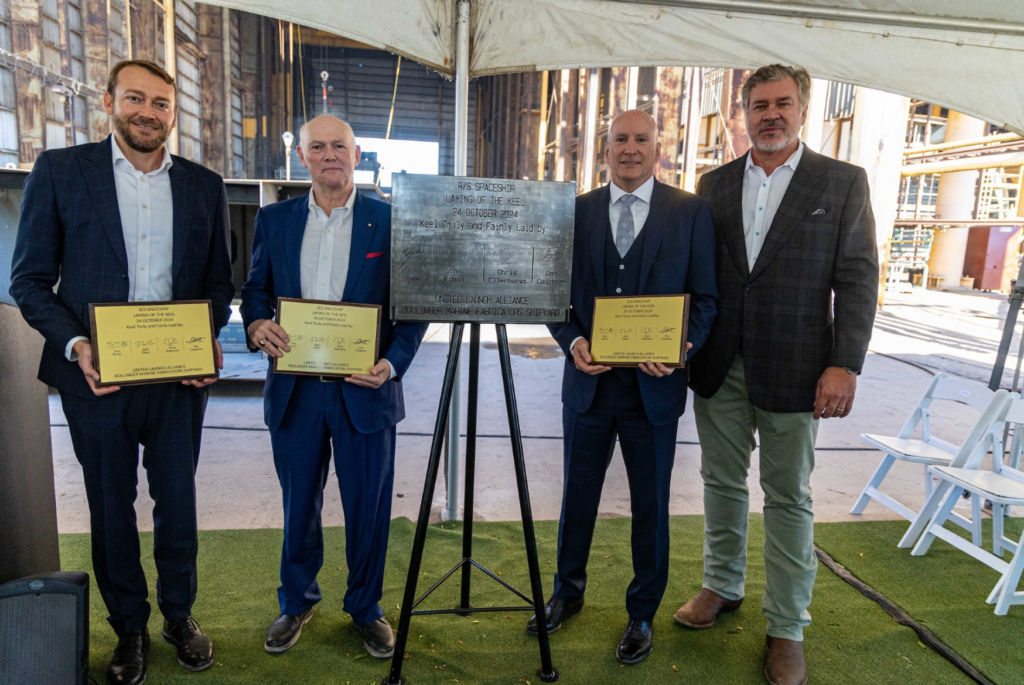
Bollinger Celebrates Construction of ULA R/S Spaceship with Keel-Laying Ceremony 

From Left to Right: Chris Ellerhorst, Vice President of the Kuiper Program, ULA; Tory Bruno, President and CEO, ULA; Dan Caughran, Vice President of Production Operations & Supply Chain, ULA; and Ben Bordelon, President and CEO, Bollinger Shipyards. 

SpaceShip to transport Vulcan rockets to launch sites in Florida and California 

AMELIA, La. — (October 24, 2024) – Joined by ULA President and CEO Tory Bruno and other ULA executives at Bollinger Marine Fabricators, Bollinger Shipyards (“Bollinger”) today officially laid the keel for the future R/S SpaceShip, a new ship to transport Vulcan rockets from the factory in Decatur, Alabama to the launch sites at Cape Canaveral Space Force Station in Florida and Vandenberg Space Force Base in California. This is the second transport vessel in ULA’s maritime fleet. 

“We’re proud to continue our partnership with ULA in support of their increasing capabilities and launch capacity,” said Ben Bordelon, President and CEO of Bollinger Shipyards. “Bollinger’s skilled workforce is second to none when it comes to designing, engineering and building complex vessels to meet the challenges of today and tomorrow, and we look forward to delivering SpaceShip to further ULA’s mission of enabling the future of space exploration.” 

The keel authenticators were Tory Bruno, President and CEO of ULA, Chris Ellerhorst, Vice President of the Kuiper Program at ULA, and Dan Caughran, Vice President of Production Operations & Supply Chain for ULA. 

“SpaceShip’s future voyages will transit rivers and seas, delivering powerful rockets to our launch pads and beyond, with that journey continuing literally into space,” said ULA President and CEO Tory Bruno.  “As all rockets are not created equal, the same is true for ships. Bollinger’s legacy of more than 75 years of excellence in shipbuilding is impressive and we are proud to partner with this very capable team.”  

ULA awarded Bollinger Shipyards a contract in December 2023 to build a second roll-on/roll-off vessel classed for both ocean-going and river service. Construction of the 356-ft-long ship is taking place at Bollinger Marine Fabricators in Amelia, Louisiana, with delivery to ULA expected in early 2026. 

ULA is expanding launch capacity in support of its customer Amazon’s Project Kuiper. ULA’s new Vulcan rocket is contracted for 38 launches to support the deployment for the Project Kuiper constellation, which will provide fast, affordable broadband service to unserved and underserved communities around the world. 

Vulcan is ULA’s next generation rocket, and it saw its successful inaugural launch in January 2024. Vulcan will provide high performance and affordability while continuing to deliver superior reliability and orbital precision for all our customers across the national security, civil and commercial markets. 

ABOUT ULA 

All rockets are not created equal. ULA is the nation’s most experienced, reliable and accurate launch service provider delivering unmatched value, a tireless drive to improve, and commitment to the extraordinary. Vulcan’s inaugural launch marked the beginning of a new era of space capabilities and provides higher performance and greater affordability while offering the world’s only high energy architecture rocket to deliver any payload, at any time, directly to any orbit. 


Carrier Strike Group Conducts Second Multi-Large Deck Event with Italian ITS Cavour CSG 

U.S. CENTRAL COMMAND AREA OF RESPONSIBILITY (Oct. 18, 2024) Abraham Lincoln Carrier Strike Group and the Italian Carrier Strike Group leadership pose for a group photo aboard the Italian aircraft carrier ITS Cavour (CVH 550). (Official U.S. Navy photo) 

By Abraham Lincoln Carrier Strike Group & Cavour Carrier Strike Group Public Affairs | October 24, 2024 

U.S. CENTRAL COMMAND AREA OF RESPONSIBILITY — The Abraham Lincoln Carrier Strike Group (CSG) conducted a Multi-Large Deck Event (MLDE) with the Italian Navy’s ITS Cavour CSG, Oct. 18. 

 MLDE provide the ships and aircrafts of the two naval forces, comprised of more than 7,500 U.S. and Italian Sailors and Marines, an opportunity to advance interoperability by carrying out integrated planning and coordination, communications, cross-deck leadership exchanges, a fast-roping exercise, and an air defense exercise to strengthen combined maritime operations and combat readiness. 

 “The opportunity to exercise our interoperability with our Cavour CSG counterparts for a second time in our deployment, highlights our strategic advantage inherent to our network of strong alliances,” said Rear Adm. Adan Cruz, commander, Carrier Strike Group (CSG) 3. “We have seized every opportunity to fly and sail with our Italian counterparts to deepen our combined operational capacity anywhere in international waters.”   

 During the event, Rear Adm. Giancarlo Ciappina, commander, Cavour Carrier Strike Group, hosted Cruz, aboard the ITS Cavour for a visit focused on building relationships. 

 ”We are proud to work once again alongside Lincoln Carrier Strike Group, after almost two months from our first interaction in the Pacific Ocean,” said Ciappina. “[It] has represented another precious opportunity to train together and to exchange experiences and knowledge, highlighting the versatility and flexibility of Navies operating on a global scale, wherever a presence is required to keep maritime lines of communication open and safe to strengthen our bonds and to enhance levels of cooperation with commitment to security.” 

This marks the second time the Abraham Lincoln CSG participated in an MLDE with the Italian Navy during the 2024 deployment. The previous event in August marked the first-ever MLDE between U.S. and Italian Navies in the Indo-Pacific. 

 Participating ships in the MLDE included Nimitz-Class aircraft carrier USS Abraham Lincoln (CVN 72), Integrated Air and Missile Defense Commander (IAMDC) USS Frank E. Petersen, Jr. (DDG 121), Arleigh Burke-class guided-missile destroyers USS O’Kane (DDG 77) & USS Michael Murphy (DDG 111), assigned to Destroyer Squadron 21, Italian aircraft carrier ITS Cavour (CVH 550), Italian Frigate ITS Alpino (F 594), and Italian Multipurpose Combat Ship Raimondo Montecuccoli (P 432). 

 Participating aircraft included MH-60S and MH-60R Sea Hawks, F/A-18E & F Super Hornets, E/A-18G Growlers, F-35C Lightning II, and E-2D Hawkeye, all assigned to Carrier Air Wing 9; and Italian F-35B Lightning II and AV-8B Harrier II assigned to Cavour CSG. 

 Cruz and Ciappina conducted a conditions check via virtual teleconference prior to the commencement to ensure all participants were ready, Oct. 17. The exercise started with personnel exchanges where key Abraham Lincoln CSG leadership toured Cavour and Italian officers toured the USS Abraham Lincoln.  USS O’Kane and ITS Raimondo Montecuccoli conducted a joint live-fire exercise, while the embarked U.S. explosive ordnance disposal team conducted a subject matter expert exchange and fast rope exercise with Italian counterparts. The event concluded with a complex air defense exercise involving both CSG’s tactical aircraft. 

 ”It is an honor to once again have the opportunity to work jointly with our NATO Allies,” said Cruz. “I am grateful to Rear Adm. Ciappina and his entire crew of the ITS Cavour for their gracious hospitality aboard their ship. I am also grateful to continue training and operating together to drive interoperability forward.” 

 Ciappina responded with his reflection on the MLDE. 

 ”I am very grateful to Adm. Cruz and to the whole crew of ABE CSG for their great effort and professionalism continuously shown during these challenging times for peace and international stability and that clearly confirm their strong commitment towards own common values, which are shared within the allied and partner Navies on a global scale,” concluded Ciappina. 

 The Abraham Lincoln Carrier Strike Group stands ready to successfully conduct any mission essential to U.S. National security, spanning combat operations to integrated maritime operations with our allies and partners to maritime security and stability in the U.S. Central Command area of responsibility. It also operates postured to deliver unfaltering maritime force to deter, defend, and if necessary, defeat coercive behavior from those who seek to challenge the rules-based international order. 

 The Abraham Lincoln Carrier Strike Group consists of USS Abraham Lincoln (CVN 72), embarked staffs of Carrier Strike Group (CSG) Three and Destroyer Squadron (DESRON) 21, squadrons of Carrier Air Wing (CVW) Nine, IAMDC USS Frank E. Petersen Jr. (DDG 121), and USS O’Kane (DDG 77), USS Spruance (DDG 111), and USS Michael Murphy (DDG 112). 

 CVW-9 consists of an F-35C squadron, the “Black Knights” of Marine Fighter Attack Squadron (VMFA) 314; three F/A-18E/F Super Hornet squadrons, the “Tophatters” of Strike Fighter Squadron (VFA) 14; “Black Aces” of Strike Fighter Squadron (VFA) 41, the “Vigilantes” of Strike Fighter Squadron (VFA) 151; “Wizards” of Electronic Attack Squadron (VAQ) 133, operating the EA-18G Growler; “Wallbangers” of Carrier Airborne Early Warning Squadron (VAW) 117, operating the E-2D Advanced Hawkeye; “Chargers” of Helicopter Sea Combat Squadron (HSC) 14 operating the MH-60S Sea Hawk; and “Raptors” of Helicopter Maritime Strike Squadron (HSM) 71, operating the MH-60R Sea Hawk. 


Senators Ask Administration to Assess Proposal to Address Submarine Production Delays 

Oct. 25, 2024 

WASHINGTON, D.C. – Today, U.S. Senator Tim Kaine (D-Virginia), Chair of the Senate Armed Services Subcommittee on Seapower, U.S. Senator Chris Murphy (D-Connecticut), and U.S. Senator Richard Blumenthal (D-Connecticut) led a bipartisan group of their colleagues in asking the Biden Administration to address funding shortfalls for submarine programs as they consider funding levels for Fiscal Year 2025. In two separate letters to Office of Management and Budget (OMB) Director Shalanda Young and Department of the Navy Secretary Carlos Del Toro, the lawmakers also urged the Administration to carefully assess the merits of the proposed Shipbuilder Accountability and Workforce Support (SAWS) agreement—which would restructure how the Navy pays for submarines—as a potential solution to address delays and get the programs back on track.  

While Congress has invested over $2.3 billion between 2018 and 2023 and an additional $3 billion this year as part of a national security supplemental in the nation’s submarine industrial base, the Virginia-class and Columbia-class submarine programs face significant delays and are expected to be over budget. The on-time completion of Virginia-class submarines, which are built in Virginia and Connecticut, is especially critical to the fulfillment of the Australia-United Kingdom-United States (AUKUS) trilateral partnership, through which the United States will sell at least two submarines to Australia to bolster security in the Indo-Pacific. 

In their letter to OMB Director Young, the members wrote, “The United States’ submarine programs provide our nation an undersea advantage that is critical to our national security… Based on the information available so far, the Shipbuilder Accountability and Workforce Support (SAWS) agreement strikes us as a promising approach to ensure our submarine industrial base rises to the occasion, accelerates submarine production, and fully meets the critical and building demand on U.S. shipyards… We request that you give all due consideration to this initiative, while ensuring it includes the accountability and leverage measures necessary to ensure our federal investments in submarine production go as far as possible in getting these critical programs on track.” 

In their letter to Secretary of the Navy Del Toro, the members wrote, “It is our understanding that over months of conversation Pentagon leadership, the Navy, and industry reached an agreement to maximize use of taxpayer funding for construction of the next tranche of Columbia-class and Virginia-class submarines – including by raising wages to attract and retain America’s skilled and organized shipyard workforce, addressing rising costs, and advancing much-needed infrastructure investments, all to improve program reliability and schedule.”  

“We therefore urge more consistent communication with Congress and with OMB so that all parties clearly understand the Navy’s position on SAWS and overall plans to get our nation’s submarine production on track,” they continued. “It is critical that our submarine programs be on schedule and on budget.” 

In addition to Kaine, Murphy, and Blumenthal, the letters were signed by U.S. Senators Jeanne Shaheen (D-New Hampshire), Angus King (I-Maine), Kevin Cramer (R-North Dakota), and Mark R. Warner (D-Virginia). 

The letter to OMB is available here. The letter to the Navy is available here


U.S. Navy Awards MEDUSA Contract to Advance Innovative Unmanned Technology 

By Program Executive Office Unmanned and Small Combatants (PEO USC) Public Affairs, Oct. 25, 2024 

WASHINGTON — The U.S. Navy competitively awarded a contract to General Dynamics Mission Systems Inc., to develop the Mining Expendable Delivery Unmanned Submarine Asset (MEDUSA) System. The contract underscores the Navy’s commitment to developing a manned-unmanned hybrid fleet to enhance operational effectiveness and mission agility across all maritime environments. 

MEDUSA is a mining system utilizing an expendable Unmanned Underwater Vehicle (UUV) that can be deployed from a submarine. It is a cutting-edge unmanned system designed to meet the Navy’s requirement for an advanced maritime mining system. The tasks under this contract include program management, design, systems engineering, fabrication, and testing and integration of the MEDUSA system for employment from Navy submarines. 

“The award of the MEDUSA contract represents our commitment to advancing unmanned technology and integrating it into Navy operations,” said Capt. Matthew Lewis, program manager of the unmanned maritime systems program office. “Innovation is critical to our national security and directly contributes to the readiness of our fleet. This contract enables us to invest in future operational capabilities and to push the boundaries of what we thought possible.” 

The base contract, currently valued at $15.9 million, will provide for program management, design, systems engineering, fabrication, testing and integration activities through September 2026. However, if contract options are exercised, work will continue through 2032 and the total contract value could reach $58 million. This strategic investment in unmanned technology is vital for maintaining maritime superiority and ensuring the readiness of our naval forces in an evolving security landscape. 

“MEDUSA is an exciting leap forward for our Navy, aligning with CNO’s updated NAVPLAN and the evolving nature of warfare,” said Rear. Adm. Kevin Smith, Program Executive Officer, Unmanned and Small Combatants. “This innovative mining system enhances our capabilities, allowing us to stay one step ahead in a rapidly changing environment. By empowering our warfighters with cutting-edge unmanned technology like MEDUSA, we’re ensuring they have the tools they need to thrive in complex situations and protect our interests at sea.” 

The Navy’s unmanned maritime systems program office is a part of the Program Executive Office Unmanned and Small Combatants portfolio, which designs, develops, builds, and delivers the Navy’s unmanned maritime systems; mine warfare systems; special warfare systems; expeditionary warfare systems; and small surface combatants. 


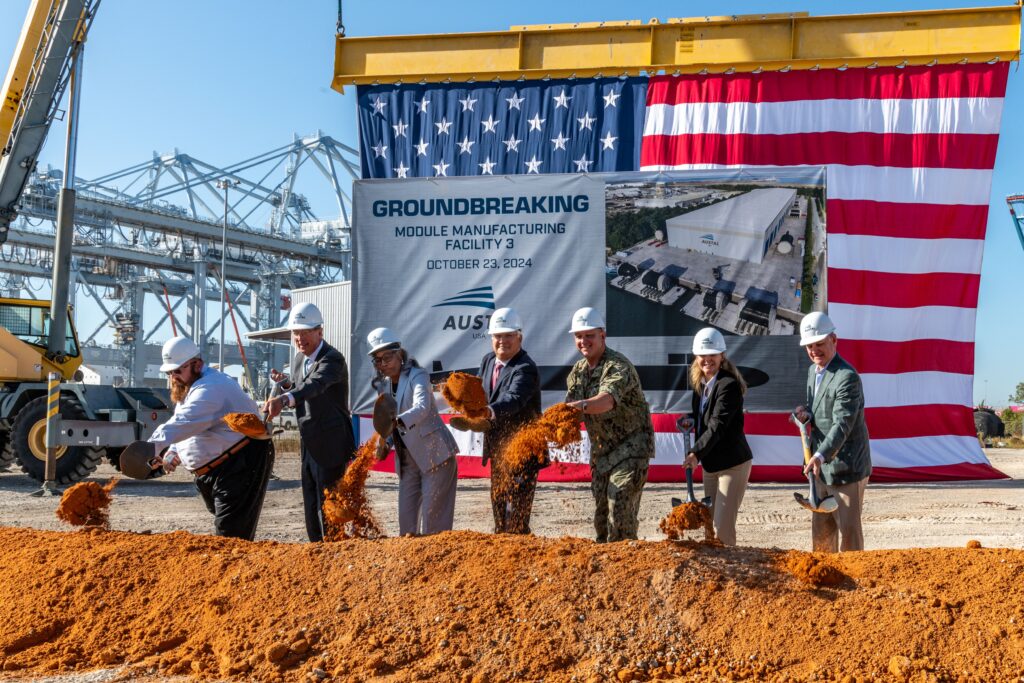
Austal USA Breaks Ground on New Manufacturing Facility for Submarine Modules 

From Austal USA 

Mobile, Ala. – Austal USA celebrated the start of construction for a new manufacturing facility for submarine modules (MMF3) today.  This new building, scheduled to be fully operational in late 2026, will significantly increase Austal USA’s capacity to support the U.S. Navy Submarine Industrial Base (SIB).  

The new building will provide 369,600 square feet of indoor manufacturing space purpose-built to manufacture submarine modules.  The production from this building will support the U.S. Navy’s goal of delivering one Columbia-class and two Virginia-class submarines annually.  It will include a material storage area, machine shop, assembly area, and waterfront improvements to support the shipment of the completed modules via barge.  

This project, combined with the recent groundbreaking for another manufacturing building, represent over $750M in expansion of Austal USA’s Mobile facility further solidifying Austal USA’s role as a major contributor to Alabama’s economy.  The two buildings, when fully operational, will add over 2,000 new jobs.  In 2023, Austal USA’s contracts were supported by 259 Alabama-based suppliers accounting for over $115 million of business.  This includes 185 small businesses, over 50 percent of the total spend. 

“Austal USA’s continued expansion in Mobile is a testament to Alabama’s growing leadership in the defense industry and our commitment to supporting our nation’s security needs,” Governor Kay Ivey said. “This new facility for submarine module manufacturing reinforces Austal’s vital role in delivering the advanced capabilities required by these vital submarine programs. The creation of 2,000 jobs and the investment in cutting-edge manufacturing technologies further demonstrates Austal’s dedication to both Alabama’s economy and our national defense.” 

“Austal USA is committed to supporting national security initiatives like the Navy’s Virginia and Columbia-class submarine programs, evidenced by our aggressive infrastructure and workforce expansion efforts,” commented Austal USA President Michelle Kruger.  “The key to our success is the strong partnerships we have built with not only our customers but also our employees and the amazing community surrounding us.  We are grateful for the unending support we continue to receive from the city and county of Mobile and the great state of Alabama.”  

In July Austal USA started construction on a new assembly building to enable the erection of large steel modules for Navy and Coast Guard ships, including the Offshore Patrol Cutter (OPC) and TAGOS-25 programs.  The building will occupy four and a half acres providing over 192,000 square feet of new indoor manufacturing space. This project will include a shiplift system that features an articulated lifting platform approximately 450 feet long by 125 feet wide. The shiplift will provide a safe and reliable system to launch ships as they are completed in the assembly buildings and will also enable bringing ships back on the land-side facility for repair and maintenance. 

Upon completion of these buildings, Austal USA’ s Mobile, Ala. ship manufacturing facility will include a 117,000 square-foot steel panel line, two module manufacturing facilities totaling over one million square feet of covered manufacturing space optimized for serial production, and seven assembly bays providing over 400,000 square feet of indoor erection space.  In all, the Mobile facility covers 180 acres and, when this project is complete, over 1.5 million square feet of indoor manufacturing space.  


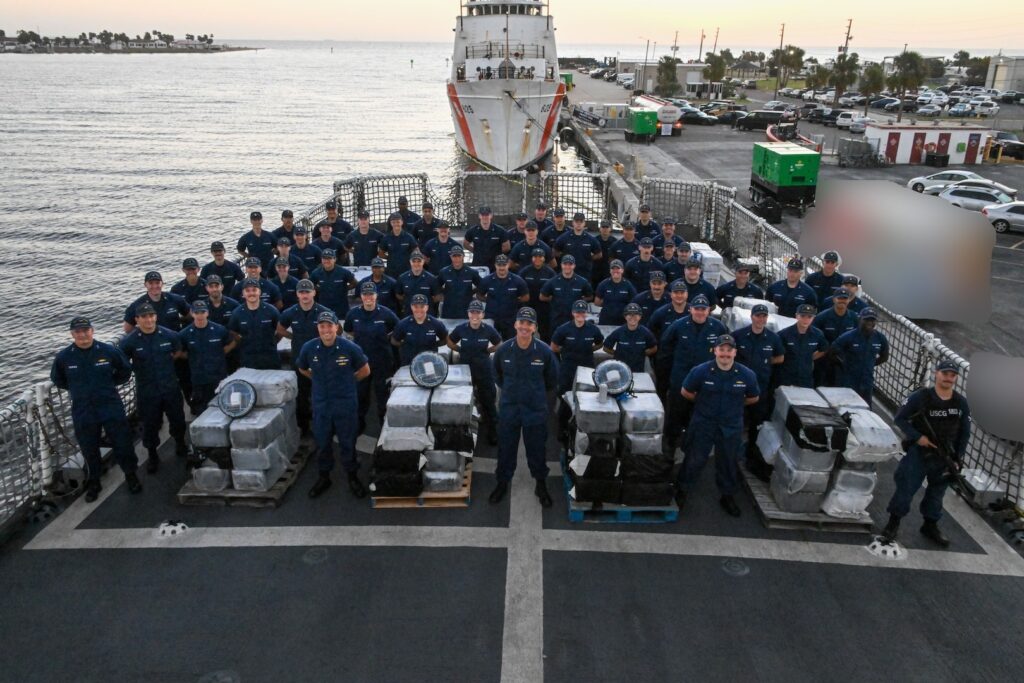
USCGC Resolute Crew Returns Home, Offloads $115M Worth of Drugs in St. Petersburg 

he crew of Coast Guard Cutter Resolute unload interdicted narcotics onto Sector St. Petersburg South Moorings, Florida, Oct. 23, 2024. (U.S. Coast Guard photo by Petty Officer 1st Class Riley Perkofski)

From Public Affairs Detachment Tampa Bay, Oct. 23, 2024 

ST. PETERSBURG, Fla. – The crew of U.S. Coast Guard Cutter Resolute offloaded approximately 9,690 pounds of cocaine and 5,490 pounds of marijuana, worth an estimated $115 million, in their homeport of St. Petersburg, Wednesday.   

In addition to the contraband, Resolute’s crew previously transferred five suspected smugglers ashore to face federal prosecution by the U.S. Department of Justice.   

Resolute’s crew deployed to the Caribbean Sea for 38 days in support of Joint Interagency Task Force-South (JIATF-South), an interagency and international task force that conducts counter-illicit trafficking and security cooperation operations in the Caribbean Sea and the Atlantic and Pacific Oceans. During their patrol, the Resolute crew was strategically positioned to deny drug trafficking organizations access to maritime smuggling routes from Central and South America to prevent harmful narcotics from reaching the United States.   

Early in the patrol, Resolute’s crew launched two small boat crews to pursue a go-fast vessel across 40 nautical miles of open ocean in six-foot seas. Despite the vessel’s significant horsepower, the Resolute crew worked with a Dutch aircraft to disrupt the go-fast vessel, forcing the smugglers to jettison their illicit contraband. Two weeks later, the Resolute crew located a suspicious sailing vessel traveling through the central Caribbean. During the late-night boarding, Resolute’s law enforcement boarding team discovered nearly 1,653 pounds of cocaine in a hidden compartment. The boarding team seized the contraband and detained the suspected smugglers onboard. The crew’s efforts in both cases prevented an estimated $58.1 million worth of contraband from reaching the United States.   

“Time and time again, the crew demonstrated their professionalism, cohesion and excellence in mission execution,” said Cmdr. Ian Starr, commanding officer of Resolute. “I am so incredibly proud of their efforts and their ability to achieve success in conditions where success is never guaranteed.”   

As part of the international partnerships under JIATF-South, the Resolute crew worked with the Royal Netherlands Navy ship HNLMS Holland and their embarked U.S. Coast Guard Law Enforcement Detachment 102 from Tactical Law Enforcement Team Pacific to transfer custody of seized contraband and suspected smugglers for future prosecution in the United States. Holland’s crew transferred more than 5,000 pounds of marijuana and 4,409 pounds of cocaine to Resolute, promoting diplomatic relations through the shared efforts to stem the flow of illegal narcotics through the Caribbean joint operating area.   

In support of Homeland Security Task Force-Southeast and Operation Vigilant Sentry, Resolute’s crew also worked with the crews of Coast Guard cutters William Trump and Reliance to interdict an overloaded and unseaworthy vessel with 181 migrants off the coast of Haiti. Resolute’s crew worked throughout the night to safely transport Haitian migrants to Coast Guard Cutter Reliance, allowing the crew to provide timely shelter and care to dozens of men, women and children.    

Resolute also conducted flight operations with an MH-65 Dolphin helicopter crew from Coast Guard Air Station Miami, successfully completing their Aviation Standardization Inspection. During the assessment, Resolute completed 30 helicopter evolutions including in-flight refueling, vertical replenishment and shipboard launch and recovery operations to enhance mission readiness.   

The Resolute crew was permitted to return home early to reunite with their families following the devastating impacts of Hurricane Helene, but almost as soon as they arrived, they went back underway again for storm avoidance before Hurricane Milton made landfall on the west coast of Florida. The Resolute crew provided offshore search and rescue support to Coast Guard Sector St. Petersburg in the wake of Hurricane Milton, along with Coast Guard Cutter Thetis and Coast Guard Cutter Pablo Valent.   

The fight against drug cartels in the Caribbean Sea and Eastern Pacific Ocean requires a unity of effort in all phases, from detection and monitoring to interdiction and apprehension, through criminal prosecutions by international partners and U.S. attorneys’ offices in districts across the nation. Joint Interagency Task Force-South in Key West, Florida conducts the detection and monitoring of aerial and maritime transit of illegal drugs. The law enforcement phase of operations in the Caribbean is conducted under the authority of the Seventh Coast Guard District, headquartered in Miami, and cases in the Eastern Pacific Ocean are conducted under the authority of the Eleventh Coast Guard District headquartered in Alameda, California. The interdictions, including the actual boardings, are led and conducted by members of the U.S. Coast Guard.   

These interdictions relate to Organized Crime Drug Enforcement Task Forces’ (OCDETF) Strike Force Initiatives and designated investigations. OCDETF identifies, disrupts, and dismantles the highest-level criminal organizations that threaten the United States using a prosecutor-led, intelligence-driven, multi-agency approach. Additional information about the OCDETF program can be found at https://www.justice.gov/OCDETF.  

Resolute is a 210-foot, Reliance-class medium endurance cutter homeported in St. Petersburg. The cutter’s primary missions are counter drug operations, migrant interdiction, enforcement of federal fishery laws, and search and rescue in support of U.S. Coast Guard operations throughout the Western Hemisphere. Resolute is under the command of U.S. Coast Guard Atlantic Area based in Portsmouth, Virginia. U.S. Coast Guard Atlantic Area oversees all Coast Guard operations east of the Rocky Mountains to the Arabian Gulf.  

For information on how to join the U.S. Coast Guard, visit GoCoastGuard.com to learn about active duty, reserve, officer, and enlisted opportunities. Information on how to apply to the U.S. Coast Guard Academy can be found here.