SECNAV Visits Georgia Tech Research Institute, Underscoring Commitment to Innovation and Collaboration

From SECNAV Public Affairs, 23 October 2024 

ATLANTA – Oct. 23, 2024 – The Secretary of the Navy Hon. Carlos Del Toro visited the Georgia Tech Research Institute today to highlight the vital role of research and development in maintaining naval dominance and warfighting excellence. The Secretary addressed Georgia Tech students and faculty, and Naval Reserve Officers Training Corps students from Georgia Tech, Spelman College and Morehouse College, emphasizing the importance of their contributions to national security.  

The Secretary’s visit underscored the Navy’s commitment to fostering strategic partnerships with academic institutions like Georgia Tech. GTRI, the applied research division of Georgia Tech, plays a crucial role in developing cutting-edge technologies for the Department of the Navy and the Department of Defense.  

“Georgia Tech is a powerhouse of innovation, and GTRI’s research is critical to ensuring our Sailors and Marines have the technological edge they need to prevail in any conflict,” said Secretary Del Toro. “The work being done here, particularly in areas like artificial intelligence, cyber-physical systems, and electromagnetic spectrum operations, is directly aligned with the Navy’s strategic priorities.”  

The Secretary highlighted GTRI’s contributions to the DON, including:  

Collaborative Research: GTRI works closely with the Office of Naval Research (ONR) and other DoD entities to address specific technological needs.  

R&D Contributions: GTRI develops advanced systems such as autonomous vehicles, millimeter wave radar technologies, and electronic warfare solutions.  

Prototyping and Testing: GTRI provides facilities for testing and validating new technologies to meet military specifications.  

Technology Transition: GTRI focuses on translating research outcomes into practical applications, enhancing operational capabilities for the Navy and broader defense community.  

The Secretary’s remarks also emphasized the importance of innovation in the face of evolving global challenges.  

“To win the fight of the future, we must embrace and implement emerging technologies,” said Del Toro. “We are in an innovation race, and it is one we must win.”  

The Secretary highlighted several DON innovation initiatives, including:  

The Naval Science and Technology Strategy: This strategy guides the Navy and Marine Corps’ investments in science and technology research.  

The Naval Innovation Center (NIC) at the Naval Postgraduate School: The NIC accelerates the innovation process by bringing research concepts out of the lab and into the field faster.  

The Department of the Navy’s Science and Technology Board: This board provides independent advice and counsel on matters relating to science, technology, and acquisition.  

The Disruptive Capabilities Office (DCO): The DCO identifies and implements already-available or emerging technologies to address the fleet’s capability gaps.  

“With today’s enemies developing more advanced technological threats, we are grateful that the Secretary of the Navy made time to visit our Atlanta Region NROTC Midshipmen,” said Atlanta Region NROTC Commanding Officer Capt. Jesus Rodriguez. “Our future Naval officers were provided with a once-in-a-lifetime opportunity when the Secretary personally impressed on them the importance of continued studies in science and technology. Our Midshipmen and NROTC staff are all appreciative for the opportunity to meet with and listen to our Navy’s leadership emphasize the importance of our students’ initiative in technological development during their Naval careers.”  

The Secretary concluded by issuing a call to action to the students in attendance.  

“Innovation must permeate every aspect of our department’s approach to deliver technologies and capabilities at a speed and scale necessary for our Navy and Marine Corps to confront the challenges of today and the future.”  

Read Secretary Del Toro’s remarks here


Coast Guard Cutter Mohawk Returns Home From 62-Day Migrant Interdiction Operations Patrol 

A Coast Guard Cutter Mohawk (WMEC 913) small boat crew rescues 25 migrants from a disabled vessel, Aug. 20, 2024, while underway in the Florida Straits. (U.S. Coast Guard photo by Ensign Brian Morel) 

From U.S. Coast Guard 7th District, Oct. 23, 2024 

KEY WEST, Fla. — The crew of Coast Guard Cutter Mohawk (WMEC 913) returned to their homeport of Key West, Oct. 11, following a 62-day migrant interdiction operations patrol in the Florida Straits. 

Mohawk’s crew deployed in support of Homeland Security Task Force – Southeast (HSTF-SE) and Operation Vigilant Sentry (OVS) while underway in the Seventh Coast Guard District’s area of responsibility. While on patrol, crew members worked alongside additional Coast Guard units and partner agency crews to detect, deter and intercept unsafe and illegal migrant ventures bound for the United States. 

While at sea, Mohawk crew members interdicted and rescued 41 migrants from unseaworthy vessels. Of these, Mohawk’s crew rescued 25 migrants aboard a single disabled vessel found taking on water in the Florida Straits on Aug. 20. Throughout the deployment, Mohawk cared for a total of 53 migrants, providing shelter, sustenance, hydration and medical care before conducting safe repatriation back to their country of origin. 

On Oct. 3, Mohawk’s crew conducted a rescue of four personnel stranded on the remote island of Cay Sal, Bahamas after their seaplane was disabled. Mohawk coordinated with a U.S. Navy P-8 Poseidon airplane and a Coast Guard Air Station Miami HC-144 Ocean Sentry airplane to vector in Mohawk’s small boat crew for the rescue. 

Most recently, the crew of Mohawk extended their deployment in response to the approach of Hurricane Milton. Mohawk sortied alongside other Key West-based Coast Guard cutters to avoid potential storm damage and ensure response readiness after the hurricane. Mohawk’s crew also conducted a tow of the Isaac Mayo during the sortie for several days of rough seas as the cutter was disabled due to scheduled maintenance. 

Of note, this patrol marked a significant historical event for the Coast Guard’s Famous-class medium endurance cutter fleet. Mohawk was the last in its class to fire the onboard Mk 75 mm gun weapon system. The largest caliber weapon in the Coast Guard inventory, it has been utilized by Famous-class cutters like Mohawk since they were first commissioned in the 1980’s. Now, large caliber weapon systems onboard Famous-class cutters are being modernized for a service life extension program. 

To successfully conduct the migrant interdiction mission, Mohawk partnered with U.S. Customs and Border Protection – Air and Marine Operations air and boat crews as well as additional Coast Guard units to include Coast Guard Cutters Charles Sexton (WPC 1108), Raymond Evans (WPC 1110), Isaac Mayo (WPC 1112), Maple (WLB 297), Coast Guard Station Key West, Coast Guard Sector Key West and Coast Guard Air Station Miami. 

“Outstanding work by the Mohawk crew. I am very proud of our ability to secure our nation’s maritime borders while maintaining the safety of life at sea,” said Cmdr. David Ratner, commanding officer of Mohawk. “We understand the importance of deterring unlawful and dangerous maritime migration attempts on often overloaded and unseaworthy vessels. One such vessel with 25 migrants on board was disabled with insufficient fuel to make it to land and was taking on water.” 

Mohawk is a 270-foot, Famous-class medium endurance cutter with a crew of 100. The cutter’s primary missions are counter-drug and migrant interdiction operations, enforcement of federal fishery laws as well as search and rescue in support of Coast Guard operations throughout the Western Hemisphere. Mohawk falls under the command of U.S. Coast Guard Atlantic Area, which is based in Portsmouth, Virginia. U.S. Coast Guard Atlantic Area oversees all Coast Guard operations east of the Rocky Mountains to the Arabian Gulf. 

For information on how to join the U.S. Coast Guard, visit GoCoastGuard.com to learn about active duty and reserve, officer and enlisted opportunities. Information on how to apply to the U.S. Coast Guard Academy can be found here.  


US, Australian Naval Forces Conduct Bilateral Operations

BAY OF BENGAL (Oct. 20, 2024) – Royal Australian Navy Communication Information Systems Specialist Able Seaman Karl Jamieson (left), from Albany, Australia, talks with U.S. Navy Information Systems Technician Caleb Jones, from Phoenix, on a missile deck aboard the Arleigh Burke-class guided-missile destroyer USS Dewey (DDG 105) while operating in the Bay of Bengal, Oct. 20, 2024. (U.S. Navy photo by MC1 Greg Johnson) 

By MC1 Gregory Johnson. Oct. 24, 2024 

STRAIT OF MALACCA  –  The U.S. Navy (USN) and Royal Australian Navy (RAN) conducted bilateral operations in support of a free and open Indo-Pacific in the Strait of Malacca, Oct. 20-23. 
 
Participating ships included the USN Arleigh Burke-class guided-missile destroyer USS Dewey (DDG 105) and the RAN Anzac-class frigate HMAS Stuart (FFH 153). The two ships took part in exercise Malabar 2024 earlier in October. 
 
“This exercise further builds on our existing interoperability and combined readiness we have with the Royal Australian Navy,” said Vice Adm. Fred Kacher, commander, U.S. 7th Fleet. “Every time we operate together, we strengthen our capabilities and shared commitment to a free and open Indo-Pacific.” 
 
Over four days, the ships engaged in a formation sailing exercise, an air defense exercise, maritime communications training, personnel cross-decks and visit, board, search and seizure drills. 
 
“Conducting a joint sail with USS Dewey has been of great value, with multiple different activities conducted between the ships, including personnel exchange, boarding practices, manoeuvring in close company, and warfare drills,” said Cmdr. Warren Bechly, commanding officer, HMAS Stuart. “Whether it is large scale exercises, or ships in transit between the same ports, working with our allies and partners is always a valuable opportunity to build closer ties and enhance interoperability.” 
 
The U.S. Navy regularly operates alongside our allies in the Indo-Pacific region as a demonstration of our shared commitment to the rules-based international order. 
 
Bilateral operations such as this one provide valuable opportunities to train, exercise and develop tactical interoperability across allied navies in the Indo-Pacific. 
 
Dewey is forward-deployed and assigned to Destroyer Squadron (DESRON) 15, the Navy’s largest DESRON and the U.S. 7th Fleet’s principal surface force. 
 
U.S. 7th Fleet is the U.S. Navy’s largest forward-deployed numbered fleet, and routinely interacts and operates with allies and partners in preserving a free and open Indo-Pacific region. 


Navy’s Third Operational F-35C Lightning II Squadron Achieves Safe For Flight Certification

An F-35C Lightning II from VFA-86 performs a touch and go aboard USS Nimitz (CVN 68) in the Pacific Ocean. (U.S. Navy photo by MC2 Carson Croom) 

From Lt. John Choi, Oct. 23, 2024 

VFA-86 has earned a Full Safe for Flight certification on the F-35C. 

The F-35C enhances the carrier strike group’s ability to project power, supporting U.S. national security and integrating seamlessly with other carrier air wing assets. 

“I couldn’t be more proud of the Winder Team for this achievement,” said Cmdr. Nathan Staples, VFA-86 Commanding Officer. “Our team has excelled since the transition began in February 2023, and I look forward to our future achievements and the standards we set for the Lightning II community.” 
 
The squadron’s transition from the F/A-18, flown for 36 years, began in September 2023. Nearly 200 personnel completed training at Eglin AFB, Fla., and NAS Lemoore, while nine pilots finished their flight syllabus with VFA-125, the Navy’s F-35C Fleet Replacement Squadron, while simultaneously executing tactical training events with Naval Aviation Warfighting Development Center and TOPGUN. 
 
After achieving several key milestones, including a perfect score on the Conventional Weapons Technical Proficiency Inspection and the highest Maintenance Program Assist inspection score, VFA-86 earned Interim Safe for Flight certification in June 2024. In July, they conducted their first embarked operations aboard USS Nimitz (CVN 68), culminating in Full Safe for Flight certification. 
 
“Our success is due to proactive management, engaged leadership, and a can-do attitude,” said AFCM Rich Brickey, VFA-86 Maintenance Master Chief. “Our Sailors have excelled in every metric and will continue to do so whenever called upon.” 
 
Established in 1951, VFA-86 has flown nine different aircraft and supported combat operations in Vietnam, Bosnia, Iraq, Afghanistan, and Syria. As the Navy’s newest F-35C squadron, the Sidewinders remain committed to their motto: “When diplomacy fails… 86 ’em!” 


Coast Guard Offloads $3.5M in Seized Cocaine, Transfers Smugglers to Puerto Rico

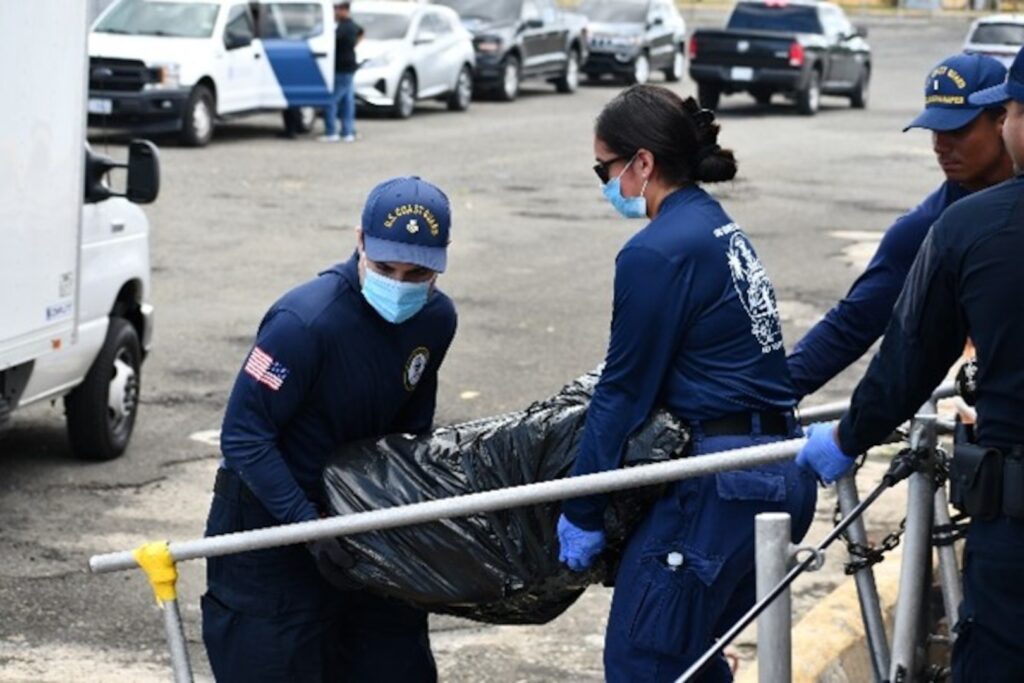
Coast Guard Cutter Joseph Napier crewmembers offload 664 pounds (301 kgs) of seized cocaine and transfer custody of six smugglers to Coast Guard Investigative Service and FBI Special Agents in Mayaguez, Puerto Rico, Oct. 19, 2024. (U.S. Coast Guard photo) 

From U.S. Coast Guard 7th District, Oct.22, 2024 

SAN JUAN, Puerto Rico — The crew of the Coast Guard Cutter Joseph Napier offloaded 664 pounds (301 kgs) of seized cocaine and transferred custody of six smugglers to Coast Guard Investigative Service and FBI Special Agents in Mayaguez, Puerto Rico, Saturday. 

The interdiction is the result of multi-agency efforts in support of the Caribbean Corridor Strike Force, while the seized cocaine is estimated to have a wholesale value of approximately $3.5 million.  

The apprehended smugglers are facing federal prosecution in Puerto Rico on criminal charges including conspiracy to possess with intent to distribute a controlled substance aboard a vessel subject to the jurisdiction of the United States. The charges carry a minimum sentence of 10 years imprisonment and a maximum sentence of imprisonment for life.  Special Assistant U.S. Attorney Helena B. Daniel and Maria L. Montañez, Deputy Chief of the Transnational Organized Crime Section are prosecuting the case. 

During the afternoon of October 13, 2024, the crew of a Coast Guard HC-144 Ocean Sentry aircraft detected a suspicious 25-foot go-fast vessel in international waters north of Dorado, Puerto Rico.  Coast Guard watchstanders in Sector San Juan diverted the cutter Joseph Napier to interdict the suspect vessel. A Customs and Border Protection Air and Marine multi-role enforcement aircraft also responded and maintained aerial surveillance of the suspect vessel. Once on-scene, the cutter Joseph Napier crew launched the cutter’s Over the Horizon boat to stop the suspect vessel. During the pursuit, the passengers aboard the suspect vessel were observed jettisoning suspected contraband cargo overboard. Shortly thereafter, the cutter boat crew stopped the go-fast vessel. Following the interdiction, cutter Joseph Napier’s crew recovered six bales and a single package of the jettisoned cargo which tested positive for cocaine. The six persons onboard the vessel were apprehended. 

“This successful narcotics interdiction highlights the importance of interoperability with our Caribbean Corridor Strike Force and Caribbean Border Interagency Group partners.”  said Lt. Matthew Carmine, Coast Guard Cutter Joseph Napier’s commanding officer. “I am humbled by the professionalism and seamless coordination between multiple Coast Guard units including, Station San Juan, Air Station Miami, TACLET South, Sector San Juan Boarding Team, in conjunction with our interagency partners from Customs and Border Protection – Air and Marine Operations. Everyday my crew and I are proud to stand the watch alongside our Department of Homeland Security partners as we continue to relentlessly combat drug trafficking and illegal migration throughout the waters of Puerto Rico and the U.S. Virgin Islands.”   

This interdiction, seizure and prosecution is part of an Organized Crime Drug Enforcement Task Forces (OCDETF) Strike Force Initiative, which provides for the establishment of permanent multi-agency task force teams that work side-by-side in the same location. This co-located model enables agents from different agencies to collaborate on intelligence-driven, multi-jurisdictional operations to disrupt and dismantle the most significant drug traffickers, money launderers, gangs, and transnational criminal organizations. The specific mission of the Caribbean Corridor Strike Force (CCSF) is to identify, disrupt, and dismantle Transnational Criminal Organizations. The CCSF is comprised of agents and officers from the Drug Enforcement Administration, Federal Bureau of Investigation, United States Immigration and Customs Enforcement, Homeland Security Investigations, United States Coast Guard Investigative Service, and United States Marshals Service, and prosecution is being led by the Office of the United States Attorney for the District of Puerto Rico. 

U.S. Coast Guard Cutter Joseph Napier is 154-foot fast response cutter homeported in San Juan, Puerto Rico. 


SECNAV Names Future SSN 813 for Atlanta 

From SECNAV Public Affairs, 23 October 2024 

ATLANTA (Oct 23, 2024) – Secretary of the Navy Carlos Del Toro announced that the future Virginia-class Nuclear-Powered Attack Submarine SSN 813 will be named USS Atlanta. Del Toro made the announcement during a ship naming ceremony at the Jimmy Carter Presidential Library and Museum, in Atlanta, on Oct. 23. 

The future USS Atlanta honors the city of Atlanta, and the crews of the five previous Navy vessels named Atlanta.

The naming selection of the future USS Atlanta (SSN 813) continues the trend of naming Virginia-class submarines after cities. Secretary Del Toro previously named USS Long Island (SSN 809), USS San Francisco (SSN 810), USS Miami (SSN 811), and USS Baltimore (SSN 812). 

“The city of Atlanta shares a storied and historic relationship with our Navy. Since the founding of our great nation, Atlantans from all walks of life have answered the call to service, including President Jimmy Carter, who helped advance our nuclear submarine program alongside Admiral Rickover, “the Father of the Nuclear Navy,” said Del Toro. “It has been 25 years since the Navy has had a ship named after the proud legacy of the city of Atlanta. Today, it is my honor and privilege to name the next Virginia-class submarine, SSN 813, USS Atlanta.” 

Congresswoman Nikema Williams, from Georgia’s 5th Congressional District joined Secretary Del Toro for the ceremony honoring Atlanta. 

“The naming of this ship is a testament to Atlanta’s history as the cradle of the civil rights movement,” said Williams. “As this vessel sails across the globe, it will carry with it the legacy of civil and human rights leaders like Congressman John Lewis and President Jimmy Carter, embodying Atlanta’s unbreakable spirit and the fight for justice that continues today.” 

Atlanta Mayor Andre Dickens also served as a guest in the official party and highlighted the honor and meaning behind the naming of the Navy’s newest submarine.   

 “Thank you, Secretary Del Toro for allowing Atlanta to take its place among the great American cities with namesake vessels,” said Dickens. “We envision the future USS Atlanta sailing and submerging as a testament to some of the same values that this city holds…protecting this nation with courage and strength. 

Secretary Del Toro also named the ship sponsor at the ceremony, former Atlanta Mayor Keisha Lance Bottoms. 

 “The ship’s sponsor fills a vital role throughout the life of a warship, serving as the bond between the ship, her crew, and the nation they serve,” said Del Toro. ”I am honored that Mayor Bottoms accepted the invitation to serve as ship sponsor. As a leader and champion for the people of Atlanta, she represents the best of our nation, and I thank her for her lifelong commitment to our Navy, to our service men and women, and to the United States of America.” 

The city of Atlanta has strong ties to American history. Founded in 1836, the city (originally named Terminus) was incorporated as Atlanta in 1847. Following its destruction in the Civil War, Atlanta rapidly rebuilt, became the state capital in 1868, and is now an important center of industry, finance, and transportation. The greater Atlanta region was home to Naval Air Station Atlanta (1943-2009) and hosted squadrons from Reserve Carrier Air Wing 20, and Marine Aircraft Group 42. 

The first Atlanta, a screw gunboat (1858-1859) was renamed Sumpter after commissioning. The second, a protected cruiser (1886-1912) primarily served in the Atlantic Ocean and Gulf of Mexico and as a barracks ship. The third Atlanta (CL-51), a light cruiser (1941-1942), screened Task Force 16 carriers Enterprise and Hornet during the Battle of Midway, supported the Guadalcanal campaign in July and August, and defended Enterprise at the Battle of the Eastern Solomons on 24 August 1942. From 12-13 November 1942, Atlanta took part in the Naval Battle of Guadalcanal, during which she helped sink the Japanese destroy Akatsuki, and later received the Presidential Unit Citation and the embarked Flag Officer, Rear Admiral Norman Scott, was awarded a posthumous Medal of Honor. Suffering extensive torpedo damage, she was scuttled. The fourth Atlanta (CL 104), a light cruiser (1944-1970) served off Japan with the Fast Carrier Task Force where she conducted shore bombardment missions. The fifth Atlanta (SSN 712), a nuclear fast attack submarine (1982-1999), homeported in Norfolk, VA, completed multiple deployments and fleet readiness exercises during the Cold War before being decommissioned. 


Attack submarines are designed to seek and destroy enemy submarines and surface ships; project power ashore with Tomahawk cruise missiles and Special Operation Forces (SOF); carry out Intelligence, Surveillance and Reconnaissance (ISR) missions; support battle group operations; and engage in mine warfare.


Navy Warfare Center Drives First Naval Strike Missile Launch Demo from Destroyer

USS Fitzgerald (DDG 62) conducts the first demonstration firing of a Naval Strike Missile from a U.S. Navy destroyer during RIMPAC. 

From Thomas McMahon, Oct. 23, 2024 

PORT HUENEME, California – Among the flurry of fleet activities in the recent Rim of the Pacific (RIMPAC) exercise in Hawaii was a milestone that Naval Surface Warfare Center, Port Hueneme Division (NSWC PHD) spearheaded — the first demonstration firing of a Naval Strike Missile (NSM) from a U.S. Navy destroyer. 

USS Fitzgerald (DDG 62) fires the first naval strike missile from a U.S. destroyer while participating in RIMPAC 2024. (MC2 Jordan Jennings) 

 Working under a compressed timeline, NSWC PHD and its partners installed the first Over-the-Horizon (OTH) Weapon System on a destroyer, USS Fitzgerald (DDG 62), in time for it to launch an NSM at a decommissioned ship on July 18 during RIMPAC. 
 
Other major players in the effort included Program Executive Office Integrated Warfare Systems (PEO IWS) 3H, Naval Air Warfare Center Weapons Division (NAWCWD) China Lake, General Dynamics Mission Systems and Kongsberg Defence & Aerospace AS. 
 
“This was a high-visibility requirement for the Navy,” said Eric Romero, customer advocate for OTH with NSWC PHD in Port Hueneme, California. 
 
OTH is a long-range surface-to-surface warfare system that launches NSMs, which are anti-ship guided missiles. The Navy has added the system to about a dozen Independence-variant littoral combat ships over the past five years. 
 
In late September 2023, the Office of the Chief of Naval Operations challenged PEO IWS, which in turn tasked NSWC PHD, with installing an OTH on Arleigh Burke-class destroyer USS Fitzgerald in time to demonstrate it at RIMPAC 2024. That left only about nine months before the biennial international fleet exercise. 
 
“We knew we were working on an aggressive schedule, but we had all the right personnel on the team to make sure we were successful in executing it,” Romero said. 
 
NSWC PHD employees took on various projects to pull off the endeavor at this accelerated pace, from developing ship installation drawings to getting cybersecurity approval to installing and testing the equipment. 
 
The overall effort encompassed nearly 20 organizations, including five program offices, four warfare centers and a dozen external entities, according to Todd Jenkins, platform integration lead with NSWC PHD in San Diego. 
 
“We were expecting a great deal of roadblocks due to the compressed timeline, but everyone came together to accomplish this monumental event,” Jenkins said. 
 
Typically, this type of first-of-class installation takes at least two years, according to Robert “Tony” Honeycutt, Alteration Installation Team manager at NSWC PHD’s Virginia Beach Detachment in Virginia. A key factor in speeding up the process was proposing the OTH as a temporary change to USS Fitzgerald, which reduced the requirements for documentation and drawings compared to a permanent change. 
 
Beyond streamlining the paperwork, Honeycutt and Jenkins met frequently with stakeholders from PEO IWS 3H and NAWCWD China Lake to overcome obstacles and stay on schedule. 
 
“Basically, we were just driving it as hard as we could,” Honeycutt said. “As soon as we ran into a problem, we had a group powwow and figured out the solution.” 
 
Another task that the team sped up was securing the cybersecurity accreditation known as authority to operate (ATO) for the OTH software that would be installed on the ship. The rigorous six-step process typically takes about a year, but in this case it had to be completed much quicker so the installation could start. 
 
“We had to do the cyber ATO in two months,” Romero said. 
 
The team installed the OTH on USS Fitzgerald at Naval Base San Diego from mid-March to late May. The main components of the system are the launcher and an operator interface console. To make it compatible with the destroyer, the system also required a navigation adapter. 
 
After installing the OTH, NSWC PHD trained crew members and helped them test the system while underway. 
 
“We made sure they were trained up, such as to be self-sustaining as operators,” Romero said. 
 
In Hawaii for RIMPAC in July, USS Fitzgerald participated with other ships and aircraft in a sinking exercise, known as a SINKEX. The target was a decommissioned amphibious ship about 50 nautical miles off the coast of Kauai. 
 
With NSWC PHD team members monitoring remotely, USS Fitzgerald launched its first NSM from the OTH. The NSM successfully searched the target area, detected and prosecuted the target. 
 
“It was a successful NSM live-fire shot launched from the OTH Weapon System,” Romero said. 
 
Following the inaugural firing at RIMPAC, NSWC PHD personnel will help prepare USS Fitzgerald to go on deployment with the OTH. 
 
While the new weapon system is still authorized as a temporary installation on USS Fitzgerald, the team is working to secure approval for it to stay on the ship indefinitely. 
 
“We’re migrating the ship change document to a permanent change, as we want to keep the system aboard DDG 62,” Romero said. 
 
The work done on DDG 62 will help inform the way forward on providing this capability to other DDGs. 


Philly Shipyard Delivers Second National Security Multi-Mission Vessel, Patriot State 

Program designed to provide state-of-the-art training vessels to five state maritime academies 

From Philly Shipyard, Sept. 26, 2024 

PHILADELPHIA — September 26, 2024 — Philly Shipyard, Inc. (“Philly Shipyard”), the sole operating subsidiary of Philly Shipyard ASA (Oslo: PHLY), today delivered the Patriot State, the second of five new purpose-built, state-of-the-art training vessels for America’s state maritime academies. The U.S. Department of Transportation’s Maritime Administration (MARAD) new vessel program – known as National Security Multi-Mission Vessels (NSMVs) – was designed to provide world-class training for America’s future mariners and to support humanitarian assistance and disaster relief missions in times of need. This second vessel, Patriot State, is being delivered to MARAD and will serve Massachusetts Maritime Academy. 

“We stand tall and proud as we wave goodbye to the Patriot State.” said Steinar Nerbovik, President and CEO of Philly Shipyard. “It is the second NSMV to be delivered in the program, and the journey to Massachusetts brings well-deserved recognition and excitement for the future of the vessel, the entire NSMV program, and our shipyard. Our workforce has dedicated much time and skill to ensuring a safe at-sea experience for the cadets and crew and a dependable learning environment for all future mariners.” 

Philly Shipyard was awarded the contract to build the NSMVs by TOTE Services, LLC (“TOTE Services”), a U.S.-based company hired by MARAD as the Vessel Construction Manager (VCM) to oversee the construction of the training vessels. The NSMV program is the first government sponsored ship building program to utilize the VCM model. This model places the responsibility for the selection and oversight of the shipyard on a government contractor that utilizes commercial best practices to manage the project. 

NSMV I, Empire State, was delivered in September 2023 to serve SUNY Maritime College. NSMV III (Maine Maritime Academy) and NSMV IV (Texas A&M Maritime Academy) are both under construction in Philly Shipyard’s outfitting and building docks, respectively. NSMV III is scheduled for delivery in 2025. The steel cutting for NSMV V (California Maritime Academy) was completed earlier this year, placing all remaining vessels in various stages of production at Philly Shipyard. 

“The Patriot State is the second of five NSMVs that TOTE Services is managing in partnership with Philly Shipyard. These vessels are a vital investment in the future of maritime in the U.S. and showcase the potential that arises when we utilize the right expertise and resources for the benefit of our country and future generations. TOTE Services’ role as the vessel construction manager for these ships highlights its 49-year legacy as a leader in American maritime,” commented Jeff Dixon, President of TOTE Services. 

The NSMV program is an important investment in America’s shipbuilding industry, which supports nearly 400,000 U.S. jobs. Each NSMV will feature numerous instructional spaces, a full training bridge, and accommodations for up to 600 cadets to train in a first-rate maritime academic environment at sea. State maritime academies graduate more than half of all new officers each year — the merchant mariners who help keep cargoes and our economy moving. Many also support U.S. national security by crewing military sealift vessels. 

Today’s delivery of the Patriot State marks an important milestone for the NSMV program as well as the VCM contract model. This innovative approach enables shipyards to apply commercial best practices for design and construction to government vessels. There is growing interest in the VCM contract model and its potential applicability to government shipbuilding programs to reduce costs, accelerate delivery times, and build more vessels. 

About the National Security Multi-Mission Vessel (NSMV) Program 

The U.S. Department of Transportation Maritime Administration’s (MARAD) NSMV program is designed to provide a purpose-built, state-of-the-art training platform for the state maritime academies in New York, Massachusetts, Maine, Texas, and California, respectively. 

This next-generation training fleet will address a critical shortage of qualified officers necessary to crew government and commercial owned sealift ships. In addition to providing world-class training for America’s future mariners, the NSMVs will be available to support humanitarian assistance and disaster relief missions in times of need. 

The NSMV will feature numerous instructional spaces, a full training bridge, and have space for up to 600 cadets to train in a first-rate maritime academic environment at sea. State maritime academies graduate more than half of all new officers each year—the merchant mariners who help keep cargoes and our economy moving. Many also support U.S. national security by crewing military sealift vessels. 

In addition to being a state-of-the-art training and educational platform, each ship will feature modern hospital facilities, a helicopter pad, and the ability to accommodate up to 1,000 people in times of humanitarian need. Adding to the NSMV’s capability, it will provide needed roll-on/roll-off and container storage capacity for use during disaster relief missions. 

Ship specifications will be compatible with the pier length, draft restrictions, and mooring limitations at each of the maritime training academies. 

Vessel specifications: 

  • Length: 159.85 m 

  • Breadth: 27.00 m 

  • Draft, scantling: 7.50 m 

  • Total berthing: 760 people 

  • Speed: 18 kts 

  • Deadweight: 8,487 MT 


Navy Announces Commissioning Ceremony for the Future USS Beloit

From Karli Yeager, Commander, Naval Surface Force, U.S. Pacific Fleet Public Affairs 

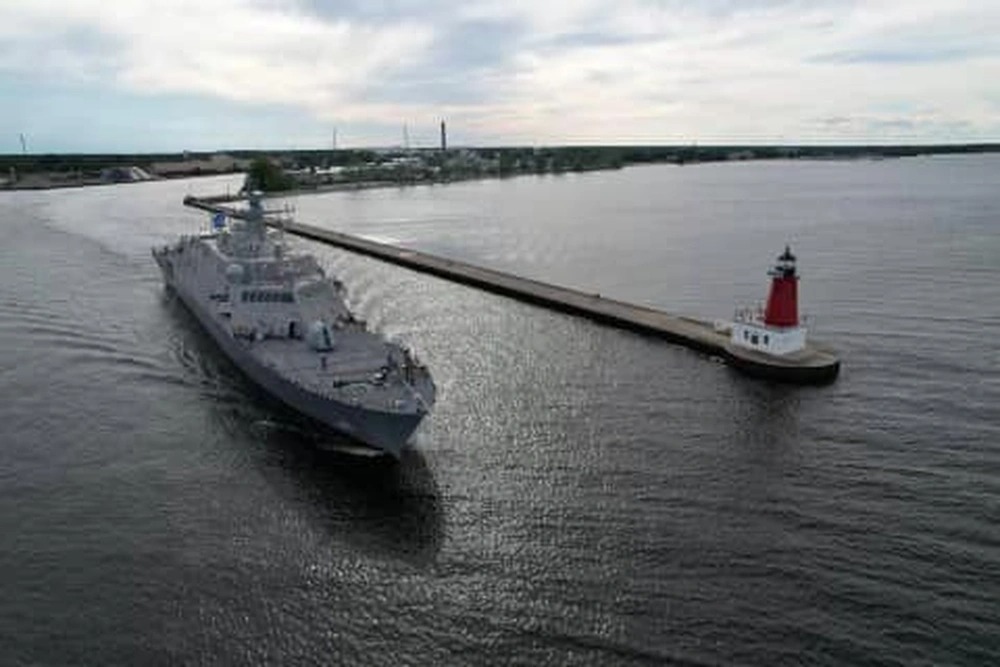
The U.S. Navy will commission the future USS Beloit (LCS 29), a Freedom-variant littoral combat ship, on Nov. 23, 2024, in Milwaukee, Wisconsin. 

LCS 29 will be the first commissioned ship in naval service bearing the name of Beloit, Wisconsin. 

The naming of LCS 29 honors the contributions the people of Beloit have made to the U.S. Navy, such as the Fairbanks Morse plant, which built engines that power many of the Navy’s ships and submarines, including USS Beloit. 

As the ship’s sponsor, retired Army Maj. Gen. Marcia M. Anderson will lead the time-honored Navy tradition of giving the order during the ceremony to “Man our ship and bring her to life!” At that moment, the commissioning pennant is hoisted, and the Beloit becomes a proud ship of the fleet. 

Following its commissioning, the Beloit will depart Milwaukee for its homeport assignment of Naval Station Mayport in Jacksonville, Florida. 

The future USS Beloit (LCS 29) commissioning ceremony will be livestreamed at www.dvidshub.net/webcast/35146. The webcast will begin at 9:45 a.m. EST and the ceremony begins at 10 a.m. EST, Nov. 23. 

LCS 29 is a fast, optimally manned, mission-tailored surface combatant that operates in near-shore and open-ocean environments, winning against 21st-century coastal threats. Littoral Combat Ships integrate with joint, combined, manned, and unmanned teams to support forward presence, maritime security, sea control, and deterrence missions around the globe. 

The mission of CNSP is to man, train, and equip the Surface Force to provide fleet commanders with credible naval power to control the sea and project power ashore. 


15th MEU H-1 Det Conducts Live-Fire Training from USS Miguel Keith in the Indo-Pacific 

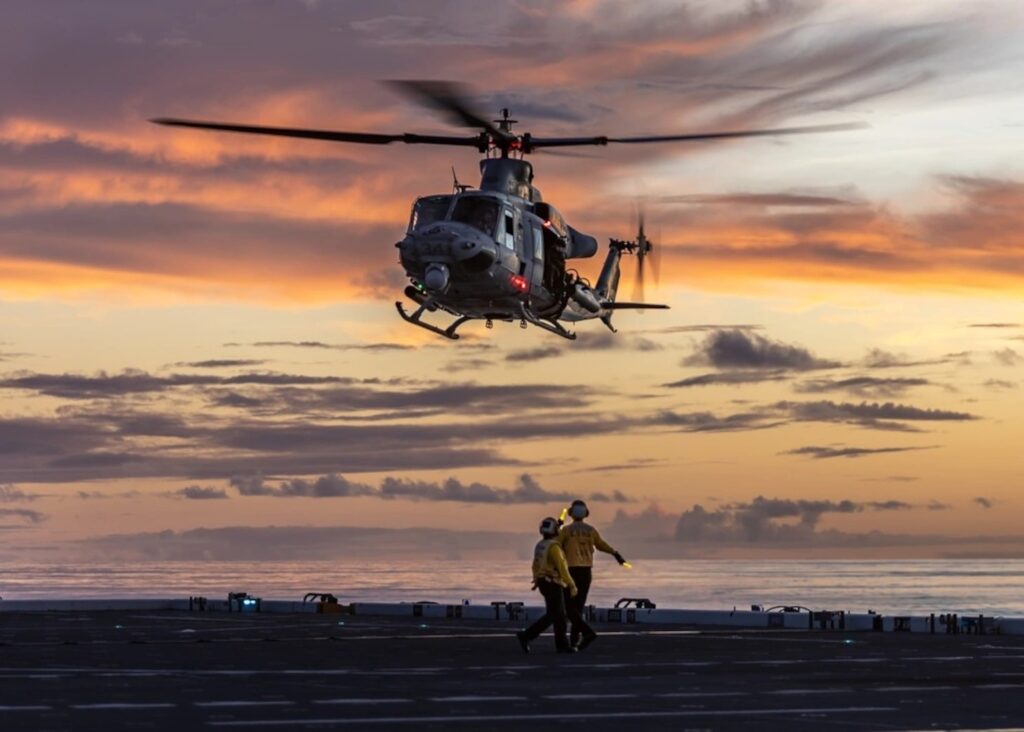
PHILIPPINE SEA (Sept. 28, 2024) A U.S. Marine Corps UH-1Y Venom attached to Marine Medium Tiltrotor Squadron (VMM) 165 (Reinforced), 15th Marine Expeditionary Unit, prepares to land aboard the expeditionary sea base USS Miguel Keith (ESB 5) in the Philippine Sea, Sept. 28, 2024. (U.S. Marine Corps photo by Capt. Staci Morris) 

by Capt. Brian Tuthill, 17 October 2024 

PACIFIC OCEAN — UH-1Y Venom and AH-1Z Viper aircrew assigned to the 15th Marine Expeditionary Unit (MEU) conducted a series of day and night close air support training missions with live ordnance Sept. 25 and Oct. 13, launching from the expeditionary sea base USS Miguel Keith (ESB 5) to a range west of Okinawa, Japan. 
 
The H-1 helicopter detachment, part of Marine Medium Tiltrotor Squadron 165 (Reinforced), 15th MEU, temporarily transferred to Miguel Keith from the amphibious assault ship USS Boxer (LHD 4) on Sept. 21. 
 
This marked the first time a full H-1 detachment has operated from an ESB-class ship during a deployment, allowing the 15th MEU to extend its aviation operations capabilities across the Indo-Pacific. 
 
The live-fire training at Idesuna Jima featured mixed sections of Viper and Venom helicopters launched from Miguel Keith to conduct simulated close air support missions, flying approximately 30 miles to engage simulated targets in both day and night conditions. During each of the training events, the H-1 detachment completed 18 sorties with four aircraft, employing 2.75-inch rockets, 20 mm semi-armor-piercing high-explosive incendiary rounds, and .50 caliber and 7.62 mm crew-served weapons. 
 
This training enhanced pilot proficiency, ensured important skill sustainment and qualifications were met, and also increased overall unit readiness. 
 
“This training was significant for our detachment and the 15th MEU because it resulted in the certification of an aircraft commander and an aerial gunner, as well as the completion of several section leader training events,” U.S. Marine Corps Lt. Col. Michael J. Harper, H-1 detachment officer in charge, VMM-165 (Rein.), said about the September training event. “As part of our long-term aircrew training plan, this means these crewmembers will return to the MEU aboard Boxer more capable and ready to lead and train Marines in our parent squadron after deployment.” 
 
The training in October was similar, and allowing for pilot combat flight leadership progression, trained additional section leads, and qualified Venom aerial gunners in preparation to attend the Weapons Tactics Instructor program next year. 
 
The integration of Miguel Keith as a “spoke” for 15th MEU aviation operations expanded the capability and capacity of the MEU’s Marine Air Ground Task Force. The detachment’s transfer allowed Marine Fighter Attack Squadron 225’s full complement of F-35B Lightning II aircraft to return aboard Boxer, supporting additional operations with partner and allied forces in the U.S. 7th Fleet area of operations. 
 
“The H-1 detachment operating from an ESB during our deployment expands the concept of employment for the hub-spoke-node construct, where this afloat spoke serves as an intermediate base for aircraft to operate within contested areas,” said Harper. “This concept provides the MEU’s aviation combat element with enhanced operational utility and demonstrates the versatility of an H-1 detachment to conduct distributed operations ashore or at sea, offering more options to the Joint Force commander.” 
 
Elements of the same H-1 detachment previously operated aboard Miguel Keith in April 2022 during training exercises with dummy ordnance and crew-served weapons to advance efforts to certify the ship to for aviation explosive ordnance, said Harper. That evolution marked the first time an ESB-class ship hosted H-1 helicopters in the Indo-Pacific, laying the groundwork for the detachment’s current temporary assignment that provided vital experience for the Miguel Keith’s crew. 
 
“Our time aboard Miguel Keith has allowed the H-1 detachment to build proficiency and continue to refine standard operating procedures for ordnance storage and handling on ESBs,” said Harper. 
 
The experiences and lessons learned by Harper’s detachment will benefit future forward-deployed aircraft, including CH-53E Super Stallions or CH-35K King Stallions, MV-22B Ospreys, Navy MH-60s, but especially Vipers and Venoms. 
 
“One of the greatest strengths of H-1 aircraft are their relatively small size and logistical footprint compared to other aviation platforms that provide fire support or lift,” Harper said. “We rely on theater lift or forward arming and refueling points to get us closer to the objective. Operating from an expeditionary sea base capitalizes on our mobility and small footprint, while compensating for our range.” 
 
ESB-class ships like Miguel Keith enable sea-based expeditionary forces, such as the 15th MEU, to maintain forward presence anywhere across the globe, with the capability to transition quickly from competition to combat missions. The ESB design showcases the flexibility and agility of naval forces, particularly in vital chokepoints, and demonstrates the range of capabilities these ships can offer. Each ESB is equipped to support aviation, unmanned systems, troop movement, equipment staging, and command and control functions. 
 
Elements of the 15th MEU are under the command and control of Commander, Task Force 76, which 7th Fleet employs to cooperate with allies and partners to preserve a free and open Indo-Pacific. 
 
As 7th Fleet’s primary Navy advisor on amphibious matters in the 7th Fleet area of operations, CTF 76 is responsible for conducting expeditionary warfare operations to support a full range of theater contingencies, ranging from humanitarian assistance and disaster relief operations to full combat operations.