Sonobuoy Testing on Heavy Lift Helicopters Expands Capabilities
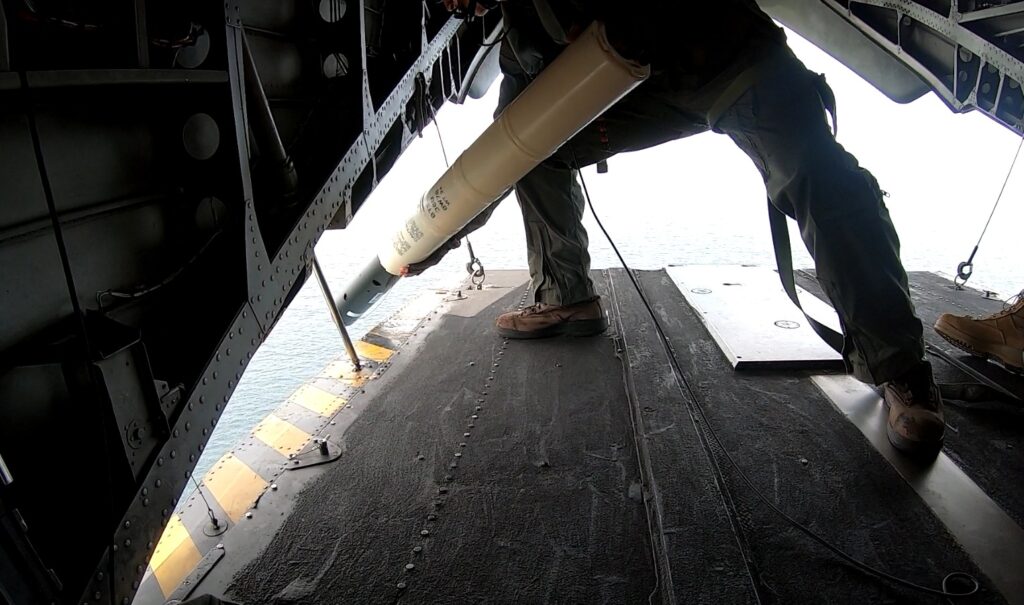
Hand-launched deployments of sonobuoys from a CH-53E Super Stallion showcases the aircraft’s flexibility and various payloads the heavy lift helicopter can take on. (U.S. Navy)
From Naval Air Systems Command, Sep 27, 2024
PATUXENT RIVER, Md. — Recent successful testing of hand-launched deployments of sonobuoys from a CH-53E Super Stallion have expanded the capabilities of the aircraft, providing increased flexibility for the U.S. Navy to support Anti-Submarine Warfare (ASW) in the joint environment. Similar testing will soon do the same for the CH-53K King Stallion.
The successful deployments of sonobuoys from a heavy lift helicopter showcases the aircraft’s flexibility and the changing payloads the aircraft will take on as the CH-53K replaces the CH-53E in the fleet.
“The H-53 is purpose-built to carry heavy loads, but that’s not the limit of our operational relevance,” said Col. Kate Fleeger, Program Manager, Heavy Lift Helicopters Program Office (PMA-261). “This test is just one example of the untapped capabilities of the H-53. Future payloads and the evolution of the H-53 in the battlespace are limited only by our imagination.”
PMA-261, Air Test and Evaluation Squadron Two One (HX-21) and Air Anti-Submarine Warfare Systems Program Office (PMA-264) at Naval Air Station Patuxent River, Maryland, conducted the sonobuoy tests, which were overseen by Adam Chesser, H-53 Lead Test Engineer, and performed over the Atlantic Ocean off the coast of Virginia.
“We evaluated the procedures and separation characteristics to ensure the sonobuoys would not strike the aircraft when launched,” said Chesser. “Clearing the heavy lift aircraft for sonobuoy deployment creates another level of redundancy for the Navy and provides more resources and flexibility to complete the mission.”
The successful tests were also accomplished with a significant savings in time and money, according to Joe Pham, Assistant Program Manager for Test and Evaluation at PMA-261.
“By exploring and using an alternative test range option to alleviate scheduling and funding constraints, we were able to execute the test on time and save cost to the program,” he said.
PMA-261 manages the cradle-to-grave procurement, development, support, fielding, and disposal of the entire family of H-53 heavy lift helicopters.
PMA-264 plays a critical role in developing, acquiring and sustaining airborne ASW systems and sensor requirements for the Fleet, the Maritime Patrol and Reconnaissance Aircraft program office, the H-60 Helicopter program office, the Persistent Maritime and the Unmanned Aerial Systems program office, and the Navy and Marine Corps Multi-Mission Tactical Unmanned Air Systems program office.
Navy Unveils ‘Strike Group’ Recruitment Technology
Lieutenant Commander Tiffany Pearson at the Strike Group mixed-reality system, on display at the Navy Memorial in Washington, D.C. Brett Davis
WASHINGTON — The U.S. Navy displayed one of its latest high-tech recruitment tools, the Strike Group, in Washington, D.C. last week at the Navy Memorial.
The modular, mobile system showcases different aspects of Navy life in an aircraft carrier strike group, giving potential Sailors an idea of careers they could pursue on or under the water.
“What we have here is our interchangeable, cutting-edge, multi-unit mobile experience,” said Lieutenant Commander Tiffany Pearson, who was doing community outreach. “It’s called the Strike Group. Obviously it alludes to our carrier strike group in the Navy, and the goal here was to engage our target demographic, 17 to 24 years old, so Generation Z. Generation Z is huge on gaming, as you can see we have different patches at each different station, so game badges are a way to incentivize people to keep going.”
In Washington, the modules were arrayed around the U.S. Navy Memorial Plaza, just down Pennsylvania Avenue from the Capitol.
The Strike Group includes these modules:
All Hands, where players test their skills on the deck of a virtual aircraft carrier in a first-person reality game
Support, where participants survey an interactive map of the world showing Navy ships conducting humanitarian missions
Fly, where players operate a full-motion flight simulator
Dive, where participants take on the role of a Navy diver as part of an Underwater Construction Team
Achieve, which participants learn about hundreds of potential jobs in the Navy and get an AI-generated image of themselves in their recommended role
Seek, which showcases the “silent service” and allows playes to learn about life on a submarine taking part in an Ice Exercise near the North Pole
Train, where a Navy Seal trainer guides participants through a series of challenges to test their physical strength, mental fortitude and willpower.
At each station, participants would collect a badge showing their achievement.
“The overall motivation behind that is, unfortunately a lot of people do not have interaction with military members today, either active duty or reservist,” Pearson said. “So, our goal is, with this, to bring it around the country to high schools and colleges, universities, so individuals can get a hands-on experience … to see what it’s like to fly a plane maybe, or to be a diver if that interests them, or even see what humanitarian missions we’ve done. … We even have a trailer that shows them who they could be in the Navy.”
The Navy has previously used similar demonstrations, but the systems were both larger and less flexible. One was the Nimitz, which showcased life on an aircraft carrier, and another was the Burke, highlighting the Navy’s destroyers.
For the latest system, “we call it a strike group because it just doesn’t limit it to one platform … here, it’s a strike group, all-hands efforts,” Pearson said.
The weather for the system’s public debut was not the best, rainy and overcast, but Pearson said a number of potential recruits loved interacting with the technology, so “it has been a bit of a challenge, but it’s been great.”
SIOP microgrid study by NAVFAC EXWC to enhance energy resilience, mission assurance at naval shipyards
NAVFAC awarded a $3.7 million contract for an electrical microgrid study as part of the Navy’s Shipyard Infrastructure Optimization Program to assess public shipyards in the event of a power grid or utility outage.
From William Couch, Sept. 27, 2024
WASHINGTON — Naval Facilities Engineering and Expeditionary Warfare Center (NAVFAC EXWC) awarded Jacobs Engineering CH2M Hill/Clark Nexsen Energy Partners Joint Venture a $3.7 million contract for an electrical microgrid study as part of the Navy’s Shipyard Infrastructure Optimization Program (SIOP) Sept. 13.
The study, expected to be completed in October 2025, will assess all four public shipyards and develop proposed courses of action for ensuring up to 14 days of electrical power in the event of a power grid or utility outage. It will include assessing the technical, economic, and environmental feasibility of implementing a microgrid system to enhance energy efficiency, reliability, and resilience within shipyard facilities.
“This study is foundational to providing energy resilience at our naval shipyards,” said Capt. Luke Greene, SIOP program manager. “Off-grid survivability is critical to maintain the shipyards’ operations under adverse conditions and deliver ships and submarines back to the fleet on time.”
The study is part of SIOP’s holistic recapitalization effort that integrates all infrastructure and industrial plant equipment investments at the Navy’s four public shipyards to meet nuclear fleet maintenance requirements, as well as improve Navy maintenance capabilities by expanding shipyard capacity and optimizing shipyard configuration.
Leveraging the structure and rigor of the Department of Defense’s Major Defense Acquisition Program process — a first for an infrastructure program — SIOP established infrastructure performance criteria to evaluate potential solutions to facilities challenges at the shipyards. These criteria include the ability to operate independently of the electrical grid for up to 14 days.
To date, SIOP has completed 30 facilities projects totaling $867 million, with an additional 40 projects worth a total of $6 billion under contract. This includes four dry docks under construction. SIOP work continues to strengthen the naval shipyards’ resiliency in the face of sea level rise and other adverse conditions.
NAVFAC EXWC, the specialized engineering support and contracting activity for the study, provides research, development, testing and evaluation; in-service engineering; and life-cycle management for shore, oceans, and expeditionary domains to accelerate innovation enabling fleet lethality both at sea and ashore.
“This microgrid study will support infrastructure modernization of our naval shipyards by providing a course of action to increase resilience and provide uninterrupted critical power,” said Andy Vasquez, NAVFAC EXWC program manager. “NAVFAC EXWC is proud to provide the required specialized engineering services to support SIOP.”
For more information about the Shipyard Infrastructure Optimization Program, visit https://www.navfac.navy.mil/PEO-Industrial-Infrastructure/PMO-555-SIOP/.
BlackSky Wins U.S. Navy Research Contract for Gen-3 Advanced Optical Intersatellite Links
Project Overmatch initiative advances JADC2 mission and enables real-time imagery support to warfighters during time-sensitive military operations worldwide
From BlackSky, Sept. 26, 2024
HERNDON, Va. (September 26, 2024) — BlackSky Technology Inc. (NYSE: BKSY) won a competitive U.S. Navy research contract to explore applications for advanced optical intersatellite link terminals on board the company’s Gen-3 imaging satellites, giving warfighters real-time access to imagery during time-sensitive military operations worldwide. The effort directly supports the Navy’s Project Overmatch and the Department of Defense’s Joint All Domain Command and Control (JADC2) initiatives.
“BlackSky is making space a viable option for the tactical ISR mission. Extending our Gen-3 satellite capabilities with optical intersatellite link terminals will give Navy customers assured access to real-time earth imaging capabilities across the full range of warfighting scenarios both while underway and ashore,” said Brian E. O’Toole, BlackSky CEO. “End users will receive BlackSky data and insights 10-times faster, with data volumes 5-times greater than current systems.”
Optical intersatellite links are laser-based communications relays that enable faster and more reliable rates of data transmission compared to radio frequency communications. As part of this study, BlackSky will modify its systems to accommodate an optical intersatellite link terminal that will be uniquely compatible with both the Space Development Agency’s (SDA) Transport Layer and commercial transport layers. BlackSky will also establish novel operating concepts that will inform the acquisition of commercial transport network nodes, how data is moved, and how to seamlessly maintain the core Earth-imaging mission.
Element U.S. Space & Defense Unveils New $3M Naval Shock-Testing Barge to Enhance U.S. Navy Readiness
From Element U.S. Space & Defense, Sept. 26, 2024
State-of-the-Art Platform Bolsters National Defense by Ensuring Critical Naval Equipment Withstands the Harshest Conditions
BELCAMP, Md. –Element U.S. Space & Defense, a trusted government partner with over six decades of expertise in space and defense testing, celebrated the launch of its state-of-the-art Extended Floating Shock Platform (EFSP) barge on Wednesday, September 18 at its Rustburg, VA facility. This $3 million investment advances Element’s ability to conduct high-impact shock testing to confirm the durability and reliability of essential equipment used by the U.S. Navy—ultimately protecting sailors at sea.
The new barge simulates real-world naval conditions, subjecting vital shipboard systems to extreme shocks from explosions and rough waters. These tests verify that equipment meets the Navy’s stringent shock-resistance standards, enhancing the operational readiness of ships and the safety of personnel. Manufacturers can now validate their products in an authentic maritime environment to guarantee peak performance under the most demanding conditions. Equipment that successfully passes Element U.S. Space & Defense’s EFSP barge testing earns Navy certification for meeting the highest standards for mission-critical use.
“We’re taking crucial steps to safeguard our sailors by ensuring that shipboard systems perform reliably under the harshest conditions,” said Jeffrey Simmons, General Manager of Element U.S. Space & Defense’s Rustburg facility, during the launch event. “This investment significantly boosts our ability to validate and protect the equipment that the Navy depends on.”
The celebration—which featured a ribbon-cutting ceremony, followed by an exclusive tour showcasing the barge’s advanced capabilities—also included remarks from Calvin Milam, Element U.S. Space & Defense’s Engineering Manager, who highlighted the importance of innovation in military readiness. Matt Cline, a member of the Campbell County Board of Supervisors, also attended the event, recognizing the company’s valuable contributions to national defense and the local economy.
Britton Kreitz, Senior Vice President of Operations at Element U.S. Space & Defense, highlighted the strategic significance of the new barge for both the U.S. Navy and the company’s mission. “This investment is about more than expanding our capabilities—it’s about directly addressing the evolving needs of the Navy and the Department of Defense. By pushing the limits of shock testing, we can confirm that the equipment our sailors rely on is ready for anything. This barge solidifies our role as a key partner in safeguarding national security.”
With the introduction of this cutting-edge platform, the Rustburg facility now sets the industry standard for heavyweight shock testing, confirming that the Navy’s vital parts and systems remain battle-ready. For more information about Element U.S. Space & Defense and its advanced testing capabilities, please visit www.elementdefense.com.
Marine Corps Successfully Demonstrates Link-16 in Third XQ-58A Valkyrie Test Flight
From Headquarters U.S. Marine Corps
EGLIN AIR FORCE BASE, Fla. — The Marine Corps’ XQ-58A Valkyrie successfully completed its third test flight on Sept. 20, 2024, at Eglin Air Force Base in Florida. This flight was conducted in partnership with the Office of the Under Secretary of Defense for Research and Engineering, the Naval Air Warfare Center Aircraft Division, and industry partners.
The test demonstrated newly added Link-16 capabilities for the uncrewed collaborative combat aircraft prototype, marking the first time the Department of Defense controlled an air vehicle using offboard expeditionary methods. Initial results indicate that the prototype met threshold requirements for autonomously exchanging relevant tactical information. These Link-16 capabilities significantly enhance the Marine Air-Ground Task Force’s ability to conduct integrated and joint operations, contributing to the Marine Corps’ mission to deter conflict and, when necessary, defeat enemies in complex and evolving scenarios.
This successful test was conducted in preparation for Emerald Flag 2024, a multiservice and multi-domain training exercise scheduled for October. The exercise will incorporate technology and focus on the efficiency of joint warfare. The XQ-58A has proven itself ready for this capstone event, allowing the Marine Corps to demonstrate cooperative kill chain closure between manned and unmanned strike platforms for the first time in a large-force exercise.
BAE Systems Awarded Modernization Contract for USS Halsey
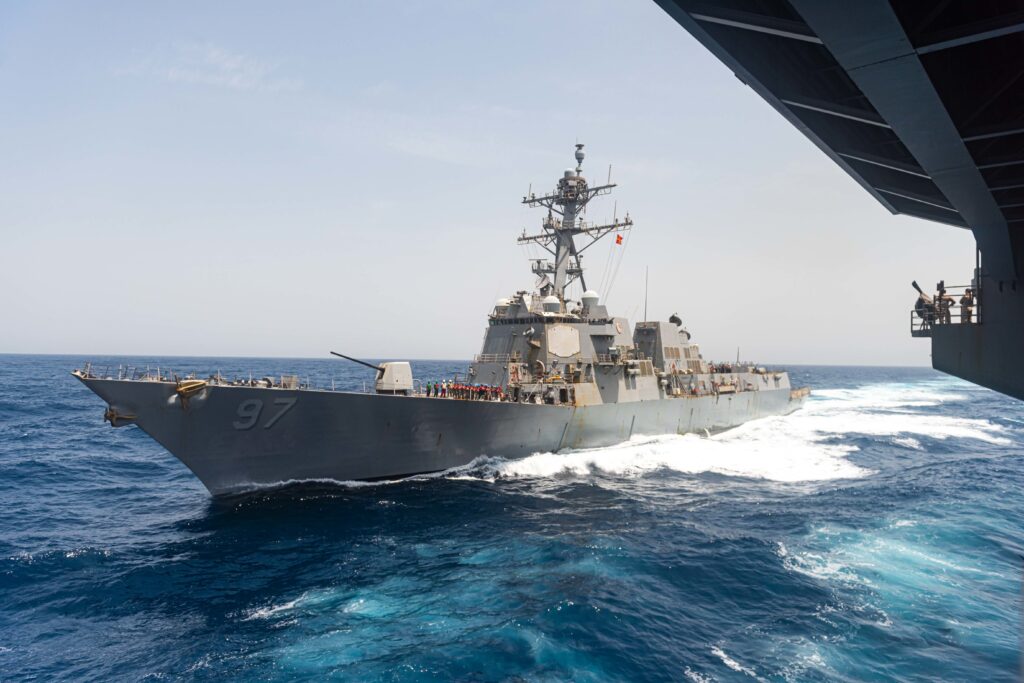
GULF OF ADEN (July 12, 2021) The guided-missile destroyer USS Halsey (DDG 97) operates in formation with aircraft carrier USS Ronald Reagan (CVN 76) during a fueling-at-sea in the Gulf of Aden. (U.S. Navy photo by Machinist’s Mate Fireman Brandon Perera)
SAN DIEGO — Sept. 26, 2024 — BAE Systems has received a $177.8 million contract from the U.S. Navy for the maintenance and modernization of the Arleigh Burke-class guided-missile destroyer USS Halsey (DDG 97). The total value of the previously awarded undefinitized contract award could reach $225.5 million if all options are exercised.
Under the Depot Maintenance Period (DMP) contract, BAE Systems’ San Diego shipyard will dry-dock the 509.5-foot-long ship, perform underwater hull preservation work, enhance the ship’s Aegis combat system with the Surface Electronic Warfare Improvement Program (Block 3), upgrade the command-and-control systems, and refurbish the living spaces for the ship’s 260 crewmembers. The work is expected to begin later this month and will continue into 2026.
“This type of deep-level sustainment work is necessary and critical to maintain the combat effectiveness of the USS Halsey,” said Eric Icke, vice president and general manager of BAE Systems San Diego Ship Repair. “Our San Diego team is ready to conduct the assigned DMP work that will enable the Halsey to move into its next phase of fleet readiness.”
The San Diego shipyard recently completed similar work aboard the USS Mustin (DDG 89). The Halsey will be the shipyard’s fifth DMP project.
USS Halsey is the 47th ship in the Arleigh Burke class of guided missile destroyers and was commissioned in July 2005. It is the second Navy ship named in honor of Fleet Admiral William F. “Bull” Halsey, who gained fame in the Pacific theatre during World War II.
Northrop Grumman Awarded JCREW/DRAKE Full Rate Production Follow-on Contract
Master-at-Arms 1st Class Everest Austerman operates a Drone Restricted Access Using Known Electromagnetic Warfare (DRAKE) anti-drone system during a simulated straits transit aboard the Arleigh Burke-class guided-missile destroyer USS Porter (DDG 78). (Photo Credit: U.S. Navy)
Intelligent electronic countermeasure systems designed to increase protection from ship-to-shore
SAN DIEGO – Sept. 26, 2024 – Northrop Grumman Corporation (NYSE: NOC) was awarded a follow-on production contract as part of a larger contract, which is now valued at over $161 million, by the U.S. Navy for the next generation JCREW/DRAKE 2.0 systems.
The award includes production and delivery of the JCREW/DRAKE 2.0 dismounted and mounted systems.
As the recommended counter-improvised explosive device (IED) and counter-unmanned aircraft system (UAS) solution, JCREW/DRAKE 2.0 will feature increased signal processing and frequency range, instantaneous bandwidth and a more capable user interface.
Expert:
Gordie Russell, vice president, communications solutions, Northrop Grumman: “JCREW/DRAKE continues to prove itself as a critical component in protecting our warfighters while maintaining the strategic advantage needed to succeed across the modern battlefield. These systems are designed with an open and integrated architecture to support rapid upgrades and mission agility from ship-to-shore – capabilities that are critical for quick decision making.”
Additional Details:
JCREW/DRAKE 2.0 provides 360 degrees of protection to the warfighter afloat, ashore and on-the-move by using intelligent jamming to selectively defeat threats without interruption to friendly communications.
The system can operate independently or can integrate with other Command and Control (C2) systems such as Northrop Grumman’s FAAD C2 system, delivering a layered defense and technological advantage for the warfighter.
JCREW, the system’s counter-IED capability, is a TRL 9 system with Full Rate Production and is a Program of Record with Naval Sea Systems Command. It achieved Full Operational Capability ahead of schedule in July 2023 and is currently employed by the U.S. Navy, U.S. Air Force, Australia and New Zealand.
DRAKE, the system’s counter-UAS capability, was added to the Army’s Joint Counter-small Unmanned Aircraft Systems (C-sUAS) Office list of recommended C-sUAS Detection and Defeat Systems in May 2023 and recently became its own Navy Program of Record under Program Executive Office Unmanned and Small Combatants, Expeditionary Missions Program Office in April 2024.
USS Preble Departs San Diego for Japan
USS Preble (DDG 88) departs San Diego Harbor as part of a homeport change in the Pacific, (MCC Mark D. Faram)
USS Preble Departs San Diego for Japan
26 September 2024
From Commander, Naval Surface Force, U.S. Pacific Fleet
SAN DIEGO — The Arleigh Burke-class guided-missile destroyer USS Preble (DDG 88) departed San Diego Sept. 22, 2024, shifting its homeport to Yokosuka, Japan. The move is part of a scheduled rotation of forward-deployed naval forces in the Pacific a permanent change of station move for for the crew and family members.
USS Preble (DDG 88) departs San Diego Harbor as part of a homeport change in the Pacific, (MCC Mark D. Faram)
Preble replaces USS Benfold (DDG 65), which will depart Yokosuka and shift its homeport to Everett, Washington.
The forward presence of Preble directly supports the United States’ commitment to the defense of Japan, enhancing the national security of the United States while improving its ability to protect strategic interests. Preble will directly support the Defense Strategic Guidance to posture the most capable units forward in the Indo-Pacific Region.
The United States values Japan’s contributions to the peace, security and stability of the Indo-Pacific and its long-term commitment and hospitality in hosting U.S. forces forward deployed there. These forces, along with their counterparts in the Japan Self-Defense Forces, make up the core capabilities the alliance needs to meet our common strategic objectives.
“It has been more than four years since Preble last operated in 7th Fleet,” said Cmdr. Paul Archer, Preble’s commanding officer. “But Preble today is markedly different than the ship that last left 7th Fleet. Armed with the U.S. Navy’s most capable combat system suite, this crew is well-trained and hungry to take our cutting-edge warship west to support national strategic objectives. The Western Pacific is gaining a true asset—unparalleled technical capabilities and more than 300 Sailors excited for this new opportunity.”
Preble is the sixth ship to be named in honor of Commodore Edward Preble, an early 19th century U.S. Navy hero who served in the Revolutionary War and launched the attack on Tripoli in 1803.
The ship was commissioned Nov. 9, 2002, in Boston and has been homeported at Naval Base San Diego for nearly 22 years.
One of Preble’s most notable operations was its 2004 surge deployment in support of the global war on terrorism. It was one of several U.S. Navy, Coast Guard, and coalition ships responsible for patrolling and safeguarding the waters near the Khawr AL Amaya and Al Basrah oil terminals in the Persian Gulf.
The security environment in the Indo-Pacific requires that the U.S. Navy positions the most capable ships forward. This posture allows the most rapid response times for maritime and joint forces and brings our most capable ships with the greatest amount of striking power and operational capability to bear in the timeliest manner.
The mission of Commander, Naval Surface Force, Pacific is to man, train, and equip the Surface Force to provide fleet commanders with credible naval power to control the sea and project power ashore.
Navy Awards Amphibious Multi-Ship Procurement Contracts
The U.S. Navy awarded contracts totaling $9,472,132,620 for procurement of one America-class amphibious assault ship (LHA) and three San Antonio-class amphibious transport dock (LPD) ships, Sept. 24. The award, executed across two separate contracts to Huntington Ingalls Industries, Ingalls Shipbuilding Division, utilized a multi-ship
From Team Ships Public Affairs, 24 September 2024
WASHINGTON – The U.S. Navy awarded contracts totaling $9,472,132,620 for procurement of one America-class amphibious assault ship (LHA) and three San Antonio-class amphibious transport dock (LPD) ships, Sept. 24. The award, executed across two separate contracts to Huntington Ingalls Industries, Ingalls Shipbuilding Division, utilized a multi-ship procurement approach. By using this strategy, as authorized by Congress, the Navy is projected to achieve more than $901 million in cost avoidance as compared to the use of annual contracts.
The long-term contract agreements align with Secretary of the Navy Del Toro’s maritime statecraft initiatives to make naval shipbuilding more cost effective while promoting shipyard stability and investment. The agreements provide stable shipyard workload well into the early 2030s, providing a consistent demand signal to vendors.
“The importance of this multiple amphibious ship purchase cannot be overstated with respect to our whole-of-government effort to restore the maritime capabilities of the United States,” said Del Toro. “This purchase sends a steady demand signal to our shipbuilding industrial base that our Navy is actively investing in our shipbuilding infrastructure.”
The awards are consistent with the Commandant of the Marine Corps’ projected force structure requirements and demonstrates the Navy’s commitment to maintaining 31 amphibious ships.
“The Amphibious Ready Group / Marine Expeditionary Unit (ARG/MEU) is the premier force offering of our Corps,” said Lt. Gen. Eric Austin, Deputy Commandant for Combat Development and Integration. “This multi-ship procurement contract ensures the Marine Corps upholds the obligation to meet combatant commander requirements for continuous MEU presence. ARG/MEUs provide our national leadership with combat credible forces that are persistently forward, assure allies and partners, and contribute to deterrence, campaigning, crisis response, and combat operations.”
The America-class of amphibious assault ships operate as the centerpiece of ARG/MEU operations and Marine Expeditionary Brigade with accommodations for ship’s company, troops, vehicles, and equipment. The San Antonio-class of amphibious transport dock ships are designed to embark, transport, and deploy ground troops and equipment.
“This multi-ship procurement provides the long-term stability our shipbuilders and vendors require, enabling them to deliver product effectively, help support and retain a talented and critical workforce, and invest in the infrastructure required to sustain and grow our shipbuilding capability and capacity,” said Assistant Secretary of the Navy Acquisition, Research and Development, Nickolas Guertin.
“This multi-ship procurement will deliver critical amphibious warfare capability to support the Navy and Marine Corps mission,” said Capt. Matthew Tardy, program manager, Amphibious Warfare Program, Program Executive Office (PEO) Ships. “The partnership between the Navy and Ingalls Shipbuilding is important. We are proud to be working with their talented workforce to build and deliver highly capable ships and provide needed stability for the shipbuilding industrial base.”
Program Executive Office Ships (PEO Ships), one of the Defense Department’s largest acquisition organizations, manages the design and construction of destroyers, amphibious ships, special mission and support ships, as well as a wide range of boats and craft for U.S. agencies and foreign military sales. These platforms enable our nation and its allies to project presence in peace, power in wartime, and assured access at all times.
The Navy provide the following opening statements in a press roundtable announcing the contract on Sept. 25:
Tom Rivers, Executive Director, Amphibious Auxiliary and Sealift for Program Executive Office Ships
“I want to thank everybody for joining us today for this media roundtable. Earlier this evening, using the authorities provided within the National Defense Authorizations Acts for fiscal years, 2023, and 2024, Huntington Ingalls Incorporated, better known as Ingalls shipbuilding division of Pascagoula, Mississippi, was awarded a combined $9.47 billion fixed price incentive fee agreement to procure three San Antonio class amphibious transport docks, LPDs, 33, 34 and 35 and one America class amphibious assault ship, LHA 10. The agreement involves two separately numbered contracts that will be awarded simultaneously. You probably saw the announcement come out at five o’clock the first ship, LPD 33 is scheduled to deliver in 2031 the LHA and LPD platforms perform a variety of expeditionary warfare missions and are designed to operate independently or as a part of an amphibious Task Force or an amphibious ready group or an expeditionary strike group or Joint Task Force. This amphibious ship, multi ship multi ship procurement demonstrates the Navy’s commitment to maintaining 31 amphibious warships and the prudent use of taxpayer funds. The use of this multi ship procurement will result in significant savings to the American taxpayer compared to the total anticipated cost of carrying out the program through annual contracts. The estimated program savings is $901 million across fiscal years, 2024 through fiscal year, 2029 by using this approach, in keeping with the Secretary of Navy’s maritime statecraft initiative, this multi billion dollar contract award reflects the innovation to build and sustain our maritime dominance and allows for critical investment and sustainment of our shipbuilding industrial base, helping to ensure stability and jobs for the next decade. Lastly, the use of this multi ship Procurement Agreement for four ships is consistent with the Commandant of the Marine Corps’ projected forest structure requirements for amphibious ships.”
Lt. Gen. Eric Austin, Deputy Commandant for Combat Development and Integration
“Thanks, Mr. Rivers, and thanks to all the folks that are able to dial in for this conversation this evening. And I also, just as a Marine and the requirements officer for the Marine Corps and the combat developer, I just want to thank PEO ships, OPNAV, industry partners and our Congress for getting this over the finish line in terms of the contract award, this is a big deal for our Navy and Marine Corps, our naval expeditionary force. This multi ship procurement award is really fantastic news. The amphibious ready group, Marine Expeditionary we call it the ARG MEU, is the premier force offering for our corps and for our naval expeditionary force, three San Antonio class, LPDs and the America class LHA will provide sea bases for embark forces to provide the nation with the most modern and lethal amphibious warfare capability in history, the multi ship procurement contract enables the Marine Corps obligation to meet the combatant Commander requirements for continuous MEU presence. Our ARG MEUs provide our national leadership with combat credible forces that are persistently forward, that assure allies and partners, contribute to deterrence that campaign and respond to crisis and support combat operations when required, simply put expeditionary Marine Forces embarked on amphibious warfare ships, facilitate forward presence, make our naval forces stronger, our joint forces more capable and our allies more confident.”
Below is a statement from Paul Roden, chairman of the Amphibious Warfare Industrial Base Coalition, on occasion of the contract award:
“Today marks a historic moment for the 650 suppliers across 39 states that comprise the amphibious warship industrial base, as the Navy officially announced the award of a block buy for one LHA and three LPD amphibious warships. This four-ship bundle provides the stability and predictability that our suppliers need to invest in their facilities and, importantly, in their workforce. Even more, the block buy is projected to save U.S. taxpayers nearly $1 billion. We’ve long advocated for this type of needed investment in our amphibious fleet, and we are deeply grateful to everyone who contributed to making it a reality. From our supporters in Congress, to leaders in the Navy and Marine Corps, and suppliers nationwide that helped emphasize the value of this investment — Thank You.”